bearing blog


bear – ing n 1  the manner in which one comports oneself;  2  the act, power, or time of bringing forth offspring or fruit; 3 a machine part in which another part turns [a journal ~];  pl comprehension of one’s position, environment, or situation;   5  the act of moving while supporting the weight of something [the ~ of the cross].


  • Unmuddling repentance.

    Most of us are aware of the radical teachings of Jesus regarding response to harm and injury caused by another.

    "Turn the other cheek also… give your cloak as well."  (Mt 5:39-40)

    "Forgive us our debts — as we also have forgiven our debtors…for if you forgive others their trespasses, your heavenly Father will also forgive you."  (Mt 6:12-14)

    "[Forgive], not seven times, but I tell you, seventy times seven times."   (Mt 18:22)

    Are these instructions clear?  Is their meaning obvious?

    I think perhaps they are not, at least not to us in our culture.  Because we, in our culture, are not very clear about what we mean by the word "forgive."  And because we are not very clear about what we mean by "forgive," these instructions lay a heavy weight on people who have been harmed, are aware that there is something that Jesus calls us to do, something by the name of "forgive."  The person who wants to follow Jesus' injunction to forgive may have many questions that leave them uneasy.  When you don't know what forgiveness means, exactly, how do you know when you have forgiven? 


    •  The thing about seventy times seven seems to imply a sort of limitless forgiveness—but is it limitless in the sense of a mass formless quantity of which you can never have too much?  Or is it limitless in the sense of an unlimited number of discrete, completed forgivenesses?


    • Is forgiveness something that mostly happens inside the person harmed?  Or is forgiveness something that is not real until it has been experienced by the perpetrator?


    • Who is the forgiveness for?  Is it for the perpetrator's good, to bring them peace and encourage them to change for the better?  Or is it for the perpetrator's just punishment, to "heap burning coals on their head" (Prov 25:22) by offering them an undeserved kindness?  Or is it primarily for the harmed person, to help them move forward and away?


    • When must forgiveness be offered?  Does it matter if the perpetrator has admitted the wrong and tried to repair it?  Does it matter if the wrong is actually irreparable?  Does it matter if the perpetrator is unable to understand that he has injured someone, or unable to take any steps toward repentance, sorrow, or change? 


    • What if the perpetrator doesn't accept our extended forgiveness as good enough?  What if he accuses us of holding a grudge and refusing to forgive, because we do not indulge him in his own idea of forgiveness?  Is he correct?  Have we failed to forgive?


    • We all understand, I hope, that forgiveness is rarely instantaneous:  is there a time limit?  If we can't manage to attain it in our lifetimes, will our own trespasses remain unforgiven?


    There is a desperate need for clearer thinking, if we are ever going to answer these questions.  That goes for theoretical, general questions, and for the specific wounds in our own lives.

    + + +

    I recently read a book that seeks to clarify the thinking around these issues:  On Repentance and Repair:  Making Amends in an Unapologetic World (Beacon Press, 2022) by Rabbi Danya Ruttenberg.   Rabbi Ruttenberg calls on a framework of repentance that originates in the law regarding Yom Kippur, and that was further codified by Torah scholar Maimonides (1138-1204).  With this she lays out for us what the Jewish tradition, at least, asks of human beings as they move forward after one has injured the other.

    Along the way, Rabbi Ruttenberg points out how the vagueness of our understanding of "forgiveness" has allowed people to weaponize it  against victims, demanding their silence and their peace in the face of injustice, minimizing the harm, even demanding that they put themselves back within reach of real harm.  This tactic works particularly insidiously against many sincere Christians, who know they are supposed to forgive but don't understand how to make that forgiveness co-exist with, to put it bluntly, boundaries.  She carefully separates and untangles forgiveness from the things that it is not, things that should be considered separately.  Grounded in the Jewish tradition, she offers a way of understanding a process of forgiveness.  She does not go so far as to affirm a positive responsibility to forgive in all cases—but I think her approach is wholly compatible with a Christian understanding of Jesus's radical call to mercy, and her careful treatment of the subject and distinguishing of different parts of the process can only help inform us as we try to live up to it.  

    +  + +

    I will begin with the confession that I'm writing this a little too hastily for it to count as a complete book review.  I bought the book because I needed some specific advice about repentance and forgiveness in networks of interpersonal relationships, and I pored deeply over the chapters that directly addressed these while skimming over the chapters on institutions, nations, and justice systems.  (I'm very interested in those topics too, so I'm going to dig into those soon!)  The point here is, this book helped me immensely in clarifying my thinking, and I now feel equipped to figure out a way forward where before I was wallowing in confusion.

    Let me see if I can explain where the clarity comes from.  It mostly has to do with untangling concepts that have become, at least in my mind, enmeshed with each other. 

    (By the way, speaking of clarity, I'm going to use the term "perpetrator" to mean someone who has done a specific harm to a specific person, and "victim" to denote that person, just to make the identities of whom I'm talking about very clear.  The choice of those terms is not a statement of the permanent status or identity of either.)

    First off, Rabbi Ruttenberg separates the concepts of "the perpetrator's repentance" and "the victim's forgiveness."  The work that the perpetrator must do is not dependent on the victim's ability or willingness to extend forgiveness.  The victim's decision to forgive or not forgive may take place whether the perpetrator ever repents or not.  The two processes can inform one another but they are not the same process and they do not require the perpetrator and the victim to have contact or an exchange of any sort of information or messages with one another.

    That divides our discussion into two bundles of concepts:  one about the perpetrator's work, and one about the victim's process.   In a subsequent post, I'll write about how Rabbi Ruttenberg has clarified my thinking about the victim's part.  For the remainder of this post, I'll take up the perpetrator's bundle.

    + + +

    Ruttenberg explains that Maimonides set forth a five-step task list for the perpetrator who desires to become a penitent.  The five steps help us to separate and distinguish parts of the work.  They may remind you, as they did me, of the steps taught to Catholic children leading up to the sacrament of confession.  

    Step one:  Naming and owning harm; comprehending it, facing it, confessing it in an appropriate venue, whether private or public.

    Step two: Starting to change.  Says Ruttenberg, 

    Translated to our own time, the work of transformation might include tearful grappling with one's behavior in prayer, meditation, and/or some other practice; making financial sacrifices that have meaningful impact both on one's own wallet and the world; changing one's self-conception and self-identity in appropriate ways; putting oneself in new situations both to consciously avoid the opportunity to cause harm and perhaps to experience what it's like to not have control or power—someplace where one might get some practice in the virtue of humility.  

    These days the process of change might also involve therapy, or rehab, or educating oneself…a concrete action plan….grappling with the root causes of the harm.  Some of these things may be necessary even before the confession stage, some may be appropriate at this point in the process, and in many cases the answer might be both.

    Step three:  Restitution and accepting consequences.  "Repair work isn't really repair," says Ruttenberg, "if the only thing that's changed is the perpetrator."

    Step four:  Apology.  Notice how late in the process this step is!  "I think he was trying to tell us," says Ruttenberg about Maimonides, "that apologies, and even amends and reparations, don't truly have the needed effect if the work to become different isn't already underway."  Maimonides says, she  tells us, that the perpetrator has an obligation to "'pacify [the person harmed] and to beg their forgiveness.  Even if they only offended their fellow verbally, they must appease and implore until [the harmed party] forgives them.'"  And she notes that "the focus is the mental and emotional state of the victim, not the boxes that a perpetrator needs to check in order to be let off the hook."

    Step five:  Making different choices. 

    The critical fifth and last stage of this process is that the perpetrator must, when faced with the opportunity to cause similar harm in the future, make a better choice.  This can happen only if they've done the deep work of understanding why the harm happened, stayed out of situations that would make the harm easy to perpetrate again, and reoriented themselves and their life….[T]he choice will happen naturally because the person making it is a changed person in the ways that matter.

    + + +

    So what we see here is that the following threads, actions, can all be successively separated from one another and deemed individually necessary parts of repentance:

    • owning up to the harm one has caused
    • forming a firm purpose of amendment
    • repaying the debt, literally (restitution) or figuratively (accepting punishment)
    • making a sincere apology to the victim and possibly also to other affected parties or the public
    • transformation of the self into a person who does not do that harm anymore

    Besides these, there is another.  Rabbi Ruttenberg reserved for the very last chapter in the book a sixth distinct concept, atonement, which she says is more about the perpetrator's relationship with God.  But, she says, it's "the last step, after everything else is complete":

    [A]tonement works only if you've done the necessary work of owning harm and undergoing transformation—repentance.  And if that harm has an interpersonal dimension, atonement is entirely impossible without repair, amends, and in most cases, apology.

    Catholic readers may note that for us penitents, absolution at least (our personal wiping-clean of the slate, since the atonement in our tradition has been accomplished by Another) is available on the making of a good confession, and doesn't necessarily depend on us already having completed the transformation, repaid anyone, or apologized.  However, it's not unreasonable to argue that in order to make a good confession, one must be wholly ready to do these things insofar as we can.  If we are not ready to apologize, make restitution, or reform ourselves, do we really have the firm purpose of amendment that the "good confession" requires?  And indeed the priest is empowered to withhold absolution, or to call upon us to make restitution as part of our penance.   Part of examining our conscience is to discern whether we indeed have the will to do better. 

    Should we stay away until we are sure we can do all those things?  I think it's better to approach the sacrament even with imperfect contrition, and the fear of having to do all that necessary work.  The sacrament is there to give us grace and to strengthen us to do better, and we can come back again and again as needed.  I think that for Catholics, bringing the harm to confession happens first somewhere in the first two steps, and can be repeated as we gather strength to move through steps three, four, and five.

    More on the other side of the coin—forgiveness and its allied concepts—in the next post.


  • Thanksgiving.

    It's true that we have been married for almost twenty-six years, and we have been parents for twenty-four years, with children at several ages down to ten.

    It's true that we both know how to cook a big dinner and we both know how to organize and plan.  

    It's true that we've emerged from the howling chaos of the past few years, just like everyone else.  And at the same time not at all like anyone else:  that same grinder that left everyone wounded both generally and privately, so that we can all nod knowingly at each other, gesture vaguely at all this sort of thing; and at the same time maintain a sort of beaten privacy about the specifics.  Yes, we came out of it.  Yes, we learned.

    It's true that our grown children (the ones who can) are choosing us,  to be home with us this holiday.  And Mark's parents are joining us too, driving up.   We are loved.  The family wants to be together.

     + + +

    Still….

    there is nothing like hosting Thanksgiving to drive home the point that we are completely winging this big-family thing.

    + + +

    My early memories of Thanksgiving as a child are charmingly static:  or maybe they all layer over each other, year after year, so that I can't distinguish one from the next.  "Over the River and Through the Woods," learned in elementary school music class, we sang in the car on the way to my own grandmother's house.  We sat in my her small living room, some at the dining table, some on the couch or in the easy chair or in the rocking chair with TV trays; there was a turkey carved with an electric knife, and mashed potatoes and dressing, and sweet potatoes and green beans.  There were always exactly four cousins, since I am number three and barely remember the fourth, my brother, being born.  My uncle proclaimed the pie better even than last year.  My mother and aunt chided Grandma for not eating and she insisted that she got filled up on the smell.  Everyone talked loudly all at the same time, and football was on the television in the same room, there was laughter and good smells; and it was the same each year, something fixed, something that just happened, like the moon and stars wheeling in the sky.

    + + +

    And then you grow up and the secret is revealed.

    Every year now, I am suddenly gobsmacked, right after the falling of the leaves and around the time of the falling of the snow:  Holiday traditions don't just happen!   Sooner or later you have to make them yourselves!

    Like…. you just have to invent them!

    And in theory, you could do anything.   Hang the moon and stars however you want.

    + + +

    Look back, look forward, at the same time.   Logically, my grandmother's Thanksgivings could not have been static.  Logically, and if I think really hard about it I can come up with details—logically each year must have been at least a little different.  Logically there was a time before the loud, full-packed living room.   Logically, my grandmother made choices.  And my grandfather, too, in the time when he was living, before I got old enough to form many memories.

    Long ago, they invented Thanksgiving for me, and they made something imperfect but good enough.   

    I guess it's not that I have to squint terribly hard, or turn it over and over, to find the seams and brushmarks and sticky places.  They are there if you look, and pretty obvious.

    It's more that I don't feel that I need to.

    + + +

    So.  Mark and I may be winging it, with our Thanksgiving pot roast and our cluttered living room, but do the kids realize that?  Will they forgive us for improvising?  Will they found their own families and discover the secret on their own?

    Maybe they do, maybe they don't.  Maybe they will, maybe the won't.  But you know, I am starting to think it's going to be okay either way.


  • A few notes from Facebook, for Melanie.

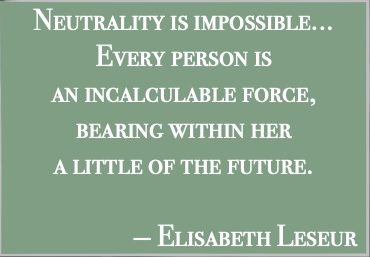
    I've been reading Elisabeth Leseur's Journale et Pensées de Chaque Jour (Journal and Daily Thoughts) this summer, and occasionally posting some passages to FB.  Melanie was interested in the conversation but has had some trouble following along what with the intermittent uselessness of the native notifications.  I'm reproducing some of it here for her benefit.  And maybe yours?

    Begin…

    I have made a substantial dent in Journal et pensées de chaque jour by Elisabeth Leseur including the lengthy biographical memoir by her husband that serves as the preface.   Some notes follow…

    Note 1.  I hadn’t noticed before, but E.L. didn’t write in her journal very often. (These are not excerpts, as far as I can tell.) She wrote in bursts and isolated days: five entries in September 1899, one the next February, two back-to-back days in March, once in May…
    Often the entries give brief accounts of the time since the last one, lists of resolutions for the future, and private expressions of thoughts that she feels she can’t share with anyone in real life. She sometimes comments on rereadings of past entries. It’s a journal of spiritual progress, I get the sense that she uses it to help her remember her resolutions and be accountable, but it isn’t a daily journal. And while she discusses how she’s fulfilled or not fulfilled her resolutions generally, she very rarely describes particular failings or successes in any detail. Very different compared to, say, St. Thérèse with her many personal anecdotes. She mentions day-to-day joys (presents from Félix, vacations, etc.) and worries (sick loved ones especially).
     
    It’s nice to know that a significant and fruitful journaling practice can be irregular, as-needed, seasonal, and even discreet. You don’t have to put your whole examen in it every day.
     
    Note 2. On my first (English) reading of the journal and of biographical material about E. L., what I found most prominent about her difficulties was that she lived and moved among people who didn’t share her faith and whom she couldn’t really talk to about it from the heart; and that she resolved not to argue with people and to always respect consciences, preferring to be an example of charity, honesty, and simplicity as well as intense in private prayer. This is a suffering of isolation and loneliness (despite living in a lively intellectual circle of friends and relations).
     
    On this second reading, I am more struck by her descriptions of the suffering caused by her physical illnesses, both because of chronic pain and exhaustion and because she has to set aside active kinds of service and take care of herself instead of other people. She doesn’t specifically mention their childlessness (that I have seen yet) but I think I can read that between the lines. She’s determined to make this suffering fruitful. She also resolves often not to complain about her illness.
     
    I find it interesting because she resolves to be honest and simple, and to care for her body as required (to rest instead of work for instance), but also to keep some deep layer of her suffering private and interior, because it seems to her to be more fruitful that way. (She later acquires a spiritual director to whom it seems she reveals some of this.) It’s an interesting line to walk: sometimes it is a sacrifice to be honest, and sometimes it is a sacrifice to be reserved.
     
    Also this may depend very much on the kinds of people who are around her and her specific desires for those relationships. I don’t think she’s offering us a universal rule. It’s her *personal* path which she’s arrived at through long contemplation.
     
    Note 3. There’s a rule of life that she laid out in autumn of 1906 that is absolutely fascinating. Part of her personal apostolate is to learn as much as possible about all kinds of intellectual subjects so she can understand everyone she meets as clearly as possible. And she is absolutely convinced that her specific duty is never to speak directly about Christ or her faith, unless asked, but simply to be a very attractive and self-giving personality that displays Christlikeness, and also secretly offer many prayers and sacrifices for the people she encounters and loves.
     
    I’m trying to imagine the social milieu in which a person would decide after much thought and prayer that it is an actively superior and more fruitful type of evangelization to literally never speak the name of Christ.
     
    One possibility would be if experience has taught you that you yourself often commit unrecoverable errors such that you drive people farther from Christ, or that you are sorely tempted to pride and contempt or to self-aggrandizement whenever you speak openly about Him. There are some suggestions that E. L. was concerned about personally falling into errors of pride.
     
    Another possibility—E. L. specifically identifies this—is if you are surrounded by people with very strong hostility and prejudices against Christianity, who would be repelled or tempted to double down against it; she has decided that she can let Christ work on them through her without revealing it to them.
     
    A corollary to this that I identify by extension is when we are surrounded by people who have been harmed, hurt, and traumatized in the name of Christ, so that the name itself wounds.
     
    The existence of an enormous confusing backdrop of many disunited voices talking over each other and arguing about who Christ is and what He would have us do, coupled with an awareness that one is not particularly equipped to stand out from the background, is another.
     
    I guess another thing to think about: Quite often it is fruitful, we assume, to proclaim, instead of being silent about, what God has done for us. But E. L. is here renewing resolutions “after lapses, of silence about myself, about my soul, about my sufferings, about graces received.” Usually spontaneous testimony and confession (public) is thought of as positive.
     
    I don’t doubt that there are fruits to it. Encouraging one another, etc. And of course the publication of the diary happened. But E. L.’s firm conviction that she was called to near-total silence rather than testimony calls attention to a need for discernment. Testimony is not an unalloyed good, is not appropriate in all circumstances and for all people.
     
    It’s an error to believe that our outward expressions will hit home before the hour chosen by God. Let us speak only in the measure that seems to accord with the intention of Providence, when our words answer the souls’ call.
     
    Note 4.  She writes the same, or nearly the same, resolutions over and over again.
     
    Deirdre commented:
     
    I find the idea that we’re called to draw other people back to Christ just by… being someone people want to be like very challenging, as I’ve often been told point blank that my family does the opposite by being too weird and disorganized and unattractive. My current tact is “if we’re not too much of a hot mess to be part of the church, you’re not too much of a hot mess either?”
    Because yea, we are pure mess, and it’s not for want of trying to be less messy.
     
    But her method seems especially well suited to aggressively secular France.
     
    Oh, I said to Deirdre, if you read the diary it’s very clear that her resolution to be verbally silent about her faith (except when called upon, and then to express herself firmly but very simply) is a response to her very personal and specific situation. She is even holding her tongue in the face of people mocking the faith, as a personal mortification.    ("Wow.  That's… Iron will," said Deirdre.)
     
    Also, I said:  It’s more than “being someone people want to be like.” Over and over she uses a metaphor of cracking open a door just a little so that the light shines out.
     
    Melanie chimed in, 
     
    [M]y thought is that the people who find your family too unattractive or whatever… they’re not the people you’re called to be witnessing to. Or maybe what you’re witnessing to those sorts of people is… something else. But anyone who says crap like that to you is cruel and unkind and honestly needs to do some serious soul searching about what kind of witness they are called to be. Because comments like that are not witness to Christian love. They’re meant to wound.
     
    Here are some more quotes from Elisabeth:
     
    I am renewing my resolution of silence, seeing more than ever how necessary is an extreme reserve with all people, especially concerning matters of God. My soul, my spiritual life, the graces received, I must veil from everyone; and also, I must speak as little as possible about my ordeals and my health.
     
    The edification of our neighbor which used to sometimes spur me on (aside from less-pure motives) to effusiveness can only be a result, but not… our goal. The only end that I want to pursue is the will of God, and my ‘abandon’ must become complete, humble, and filled with love.
     
    Nifty wordplay here perhaps. ‘Abandon’ can mean ‘abandon’ as in abandoning a post or a responsibility, it can mean ‘withdrawal’ as in dropping out of a contest, it can mean ‘freedom’ as in ‘a sense of total abandon’ and it can mean ‘surrender’ as in ‘abandoning oneself to the will of another’ — all these senses work here at once.
     
    But really the part I was pointing out is the difference between “only a result” and “our goal, our end.”   The same entry continues:
     
    The absolute incomprehension or ignorance of many concerning the supernatural life is a serious reason to practice this silence which the ascetic authors have so often recommended.
     
    Therefore, interiorly I want to practice a more complete contemplation, a more intimate union with Our Lord; exteriorly, I want to step up still more, give more lavishly of myself, become more amiable and cheerful. And when my task of humble charity and daily efforts is complete, God will know how to use it for souls and for his glory.
     
    Mine is the labor, unrecognized by others; His is the bringing about of the good that I desire, of the spiritual ‘oeuvre’ toward which my poor labors aim. The laborer brings his works, the Master uses it as he pleases; let it be enough for me to know that never shall this labor remain unproductive.
     
    To work, then, and joyfully. And if I still must suffer for my faith, I shall offer those troubles with serenity for my usual intentions and in a spirit of reparation.
    At the start of Lent 1912:
     
    More than ever I want to hide my works, prayers, mortifications in the Heart of Jesus; no longer preach except by example; not speak of myself and speak little of God, since in this sad world to speak of one’s love for him scandalizes and irritates people.
    But whenever a soul comes to me, whenever it seems to conform to the divine will that I go to a soul, I will do it, very humbly, very discreetly, effacing myself and disappearing when the job is done, not confusing the “me” with the act done for God alone.
    And then if I am unfavorably judged, criticized, imperfectly understood, I will turn my efforts to rejoicing, thinking of our divine Model, and I will make myself very small in the eyes of others, myself who is really so poor and little compared to God.
    I think it is really interesting this response to seeing people scandalized and irritated by hearing about people’s love for God.   Emphasizing here that I am pretty sure E.L. is not prescribing this way for everyone. Obviously it is some folks’ job to preach even in the face of others’ feeling scandalized or irritated.
     
    But we have all known some people who seem to respond instead by being all the more emboldened to scandalize and irritate even harder?  Or who take others’ scandal and irritation as a positive sign that they are preaching well and sharing correctly?
     
    I am not saying that negative reactions on the part of others are necessarily evidence of bad sharing/preaching (and neither is E.L.!) but E.L. is advocating some very serious discernment about it. She reminds us that “edification” of souls is not the end we are aiming at. That God’s will be done is primary; their edification (by us) may be the means God wishes, or He may wish to accomplish it some other way. So she’s reasoning that if we edify contrary to the way God wishes, that would be inferior to being silent and offering private prayer and sacrifice for them.
     
    It seems that at least for herself, she believes that, in the absence of a strong positive sense that God wants her to “edify” by speaking to a particular person, she is called not to risk scandalizing and irritating people with talk of God.  That was something that was easy to do in her social circle (and, I would argue, is easy to do in many circles here and now). When most minds are unprepared or unable to receive the Gospel verbally, there is a real risk of making the situation worse by speaking rashly, without humility or discernment. And E. L. firmly believes in the power of the other options available to her.
     
    Melanie responded:
     
    I really like the emphasis here on discerning God's will as primary and edification of souls as secondary. I think this is where we often make mistakes– when we assume we know God's will in a situation and thus push forward to preach at people or correct them or whatever it is we think we need to do, *before* we actually stop and ask God what it is HE thinks we should do.
     
    I was recently listening to a podcast interview (from a few years ago) with Meg Hunter-Kilmer in which she was talking about the importance in her ministry of giving God some quiet space in each day. Even though most of the time she was just sitting there bored in the silence and God didn't actually say anything, it was important that she give him the chance to talk. If he said nothing, then she'd go ahead and do whatever she thought was best to do, whatever the logical next step was, etc. And that was most of the time. But sometimes she'd understand that God wanted her to do X where X clearly wasn't an idea that came from her own mind or will. And she was saying it was that radical openness to listening that she felt was really most important.
     
    Or to put it another way, one of the Franciscan friars on another podcast I've been listening to likes to say his favorite prayer is: "Jesus, what is your heart for me in this situation?" And then again, the implication is we follow that prayer with silence so that we can listen to hear what it is that Jesus has to say.
     
    And maybe this is really speaking to me because I'm trying to learn how to make time and space for that kind of silence, that listening. Which is really hard. Recently I've been envying people in religious life who have built in a time and place for making a holy hour, having a chapel in the place where they live where they can go and be quiet with Jesus for a time. I've started doing a weekly holy hour on Wednesday nights from 11-12 and it's hard to fit even that in, but I really felt I needed to make that space in my week. I don't know that I could have done it before now and even now it feels like a big sacrifice. And yet at the same time part of me yearns to be able to do that daily. (It would help if the adoration chapel were closer instead of a 15 minute drive. Not that 15 minutes is THAT far, but still a holy HOUR is actually an hour and a half out of my day.)
     
    I noted:  E.L. writes often about how she longs for more solitude and a real kind of monasticism, but one of the mortifications of her state of life is that she can’t have as much as she would like. She treasures a daily meditation, the obligatory practices, and communion when she can, and manages a pilgrimage once in a while. But the rest of the time her “cell” is wholly interior.
     
    Back to Elisabeth.  Here’s something interesting from September 1912. She describes having asked Jesus for “the virtues dear to his Heart” and lists them each with a short elaboration: purity of heart, mildness, patience, humility, mortification, and finally:
     
    [P]overty of spirit, by interior divestment, real renunciation, and as far as my state in life allows, the carefully hidden practice of personal poverty and detachment. Sacrifice nothing that concerns the duties of my state; rather, take even more care of ‘the exterior’; grooming, attention to the home, food, elegance even, the better to make myself more attractive and the better to hide my private austerity.
     
    What do you think of this framing of “poor in spirit?”
     
    Melanie:  "I'm really fascinated by her interpretation of poor in spirit as a very inward trait, not discernible to her neighbors or possibly even to her household. Really focusing on the 'in spirit' part."  (And I noted:  It would be especially indiscernible to her household. She kept everything secret from her husband, who knew nothing until he read her journal after her death.)
     
    I think that's where we left off.  Anyone interested can continue in comments.


  • Planning, creatively.

    As the years go by I choose Lenten disciplines which are less and less ambitious. 

    I think this is funny, because early on I assumed that I would get better and better at deciding to resist a desire in the moment; at keeping track of my planned sacrifices day by day; at remembering we are in a season of self-discipline at all.  

    Remarkably, this has not happened.  I am no better at practicing Lent now than I was thirty years ago as a beginner.  Maybe I am just lazy.  Or maybe I've learned something.

     I can't tell you whether it is smart or not to keep starting over at very low levels.  It might be something that is smart for me and wouldn't be smart for other people.  But I've noticed a theme in the past few years:   

    It turns out that I am less able than I realized to make things happen the way I want them to. 

    It turns out that when things don't happen in accord with my expectations, when we can't meet expectations—when I pile more expectations (on myself or others) to catch up, well, that doesn't actually force us back onto the track I imagined.

    I've been dropping a lot of expectations.   I still wake up each day, drink my coffee, and wait for the caffeine to kick in with that lovely feeling that I can accomplish my plans.  But the plans for the day are growing sketchier all the time, and leaving more room for surprise; and I am reframing disappointment as discovery.

    + + +

    So my Lenten discipline, other than a few extremely minor practices that are not so much sacrifices as variations that mark the season,* is to read through the thirty-eight very short and approachable Catecheses on Prayer from the Wednesday papal audiences beginning May 6, 2020

    (That link goes to vatican-dot-va, in case you would like to follow a penitential path; in all these years they have never added a "forward" button that lets you read Wednesday audiences in order.  A more useful link is this roundup from Irish Papist which links to all the addresses in numerical order.)

    And, should my youngest child stay in bed long enough to afford me extra silence, to pray a rosary or at least as many of the decades as I have time for.   Because the flesh motivates the spirit, it's actually helping that splurged on a lovely new rosary from Iron Lace Designs this year, one that's absolutely a pleasure to hold and fiddle with.  

    Rosary


    + + +

    Anyway, today I read the thirteenth catechesis:  "Jesus, Teacher of Prayer."

    During his public life, Jesus constantly availed himself of the power of prayer. The Gospels show this to us when he retired to secluded places to pray. These are sober and discreet observations that allow us only to imagine those prayerful dialogues. They clearly demonstrate, however, that even at times of greater dedication to the poor and the sick, Jesus never neglected his intimate dialogue with the Father. The more he was immersed in the needs of the people, the more he felt the need to repose in the Trinitarian Communion, to return to the Father and the Spirit.

    …The Catechism states that “when Jesus prays he is already teaching us how to pray” (no. 2607). Therefore, from Jesus’ example we can derive some characteristics of Christian prayer.

    There are several characteristics, and I encourage you to read the whole thing, but I found myself focusing on this one:

    Another characteristic of Jesus’ prayer is solitude. Those who pray do not escape from the world, but prefer deserted places. There, in silence, many voices can emerge that we hide in our innermost selves: the most repressed desires, the truths that we insist on suffocating, and so on. And, above all, in silence God speaks. Every person needs a space for him or herself, somewhere to cultivate their interior life, where actions find meaning again. Without an interior life we become superficial, agitated, and anxious — how anxiety harms us! This is why we must turn to prayer; without an interior life we flee from reality, and we also flee from ourselves, we are men and women always on the run.

    I sometimes (who am I kidding—it's all the time) don't manage to get any serious morning prayer in, because the kids wake up too soon, or whatever, and I don't get any morning time alone with my coffee.   Obviously I could make more of an effort to make that alone time later in the day, but let's not pretend it isn't a bit of a handicap!  Seeking solitude, having trouble finding the space for prayer when you're surrounded by people, is normal and healthy.  If you never get that alone time, you are probably going to have to resort to other types of prayer:  communal prayers in the family, which I've never got the hang of except in scripted situations like mealtime grace; ejaculatory prayers, those tiny interior spaces we find between the moments of our day, I find, are more nourishing.

    Anyway, this helped me feel less like there is something wrong with me that I feel I can't quite do it right without solitude.  And it led me to think it would be interesting to go over the Gospels and compare two types of passages: those where Jesus disappears into solitude to pray, and those where Jesus prays out loud in front of everybody so they can hear.  I wonder what can be learned from the conditions which surround those two different modes.

    + + +

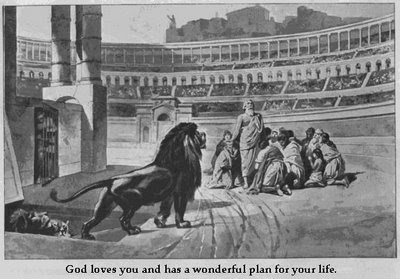
    In the first decade of my rosary, the mystery of the resurrection, I was still thinking about plans and how plans don't work out the way we expect them to.  And I thought about how the individual resurrection is, we assume, the start for all of us of really actually living out the plan God has for us.  Hmm, I thought,  a lot of people say things like "God has a plan for your life," but… I guess we don't really know that? 

    God loves you

    (h/t for the meme to this great post by Amy Welborn)

    God has a plan for everybody's resurrection and eternity.  Assuming we find ourselves still on board with the plan upon death, we'll be living that plan ever after.  Because our wills will be fully aligned with his, et cetera.

    And of course, we believe in a "divine plan" that broadly encompasses the whole of creation, an engine that gets us there, supplied with enough grace to drive us whenever we choose to tap into it.

    But I'm inclined to think that, free will being what it is, there may be no individualized plan for our lives at all.  At least not a "plan" that resembles the kind of things that humans make and call plans in any way.  It may be actively harmful to think of "a plan" that God has for my life, as it admits of the possibility of failing so badly that I cannot keep up with it or ever catch up at all.  It also, I think, devalues the role of will and discernment as images of God:  discernment isn't, I think, a kind of decipherment, where we try to read exactly the itemized steps that God has determined are best for us.  It's a kind of creativity, of problem solving; cooperation.  

    The idea of an individual plan for my life is, I think, maybe a bit of an accretion?   We have a perfectly good and much more open-ended model, instead, in the idea of vocation.  I think it will be healthier, at least for me, to put listening first, and then apply prudence as needed.  

    Plans are not bad!  They are good!  Well, they can be, anyway.   But let's accept that we don't have to figure out the divine plan, in whole or in part.  We can make normal fallible human plans, for my life, for my year, for my morning; and we can plan to be flexible.    Listening, learning, adjusting, getting closer to alignment, solving problems as they come up, creatively.


    ________

    * I mean.  I like eating fish or chickpea curry a lot.   I like my tea without milk just about as much as I like it with milk, too.     Milkless tea is Lenten tea, it's not sacrificial tea.  I don't know, it still seems like a good idea.  I should find more of these little practices.


  • Hand in hand in hand.

    5049FCD1-9E79-4693-B3A5-611A2A4B4F26 
     

    This vacation rental has four bedrooms.  Mark and I are in one.  The 15yo has one.  The 8- and 12yos have one.  And our two grown boys, the recent college graduate and the one who will be moving to college in the fall, have one.  This is basically the same arrangement in our house at home, at least in theory; but in practice it’s probably only been a handful of times, for the youngest was still sleeping in our bed quite a lot when the oldest went away to college.

    This is our third time in Chamonix as a family, after 5 years and the most intense parts of a global pandemic.  The 15yo now has free roam of the entire walkable town, and the 12yo is learning his way around and so his “boundaries” are increasing.  The 18yo can buy himself a drink in a bar.   

    Jet lag has not been kind to the 15yo, who has been plagued by unrestful sleep for many months; there is still no diagnosis, but we are trying some medications with the help of a pediatric sleep clinic.  We let them sleep as much as they wanted for the first couple of days—all of them—and everyone has adjusted except the 15yo.    Today we will try an 11 am wakeup and see if the sleep schedule can be improved, but no one really thinks that the unrestfulness will be.  So that has been hard for the 15yo.

    I don’t know quite what to do with other people’s unhappiness, of the kind that goes on and on and rarely lifts.  “Rejoice with those who rejoice, weep with those who weep”:  it is good advice for temporary connections and for temporary weeping; but what to do when one lives, all the time, with someone who is suffering?  And at the same time with others who are not, who are even rejoicing most of the time?  I have not learned the trick of rejoicing and weeping and rejoicing again in quick succession, day after day for a year or more.   I have not learned the trick of rejoicing and weeping at the same time, because I am together in one house with one who rejoices and also one who weeps, as well as some other people, and they are getting on each other’s nerves.  Cultivating a serene acceptance, would perhaps be easier.  But detachment, which is the only way that I know to achieve serenity, succeeds exactly because it fails to be “with” anyone.

    + + +

    Perhaps “weep with those who weep” was never meant to encompass clinical depression.

    I don’t mean that we cannot com-passion-ate, suffer with, someone whose particular sorrow is depression.  I mean, there are two kinds of sorrow there:   the disordered sorrow, the moments of believing the lies that depression tells; and then there is ordered sorrow in the face of depression, the simple wishing that  depression wasn’t there, the longing for what it has thieved away, the unrequited desire to feel better, the weariness of trying one remedy after another, of working through therapies that are, well, work.

    I think it must be that “weep with those who weep” means to accompany the sufferer in the latter grief, but not to fall somehow into the disordered thinking and feeling itself.  Or to mistake one for the other.   Clinical depression is an illness manifesting as a collection of unreasonable emotions; and yet it is entirely reasonable to have emotions about the depression.  The former is what therapy works to challenge by deliberate effort of will and behavior; the latter are valid and what therapy works to accept and process.  And yet the two resemble each other; a twisted cord to be unbraided gently.

    + + +

    The other difficulty, of somehow accompanying the rejoicing and the weeping at the same time, I don’t have an answer for yet.  I hold back from rejoicing for fear of abandoning the one who weeps, and restrain my weeping for fear of deflating the one who rejoices.   Is the answer to compassionate and rejoice interiorly, but keep a lid on it exteriorly?  or to learn to code-switch smoothly from one to the other and back?  or is this advice simply not well applied to the situation of simultaneity, and some other approach is needed?

    A family means:  being with, really with, more than one person at a time.  Does that mean being more at one time?  It is hard to see how to be enough.  But logically I must be enough, already.

    So instead of thinking of it being pulled in opposite directions, there must be a way forward, hand in hand on either side.


  • “I may give it to whomever I wish.”

    From the Gospel (Luke, chapter 4) for the first Sunday of Lent, yesterday, the middle part:

    Then he took him up and showed him
    all the kingdoms of the world in a single instant.
    The devil said to him,
    “I shall give to you all this power and glory;
    for it has been handed over to me,
    and I may give it to whomever I wish.
    All this will be yours, if you worship me.”
    Jesus said to him in reply,
    “It is written
                'You shall worship the Lord, your God,
                            and him alone shall you serve.' ”


    Of the power and glory of the kingdoms of the world, the devil in this story says:

    "I may give it to whomever I wish."

    We really need to keep this in mind whenever we are intellectually tempted towards any version whatsoever of the prosperity gospel, the idea that material, physical, or bodily blessings are the natural reward of faith and righteous living.

    There is a practice among comfortable Christians (like ourselves) which, though well-meaning, has always bothered me, and I've had trouble articulating exactly why. 

    It is this:  when acknowledging that one has escaped a bad material situation, or received a material windfall, or simply lived a comfortable life free from major material difficulties, there is a good-hearted desire to acknowledge that it wasn't through wisdom or had work that good befell them, that they aren't taking credit.  And there is also a desire to avoid saying, for instance, "We've been lucky," I suppose to deny a superstitious-type believe in "luck" or to assert that the hand of God works in all things and so perhaps even to deny the action of random chance.   So, not wanting to take credit, and not wanting to use the word "luck" for whatever reason, they substitute:  "We have been blessed."

    But… this is also a problem, especially when spoken aloud in a society like ours where many people do believe in the prosperity gospel, whether they realize it or not.  Anyone who says "We have been blessed" may mean "We have received this consolation through no deserving action of our own," but a lot of folks may hear "God has looked with favor upon us and rewarded us for our innate goodness and/or our faithful behavior."  

    So I don't think it's a good idea to use those words.

    And the Gospel gives us another reason.  Are material goods and comfort and power and respect necessarily blessings?

    Are the opposites necessarily curses?

    "I may give it to whomever I wish."  

    (I once heard a perhaps apocryphal story of a page-a-day Scripture calendar that had printed on one page, "All this will be yours, if you worship me."  It was meant to be funny, the story; but honestly, I think "I shall give to you all this power and glory, for it has been handed over to me and I may give it to whomever I wish" would work better.  I think a lot of people would like to believe that the voice that says this is the voice of God.)

    + + +

    Satan, of course, is the epitome of the unreliable narrator.   But Satan is here a character, not a narrator.  The narrator chose the words to put in the mouth of the devil, and chose them with care.

    I don't know what phrase we should substitute for "We've been blessed."  But I do think we should stop using it that way.


  • “You, Reading This, Be Ready” by William Stafford.

    William Stafford is a poet who is new to me, but he was incredibly prolific, despite beginning his career late:  at 48 (I turn 48 this year!) he published his first major collection of poetry.

    Why not this poem, this pseudo-sonnet, for the first Friday in Lent?

    You, Reading This, Be Ready

    Starting here, what do you want to remember?
    How sunlight creeps along a shining floor?
    What scent of old wood hovers, what softened
    sound from outside fills the air?

    Will you ever bring a better gift for the world
    than the breathing respect that you carry
    wherever you go right now?  Are you waiting
    for time to show you some better thoughts?

    When you turn around, starting here, lift this
    new glimpse that you found; carry into evening
    all that you want from this day. This interval you spent
    reading or hearing this, keep it for life—

    What can anyone give you greater than now,
    starting here, right in this room, when you turn around?

    .                                                                    — William Stafford


  • Today and tomorrow.

    Let's get this out of the way first thing.

    The readings for today tell us to do both:

    "Blow the trumpet in Zion!
                proclaim a fast,
                call an assembly"

    AND

    "…when you fast,
    anoint your head and wash your face,
    so that you may not appear to be fasting,
    except to your Father who is hidden."


    There is no contradiction here, and there doesn't need to be.

    Today we proclaim the fast.

    Tomorrow we wash our faces, and keep going.

    Ash-Wednes


  • Narrators.

    These days I find myself thinking more and more about Erma Bombeck.

    Erma Bombeck had a daily column in my hometown newspaper when I was a child.  (I didn't know when I first started reading her that the columns were syndicated to appear all over the country; the readers of the Dayton papers knew she was local).  I loved reading the newspaper; comics first, of course, but also advice columns and weird-little-fact-of-the-day columns and humor columns.  And I loved reading Erma Bombeck.  She was funny, even if I did not always understand the humor, and touching, and I recognized a skilled practioner of the writer's craft even then.

    And there was another side to it.  She wrote a "housewife's column:"  she wrote about raising a family, finding humor and ridiculousness and occasionally profundity in the ordinary mother's life.  I was not a homemaker; I was, what, eleven or twelve?  But I lived in a home.  I had a mother.   And when I read about children from her perspective, sometimes I didn't understand what was so funny about it (for example, she wrote a tongue-in-cheek instruction manual for after her death, including careful instructions on how to change a toilet paper roll and wipe toothpaste out of a sink, which I took as utterly serious when I first read it and didn't realize until I was an older teenager that it was satirical).  Nevertheless some of it sank in and I could see myself, as a child, and the ordinary childish things I did.  It was a little mortifying, but eye-opening in an important way.  I think it helped me see my own mother as a more complete human being than I might have otherwise.  And I remembered those things years later when I became a mother, myself, and again when I lost my own mother.

    If you've never encountered Erma Bombeck, I suggest starting with her 1971 collection If Life is a Bowl of Cherries, What Am I Doing in the Pits?  I haven't read it in many years, and maybe it's super dated by now, but in any case you'll get an idea of what I'm talking about.

    + + +

    I am always saying that I think the first so-called mommyblogger (let's retire that term, though) was Erma.  I would like to go back in time and ask Erma what it was like, to write about home and family, to write humorously about home and family, prolifically so (thousands of columns over many years) and still to guard the hearts of the individuals she lived with and loved.  How did she do it?  Was she always successful?  Did her kids go off to college uneasily wondering if their professors would ask when they learned to change a toilet paper roll?  And what about the griefs and the struggles small and large?  How much did she write about those?  How much did she keep in?  Was she ever bursting with stories she wanted to tell because they were her stories but in the end could not, because they were not ONLY her stories, but also someone else's?

    Stories about relationships never belong to only one person.

    Even stories about the briefest of encounters never belong to only one person.  

    + + +

    And it's hard to understand what to do with them.  I mean, everyone whom the stories belong to has something to grapple with. 

    One of the key things to realize is that we are the main character in some stories and simultaneously a supporting character, or even an antagonist, in others.  And there's no absolute right story, either; God may have the God's-eye view, but good luck obtaining the transcript.

    Being the supporting character in someone else's story doesn't negate my own version.  It doesn't remove my need to tell it, or my right to tell it… but respect for the existence of all those other versions sure calls into question the wisdom of telling it, or setting it out in public.

    + + +

    All this is to say that one of the great hardships of loving someone, having a close family member who is having a really, really hard time…

    …and yes, I love someone, I have a family member, who is having a really, really hard time… many of us do…. and it is hard, it is…

    …is the knowledge that the experience is not only your own and it would be an injustice to preserve your own point of view as the sole, Authorized Version.

    + + +

    I almost wrote, "No matter how hard it is for you personally,  it isn't your story to tell."

    But that's not true.  There is a story that is mine to tell if I wish or keep back if I deem it wise… but wisdom and respect for the fullness of other human beings' internal lives, at least the shreds of wisdom I've managed to claw together in forty-seven years, tell me that you can't have everything.  You voluntarily set some things aside because you value other things more. 

    And one of the things you sometimes waive is the right to tell your own story, at least widely.

    + + +

    Being the supporting character in someone else's story, though?

    Holding true things back, for important reasons?

    It doesn't mean that your story is false, and it does not mean that your story is unimportant.

    Yes, your story—the one in which you are the main character—the one in which you stand just off to the side, doing what you can, while a great battle is happening just out of your reach.  

    It is real, it is important, because your heart matters too.  And maybe there's a safe audience:  a trusted friend, a small group of supporters, an audience to whom you can remain securely anonymous perhaps.  Or maybe it's just a private journal, or slips of paper that afterward must fall into the flames.  Or maybe it seems to come to nothing at all, just an unarticulated heart-hurt.  Like a wispy tendril of poetry that circulates in your heart for years, never written down, because you can find no words that will catch it and pin it down without destroying it in a puff.

    I'm just saying, it's real, and there is something that will come of it, someday; because it's you, it lives in you, in the works of your hands and in the spark that is common to every human life.

    + + +

    Luke 2:19

    + + +


  • The importance of taking temperatures.

    We have had a lot of feelings around here for the last two years.  Feelings of loss, feelings of anger, feelings of relief from time to time. 

    In that time, two of my kids have been diagnosed with disorders that bear the names of feelings:  one with anxiety, one with depression.  I've become very caught up in all things "feeling."  There are medications for these conditions, of course, but those don't get you there on their own; therapy is part of it too, sometimes for the individual kids, sometimes including one or both of us parents; occasionally Mark and I have had a session with the child's therapists and without the child. 

    Therapy means lots of talk about feelings.

    + + +

    One of my young people, the anxious one, has been given a diagram called a "feelings thermometer."  I'm told that it goes by other names, with the most clinical-buzzword-sounding being SUDS:  the Subjective Units of Distress Scale (Wikipedia).   

    A thermometer colored by a child in a rainbow spectrum with blue at the bottom and red at the top.  The ticks are labeled from bottom to top:  1-I'm feeling great! 2-I am relaxed and happy 3-I am cool and collected "I got this"  4-I am okay  5-This is hard but I am in control  6-I am getting uncomfortable  7-I am heating up  8-I am boiling  9-I am ready to explode 10-I am exploding out of control

    One version of the emotional temperature scale for a younger child.

    It's basically a form of "On a scale of one to ten (or zero to ten), how anxious are you feeling right now?" 

    You would think that something this simple would not be very helpful, but I've been amazed at how much it's helped. The more reading I do about ways that clinicians use the scale, the more I try to use it in everyday conversations. 

    I suspect that one of the reasons it's helpful in our family is just that it yields a number within a number range, which even if it is entirely subjective, is a landscape that…certain people in the family… find to be comforting and reliable, like a well-blazed hiking trail.  

    + + +

    Notwithstanding the quirks of our comfort zones:  it also gives us a low-impact way to inquire about the well-being of the anxious young person. 

    All types of measurement change the value being measured, but some do it more than others.  At the beginning of our journey from "this kid is a worrier" to "we need help if we are going to help this kid" to "this kid is in treatment for an anxiety disorder", any attempt to ask about anxiety tended to create more anxiety. 

    Take a seemingly simple question like "How are you doing today" (yes, I know that in many circumstances this question is not perceived as simple).  Sometimes asking it would precipitate a complete meltdown; I think the act of self-examination itself triggered anxiety.   But the number is somehow less weighty, maybe because it doesn't force much engagement with language. 

    At first it was difficult for the child in question to nail down the part of the scale, and there was some hemming and hawing, and prompting from us.  But with practice it became a very quick way to check in:  "What's your emotional temperature right now?" gets a numerical response almost right away, with only a few "um"s.

    + + +

    One thing I found really helpful as I went on reading about how people use the thermometer:   Different parts of the scale call for different kinds of support. 

    At the very top of the scale—let's say betwen 8 and 10—the anxious person may be incapable of language-based reasoning.  There's no point in, say, insisting that they just get back to their schoolwork, or that they explain what set them off.  There may not even be a point in trying to talk them down, or reassure them with language.   Instead, depending on what works best with this particular person, it may be time for a cuddle or a hand lightly stroking the back; or an invitation to go to a quiet place and rest, with another or in private; or a suggestion to engage in vigorous activity or in some self-soothing behavior that the young person has practiced and found to work for them in the past.  (more on that below.)

    Towards the bottom of the scale—say below 5—even if the anxious person is not totally at peace, they can reason and think and perform tasks, independently or with others.  They can engage in therapy, they can be encouraged to stay on task, they can consciously choose behaviors.  They can also practice deeper relaxation techniques to bring the number lower still.

    In the middle, when a moderate amount of stress is being experienced, there is an opportunity to develop self-regulation.  Here is where the young person (as well as their parents!) can learn to notice when the temperature is rising and then do something about it.  Take a break, switch to another task, practice breathing exercises, get up and stretch, try a visualization, get up and fetch something to use as a fidget… all these things are behaviors that have to be learned.  It is here, in the zone of moderate stress, where they can be tried, tested, and practiced; later when the emotional temperature goes through the roof, they can call on these techniques to help bring them down.

    + + +

    One of the things I have learned by using the emotional temperature scale is that what a kid looks like on the outside is not necessarily a great indicator of what distress level they would report on the inside.  And yes, if you had asked me about this before we were using the scale, I would have said "of course that makes sense, everyone exhibits distress differently." 

    But I did not have, then, so much personal experience with how the same person can exhibit distress differently at different times.  A child who appears to be quietly playing a favorite computer game may be, in fact, calm and happy, and often they are.  But a child who appears to be quietly playing a favorite computer game may also be trying desperately to use the computer game to distract from intense internal distress.  A child who is flailing around in the playroom or, grunting with effort, whacking the hanging punching bag with a stick, not answering when called, may be physically expressing anger and distress.  Or they may be absorbed in an imaginary game of swordfighting.   

    I often tell the kids, "I can't read your mind; you have to tell me."  I regularly need to remind myself of that as well.


  • The baptism of water and the repentance of God.

    A couple of weeks ago I had time for a single decade of the Rosary, and it being Thursday, I chose the first Luminous Mystery:  the baptism of Jesus by John.

    I don’t know very much about how other Christian denominations (who have different views of sacraments and sacramentals) understand John’s baptism, exactly how it fits into the economy of salvation, or precisely what it accomplishes when Jesus undergoes it.  I’d like to know more.

    John the Baptist appears in all four Gospels.  Here is the version of his baptism from Mark 1 (this is the NRSVCE):

    Ethiopianbaptism

      John the baptizer appeared in the wilderness, proclaiming a baptism of repentance for the forgiveness of sins. And people from the whole Judean countryside and all the people of Jerusalem were going out to him, and were baptized by him in the river Jordan, confessing their sins….

        He proclaimed, “The one who is more powerful than I is coming after me; I am not worthy to stoop down and untie the thong of his sandals. I have baptized you with water; but he will baptize you with the Holy Spirit.” 

        In those days Jesus came from Nazareth of Galilee and was baptized by John in the Jordan.  And just as he was coming up out of the water, he saw the heavens torn apart and the Spirit descending like a dove on him. And a voice came from heaven, “You are my Son, the Beloved; with you I am well pleased.”  And the Spirit immediately drove him out into the wilderness.

    And here it is from Matthew:

         In those days John the Baptist came, preaching in the wilderness of Judea and saying,“Repent, for the kingdom of heaven has come near.”

        …People went out to him from Jerusalem and all Judea and the whole region of the Jordan.  Confessing their sins, they were baptized by him in the Jordan River. 

       But when he saw many of the Pharisees and Sadducees coming to where he was baptizing, he said to them: “You brood of vipers! Who warned you to flee from the coming wrath?  Produce fruit in keeping with repentance.  And do not think you can say to yourselves, ‘We have Abraham as our father.’ I tell you that out of these stones God can raise up children for Abraham.  The ax is already at the root of the trees, and every tree that does not produce good fruit will be cut down and thrown into the fire.

     “I baptize you with water for repentance. But after me comes one who is more powerful than I, whose sandals I am not worthy to carry. He will baptize you with the Holy Spirit and fire.…”

    Then Jesus came from Galilee to the Jordan to be baptized by John.  But John tried to deter him, saying, “I need to be baptized by you, and do you come to me?”

    Jesus replied, “Let it be so now; it is proper for us to do this to fulfill all righteousness.” Then John consented.

    As soon as Jesus was baptized, he went up out of the water.

    In Catholicism, it’s a matter of considerable mystery with some room for contemplation (hence its inclusion among the mysteries of the Rosary).  A few things we have as settled doctrine:

    • John’s baptism is not the same as today’s Sacrament of Baptism; it’s not a sacrament at all.  It’s not a channel of grace that’s promised to anyone who, properly disposed, undergoes it.  It’s something else.
    • Like a sacrament, though, it is a sign:  a sign of relationship, conversion, and preparation.  “He will go before him in the spirit and power of Elijah, to turn the hearts of the fathers to the children, and the disobedient to the wisdom of the just, to make ready for the Lord a people prepared.”  (Luke 1:17)
    • John baptizes with water for repentance.  He rebukes people who present themselves for baptism, ostensibly claiming the sign of repentance, but whom he knows to be living in a way that is not “in keeping with repentance.”

    John’s baptism is not just something that John does to people; the people come and ask for it, and those who are properly disposed are permitted to willingly undergo it, publicly before the crowd.

    So what is it, exactly?  Is there a simple way of understanding John’s baptism of the people?  Is something like it accessible to us even today?

    I think there is:  to undergo John’s baptism is to make an act of contrition.  It is short of a sacrament, yet it is a sign of repentance; includes acknowledgment of one’s sins; and its effects are really only accessible to those who, well, mean it.

    Schoolchildren typically learn a memorized form of an Act of Contrition, with the intent that they can call on it all their life as a prayer of supplication and sorrow for sins.   A childlike version is:  “My God, I am sorry for my sins with all my heart.  In choosing to do wrong and failing to do good, I have sinned against you whom I should love above all things.  I firmly intend, with your help, to do penance, to sin no more, and to avoid whatever leads me to sin.”   This may well have been the same sentiment in the hearts of many who waded with John into the water.  And I think it’s a good reason to keep John in mind when we say an act of contrition ourselves, whether in or out of the sacrament of confession.

    + + +

    That is what I think John’s baptism means for the ordinary person.  So what does it mean for the stainless Son of God to wade into the water and be baptized by John?  What does it mean for God to make an act of contrition?  God, who can neither be dishonest in his signs and messages, nor… have sins in His past for which He might be sorry?

    Why does Christ display repentance?

    The answer John is given when he protests is:  “Let it be so now, for it is proper for us in this way to fulfill all righteousness” (Mt 3:13).  We can read this fifteen ways till Tuesday and it is going to be very hard to extract much out of this answer beyond, well, reassuring John, who sounds rather alarmed at being put in the position of baptizing the Messiah.  

    B493ff57-e7ab-4f42-9802-0df4038f9f42_text

    No, really, John.  It’s “proper.”  At least for “now.”  It will fulfill “all righteousness.”

    What are the effects?

    Jesus’s baptism by John is seen to mark the beginning of His public life, so one effect is to inaugurate His public ministry.  According to the Catechism (par. 536), it also represents “the acceptance and inauguration of His mission as God’s suffering Servant”; “He allows himself to be numbered among sinners;”…he anticipates (willingly, as the others willingly made their act of contrition) the “‘baptism’ of His bloody death.”

    Jesus entering the water sanctifies the water for us as a sign of repentance and conversion.  Since it is linked to His willing acceptance of His saving death, it imbues the water of our Baptism with our own willingness to die to self and to make of our lives a sacrifice.

    I think I understand this, but I’m often still stuck on “but why is Jesus pretending to be, you know, personally contrite?  Is there something just a wee bit dishonest about this?  “God is not a human being, that he should lie, or a mortal, that he should change his mind” (Num 23:19).

    + + +

    And yet…

    …there are a handful of lines here and there in which “God repented.”  And sometimes the “repentance” is sealed, so to speak, with an act.

    And the LORD was sorry that He had made man on the earth, and it grieved Him to His heart.  “I will blot out man whom I have created from the face of the ground… for I am sorry that I have made them.”  (Gen. 6:6-7)

    God depicts the flood as an act of contrition, a sign of regret.  (Later followed by something better:  the sign of the covenant and promise to Noah.)

    “I regret that I have made Saul king, because he has turned away from me and has not carried out my instructions… I am sending you [Samuel] to Jesse of Bethlehem.  I have chosen one of his sons to be king.”

    God depicts the withdrawal of the kingdom from Saul as an act of contrition.  Later followed by something better:  the anointing of David.

    There are some other mentions:  the Psalmist says, e.g. in Ps 106, “Yet he took note of their distress when he heard their cry; for their sake he remembered his covenant and out of his great love he relented. He caused all who held them captive to show them mercy.”  And the prophet Amos declares, of various plagues, “The Lord repented, concerning this,” presumably ending the plagues.  These could definitely be read more as the human perspective on what’s going on in God’s mind, though; it’s not as strongly worded as putting the words “I regret” directly in the mouth of the Eternal.  And then there’s God repenting of threatening to destroy the people in Exodus, in response to Moses’ plea.

    What I’m saying is, it’s there: God allowing himself to be depicted as a being who repents and relents, like a creature in time.  It might be only human misunderstanding of the way that mercy and justice interplay, and that’s how it’s come down to us, because that’s the best way it could get through our heads how mercy works.

    Here is the thing:  we are creatures in time, and so we have the capacity to repent and relent, to admit our wrongs, or to show mercy.  But none of us is guaranteed to do so; we refuse the opportunity often, and perhaps some people never learn to!

    And how could we learn unless we are taught?

    + + +

    When my children ask me about various Old Testament stories, “But did this really happen?” I usually prefer to be a bit circumspect about it.  The correctness of the answer depends, after all, on what the child understands their question to mean.

    In appropriate context I will tell them, of course, that Scripture is a different kind of book from a history or a science text or a morality tale, and that all those kinds of books can be true in different ways and with different kinds of language.

    But if I am pressed  personally (“do you really believe this really happened?” ) I answer:  I believe with all my heart that God wanted us to know this story, and he wanted us to know it for a good reason. 

    + + +

    By that standard it doesn’t have to make sense that God “repented” or “was sorry” for various of His early acts, and it doesn’t have to make sense that Jesus says it is “proper” for John to baptize Him with a baptism of repentance.  If nothing else, He must have wanted us to know a story that depicts Him enacting something that is proper to him—mercy—by a means which models a way that is more proper to us—repentance.


  • Clothes that fit.

    One of the tropes of the pandemic was:   living in yoga pants.   Or, not just yoga pants, but comfortable clothes in general:  pajamas on the bottom and buttoned Zoom-ready shirts on top, or maybe just pajamas all day if you can conduct business by email and voice call.   My spouse is still working out of a home-office carved out of half our game room, webcam and all, often in a Work Shirt, running shorts and sandals.  I hope the flourishing armies of delivery drivers were wearing supportive shoes and clothes they could easily move in, too (and that my neighbors and I tipped them well enough to pay for good functional ones).

    Now that I am vaccinated and shopping in person is safer, I have been systematically replacing my wardrobe.   I've put it off too long.  Not entirely voluntarily, but to some extent. It would certainly be understandable to put it off if I needed to stay in a strict budget and replace things one at a time as I could afford it; lots of people have to do it that way; but I have been economically fortunate and do not have that excuse.   No, over the last few years I have gradually changed clothing sizes and, well, tried to ignore it.  The involuntary part is because just about when the clothes I was wearing started to be no-longer-deniably small for me, the pandemic hit and delayed me further. 

    But now that I've started to buy new clothes again I've realized just how much I undervalued simple comfort.

    Freedom of movement, functional pockets in the right places, clothing that doesn't gap or tug if I bend or stretch or sit a certain way, clothes that fit.  I had almost forgotten what a difference that makes.

    + + +

    The first things I got, which kind of set me off in this direction, were some summer dresses from eShakti.  If you don't know eShakti, well, take a look:  you can send in your measurements and get clothing (mostly dresses) made-to-measure and customized with your preferred sleeves, hems, and necklines.  The dresses came back, I held them up in front of me by the shoulders, and I thought:  whoa those are thick in the waist.  And then I put one on and took a deep, cleansing, belly-expanding breath, and thought, "I am going to live in these dresses all summer."  And when I looked in the mirror I didn't think they looked bad at all, despite the loose waist.  

    IMG_9960

    Selfie with dress that fits.

    Here's the thing about clothing based on a tape measure:  it's honest.

    The next things I got were new athletic clothes.  I've been lifting weights three times a week and swimming or running twice a week, with the occasional yoga session thrown in.  (More on that later.)  Result:  I am living in gym clothes a lot.  You know how one of the tips and tricks for getting yourself to exercise, if you can swing it,  is to start your day wearing the gym gear?  Or sleep in it, to help nudge you to wake up and go running?   I have been doing that.  And I finally got tired of the tops being too unsupportive and the bottoms being too squeezy. 

    I finally got tired of it…  No, that's not really what happened.   I think I could have gone on with slightly uncomfortable athletic wear for a while.  What really happened is that, as is relatively normal in weightlifting, I have been taking progress photos every month to monitor the muscular development of my arms and shoulders.  And indeed my arms and shoulders are getting more muscular, and also I can tell that my pregnancy-damaged core muscles are doing a much better job holding my insides in place.  But also the athletic clothes are not getting any more well-fitting.  I guess it was reasonable to think that they might possibly do so, since you never quite know what will happen when you start lifting weights:  you might get larger, you might get smaller, you might do both at the same time in different places.  Now that some months have gone by, though, it's clear that I should stop waiting to see if the running pants and support tops will fit again, and should just start amassing a wardrobe of clothes that fit.

    So I've got new quick-dry hiking pants and new roll-up climbing pants with the phone zip-pocket behind the knee.  Runnig capris and sports bras and support tanks.  A one-piece number that is like a singlet with a stretchy sheath dress over the top.   Some yoga stuff.  New bike shorts.   

    + + +

    What I didn't expect was that I would feel instantly so much better and more optimistic.  There are some subtle cues that too-tight clothing sends you all day long.  In the past I had even believed that I needed discomfort in my clothes to remind me, you know, not to eat whenever I felt like it;  I thought I had shed that self-punishment, maybe I hadn't completely.   But now that I can breathe again, I feel released, easy:  not just in the sense that my body isn't pinched and compressed by my clothes anymore, but more comfortable in my own skin.  I feel not just good, but well.   Like I am already on my way to reaching my goals of being stronger, more flexible, with better balance.  A sense of power and capability, and gratitude for movement.  

    I put off buying a larger size because I didn't want to be a larger size.  But I did want clothes that fit.  The tape measure helped me get over it.

    + + + 

    About ten years ago, in response to a reader question, I wrote a post about "acceptance," though I definitely meant specifically self-acceptance, and should have said so.  Acceptance of other people's selves is a matter of justice; self-acceptance, of humility properly understood.  So if I wrote the post today, I'd write it differently.  For example:

    I'm not really happy with the vocabulary surrounding the debate about "acceptance."  Should people accept their bodies as they are?  Is the fat-acceptance movement healthy or not?   

    One thing I didn't grasp at the time I wrote this:  the "fat-acceptance" movement has an important self-acceptance component for sure, but a far more urgent feature of it is the work to compel others—institutions and gatekeepers—to accept the existence of fat persons, who have the right to equal treatment, respectful health care, and comfortable, safe access to public spaces.  Missing that was an ignorant mistake on my part.

    Here's much of the rest of that post, lightly edited.

    The words "accept" and "acceptance" are weaselly.  People choose them for their positive connotations (who will come out against "acceptance?") but their precise meaning requires more information. 

    First: "to accept" needs an object to make any sense at all.  One doesn't merely "accept," one accepts a thing — or a person, or a place, or an idea.  To describe a person, for example, as "very accepting," says nothing of substance, only imparts a glow of positivity, until the writer specifies:  Exactly what does she accept?

    Second: the verb morphs its meaning depending on what the object is.  Watch this:

    • "I accepted the job" = "I agreed to the terms of the offer of employment."
    • "I accepted the gift" = "I agreed to receive the gift and I received it."
    • "The college accepted me" = "The college permitted me to enroll as a student."
    • "I accepted that fact" = "I acknowledged that fact as true."
    • "The restaurant accepts credit cards" = "The restaurant will receive payment in the form of credit cards"
    • "The employees accepted the poor working conditions" = "The employees endured the poor working conditions without complaining"

    What all these threads of meaning have in common is the notion of receiving willingly or agreeably.   A thing which is "accepted" is received, along with all its consequences, whether they be good or bad, with the assent of the will in some way.   But notice the necessity of the concept of "receiving"—something is grasped, or taken, or taken on, that was not grasped before. 

    So when you're talking about "accepting a person" the meaning is perfectly clear if that person has either undergone a sort of a change, or else despite some measure of apparent other-ness, has been "received" as a fellow nonetheless.

     When a college accepts a student or a team accepts an athlete, the meaning is that a person has newly become a member of a group because the group has agreed to admit him. 

    When a grown child's new spouse is accepted as part of the family, that means that—even though the other family members didn't get to choose the spouse—the family nevertheless willingly extends "membership privileges," treating the new person as a family member. 

    When we Catholics in our wedding vows agree that we "will accept children lovingly from God" we mean that we promise to welcome children that we don't yet have, should they arrive. 

    All of these cases involve an act of will, but also an act of receiving.  Even if the receiving happened without our explicit chance to consent (as in the case of the in-laws, or sometimes in the case of the children!), the act of will that turns it from merely "receiving" to "receiving willingly"—to "accepting"—is a choice.  That act of will may happen much later than the act of receiving (perhaps the in-laws take some time to "accept" the new spouse) but the receiving is still implied.

    So—here's a question—how can one "accept one's body?"  

    "I receive my body willingly?"  That doesn't really work, unless personhood and will precede embodiment, a belief that I'm betting few or none of my readers subscribe to.    I have been embodied since my beginning.  I cannot "accept" it in any literal sense, because I never "received" it.   I can accept someone else's body but it's nonsense to say I accept my own.

    So when we say something like "body acceptance," meaning one's own body, we must be using "body" as a euphemism or as shorthand for the real object.  

    What's the real thing we accept?

    + + +

    One possibility:  we accept a physical condition that our body is in.    This connotes "endure without complaining"—in the way one might accept a privation, or a punishment, or the "poor working conditions" mentioned above, or a disease.  

    But even this isn't really specific enough to say whether such "acceptance" is healthy or unhealthy.  What's the attitude inside?  The term doesn't specify.   

    I'll-prove-I-can-withstand-this?   

    Looking-on-the-bright-side?   

    Maybe uniting-my-suffering-to-the-suffering-of-Christ, or complaining-won't-help-so-why-bother? 

    Any of these will do to be described as "accepting the conditions."    But I think you'll agree that which one is meant makes a very big difference to the spirit.

    + + +

    Another possibility is that we accept some idea or truth or statement about our body.   This means, simply, "we believe" that idea or truth.  In that case, whether it's healthy to "accept" the truth or idea hinges on whether the truth is true!   

    "I accept that this morning I weighed X pounds" is a lot different from "I accept that I will always weigh  X pounds."  

    "I accept that my physical condition increases my risk of developing diabetes" is a lot different from "I accept that I will develop diabetes." 

    "I accept that I wear a size Y" is a lot different from "I accept that I have to wear big baggy clothes to hide my ugly hips."  

    "I accept that it's very difficult to exercise" is a lot different from "I accept that I am not able to exercise."

    The original post was written as an answer to the following question, which (following the way my blog was going at the time) focused on weight loss:

    [W]hat do you think is the sequence for losing weight? Not accepting your body, so you change it; or accepting who you are and then from that acceptance just 'loving' yourself enough to change.

    When Delores asked me that, did she mean "enduring" a body-condition, or does she mean "believing" a body-truth?  I think the question becomes more logical if we frame it as follows:

    "What do you think is the sequence for losing weight? 

    • Is it:  (1) refusing to accept the proposition  "Changing your body is impossible or undesirable."   Instead, accepting a different one:  "Changing your body is possible and desirable."  (2) taking steps to change your body.
    • Or is it (1) accepting the relevant facts about yourself:  that your body is in a certain condition, and that you live under certain constraints, and that you have certain tendencies and desires; (2) with the power that comes from that knowledge, just willingly making sacrifices or acts of will that create good changes."

    These are not mutually exclusive propositions.  They are each incomplete, and can be put together to make a sequence that is more complete.  

    1.  Understand and believe the relevant facts.

    2.  From those facts, discern carefully whether a change offers benefits.

    3.  If a change offers benefits, discern carefully from the facts whether they are possible to attain.

    4.  If there are benefits that are possible to attain, determine from the facts how they could be attained. 

    5.  Decide whether you want to expend the effort to attain them.

    That's the order of operations, without using the word "acceptance."  

    + + +

    Not totally a complete order of operations, though, because it's important to acknowledge that not every desired change is within the reach of the will:  sometimes there are real obstacles.  And not every desired change is, shall we say, correctly desired?   Occasionally we feel a manufactured dissatisfaction, or one imposed from outside pressure.  

    Ten years later, I would also add that there is some trial and error involved:  expending the effort could bring desired results, undesired results, or nothing.  That outcome produces facts that should be fed back into the discernment loop.   I've definitely experienced some changes in the facts since I wrote that, and have had to update my priors, and redirect my efforts. 

    And sometimes just de-center the dissatisfaction, and re-center in gratitude.

    Giving my body space to move and breathe isn't challenge-free (it does cost money and time to make any change) but it is just not that complicated, compared to so many other more grueling sorts of change-work.   I don't have to earn the right to the space to move and breathe, and neither does anyone else, in any sort of body.