
Amy Welborn has posted some initial, if not “hot,” responses to Magnifica Humanitas, Pope Leo XIV’s first encyclical. One thing I learned from her take is the distinction between history and historiography! But I digress.
Here’s what Amy did:
Before last week, I had never, ever in my life used any kind of LLM or AI or whatever you call it…
…I thought….maybe I should check this out.
…I asked Chatgpt to give me descriptions of bread in the style of various writers. Then I asked it to give me a few paragraphs on AI in the style of various popes and TA. Then I spent five minutes shooting random image requests.
What follows is an LLM-generated paragraph ostensibly in the style of Chesterton, one in the style of Chandler, one after Flannery O’Connor, and so on.
Amy points out a couple of important things. Beginning with:
The homages aren’t perfect and are in a way rather predictable in how they appropriate the style and content of the writers. They’re definitely superficial. But…it took twenty seconds.
Any student of these writers could have done something similar, but it would have taken far longer. Far longer.
So what of it, she asks? Now that machines can do this, what should humans be doing? And that is the question in every era, no? What should humans be doing? Please, go read the rest.
+ + +
I suppose there is a silver lining to this.
People like mild, mindless entertainment. People are now able to consume it—not in the midst of a live audience with human reactions—not even as part of a nationwide community of broadcast network watchers who can discuss the latest episode around the office coffeepot the next morning—but in isolation on a hand-sized screen. Consider how much of our economy is directed towards the creation of content to be consumed in such a way.
Well, we are on the cusp of a revolution: Mildly entertaining text and images can now be generated to meet that desire, that market, without anyone having to spend time and resources developing their skills, researching styles, practicing turns of phrase, and polishing. All that precious human effort, whole lives spent just to produce mild entertainment, impersonal and remote, soon forgotten: freed.
Presumably the skilled observer and writer and polisher can soon put their efforts to something more meaningful, either useful or beautiful.
But perhaps my snobbishness is showing. How easy it is to think that my entertainment is a worthy human endeavor, while another person’s entertainment is a waste of human effort!
Let me explain what I mean. I don’t watch football, haven’t since college. Football playing is also arguably bad for the human players. So here is a thought experiment:
Someday generative AI could display whole simulated games, such that the experience of watching on a screen would be indistinguishable from watching a televised real football game, and just as unpredictable at the outset: injuries, weather, officials all incorporating appropriate levels of random influence. Suppose I were to propose this to a serious sports fan, or even someone who enjoys betting on games: let’s stop pouring money into real live TV football and just watch simulated TV football instead. Surely this would be a better use of resources, especially since real physical football is dangerous and even more especially because it doesn’t interest me personally and I honestly don’t care who wins.
I wonder how it would go over. I can imagine the arguments to the contrary.
+ + +
I scrolled past the LLM pastiches that Amy prompted and included in her post, skimming over them enough to get Amy’s point about the capabilities of imitation, but with no interest in reading them. And I asked myself, Why do I have no interest?
I would, actually, be interested, if I knew a human had labored to produce them. If such parodies or homages were skillful, I would enjoy appreciating and admiring them. If they were amateurish, I would enjoy judging them, perhaps enjoy the challenge of suggesting better choices. Flannery would never say it this way. Chesterton would be more like that. This phrase is perfect, this other one needs improvement.
I am not an expansively social person, but I crave connection to other human beings as anyone does. My whole life, that has frequently been through text. In an earlier century I like to think I would have devoted hours to correspondence. In this one, I grew up among books and came of age just as the Internet gave me a functionally infinite library and message board.
I am interested in text as a conversation between writer (even a long-dead one) and reader, and in the knowledge and experience of being part of a community or society made up of all who have ever read a text. I am interested in real online conversations with real human beings. If I become aware that in a text there is no one to encounter, then however entertaining the content might seem, it becomes a waste of time to me, meaningless. Signifying nothing. And for me that means losing my appetite for the content.
That is not to say that Amy’s experiment wasn’t worthwhile! But to me, the point is that I found myself scrolling and scrolling down through the pastiches to get to what Amy had to say about them, and that’s for a reason. Perhaps it’s merely a matter of taste—a preference for the real human voice, independent of the “quality” of the content, only because it (and not the artificially generated content, even if you can’t tell) represents a conversation.
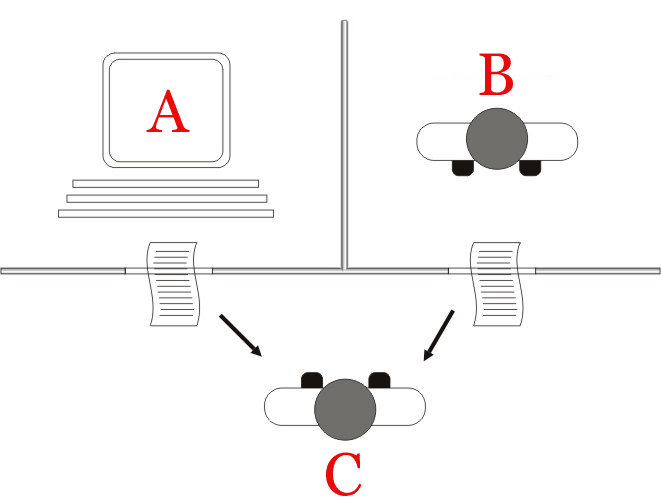
Is my taste test wiser than Turing’s? Importantly, Turing didn’t propose that indistinguishability-from-human-interaction was the criterion for a “thinking machine.” Rather, he proposed to replace the unanswerable question “Can machines think?” with the different but more well-posed question “Can a machine convincingly imitate a human?” This question is not only answerable, but useful.
The “replacement” language demonstrates that Turing understood the distinction between imitation and reality, even if he judged “the imitation game” to be the experimentally testable, theoretically relevant criterion. I believe that an imitation conversation can be useful in certain pragmatic situations—I recently mused about its utility in things such as tech-support troubleshooting chatbots. But my taste runs to genuine conversation, whether my interlocutor is long-dead or not. Do I have more discerning taste than the LLM fams? I don’t know that my taste says anything about the quality of me, but it’s mine and I, a human, claim it.
Juan Alberto Sánchez Margallo.
Licensed under the Creative Commons Attribution 2.5 Generic license.
 bearing blog