bear – ingn 1 the manner in which one comports oneself; 2 the act, power, or time of bringing forth offspring or fruit; 3 a machine part in which another part turns [a journal ~]; 4 pl comprehension of one’s position, environment, or situation; 5 the act of moving while supporting the weight of something [the ~ of the cross].
A few Lents ago, I chose Dorothy Day’s diaries and letters for my daily reading. I occasionally posted snippets to Facebook, which means these come up in my “memories” every February and March.
Here’s the one that popped up for today, on a date that wasn’t Ash Wednesday that year, but still a good sentiment for me personally as I set out to begin Lent.
“Bertha says I am gruff and indifferent to people (she means when I come off the platform or am meeting a mass of them at a time). She rightly points out that we are trying to change people’s attitudes, to create understanding….
So I must learn to be more cordial to people and overcome that immense sense of weariness and even impatience when people, quite sincerely, tell me they enjoy my books, how interested they are in my work. Miss Jordan told me I look at people as tho they were going to steal 5 minutes of my time! It makes me unhappy to give such an impression, I feel as tho I had failed people again and again…
I must do better, guard myself rigidly, control my fatigue…
I’ll just have to work every day at it.
These hours on trains or bus are so precious—to be alone for a short while, it is a complete relaxation, a joy…
I am an unprofitable servant and must begin over again right now to change myself.
God help me.”
—Dorothy Day, diary entry, 15 Mar 1940
Dorothy Day at a speaking engagement in Seattle, 1940. Source
Back just after Epiphany, I received this great email from a reader named Jenny:
I just wanted to let you know that I tried your faux cinnamon roll recipe… but not for cinnamon rolls.
Down here in New Orleans, Epiphany heralds not so much the end of the Christmas season as the beginning of the Mardi Gras season. The famous parades don’t really happen until a couple of weeks before Mardi Gras itself–but the balls and banquets begin on “Twelfth Night”. An important (hee) part of this whole Mardi-Gras-season is, of course, King Cake. Every local bakery makes them–you can get them at coffee shops, grocery stores–just about anywhere, in this town, at this time of year.
King Cakes are usually a brioche made into a circle and decorated with icing and purple, green, and gold sugars (the “official” colors of Mardi Gras). I tried my hand at making one a few years ago, but I find brioche difficult to work with. And then I started having babies. And I stopped trying to get a handle on homemade brioche and started using a bread machine.
But your bread-machine cinnamon roll recipe has saved me! It makes a delicious King Cake bread!
I used your recipe…
[added by bearing: here’s what you put in the bread machine, taken from the link above]:
2 and 1/4 cups whole wheat flour
1 and 1/2 tsp bread machine yeast
1/2 tsp salt
1/2 tsp cinnamon (cardamon is also nice, as is chai spice)
3/4 cup plus 2 Tbsp milk (or you can use apple juice; omit the sugar)
3 Tbsp sugar
1 Tbsp coconut oil (or butter)
1/2 cup raisins or currants
….but when I took the dough out of the machine, I sort of stretched it into a long snake–which I then flattened out and dotted with small pats of butter and an additional sprinkling of cinnamon and white sugar down the center. I folded up each side to enclose the cinnamon/sugar/butter and then laid the whole thing in a ring on a baking sheet.
[After the second rise of about 30 minutes, bake it at 350 degrees for 30-35 minutes — edited by bearing].
When it came out and had cooled a bit, I did a simple powdered sugar/milk/vanilla glaze and then added the colored sugars.
Everyone loved it. My husband, an actual New Orleans native, proclaimed it “the best King Cake he’d ever had”, even after I’d accused him of just trying to get in good with the chef (ha).
Anyway, thanks for the recipe! The good/bad news is that now we’ve decided that since it is, in fact, better than store-bought King Cake, I am now assuming the role of Official King Cake Baker from now until Mardi Gras…
I’ve attached some photos of the cake, in case you’re interested.
Am I? Am I?
.
I almost feel bad about this because… this is a reasonably healthy recipe! That’s why I use it for an everyday, if fun-to-eat, breakfast bun. It’s made from 100% whole wheat flour, a little bit of coconut oil, milk (or apple juice if you want), and not even very much sugar. No eggs even. Heck, you can make this recipe vegan if you want! Not exactly in the spirit of Mardi Gras!
It is possible to make non-faux cinnamon rolls in the bread machine, with a brioche-style dough, if you want a richer version (e.g. with eggs and milk and butter and not so much whole wheat flour). But Jenny is right that brioche dough is harder to work with, so this may be a lower-stress version as well as a lower-sugar-buzz version.
Traditionally you’re supposed to hide a trinket inside the cake, and the person who gets the trinket has some kind of obligation or wins a prize or is lucky or something like that. Be careful not to choke on it!
The last two months here in Minneapolis have been beyond educational… maybe “astonishing” is the right word.
Faced with an unprecedented occupation of the city and its surroundings by armed and hostile federal agents, using law enforcement as a pretext for terrorizing the city and coercing the state, neighbors have come together rapidly. Organizing has been bottom-up. Think blocks coming together under block captains, neighborhoods making plans at potlucks. The keyword here is “hyperlocal”—grocery deliveries, rent support, safe rides to medical appointments, carpooling kids to school, all of that is happening all over the city but largely executed by people for their near neighbors.
My neighborhood held a meeting last weekend that was intended to give us a sort of break from the endless organizing, volunteering, and delegating. We had a potluck in a church basement, maybe fifty people. We spent time getting to know each other by name and face. And then we had a poetry reading—like a slam but without competition. Five pre-scheduled speakers and then an open mike time, reading poems of anger, of grief, of hope, even of grace.
I’ve never attended a performance so cathartic. I was amazed to hear the tender composition of a neighbor who is a dad-down-the-street from me, who signed up for the open mike. I thought to myself if I had a poem, it would be something like
Once I asked God to take my heart of stone
and give me a heart of flesh.
Neighbors, I am sorry,
and my heart thanks you.
+ + +
If you had told me even six months ago that I would decide to spend three hours on a Sunday afternoon at a neighborhood amateur poetry reading, I would never, ever have believed you.
There is something about what is happening in Minneapolis that I am having trouble reconciling with my previous experiences.
I feel like I fit into the cities of the Upper Midwest, culturally, much better than I ever did where I grew up in suburban southwestern Ohio. (Note that I can’t really speak to the rural areas or the smaller towns.)
People are a little more aloof and reserved here. They keep a little bit of distance. They mind their own business. Small talk is brief and non-intrusive. For a somewhat socially awkward introvert, this is wonderful. Plenty of personal space, plenty of room to exist in my own head. In some ways, moving through the public spaces here actually feels a little similar to moving through New York City, where tightly packed human beings compensate for limited physical space by creating a sort of psychic personal space for themselves and for each other.
There are stereotypical downsides to this aloofness. An old joke goes that Minnesotans are so nice, we will gladly give you directions to anywhere except our own house. New arrivals, especially those unused to the culture, can find it is hard to make new friends. For a time a few years ago, we tentatively joined a new parish (in a first ring suburb!)—and a year and a half later we decided to find a new one, having learned not a single other family’s names. Minnesotans are famously indirect in criticism. “That’s different” or “that’s interesting” can indicate anything from mild shock to a state of being absolutely appalled.
(If you want a taste of this view, there’s an old parody film called How to Talk Minnesotan which is definitely parody and also accurate. It’s available on YouTube.)
But we also all shared a certain pride in getting through the winters together, in digging each other’s cars out and clearing each other’s sidewalks. There is a neighborliness that expects little and offers what it can, when it sees the need.
+ + +
So having lived here a while I had developed a sort of affection for, and affiliation with, the Minnesota way (except for the refusal to speak bluntly about problems). The aloofness and reservedness, and tendency not to make fast friends, I felt that I understood and was comfortable with, as I felt free from a pressure to perform socially or to commit to any roles.
I lived on a pleasant and modest block in South Minneapolis for about 23 years, and in all that time I barely got to know the people living around me. I vaguely knew the few families that had kids, I knew the neighborhood dogs, I waved and said hi, I greeted them when I served as an election judge. After 2020, things got a little friendlier: the neighborhood organizations started a block-captain program, and some families set up a Signal chat that our block used to discuss lost cats and misdelivered packages and kids’ fundraisers and jumper cables. Through the chat I learned a handful of names and faces.
And then…
2026 happened, and the federal agents showed up to seize some of my neighbors, and—the aloofness, the personal space, the reservedness—it just completely evaporated.
Gone!
Emergency block meetings. Emergency neighborhood potlucks. Division into teams: teams for care and support, teams for communications, teams for neighborhood watch, teams for letter-writing and fundraising and boycotts. Minnesotans giving rides in their own cars to perfect strangers, ferrying them to medical appointments or legal offices. Neighborhood dads walking one child of their own and three children not their own safely to school. Churches inviting volunteers of all kinds to sort and pack groceries, and more volunteers to pick them up and deliver them to homes. People using their own Venmo accounts to raise money from friends and redistribute it to neighbors who otherwise couldn’t pay their rent; donors trusting those folks to handle the money honestly.
Two observers shot dead. At least one in ten Minneapolis residents stepping up to receive training in legal observation, stepping up to stand in the shoes of Alex Pretti and Renee Good.
Sometimes for the sake of neighbors they knew and cared for, personally.
Often for the sake of neighbors they did not previously have ties to any stronger than the casual ones I had with mine.
+ + +
Before this, I never so much as invited a neighbor to tea. Today, I am literally ready to be tear-gassed for any person on my block, for any child at the neighborhood school. And there are few of us who haven’t accepted, one way or another, the grim possibility of another death.
My perceptions before the occupation were not false. The reservedness was real. But this fierce mutual defense, this taking on of real bodily risk, this palpable answer to who is my neighbor? is also real.
I’m forced to conclude that there is some consistency underlying both of these seemingly incompatible visions of my community.
I think it is respect. Simple, neighborly respect.
Respecting boundaries, respecting privacy, respecting that your ways and my ways may be “different”—and that this is all that is worth saying about them, at least in public. Living pleasantly alongside one another as human neighbors do.
We do have at least one thing in common, by definition. We chose this community to be our own. That is a real and true connection in any neighborhood.
And when a force comes in that speaks ill, not just of some of our neighbors, but of the very idea ofour neighborliness—
We are—and this is hard to do to a Minnesotan—offended.
And all our stubbornness and our hardiness turn to a collective fury, driven to prove how very, very wrong that image of us is.
+ + +
I hope we can live up to this drive in the aftermath. Our economy is damaged. People’s nest eggs are depleted. Even after the immediate damage is over, neighbors will need help: from the trauma, from the legal fees, from evictions, from medical complications. I hope we will step up and keep lifting each other up, long after the attention turns elsewhere.
This is gonna be more off the cuff than usual. I’m writing on my phone and I want to get it out, not go back and edit and fact-check.
Three things happened yesterday that all had me thinking about St. Thérèse, the Little Way, and what it means.
• A neighbor from a couple blocks over, whose name I know, whom I ran into yesterday on the street, sent me an appreciation text yesterday. I see how much you are showing up… Thank you so much for keeping our neighbors safe.
…And I thought, and expressed this clumsily in a reply, about the very firm boundaries I have set around my “showing up.” I picked one thing to do regularly, largely because it felt like a safe and easy thing: joining the foot patrol at the elementary school, just during morning arrival and afternoon dropoff, three days a week. I don’t turn my phone on till I have had my coffee in the morning, about eight, and when I do I’m aware that some folks have been out watching the morning commute since 5 am. I know there is so much more that needs doing.
• “How do you keep going out there? Are you not worried about your safety?” The VIP wanted, sincerely, to hear from some of us who were on the ground, and through random geography and time and self-selection, I was part of a group of maybe ten people, school patrollers and school parents, who showed up in a small conference room to answer those questions.
One mother, weeping, described the children’s fears, and the much larger fear of other school parents whose families were at greater risk. Another man, a tall and imposing guy in a hi-vis vest who’s always posted at the parking lot entrance, described being simply focused on the work of his shift of a few hours.
“…You just do your one job,” is what I said. I was thinking about earlier, when
• I was standing on the corner doing the thing that I do because it helps occupy my mind and it’s not useless: watching the cars arriving from the east, looking at each license plate in turn. I read the license plate aloud to myself to put it in a short-term memory slot, I scan the car for red flags. Is it an out of state plate? Are there two men in the front seat and are their faces covered? Is it a big dark SUV with black-tinted windows so I can’t see in? Does it even have a license plate? (The day before, two vehicles that passed me had none, front or rear). If the car looks normal, I forget the license plate and go on to the one on next car. And I do that three-second scan over and over again for 45 minutes while lone drivers, especially sheepish ones in big dark SUVs, give me friendly waves and polite honks.
…And while I was standing there, I became suddenly aware of the focus, of the flow state. I was fully focused on reading license plates and being aware of my surroundings: the other patrollers in their hi-vis vests on the opposite corner, the parents arriving on foot with children (here is one white parent escorting one white child and two nonwhite children the same age) to deliver them to school, the line of school buses stacking up across the street and the teachers coming out to escort the children in. A thing to do, strings of letters and numbers, maybe check my watch to see how long I have left.
…I wasn’t thinking, all that time, about the reason I had chosen to walk over here most mornings. I wasn’t thinking of the kids, how we are there to deflect incidents from affecting them on a school day. (The day before, before my shift, other patrollers, the tall man in the hi-vis vest, de-escalated a serious situation: Get out of here with your guns and your tasers, this is a school zone, the kids are going to be dismissed soon, just leave, you’re in front of a school.) And here I was, not thinking about the kids at all. Just thinking about license plates. Not feeling anything except cold fingers and toes: not fear, not compassion, not affection, not anger, just feeling like you do when you’re busy solving an algebra problem or writing code.
And I thought about this one small thing I am doing—it is a small, tedious thing—and asked myself: Can this possibly be “a small thing done in love?” Little-Way-style. It doesn’t feel like it. I feel kind of numb, actually. I smile and say hi to the occasional small child who walks by hand in hand with an adult, who presses the button and waits at the corner. I send texts, utilitarian ones, to the other patrollers. I am busy doing a job and my job is looking at each of these cars, maybe to mention a few to other patrollers.
Anyway. I don’t have a good answer. Where is the love? My mind is too busy to worry about it.
One of my guilty reading pleasures is advice columns. I’ve been drawn to them since I was a kid hunkered over the hometown newspaper, which featured Ann Landers and Miss Manners directly opposite the weekday comic strips. I think I found them so fascinating because to me, the world of social interactions was challenging enough at the elementary school and familial level. I loved that there were people out there who seemed to know exactly how one should behave, and were happy to tell anyone who asked.
I’ve never lost my love for advice columns, although the older I get, the more discriminating: I no longer have illusions that all of them know what they’re talking about, and some of them are much better writers than others. But they still frequently open my mind to new ways to think about navigating the difficult situations of the world, even if wholly hypothetically (one of my very favorites is workplace columnist Alison Green of Ask A Manager, even though I hardly spend any time in anything remotely resembling a workplace anymore).
The person who wrote in described how her son was engaged to a “wonderful young woman” from a “fun, warm, and welcoming” but also “quite wealthy” family—much wealthier than the writer:
Her parents recently had a sit-down with the kids and told them they’d like to spend $75,000 on the wedding. They also said they’d like to invite my husband and me for a visit so we can all work out the details about who’s paying for what. I don’t know what to say or do. They are such genuinely nice people, and we really do want to contribute as much as possible, but there’s no way that we can come up with anything near that. Honestly, we’ll be lucky to scrape together even a few thousand dollars, and that fills me with bone-deep shame.
He’s our only son. We love him so much but feel like bumpkins with bupkes to give them. What can we do?
This was one of the questions that Hax opened up to readers’ comments. As I settled in to read them, I expected comments that addressed the hypothetical uncomfortable conversation during the visit with their future daughter-in-law’s parents: how to broach the subject of their financial disparity, for instance, or how to agree on a more affordable event, or how to decide what they can afford to spend, or perhaps how to overcome their misplaced feelings of shame.
But the first response got right to the correct point: Whom the groom’s mom and dad should be having this conversation with. The reader advised:
This is something you should be discussing with the couple, not your son’s future in-laws.
Oh—that’s right.
…My parents weren’t able to contribute nearly as much to our wedding as my in-laws. We asked each parent what they were able to contribute, figured out the amount we were willing to contribute, and then we came up with the wedding budget from there.
I would call your son and explain to him how much you can give. Your financial situation is likely something your son already knows, right? If not, it is an opportunity to explain it. Then leave it to the couple to determine what the budget should be. Maybe her parents will choose to pay for everything; that’s a very traditional take on weddings. Or maybe the couple will decide that a big wedding isn’t worth it and will choose something small.
This is so exactly right, obvious as soon as it was pointed out, and a great example of why I keep reading advice columns. Because I am the sort of person who is easily sniped by a Problem to be Solved, and sometimes I see the side issue first.
Like so many others, this questioner needs advice about how to set and enforce a boundary. But the first boundary that needs to be decided upon here isn’t a cap on contributions that they are going to have to explain to twice-removed wealthy in-laws. It’s whom they are willing to explain their cap to.
This is exactly the kind of thing I often forget about boundaries: Whom you explain things to, including your other boundaries, is itself a boundary. Sometimes this kind of discretion protects you: you don’t have to have uncomfortable conversations if the necessary information can be handled another way. Other times it protects others: from your nervous oversharing, from violating privacy, things like that.
If contributions to a wedding are to be a real gift, then they go to the couple who can decide what to do with them. The letter-writer cannot control how much the fiancée’s parents offer and she cannot control how much of that gift the young people accept. (She also can’t control whether the other family’s contribution implies an expectation of a degree of control over the details, like choosing the venue.)
It’s better to be honest with the engaged couple and let them take responsibility for what to do with what is being offered.
+ + +
Anyway, the broader boundary-setting lesson will stick with me. Before plunging ahead to decide what boundary to set with someone, or what words to set it with, consider whether the boundary should be set with the first person who came to mind, or if someone else in the affected circle is a more appropriate channel for the information.
Careful—discretion in channel-choosing mustn’t be confused with triangulation (involving a third person in a conflict in order to manipulate someone by bringing pressure on them from a different direction). In this case the groom-to-be’s parents would be gently extracting themselves from a perceived pressure situation that was probably unintended, even if it could have been prevented had the other family been a little more self-aware.
“What’s happening to our Somali Americans in Minnesota is unacceptable, un-American and dangerous,” said Khalid Omar, an organizer with the coalition of faith groups ISAIAH. “Over the last few days, our community has been terrorized by federal agents and ICE officers.”
Omar said immigration officials have been asking Somali-Americans who are U.S. citizens to produce passports and other legal documents.
Asad Zaman, executive director of the Muslim American Society of Minnesota, said he is reluctantly advising fellow naturalized citizens to carry their passports with them.
“Today it broke my heart that, in my sermon, that was among the advice I gave my people,” Zaman said.
But:
People are holding potlucks to meet their neighbors and plan for how to help.
People are sharing lessons learned from Chicago and other cities.
People are pledging to be ready to stand as a peaceful witness and document illegal overreach by masked agents, ready to provide those who are unlawfully detained or injured with the video evidence they need to press charges or sue.
This is frustrating. Infuriating: the casual dehumanization that is a feature of the current administration, the intentional cruelty, the delight in violence.
But we know that being neighbor to someone is, in however small doses, a worthy response.
+ + +
I am sorry to say that I have never really prioritized neighborliness. There’s a little bit of social anxiety that gets in my way. I have friends mostly outside my neighborhood. My kids, being mostly homeschooled, never went to the neighborhood school (one went to a city magnet high school). I go to church at a Jesuit parish, not any of the ones much closer to us, except sometimes when the schedule is more convenient here. We have a traditon of even trick-or-treating at a holiday party with friends in another town.
I’ve been trying to change, gradually. I became an election judge and I serve in my own precinct, in part so I can serve my own neighbors. I have made a point with my younger kids to use the neighborhood library and walk to the neighborhood grocery store much more than I used to. I joined a little neighborhood chat group for my immediate block which has actually helped me get to know the people living around me much better than before: at least I can put names to addresses, and occasionally help with little needs like misdelivered packages and lost dogs.
It’s time to change a lot faster. What do I really have to fear, after all?
In the last post I looked back at 2008 and a series of posts I wrote about, back then, learning to face some serious mental issues around food. I’m sort of looking at how far I have come, how my thinking has evolved over the years, and where I am now. Especially, I’m inserting some important caveats where I think my writing back then was really wrong—if you didn’t start there, please go back to see what I mean.
Will I keep getting hungry between meals, ever? Will I never eat an entire pizza? Will I always ask for the half portion? Will I forget about ever filling up on bread, ever again? Will I roll over in bed when my stomach growls at 3 a.m., saving that appetite for breakfast? Will I throw out the kids’ sandwich crusts? Will it start to feel wonderful, instead of worrying, to believe that the eating-till-I’m-stuffed is over?
About two years after writing that, after I’d had another baby, I wrote this post looking back on the same questions:
That is the writing of someone who is frightened by the idea of never eating an entire pizza again. I write now as someone who is relieved by the idea of never eating an entire pizza again. Even by the idea of never having more than, say, a quarter of a pizza at a sitting….
If I learned I only had a few months to live … I still wouldn’t want to eat an entire pizza. I wouldn’t want to stuff myself with food, even really tasty food. I guess I might eat a higher proportion of my food from the Deep-Fried Group, but … “not stuffing myself” doesn’t feel like a sacrifice, like any kind of self-denial. It’s what I want to do now and for the rest of my life. I feel so much more free about it than I did when I ate whatever I “wanted.”
And now it’s seventeen years later and I will answer these questions again!
…Yes, I still let myself get hungry between meals. Meals are better when you are hungry! I am kind of addicted to that feeling, in fact.
…No, I basically never eat an entire pizza, with the rare exception of Neapolitan style personal pizzas, and even then I have to be really ravenous.
…Half portions: pretty much, if the “small” is a standard menu size, that’s what I order.
…Yeah, I don’t fill up on bread. Not a problem. Not even really tempted, unless caraway rye is involved.
…I cannot remember the last time I got out of bed in order to eat. Drink water, yes. Maybe if I was sick.
…Kids’ sandwich crusts? Not a thing anymore around here. I admit that last night I nibbled on their rejected salmon patties at the end of dinner.
…And for a really, really long time, I’ve preferred the feeling of “ate enough” to “ate so much I feel full.”
So I wish I could go back and reassure myself back then: I was really fixing some things in my head. A lot of things got better and they stayed better.
+ + +
In fact, I kept up all those generally good habits, and felt good, and stayed about the same size, for ten years, including two pregnancies. In 2018, when I was 44, a few months after I stopped breastfeeding for good—yes, if you’re doing the math, I’m one of those people that lets the child set the pace, so I’m not exactly sure when it ended but around there sometime—my weight started to rise very very slowly but steadily, and that without me changing anything at all. I chalked it up to the end of breastfeeding, but it could just as easily have been the onset of perimenopause; maybe both.
For a little while I stressed out about it and tried counting calories and things like that, but after the pandemic hit and there was a sudden new source of stress in my life, I decided to change my thinking and my approach instead.
For one thing: My teenage son installed a squat cage in our basement, and I switched from swimming and running at the suddenly-unavailable YMCA to barbell training and long walks. I figured that if I was going to be slowly putting on weight, I might as well try to nudge some of it into becoming muscle.
That turned out to be really good for my mental health and body image. Ever since then I’ve been too busy thinking about performance, and avoiding injury, and getting enough protein, etc. I’m really focused on the long term now. Eventually I added the running and swimming back in, by the way, though it’s hard to do that more than once a week now that I really prioritize not skipping weight training.
It isn’t too far off to say that I am thinking seventeen-plus years in the future. I don’t worry anymore that I will develop seriously disordered eating (in either direction) but I do wonder about that older, hopefully wiser me. When my youngest child is twenty-eight and my oldest child forty-two—when I am sixty-eight—how will I feel? Will that not-disordered-eating be something that is actually easy and natural by then, or will I still have to sort of think about it to keep it in balance? Will I still be lifting barbells? Will I have made it through to menopause with adequate bone strength? Where will I have landed in my endless waffling over wine consumption: “life is short, go ahead and enjoy this great pleasure of life” or “learn to cut back and live longer?” Will I have entirely, instead of mostly, stopped viewing my body critically in the mirror? Will I have gone full salmon-and-kale-and-avocadoes, or will I still demolish a plate of nachos or a bowl of spaghetti bolognese from time to time? (No judgment there, by the way. I’m just wondering.)
It’s tempting to think that I’m ahead of the game in a couple of areas. First, I’m not afraid of or ashamed of aging per se. I’m nearly the age my mother was when she died of cancer; I don’t take these years for granted; I’m pleased to have reached my fifties, pleased even by the visible signs of being older, the gray hair and the fleshiness around my chin, and by Mark (who has nineteen months on me) growing older beside me. Second, I’ve got a few really good habits that I’ve been keeping up since my thirties. I hope those can make up for the wine a little bit longer.
It seems amazing to me that it’s been seventeen years since I first began writing seriously about the weight loss I experienced in 2008. I’m revisiting some of those posts now as I work on getting my blog tidied up now that it’s moved to WordPress.
One major reason for the revision is that I’ve come to reject some of the language I used during that series—and it’s all the more important that I go back and add some caveats and things because that language really seemed to resonate with people. I’ve been meaning to do it for a long time, and so I’m glad I finally have a chance to do so.
Some of the mental habits I developed along the way were not very healthy ones, and I came to a place later on where I decided I would rather have a healthier mindset and accept a larger body if that turned out to be the consequence. I don’t regret that change one bit.
I also would like to strengthen the position that body size is not supposed to be a source of shame, period, nor a reason to deprive anyone of access to medical care, education, transportation, or recreational facilities. I don’t know if it is possible to go back to those old posts and keep what’s useful in them but still remove any material that inadvertently reinforced all the societal expectations which create adverse mental, physical, and social health outcomes for people who have larger bodies. Instead I’m choosing to acknowledge that I didn’t consider that enough, to assert that it was negligent on my part, and to leave the posts up. I hope that’s the correct decision, or at least sufficient.
“I decided to try, um, eating less…. I started [a food diary]… more like a feed-forward record, or a plan… I carried planned, premeasured snacks… I believe that… my habits have been addressing the underlying mental defect that’s been causing my lifelong weight dysfunction… I thought to myself, ‘I’m ready to try being okay with being hungry.’”
“Here’s the root of my problem [in 2008, remember!]: I have an irrational fear of getting hungry.”
Was this an accurate assessment then? Is it still true?
Speaking now in 2025: I am extremely confident that this was true then, and also that it is not at all true now. One way or another, I killed that fear dead.
I wrote out the evidence. It’s interesting to look at it now because some of it is entirely absent from my life now. For example:
I used to explicitly think “I’d better eat extra so I won’t be hungry later.” Nope. I am not thinking that.
“I get very antsy on road trips as mealtime approaches.” No. This is no longer a problem. I might get interested in thinking about what I’ll get to eat, as I get hungrier, but I’m not worried about it. This is now a fear-free situation.
“I get irrationally irritated when I’m at someone’s house for dinner and food is delayed.” No. This is not a big deal at all. I can deal with not knowing when dinner will be.
And here are some elements that I identified as “fear of hunger” that are still kind of an issue. But without the context of the missing three items above, I no longer interpret them as a “fear of hunger” thing.
“Certain foods that I eat compulsively if they are just sitting around.” That is still kind of true, although I’m less likely to do it if they aren’t something I actually really like a lot.
“I rely on external cues” like if there is food left, if others are eating, if something will be thrown out. Yes, this is still an issue.
“When I am responsible for feeding a crowd, I am very preoccupied with there being ‘enough’ food.” Okay, this is still true. But even back then, I tagged it as “hostess anxiety” and, well, it still is, I guess.
“Recurring dream… where someone gives me piles and piles of food and I know I have to eat it.” I still do get that sometimes.
The only one that I think might perhaps qualify as evidence of being preoccupied with hunger is the last one, and it’s just my subconscious dealing with some kind of anxiety about food.
Instead, I have… sort of ordinary issues? Environmental ones? Maybe more having to do with the social interaction aspects of eating and serving and enjoying food with other people? None of which I would classify as an “underlying mental defect.”
So, back then, I described my success as having a two-prong approach: find ways to soothe the fear of hunger that didn’t involve pre-emptive eating (for example, pre-emptive carrying of snacks), and getting used to the idea that hunger is okay.
…But now, I already know that hunger is okay. I’m actually pretty good at hunger! So what worked then primarily on that particular problem is not likely to do anything for me now.
On the other hand, I can explore the social-interaction and environment aspects. They might not ever have really been evidence of fear of hunger at all, but instead may have been evidence of something else that caused me trouble. Maybe circling back to those will do me some good.
+ + +
I’m in a whole new stage of life now. I’ve been through whole stages of life! In July 2008 I was thirty-three years old. I had three children under the age of eight. I was breastfeeding a toddler. Back then, raising children took most of my attention, and even though I was thinking a lot about taking care of my own health and improving it, a lot of it was because I hoped to have another pregnancy and wanted to be in better condition for it, and maybe come out on the other side without having put on a bunch of weight that wouldn’t come off (because I was thinking about trying to be thinner, too).
Now I’m fifty-one years old. Those three children are adults. I did go on to have two more children, who are now a teen and a tween. I stopped breastfeeding, let’s see, seven and a half years ago maybe? And now when I think about taking care of my own health and improving it, I’m thinking about aging well. I’m thinking about taking steps to not fracture my hip someday. I’m thinking about protecting my heart and lungs. I’m thinking about remaining flexible and strong. I’m wondering how menopause, which hasn’t come close to starting yet, will treat me.
This isn’t unrelated to the “good life” stuff I mentioned before; in fact it’s quite related. I think since I’m digging into my archives anyway and revising and revisiting them, I will use those old posts as springboards for thinking about the future. Stick around and we will see where they take me.
Have you ever been engaged in some pleasant or satisfying activity, or maybe passively enjoying an experience, when, suddenly, you become suddenly aware of it? And there’s a thrill that goes through you at the awareness of it? Here am I, doing something cool, feeling something delicious. It’s sort of the opposite of a flow state, in that it suddenly takes you out of the activity or the sensation: you become an observer of your own thoughts and feelings But in a good way, a delightful way.
The best explanation I can come up with: it’s sort of like being outside on your way somewhere, and suddenly catching your own reflection, unexpectedly, in a shop window at an odd angle, and being delighted by this vision of yourself in the midst of the world, a little glimpse from outside yourself.
I listed some of the things that give me that sensation. Drinking wine with my husband at the kitchen table, wandering around an airport, running on a lovely day. I wanted to try to interrogate (a) what do these experiences have in common, such that they all give me this same sensation? and (b) why do I want to call it the sensation of “the good life”?
I spent a good long time thinking about (a). (Notice, it’s five days since I wrote the post!) And I think I’ve come up with some answers to that part.
I tend to get this sensation when
I’m not wholly immersed—I’m perceiving myself;
I perceive that I am doing something “right,” not something “wrong;”
I feel connected and belonging in some way that is important to me;
I am having an experience that once I didn’t think was possible for me: I’m pleasantly surprised to see myself in this experience.
In some ways I think the dominant feature of all these experience is that last bit: the surprise. There’s an element to every part of it that seems to say: If only I could show this to my self of five, or ten, or twenty, or forty years ago. I’d never have believed this was possible.
And I suspect that part of what I didn’t believe was possible? The doing something right. The connectedness and the belonging.
+ + +
Sometimes the doing something “right” has to do with doing something that is, well, good for me, or doing good for someone else. So, going for a run, or making myself a plate of healthy food, or having labored to make our home comfortable and welcoming. Some other things I can think of that I didn’t list.
Other times the doing something “right” means: I’ve learned how to behave in public, and nobody around can tell that I’m actually sort of a weirdo inside. I can make small talk and smile and wear clothes and carry myself like a real adult human woman. I am organized and capable. No one will point at me and laugh.
+ + +
Sometimes the connectedness and belonging has to do with my close friends and loved ones. I’m with my grown children, who don’t NEED need me anymore, and they want to spend time with me and we can have fun together. I’m with my husband, and we are talking and laughing like old times, still interested in what each other has to say, or enjoying some other thing together. I’m with a friend who knows me and likes me a lot anyway.
Other times the connectedness and belonging has to do with something a little more, well, invisible, or even mystical. I’m in my own neighborhood,walking home from the library where I see the same patrons and librarians regularly, or from the co-op where I pick things up once or twice a week; I’m seeing the neighbors’ gardens, perhaps a friendly dog; it’s my neighborhood, I live here, I belong. I’m reading in a coffeeshop, I’m surrounded by a gentle hubbub of voices and clinking dishes and traffic outside: a crowd of people, and I belong in the crowd among them; we all have something in common today, even if it’s only this coffee shop. I’m running around the lake in the city I call home; the city we have chosen to live in for more than twenty-five years; I can see the downtown skyline, I run past the bandstand, the racks of canoes; other runners pass me, all ages, all sizes; I see people fishing off the pier, or biking in all weather; I have a sense of place, of this being my place, and these people around me also chose this place and maybe they love it too.
+ + +
What’s so unexpected about all this? Some of it I know, some of it I don’t. Once upon a time, I never expected to be much of a runner. (I’m still not much of a runner. I mean I never expected I’d run anywhere ever, let alone at least once every week or two.) Once I never expected that I’d get married at all, let alone stay happily married for as long as I have; someone told me once (over the phone, not quite to my face) that when Mark figured out what I was really like, he wouldn’t stay long. I certainly didn’t expect when I was younger that I’d want to have five children. Some part of me seems to be surprised to own a house, for some reason. I did expect to travel a lot when I was young, but then I unexpectedly spent a rather long time not traveling a lot, and that led to me being pleasantly surprised by it again now that relatively frequent travel is part of my life again.
I’m just continually surprised to find myself loved and in love, at home, and out in the world, in any sort of ease. Having built a life that isn’t always easy but is frequently enough punctuated with successes, and connections, that it is just about always satisfying.
+ + +
So that’s what all this stuff has in common: a joy and connection and satisfaction that somehow creeps up and surprises me. Look at you! it seems to say. You did not think you deserved this!
…No, I want to correct that a bit. Because goodness knows we don’t want to talk about what we deserve. It’s more:
You didn’t think you were capable of this. Or maybe: worthy.
And I really didn’t, and so it sneaks up on me and surprises me sometimes.
+ + +
That leaves me wondering if the feeling really is a positive one. Is it more an appreciation of the good things I have? Or is it a kind of mirror-image of past sorrow, or memories of a time when I didn’t think I could ever access all these things?
I’m not sure. Maybe this is the key to understanding why I think I chase that feeling a bit, for its own sake, and why I want to call it “the good life.” Even though there’s something unsatisfying about that label: and I can’t decide if it’s the label alone that is unsatisfying, or if I’ve chosen that label because it puts a finger on something that’s not quite right about the sensation, or about the chasing.
That’s what I’m calling it, anyway; maybe something else should go between the quotation marks, but it seems like the right choice, as a descriptor for something I have been taking the time to notice lately.
Let me explain.
Have you ever been engaged in some pleasant or satisfying activity, or maybe passively enjoying an experience, when, suddenly, you become suddenly aware of it? And there’s a thrill that goes through you at the awareness of it? Here am I, doing something cool, feeling something delicious. It’s sort of the opposite of a flow state, in that it suddenly takes you out of the activity or the sensation: you become an observer of your own thoughts and feelings But in a good way, a delightful way.
The best explanation I can come up with: it’s sort of like being outside on your way somewhere, and suddenly catching your own reflection, unexpectedly, in a shop window at an odd angle, and being delighted by this vision of yourself in the midst of the world, a little glimpse from outside yourself.
Some might call it a feeling of joy—I should go back and re-read Surprised by Joy and see exactly what words Lewis used to describe his “joy” sensation, to see if it’s similar. Some might call it being aware of being happy. For myself, gratitude is usually a part of it: thankfulness for the gift of the moment, or the company, or the opportunity.
I hope this is a common experience, because it’s pleasant, and mine are often (not always) based not in rare opportunities but in simple activities that would be in theory accessible to lots of people. It seems to me that it should be. I hope it is.
And it hasn’t been a daily experience for me, but it isn’t infrequent either. Since I deliberately started trying to notice it, I think I’ve noticed it more. Which is good, I think!
+ + +
I started making a list of the kind of things that set it off. Note: it’s not the same thing as a list of “things I like to do” or even “my favorite things to do.” I like a lot of things. But it’s only sometimes that I get this extra little, oh, I don’t know, record-scratch freeze-frame kind of self-awareness; if there was flow, it pitches me right out of the flow and into conscious awareness.
Here’s a list of recent times when the record scratched:
sitting at my own kitchen table with my husband, finishing any kind of dinner together and drinking a whole bottle of wine, laughing together and talking
almost any point when I am traveling, especially solo: airports after passing security but before I have to be at the gate, the NYC subway, walking briskly from one place to another
carrying a pile of books home from the library in our neighborhood, or a basket of groceries home from the store that I can walk to
when I walk into the kitchen to make dinner and me-from-a-few-hours-ago has cleaned it all up and left the countertops clear and the dishes running
sitting in my chair and drinking the second cup of coffee of the day
getting into bed when the bedding is freshly laundered, ideally with one of the aforementioned books
going out for a nice dinner with our adult kids
sitting down to eat a really lovely breakfast or lunch that I’ve made for myself just exactly the way I like it, something nourishing and balanced, and just the right size
going for an easy-to-medium run in cool, beautiful weather: autumn or spring any time of day, summer in the early morning
taking work to the coffee shop, listening vaguely to the hubbub of people around me
I got it just yesterday, during co-schooling at our house; I was having tea and working at the computer writing a test for my high schooler, half listening to H. leading the three 11-year-olds in a literature discussion. Whoosh, there it was.
Again: This isn’t just a list of things I like to do or that make me feel happy or grateful. It’s a list of the things that have given me that specific, sudden feeling of self-awareness. There are many enjoyable things that almost never do. For example, going to the theater doesn’t ever do it. I’m too busy watching the play. Some of my favorite foods make me momentarily happy but don’t do this to me. I like swimming more than running, objectively speaking; I love a good swimming workout; yet I get this sensation from running outside, as long as I’m not working too hard, and I never get it from swimming. What gives? What’s the difference?
+ + +
I think it is something cognitive that comes along with the sudden sensation of awareness of enjoyment. There’s some kind of interpretation happening in my head as well, that reverberates with the feeling to create a sort of mental-emotional feedback. And if I work to put words to it, this is the best I can do:
This experience is evidence that I am living The Good Life.
Isn’t that a funny interpretation? But examining it, I think that’s what it means. Something about these moments symbolize to me that I have landed, for now, in a place that is beautiful to be. Like, seriously unexpectedly beautiful.
Not everything is beautiful. I have challenges in my life, I have dissatisfactions in my life, there are some worrying unknowns in the future; I know I am mortal and so are my loved ones; I know I am a flawed human being who must work hard to interrupt impulses of self-centeredness and to overcome the barriers that keep me from connecting deeply; I must grow in generosity and patience. I have frustrating days, sick days, lonely days, days when I feel very incompetent to handle the interactions I have to have with people.
But these particular moments that come to me sort of make a context in which I am surrounded by beauty and connection. Whatever the challenges are, this is The Good Life.
+ + +
I’m planning to write more about this. It strikes me that there are some opportunities here, but maybe also some dangers.
For one thing, it’s an addictive feeling, or thought. I can see as I look over my list that I sometimes do things because I am trying to chase it, even though I wasn’t really aware of it as a specific internal state until recently.
Also, “The Good Life” is a phrase that has some disconcerting associations. Do I mean material wealth and comfort? After all, many of these experiences have a component that is made more accessible because we are relatively-well-off. Do I mean feelings of invulnerability, like I’ve made it and nothing can touch me? I want to keep an accurate sense of the fragility of my houses of cards. Do I mean superiority, or that I have done something to deserve these good things? Is this only a good because other people lack it? Is it an improper attachment to the things that do not last, or is it a proper enjoyment and appreciation of them?
So I’m interested in exploring this sensation that I have. What it means exactly, and why The Good Life seems to be the right phrase to describe it, even though (this is the weird part) I’m also a little bit turned off, or maybe embarrassed by, the phrase.
And if there’s anything I can learn from it.
“Urban reflection through café window” by Sami Abdullah. Marked free to use by the creator.
Today’s gospel, Luke 18:9–14, is a story about two particular people and two particular types: but “tax collector” and “Pharisee” aren’t the types, that’s just background information. All tax collectors aren’t represented by the character in the story Jesus tells; all Pharisees aren’t represented by the Pharisee character either.
But often when two people are contrasted in stories like this, they are types. Here we have two different personalities; two different worshippers; two different sinners. What are they?
They are different types both externally and internally, and not in ways that are necessarily correlated. It’s the internal state of each that is important to his justification:
Jesus addressed this parable to those who were convinced of their own righteousness and despised everyone else.
And
whoever exalts himself will be humbled, and the one who humbles himself will be exalted.
Okay, so one man in this story is, internally, a sinner and worshiper who belongs to the type that “exalts himself” —this is the type that Jesus is issuing the warning to, those who are “convinced of their own righteousness”—and the other is, internally, of the type who “humbles himself.”
This internal state is what is important to Jesus, and what really makes one man go away justified. Don’t model your worship on the self-exalting type; model it on the self-humbling type.
But in telling this story Jesus has also subverted the expectations of his listeners by assigning these internal states in an unexpected way to two opposing externally visible types.
No, not “Pharisee” and “tax collector.” That’s just background information: neither represents every single person who might have that descriptor, then or now. It perhaps invites us to imagine some details about how each of them might have come to have the attributes in the story.
No, these types are the worshipper in good standing, and the worshippernot im good standing.
This tax collector’s adopting a less-visible position “at a distance” where he won’t attract attention, as well as his profession, and as well as the fact that the other man recognizes him as guilty of serious, ongoing, public infractions—his infamy!—are all elements that identify him as not in good standing. It is externally evident to everyone that he belongs to a class of public sinners.
This Pharisee—let us take his word for it—commits no public sins, holds no disgraceful occupation, tithes and fasts correctly, and occupies a position that he owns or is assigned, it is “his.” He is a worshipper in good standing. He is also, in a nonpublic way, a sinner: his pride is invisible (though we hear about it thanks to our Omniscient Narrator), and anyway, just about everyone is a sinner including this guy, who should know better.
The subversive part is that Jesus swaps the visible and invisible parts of the type. We expect that a worshipper who is in good standing is more likely to be justified than a worshipper who is not in good standing. But Jesus makes clear that it isn’t so.
This concept of “good standing” is heavily suspect as a means of classifying people. Folks will give pastoral or canonical justifications why this or that person ought to be excluded from some role or another for reasons of “not being in good standing.” But we should interrogate these assertions. And we should never “despise” (Jesus’s word!) those without good standing, or count our own good standing, if we possess it, as points in our favor. It seems, according to this parable, that our reputation is entirely irrelevant to our justification, and our humility is extremely relevant. It also seems that “standing” may be, to certain interior types, a very dangerous thing to possess.
Brothers and sisters, this can also happen in the Christian community. It happens when the ego prevails over the collective, causing an individualism that prevents authentic and fraternal relationships. It also occurs when the claim to be better than others, as the Pharisee does with the tax collector, creates division and turns the community into a judgmental and exclusionary place; and when one leverages one’s role to exert power, rather than to serve.
…With the same humility that [the other] showed, we too must recognize within the Church that we are all in need of God and of one another, which leads us to practice reciprocal love, listen to each other and enjoy walking together. It is based on the knowledge that Christ belongs to those who are humble, not to those who elevate themselves above the flock.
…Dear friends, we must dream of and build a more humble Church; a Church that does not stand upright like the Pharisee, triumphant and inflated with pride, but bends down to wash the feet of humanity; a Church that does not judge as the Pharisee does the tax collector, but becomes a welcoming place for all; a Church that does not close in on itself, but remains attentive to God so that it can similarly listen to everyone.
James Tissot, Le pharisien et le publicain (1886-1894). Brooklyn Museum, accession no. 00.159.178.
The parable of the unjust judge and the persistent widow (Luke 18:1-8) is a weird one, isn’t it? I’ve often thought that it’s hard to read. Praying to God for help is like bothering a nasty government official?
I suppose that a parable that was meant to be read in all times and all places by all people, who should be able to derive meaning from it, is bound to be a little weird when one of the features is, well, the state. Because “the government” takes a lot of different forms throughout history. The judge has to stand in for officials, authority figures, the powers that be, of all kinds. It’s not crazy that the barest outline is what we’re left with.
Let’s take a look, and then I’ll tell you about some details that were picked out in the homily I heard on Sunday.
Jesus told his disciples a parable about the necessity for them to pray always without becoming weary. He said, “There was a judge in a certain town who neither feared God nor respected any human being. And a widow in that town used to come to him and say, ‘Render a just decision for me against my adversary.’ For a long time the judge was unwilling, but eventually he thought, ‘While it is true that I neither fear God nor respect any human being, because this widow keeps bothering me I shall deliver a just decision for her lest she finally come and strike me.’” The Lord said, “Pay attention to what the dishonest judge says. Will not God then secure the rights of his chosen ones who call out to him day and night? Will he be slow to answer them? I tell you, he will see to it that justice is done for them speedily. But when the Son of Man comes, will he find faith on earth?”
The first thing that the homilist pointed out was something I’ve noticed before, something that is part of why this parable is hard to read. This unjust judge is a sort of “antithesis of God,” he said. I would go further and say, since Christ is a model Judge, that the unjust judge is a type of anti-Christ. Here’s the features the homilist identifies:
he does not respect any human being, which is also not a characteristic of Jesus
he doesn’t do his job, which is to render decisions
The widow, on the other hand, is in an extremely vulnerable position (almost by definition), plus she has an adversary. Nevertheless, the widow seems not to fear the judge; perhaps she has nothing left to lose? But the judge, who doesn’t fear even God, seems to be afraid of the widow! Like, physically afraid of the widow: “lest she finally come and strike me.” There’s something fearful here! So, he, also unlike Christ, shies away from threats.
Another thing, not pointed out by the homilist, but that I noticed for the first time: In this parable, Jesus actually tells us what the most important part is. “Pay attention to what the dishonest judge says,” says Jesus. Okay, so let’s do that:
‘While it is true that I neither fear God nor respect any human being, because this widow keeps bothering me I shall deliver a just decision for her lest she finally come and strike me.’
That, I guess, is the main point, and if we get distracted by details about who the judge is, what the adversary wants, whether the widow is right or not, we might miss that. This is the most important bit. The judge, who does not act out of any kind of care about God’s laws, does not act out of any kind of care for the good of human beings, is finally moved to act out of pure self interest, because the widow demanded justice. Did she have any hope that he would do the right thing? Maybe not. But she demanded it (as was her right), repeatedly, in the face of repeated failure, and eventually he responded.
The Lord goes on to say, if you can get results by persistently (faithfully) bothering someone who does not care about you or about God, then surely you can get results by persistently (faithfully) “call[ing] out to him day and night.”
The parable ends with a question from Jesus: when the Son of Man comes, will he find faith on earth? I suppose this may mean, will we have given up asking God for help and for justice by then?
+ + +
Remember, I said that the government takes many forms through history: the dishonest judge has to be meaningful to all people everywhere. I suppose that wherever there are officials of any kind, there are corrupt officials, or at least the threat of them. The homilist couched his description of the unjust judge in such a way as to illustrate that, today, in the United States of America, the concept of “bothering the dishonest judge” ought to remind us of, say, exercising your First Amendment right to petition the government for a redress of grievances.
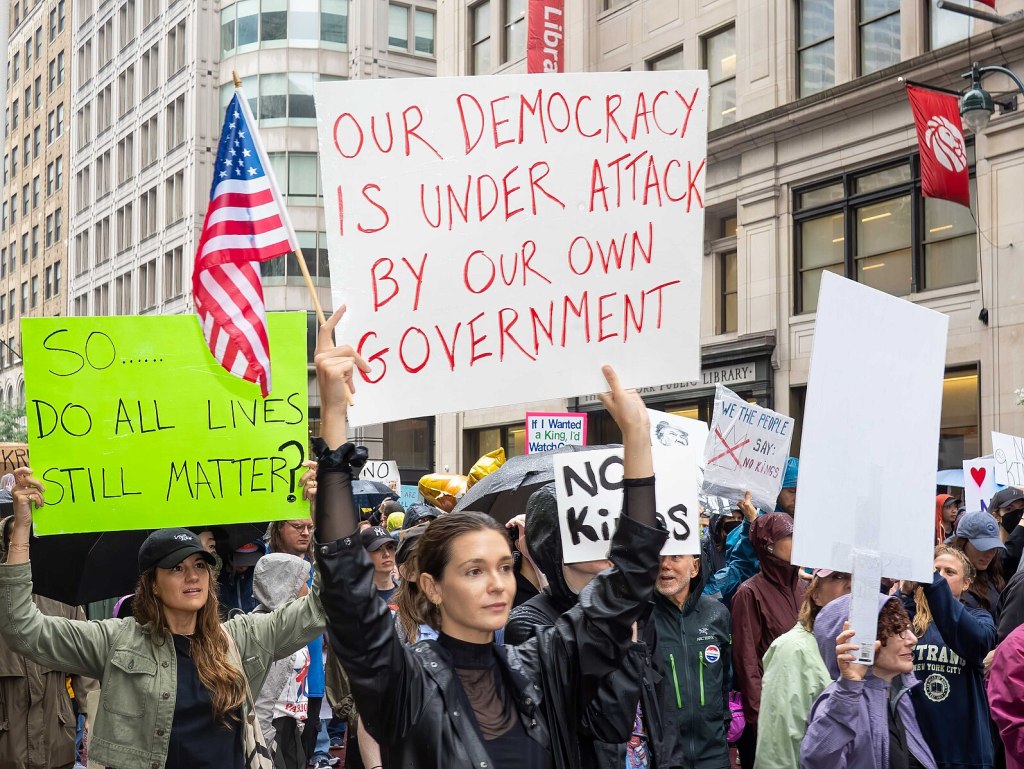
The judge isn’t doing his job. Well, sometimes the government seems not to be doing its job. And one thing we do, when that happens, is we demand better behavior. We write, we call, we sign petitions. We pour into the streets, demonstrating.
People marching for the No Kings protest in Manhattan, New York, 14 June 2025. By Wikimedia contributor “Rhododendrites.” Published under the Creative Commons CC BY-SA 4.0 license.
And sometimes the government, or the officials, respond. Not necessarily because they believe in doing the right thing, or because they care about us. We may not have changed anyone’s mind! But perhaps they fear the consequences, a little bit, some kind of real consequence, even if it’s just losing the next election.
And it does take a certain sort of persistence for that to work. You have to keep at it long enough that the specter of consequences becomes real to the officials you’re trying to reach. As long as the officials “neither fear God nor respect any human being,” what you’re after is their self-interest, in the end. And the minute they don’t feel bothered, there’s no leverage at all.
It’s certainly not an inherently partisan observation; it’s easy to imagine the same connection being made about all sorts of protests against government injustice or perceived government injustice. And the homilist I heard did not dwell on the specifics about what the crowds were protesting, just observed them as a fact: the crowds saw injustice, the crowds came out and demanded justice.
And like I said before, this parable is difficult to read because it’s not immediately clear how we’re supposed to understand the parts. Is God like this dishonest judge somehow? some readers might wonder. Are we to nag at him? I know I’ve been unsure how to read the parts of this analogy.
But if you take a moment to translate the parable into the context that you really live in, if you think, no, this judge is like when our government officials are corrupt, don’t fear God, don’t do their jobs, don’t respect the dignity of all human beings as inherently worthy of love… and the widow demanding justice is like us, protesting (something that doesn’t “get things done” by itself)… then it feels a little more familiar?
Because we can certainly imagine, that if we’re persistent, the corrupt government officials may act to preserve themselves or their power, and it might go our way. But the persistence is necessary. We can see that. We can understand that. If we give up, we lose our leverage over them.
So maybe this parable is about being persistent? And another word for persistent is faithful. Be persistent in faith, the way that you have to be persistent in nagging at government officials to get them to do something right for a change.
Even though God is nothing like these government officials. But if we can be bothered to rise up and call for justice from them, then we can also be bothered to call out to God as persistently.
And after all, the last question of the parable is one about whether we will have been persistent in our faith till the end.







 bearing blog