bearing blog


bear – ing n 1  the manner in which one comports oneself;  2  the act, power, or time of bringing forth offspring or fruit; 3 a machine part in which another part turns [a journal ~];  pl comprehension of one’s position, environment, or situation;   5  the act of moving while supporting the weight of something [the ~ of the cross].


  • What I ate yesterday.

    The first full day after having slept, we designated as a rest and orientation day. The only really important task was to make sure everyone could maintain blood sugar, body temperature, levels of serotonin, and personal hygiene.

    1. 5 a.m. I popped awake with one thought: obtain and demolish the half-sandwich Mark had stowed in the fridge. I obeyed and then slept four more hours.

    2. 9:30 a.m. Kids awake already, so I am deprived of obligatory two hours drinking coffee in silence. Cognitive issues, also lack of coffee, led to struggle with the drip coffeemaker. Gave up and used off-brand Nespresso pod to make bad espresso while Mark figured it out.

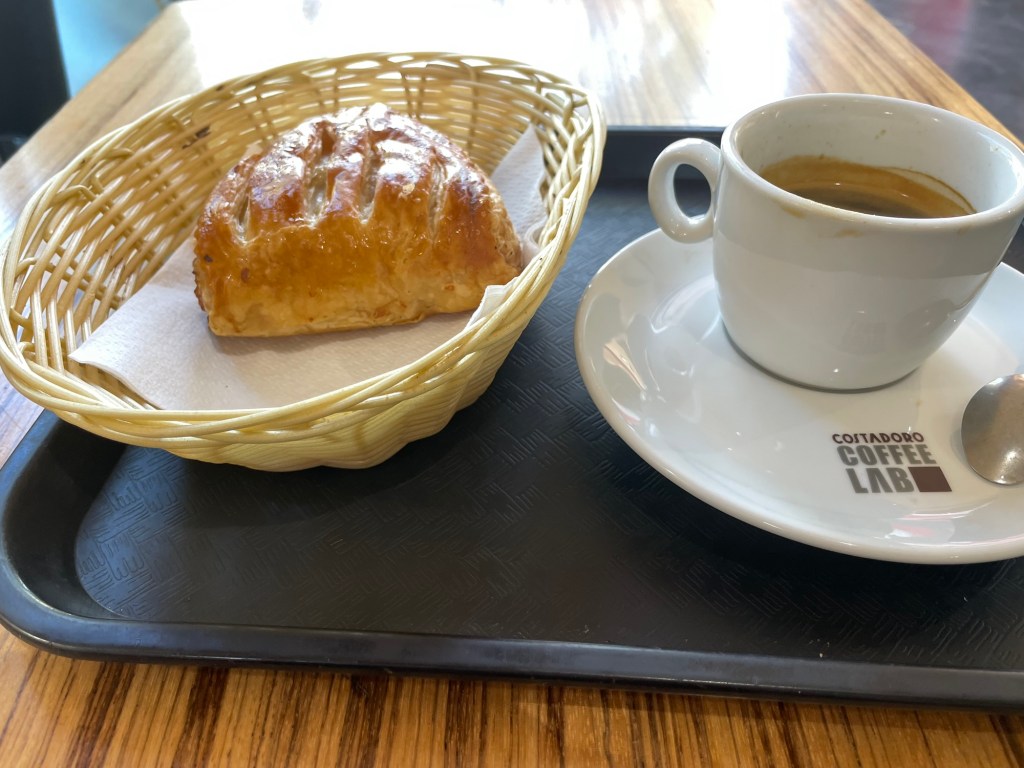
    3. 11 a.m. I head out with a shopping list of toiletries. First I find a bakery-café that will still sell me a Formule Petit-Déj, and I eat an apple chausson. It comes in a wicker basket and I get pastry flakes all over my black dress. The double espresso is better than aparment Nespresso. I write yesterday’s blog post and put up a picture.

    4. 1 p.m. We all go out to lunch immediately after I return from the store with shaving cream and shampoo and deodorant and paper towels and better coffee. I am flustered and tired and my brain is not working, and I misunderstand my family’s intention to walk around looking for a place, and I march up and ask for a table at the first restaurant we hit when we get to the beach. Before we know it we are seated at the seaside and Leo is explaining to me that the plan was to walk around choosing one, whereas I had gotten the impression that (a) everyone needed to eat sooner and (b) they had already preselected this particular restaurant by internet search. Oops!

    Fortunately the sea breeze is lovely, the umbrellas are perfectly shady, and the restaurant has pizza which both boys demolish eagerly, as well as really good frites.

    A teenage boy seated at an outdoor restaurant table frowns severely at a pizza as he saws at it with a knife and fork
    Leo using a knife and fork on pizza.
    A boy eats a slice of pizza at an outdoor table.  A bottle of orange Fanta is visible on the table and the restaurant façade is visible across the street:  “Restaurant des Artistes”
    Simon, happy.

    The boys say the pizza tastes like the English muffin pizzas I made using tomato paste, when they were little.

    I have the salad with goat cheese toasts and proscuitto and honey. Mark, duck breast and fries. I say I can’t possibly eat it all because my appetite is all screwed up but I slowly and gradually plow through it. And I force myself to drink lots and lots of water, which I know I need after the travel day.

    Tablescape:  salad piled high with charcuterie and goat cheese toasts in the foreground, a bottle of mineral water, then another plate with fries and salad visible.  Across the table a man wearing sunglasses and an orange shirt, sunglasses case in the breast pocket.  In the background, a beach with blue water, swimmers, a distant point of land
    Hungrier than I thought

    4. 4 p.m. Mark returns from the beach with children and I return from shopping again with vegetables and limoncello. (After lunch and a nap I had paged through Provençal recipes and settled on a “light vegetable soup”). We open the limoncello before it is quite cold enough and drink some, then we have glasses of leftover red wine. Then Mark takes Leo shopping for a wallet and I begin chopping vegetables.

    Kitchen counter piled with fresh vegetables and a bottle of wine.
    Vegetables, parmesan, herbs, a jar of French-made pesto with walnuts.

    The onions, leek, celery, carrots, zucchini, potato, and green beans are all finally in little tiny dice when I discover that I can’t figure out how to operate the electric cooktop. We poke at it for a while, discuss whether it is induction or infrared, search fruitlessly for a manual, google without the help of the model number, drink more wine, break a wine glass and clean it up, and finally Mark finds a YouTube video and learns how to defeat the cooktop’s child lock. I am delighted to open a cabinet and find a food processor, which my recipe requires but I had resolved to do without.

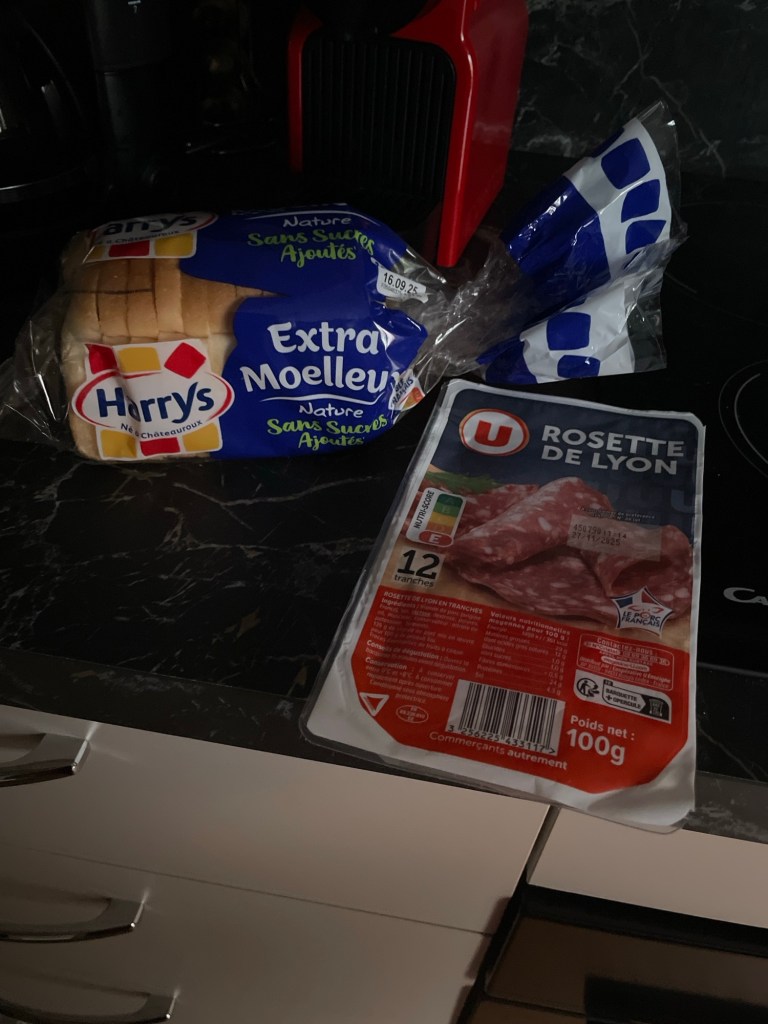
    Meanwhile, Simon makes himself a sandwich of rosette de Lyon on “Harry’s Extra Moelleux Pain de Mie Nature” and is very pleased with it. And Leo goes into town and comes back with apricot preserves and is very pleased with them.

    Kitchen counter with a plastic-bagged loaf of sliced white bread (reminiscent of Wonder Bread, but French) and a package of rosette de Lyon sliced hard salami.
    Salami and sliced white bread for Simon

    5. 7 p.m. I have sautéed lardons of smoked bacon in olive oil, followed by the hard vegetables and then the soft vegetables, then added water and a potato (1/4 of it in a chunk and 3/4 of it in small dice) and a parmesan rind and thyme and bay leaf and pepper and salt. I have simmered, then added two ripe whole tomatoes, and then retrieved them and peeled them before puréeing them with the soft potato chunk and a bit of brothy vegetables and added them back to the soup. I have removed the parmesan rind and bay leaves and added white beans, red wine vinegar, and half a jar of pesto.

    A bowl of vegetable soup in the foreground, white wine and jar of pesto in the background.
    Soupe au pistou.

    We eat it with chilled Macon-Villages white wine, marinated olives, a bowl of blueberries and a bowl of greengage plums, a package of jambon de Bayonne, and chunks of baguette spread with ordinary French grocery store butter, which is to say it is amazing butter.

    Somehow without having to work hard at it we manage to sit at the table for almost two hours leisurely enjoying our food and wine. I have to go lie down on the couch for a while though, while Mark and Leo do the dishes.

    6. 9 p.m. We go out in search of gelato (look, we are right on the border, all the glace is Italian-style, I’m calling it gelato). I fail to take any pictures, but trust me, we found it. Leo orders the ice cream except for mine. Mark declares his cone (one scoop of chocolate, one of coconut) the best so far. I have a serviceable but melty scoop of banane. Simon has a lemon sorbetto that tastes exactly like a tart lemon drop, which he declares perfect; Leo has that plus coconut. We walk back along the roaring stony beach, put the cooled soup away, and that ends our rest day. We have indeed been fed.


  • Arrivés.

    Yesterday is a bit of a blur. I mean Sunday and yesterday—blurred together, all into one.

    None of us slept much on the plane. I watched Interstellar on and off, interspersed with crossword puzzles. Arrival and passport control at Nice-Côte d’Azur went smoothly, all our luggage came too. Ten minutes’ confusion about how to buy tickets for the tram to the train station, no problem buying train tickets to Menton, no problem walking to and letting ourselves into the AirBnb.

    A marriage note!

    I’ll get used to it, I always do, but as soon as the plane lands outside the English-speaking world (cue dolly zoom) a certain set of roles suddenly reverses. Normally, when we are traveling with the kids, by unspoken agreement and long habit, I manage children and Mark deals with car rental counters, ticket-buying, lost luggage offices, hotel maintenance complaints, etc. Generally, having conversations with the hostile bureaucracy of commerce.

    But we are in France, and I speak French well enough, and now all of that is my job! And I know it is my job but every single time when I first hear him say “Stand over here and wait with me, your mom’s going to go buy the train tickets” I am suddenly gobsmacked.

    I mean, I can buy the tickets, it’s not a problem, but the switch takes time to reset in my brain.

    + + +

    We rested, went out to get pastries, came back, I went grocery shopping for milk and cereal and jambon serrano and cheese and baguette and wine and fruit and yogurt. We rested, then hauled the kids up and outside to catch afternoon sun, bribing them with ice cream. I distributed medication doses carefully at predetermined times in accordance with a spreadsheet I had made before leaving. We went back, ate the dinner, drank the wine, went out for more ice cream. Back again, melatonin for all, and finally the long sleep.

    We assigned Leo to order ice cream with his one year of high school French. I stayed outside and waited on a bench so I wouldn’t be tempted to jump in and rescue him. He did fine. He’s pleasantly surprised at how well he can understand things.

    OK, my chausson de pommes and double espresso are gone now. I need to go buy a month’s worth of shampoo and shaving cream. Catch you later.


  • Mental note for transatlantic travel

    Do not assign any weight whatsoever to how people feel about the city, the room, the food, and/or whose idea even WAS it to come on this trip anyhow, until everyone has had a chance to sleep several hours in a row.

    In other words, remember that it is just the jet lag speaking.

    Signed, someone who has been almost entirely awake for 24 hours now and just walked back from a grocery store.


  • Eighteen hours to go.

    I never sleep well the night before a trip. Yesterday evening, too, I made the mistake of having a couple glasses of wine while hanging out with Mark and our college-senior son. So it isn’t surprising that I woke at 2:45 am and only dozed after that. Now it’s 6:30 and I am drinking coffee. Perhaps later I can pretend that the early waking was a preëmptive jet-lag strategy. Perhaps it means I will easily sleep on a plane later today.

    + + +

    Our local adult son has house-sitting duty, so that part isn’t it. Our new college freshman is installed at school and sounds great on the phone, so that part isn’t it. Our oldest, launched—no unusual concerns there. Our two youngest have proved themselves competent travelers in three recent less involved trips. So why am I feeling anxious this morning?

    I think there are a few things going on here.

    For one thing, this is the first major family trip that’s only this smaller part of our family: we are traveling as a family of four, not seven. Other than a weeklong trip to Boston in autumn 2019 without our oldest, all our longer trips have involved all our kids. It’s strange to be so few, and also, I’m used to having extra adults and older teens around to help with things.

    For another, we have fewer activities planned. Mark has to work some of the time. The boys have schoolwork, with a loose goal for how much to do each day. I have pre-arranged but not pre-scheduled one adventurous activity; I have one side trip in mind; Mark has an idea about a grand day out for himself. But that’s it. This particular trip, we are intentionally embracing the possibility that we will not do very much vacation-y stuff. We are intentionally remaining flexible, open, unscheduled. Which is very much not how I roll.

    I guess there’s also all the ordinary travel-day jitters. I know we checked and double checked, but do we really have all the passports? I know I counted out all the medications, but am I absolutely sure I counted out enough? I know Uber is normal and works but will the Uber really show up? I know it’s in the hands of the airline but will we make our connection? I know we have seats assigned together but will the airline switch them at the last minute and put the kids elsewhere? Look, none of those concerns will be soothed until we’re all actually buckled in on the big plane.

    At which point (I know from experience) this last part of the fretting will evaporate completely. It’s possible that when it does, it will take the other frets away with it, and I will sink into my seat and truly relax.

    So let’s get there!


  • Emptier nest.

    A week ago we delivered our third child to the college dorm out of state for freshman year. This particular kiddo, unlike numbers 1 and 2, graduated from a public high school, and was emancipated from family dinners some time ago for health reasons. So we are all somewhat accustomed to a house with one fewer person in it, a dinner table with one fewer place setting, than we might expect.

    It still feels a little extra quiet, a little more roomy. Mark and I designed this house for a large family to live compactly: four not-enormous bedrooms, two and a half baths, a playroom with climbing walls in the basement, a game room in the attic. The schoolroom had four little matching desks. The seven of us made it a little crowded there for the four years leading up to the oldest’s moving out. Now we are a Normal-Sized family of four, and there is plenty of room for everyone. The four little desks are long gone. I stacked the extra dining chair off to the side.

    I’m excited for the newest College Kid. There was a string of struggles getting all the necessary accommodations for a disability that gives on-campus student life some significant extra challenges. So I am not at all sad, just relieved that in the end most of it came together for a good start, and ready to turn my attention to the next phase: just two kids at home, one middle schooler, one high schooler, both learning outside a school.

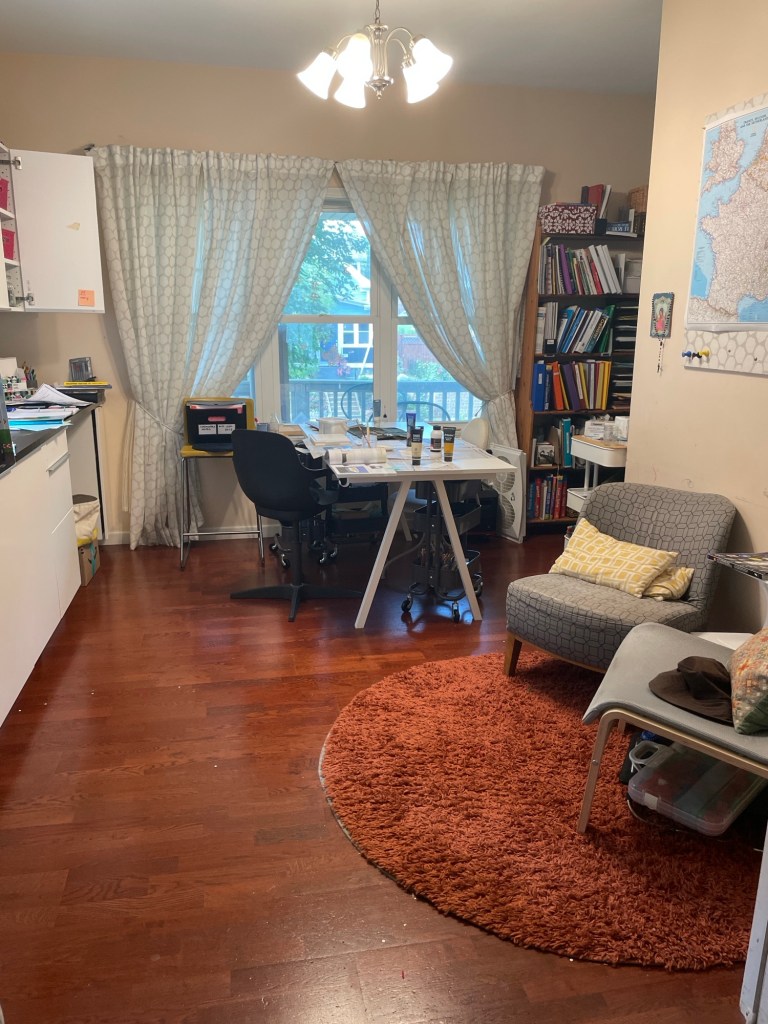
    A room with a curtained window at the far end looking out on the street.  A white table with a half-finished painting project spread out.  Two comfy chairs in the foreground, on a round area rug the same color as the wood floor.  A countertop and cabinetry, a stuffed bookshelf, a map of France on the bulletin board.
    The schoolroom now, with no little desks in sight.

    So I have some hope that I might be able to pick up blogging a little bit in the next month or so. Right now I am sitting in my rocking chair doing something I never thought I would ever want to do: writing a blog post with my thumbs on my phone. I am practicing, you see. For the next month or so.

    + + +

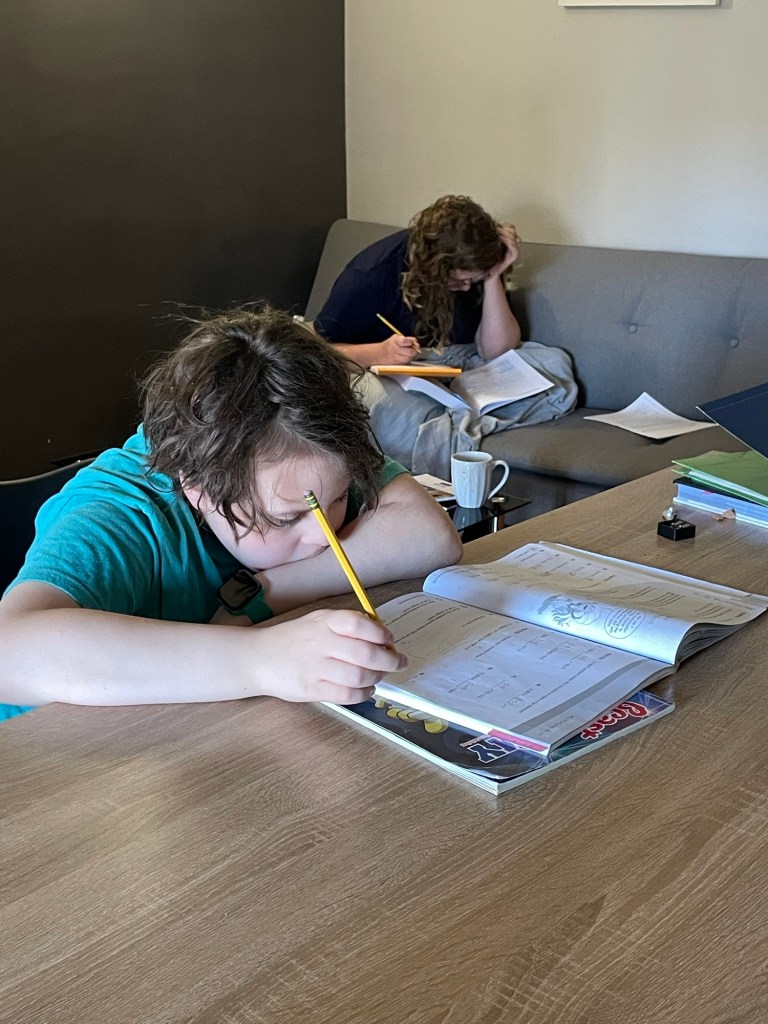
    We started school at the beginning of August, but we only did half-school. The 10th grader started chemistry, civics (uffda), and a bit of English. The 6th grader worked sort of loosely on everything, with a little extra art. That was nice, a slow entry into the year, and we got just as far as I hoped we would in a month. Half-school makes it easy.

    In September, since we have already done half a month’s worth of school, we will do the other half (at least we will try). We will set aside the chemistry and civics, and the 10th grader will start geometry and French II. The 6th grader will buckle down a little less loosely to math and English and history and science.

    But we won’t be doing it at home. Those books are currently distributed among several suitcases. We’re about to try something totally new: taking school somewhere else. And also, taking only two of our kids, the oldest three off living their own lives (okay, two of them are doing it on our dime, but still) in places where they have keys and we don’t.

    I’ll try to keep up!


  • This blog will be moving.

    TypePad has announced it will be shutting down at the end of September.

    I've managed to get most of the stuff migrated to WordPress.  It's messy and barebones for now, and all my internal links are currently broken, but here it is:  http://bearingblog.com

    Good thing I already had that domain name ready to go!


  • Blogging on the move.

    Well, I haven’t made any posts since Christmas, and only a handful since the start of the pandemic, and here I am making three or four posts in the span of a day. Thanks, TypePad, for imploding and forcing my hand!

    It’s not that I haven’t had thoughts for the last five years or so. I even wrote some down! With a pen on paper. I think I just got, well, less certain that the words needed to get out there. I definitely became less comfortable with writing in order to figure things out —at least, where everyone can see. It seems fraught, these days, to let a half-formed idea out into the world; even in order to invite people of good will to critique and answer it, and so to help sharpen it through friction. Maybe because there seems to be less good will out there? Or more ill will. Certainly—as today’s local news indicates—there is something out there, unpredictable: what spasm next, responding to who-knows-what?

    + + +

    I perhaps ought to write about that, but don’t want to. It’s so close; I am bound to know someone touched by it. No one wants the national news turned on their own city for something this dire and awful. No one wants that kind of attention. None of us want people who don’t live here to tell us the reasons why it happened here, while they go on thinking that it cannot happen to them.

    + + +

    I had planned to pick the blog up for a few weeks here in September. We’ll see if I manage. Maybe the timing is good, this forced move to WordPress. Be patient with the formatting—I have to figure out what I am doing—and I will try to prioritize checking in here. Maybe you’ll see some photos.

    Thanks for visiting. Au revoir? No—à bientôt.


  • test post

    nothing to see here for now


  • In the process of moving (blog hosts that is)

    Apologies in advance for all the permanently broken links and missing images. My priority is to get the text moved over here.

    img_6404
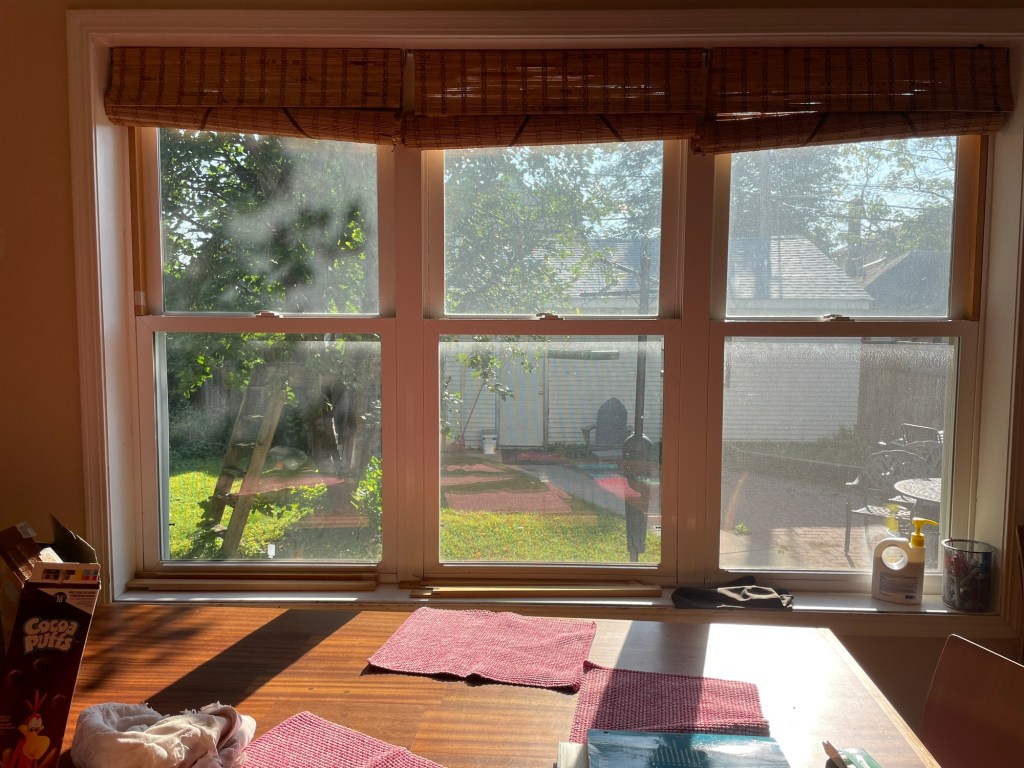
    Morning.


  • It’s the end of Typepad as we know it

    Welcome to WordPress! This is your first post. Edit or delete it to take the first step in your blogging journey.

    I have a few days to figure this out.


  • Hello World!

    Welcome to WordPress! This is your first post. Edit or delete it to take the first step in your blogging journey.


  • Unmuddling forgiveness (part II of a book report).

    Continued from the last post where I am writing about how a 2022 book is helping me clarify my thinking about repentance and forgiveness.  Recap:


    The point here is, this book helped me immensely in clarifying my thinking… It mostly has to do with untangling concepts that have become, at least in my mind, enmeshed with each other. 

    First off, Rabbi Ruttenberg separates the concepts of "the perpetrator's repentance" and "the victim's forgiveness."  The work that the perpetrator must do is not dependent on the victim's ability or willingness to extend forgiveness.  The victim's decision to forgive or not forgive may take place whether the perpetrator ever repents or not.  The two processes can inform one another but they are not the same process and they do not require the perpetrator and the victim to have contact or an exchange of any sort of information or messages with one another.

    That divides our discussion into two bundles of concepts:  one about the perpetrator's work, and one about the victim's process.   In a subsequent post, I'll write about how Rabbi Ruttenberg has clarified my thinking about the victim's part.  For the remainder of this post, I'll take up the perpetrator's bundle.

    The last post was about how Rabbi Ruttenberg's book clarified my thinking about the perpetrator's job of repentance.  This post will be about the work of forgiveness.

    + + +

    The discussion of forgiveness begins in the part of the book where Rabbi Ruttenberg is laying out the steps of repentance, because she needs to explain what it does and doesn't have to do with the perpetrator's responsibilities.  Recall (from the last post) that Rabbi Ruttenberg laid out the scholar Maimonides's five steps of repentance, and one post-script:

    •  owning up to the harm
    • forming a firm purpose of amendment (starting to change for the better)
    • making restitution and/or accepting punishment
    • making a sincere apology to the victim and other affected parties, possibly to the public
    • transformation of the self into someone who doesn't do that anymore

    When the obligations of the penitent (taken from the above five steps) are adequately discharged as far as he has power, then (in Maimonides's tradition) he may seek the last closure, i.e.,

    • atonement,

    understood in the context of Yom Kippur.

    The way that I'm being personally helped by this book is by the separation of these concepts, these steps of repentance as separate and necessary parts of the larger work of repentance, so they can be individually considered and evaluated.  And so, as we turn to considering forgiveness —let's look at that step of apology, which is obviously closely related. 

    In a good, complete, apology, a perpetrator usually asks for forgiveness.  I think we all understand that a perpetrator does not have the right to demand forgiveness; he should understand that forgiveness, if it is offered, is a free gift—otherwise, it's a confused sort of apology, if it counts as an apology at all.  Right?  Isn't that sort of the essence of an apology?  An acknowledgment that forgiveness is not deserved at least without some demonstration on the perpetrator's part?

    And indeed, in the steps of repentance, the apology does not come first, nor even second.  First the harm and one's part in it must be admitted, confessed to, acknowledged, truthfully and without minimization.   Next, the beginnings of change—and the barest beginning of change is the desire to do better.  Next, restitution and/or accepting consequences; at least this must be begun; one of the consequences one should accept is the necessity of the humble apology and the begging for (not demanding or coercing) forgiveness.  And then, with that evidence of walking the walk of repentance shoring him up, the perpetrator may apologize.  

    He begs for forgiveness, and then, whether the victim agrees to forgive or not, he must continue with the rest of the work. 

    In Rabbi Ruttenberg's view of Jewish law here, the victim is encouraged for their own good to forgive, but in certain circumstances is not required to do so.  Nevertheless, even without the victim's forgiveness, there is mercy here for the perpetrator.  Rabbi Ruttenberg explains that the law lays out a way for the perpetrator to know when he's apologized and begged forgiveness "enough:"  perhaps it wasn't "enough" for the victim, but it can be "enough" for the perpetrator to lay down the work of begging, accept that they will not receive the gift of the victim's forgiveness, and continue the work of transformation.  Atonement becomes possible when the whole process has been sincerely tried.

    + + +

    Recall, though, that our big question is:  what is meant by forgiveness?  What is this thing which, from the perpetrator's point of view, we are to regard as an undeserved gift from a victim—but which we Christians have often heard described as a required step for our own salvation?  How to untangle these concepts?

    The first clue we get from Rabbi Ruttenberg (who notes that English "forgive" comes from a word meaning "to give, bestow") is a distinction between two Hebrew words that are used in the context of forgiveness.

    The first is mechila, which might be better translated as "pardon."  It has the connotation of relinquishing a claim against an offender; it's transactional… the acknowledgment that the perpetrator no longer owes them, that they have done the repair work necessary to settle the situation…. It doesn't mean that we pretend [it] never happened, and it doesn't (necessarily) mean that our relationship will return to how it was before….With mechila, whatever else I may feel or not feel about you… we're done here.

    Slicha, on the other hand, may be better translated as "forgiveness"… It looks with a compassionate eye at the penitent perpetrator and sees their humanity and vulnerability, recognizes that, even if they have caused great harm, they are worthy of empathy and mercy…. [i]t does not denote a restored relationship…(neither does the English word, actually; "reconciliation" carries that meaning), nor…a requirement that the victim act like nothing happened.  But it has more of the softness, that letting-go quality associated with "forgiveness" in English.

    Notably, the Jewish literature of repentance mostly deals with mechila… What needs to be done to close accounts, here?


    So we begin to think of these two different ways we might imagine "forgiveness."

    And then we also consider the two sides of the forgiveness coin, or currency:  There must be a sense in which forgiveness, if it is to be given, must be given freely; else, a perpetrator would have the right to demand it from us (and we know, especially from having been repentant perpetrators ourselves, that it is repellent to consider such a demand as just).  And there must also be a sense in which Christianity requires it of us somehow:  the words in the Gospel of Matthew must mean something.

    + + +

    I'm inclined not to make any prescriptions at this point about whether one or both of these Hebrew concepts, slicha or mechila, is exactly what Jesus meant when He talked about forgiveness.  I'm inclined just to note that they do, indeed, appear to be two different concepts, and it is easy to imagine being prescribed (as a victim) to do our best, at the appropriate time, to achieve one or the other. 

    Mechila:  It makes sense that there may come a point when the perpetrator, having repented, having paid us what he can, has done enough and we don't need him to do anymore; a point when it would be better for us to move on with our lives.   (Rabbi Ruttenberg notes that, in cases wheref the harm is irreparable, she agrees with authoritative sources who say the victim is not obligated to forgive at all; but she concedes that it may be better for the victim's healing to choose to do so.)  It squares with Christian thought that we ought to refrain from total retribution or from insisting on reparations that leave the perpetrator in utter poverty, even if this was the only way to be made whole.

    Slicha:  It also makes complete sense, in the Christian worldview, that no human being is worthless, God loves everyone, and so simple humility and truthfulness requires us to remember that humanity, the need for mercy.   They may, for instance, deserve pity, and an understanding of circumstances that explain, if not excuse, the behavior.  This is the sense where instead of hoping for the perpetrator's downfall, it accords more with Christian thought to try to hope for the perpetrator's conversion, repentance, and eventual salvation.

    So maybe Jesus means:  When the perpetrator has repented, apologized, and made amends, started to become better:  then, release them from their obligation to you.

    Or maybe Jesus means:  After the hurt has passed, remember that the perpetrator needs mercy, as you also need mercy.

    But neither of these are necessarily places that we can get to quickly, or easily.  The medicine may be good for us, but it can be bitter.  And it doesn't go down in one gulp.

    + + +

    From a podcast called We Can Do Hard Things, episode 163, "How to Make Wrongs Right with Rabbi Danya Ruttenberg," in which the hosts interviewed the author:

    …It often feels like, 'can you forgive me?' feels shorthand for 'can we pretend that that never happened?  Can we go back to a way where that never happened?'  And that feels like… the opposite of forgiveness for the person, which is accepting that it can never be…"

    Here are some things that forgiveness (either kind) is distinguishable from:

    • forgetting what happened
    • healing from the trauma caused by the perpetrator
    • transforming the injury into wisdom or growth
    • transforming anger, rage, or sorrow into positive actions
    • having compassion for the perpetrator's suffering or poor situation
    • declining to hold the perpetrator accountable
    • minimizing the harm or the intent
    • silence that protects the perpetrator or the systems within which he was able to cause harm
    • restoration of the relationship to the way it was before; pretending the injury never happened
    • reconciliation, returning to a renewed relationship
    • putting oneself back in reach of the perpetrator, where he has the opportunity and perhaps the temptation to harm you again in the same way.

    The injunction to forgive others their trespasses—mechila or slicha or some other mysterious thing—has been used against sincere Christians in a sneaky way, to imply that Jesus wants their silence.  Jesus wants their not making trouble.  Jesus wants them to forget, to pretend, to not be so goddam sensitive.    So there is a long, painful history of coerced forgiveness there, which is not really coerced "forgiveness" but is instead coercion that aims at some combination of these other things, these things which serve the perpetrator and serve the structures that let the perpetrator do harm.

    Rabbi Ruttenberg's formulation also seems to imply that in serious situations, forgiving too soon may actually deprive the perpetrator of an opportunity to do the real work of repentance.  What if, deprived of consequences, the perpetrator never realizes he has work to do at all?  Forgiveness is a gift, but (at least initially) withholding forgiveness might be a gift as well.  It depends on the human beings involved.

    + + + 

    I think that the answer  to "how do you know when you've forgiven?" is not one that can be addressed in generalities.  I very much doubt there is a single formula that is correct for everyone.

    Instead of asking "Is forgiveness something that mostly happens inside the forgiver?" —I think we have to, within our situation, ask:  Is the forgiveness I am called to try to achieve, something that will happen mainly inside me?  

    Instead of asking "At what point in the process of a penitent's repentance must forgiveness be offered?"  I think we, in a particular situation of forgiveness, need to be asking:  What evidence is there that this person who harmed me has acknowledged what he did, has remorse for it, desires to change?  Has he repaid me or accepted the consequence?  Has he done as much as he is capable of?  And then, upon determining the answer to these questions:  Can I forgive him at this point?  Would that interrupt his process?  Does he need to know about it?

    These are principles that must be considered and worked through—like so many moral questions.  They are not canned answers that work the same way in every circumstances.  But with a clear idea of the difference between forgiveness and the things that masquerade as forgiveness, victims have a better chance of escaping the false forgivenesses that serve neither justice nor mercy, and finding a place of real peace and closure.

    I recommend Rabbi Ruttenberg's book as an example of that clarity.