bear – ingn 1 the manner in which one comports oneself; 2 the act, power, or time of bringing forth offspring or fruit; 3 a machine part in which another part turns [a journal ~]; 4 pl comprehension of one’s position, environment, or situation; 5 the act of moving while supporting the weight of something [the ~ of the cross].
Mark likes to tell a story from a trip to Rome he took without me, where some local he made English small-talk with warned him that he needed to stay away from “the dangerous parts of Rome.” Mark inquired what parts did he mean, and the gentleman leaned in and said, “You see, there are places here where you will pay too much for not very good food .”
I’ll just say, here in Menton we have had no dangerous experiences at all.
Most meals cost less than it would cost us to go out in our home city, and that is even if you correct for the differences regarding tax and tip and even with us drinking more alcohol (since neither has to drive) than we would at home.
Ice cream costs less. Wine costs less. Sodas for the kids maybe cost a little more. Groceries seem to cost less.
And we’ve now eaten at lots of different places, including some you might expect to be dangerous. Bistros right on the sea. Brasseries in sight of the very-photogenic stairs leading up to the basilica. Snack bars, kebab shops, pizzerias, sushi even. It’s all great.
Well, the sushi was about as good as good American sushi, so nothing mind-blowing, just familiar and yummy. And last night Mark had some swordfish that he thought was just okay, but that might just be that he isn’t as into swordfish as he thought.
Anyway. Just another nice and pleasant note.
Today we’re off to Nice early to fetch our rental car, so I have to keep this one short.
What makes a vacation? Are we on vacation every day here, or only on days (like today) when Mark isn’t working and we’re not doing school?
At first I thought it was a half-vacation. Now I think, at least for me, it’s the whole time.
+ + +
George Carlin did a bit called “A Place for My Stuff” that I’ve been thinking about (link has both video and readable transcript):
Sometimes you leave your house to go on vacation,
And you gotta take some of your stuff with you…
Gotta take about two big suitcases full of stuff, when you go on vacation,
You gotta take a smaller version of your house, It′s the second version of your stuff…
Go read or watch, it’s pretty good.
Anyway, what I was thinking is that one of the things that makes a vacation—at least for me—is that you’ve voluntarily and temporarily left so much stuff behind you.
(Voluntarily and temporarily are both key. We haven’t lost our stuff in a hurricane or fire. We are not refugees. We have not renounced our worldly goods and gone to live as hermits or anchorites. We have not downsized to a retirement home. )
We have a lot of luggage, it feels like, and I won’t know until we see the weather in the mountains next week whether I seriously overpacked or packed just right (because I have a whole set of warm clothes I haven’t touched). We have about one tote bag’s worth of schoolbooks and worksheets. I brought a library book with me which I shouldn’t’ve, because someone reserved it after me and the library wanted it back yesterday. We have ice tools and climbing gear and helmets. Leo has a laptop and Simon an iPad.
But it’s still so much less than the sum of all our stuff.
+ + +
I once read somewhere a claim that men and women, in general, have different definitions of “comfort foods.” It probably doesn’t divide quite so neatly between male and female, could well be generationally outdated and has more to do with a dichotomy of personal history. The idea was that (generally speaking) men rattle off favorite comfort foods like pot roast and homemade apple pie, whereas women mention ice cream and packaged snacks.
The difference was supposed to come from what the food represents to you, especially whether it’s something you associate with labor or rest, being cared for or working to take care of others. A pot roast is maybe less comforting if generally you are the one who will have to make it. Ice cream and packaged snacks don’t demand time in the kitchen.
(Important note: This is not any kind of jab at my own husband, who makes the Thanksgiving pot roast every year. And it doesn’t quite work for me, because I find cooking relaxing. But I do grok the importance of associations to emotional content.)
So I wonder the same thing about “I left my stuff behind, so it’s a vacation.” For me I am sure that some of the rest comes from having a break from needing to care for or even think about all the stuff we have.
I am glad to have so many resources! A whole library of books; a pantry full of spices and canned goods; nearly always the right tool for the job. In fact I very much dislike being without a thing I expected to have, and I like a life of comforts and conveniences and the things that keep, or seem to keep, certain troubles at bay.
But I can’t deny that everywhere I look, when I’m at home, I see unfinished labor. This needs tidying, that needs mending, when was the last time I cleaned the…? And can I even find the things I need? And why am I tripping over this object left in the middle of the floor again? And the objects that have vague unsettlements attached… that game I bought the kids that we never play, the unfinished-book pile, the half-done project.
I should ask Mark, who has to go on quite a lot of work trips to not-particularly-exciting towns, whether not having any of his stuff with him feels freeing to him at all, like it does to me, or whether it’s more of a necessary nuisance.
We still have to sweep the floor and do the dishes in this little apartment, but there’s so little stuff in the way that it’s a pleasure.
+ + +
Having kids along with you who have particular needs for certain familiar items, sensations, and supports will color it a little bit, I suppose. Some stuff is almost non-negotiable. It’s certainly true when you have very young children, or kids with some types of medical conditions or neurodivergencies. As they grow and get better at self-regulating, at self-management of their medical needs, better at foreseeing and solving problems, better at making do—those are developmental skills—it gets easier to pare down what you carry. And we are getting there!
Still, we made room for a few things, and for some autonomy in prioritizing luggage space. For example, although I planned to buy toiletries and certain personal items over here, I told the boys to identify any familiar brand-name items they felt they needed to bring (Simon chose watermelon-flavored toothpaste, Leo his favorite hair care products—hey, I brought a couple of those too). And we made room and weight-allowance for Leo’s sleeping hammock and a metal-tube-type hammock stand that disassembles and has a carrying case. That’s pretty bulky, but sleeping well has such importance that we never questioned whether to take it along.
These extras only mean that I—who claim to love the paring-down to essentials—need to pare down a little farther. I can do that, to make travel a little less easier on those of us who need a bit more support. The “easier” will ripple out to the rest of us anyway.
+ + +
Another thing about the George Carlin bit that I like is his description of trips-within-trips and how you bring less stuff along with you each time, a subset of a subset of a subset:
Aww, no. NOW what do you pack? Right- you gotta pack an even SMALLER version of your stuff. The fourth version of your house. Only the stuff you know you’re gonna need. Money, keys, comb, wallet, lighter, hanky, pen, smokes, rubber and change. Well, only the stuff you HOPE you’re gonna need.
It puts me in mind of a matrushka doll, a nested set of boxes, a concentric Venn diagram. What you have, what you might need, what you know you’re gonna need, what you really need.
(Pause, though, to acknowledge that the diagram isn’t concentric for everyone; an acknowledgement that demands a response, gratitude and humility and discomfort and charity.)
Carlin’s bit is meant to be absurd, and it is, but also: it’s a reminder that those of us who live in plenty, so much plenty that it’s a bit of a relief to get away from our possessions once in a while—we can cut back on it. And maybe in some seasons of life it makes sense to lay up a cushion against all the might-happens, but eventually a lot of us—not everyone—will need to leave some of that stuff behind for our own good or someone else’s.
Ultimately we will leave it all behind, so there’s virtue in practicing. In deciding which stuff goes in which box, or circle; in shedding things like a snakeskin, and being bigger on the inside.
Will I remember this when I get home and contemplate my overstuffed bookshelves? Maybe, maybe not. I will let you know, when it happens, whether I am happy to see them again.
Let’s talk a little about jet lag, sleep, time zones, and energy. Also what we see and hear around us. In between, some irrelevant pictures from yesterday (and a brief video).
Headed toward lunch at the marina.
We are seven hours ahead of home in Minneapolis. We got here via a very brief layover at JFK. Thus the “overnight” flight skipped six hours of time while simultaneously lasting about six hours. I don’t think any of us did more than doze, so the effect felt more like one really long day, not one really short night.
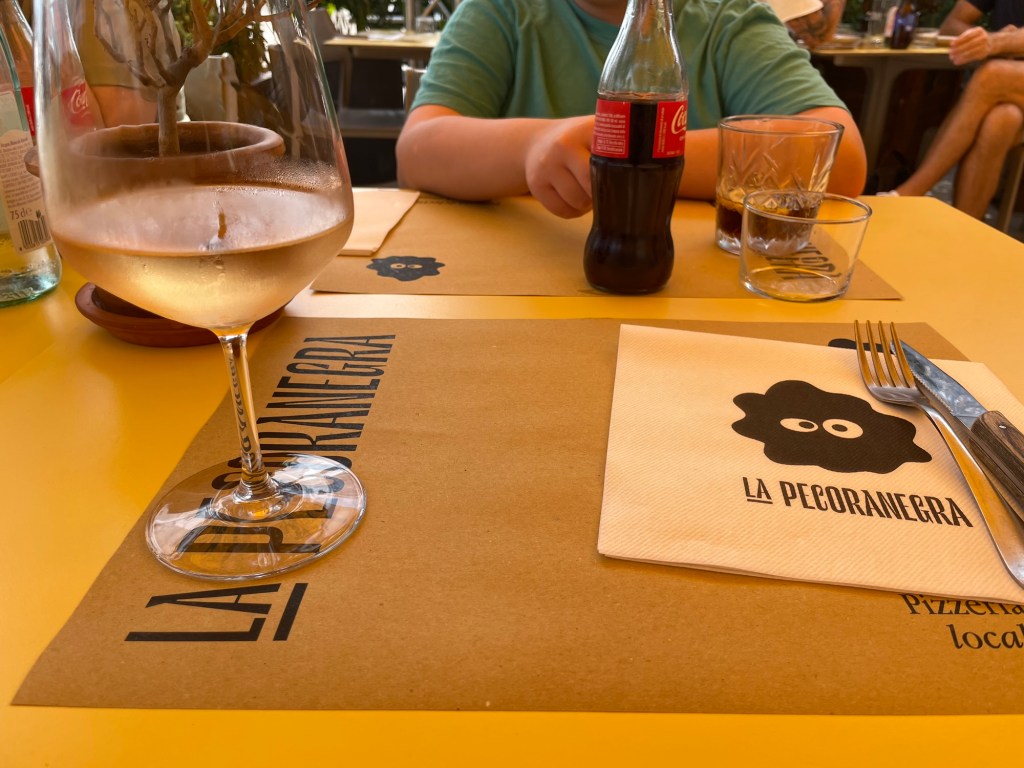
A favorite Mpls pizza restaurant is Black Sheep. Here is the Franco-Italian version.
One thing I was really careful to prepare for is medication. One of our kids is on a highly dialed-in medication regime involving five prescriptions and three OTC supplements, taken at four clock-times during the day. Normally I fill weekly dosing boxes every Sunday night and he is responsible for taking them on time, but it’s generally pretty important they be on time.
I carefully made a spreadsheet before we left and separately counted the hours between each of the different doses, and filled them into tiny ziplocks numbered 0-5 (the zeroth bag was for the last dose at home about an hour before our Uber came). Then doled them out: on the first plane, in New York, two separate times on the long plane, in the Nice airport. The once-a-days wound up coming at intervals of 21 hours twice. The one that could be six hours apart was not disrupted at all. The melatonin and the one that is a sleep aid were deployed strategically to match the new time zone. It worked! No noticeable I-missed-my-meds effect.
Tuna, onion, olive.
I hardly remember how we slept the first day or two, just that the first day we tried to stay up all the way till about 8 p.m. I felt mostly normal by day 3. But we haven’t had the same sleep schedule as at home.
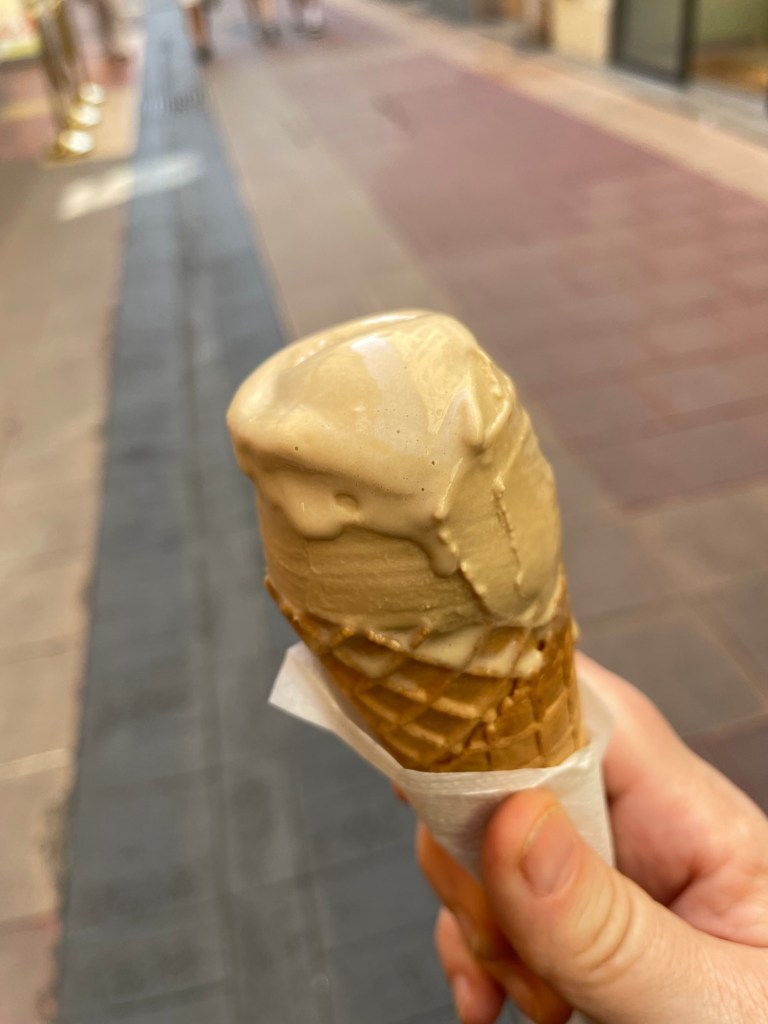
Licorice gelato!
One of my college kids takes a medication that requires a dose at bedtime, around 10:30 pm, and a dose four hours later. For a long time I have served as a backup alarm for that second dose. At home we do it with an Amazon Echo Dot at my bedside that the college kid can set and un-set alarms on remotely with the Alexa app. It’s a good system.
Here, dose 1 is around 5:30 a.m. I get a text. Later I make sure I got the second text for dose 2; if not, I call. Anyway, that 5:30 am text wakes me fully up for a little while. I get on my phone and catch the last hour of U.S. social media before everyone goes to sleep. Then I get sleepy again, put down my phone, and doze off till 7:30 or 8:30.
This is technically the southern end of the Alps running down to the sea
Mark sleeps in later than I do. His colleagues, with whom he occasionally has to meet, are working (in our perspective) from about 3:30 pm till midnight. So it literally does not matter when he gets up in the morning. He normally works from breakfast to lunch, then we take a long lunch, then he has meetings until 6 or 7 or 8. Not every day though, some are vacation days.
I’ve also been starting late so I can blog. I am out of practice, it takes longer than it once did.
I have a mission to the grocery store
I needed an afternoon nap a couple of times. And yesterday Leo got a little lost after lunch—he walked to an interesting cemetery to look at very old tombstones, but Google Maps had trouble getting him out because it interpreted all the short ways out as Not For Pedestrians and sent him on foot wayyyy uphill first—and by the time he got back he was hot, thirsty, frustrated, and sore. So we sent him to rest instead of afternoon school. But since he missed only his French lesson, I figure we broke even.
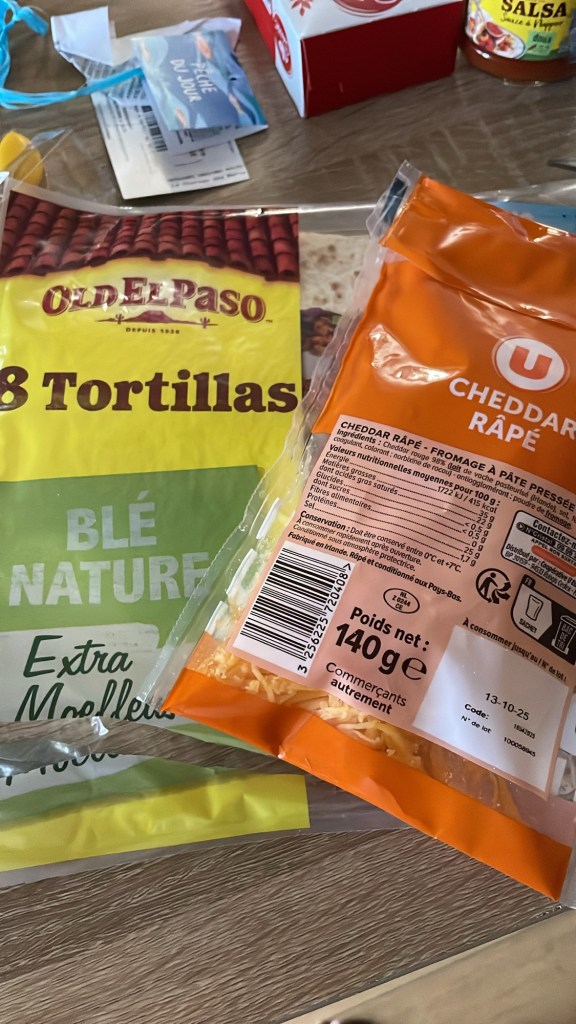
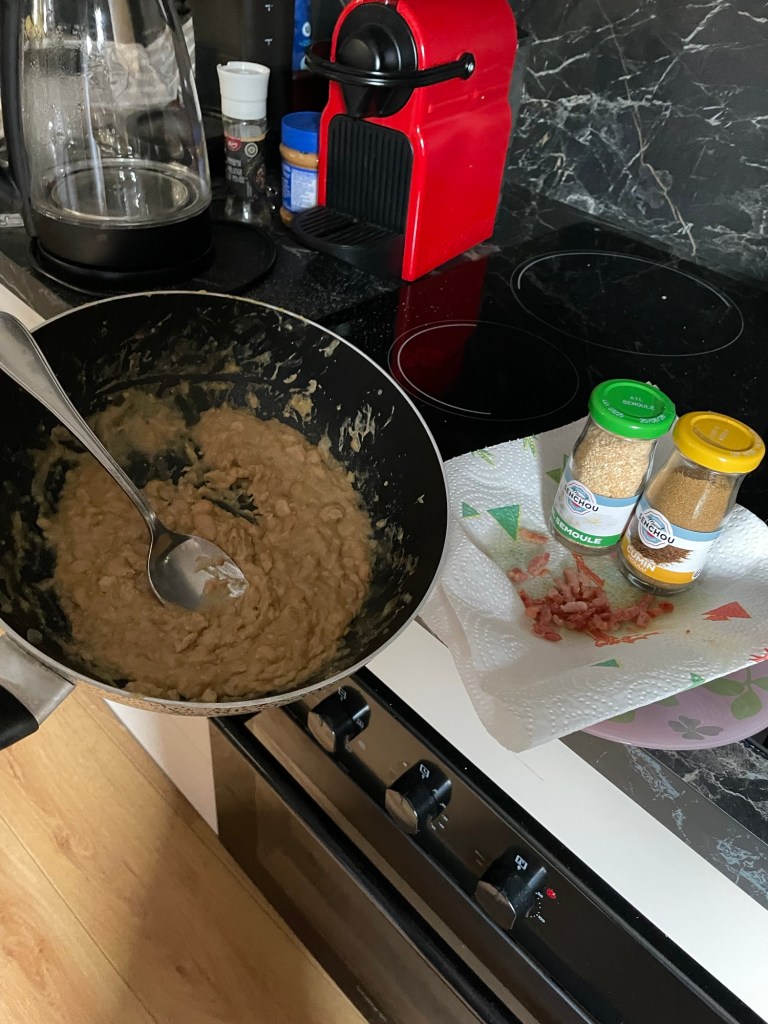
The mission: make quesadillas like we have at home
After school is when I get a little time to myself. The boys mostly want to use screens, though Leo ventures out alone sometimes, so sometimes I stay and sometimes I go out. I am enjoying walking around and people-watching. I exit the apartment around the time schools let out here, so there are many children with backpacks being escorted home by a parent or grandparent (not a few are being given ice cream cones) and many uniformed teenagers standing in clusters on the street talking animatedly.
This is clearly a vacation town, and the streets of the vacation-town part (the part that has an abundance of gelato shops as well as souvenir shops and citrus-themed boutiques) are thronged with shoppers. We hear lots of Italian and lots of English: Americans, different British accents, and a couple times Australia or NZ. More rarely, something Slavic-sounding, and even more rarely than that an East Asian language.
But obviously, regular people live here too. There’s a middle school right around the corner. It’s also got a campus of one of les grands écoles, Sciences-Po, and they just started for the fall. And on Saturday there was a street fair of all the clubs and organizations and things in town: soccer clubs and parishes and gyms and the like.
Refried (cannellini) beans
Dress here is largely vacation casual. We made the kids pack better shoes and collared shirts, but I needn’t have bothered: even Sunday mass was shorts and sleeveless tops on most people, and they were not all tourists because that included the parents and godparents of the baby being baptized. It’s hot here and people dress for it.
You do see the whole range if you look: elegant older women with scarves and stylish not-too-high heels, a few men who might have stepped off a menswear blog, through that magical French effortlessly-put-together look, down to just-off-the-beach (but covered). I don’t see leggings-as-pants or exercise clothes on anyone not actually out for a run or on a bike. I don’t see anyone dressing consciously to stand out: hardly any brightly colored hair, no one in torn clothes or avant-garde or Goth looks. There are people in evident poverty, some begging, most minding their own business seated on a step here or against the wall there, perhaps smoking, perhaps enjoying the cool of the building’s shade, perhaps thinking or people watching like me.
I succeeded in making a relatively normal kid-quesadilla
I see a lot of maxi skirts in a light billowy fabric, and oddly, some in a slinky, satin-shiny, stretchy fabric as well (it looks too warm for this weather). There are a lot of men wearing casual short-sleeve shirts that appear to be crocheted: some like polos, some buttoned. Crocheted dresses on women too, sometimes a tight opaque “weave,” sometimes with a pattern of open and not-so open eyelets, sometimes very open but layered over something that peeks through. So keep your eye out, perhaps that’s next year’s look in the states.
The same courtyard as a couple nights ago, but a different restaurant.
Overall, we get the impression that this is a vacation town for, you know, not the Monaco elite, but regular people. In a country where regular people, by law, are allotted at least five weeks’ vacation, I would hope there is room somewhere along the Riviera some of the time. I don’t beach enough to think of what American beachfront vacation town it would be analogous to. Maybe there is no good comparison.
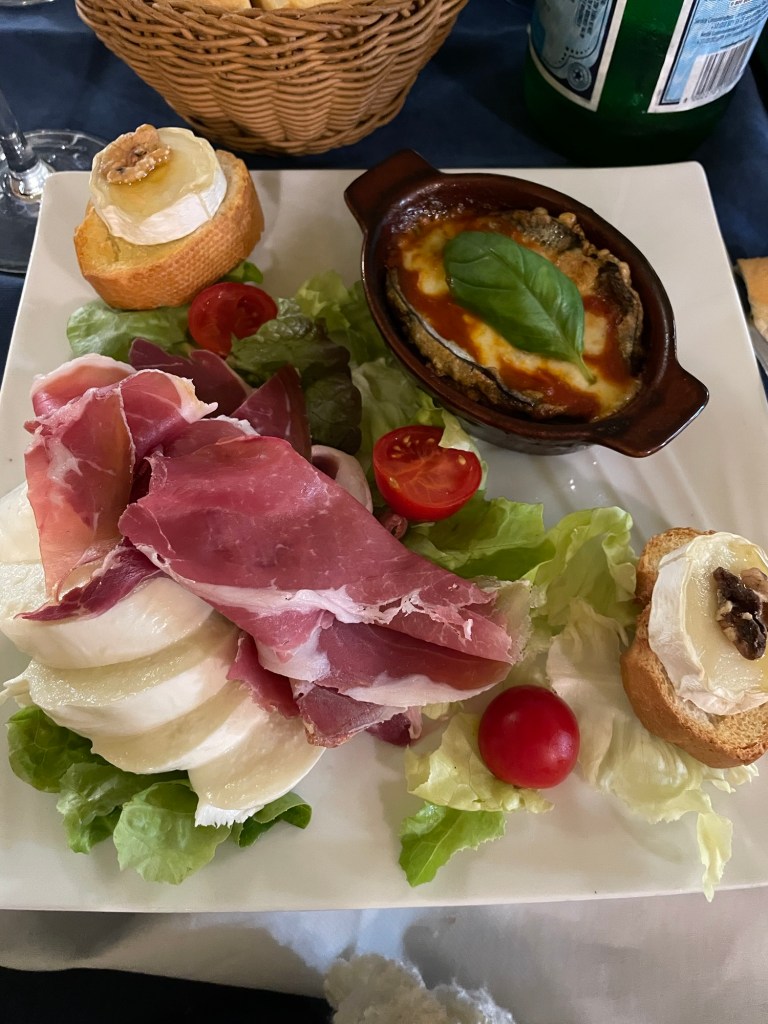
Antipasti for dinner. The baked cocotte is eggplant.
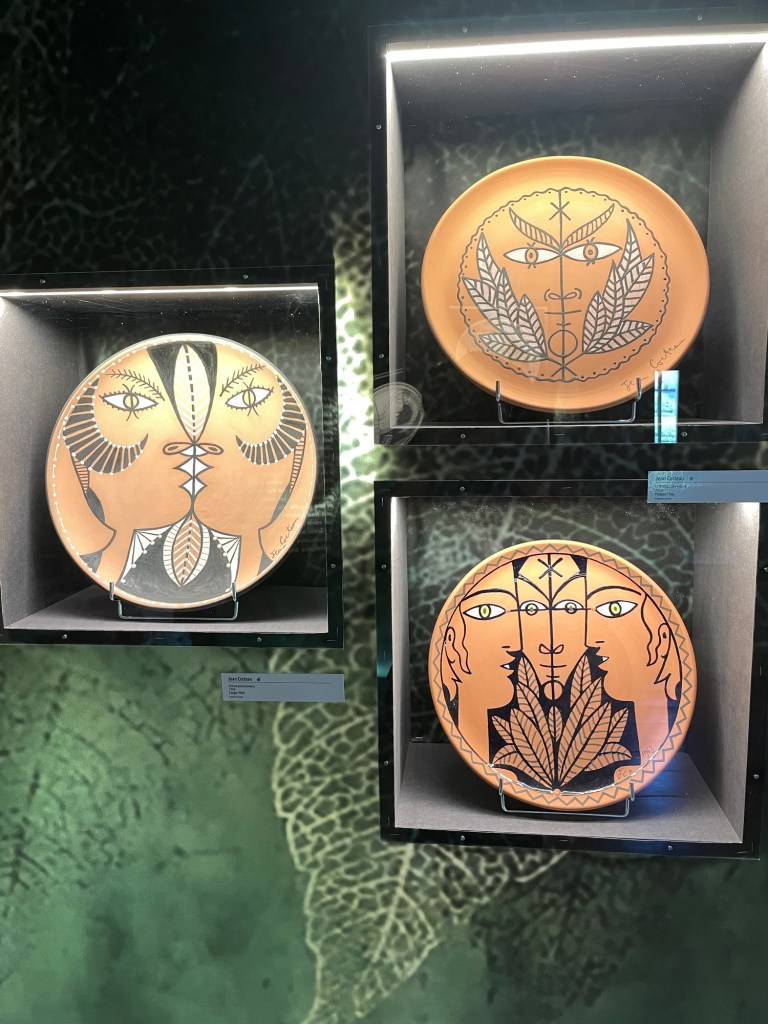
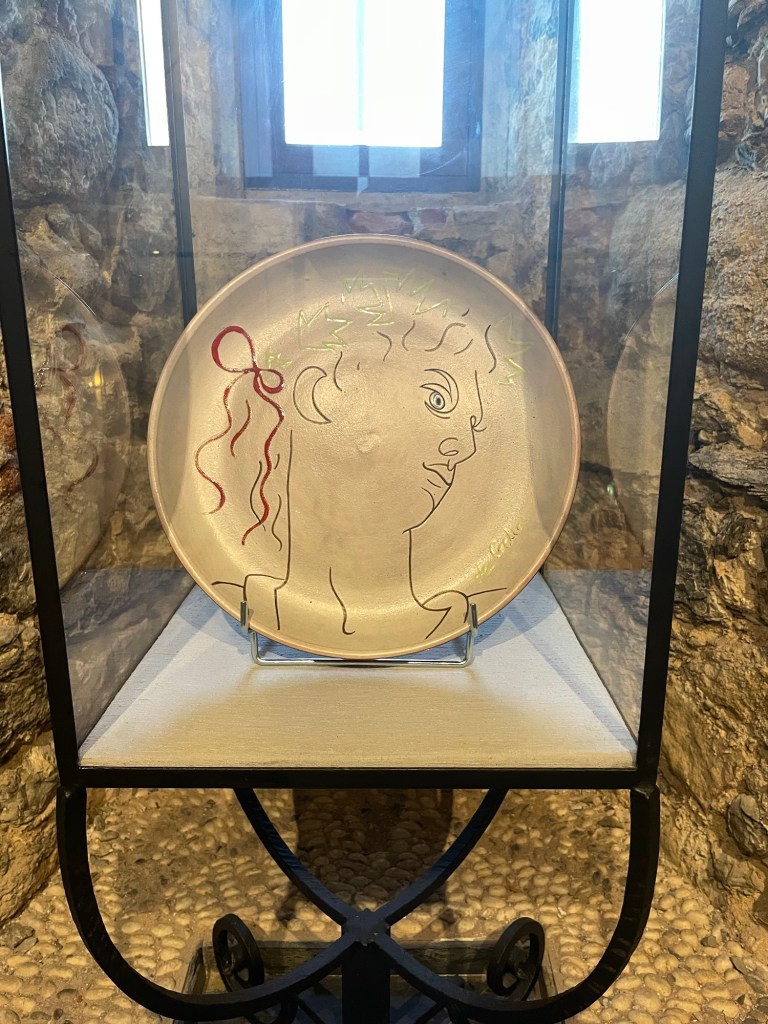
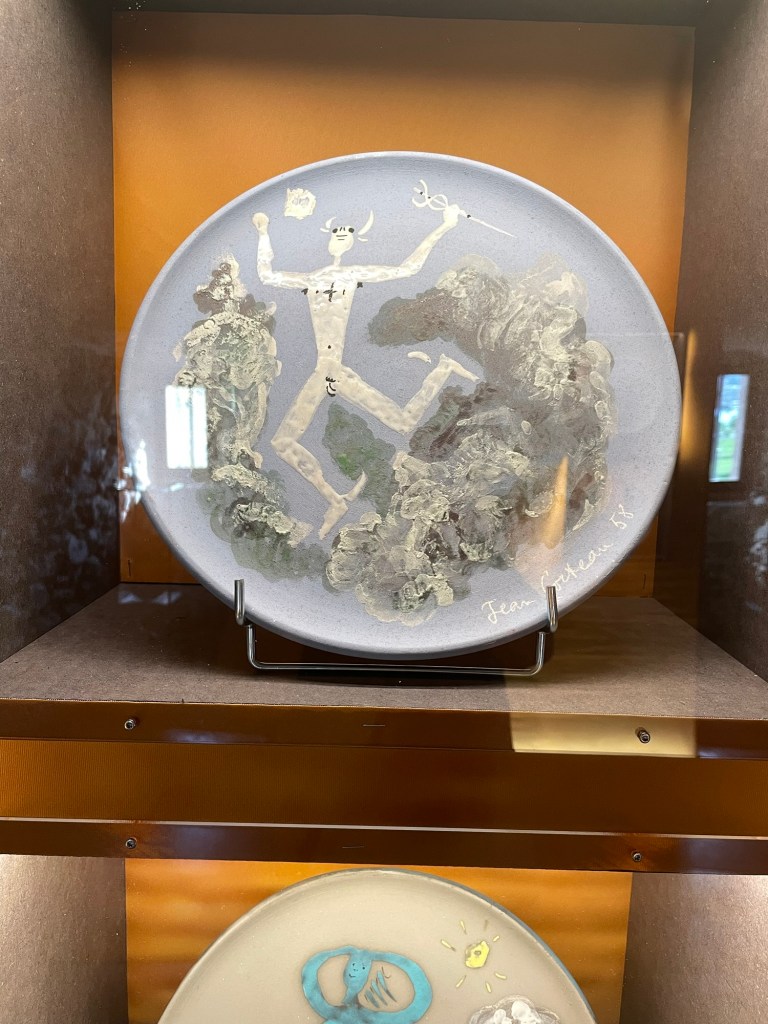
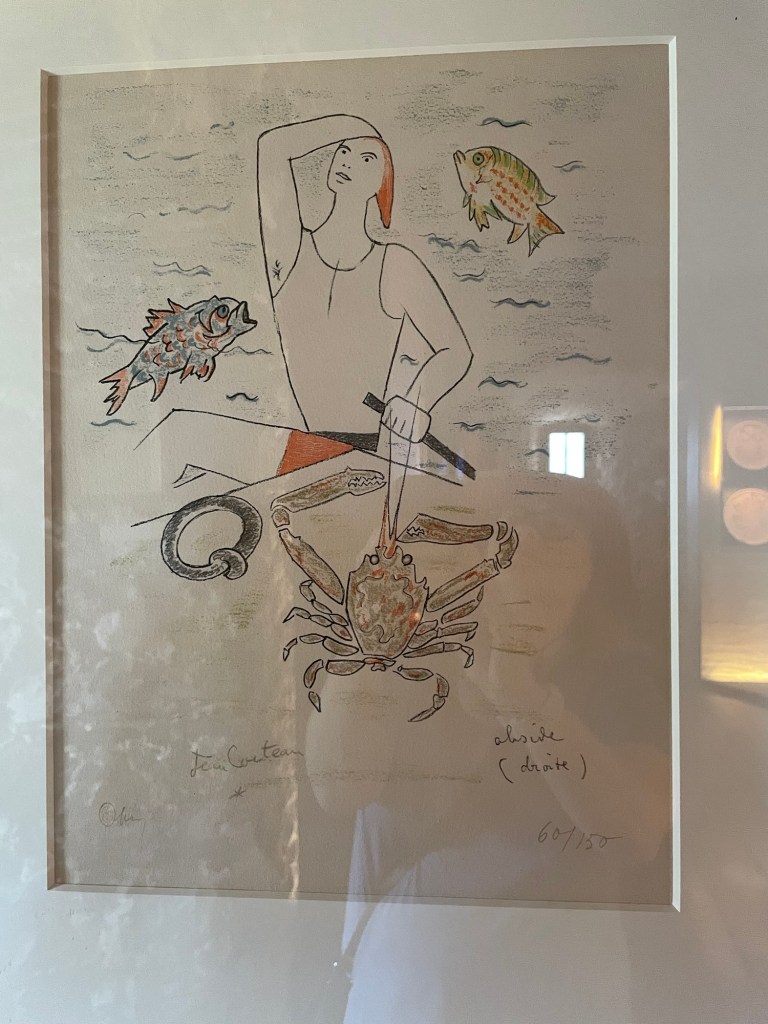
I didn’t do my homework before coming here, so I haven’t learned as much about Jean Cocteau (1889-1963) as I ought. He seems to be one of those artists who has his hands in everything and who knows everyone. Wikipedia calls him a “poet, playwright, novelist, designer, film director, visual artist, and critic,” “one of the foremost avant-garde artists of the 20th century,” “hugely influential on the Surrealist and Dadaist movements,” “‘closest to being a Renaissance man.”
I think maybe the only thing I knew about Cocteau was a sliver of cinematic history picked up from somewhere: that he was the director of the 1946 film Beauty and the Beast. (Here’s a deep dive on that film). I could maybe have picked him out of a lineup of Early 20th-Century Iconoclastic Artists. I’ve probably seen a portrait of him; counting photos, paintings, and sketches, there are many in collections around the world.
Cocteau is particularly associated with the French Riviera, especially Menton. Here’s a brief summary of his prominent works in Menton. Here’s a small photo gallery of the interior of the “Fishermen’s Chapel” of St. Peter, in Villefranche-sur-mer, that he completely redesigned in 1956-57; Googling for more photos will be rewarding.
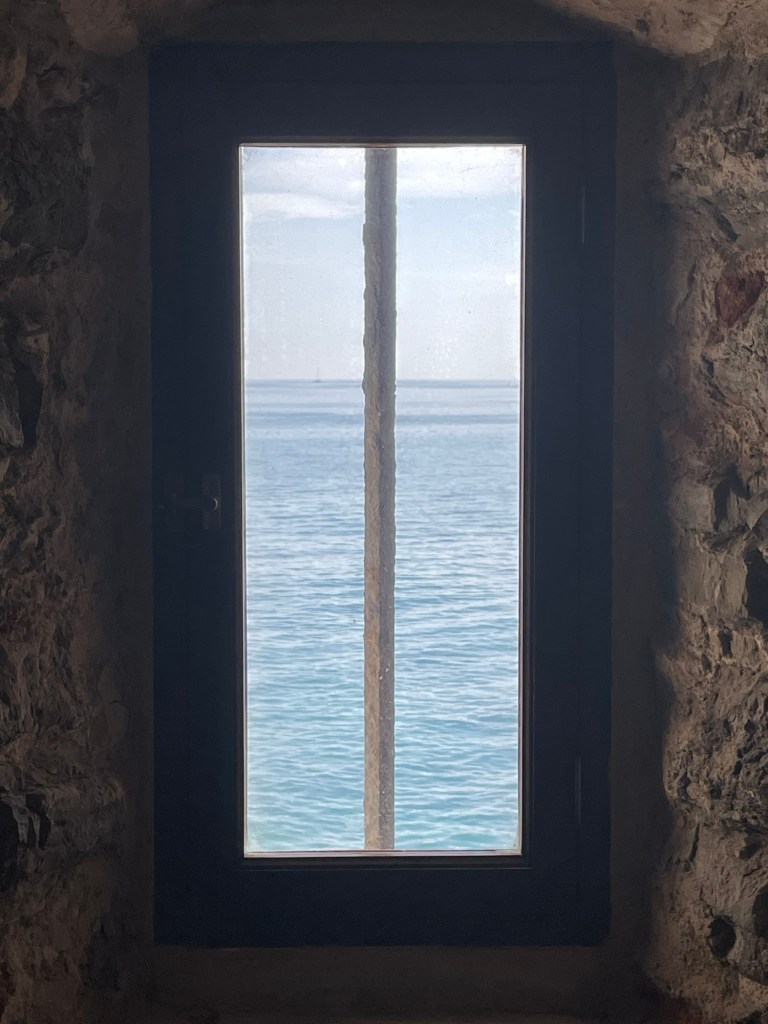
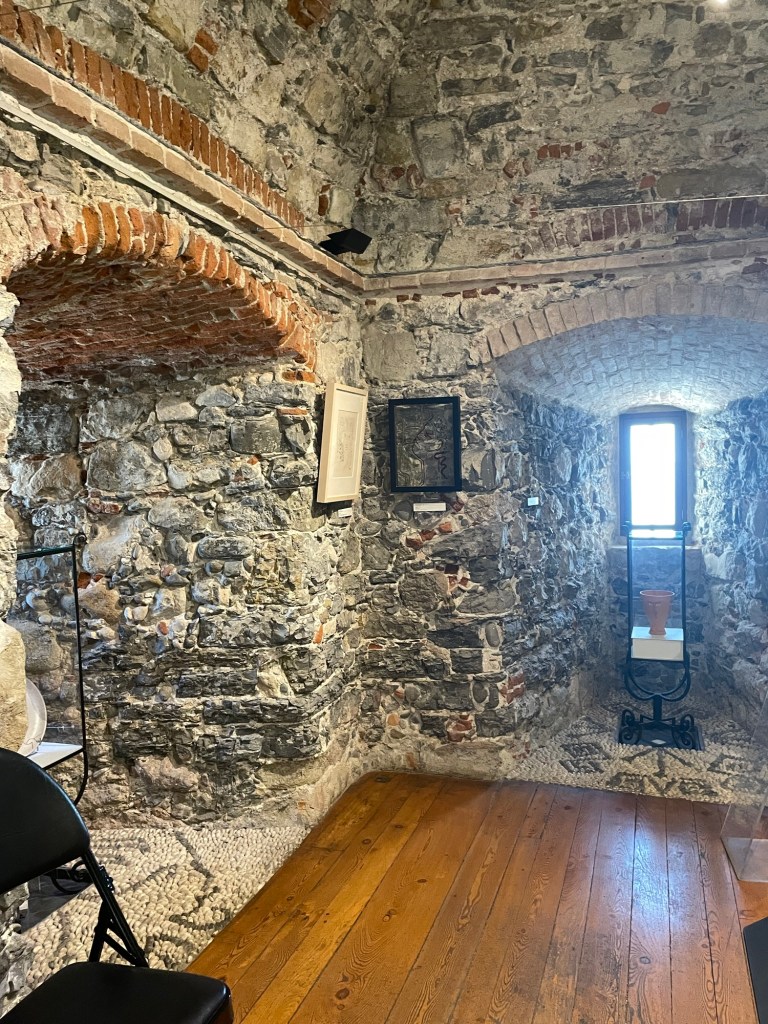
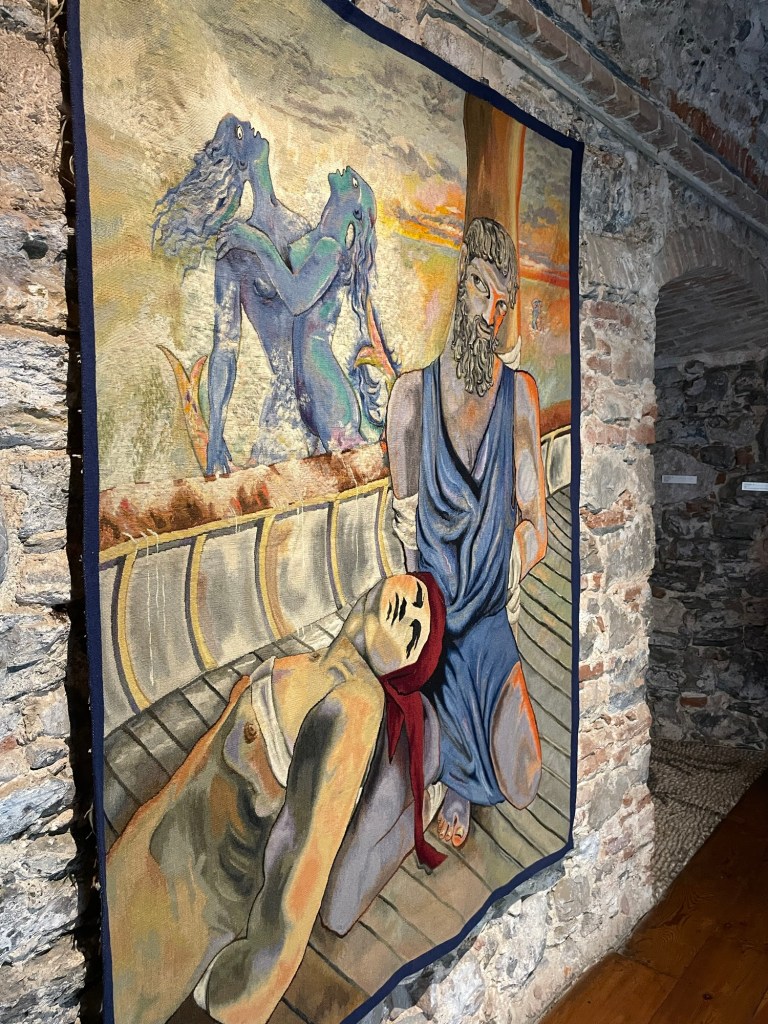
There are two museums devoted to Cocteau’s works in Menton. The first, which I visited yesterday, is the Bastion, and it is indeed a former bastion on the seawall. Cocteau was given leave to redesign the space and display his works in it, and it opened in 1966. It’s a tiny, cozy space with windows onto the Mediterranean horizon, set into little niches that they share with the art.
Cocteau’s mosaic of natural stones in the entry hall
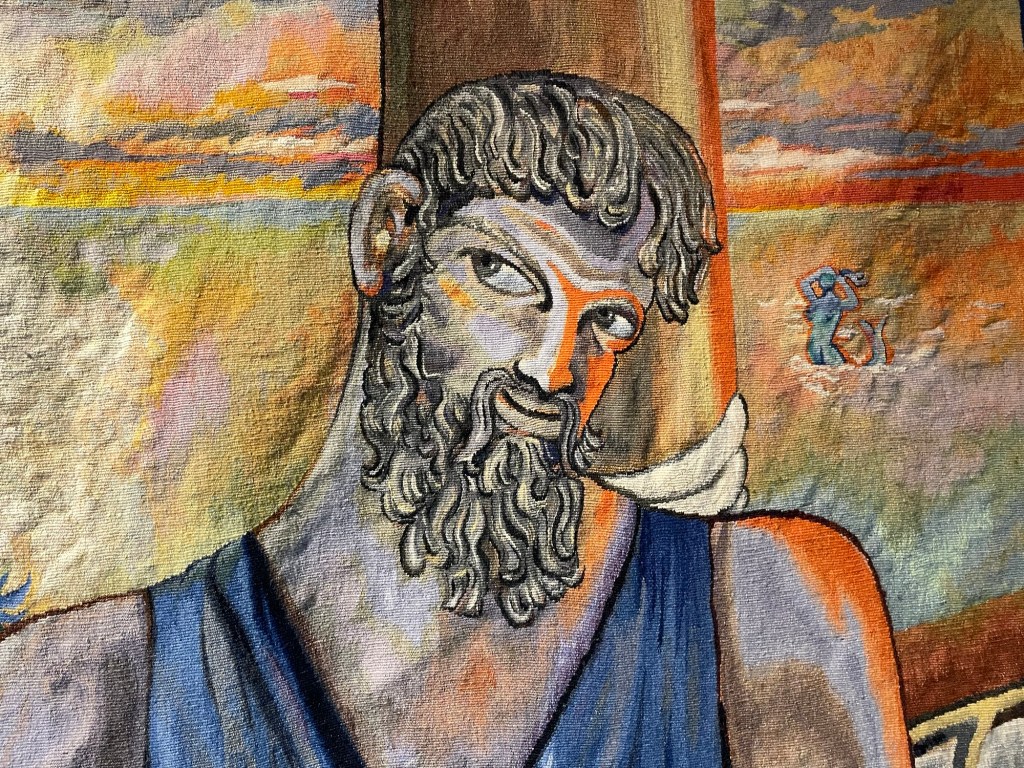
The exhibits rotate every year. Right now, a lot of mythological-inspired pottery, some drawings on paper in various media, and a marvelous tapestry of Odysseus lashed to the mast.
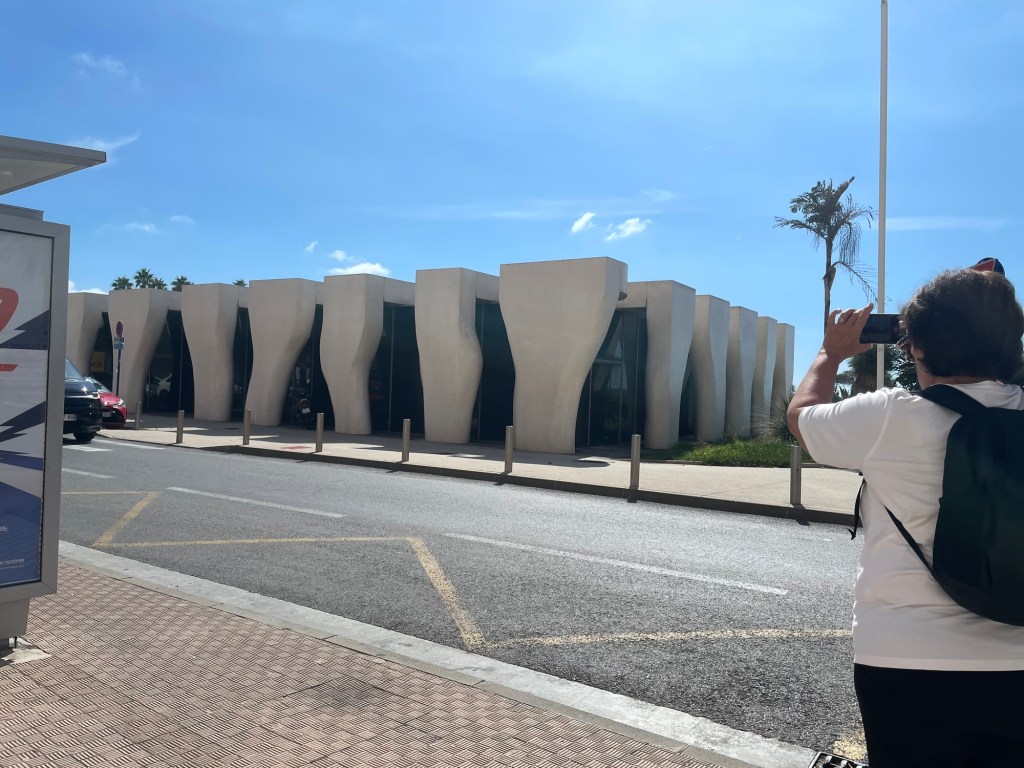
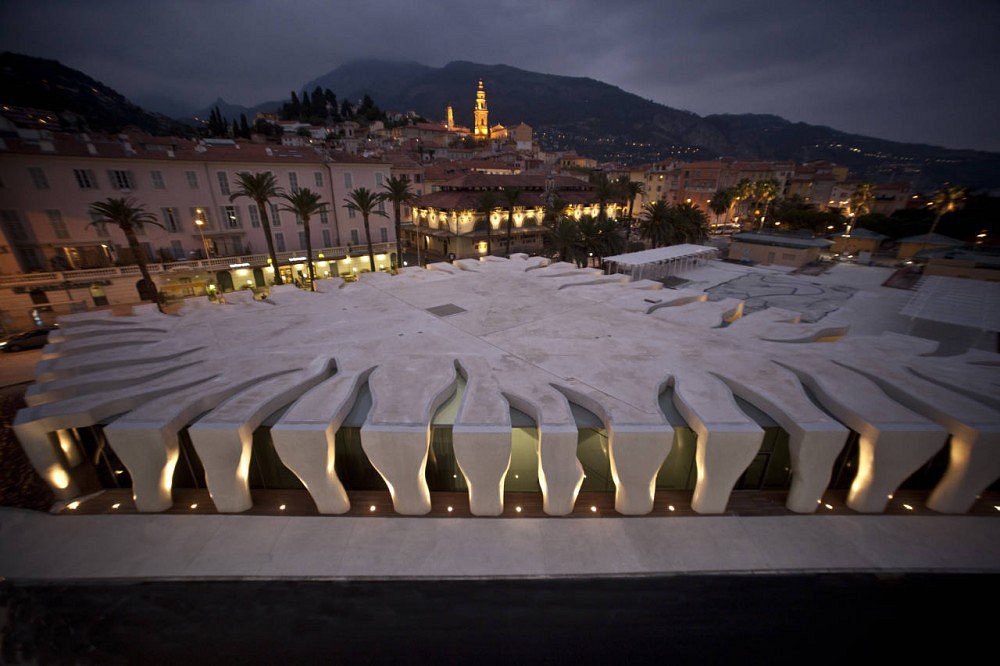
The other museum, celebrated for its design by French architect Rudy Ricciotti, looks gorgeous from the outside on its perch 50 meters from the sea. It was designed to be the definitive repository of Cocteau’s oeuvre. Sadly, it has been closed since a storm surge in 2018 flooded the basement (in which were stored numerous works) and part of the ground floor with seawater.
Cocteau is in the news now (link is in French) because the heirs of Severin Wunderman, the American collector who gave 2,000 Cocteau works to Menton to be placed in the museum on permanent display, are threatening legal action to claw the works back because the city has not upheld its obligation to display them.
+ + +
The last meal we ate at home before leaving the U.S. for a month was a mess of tacos from the taco place a couple blocks away. I knew there would be no tacos al pastor, on tiny masa corn tortillas, buried in cilantro and decorated with charred spring onions, in France.
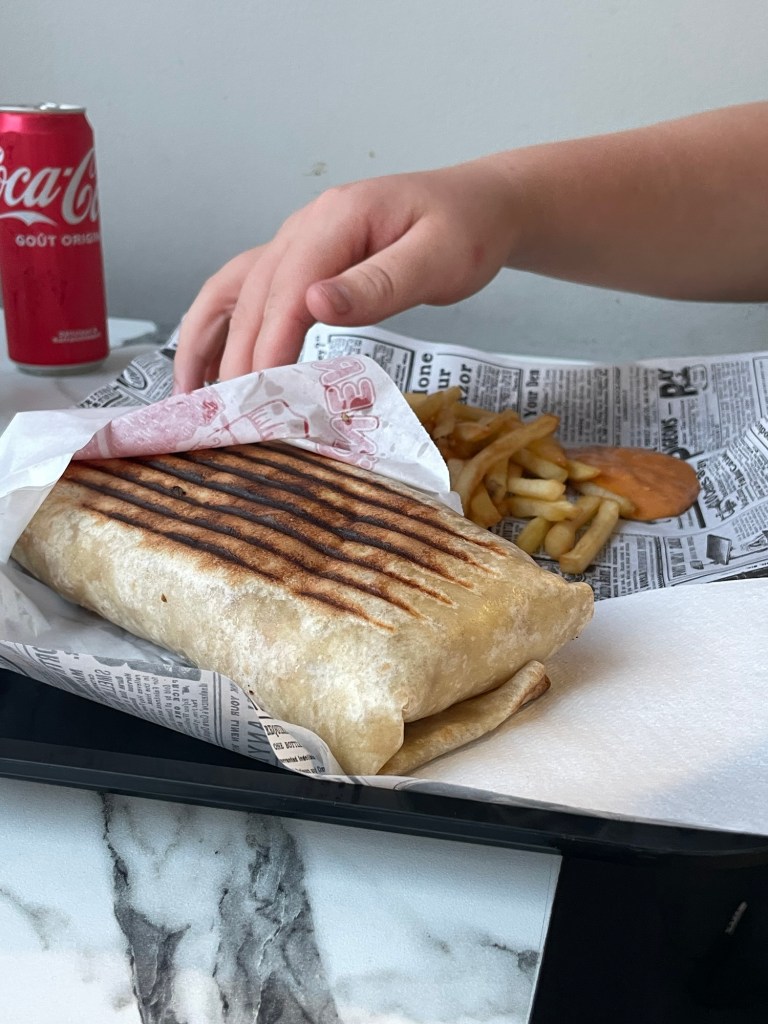
But France does have les tacos! Only they look like this:
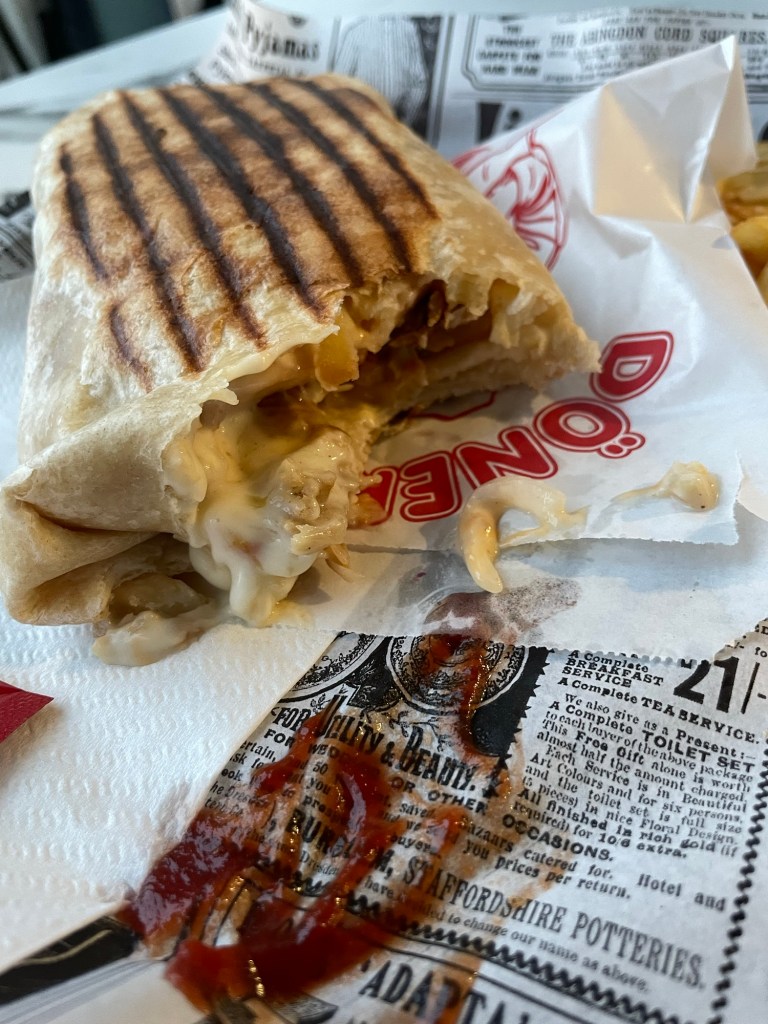
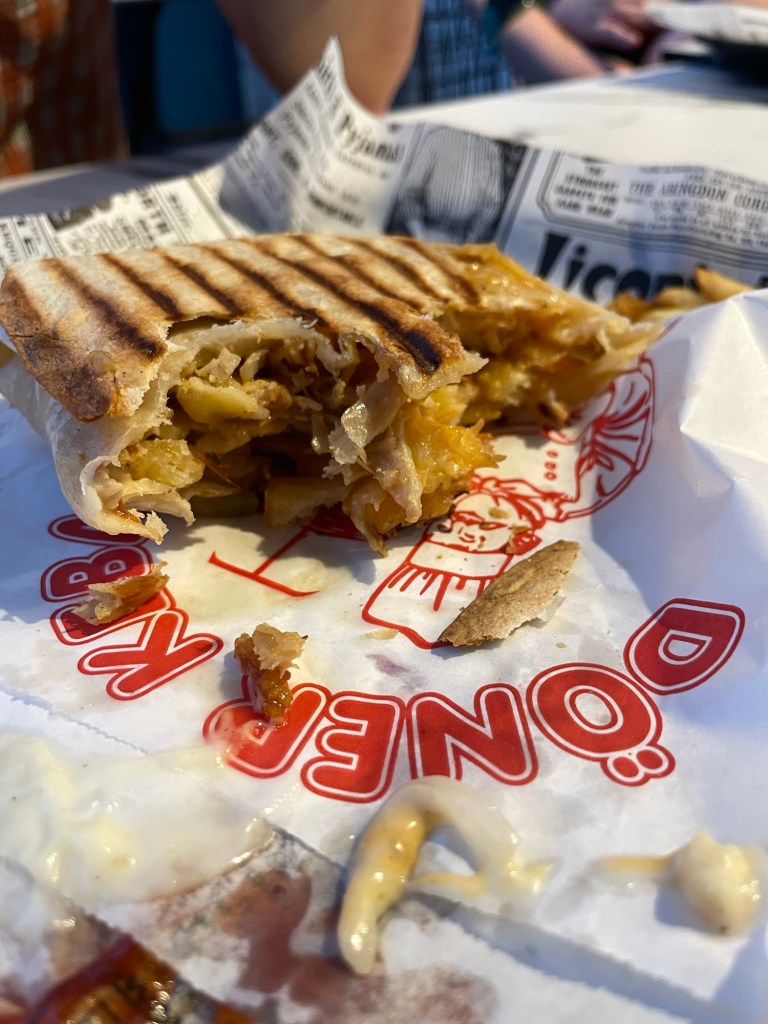
This taco is from Kebab Berlinois, which Leo has been visiting regularly since we got here. Previously he got les wraps. (I described eating some leftover wrap in a previous post.) As far as we can tell, the difference between le wrap and le taco is that le wrap contains pieces of cheese and is not grilled, but le taco contains cheese sauce and is grilled.
Both contain “kebab meat,” which is halal and sort of is like gyro meat shaved very, very thin; onions; a salade of vinegary purple cabbage; and frites for crunchiness.
Leo ordered ce taco without the cabbage. Sadly, he did not like it as much as the wrap because there was such an abundance of cheese sauce.
We were at Kebab Berlinois feeding the children combo meals (Simon had a cheeseburger) with the intention of taking the kids back to the apartment and then going out ourselves for a nice dinner. McDonald’s is close by to the kebab shop, so Leo headed over there to grab something quick to replace it, leaving Simon to work on his cheeseburger and leaving Mark and me alone with 95 percent of le taco.
We took turns tasting it.
Okay. It is definitely a weird taco. But. The Frenchified taco (by way of, we assume, Turkey and Germany), as our college-senior son would say, slaps. I honestly wish I could bring it home.
After we got the kids back, we did go out on the town, but only for a glass of wine. So I missed one French dinner that I might have had. But le taco is its own experience, and I expect someday years from now, late at night, I will wake up hungry and think: One of those kebab taco things would really hit the spot right now.
Facebook took a few days to figure out it should be pushing me the Menton municipal page, which is too bad because I found out on the day after it happened that there had been a little wreath-laying ceremony, with a color guard and US/UK flags and national anthems, commemorating the 81st anniversary of the Allies’ liberation of Menton. That would have been cool!
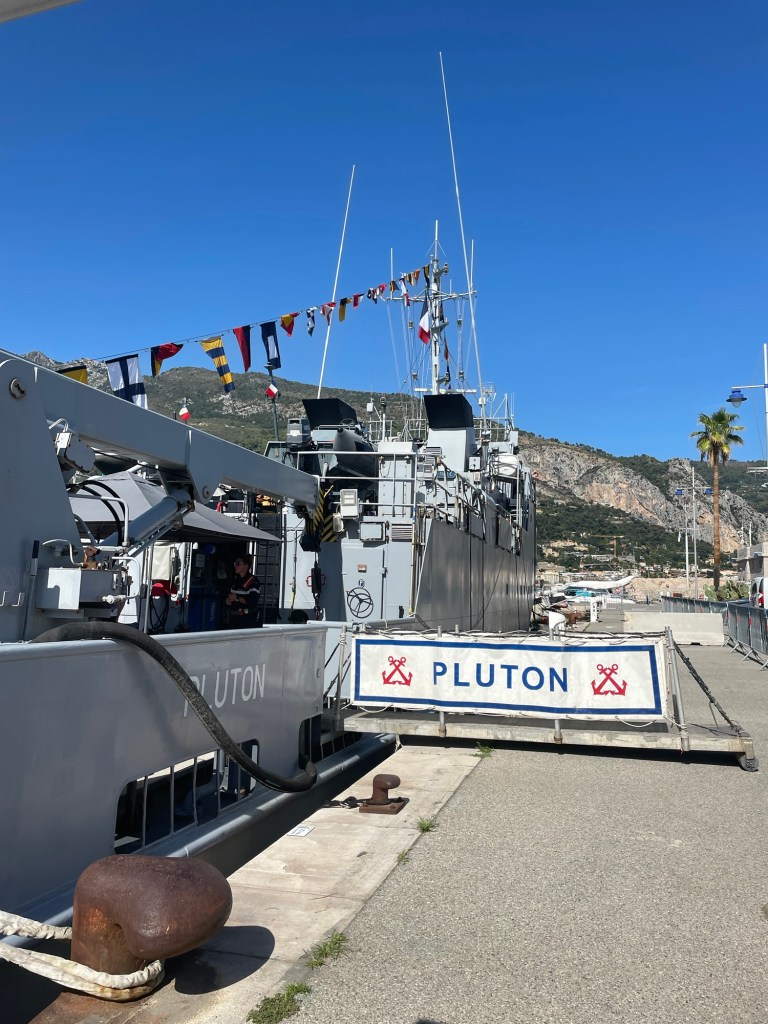
But the honor guard was formed from the crew of a French naval vessel called Le Pluton which docked in the harbor for the occasion, and they were open to the public and giving tours. So when we went out for afternoon gelato we wandered to the harbor and joined the tour.
Our guide talked very fast and I followed him pretty well but I couldn’t translate much and listen at the same time. Fortunately, a naval vessel is, as Mark put it, a “context-rich enviroment,” and most of the things that Simon wanted to know, Mark could guess or tell him based on prior knowledge and I could confirm from what I could pick up. Like: “That, son, is a hyperbaric chamber.” Moments later I heard hyperbare and subsequently what was obviously an explanation of the bends.
I threw random facts back at them as I sifted them from the patter. Ship launched in 1985. Supports “plongeur-démineurs”—divers who defuse explosives? Some of these folks.
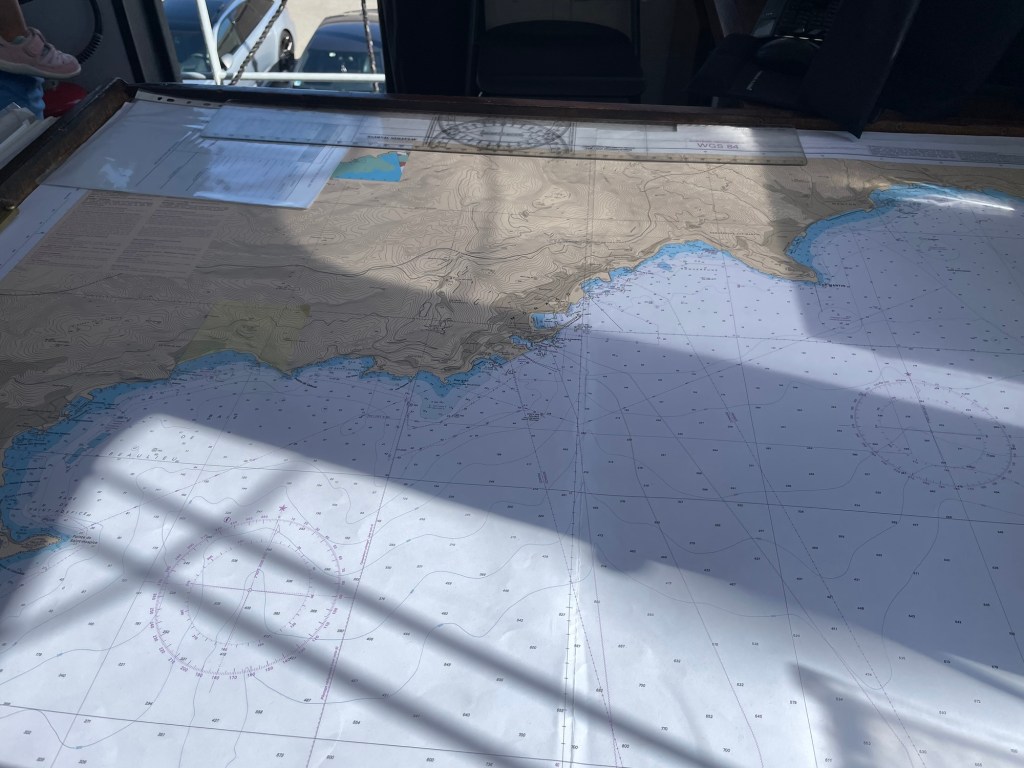
So, that was pretty cool. Zodiacs on the deck, the kitchen, the bridge, the naval map spread out of the whole eastern French Riviera.
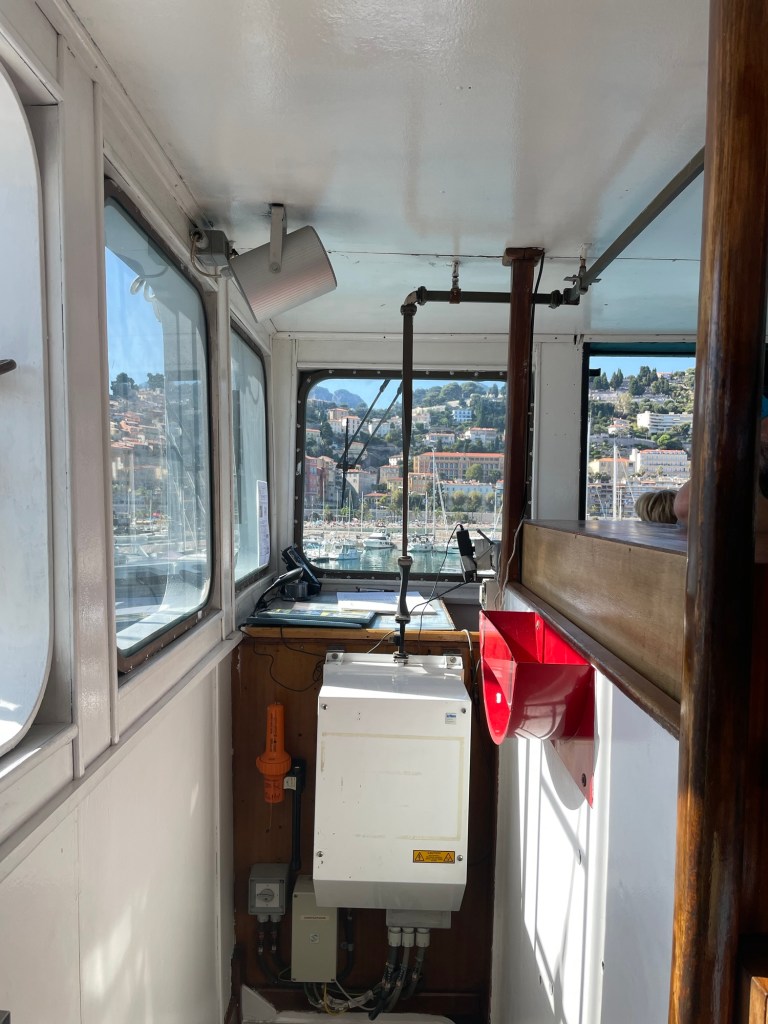
I don’t much like messing about in boats, but there is something I love about getting to see the inside of a working vessel when it is safely docked. The way all its parts fit compactly together like a puzzle, the abundant signage, the clever little racks and attachments that keep things where you left them, the low ceilings that cause sub-five-footers like me zero trouble, the way space is not wasted…
…the way the enviroment is so context-rich, I guess.
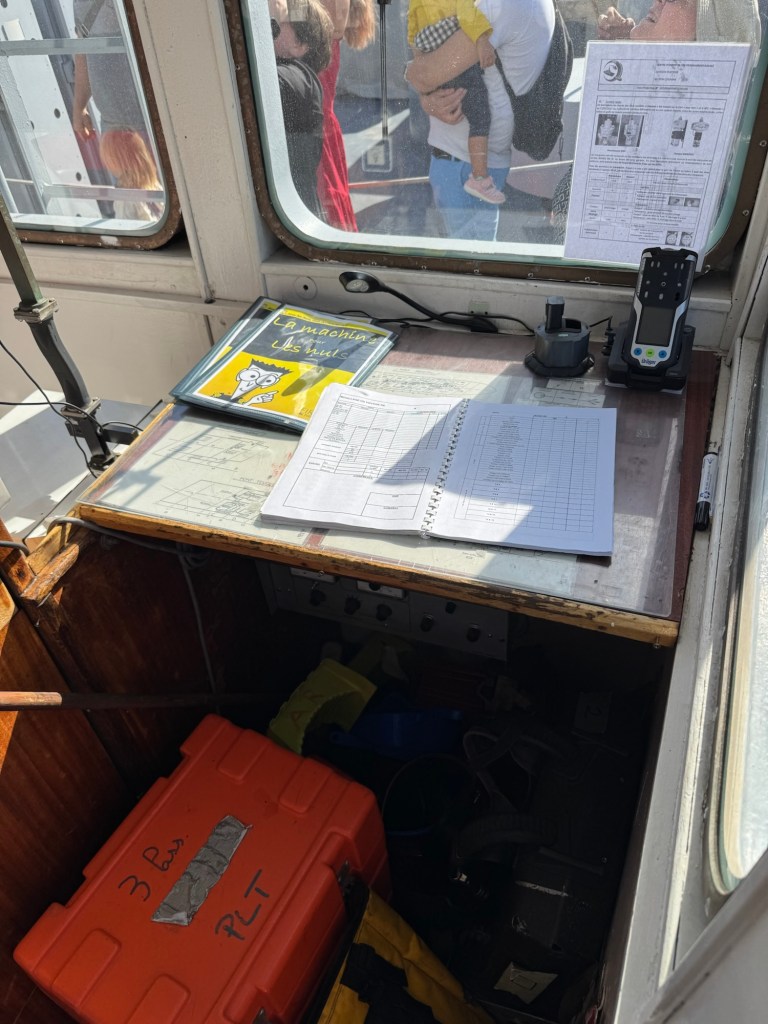
But also the way the humans who occupy the space leave their mark behind: a scribbled note tucked into the corner of a display board, a jumbled messy-desk visible through a hatch, and a joke Mark photographed: a three-ring binder among a stack of operation manuals whose cover had been replaced with a French version of “Machinery for Dummies.”
See it?
I think if I were a small child I would come away wanting to go to sea, because I would imagine having a tiny cozy capsule of a bunk, and cooking in a fairy-sized kitchen, and having a lot of specialized tools.
I am not a small child, however, and I know better! But it’s still fairly entertaining to crawl all around and spider up the impossibly steep stairs, looking at everything. The best might be the view of the harbor from the window, though.
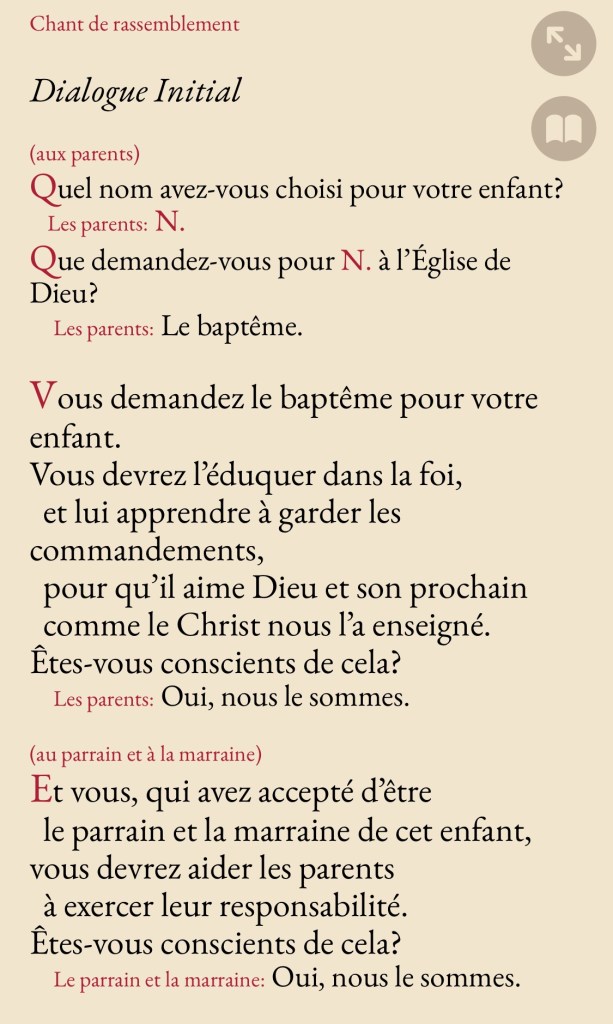
Okay, first off, I didn’t take any pictures of the interior of the church. I have put up photos I have taken of church interiors while traveling before, but whenever I am in a place that is a certified tourist spot, the sort where regulars might have a distracting problem of people taking pictures during worship services all the time, I don’t want to add to it. So here’s a photo of the handout with a variety of hymn lyrics.
We went at 11 am to the church building physically closest to our apartment, not the picturesque basilica at the top of the hill.
This is not where we went to Mass
Based on the bulletin and the website, it seems that all the Catholic churches in town plus some from a neighboring town are encompassed by one parish called Notre Dame des Rencontres.
The church in the neighborhood—if I walk by later on the way to the store I’ll take an exterior shot—was a good deal smaller but roomy and with a fairly full house. There was a kind of fine net suspended about 9-10 feet high above the heads of us pewsitters, obscuring the ceiling; as it already had caught a few small chunks of ceiling material (plaster, I am guessing) we surmise that is its purpose. The pews were wooden movable benches without kneelers and our 11yo had to be cautioned not to accidentally scoot ours around by, e.g., flopping into the pew too hard at sitting time.
The stained glass windows illustrated parables and events in the life of Christ and were bright and almost new-looking, with short explanatory panels (e.g., Christ the shepherd finding the lost sheep was labeled something like Jésus cherche le pecheur).
On that morning they had a baptism, of a wiggly (I guess) 9-10-month old baby named Lya. Something I hadn’t seen before: the introductory par of the baptismal rite took place outside the church on the steps, so everyone in the pews waiting for the start of Mass turned around and looked back out the front door as les parents and la marraine et le parrain stated their readiness.
Thanks, iBreviary
Then they were welcomed across the threshold of the parish church and the procession began. I liked it, it sort of made the fact that the rite has us kind of do this twice make more physical sense.
More observations: casual summertime dress on everyone, including the baptismal party, dad and godfather looking fairly dashing in sunglasses while standing outside on the steps. It’s hot here and brightly sunny, and numerous people in the only slightly cooler church fanned themselves with folding fans—not bulletins, they came prepared.
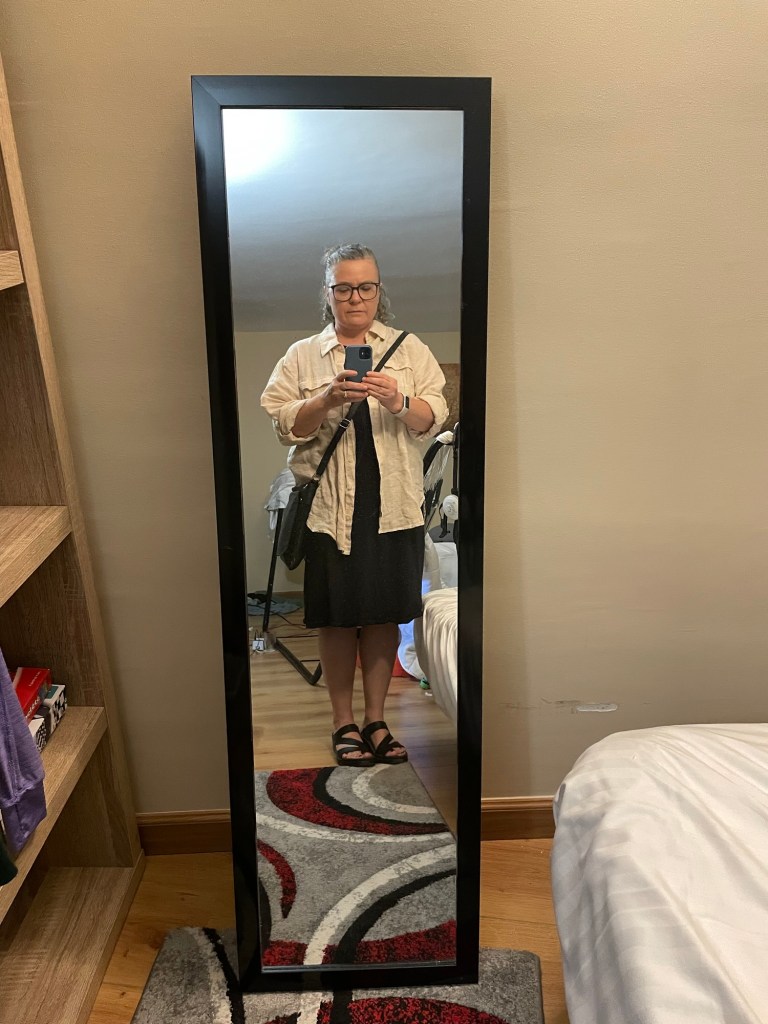
I wore this—linen shirt over black A-line tank dress—and I was too hot.
I kept up okay with the mass parts thanks to a worship aid that has the responses and Credo and things in French, and with the readings thanks to iBreviary’s French-language option on my phone. But I am afraid I couldn’t catch the homily at all, a combination of sitting too far back to really watch the speakers’ lips and reverb from the microphone, plis of course the speed of ordinary speech. The most I could grasp was context: now he’s talking about the first reading, now he’s talking about the Gospel.
+ + +
About that Gospel. In the English translation we hear at Mass Jesus says:
“If anyone comes to me without hating his father and mother, wife and children, brothers and sisters, and even his own life, he cannot be my disciple.”
And in the French translation that French people hear:
« Si quelqu’un vient à moi sans me préférer à son père, sa mère, sa femme, ses enfants, ses frères et sœurs, et même à sa propre vie, il ne peut pas être mon disciple. »
That is: “If someone comes to me without preferring me to his father, his mother, his wife, his children, his brothers and sisters, and even to his own life, he cannot be my disciple.”
Now, we’ve all heard exegesis that essentially says that what we hear in our English Gospel doesn’t actually mean “hate” and it really means “must be ready to choose Jesus over those other attachments” or whatever, no? It would be absurd if “hate” really meant “hate” here the way modern English speakers use the term so the strong language must be for emphasis, etc.? Anyway, I just thought it was interesting that French Mass-goers have that already built in.
(This has been one of your humble blogger’s tangents on the topic of Catholic English Speakers Get A Different Gospel And It Might Be King James’s Fault.)
(Brought to you by the same folks who brought you: “What Does ‘The Meek’ Really Mean, I Mean Really? And Why Is It les débonnaires in French?”)
+ + +
Anyway, I was sorry I could not really follow the homily, especially because the priest made several apparently funny jokes. But I had pretty windows to look at and a handful of bulletins and worship aids to examine.
Oh one more interesting thing. They had the usual thing where if people aren’t receiving communion for whatever reason, they come up with their arms crossed to receive a blessing. I saw this about three people ahead of me in the other communion line, and the person dropped to a knee on the hard floor for the blessing and then the priest blessed her by making the sign of the cross and them touching the base of the ciborium to the top of her head. Like he set it on her head for a second. I’ve never seen that one before.
+ + +
Simon was hot and hungry when Mass got out—the baptism made it long—so we stopped at the grocery store on the way back for a snack. Then lunch in the apartment, then I returned to the grocery store for real shopping for dinner. No local specialties or counsel about wine pairings, since all the little shops, fruiterers and wines and fish markets, are closed on Sunday. But times have changed and the big grocery store chains will sell me potatoes and Spanish lemons and Barents Sea vacuum-packed fish filets and fat Peruvian blueberries just like the ones we buy at home.
The lunch in Italy made me sleepy, so I took a long nap while Mark went to the beach with Simon. After he got back and showered, we scrounged some food for the kids and left them in the apartment with their computers so we could look for a nice dinner together.
If you’re keeping track, you might have noticed that there were exactly two things I did on Saturday:
Go out to get lunch
Go out to get dinner
Anyway, we left the apartment and started walking east.
+ + +
Menton is a town stretched out along a curved bay nestled against the very end of the Alps coming down to the sea.
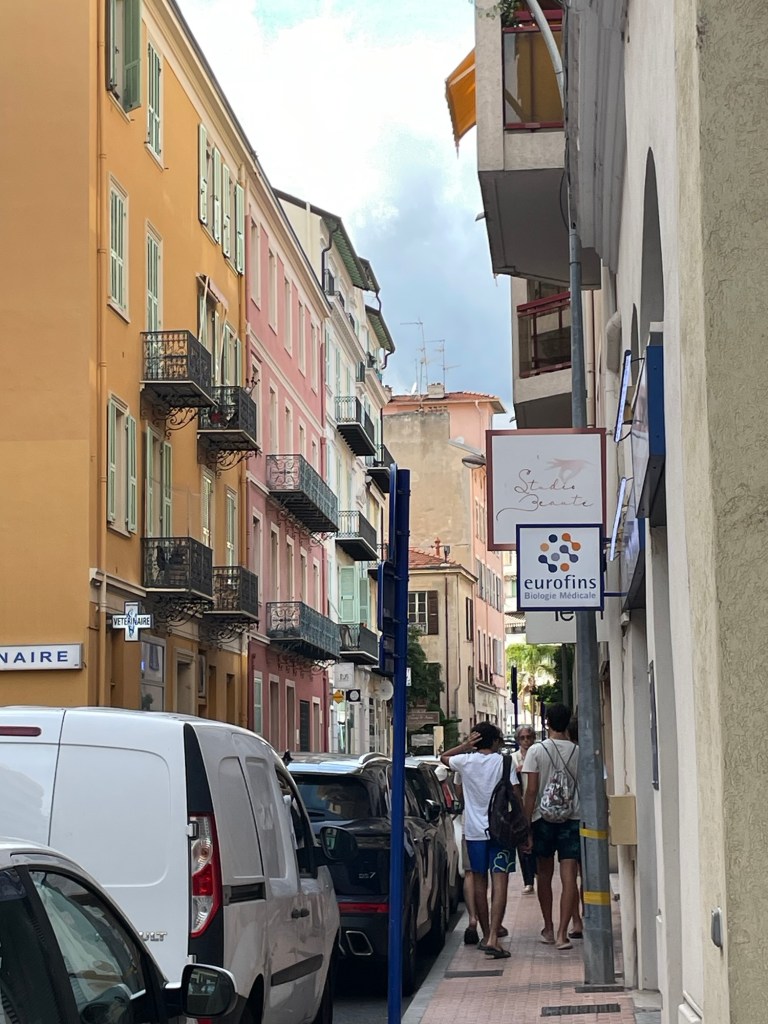
The old town is toward the east, and that’s where the winding streets and the picturesque stairs and the high concentration of restaurants are. We thought we’d like to stay at that end, but the best apartment for us we found on the west end, on a wide boulevard that comes straight down from the train station. No matter: it is a 15-minute walk to the old town. All along the seaside is a string of stony beaches and bars and gelaterias; or you can sidestep one block inland and walk along a street that’s a mix of touristy shops and ordinary shops like pharmacies and hardware stores and sporting goods stores.
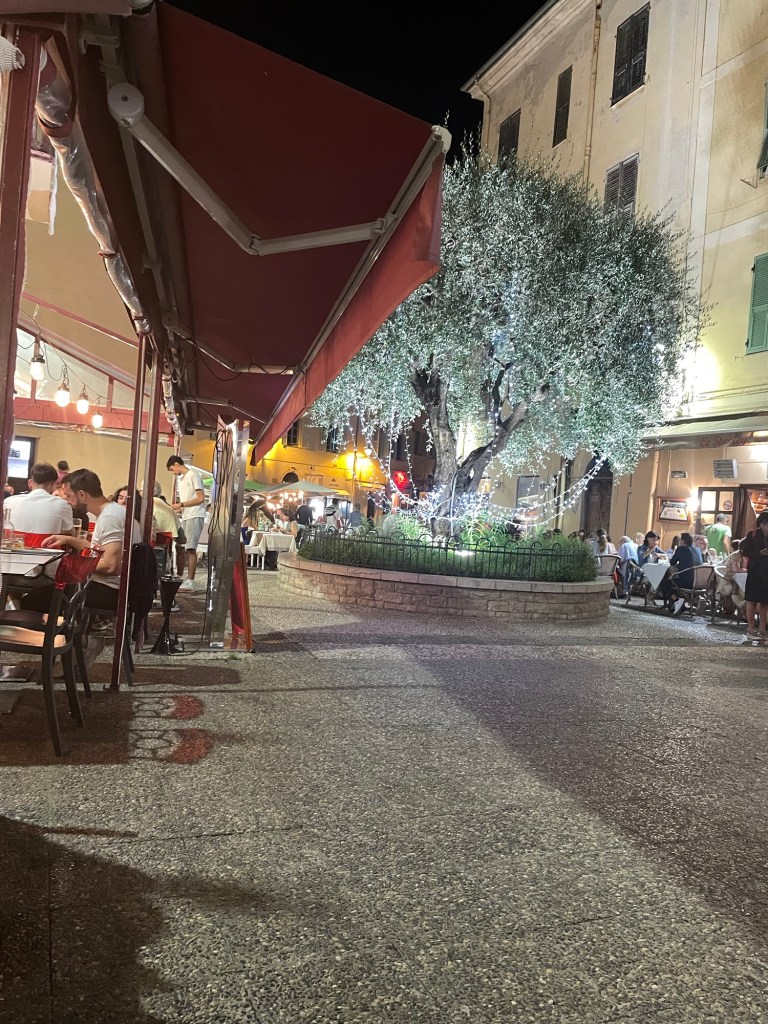
We went into the old town and found a place that wasn’t particularly Italian surrounded by Italian restaurants, tucked in a little plaza with a tree growing in the middle, strung with lights.
View from my seat
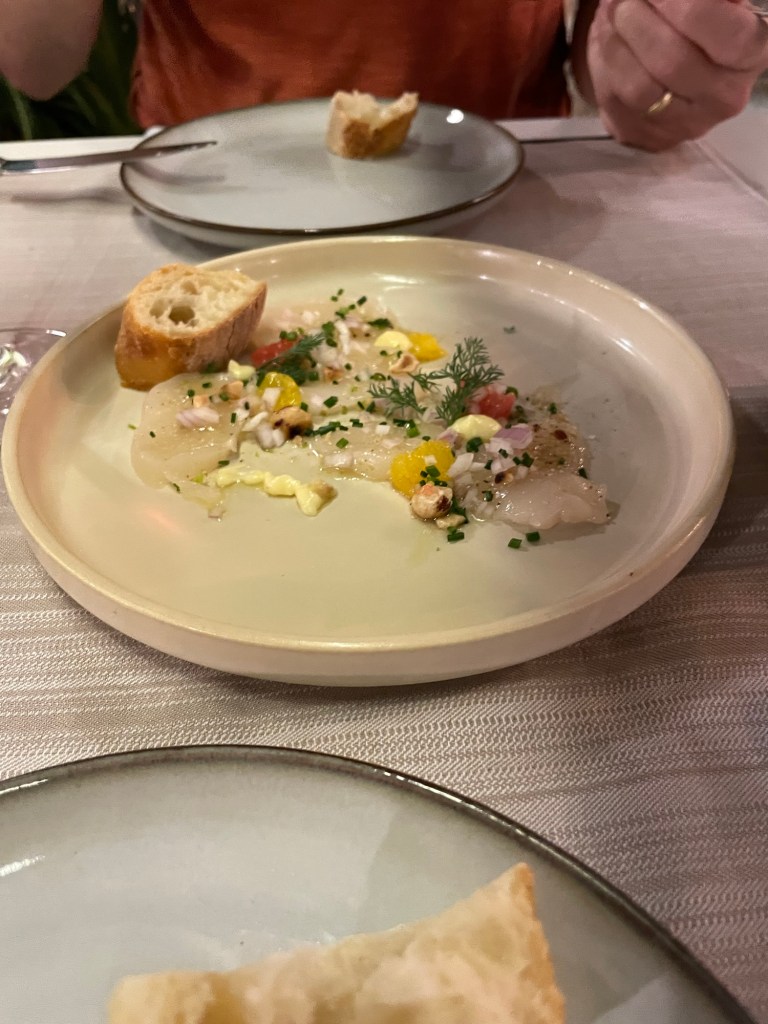
I’ll just highlight the food here. Scallop carpaccio with chunks of citrus
Duck breast in port wine reduction
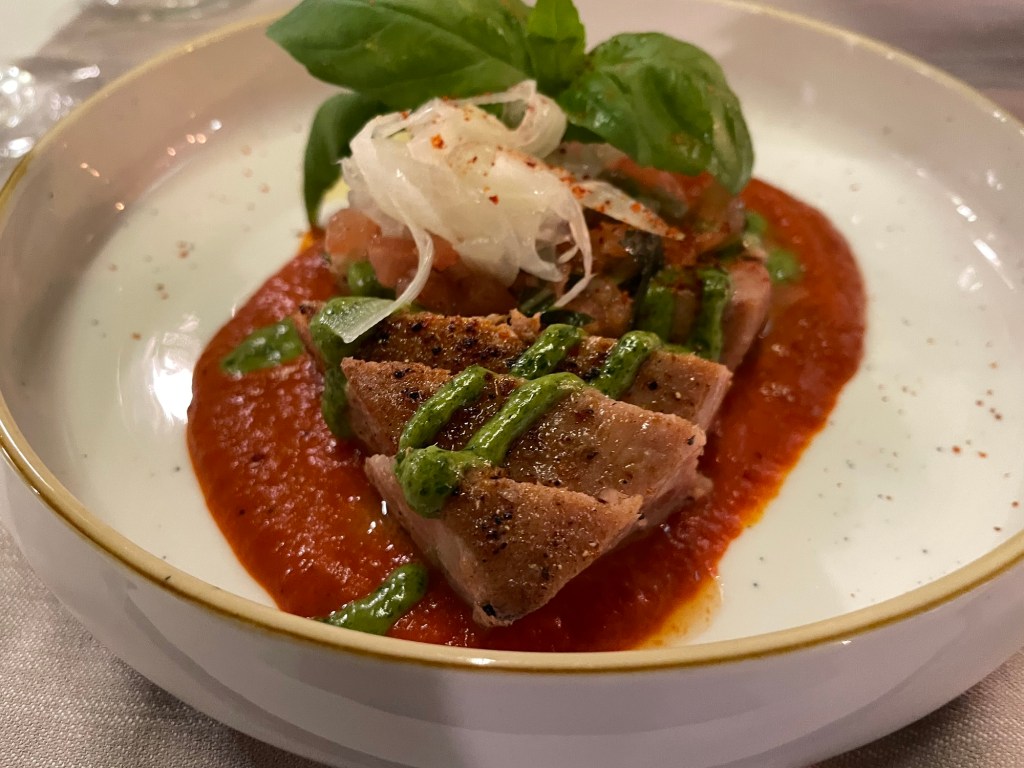
Seared rare tuna with piquillo puree and fennel slaw
More tomorrow, I hope, especially if I can get out to a café for a pastry as soon as the shops open.
Here’s what we did yesterday though: lunch in Italy. We’re only two train stops from Ventimiglia.
Leo was tired and sore from lots of walking, so he stayed home. Simon and Mark and I went, and wandered purposefully until we found a restaurant that was already open at 11:30 and had both pasta and pizza.
Began with fries for Simon and a carpaccio of three fish. It was supposed to be tuna, smoked salmon, and swordfish, but they gave us a thinly sliced terrine of octopus instead of swordfish. I had to practice liking the tentacles. But the fish was good.
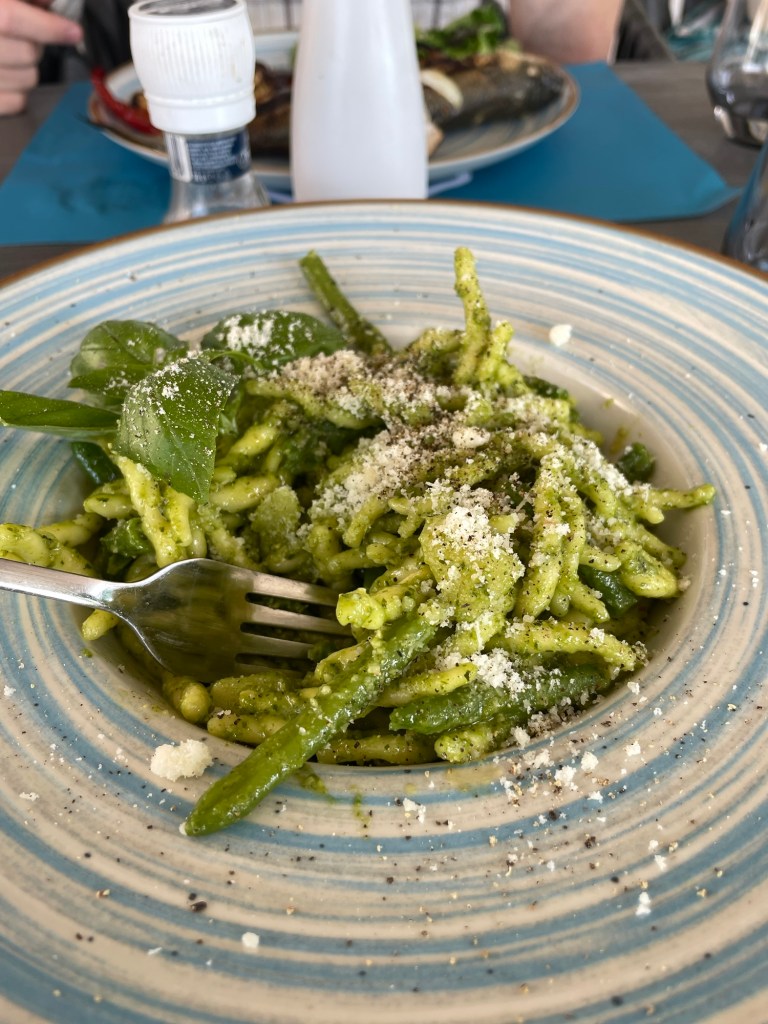
Trofie alla genovese for me: pesto, potatoes, haricots. Also two glasses of chilled white wine.
A trouty sort of fish for Mark. Perfectly chargrilled.
Simon filled up on fries so Mark ate some of his pizza and then we got a box.
After this Simon was completely exhausted so we got back on the train and returned to the apartment without even getting gelato.
There’s this SNL skit in which Adam Sandler plays a tour guide for “Romano Tours.” (If you are in the US, google it, because I am forbidden by the National Broadcasting Corporation to see any clips from here.) But I did find a transcript! **
People love us. But, every so often, a customer leaves a review that they were disappointed or didn’t have as much fun as they thought. So here at Romano tours, we always remind our customers, if you’re sad now, you might still feel sad there, okay? Do you understand? That makes sense? Our tours will take you to the most beautiful places on Earth. [Cut to video clip of Amalfi coast] Hike to cliffs off the Amalfi coast. Fish with the nets in Sorrento. [Cut to video clip of a woman yoga posturing] Do this, I don’t know.
[Cut to Joe] But remember, you’re still going to be you on vacation. If you are sad where you are, and then you get on a plane to Italy, the you in Italy will be the same sad you from before. Just in a new place. Does that make sense? There’s a lot a vacation can do. Help you unwind. See some different looking squirrels. But it cannot fix deeper issues like how you behave in group settings or your general baseline mood. That’s a job for incremental lifestyle changes sustained over time.
[‘Can’ and ‘Cannot’ chart appears in the screen]
I want to be very clear about what we can do for you. We can take you on a hike. We cannot turn you into someone who likes hiking. We can take you to the Italian Rivera. We cannot make you feel comfortable in a bathing suit. We can provide the zip line. We cannot give you the ability to say Whee and mean it. You’re not your sister.
Ahem.
So, one of the things we wanted to do with this trip was have it not be a month of pure vacation. Mark is working remotely for much of it anyway, and we are doing school, so in one sense we wanted to just move our regular life and relationships to a prettier setting.
Since I couldn’t bring my house, which functions as a permanent three-dimensional to-do list that I wake up in every morning, I am free of a lot of ordinary “work stressors” here. But other than that I am still me and we are still us.
I still need a block of alone time every day. So far I have gotten this mostly when Mark takes Simon and Leo to the beach to frolic in the waves. I have stayed in the apartment each time: napping, doing laundry, cleaning the kitchen while listening to podcasts. Or I have gone grocery shopping in town, happy to not have help even though it means I have to carry it all back.
And then. There are a lot of activities we could be doing out there, or I could. I could take the train to Nice for an afternoon and see one of several art exhibits, or walk along the Promenade des Anglais. I really thought I was going to do that before I got here. I thought we would take a shuttle up into the hills and make the boys take an educational tour of a citrus grove, picnic included. Doesn’t it sound fun? And we fully intended to go to Monaco for the day, see the aquarium in the oceanographic museum and maybe the big royal automobile collection.
But just as most days in Minnesota I do not go to the art museums in my own hometown nor drive into the countryside to tour excellent Wisconsin dairy farms, here I just kind of want to sit down and relax into a routine. Eat, shop, cook, wander around, buy gelato, take a nap when I am tired, do schoolwork with the kids in the weekday morning, swap the dishwasher, go to the wine store and ask what I should pair with the dinner I plan to make.
Look. I had this idea that I would embrace French petit déjeuner: coffee and a little bread and marmalade, maybe a cup of really good yogurt; or every few days I would go out to a café and get a pastry and a cappuccino. And I have done those things!
Early morning countertop. The green coffee bag is the caffeine one here.
But do you want to know what I had for breakfast this morning? While my drip coffee was brewing I opened the fridge and found the leftover second half of a fat spicy meat wrap that Leo bought himself at the Kebab Berlinois around the corner. It is reminiscent of a Chipotle burrito only with thinly shaved, mildly spiced gyro-like meat and an oniony purple-cabbage slaw, and I think some tahini with the faintest perfume of a capsicum variety. Cold and ever do slightly soggy from twelve hours in the fridge.
What ho! A leftover hoagie!
And just as I would have at home, that is what I had for breakfast, right out of the wrapper.
+ + +
Church in an hour. And hey—today is Bl. Carlo and Bl. Pier Giorgio’s big day! We love BPG around here and consequently we are going to be stumbling through our dinnertime litany for the next few weeks.
______
** Sorry the excerpt is so long. Still learning the WordPress mobile app. The quote block won’t let me abridge it.
In fact, we hardly left the apartment yesterday before evening. Mark hadn’t had any pastries at all yet, so he went for an almond-filled and a coffee in the morning, and then fired up the old laptop and got to work.
Leo had had a poor night of sleep, so after some consultation we sent him back to his hammock with an extra blanket against the beautifully frigid air conditioner and turned out the lights.
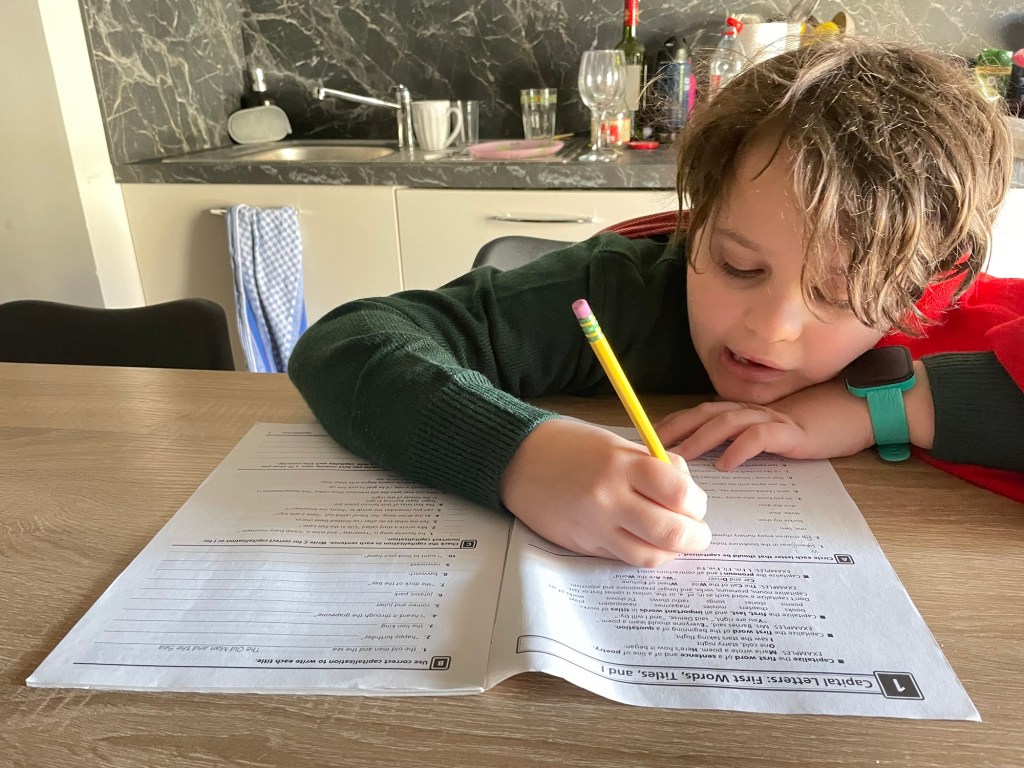
I worked closely with Simon for a few hours, completing a day’s worth of history reading, English mechanics practice, and science workbook. Then I went for a little walk outside to see if I could find out why they were shutting down the street and putting up a long row of tented booths, each with two folding chairs and a table on it.
First I discovered what they do with your motorcycle when you park it where it says No Parking Today.
Then I went into the tourist office nearby, sniffed a couple of candles scented with the region’s special agricultural product (lemons), picked up a city tourist map, and asked “Qu’est-ce que se passe dehors avec toutes les tentes?”
The answer is that it was a municipal activity fair, and all the local sports clubs and dance schools would have brochures and a place to sign up, and there would be performances and the like. Sensible, on the first Saturday of the school year, So, nothing for us, but it might be interesting to see.
I returned and with Mark ate a lunch of leftovers. We woke Leo and made him eat something. Then school again: I read aloud to both boys then set Simon on math while I worked with Leo on geometric constructions and French review.
About five pm I took the boys to find a cheeseburger and fries, then took them back; and they stayed in the apartment while Mark and I ventured out.
+ + +
There had been a little burst of anxiety from the direction of the children at the French-fry stand: one spilled his drink on the other, the other got upset. I worried they’d need to text us for intervention while we were out. Accordingly it took me a long time of strolling through the town looking for a bar to sit at, and then changing our minds and looking for a restaurant, before I could quite release myself from feeling high-strung. Mark soothed me, pointing out that the worst that would happen would be that I would sit at a seaside bar with a drink while he would jog two minutes back to the apartment to solve any problems. Perspective restored, I accepted this outcome and chose a restaurant. And I immediately ordered a spritz Hugo for medicinal purposes.
I don’t do a lot of needing a stiff drink and the Hugo isn’t exactly stiff but after downing it I did feel I could breathe more deeply. And order food.
moules frites
Mark had a cut of beef with roast potatoes. It looked pretty good but I concentrated on my mussels. I think it was good that it gave me something to occupy my hands. They are the unshelled pistachios of the sea.
Et j’aurai besoin d’une verre de vin blanc avec cela. The waiter offered me Sauvignon Blanc or Côte de Provence and I picked the latter.
Okay, I’m calming down. The sea, the sky, the food, the wine.
I thought I would want to do more, take the train to Nice, visit a lemon orchard, see an art exhibit. All I want to do is lie around, walk around, eat, shop, cook. Get gelato. Do it all again.
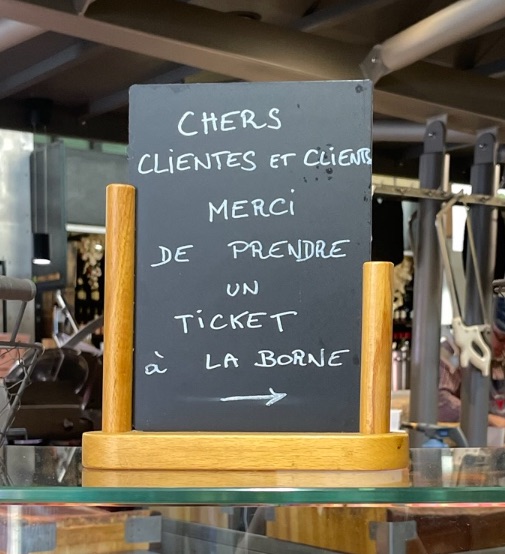
I took a picture of this sign because it’s an example in the wild of a change in the everyday rules of French grammar since I learned them in high school.
You know, probably, that French is a gendered language, and a binary one: it has no neuter gender (unlike German or Latin) and it has no neuter pronoun for objects (unlike English). Every noun has a specified gender, masculine or feminine, with which you must use the agreeing articles and adjectives. Sometimes, say with nouns naming animals or a person’s job, there are masculine and feminine forms distinctly pronounced and spelled. Even if the two noun forms are identical, because of the articles and adjectives and perhaps because of sheer mental habit, you wouldn’t say “oh, that word isn’t gendered,” the way English speakers would say “pilot” is not gendered, nor “flight attendant,” but “steward/stewardess” is. You would say, “oh, the masculine form is the same as the feminine form.”
(Obviously there are a lot of little details that complicate this grammar and make it frustrating or fun, depending on how you feel about languages, like the fact that une personne is feminine even if the person in mind is a dude, and the creation—spontaneous or systematic, I am not sure—in recent decades of distinct feminine forms of professional nouns like avocate (lawyer, with an e) that didn’t exist before. I don’t want this post to take forever so I better stop. I’ve been reading this really interesting book (French edition) that gets into some of these. Anyway.)
So one of the rules we had back in the late 80s and early 90s was that if you were referring to a group of people, only if the group was entirely made up of girls and women could you use the feminine pronoun (elles) for them nor could you use a feminine noun referring to their class (such as employées). As soon as an evidently male person joins, the group receives the stamp of masculinity: ils sont tous employés, one e, in their class, their adjective or participle, in their they pronoun.
That’s what we learned, and any French placement test was guaranteed to include a question designed to catch if you remembered this fact, probably by having a question about three teachers or something who all have female-presenting names or who are pictured wearing dresses. Because the all-feminine group functions almost like an exception.
But something that I haven’t learned from a rule book but that I have been noticing here and there for years as I occasionally read French news articles or listen to French podcasts (not as often as I wish I had, it’s too much concentration needed while driving): increasingly, describing mixed groups of people by doubling nouns and pronouns.
And here is an example I saw in the wild: not clients (meaning customers-in-general, using the standard masculine form) but clientes et clients (meaning female customers and male customers).
Even on a small chalkboard with not a lot of extra space!
+ + +
I freely admit the following is an amateur take and welcome correctiom from experts….
This is not what English speakers have done as our language has moved (starting from before I was born) to adopt changes perceived by many as more inclusive and modern. In some cases we’ve done the opposite.
Here’s one way we do it in English. You take a word like chairman or fireman that sort of embodied the assumption that the role was almost entirely filled by men. Occasionally you might see chairwoman but we have largely moved to gender-neutral terms, some of them crafted for the purpose: chairperson, firefighter, postal carrier, flight attendant, Congressional representative, etc. And I still see these new words sometimes being coined: instead of the feminine-gendered seamstress you now sometimes see sewist, which I think I only saw for the first time a couple of years ago (replacing some wordier, less precise options like textile artist). I wonder about which words get the -person treatment and which don’t. I don’t see an obvious pattern. Some sound clunky to me and some don’t.
Another thing we have done in English is the exact opposite of the French evolution. Where one word came in masculine and feminine forms (e.g., actor and actress) some style standards are to eliminate the feminine form (everybody’s an actor). Oddly enough sometimes this has been followed by a second substitution (waiter/waitress to waiter to server) —maybe because the first change didn’t stick?
At any rate, we are definitely not saying actors and actresses every time we discuss Hollywood. You don’t see that double construction except in a few formulaic and possibly fading expressions (Ladies and gentlemen) and when you need to emphasize something (boys and girls perform similarly on this test).
+ + +
I think this is very interesting, nonjudgmentally, and perhaps a glimpse into the interior workings of French as compared to English. It seems to me that there are two linguistic (that is to say, mechanical, not sociopolitical) features of French relative to English that may explain some of the different approaches.
First, English is habitually pithy. English takes fewer words to say things than French does: compare the thickness of your favorite translated novel in trade paperback version to that of the original. I suspect that lengthier phrases just do not sound as lengthy in French whereas they make English speakers itch. Doubling the length of a noun phrase may just fit more comfortably and seem more natural.
The other is that English speakers, having most of our nouns be genderless, including many nouns for people and professions, can easily come to view our handful of gendered people-nouns as exceptions to the rule. English mostly does not have gender. The normal nouns for people are objectively genderless even if the class is male- or female-dominated and thus connotes one or the other: teacher, nurse, lawyer, electrician, engineer, laborer, garment worker; and also customer, boss, consumer, traveler, student, patient, retiree, and many more. The nouns that expressly segregate the genders for no functional reason (like waiter/waitress) are unusual. For language learners they represent a list that “just has to be memorized.” Reducing these doubles to the less-marked counterpart—always the masculine, that’s where the sociopolitical analysis creeps in—is linguistically simple. It makes English grammar more uniform, not less.
One of my goals in French learning is to grasp better and to get more current on how these rules are evolving, because they are not evolving in a way that is predictably parallel to how English is evolving. I don’t, for example, have much knowledge at all of how expressions that in English we call “nonbinary” are coming to exist (or not) in colloquial French, with its structure that’s far more inherently binary than English (itself far more inherently binary than some other languages that I have never studied). I need to do more reading.
Okay, that’s the end of my writing time. More travelogue later!
Wednesday we worked, Thursday we didn’t. (Friday we’ll work again).
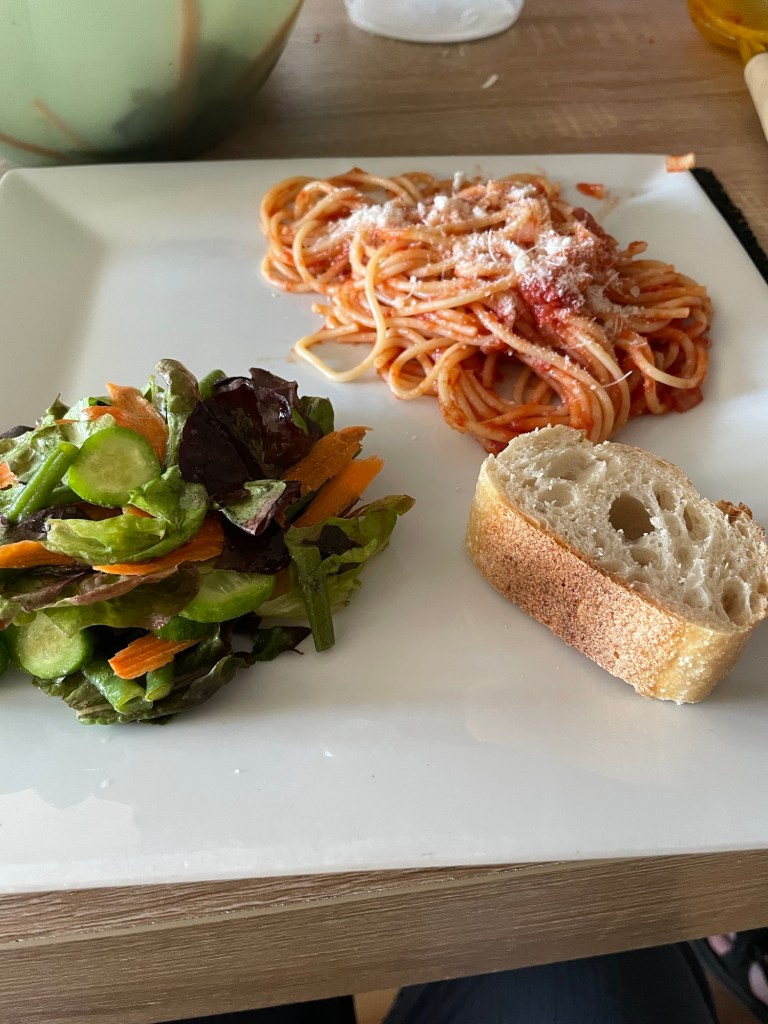
Leo had heard me mention that I had picked up ingredients for pasta all’amatriciana, all of which keep, for an emergency dinner. He wanted it sooner, he said. Could I make it tonight? Okay, I said, I’ll just buy salad stuff today.
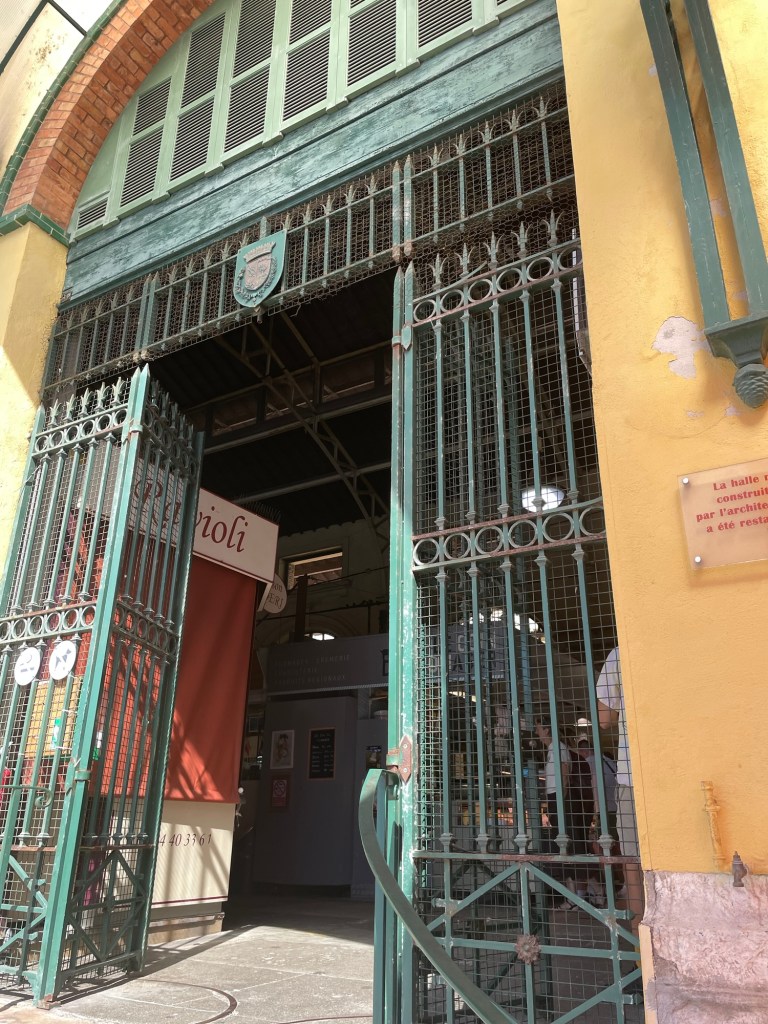
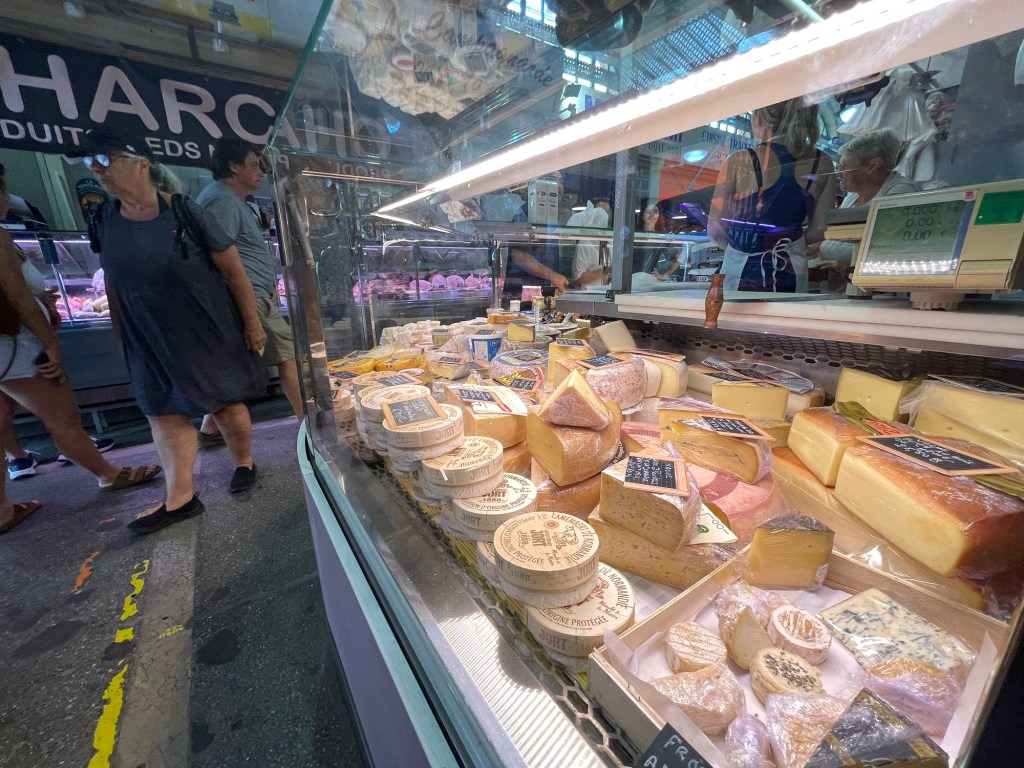
Off to the municipal market!
Entrance to le marché des HallesMore on this sign later.
I observed the produce vendor for a few minutes and then took my little basket and selected a salad-sized lettuce, a carrot, three tiny cucumbers, an onion, a yellow tomato, two plums and a peach, a nectarine, and a melon. A few minutes in line and then my turn at the scale. Each item was weighed then put into little waxy-paper sacks, the tomato with the plums and the peach with the nectarines. I noticed that the berries were in tubs in a fridge behind the counter, to be asked for and not handled; so was a big tub of already-torn mixed salad greens to be doled out on request.
Produce basket
I wandered around the hall looking for perhaps a jar of mustard or some olives, remembering the pretty little marinated olives from the wine bar last night. I did find an olive counter but it didn’t take credit cards unless I paid enough for half a kilo. I found a sushi bar where you could buy little boxes of fresh sushi, like the grocery store ones at home, but made in front of you. I found a wine bar where people were drinking prosecco in flutes, across from the Italian meat vendor with his mortadella and salame. I found a vendor with a giant bin of potatoes and a smaller bin of sweet potatoes.
Potatoes next time, I decided. Fish and potatoes, with capers and lemon.
There was a grocery next door where I found mustard—I just got the store brand, trusting it would be pungent and adequate for salad dressing—and instead of olives, a jar of tapenade. I’d already bought a baguette when I went out for pastry and espresso earlier.
Meanwhile, Mark had taken Simon to the toy store. Simon is, at eleven, rather a collector and connoisseur of stuffed animals, and he had been promised one small “stuffie” from each of the two towns of our trip. He chose a soft brown rabbit with quilt scraps for a tail.
+ + +
We had had a minor electrical problem the evening before—the power had tripped, Mark had located and reset the breaker, but much later in the evening when the apartment got hot, we realized that the air conditioner hadn’t come back on. I composed a text to the property manager, in which I learned lots of new French words like the ones for “circuit breaker” and “to flip a switch” and “compressor.” She came over and showed me the controls and adjusted them. In fact we had a whole conversation about the split-system air conditioner operation, which of the two units outside might connect to which one inside, and how to determine if each was working, a comversation which Mark could only watch helplessly. Anyway, despite her telling me that the a/c wasn’t something she knew much about and saying she would contact the owner to send someone to look at it, whatever she did to the controls got it working again. It has been pleasantly chilly ever since.
+ + +
Leo had been planning our lunch all this time. He announced we were going to have sushi at a specific seaside restaurant to the west.
We walked through the city, taking notes about nearby pastry shops and wine bars, and especially a counter-service place that advertised tacos, “sandwishes,” bbq and tex-mex. “I’ve had so much Americanized Italian and Chinese food,” Leo said, “I want to try Frenchified American food!” But we pressed on to sushi.
I told Leo how to say “Nous sommes quatre” and sent him in to get a table. Simon was a little sulky—sushi’s not his favorite—so we promised him that if he didn’t manage to eat enough we’d find something else for him afterwards. He perked up, especially when we discovered they had those Japanese Ramune sodas on the menu, the kind sealed with a glass marble inside, and in his favorite flavor (fraise).
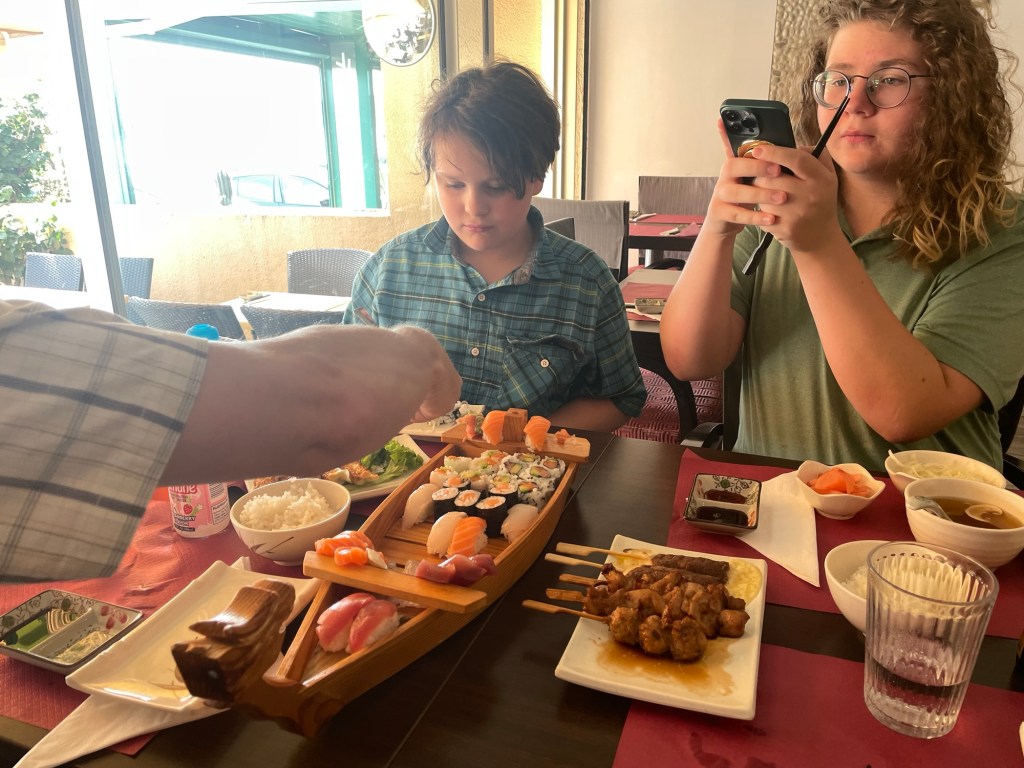
We studied the menu for about thirty seconds before Leo decided that we had to get the BIG SUSHI BOAT and it being immediately clear that this would simplify the ordering process, we agreed.
Le bateau de sushi pour 3 personnes
Simom liked the dragon figurehead, reached out and rotated it to face him. It was all very much like what we would have at home, and very good. Legitimately the best mackerel sashimi I’d ever had. Also rice and skewered meatballs and chicken and miso and cabbage salad.
The one unusual exception: cheese. One of the skewers was marinated beef wrapped around a mild white cheese, mozzarella-esque, and grilled till the cheese was all melted. It was yummy but not something I’d seen in a sushi restaurant before. Also, this restaurant sold salmon avocado poke bowls—with chunks of soft, washed-rind cheese wheel on top.
“Frenchified Japanese food has French cheese in it,” Leo observed.
Anyway, Simon was happy about the chicken meatballs and rice, so he also was fed and happy when we left.
+ + +
Mark took the boys to buy an inflatable ring toy (jouet flottant) which they filled for him with a compresseur (see, new vocab!) and then to the beach. I stayed in the apartment for some quiet alone time, and ran a couple loads of laundry, and texted with MJ to hear how the second week of college was going.
+ + +
Mark and I started dinner with some limoncello from one of the many lemon-products boutiques, and the tapenade and a little cheese, while my sauce gently cooked on the stovetop. When we ran out of limoncello we opened the Côtes de Provence I had been recommended at the wine store, and I made the vinaigrette for the salad with mustard and a spoonful of lavender honey, and plated it all up. The apartment dishes are these ridiculously large squares, but they actually work pretty well for plating.
We sat around and drank wine, then ran the dishwasher, then went out for ice cream and a walk in the very comfortable evening.





















 bearing blog