bearing blog


bear – ing n 1  the manner in which one comports oneself;  2  the act, power, or time of bringing forth offspring or fruit; 3 a machine part in which another part turns [a journal ~];  pl comprehension of one’s position, environment, or situation;   5  the act of moving while supporting the weight of something [the ~ of the cross].


  • Direction of intention according to St. Francis de Sales.

    Having time for just a quick post this morning, I thought I'd return to my series on the very practical body of Salesian spirituality, in particular, St. Francis de Sales's Spiritual Directory.  There's a quite short, but useful, bit in it that I want to highlight.

    I had just gotten started on the series about the Salesians  before our family's month in Europe, and then I started trip-blogging and lost the thread.  Here's a quick recap of the series:

    Salesian spirituality: Four examples.  Why Salesian spirituality resonates with me; introductions to St. Francis de Sales, to St. Jane Francis de Chantal, to St. John "Don" Bosco, and to Elisabeth Leseur.

    Francis de Sales:  The patron saint of to-do lists?  In which St. Francis sanctifies the act of making one's daily to-do list by turning it into the Morning Offering.

    The Salesian preventive system, or:  How to not punish kids.  John Bosco's philosophy as an antidote to the spank 'em and show 'em who's boss strain of Protestant-influenced American Catholic parenting.

    + + +

    In the second post up there, the bit about "to-do lists," I dug down into the Spiritual Directory:

    It's sort of a rule of life for the religious he supervised — only instead of specifying so mant hours of work, so many of sleep, so many of prayer, etc., he specifies little acts of devotion and intention to be performed throughout the day, connected to rising, worship, work, meals, bedtime — the whole cycle of an ordinary day. They are, so to speak, spiritual exercises, not for a novena or a retreat but for every day.

     "It is true that the Directory proposes many exercises," Francis writes,

    "Yet it is good and fitting to keep one's interior orderly and busy in the beginning. When, however, after a period of time, persons have put into practice somewhat this multiplicity of interior actions, have become formed and habituated to them and spiritually agile in their use, then the practices should coalesce into a single exercise of greater simplicity, either into a love of complacency, or a love of benevolence, or a love of confidence, or of union and reunion of the heart to the will of God. This multiplicity thus becomes unity."

    I like this idea of patiently developing little habits that "coalesce" over time into character.

    I went on in that post to describe Article 2, "Meditation," which is the bit about making your to-do list — okay, Francis doesn't call it that, he calls it "the exercise of the preparation of the day."  

    There are other articles:  how to enter into the praying of the hours, notes for how to properly prepare themselves interiorly for Mass, examination of conscience, meals and recreation, night prayer, and so on.  But it's not neatly organized, and tucked into Article 1 with "Rising" is a little bit called "Direction of Intention" that I think exemplifies what he is trying to get at in the introduction, about making each day a single exercise of greater simplicity.  Because it has to do with sanctifying every action of the day.

    Here's how it goes, with paragraph breaks added by me for emphasis.

    They who wish to thrive and advance in the way of Our Lord should,

    at the beginning of their actions,  both exterior and interior,

    ask for his grace

    and offer to his divine Goodness all the good they will do.

    + + +


    In this way they will be prepared to bear

    with peace and serenity

    all the pain and suffering they will encounter

    as coming from the fatherly hand of our good God and Savior.

    His most holy intention is to have them merit by such means 

    in order to reward them afterwards out of the abundance of his love.

    + + +

    They should not neglect this practice in matters which are small and seemingly insignificant,  

    nor even if they are engaged in those things which are agreeable and in complete conformity with their own will and needs,

    such as drinking, eating, resting, recreating and similar actions.

    By following the advice of the Apostle, everything they do will be done in God’s name to please him alone.

    + + +

    I think "the advice of the Apostle" refers to Paul's letter to the Colossians, cf. Col 3:17, or possibly First Corinthians, cf. 1 Cor 10:31, but could also be a general description of Paul's advice.  

    + + +

    So, I guess this is the gist of the direction of intention:  

    You're about to do something — anything.  

    (Really, anything.  Start your work, start your coffeemaker, wake the children, change a diaper, eat a sandwich, begin a blog post, take a nap, walk up to receive the Eucharist, make that phone call you've been putting off all day, go to bed with your spouse, step on the treadmill, meet a friend for drinks.  Anything.  Something you're looking forward to or something you're dreading.  It doesn't matter.  Anything.)

    Do this (quickly, silently, or it will never do for all your actions):

    — Ask God for grace

    — Offer God all the good that comes of it

    — Try to intend in the doing of your action what God intends:  That you may gain merit through patiently bearing any and all suffering (however minor!) that comes via that action.  

    + + +

    The whole rest of the Spiritual Directory is this advice writ larger and more specific.  The exercise of the preparation of the day is a longer and more formal way to ask God for help and to offer God all your intentions.  The exercise upon rising is an offering of all affections and resolutions, and asking God for help and blessing.  So is the exercise before the divine office.  St. Francis suggests a variety of meditations and prayers for the variety of "checkpoints" in the day, but they all boil down to asking for help, offering God the good one does, and uniting one's will to God's will — that is, to his will specifically for you and your benefit, which should be an easy exercise even to those who are used to doing things for their own will alone.

    + + +

    The direction of intention "before all your actions" is the stuff for which the little prayers called "ejaculatory prayers" have been invented.  I imagine that each person could easily set down their own version.  As for me, I am fond of taking these two bits from Psalm 69/70:

    O God, come to my assistance… Let all that seek you rejoice and be glad in you.


    An alternative formula from the same psalm could be,

    Let all that seek you rejoice… You are my help and my deliverer.


    Or you could use "the advice of the Apostle" (1 Cor 10:31) as an ejaculatory prayer:

    Whether you eat or drink, or whatever you do, do everything for the glory of God.


    It's up to you.  The point is to form the intention.  Whatever you can come up with that will quickly orient the mind and heart will do.  Maybe put it up on a sticky note in the places where you tend to do things, and see if you can turn it into a habit.


  • Sickness and wellness.

    We meant to spend Monday putting things in order after a long vacation, and Tuesday starting bright-eyed and refreshed, with newly cleaned desks and sharpened pencils, back to our schoolwork.  

    Instead, we all got sick on Monday, everyone but the baby at about the same time.  Maybe a bug we picked up in our travels.  Maybe there was contamination in the deli meat that was Sunday dinner for everyone but the baby.  It doesn't matter.  Mark came home sick early from work to find me already shivering and groaning in bed, with the 14yo minding the baby and the 11yo having been sent to the store for Gatorade and canned chicken soup.  Six hours later the kids were sick too.  Mark slept with the 4yo, I slept with the 8yo, and we each got up to rinse out their buckets more than once.  The 14- and 11-yos fended for themselves.  It was a long night.

    + + +

    Today there was no question of school; we were all in recovery.  Mark stayed home, alternately napping and doing quiet work on the computer.  I let the children watch movies most of the day.  As for me, I rested, but I also tried to keep things running; I put bread in the bread machine, started some chicken soup on the back burner, and began the long process that is Washing All The Bedding.  

    Hours later the bedding is almost finished.  All day long, whenever I judged that the washer and the dryer had both stilled, I trudged up the stairs to process it.  Hot, fresh sheets and towels out of the dryer; wet, sopping ones pulled from the washer and stuffed into the dryer; stinking crusty bedding from the mountain on the laundry room floor, gingerly loaded into the washer with detergent and turned on "Hot."  And then (after washing hands) I would turn to folding the warm, fresh towels and putting them away, stretching the fitted sheets over the mattresses.

     I do not enjoy laundry as a rule, but this particular work satisfied me.  My family was in need:  drained, empty-stomached and grimy; I fed them, cleaned up after them, made dry, warm beds for them one after another, mother's work if ever there was such a thing.  And being tired out myself, it took most of my time and energy; I had to sit and rest, or take a nap, in between loads.  

    (This being a modern story, I should note that Mark did a fair amount of laundry-processing while I was resting, too.  This being a modern story, I also spent an hour or two of my in-between-laundry time removing malware from the laptop.   It doesn't quite fit with the cliché of motherly nurturing work, but I assure you, it was both necessary and satisfying.)

    +  +  +

    I wasn't able to do much else besides that minimum, but important, work restoring the household to basic hygiene and health, because I myself was impaired.  I'm behind in other things I'm supposed to do this week, and that is annoying, but at some level it's got to be accepted:  I can't do everything, and I have my priorities.  They are at home.

    +  +  +

    This almost serves as a little fable to me, coming on the heels of some difficult work and difficult revelations that happened in my personal life in the last ten days or so.   

    I do not write about it often, but:  I don't come — originally — from a very whole place.  

    I live in one now, thanks to a good partner, good friends, all the information I need to ground myself, and a fair bit of determination — to seal up, to heal up, the cracks wherever they might appear.

    I mentioned a couple of posts ago that I have zero regrets about concentrating all of my efforts on running a family and educating our children.   I had to confront some of the broken places in the past ten days, and it's only strengthened my resolution.

    This is not — not at all! — to say that other people can't successfully arrange their lives in many different ways.  I see it happen.  I admire it where it works.  

    But you, they, are not me; when I look at myself I know:  Me being who I am, it really does take all my efforts to make a home, to mother a family, that is whole.  I come to the job just a little bit broken, weakened, and so I have to prioritize.  I am far too efficient, far too adept at compartmentalization, far too schooled in the arts of sealing-off, to divide my attention so that some of it would be directed outside and away.  

    If I had to, I could do it.  In a way it is a strength, a latent one, one I hope I won't have to call on.

    The better way, since I don't have to rely on that particular plan B (God willing), is to use all my powers where they count, in the place that it is most needed, which is simply being present every day, growing this family.  Drawing a line in the sand and saying It stops here:  all the crazy, all the meanness, stops right here.  Believing every day that the difference I make is a good and right one, and making it come true, one loaf at a time, one day at a time, my life's work, ripping out poor stitches to weave something whole.


  • Happy new year! Let’s look at last year’s resolutions.


    Here we are, with one day left in Christmas and the first Monday in January upon us.  

    I didn't blog over the holidays, and I'm ready to start up again.  I decided to dig back into my past year to look for old posts that I can update.  Why not start with last year's resolutions, and see how I did?

    + + +

    In February last year, my baby was about six weeks old.  It was too late to make New Year's Resolutions, so I decided to make New Baby's Resolutions instead:

    I am now thinking that a really great time for a resolution — a shaking up of the old routines and a turning over of a new leaf — is several weeks after the birth of a new baby.

    Because you know what?

    There's no going back to the way things were before.

    I might as well formalize it….

    Mostly, this post was about how I realized I needed to cut back the amount of work I do — lowering my own standards for productivity — while I was pregnant and with a new baby.  I started in that post with New Baby's Resolution Zero, and continued through a few others.

    New Baby Resolution 0:   to recognize and honor all my priorities.  (I identified thirteen).

    New Baby Resolution 1:  to keep in mind the priorities that don't fit into a schedule:

    I drew a vertical line down a sheet of paper. To the right I made a list of the things "There's A Time For." Meals and chores and the like, a rough schedule marked out by hours.

    But to the left, outside of the schedule, I made a list of things to strive for "All The Time:"

    • Serving God in everything
    • Showing each other LOVE, INTEREST, & DELIGHT in one another
    • Anticipating/resolving conflict by modeling KINDNESSGENEROSITY, & REASON
    • Helping each other work by teaching DILIGENCE

    These all have to do with keeping a certain intentional attitude while taking care of all the busy-ness of the day.

    Resolution one is to keep these in mind as all-the-time intentions, and find ways to do each thing — to spend each "time" — that honors these priorities all day long.

    I hope to revisit these a bit.  I had a bit of success with intentions, but less of that came from this resolution than from some reading I did from the works of St. Francis de Sales. 


    New Baby's Resolution 2: Simplifying the list of things that there are "times" for.

    Better to re-formulate the categories and condense them, without micromanaging the details. Mother Teresa's rule for her sisters famously included time blocks that were simply labeled things like "Work for the poor." It wasn't subdivided into individual tasks. I need the same generality categories, because in this season of life, I need to stay flexible. At a particular time in the afternoon, I may need to spend some time homemaking, but I don't want to say "laundry at this time, bed-making at this other time, return phone calls from then until the next time." I need the flexibility to do whatever household task is most important and then let the rest of the to-do list go when I have to move on to some other activity.

    So what I came up with was this list:

    Things we make "times" for 

    • Rest
    • Taking care of body and clothing
    • Meals
    • Learning time
    • Work
    • "Activities"

    Much simpler, isn't it?

    …Rest, meals, learning, work, self-care, activities. To everything there is a time. And each of these to be met, all the time: in a spirit of service, loving one another, peacefully, diligently.

     New Baby's Resolution 3:  Know how much time I have in the day.  I subtracted off time for rest and stuff, and calculated that on a typical day at home I have 4 h 45 minutes to knock stuff off my to-do list (not counting teaching).  Then I resolved 

    • to stop pretending I can somehow stretch those 285 minutes out;
    • to value them, and try not to waste them;
    • to quit berating myself for not doing more than I could reasonably have done in those minutes;
    • to decide what tasks to use them for, and then to delegate the rest or let them go.

    I think all these still stand pretty well.

    New Baby's Resolution 4.  This was a pretty nebulous resolution, "Don't get bogged down in scheduling specific tasks."  At the time, I resolved to think of tasks in broad categories, and planning to "schedule" the categories instead:  work for schooling, work for the family, work for others, and creative work.  The problem I was trying to solve with it is my tendency to beat myself up over departing from my specific plans, even when I do so for a good reason.

    Back then, commenter Jenny sent me to a blog post at Amongst Lovely Things called  "Looping:  Task Management for the (Recovering) Type A Mom".  That post helped me a lot as I planned out the rest of my school year, including this year:  several of my 3rd- and 5th-graders' subjects are arranged this way, and it's worked out great.  I think maybe this coming year I will try to figure out how to use it for some of my other recurring tasks, and for my sadly-neglected creative outlets.  I'm going to revisit it soon.

    New Baby's Resolution 5.  "Quit multitasking."  

    Somewhere, I know, there is a homeschooling parent with the opposite problem who is resolving to learn how to multitask.  I can be quite effective, it's true.   BUT I can't multitask like that AND demonstrate love, interest, and delight.  Rather, such effectiveness tends to give me Resting Bitchface.  Not a good look on a mom.

     So here's resolution five:  Decide what I'm doing, and do that one thing.  

    Leave room in my attention for that love, interest, and delight.

    Leave room in my attention to be reasonable, to be kind, to be generous.

    Leave room in my attention to stop and guide a child back on task before the urge to yell sets in.

    Leave room in my attention for …intention.

    This is a great resolution. So great that, I, um, need to make it again.


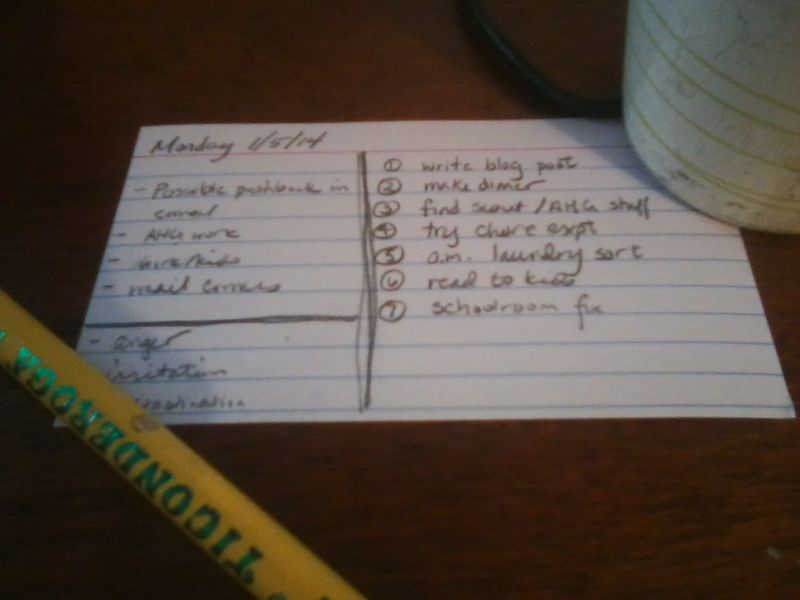
    Bonus Nifty To-Do Trick.  I started making my to-do list on an index card instead of a whole piece of paper, to force myself to keep it short. 

    Guess what:  This mini-resolution has stuck, probably permanently:

    0105150810-00

    That's from this morning.  As you can see, I'm still on task #1.

    On the left side of the index card, by the way, are some notes about what I can expect to happen today (especially things that might derail me) and a short list of faults I am hoping to avoid (anger, irritation, procrastination).  I think I'll revisit this soon, too.  

    I do keep a longer, running to-do list on Wunderlist and also schedule time-sensitive things on my calendar.  The index card is just for daily concerns.  I can throw it out at the end of the day, whether everything on it is done or not.  Works great.

    + + +

    I have to say that although the details didn't work out exactly as I'd planned, the past year — particularly the school-support-work part of it — has been going astoundingly well. 

    Practically every time I sit down for end-of-the-day tea with H, with our three babies toddling around at our feet, we look at each other and say:  "I can't believe how well this is going."  The two of us really scaled back our expectations for what we can accomplish with babies underfoot, and — lo and behold — we seem to have actually set realistic, achievable ones.

    In my own home, I pushed most of my weekly schoolwork prep (including recordkeeping and grading) to Saturday afternoons, resolving not to let it bleed into Sunday.  I gave myself a deadline, and I found that I can get the essentials taken care of in two or three hours of focused work.  

    (Mind you, I used a lot of the summer to put together a whole-year, big-picture plan for each subject.  So this isn't all my planning, just the setup and takedown of each  week's work:  making photocopies, writing out assignments, grading papers, and the like.)

     I lowered my standards — and life is better for everyone.  

    Maybe you should resolve, in 2015, to lower your standards too!


  • The costs and benefits of accountability.

    I knew it was coming, because they asked me last year and I told them then that, sorry, it sounded fun but the notice was too short, and anyway I had a new baby. Maybe next year, I said. And then next year turned into this year, and they called again.

    Nothing big, a small thing, really: an idea that attracted me, though. A homeschooling co-op had started up in one of the outlying suburbs. They wanted someone to facilitate high school general chemistry, in 90 minute sessions, once a week, on Tuesdays. One of the other parents must have known of my background and suggested my name.

    It was a paid position — I don’t know exactly how much it would have been, because it depended on the number of students who signed up: the fees came directly from each student to the tutor (“not ‘teacher,’” it was explained to me; I get it, the idea is that the students do most of their learning independently, and then meet once a week for feedback or discussion or something like that.) On the order of a couple of hundred dollars per student for a semester. There was a science lab space available, apparently, which is more than I have at home. I would be free to choose the curriculum, even design my own, as long as it helped the students acquire the equivalent of a high school chemistry credit.

    I have a high school student of my own who plans to study chemistry next year, so that was another point in in its favor — some of the work of curriculum preparation, I would be doing anyway. The money made the offer attractive not so much for its buying power, but that it turned the gig into an actual — you know — job, relying on some of my professional knowledge and experience as well as some of the skills I have enjoyed developing behind the scenes, so to speak, over the past ten years.

    I had a lot to think about, so I started researching available high school chemistry curricula and lab kits, and also musing about exactly why the offer attracted me.

    + + +

    I have zero regrets about walking away from the paid workplace in order to concentrate my efforts on running a family and educating our children. Sometimes, however, I consider a hypothetical future in which I decide I would like to return to it, and I wonder what I might put in motion now in order to help that happen more smoothly.

    The missing piece, at least in a tight job market, is really experience that has measurable accountability.

    I measure much of my own work against more-or-less objective criteria, of course. Over the years I have grown more and more efficient at setting out a syllabus for the year and more and more disciplined at following it, while also figuring out how to adapt it to make room for interruptions. I have learned what to look for in a textbook, and how to work with what I have available when the only texts are flawed. I have taught myself in a few weeks a years’ worth of an unfamiliar technical subject, in enough depth to write a week-by-week guide for a student to work through it on his own. To different extents, I have taught myself three languages. I have spent many hours of trial and error figuring out how to present material to young people who learn in a style vastly different from mine, and to measure the learning of young people who express their acquired skills in ways vastly different from my expectations. I have learned how to give a mathematics lecture on the fly with a quick glance at the book — let’s see, what are we supposed to do today? Oh, that. Well, here we go. I have developed my patience and my flexibility. I know that all this is happening, because every year it gets easier and runs more smoothly, at the same time as it seems I should have more and more tasks to do in less time. This basic sense of growing competence — at least in the parts where I organize time and environment, write curriculum, and teach willing students — means that every year I enjoy my work more.

    But none of this belongs on a résumé.

    Do not bristle about this showing that the work of parents in the home is not valued. The difficulty is that work of parents in the home is not measurable. Home educating develops skills that may be measured; but it doesn’t, itself, measure them.

    This is inherent to its genius. There is wonderful freedom in home education, which is one of the things that makes the work so satisfying to me. I have no supervisor, and rely on my innate desire to see the children succeed — plus my desire for order and peace in our home — plus my own pleasure at digging deeply into a subject — to motivate me to excel. I know from talking to numerous other home educators that this same freedom can, to others, be intimidating, which is one reason why there is such a big market for school-in-a-box curricula. “I want accountability,” they tell me. Whether one wants it or not is a matter of self-confidence and working style; it’s absolutely true that, in homeschooling, freedom is free and accountability is something you have to pay for if you want it.

    Not being accountable to anyone who is paying us — trading economic value for economic value — means that we can’t verify these particular skills and strengths for the purpose of selling them. We cannot demonstrate having had to perform to external standards, because the standards we keep are not external. There are no professional references that may be checked to confirm our fitness as an employee. It is a bit like being self-employed, except that even the self-employed can point to the successes and struggles of a small business in a market of other people and the constraints of budgets and regulations, all of which are external and, in principle, verifiable.

    This is not something to take personally. It’s not about whether parents’ work in the home is valuable; it’s about whether parents’ work in the home is ever capable of demonstrating to a particular potential employer that the candidate in question has something of value in the immediate future to offer to that employer. You have to own the fact that it usually cannot. You have to be satisfied with internal accountability, because there is no other kind. I cringe when I read nonsense like “I’m employed as a Domestic Engineer” or (what is infinitely worse) listing children or spouses as the “employer” on a FB or LinkedIn profile. Even as a joke, this cheapens us all.

    + + +

    So I thought seriously about the challenge of having accountability — with cash on the line — to other people for a change. I bet I would enjoy it for its own sake, and then, I imagined it could come in handy later; a thing that produces references, and a line on a hypothetical future résumé, a line that combines the professional interests I used to enjoy with the practical skills I have developed doing my, shall we say, undocumented work.

    In the end, the attraction to hypothetical future benefits was not enough to overcome the immediate costs. I would have had to drive forty minutes each way; and the subjects that my younger kids could be doing at the same time were not ones I really wanted to outsource; and this particular co-op, it turned out, didn’t offer any onsite activities for preschooler siblings. If I weren’t already co-schooling two days a week with H, taking one day a week for a co-op day might fill a social void without cutting too much into our schedule. But — I am, and those co-schooling days are far more valuable to me.

    This year things are running more smoothly than ever, and — when you get right down to it — adding accountability might strengthen my résumé, but it would weaken my real, day-to-day performance at my primary responsibility. The ultimate end of all work (including work done for personal development and enjoyment) is the support of the family; judged by that standard, this particular work at this particular time would only undermine mine.

    Some other year.


  • Spicy placebo.

    Sick MrsDarwin posted her hot toddy recipe a few days ago in between coughs:

    [MrsDarwin's] Hot Toddy

    In a large cup, combine 1 spoonful honey, juice of ¼ lemon, 1 cinnamon stick, small dash tabasco (optional but recommended) and the tea bag of your choice. Stick 3 cloves into 1 small lemon wedge and add to the cup. Pour in a slug of bourbon, as much or as little as you like. Fill cup with boiling water, stir well and let steep 5 minutes. Savor slowly; repeat as necessary.


    I confess I'm bemused by the combination of caffeine and booze, Irish coffee notwithstanding.  But hundreds of miles away, I have been coughing and sniffling and sipping my own concoction, the one I always go for when I have the latest creeping crud.  

    I leave out the tea, because I want to sleep, and I leave out the alcohol, because it rarely makes me feel healthier.   The rest of it is borne out of a mix of vague theoretical herbalism (I heard that the allium family is supposed to have anti-viral properties, and isn't honey a natural cough suppressant?) and desire, after several days of my nose not working, to sip something — anything — that I can taste

    I give you Erin's Spicy Placebo:

    Into a mug place:  

    • 2 slices lemon
    • 1 slice orange
    • Several thin slices of fresh ginger
    • 1 fat clove of garlic, crushed with the flat of a knife
    • 1-4 thin slices of fresh jalapeño chile

    Pour boiling water over and steep for several minutes.  Stir in a generous dollop of honey and sip slowly, breathing in the pungent steam.

    People generally look at my drink with alarm.  I have no idea whether the contents of the cup are, in fact, therapeutic.  I only know that they make me feel better, as the tingle of the chile penetrates my sinuses and the pleasant ginger-scented vapor settles my stomach.   This is good enough to keep me coming back to it time and time again.  

    When I run out of lemons and oranges, I substitute a teaspoon of apple cider vinegar to keep the mixture tangy; I can't smell the citrus anyway, so one acid is probably as good as another.  If I close my eyes and picture lemons and oranges, I can almost fool myself.

    If you happen to know for a fact that garlic's antiviral properties are exaggerated and that honey is no better than plain hot water at suppressing coughs, I only ask you to keep it to yourself.  This stuff is working for me, better than anything else this nursing mother wishes to take, and I would hate for anything to happen to the web of belief that keeps it that way.

    Last night my father-in-law offered me a slug of brandy for my mug and I tipped just a little in.  It wasn't bad.  I haven't decided if I want to modify my recipe or not, but I do want to note something Mark told me he read once:  the more expensive that people believe a "medicine" to be, the more likely they are to experience the treatment as successful.  I suppose I might be willing to add some booze to my brew, but if so, I'd better be prepared to stick to the top shelf.


  • The best you can do with what you have.

    "Doing the best you can with what you have" sounds like a disappointment; people who talk of "doing the best you can" imply that disappointment, a settling for secondhand wishes.

    It doesn't have to be, though, does it? The first step is acceptance of reality: I live in certain circumstances, not others. I don't have to let visions of wishes stunt me, unable to use the resources I actually do have, stuck in unhelpful comparisons to others.

    The second step is a clear-eyed questioning: What can I do with this?

    If the comparison game is too strong a habit to break, you can always turn it around and ask: Well — what do I have at my disposal that other people don't? What story are we telling with our lives, here?

    + + +

    I think and write about this theme a lot with respect to homeschooling, because nobody plays the comparison game better (or worse, I suspect) than home educating parents do. It is sociable and frequently helpful to share our successes and our best ideas with each other, but the dark side of that is the unending list of Super Enriching Lessons And Experiences That We Are Not Giving Our Children. Add that to the felt pressure to somehow "make up" for the great yawning hole that the mainstream culture imagines we have scooped out of our children's weekdays between 7:30 am and 3:30 pm. It can get overwhelming.

    But the answer to the Great Yawning Weekday Hole fallacy is the reminder that institutional education is just one way of life, not the only one or even the default; our days are filled, and the "hole" exists in minds. The closeness of siblings and parents is not an absence. The home and the wider community of libraries, shops, streets, and work is a real environment, not an artificially designed one: soil and sun and rain, not fluorescent lighting and bell-timed treatments.

    There is no vacuum here. There is always something. Embrace the something you have.

    I have an urban postage-stamp of a yard and no close access to parks or other green space; schoolday nature study, Charlotte Mason style, is not available to us. I have five children across a wide age-span; I have to say no to some young-child activities because of my older kids' needs, and to some activities for teens because I have younger children. I don't have room for a piano, and we've ruled out team sports because of the huge time commitment. Our co-schooling schedule means that 40% of community activities designed for homeschoolers (anything on Mondays or Thursdays) are already ruled out.

    But notice! The things we don't have are all not there because of the things we do have instead. We live in a city, walking distance from the library, right on half a dozen bus lines. My children have siblings across a variety of ages, and each of them, in their own niche in the family, lives out a different experience of that sibling group. We didn't put in a music room because we put in a basement climbing gym, an attic space for playing board games and Wii, and a guest room so Grandma and Grandpa can stay with us and visit as much as they want. We don't do team sports, but we go to the gym as a family two or three days a week, for swimming, aikido, track running, and using the fitness machines. And co-schooling — well, it may keep us from signing up for plenty of one-offs, but week in and week out it has set the rhythm of our lives, revolving around relationships that have grown and strengthened over years.

    It's okay if you don't have these things. Undoubtedly you have something else, and that something else is a place where your family can thrive.

    + + +

    Recently a neighbor, who has two small children, asked me via FB,

    How are you feeling about living and raising kids in our neighborhood? Have you all decided to continue raising family here or is moving to a "family friendly" neighborhood something you all consider?

    … We are financially in a spot where we could "move up" and are considering other neighborhoods. But we love our house and think we could better use our money for other things…. but we wonder if our kids would be "happier" kids in a different neighborhood.

    I realize it's a deep personal decision… but we do get the family pressure of "when are you all moving to a better and safer neighborhood." The pressure to assume we deserve better. Whatever that is.

    And I thought about that… and how it's not so much a "better," but simply a "different."  We've made a point of trying to exploit the things that are great about where we live.  

    I wrote back (edited slightly to remove specific details):

    I think that living in the city, kids "launch" into safe independent wandering a little bit later than they can in a suburb with no busy streets and homes on cul-de-sacs, but once they do launch there is quite a bit they can do — it is a different sort of independent activity.

    At 14, my oldest now takes the bus downtown to buy his own clothes, and to the mall to go to the movies alone; he and my 11yo took the bus into the next suburb over to go rollerskating recently.

    (Since I have five kids I am eager to get them to the point where I don't have to drive them everywhere).

    They walk half a mile to the main drag through our part of the city.  There they can buy chai at a coffeeshop, or walk to the Y for their swimming and aikido lessons; we can send them to the hardware store and to the Mexican grocery.  We are looking forward to when a new food co-op goes in even closer to our house.

    As little kids, my children haven't been allowed to go to the playground and play by themselves, and there don't happen to be any neighborhood friends they can walk to and visit, and that is too bad; but there are things to do that are interesting for older kids and teens, things that kids in the suburbs can't always get to until they can drive.

    + + + 

    Now that my oldest is getting older, I feel that our neighborhood is starting to … bloom? … with possibilities for us.  Yesterday the homeschooling co-op had a tour of the Minneapolis Institute of Arts, led by our parish priest, who pointed out details in various pieces of sacred art in the permanent exhibits.  It was for high school kids only.  Rather than bundling everyone in the car to drive my high schooler there and then again to pick him up, I gave him bus fare and he went on his own, met up with the group, took his tour, and then schlepped back to the bus stop.  He didn't  even have to change buses, and his return trip was on the transfer from the outbound trip, so he saved one fare.

    This is like a revelation.  The same 14yo is just now, I think, comfortable watching his younger siblings (minus the baby) while his dad and I go out for a little while.  Because we live where we do, we can walk to get a beer together (with the baby) on a weekday evening.  We have the phone, the teen has the phone, and we're literally close enough that Mark could sprint home if there was a problem.

    I admit I don't take the kids to the playground as much as I like; but yesterday afternoon Mark came home early (after a week of late nights and early mornings) so I went to the pool for a quick swim before dinner.  "Can I go?" asked my four-year-old, so I took him with me and he went to the Y's child care for an hour and a half, running around and playing with other children and having a grand old time (he burst into tears when I showed up to take him home).

    Most of my friends live in the suburbs, and they do have some nice things, like un-busy streets where their kids can ride their bikes, and lots of neighbors who also have kids of the same age (granted, occasionally that's not always wonderful), and big yards.  We have some nice things too.  You just don't always see those opportunities flower until kids are old enough to use them much.


  • Apple pecan crisp, GF if necessary.

    So, our Thanksgiving was spent with friends here in Minneapolis, one other family with four children roughly matched to our children's ages.  Although each family contains one person who is a pretty good cook if we do say so ourselves, neither one of us particularly wanted to roast a beast; so when he suggested that we order alambres al pastor from the local taqueria, open till 6 on Thanksgiving, and share homemade appetizers and desserts, we said "Olé!"

    10351400_4796015956414_1388457074771674659_n

    our friend's homemade guacamole and fresh tomatillo salsa


    10387610_4796017676457_3098707071655823557_n

    alambres al pastor …  beast (porcine type) roasted on a spit, sliced thinly and broiled with onions and green peppers and bacon, served with tortillas 


    10458217_4796016516428_6661286839428023374_n

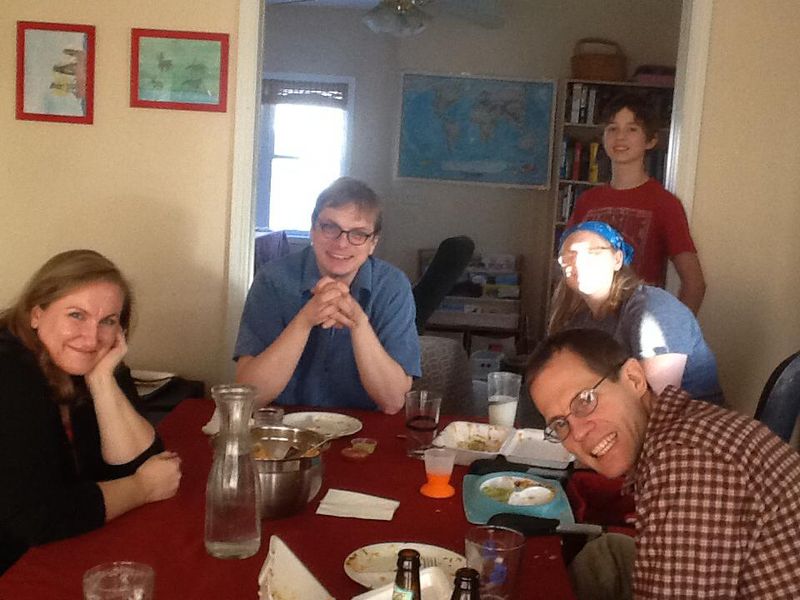
    fellow friends who also have no family living in the state, seated at my schoolroom table turned into a "grownups table"


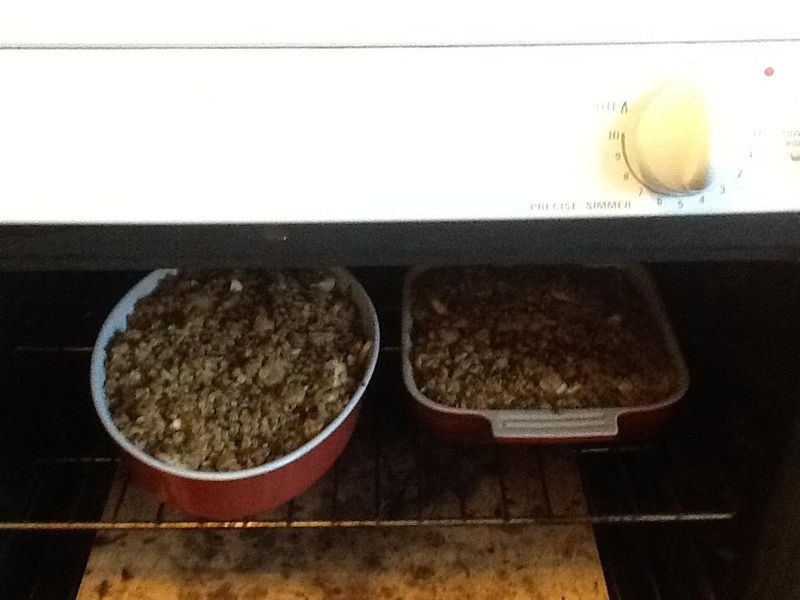
    I made the best apple crisp I have ever made, and Mark (who loves all fruit crisps) has declared it worthy of its own blog post.  The topping was filled with enough pecans so as to be practically praline.  I adapted it from this recipe at Once Upon A Chef, which I found by Googling "apple pecan crisp."  I doubled it to make two pans of crisp (the recipe below is for the original un-doubled recipe), toasted the nuts, and replaced the wheat flour with finely ground oats in order to accommodate our friend who lives with celiac sprue (and chooses to eat oats, which is somewhat controversial in the celiac community).  

    The apples I used were about fifty percent Gold Rush apples given to us by Mark's dad, and fifty percent Granny Smith for tartness and structure.  Mixed apples make the best fillings, but you want to make sure that at least some of them are tart "baking" apples so you don't wind up with applesauce.

    Apple Pecan Crisp (GF)

    • 1 cup pecan pieces
    • 3/4 cup plus 2 Tbsp old fashioned rolled oats (divided)*
    • 1/4 cup plus 2 Tbsp light brown sugar, packed
    • 1/2 cup plus 2 Tbsp granulated sugar (divided)
    • Pinch salt
    • 6 Tbsp very cold unsalted butter, cut into 1/2" dice
    • 2 and 1/2 pounds tart baking apples
    • Cooking spray or butter for the pan

    Preheat the oven to 350°F.  Generously grease a two-quart baking dish (a 12"x8"x2 oval or an 8"x8"2" square will work).

    In a heavy dry skillet, toast the pecan pieces over medium heat until golden brown and fragrant, stirring constantly.  Do not allow to burn.  Transfer to a plate to cool.

    Put 1/4 cup plus 2 Tbsp of the rolled oats in a food processor and process until ground to a coarse "flour."  Then add the brown sugar, the salt, and 1/4 cup of the granulated sugar and pulse till combined.  Add the butter and pulse until the mixture resembles coarse meal.  Transfer to a bowl and stir in the oats and pecans.  Set aside.  

    (At this point the mixture can be refrigerated overnight and the recipe can be continued the next day, which is what I did to save time on Thanksgiving.)

    Peel the apples, core them, and slice them 1/4" thick.  In a medium bowl, toss the apples with the remaining 6 Tbsp granulated sugar.  Transfer the apples to the prepared baking dish and cover with the oat topping. 

    Bake in the middle of the preheated oven, uncovered, for 40-50 minutes or until the apples are bubbly and concentrated and the topping is toasted and brown.  (In my experience, you just have to keep checking until it looks right.)

    10440848_4796018196470_8824098785313761973_n

    Serve warm with vanilla ice cream.

    ___

    * If gluten is not a problem:  You can replace the first 1/4 cup plus two tablespoons of oats, ground in the food processor, with an equal volume of wheat flour, simply pulsed with the sugars and salt to combine.  That's what the original recipe called for.


  • Housekeeping.

    Sometimes I think the world must be made up of two kinds of people, or at least two kinds of housekeepers.

    (1) The kind of person who says, "Life's too short to spend your free time tidying up"

    (2) The kind of person who says "Life's too short to spend your free time looking at a lot of untidy stuff"

    I am the latter type of person, and so is my husband, so we're compatible in this way, which is thankful; I expect it's hard for the two types of person to be married to each other, unless they're both also super-patient and aware.  

    Not that we can keep up with it, what with the five children who spend their days here:

    Photo (5)


    typical, not preferred, morning orientation of the kitchen, before most children are awake


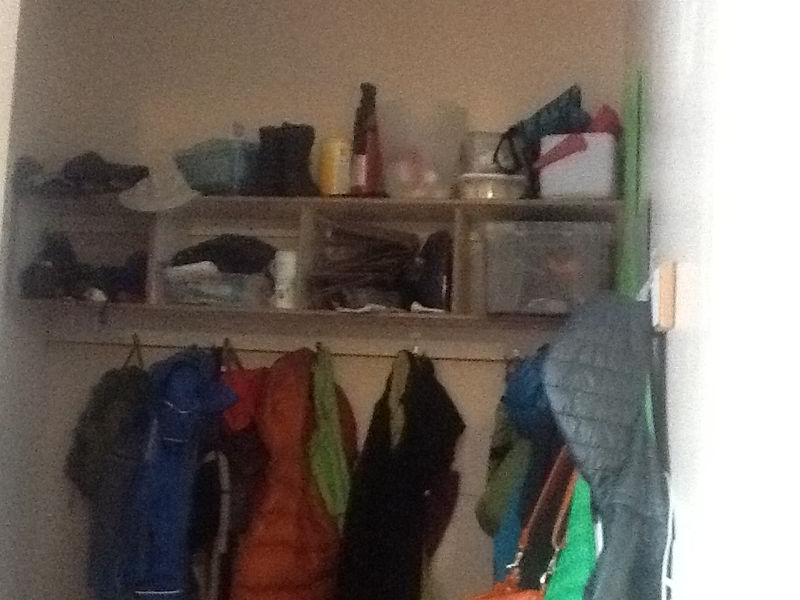
    Photo (6)

    mudroom — yes, I'm fortunate, nay, privileged, to have one — no, we can never find anything in here


    Furthermore, evidence suggests that the children's rooms have become clogged enough with extraneous stuff that they need to be snaked out, so to speak, so that the children have an easier time keeping their own spaces clean.  

    This weekend happens to be clear, and so the two of us have agreed that This is The Weekend Of The Great Household Purge. Will it be filled with family fun and togetherness?  Togetherness, yes.  Fun?  I'll probably find it satisfying to pull all the accumulated bits from under beds and carry garbage bags of broken toys to the corner.

    We'll be setting timers for 20 minutes of work and then 10 minutes of screen time and then 20 minutes of work again.  We'll be exhorting the children to get back to their tasks so they don't have the timers turned back.  I'm going to put some thought into rewards that can be "unlocked," video-game style, if they accomplish certain outcome-based milestones.  Fill 1 large box with your own belongings for Goodwill and you get a prize.  Accomplish complete processing of your own clothes — all clean things put away, all remaining dirty things confined to a single basket, all out-of-season things upstairs waiting for me to put them in storage — get another prize.  Remove all the stray items from the basement climbing gym and put them back in their own places:  everyone gets a prize.  

    (Not sure what the prizes will be; not toys, which defeats the purpose; probably something like "we order pizza for lunch on the next school day" or "we put a family trip to the science museum on the calendar instead of vaguely promising to go some time" or "we rent a movie and watch it all together in the evening.")

    We might top it all off with Family Game Night, which is what I call it when, once a year or so, we open up all the boxes, and count the game pieces, and take all the pieces out of the wrong boxes, and get rid of the games that have been rendered unplayable by attrition, and order extra dice on Amazon.com, and seal all the little bits into Ziploc bags inside the correct boxes.  

    + + +

    We clean a lot.  We make the kids clean a lot.  I probably make the kids clean the main living area four times a day:

    •  swap the dishwasher after breakfast and wipe off the table
    • swap the dishwasher after lunch and wipe off the counters and pick up the floor (then they get to have break time until two o'clock)
    • pick up the floor and clear their school desks around 4:30 for "end of the day cleanup"
    • help clean up the dinner dishes between dinner and bedtime snack.

    They're also supposed to keep their rooms clean (which has not happened consistently since we got back from Europe, part of the reason for the upcoming Great Purge) and do a daily bathroom-tidying task without being asked.  This does not happen consistently either, these days; I have laid out the consequences of demonstrating that they are not able to do all the tasks, which are that I will take jobs away from them and reduce their allowance accordingly at the start of December.  We'll see.

    + + +

    Sometimes I imagine my children talking to their future therapists, or maybe friends over coffee, and they'll be saying:  

    My mom was this total neat freak.  

    She made us clean the house four times a day.  

    We were homeschooled, so there was plenty of time to put us to work.  

    I think she spent more time making us clean the house than she spent teaching us.

    + + +

    And in my fantasy I can appear in the fantasy therapist's office and retort, "Well, you ate four times a day.  Five, actually.  And since you were homeschooled, you were home all day living in the house, so yes, actually, there was plenty of time for you to make it messy again after you cleaned it.  And a big part of what I taught you, besides how to read and reason and calculate and remember, is how to maintain a home so that you can find what you need when you need it.  How to care for your clothing.   How to keep a bathroom sanitary.  How to feed yourself and how to feed a family."

    + + +

    So, you know, one thing we don't do very much is sit around in the evenings with the children and just enjoy each other's company.  

    Instead, they flee after dinner, hoping that we won't call them back to swap the dishwasher.  And it works sometimes, because sometimes Mark and I will open another beer and sit there together, amongst the dinner dishes and pans, marveling at the abundance around us and in one another, and talk together as husband and wife; sometimes it's quite a while before we say, "Goodness, we've got to get this place straightened up and put the kids to bed," and the kids know it, and they stay upstairs and play Minecraft or Settlers of Catan or whatever and stay out of our way until we make them come down and empty the dishwasher.

    And it's just how we roll.  In my mind I imagine other people, who own sofas more comfortable than mine,  games and books and kitchenware bursting out of their cupboards and corners piled high with clean but not-yet-folded laundry, happily putting off the dishes till tomorrow, snuggling on the sofa and reading a stack of beautiful library books to their children while other children are busy building complicated craft projects in the next room, getting glitter on things and leaving pompoms and pipe cleaners stuck to the floor.  

    It's a romantic picture, and it isn't the picture I live in.  I hasten to add that if it is the picture you live in, I really do love coming over to your house for a visit.  My children will disappear into the recesses of your home, and I will cup the mug of hot coffee you pour me between my two hands and sink into the sofa and sigh with contentment and welcome, knowing that none of your cupboards are my business, although if you start folding towels in front of me, I'll also be glad to help.

    But you know, we really all are different, and regardless of what kind of therapy they may or may not need — someday my kids get to decide what satisfies them, and live in their own space…

    ….aha, though, probably among other human beings who have their own desires.

    But together with others they will get to work out what they view will be when they come down the stairs in the morning; and what to do with what's left of the light in the evenings…

    just like we do, those winter evenings when the snow is coming down outside, and I could wash these glasses right now, or else, if you want, I could fill them again.


  • Jon Stewart, expertise, and homeschooling.

    Even though I'm on the board this year and am supposed to be partly responsible for it, I left the homeschooling support group meeting before it was over; my nursling was at home without me.

    Ever a well-appreciated meeting format and easy to throw together with a couple of weeks' notice, the Panel Of Four Experienced Homeschoolers had drawn an audience of a dozen or so.  

    How do you make a seven-year-old just, you know, do her math sheet?

    I don't understand why my curriculum provider has thirteen subjects for a fourth-grader.  It's ridiculous.  How do you do them all?

    Is it okay that my daughter holds her pencil in this funny way?

    I put my four-year-old in preschool one day a week for socialization, and he loves it and is thriving.  How can I homeschool a child who really likes to be around other kids?

    What do you tell the naysayers?

    How do you keep up with the grading when you have more than a couple of kids?

    I'm not one of the Panel People yet.  My oldest is in ninth grade.  K on the panel has an oldest who is in tenth grade; but K is one of the grandest multiparas in our co-op, with eight children, a levelheaded former accountant.  Of the others, one has five children with the oldest a senior in high school, and the other two have graduated multiple children.  I'm not there yet.

    Increasingly, although I still think of things I'd like to ask, I no longer feel like a questioning member of the audience either.  I know how to write my own curriculum, how to adapt a purchased curriculum to my needs, how to stay a few steps ahead of the kids learning a subject that's new to all of us.  We've tried things and discarded them many times, and so we've learned already what takes time and experience to learn:  

    What works for one family won't work for another family.

    You have to figure out how to make the curriculum work for you, not the other way around.

    You discipline your children to do their schoolwork the same way you discipline them to do anything else they have to do that they don't want to do.

    In some areas you must be firm, and in other areas you must be flexible, and figuring out which is which takes trial and error.

    Some things that seem super important turn out, in the end, not to matter all that much.

    Listening to a few members of the audience sharing stories of how they won over the children's grandparents with twice-yearly piano performances and poetry recitals, I felt like chiming in with my own perspective but didn't.  Especially, I was thinking of friends who have children with disabilities, and the many, many children who don't win national spelling bees or play instruments well or send the achievement-test bars into the ninety-ninth percentile, but nevertheless thrive at becoming themselves in their family environment.  I was thinking:

    Some people in your lives will always be naysayers, and no amount of your children's accomplishments will ever win them over.  I say fuck 'em.

    But I felt unsure that it was my job to deliver that message, so instead I went and poured myself another cup of decaf from the carafe on the counter, there in the parish school library.

    + + + 

    I'm partway through my career:  not an expert yet (despite loving to share what I've discovered), and not a newbie either.  By the time my last child has finished homeschooling, I expect I will be rather skilled at teaching my own children.  I will have lots of experience, highly specialized to work with these particular five people.   

    And when they are grown, my job (so to speak) will have entirely disappeared. I will be a highly specific expert with no outlet for my specific expertise.  

    + + +

    In the cold car, I punched the radio button for NPR and found Terry Gross, the host of Fresh Air, interviewing the director of the new film Rosewater.  Oddly,  the director had the same name as Jon Stewart, the host of the comedy/news program The Daily Show.  A couple of minutes into the interview, I realized that both Jon Stewarts were the same person, and remembered that Stewart had been on an extended absence from The Daily Show with John Oliver subbing in, and of course it made sense that he was off making his documentary then.

    Towards the end of the show (about 38 minutes into it here), Gross asked Stewart about whether he feels conflicted between moving on to new projects and staying on at his own show.  

    TERRY GROSS:  I'm just thinking of the difficult spot that you're in… because maybe you're going to try something else… restless… on the other hand you're so darn good at doing The Daily Show! … I was just wondering about the conflict that maybe you'd be feeling, about knowing how special this thing is that you created, and yet, perhaps, wanting to do something else.

    JON STEWART:  It's always difficult. I do feel like I don't know that there will ever be anything that I will be as well suited for as this show.  That being said I think there are, there are moments when you realize that… that's not enough anymore, or that maybe it's time for some discomfort…

    I'm certainly convinced I'll never be able to find the type of people that I've been able to work with in that environment… and be able to have that feeling of being able to utilize every part of something that I think I can do, like I utilize to full capacity on that show.  I'm still really proud… of the work that we do day in and day out…

    That is the difficulty, is….  When do you decide, that even though it's this place of great comfort… when you feel plugged into something like you've never been plugged into anything else that you've ever done, you know, but there are other considerations, like family, or just… not wanting to be on television all the time! [laughs].

    You can't just stay in the same place because it feels like you've built a nice house there.

    I found myself listening to Jon Stewart more intently than I thought I would.  You can't just stay in the same place because it feels like you've built a nice house there.  It's so true.  He is talking, of course, about creative pull to do other things; but it's completely true that no matter how good he is at The Daily Show, he can't do it forever, and he won't.  And no matter how good I get at homeschooling, I can't do it forever, and I won't.

    My favorite feeling is the feeling of competence, of flow, of being lost in my task.

    The longer I do this the better I get at it; and the longer I do this the closer I get to when the job is simply done.  And then what?

    + + +

    Maybe that's the day that I sit on a homeschooling-expert panel in the parish library and tell the audience: You'll have naysayers no matter what you do.   Fuck 'em.


  • Snow a-coming.

    This weekend Mark and I pulled out all of the wintry gear.   

    An impending visit by Mark's parents is what spurred it; we habitually toss out-of-season and recently-outgrown clothes through the door of the spare bedroom and ignore them until we have to do something about them.  But we would have had to do it anyway, because tomorrow… it comes.

    The snow.  The first sticking snow, the one that the fire hydrants foreshadowed all through the spring and summer and fall.

    I'm a little ahead of the curve; I needed my warm hats and scarves and wool socks already this week, even though the thermostat reads  68° F, because I am still (slowly) losing postpartum weight and that makes me cold.  My nose and fingers and toes are cold right now.  

    Mark says I should take cold baths and then I would acclimate myself and the cold wouldn't bother me, but I'd rather just pull on an extra layer and pour myself another cup of coffee and grumble.

    + + +

    I called H this morning to plan for tomorrow.  I want to be in denial about the possibility of changing plans on a co-school day, but the first snow of the season always makes rush hour positively horrific.   I need to face reality, and reality says there's an extremely good chance I won't be driving across town to her house tomorrow at all, let alone on time.  

     I'm supposed to bring dinner, which was going to be chicken adobo in the crockpot with rice and pineapples.  I'm not going to defrost enough chicken legs for 14 people if there's a good chance that I won't be cooking them.  I have meatballs in the freezer; if it turns out that I'm going over there in the afternoon, I'll bring those.  They defrost fast and cook fast.

    As for schoolwork, the younger kids (assuming it snows) will just get a snow day.  Our high schoolers, however, need to stay on track.   Fortunately, they don't need a lecture for geometry tomorrow, and they don't need one for history either; but I have a lot of stuff to hand out.  So I'm going to head over to her house after church today — church is about halfway there — and drop off all the materials I was going to hand out to her ninth-grade son, and spend a few minutes explaining how to use them.  Then I'm going home to enjoy the rest of my Sunday and batten down the hatches.

     I might conduct a Latin class tomorrow over Google Chat by audio, since I'm planning to introduce personal pronouns in the third person.  I really wanted to do a slew of oral exercises and recitation for it.  If the snow isn't too heavy and the roads are clear by the afternoon, we still might make it over there on Monday for dinner and to get the kids to Scouts.  But I'm not counting on it. 

    + + +

    This represents a significant advance in my ability to deal with plan changes.  Previously the threat of snow on a co-school day for which I had already made my lesson plans only drove me into deep denial.  The snow might not be that bad!  I've got snow tires on my van!  I might just leave a little bit later!  We can keep going!

    Yeah, no.  Not for the first snow of the season.  I'll still be ready to head over there, just in case it turns out to be a false alarm, or the snow holds off tonight and doesn't start till afternoon tomorrow.  But I'm going to be more ready for the snow.  And I'll be glad, tomorrow, that I did, if we wake up to a thick white blanket over everything, and all I have to do is wrap a scarf around my neck and pour another cup of coffee.


  • Thirds on entrées.

    One of my real-life friends tried my suggestion to have an entrée with her family dinners for a couple of weeks:  set out a dish at the beginning of the meal as a first course.  

    She reported that it had an incredible effect on the pleasantness of the dinner.  I'm paraphrasing her comments here from memory:

    • They had time to begin with a prayer and to talk about their day.
    • They didn't start off their meal by frantically grabbing to get the best stuff before their brothers and sisters could eat it all.
    • Her kids' medications start to wear off towards dinnertime, and that leaves them with a suddenly ravenous appetite.  The slower start, she thought, worked better with their hunger levels and kept them from eating too much right away.
    • The kids began to look forward to dinner with interest, asking, "What are we having for appetizer tonight?"

    We both agreed that this one little change has a number of different effects on the pace of the dinner, and it's hard to find an explanation for all of them.  It just… alters the environment.  

    Because we don't clear away the first dish until (a) everyone has eaten at least a little of it and (b) no one is still working on theirs, we all become a little more aware of the other family members' pace.

    There's usually a pause at some point, where we find ourselves talking to each other instead of head pointed down into our bowl, and when we become aware of that we know it's time to get the next course.

    Because the rest of the meal arrives somewhat gradually — I have to get up, take away the salad dishes, and bring the serving dishes to the table one at a time — the dishes begin to be passed as they arrive, and instead of a free-for-all it's more orderly.  

    No one is positively starving when the "good stuff" arrives, and that means everyone has the patience to wait for their turn to help themselves.

    + + +

    My friend took it even farther than I do and served dessert, too.  I'm not sure what she made each day, but knowing her family, it might well have been a homemade sweet some days, a packaged sweet on other days, and fruit on yet other days.  She reported that the formalization of the dessert course also added to their enjoyment of the meal.

    Dessert is not part of my family culture except on special occasions or sometimes when we have guests.  Instead, Mark and I linger after dinner over our drinks, chatting, as the kids finish up and excuse themselves and run away; later, we call them back to help us clean up (unless we'd rather do the dishes ourselves while we polish off the bottle and continue our conversation), and then we have "bedtime snack."  It's as good as dessert, but it's after dishes; that's just the way we do it.  Ice cream, milkshakes, cereal, the occasional plate of nachos.  I can't see us changing that anytime soon.  It works great for us.

    But I've been persisting in the "first course" habit too, despite having to streamline my cooking quite a bit on school days. 

    The entrée is sometimes just an afterthought.  A couple of times so far, the first course has just been applesauce from a jar, made slightly fancy by a shake of cinnamon sugar.  (In that case, Mark and I skipped the applesauce and started in early on our wine.)

    Yesterday I thawed some leftover chickpea curry, and we had that with rice and greens; I served the grated-carrot-and-lemon-juice salad, usually my go-to-with-curry side dish, as the first course (and replaced its sweet-and-sour flavor in the main course with a bowl of canned pineapple chunks).  

    This coming week, my son is making hamburgers and tater tots for dinner, and he's going to start us off with a Caesar salad (from a bagged kit, but hey, it's his turn to cook and his turn to decide).

    I'm going to make some kind of a beef and pepper and rice skillet on Saturday, and I think it'll be easy enough to do a black bean and corn salad at the same time.  I'll add avocadoes if any are ripe by then.

    I'll make black-eyed pea soup on Tuesday with bread.  I'll buy some bagged baby spinach and mandarin oranges, and hope that the spinach stays crisp long enough to turn that into a salad; but if it wilts, we'll just have extra oranges and I'll put the spinach in the soup.

    Not much fresh stuff will be left by a week from today, so Wednesday's appetizer will be a cabbage-apple salad — or just a coleslaw if the apples have all been eaten by then.

    I have a few emergency things up my sleeve, too — the aforementioned applesauce is one, but I also have some frozen edamame in the pod, and I think perhaps I might buy some frozen cooked shrimp and some cocktail sauce to have on hand, too.  The whole thing has been very fun, and hasn't added a lot of work.  Try it and let me know what you think.


  • Taking notes; and the photo shoot of the saints.

    Today was the first day that I had to scrape ice off the windshield. I got up at 7:30 so I could grab a cup of coffee before heading off to the 9:00 Mass for the Feast of All Saints.

    In our archdiocese, the obligation tis lifted when the feast day falls on a Saturday or Monday, so I took the opportunity to go to Mass all by myself, and relished it. It is rare that I manage to get to Mass both on All Saints’ and on All Souls’.

    + + +

    Recently, as the 4yo gets closer to being a 5yo and easier to handle, and as Mark has been taking over more of the duty of carrying the baby around during Mass, I have found myself less frequently occupied with childminding and more often with my hands free. I’ve started doing something I have long thought about doing but worried about how it might look: Taking notes in Mass, at least during the homily.

    I spent more than half my life as a student, you know, and I am a note-taker: pen on real paper, the sort that draws circles around important words, adds lots of arrows to connect ideas, goes back and finds the main points and numbers them. I listen so much better with a writing instrument in my hand, and I retain so much more — even if I never go back to those notes again — if I once write the information down. Not to mention that the task of catching the important parts, distilling them into bits concise enough to keep up, and recording them — a survival skill I worked on for years and years — focuses me on the words instead of the little distractions of my mind and body — what else I have to do today, what on earth I am going to say to so-and-so the next time we talk, when I will be able to have lunch.

    I decided all of a sudden that I don’t care if anyone looks at me funny during Mass. I have a little notepad in my bag anyway, and I started pulling it out at homily time (sometimes during the readings if something in the readings strikes me) and taking notes.

    It’s made a lot of difference in my ability to take what I hear, find something fruitful in it, and carry it around in my mind — out of the church and into the places where I can actually put it into practice. Also, it’s easier to discuss it with Mark or with the kids later, because — what’s new — I remember it more than five minutes after Mass is over.

    + + +

    I really liked an image that our pastor used in his homily this morning. Children getting ready for picture day at school often protest at the dressy clothes and the sitting still; but when we are older, and it is time for us to pose for a group picture for some club or association or even friendship that we are happy to belong to, we don’t want to stand out as the guy who doesn’t seem to belong; we want to fit in, are eager to show through our image, our appearance and our expression, that we belong to this and it belongs to us. It is not superficial if the desire to be a part of the group is real.

    Putting on saintliness here on earth is like that, because we belong already to the friendship and association of all the saints.

    The notion of standing in rows and saying Cheese with my friends here on earth, and with St Therese and St Paul and St Josemaria and St Thomas and St Gianna and St Andrew and all the rest, just has tickled me all morning.

    So. I am glad I wrote it down, because otherwise I might have been thinking about lunch instead.