bearing blog


bear – ing n 1  the manner in which one comports oneself;  2  the act, power, or time of bringing forth offspring or fruit; 3 a machine part in which another part turns [a journal ~];  pl comprehension of one’s position, environment, or situation;   5  the act of moving while supporting the weight of something [the ~ of the cross].


  • Minestrone, a late night, and an early morning.

    Co-schooling has been going fine, if irregularly.  For the first four weeks of the school year, my family was traveling in Europe.   Then we had a series of mishaps and scheduling faults — we had a respiratory virus, and then H's family went out of town for a wedding, and then H's daughter sustained a nasty scalding burn that kept her recuperating in her own house for several days.  

    So yesterday, Thursday, was actually the first co-schooling day we've managed to hold at my house yet this school year.   I anticipated a late start and a late end, so for dinner I put on a pot of minestrone at the end of the day.  It's done in twenty-five minutes or so, with not much chopping or stirring, and no meat to bother with.  A zucchini, a carrot, onion and garlic, half a cabbage, canned tomatoes, chicken stock, herbs, beans, pasta.  That's the recipe.  The onion and garlic are quickly sauteed before everything goes in.  Sugar and balsamic vinegar adjust the sweet-tart balance at the end.

    With minestrone we always have parmesan pita chips.  I only ever make these with minestrone, and I always make them with minestrone.   You know the kind:  you cut up some pitas, split them into thin triangles, brush them with olive oil in which there is a bit of crushed garlic and some dried basil, top with fresh grated parmesan (only a little per chip) and broil till brown and crispy.

    And with minestrone we always open a bottle of red wine.  I know I spent an entire year learning how to be a beer snob, and I learned a lot about matching beer to food; but one of the things that I learned was that no beer goes with minestrone as well as cheap red wine does.  And good red wine is even better.  

    All that is to say that we came pretty close to finishing the bottle, and sat around quoting The Princess Bride to each other, and later playing old clips on YouTube for the kids of Bob Newhart doing stand-up comedy, and I never got to the gym last night.

    So I got up at 5:20 this morning to go to the pool instead, and was back by 7.

    + + +

    After I got back from Europe, I didn't take up the weightlifting again.  I mean to get back to it eventually, but I ran into a few problems.  

    First of all, I've kind of hit the limit of what I can safely lift without a real squat cage.

    Second, I missed the therapeutic effects of swimming:  swimming makes me feel good.  It's meditative, and the peculiar achy tiredness of having swum is a peculiarly good achy tiredness.   Stress and worry just seems to lift away from me, and I get to finish with a nice hot shower, which itself is one of my favorite petty luxuries.  Weightlifting was interesting, but sometimes I don't want interesting.

    Third, I was struggling with the protein requirements.  Muscle fiber repair and rebuilding takes a lot of it, about a gram per pound of body weight each day.  At first it was kind of fun eating four-egg omelettes for breakfast and downing chocolatey shakes after each workout.  But I found after I came back from our trip that I didn't want to eat quite so much.  And I still was hanging on to fifteen extra pounds (and a couple of dress sizes) from my pregnancy, which is being borne ceaselessly back into the past, which tells me I still need to re-teach my no-longer-pregnant self how to eat.  I think I'd rather get back to the baseline, learn how to maintain again, and then re-start experimenting with weights.  Supposedly if I went full Paleo I could get the protein I needed, build muscle, and still drop some of that extra body fat; but I don't like full Paleo.  Back to portion control.

    + + +

    That's what I was thinking about as I went back and forth across the pool between 5:47 and 6:17 this morning (yeah, 30 minutes isn't great, but it let me get back to the baby in time for Mark to leave for work).   That and the annoyance of becoming boring again, as I devote precious hours and energy to the work of paying attention.  If I don't pay attention, then just when things start to look easy again, my body tricks my brain into thinking I need cake.    

    So I'm back to old habits like half-sandwiches, only sharing beer with dinner (last night's wine notwithstanding), measured servings, a small ice cream after dinner to remind myself not to go back for seconds and thirds, and sticking with fruit and cheese and nuts for an afternoon snack.   Experience has taught me that when I attentively do these things, and go for a swim two or three times a week, I see the numbers on the scale  slowly go down.  

    "Attentively" is the hard part.  We'll see how I fare with the Halloween candy tonight.


  • The lack of checklists.

    Recently a friend of mine asked me if I could recommend any books for someone who was struggling with scrupulosity — in particular, the Do I Have A Sufficiently Serious Reason To Delay Pregnancy sort of scrupulosity, mixed with depression and struggles with anger and being overwhelmed. I wanted to help, so i put some thought into it.

    Longtime readers will know of my irritation with the tendency of some corners of the Catholic internet, lacking any actual lists of rules from the Magisterium, to write their own rules for what constitutes a Serious Reason and then disseminate them.

    My position is that those entrusted with the teaching authority of the Church, as well as the inspired writers of Scripture, knew what they were doing when they didn’t, for example, add “subclinical depression isn’t a good enough reason to watch your fertility signs” or “if only one spouse is sure that it’s a good time to try for another baby, the other one should get in line.” The fact that the Church has declined to give further guidance beyond generosity and the good of the family, is itself a kind of guidance: a signal that discernment about family size and childbirth timing belongs not to theologians and pastors, nor to doctors and therapists, nor to social media friends and Twitter, but to a well-formed married couple themselves — and no one else.

    I couldn’t think of any books that I could recommend through experience, although I found some promising titles via Google. I know of a number of web-published articles and blog posts that make the case for backing off from pressuring others with the so-called Grave Reasons and minding yer own business, but as it was of course web-published articles and blog posts that helped convince my friend’s friend that her own struggles were not bad enough — that she was not good enough, and if she could only be better she could handle everything, and maybe the first step towards being better was to take on more and more and more — well, I wasn’t sure that piling more websites, no more authoritative than the others, would help.

    So I suggested working on recognizing scrupulosity in general, and left it at that.

    + + +

    Later on this week it occurred to me that there is another sort of commandment — one that is much, much more fundamental to the Christian life than anything having to do with married life, since it applies quite strictly to everyone of any age and state of life — that, despite its importance, is similarly light on the details.

    We all know we’ve got to do it. In a very real sense our salvation is said to depend on it. But no one — not Christ’s words in scripture, not the Catechism, no papal teaching document, no synod — has ever told us exactly how to do it, or how to know when we’ve done it, or given us a checklist of features of successfully practicing it. And yet this virtue, this activity, is not something that is purely spiritual or invisible; like generosity in the service of life, it plays out in the arena of real contact between real human beings, and if we invite it in, if we practice it, somehow (but no one will tell us how, exactly) it will change the course of our days.

    I am speaking of forgiveness. We know it’s always necessary: Jesus said himself that we can’t be forgiven unless we forgive. We know it must be offered again and again, without practical end; that, at least, is what the exegetes tell us that “seventy times seven” times means to say to us.

    But beyond the teaching that we have to do it, and that we are never allowed to give up doing it — we are not told what we have to do to be forgiving.

    How can we ever forgive enough? There is no “enough,” because our model of forgiveness — just like our model of life-giving generosity — is God Himself.

    There is only what we are called to do. And because it is a matter of a call, no one can figure that out for us. We have to discern on our own.

    + + +

    Let’s talk extremes: Almost nobody (unless they are trapped, themselves, somehow) believes that the injunction to forgive means that a physically abused person must go on putting himself or herself in danger of more abuse. We don’t say that there is a limit on forgiveness; rather, we advise that forgiveness doesn’t require the risk of being harmed by a dangerous person.

    And yet… all forgiveness means some level of risk and vulnerability (otherwise we wouldn’t have to remind people to do it). And so there is always the open question of how much vulnerability we can create before we have forgiven.

    The question is open. There is no checklist.

    “If your neighbor commits such-and-such a crime against you, and then he apologizes and makes restitution, forgiving him means declining to press charges. But if your neighbor commits such-and-such a different, particular, crime, and then apologizes and makes restitution, forgive him some other way while you still press charges.” Nope. We don’t get advice like that.

    “If you lend money up to $X and the borrower never pays you back, forgiveness means that you stop demanding the money and you should be willing to lend to that person again. If the unpaid amount is between $X and $Y, forgiveness means that you stop demanding the money, and don’t think of it again, but probably you should not lend to that person again. If the amount is between $Y and $Z, it is permissible to take the borrower to court for the money, while forgiving the borrower in your heart…” Nope. We don’t get advice like that.

    “If a family member hurts you in such-and-such a way, forgiveness means that you tell the person of your hurt and then never speak of it again, and not gossip to other members of the family, and keep going to visit the relative who hurt you, and send Christmas cards, and the like. If a family member hurts you in a different way, forgiveness means that you keep silent about the hurt, keep visiting with that person, and learn to change the subject when necessary to avoid the topics that lead to people saying hurtful things. But if a family member hurts you in such-and-such a different way, it’s okay to separate yourself completely from that person and quietly work on your own anger issues without subjecting yourself to further mental abuse, and that is what forgiveness means in that case.” Nope. No specific advice.

    Look in the encyclicals all you want. Read the Bible as much as you want. There is no algorithm.

    But isn’t this dangerous? Aren’t some people going to feel trapped by the injunction to forgive, trapped in cycles of self-hatred, trapped in abusive relationships, trapped by toxic family members demanding what they have no right to demand?

    Yes. It is dangerous. And people are trapped in this way.

    And yet it would be dangerous in a different way if we were given such an algorithm, because we would none of us have any room for discernment — for working out the best way to forgive in a specific situation, with specific human beings.

    We have a Church, not a clinic; we have a Teacher, not a Diagnostic and Statistical Manual; we deal with disordered human persons (including ourselves), not with disorders. We have to judge the situations that we are in by looking at the needs of the people who are affected by the situations. We as individuals are the only ones who can see the details of our surroundings. A predictive, exhaustive flowchart (if P then Q) would, I presume, hobble us; leaving no room for a flowering of authentic human forgiveness, it would tempt us to go just so far and yet no farther.

    It might serve as an excuse to limit forgiveness, by telling us when we had forgiven “enough.”

    Forgiveness comes in different shapes, and we have to see the shape it will fit into, in our hearts and in our relationships, and work over and over again to more fully fit it into its place. But it isn’t ever done and isn’t ever enough. The nature of forgiveness, like generosity, is a nature of readiness-to-serve; never saying “I am done,” but instead always ready to be called to do something more.

    What that something may be, we apparently have to figure out on our own, for it to be forgiveness and not some other thing — maybe, a good thing, but something else.


  • Seconds on entrées.

    A second post, that is.

    Last night I tried serving soup first, in this case a bean soup; and that didn't seem to Mark and me to have quite as much utility as serving vegetables first.  

    On the other hand, it certainly fulfilled the rule that one should eat the leftovers one already has before creating new ones.  The bean soup was eaten instead of lingering for another day.   And I did have it (along with bread) on the table when we sat down, which helped a bit with the pacing.  But I had to hop up midway through and toss the salad, which was less relaxing.

     I think in the future I'll stick with vegetable starters.

    + + +

    So, I did a little research on French websites to get a list of simple vegetable entrées (using italics here to highlight that I am using the word in the French sense, meaning "starter," i.e., "entry into the meal," and not the English meaning of "main dish").  

    That was fun — I don't know why I don't do that more often.  Here are some of the websites I looked at:

    • La cuisine d'Annie (Annie's Kitchen)– Food and recipe blog associated with a newsmagazine
    • Toutes les recettes (All recipes) — Not, I think, the same as Allrecipes.com
    • Koocook — Includes a weekly menu planner
    • Manger Bouger (Eat, Move) — French government's healthy eating website, includes a menu planner
    • Marmiton — General recipe site

    Anyway,  here's what French websites offer as suggested starters.  These include some that are quite out of season now, by the way.

    • Melon slices with olives and parma ham
    • Sliced raw tomato drizzled with dressing
    • Salad of diced, cold cooked beets on a bed of lettuce with dressing
    • Cold beet soup
    • Leek and potato soup, with or without cream
    • Chopped orange-fennel salad
    • Grated carrots with lemon dressing
    • Onion-spinach-orange salad
    • Grated apple and fennel slaw
    • Avocado slices with tuna and herbs
    • Salad of tender lettuce and corn
    • Skillet of green beans and leeks
    • Celeriac and apple salad
    • Cooked cold leeks in vinaigrette
    • Crunchy slaw of cabbage and Granny Smith apples
    • Corn in vinaigrette (boy, I'd want some diced bell pepper with that)
    • Endive and corn salad
    • Marinated mushrooms
    • Kiwifruit and cold cooked shrimp
    • Roasted broccoli salad

    Slightly more complicated suggestions included:

    • Quiche with tomatoes, chèvre, and basil (not sure what you'd follow that up with… but I guess if they were small slices and you were having a main-dish salad or light pasta) 
    • Custard of zucchini and smoked salmon, served cold
    • Puff pastries stuffed with apple and comté cheese

    But I don't have to make a lot of new things in order to have starters.  Plenty of my ordinary side dishes and salads work just as well as a first course.  We have carottes râpées, dressed with nothing but lemon juice and salt, all the time.  Cole slaw of various types, too.  Almost any salad that isn't a main-dish type of salad.  Green beans stewed in tomatoes and onions — one of my favorite crock-pot recipes — makes a great starter, especially if there isn't much available per person, and you strew a little feta cheese on top.

    Just some idea.


  • Entrées.

    While I was in France with my family, I posted about wanting to be changed permanently in some way by my vacations.  

    I know better than to think, even for a minute, that I have time to do much of the fancy sort of French cooking. But surely I have time to make my quick meals more civilized? With the good kind of canned tuna that is packed in olive oil? With better cheeses on my salad? With tiny, ice-cold glasses of fresh-squeezed grapefruit juice? 

    Because even the quick things are so very much better here. 

    Being changed by them, and one hopes for the better:  It's really the only way you can "take it with you," back home, in a tangible way. 

    + + + 

    So, one thing I noticed that I liked is the serving of meals in courses.  Yes, I know that is a totally normal thing to do "over here," but it's nothing we ever do; we tend to put all the serving dishes in the middle of the table and help ourselves to everything at once.  

    There's nothing wrong with that per se, but I wonder if I could slow us down just a wee bit, and have a first course.  

    Not make anything extra.  I typically have two or more vegetable side dishes at each meal anyway.  Just take that salad, or that soup, and put it out ahead of time so we can warm up to the table and to each other before we start snarfing down our meat and carbs.

    + + +

    I tried this the other day when we were having one of my simplest busy-day meals, an everything-in-the-oven arrangement:  baked potatoes and sliced kielbasa roasted on top of a layer of frozen brussels sprouts.  (The potatoes go in about an hour ahead of the kielbasa and sprouts, but roast at the same temperature; it's a really easy way to put dinner on the table.)  I had some leftover lima beans and just a bit of lettuce, so I decided to make a mustard vinaigrette, with some parsley and minced onion, and marinate the beans with diced carrots.  

    Before I pulled the other things out of the oven, I plated little portions of salad, a scoop of marinated vegetables atop a few lettuce leaves, and set them out on the table.  

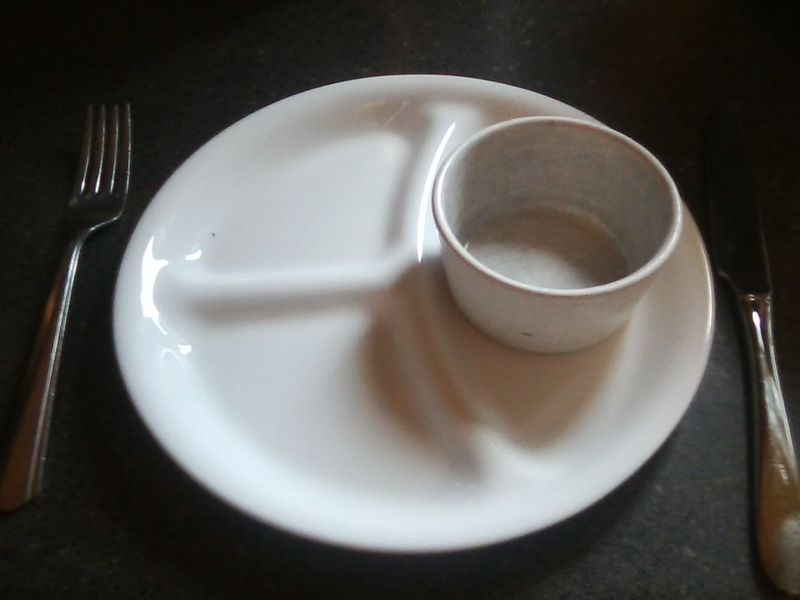
    I plated the food in a slightly unorthodox, inelegant way.  We typically use divided plates for dinner; it's not super elegant, but it's good for portion control and dealing with the children who reject  Food That Touches Other Food.  I gave the children small "tasting" portions of salad in little ramekins, which I placed on their "regular" plate:  

    1016141508-00

    You'll have to imagine the salad.

    This doesn't represent an "extra" dish, by the way.  They always get their salad in a ramekin anyway.

    The bigger kids got larger ramekins (I have some that hold about 8 oz) but otherwise it was the same presentation.  As for Mark and me, I just stacked our dinner plates nearby and we had our salad out of normal-sized salad bowls.

    Yes, inelegant, but workable for our usual patterns.

    "Is this all we get?" wailed the four-year-old when he saw his plate.  

    "No," explained Mark, "this is your salad course.  When we're done with that we will have the rest of the food."

    "Do we have to finish it all to get any meat?" asked my 8yo daughter with a worried look on her face.

    "No, but you have to practice liking it by taking a couple of bites, and you have to wait till the rest of us have eaten as much as we want."

    So Mark and I sat there, and ate our salad, and chatted with each other about our day.  Out of the corner of my eye I saw everybody take at least a few nibbles.  The 4yo stayed upset, but no out-and-out insubordination occurred.

    After Mark and I were finished, I got up, whisked the salad bowls away without commenting on who had or hadn't finished theirs, and carried the platters of potatoes, meat, and vegetables to the table.  And we all ate the rest of the meal.

    + + +

    I noticed that, however unhappy the kids were with the salad, it was still a noticeably more peaceful beginning.  Instead of saying grace only to be immediately faced with "Pass this! Pass that!  Don't take so much!  Yes, you have to put that on your plate!" there was a pause when there wasn't anything to pass and there wasn't anything to ask for.  

    I doubt it's a panacea, and like most experiments there will probably come a time when I give up altogether because there's too much trouble involved.  But it's fun to try, for now.

    Tonight, the starter will be bean soup (from a few days ago; yes, it's a leftover) followed by salad and mini meatloaf.  I'll let you know how it goes.


  • A new morning exercise, à la St. Francis de Sales.

    I took a nice long hiatus from it while I was traveling, but I fully intend to get back to the series I had started on Salesian spirituality.  Today seems like a good day.

    First, a recap of the three posts I wrote before we left:

    Bonus:  the post where I went to visit St. Francis and St. Jane Frances:

    Okay, today's post comes from St. Francis's Spiritual Directory, a set of instructions to the Visitation Sisters on their rule of life.  I've already mined this document once in the bit about to-do lists, where I started by discussing Article #2.

    Backtracking, let's talk about the first part of  Article #1, "Rising." 

    First of all on awakening, followers of the Directory are to direct their minds completely to God by  some holy thought such as [one of] the following:

    • "Sleep is the image of death and awakening that of the resurrection;"
    • that voice that will ring out on the last day, "O dead, arise and come to judgment;" 
    • with Job: "I know that my Redeemer lives, and that on the last day I will rise again. My God, grant that this be to eternal glory; this hope rests in my inmost being;"
    • "On that day, O God, you will call me, and I will answer you; you will stretch forth your right arm to the work of you hands; you have counted all my steps."
    • or others which the Holy Spirit may suggest, for they do have the freedom to follow his inspirations.

    After the Angelus they will make the morning exercise,

    • adoring Our Lord from the depths of their being
    • and thanking him for all his benefits.
    • In union with the loving offering which the Savior made of  himself to his eternal Father on the tree of the cross, they will offer him their heart, its affections and  resolutions, and their whole being,
    • and beg for his help and blessing.
    • They will greet our Lady and ask for her blessing,
    • as well as that of their guardian angel and holy patrons. 
    • If they wish, they may say the Our Father.

    All this should be done quickly and briefly.

    I don't pray the Angelus, so to adapt this to my own life I unified the two into a single morning exercise.  It tends to work best for me if I tape a copy of it to my bathroom mirror.   I chose just one of the locutions that St. Francis suggests, used an Ave for "Greet our Lady and ask for her blessing," and added an adapted version of a non-childish prayer to children's guardian angels that I found online here.  

    Here's my version.

    + + +

    Morning Exercise

    I know that my Redeemer lives, and that on the last day I will rise again.
    My God, grant that this be to eternal glory; this hope rests in my inmost being.

    O Lord, I adore You from the depths of my being
    and I thank You for all Your benefits.

    In union with the loving offering
    which You made of Yourself to our Father
    on the tree of the cross,
    I offer You my heart,
    its affections,
    its resolutions,
    and my whole being.

    I beg You for Your help and blessing.

    Hail Mary…

    I humbly salute you, O you faithful, heavenly Friends of my family!
    I give you thanks for all the love and goodness you show them.
    Continue to watch over them,
    providing for all their needs of body and soul,
    and pray for me, my husband, and my children,
    that we may all one day rejoice in your blessed company.

    Sts. N. and N…., pray for us.

    + + +

    This is going up on my bathroom mirror.  I think it's not too long to be done "quickly and briefly."


  • Tiresome apologies for blogging.

    No, not from me.  

    + + +

    I don't have anyone in particular in mind today.  Ever since partway through my last pregnancy I've had trouble putting my butt in the chair long enough to produce decent blog posts at a decent clip.  I managed to blog about our European adventure reasonably well, but I've gotten out of the habit.  Or into the bad habit of throwing things up on Facebook, and then being rid of them and going blithely on my way.

    I bring this up because… lately whenever I read some well-meaning mother blogger bemoaning how blogging is actually a Bad Habit that is taking her away too much from What Is Really Important, and she's really going to shut down the computer and go play with her kids, well, I've lost patience with it.  Not going to nod and say "I know what you mean" or "Good for you" any more.

    +  + +

    I mean, you do what you have to do, or what the Good Lord is leading you to do, by all means.   And sure, it's possible to make an idol of anything — all can be done to unhealthy excess, including cooking fresh meals for your family, reading great literature, getting vigorous exercise, washing your hands after going to the toilet, and giving to worthy causes.  So yeah, can one blog too much?  Assuredly.

    But.  Blogging as general bad habit that represents, by default, a retreat from the three-dimensional world, a failure to connect with real human beings, and an unhealthy choice to chronicle life rather than experience it?  Especially for mothers of families?

    No.  Not playing along with that implication anymore, ever.

    (I promise to keep my mouth shut about it during the three days before Lent starts when everyone logs on one last time to explain why they are giving up blogging for Lent.  It's a perfectly fine thing to give up for Lent, because Lent is a time for giving up legitimate pleasures and taking on voluntary sacrifices.  But other than that?  Done.)

    + + +

    Personal blogs are nothing more, and nothing less, than a modern combination of three very old concepts.

    (1) Diaries

    (2) Letters

    (3) Philosophical treatises.

    The third category probably needs little comment from me, so let's turn to the first two.

    Diaries and letters are of incalculable historical importance.  And they are especially important in the historical assessment of the lives of women throughout the ages.  Often it is letters and diaries that provide us with the clearest glimpse into the day-to-day existence of real human beings in that faraway country, the past.   

    In the case of women, we're talking mostly about women of the intellectual elite, for most of history:  wealthy women who enjoyed the privilege of education, or cloistered women.  But not always, and less so as time went on and society cast a wider net from which to draw its literate citizens.

    + + +

    Texts sent long-distance from one person to another, and texts sent back in reply, have been an established means of carrying on significant intellectual discourse since long before the mails were anything like reliable.  And we possess evidence of this, in the form of the physical texts that were physically sent from one place to the other.  

    In all cases we take these letters as evidence of connection, as something that mitigated isolation or prevented it.  

    We have letters to and from St. Hildegard of Bingen:  women such as Eleanor of Aquitaine, and men such as Bernard of Clairvaux, wrote to her seeking advice and consolation, and she wrote back.

    We have letters of Hrotsvit, a tenth-century nun, who put the letters as prefaces to her volumes of plays and saints' lives, the result being that her audience is "her readers:"  she would never meet them nor know their names, but she wanted to address them with a kind of apology and explanation of why she phrased things the way she did.

    We have many letters of St. Jane Frances de Chantal, who wrote on matters both practical and spiritual, corresponding with both men and women; and including a number of "circular letters" addressed to the other Visitation Sisters as a group.  

    We have the letters of Queen Caroline of Ansbach, who was undoubtedly a busy person but who must have regarded her correspondence as a vital part of that busy-ness, as she kept up a lively dialogue with philosophers, physicians, and politicians as well as other royals, and served as a mover of public opinion — for instance in her carefully researched and highly publicized decision to have her children inoculated against smallpox.

    More recently we have the letters of other public figures.  One of my favorite volumes of letters is The Habit of Being, gathered from Flannery O'Connor's correspondence; but while O'Connor's letters are a good example here, let's remember the women who wrote to her, too — in particular Betty Hester, whose identity was preserved only as "A" until recently, and who exchanged hundreds of letters on topics personal and spiritual with O'Connor over nine years.

    Furthermore we have preserved the writings of many women because of their correspondence with historically important men:

     – We have a reconstructed letter from an otherwise unknown widow named Hedybia, who wrote to St. Jerome (right to the source, so to speak!) with a list of difficult questions about events in the Gospels.  

     – We have the letters of spiritual direction of St. Francis de Sales; many of his correspondents who wrote to him describing their situations and seeking guidance were married women, women who had busy lives, children to educate and households to run.  I daresay it was the vicarious experience that St. Francis acquired through acting as confessor and spiritual director to so many worldly, married, busy women that gave him the insight necessary to compose such a practical work as Introduction to the Devout Life, which advises the busy person living in the world on how to put God in first place despite so many duties.  Indeed, the Introduction is written in epistolary form to "Philothea"  – and there was a real "Philothea," Louise de Châtel, Mme. de Charmoisy, whose correspondence with Francis de Sales led directly to the saint's composition of this classic of spiritual direction.

     + + +

    We do not say of Queen Caroline, "She neglected her household duties and her social obligations by constantly writing."  We do not say of Betty Hester, "If only she had not spent so much time scribbling letters to celebrities, think how much farther she might have gone in her work."  We do not say of the women writing to their spiritual directors, "All that navel-gazing takes the mind off of the really important things."  We do not say of St. Hildegard, "If she hadn't spent so much time chronicling those visions of hers and recording them for posterity, maybe she would have been able to really experience them to the fullest."

     + + +

    This is how we connect now.  

    Yeah, I have dozens of Facebook friends too, and they can't all be my besties.

    And they're not.  You know they're not.  It's the same with you.

     There are a handful, though — some who read and comment on my blog, some who write blogs I read daily, some who exchange emails with me, a few of the people that I check in with several times a day via Facebook.  

    You know who you are.  Hello, friends.  I've "exchanged letters with you" for years now.  I've "kept up a lively correspondence" with you.  I've sought advice, consolation, spiritual direction.  I've written treatises in response to your inspiration, and I've made queries that inspired treatises from you in return.

    Blogs for sure — but even Twitter and Facebook and whatever comes after those — I know I am really connecting with real people.  Yes, I have a family.  Yes, I have responsibilities.  You have jobs and I have jobs.  And yet, making time for each other to meet one on one — it's not just allowable; it's good.  Intellectual life is not something we must fit in the crevices of our "real" lives.  It is in some ways the realest life we have, the life of human beings being human together in the world of knowing and expressing.

    So, no more apologies.  I'll stop my ears, until you have something more important to say.


  • Tuesday to Wednesday: History, art, and a stroll with my two big boys.

    Of course, I am already home by now, and the title's Wednesday was eight days ago. I still find myself thinking, "One week ago I was in Rome," and feeling the sensations slip back into the past. They are still, barely, in the immediate memory — I can still hear the ear-piercing tones peculiar to Roman ambulances, taste the supplì, feel the slick basalt of dinner-plate-sized Roman paving stones under the soles of my sandals. But they are quickly retreating into the fog of interpretation and selection.

    For some reason, I keep thinking of those cobblestones — not the ancient ones, but the rough, recent, square-cut ones, palm-of-hand-sized, that pave so many modern Roman streets in a pattern of overlapping arcs. I would like to hold one in my hand.

    + + +

    Tuesday after the Scala Santa trip, I gathered my energy, hoisted myself off the bed, and went with my Two Big Boys (with a younger sister and then two younger brothers, the 14- and 10-year-olds are going to be stuck to that moniker) to hop the bus to Trajan's Market.

    We learned about Trajan's Market well in advance of our trip, and it was one of the ancient constructions the boys had talked repeatedly about visiting in person.  Said to be the Western world's first shopping mall, it did not disappoint.  

    It's hard to tell, when you're in it, which parts are truly ancient and which had been altered afterwards.  Such a large and versatile building — it couldn't help but to be used for various purposes over the years, and its various users changed it.  For example, a religious order used it as a convent for some time; while the nuns had it in their possession, they put a floor across the second level of the great hall's atrium, acquiring more floor space.  The floor has since been removed.

    10711042_10203035358472596_1839884836329523911_n

    Furthermore, it's had some restoration work done to it — missing blocks of travertine sidewalk were replaced, for instance.

    And still furthermore, one of the old tabernae (shops) still serves its ancient purpose — it hosts a cash register, shelves of coffee-table books, and racks of souvenirs.

    Still, I believe the bones of the building are there.

    I was struck by how much sunlight and air streams into the building.  The windows in the great hall are aligned with the upper windows in the tabernae to let a great deal of light into what otherwise would be dark little cells.

    10698430_10203035358952608_5721974233220565320_n

    There are three levels of Roman roads in the market — they pass over and around it.  One is called the Via Biberata, possibly because beverages were sold in many of the shops that line it.  The sidewalks make it feel, well, very like a modern street; our bodies felt at home strolling along the second-level road.  

    The low partial walls show that once the road was not so airy, but enclosed on the other side by a rank of shops mirroring the opposite ones.

    10409053_10203035359952633_3464422136051008387_n

    On the upper levels there are sunny terraces, where we felt a fresh September breeze, and could look out onto the pavement of what once was an interior space.  The floor-tiling pattern of circles and squares resembles the one in the Pantheon.

    10456038_10203035360592649_3283400117186829049_n


    The boys and I wandered around, wondering.  We agreed that, though we had learned about the architecture of the market and knew quite a bit about it, there was really nothing that could replace the experience of walking through and around it.  We could see how the light came in to the little shops, how the great hall filled with people, how steps led from one level to another and how one might stroll down the street, checking out the contents of the shops. 

    (In one, roped off, were stored stacks of child-sized chairs and folding tables.  In another, ranks of pottery and statue-parts, numbered and labeled.  Others were empty except for sunbeams, and the dark quiet air inside that carried a strange and mildly unpleasant odor.  Still others were closed off with wooden doors.)

      10711043_10203035359512622_3540399673853608758_n

    We couldn't stay too long because I had left the baby back at the apartment with Mark and the other two children.  We were sorry Mark had missed it, but he really needed to rest, and was glad to have had the rest.

    + + +

    The next morning I was off early in a cab with the same two boys, plus the baby, to the Galleria Borghese. I barely managed to get tickets for the gallery in time to see it before we left.  The Galleria Borghese is a jewel of a museum, and its handlers strictly limit entry:  360 visitors at a time, and the visits are limited to two hours.  In between they empty the museum.

     We encountered many paintings that we enjoyed that day — we were all struck by Raphael's Entombment (here) and by an unknown artist's Judgment of Solomon (pic here) as well as a number of other things.  There are a lot of  the Madonna-and-Child, some of which are really innovative and sweet, and a number of the Holy Family:  the gesture of Joseph in this one touched my 14yo.  

    But we were really there for the Berninis:  the four great commissions of Apollo and Daphne; David; The Rape of Proserpine; and Aeneas, Anchises, and Ascanius.  Each time we encountered one, we walked around and around and around it for many minutes, marveling at the way they each fit together as a whole.  A high-quality photograph is good enough to appreciate most paintings; it is reasonably good as a means of communicating a single detail of a sculpture, if the lighting is well-chosen; but there is no substitute for walking around a sculpture to grasp it as a complete work.

    + + +

    I experienced one important first in the Galleria Borghese.  There aren't many chairs or benches in there.  This was the first time I asked someone to move off the only available chair (she was perusing a guidebook, and didn't catch a hint) so that I could sit and nurse a baby who badly needed it.

    + + +

    After the gallery, we considered catching a taxi back (buses and trams were on strike), but since it was a lovely day, we instead walked the whole way south through Villa Borghese and then continued south to our apartment near the river.  It was pleasantly hot, so that the shade of the enormous green park was welcome, and so too were the Cokes and gelatos we stopped for along the way.  

    First we stopped at Piazza del Popolo, where we entered into the church that hosts the famous Caravaggios, St. Peter's Crucifixion and St. Paul's conversion.  I love that particular pair, how they work together:  each an inversion, with Saul off his horse reaching up, and Peter being upended on his cross; the haunches of the horse, the haunches of the figure bending under Peter's cross; one a Christian life's beginning, the other an end; the cramped horizontals, suggesting  subjects too big to cram into a single side chapel.

    The boys and I took our time.  We looked into the expensive designer shops along the Via del Corso; my sons were interested in pocketknives, I in leather goods.  We passed the Spanish Steps, crowded with tourists even on this day out of season.  

    At one point the road was blocked off by tape, except for a narrow sidewalk on either side.  They were repaving the street.  First we passed a gaping hole in the dirt (and couldn't help but peep in, imagining we might see some ancient artifact); then a place where the dirt was filled in; later, where it was smoothed over, a level bed; finally, the place where the workmen, now perhaps at lunch, had been setting rank after rank of those rough cubes of gray stone that make the cobbles of the streets all over Rome.  

    The cobbles were loose in the last rank, and they lay about in piles.  The piles were unattended and I temporarily entertained the idea of bending over, picking up one fist-sized cobble, and slipping it into my handbag.  I would take it home with me in my carry-on luggage, and at home I would unpack it, and leave it lying about on my schoolroom counter.  A paperweight, a relic, a piece of the streets.

    + + +

    I didn't steal a paving stone that day.  But here at home, surrounded by my own belongings, I'm not entirely sure I don't regret it.


  • Tuesday: Scala Sancta.

    After our beach day at Santa Marinella, it seemed as if we all got a second wind.

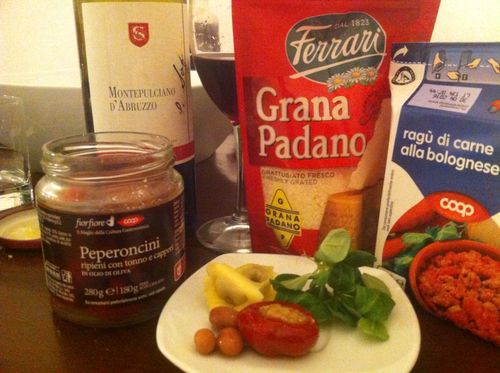
    We came back to a lovely dinner of Italian convenience food from the grocery store across the street:

    Refrigerated ravioli stuffed with proscuitto. Boxed store-brand pasta sauce (the ragù is shown, but the best was arrabiata). Bagged grated cheese. Jars of little sweet red peppers stuffed with a tuna-caper mixture. A jar of borlotti beans for the baby. A bagged salad with all sorts of beautiful mixed greens.

    With three days left in our trip, I bought a three-day bus pass for everyone over the age of 10. And…

    The next day we hopped the bus and headed for the Scala Sancta. It is over near St John Lateran and is the original “stairs that you go up one at a time on your knees” indulgence. It is a marble stairway, encased in wood for its protection (although there are a few portholes cut in the wood so you can see and touch the marble). Reputedly they are the 28 steps that once led up to Pontius Pilate’s praetorium in Jerusalem, so: they are, if it is true, a physical part of the Way of the Cross. Since the Middle Ages at least it has been said that St. Helena brought them to Rome from Jerusalem in the 300s. And the legend has a nice long history of annoying people like Martin Luther (possibly) and Charles Dickens (verifiably).

    The map was a little confusing and the building was so nondescript (at least compared to the nearby basilica) that I wasn’t sure I had the right place until I got in front of the door and saw the stairs with about a dozen people kneeling on them. (See the Wikipedia article, from which I took the historical information, for a picture not unlike what I saw. I did not feel comfortable photographing people there, although it is allowed from the bottom of the stairs.)

    I explained to the children that no particular prayer is prescribed for the stairs, so they could pray something as simple and short as the name of Jesus, or something longer if they wanted. As for me, I had downloaded a set of devotional prayers on my iPhone, the kind that gives you something slightly different to meditate upon for each step. Mark went up the stairs with the 4yo in his arms and I went up with the baby in a front carrier. At first it was not hard, but around the tenth step the wood started to press uncomfortably on my knees and the baby began to stir.

    About step 19, the baby started crying loudly, so for the sake of the other pilgrims, I quit with the iPhone prayers and went with something MUCH shorter as I crawled up the remaining nine steps. (You aren’t allowed to step on the stairs, so there wasn’t really a faster means of escape for me, other than tumbling down them, I suppose). At the very top, hands reached down to help me up, and pulled me, sweaty and flustered, to my feet. I stroked the baby’s head and apologized in Italian, and the other strangers who had also just finished their ascents shook their heads, and smiled, and cooed at the baby, and told me it was not a problem, that it was a great blessing.

    I believe I was reasonably well disposed, but this was not a time when I was granted any special consolations. I made it up the stairs; it was physically uncomfortable; I was rather focused on my crying baby.

    Are they really the steps Jesus walked on? They might be. They might not be. Regardless, they represent the whole via dolorosa; my downloaded prayers don’t say, for example on the sixth step, “O my Jesus! By this 6th step,” etc., they say things like

    O my Jesus! By the patience thou didst exhibit amid the outrages and mockeries of which Thou wert the object throughout the night preceding Thy death, have mercy on me!

    They take you through the whole Passion. The physical object of the Holy Stairs — there likely were once some holy stairs, whether these are they or not — is not the object of our worship. Replica “holy stairs” have been built for other pilgrims in other places, and none of those pilgrims believes that the stairs they climb are really the stairs Jesus climbed; in at least one sense, it is the thought that counts. Or rather, the intention, allied with the action.

    The stairs inspire the faithful to suffer, voluntarily, for a time.

    Speaking from experience as someone who hardly ever voluntarily suffers, despite holding a fervent belief that voluntary acceptance of suffering has meaning and bears fruit — this is a valuable thing. I climbed them because they were there. If they weren’t, doubtless there is no other voluntary suffering I would have substituted that day.


  • Beach day.

    Okay — so we’ve been tired. So very tired. We go out in the morning, we see stuff, we have lunch, we come back, we zonk out for three or four hours, we go to the store, we come back and eat food from the store, we clean up, we go out for gelato, we come back, we go to sleep.

    I hope to come back and fill in some of the last few days. Friday, Vatican. Saturday, Pantheon, St. Ignatius, San Luigi dei Francesi, and lunch; Mass at Santa Maria in Trastevere before bed. Sunday, attempted to go to Angelus, wound up at Papal Mass followed by Pope Francis riding around in his cart, unexpectedly; then, lunch, rest, clean up, gelato.

    Today, everybody needed a break from the routine. You just can’t keep going and going and going to churches and museums, however much you might want to, if you have a bunch of kids under 15.

    You need… a beach day.


    First step: figure out how to buy bus tickets (easy, there is a tobacco shop on the corner, and that is where you can buy them).

    Second step: Figure out which children are free (not so easy, half the sources say “kids under ten” and half say “kids ten and under;” we paid for the ten-year-old just in case. Buy four single-voyage bus tickets.

    Third step, made much easier with the advent of Google Maps: Find bus, any bus, that goes to Roma Ostiense train station. There are four within walking distance. Go to bus stop. Attempt to ask advice of young lady who turns out to be an Argentine tourist trying to take her own first bus trip in Rome. Wing it.

    Rush to train station. Figure out which children are free and which are half price. Buy three full price round trip tickets and three half-price round-trip tickets. Rush to platform. Await train. Ask little old lady, “È questo il treno per Pisa?” just as the announcement starts to come over speaker, causing her to irritatedly make shushing noises before confirming it. Get on train. Collapse into seats.


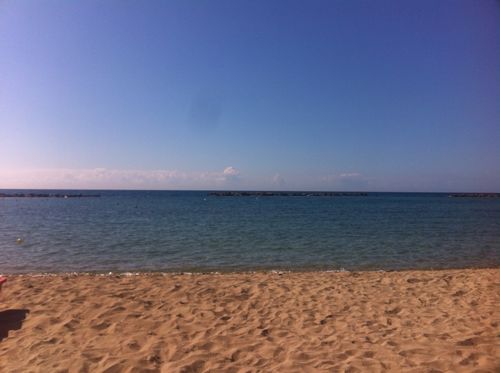
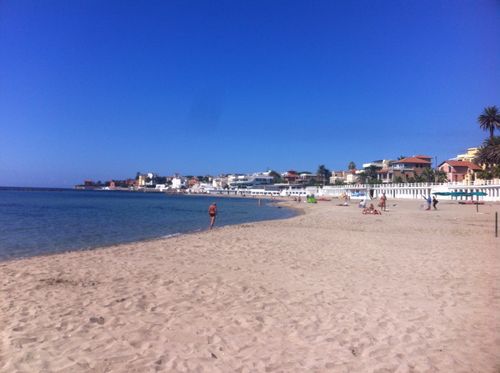
    Ride 38 minutes to Santa Marinella, nervously following progress on Google Maps so as not to miss stop. Get off at tiny station. Walk about three blocks. Arrive here:

    Pay a bunch of money to rent two umbrellas, three chairs, and a chaise longue.


    Rejoice. Take it in.

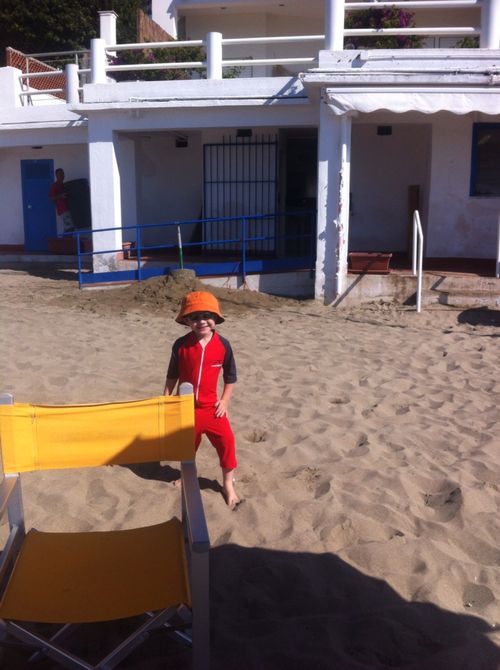
    Put iPhone away so as not to get it wet and fail to take any more pictures. Fill day with splashing children, four-year-olds brandishing chunks of driftwood, moat-digging, babies with pirate bandanas tied on their heads and sand-stubble sticking to their faces, and a good deal of sitting in a chair under an umbrella next to one’s spouse watching the children and the sparkling sea and the gulls wheeling overhead, and thinking, “Damn, it could definitely be worse.”


    Don’t get the iPhone out again until it’s time to pour drinks after staggering tired and rosy through the front door.


    Such a good day. The kids are excited that they swam in the Mediterranean. Me too.


  • I have taken 3 children under age 9 to the Vatican Museums and lived to tell about it.

    This morning it was up at 5:50 a.m., dress, breakfast, coffee, hurry children into clothes, and hurry shivering in the chill of dawn to the taxi stand at the Largo del Torre Argentina. Mark and the two big boys got into one taxi, headed for St. Peter’s to see it first thing in the morning. Me, I was going somewhere else. I helped the 4yo and his 8yo sister into the back, then bundled myself and the baby in.

    Alora, ingresso dei Musei Vaticani, per favore.”

    + + +

    I had prepaid for a private tour from a company called Walks Inside Rome, recommended by a friend. WIR features several tours intended for children and families, including the “Treasure Hunt In The Vatican” tour. (We had also taken a private tour of the Colosseum and Forum from them on Wednesday). This was not cheap, mind you, but I could not think of a better way to include the younger children in this trip than to hire someone who had already done the legwork of identifying things that would interest them and guiding us quickly from one to the other.

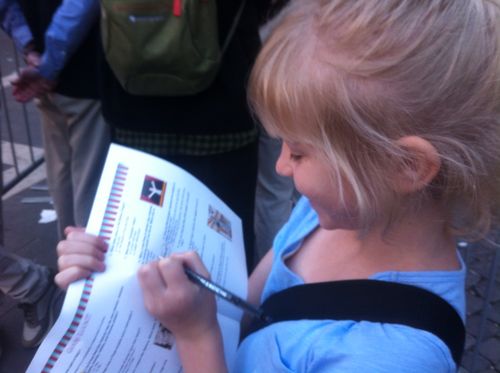
    Outside the walls we met our guide, Luisa. She brought with her a little quiz book of questions for the 8yo to work on while we waited. Luisa entertained the 4yo with questions (“Do you know we are going to another country just on the other side of this wall? Do you know who is the president, or the king, of this other country? Do you know what colors are the flag of this other country?”) I contemplated the great metal doors embedded in the city walls, still looking as if they are ready to resist the sack of the barbarians.


    It is a bit jarring when the doors open, finally, to reveal a ticket office. Of course everything is all friendly now, and good for business, but I can’t help but remember that it wasn’t quite so long ago that these walls meant business. They really are fortifications, after all.

    Inside our first stop was in a lovely courtyard, the Cortile della Pigna, with a great brass sphere in the center. “Can I run?” asked the 4yo, and took off before Luisa could say anything.

    “Come right back,” I called after him, and looked to the guide nervously, but she said that now, before there were really any crowds, it wasn’t a problem.

    “Stay off the grass though!” she called.

    He made the circuit of one rectangular grass plot and came back to us, and I caught his hand.

    “This courtyard contains some very old things, and some very new thing,” she said. “Can you be a detective and solve the mystery of what is the very old thing and what is the very new thing?”

    The very old thing turned out to be an Egyptian lion, which delighted my 4yo, who knows well what his first name means. And the new thing, my daughter picked out: the brass sphere in the center of the courtyard. Luisa led us there. She stepped over the rope, put her shoulder against a crevice in the sphere, threw her weight into it, and slowly the sculpture began to rotate. As the hidden side came into view, we could see a second, concentric sphere revealed within the first. The sculptor, Arnoldo Pomodoro (“Mr. Tomato,” she said), meant for the great sphere to be the world, “a great world with much evil,” she said, “and a smaller, good world that is hidden inside and bursting out of it.”


    more to come…


  • A change of plans that turned out all right.

    Last night we finally accepted that the late-night Roman dinner schedule was not going to make for a peaceful night out with our four-year-old, and we vowed to switch to a lunch-out-dinner-in-the-apartment schedule. There was a really nice all’amatriciana involved, but Mark and I had to take turns eating it and coddling the baby out on the Trastevere cobblestones. Which wasn’t so bad because lots of people come and say hello to the baby, and that is kind of fun.


    The best thing on the table, besides the pasta all’amatriciana, was a single piece of deep-fried baccalà (cod) on the platter of fritto misto. I remembered having passed a tiny place that offered carryout fried stuff, fish and artichoke hearts and potatoes, around the corner from our apartment. I suggested that the next night (Thursday) we plan on having Mark go fetch fried stuff and eat it in the apartment. So that’s our plan for tonight. I have already been to the grocery store and bought lemons, ketchup, and wheat beer.


    + + +


    Mark very much wanted a slow start this morning, so we decided not to try to get to St Peter’s first thing in the morning. As we were getting ready, around ten, someone turned the TV to a channel that appeared to show a live feed from St. Peter’s Square, and the square was full of empty chairs; a long line of people snaked around the edge.


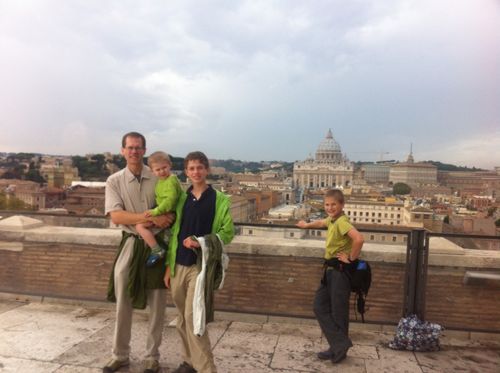
    We walked there anyway, with a backup plan: if the basilica wouldn’t work for us, we’d go to Castel Sant’Angelo. Supposedly it was pretty interesting for kids.


    + + +


    Mark had the brilliant idea to walk along the river instead of the most direct route, because we wouldn’t have to cross any streets. Seriously, that was smart. It was so much more peaceful to walk the continuous sidewalk, and only have to pause and gather everyone up and make a run for it when we came to the occasional bridge. I carried the 4yo on my back most of the way, my arms under his butt, and Mark carried the baby.


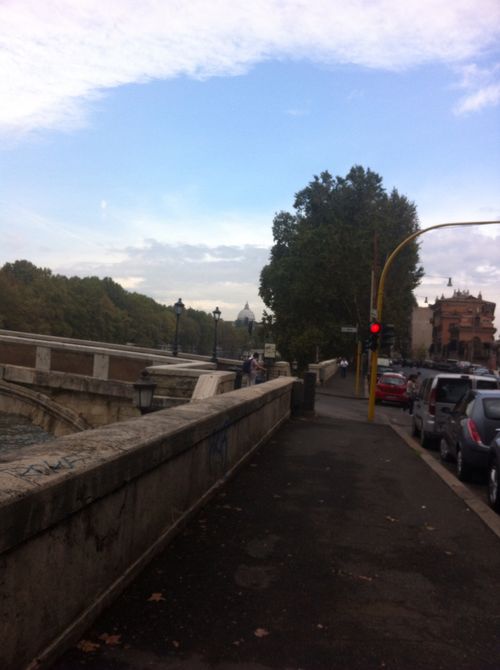
    After a while of walking along the Tiber, lined with smooth-trunked, broad-leaved trees, we caught our first glimpse of the great dome of St. Peter’s:

    But when we got to the piazza, we could see right away it didn’t make sense for us to try to go in. The piazza was filled with empty chairs (someone told us later that Mass had been celebrated in the square the day before, and it wasn’t cleared away yet), so it wasn’t possible to stand on the porphyry disks that mark the centers of the colonnade or find the red one that marks where St JPII was shot. And the line to go through security wrapped all the way around the square.

    So, instead, after admiring the colonnade from off-center, we ducked through the line on the right, passed through the wall, and headed down Borgo Pio to find lunch.

    Six plates: caprese, antipasto misto (with very yummy grilled red pepper), risotto pescator (tiny mussels and a plump little octopus), veal marsala, and a steak. Mark and I each had a beer (which Mark, to my amusement, accidentally ordered in German). Baby liked the risotto. We finished with cappuccino.

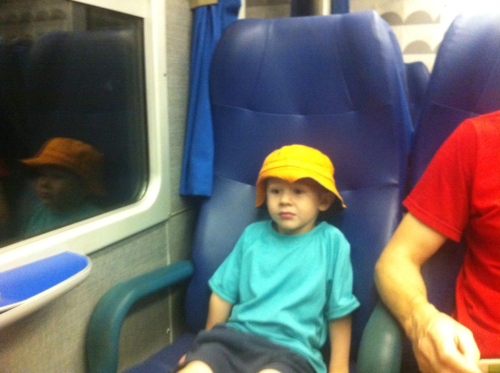
    Here is a free tip for taking babies to Rome. Every restaurant so far has had the same kind of high chair: tall, straight-backed, wood, with a wicker bottom and a bar across the arms but no belt. Mark and I have been taking turns gripping the baby’s arm so he doesn’t fall out of it. Today the 4yo was wearing a nylon webbing belt, the kind with a plastic click buckle, just in case he had to carry a sword in it or something. We borrowed it and used it to strap the baby to the chair. Hands free dining!

    + + +

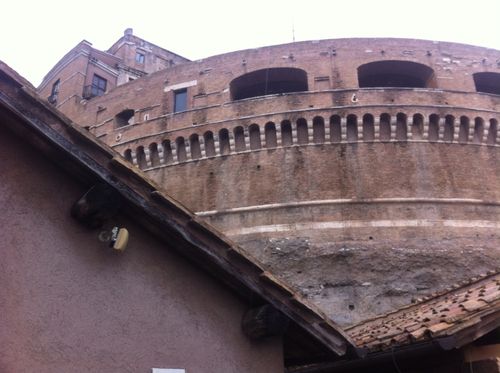
    After lunch we continued on down Borgo Pio to the tomb-fortress that is Castel Sant’Angelo. It is really quite impressive close up.


    Kids are free and adults are €10.50. We paid and then went in.

    The boys were very impressed by the physical structure of the fortress. Both talked animatedly about the value of the thick inner wall surrounded by the outer wall, its utility in resisting siege towers and cannonballs, and the ingenuity of the many hatches for pouring hot oil on attackers as well as the arrow slots and such things. Patches remain of the original flooring from the era of Hadrian, although the castle has been modified many times over the years. There is a long spiral ramp winding upwards, and then a long, slant-stepped stairway, and then you arrive at several sumptuous papal rooms. Fantastic ceiling frescoes depicting the life of Alexander the Great, and a cool trompe-l’oeil decoration that makes an otherwise plain room look as if it has an elaborate fireplace hearth flanked by a curtain being pushed aside to reveal a (real) door.

    There is an exhibit of weaponry near the top, but the real reward is the rooftop view.

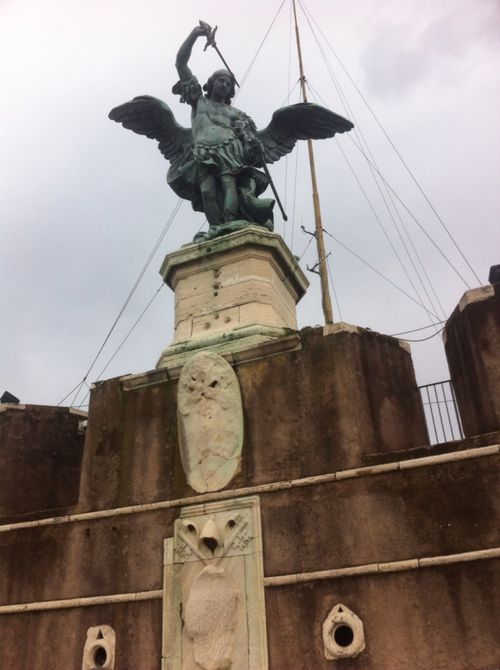
    It almost feels as if you are standing on board a ship, what with the angel looking like a sort of figurehead, and the flagpole looking like rigging. The parapet has a very gunwale-like feel.

    We finished the castle tour with a trip around the four-sided top of the fortifications, anchored by four bastions at the corners named after the four Evangelists. The boys were impressed (interlocking fields of fire!) and amused (hey, there’s a crest up there for Alexander VI! That’s the Borgia Family pope from Horrible Histories!)

    Once down, I shifted the baby to my back and plotted a course that would take us down the narrow and charming shop-lined Via dei Coronari and then to the Piazza Navona, coming out near the Four Rivers Fountain. We bought gelato on the way (fior di latte and peach, yum) and then while the four- and fourteen-year-olds finished theirs outside with Mark, I took the 8yo and 10yo into the Church of St. Agnes to say hello.

    This church is a jewel box. We admired the beautiful dome inside and scrutinized some of the marble bas-reliefs, then found our way around a corner to the chapel in which the saint’s skull rests behind glass in a reliquary. A woman was there taking pictures with her iPad held up in front of her face; at first I stayed back with that impulse to not ruin someone’s picture, but then changed my mind and decided it would make a better picture with my kids and me praying in the chapel. I walked through the open-gated railing, knelt down, and greeted the Saint with a petition or two. My two children followed (three actually, since the baby was strapped to my back) and did the same.

    We continued on past the Campo dei Fiori and back to the apartment, ready for several hours’ rest. It’ll be carryout for dinner, then an early bedtime, because tomorrow morning we must be at the Vatican Museum for early entry.


  • Colosseum and Forum, followed by decompression.

    Sometimes you want to do something that’s difficult.

    Not necessarily because it is difficult, mind you. We’re not talking about things like, say, climbing a high mountain or running a marathon, things that would almost not be worth doing except that they are difficult to complete.

    No, I mean activities that have real intrinsic value — you want the experience for some other reason — but nevetheless you can easily foresee difficulties. You know they are coming. You want to do the thing anyway. But wanting the thing, deciding to do the thing, will not make the difficulties go away. They will still be there.

    And so will the reasons you had for doing the thing in the first place.

    + + +

    So it is with taking five children to Rome. I wasn’t exactly sure what we were in for, but there were some parts I expected would be hard. The flights, for one thing. The late-night dinners. Walking long distances. I expected a sore back from carrying the baby. I expected some squabbling.

    All this has come to pass.

    I knew it would.

    And yet we chose to come, to set aside money for six years, to leave school and work for a month. We chose for reasons, reasons that have not expired. We are here. This is what we make of it.

    + + +

    I tried not to schedule much, preferring flexibility, but there were two items that had to be scheduled in advance or not at all. The first was a tour of the Colosseum and Forum. We did that today.

    I have good pictures of smiling kids.


    The tour was truly interesting. It was also gruelingly long for my four-year-old and baby. The baby had a long time in the middle of screaming in the carrier until I got him settled down and he slept. The four-year-old started misbehaving on the top level of the Colosseum.

    Right after this he was climbing steps he shouldn’t have been.

    Sara, our guide, really did a great job engaging the kids with quiz questions and with a book of pictures showing what the buildings might have looked like many centuries ago.

    But there is only so much you can do. Eventually the 4yo had to be carried, and the 8yo (who had refused to eat breakfast) trudged groaning forward with glazed eyes.


    i really should have gotten a picture of that, but I did ‘t know how without insulting one of them.


    The whole experience, from leaving the apartment to walk to the Colosseum, to getting back in the apartment for lunch, was about four and a half hours.

    And we were so tired. So tired that we could not even stop for gelato. We got back, the kids turned on the TV and collapsed on the couch, I asked Mark to go out and bring back sandwiches. And Cokes. I specially requested Cokes.


    At lunch I turned the usual question on its head by asking everyone to name the worst thing that happened to them today so far. This cheered people up a bit. The four-year-old gave an answer that, in a roundabout way, meant “The part where we were on the tour.”

    But then we did the usual thing and asked about everyone’s best thing, and it turned out that there was a best thing. Even though for one kid it was “This sandwich.”

    (For me it was the Vestal Virgins’ house.)

    Because you know, we are here for reasons, and the difficult — the expected difficult — doesn’t take them away.