bearing blog


bear – ing n 1  the manner in which one comports oneself;  2  the act, power, or time of bringing forth offspring or fruit; 3 a machine part in which another part turns [a journal ~];  pl comprehension of one’s position, environment, or situation;   5  the act of moving while supporting the weight of something [the ~ of the cross].


  • Co-schooling flow.

    This morning as I was driving the kids out to the northwest suburb where H lives, thinking over what I was going to teach today, I felt… really, really happy.

    Astonishingly, co-schooling twice a week with three toddling babies underfoot has turned out… okay.

    This year, the subjects I am teaching actually excite me. I realized that I was looking forward to introducing the third conjugation to the 3rd, 4th, 5th, and 6th graders. I was pondering which verb to use: I needed a transitive verb that could still be used without an object without sounding too weird, one that was easy to spell, one that could be used with most nouns as an object. Pono, ponere (to put or place)? Ago? Definitely not. I settled on “send.”

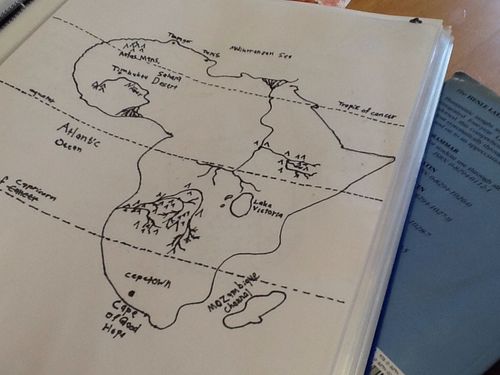
    I am also loving every lesson of the geography curriculum. We are having so much more fun this year than last year, when a couple of the kids (well, mostly my daughter) rebelled against Story of the World. This year all four kids love drawing maps and playing sailing games rolling dice and moving little ships around portolan charts.

    Thursday we are going to bake giant sugar cookies shaped like Africa, and paint them yellow and green for the desert and the rainforests, and decorate them with chocolate chip mountains and blue-icing rivers, and then eat them for afternoon snack. I can’t wait. The kids will love it. So will I. It is so much more fun to work with kids when they enjoy the material. Which has truly been a learning experience for me.

    I use a lot of documentaries for the high school boys’ modern world history this year. I learned my lesson two years ago when they were learning about Henry VIII: if my goal is for them to remember the story of history, a well-made documentary beats text readings every time. Text readings have their place, and I haven’t given up on them, but whenever I can find a really good documentary, we use those and the text is demoted to “supplement.” Thank you, BBC and YouTube uploaders. Today we are starting in on WWII with “The Dark Charisma of Adolf Hitler.” My 5th grader is voluntarily watching along with them instead of taking a break.

    The weather is unseasonably warm, though I would still call it “chilly.” That hasn’t stopped the younger children from going out barefoot.

    H’s crockpot is full of chicken cacciatore that I brought. It is my turn to bring dinner. Tonight the four older boys (between our two families) have Scouts and the two older girls have American Heritage Girls. I will slurp it down along with the girls before driving them to their meeting.


    And bring some planning materials with me, too. High school marches on. I need to get set up for chemistry, and for more Latin.

    And somehow figure out how the two of us are going to fit it all into our days, two days a week, next year. This year has given me so much confidence, though. It is really working very well, and I am confident that it will work next year, too.

    I started homeschooling years ago because I wanted schooling to revolve around our family life, instead of our family life revolving around a school. It has paid off many times over in that department.

    Some days there is real drudgery and frustration in it, especially when I have to deal with the tussles between my 3rd-grade daughter and my 5th-grade son. I detest whining and I have been hearing a lot of it lately. And there is the constant wish that the house would keep itself clean, the constant internal refrain of “I should really be doing more…” … more reading to the children, more field trips to local museums, more walks
    to the park; all those things.

    But as the years have gone by — I am a good ten years into it now — there has also been a great deal of delight and discovery. And challenges that feel good, not frustrating: teaching myself material so I can turn and teach it to others, learning to work with kids who learn in different ways, encountering material I learned a long time ago (meeting it as if it were an old friend).

    These days go so well, all together. The kids get English, Latin, social studies, and a bit of math for the high school boys. And they work efficiently! They know that if they finish quickly they get to play with their friends.

    My home days never seem to go quite so well for the younger ones. Maybe it’s because math and spelling aren’t as fun (they do like art and science pretty well). Maybe it’s because the dreaded DOUBLE MATH DAY that comes once a week (since we spend two days a week doing no math at all) hangs over everything like a cloud. Maybe it is because of chores.

    But my high schooler gets so much done on those days, barricaded in a quiet room with his to-do lists and his syllabi, that I have plenty of hope for the future.

    God help me, I am really starting to enjoy this. Everyone eventually comes up with theories of how the young should be educated, because theories of education are only proxies for theories of humanity. We who educate our own children are really putting our money where our mouth is, and finding out if we understand these young humans in our care the way we think we do, and finding out if we understand how to explain humanity to the humans and vice versa, as we go along. It is theoretical and it is empirical. It is exhiliarating and it is frightening. It is learn-as-you-go and throw-out-everything-you-thought-you-knew all at once. It is a life’s work that is simultaneously broad and wide, and narrowed to the very dagger’s point. I have learned so much. I have so much more to learn. Some of it is sticking, and some is falling away, and at the end the shape will be different for each one of them, and I will be different, too.


  • Othering the mother.

    Just Another Jenny wrote about "I don't know how you do it:"

    There is nothing that prompted this post except memory. For some reason this phrase bubbled to the forefront of my mind and I remembered the pain it can sometimes bring:

    I don't know how you do it.

    Lots of us have heard it from time to time.  I don't usually experience it as "painful;" rather, annoying (not this again).  But I have heard it mostly in reference to aspects of my lifestyle about which I do not have ambiguous or negative feelings.  I remember hearing it while I was a graduate student in engineering school, for instance. ("I don't know how you do…" what?  Math?)  And I hear it now about home education and about raising five children.  I channel the slight annoyance into bemusement and, I'm afraid, into a tiny sense of superiority which I really should try to quash.  

    Of course you don't know how I do it.  That's why I do it, and you don't.

    No, I don't say it out loud, but I admit to thinking it.  It's not good because, though interior, it represents a  retaliation in kind.  I am hitting back with the same stick that is being waved at me.  

    + + +

    Jenny is in a situation significantly different from mine, but one that attracts "I don't know how you do it" from mothers in situations that are more similar to mine:

    Usually the context of this phrase is when a mother who normally stays home with her children has had to leave town without them for a few days. She is struck by how much she misses her children and how happy she is to be reunited and then the fatal phrase is uttered:

    "I don't know how you working mothers do it. I missed my children so much. I could not do this everyday."

    It stabs. The intent is almost never malicious. It is an innocent wonder at how such a burden could consistently be borne. The problem with voicing such a thought is not that it isn't reasonable or true. The problem is that it very reasonable and terribly true.

    I think I've put my finger on what the "problem" with this vocalization is.  The "problem" is not that it is true and painful.  It's not even that it is an expression of pity; genuine pity is not necessarily negative (although it can be).

    Jenny is probably correct that it is not said in malice, but I think she is not correct that it is innocent.  The intent may be unconscious, but here's what underlies "I don't know how you do it:"

    It is an othering statement.

    If you don't like the slight "buzzwordiness" of the term "othering," you might try substituting the term "invalidation;" it is the same sort of thing, although personally I think the verb "to other" is a quite concise use of the English language to express what is going on here.

    Like many other examples of "othering,"  IDKHYDI exists in an ambiguous point on the spectrum between unconscious and intentional.  People do it on purpose, and people do it without realizing it, and there is usually plausible deniability ("I certainly didn't mean it that way, she was reading too much into what I said to her"); so it is impossible both to give careless speakers an appropriate benefit of the doubt and to call people out when they cross the line.  

    And so othering goes on, blithely, and no one is willing to do anything about it, because come on, what are you going to do?

    + + +

    Here is a decently written introduction to "othering:"

    By “othering”, we mean any action by which an individual or group becomes mentally classified in somebody’s mind as “not one of us”. Rather than always remembering that every person is a complex bundle of emotions, ideas, motivations, reflexes, priorities, and many other subtle aspects, it’s sometimes easier to dismiss them as being in some way less human, and less worthy of respect and dignity, than we are.

    "I don't know how you do it" is precisely a way of dismissing other women.  And yes, it's the same kind of thing as lumping into one group everybody who votes for that other political party.  It's exactly the same thing that creates "death by a thousand cuts" in the workplace, in the community, for people who visibly belong to minority ethnic groups or who have visible disabilities.

    It quite literally says:  I am unable to have empathy for you.   

    You are so different from me that I am not able to imagine myself walking in your shoes.  I will not make any reference to trying.

    It appears to be a compliment:  your abilities are beyond my imagination; but it is in fact a backhanded compliment:  your personhood is beyond my imagination.   

    It imagines that your unimaginable skills must be made possible only by the existence of some deficiency:  the working mother must lack a certain maternal love for her children, the mother of numerous closely spaced children must lack self-control or intelligence or self-respect, the parent of disabled children must be somehow "special" herself for God to have sent the children to her.  

    (Whatever; it couldn't happen to me, says IDKHYDI, because I, unlike you, am normal, normative, mainstream.)

    It says:  You must be different from me in some fundamental way.  You are a different kind of person, because "I could never" be the kind of person who would "do what you do."  

    It says:  If I were in your situation, I'd do things differently.  

    It might even mean:  I could never get into the situation you've gotten yourself into.  That's why I don't bother to imagine how I would cope:  because I know that I wouldn't get into your situation.  I don't have to imagine how I could do that, because what has happened to you would never happen to me.  I am not the kind of person that you are, the kind of person that would let that happen.

    + + +

    This is why I say it would be better if I quashed my internal reaction ("of course you don't know how I do it"); the internal reaction is a retaliatory othering, one that says, "Oh, I'm 'the other' to you?  Well, guess what, sister; you're 'the other' to me, and I rather like it that way."

    The source I linked above on "othering" is called There Are No Others; it has not been updated in a while, which is too bad, as it seemed like a really good start.  From the same page I linked:

    The concept behind this site, then, is that

    • a) humans have an undeniable and insidious inclination to engage in “othering” thought patterns for the purpose of self-preservation, and
    • b) learning to avoid and counteract these thought patterns is integral to greatly reducing the world’s hatred and suffering.

    Our intent is to raise people’s consciousness about othering behaviour, to make them more alert to these thought patterns, and to encourage alternative ways of addressing the problems that we often seek to avoid by dehumanising any one group.

    I want to be aware of mental "othering" and "othering" behavior in myself.  It may be true that we naturally do it, as a form of self-preservation and group preservation, naming certain people as our neighbors who are like us and "othering" different people, for safety.  But being human, we are more than natural, and we are called to constantly ask "who is my neighbor?" and acknowledge that the answer is "anyone."  There is no good excuse for dehumanizing anyone, even a little bit.

    This might be a good Lenten calling for anyone:  search out the othering, mental and vocal, and search out the invalidation, the defense mechanism. Notice it, and try to root it out wherever it occurs.

    Everyone is fully human?

    Even those people?

    Yep.

    Now try to behave as if it is true.


  • Lent notes.

    I started Lent off without a specific plan to give something up “for Lent.” I understand that to forgo voluntarily some specific pleasure or luxury — chocolate, or Twitter, or cream in your coffee — is a valuable penitential practice for many. My husband gives up chocolate every year, Sundays included, and reports that its absence bears fruit for him. I don’t like to do it though — I find that it doesn’t keep me in a Lenten frame of mind. It feels more like an endurance contest. I get more focused on “making it through” and on success — personal success.

    I don’t like associating Lent with “success.” This is not the point. So the longterm deprivation thing doesn’t seem to be the right personal penance for me.

    I feel drawn to an attitude suggested by this hymn which appears in the Liturgy of the Hours:

    More sparing therefore let us make

    The words we speak, the food we take,

    Our sleep and mirth, and closer barred

    Be every sense in holy guard:

    Avoid the evil thoughts that roll

    Like waters o’er the heedless soul;

    Nor let the foe occasion find

    Our souls in slavery to bind.


    (The translator is John Mason Neale, the original text, attributed to St. Gregory the Great, Ex more docti mystico.)

    I like the idea to rein in everything just a little bit, more sparing in food, in speaking, in entertainment, in sensual luxuries; rise a little earlier and go to bed a little later to make room for extra meditation and reading. Every time I remember it is Lent, to stop and take quick stock of my environment and make a little choice to spare something. It can be something small: I am pouring the tea: let me take it without milk today. I am driving: slow down to the speed limit. I am unloading the dishwasher: do it gently, without clanging pots (and definitely without sighs of annoyance). I am in the shower, one of my favorite petty luxuries especially in the winter: finish up and turn it off instead of lingering under the running hot water.

    Last week I was reviewing Introduction to the Devout Life, which counsels one who is struggling with a particular vice to practice the opposite virtue as continuously as possible. This year I seem to be struggling with my temper, with anger, quite a lot; so I was studying the chapter entitled “Gentleness.”

    I wound up ranging over quite a lot of material, reading works by St. Francis de Sales, by St. Alphonsus Liguori and also the Sermon on the Mount; in trying to work out references from St. Francis’s French original text, I discovered that “Blessed are the meek” in French is rendered “Blessed are the débonnaires,” which amused me greatly. It turns out that our derivative “debonair” is not very close to the meaning of the French word, which is something like “good-natured” or “easygoing,” meaning not easily ruffled, calm. The French in turn is a straight translation from the Latin Vulgate’s “mītēs,” which also means calm or placid, a word that is used to describe rivers or weather. (Nature. Bon aire.) Our word “meek” mainly means something like “submissive” these days, which is accurate in the sense that one “submits” one’s impulses to whatever happens to them rather than getting angry, but it really implies a kind of grovelliness that isn’t there in mītēs at all. It turns out that there is quite a bit of debate out there about the meaning of the Greek word that is rendered mītēs, meek, débonnaires, but as I am not a Greek scholar yet I will not get into that.

    Anyway, St. Francis’s advice for those struggling against a naturally short temper is to “speak and act at all times as gently as possible,” and I hit on that as a particular Lenten practice: be sparing in my motion and speech, whenever I can. As soon as I remember: slow down, stop banging into things, walk more carefully, speak more deliberately, eat more slowly, move more purposefully. Try to set this cup down noiselessly, slide the book into its spot instead of tossing it into the bookshelf, stir the sauce without splashing. I find I have to plan ahead slightly so I am not carrying more things than I can manage gently, leave myself a little bit more time so I am not rushed.

    It works. It sinks into the soul from the outside.

    Lentement.


  • Spelling reform.

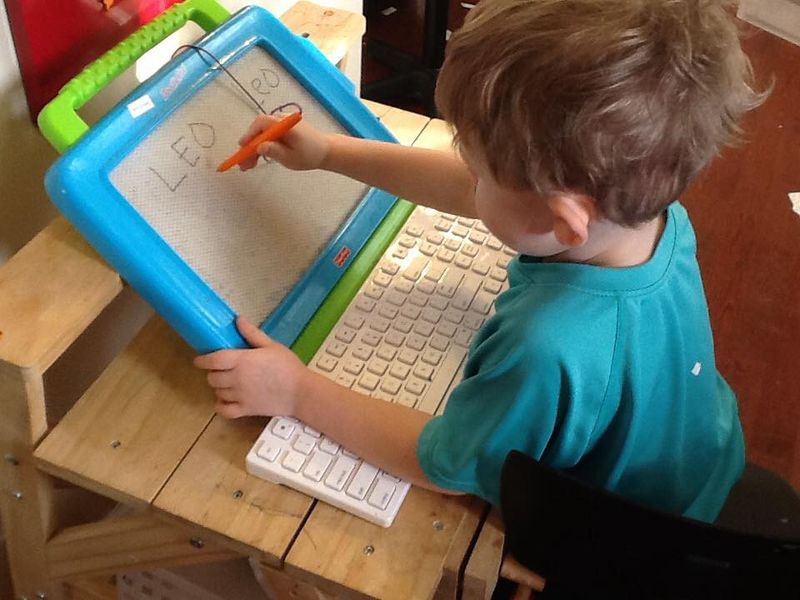
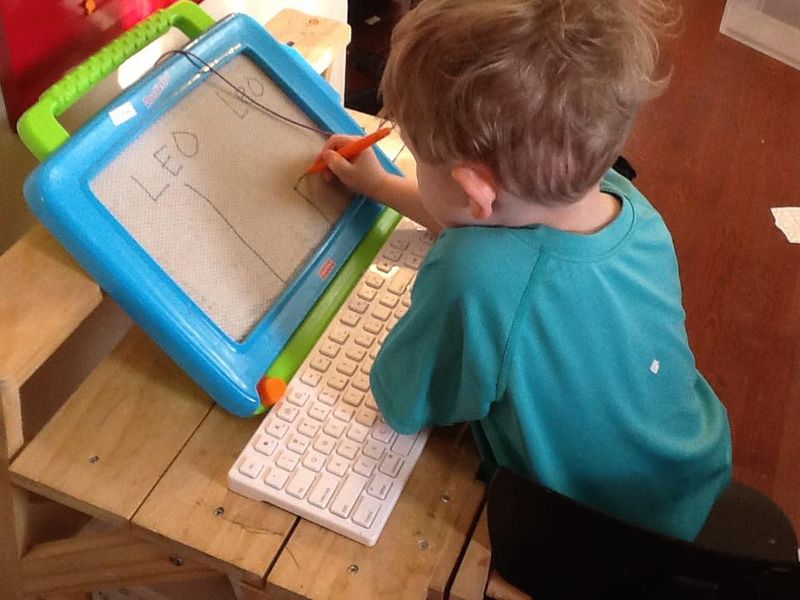
    Yesterday my 5yo took a broken keyboard (from which we'd clipped the USB cable, making it a toy) and a magnetic Doodle Pro and propped them up on his wooden workbench to make a "computer" with a screen into which he could enter text.

    10471314_10200220869962551_4471121095037675867_n

    He asked me to write his name on the "screen" so he could copy it.  (That's my writing at the top of his Doodlepro.)  Then he dutifully pecked out each letter on the keyboard, and picked up the magnetic stylus on its tether to write the letter on the screen.

    I wrote the name at first with just the initial capital letter, and he insisted on my changing it to all caps.  He rejects the notion that a lowercase "e" belongs in the middle of his name.

    + + +

    We've been working on letter sounds and reading words with short vowels in them for most of this school year, not as consistently as I would like, but enough that he can blend well, even though he often needs to be reminded of the difference between a "b" and a "p" and a "d," and sometimes I have to remind him of others, especially "n" and "f."  Even though those aren't perfectly mastered, I started moving on to the digraphs:  "sh" and "er" (for /ɜr/ as in fern) and "ai" (for /eɪ/ as in fail) and "th" only for /θ/ as in both  —     /ð/ as in bother waits till much later in my system.  At first, I teach a single sound to go with each digraph.   

    A couple of days ago I introduced "ee" for /iː/ as in "seed," telling him that when we write two e's together, we usually spell the sound /iː/, and my 5yo told me:  "That is not an E.  An E has three lines that go across."

    I explained about capital letters, took my dry erase marker and wrote a capital A and a lowercase a, a capital B and a lowercase b, continued through to the E and the e.

    He said:  "In my name there is an E, and it has three lines that go across."

    I said, "We have worked with the letter "e" before, only we have always had it spell the sound /ɛ/.  Like this," and I wrote   r e d    on the board.   "Rrrrrruh.   /ɛ/.    D.     Red."

    He looked at me skeptically for a minute and then said:  "Okay, mom.  How about this.  When you want it to say /ɛ/ you will write it that way.  And when you want it to say EEEEEEE like in my name you will write it with the three lines that go across."

    Oh, child.   That would make sense, wouldn't it.  

    "That is a good idea," I told him, "to write different symbols for different sounds.  Some languages are written that way, and it makes them easy to learn to read.  But unfortunately, ours is not, and we all have to learn how to read it the way that it is written in our books."  

    My little spelling reformer.  Maybe I should have gone the medieval route and taught him to read in Latin first, adding English reading at the advanced level of decoding.  The system has its appeal.

    10930112_10200220870162556_7890903254107261916_n


  • St. Francis de Sales on “eternal happiness:” eternal multitasking.

    Wrote this post on Sunday:

    This one will be short because I just got back from celebrating my husband's 42nd birthday, which we did by — for the first time — leaving all the kids at home, under the oldest's supervision, including the napping baby, and heading to a neighborhood bar to drink fizzy drinks and eat deviled eggs. I had a second glass of cheap bubbly, and I am now sleepy. It is Sunday, though, so resting is not only a good idea, but mandatory. Hurray for feast days! And for Sunday dinners of cheese and crackers and cut veggies and dip, which mean that I don't have to cook (unless you count the four and a half pounds of sweet potatoes that I plan to peel and dice right before bed so I can take them to H's in the morning and make them for dinner tomorrow).

    + + +

    The fourth sermon in the book of Lenten sermons that I am working my way through is, happily, a sermon that was given on the second Sunday of Lent in 1622. We, of course, got the Transfiguration today; Indeed, so did St. Francis. His sermon began by riffing of the twelfth chapter of Second Corinthians, in which St. Paul speaks obliquely of himself:

    I know a man in Christ — whether he was in or outside the body I do not know, God knows — who was snatched up to the third heaven… and heard secret words, words which it is not granted to man to utter. 2 Cor 12:2-4

    St Francis comments,

    Now, if he who saw [wonders in Paradise] cannot speak of them — if even after having been snatched up even to the third heaven, he dares not say a word of what he witnessed — much less should we presume to do so…

    But then he goes on to explain that Matthew's story of the Transfiguration "treats of eternal happiness."  He begins with a parable from St. Gregory the Great, in which a mother must bring up her child from birth in a windowless prison.  She teaches him about the sun and the stars, about hills and fruit trees; she shows him samples of leaves and of fruit, but he cannot comprehend what his mother wants to teach him because "all that she shows is nothing compared to the reality itself."

    The limitations are the same, my dear souls, with all that we can say of the grandeur of eternal happiness… But be that as it may, and we may be certain that we can say nothing in comparison to the reality; still we ought to say something about it.

    The saint then goes on to discuss three "difficulties" which people have in attempting to comprehend the goodness of eternal life, all of which have to do with the idea that, in heaven, the soul will be somehow more limited in its powers.  These are:

    • wondering how the blessed can use their minds and senses while they are separated from their bodies;
    • supposing that the blessed are so "inebriated" with happiness that they are unable to act; and
    • thinking as if in eternal glory we will be "subject to distractions."

    For the first, St. Francis relates a story from St. Augustine:

    [A] physician told him that when young he began to doubt whether the soul, separated from the body, can see, hear, or understand anything.  One day, while in this error, he fell asleep.    Suddenly, a handsome young man appeared to him in his sleep and said, "Follow me."  The physician did so, and his guide led him to a large and spacious field where on one side he showed him incomparable beauties, and on the other allowed him to hear a concert of delightful music.  Then the physician awoke.

    Some time after, the same young man again appeared to him in sleep and asked, "Do you recognize me?… But how can you see and recognize me?… Where are your eyes?…  And where is your body?… And are your eyes open or closed?

    "If they are closed, they can see nothing.  Admit, then, since you see me even with your eyes closed, recognize me distinctly, and have heard the music even though your senses slept, that the functions of the mind do not depend on the corporal senses, and that the soul, even when separated from the body, can nevertheless see, hear, consider, and understand."  Then the sacred dream ended and the youth left the physician, who never after doubted this truth.

    As to the second, Francis says that happiness "will not render the soul less capable of seeing, considering, understanding, and performing the various activities which the love of her Beloved will suggest to her."

    For the third (distractions), Francis again insists that the powers of the soul will be expanded:

    We must never again allow this "difficulty" entrance into our minds, namely, whether our souls… will have full and absolute liberty to perform their functions and activities.  For then our understanding will see, consider, and understand not only one thing at a time, but several together; we shall be able to give our attention to several things at one time without one of them displacing any other.

    There you have it, folks:  without the fetters of this mortal coil, our souls will be perfect multitaskers.

     Rather, each [act] will perfect the other.  The many subjects we will have in our understanding, the many recollections in our memory, or the many desires of our will will not interfere with each other, nor will one be better understood than any other.  Why is this?  For the simple reason… that all is perfected and brought to perfection in the eternal beatitude of Heaven.

    What would you expect from the patron saint of to-do lists?

    The saint goes on to explain that all the blessed will know one another by name, again pointing to the Transfiguration ("The three disciples recognized Moses and Elias even though they had never seen them before"), and imagines the conversation we will have, with the other blesseds, with the great saints, with the angels, and with God himself, whom we will see face to face; to St. Francis, the Beatific Vision is also a participation in a conversation:

    In this vision and clear knowledge consists the essence of felicity.  There we will understand and participate in those adorable conversations and divine colloquies which take place between the Father, Son, and Holy Spirit.  We shall listen to how melodiously the Son will intone the praises due to His heavenly Father, and how he will offer to him on behalf of all people the obedience that He gave to Him all during His earthly life.  In exchange we shall also hear the Eternal Father, in a thunderous but incomparably harmonious voice, pronounce the divine words which the Apostles heard on the day of the Transfiguration:  "This is my beloved Son, in whom I am well pleased.  And the Father and the Son, speaking of the Holy Spirit, will say: "This is Our Spirit, in whom, proceeding One from the Other, We have placed all Our Love."

    Ever the intellectual, St. Francis imagines a Vision as something participatory for all the senses, senses which are not more fettered, but more free.


  • Attentive.

    A little more on the notion of “attentive faith” that St. Francis de Sales described in great detail in that third sermon which I blogged yesterday.

    To sum up from memory (I do not have the book with me):

    • Jesus praises the Canaanite woman, “How great is your faith!”
    • So some persons can have a “great” faith.
    • This does not consist in believing more things, or in believing them more surely, but in having excellent attributes.
    • The excellent attributes that faith can have are liveliness, vigilance, and attentiveness.
    • A lively faith is animated by good works; a vigilant faith is kept alert in its understanding by frequent meditation upon the truths which it believes; an attentive faith is ever-ready to receive what God gives and do what God asks of it.
    • Liveliness is accompanied by charity; vigilance by the four cardinal virtues; attentiveness by confidence, humility, perseverence, and patience.

    I was pondering those and thought to myself that I find vigilance and attentiveness easier to attain than liveliness. I like to think about things, so it is no great difficulty for me to turn anything I have learned over and over in my mind to extract more from it. And I have a mental habit of being on the lookout for graces, so to speak, crumbs falling from the table. I was trying to describe what this “attentiveness” means to me, and I think it is something like — always expecting that around the next corner God may be trying to tell you something. Not will tell you something, which would be presumptive. Not a message, like skywriting. I think it is a constant evaluation of the meaning of events, or a quest to live meaningfully in a world where it can be all too easy to see meaningless suffering and random luck everywhere. Maybe like particle physicists trying to get at the very fundamental bottom (top, up, down, strange, charm) of the universe, and seeing those actions somehow even at the top level, stirring sugar into a cup of morning coffee, staring at the rotating liquid, tasting, knowing all the time what is under it all.


    I completely see how this goes with confidence, patience, perseverence, and humility. Without humility you might become certain that meaning is only accessible to special people like yourself, and also you would really be looking for meaning in yourself instead of outside yourself and permeating you. But confidence in the basic reliability of God and the universe means that it answers to you just as it answers to any other person, and grace is just as accessible to you as to anyone else. And then of course it takes patience and perseverance to span the long times between insights or consolations. Directions. Crumbs.


    Besides the quick-witted Canaanite woman, if you want a modern exemplar of attentiveness among the saints, I think St. Thérèse of Lisieux would do well. Cheeky, that one.


  • St. Francis de Sales on faith. (And dogs.)

    Part of my series for Lent 2015.  

    + + +

    The third sermon in The Sermons of St. Francis de Sales for Lent is entitled "Faith," and is a meditation on the Gospel passage about the Canaanite woman, Matt. 15:21-28.

     After this, Jesus left those parts and withdrew into the neighbourhood of Tyre and Sidon.

    And here a woman, a Chanaanite by birth, who came from that country, cried aloud, "Have pity on me, Lord, thou son of David.  My daughter is cruelly troubled by an evil spirit."

     He gave her no word in answer; but his disciples came to him and pleaded with him; "Rid us of her, they said, she is following us with her cries."

    And he answered, "My errand is only to the lost sheep that are of the house of Israel."

    Then the woman came up and said, falling at his feet, "Lord, help me."

    He answered, "It is not right to take the children’s bread and throw it to the dogs."

    "Ah yes, Lord," she said; "the dogs feed on the crumbs that fall from their masters’ table."

    And at that Jesus answered her, "Woman, for this great faith of thine, let thy will be granted."   And from that hour her daughter was cured.

    The theme of the sermon is:  How can anyone's faith be "greater" than another's?  Francis tries to show this by using the Canaanite woman as an example of "great faith." 

    St. Francis first begins by defining faith as an interaction among the understanding and the will and the truth:  by it the will chooses to adhere the understanding to truth:

    [Faith] is nothing else but an adhesion of our understanding to these truths which it finds both beautiful and good.  

    Consequently, it comes to believe them, and the will comes to love them.   For just as goodness is the object of the will, beauty is that of the understanding…for beauty is never without truth, nor truth without beauty.

    Now the truths of faith, being true indeed, are loved because of the beauty… I say loved, for although the will has goodness for the direct object of its love, nevertheless when the beauty of revealed truths is represented to it by the understanding, it also discovers goodness there, and loves this… In order to have great faith, the understanding must perceive the beauty of this faith.

    …The understanding, feeling itself drawn or captivated by [beauty], communicates this truth to the will, which accordingly loves it for the goodness and beauty it recognizes there.  

    Finally, the love that these two powers have for revealed truths prompts the person to forsake everything in order to believe them and embrace them.

    All this helps to explain how faith can be said to be nothing else but an adhesion of the understanding and will to divine truths.

    I like this because it reminds us that faith is an act of cooperation between the understanding (the power of reason) and the will.  Once a truth is known to be true, the will chooses to "adhere" to it despite the confusing, unreliable signals we may get from (for example) emotions, rationalizations we may make, other people.  The starting point of that faith is a point of understanding, of being convinced of a truth.  It does not substitute for the understanding, the being convinced.  It chooses to adhere, to remember.

    So how can one person's faith be "greater?"

    With reference to its object, faith cannot be greater for some truths than for others.

    I think the idea here is that while it's possible to be more convinced of one truth than of another truth,  in the sense that some truths may be supported by more or stronger evidence; faith is the act of holding on to the correct degree of certainty (whatever it might be).  

    Nor can [faith] be less with regard to the number of truths to be believed.  For we must all believe the very same thing, both as to the object of faith as well as to the number of truths.  All are equal in this, because everyone must believe all the truths of faith… I must believe as much as you and you as much as I, and all other Christians similarly.  He who does not believe all these mysteries is not Catholic…

    Thus, when Our Lord said, "Oh woman, great is your faith," it was not because the Canaanite woman believed more than we believe.  It was, rather, that many things made her faith more excellent.

    And the idea here is that a Catholic is by definition one who adheres to all the truths of faith (or, I suppose, all the truths he or she is aware of); so you don't get praised for greater faith because you believe more of the truths than somebody else.  That might make you less heretical, but not a Catholic of "greater faith."

    So what Francis is saying is:

    It is true that there is only one faith which all Christians must have.  Nevertheless, not everyone has it in the same degree of perfection.

    The remainder of the sermon uses the Canaanite woman to expound on how one's faith may be more perfect than another's.  Here's how this plays out:

    • Faith accompanied by charity may be living, while faith separated from charity may be dying or dead.
    • Faith may be sluggish and dormant, if it is lax in contemplation, or it may be vigilant.
      • Vigilant faith is accompanied by virtues of prudence, justice, fortitude, and temperance.
    • The faith that the Canaanite woman possesses is an attentive faith.
      • Attentive faith is accompanied by virtues of confidence, perseverance, patience, and humility.


    Some quotes:

    On a living faith united to charity:

    [C]harity cannot really be in the soul which has faith without performing works either little or great.  It must either produce or perish, because it cannot exist without doing good works…. We know by the works which charity performs whether faith is dead or dyng.  When it produces no good works we conclude that it is dead, and when they are few and sluggish, that it is dying. But just as there is a dead faith, there must also be a living one which is its opposite…. Joined and united with charity and vivified by it, it is strong, firm, and constant…

    Now when we say that this faith is great, we certainly do not imply that it is something like fourteen or fifteen units long… It is great because of the good works it performs and also because of the many virtues which accompany it, acting like a queen who labors for the defense and preservation of divine truths.  That these virtues obey her demonstrates her excellence and greatness–just as kings are not great only when they have many provinces and numerous subjects, but when, together with this, they have subjects who love them…  But if, despite all their wealth, their vassals pay no attention to their orders nor to their laws, we would not say that they are great kings, but rather very petty ones.  So charity united to faith is not only followed by all the virtues, but as a queen she commands them, and all obey and fight for her and according to her will.  From this results the multitude of good works of a living faith.

    To avoid a dormant, sluggish, apathetic faith, meditate on truth often:

    [I]t is the opposite of vigilant faith.  It is lax in applying itself to the consideration of the mysteries of our Religion… it does not penetrate revealed truths at all.  It sees them, to be sure, and knows them… it is not asleep, but it is drowsy or dozing.

    …Persons who have a dull and dreamy mind have their eyes open, appear very thoughtful… but they are really oblivious to what is going on.  It is the same with those whose faith is dormant:  they believe all the mysteries in general, but ask them what they understand about them and they know nothing.  

    Meditation and consideration of what one knows, on the contrary, makes faith vigilant:

    But vigilant faith… penetrates and understands revealed truths quickly and with great depth and subtlety of perception.  It is active and diligent in seeking and embracing those things which can increase and strengthen it.  It watches and perceives from afar all its enemies….

    This vigilant faith is accompanied by the four cardinal virtues: fortitude, prudence, justice, and temperance….

    Faith employs prudence to acquire whatever can strengthen and increase it.  It is not satisfied with believing all the truths necessary for salvation…[but] is ever on the watch to discover new ones and …penetrate them.

    "Attentiveness" is a quality of faith that the Canaanite woman had, and here St. Francis brings in some imagery that I for one will carry with me always back to this Gospel:

    [N]otice this pagan woman standing among His listeners, carefully observing to see when the Saviour, about whom she had heard so many wonderful things, would pass by.  She was as attentive as a dog carefully watching its prey, lest it escape…

    [T]he Canaanite woman, who had been watching to seize her prey, came to present her request to Him, crying out:  Lord, Son of David, have pity on me! My daughter is cruelly troubled by the devil.

    Reflect a bit on this woman's great faith.  She asks… only that He have pity on her, and believes… that will be sufficient… Her faith would not have been so great had she not been so attentive to what she had heard…and to what she had concluded about Him.

    We normally observe this among the ordinary people of the world.  In a gathering where good… subjects are being discussed, an avaricious man will indeed hear what is said, but when it is over just ask him the subject of the conversation, and he will not be able to relate a word of it.  Why?  Because he was not attentive… his attention was on his treasure.

    …Oh woman!  how great is your faith, not only because of the attentiveness with which you hear and believe what they say of Our Lord, but also because of the attentiveness with which you pray to him and present your request.

    This is fantastic because, as we all know, this is sort of a controversial Gospel story; it's the one in which Jesus can be interpreted as calling this woman a "dog" compared to the "children" to which He is sent to bring food.  And she replies that the dogs receive the crumbs that fall from the table:  witty, to be sure, and Jesus appreciates the reply — not for its wit but for its faith, or perhaps its wit and its faith are one and the same.

    Here, St. Francis has taken a quality of dogs — attentiveness — that is desired  by the humans who care for and live with them — and ascribed it to the woman as a great virtue.  We are used to taking the "dog" comment as necessarily a slam.  

    But — especially given that the woman, more or less, asks in reply,  "Consider the dog –"

    Yes, let's consider the dog.  What are dogs?  They are not the same as children, and that otherness is exactly what Jesus is pointing to with his words addressed to her first.  And yet — they live in the master's household, they serve the master, they are fed by the good master and loved by him, they are faithful, and ready for the slightest word.  And for the slightest crumb — have you ever had dinner with a dog in the room?   That's "attentive!"  

    The woman was not only humble, hoping for a crumb.  Jesus tossed her one.  And she snapped it up with her reply, because she was ready, alert, attentive.

    St. Francis uses the woman's smart remark to tell us that in one aspect of our faith we might want to emulate dogs, sitting by the table watching for that crumb to fall, ready to dash at it.

    + + +

    There's quite a lot more here, because St. Francis goes on to explain that, because her faith is attentive, the woman possesses confidence, perseverance, patience, and humility.  He turns that into a lesson of persevering in repetitive life and repetitive prayer that I particularly like.  He is talking about religious sisters, whose life may be beautiful but is certainly monotonous after a fashion; the same, though, is true about family life in some ways.

    [P]erseverance in always doing the same thing… is a martyrdom… for the fancies of the human spirit and all self-will are continually martyred there…

    Is it not great perseverance for peasants, who ordinarily have only bread, water, and cheese for their nourishment?  Nevertheless, they do not die any sooner but rather are in better health than the fastidious, for whom one does not know what food is right.  They need so many cooks, so many different kinds of preparations!  Then, present it to them and see what happens:  "Oh," they say, "take that away from me, it is not good'; or "That will make me ill," and suchlike nonsense.  But in religion we do not make use of such artifice.  We eat what is given us!  And this is a martyrdom, as is the constant following of the same exercises.  

    Let us persevere in prayer at all times.

    I would like to quote more, but I'm already two days late with this reflection…


  • Pectus carinatum.

    A few months ago — I don't remember a specific occasion, or what we were doing — I noticed something odd about the way my oldest son's plaid shirt fell as it draped over his chest.    Without making it obvious what I was doing, I watched him more closely over the next few days, and decided that it wasn't just the way he was sitting or the pattern on that particular shirt.  Something about the shape of his chest looked unusual.

    I am, of course, aware that he is a rapidly growing fourteen-year-old boy; he rather suddenly began borrowing his dad's winter boots just this year.  Like his dad, he is slim; where his dad looks athletic and lean, in fourteen-year-old boy terms  that translates into "really lanky."  The boy has always been able to do this grotesque trick where he sucks in his belly and becomes about three inches wide from back to front.  

    So my second thought (after the first one, "Huh — did I imagine that?") was that perhaps I was just looking at an example of rapid adolescent body-changes.  He was going through a growth spurt, and teenage boys are famously weird-shaped while that is going on, and he has approximately zero body fat on his skeleton.  

    I paid attention, though.  And I started to get a sneaking suspicion that he, also, had noticed it, because one of the things I noticed over the next few months was that he never, ever appeared outside his room without a shirt on.  Or a rash guard if we went swimming.

    So after a while I Googled "teenage boy protruding sternum."  Up came the term pectus carinatum.  I re-googled "pectus carinatum," took a look at the image search and thought — yeah, that's what it looks like.  My son's case doesn't look quite as pronounced as some of the images, but the shape of what I had seen under the fabric of his shirt was very similar.

    + + +

    So, some basics of this particular chest wall deformity.

     "Pectus carinatum" means "keel-shaped chest," and is more colloquially known as "pigeon chest."  Its immediate cause is an abnormal growth of ribcage cartilage.  A related condition is pectus excavatum, colloquially, "sunken chest," and that's a much harder problem to correct and also one that tends to create more health problems.  

    Carinatum is said to be less common than excavatum, but I'm suspicious of that; excavatum looks "more wrong" than carinatum, since everyone knows the chest is supposed to be slightly convex and not concave at all, so I wonder if people who have mild cases of carinatum never seek a diagnosis.

    According to Wikipedia, "Most commonly, pectus carinatum develops in 11-to-14-year-old pubertal males undergoing a growth spurt. Some parents report that their child's pectus carinatum seemingly popped up overnight."    I read that most patients are treated successfully during adolescence with minimally invasive or noninvasive orthotic bracing, and decided that I would bring it up at the next pediatrician's appointment.  

    + + +

    Meanwhile, I looked for a time to mention it to Mark privately.  Not that I wanted to keep my concerns away from the 14yo; it was more that I didn't want to put him on the spot in case he was feeling sensitive about his appearance, and wanted to see if Mark wanted to be the one to talk to him about it.  But Mark beat me to the discussion, not privately but while he was driving us all in the minivan:  "I was thinking that I wanted to get the sports physicals for the boys a little early this year," he said to me, "and have you noticed that [our son]'s chest sticks out?"

    "Yes," I said, "I was going to talk to you about that.  It's called pectus carinatum," I said, and told him what I had learned from my brief search.  Later I showed him the images and he agreed with me that the similarity was striking. 

    Which makes twice this year that Dr. Google Images has come through for us; the other time was when I diagnosed an inguinal hernia in my 4yo son.  I'm sure some people will tsk-tsk about untrained personnel like myself taking matters into her own hands, but I for one welcome the availability of information.  I believe it saves everyone time and lowers health care costs.

    For one thing, we decided to skip the extra step of the pediatrician's appointment and go straight to a St. Paul children's specialty hospital with a reputation for orthopedic care, because we predicted that the pediatrician would just send us there anyway.

    The orthopedic surgeon came in to the examining room, shook all our hands.  "Nice to meet you," he said to our son.

    "Nice to meet you too," said my son, looking him in the eye.   All of a sudden,  I was  struck by my son's poise and manner.  Such a small thing, to notice  that your child is a person who shakes hands, replies politely, holds up his end of a conversation.  We expect it, and at the same time it's a little bit astonishing when it actually happens.   

    Okay, I know that sounds patronizing.  I don't mean it to be.  I'm not indulging in oh-my-baby's-growing-up motherly weepiness.  I want them all to grow up.  I'm — pleased.  If I have any surprise, it's not because I don't have confidence in my own kids; I think it's because I had a tough time with the transition through adolescence, and I feel as though I must find a source of well-being to provide enough for them.    We fool ourselves sometimes into thinking that everything our children will become, we have to pass on ourselves personally.  I feel impaired.  But we are all are agents of our own development.  We are fully human, not increasingly so as we grow, but from the outset.    

    + + +

    The surgeon asked my son's permission to examine him, and having secured it, asked him to take off his shirt.  He looked all around, placed a flat hand on my son's sternum and back and compressed him, asked him to bend over and ran an exploratory palm down the curve of his spine — "No scoliosis," he commented — and asked him a few questions.  No, we don't have a family history of chest wall deformities.  Yes, he's had an orthopedic issue in the past, surgical correction of epiphyseal dysplasia in one of his ankles at age four.  No, he hasn't experienced pain or discomfort.

    Finished, he suggested that our son should put his shirt on and return to the chair.

    "So on the spectrum from mild, to moderate, to severe pectus," the surgeon told us, "this is what I would call a moderate case."  As recently as a few years ago, he explained, the condition was almost always treated with surgery, but younger patients respond well to a compressive brace which reshapes the ribcage over a period of months.  He outlined a non-surgical treatment plan using the orthotic brace, which he said could start anytime between now and our son's fifteenth birthday, and in any case would last until he was seventeen or so and the rib cage began to lose its pliability.

    "If he has to wear it until the same end point, what's the advantage of starting earlier and having to wear the brace for longer?"

    "It'll appear to be corrected sooner."

    Our son said:  "I'd rather wait and have to wear it for a shorter time."

    The prognosis from the noninvasive technique appear to be good, for everyone who can tolerate it; apparently almost all of the failures are among patients who do not wear the brace consistently because of discomfort, pain, or skin irritation.   We are keen to avoid surgery if there is a noninvasive method, and our son is keen to do something that is more than nothing.   

    So…

    Today I will make an appointment with the same doctor, but at a different clinic closer to our home, for the month that our son turns fifteen.  At that appointment he will be fitted with an orthotic compressive brace that he will wear under his clothes for three months, "twenty-three hours a day."

    "That means," I said, "that he should be wearing it all the time, but he can take it off to shower or to have a swimming lesson."  The surgeon affirmed this.

    After three months, he will switch to a schedule of wearing the brace eight hours a day.  

    ("Can he choose whether to wear it when he's awake or asleep?" I asked.

    "Most kids choose to put it on after school and sleep in it, then they take it off before they go to school.  But it doesn't matter.  He can wear it on his own schedule, as long as it is eight hours every day.")

    The eight-hours-a-day schedule will be maintained until he is seventeen or so.  During that time he'll have to come in to have the brace adjusted every four to six months.  So, we're in for a fairly lengthy commitment, but hopefully not a very onerous one.

    Our son is upbeat about it all.  "I'm glad he didn't just tell me I would grow out of it," he said.  "This doesn't sound too bad."   I am glad that our Internet diagnosis was on-point and that what we heard from the surgeon corresponded well to what I had learned from my own research.  We're all glad that he doesn't appear to need surgery.

    That's the news here…


  • Under attack.

    Our parish rotates three men’s preaching through the weekend Masses: our pastor, a deacon, and an older, retired priest. All three are decent homilists, but with quite different styles. Our pastor, Father J, is the one most likely to call us to personal conversion. The deacon is the one most likely to draw lessons directly from the Gospel. The older retired priest, Father W, is the one who is most likely to incorporate commentary based on current events.

    Today it was Father W’s turn, and he exhorted us to pray for the Church that is besieged, that is constantly under attack from all sides. He was thinking of the twenty-one Coptic Christians whom the Islamic State publicly martyred in a video distributed last week; he was thinking of Iran, and the risk of weapons of mass destruction being deployed against Israel; he was thinking of recent belligerents’ announcement of a war against “Rome” and the “nation of the blood of the cross.” He argued that we must not become complacent because we enjoy relative peace in the United States, but must remain united in spirit with those Christians who are at real risk of violence because they live near people who want to do them violence in the name of religion.

    This is not the first time the siege image has been used in our parish. Our previous pastor also spoke frequently of the Church as besieged, but he was most often talking about cultural attacks from within the framework of North American society. It has seemed very much in question whether, for example, we will continue to enjoy legal protection of speech and art concerning the moral life, or whether our hospitals and schools will run up against regulations that force us to choose between abandoning missions to teach and to heal, and acting contrary to conscience.

    + + +

    The two situations aren’t remotely equal in gravity, of course, and there are important differences (for one thing, our government being acknowledged by us as a legitimate authority, even if some of us think it oversteps its bounds). And they aren’t actually what moved me to write today, just some background.

    Today I learned of two women, women I don’t know personally, Christian women: a friend’s sister, and another friend of a friend.

    The sister’s husband, some years ago, had sustained a traumatic brain injury in a car accident. Occupational therapy had restored him physically but he never quite recovered mentally. He began abusing her. Recently he announced that he was leaving her and the children, that he intended to leave them with no money or resources, and that he already has found a new girlfriend. He has blocked her access to their joint assets, taken her car, and canceled their cell phones.

    So we have a jerk, sure, but does it rise to religious persecution? Well…This man taunts his wife about the fantastic sex he is now enjoying on a regular basis with the new girlfriend: “Take that, NFP!”

    The words might have nothing to do with reality and be meant only to wound. But he knows how to wound her, and chose his words.

    + + +

    The friend of a friend told her husband, before he became her husband, that she wanted to marry a Catholic. He went through RCIA, an apparent convert; several years later, several children later, he announced, “You didn’t really think I believed all that bullshit, did you?” He gives her books arguing for atheism for her birthday, and forbids her from taking the children with her to church.

    “On the plus side,” my friend wrote when she asked me for prayers, “when the emotional abuse finally gets too much for her and she leaves him, she’ll have the easiest annulment case I ever heard of. Slam dunk.” But this is cold comfort, and bitter, when you are in the midst of it.

    + + +

    These situations are writ much smaller than militants’ genocidal persecution or government pressure. But the wounding of human hearts, by other hearts driven by their own dark ideologies, is the kind of thing that cannot be weighed in a balance, the better to say “this suffering is nothing, compared to that.”

    C. S. Lewis, in Mere Christianity:

    “One man may be so placed that his anger sheds the blood of thousands, and another so placed that however angry he gets he will only be laughed at. But the little mark on the soul may be much the same in both. Each has done something to himself which, unless he repents, will make it harder for him to keep out of the rage next time he is tempted, and will make the rage worse when he does fall into it. Each of them, if he seriously turns to God, can have that twist in the central man straightened out again: each is, in the long run, doomed if he will not. The bigness or smallness of the thing, seen from the outside, is not what really matters.”

    The little marks on the soul go both ways.

    These are also attacks on Christ, on “these little ones” (which is the same) — the mocking, the attempts to undermine the security of children in their own families — individuals taking it upon themselves to twist a knife into someone who once trusted them — all an effort to damage goodness itself: the ability of ordinary people to have faith that God and human beings are good, to have hope that suffering has a meaning, to become vulnerable, which is what it is to love. Who is to say has done more damage? The blood ran red into the Mediterranean last week, and a score of saints entered eternity; the little mark on the heart of a single, well-nourished child, one among so many others, who knows what infection may enter through such a wound, and how it might be passed to others.

    + + +

    Be kind, for everyone — everyone — is fighting a great battle. Just under the surface. I think it is far easier for us to imagine that the main thrust of the attack comes from foreign boogeymen or from irritating politicians. Such have always been and always will be, wars and reports of wars, earthquakes and falling stars. If we recognize the battle in our own families, friendships, workplaces, well — we might have to do something about it, stand up, lift our chins and be counted.


  • Fish on the way home: a repost from several years ago.

    This is from 2008. If you have trouble with the link, try going to the original post.

    + + +

    Here’s the deal with fish at our house:

    1. Some time ago I put my foot down and said, darn it, I’ll cook fish once a week, but it has to be good fish. Fish from a reputable fish counter, where we can ask whether it’s been frozen or not and when it was caught and whether it was wild-caught or farmed and whether it is being sustainably managed or not.
    2. We shop on Saturday, but we want to eat fish on Friday. A day when my fridge and pantry is especially empty; a day too long past shopping day to keep fresh fish.
    3. The cheap grocery store where we shop on Saturday doesn’t carry especially good fish anyway.
    4. Therefore, the plan is for Mark to pick up some fish on his way home from work on Friday, either at the co-op or at the expensive grocery store (motto: “Costs a lot more, but WE have baggers”).
    5. But! These places have different fish for sale each week! And at different, unpredictable prices! And you don’t really know what you want to buy till you get there and are standing in front of actual fillets and steaks!
    6. It’s me, not Mark, who carries an extensive many-branched decision tree of recipes in my head. He is a smart guy; he knows that if he’s coming home with fresh fish, buying a baguette, some salad greens, and a couple of lemons is a satisfactory solution. A safe solution. An engineering solution. Works for any fish. But if we’re going to do this every week, we’ll get bored with lemon fish/bread/salad.
    7. Enter The Fish Buying Decision Tree. (Download fish_on_the_way_home.doc)

    With this document, printed out, slipped in a page protector, and kept in the glove compartment or bike bag, Mark can bring home useful additional stuff that, with the fish, I can turn into dinner.

    Caveats: The document is written for my family, not yours. The combinations are not guaranteed to please you. Also, it assumes the presence of certain pantry staples: canned broth, herbs and spices, soy sauce, wine, onions.

    Finally, the document doesn’t actually contain any recipes. If you want to try reconstructing them, try Google, possibly including the search term “Mark Bittman,” who wrote the three cookbooks I drew on most heavily to construct the chart.

    Of course, everyone should have a couple of fish recipes that rely on tinned fish for those days when stopping on the way home isn’t practical. My quick one is a pasta salad with tuna, mint, tomatoes, and capers; the more involved one is fried salmon patties with succotash and pot greens.


  • Free-range parenting in the news – a quick link.

    Spurred by the recent NPR piece, Jane the Actuary has some thoughts on free-range parenting.

    (Incidentally, the NPR piece has a table of the minimum legal age for kids to stay home alone. I am a little annoyed this morning, because my kids’ former pediatrician either told me or strongly implied that the legal minimum in Minnesota was age 12, and I believed her — but actually there’s no minimum age defined here. The highest age in the table is 14, in Illinois.)