bearing blog


bear – ing n 1  the manner in which one comports oneself;  2  the act, power, or time of bringing forth offspring or fruit; 3 a machine part in which another part turns [a journal ~];  pl comprehension of one’s position, environment, or situation;   5  the act of moving while supporting the weight of something [the ~ of the cross].


  • Later, gaiter. (That is: later, we’ll know more.)

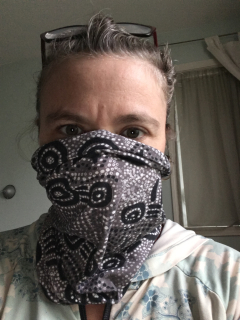
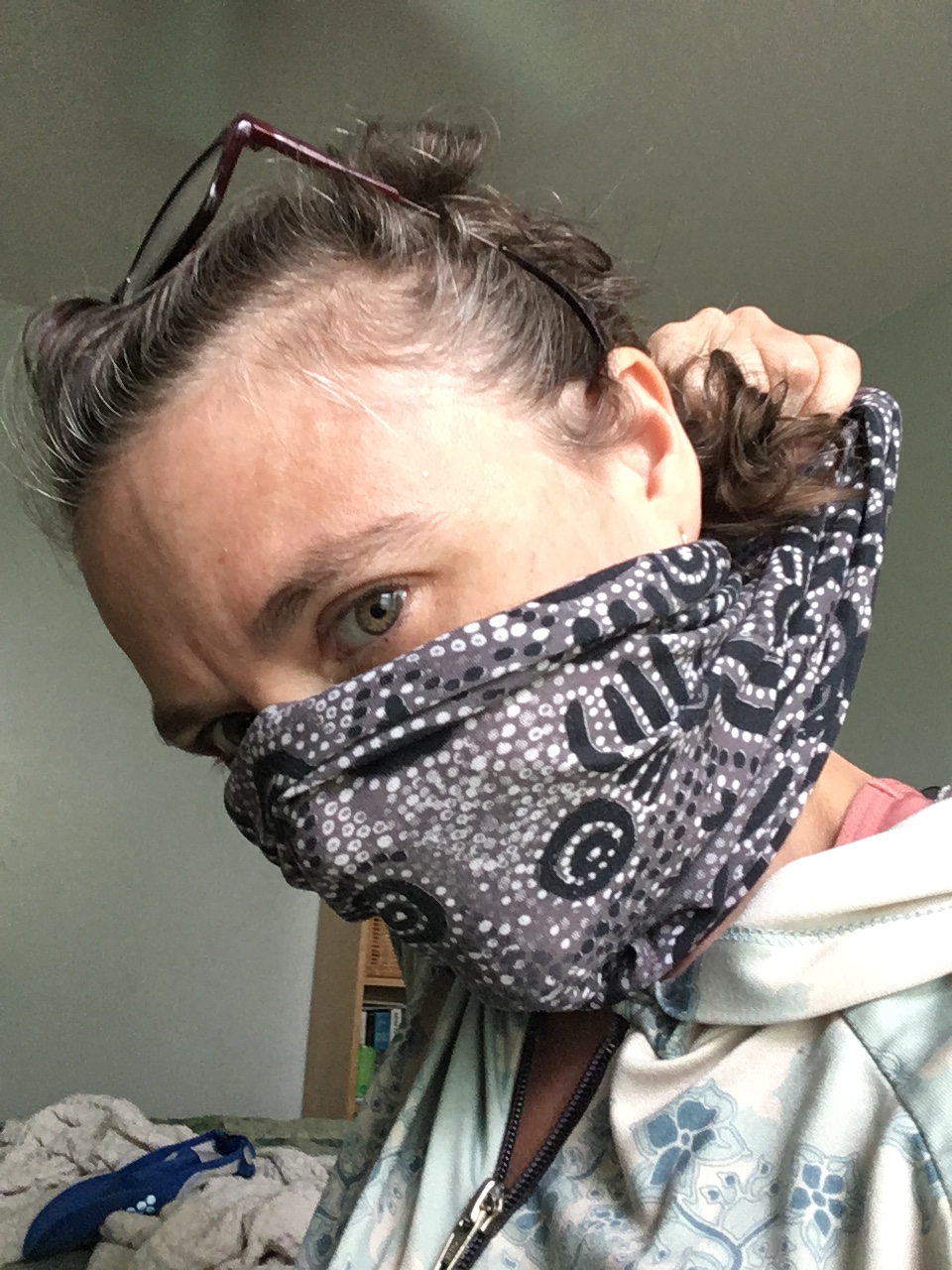
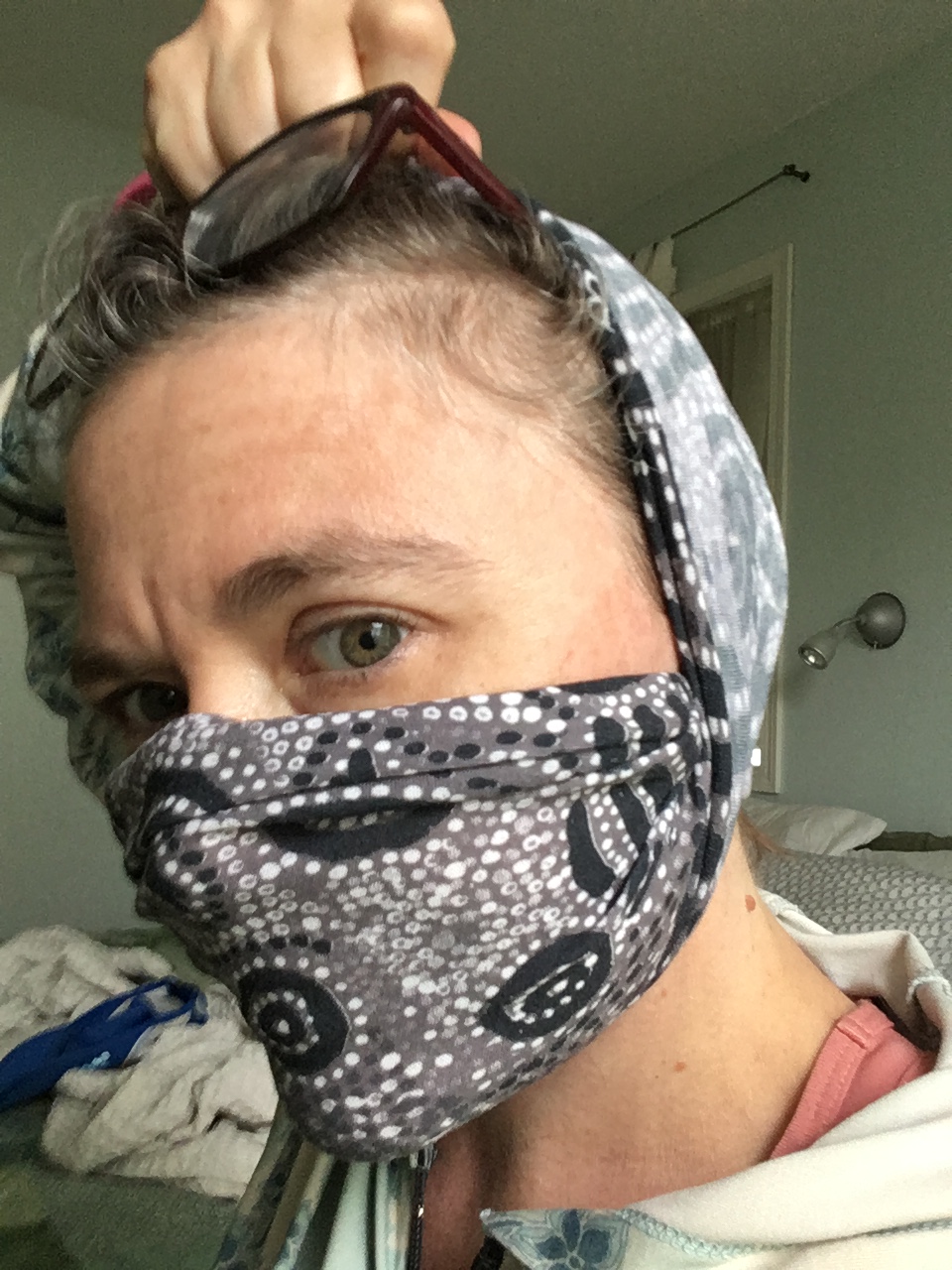
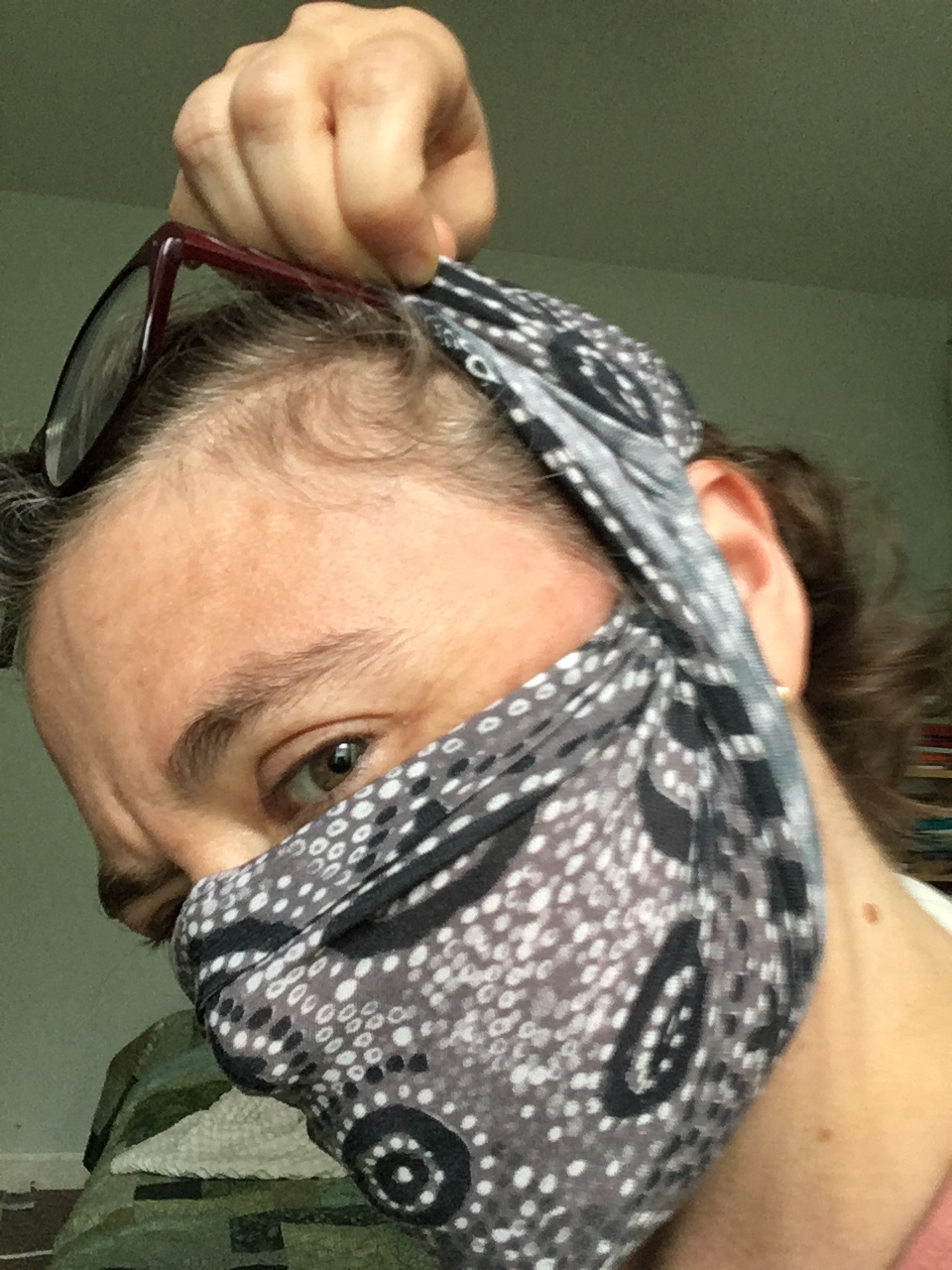
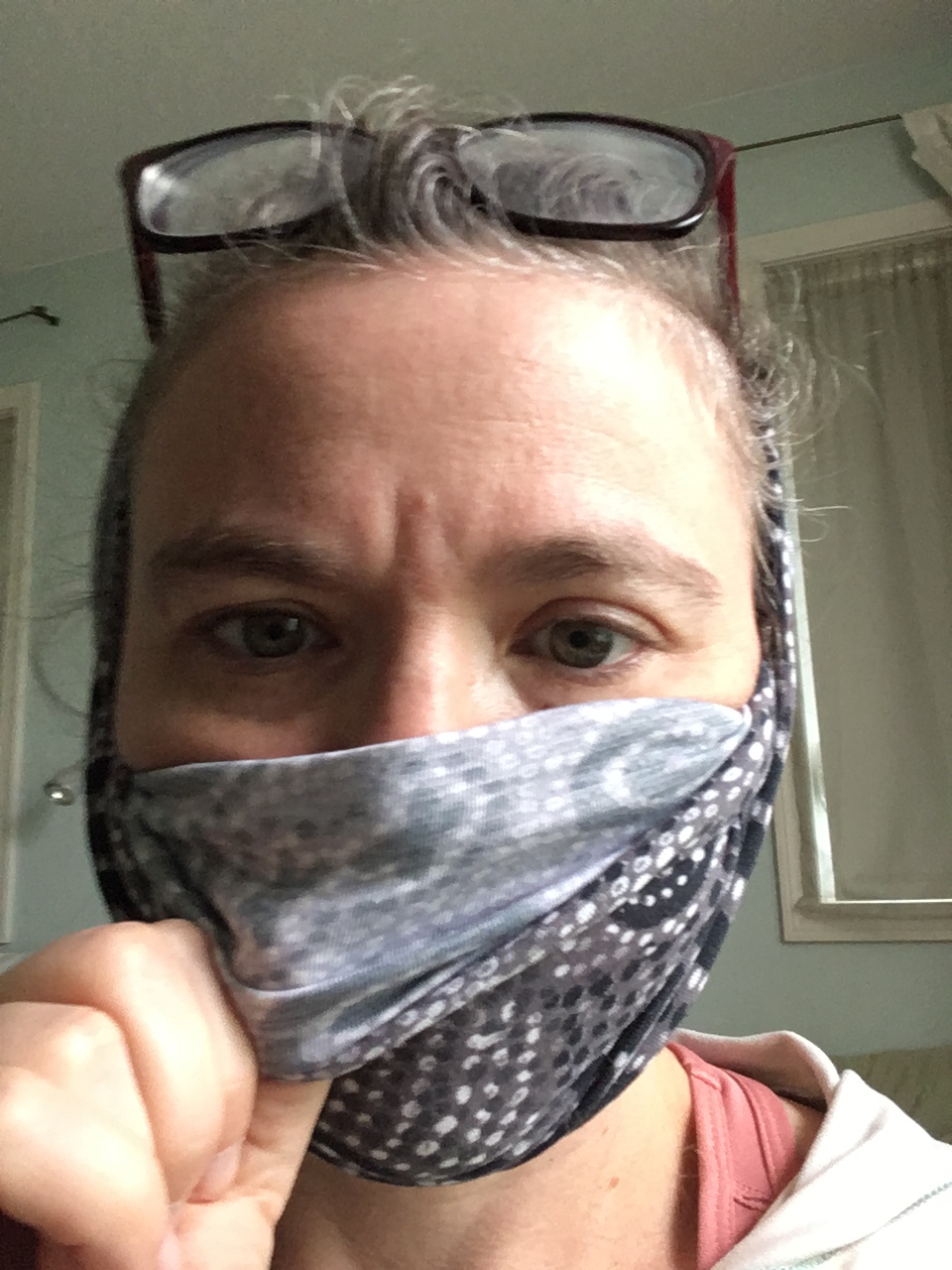
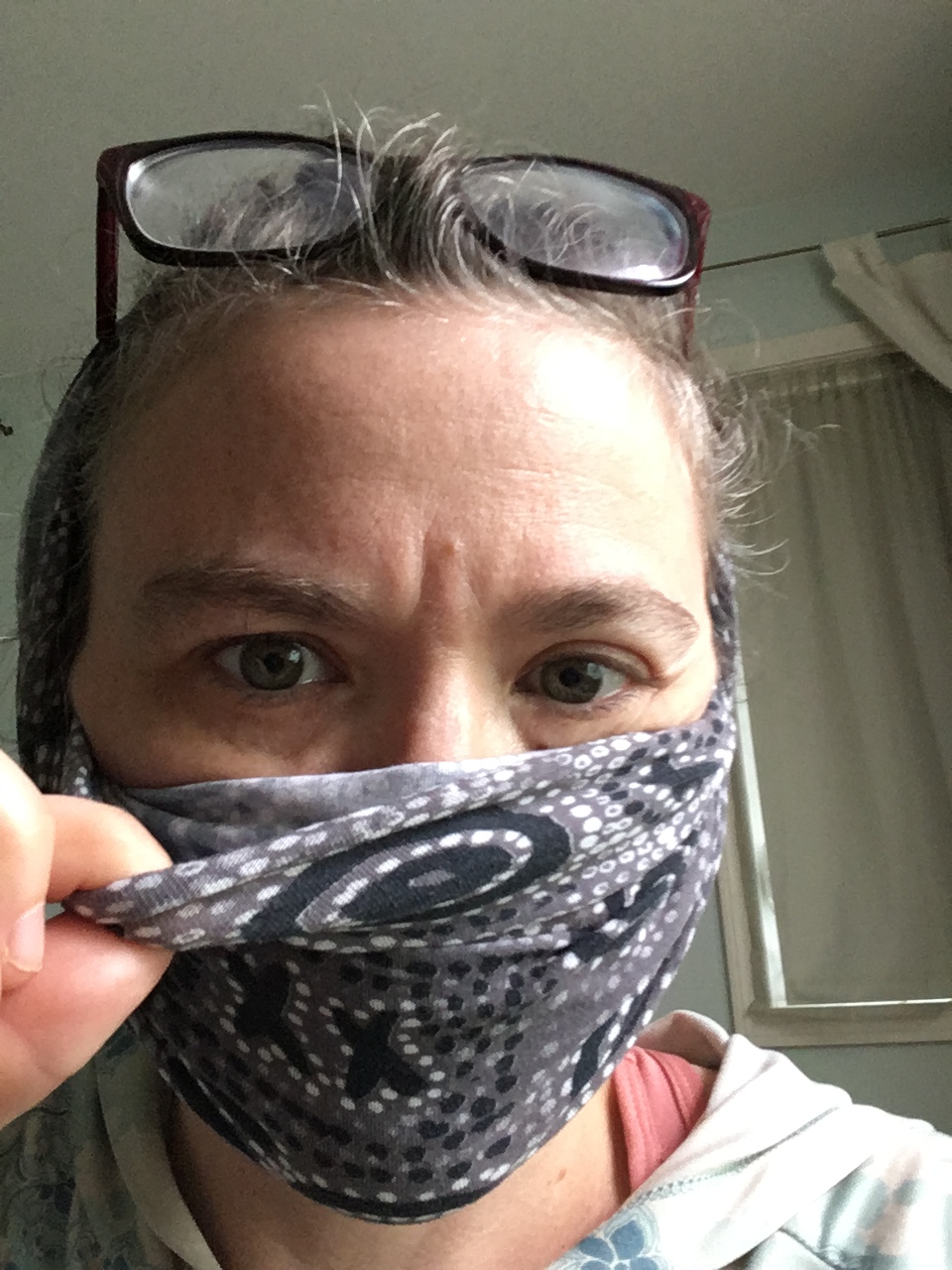
    My favorite mask so far has been the polyester neck gaiter, not worn pulled up in a single layer bank-robber-style over the nose (it's not nearly tight enough for me to feel secure that way), but lapped into at least three layers and with the selvages over my head to create a tight seal everywhere around my nose and mouth.  I showed exactly how I did it, with photos, back in May, partly in hopes to encourage the "tight-gaiter-as-mask" method of wearing it instead of the looser "bandit style."

    I listed numerous advantages, and then added:

    Potential disadvantages:

    • Polyester knit is fairly loose-weave and its specific filtration efficacy is not known.  This is the biggest caveat.  It's one reason why I try to get at least three layers over my mouth and nose.
    • Some brands are pricey
    • Maybe it will fog your glasses and you'll have to add some wire or something
    • It's a little hard to get it just right without a mirror (at least at first)

    Give it a try and see what you think.

    Repeated Disclaimer:  I am not a professional dispenser of legal or medical advice, and I have not done an exhaustive literature search to determine if there is any other available data regarding polyester knit fabric as part of masks for source control in the community.    

    So!  We now have a little bit—emphasis on the little—of data regarding polyester knit neck gaiters, and that little bit isn't good.  In my opinion, the scrap of data is enough to make me at least temporarily uneasy about relying on the gaiters without an added filter, so I've resumed experimenting with cotton fabric. 

    In my opinion, it is not enough (yet) to rule out gaiters as an effective option. 

    We really need to know more about this, because they are a very popular face-covering right now, and for good reason.  Some people believe it's the only type they can tolerate for long periods, so if it turns out that they are reasonably effective when worn in a well-fitting way, we don't want to lose them as an option.

    Let's dig in to the source of this data, which is a very cool study that came out this week and which I have carefully read with some consultation assistance from my spouse, who has professional experience in particulate imaging.

    + + + 

    Here's a typical article's headline and excerpts, this from CBS News:

    Neck gaiters may be worse than not wearing a mask at all, study shows

    Using neck gaiters as a face covering might be ineffective at stopping the spread of the coronavirus, and could even spread the virus further than not wearing a covering at all, according to a new study. Researchers from Duke University found that the neck gaiter they tested was "worse than nothing." 

    The neck gaiter is a circular piece of fabric that sits around a person's neck and can be pulled up to cover their mouth and nose. The issue with the convenient cover-up is likely not with its design, but with the fabric it is typically made from.

    According to Henrion, the study tested a neck gaiter made of a thin, stretchy polyester, which they are commonly made from. Instead of stopping droplets that can contain the virus from escaping into the air, the fabric appeared to turn large droplets into smaller ones known as aerosols….

    Duke's study focused on droplet production while talking, as opposed to coughing or sneezing…

    While the study did not set out to create a definitive ranking of masks, Henrion said that N95 and standard surgical masks released the least amount of droplets. N95s yielded the best results, and surgical masks came in second, stopping 90-95% of droplets. Simple two-layer cotton masks were effective at stopping 80% of droplets from getting out when participants spoke. 

    As for neck gaiters, Henrion stressed that the study was preliminary, and did not conclusively determine whether a gaiter's fabric or construction was responsible for producing smaller droplets. A neck gaiter with two layers of cotton could be more effective.

    Without easy access to PPE, many people have turned to making their own masks. The study showed that homemade versions can be effective, but people should be mindful of their mask construction and fit. 

    "Further research is needed to investigate the performance of bandanas and neck gaiters, since our study is only a proof of concept for the experimental method," Henrion said.

    Martin Fischer, an associate research professor in Duke's chemistry department who took part in the study, told WRAL-TV it wasn't meant to rate different face coverings, adding that "Not all … neck gaiters are bad. There are plenty good ones out there. It depends so much on the material, on how many layers you wear."

    So, if you read all the way through the news article, you do see some caveats.  It's not an irresponsibly written news article; but I'd argue it's focused incorrectly.  This study — Fischer et al., Sci. Adv. 10.1126/sciadv.abd3083 (2020) — is not a study of mask effectiveness at all.  It appears to be a valuable and elegant study, but they did not write the paper so that they could report mask effectiveness.    It is a demonstration study of their novel apparatus.

    In other words:  

    Fischer et al. were not trying to use their apparatus to demonstrate the effectiveness of 14 masks.  They were using 14 masks to demonstrate the effectiveness of their apparatus.

    Along the way, though, they did produce some data, which we shouldn't ignore; but we should be aware of its limitations.  

    + + + 

    A much better article about the study, the one that I wish had gone viral in the first place, was published in WIRED.   From the very headline and sub-head, they get the focus correctly where it belongs:  on the apparatus, not on the masks.

    Scientists Put Masks to the Test—With A Cell Phone and a Laser

    When it comes to blocking germs, not all cloth masks are created equal.  A new, low-cost testing device literally illuminates which ones won't get the job done.

    Three cheers for journalist Megan Molteni, who wrote the article!  Three cheers for WIRED, who put all of the above in big type before the colorful illustration!  

    I would love for you to read the whole WIRED article, but I'll pull out a section that's especially relevant to the neck gaiter question.  Emphases are mine.

     The neck gaiter, made out of a lightweight, breathable fabric favored by runners and cyclists, let through even more particles than the control group—110 percent relative to wearing no mask at all.

    If you’re wondering how that is even possible, you’re not alone. Fischer was similarly stumped. Then he went back and looked at the footage again of himself wearing the neck gaiter. “You can see that it’s not just that there are more particles, but that on average, the particles are much smaller,” he says. His team believes the stretchy, porous material is actually fracturing bigger, heavier droplets, splintering them into tinier particles that can more easily remain suspended in the air.

    If that’s true, it would blow up the maxim that any mask is better than no mask, says Kimberly Prather, an environmental aerosol researcher at UC San Diego who was not involved in the study.

    But there’s another possible explanation: Maybe the extra particles aren’t all respiratory droplets. Instead, they could be fibers shedding off the material itself. This has been shown to happen before, and would be easy enough to test—but Fischer and his coauthors didn’t. “Splintering would be bad, but we don’t know for sure that’s what’s going on,” says Prather.

    She also points out that the sample size for most of the mask testing is precisely one person. The study doesn’t capture all the variability in how people’s face shapes and speaking patterns might affect the effectiveness of different kinds of masks. So, while this project’s results are in line with other, larger, more rigorous studies, one shouldn’t read too much into the performance outcomes of individual masks based on this study alone, she says.

    Still, Prather is impressed that the Duke team’s technique can detect particles down to half a micron. Most laser visualization methods are sensitive only to about 20 microns. “That’s a big deal, because this captures aerosols—the particles that come out during speech—not just bigger droplets emitted during coughing or sneezing,” she says. “Keeping it in perspective, I think it’ll be a great comparison tool to look at variability between people, more conditions. There’s a lot of different things you can do with the setup they’ve developed.”

    Fischer and Westman also recognize the study’s shortcomings. “This was never going to be a definitive ranking of all masks under all types of conditions,” says Fischer. Doing that would require hundreds, or even thousands, more people testing lots more masks. “What we don’t want people taking away is: ‘This mask will work. This will not.’ It’s not a guide to masks. It is a demonstration of a new, simple methodology for quickly and somewhat crudely visualizing the effect of a mask,” he says.

    If you would like an article that is a little more mainstream-web than the tech-web WIRED, you could try this article by Susan Matthews  in Slate.  It's more of a rebuttal to the "neck gaiters are definitely worse than nothing" narrative, and mentions other reasons why it is too soon to draw that conclusion definitively.  And it's written in a conversational style that might get the average person reading to the end. 

    And, just in — that is, a nurse friend shared this on Facebook while I am actually writing this blog right now — here is an article from ScienceNews that has a bad headline (it isn't a "mask study!" argh) but summarizes everything I've been trying to say.  I'm being scooped in real time!

    I do want to emphasize that the study is not a flawed study.  It's a good study!  And the paper is very responsibly written.  Fischer et al. themselves are very careful to explain what their work does and does not show.   It's just that media outlets don't always bother to read that far.

    + + +

    I have many hot takes from all this, but as a number of them are duplicated in the news articles I've linked above, I'll restrict myself to a few in particular.

    (1)  A new, cheap, effective testing method. 

    The fundamental advance of Fischer et al.  is to design and describe a low-cost mask-effectiveness-testing apparatus and data analysis method that can be assembled by any research lab and even by your higher-level citizen scientist,  It is not beyond the ability of a bright high school student looking for a science fair project, or a garage tinkerer, if they can manage the data processing part or else figure out a proxy measurement.  

    (2) This is the first mask-tester I have seen that actually tests the mask's performance while it is being worn by breathing humans.

    Other studies of mask effectiveness have looked mainly at the filtration efficiency, by  (for example) stretching a sample of the fabric over an opening and pumping a mixture of air and saline droplets through the mask.  But the filtration efficiency of the fabric is definitely not the only significant question, and for all we know it might be one of the least important attributes.  We do not know how important the edge-seal around a mask is.  We do not know how tight a mask needs to be.  We do not know if the best mask-shape is different for different kinds of facial structures.  We do not know how well masks perform after they become wet with sweat or respiratory fluids.  We need to know these things, and the only way to find out is to test masks while they are being worn by real people.

    (3) Now that an easy-to build apparatus exists, perhaps we'll soon start to see the mask studies that answer some of our questions.  

    What we want to see are studies that evaluate a single type of mask in many iterations on many people, while they breathe, pant, talk, sing, cough, sneeze, and shout.   We want them to specifically identify the type of mask it applies to, and no, "fleece gaiter" is not good enough, nor is "two-ply cotton mask" or "poly-cotton blend."  What's the proportion of polyester and cotton?  What's the thread count?  Is it held on by ear loops or head ties?  In the case of a multipurpose face-covering such as a gaiter, is it worn tight to the face and jaw like I always have, or only pulled up over the nose?  I'll just point out that this study mentions three different two-layer cotton masks, and they do not measure the same.

    (4)  Certain improvements that could be made will answer even more questions which are not possible with the current apparatus.  Among them:  how important are droplets that come away off to the side instead of dead-center in the front?

    The authors of the paper explain that some very important questions literally cannot be answered with the apparatus as described in their paper, but in principle some design changes could close those gaps.  I'll just quote here.

    A first limitation is that our experimental implementation samples only a small part of the enclosure and hence some droplets that are transmitted through the masks might not be registered in the laser beam…. The physiology of each speaker is different, resulting in variations of the position of the mouth relative to the light sheet.  Hence, the droplet count reflects only a portion of all droplets… A speaker hole that is sealed around the face would prevent the undetected escape of particles.

    From looking at the diagram of the apparatus, I judge that droplets escaping around the edges of a poorly-fitted mask are the least likely to be caught at all.  So if edge-leakiness is to be evaluated, the apparatus will require development.

    (5) One possibility:  This apparatus could be used to give a quick estimate of a particular person's particular mask on a particular day.  

    My spouse, who unlike me does his engineering for a corporation for actual money, immediately thought of commercializing a similar design as a screening tool.  If it's vitally important that people have to have a mask that functions well on them to enter your building, you could set something like this up at the door and intercept people before they enter.  You could then, in principle, get a quick estimate of how well each person's mask is working for them, relative to a standard of your choosing.  If the mask they are wearing doesn't work well, you could advise the person to adjust the mask fit, or could offer the person a different type of mask.

    (6)  It's definitely too soon to shame people who are wearing neck gaiters.

    Don't do it.  I, personally, am concerned enough that I'm going to start looking for a comfortable cotton mask that fits me well (previously I had decided that the neck gaiter, twisted into a tight mask conformation, worked so well that I hadn't even bothered with cotton ones).  After all, we might find out that the gaiter really is a poor choice, and I want to be ready.  But we really do not know enough to abandon them, or the maxim that the best mask is the mask that you wear correctly and consistently.  Save your shame for the conspiracy theorists and the people who refuse to wear any mask at all.  We just don't know enough to be sure.

    And I'll be frank:  One of the cotton adaptations I've tried so far, and the one that I like best, is to layer the neck gaiter on top of the cotton mask.  It's a little hot, but the tightness of the gaiter securely fastens the cotton mask to my face so it won't budge; destroys glasses-fogging; and spreads the pressure out all over my head.  But you know what?  You can't see that there's a cotton mask underneath.  So if you see me on the street with my gaiter wrapped around the lower half of my face, have pity:  I've got another layer under there.  

    + + +

    My ultimate recommendation is to watch for citations of Fischer et al. in the literature.  Any paper that reproduces or improves upon their apparatus ought to be citing them, as should any paper that uses the apparatus to do a true mask study.  And if my observations about media coverage of scientific results are accurate, no matter what followup studies they perform, we'll likely never see them go viral again.


  • The greatest commandments and the city council.

    I am out of practice, so expect a somewhat stream-of-consciousness post today.

    Today I listened to a relatively short homily in which one point went like this (paraphrased from memory): 

    We cannot expect the city council to solve our problem, because our problem is sin, and Jesus is the only solution for that.  We cannot put all our hopes in them or set them above God.  Our problem will only be solved by conversion of hearts, and so that is where we have to look first.

    None of this is false, and yet I went away troubled and unsatisfied by the homily.  Part of the truth is, I think, missing from it.

    Surely one reason I am unsatisfied is the lone reference to the “city council.”  It is true that the city council cannot solve the problem of sin, but it’s also true that the words “city council” call to mind for those of us living now in the Twin Cities something quite specific.  The Minneapolis City Council is in the process of dismantling the status quo ante of the police department, and everyone, whether they live in Minneapolis or not, seems to have an opinion about it.  So I am left with a strong impression that the homilist meant that whatever we hope the city council might do, we ought to mostly focus our efforts not on influencing it, but on conversion of our own hearts regarding such things.

    But maybe what was really meant was not to point just to city government, but to government in general.  That would be a more expansive view, and so less incomplete.  It isn’t just the city council who can’t solve the problem of sin.  Traffic and parking can’t; the state legislature can’t.  Federal judges cannot solve the problem of sin; getting the right president in office will not solve the problem of sin.  Only conversion of heart will solve the problem of sin.  Now, it is true that I do not remember ever being warned on the Sunday preceding the first Tuesday after November 1 that I should be careful not to trust in federal judges to solve our big problems.  But I am as subject to cognitive bias as anyone else, and my memory might be faulty.

    Anyway, all that is not wrong.  We cannot set any level, any branch of government up as a substitute salvation that will solve the big problem.  There is certainly a risk that we might.  As the legend goes, progressive atheists want to set government up as a new idol, substitute central planning for morality.  I am not sure there were very many of those listening to the homily.  But the point is taken. Government is not the solution to the Big Problem.

    And yet, even if we don’t fall for the idea that government can solve The Big Problem (sin, or if you like, selfish human nature), still we think government can be useful to solve, if not THE problem, then just A problem, here and there, from time to time.  How do we work to get our government to solve A problem without accidentally making an idol of it?  Without neglecting conversion of hearts?

    If I look to the city council for help keeping, say, police officers, from, say, murdering unarmed Black residents, is that so wrong?  Surely what we really need is for a bunch of hearts to be converted so that no one tries to murder anyone at all, but do we have to see many more people die while we try to convert them?  And are we working on the correct set of hearts?

    + + +

    I often think about the two great commandments, Love God and Love Your Neighbor.   Probably I should think about their content, but I often think about their number.  Why are there two?  Jesus says that in those two are contained all the rest of the law.  But at least superficially, one might think that they are also contained in each other.   “Love God” should imply loving His creation, including the neighbors, no?  And “Love your Neighbor” should imply the existence of a law of Love higher than ourselves, which must come from God, no?  So why do we get both instead of one or the other?

    Let’s suppose we only had been given one, and see if it gets us somewhere different.

    1.

    If the only greatest commandment were “Love God,” then we would at least know to love God more than neighbor.  And that seems to go with other bits of scripture, like today’s, where Jesus says we ought not love parent, son, or daughter more than we love Him.  But without “Love your neighbor,” how could we really be sure that our neighbors even exist as real people?  What if they are illusions?  What if I, and the voices in my head, are all that is?  The voices in my head, or the desires in my heart, might themselves be God.  I might try to love God only by obeying those voices, or only by obeying my desires.

    But because “Love your neighbor” is also a great commandment, I have a way to test the voices in my head and the desires of my heart.  If they tell me to hate, to harm, or to use my neighbor as a means to an end—anything impossible to square with loving the neighbor—then I know it isn’t God I am serving if I do what they tell me.  I know the god to be a false one.

    2.

    And what if the only greatest commandment were “Love your neighbor as yourself?”  Then I know I am always to will my neighbor’s good, yes, in the same way that I will my own good.  But what is my good?  What is my relationship with Good?  Who am I?  What am I?  If I cannot understand myself and how I relate to Good, how do I will and enact good to others?

    This is why I also need the commandment “Love God.”  I am a creature, but not a thing.  I need God and am to love God.  And since I am to love my neighbors as myself, they are also creatures who are not things.  I owe my love, because I owe myself, to God.  And so I can also test my love of neighbor:  if I attempt to will and enact the good of my neighbor in a way that violates my own right relationship as a child of God, with my own dignity and my own duties, I have chosen the wrong way.

    Conclusion:

    The two commandments interpret each other, test each other, and together they test all the others.

    + + +

    The two together are, I think, the test of most moral questions, questions of right relationship— such as whether we have inadvertently set some useful tool up as an idol.  Any tool, even a quite useful one, can be an idol if we attempt to obtain and wield it at all costs—in particular, if we are willing to violate the two great commandments.

    Yes, even if we wish to use the tool (once we have it) to love God or to love (some) neighbors.

    If you try to obtain the tool, or the power to use it, by denying or wounding or neglecting God—or by harming your neighbor, or using the neighbor as a means to get the tool—or by lying or deceit or cheating

    —yes, even if you hope to use the tool to help someone later, or a great number of someones—

    your tool is an idol.  Even if it’s the city council; even if it’s a federal judge.


    + + +

    But… if you haven’t set it up as an idol….

    ….your tool can be simply a tool. 

    There is nothing wrong with writing to my city council representative, or showing up to a public meeting, and telling her my opinion about how a future public safety department ought to be organized.  There is nothing wrong with me writing that I will vote for her if she does one thing and against her if she does something else.  There is nothing wrong with my voting.  Nothing about any of that is inconsistent with loving God or my neighbor, as long as I form my opinion with an honest attempt to serve the common good, and to spend my vote and my words and my work to get the best outcome for that common good that I can get.  And it doesn’t prevent me from hoping for conversion of hearts, or even working for conversion of hearts, in some other way.

    Trying to make civil society better, fairer, safer, more just is not a risk of making it a substitute for God, unless you choose means that violate your relationship with God or your relationship with your neighbor.  And there are usually means available to you that do not violate them.

    There are also probably means available to you that would so violate them.  And those means might well seem as if they will get the job done faster, better, or with more certainty.  Congratulations: this is what is known as a “temptation.”  They are common, and the point is to avoid them if you can, and if you can’t, then not to give in.

    + + +

    And so it comes back, as it so often does, to means and ends.  We may use any thing—a tool, a structure, a process, an organization—to love our neighbors, giving them what is justly theirs, and to love God, giving God what’s due.

    We may not use, or harm, a neighbor in order to get hold of the tool; and we may not deny or neglect God either.

    If we aren’t breaking those commandments, I submit that we ought to be confident that accusations of setting up false idols are baseless.  And so we shouldn’t be scared away from using those means to try to protect the powerless, provide for the poor, and make whole the injured.

    Or, for that matter, to reach and speak to all those unconverted hearts, even ours;  the ones that work together, maybe without knowing it, to embed the Big Problem—selfish human nature—deeply in all the systems we participate in, including the ones we want to use and change to lift the very burdens that oppress us all.


  • My no-sew community mask method.

    Today, the mayor of my city, Minneapolis, announced that next week cloth masks will be mandatory here in "indoor spaces of public accommodation."  So that seems as good a time as any to write a fairly practical post.

    In other words:   Today I tell you how I do something that, if you wanted to do it my way, you'd probably be able to figure it out yourself.  But hey, why not, I'm a little writer's-blocked.

    Disclaimer:  I am not a professional dispenser of legal or medical advice, and I have not done an exhaustive literature search regarding polyester knit fabric and droplet control, only a cursory one.  I hope to get around to that sometime before I start shopping in stores regularly again.  But I'm also not going to let that stop me from blogging.

    + + +

    I'm going to show you the fog-free, not-too-sweaty, NO-SEW mask method I came up with using things I already had in my house.  

    IMG_8751

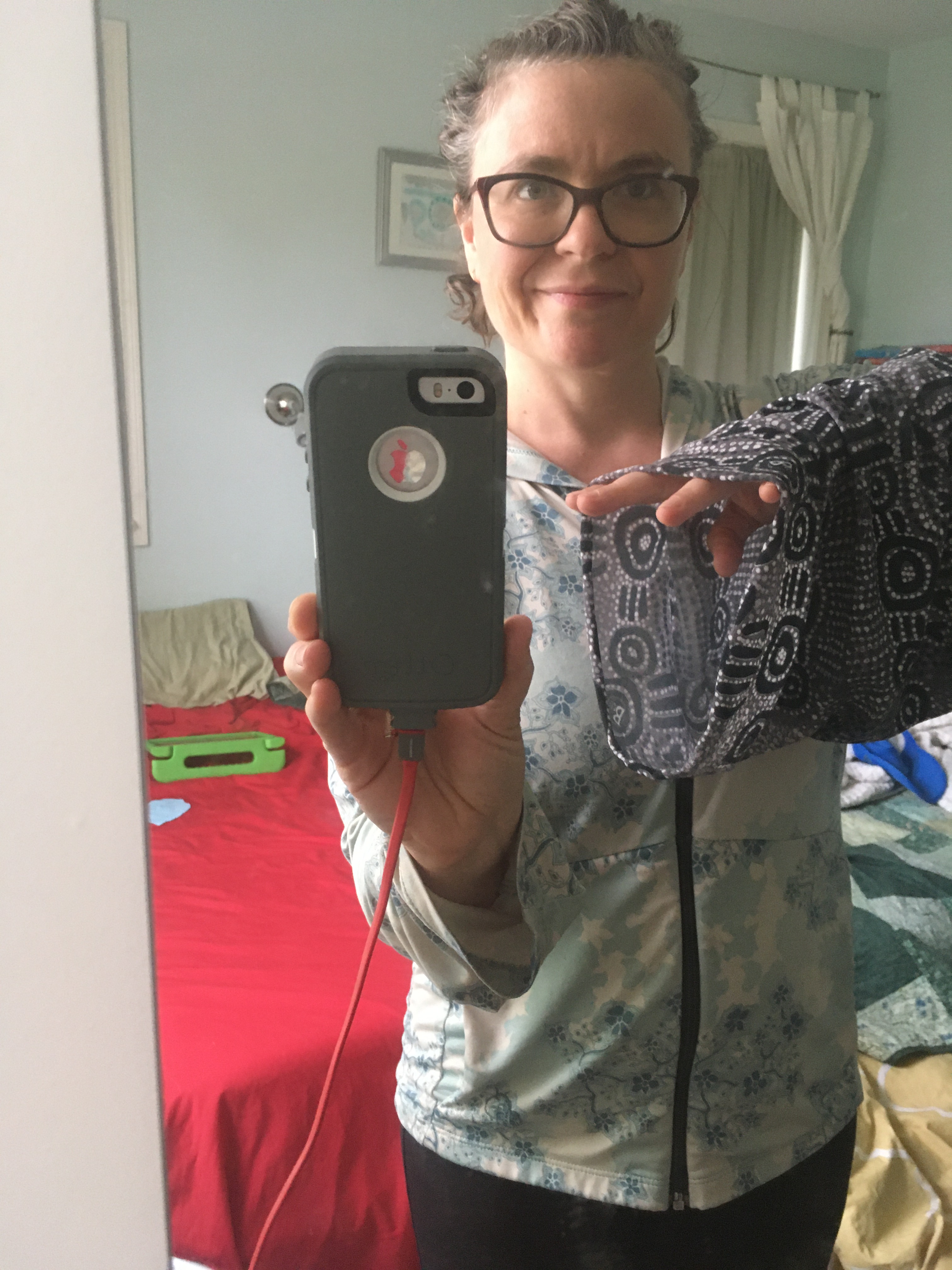
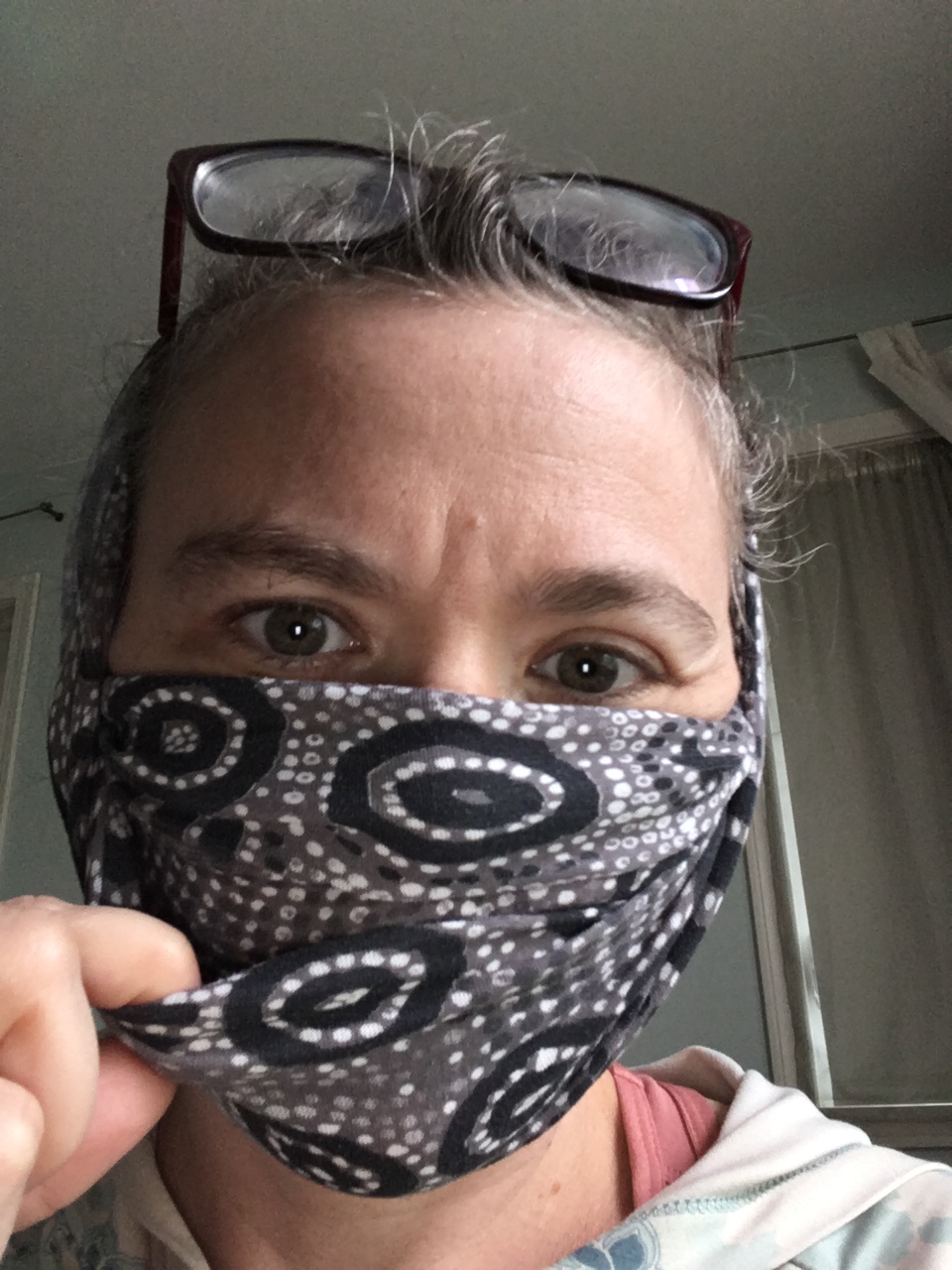
    Me with my arm through a tube bandanna.

    What I already had in my house:  about six of these stretchy polyester tube bandannas, or you might see them called "multipurpose running headband."

    Most of the ones we have are made by Buff (available at a lot of different places, including REI and Amazon).  Buff Original Multifunctional Headwear is a little heavier; Buff Coolnet fabric is a little more lightweight.   The one I am showing you today is an adult size, but personally, I prefer the junior/kids' size; it fits a little tighter.   

    All those will run you $20-26 at full price.   You can find similar, much less expensive ones at Decathlon (like this one); my favorite is the Quechua MH 500 Children's Hiking Headband, though just now it seems to be out of stock in the US.  Here it is in the UK.

    + + +

    A word about stretchy polyester as a mask material:

    I wish I didn't have to waste time explaining this, but I'm talking about community masking for source control here.   I am not talking about self-protection, and I am certainly not talking about the kind of PPE you need in medical settings or being a caregiver for sick people.

    A homemade cloth mask for community masking has two purposes.   (1) to reduce the number and velocity of droplets that come out of the wearer's mouth and nose into the surrounding environment and (2) to comply with building rules or local regulations that require people to wear cloth masks when they are around other people.  

    Perhaps such a mask will also confer some protection against inhaling other people's face-hole droplets.  That is beside the point for my purposes.  I'm wearing this mask to help protect my neighbor, just in case I am an asymptomatic carrier of infection.  I am glad to see my neighbor wearing a mask to protect me. 

    Those formalities out of the way:  I am not representing this type of mask as more effective, as a community protective strategy, than any other type of cloth or paper mask. 

    There is reason to believe that some fabrics are intrinsically better than others at filtering out droplets of the relevant size.  Konda et al. put out a preprint describing air filtration experiments in which they passed air containing aerosolized saline through fabric samples; different fabrics showed very different results, and combinations of fabrics appeared to be generally better than single fabrics.   They caution, of course, that the intrinsic filtration efficiency of the fabric isn't the only important factor.  Indeed, the better the mechanical filtration, the more air pressure it takes to breathe through the mask fabric, and the more likely that air will escape around the edges.  The shape of the mask and how it fits to your face are factors—as well as whether you find the mask comfortable enough to keep it on.  

    I have been watching for data about hydrophilic and hydrophobic mask fibers.  A lot of people are writing about cotton quilting fabric and not that many people are writing about polyester knit.  Polyester is generally a hydrophobic, water-repelling fabric, although the manufacturer may have treated the surfaces of the fibers in ways that affect their hydrophobicity; and often you find it in blends with hydrophilic (water-attracting) fibers such as cotton.  One might expect that a hydrophobic fiber network would be less likely to catch droplets of water-rich spittle than a hydrophilic one.  But Konda et al. found that a polyester-Spandex chiffon fabric (a woven fabric, not a knit) was a remarkably efficacious filter medium, possibly because it—like the material in N95 masks—holds an electrostatic charge that traps small particles.  A relatively new preprint by Aydin et al. is notable because not only does it include data on polyester knits, it considers the breathability of the fabric and also how easily it becomes soaked with moisture.    

    I'm not aware yet of much data regarding the effectiveness of different kinds of fabric in actual use, sewn as masks, and fitted onto people's faces, at filtering air that actually contains viral particles.  But it does seem clear that wide acceptance of plain paper unfitted surgical masks significantly reduce the spread of respiratory diseases.  So for now, I'm going on the assumption that, with community masking, the most important thing is that as many people as possible find a well-fitting mask that they can and will wear, comfortably, whenever they are out.   

    And I think this is pretty comfortable, and fits nice and snug with no air going around the edges.  I can add an extra layer of filtering fabric if I want.  So this is the main thing I do when I am out and about.

    + + +

    Step by step, starting with the multifunctional running headwear:

    1.  Put it around my neck, before clipping my hair out of the way.  Then wash hands!

    IMG_8752

    You might like the way it looks more if you put it on reverse-side-out at this point, but for me it works best right-side out.


    2.  Spectacles out of the way, the top edge goes over the nose.

    IMG_8753

    If you are very, very sensitive to having tight fabric covering your mouth and nose, you could stop here.   This fits very loosely and covers well past the chin.  It will comply with most places' rules about wearing face coverings, I expect.  I would recommend taking up some of the slack, if there is any, or else using clips to secure the back of your mask into your hair or perhaps to your hat.  It's better if you don't have to adjust it and if it doesn't fall down by itself.

    But I want a tightly-fitting, secure mask with more layers over my face, so…

    3.  Take hold of the bottom edge of the mask where it passes behind your neck….

       IMG_8754  


    4. …. and pull it up, flipping it reverse-side out.  You can pull it as far as up over the top of your head.

    IMG_8755

    How far you pull it depends on how tight you want that edge to be under your chin. 

    Right here is where I stop when I am using the bandanna to make a face mask for my six-year-old and my ten-year-old.  It is comfortable, it stays put, and they think they look fierce in it.


    5.  Now we tighten it over the nose.  We do this by grabbing the other edge of the mask, the one that crosses over your nose and under the part covering your ears, and is now behind your neck.  Grab it and pull it straight away from your neck.  You will feel that edge tightening over the bridge of your nose.

    IMG_8756


    6.   Then, much like you tightened the first edge, pull it up behind your head, folding it right-side out.   Again, how far you pull it depends on how tight you need it to be over your nose.  Don't worry if it isn't perfect quite yet.

    IMG_8757


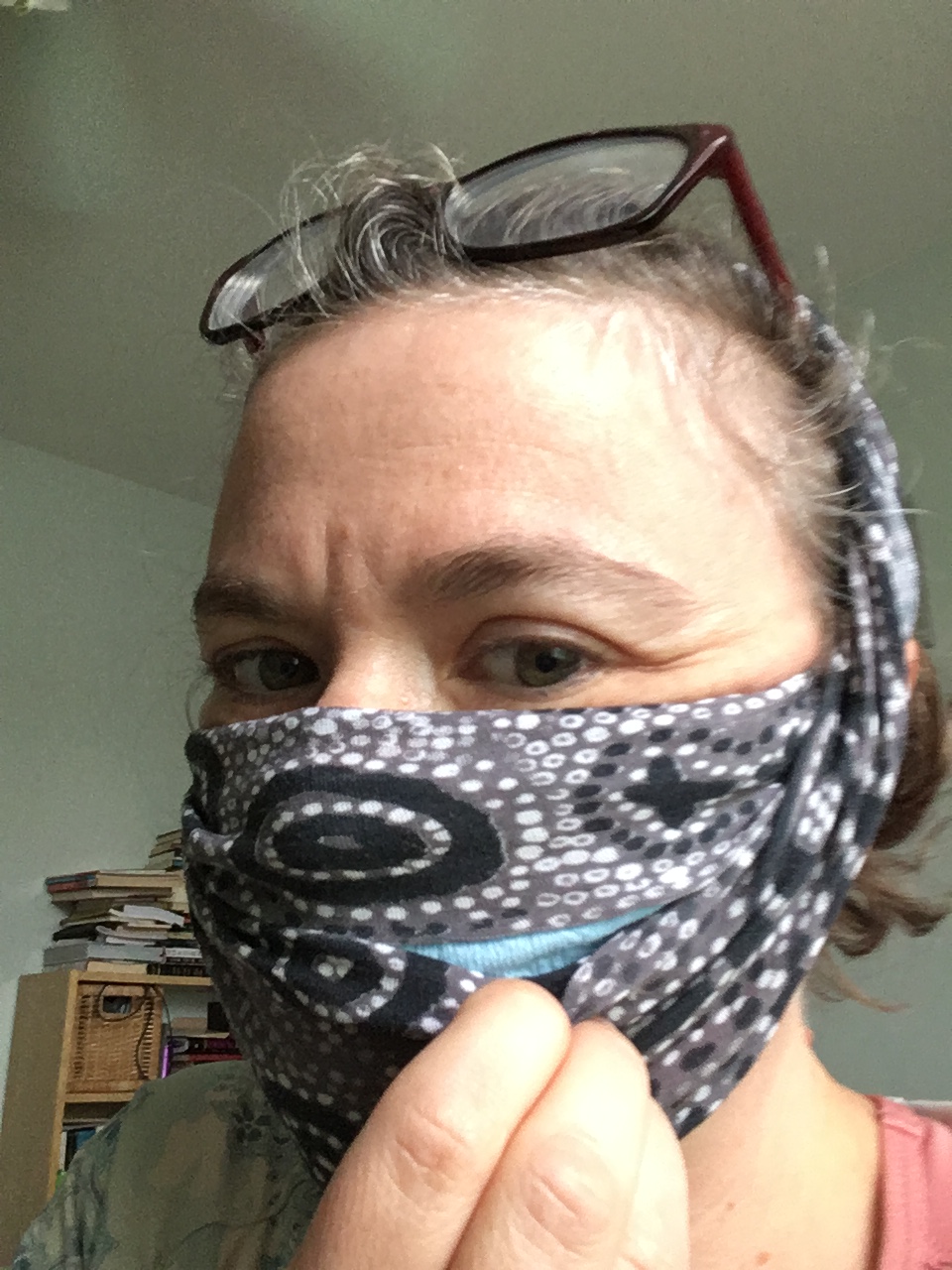
    7.  You may have noticed that, so far, there's only one layer of fabric over your nose and mouth.  Let's fix that.  There's plenty of extra fabric to fold here.  You can fold the top edge down, showing the reverse side of the fabric, and get two layers quite easily.    (If you stop here, maybe you would prefer to have started with the bandanna reverse-side-out.)  But I prefer to do a little fancier folding…

        IMG_8758

    8.  Flip that edge back up and now there's three layers over the nose.

    IMG_8759

    9.  You can do a similar thing with the bottom edge and get two or three layers over your mouth.  I do find that, however you fold it, it's better to have the very bottom edge go under your chin instead of across your face in some way, since that helps it be held snugly over your face by the tension of the edge passing over the top of your head.

    This makes a little pocket which you can use to add an optional extra layer of filtering material!  

    IMG_8760


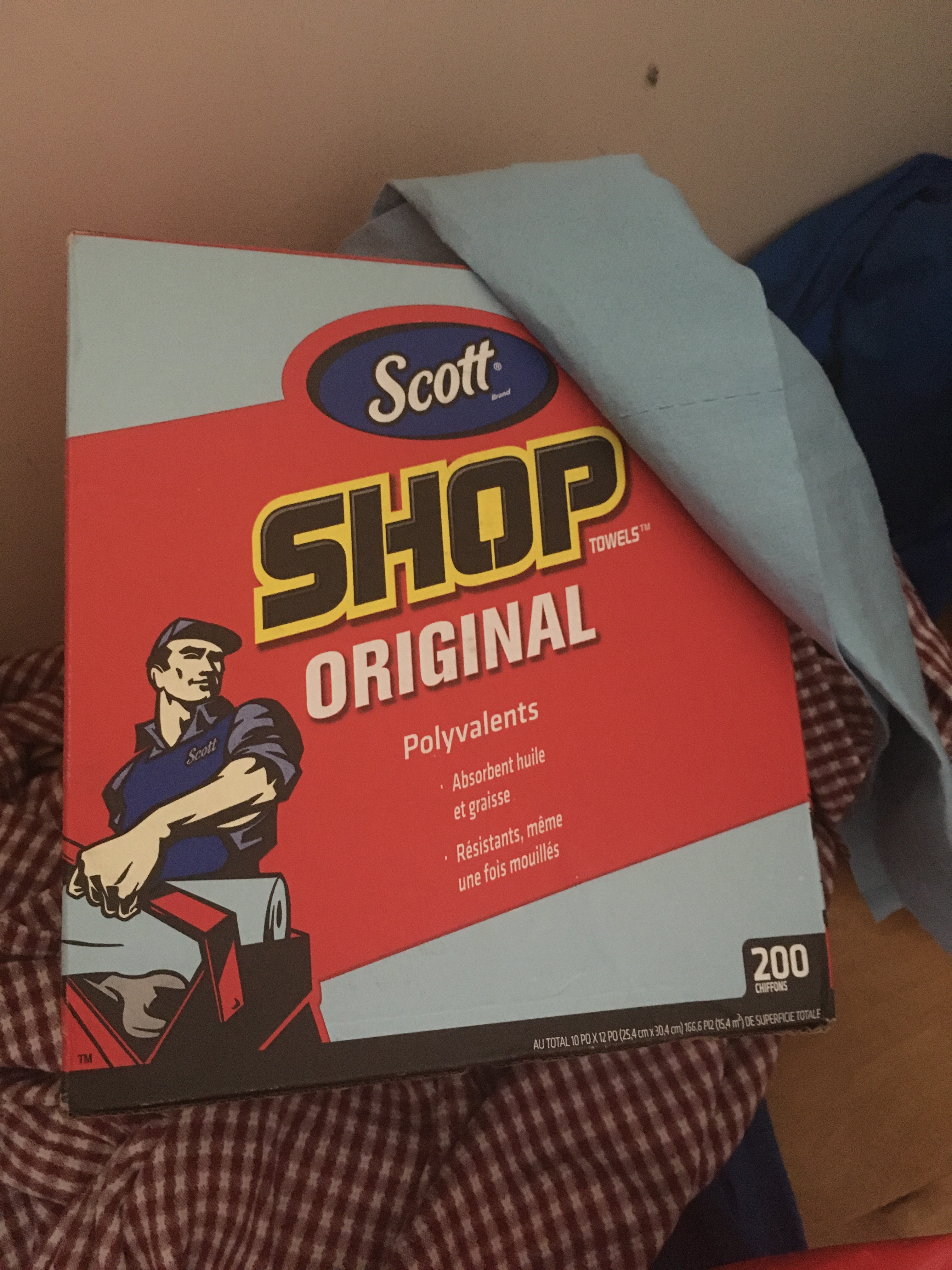
    Today's optional extra filtering material will be Scott Shop Towels, cut into a shape that seems to stay put on my face in this mask.  I am not recommending this particular fabric for any other reason besides the fact that I have it in my house and it is an absorbent non-woven breathable food-safe fabric that I can cut with scissors, which happens to be a color that contrasts with my mask so you can see it in the pictures.  I don't actually know what they are made of (apparently Scott keeps that secret).  Replace it with anything that you have decided will enhance your face mask.

    IMG_8750

    IMG_8761


    10.  If I am using the extra filtering material, I tuck it behind the folded-over flaps, both the one coming down over my nose and the one coming up from my chin.  This takes some adjusting of the folds to make sure I have enough material to work with.  

    IMG_8764


    11.  A little fine adjustment across the nose.  I take up a little bit of slack and pull it below my cheekbones at the edges, by tucking it further under the twist at the temple.  

    IMG_8765


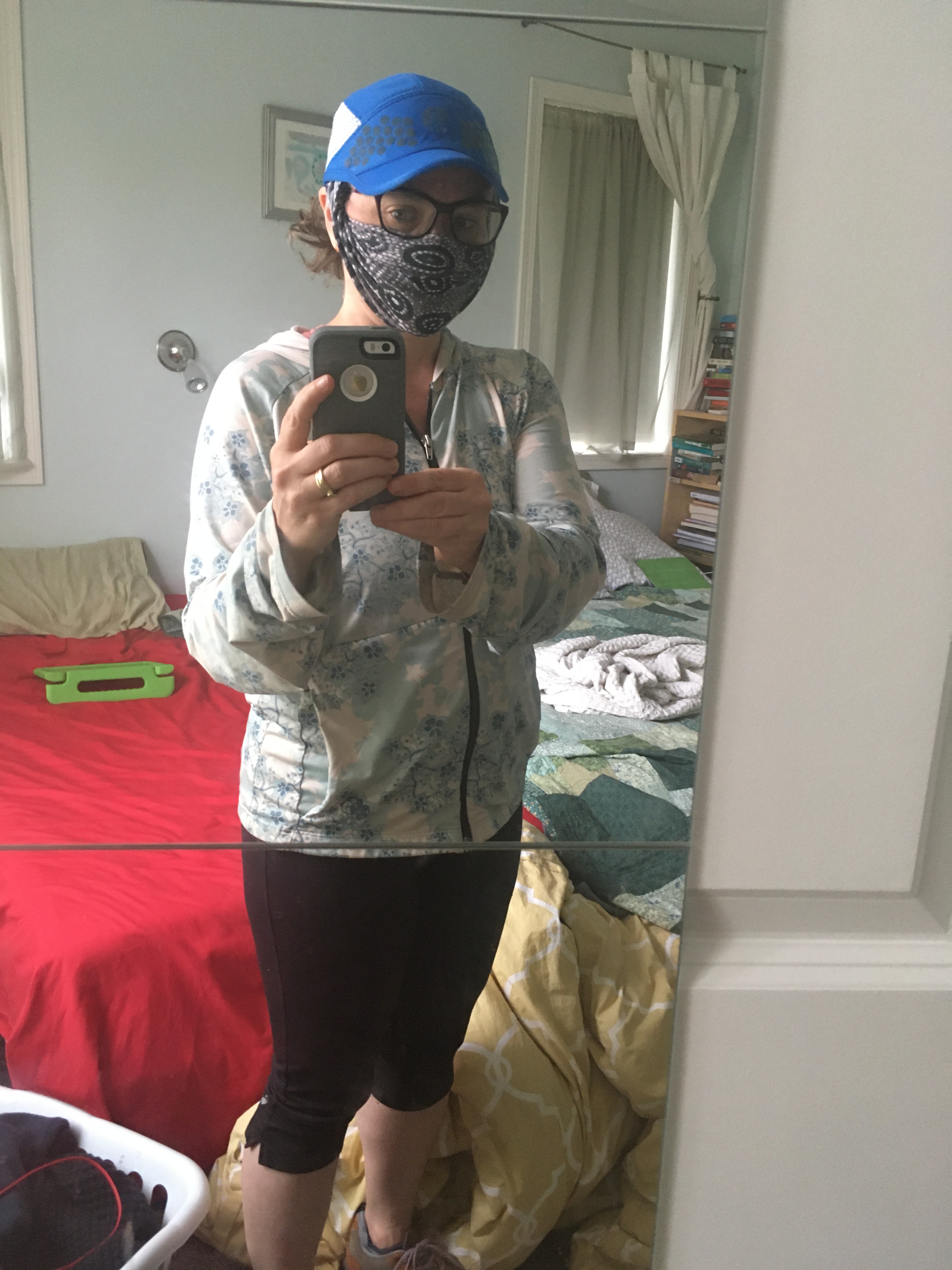
    12.  Eyeglasses (fog check:  zero) and hat.  Done!

    IMG_8766 IMG_8768


    Here are the advantages I see to this type of face covering:

    • Machine washable, quick-drying
    • Sweat-wicking fabric
    • Easy to obtain two, three, maybe even more layers across the face
    • Fairly stylish
    • Can vary the tightness from quite loose to quite snug
    • Can put in an extra filter if you want
    • I bet you could wear it over an N95 if you wanted to
    • YMMV, but it doesn't fog my glasses
    • No sewing
    • Stays in place, no need to touch it frequently
    • Kids seem to like it
    • Doesn't hurt your ears or tangle in your hair (though I'm much more comfortable with my hair put up)
    • Without the extra filter:  Easy to breathe through
    • If you take it off, for example, to drive from place to place, it will just stay comfortably around your neck

    Potential disadvantages:

    • Polyester knit is fairly loose-weave and its specific filtration efficacy is not known.  This is the biggest caveat.  It's one reason why I try to get at least three layers over my mouth and nose.
    • Some brands are pricey
    • Maybe it will fog your glasses and you'll have to add some wire or something
    • It's a little hard to get it just right without a mirror (at least at first)

    Give it a try and see what you think.

    Repeated Disclaimer:  I am not a professional dispenser of legal or medical advice, and I have not done an exhaustive literature search to determine if there is any other available data regarding polyester knit fabric as part of masks for source control in the community.    


  • A declining sense of danger.

    Here's something odd about me in the continuing weeks of the pandemic:  as time goes on, I feel safer, but I probably am in reality less safe.

    I date my personal lockdown from March 15, easy to remember, the ides of March.  On Friday, March 13, we headed west for our Utah ski vacation, got a little way into South Dakota, sanitized a hotel room, and spent the night.  The next morning, after consulting some more with our Utah friend, we turned around and headed back home instead.  Early Sunday I went for one last trip to the grocery store, and that was it.

    + + +

    All my plans, like everyone's plans, changed at once.  This is a situation that makes me particularly uneasy; I'm not at all good at changing my plans. 

    I spent about a month actually afraid.   I had trouble eating, I had trouble sleeping, I mainlined the news out of Italy and New York City, I obsessively catalogued the freezer and locked the pantry to keep the children from snacking on our hoard.  (Lest you think I starved them, I provided a bin full of permitted snacks).  For a couple of weeks we ate only out of the pantry.    I didn't go outside except to take long solitary walks on empty streets, crossing to avoid other people, bundled in coat and hat that seemed to make my face covering and gloves more normal, just part of living in Minnesota.

    And then it started to wear off. 

    I arranged for grocery delivery.  (I washed the containers as they came in.) We ordered pizza, we went to pick up takeout.   We started ordering other things, first only essentials, later things just because we wanted them. (I put on gloves to cut open the boxes.)  

    The weather warmed up and I went in the fenced-in backyard barefoot and barefaced.  I put the gloves away.  I took longer walks in the sun with the mask but no hat and coat.  

    I started to feel safe again.

    + + +

    I guess I only have the energy for so many weeks of fear and grief, compounded by a grave gratefulness that (despite worrying) we have so far been relatively untouched.  And of course, compounded further by anger at everyone whose incompetence, malice, or cowardice did its own small part to help this global catastrophe make a smoldering home in our country.

    And then there is the bit about having trouble with changed plans.  Eventually our changed circumstances, here in the United States, began to feel like a new normal.  And I began to see other plans, coming visible over the old ones like lemon-juice writing over a candle flame.  A plan to stay home, to wait and see, to keep on keeping on; a plan to wait, likely till fall, a plan for this summer to be a lost summer, a quiet, stay-at-home summer, a contemplative, cloistered summer.  Anything happening could be a surprise and a bonus. 

    We developed a new routine, punctuated by take-out meals.  Monday pizza lunch, Thursday casual dinner, Saturday nice dinner.  The groceries come on Tuesday.    We drank more wine.  The teenager's home weightlifting setup arrived; I started strength training every day, and doing yoga videos in between.

    And in the routine, I found I could eat again, sleep again.

    + + +

    Here's the really odd thing.  In Minnesota, we have not yet hit the peak.  The total cases are rising, rather alarmingly, and our testing has not caught up.  I approved of the governor's relatively slow pace of re-opening:  the stay-at-home order, the closing of schools; the buying of time; followed by cautious re-opening of businesses based on whether they could safely operate; the ten-person limit on gatherings, the suspension of public religious services.   Perhaps it's done what it was meant to, pushed the peak later, gave the health care system a chance to be ready. 

    The delaying of the peak does, however, mean that every day there are more infected people, perhaps asymptomatic, out in the community.  It is objectively more dangerous now then it was on the Ides of March. 

    And yet, back then, I felt, well, terrified, for myself and for others around me.  I just wanted us to stay in the house and not leave it, not call delivery to my door, last as long as we can on the canned goods and frozen meat and dried pasta.

    And now, I don't feel that way.  I am starting to think thoughts about maybe, if I run out of something we need, going to the store (masked) and going in and picking out the thing and buying it. 

    I'm not going to do that, because I don't have to.  Delivery here is alive and well and slots are not scarce, and I am happy to tip double or more what I did before.   Lots of places have curbside pickup.  If my toner cartridge runs out, I can order one online (along with a bunch of pens and paper and things, to save trips) and drive to the office supply store where a human being who works at that store will put it in the trunk of my van, which has a button-operated lift gate, and the human being will earn his or her pay while never having to come within six feet of me.  

    But when I think about putting on a mask and driving to a store and going in to buy my one thing, it doesn't feel frightening anymore.  But it did before.  Even though now it's probably really more dangerous than it was then.

    I think I have simply become used to the sense of danger.

    + + + 

    An alternate explanation:  I have a lot of faith in my fellow humans, maybe too much.  "People are socially distancing now; they are wearing masks and avoiding coming too close together; the stores are emptier, and also the various shops have put up barriers and tape on the floor and things, and have learned a little about what works and what doesn't, so even though there are more infected people, the people are not getting as close together."

    Problem:  no data specific to my situation.  I am only projecting, imagining what it is like inside the office supply store where I buy my toner cartridges, inside the co-op where I pick up a gallon of milk midweek, inside the coffee shop that is selling good dark roast to go.  I imagine that everyone is being as careful as I would be.  But reading stories my friends tell on social media, I know that my imagination might be wrong.  

    Anyway, it's just an interesting observation about my own cognition.  Whether it's wishful thinking, or projection, or the soothing balm of familiarity, I feel less afraid even as the passing of time likely makes my reason for fear grow greater.  I wonder if my feelings will ever overcome my rational mind; or if someday I will just decide that it's time to go on with life, mask or no mask.  It's hard to believe that I might, but then, we are talking about the humanmind here:  we rationalize, we back-justify, we change our opinions all the time, and tell ourselves stories about how we were right all along.  

    At least I'll have this blog post, to limit how much I can fool myself about what I was thinking today.


  • Correction, and the damaged icon.

    A Facebook friend posted this quote the other day, and I am basically blogging it now just so I can remember it.  

    Unless we look at a person and see the beauty there is in this person, we can contribute nothing to him. One does not help a person by discerning what is wrong, what is ugly, what is distorted. Christ looked at everyone he met, at the prostitute, at the thief, and saw the beauty hidden there. Perhaps it was distorted, perhaps damaged, but it was beauty none the less, and what he did was to call out this beauty.

    —attributed to Metropolitan Anthony Bloom of Sourozh

    The more I look at it, the more I am drawn to it as one of the great principles for governing our voices in the world–I mean, the principle has been around for quite a long time, it's just that this is a very concise and memorable way of putting it.

    As I commented when I first saw it, "Good for remembering when someone is wrong on the internet."  But it is more than that, and I keep coming back.

    + + +

    Who was Metropolitan Anthony of Sourozh?  For years he served as archbishop of the Russian Orthodox Church in Great Britain and Ireland.   He published six books on prayer during his life.  Texts (in English) of numerous sermons are available at this link.  I haven't been able to confirm the quote or figure out which publication it comes from via internet-only searches yet.  This article suggests it might be tracked down in a book about him, This Holy Man by Gillian Crow.

    I found other pieces sometimes connected to the quote that go as follows:

    This is what we must learn to do with regard to others. But to do so we must first have a purity of heart, a purity of intention, an openness which is not always there – certainly not in me – so that we can listen, can look, and can see the beauty which is hidden. 

    Every one of us is in the image of God, and every one of us is like a damaged icon. But if we were given an icon damaged by time, damaged by circumstances, or desecrated by human hatred, we would treat it with reverence, with tenderness, with broken-heartedness. We would not pay attention primarily to the fact that it is damaged, but to the tragedy of its being damaged. We would concentrate on what is left of its beauty, and not on what is lost of its beauty. And this is what we must learn to do with regard to each person as an individual…

    …but also – and this is not always as easy – with regard to groups of people, whether it be a parish or a denomination, or a nation. We must learn to look, and look until we have seen the underlying beauty of this group of people. Only then can we even begin to do something to call out all the beauty that is there. Listen to other people, and whenever you discern something which sounds true, which is a revelation of harmony and beauty, emphasize it and help it to flower. Strengthen it and encourage it to live.

    (versions of the quote here, here, here)

    And a similar quote in this article suggests it might be tracked down via a biographical work, This Holy Man by Gillian Crow.  But that's as far as I got this morning.

    + + +

    Unless we look at a person and see the beauty there is in this person, we can contribute nothing to him.  

    I think a lot of us think that we are justified in criticizing, commenting, and correcting any other person as long as we are correct, or as long as whatever we want to say is important enough. 

    But I think it is nearer the truth to accept that we can contribute nothing to a person whom we do not see as a real person, with good in him or her.  What we wish to say might be true.  What we wish to say might be eloquent or beautiful in and of itself.   But without a sense of the human-ness and the intrinsic goodness of the intended recipient, we cannot contribute it:  we can only transmit, or worse, inflict.  

    The content of the message, alone, cannot justify every act of communicating it.  That is a type of ends-justify-the-means.   And even if it is a message we are bound to bear, we can only be bound to it in the sense that we are capable of it; and the idea here is that we are not, in fact, capable of "contributing" it to everybody.  And when that's so, the fault is often on the messenger's side. 

    + + +

    I've heard it said that we should "look for opportunities" to speak the truth.  I guess the idea is to find people in moments when they are open to our message, and strike at the vulnerable moment.  It's better than not looking at the people at all, but even that falls a little flat.   Because when we look at a human being we should see a person for their own sake, not an opportunity to enact our desires or even our mission.    If I, specifically, cannot see the humanity particular person I'm thinking of addressing in a particular moment, "there is nothing I can contribute," and I should probably just shut up and find another conversation.

    + + +

    But what about when we have a clear duty to correct falsehoods, imposed not by a specific relationship with a person spreading them, but imposed by the ethics inherent to our own position?  If we are scholars, or teachers, or journalists, or editors, or leaders in government, or have pastoral responsibilities?

    Such individuals might be bound to correct—not people, exactly—but other people's bad messages.  And really, any of us might be in a position to be able to protect our friends and family, or the wider public, from objectively wrong messages.  Disinformation is a real problem today; friends and acquaintances may be spreading falsehoods, sometimes dangerous ones.   Besides disinformation, some expressions of "mere" opinions can also promote objective falsehoods, such as vile prejudices or broken visions of human dignity.

    So sometimes we may rightly judge that we have a duty not to be silent, even if the person spreading misinformation, or vile prejudice, or whatever, is someone we can't bring ourselves to view in the moment as a human being possessing inherent beauty.

    (Face it.  Even if we wholly subscribe to the notion of inherent dignity of all human beings:  Some human beings really test us.)

    Even if it is very difficult to see the goodness and humanity of a given spreader-of-untruths, so that we cannot contribute anything to that person, I think it's possible to counter their misinformation.  The key is speaking to the other listeners, refuting the message, offering the better alternative. 

    Maybe it's best to acknowledge, at least to ourselves, that we are unlikely to be able to reach the original poster.  We don't know them well enough; we can't see them well enough as human beings; possibly they won't see us, either; all we know is that, from our side, we can't contribute to them; we lack the grace to see them as fully as we should.

    But there are other people listening, and we can address ourselves to them instead.  And in the meantime, we should be working on seeing the goodness of humanity in as many people as we can.


  • How I know I’m coming to acceptance.

    I believe it is necessary and prudent–but I still don't much like being under the stay-at-home directive. 

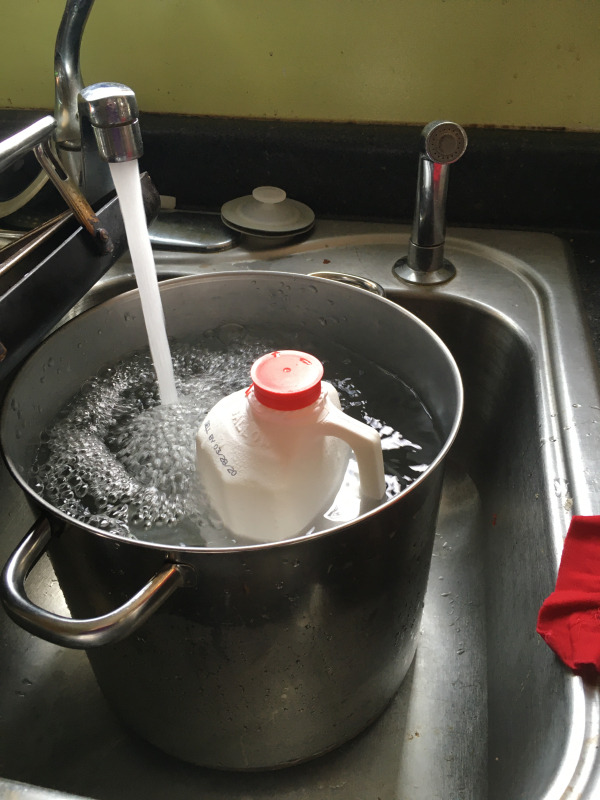
    I'm getting used to it for the most part, and have developed some compensatory practices. For example:   Did you know that you can freeze whole milk in its original plastic container, and thaw it again, and it will be totally fine?  I sort of knew you could do that, but I've never had a reason to do so before.  Half gallons are easier to deal with than gallons.  I built up a six-(half-gallon) buffer in the chest freezer.  Now every week I order one gallon and 1-3 half gallons, depending on how many half gallons we used last week; the half gallons go straight into the freezer and the gallon into the fridge; later, as needed, I pull the half gallons out and thaw them, either overnight in the fridge or in cold water in the sink.

    IMG_8647

    Even though we are able to weather this fairly well in our own house, venturing out only for exercise in the outdoors and the occasional takeout dinner, I don't like it and I don't have to like it.  Every morning I wake up and in the place where my brain always says Let's see, now, what do I have to do today? I get this sinking, it's-not-a-dream feeling instead.    And that's without anyone I know and love really living in peril! 

    Only the conviction that sooner or later, someone will be.  And that's bad enough.

    + + +

    I probably spent the first month in a fog of being alternately pissed-off and anxious, and feeling very stuck there.

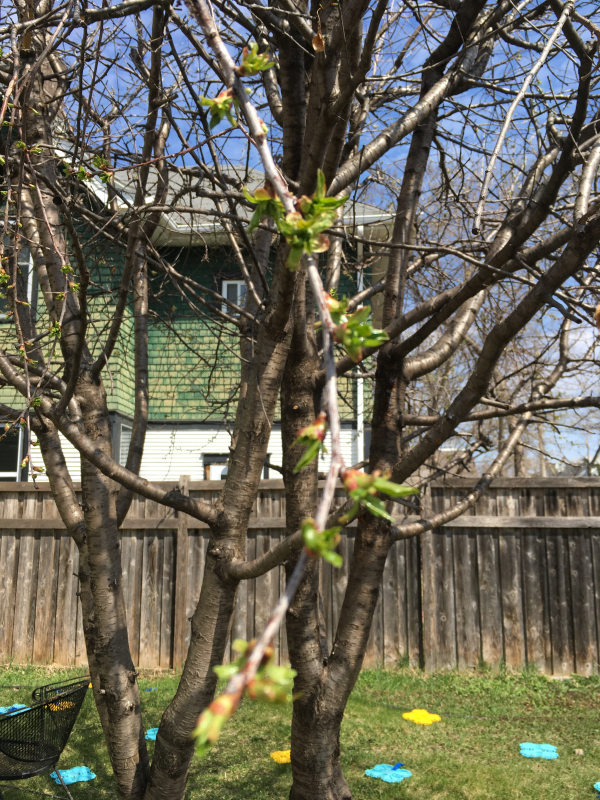
    The fog is, however, just now beginning to burn off in the late-April sunshine.  I honestly think the improving weather has a lot to do with it.  There are green leaf-buds on the cherry tree now. 

    IMG_8648

    I can sit in the patio chair and put my feet up and read, or watch birds and squirrels, or listen to the next-door neighbors working on constructing the patio behind their half-rebuilt, roofless house, standing open to the elements since the last time the contractors went home for the weekend and never came back.  Their younger children are playing, their older children are helping, while they dig and plant and lay pavers.  We chat over the high fence; we can look down from our second-story windows, right into their walled-but-open-topped living space, and see them doing what they can while they wait to come home.

    + + +

    Two signs that I've finally started moving on with my life, in the place where I find myself.

    IMG_8646

    (1) I'm starting to close out the school year, at least as far as grades are concerned.  

    I know, grades are not terribly important for homeschoolers.  But my tenth-grader needs a transcript this year for various applications, and I'm supposed to include some sort of assessment or grades for some of them.  I try at least to give a sense of the student's relative strengths, and a sense of what has improved over time, not to mention communicating the true fact that yes, this young person has experience being held to some kind of standard.

    And I owe an objective assessment to H. for the two teenagers of hers that I have been facilitating through Latin II, geometry, and American history.  So I'll be counting up how many assignments were turned in, how they did on the exams, that sort of thing.

    We are not done with the year, not by a long shot.  And we may continue studying together past the ordinary end of the school year, if the summer activities continue to be canceled and there is nothing else to do, at least in those subjects that we've had to cut back on.  But I think that, like lots of other kids around the country, our high schoolers are going to get a grade for the first semester (or maybe the first three quarters) of the year, and then a pass-fail type grade for the rest.  And if that's the case, well, then, I already have all the data I need.  Might as well start pulling it together and writing up the narrative.


    (2)  I finally stopped moping around and wishing I could go to the swimming pool, Pilates class, and running track at the Y, and started daily strength training and yoga in the house.

    I'm trying not to feel embarrassed that it took me about a month to get my head on straight about this.  I'm trying to go easy on myself, because–considering my track record–it honestly isn't surprising that I reacted poorly to having all my plans changed at once. 

    (I still can't really bear to go running.  Huffing and puffing out on running paths where I can imagine clouds of exhalations and droplets emanating from every other person I pass–the idea does not appeal.)

    Here's where I lucked out.  My teenage son has in recent months taken to weight training at the YMCA as an interesting hobby.  When everything he was enjoying and looking forward to this spring was yanked away from him, he became so downcast that Mark cleaned out a corner of the basement shop/storage room and gave him permission to order a squat cage, bench, bar, and weights.   I turned over my old set of fractional plates and resistance bands, too.  And Mark helped him make a hang board to practice finger grips for climbing.

    This was totally the right call, by the way.  He's a lot happier now that he can stay fit for indoor climbing when the gym re-opens again someday.  And it's an hour or so of time he can kill productively while stuck in the house, every day.  Yesterday he benched 200 pounds for the first time, which means that he needs more weight plates; it will be a while before he can get more, as every weight plate in the country appears to be on indefinite back order.   (Next year will probably be a great time to buy a used set of weights.  You heard it here first).

    But as for me…. I am also, for the first time, set up to do weight training at home, in the time I have, anytime I want.

    IMG_8638

    + + +

    Let's just pause for a moment and inquire why, even as I cheerfully told people that I would get back into lifting as soon as I could find the time to do it regularly enough to be safe,  I never realistically thought of exercising this option–setting up a home weightlifting gym–for my own sake.

    All I am going to say about this is that it was not out of any expectation that Mark would object to the cost, or to the use of the space.  I just never took this option seriously enough to let it rise to the top of my consciousness.  But it somehow became the obvious solution when the teenage boy got sad about his gains.

    I don't know.  I can psychoanalyze myself some other time.  I just wish I would remember to think things through to their possible ends more often.  There's some kind of barrier in there, and leaping over it is hard for me.

    + + +

    Speaking of leaping over things–see that wooden box girder over the safety bars in the squat cage?  Mark built it for me so I can reach the chin-up bar.  I went upstairs and asked him to build me a box to put on the floor for me stand on, thinking of the sort of things that Cross-fitters use for box jumps.  He countered with a built-to-fit platform across the safety bars, which he put together for me yesterday morning.  It's got rubber foam underneath to keep it stable on the bars, and it just leans on the wall out of the way when I'm not using it.  It's very stable and lets me stand with the bar just under my chin, so I can use it for leg-assisted chin-ups, which is the only kind I can do at this point.

    After a month of not even swimming, I am seriously de-trained.  I cannot use the oly bar for anything except to set it on the rack at the right height to use it for inclined pushups.  (We have an aluminum technique bar on back order.  That will help, if it ever ships.)  I am doing a lot of bodyweight squats, or squats holding a single weight plate in both hands.  Lacking dumbbells, I am doing one-arm rows by piling plates in a strong canvas tote bag.  The ten-pound plates have convenient handles cast into them, so I can reasonably safely press them overhead, one arm at a time.

    It's getting easier.  Between that and livestreamed YMCA yoga classes for the off days, I am settling into a lunchtime routine.

    + + + 

    I take my yoga mat downstairs to the basement gym, for friction and cushion on the smooth cold concrete floor.  I lie on my back on the mat to do static stretches afterward, gazing up at the unfinished ceiling, at the row of the family's downhill skis arrayed by size in their ceiling rack, where Mark put them away when we came back from our aborted trip on March 14. 

    A thing that is a little daunting about this, that's never far from my mind while I am down there:  I literally do not know what future I am training for.  Training myself, training up the children.  Sickness or health?   Grief or joy?  Emerging, or hiding away for longer?

    I don't know.  But I guess I have decided to bet that I'll prefer being stronger, whenever we get there, whatever "there" is.


  • Locked in, in Emmaus.

    I don't think I've ever attended Easter Sunday Mass in the evening.  I don't mean the Vigil; I mean, an afternoon or an evening Mass held on Easter Sunday. 

    The Gospel reading for the evening Mass of the Lord's Resurrection, is, I think, the most appropriate of all of them for the situation in which we find ourselves today.  That would be Luke 24:13-35, aka, the appearance on the road to Emmaus:

    Now that very day two of them were going to a village seven miles from Jerusalem called Emmaus, and they were conversing about all the things that had occurred.  And it happened that while they were conversing and debating, Jesus himself drew near and walked with them, but their eyes were prevented from recognizing him. 

    He asked them, “What are you discussing as you walk along?”

    They stopped, looking downcast.  One of them, named Cleopas, said to him in reply, “Are you the only visitor to Jerusalem who does not know of the things that have taken place there in these days?” 

    And he replied to them, “What sort of things?”

    They said to him, “The things that happened to Jesus the Nazarene, who was a prophet mighty in deed and word before God and all the people, how our chief priests and rulers both handed him over to a sentence of death and crucified him.  But we were hoping that he would be the one to redeem Israel; and besides all this, it is now the third day since this took place.

    "Some women from our group, however, have astounded us: they were at the tomb early in the morning and did not find his body; they came back and reported that they had indeed seen a vision of angels who announced that he was alive.  Then some of those with us went to the tomb and found things just as the women had described, but him they did not see.”

    And he said to them, “Oh, how foolish you are! How slow of heart to believe all that the prophets spoke!  Was it not necessary that the Messiah should suffer these things and enter into his glory?"  Then beginning with Moses and all the prophets, he interpreted to them what referred to him in all the scriptures. 

    As they approached the village to which they were going, he gave the impression that he was going on farther. 

    But they urged him, “Stay with us, for it is nearly evening and the day is almost over.” So he went in to stay with them. 

    And it happened that, while he was with them at table, he took bread, said the blessing, broke it, and gave it to them.  With that their eyes were opened and they recognized him, but he vanished from their sight. 

    Then they said to each other, “Were not our hearts burning [within us] while he spoke to us on the way and opened the scriptures to us?” 

    So they set out at once and returned to Jerusalem where they found gathered together the eleven and those with them who were saying, “The Lord has truly been raised and has appeared to Simon!”

    Then the two recounted what had taken place on the way and how he was made known to them in the breaking of the bread.

    What have we got here?  Our scene takes place not where "the eleven and those with them" are gathered together.  Instead, two disciples are alone, dejected, no longer hoping, and headed (probably) home.  And discussing and disputing about the things that had happened.

    And what happens?

    Jesus comes to where they are, teaches them, enters into their home with them, and blesses the food on their table.  

    They do not recognize him, but afterward they speak of how their hearts were burning.  And later, as soon as they can, they rush back to the assembly to tell their friends (who are talking of what Simon Peter had to say) about their own, private, domestic encounter with the Lord.

    + + +

    In the Vulgate, when the Jesus-they-don't-recognize rebukes the disciples on the road, he mentions their "stupid and slow hearts."  I am very interested in the word "heart" as it appears in the Gospel and in Catholic pious tradition.   Sometimes it seems to refer to an organ of the intellect, other times an organ where virtues such as courage and humility reside, other times it seems simply to be a part of the body.  Belief lives there, belief in people (and indeed the verb credo is thought to arise from an Indo-European root meaning "heart"); but it's never a cleanly distinguished concept:  whether this means intellectual assent to existence, or something more like fidelity and trust in.  Or "setting your heart on" a person.

    I've come to think of "heart" as standing in for the bleeding edge between the intellect and the emotions, the will and the action.   It is, to me, the interface and the mystery of how our consciousness and our body coexist and co-produce:  the place where the invisible diffuses across the veil into the visible, and vice versa; the place where our metaphysical choosing emerges as physical manipulation of matter, and where the actions and consequences of the interactions of matter (real matter:  protons and electrons and neutrons, and more) burrows into consciousness and reverberates in the soul.

    Contemplate the Sacred Heart of Jesus and the Immaculate Heart of Mary:  we're talking about something that has to do with their bodies, but it's making something else visible as well.

    The disciples on the road were discussing and disputing, using their intellect, their brains and their common language and shared experiences, to try to get at what they had seen happen.  They were doing it while walking away from the community, quite understandably, and their efforts may well have been good ones, but this particular effort wasn't going to get them to where they really needed to go.   (And really, could they have known it on their own?)

    Here's another situation where having access to different translations helps—because in some of them the stranger on the road says the disciples are stupid and slow, and in some of them He says that the disciples are stupid, or "minds without intelligence," and their hearts are slow, and in some of them (e.g. Latin) he says their hearts are stupid and slow.  In any case, there's something that isn't the intellect, called the heart, that isn't grasping what's going on.  And he teaches them, and explains the Scriptures, and their hearts listen and are set alight.  The mind wasn't enough.  The part of us that can will, and love, and then listen and talk and act from that place of willing and loving, that is what is needed. 

    Hear with the heart; experience with the heart; speak from the heart:  it is, I think, the place of loving and knowing and choosing that can also hear, feel, and speak.

    + + +

    And this is what we have to do, no?  We are sealed up each in our own tiny houses, receiving packages and messages from outside, sending packages and messages away.  No-contact.  

    (This is a metaphor.  Did you get it.)

    But the metaphorical, liturgical, literary heart is a boundary, a veil, a membrane, a place of sure contact.  Whatever it may mean, and I'm not pretending to know exactly, there is a way somehow we can choose to open it up like a parallel sluice to the senses.  And those same packages and messages will go back and forth, but in a new way, with a new channel, a new way where heart speaks to heart an  we aren't alone on the road anymore, nor alone in our houses, but with Him, and being with Him, being with everybody else, inside and outside of Time.


  • Before the plot twist.

    Since it's Good Friday, we will get the "suffering servant" from Isaiah as the first reading when we watch the celebration of the Passion livestreamed from our parish today.

    + + +

    One of the things I've been doing for Lent is reading the daily Mass readings (not that it's Mass today, but you know what I mean), first thing in the morning after I've had enough coffee and listless news-surfing to feel ready for it.   Plot twist is that I've been reading it in other languages that I can decently parse, occasionally Latin or Italian or Spanish for the practice, but most often French since I'm close to fluent in it and it's handily available via the iBreviary app. 

    I started off thinking that it would be good language practice and that the novelty might encourage me to keep it up, but the language practice has really faded into the background as I have discovered that reading not-in-English gives one a marvelously fresh look at familiar stories.  Many of the Gospel readings have struck me almost as if I were reading them for the first time.  If you have any other language, I highly recommend giving this a try.

    + + +

    This is a little bit beside the point.  I wanted to look at the Suffering Servant verses today.  I know them so well, I can almost hear the deep tones of the radio-voiced parishioner who always reads the first reading on Good Friday.  But I was kind of interested in excerpting just some of the verses today.

    Even as many were amazed at him, so marred was his look beyond human semblance and his appearance beyond that of the sons of man, so shall he startle many nations, because of him kings shall stand speechless…

    I was thinking about the "startle," and the "speechless."  (Il étonnera de même une multitude de nations; devant lui les rois resteront bouche bée…)   

    I am far from the first to observe that one of our modern problems with understanding the Passion is that we aren't surprised anymore.  We have seen so many artistic depictions that t is stylized in our minds.  The crown of thorns belongs on Jesus's head, the streaks of gore are painted plaster, we don't need to probe the wounds because, yes, yes, we know, there they are, they have pierced your hands and feet and counted all your bones, we know.

    I thought to take a close look at the description of the suffering servant before the revelation, before everyone finds out the twist ending.  (Bits from the French readings that seem to differ in translation are added in brackets, for your reading interest as you consider word choice in the English version.)

    so marred was his look beyond human semblance [car il était si défiguré qu'il ne ressemblait plus à un homme, because he was so disfigured that he no longer looked human]

    and his appearance beyond that of the sons of man…

    He grew up like a sapling [a poussé comme une plante chétive, sprouted like a stunted plant]  before him, like a shoot [une racine, a root] from the parched earth;

    there was in him no stately bearing [apparance ni beauté, neither appearance nor beauty] to make us look at him, nor appearance that would attract us to him [son aspect n'avait rien pour nous plaire, his appearance had nothing that we would like about it].

    He was spurned [méprisé, scorned or despised] and avoided [abandonné, abandoned] by people, a man of suffering [douleurs, pains or sorrows], accustomed to infirmity [souffrance, suffering], one of those from whom people hide their faces, spurned [méprisé] , and we held him in no esteem [compté pour rien, counted as nothing].

    …we  thought [et nous, nous pensions– emphasis on we thought] of him as stricken [frappé, smited], as one smitten [meurtri, beaten up, bruised] by God and afflicted [humilié, humiliated, shamed].

    …Oppressed [arrêté, seized]  and condemned [jugé, tried], he was taken away [supprimé, done away with], and who would have thought any more of his destiny [Qui donc s'est inquiété de son sort? So who cared what happened to him?]

    a grave was assigned him [on a placé sa tombe, they put his grave] among the wicked…

    I've carefully picked out the phrases that describe the servant as he appears to ordinary people, before the twist ending.  In the reading these are interlaced with sentences about justification, elevation, redemption; but today is Good Friday and none of that is visible yet.

    So take a minute and think about being an ordinary person in the ordinary life that you are living, surrounded with various kinds of people.  Whom do you see that gives you the described reaction? 

    Have you ever passed somebody and averted your eyes to avoid looking into theirs? 

    Ever seen a person, maybe just a photo, of a person with a face so disfigured—burned, misshapen, broken—that they barely looked like a human face? Have you felt the automatic revulsion—it's a natural human response of self-protection—and maybe been ashamed of yourself, so you scrolled rapidly by to soften the discomfort?

    Or maybe it's not a physical disfigurement—something in the eyes and expression and behavior that looks too vacant or crazed to possess intelligence and reason behind the eyes?  Not someone that one would call a person—people choose words like "an animal," or "a monster."

    Someone who comes from nowhere important, like maybe, not a respectable family.  For whatever reason, stunted at an early age. Wouldn't ever have amounted to anything anyway.  A nothing.  A loser.

    Ugly.  Pitiful to look at.   Unpresentable.  Disgusting.

    Somebody like that has gotten what they deserved.  We don't want people like that among us.  Take him away, haul him before the judge, lock him up and throw away the key, send him to where we don't have to think about him and people like him anymore, let somebody else worry about him.  Let him die for all we care, and when he dies he can go like the rest, into an unmarked trench with the others.

    + + +

    "The poor you will always have with you," and we do, and I don't mean the deserving poor, but the untouchables.  The poor that no one wants to serve, not even for the small reward of a charitable act; no, the kind of poor that people hesitate to help, because what good could it possibly do to help someone who is obviously beyond help, someone whose degradation is their own fault, someone who might lash out at me for even trying?

    + + +

    One could think I meant only what Jesus said, that "what you do to one of these least ones, you also do to me," an urging to perform acts of charity to the poor around us despite our feelings about them; and that's a good sentiment; but that reading is for a different day.  Today's reading is about the surprise. 

    For there to be a surprise, there must be a before-the-surprise.

    + + +

    This is part of what we need to understand at Good Friday: 

    This is our God, the God of the disgusting, the God of the smelly, the God of the limping, the God of the repulsive, the God of the self-destructive, the God of learned helplessness, the God who was asking for it, the God who will get what's coming to him, the God of the gutter, the God you won't look in the eye.  The God with his hand out.  


  • Three days more.

    And here we are, at the Triduum already.

    + + +

    I wrote a post earlier about how it seemed almost appropriate that we should be pressed into quarantine smack in the middle of Lent. 

    I was thinking about it as a sort of warning against "reading too much into things," that those of us who are inclined to try to find meaning in the small coincidences of life would probably try to find that meaning anywhere.  That there's nothing particularly special about quarantine during These Forty Days, linguistic parallels notwithstanding.   We'd find meaning if it were Advent too.  If it were Christmas.

    And if it were Easter?  I suppose we're about to be tested.

    + + +

    Consolations.  

    Turning to the old, old ideas about consolations is my way to understand the temptations we Americans have to listen to the prosperity gospel. 

    Although I suppose anyone can fall into it, I do think it is a peculiarly American idol, this notion that bad things don't happen to good people, that faith is reliably rewarded with material comfort, or that karma will get the bad actors in the end.  It manifests differently on the left and right sides of the political spectrum, it manifests differently among different subgroups; but it isn't evenly spread around either; some folks have it worse than others for sure.  

    Aaaaahh, I don't need to write it all over again.  Here's the post I wrote about it last year, inspired by a post Amy Welborn wrote that identified the truth that gets twisted into the "health-and-wealth" gospel.

    Humans are perfectly capable of taking true graces that truly come from God and… screwing up our responses to them….

    Consolations are, in the writings of the saints and in the writings of the magisterium, the opposite of affliction.   These are free gifts of happiness, contentment, felt blessings, confidence in the presence of God, strong feelings of conviction. All bestowed by God on some of the faithful, and occasionally understood to be withdrawn from them by God, as a means of increasing their (or someone's) growth in faith.

    Numerous saints have warned Christians against mistaking the consolation for something it is not. It is not (necessarily) a reward or a punishment; it is certainly not a reliable indication of the holiness of the individual, such that holier people receive more or fewer consolations; and while we may hope for consolations, we are expressly warned against making the consolation the end that we seek.

    I feel like with prosperity gospel, the end-of-the-end is a feeling of confidence that one is on the right track.   To practice one's faith and put one's values into actions—and the faith and values don't have to be Christian or even theist ones either, they could be any sort of humanism, for example—think of activists who grow rich on speaking fees, or enjoy accolades from the upticking follower count—

    —then to get the payoff, the success, the praise, or even to see what they've worked for come to measurable fruition—

    —and to see that payoff as some kind of personal validation, not just that their efforts were well-designed or well-timed, but to see in it a rightness of the cause and a confirmation that they, they themselves, they are good and not bad.

    Success = Rightness and Goodness.

    + + + 

    Where am I going with this?  "Consolations" in spiritual writings often refers to feelings of affection and energy and fervor and devotion, which can make it seem that consolations are always abstract things.  I don't think that feelings are abstract things.  I think they come from our bodies and are therefore material things.  And if "consolations" can be one kind of material thing, then they can be other kinds of material things, like our circumstances; our richness or our poverty, our liberation or our captivity (physical, not metaphorical).

    And where are we now?

    Entering the Triduum, bereft of many of our usual consolations at Eastertime.

    + + +

    I mean, we may have some other consolations to take their place. 

    Some of us have beloved relatives gathered around us who might otherwise be off at school or living in another city.  Some of us have a renewed appreciation for health and safety, and renewed concern for others, and renewed gratitude for the many people whose labor makes life easier for others.  Some of us have had time to reflect thrust upon us, and have found the reflections fruitful.  

    But surely not everybody has those consolations.  Some people are in grave danger.  Some people appear to be deliberately spreading malice and lies, perhaps only the tip of the iceberg of mass spiritual danger.  Some people are working harder for less; some people have lost all income and despair of the future.

    And—I repeat—we've almost all of us who celebrate Easter lost the ordinary means by which we stir up our hearts to feel the Resurrection.

    We have no reason to expect to receive any consolation this year.   I don't mean to exclude the possibility that we'll be graced with it.  I just mean—I look forward to the Triduum liturgies because, in part, they usually give me at least, some little glints of joy, here and there; at best a thoroughly exhilarating feast of the senses.  I guess I feel I'm sort of entitled to that feeling, and variations from year to year are part of the expectation and the pleasure.  What will I find in my basket on Easter morning?

    + + +

    I expect a kind of poverty this year.  I expect to find out more of what it means to be "poor in spirit," a phrase I turn over often and, despite reading many glosses, have never settled comfortably into understanding.  

    I took the position (different from some of the saints) that all consolations are sent by God and it's our response to them that matters; not that some are sent by God and some from the devil or the world-in-opposition-to-God or whatever.  So if consolations are sent by God then the withdrawal of consolations is His as well, and once again, our response is what matters.

    We have no wine.

    We have no wine.

    What happens next?


  • Nicodemus.

    Saturday's Mass readings included the second of the three appearances that Nicodemus makes in the Gospel of John.    Nicodemus is a Pharisee, and a member of the Sanhedrin, presumably wealthy or at least with access to wealth, who does three rather surprising things:

    • Visits Jesus by night, confesses "We know that you are a teacher who has come from God," and discusses Jesus's teachings with him, notably the bit about being "born again"/"born from above," in the course of the discussion eliciting the famous John 3:16 among other things.  (Jn 3:1-21)
    • Challenges the chief priests and the other Pharisees, who have ordered Jesus arrested and disdained the mob's ignorance of the law, by appealing to the same:  "Does our law condemn a man without first hearing him to find out what he has been doing?" (Jn 7:50-51)
    • Joins Joseph of Arimathea, a "secret" disciple, when he comes to take down the body of Jesus.  Nicodemus provides a hundred pounds of burial spices, a king's burial offering, and it is he and Joseph of Arimathea who lay the body in the new tomb (presumably owned by Joseph himself).

    I like the figure of Nicodemus, but despite that I have never spent much time thinking very deeply about him, or considering what it might mean to us that we have the story of this one man popping up in multiple places, gaining courage and giving more and more. 

    But I should pay more attention to Nicodemus, I think.  Of all the sinners in the Gospels it's the Pharisees in which I see myself most.  I like law, the whole notion of it, and the safeguard of a society's foundation on the rule of law instead of on monarchy or on charismatic, cultish and dangerous leaders.  I like laws, laws in the plural:  I like to understand them, dissect them, test them against various problems, and put them back together again.  I love the words that Robert Bolt puts in the mouth of Sir Thomas More in A Man for all Seasons:   

    "Oh?  And when the last law was down, and the Devil turned round on you, where would you hide, Roper, the laws all being flat?  This country is planted thick with laws, from coast to coast, Man's laws, not God's!  And if you cut them down, and you're just the man to do it, do you really think you could stand upright in the winds that would blow then?  Yes, I'd give the Devil benefit of law, for my own safety's sake!"

    And of course, besides laws and rules themselves, I love wisdom, by which I often mean I love thinking myself wise, and am frequently tempted to sneer at the less-wise.  I have a reflexive tendency to trust the law too much—if it is only a well-written, well-conceived law—and to think that systems can fix the problem of human nature.  Standard operating procedures—handbooks—constitutions—contracts.  I mean, I really do know better, but I catch myself thinking it anyway, or at least behaving as if I thought it.   

    Mind you, the rich young man is also the sort of sinner I can identify with, but that's only because I happen to be relatively rich.  Had I not been, I'd still have written within me the sort of things that make me identify uncomfortably with the Pharisees.  It's more aligned with my essence.

    + + +

    So I should pay more mind to Nicodemus, who first sneaks around by night, drawn to Jesus and wanting to dialogue with him, and himself drawing out some of His best-remembered words; then, back among the council, challenges them within the bounds of their shared value-system (and for his trouble is accused of being "a Galilean" himself); finally, openly, before the sun sets on the day of the Crucifixion, joins another previously secret disciple, bringing the expensive spices, and performs that great merciful work on the body of the dead Christ.   I myself felt a bit sneaky about coming to Jesus at first.  I still like appealing to shared values, in dialogue with smart people who have a different idea about Him than I do, and trying to maintain my ties among the wise and learned and respectable people (but at the same time, making my own poor efforts to put Him in a better light according to their eyes).  

    The question remains for me whether I have gone far enough that I can make the final step of faith that Nicodemus is remembered for:  in the end, he served Jesus openly, treating his body with the honor and respect that he knew Jesus to deserve.  It was an act of mercy; it was in obedience to the Law he held dear (hastily, so as not to trespass the Sabbath); it was in company with the privileged, who had the ear of Pilate.  But it must have also been an expression of devotion, of real love.  Not, over the old norms, a trespass, but a transcending.

    + + +

    I discovered, in my further reading, Henry Vaughan's poem "The Night." Here it is:

    Through that pure virgin shrine,
    That sacred veil drawn o’er Thy glorious noon,
    That men might look and live, as glowworms shine,
                 And face the moon,
        Wise Nicodemus saw such light
        As made him know his God by night.
     
             Most blest believer he!
    Who in that land of darkness and blind eyes
    Thy long-expected healing wings could see,
                 When Thou didst rise!
        And, what can never more be done,
        Did at midnight speak with the Sun!
     
             O who will tell me where
    He found Thee at that dead and silent hour?
    What hallowed solitary ground did bear
                 So rare a flower,
        Within whose sacred leaves did lie
        The fulness of the Deity?
     
             No mercy-seat of gold,
    No dead and dusty cherub, nor carved stone,
    But His own living works did my Lord hold
                 And lodge alone;
        Where trees and herbs did watch and peep
        And wonder, while the Jews did sleep.
     
             Dear night! this world’s defeat;
    The stop to busy fools; care’s check and curb;
    The day of spirits; my soul’s calm retreat
                 Which none disturb!
        Christ’s progress, and His prayer time;
        The hours to which high heaven doth chime;
     
             God’s silent, searching flight;
    When my Lord’s head is filled with dew, and all
    His locks are wet with the clear drops of night;
                 His still, soft call;
        His knocking time; the soul’s dumb watch,
        When spirits their fair kindred catch.
     
             Were all my loud, evil days
    Calm and unhaunted as is thy dark tent,
    Whose peace but by some angel’s wing or voice
                 Is seldom rent,
        Then I in heaven all the long year
        Would keep, and never wander here.
     
             But living where the sun
    Doth all things wake, and where all mix and tire
    Themselves and others, I consent and run
                 To every mire,
        And by this world’s ill-guiding light,
        Err more than I can do by night.
     
             There is in God, some say,
    A deep but dazzling darkness, as men here
    Say it is late and dusky, because they
                 See not all clear.
        O for that night! where I in Him
        Might live invisible and dim!


  • Anxiety, or patience?

    I told Jamie, who was writing about anxiety and OCD in the time of coronavirus last night, that I was going to find a particular quote from St. Francis de Sales about anxiety, and post it on my blog.  I knew I had read it recently (I'm reading Introduction à la Vie Dévote in the original somewhat-updated French now), and it would be simple to find it.    

    Where was it now… something about doing the possible remedies and then trusting God?  I mean, it wasn't particularly profound, it was the sort of thing you could find anyone saying to anyone else, including lots of people who would never say "and then trust in God" but would instead say something like "and then let it go" or "and then let the universe take care of it."  There is definitely a chapter entitled Anxiety… let's see…  

    I flipped through the pages quite a bit before realizing that in fact the passage is not in the chapter about "anxiety" but is in the chapter about "patience."

    French below, followed by my own (quick, unscholarly) translation.  It's the second paragraph I was looking for.

    Soyez patiente, non seulement pour le gros et principal des afflictions qui vous surviendront, mais encore pour les accessoires et accidents qui en dépendront.  Plusieurs voudraient bien avoir du mal, pourvu qu'ils n'en fussent point incommodés.  Je ne me fâche point, dit l'un, d'être devenu pauvre, si ce n'était qu cela m'empêchera de servir mes amis, élever mes enfants et vivre honorablement, comme je désirerais.  Et l'autre dira:  je ne m'en soucierais point, si ce n'était que le monde pensera que cela me soit arrivé par ma faute.  L'autre serait tout aise que l'on médit de lui, et le souffrirait fort patiemment, pourvu que personne ne crût le médisant…..  Or je dis, Philothée, qu'il faut avoir patience, non seulement d'être malade, mais de l'être de la maladie que Dieu veut, au lieu où il veut, et entre les personnes qu'il veut, et avec les incommodités qu'il veut, et ainsi des autres tribulations.

    Quand il vous arrivera du mal, opposez à icelui les remèdes qui seront possibles et selon Dieu:  car de faire autrement, ce serait tenter sa divine Majesté: mais aussi cela étant fait, attendez avec une entière résignation l'effet que Dieu agréera.  S'il lui plaît que les remèdes vainquent le mal, vous le remercierez avec humilité:  mais s'il lui plaît que le mal surmonte les remèdes, bénissez-le avec patience.

    "Be patient, not only with the obvious, dominant afflictions that happen to you, but also with the secondary effects and consequences that follow upon them.  Many people would gladly be willing to suffer, provided that they were not at all inconvenienced by it.  "I wouldn't get upset," says one, "about having become poor, if it weren't for the fact that it makes it so hard to help my friends, raise my children, and live decently, the way I would like."  And another will say:  "I wouldn't care one bit that this should happen to me, if it weren't for everybody thinking that it my own fault."  Yet another is quite delighted when some person bad-mouths him, and will very patiently put up with it–provided that no one actually believes the gossip!  But what I'm telling you, Philothea, is that you have to have patience, not only about being unwell, but about the types of maladies that God wills, in the place where he wills it, and in the company that he wills for you, and inconvenienced in the ways he wills for you, and so on with other trials and tribulations.

    When something bad happens to you, counter it with remedies that are both feasible and in accordance with God; because to do otherwise is to put his divine Majesty to the test; but having done this, be ready with complete resignation for whatever outcome God is pleased to send you.  If God wills that your efforts defeat your troubles, then thank him with humility; but if instead he wills that the maladies grow too great for your efforts to overcome, bless him, with patience."


    + + +

    I guess I remembered "anxiety" because of this very last bit.  It's slightly different than I remembered.  It's not "do what you can from what's permitted, and then trust God" but rather "do what you can, and then wait for the consequences; if they work out for the good, be thankful — which is humility; and if they don't, bless God anyway — which is patience."

    It seems important in this time because some folks seem determined to put God to the test with respect to the malady we are currently being sent.  And not even just wishing to put themselves at risk, but other people.  I don't feel like linking any of the opinion pieces I am thinking about right now, but they are out there.

    When something bad happens to you, counter it.  St. Francis says "avec les remèdes qui seront possibles" which is obviously cognate to English "possible" but another meaning is "feasible, realizable."  I took the liberty of assuming that he meant "possible" in a practical sense, not "possible" in a theoretical one, since the whole clause "qui seront possibles et selon Dieu" seems to me evident to be a limiting phrase.  

    It's not feasible that we can eliminate every single theoretically possible source of contamination that could disturb our safety.  Not only that, but there's a point beyond which our efforts would no longer be "in accordance with God" — if we endanger others, if we unnecessarily disturb and frighten them, if it gets in the way of the daily duties we really are bound to perform.  St. Francis doesn't give us a precise definition of the balancing point, just the principle.  Yes, we are bound to work against the bad things that befall us.  We are also bound to work against them insofar as it doesn't rupture our relationships (from our own ends):  gotta keep loving our neighbor; gotta keep our lifeline to the way, the truth, the life.

    And then—this part isn't "trust God" as I remembered it—it's be ready to take whatever comes, a peaceful acceptance.  Notice that the acceptance takes different forms depending if the outcome is good or bad.  If good, we accept it in humility, giving thanks.  If bad, we accept it with… more patience, and praising God as we ought to all along.  Follow the flowchart arrow, it strikes out, elbows upward, back to the beginning.  Some new ill has befallen us; it is time, once again, to counter the new ill with new remedies, new remedies which strike a new balance, now in different conditions, but always weighing the possible against the permissible.

    No point in countering the current malady with future remedies that would be appropriate for the malady we imagine might befall us later as a consequence of the efforts we are expending now.

    Patience is what we all need a lot of, right now.

    There's a bit more in this section, about how to complain about your situation with a measure of prudence.  Perhaps I'll do that later— but right now it's time to start teaching the kids, which is, after all, one of the remedies I am putting my efforts into right now.


  • Physicality.

    I've been blown away by how much I'm feeling the anxiety and uncertainty of the present moment in my body.  For the first few days after we decided to #StayTheFHome, it was an ever-present companion:  a heaviness in my chest, a shortness of breath, a need to swallow. 

    It reminded me of nothing less than the brief stretch of months in my early twenties when, for no reason I could see, I suddenly experienced a flurry of panic attacks.  They came on for no reason; I'd never had them before; they came on randomly, triggered by nothing I could see; and just about the time I started to wonder if I should seek professional help for them, they went away and I've never had one since.

    This felt similarly, but less intense: subacute, but lasting longer.   A claustrophobia, a desire to flee somewhere this isn't.  A generalized feeling of un-safety.

    After a few days I had a time of blessed relief.  I was still thinking all the same things in my head, but the fog and paralysis in my body had lifted.  Am I better?

    It came back again, lasted a whole day; then lifted again.

    + + +

    I keep taking a daily walk in my neighborhood, which although fairly densely populated (houses and small apartment buildings, mostly) has little foot traffic, most of it walking leashed dogs.  The daily walk helps.  I can feel my spirits lift.  Yesterday was a day that started with the heaviness in the chest, and it persisted.  I took the walk anyway.  As I walked the long straight stretch of wide and empty sidewalk, on a street that runs uninterrupted from downtown all the way to the southern suburbs and on (not that I was walking that far), I imagined another weight. 

    It was not hard, feeling that lump pressing down on my sternum, along with the chin-tickling fluffy scarf wrapped about my neck to keep out the cold, to remember all those walks taken with a baby cinched up tight, in the baby carrier or ring sling, high up and curled like a shell over the chest.  It is warm (I felt flushed with my briskness), it is heavy like the anxiety that seems to press down on me, it is compact and dense.  It is a thing I am carrying, a live-seeming thing, and in many ways it is a thing I am carrying for others and not for myself.

    Deep breaths—They seem to meet gentle resistance, like a warm external weight, with a life of its own, burrowing deeper down and seeking warmth and tightness.

    + + +

    I have often in the past sixteen years thought back to a time when my second baby was a fairly new newborn.  He was a "lungy" baby, and whenever he had the slightest sign of a cold would wheeze and cough so that he sounded like a pertussis patient.  I guess he was a little bit croupy.  (Later he was prescribed albuterol to help.)

    When he was quite small, less than a month old, he had one bad night:  I could not put him down, or he coughed and wheezed.  Held upright, he breathed, a little raggedly, but contentedly.   I spent most of the night sitting up with him in my arms, surfing the internet on a laptop so I wouldn't doze off.   I had some experience with sleepless nights by then, since he wasn't our first child.  What I remember about the experience was that I was astonished to find that, although I could have asked Mark to get up and hold him for a while so that I could rest, there was nothing I wanted more than to sit up with him and to continue sitting up with him.  He slept and breathed comfortably if I was holding him curled on my chest, and the sound of his sleeping and breathing comfortably was a sound so beautiful to me that I did not want to let anyone else take my place.  I sat there in the chair, clicking around and reading different things on the laptop, but my ear tuned to the sound of that breathing, and feeling that constant, heavy, warm, peaceful weight compressing my upper chest, constricting ever slightly my own breathing, which itself matched the double-time rhythm of the wispy baby-breaths at my throat.

    + + +

    That's what the weight of the anxiety almost felt like, in its physicality.  As I walked, I tried to put myself mentally into that place, as if this new weight were the weight of that small baby, reassuring me even as it generated that tiny bit of physical difficulty.  And it is not far off from the truth:  part of what I am carrying around is, well, all my children, and all the other people I love, especially the ones who depend on me.

    But thinking of it that way was a comfort, while it lasted. 

    + + +

    The weight lifted off me by afternoon, after two different teenagers' algebra lessons (from different places in the book), after making dinner.  I expressed wonder to Mark about it:  all the same mix of hopeful and fearful thoughts were in my head, but the heavy weight, the knot in the stomach, the cold fingertips, the deadened appetite, those had just left me.   Without any hint of why, or any soothing event.  Like hiccups, I just noticed after a while that they had been gone for some time.

    I guess I just can't sustain the physical manifestation all the time.  It does seem that the periods are shorter when it envelops me, and the physically-normal feelings are lasting longer.  I'm getting used to it.  I'm glad for that.  It gives me hope that I can go on carrying it all (carrying them all) for as long as I have to.