bearing blog


bear – ing n 1  the manner in which one comports oneself;  2  the act, power, or time of bringing forth offspring or fruit; 3 a machine part in which another part turns [a journal ~];  pl comprehension of one’s position, environment, or situation;   5  the act of moving while supporting the weight of something [the ~ of the cross].


  • Locked in, in Emmaus.

    I don't think I've ever attended Easter Sunday Mass in the evening.  I don't mean the Vigil; I mean, an afternoon or an evening Mass held on Easter Sunday. 

    The Gospel reading for the evening Mass of the Lord's Resurrection, is, I think, the most appropriate of all of them for the situation in which we find ourselves today.  That would be Luke 24:13-35, aka, the appearance on the road to Emmaus:

    Now that very day two of them were going to a village seven miles from Jerusalem called Emmaus, and they were conversing about all the things that had occurred.  And it happened that while they were conversing and debating, Jesus himself drew near and walked with them, but their eyes were prevented from recognizing him. 

    He asked them, “What are you discussing as you walk along?”

    They stopped, looking downcast.  One of them, named Cleopas, said to him in reply, “Are you the only visitor to Jerusalem who does not know of the things that have taken place there in these days?” 

    And he replied to them, “What sort of things?”

    They said to him, “The things that happened to Jesus the Nazarene, who was a prophet mighty in deed and word before God and all the people, how our chief priests and rulers both handed him over to a sentence of death and crucified him.  But we were hoping that he would be the one to redeem Israel; and besides all this, it is now the third day since this took place.

    "Some women from our group, however, have astounded us: they were at the tomb early in the morning and did not find his body; they came back and reported that they had indeed seen a vision of angels who announced that he was alive.  Then some of those with us went to the tomb and found things just as the women had described, but him they did not see.”

    And he said to them, “Oh, how foolish you are! How slow of heart to believe all that the prophets spoke!  Was it not necessary that the Messiah should suffer these things and enter into his glory?"  Then beginning with Moses and all the prophets, he interpreted to them what referred to him in all the scriptures. 

    As they approached the village to which they were going, he gave the impression that he was going on farther. 

    But they urged him, “Stay with us, for it is nearly evening and the day is almost over.” So he went in to stay with them. 

    And it happened that, while he was with them at table, he took bread, said the blessing, broke it, and gave it to them.  With that their eyes were opened and they recognized him, but he vanished from their sight. 

    Then they said to each other, “Were not our hearts burning [within us] while he spoke to us on the way and opened the scriptures to us?” 

    So they set out at once and returned to Jerusalem where they found gathered together the eleven and those with them who were saying, “The Lord has truly been raised and has appeared to Simon!”

    Then the two recounted what had taken place on the way and how he was made known to them in the breaking of the bread.

    What have we got here?  Our scene takes place not where "the eleven and those with them" are gathered together.  Instead, two disciples are alone, dejected, no longer hoping, and headed (probably) home.  And discussing and disputing about the things that had happened.

    And what happens?

    Jesus comes to where they are, teaches them, enters into their home with them, and blesses the food on their table.  

    They do not recognize him, but afterward they speak of how their hearts were burning.  And later, as soon as they can, they rush back to the assembly to tell their friends (who are talking of what Simon Peter had to say) about their own, private, domestic encounter with the Lord.

    + + +

    In the Vulgate, when the Jesus-they-don't-recognize rebukes the disciples on the road, he mentions their "stupid and slow hearts."  I am very interested in the word "heart" as it appears in the Gospel and in Catholic pious tradition.   Sometimes it seems to refer to an organ of the intellect, other times an organ where virtues such as courage and humility reside, other times it seems simply to be a part of the body.  Belief lives there, belief in people (and indeed the verb credo is thought to arise from an Indo-European root meaning "heart"); but it's never a cleanly distinguished concept:  whether this means intellectual assent to existence, or something more like fidelity and trust in.  Or "setting your heart on" a person.

    I've come to think of "heart" as standing in for the bleeding edge between the intellect and the emotions, the will and the action.   It is, to me, the interface and the mystery of how our consciousness and our body coexist and co-produce:  the place where the invisible diffuses across the veil into the visible, and vice versa; the place where our metaphysical choosing emerges as physical manipulation of matter, and where the actions and consequences of the interactions of matter (real matter:  protons and electrons and neutrons, and more) burrows into consciousness and reverberates in the soul.

    Contemplate the Sacred Heart of Jesus and the Immaculate Heart of Mary:  we're talking about something that has to do with their bodies, but it's making something else visible as well.

    The disciples on the road were discussing and disputing, using their intellect, their brains and their common language and shared experiences, to try to get at what they had seen happen.  They were doing it while walking away from the community, quite understandably, and their efforts may well have been good ones, but this particular effort wasn't going to get them to where they really needed to go.   (And really, could they have known it on their own?)

    Here's another situation where having access to different translations helps—because in some of them the stranger on the road says the disciples are stupid and slow, and in some of them He says that the disciples are stupid, or "minds without intelligence," and their hearts are slow, and in some of them (e.g. Latin) he says their hearts are stupid and slow.  In any case, there's something that isn't the intellect, called the heart, that isn't grasping what's going on.  And he teaches them, and explains the Scriptures, and their hearts listen and are set alight.  The mind wasn't enough.  The part of us that can will, and love, and then listen and talk and act from that place of willing and loving, that is what is needed. 

    Hear with the heart; experience with the heart; speak from the heart:  it is, I think, the place of loving and knowing and choosing that can also hear, feel, and speak.

    + + +

    And this is what we have to do, no?  We are sealed up each in our own tiny houses, receiving packages and messages from outside, sending packages and messages away.  No-contact.  

    (This is a metaphor.  Did you get it.)

    But the metaphorical, liturgical, literary heart is a boundary, a veil, a membrane, a place of sure contact.  Whatever it may mean, and I'm not pretending to know exactly, there is a way somehow we can choose to open it up like a parallel sluice to the senses.  And those same packages and messages will go back and forth, but in a new way, with a new channel, a new way where heart speaks to heart an  we aren't alone on the road anymore, nor alone in our houses, but with Him, and being with Him, being with everybody else, inside and outside of Time.


  • Before the plot twist.

    Since it's Good Friday, we will get the "suffering servant" from Isaiah as the first reading when we watch the celebration of the Passion livestreamed from our parish today.

    + + +

    One of the things I've been doing for Lent is reading the daily Mass readings (not that it's Mass today, but you know what I mean), first thing in the morning after I've had enough coffee and listless news-surfing to feel ready for it.   Plot twist is that I've been reading it in other languages that I can decently parse, occasionally Latin or Italian or Spanish for the practice, but most often French since I'm close to fluent in it and it's handily available via the iBreviary app. 

    I started off thinking that it would be good language practice and that the novelty might encourage me to keep it up, but the language practice has really faded into the background as I have discovered that reading not-in-English gives one a marvelously fresh look at familiar stories.  Many of the Gospel readings have struck me almost as if I were reading them for the first time.  If you have any other language, I highly recommend giving this a try.

    + + +

    This is a little bit beside the point.  I wanted to look at the Suffering Servant verses today.  I know them so well, I can almost hear the deep tones of the radio-voiced parishioner who always reads the first reading on Good Friday.  But I was kind of interested in excerpting just some of the verses today.

    Even as many were amazed at him, so marred was his look beyond human semblance and his appearance beyond that of the sons of man, so shall he startle many nations, because of him kings shall stand speechless…

    I was thinking about the "startle," and the "speechless."  (Il étonnera de même une multitude de nations; devant lui les rois resteront bouche bée…)   

    I am far from the first to observe that one of our modern problems with understanding the Passion is that we aren't surprised anymore.  We have seen so many artistic depictions that t is stylized in our minds.  The crown of thorns belongs on Jesus's head, the streaks of gore are painted plaster, we don't need to probe the wounds because, yes, yes, we know, there they are, they have pierced your hands and feet and counted all your bones, we know.

    I thought to take a close look at the description of the suffering servant before the revelation, before everyone finds out the twist ending.  (Bits from the French readings that seem to differ in translation are added in brackets, for your reading interest as you consider word choice in the English version.)

    so marred was his look beyond human semblance [car il était si défiguré qu'il ne ressemblait plus à un homme, because he was so disfigured that he no longer looked human]

    and his appearance beyond that of the sons of man…

    He grew up like a sapling [a poussé comme une plante chétive, sprouted like a stunted plant]  before him, like a shoot [une racine, a root] from the parched earth;

    there was in him no stately bearing [apparance ni beauté, neither appearance nor beauty] to make us look at him, nor appearance that would attract us to him [son aspect n'avait rien pour nous plaire, his appearance had nothing that we would like about it].

    He was spurned [méprisé, scorned or despised] and avoided [abandonné, abandoned] by people, a man of suffering [douleurs, pains or sorrows], accustomed to infirmity [souffrance, suffering], one of those from whom people hide their faces, spurned [méprisé] , and we held him in no esteem [compté pour rien, counted as nothing].

    …we  thought [et nous, nous pensions– emphasis on we thought] of him as stricken [frappé, smited], as one smitten [meurtri, beaten up, bruised] by God and afflicted [humilié, humiliated, shamed].

    …Oppressed [arrêté, seized]  and condemned [jugé, tried], he was taken away [supprimé, done away with], and who would have thought any more of his destiny [Qui donc s'est inquiété de son sort? So who cared what happened to him?]

    a grave was assigned him [on a placé sa tombe, they put his grave] among the wicked…

    I've carefully picked out the phrases that describe the servant as he appears to ordinary people, before the twist ending.  In the reading these are interlaced with sentences about justification, elevation, redemption; but today is Good Friday and none of that is visible yet.

    So take a minute and think about being an ordinary person in the ordinary life that you are living, surrounded with various kinds of people.  Whom do you see that gives you the described reaction? 

    Have you ever passed somebody and averted your eyes to avoid looking into theirs? 

    Ever seen a person, maybe just a photo, of a person with a face so disfigured—burned, misshapen, broken—that they barely looked like a human face? Have you felt the automatic revulsion—it's a natural human response of self-protection—and maybe been ashamed of yourself, so you scrolled rapidly by to soften the discomfort?

    Or maybe it's not a physical disfigurement—something in the eyes and expression and behavior that looks too vacant or crazed to possess intelligence and reason behind the eyes?  Not someone that one would call a person—people choose words like "an animal," or "a monster."

    Someone who comes from nowhere important, like maybe, not a respectable family.  For whatever reason, stunted at an early age. Wouldn't ever have amounted to anything anyway.  A nothing.  A loser.

    Ugly.  Pitiful to look at.   Unpresentable.  Disgusting.

    Somebody like that has gotten what they deserved.  We don't want people like that among us.  Take him away, haul him before the judge, lock him up and throw away the key, send him to where we don't have to think about him and people like him anymore, let somebody else worry about him.  Let him die for all we care, and when he dies he can go like the rest, into an unmarked trench with the others.

    + + +

    "The poor you will always have with you," and we do, and I don't mean the deserving poor, but the untouchables.  The poor that no one wants to serve, not even for the small reward of a charitable act; no, the kind of poor that people hesitate to help, because what good could it possibly do to help someone who is obviously beyond help, someone whose degradation is their own fault, someone who might lash out at me for even trying?

    + + +

    One could think I meant only what Jesus said, that "what you do to one of these least ones, you also do to me," an urging to perform acts of charity to the poor around us despite our feelings about them; and that's a good sentiment; but that reading is for a different day.  Today's reading is about the surprise. 

    For there to be a surprise, there must be a before-the-surprise.

    + + +

    This is part of what we need to understand at Good Friday: 

    This is our God, the God of the disgusting, the God of the smelly, the God of the limping, the God of the repulsive, the God of the self-destructive, the God of learned helplessness, the God who was asking for it, the God who will get what's coming to him, the God of the gutter, the God you won't look in the eye.  The God with his hand out.  


  • Three days more.

    And here we are, at the Triduum already.

    + + +

    I wrote a post earlier about how it seemed almost appropriate that we should be pressed into quarantine smack in the middle of Lent. 

    I was thinking about it as a sort of warning against "reading too much into things," that those of us who are inclined to try to find meaning in the small coincidences of life would probably try to find that meaning anywhere.  That there's nothing particularly special about quarantine during These Forty Days, linguistic parallels notwithstanding.   We'd find meaning if it were Advent too.  If it were Christmas.

    And if it were Easter?  I suppose we're about to be tested.

    + + +

    Consolations.  

    Turning to the old, old ideas about consolations is my way to understand the temptations we Americans have to listen to the prosperity gospel. 

    Although I suppose anyone can fall into it, I do think it is a peculiarly American idol, this notion that bad things don't happen to good people, that faith is reliably rewarded with material comfort, or that karma will get the bad actors in the end.  It manifests differently on the left and right sides of the political spectrum, it manifests differently among different subgroups; but it isn't evenly spread around either; some folks have it worse than others for sure.  

    Aaaaahh, I don't need to write it all over again.  Here's the post I wrote about it last year, inspired by a post Amy Welborn wrote that identified the truth that gets twisted into the "health-and-wealth" gospel.

    Humans are perfectly capable of taking true graces that truly come from God and… screwing up our responses to them….

    Consolations are, in the writings of the saints and in the writings of the magisterium, the opposite of affliction.   These are free gifts of happiness, contentment, felt blessings, confidence in the presence of God, strong feelings of conviction. All bestowed by God on some of the faithful, and occasionally understood to be withdrawn from them by God, as a means of increasing their (or someone's) growth in faith.

    Numerous saints have warned Christians against mistaking the consolation for something it is not. It is not (necessarily) a reward or a punishment; it is certainly not a reliable indication of the holiness of the individual, such that holier people receive more or fewer consolations; and while we may hope for consolations, we are expressly warned against making the consolation the end that we seek.

    I feel like with prosperity gospel, the end-of-the-end is a feeling of confidence that one is on the right track.   To practice one's faith and put one's values into actions—and the faith and values don't have to be Christian or even theist ones either, they could be any sort of humanism, for example—think of activists who grow rich on speaking fees, or enjoy accolades from the upticking follower count—

    —then to get the payoff, the success, the praise, or even to see what they've worked for come to measurable fruition—

    —and to see that payoff as some kind of personal validation, not just that their efforts were well-designed or well-timed, but to see in it a rightness of the cause and a confirmation that they, they themselves, they are good and not bad.

    Success = Rightness and Goodness.

    + + + 

    Where am I going with this?  "Consolations" in spiritual writings often refers to feelings of affection and energy and fervor and devotion, which can make it seem that consolations are always abstract things.  I don't think that feelings are abstract things.  I think they come from our bodies and are therefore material things.  And if "consolations" can be one kind of material thing, then they can be other kinds of material things, like our circumstances; our richness or our poverty, our liberation or our captivity (physical, not metaphorical).

    And where are we now?

    Entering the Triduum, bereft of many of our usual consolations at Eastertime.

    + + +

    I mean, we may have some other consolations to take their place. 

    Some of us have beloved relatives gathered around us who might otherwise be off at school or living in another city.  Some of us have a renewed appreciation for health and safety, and renewed concern for others, and renewed gratitude for the many people whose labor makes life easier for others.  Some of us have had time to reflect thrust upon us, and have found the reflections fruitful.  

    But surely not everybody has those consolations.  Some people are in grave danger.  Some people appear to be deliberately spreading malice and lies, perhaps only the tip of the iceberg of mass spiritual danger.  Some people are working harder for less; some people have lost all income and despair of the future.

    And—I repeat—we've almost all of us who celebrate Easter lost the ordinary means by which we stir up our hearts to feel the Resurrection.

    We have no reason to expect to receive any consolation this year.   I don't mean to exclude the possibility that we'll be graced with it.  I just mean—I look forward to the Triduum liturgies because, in part, they usually give me at least, some little glints of joy, here and there; at best a thoroughly exhilarating feast of the senses.  I guess I feel I'm sort of entitled to that feeling, and variations from year to year are part of the expectation and the pleasure.  What will I find in my basket on Easter morning?

    + + +

    I expect a kind of poverty this year.  I expect to find out more of what it means to be "poor in spirit," a phrase I turn over often and, despite reading many glosses, have never settled comfortably into understanding.  

    I took the position (different from some of the saints) that all consolations are sent by God and it's our response to them that matters; not that some are sent by God and some from the devil or the world-in-opposition-to-God or whatever.  So if consolations are sent by God then the withdrawal of consolations is His as well, and once again, our response is what matters.

    We have no wine.

    We have no wine.

    What happens next?


  • Nicodemus.

    Saturday's Mass readings included the second of the three appearances that Nicodemus makes in the Gospel of John.    Nicodemus is a Pharisee, and a member of the Sanhedrin, presumably wealthy or at least with access to wealth, who does three rather surprising things:

    • Visits Jesus by night, confesses "We know that you are a teacher who has come from God," and discusses Jesus's teachings with him, notably the bit about being "born again"/"born from above," in the course of the discussion eliciting the famous John 3:16 among other things.  (Jn 3:1-21)
    • Challenges the chief priests and the other Pharisees, who have ordered Jesus arrested and disdained the mob's ignorance of the law, by appealing to the same:  "Does our law condemn a man without first hearing him to find out what he has been doing?" (Jn 7:50-51)
    • Joins Joseph of Arimathea, a "secret" disciple, when he comes to take down the body of Jesus.  Nicodemus provides a hundred pounds of burial spices, a king's burial offering, and it is he and Joseph of Arimathea who lay the body in the new tomb (presumably owned by Joseph himself).

    I like the figure of Nicodemus, but despite that I have never spent much time thinking very deeply about him, or considering what it might mean to us that we have the story of this one man popping up in multiple places, gaining courage and giving more and more. 

    But I should pay more attention to Nicodemus, I think.  Of all the sinners in the Gospels it's the Pharisees in which I see myself most.  I like law, the whole notion of it, and the safeguard of a society's foundation on the rule of law instead of on monarchy or on charismatic, cultish and dangerous leaders.  I like laws, laws in the plural:  I like to understand them, dissect them, test them against various problems, and put them back together again.  I love the words that Robert Bolt puts in the mouth of Sir Thomas More in A Man for all Seasons:   

    "Oh?  And when the last law was down, and the Devil turned round on you, where would you hide, Roper, the laws all being flat?  This country is planted thick with laws, from coast to coast, Man's laws, not God's!  And if you cut them down, and you're just the man to do it, do you really think you could stand upright in the winds that would blow then?  Yes, I'd give the Devil benefit of law, for my own safety's sake!"

    And of course, besides laws and rules themselves, I love wisdom, by which I often mean I love thinking myself wise, and am frequently tempted to sneer at the less-wise.  I have a reflexive tendency to trust the law too much—if it is only a well-written, well-conceived law—and to think that systems can fix the problem of human nature.  Standard operating procedures—handbooks—constitutions—contracts.  I mean, I really do know better, but I catch myself thinking it anyway, or at least behaving as if I thought it.   

    Mind you, the rich young man is also the sort of sinner I can identify with, but that's only because I happen to be relatively rich.  Had I not been, I'd still have written within me the sort of things that make me identify uncomfortably with the Pharisees.  It's more aligned with my essence.

    + + +

    So I should pay more mind to Nicodemus, who first sneaks around by night, drawn to Jesus and wanting to dialogue with him, and himself drawing out some of His best-remembered words; then, back among the council, challenges them within the bounds of their shared value-system (and for his trouble is accused of being "a Galilean" himself); finally, openly, before the sun sets on the day of the Crucifixion, joins another previously secret disciple, bringing the expensive spices, and performs that great merciful work on the body of the dead Christ.   I myself felt a bit sneaky about coming to Jesus at first.  I still like appealing to shared values, in dialogue with smart people who have a different idea about Him than I do, and trying to maintain my ties among the wise and learned and respectable people (but at the same time, making my own poor efforts to put Him in a better light according to their eyes).  

    The question remains for me whether I have gone far enough that I can make the final step of faith that Nicodemus is remembered for:  in the end, he served Jesus openly, treating his body with the honor and respect that he knew Jesus to deserve.  It was an act of mercy; it was in obedience to the Law he held dear (hastily, so as not to trespass the Sabbath); it was in company with the privileged, who had the ear of Pilate.  But it must have also been an expression of devotion, of real love.  Not, over the old norms, a trespass, but a transcending.

    + + +

    I discovered, in my further reading, Henry Vaughan's poem "The Night." Here it is:

    Through that pure virgin shrine,
    That sacred veil drawn o’er Thy glorious noon,
    That men might look and live, as glowworms shine,
                 And face the moon,
        Wise Nicodemus saw such light
        As made him know his God by night.
     
             Most blest believer he!
    Who in that land of darkness and blind eyes
    Thy long-expected healing wings could see,
                 When Thou didst rise!
        And, what can never more be done,
        Did at midnight speak with the Sun!
     
             O who will tell me where
    He found Thee at that dead and silent hour?
    What hallowed solitary ground did bear
                 So rare a flower,
        Within whose sacred leaves did lie
        The fulness of the Deity?
     
             No mercy-seat of gold,
    No dead and dusty cherub, nor carved stone,
    But His own living works did my Lord hold
                 And lodge alone;
        Where trees and herbs did watch and peep
        And wonder, while the Jews did sleep.
     
             Dear night! this world’s defeat;
    The stop to busy fools; care’s check and curb;
    The day of spirits; my soul’s calm retreat
                 Which none disturb!
        Christ’s progress, and His prayer time;
        The hours to which high heaven doth chime;
     
             God’s silent, searching flight;
    When my Lord’s head is filled with dew, and all
    His locks are wet with the clear drops of night;
                 His still, soft call;
        His knocking time; the soul’s dumb watch,
        When spirits their fair kindred catch.
     
             Were all my loud, evil days
    Calm and unhaunted as is thy dark tent,
    Whose peace but by some angel’s wing or voice
                 Is seldom rent,
        Then I in heaven all the long year
        Would keep, and never wander here.
     
             But living where the sun
    Doth all things wake, and where all mix and tire
    Themselves and others, I consent and run
                 To every mire,
        And by this world’s ill-guiding light,
        Err more than I can do by night.
     
             There is in God, some say,
    A deep but dazzling darkness, as men here
    Say it is late and dusky, because they
                 See not all clear.
        O for that night! where I in Him
        Might live invisible and dim!


  • Anxiety, or patience?

    I told Jamie, who was writing about anxiety and OCD in the time of coronavirus last night, that I was going to find a particular quote from St. Francis de Sales about anxiety, and post it on my blog.  I knew I had read it recently (I'm reading Introduction à la Vie Dévote in the original somewhat-updated French now), and it would be simple to find it.    

    Where was it now… something about doing the possible remedies and then trusting God?  I mean, it wasn't particularly profound, it was the sort of thing you could find anyone saying to anyone else, including lots of people who would never say "and then trust in God" but would instead say something like "and then let it go" or "and then let the universe take care of it."  There is definitely a chapter entitled Anxiety… let's see…  

    I flipped through the pages quite a bit before realizing that in fact the passage is not in the chapter about "anxiety" but is in the chapter about "patience."

    French below, followed by my own (quick, unscholarly) translation.  It's the second paragraph I was looking for.

    Soyez patiente, non seulement pour le gros et principal des afflictions qui vous surviendront, mais encore pour les accessoires et accidents qui en dépendront.  Plusieurs voudraient bien avoir du mal, pourvu qu'ils n'en fussent point incommodés.  Je ne me fâche point, dit l'un, d'être devenu pauvre, si ce n'était qu cela m'empêchera de servir mes amis, élever mes enfants et vivre honorablement, comme je désirerais.  Et l'autre dira:  je ne m'en soucierais point, si ce n'était que le monde pensera que cela me soit arrivé par ma faute.  L'autre serait tout aise que l'on médit de lui, et le souffrirait fort patiemment, pourvu que personne ne crût le médisant…..  Or je dis, Philothée, qu'il faut avoir patience, non seulement d'être malade, mais de l'être de la maladie que Dieu veut, au lieu où il veut, et entre les personnes qu'il veut, et avec les incommodités qu'il veut, et ainsi des autres tribulations.

    Quand il vous arrivera du mal, opposez à icelui les remèdes qui seront possibles et selon Dieu:  car de faire autrement, ce serait tenter sa divine Majesté: mais aussi cela étant fait, attendez avec une entière résignation l'effet que Dieu agréera.  S'il lui plaît que les remèdes vainquent le mal, vous le remercierez avec humilité:  mais s'il lui plaît que le mal surmonte les remèdes, bénissez-le avec patience.

    "Be patient, not only with the obvious, dominant afflictions that happen to you, but also with the secondary effects and consequences that follow upon them.  Many people would gladly be willing to suffer, provided that they were not at all inconvenienced by it.  "I wouldn't get upset," says one, "about having become poor, if it weren't for the fact that it makes it so hard to help my friends, raise my children, and live decently, the way I would like."  And another will say:  "I wouldn't care one bit that this should happen to me, if it weren't for everybody thinking that it my own fault."  Yet another is quite delighted when some person bad-mouths him, and will very patiently put up with it–provided that no one actually believes the gossip!  But what I'm telling you, Philothea, is that you have to have patience, not only about being unwell, but about the types of maladies that God wills, in the place where he wills it, and in the company that he wills for you, and inconvenienced in the ways he wills for you, and so on with other trials and tribulations.

    When something bad happens to you, counter it with remedies that are both feasible and in accordance with God; because to do otherwise is to put his divine Majesty to the test; but having done this, be ready with complete resignation for whatever outcome God is pleased to send you.  If God wills that your efforts defeat your troubles, then thank him with humility; but if instead he wills that the maladies grow too great for your efforts to overcome, bless him, with patience."


    + + +

    I guess I remembered "anxiety" because of this very last bit.  It's slightly different than I remembered.  It's not "do what you can from what's permitted, and then trust God" but rather "do what you can, and then wait for the consequences; if they work out for the good, be thankful — which is humility; and if they don't, bless God anyway — which is patience."

    It seems important in this time because some folks seem determined to put God to the test with respect to the malady we are currently being sent.  And not even just wishing to put themselves at risk, but other people.  I don't feel like linking any of the opinion pieces I am thinking about right now, but they are out there.

    When something bad happens to you, counter it.  St. Francis says "avec les remèdes qui seront possibles" which is obviously cognate to English "possible" but another meaning is "feasible, realizable."  I took the liberty of assuming that he meant "possible" in a practical sense, not "possible" in a theoretical one, since the whole clause "qui seront possibles et selon Dieu" seems to me evident to be a limiting phrase.  

    It's not feasible that we can eliminate every single theoretically possible source of contamination that could disturb our safety.  Not only that, but there's a point beyond which our efforts would no longer be "in accordance with God" — if we endanger others, if we unnecessarily disturb and frighten them, if it gets in the way of the daily duties we really are bound to perform.  St. Francis doesn't give us a precise definition of the balancing point, just the principle.  Yes, we are bound to work against the bad things that befall us.  We are also bound to work against them insofar as it doesn't rupture our relationships (from our own ends):  gotta keep loving our neighbor; gotta keep our lifeline to the way, the truth, the life.

    And then—this part isn't "trust God" as I remembered it—it's be ready to take whatever comes, a peaceful acceptance.  Notice that the acceptance takes different forms depending if the outcome is good or bad.  If good, we accept it in humility, giving thanks.  If bad, we accept it with… more patience, and praising God as we ought to all along.  Follow the flowchart arrow, it strikes out, elbows upward, back to the beginning.  Some new ill has befallen us; it is time, once again, to counter the new ill with new remedies, new remedies which strike a new balance, now in different conditions, but always weighing the possible against the permissible.

    No point in countering the current malady with future remedies that would be appropriate for the malady we imagine might befall us later as a consequence of the efforts we are expending now.

    Patience is what we all need a lot of, right now.

    There's a bit more in this section, about how to complain about your situation with a measure of prudence.  Perhaps I'll do that later— but right now it's time to start teaching the kids, which is, after all, one of the remedies I am putting my efforts into right now.


  • Physicality.

    I've been blown away by how much I'm feeling the anxiety and uncertainty of the present moment in my body.  For the first few days after we decided to #StayTheFHome, it was an ever-present companion:  a heaviness in my chest, a shortness of breath, a need to swallow. 

    It reminded me of nothing less than the brief stretch of months in my early twenties when, for no reason I could see, I suddenly experienced a flurry of panic attacks.  They came on for no reason; I'd never had them before; they came on randomly, triggered by nothing I could see; and just about the time I started to wonder if I should seek professional help for them, they went away and I've never had one since.

    This felt similarly, but less intense: subacute, but lasting longer.   A claustrophobia, a desire to flee somewhere this isn't.  A generalized feeling of un-safety.

    After a few days I had a time of blessed relief.  I was still thinking all the same things in my head, but the fog and paralysis in my body had lifted.  Am I better?

    It came back again, lasted a whole day; then lifted again.

    + + +

    I keep taking a daily walk in my neighborhood, which although fairly densely populated (houses and small apartment buildings, mostly) has little foot traffic, most of it walking leashed dogs.  The daily walk helps.  I can feel my spirits lift.  Yesterday was a day that started with the heaviness in the chest, and it persisted.  I took the walk anyway.  As I walked the long straight stretch of wide and empty sidewalk, on a street that runs uninterrupted from downtown all the way to the southern suburbs and on (not that I was walking that far), I imagined another weight. 

    It was not hard, feeling that lump pressing down on my sternum, along with the chin-tickling fluffy scarf wrapped about my neck to keep out the cold, to remember all those walks taken with a baby cinched up tight, in the baby carrier or ring sling, high up and curled like a shell over the chest.  It is warm (I felt flushed with my briskness), it is heavy like the anxiety that seems to press down on me, it is compact and dense.  It is a thing I am carrying, a live-seeming thing, and in many ways it is a thing I am carrying for others and not for myself.

    Deep breaths—They seem to meet gentle resistance, like a warm external weight, with a life of its own, burrowing deeper down and seeking warmth and tightness.

    + + +

    I have often in the past sixteen years thought back to a time when my second baby was a fairly new newborn.  He was a "lungy" baby, and whenever he had the slightest sign of a cold would wheeze and cough so that he sounded like a pertussis patient.  I guess he was a little bit croupy.  (Later he was prescribed albuterol to help.)

    When he was quite small, less than a month old, he had one bad night:  I could not put him down, or he coughed and wheezed.  Held upright, he breathed, a little raggedly, but contentedly.   I spent most of the night sitting up with him in my arms, surfing the internet on a laptop so I wouldn't doze off.   I had some experience with sleepless nights by then, since he wasn't our first child.  What I remember about the experience was that I was astonished to find that, although I could have asked Mark to get up and hold him for a while so that I could rest, there was nothing I wanted more than to sit up with him and to continue sitting up with him.  He slept and breathed comfortably if I was holding him curled on my chest, and the sound of his sleeping and breathing comfortably was a sound so beautiful to me that I did not want to let anyone else take my place.  I sat there in the chair, clicking around and reading different things on the laptop, but my ear tuned to the sound of that breathing, and feeling that constant, heavy, warm, peaceful weight compressing my upper chest, constricting ever slightly my own breathing, which itself matched the double-time rhythm of the wispy baby-breaths at my throat.

    + + +

    That's what the weight of the anxiety almost felt like, in its physicality.  As I walked, I tried to put myself mentally into that place, as if this new weight were the weight of that small baby, reassuring me even as it generated that tiny bit of physical difficulty.  And it is not far off from the truth:  part of what I am carrying around is, well, all my children, and all the other people I love, especially the ones who depend on me.

    But thinking of it that way was a comfort, while it lasted. 

    + + +

    The weight lifted off me by afternoon, after two different teenagers' algebra lessons (from different places in the book), after making dinner.  I expressed wonder to Mark about it:  all the same mix of hopeful and fearful thoughts were in my head, but the heavy weight, the knot in the stomach, the cold fingertips, the deadened appetite, those had just left me.   Without any hint of why, or any soothing event.  Like hiccups, I just noticed after a while that they had been gone for some time.

    I guess I just can't sustain the physical manifestation all the time.  It does seem that the periods are shorter when it envelops me, and the physically-normal feelings are lasting longer.  I'm getting used to it.  I'm glad for that.  It gives me hope that I can go on carrying it all (carrying them all) for as long as I have to.


  • Seasonality.

    It’s Lent.  For the first couple of weeks of Lent I was still meeting friends, driving kids to activities, and having breakfast in restaurants.  I started out just making jokes about how I was “giving up touching my face for Lent.”  And then the changes came hard and fast; one week I was grocery shopping with gloves on, trying to get the slippery ends of the produce bags to open with the knitted woolen fingertips; then I was skipping trips to the gym; and now I have given up going anywhere at all, except a daily walk in the sunshine, apologetically skirting a six-foot radius around all the other humans in my path.  We have given up close contact for Lent.  It is a Great Lent, one that makes us wonder what Easter will come.

    But the global spread might have struck us at any season of the year.  Would we find meaning equally well in each?  Does that give the lie to our sense of pattern?

    Had it been during Advent, surely we would be talking of the darkness of winter, in sin and error pining, and longing for the light.  Had it struck in the Christmas season, what then?  I imagine we would be drawing a contrast instead; despite the sadness of having to cancel all our holiday parties and Christmas dinners and midnight masses, we’d probably be consoling each other with talk of the true meaning of Christmas, and making Grinch jokes.  Maybe after a few drinks we’d work a little too hard on our analogies and wax poetic:   giving up our freedom to stay secluded in our houses, for the health of the world, is a little like the God of the universe giving up a measure of dignity and freedom to become enclosed in flesh, in helplessness.   How about another drink?

    Had it struck in the Easter season, what then?  I guess we would be grateful to have made it through Holy Week and the Triduum, before having to step away.  The newly baptized, the ones just received into the church—those of us who have been there know the peculiar post-Easter letdown even in a normal year.  All those months of preparation, the climax of the vigil, the sacraments—and then waking the next morning and just simply getting on with the Christian life, well, it can be anticlimactic.  Imagine, had this struck in the Easter season, being a new Christian, and suddenly no church to go to:  no persecution, just the doors closed.  What then?  And the rest of us would feel it too, the great nothingness, in the season that ought to be the fullest.  I think we would console ourselves by thinking of the invisible Church, the rest of it, the triumphant, the suffering, going on about their business of rejoicing and praising with nothing more to fear.  Taking over where we left off.

    And Ordinary Time?  Maybe we would have thought nothing particularly appropriate, had it struck us at the start of the long ordinary season.  Perhaps we would think about how we don’t know the day or the hour; we are promised wars, and reports of wars, and signs, the sorts of things like earthquakes and pestilences, every single ordinary day; none of them will help us identify the end, because they will keep on coming, and we will keep on getting through them, however portentous they seem, generation after generation.  This is the ordinary thing about ordinary humans:  we like to imagine patterns and messages where there is only the stochastic march of random events.  Had it struck us in ordinary time, perhaps we would be reminded only that suffering is ordinary, and maybe this is a portent and maybe it isn’t;  but it doesn’t much matter, because our job is the same either way.  Go on loving God, and go on looking out for our neighbors just as we would look out for our own selves, and not give up on that.  Keep getting up every morning and doing it all over again.

    I am sure we would have come up with a way to fit the pestilence, the lockdown, the isolation, the loss of our sacramental life, into our year.  Whichever season it happened to land in.

    But darn it.  Doesn’t it feel that it belongs when it is?  Don’t we who keep Lent feel, just a little bit, oriented to it?

    We’re told it will likely last through Easter and beyond.  When that happens, if we are still shut in, will we feel any change?  Will we sense the season?


  • A tentative distance co-schooling plan.

    I texted H yesterday “Let’s talk later,” and then spent some time with a pad and pencil.  It’s difficult right now for me to concentrate; I kept looking up, reaching for my phone, putting it down again.  I was trying to think:  what, after all, is the point of going on with this school year?

    But I have been writing, in various Twitter threads and Facebook discussions, comments to parents who find themselves suddenly supervising their children’s education at home.  And in part because the act soothes me, I have been writing things like “It’s okay if you can’t keep up.  Keeping up is a low priority.  The distance learning tools the school sends you are resources to help you.  Use them to help your kids have structure and a sense that the adults are taking care of them.  Use them to help your kids stay connected with their classmates.  Use them to reassure your kids that they are still doing what they are supposed to be doing.   But when ‘keeping up’ becomes a source of stress, step back.  You get to choose what works for your family.”

    I don’t think we can “keep up” either, and I don’t think it actually matters in the end if, e.g., we finish the whole Latin book.  (After all, every other kid in the country has been similarly disrupted.)  What we need to do, I think, is just connect the dots from here till when This Whole Thing Is Over.  We can pick up the pieces then, adjust; but these kids need time to get used to this new normal, time to grieve the experiences they have lost, time to make up for the extra stress that we are all living through.   And if they aren’t feeling it, they may pick it up from us, and if they don’t pick it up from us, then we probably need that extra time too.

    I just want them to feel that something normal is happening, and to relax into it and do the work we give them, to learn and have the satisfaction of learning.  The dosage might have to be different.  We all need more time.

    + + +

    Giving ourselves enough time, I wrote at the top of the page, and What do we need?  The first thing to make room for, I decided, was a nice big block of time to connect with friends.  A dedicated time when they could use the computer or phone to play Minecraft or text other kids.  I would ask H if we could coordinate the same time for that.

    Everybody needs some exercise and fresh air.  I would like to take a daily walk, as long as it is allowed.  Backyard time for the younger two, maybe encourage the teens to run or to climb in the basement on the climbing wall.

    The 16yo needs driving practice, if that is allowed.  If we have a shelter in place order, it might not be.  We will see.

    The 13yo wants to bake cakes and cookies and make candy.  I can make room for that, if we ever have a steady supply of groceries again.

    I need time to write and connect with people.  Early morning is fine.

    In between all those things, what of the school can get done?


    + + +

    I queried the teenagers and they both said they would prefer to meet me in the afternoon and be left to do independent work in the morning.  Fine; I can concentrate on the younger boys in the morning.  Perhaps the online connection time could be from eleven or so until two or so, with a hasty but simple lunch in the middle.

    After I called H, and we discussed how it could work teaching each other’s kids over the phone, I went away again and made a plan.

    Gone is our block schedule with all day Monday and all day Thursday working together, the other days working apart.  Now we have set aside the hour from 2:30 to 3:30 each day, Monday to Friday, as remote checkin time.  Some of the days it is H discussing English, first the teen boys (who are tenth graders) and then the teen girls (eighth and ninth grade).  One of the days it is me checking in on the Latin students and then trying to do an abbreviated geometry lecture.   One of the days it is split between us: some tenth grade English, some geometry.  (And there is a single check-in she will do one morning with my fourth-grader.)

    That decided, I returned to my schedule.  While I teach the youngers, the teens have the morning to do independent work; the computer time starting in late morning can be a carrot, perhaps, to encourage them to complete a modest goal set at breakfast.  The ten-year-old is adept at independent math, so that can be his post-lunch work.  After the remote meeting block, I can check in with each of my teens in turn for their other subjects.

    I am positive we will not be moving as fast as we were.  I was having the teen boys complete two history assignments each week.  I am only going to do one to start.  I was doing geography twice a week with the 10yo.  I believe that will drop to once as well.  I think math can continue at about the same pace, but I won’t push too hard.  And I honestly have no idea yet what I am going to dowith Latin, for which I relied heavily on our two ninety-minute sessions of intensive group work each week.  I still have to figure out how to transition to a much more self-directed form of learning, becoming less teacher than tutor.   But I have a plan for this coming week, not a very exciting one, but intended to give me time to come up with something better adapted to our current situation.

    Maybe the whole thing will not work at all and we will have to try something else entirely.  Who knows?  But we owe it to them to do something, and owe it to ourselves, too, because too much nothing is not great for anyone.


  • Fourteen-day contact diary, backwards into memory.

    Unnamed

    3/18

    I took a walk.  I passed within six feet of somebody coming out of his house.  When I was twenty feet away I heard him cough.  I will try not to think about this for the next fourteen days.  I also saw some good dogs.  From a distance.  People are visibly crossing the street to avoid passing other people on the sidewalk.  That includes me (although, to be honest, it's not such a deviation from my usual behavior, because I like talking to myself).

    Mark called in an order to that same neighborhood bar-and-grill and picked it up from their parking lot.  He didn't have to get out of the car or sign the receipt.  We ate it from paper containers at our table.  The kids had bottled root beers delivered, and I drank a beer I found in the fridge.  The nachos, one box with jalapeños and one without, were cold, but comforting.  


    3/17

    Mark went for a run.   Nobody else left the house.  We finished watching Avatar:  The Last Airbender.


    3/16

    I took a walk.  I didn't pass anyone closely.  People were not crossing the street, just stepping off the sidewalk and smiling sheepishly to let each other pass with a wide berth.  Nobody else left the house.  We still had episodes of Avatar left.


    3/15

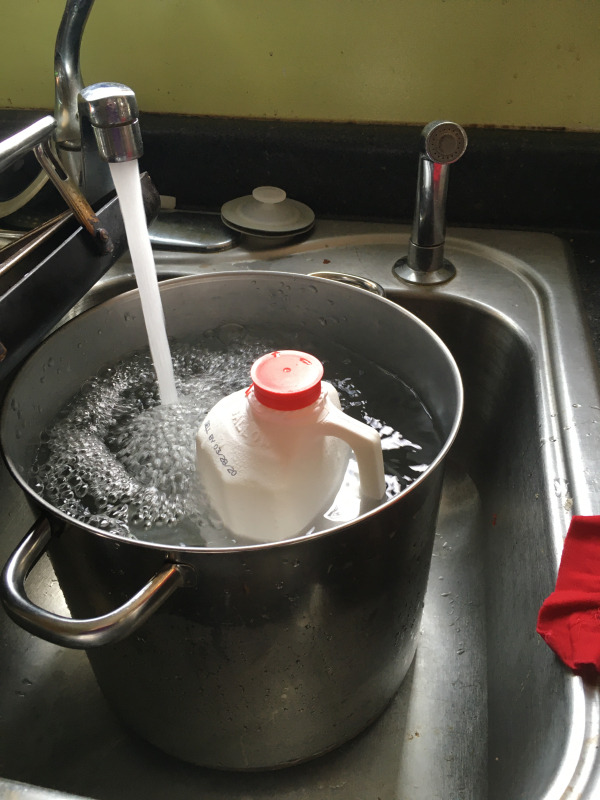
    Sunday morning.  Mark convinced me to take a trip to the local natural-foods store, which is considerably smaller and more expensive than the regular grocery store, and also very close to the house.  I went around 9 AM.  It was busy on a level that's normal for 4:30 p.m. on a weekday.  I wore gloves and didn't spend any time close to any shoppers, but I did prematurely flee the bulk coffee dispensers when a man next to me started coughing.  I guess I might have spent an hour there.  Of course, I "came in contact" with the cashier.  Bagged my own groceries in bags I brought from home.  Normally I forget to bring them.  I bought five gallons of milk.


    3/14

    Woke up in a Hampton Inn in Mitchell, South Dakota.  Ate breakfast in the breakfast room:  we made the smaller kids sit down and fetched their food for them, so they wouldn't run all over.  Left a double tip for the housekeeper, repacked our van, and drove back to Minneapolis.  Stopped for a bathroom break, maybe fuel  too, at a Kum-and-Go in Adrian, MN, and got lunch from a McDonald's drive-thru in Worthington, MN.  There may have been other fuel stops and bathroom stops.  I don't remember.  We ate the McDonald's food in the car in the parking lot and got back on I-90 to get home.  Arrived at our house, parked the van in the front, turned the water back on.  Fortunately, I'd forgotten to throw out the milk in the fridge.  I made some chili.  We settled in.


    3/13

    Mark worked from home till early afternoon.  I had a dentist appointment at my regular dentist at 8:20 a.m.  I definitely came into extremely close contact with the hygienist and the dentist.    My 16yo walked to the natural foods store, I think, in the afternoon,  too.  We cleaned up, threw out the food from the fridge that wouldn't last, turned off the water in the house, turned on some lights, put the small car in the garage, and headed out West for our weeklong ski vacation. 

    We chose a Perkins for dinner, I think the one in North Mankato, because we felt a sit-down chain restaurant would be complying with hygiene orders from corporate; also, it was Friday and they have pancakes.  We weren't wrong; the manager explained about how the jelly caddies and bowls of creamer had been taken off the table, and we were handed menus still glossy from having been wiped down.  The waitress kept her distance.  I tipped her very well.  Then (there must have been a fuel stop; maybe it was at the same off-ramp as the Perkins?)  past Sioux Falls to Mitchell, SD, where we got a room big enough for all six of us in a Hampton Inn.  After Mark checked in—I suppose he must have come in contact with the desk clerk he gave me one of the key cards and I went in with a tote bag full of cleaning supplies.   After I finished pre-cleaning my own hotel room and disinfecting all the high touch surfaces, I opened a window and propped open a door to let the fumes out and texted the family to wait eight minutes and then come in.  They did.  We slept soon.


    3/12

    Mark's last day in the office.  We had about a half-day of co-schooling at H's.  Her mother was there, saying hi to us as she headed out and we headed in.  H. had pizza delivered from Domino's.  Then we went home.  Mark picked up our 16yo's prescription toothpaste at the uptown grocery store.  We had Chinese food delivered from a local place for our last dinner at home.


    3/11

    We learned that the 10yo's playdate friends had mild sniffles, so we canceled the planned playdate and everyone stayed home.  The teenagers took the city bus to the climbing gym for team practice.  I drove the 10yo to his weekly religious education class, where they were having Confession Night.  Then to the grocery store, where I bought mostly nonperishable items to stock the kitchen in our vacation rental, but also some extra cleaning supplies.  I finished quickly enough that I had time to pick up the 10yo after his class; Mark picked up the teens, probably waiting in the car in the parking lot for them.


    3/10

    Dentist appointment for the 16yo; Mark drove him and probably sat in the waiting room.  I picked up a few things from the natural foods store, just enough for dinner that evening.   In the evening I met Mark in the Y parking lot and handed off the 6yo for swimming lessons and the 16yo, who wanted to lift weights.  My class had been canceled.  I didn't go in to run or swim, either.  I hadn't, either, encouraged the other two children to go and get some exercise.  It seemed imprudent.  So I just went home.


    3/9

    At H's all day.  Ran an errand to the post office to send something Priority Mail; used the self-serve payment kiosk (wore gloves) and handed the envelope directly to a postal worker who happened to be emptying the catch bins under the slots.  There was no meeting for our daughter's scouting-type group that evening, so I took three children home early while Mark drove the 16yo to a scout meeting.


    3/8

    11 AM mass.  We made the small kids keep their knitted gloves on in church.  Doughnuts and coffee afterward.  But we stayed at our own table.    I made a trip to the somewhat fancy grocery store to pick up charcuterie items for dinner, and also to Walgreens to stock up on hand soap, disinfectant, cleaning supplies, and the like.  I laid out the table and we ate; H. and her teens showed up and scarfed down some of it; then she and I and all four of the teens piled into my van to go see Twelfth Night at the Guthrie.  We arrived with just enough time to buy drinks in the express cafe to carry into the theater; of course, I spent time in line, and with the two staffers behind the counter.  As for the play:  It was a wonderful production.  A packed house.  Great acoustics, too:  from our balcony seats (row N) I heard every cough.


    3/7

    Breakfast at my favorite Saturday breakfast spot. I had a table to myself, though of course a server came around and refilled my coffee, and I paid at the counter, and waited in line with a couple of other people.  I sat there from 7:30 to nearly 10:30, reading; and then decided to go for a walk around Bde Maka Ska.  It wasn't too crowded, even though the ice had almost melted off the paths.   Meanwhile:   The 16yo went to his last Swedish class at the Institute, and Mark took the 10yo to the Y for swimming lessons.  He picked up milk on the way home.  The 16yo, newly accepted onto the intermediate climbing team, and visibly excited, went to his very first Sunday evening practice for it.  I don't remember if he took the bus.


    3/6

    I went to the Y to swim in the afternoon, by myself.  Usually I take the kids, since there's open swim and a child care, but I didn't this time.  It was lovely.  The pool and locker room were uncrowded.   I spent time in both women's and girls' locker rooms, because the hot water was out in the women's.


    3/5

    H. at our house for co-schooling.  In the evening, we went to the Children's Theatre to see Spamtown, USA — a really well-done production, seriously — in the smaller Cargill theatre, packed on padded benches.  Before they let us into the theatre the smaller children ran around in the lobby, tracing the spiral-patterned tiles on the floor, with numerous other waiting children, as the space was designed to allow; and they used communal art supplies that had been set out for us; and the teens bought candy from the concession stand with their own money.  After the show we went to our usual bar and grill, the one where they know us and we know them; ordered root beers for the kids and drinks for Mark and me, and dinner for all:  but first, two big platters of steaming hot nachos, one with jalapeños and one without, the cheese coming away in long melty strings.


  • The Confusing Mysteries.

    Today is a fast day in our Archdiocese, declared by the archbishop, a response to the pandemic.  It’s the same rules as Good Friday or Ash Wednesday.  I had coffee for breakfast, and some instant miso in the middle of the day with a few spoonfuls of leftover cooked brown rice and peas stirred in.   We still plan to order takeout for dinner from some local restaurant; it isn’t hard to find one that will sell us a pesto melt or fish tacos.


    + + +


    Thoughts and prayers.  Thoughts of food, and prayers.  I took a walk today while the kids ate their cheese pizzas:  I walked south until I finished the rosary, and then on my way back a Divine Mercy chaplet.


    It’s Wednesday, and that’s the Glorious Mysteries, but every single time (n=1,…5) that I started a decade, I said “The n-th Sorrowful Mystery” by mistake and had to correct myself.  And what stood out to me wasn’t the glory at all, but the moments of sheer confusion.


    They have taken my lord away, and we don’t know where they have put him.


    they were looking intently at the sky… “Why are you standing there looking at the sky?”


    They were all astounded and bewildered and said to each other, “What does this mean?”


    I couldn’t feel anything at all except the confusion.  I went with it, though.  I know that there is a resolution, an explanation, in all three of the stories, but I sat, or rather walked, with the confusion.


    + + +


    I am going easy on myself this afternoon, just as I usually have to on the ordinary fast days.  I did housework all morning while Mark worked on his laptop in the attic:  laundry, then I set up the bread machine, hoping the yeast was still good (it was).  Then I got some hot soapy water and washed all our light switches and doorknobs.  We have been quite isolated since we abandoned our trip, but it seemed like a good idea to start.  Sooner or later someone will need to venture out to a grocery store or something, and they will touch knobs and such when they come back, and maybe by then I’ll want to follow the path from the door to the handwashing station, disinfecting.


    After that I read and commented on blogs, and answered emails from friends, and checked in on some specially created FB groups.  Before, I called that “wasting time” but now it is on my official to-do list, because it feels good for us all.  And then the walk, and now I am resting, and writing on my tablet propped on a pillow on my knees.  I don’t really have much energy left, though after breaking fast tonight I will probably have energy for something or other.


    + + +


    St. Francis de Sales’s Introduction has a multistep method of mental prayer where you begin by choosing one of four ways to place yourself in the presence of God.  If you are seasoned, the ways will all sound pretty elementary.  The fourth way is to imagine Jesus in his humanity in the room with you, as you might imagine a friend (“I imagine I see such-and-such a person, doing this and that,” says St. Francis), and then you move on to the next steps.  Usually I straightforwardly picture the presence of an adult Jesus sitting just behind my shoulder where I can’t see, but today on a whim I thought instead of myself sitting by the manger instead.  What should I do now? I wondered, and the thought came, Pick up the baby, and I desired to and of course I can’t.   And there was a flash of real grief, here and then gone… but strong, and I did not know what to do with it.

    So that was a sudden felt longing.  And an impression that pick up the baby is a sort of guiding principle that I can lean on in the coming weeks, even though what exactly it might mean for me leaves me, well… confused.


  • Science communication in the age of… oh gosh I’m so tired of “in the age of”

    I've been thinking a lot about the power of science communication this week. 

    Even though I've fallen off on blogging, I think a lot about sci-comm in general… or, now that I think about it, my thinking about sci-comm in general is part of why I've fallen off in blogging. 

    When I first completed my PhD and transitioned to full-time attention to raising and educating my own family, I was highly confident that I would never be an academic or a researcher again (and not too sorry about it, although I would miss many corollary benefits).  I had an idea that sometime in the future (but with no urgency, and no plan) I might move into the broad field of sci-comm.  Journalism?   Textbook publishing?   Something to do with education?   It was then, and always has been, a vague idea.  I enjoy explaining technical things to non-technical people:  converting technical language into everyday language, and I think I have a bit of a natural talent for it; I'm untrained, if I ever decided to really make the career change I'd probably seek out some technical communications courses first to brush up on my skills, but it's always floated around in the back of my mind as "the thing I would do if I decided to re-enter the paid labor market."

    (Understand, by the way, that I have zero formed plans or intentions to re-enter said market.  It's just a topic that's been on my mind a lot, especially since I decided to follow a bunch of sci-comm professionals on Twitter, who are always tweeting about how valuable it is and generally bumping it up in my consciousness a lot more.  So don't read any of this as hints that I am purposefully researching a career change.)

    So why am I not blogging, then.  I guess, the more that professional writing and communication is on my mind the more clogged up I become as an amateur writer.  Sometimes I think about banging out a quick critique of  a news article on a technical topic, or an opinion piece about something or other, or even a close reading of some research article that's making the rounds in the form of bad journalism.    For a long time I was perfectly happy to blather on at length, applying mathematics or chemistry that I learned in one context to situations that are entirely different, evaluating writers in fields far outside the areas where I legitimately have some expertise.  Because I like to have broad technical competence, not narrow and specialized knowledge (I learned that when I spent seven years specializing).  I like to drill down deep here and there, all over the place, according to my interests, and as I learn, bringing other people along with me.  It's simply… fun.

    But I've always been aware of the dangers of thinking that because you're an expert in one field, you get to be treated as an expert in other fields.  Even if you count expertise that isn't credentialed — I believe it is possible, even common, for motivated and intelligent people with a good sense of what they do and don't know to develop genuine expertise outside the gates — you run the risk of overstepping your knowledge and not realizing it, and that's downright embarrassing when you get called out by the specialists.  The generally nerdy nerd has to be a humble listener, and listen to the specialists.  There is a general technical toolbox that we all share, but the specializers are the ones who generate the majority of the information that we generalists relish, chew on, and digest.

    I feel like I can come up with new ways to say things, new ways to organize information.  Occasionally I have anecdotal experiences that are worth sharing, for the purpose of raising questions about how they connect to the wider world of investigation.  I'm not doing original research.  I know this.  But that doesn't mean I shouldn't be able to write about other people's expertise.

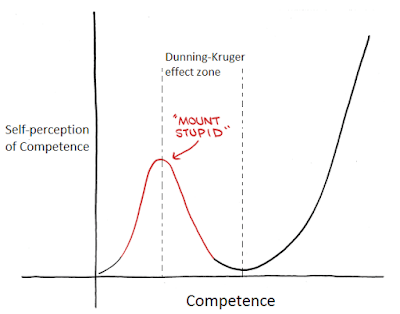
    Still, I am a little bit choked these days by the fear that I will either overstep my bounds, or appear to be pulling rank inappropriately:   "I have a PhD in something so you should listen to me about this other thing."   The more I appreciate the importance of general science communication, the more I respect it as a profession, the meeker I feel about engaging in it as an amateur.   It isn't imposter syndrome, exactly; there's no particular place that I belong, but feel a secret un-belonging.  It's more the backside of the popular concept of Dunning-Kruger:  I've gone over the edge of Mount Stupid and the valley on the other side is long and flat.

    The other reason I think I've been hesitating is because I feel more mixed these days about having a blog that is about a million different things.  There is no way I could separate them and have one blog for recipes and homeschooling and another blog for technical writing and a third blog for theology and canon law and a fourth blog for constitutional law and… The whole reason this won't work (unless I ever do make that career change) is my penchant for general nerdiness.  I am nerdy about recipes, and homeschooling, and numerous technical topics, and canon law, and constitutional law, and language learning, and basically everything I ever think about at any time.  It's unclear to me where the dividing line is between "Personal Musings" and "Technical Communication."  

    ….aaaaahhhh, there is no such line for me.  I just gotta start climbing the other side of that valley.

    + + +

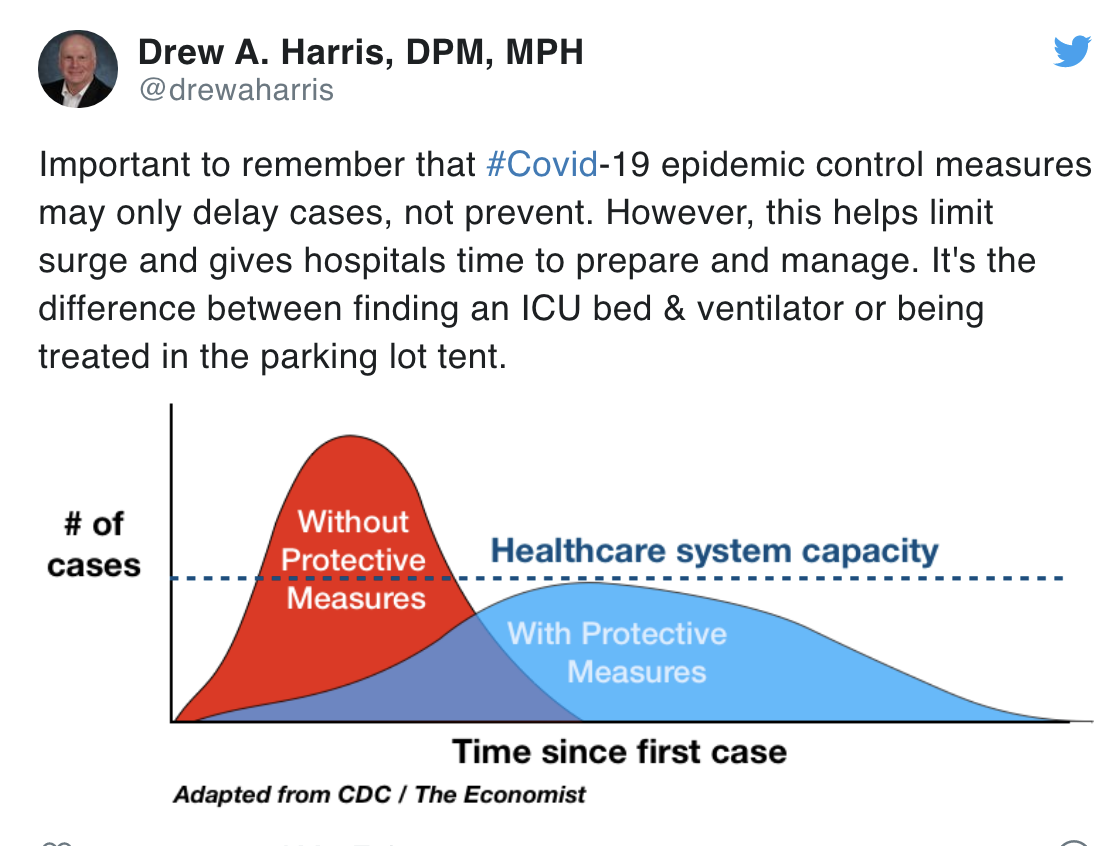
    I'll just close here by noting something that I hope the rest of you have noticed, too:  The people who made the various popular versions of the "Flatten the Curve" graph have, personally, probably saved an uncountable number of lives. 

    I'll highlight Drew Harris's version below for its unfussy and concise elegance.  This is not the work of an amateur; it's the work of an expert.  But his version nailed the clear communication of the relevant information.

    Screen Shot 2020-03-17 at 10.32.12 AM

    The concept predates Dr. Harris, and other artists made later versions which arguably were accessible to more laypeople and included information showing how ordinary people could "flatten the curve."  Personally, I think his version marks the turning point of the dissemination of this idea.  This article traces the evolution of the idea's presentation from a 2007 CDC publication, through Dr. Harris's chart, to the memes that people are sharing today.

    Now go wash your hands.


  • Inside.

    taps microphone

    Hello?

    Anyone there?

    + + +

    I'm trying to imagine an alternate universe right now, one where we decided to have a Spring Break staycation for no particular reason; didn't feel like skiing or camping, just decided to hang out at home and chill all together.  I can't quite make myself imagine it vividly enough to enjoy myself.

    Yesterday I made my last trip to a grocery store, not a big one, a small neighborhood natural-foods store, so I could stock up on the last few items for my freezer.  I didn't empty any shelves, but took one thing here and one thing there; the exception was milk, which I'd just that morning remembered you could freeze; that memory was why I decided on the "one last trip."

      I came home and was beset by anxiety for a few hours about having done it.  Even if I don't set foot outside my house for the next fourteen days, I think I'll still have little waves of anxiety about it.

    Tomorrow it will be fourteen days since I worked the polls on Super Tuesday.  Thursday it will be fourteen days since the family went to the Children's Theatre.  Saturday it will be fourteen days since I last had breakfast out.  Sunday it will be fourteen days since H and I took four teens to see Twelfth Night at the Guthrie.  Ticking them off one by one.

    + + +

    Whenever I actually spend time working on something that theoretically will Help Us Get Through This, I feel better while I'm doing it.  Early this morning I did laundry, extra focus on the towels and on the gloves we've worn in public places, and the scarf I used to grab all the door handles.  Later I went downstairs and took inventory of the freezer.  Then I made lunch for us to eat together as a family, Mark coming down the stairs with his coffee cup to sit with us, almost as if it were dinnertime. 

    I thought that would be a comfort to me, having us all together; but it seemed only to remind me today how very disturbed we are:  we never sit down together for lunch on a weekday, I don't even sit down with the kids; I don't eat what they eat; the teenagers usually make frozen pizza or quesadillas and I usually eat leftovers or a salad.  And here we were all six of us, Mark and me and the four kids still living at home, eating waffles and sausage and a sort of peach topping I made out of an ancient bag of homemade peach pie filling that I excavated from the freezer.  

    FIFO, y'all.

    + + +

    I hope that after a few days it will start to feel like a new normal, and I'll cease being startled by it.  We'll start doing school again on Monday, a week away, somehow or another; we won't go to H's,  but we'll do something; I'll enlist the teenagers, hers and mine, to work out some kind of remote voice chat thing.  

    + + +

    I feel kind of lame about my attempt to sit down and write a blog post.  I hoped I would write something different:  either something a little more inspiring, or else something that might actually help someone, information and recommendations; or a meditation on this long unchosen Lent we face, that will stretch on beyond Easter; or, I don't know, almost anything else besides what I'm actually writing about, which looks like a rather dry accounting of being home for one whole day with my family (most of it) but it's really not about that at all; in fact it's about a wrenching sorrow that I'm tamping down and trying to keep below the surface, a sorrow for missed chances, for lost data of all things, for future lives everywhere that spool out like threads, the frayed end tucked under the few turns that are left, not enough length to hold the seam.