bearing blog


bear – ing n 1  the manner in which one comports oneself;  2  the act, power, or time of bringing forth offspring or fruit; 3 a machine part in which another part turns [a journal ~];  pl comprehension of one’s position, environment, or situation;   5  the act of moving while supporting the weight of something [the ~ of the cross].


  • Nerd mom.

    I like Jamie's my-little-boy-is-growing-up-(sniff) story from yesterday.  I like it a lot.

    It's good to be a nerd.

    Beauty-1

    Not that kids are slime molds or anything. 

    All I'm saying is, I may not be a speech pathologist like Jamie, but the language of nerd is a universal one, and nerd-mom is even better.

    (Comic here)


  • 27:30.

    Just a brief interjection here:  This morning I ran my fourth 5k, and I set a new PR at 27 minutes 30 seconds.  I placed 64th overall out of 160, and 22nd out of 90 women.  Third out of the 15 women in the 35-39 age group.

    I did much better than I expected, given these four facts:

    (1) It's my first race using the forefoot strike (aka Pose or Chi running, and often used by the barefoot running types, though I run in cross-country flats).  You may remember that I took a running clinic last year in which I learned the new form.

    (2) I haven't been training on pavement at all since I started forefoot striking.  Only treadmill and indoor track.

    (3) It didn't occur to me to sign up for the race until about 5 pm the evening before, when I was surfing around and discovered that one of my favorite small local races was scheduled for 8 am.  (Just as an aside:  I am so thrilled that I can just decide in the evening that I'm going to run a 5k the next morning.  That rocks.  I love the internet.)

    (4) I forgot to eat breakfast.

    For all those reasons, I went into it reminding myself that I didn't want to push too hard.  Still, when I checked my stopwatch at the one-mile mark, I found that I'd run my fastest-ever first mile.  Oops!

    A couple quick takes:

    -You know how they tell people not to worry about whether your gear looks like "real" running gear because nobody notices it?  Lies, all lies.  The man warming up next to me at the start said, "I see you've raced before.  You're wearing flats."

    -Just as they were telling us to get ready, the big purple inflatable START arch suddenly went flaccid and collapsed in front of us all.  They had to delay the race a few minutes while the volunteers removed it.  (It was back up again in time for me to cross it going the other way at the end)

    -Also the first race that I tried listening to my iPod while I ran.  Wonder what the people next to me were thinking when "The Time Warp" from The Rocky Horror Picture Show came on and I suddenly blurted out, "Group sex group sex group sex."

    – Oddest thing I noticed that I attribute to the forefoot strike:  I felt physically more comfortable running uphill than running downhill, which is a first, believe me.  I tried hard to work it.


  • Tidiness and efficiency are not always correlated.

    It used to be that the "find files" or "search" option on a personal computer, or in an email program, wasn't very good.  Remember? 

    Cue the wayback machine.  Once upon a time,  if you had a lot of documents and you wanted to be able to pull up an old one quickly, you'd better have your documents folder organized.  Folders within folders:  Spreadsheets > taxes > 1994.  Or at least you should be good about putting enough details in the filename that you could pick it out of a lineup. Remember that?  It was especially hard back when you had to name a file in eight characters or less.  (Now I'm really getting nostalgic.)

    Not so anymore, right?  (Except maybe for photos, which as of this moment aren't very searchable unless you name them carefully.)  Here in 2011, if I want to find some old document  on my Mac's hard drive, I type a few words into the search field, and it appears.  Knowing the filename may help; often it doesn't matter because the search terms can come from the contents.  I don't have to remember if I called it  "new grocery list" or "shopping items" or  "Highway 7 Cub Foods"  — if I type "triscuits" I'll find what I'm looking for. 

    So now I don't spend a lot of time dragging files (except photos) in and out of folders just so I can "find" them later, or thinking carefully in which folder to save a particular file.  I occasionally group documents for some other reason — such as uploading related files simultaneously — but not for retrieving them.  I save most files right into the default "Documents" folder, and I trust the operating system  to search for it if I ever need it again.

    Makes you wish you had a search engine for paper, doesn't it? 

    Some time ago I needed to get some information from the list of covered items in one of our insurance policies.   I didn't need the information particularly quickly, but it was important.  The insurance policies are something that Mark, rather than I, usually deals with, so I went upstairs to the desk where Mark pays the bills, and started looking.   I checked the filing cabinet first — not there — then started going through the stacks and baskets of documents and papers on the desk.  I expected it would take me a while, fifteen minutes or so, but I wasn't worried, for several reasons:

    •  I wasn't actually in a hurry
    • I was motivated to find the policy, so I knew I wouldn't give up
    •  I knew I would recognize it the instant I uncovered it
    •  and I knew it was here somewhere, in one of the piles.

    And I did find it.  I copied down the information I needed, left the policy where I found it and went off to do my work.

    So the piles … worked.

    + + +

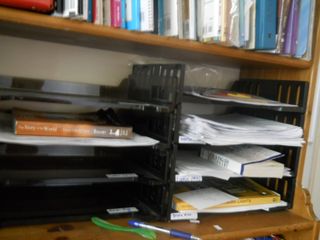
    That was on a day when there were a lot of tall piles on and around the desk.  Sometimes they're fairly well corralled:

    DSCN0950    

    The filing system will never get that upstairs home office a photo shoot in House Beautiful or Real Simple. 

    DSCN0952 

    They sometimes look as if there's nothing systematic about it.  

    DSCN0951

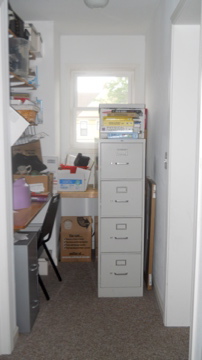
    And it's too bad that they cover up the beautiful built-in desk tops that Mark built to fit perfectly into the tiny niche at the end of the hall. 

    DSCN0949 

    But the truth is that whatever state they're in, they function adequately for us as a document-retrieval system.  Here's why:

    First of all, we rarely need to find any of that stuff quickly.  In fact, we rarely need to find anything in there at all.  Especially now that so much information is stored electronically, of all the paper we have to save, most is there only "just in case" we need to look at it or produce it later, not because we expect  to need to refer to it often.   Tax documents from one to five years ago.  Insurance policy numbers and coverage information.  Our college transcripts.   None of that stuff needs to be at our fingertips.  I can count on one hand the number of times I, personally, needed to search for a document in that office in the last two years.   I assume Mark has some system for keeping track of the tiny fraction of files up there that are active for him.  (I keep "my" stuff somewhere else.  This is probably a key feature!)

    Second, there isn't a whole lot of junk there diluting the important things.  Oh, there's some things in the "maybe we should save this" category, but Mark's pretty good about recycling paper we won't need.  So the stacks aren't so large and stuffed full of irrelevant material that I know it'll take forever to find something.  It will take minutes. It will not take hours.  

    Third,  when he or I puts a file in a stack up there, it stays put until he decides to do something with it.  The papers in the stacks are safe there, or at least, safe enough for us.  The upstairs office, tucked at the end of a hall, is out of the way of daily living; the stacks do not get knocked over, nor do they accumulate much irrelevant junk.  I do not mess with the stuff except to look for things from time to time.  The children know they are not to touch "Dad's papers."  So, to put it succinctly, if it's up there, we know if it's there somewhere.

    Fourth, it's easy to put a document into the system, because it doesn't much matter exactly where it goes.   And that's important, because all the documents have to get into the system.  On top of the nearest pile is good enough, or in my case, into a particular wire basket downstairs that serves as an "in-box" from me to him.  

    DSCN0953

    (Note wire basket inbox, containing — besides mail — Chapstick, a bicycle headlamp, the packaging from his new heart rate monitor, and always — always — several screwdrivers)

    (If your husband's household inbox does not have room for random screwdrivers, then there's a big part of your problem right there, I'll bet)

    (Because there's also no search engine for screwdrivers yet)

    (No comment shall be made on any similarities that might be found between the stacks upstairs on the desk shelves and the stacks of recipe books on the kitchen shelves)


    Ahem.  So the system, though not pretty, works.  The basic reason why conventional organization isn't necessary here — and maybe would even be a hindrance — is that, given the kind of files we keep, quick and easy file storage is much more important than quick and easy file retrieval. 

     If you want to find something, it must still exist somewhere.  If you don't put it away promptly, an important document might sit around in an unsafe place — like the kitchen counter or a schoolroom table — long enough to get damaged or lost.  Putting it away where it's safe is obviously a prerequisite.     But it has to be easy.   If it was a lot of trouble to put a document into the system, chances are that we would procrastinate on the filing.  There just isn't much intrinsic motivation to proper filing.  

       Unknown Even if, like me, you already own a really cool label maker.


    On the other hand, if I need to find something, well, that is a fairly strong intrinsic motivation.  I trust I'll be motivated to riffle through the piles of paper until I uncover the one I'm looking for. 

    So it's okay that it takes a while to find something.  It's not okay if it takes a while to put something away.  

    (This is not true for every household or every function — but it happens to be true for mine.)

    If it obeys this rule, an untidy system works.  It might even work better than if it were tidy, because keeping it tidy — just so I might be able to find something a few minutes more quickly later — would cost us time.  I'm not sure that time would be a good investment.

    + + +

    When I realized this basic need, it changed our paper-handling in two important ways.

    First, I stopped bugging Mark to clean up the papers on the desk.   The system works, and at least until we decide we need to clear more space for writing, there isn't a reason to find a different place for the piles.

    Second, it opened my eyes to how I, personally, handle paper — and many other items — in the homeschool.

     More on that in another post.


  • Blogging outage.

    My internet pipes are clogged, and. Comcast can't send the plumber till. Wednesday. You'll have to talk am


    UPDATE ONCE I SAW THIS:  ongst yourselves.  Stupid phone.


  • Alternatives.

    Probably on account of hearing it so much when I was growing up, I like to have an alternative to "Because I said so."

    Around here, we like to say "Because I am arbitrary and capricious."

    How about you?


  • Reunion.

    I really should be using Google Maps to find a Mr. Tire that's open early on Saturday mornings within walking distance of a coffee shop, but I'm putting it off just a few minutes.

    Everyone else is at the Minnesota Catholic Homeschooling Conference and I'm not.  I would make a frowny face except that the reason I am not there is that my husband is actually HOME tonight.

     He has been on business travel for 16 out of the past 33 nights.    He will be leaving again soon for another series of trips.

    I could have looked at it this way:  I've been doing a lot of single-ish parenting over the last month, and there's more coming up, and I could use a break.  And I could have headed off to the conference and left him with the children for a little breathing space.  And that would have been fun.  And totally understandable.

    But it's also kind of nice to spend the afternoon having lunch together, and tidying up the house together, and doing the giant quarterly nonperishable-goods shopping trip together, and taking everybody to the gym together, and going out to  the kids' choice of restaurant together (The new Asian buffet!  The one they've been begging to go to for months!  Where 3 out of 4 of my offspring decided to pile their plates with pepperoni pizza!), and looking forward to maybe having a drink together at the end of the day, after we send the kids to bed. 

    Yeah, I think I could go for that.


  • Fitness Friday: Do what you like?

    I think I've mentioned before that I don't actually like running very much.  Although I do admit that I can sort of see the fun in going for an easy run — that is, if there is such a thing as an easy run, which is only possible if you have endured many not-so-easy ones.

     Anyway, I was thinking that, for novice exercisers, one piece of advice I don't really buy anymore is the advice that, when trying to fit more physical activity into your life, you should choose your activity based on what you like to do or find fun.

    I think the idea is that if you like the activity, you will have extra, intrinsic motivation to get out there and do it.  After all, if you enjoy (say) cycling, the thought of getting on your bike will fill you with eagerness instead of dread.  You will not f0cus on the unpleasantness of exertion but instead on the cool breeze and the changing scenery and the satisfaction of transporting yourself with your own muscles.  And therefore you will exercise more often than if you chose an activity that you didn't enjoy.  Right?

    It's not a crazy idea.  But it may be unnecessarily limiting.   Here are some reasons why you might want to consider taking up an activity you don't like or find fun.

    (1) Just because an activity is fun doesn't automatically mean you will do it often.   Skiing is really fun for me; I do it a few times a year if I'm lucky.  Going to a movie with my husband is fun; I think we've gone to fewer than five shows together since we had kids.  I also think rollercoasters are fun, and riding on trains, and visiting art museums all by myself.  Nevertheless, for a variety of reasons, I hardly ever do any of these things.    I am sure that if you pause for just a few moments, you will think of several activities that are good, that you would say "Oh, I really love doing that," but that… you don't do, or at least don't do much.   Why don't you do them more often, if they're so fun?  Things get in the way, hm?  Well, if it's true about movies, it's also true about bike riding or hiking or belly dancing.   I just don't see any evidence that picking an activity you "like" as your very own exercise plan will make it more likely that you will exercise more.

    (2) Some things aren't fun until you get good at them.  I swim once or twice a week, myself.  I like swimming — now.  I look forward to the physical sensations of pulling myself through the water — now.  Once upon a time it wasn't so.  I had to take a year of swimming lessons before I really could relax and just enjoy swimming.  Now that I'm a competent fitness swimmer, I really do enjoy it, but there was a lot of hard work getting there.  And I didn't get there by restricting myself to activities that I already enjoyed.  I got there by deciding I wanted to be able to enjoy it, and knowing I would have to work to learn how, and then by signing up for lessons and showing up week after week.  I had to take up an activity that I did not already enjoy.


    (3)  Many of us can't imagine finding any sort of exercise we like.  If you're a really, seriously virgin exercise newbie, maybe the whole idea of moving your body hard and fast is kind of scary.  Maybe you suffer from post-traumatic gym class stress disorder.  Maybe you hate the way it feels when you get winded just climbing the stairs.  If you've never known what it's like to get moving and enjoy it, how can you know what sort of exercise will appeal to you?  Don't let these exhortations to "find an activity you enjoy" intimidate you.  You don't have to enjoy it to do it.  It's not true that you are doomed to quit if you pick the wrong exercise.

    (4) "Fun" is probably not the problem.  The biggest barrier between you and exercise is likely to be something other than disliking physical activity.     Inability to carve out time, or need for someone to watch the kids, or procrastination, or fear of being seen by others, or lack of access to a safe place to exercise, or lack of equipment, or lack of family support, or chronic illness — none of these things will be "fixed" by choosing an activity you ordinarily would enjoy.    Figure out what you can do to knock down what's truly standing in your way.  It might mean picking an activity that's not your favorite, but at least you'll have an easier time getting there. 

    (5) Give yourself more credit — you are perfectly capable of doing all kinds of things that aren't particularly fun.  The flip side of "There are many fun things I don't do" is, of course, "I do many things I don't enjoy every day."  I hate folding laundry and yet I do it a couple of times a week.  I don't love to go grocery shopping with four children and yet when I have to do it I can get it done.  Heroically I perform countless no-fun actions every day for little or no thanks.  Why can't I do no-fun exercise too?

    (6)  There are ways around the no-fun parts of a no-fun exercise, but it can take time to discover them.  I don't physically enjoy running, but in the years since I took it up I've learned some tricks.  Simple ones like setting up a series of carefully chosen music playlists in my iPod.  Mental ones like focusing on being grateful for forty minutes to spend on myself, or on offering up my tiny suffering for someone else.  More complicated ones like following a scripted training regimen.

    (7)  Some of the things that are no-fun at first, you may learn to appreciate with time.  I used to hate the achy feeling that would appear in my muscles the day after a workout.  Now, I actually kind of like it.  Right now, in fact, I'm aware of a pulling feeling in the backs of my thighs, and I know that this is a mild ache from yesterday's run.  But every time I feel that slight burn in the muscles, I am getting a little glimmer of the thought, "Oh, yes — I had a good long run yesterday, I can still feel it."  Achy muscles feel like an accomplishment to me now, and because of that I experience them, truly, as a pleasurable sensation.   Other things that have morphed from nuisances into pleasures:  the intense hunger that appears an hour or two after a workout (because whatever you eat tastes SO good when you're wolfishly hungry from hard exertion), and the sensation of jumping right into a cold swimming pool.  Used to hate them.  Now anticipate them with longing.

    (8) Even something that is not fun can be made interesting, and maybe "interesting" will keep you coming back better than "fun" would.  I have had a lot of success, running, with turning it into a learning experience.  I  don't like running, but perversely, I do like spending eight weeks working on form drills, or following a training regimen for an upcoming 5k.  I have found that having a program and mixing things up in a certain way does not make running any more "fun," does not make me "like" the sensation any more… but it does make it interesting, and that keeps me coming back to find out what will happen in the next installment.  Tune in next time to find out if Erin will be able to run five two-minute intervals at 7.2 miles per hour, or if she will stumble and be thrown off the back of the treadmill!

    (9) There are better rewards than fun.  Sometimes when I am running on the treadmill I hate every minute.  Hate it.  Really hate it.   Spend every breath wanting to stop, and suffering more for knowing that at every breath I could stop but won't.  And then when I've met my goal and the run is over and I step off — I have this tiny spark of pleasure from knowing that I didn't quit.  Each time I don't quit the spark is a little bit warmer.  I am changing myself into a stronger person from the inside out.

    So — don't feel discouraged if you make lists of things you "like" to do and then realize that none of the things you "like" are realistic activities to engage in regularly.   Pick some activity that is realistic to establish first.  The nice thing about this is that, since it is realistic, you can start it right away.  Then consider committing yourself to learning to like it as much as you can.  That should buy you some time, at least, while you figure out how much it is possible for you to like it.  And even once you hit that limit, you never know — there may be more to it than you think.


  • Interruptions.

    Sometimes I feel that I lack role models for my, er, role.  Here I am raising kids Catholic, for instance, when I wasn't a Catholic kid myself.   Daily I flounder in the unfamiliar waters of a happy marriage.  And I didn't grow up in a family with four kids, either.  So I never quite know if I'm doing all that stuff right.

    Yesterday the five of us — me and the four children — 10, 7, 4, 1 — went to the grocery store.  If I have to do the shopping, we go early in the morning when the store isn't crowded.  I think the kids are pretty well-behaved, but I always feel so noisy.  The four of them are constantly chattering at me (okay, the baby isn't exactly chattering, but he's not exactly quiet either) and I'm continuously barking orders.  You.  Go fetch me four lemons.  You.  Put this back, it's not on our list.  You.  Watch the cart for a minute.   You.  Hold this, er, thing.  No.  Don't give the baby a yogurt to hold, he'll peel the foil off with his teeth again.  You.  Run back to the produce section and find my grocery list, I think I left it on the tomatoes.

    As I said, they are pretty well-behaved, and it goes fairly smoothly.  But it's not exactly fun for us all.  We are always in a hurry, because we are cutting into our school time, and I want to get home and get it all put away so we can buckle down and get our work done.  So I'm barking orders.  And they're running back and forth with lemons and tomatoes and boxes of pasta, and my seven-year-old has figured out exactly how to pick the moment when I will answer any request with "Yeah, yeah, right, whatever" and not remember what it is that he asked for.  At least I think so.  He says I told him yes.

    The checkout line is the worst.  Around here the grocery store, unless it is a gratuitously fancy one, doesn't provide anyone to bag your groceries.  (If the baby is screaming by the time I am checking out, sometimes they call for one out of pity.  I do appreciate that.)  I have enough trouble navigating this when I'm all by myself:  unload cart, run to the end of the belt and bag groceries, keep one eye on the cashier so that when necessary I can pop up and say things like, "That?  Oh, that's jicama — no, it's not a rutabaga,"  run back and swipe my credit card and then run forward again to bag more groceries before they back up on the belt, and so on.

    When I have all four children with me, it does go slightly  more smoothly because they can help.  (And if the baby is screaming, sometimes the cashier calls for a bagger out of pity.)   The result is that the chattering and barking reach a peak.  I would really like to see my ten- and seven-year-old boys industriously opening bags and packing groceries while my four-year-old daughter and I unload the cart together and the baby makes faces at the people behind us.  This does happen, at least for a few moments at a time.  I have to keep reminding my seven-year-old that I need him to work.

    Yesterday the baby was making faces at a young dad with one small girl ensconced in the little red plastic car that was attached to the front of the cart.  I had already sized him up as the type who was likely to make faces back at the baby, thus entertaining the baby and allowing me more time to help pack groceries, er, I mean, bark at the bigger children.  "Wow, you've got your hands full," he said as I rifled through my own wallet, and then corrected himself to, "…but I see that you also have a lot of help."  

    I do, I do have a lot of help.  

    I wish… I wish right now that I felt able to listen to each one of the children.  Sometimes it feels like no child can speak to me, offer to show me something, or ask me a question without interrupting me.

    "Mom, can I–"

    "Just a minute, I'm talking to your sister."

    "Mom, let me show you –"

    "Wait a minute, I have to change the baby's diaper."

    "Mom, can I ask you a question?"

    "Not right now, I'm in the middle of teaching your brother his math lesson."

    This is one of those places I could use a role model.  I believe it's important to teach kids not to interrupt.  But some days it just feels like there is no time they could possibly ask me anything without interrupting.  One takes time from the other, all day long.  When am I going to listen to this one?  To this one?  To her?  To him?  When?


  • Flattery.

    Four-year-old daughter:  Mama, on your next birthday, will you start to be an old lady?

    Me:  Hmm.  No, no, I don't think a thirty-seven-year-old woman is generally regarded as an old lady.

    Her:  When does it start then?  When you get your very first wrinkle?


  • Faux cinnamon rolls.

    On Tuesday mornings when we head off to Hannah's early, we need a breakfast that's quick to eat. It doesn't have to be super-quick to make, since I'm usually up early enough with my coffee to put something together, but quick to eat is important. So I tend to make things like muffins, or breakfast burritos, or peanut butter sandwiches.

    My seven-year-old's favorite Tuesday breakfast is a sort of a whole-wheat sweet bun I make from the bread machine (though I bet you could mix up the dough the night before and let it rise in the fridge).  I'm going for cinnamon-roll pizzazz without the extra steps of rolling out, filling, and slicing.

    This is how I do it (makes one dozen small rolls):

    •    2 and 1/4 cups whole wheat flour
    •    1 and 1/2 tsp bread machine yeast
    •    1/2 tsp salt
    •    1/2 tsp cinnamon (cardamon is also nice, as is chai spice)
    •    3/4 cup plus 2 Tbsp milk (or you can use apple juice; omit the sugar)
    •   3 Tbsp sugar
    •   1 Tbsp coconut oil (or butter)
    •   1/2 cup raisins or currants

    Produce risen dough in the morning by your favorite method (for me, the bread machine).  Cut dough ball into 12 pieces.

    (At this point I take each piece, stretch it out, give it a little twist, and pinch the ends together so it has a vaguely cinnamon-roll-like shape.  But you can also just make little round buns.)

    Arrange the buns or rolls 1 and 1/2 inches apart on a baking sheet coated with cooking spray.  Allow to rise about 30 minutes (here is where I get dressed and drink my coffee).  Bake 15-18 minutes at 350 degrees.

    Cool on rack until buns are just warm before, optionally, drizzling with your favorite glaze or frosting — I like cream-cheese-and-powdered-sugar here.  Actually I like them fine without the frosting, but the children beg to differ.


  • Sightseers.

    A little background, first.

    + + +

    One of the things I took away from my in-depth reading of Introduction to the Devout Life was the importance of making a distinction between sins and weaknesses.    I wrote here:

     Sin and weakness are distinct problems, and so St. Francis means to give distinct advice about them.  

    Perhaps five hundred years ago people made more careful distinctions among the categories of sin, temptations to sin, and weakness. They are not the same. A sin is a specific act; a temptation to sin is an internal or external urge toward a specific act; weakness is, I would venture, a tendency to be assuaged by and easily overcome by temptations of a particular sort. The more I read this book, the more I come to believe that our attempts to reform ourselves are seriously muddied by treating weakness as sin and sin as weakness.

    For example, lots of people write about their weaknesses (vanity, laziness, impatience, selfishness, gluttonous tendencies) with a distinct tone of guilt. But guilt or compunction is entirely inappropriate towards weaknesses. It’s appropriate towards sin, towards sins — towards instances when our weaknesses made it easier for us to be overcome by temptation, and so we committed sins against charity or whatever.

    I wrote more specifically about the distinction between gluttony-the-weakness and gluttony-the-sin in the comments here.  I wrote some here about the replacement of the weakness of gluttony with the weakness of vanity.  And, pointedly, I came away from Francis’s writings with the distinct impression that, in the confessional, confessing weaknesses as if they were sins is to accuse yourself of generalities, almost as good as making no confession at all.

    + + +

    That’s one of the most fruitful ideas that I inferred from Francis’s work:  that guilt or compunction is inappropriate response toward your own weakness.  (Just as condemnation would be an inappropriate response to someone else’s).  Since I took that in and understood it, the sacrament of confession has been wonderfully simplified for me and — I believe — more honest.

    It is so, so easy to hide behind a screen euphemisms and generalities.  If you forbid yourself from confessing weaknesses, you are left only with your sins.    Not:  I was impatient with my children, but this:  I struck one child in anger and yelled hurtful things to another.  Not:  I keep getting distracted in prayer,  but this: I deliberately passed up opportunities to pray when my mind was clearer.  Not:  I am still struggling with gluttony,  but this:  I ate the last of the cookies, the ones that were supposed to be saved for the kids’ tea time, and lied about it later.

    You see how that works.

    + + +

    During Lent I finally found a good time and place to go to confession frequently, and I’ve been returning monthly ever since.    And I have been marveling at the quiet but forceful effects of confessing regularly.

    It works, I now see, because I found a time and place that’s convenient to my schedule, not necessarily to my tastes.  I make my confession on a kneeler before a screen, in a “reconciliation room,” off a small, modern chapel, deep within a large, old church near my home.  For privacy’s sake, the sign requests penitents to refrain from occupying the small modern chapel; we wait in line in the hall outside, and after absolution we may go upstairs to the vast, high-ceilinged church.  This is what I do, partly because of the sign, and partly because the vast, high-ceilinged church is to my taste.  I kneel in a rear pew and say my penance, taking in the view, of the marble crucifix, the glittering tabernacle, the domed altar canopy, Mary’s stone mantle spread over all.

    + + +

    This church is large, old, beautiful, and important.  And so, among the booklets of prayer devotions and flyers for crisis pregnancy centers, its keepers stock on the tables behind the rear pew many helpful information sheets detailing the history of the building, and also brochures explaining the points along the self-guided tour.  Sightseers take the brochure with them and make their own stations, audibly appreciating the quality of the historic art.  Today there are several different small groups milling about the church as I say my Our Fathers and my Hail Mary and my Act of Contrition.   A woman walks up to a stone confessional, unhesitatingly swings open the wooden door and peeks inside — it’s empty, I’m glad she chose that one, instead of the one on the other side of the church that I happen to know is used for storing cleaning supplies — before she turns and moves on to look at something else.   The sightseers do not disturb me — they are probably checking out the church before they leave to get ready for the lovely wedding that will surely take place here in a few hours.  I say a prayer for the unknown couple, that they will be and remain in God’s friendship.

    + + +

    I do, however, feel a stab of selfish desire to be sightseen, even though I do not appear in the self-guided tour.  I have a dollar in my pocket, that today no panhandler asked me for; I get up and carry it to the corner where only two or three of the votives are yet lit.

    Here we have the high altar, 24 feet square.  And here we have the bronze doors, added in 1955.  And here, before the chapel of the Immaculate Conception, we have a woman on her knees in tears.  

    + + +

    The statue in the chapel of the Immaculate Conception is tall — life-sized, or larger, I don’t remember.  The statue is unpained stone, pale, perhaps faintly rosy.  Pale Mary crushes the pale serpent’s head, and she wears a crown of pale flowers.  I have taken my sins to confession and received absolution for them; but the weaknesses remain, they ought not be confessed, and they cannot be absolved.  Only burned away.    Still, here is a place, it occurs to me, where I can ask for help with them, beg prayers — that God will — what?  Break, blow, burn, and make me new.   O Lovely.  O Beautiful.  O Immaculata.  Here is beauty, bare and silent stone.

    The Immaculate Conception receives all graces.

    One of these days I will remember to bring tissues.

    + + +

    The sightseers are still here, watching with interest as some staff member  fiddles with the candles on the wide bronze chandelier, which has been lowered by a pulley to within reach of a ladder.  I leave my one-dollar votive flickering before the Immaculate Conception and cross the aisle.  The striking of my heeled sandals echo in the hollow space as I cross to the chapel that is its left-hand mirror image, before which many more candles glow.

    Which is it?  Ah yes:  the Virgin of Guadalupe.  I kneel before the mosaic, which is a very recent addition to this church, but a faithful representation of the image, and a beloved one, to judge from the candles.

    + + +

    I feel emptied out from my time before the chapel on the other side.  I can find nothing more to say to the Virgin or to ask from her.  I study the glittering chips that make up the picture.  I open my eyes and study the picture.  This Virgin is colorful, even gaudy.   This Virgin, it seems, answers back.

    Her hair, her skin, her clothes are a message.  You know the story, don’t you? Her dark skin and black hair reveal her as a mother of the Americas.  Her clothes reveal the Savior.   The jewelry at her throat bears a cross.  The arrangement of the floral pattern on her dress means she, a woman, is the mother of God.  The black belt announces that she is pregnant.  Her mantle is the color worn by queens. It is strewn with stars.

    The Virgin of Guadalupe answers all vanities.

    One of these days I will remember to bring tissues.

    + + +

    I came to the church as an adult, not a child — well, really, somewhere in between.  Catholicism remains for me strange and exotic even at the same time as it is my home.   I have never really been able to tell the difference between what is for all the natives, what is for the sightseers, and what is just for me.

    Perhaps there is no difference.


  • Memorial day.

    I am not a pacifist.  I see the point in fighting — depending on the cause.  

    And yet my favorite memorial poetry is the bitter, dark, ironic stuff from Britain, from World War One.  The poems that turn their backs on the parades and flag-waving, and stagger into the corner with a drink.  I think it's hard to honor sacrifices unless we try to grasp them — including the parts that hurt to grasp from the outside; the sacrifice of illusions and ideals, the replacement of them by an awful sense that "it may all have been for nothing."  I never fought; what do I know?  Except that I believe no self-sacrifice is for nothing; but much war is other-sacrifice, and sadly, a lot of that has been for nothing.   

    Maybe the best way to articulate what I'm getting across:  One way to honor our fallen and wounded is to try to grasp that war indeed sucks — from the combat all the way up to the bureaucracy (thank you, Joseph Heller).  And then to reflect on the people who endured it, willingly or unwillingly. 

    Here is a bit from "Suicide in the Trenches," by Siegfried Sassoon, 1918:

    You smug-faced crowds with kindling eye

    Who cheer when soldier lads march by,

    Sneak home and pray you'll never know

    The hell where youth and laughter go.


    It's an odd snippet of verse to be reminded of on Memorial Day, but Sassoon earned the right to satirize patriotic displays that celebrate soldiers' sacrifices.    

    I wonder what he would think of the modern tendency to ignore them.  

    Anyway, here's my favorite of his.

    The Glory of Women

    You love us when we're heroes, home on leave,

    Or wounded in a mentionable place.

    You worship decorations; you believe

    That chivalry redeems the war's disgrace.

    You make us shells. You listen with delight,

    By tales of dirt and danger fondly thrilled.

    You crown our distant ardours while we fight,

    And mourn our laurelled memories when we're killed.

    You can't believe that British troops "retire"

    When hell's last horror breaks them, and they run,

    Trampling the terrible corpses – blind with blood.

    O German mother dreaming by the fire,

    While you are knitting socks to send your son

    His face is trodden deeper in the mud.