bearing blog


bear – ing n 1  the manner in which one comports oneself;  2  the act, power, or time of bringing forth offspring or fruit; 3 a machine part in which another part turns [a journal ~];  pl comprehension of one’s position, environment, or situation;   5  the act of moving while supporting the weight of something [the ~ of the cross].


  • Literature-based American history (II-a): 1812 through 1914, The Civil War in particular.

    Part I, prehistory through 1812, is here.

    + + +

    Stipulation:

    The American Civil War is a huge topic.  

    You could, if you wanted to, spend a whole year of social studies on the Civil War alone.  Not only is the topic huge, but — almost more importantly for my purposes — there is a lot of really good children's literature out there.  

    It's also a topic that is necessarily solemn.  And that is why I chose to avoid a purely chronological approach to the time period.  I had about a hundred years of history to cover in this year, and of course things happen in the 19th-century U.S. that seem to be part of a different world.  Soldiers fight in foreign wars.  Pioneers cross the Great Plains.  The railroad makes its way across the continent.  Various inventions transform ordinary lives.  But even though these things are all intertwined with the sorry history of chattel slavery and the great purging conflict that burned it away and the aftermath and the scars that still remain, I hated to interrupt the main thrust of the narrative for jaunty little side trips about stagecoaches and electric light bulbs.  

    So I decided to divide the year into two semesters.  In the first semester, I tried to encompass the American Civil War, including some background and also the political and social aftermath through Reconstruction.  Within that semester, the approach is chronological, out of necessity — because it does tell a coherent story, or narrative, of a kind.  (With the caveat that the whole history must be simplified drastically for any one person to grasp it as "a" story.) In the second semester, I considered other changes that happened during the nineteenth century, with an approach that was topical, rather than straightforward chronological.

    See, I figure that eventually these kids are all going to do a one-year survey of American history.  I don't need to do it now while they're little.  Right now I need to get them interested in the stories.  

    Meanwhile, a note about textbooks.

    Even with a literature-based approach to history education, I think it's helpful to have a "spine" — a textbook, to put it bluntly — that you can draw from to fill in any important gaps in the literature that is available to you.  Sometimes you just can't find a "good" book about this or that important topic, and the textbook will have to do.  It's also a good reference for what happened when and where.

    In my first year, I used the materials from Seton, which worked pretty well from my perspective because they provided material about the Catholic heritage that's often missing in the Pilgrim-o-centric materials that are usually available on the colonial period.  But I've never been particularly impressed with the literary quality of the Seton textbooks.  Still, I was happy to use them as a supplement.

    Between the first year and the second I discovered Joy Hakim's multivolume American history entitled The History of US.  I switched to Hakim's books for the spine after that.  (Also, by the end of the first year, I was co-schooling more heavily, and as a result, teaching children who are being raised in non-Catholic faiths.  So while I continued to make sure that the material we used wasn't exclusively WASP-centered — and it prompted me to take more pains to talk about the historical importance of Quakers and Mormons, both of which are pretty significant — I wasn't looking for religious content in a reference spine anymore.)   I mention this to explain that I didn't ditch Seton because I thought it was bad or anything, although I do prefer the tone and style of Hakim's books.   Tone and style of a textbook are much less important when it's being used as a supplement than when it's basically the only book you're using.  I imagine that Seton's materials will work very well as reference spines for Catholic families.  Hakim was the better choice for our co-schooling situation.

    So what did we use?   In this post I'll write about the Civil War material, and I'll save the second semester for another post.

    SEMESTER I:  THE AMERICAN CIVIL WAR

    Week 1
    ——
    Hakim Vol 4 on Missouri Compromise
    Hakim Vol 5, chapters 32, 33, 34
    Swain G, Dred and Harriet Scott:  A Family's Struggle for Freedom (first half).   I prefer telling specific stories to generalities.  It's true that Dred and Harriet Scott led unusual lives and aren't representative of slaves in general; but don't we all lead unique lives?  None of us are "representative."  Truth is in the specifics.  Anyway, some points that this book gets across:  (1) Slavery screwed up people's family lives.  (2) Slavery happened in the North as well as the South, and Northerners as well as Southerners owned slaves.  (3) Slaves were not devoid of agency and could and did use the legal system to exert what rights they did have.

    Week 2
    ——
    Continue with Swain G. Dred and Harriet Scott

    Week 3
    ——
    Kent Z., The Story of John Brown's Raid on Harpers Ferry
    John Brown's speech upon being sentenced to death 

    Much fruitful discussion can be had about John Brown.  I won't presume to tell other people which aspects of his story to emphasize.

    Week 4
    ——
    Douglass F, adapted by McCurdy.  Escape from Slavery:  The Boyhood of Frederick Douglass (This is a children's adaptation of Frederick Douglass's autobiography.  You could work with the original rather than the adaptation if the children are older.  This particular adaptation is well done.)
    Winter J., Follow the Drinking Gourd  (We included some discussion of the legends about the Underground Railroad that are fairly unsupported by data.  People love a good story about secret messages encoded in quilt blocks or laundry hanging on the line, but not all the stories seem really to have happened.)
    Field trip to Fort Snelling Historical Site:  Civil War Days (Depending on where you live in the U. S., there may be some very cool historical sites near you.  I live near Fort Snelling, which is notable because Dred Scott lived and worked there, and his time there, enslaved outside "slave states," formed part of the basis for his lawsuit.  Although annoyingly, the reenactors running "Civil War Days" seemed not to know much about it.  They were more into battlefield amputations and Morse code.)

    Week 5
    ——
    Kamma A., If You Lived When There Was Slavery in America  

    Week 6
    ——
    Levine E., Henry's Freedom Box  (The story of Henry Brown, who mailed himself north)
    Chapter 1 of A Separate Battle:  Women in the Civil War (about abolitionists H. B. Stowe, A. Grimke, S. Truth)
    "Ain't I a Woman?" speech by Sojourner Truth

    Week 7
    ——

    Here we start some biographies.  Lincoln is a necessity.  Robert E. Lee is also worth getting to know.  He raises the question:  What use is being an honorable person if you exert your honor on behalf of evil?

    St. George, J., Stand Tall, Abe Lincoln
    Material from several different books about the life of Robert E. Lee (I couldn't find one single biography that I liked enough to use exclusively)
    parts of James Daugherty's Abraham Lincoln

    Week 8
    ——

    Here we start discussing the Civil War itself.  I preferred to cover only a few battles, but to really spend time on them, with maps and showing the movement of troops and stuff.  I wanted to give the kids a taste of genuine military history.  

    Rapaport D., Freedom Ship  (About Captain Robert Smalls, a slave who seized the Confederate ship he piloted and delivered it to the Union Army)
    parts of Foster, G. Abraham Lincoln's World (election/inauguration; Scott, Lee)
    DuPuy, The Military History of Civil War Land Battles (introduction)  
    Use DuPuy to learn the symbols and vocabulary of battle maps (artillery, cavalry, infantry, flank, etc.)
    Kent Z., The Battle of Bull Run
    Discuss graphic in Hakim comparing the assets and populations of the Union and the Confederacy at the start of the Civil War

    Week 9
    ——
    Pratt F., The Monitor and the Merrimac (first half, up through the Battle of Hampton Roads).  I cannot praise this book enough.  We only had time to read half of it, but later my 10-year-old finished it in his spare time.

    Week 10  – Life on the battlefield.
    ——-
    Make hardtack for snack
    Polacco P., Pink and Say
    Murphy J., The Boys' War, parts about drummer boys, camp life, food, sutlers, supply issues and how they differ as the war lengthens

    Week 11
    ——-
    parts of Daugherty's Abraham Lincoln about Second Bull Run; replacing General McClellan; the drafting of the Emancipation Proclamation; Antietam
    Part of DuPuy, The Military History of Civil War Land Battles, about Antietam and how McClellan failed to drive Lee back
    Text of the Emancipation Proclamation; discuss its meaning.  Why did Lincoln free slaves only in the rebellious parts of the country?
    Watch DVD "Battle of Stones River" (Murfreesboro)  (We picked this up at the interpretive center at Murfreesboro when we happened to be in Tennessee for a family wedding that year.)

    Week 12
    ——-
    The Gettysburg Address (picture book illustrated by McCurdy)
    Dupuy, The Military History of Civil War Land Battles, about the battle of Gettysburg
    Elish, book about Gettysburg
    Discuss battle maps and troop movements at Gettysburg
    A Separate Battle:  Women in the Civil War, chapters on hospital duty and suffering on the home front
    Daugherty's Abraham Lincoln, parts on draft riots, Lincoln's pardoning of deserters, the "Bixby letter," and the Gettysburg address

    Week 13
    ——-
    Kent Z., Sherman's March to the Sea
    Discuss concept of "total war" and looting
    Kantor, M., Lee and Grant at Appomattox (first half).  This book is great for a couple of reasons.  First of all, it paints fine portraits of Lee and Grant.  Second, it includes a fairly exciting story of notes passed back and forth across battle lines as Lee tries to figure out how he's going to surrender.  Third, the terms of surrender are described in great detail, in a way that leaves the reader impressed by both men's characters.  It's a novel-length treatment of a subject that gets only a paragraph in most kids' textbooks.

    Week 14
    ——-
    Kantor, M., Lee and Grant at Appomattox (second half)
    Kent, Z., Ford's Theater and the Death of Lincoln  

    Notice all the books by Z. Kent?  These are from the "Cornerstones of Freedom" series, all of which are good sources.

    Week 15
    ——-
    Harness, C., biography of George Washington Carver (parts that fit into the post-civil-war time period).  This biography gives us a good chance to talk about life for African Americans in the post civil war south.
    Discuss Reconstruction, Jim Crow laws, and legally enforced segregation
    Joy Hakim, Volume 7, chapters 1, 2, 3, and 4 about Reconstruction, Andrew Johnson, "Presidential Reconstruction," and the concept of states' rights

    Week 16
    ——-

    Knowing that next year I have the Civil Rights movement to cover, I wanted to show the basic dichotomy of philosophy that appears here in the persons of Booker T. Washington and W. E. B. DuBois.  Two threads of "conservative" and "progressive" black America appear vividly here and can be carried forward into the twentieth century.  Caveat about "it's really much more complicated than that," etc.  My main point:  There isn't just one way to think about the African-American experience.

    Harness, C. continue the biography of G. W. Carver, up through 1914 or so
    Up From Slavery by Booker T. Washington — selections from Chapter II, "Boyhood Days;" III, "The Struggle for an Education;" entire chapter V, "The Reconstruction Period;" VII "Early Days at Tuskegee;" X "A Harder Task than Making Bricks Without Straw"
    Discuss B. T. Washington's philosophy of self-reliance and disdain for superficial success
    Discuss appropriate terminology for ethnic groups as used in Booker T. Washington's 1901 writings and as is considered appropriate today 

    Week 17
    ——-
    Hakim, volume 7, chapter 32 on Jim Crow laws
    Discussion of Plessy v. Ferguson  (this is absolutely necessary for comprehending Brown v. Board of Education next year, so we looked at the Supreme Court decision in detail)
    Freedman, S., Ida B. Wells-Barnett and the Anti-Lynching Crusade
    Discuss the poem, "Booker T. and W. E. B." by D. Randall.  We discussed whether we thought the poet had fairly characterized Booker T. Washington's philosophy.  The poem served as a transition from Booker T. to W. E. B.

    Week 18
    ——-
    Scott, Memorial Day
    Discuss why we have memorials for veterans and for those who fall in war
    Parts of McKissack, P., biography of W. E. B. DuBois:  chapters 1,2 about early life, chapters about Booker T. Washington, chapters about his book The Souls of Black Folk
    Discuss the differences between the backgrounds of DuBois and Washington
    Discuss how the differences between their backgrounds influenced their differing philosophies
    Short excerpt from The Souls of Black Folk to get a sense for the difference in writing style between DuBois and Washington.

    (It's a little tough to teach Booker T. Washington and W. E. B. DuBois equally to middle schoolers, because BTW writes much more approachably, in my opinion.  DuBois's writing is more high-flown and abstract and difficult to get.  I would say that BTW's work is high school level — so it can be carefully selected and presented to interested middle schoolers — but DuBois's work is college level, and I don't think the middle schoolers can grasp it.  But they can, I think, grasp a comparison and contrast of the two men's philosophy, and see where they can be reconciled and where they can't, and understand why both philosophies continue to be appealing today.)

    OK, on that note, I'll save the second semester (roughly, "The nineteenth century, but not the Civil War parts") for another post.


  • Literature-based American History (I): Prehistory through 1812.

    The weather is gorgeous, and it's the first real week of summer vacation, but I have one seven-year-old with pneumonia, and so we're all more or less stuck around the house this week. 

    I guess the timing isn't too bad, since I have a number of things I want to do to put the school year properly to bed.  I'm writing up a little summary of the year for the two older kids — sort of a report card — and trying to put together a final summary of my three-year literature-based American History survey, which I finished just a couple of weeks ago.

    There's another place where the timing is good.  I'm going to be starting all over again in the fall teaching "Prehistory through 1812" to  another crop of children.

    Anyway, I've posted on this before, but I thought I'd share my American history curriculum choices.  This is the first year:  Pre-history through 1812.  I've provided some links to other posts I've written.  Incidentally, beside what's here, we also used appropriate pages in a good history encyclopedia — Usborne has one, for example.

    I should note that I used a couple of materials from Seton in order to supplement the program with some Catholic heritage (such as, for example, the notion that converting Mexico to Christianity was on balance a good thing).   When I started this program I was not working with any other families on it — so I still have to run the Catholic materials by the parents of the other children I'm teaching, who are not Catholics, in order to find out whether I should use them with their children, or save them for use just in our own family.  I will likely draw heavily, too, from Joy Hakim's The History of US,  which I didn't discover till I was doing the second year.

    So here goes…

    American History I

    Unit 1. First Immigrants and Native Peoples   (4 weeks).  More detail in this post.

    • Fradin, Hiawatha, Messenger of Peace       
    • Yue, The Wigwam and the Longhouse   [Note:  There are a number of books by Yue about historical housing structures.  They are all good.]
    • Bauer, Story of the World, Volume II, Ch 32 "The American Kingdoms"
    • Seton, The Catholic Faith Comes to the New World, Chapter One, "The Dawn of History"
    • Seton, TCFCTTNW, Chapter Two, "The Norsemen"
    • SOTW, part of chapter 14, "The Arrival Of The Norsemen"
    • SOTW, Chapter 33 "Spain, Portugal, and the New World"

    Unit 2.  Europeans Get Interested In The Americas  4 weeks.  More detail here.  Particularly if you want to know how I handled the "Columbus problem."

    • Seton, TCFCTTNW, Chapter Three, "The Holy Land and Beyond"
    • SOTW Chapters 31, 41, 33, 28
    • A Child's History of the World Chapters 62, 63
    • Maestro, The Discovery of the Americas      
    • Optional:  Fritz, Around The World in a Hundred Years:  From Henry the Navigator to Magellan
    • Optional:  Fritz, Where Do You Think You're Going, Christopher Columbus?

    Unit 3.  The Spanish, French, Dutch, and English Settlers  (4 weeks).  More detail here.  Including what I decided not to use, and why.

    • Seton, TCFCTTNW, Chapter 5 "The Spanish Influence"
    • Jones, Protector of the Indians (novel length)  – finding this is my pride and joy.  It is a biography of Fray Bartolome de las Casas.  Even if you can't find the biography, studying him would be totally worthwhile.  
    • Whiting, Junipero Jose Serra 
    • Seton, American History for Young Catholics, Chapter 3, "The Conversion of Mexico" 
    • Seton, AHFYC, Chapter 4, "St. Augustine, Oldest City in the U. S."     
    • Seton, TCFCTTNW, Chapter 6, "The English Settlers"
    • SOTW Chapters 40, 41:  "New Ventures to the Americas," "Explorations in the North"
    • Seton, TCFCTTNW, Chapter 7, "The French, Dutch, and English Settlers"
    • Orfeo, St. Isaac Jogues:  With Burning Heart
    • Foster, 1620:  Year of the Pilgrims    
    • Dalgliesh, America Builds Homes     
    • Fritz, Who's Saying What in Jamestown, Thomas Savage? <–Note:  Includes non-sucky story of Pocahontas

     Unit 4.  Colonial Expansion and the Western Frontier  2 weeks.  

    • Seton, TCFCTTNW, Chapter 8, "Colonial Expansion"
    • Foster, The World of William Penn (1660-1718)   
    • Daugherty, Daniel Boone (fairly long)     
    • Gridley, Pontiac           

     Here's more detail, including a discussion of the surprisingly balanced treatment that Daugherty gives the Shawnee.

    Unit 5.  Life in Colonial America  (4 weeks)

    • Seton, TCFCTTNW, Chapter 9, "Life in Colonial America"
    • Foster, George Washington's World:  I, "When George Washington Was A Boy"
    • Haskins, Building a New Land:  African Americans in Colonial America (covers wider time period, though.)  James Haskins is an author I returned to again and again over all three years for material about experiences of African-Americans.  
    • Schaun, Everyday Life in Colonial Maryland
    • Benjamin Franklin, The Whistle     
    • D'Aulaire, Benjamin Franklin   
    • Meadowcroft, Benjamin Franklin  (optional; novel-length)  
    • Pinkney, Dear Benjamin Banneker
    • Benjamin Franklin, "A Narrative of the Late Massacres, in Lancaster County, of a Number of Indians, Friends of this Province, by Persons Unknown" 1764 

     More detail here.

    Unit 6.  The French and Indian War (1 week)

    • Seton, TCFCTTNW, Chapter 10, "The French and British Struggle"
    • Foster, George Washington's World:  II, "When George Washington Was A Soldier"


    Unit 7.  Setup of the American Revolution   (5 weeks)

    • Seton, TCFCTTNW, Chapter 11, "Liberty and Justice For All"
    • Foster, George Washington's World, III.  "When George Washington Was A Farmer"
    • Fritz, Can't You Make Them Behave, King George?  
    • Schanzer, George vs. George        
    • Fradin, The Boston Tea Party      
    • Fritz, And Then What Happened, Paul Revere?
    • Fritz, Where was Patrick Henry on the 29th of May?      
    • Henry, Patrick, speech:  "The War Inevitable"
    • Fritz, Why Don't You Get A Horse, Sam Adams?  <— my very very very favorite Jean Fritz book
    • Jefferson, "A Summary of the View of the Rights of British America"

     More detail here including some discussion of other good books that I didn't use for one reason or another.

    Unit 8.  The American Revolutionary War  (4 weeks)

    • Seton, TCFCTTNW, Chapter 12, "The American War of Independence"
    • Millender, Crispus Attucks, Boy of Valor (selected chapters)  
    • Seton, TCFCTTNW, Chapter 13, "The Tide Turns"
    • Foster, George Washington's World, IV.  "When George Washington Was The Commander"
    • Morris, The American Revolution (for coverage of major battles)  
    • Ferris, Remember the Ladies:  A Story about Abigail Adams
    • Holbrook, The Swamp Fox of the Revolution (optional; novel length) 

     Unit 9.  How the Government Began  (3 weeks)

    • Foster, George Washington's World, V.  "When George Washington was Just A Citizen"
    • Fritz, Shh!  We're Writing the Constitution!  (note, this is longer than most Fritz books) 
    • Morris, First Book of the Constitution (to supplement Fritz above)  
    • Fisher, Our Independence and the Constitution  
    • Madison, Hamilton, and Jay, Federalist Papers (selected)
    • Constitution of the United States (selected, particularly the entire Bill of Rights)
    • Brindze, All About Courts and the Law

     Unit 10.  Early U. S. Expansion and War  (4 weeks)

    • Foster, George Washington's World, VI. "When George Washington Was President"
    • Yero, The Bill of Rights (National Geographic)      l
    • Keller, Alexander Hamilton (second half)       l
    • Falkner, John Adams:  Reluctant Patriot of the Revolution
    • Harness, Thomas Jefferson
    • Optional alternative:  Fradin, Who Was Thomas Jefferson?  (This intermediate reader may be used if parents judge its brief but frank discussion of Sally Hemings to be appropriate)
    • Tallant, The Louisiana Purchase (some)       bought $5
    • Daugherty, Of Courage Undaunted
    • Fritz, The Great Little Madison (for the War of 1812; selected passages)   l


    Postscript:  The American Legend and overview 1 week

    • Fritz, Who's That Stepping On Plymouth Rock?

     I like the last book because it's Jean Fritz, of course, but also because it's the story of how historical facts got distorted into a myth and a local legend.  Something to keep in mind as they continue to encounter historical information!


  • Taking liberties with Jeremiah on St. John’s Day: For the mothers.

    Do you ever feel like you are fighting your children, and your children are fighting you, all day long?

    + + +

    From the Office of Readings for today, the Solemnity of the Nativity of St. John the Baptist:

    Jeremiah 1:4-10, 17-19

    The word of the Lord came to me thus:

    Before I formed you in the womb I knew you, before you were born I dedicated you,a prophet to the nations I appointed you.

    "Ah, Lord God!" I said, "I know not how to speak; I am too young."

    Too young, too old, too tired, too busy, too faltering, too selfish, too confused, too inexperienced, too unprepared, too overwhelmed.

    But the Lord answered me,

    Say not, "I am too young."

    Or whatever. 

    To whomever I send you, you shall go; whatever I command you, you shall speak.  Have no fear before them, because I am with you to deliver you, says the Lord.

    "To whomever I send you, you shall go." 

    Because they come after us, we often think of the children as being sent to us.

    But John turns this time-sequence on its head.  John testified:  He who is to come after me existed before me.

    And though they didn't exist before us, this paradox recalls that, rather than them being sent to us, it's more true that we are sent — to each child in turn, and at the same time.

    "To whomever I send you you shall go."  

    Then the Lord extended his hand and touched my mouth, saying,

    See, I place my words in your mouth!

    This day I set you over nations and over kingdoms,

    (Or perhaps only over one family of children),

    To root up and tear down, to destroy and to demolish, to build and to plant.

    But do you gird your loins; 

    Get out of your pajamas.  Put on your shoes and tie back your hair.  Wash your face.  Chin up.

    stand up and tell them all that I command you.   

    Be not crushed on their account, as though I would leave you crushed before them; 

    And boy, don't I feel that way sometimes.

    For it is I this day who have made you a fortified city, a pillar of iron, a wall of brass, against the whole land; Against Judah's kings and princes, against its priests and its people.  

    The Lord fortified Jeremiah against Judah.  He expected conflict.  (And got it.)  Conflict, however, was not the purpose of their relationship.  The purpose was guidance, correction, reconciliation, love.  

    In Jeremiah on St. John's birthday we are to see the purpose of "preparing a way for Christ" as well.  A road into the heart.

    They will fight against you, but not prevail over you, for I am with you to deliver you, says the Lord.

    If you had told me a few years ago, when my children were fewer and smaller, that I would read this and immediately identify with Jeremiah (knowing to whom I am sent), I probably would be horrified at the language of antagonism and conflict and power struggle.  Isn't our ideal a little bit more… collaborative?   Shouldn't we turn to language that sounds a bit more… encouraging?  Warm nurturing welcoming nourishing protecting cuddling sheltering blah blah blah?

    <ringing sound of sword being unsheathed>

    The Lord made my tongue a sharp sword; he hid me in the shadow of his hand.

    Both, perhaps?

    I am the voice.  The voice of one crying.  The voice of one crying out.

    I have placed my words in your mouth.

    Do you gird your loins.

    It is I who have made you a pillar.


  • Wardrobe that works (out).

    Want to point you to this post by Kara at Mama Sweat, about workout wear that looks good and presentable and cute and… deliberate, not accidental… outside the gym.

    Since my transformation from lumpy slob to regular swimmer/runner, I have always been the "wear normal clothes but keep the gym bag packed" sort of person.  This is compatible with my exercise lifestyle, which includes a full-service YMCA membership with child care one mile from my house.  But:  I think she makes some great points.  Really great.  

    The best way to maximize your time and improve your odds of working out and/or finishing a workout you started earlier in the day, and/or squeezing in two mini-workouts, is simple: Put on workout clothes in the morning, wear them all day and don't look back….


    When you have one of those mornings when you don’t have an opportunity to workout before the rest of the family rises (or, ahem, slept through it) don’t bother with the shower. Don’t wash your hair, silly (that’s just a waste of water if you haven’t had a chance to sweat first). Reach instead for “all-day workout wear” and be ready to sweat if the opportunity presents itself. Spandex, Dri Fit, and sports bras have a way of tricking your mind into making time. Heck, if you make time to dress for the workout, you might as well do it. 

    To make all-day workout wear truly functional you can’t just put on any ole smelly shorts and t-shirt. You have things to do girlfriend! People to see! Groceries to buy! Classrooms to volunteer in! Neighbors that drop in unexpectedly! Before and after the workout you want to be fit-inauspicious (especially if there’s no time to shower or refresh after). That is, all-day workout wear is sporty, cute, and presentable. But make no mistake, this is workout wear. If you were to go the whole day in these clothes and not workout, you’d consider the outfit wasted.


    More wise words, with pictures, at the link.  The strategy of having "real" clothes that can turn into workout wear, or vice versa, is a good one for those of us who have to stay flexible.  Flexible is not always easy, you know.  It took me a while just to get used to the idea that if I was going to be a regular swimmer, sometimes I might wind up washing my hair twice in one day. 

    So if I can find a mental barrier to exercising in "gosh, but I already showered today once," that means that someone out there might have a mental barrier in "gosh, but I'll have to change clothes."  So.  One way to knock that barrier down is to acquire some clothes that work.  Out.

    (Kara includes a disclaimer for the working-in-an-office kind of girl, but … commenter ChristyP?  If anyone I know would have found office-worthy active-lifestylewear, it's you!  If you're not off camping somewhere, have you a comment?)


  • Attention all Latin-teaching homeschoolers who are barely staying one step ahead of their children as it is

    Doesn't this look like a fantastic resource?  I am so buying this book when she finishes it.

    This book is the result of a blog I started about a year ago, Verbosum, where I looked for proverbs and mottoes to illustrate basic Latin vocabulary. I was surprised and impressed at how well the proverbs were able to illustrate vocabulary usage, with an abundant supply of proverbs for all the basic vocabulary of Latin.

    Then, earlier this summer, I had a sudden idea of how to organize the proverbs in terms of vocabulary: I could build the vocabulary, step by step, starting with the most common words and adding vocabulary one word at a time, thus creating a "ladder" or "stair step" structure. Hence the name: Scala Sapientiae, from the Latin scala, meaning a "ladder." From proverb to proverb there is at most just one step (one word) which you need to move on to the next one.

    Then, I set as my goal to organize 5000 proverbs into this ladder formation. 

    She starts with 25 basic vocabulary words (mostly functional grammar things like prepositions and demonstrative adjectives) and then the proverbs:

    1. Do ut des (ut is from the basic 25; the new word is: two forms of do, to give)

    2. Qui non habet, ille non dat (Qui, non, ille are from the basic 25; the new word is habeo, to have; the word dat is a form of do from #1)

    3.  Nihil dat qui non habet (Nihil, nothing, is the new word)

    … and so on.

    I'm going to start using this, literally, TODAY.   I don't know what the kids will think, but this kind of thing is the way I like to think.


  • Internet safety lesson.

    So, you'll recall that I have been teaching history and Latin to two families besides my own, right?  

    I wrapped up my three-year American history program (more on that again later) with a few weeks' study of mass communication in the twentieth century, and finished that off with a discussion of social media and email.  

    Why did I put this in the context of history class?  Well, for starters, for our family anyway, the timing is just about right.  My ten-year-old is ready to have his own email address and to be a little bit freer to use and find things on the Web — and you know, before you send them out in the world you have to have "the talk," right?

    It's also something that is very different for these young people than it was for us.  I didn't have to rely very much on books here, because Hannah and I could be the primary sources.  We sat down and told them what it was like to read and contribute to Usenet groups, or to look for information using Gopher, or how hard it was to filter out the irrelevant junk before Google revolutionized the search engine.  

    Anyway, I ran the "Internet safety" lesson as a sort of discussion group.  I thought I'd provide the outline here.

    + + +

    Part I:  The part that fits neatly into an American History context

    A.  Definition of social media:  "Places" on the internet where people can virtually meet and communicate with each other.

    B.   How do people communicate using social media?  

         1) By sending files to each other 

                –files can be messages (long or short), documents, photographs, audio files, video files

          2) Or by storing such files where they can be accessed by others

          3)  Or by playing games with each other which they access through various websites

          4)  Or by real-time chat or videoconference


    C.  Imagine a metaphor of a big room with lots of bulletin boards where messages may be left behind for all to see.  I used this to emphasize the lack of real privacy.

    D.   Discussion question:  How does the advent of easy, cheap social media change American culture?

         (Looking for concepts like:  people can make friends they've never met in person; people can form associations based on common interest regardless of geographical location; more international interaction; people may be more connected to "strangers" than to their own families; changes family culture; people can get addicted to being on line; business models change; people expect to connect to the internet everywhere so free time changes; advertisers have new ways to reach people; it's much easier to find information; etc.)

    Extension:   Watch the 90-minute PBS documentary Frontline: Digital Nation (available streaming through Netflix or here for free).

    + + +

    Part II.  New risks to be aware of because of social media.

    Kinds of risks, ranked from the most dangerous to the most benign (in my opinion).

    1)  The risk of being physically harmed  in "real life."  Someone who wants to harm you for fun — an online predator — might try to use the computer to find kids like you, to trick you into telling him where you can be found, or to trick you into meeting him in person.

    Discussion questions: 

    • What kind of information can be used to find out that you are a young boy or a young lady — the sort of person the predator wants to harm?
    • What kind of information can be used to find out where you are and when your parents won't be supervising you?
    • What kind of lies could a predator tell to trick a young person into revealing where she could be found?
    • What are some danger signs of online predators?


    (2) Harming you non-physically via computer communication.  Another kind of online predator might try to harm you, for fun, even without actually meeting you in person. A person can do this by sending you harmful messages or videos, or just putting it where you'll see it.  

    • What kind of messages, pictures, or videos can harm you if you read, see, possess, or watch them?  
      •  lies; 
      • cruel speech about yourself or others; 
      • obscene material; 
      • material that encourages you to do things that are wrong or illegal; 
      • material that is illegal to possess, like sexually explicit pictures of minors; 
      • frightening or disturbing material
    • What are ways that you can avoid receiving harmful files?
    • What can you do if you realize that a message, chat, picture, or video is dangerous?


    (2a) Some things may be harmful to you even though the person who made them available did not intend to hurt anyone.  What kinds of things are these?  (material that's meant for adults but not appropriate for children; incorrect facts)


    (3)  Stealing your identity or your parents' identity. If a thief can successfully pretend to be me, she could gain access to a lot of my stuff.  What kinds of things could such a person gain access to?

    • money in my bank account
    • charge things to my credit card
    • use my membership to get into organizations I belong to

    Could such a person also break the law and get me in trouble for it? (yes)

    Could they borrow money and then I would have to pay it back? (yes)

    Could they send nasty messages that look like they came from me and then I might get in trouble or lose my reputation? (yes)

    Discuss:  What kind of information can be used to steal your identity or your parents' identity?


    (4)  Spreading things that you wanted to keep secret or private.  Suppose you had a secret that you wanted to share with one close friend and nobody else.  You told the secret to your friend and made her swear that she would never tell anyone.  But suppose that this friend wasn't as trustworthy as you thought she was.  She told your secret to one other person.  And then that friend told another person.  And before you know it, everyone you know knows your secret.  How would you feel?  Could some secrets even put you or your family in danger?

    There is nothing new about this.  Secrets have gotten out for as long as people have been keeping secrets from each other.  But secrets that are passed around by computer can be a problem  in a new and particularly dangerous way.  Do you know why? 

    • you might accidentally reveal the secret to many people instead of one; 
    • they can be passed very fast to many people at once all over the world; 
    • exact copies can be made of them, even if the "secret" is a photograph or a video; 
    • they can be altered to make them look or sound even more embarrassing or incriminating than they really are; 
    • copies may be stored on other people's computers for a very long time and so the secret may come out when you least expect it

    Discussion question:  How can you protect yourself against online spreading of secrets or secret pictures or secret videos?  

    • don't send secrets by email or in any other electronic form; 
    • tell secrets only in person; 
    • assume that any message you send over the internet can be read by anyone

    (5)  Harming your computer.    Computer viruses can infect your computer.   Any file that you download from the internet may contain a virus or a piece of malware.  How can you protect your parents' computer against unwanted programs?   

    (6) Selling you stuff you don't want.  There are many advertisements on websites.  You need to be cautious about the things that advertisements on the internet say, just as you need to be cautious about claims made on TV.   Some of it is there to trick you into spending your money.

    (7) Gathering information about you so they can figure out what stuff to try to sell you.  You know that when you type words and numbers into a form on a website, or when you send an email, some information leaves your computer and goes out into the world where someone can get it.  On many websites, information can be gathered just from a mouse-click. Some companies gather information about what you like to read or look at, and they use this information to send you advertisements that they think you will respond to.  


    General Discussion and Assessment: 

    What risks are there in each of these places?  What precautions should you take?

    • Chat room
    • Online gaming
    • Social media like Facebook where you reveal information to a group of people you select
    • Social media like Twitter where your information is revealed to anyone who wants to see it
    • Photo sharing site like Flickr 
    • Browsing for interesting videos on YouTube
    • Searching for information for a school report
    • Shopping at a large secure online store, like Amazon.com
    • Online auctions, like eBay
    • Buying items from a local bulletin board, like Craigslist
    • Email messages 
    • Writing a blog
    • Online discussion groups for fans of a TV show

  • Mysteries.

    One of the side effects of co-schooling comes when it's time to sit down and update my end-of-the-year school records.  Sometimes when you see it all together, the effect can be surprising.

     See, I like to transcribe highlights from my daily what-we-did-today sheets into a sort of journalistic what-we-did-in-each-subject-this-year record.   It's all the same information, but sort of re-shuffled:  from a daily page that says, "art – we did this lesson" and "handwriting – we did that lesson" each on a separate page, I get a couple of paragraphs that sum up "all the art lessons for the year" and "all the handwriting progress for the year."  I find it to be a worthwhile exercise, especially when I need to gauge how fast I should plan to work next year.

    So, surprising.  Here is a highlight from my seven-year-old's record for the third quarter:

    Fine Arts

    The seven-year-old continues art appreciation lessons.  In one lesson (combining science and art) the seven-year-old studied paintings and engravings of birds 1500-1940 from The Art of Ornithology by Elphick and Audobon's Birds of America.  Issues discussed included artists, methods, drawing from models vs. drawing from life, the purpose of this kind of art, and how the backgrounds often show food sources and habitat.  The children discussed how the naturalist's purpose in creating art differs from other types of artists.  He chose a favorite ornithological drawing of an avocet. 

    Unknown-1

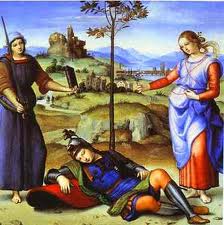
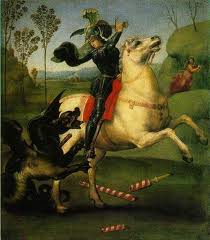
    In another lesson he studied Raphael's "The Knight's Dream" and discussed color, detail, and symbolism, as well as locating the painting in space and time on a historical map.   Raphael's "St. George and the Dragon" was studied and compared to "The Knight's Dream."  

    Images    Images-1

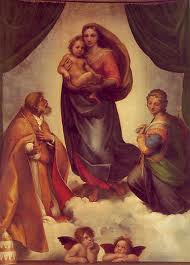
    Raphael's "The Sistine Madonna" was studied and used to discuss technique, symbolism, development, and the idea of painting "things unseen." 

    Images-2

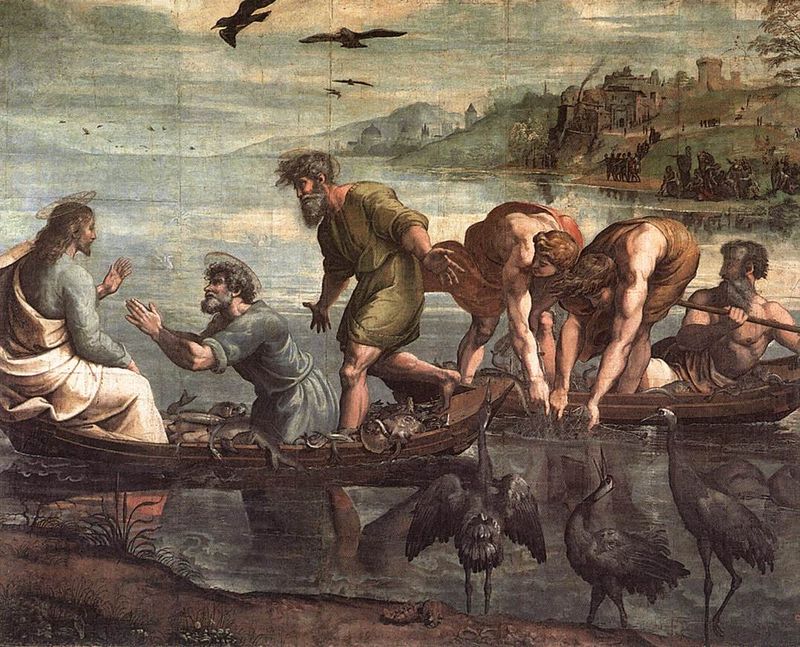
    Raphael's "Miraculous Draft of Fishes" was studied along with the story from chapter 5 of the Gospel of Luke.  

    Raphael,-The-Miraculous-Draught-of-Fishes,-1515

    In Music Theory, the seven-year-old reviewed the names of the notes over two octaves, both on a keyboard and on the staff, and then began a study of intervals.  First he learned to identify 2nds and 3rds by written notes, on a keyboard, and by ear.  Then he learned to identify the second through seventh intervals.  He and other children learned to circle-sing thirds on a mock piano keyboard.  They played "Guess the Interval" with a bell set and a piano.  They learned to sing second through seventh intervals on C major.  

    Um.  I didn't have much to do with this.  Art appreciation and music theory is what Hannah does while I am teaching Latin and history to bigger kids.   Reading this over I am blinking and thinking:  Really?  My seven-year-old?  

    And:  We managed that and we managed to feed them lunch twice a week?

    I sincerely hope she is as impressed with what I taught her kids as I am with what she taught mine!


  • Teething.

    Photo on 2011-06-16 at 17.41

    Not much more to say about this one.


  • Slow posting.

    This is just a placeholder post while I finish my coffee before running upstairs to haul children out of bed.

    + + +

    It's sort of our first week of summer.  I say "sort of" because we actually have one school-week left, which we're doing next week.

    + + +

    It's the time of year where as you drive around town you see big lawn signs out front of all the Protestant churches announcing "Kids Adventure Camp!" or "Jump Into Summer Fun Week!"  When I was little, I am pretty sure they called it Vacation Bible School.  I think they still call it that ("vee bee ess") out loud, but it does not appear on the lawn signs anymore.  

    My kids are going to a VBS camp entitled "Immaculate Mary:  The Story of Saint Bernadette and Our Lady Of Lourdes!"

    (I love our parish DRE.)

    We don't have a lawn sign.  Maybe we should.  Except then the camp might fill up even faster than it already does.

    + + +

    I'm volunteering in the nursery this year.  Margaret took a good picture of me with my coffee and the other nursery volunteers.  I don't photograph particularly well so I'll link to this one because I like it.   She's a good photographer, or at least she has a damn good camera.

    +  + +

    We are having a very dental week.   The seven-year-old needs a filling, the four-year-old has an abscess and needs an extraction, the sixteen-month-old is screaming teething on two sides all night long, and the ten-year-old — about whom the dentist announced to us, "This kid is never going to have a cavity, count your blessings"   — has an orthodontia consultation this afternoon.  Here's hoping the outlook is sunny there.


    (UPDATE:  Braces are not in our imminent future but will remain an option farther down the road, and probably a minor option at that.  So.  Good.  But.  This poor teething baby is SO NOT HAPPY.  I think we'll be exercising the "quesadillas for dinner" option.)

    + + +

    OK, coffee cup's empty.  I've got some good homeschooling posts in the queue, I think — my internet-safety lesson for middle schoolers, and I'm almost done collating the information for my three-year literature-based American history curriculum, which I'm gonna put up free of charge.

    But somewhere in there I plan to head out to the playground.

    Have a great day!


  • Messy piles for efficient storage.

    A few days ago I wrote about how I discovered that stacks of disorganized files, despite being ugly, can actually be an efficient way of dealing with many kinds of household paper records.    They cost time in file-retrieval, but they save time in file-storage (since you don't have to take much time making folders and putting them in the right spots).  This kind of storage is only appropriate if the piles stay where you put them, and if it's much more important that you be able to easily put files away than that you be able to easily retrieve them that is, if it's okay if it takes you a while to find what you're looking for as long as you know it's in there somewhere.

    In this post, I write about how I changed paper-storage in my schoolroom to exploit this principle:  How can I best use messy piles as quick, safe storage?

    + + +

    The whole concept is counterintuitive — we assume that a system must be tidy to be efficient, and conversely, that tidying will make us efficient.  But tidiness takes work.   Whether that work pays off depends on how much time you can afford to spend putting something away, how long you expect to store it before the next time you need it, and on how much time you can afford to spend locating and retrieving it.

    Lots of homeschool items must be kept safe.  The law requires me to keep copies of certain forms; I want to preserve a "portfolio" of each child's selected artwork and writings; I must keep and add to the current year's school records, aka "grades"; I already printed up some worksheets and I want to assign them in a few days.  I also have to promptly put up certain dangerous tools like the hot glue gun and the craft knife.  But only sometimes do I have the leisure to carefully store files and tools away in an organized system.  And only some of these things need to be kept close at hand.

    So let's look at the different categories of "kept items" for the homeschool. 

    • I have time to store it carefully, and I need to find it quickly
    • I have time to store it carefully, but I don't need to find it quickly
    • I don't have time to store it carefully, and I don't need to find it quickly
    • I don't have time to store it carefully, but I need to find it quickly

    Things I probably have time to store carefully away in a file, and might need to find quickly:  vaccination records, other medical records, annual reporting forms, the results from the standardized testing.  

    The reason I have time to put these away properly is because I don't deal with them every day.  I only generate them once or a couple of times a year, and that's enough of a special occasion that I'm willing to take the time to file.    For these, I keep a small box of hanging files.

      DSCN0929


    + + +

    Things I have time to put away at my leisure, and can take my time finding:  curricula that I'm done with for now but might use again.  I keep this stuff in a storage area in the basement, in big bins on big shelves, along with the camping gear and Christmas decorations.

      DSCN0932

    + + +

    Things I don't have time to put away carefully, but that I want to keep for a long time, and probably won't need to find quickly:  selected work to archive permanently, and the records of what we did every day (the "lesson plans/grade books").  For these I have a two-stage system.   I keep one magazine file for each child, labeled "Records," close at hand on an upper shelf of a bookcase in my school room.   

      DSCN0933 <–closeup       …….. DSCN0935

    When I select some child's artwork for his "portfolio," I stow it in the appropriate magazine file.  I also drop daily and weekly records and grades, some assessments, and other things in these files as they are generated.   Then, when the magazine file is full or the year comes to an end, I transfer the material to one of the labeled bins in the basement storage area.

    ….eventual destination–>  DSCN0931

     (I don't have much space in my schoolroom, so I don't save everything; a lot of stuff gets tossed instead of stowed in the portfolio file.  A person with enough room for a big bin might save everything, let it incubate all year, and cull it at the end.  There are some advantages to this idea, but as I said, I don't have enough space to save everything, so I don't.)

    + + +

     Things I don't have time to put away carefully, but that I will need pretty soon, and won't want to spend time searching for:  schoolwork sheets that I'm preparing and assembling for upcoming lessons; schoolwork that's partly done and needs to be worked on again; finished work I need to go over again with the children; library books.  

    Much of the material we use daily — the self-contained textbooks and workbooks — are kept in each child's desk drawers.  Basically, if it's all bound up nicely so a child can care for it easily, it lives in their desks.

      DSCN0937 … spiral-bound or tear-off math booksDSCN0938 … spiral-bound  handwriting and art


    But for other subjects, I seem to need to temporarily store a lot of loose paper during school planning or between assignments.  History, for example, with all the maps, or Latin, because I often make up translation worksheets.   For these I use stacking plastic in-baskets, one for each subject that takes a lot of paper to prepare to teach, especially paper that I need to keep on hand for a few weeks and use intermittently.    Some subjects get their own stack box, and then I try to have a "misc." stack basket as well. 

    DSCN0936 … always keep a baby spork handy


      The stack boxes are only for loose paper (and sometimes for small books) –  books, being reference materials, are shelved normally, and I mostly try to use binders, not for filing, but for keeping papers together that are supposed to stay that way.  Pseudo-books.  I try to keep library books in a basket unto themselves, but I won't deny that they often wander off to a child's bedroom.  


    (A side note:  If you've ever used David Allen's productivity system, Getting Things Done — or GTD as it's often called — you might recognize that the stack-baskets function as context-specific lists of action items, where the context of one basket is @planning history and the context of another is @planning Latin.  I can only concentrate on one subject at a time, so each one may as well be its own context, right up there with @calls and @computer and @home and @errands.)


    It's true that within a stack basket, the papers are disorganized.  I have to shuffle through them to find the exact one I want.  But it's a manageably-sized pile, and — most importantly — it is very quick to put something away in there.  Much quicker than filing it, or even than hole-punching it and putting it in a binder.   I don't have to think, "Argh — got to file this — oh well, I'll get to it later" and leave it on the counter where something might happen to it.  I can just stick it in the appropriate basket, and trust that it will still be there when I need it the next day or the next week.

    What goes in these boxes in your diagram?

    0613111447-00