bearing blog


bear – ing n 1  the manner in which one comports oneself;  2  the act, power, or time of bringing forth offspring or fruit; 3 a machine part in which another part turns [a journal ~];  pl comprehension of one’s position, environment, or situation;   5  the act of moving while supporting the weight of something [the ~ of the cross].


  • “The Chaos” by Gerard Nolst Trenité.

    One of my Facebook friends posted a bit of clickbait that was headlined, "If You Can Pronounce Every Word In This Poem, You Will Be Speaking English Better Than 90% Of The English Speaking Population."  He apologized for the stupid headline but praised the poem's "nerdy fun."

    I recognized the poem on the other end of the line (see end of this post for the full poem).   It had been republished on the clickbait site with a few misspellings and deletions and (what is much more irritating) without any attribution of the author.  

    You may have seen this poem before.  It's very long, not exactly literary, but cleverly constructed out of a large number of word-pairs (and occasionally triplets) that illustrate the crazyquilt that is English spelling and pronunciation.  It begins, 

    Dearest creature in creation
    Studying English pronunciation,
       I will teach you in my verse
       Sounds like corpsecorpshorse and worse.

    and it continues on through

    Ricocheted and crochetingcroquet?
    Right! Your pronunciation's OK.
       Roundedwoundedgrieve and sieve,
       Friend and fiendalive and live….

    The lack of attribution made me want to know more about the author, so I googled and found this short article about him, which appeared in the Journal of the Simplified Spelling Society in 1994.  His name is Gerard Nolst Trenité; he was a Dutch schoolteacher, author, and columnist with an interest in linguistics.

    The first known version of "The Chaos" appeared as an appendix (Aanhangsel) to the 4th edition of Nolst Trenité's schoolbook Drop Your Foreign Accent: engelsche uitspraakoefeningen (Haarlem: H D Tjeenk Willink & Zoon, 1920). The book itself naturally used the Dutch spelling current before the 1947 reform (see JSSS 1987/2, pp14-16). That first version of the poem is entitled "De Chaos," and gives words with problematic spellings in italics, but it has only 146 lines, compared with the 274 lines we now give (four more than in our 1986 version). The general importance of Drop Your Foreign Accent is clear from the number of editions it went through, from the first (without the poem) in 1909, to a posthumous 11th revised edition in 1961. The last edition to appear during the author's life was the 7th (1944), by which time the poem had nearly doubled its original length. It is not surprising, in view of the numerous editions and the poem's steady expansion, that so many different versions have been in circulation in so many different countries.

    The Chaos represents a virtuoso feat of composition, a mammoth catalogue of about 800 of the most notorious irregularities of traditional English orthography, skilfully versified (if with a few awkward lines) into couplets with alternating feminine and masculine rhymes. The selection of examples now appears somewhat dated, as do a few of their pronunciations, indeed a few words may even be unknown to today's readers (how many will know what a "studding-sail" is, or that its nautical pronunciation is "stunsail"?), and not every rhyme will immediately "click" ("grits" for "groats"?); but the overwhelming bulk of the poem represents as valid an indictment of the chaos of English spelling as it ever did. Who the "dearest creature in creation" addressed in the first line, also addressed as "Susy" in line 5, might have been is unknown, though a mimeographed version of the poem in Harry Cohen's possession is dedicated to "Miss Susanne Delacruix, Paris". Presumably she was one of Nolst Trenité's students.

    Readers will notice that The Chaos is written from the viewpoint of the foreign learner of English: it is not so much the spelling as such that is lamented, as the fact that the poor learner can never tell how to pronounce words encountered in writing (the poem was, after all, appended to a book of pronunciation exercises). With English today the prime language of international communication, this unpredictability of symbol-sound correspond-ence constitutes no less of a problem than the unpredictability of sound-symbol correspondence which is so bewailed by native speakers of English. Nevertheless, many native English-speaking readers will find the poem a revelation: the juxtaposition of so many differently pronounced parallel spellings brings home the sheer illogicality of the writing system in countless instances that such readers may have never previously noticed.

    As I said, I've encountered it before.  Some notes:

    • I find that it's very hard to read aloud, even though I know how to pronounce most of the words.  For example, in the company of "finger," "ginger," and "linger," I keep wanting to pronounce "singer" with a hard G ("sing-ger.")
    • The poem incorporates British standards of pronunciation and spelling.  The British spellings are obvious on a visual read of the poem; the expectations of pronunciation don't always make themselves known until the reader tries to recite them.  For example,

    Is your r correct in higher?
    Keats asserts it rhymes Thalia.

    and

    Muscle, muscular, gaol, iron,
    Timber, climber, bullion, lion,

    and

    Sounds like pores, pause, pours and paws,
       Rhyming with the pronoun yours;

    • I'll bet, however, that even most quite-literate English-speaking people encountering the poem will learn something new.  As for me, I was not aware that the word "victuals" is, in fact, pronounced "vittles."  I knew that "vittles" was a dialect spelling of the word "victuals"; it's pretty common in printed dialogue in American literature (Twain puts it in Tom Sawyer's mouth in Huckleberry Finn).  But I had always assumed it was a dialect pronunciation as well, and that somewhere, someone was talking about the fine "vic-tu-als" that had been set out for their afternoon tea.

    Here's the full text.  Do you learn something new from it?  What lines twist your tongue?

    ___

    "The Chaos"

    by Gerard Nolst Trenité

    Dearest creature in creation
    Studying English pronunciation,
       I will teach you in my verse
       Sounds like corpsecorpshorse and worse.

    I will keep you, Susybusy,
    Make your head with heat grow dizzy;
       Tear in eye, your dress you'll tear;
       Queer, fair seerhear my prayer.

    Pray, console your loving poet,
    Make my coat look new, dear, sew it!
       Just compare hearthear and heard,
       Dies and dietlord and word.

    Sword and swardretain and Britain
    (Mind the latter how it's written).
       Made has not the sound of bade,
       Saysaidpaypaidlaid but plaid.

    Now I surely will not plague you
    With such words as vague and ague,
       But be careful how you speak,
       Say: gush, bush, steak, streak, break, bleak ,

    Previous, precious, fuchsia, via
    Recipe, pipe, studding-sail, choir;
       Wovenovenhow and low,
       Scriptreceiptshoepoemtoe.

    Say, expecting fraud and trickery:
    Daughterlaughter and Terpsichore,
       Branch, ranch, measlestopsailsaisles,
       Missilessimilesreviles.

    Whollyhollysignalsigning,
    Sameexamining, but mining,
       Scholarvicar, and cigar,
       Solarmicawar and far.

    From "desire": desirableadmirable from "admire",
    Lumberplumberbier, but brier,
       Topshambroughamrenown, but known,
       Knowledgedonelonegonenonetone,

    OneanemoneBalmoral,
    Kitchenlichenlaundrylaurel.
       GertrudeGermanwind and wind,
       Beau, kind, kindred, queuemankind,

    Tortoiseturquoisechamois-leather,
    Reading, Readingheathenheather.
       This phonetic labyrinth
       Gives mossgrossbrookbroochninthplinth.

    Have you ever yet endeavoured
    To pronounce revered and severed,
       Demon, lemon, ghoul, foul, soul,
       Peter, petrol and patrol?

    Billet does not end like ballet;
    Bouquetwalletmalletchalet.
       Blood and flood are not like food,
       Nor is mould like should and would.

    Banquet is not nearly parquet,
    Which exactly rhymes with khaki.
       Discountviscountload and broad,
       Toward, to forward, to reward,

    Ricocheted and crochetingcroquet?
    Right! Your pronunciation's OK.
       Roundedwoundedgrieve and sieve,
       Friend and fiendalive and live.

    Is your r correct in higher?
    Keats asserts it rhymes Thalia.
       Hugh, but hug, and hood, but hoot,
       Buoyantminute, but minute.

    Say abscission with precision,
    Now: position and transition;
       Would it tally with my rhyme
       If I mentioned paradigm?

    Twopence, threepence, tease are easy,
    But cease, crease, grease and greasy?
       Cornice, nice, valise, revise,
       Rabies, but lullabies.

    Of such puzzling words as nauseous,
    Rhyming well with cautious, tortious,
       You'll envelop lists, I hope,
       In a linen envelope.

    Would you like some more? You'll have it!
    Affidavit, David, davit.
       To abjure, to perjureSheik
       Does not sound like Czech but ache.

    Libertylibraryheave and heaven,
    Rachellochmoustacheeleven.
       We say hallowed, but allowed,
       Peopleleopardtowed but vowed.

    Mark the difference, moreover,
    Between moverploverDover.
       Leechesbreecheswiseprecise,
       Chalice, but police and lice,

    Camelconstableunstable,
    Principledisciplelabel.
       Petalpenal, and canal,
       Waitsurmiseplaitpromisepal,

    SuitsuiteruinCircuitconduit
    Rhyme with "shirk it" and "beyond it",
       But it is not hard to tell
       Why it's pallmall, but Pall Mall.

    Musclemusculargaoliron,
    Timberclimberbullionlion,
       Worm and stormchaisechaoschair,
       Senatorspectatormayor,

    Ivyprivyfamousclamour
    Has the a of drachm and hammer.
       Pussyhussy and possess,
       Desert, but desertaddress.

    Golfwolfcountenancelieutenants
    Hoist in lieu of flags left pennants.
       Courier, courtier, tombbombcomb,
       Cow, but Cowper, some and home.

    "Solder, soldier! Blood is thicker",
    Quoth he, "than liqueur or liquor",
       Making, it is sad but true,
       In bravado, much ado.

    Stranger does not rhyme with anger,
    Neither does devour with clangour.
       Pilot, pivot, gaunt, but aunt,
       Fontfrontwontwantgrand and grant.

    Arsenic, specific, scenic,
    Relic, rhetoric, hygienic.
       Gooseberry, goose, and close, but close,
       Paradise, rise, rose, and dose.

    Say inveigh, neigh, but inveigle,
    Make the latter rhyme with eagle.
       MindMeandering but mean,
       Valentine and magazine.

    And I bet you, dear, a penny,
    You say mani-(fold) like many,
       Which is wrong. Say rapier, pier,
       Tier (one who ties), but tier.

    Arch, archangel; pray, does erring
    Rhyme with herring or with stirring?
       Prison, bison, treasure trove,
       Treason, hover, cover, cove,

    Perseverance, severanceRibald
    Rhymes (but piebald doesn't) with nibbled.
       Phaeton, paean, gnat, ghat, gnaw,
       Lien, psychic, shone, bone, pshaw.

    Don't be down, my own, but rough it,
    And distinguish buffetbuffet;
       Brood, stood, roof, rook, school, wool, boon,
       Worcester, Boleyn, to impugn.

    Say in sounds correct and sterling
    Hearse, hear, hearken, year and yearling.
       Evil, devil, mezzotint,
       Mind the z! (A gentle hint.)

    Now you need not pay attention
    To such sounds as I don't mention,
       Sounds like pores, pause, pours and paws,
       Rhyming with the pronoun yours;

    Nor are proper names included,
    Though I often heard, as you did,
       Funny rhymes to unicorn,
       Yes, you know them, Vaughan and Strachan.

    No, my maiden, coy and comely,
    I don't want to speak of Cholmondeley.
       No. Yet Froude compared with proud
       Is no better than McLeod.

    But mind trivial and vial,
    Tripod, menial, denial,
       Troll and trolleyrealm and ream,
       Schedule, mischief, schism, and scheme.

    Argil, gill, Argyll, gill. Surely
    May be made to rhyme with Raleigh,
       But you're not supposed to say
       Piquet rhymes with sobriquet.

    Had this invalid invalid
    Worthless documents? How pallid,
       How uncouth he, couchant, looked,
       When for Portsmouth I had booked!

    Zeus, Thebes, Thales, Aphrodite,
    Paramour, enamoured, flighty,
       Episodes, antipodes,
       Acquiesce, and obsequies.

    Please don't monkey with the geyser,
    Don't peel 'taters with my razor,
       Rather say in accents pure:
       Nature, stature and mature.

    Pious, impious, limb, climb, glumly,
    Worsted, worsted, crumbly, dumbly,
       Conquer, conquest, vase, phase, fan,
       Wan, sedan and artisan.

    The th will surely trouble you
    More than rch or w.
       Say then these phonetic gems:
       Thomas, thyme, Theresa, Thames.

    Thompson, Chatham, Waltham, Streatham,
    There are more but I forget 'em
       Wait! I've got it: Anthony,
       Lighten your anxiety.

    The archaic word albeit
    Does not rhyme with eight-you see it;
       With and forthwith, one has voice,
       One has not, you make your choice.

    Shoes, goes, does *. Now first say: finger;
    Then say: singer, ginger, linger.
       Realzealmauve, gauze and gauge,
       Marriagefoliagemirageage,

    Hero, heron, query, very,
    Parry, tarry fury, bury,
       Dostlostpost, and dothclothloth,
       JobJobblossombosomoath.

    Faugh, oppugnant, keen oppugners,
    Bowingbowing, banjo-tuners
       Holm you know, but noes, canoes,
       Puisnetruismuse, to use?

    Though the difference seems little,
    We say actual, but victual,
       SeatsweatchastecasteLeigheightheight,
       Putnutgranite, and unite.

    Reefer does not rhyme with deafer,
    Feoffer does, and zephyrheifer.
       DullbullGeoffreyGeorgeatelate,
       Hintpintsenate, but sedate.

    GaelicArabicpacific,
    Scienceconsciencescientific;
       Tour, but our, dour, succourfour,
       Gasalas, and Arkansas.

    Say manoeuvre, yacht and vomit,
    Next omit, which differs from it
       Bona fide, alibi
       Gyrate, dowry and awry.

    Seaideaguineaarea,
    PsalmMaria, but malaria.
       Youthsouthsoutherncleanse and clean,
       Doctrineturpentinemarine.

    Compare alien with Italian,
    Dandelion with battalion,
       Rally with allyyeaye,
       EyeIayayewheykeyquay!

    Say aver, but everfever,
    Neitherleisureskeinreceiver.
       Never guess-it is not safe,
       We say calvesvalveshalf, but Ralf.

    Starry, granarycanary,
    Crevice, but device, and eyrie,
       Face, but preface, then grimace,
       Phlegmphlegmaticassglassbass.

    Basslargetargetgingiveverging,
    Oughtoust, joust, and scour, but scourging;
       Ear, but earn; and ere and tear
       Do not rhyme with here but heir.

    Mind the o of off and often
    Which may be pronounced as orphan,
       With the sound of saw and sauce;
       Also soft, lost, cloth and cross.

    Pudding, puddle, puttingPutting?
    Yes: at golf it rhymes with shutting.
       Respite, spite, consent, resent.
       Liable, but Parliament.

    Seven is right, but so is even,
    HyphenroughennephewStephen,
       Monkeydonkeyclerk and jerk,
       Aspgraspwaspdemesnecorkwork.

    A of valour, vapid vapour,
    S of news (compare newspaper),
       G of gibbet, gibbon, gist,
       I of antichrist and grist,

    Differ like diverse and divers,
    Rivers, strivers, shivers, fivers.
       Once, but nonce, toll, doll, but roll,
       Polish, Polish, poll and poll.

    Pronunciation-think of Psyche!-
    Is a paling, stout and spiky.
       Won't it make you lose your wits
       Writing groats and saying "grits"?

    It's a dark abyss or tunnel
    Strewn with stones like rowlockgunwale,
       Islington, and Isle of Wight,
       Housewifeverdict and indict.

    Don't you think so, reader, rather,
    Saying latherbatherfather?
       Finally, which rhymes with enough,
       Thoughthroughboughcoughhoughsough, tough??

    Hiccough has the sound of sup
    My advice is: GIVE IT UP!

    ___


  • First Holy Communion.

    Wait a minute… didn’t I just write a post about her baptism?

    That was then…

    …this is now:

    After my coffee, I went into her room in the morning to wake her up. She was all alone in the double bed she shares with her next younger brother; he had come into our room in the night. I still had my pajamas on, so I crawled into bed next to her and put my arms around her. She turned over sleepily and murmured, “Today seems too good to be true.”

    Here is what I want to remember:

    Buckling the tiny ankle straps of her shoes for her.

    Arriving early and stopping in the adoration chapel for a moment. I thought for sure that there would be other children with parents in there, but there were only a couple of regular adorers and a visiting priest (probably a relative of one of the first communicants, come to concelebrate). And then I thought, they will look at us and smile; but none did, all stayed lost in prayer as if we were not there. So I felt as if I was in a safe cocoon of solitude as I knelt and waited for my daughter to make her little benison, whatever it was, and said my own prayer.

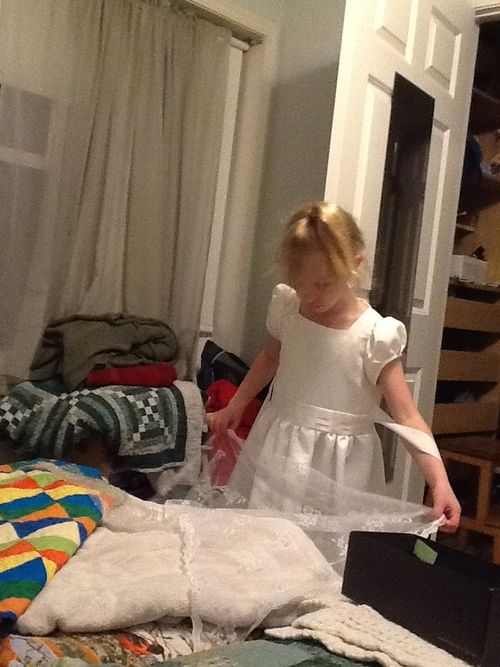
    Snapping the picture above, inside the elevator on the way down to the church basement.

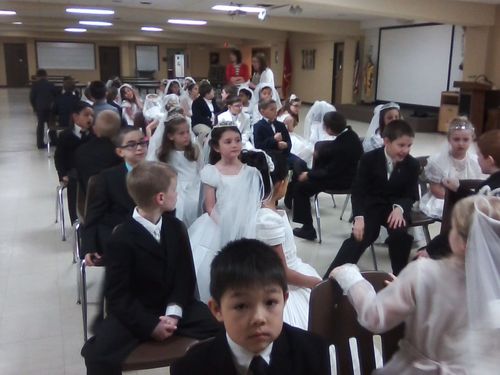
    Finding her seat, one of forty-four children receiving first Eucharist.

    Taking too many pictures, I guess.

    A crowd of chattering children, however attractively dressed, however sweet, is just a crowd of children… until you are a mother and it is a crowd that contains your own particular child.

    Then wherever she is, there is a center, somewhere, and it draws you.


    At the last minute before I went up she said suddenly, “I don’t want you to go!” and clutched at me, impulsively. I didn’t know what else to do, so I prayed a Hail Mary over her, kissed her hair, and went to go.

    On the way out she had disappeared in the crowd.


    We were assigned (by lot) a pew in the back, so I caught only a glimpse of her veil and a glint from her hair as she trotted by during the procession.

    The pastor said to us in the congregation: think back to the innocence of our own first communions, and pray to recapture it. “Have to go back a long way,” said an elderly man seated behind me, and his wife chuckled softly. And my mouth turned up in a little smile, because I had made my first communion at age eighteen. My husband, now on the opposite end of the pew so he could take pictures of our daughter, had been there for my first communion too, in a time before cell-phone cameras. We had been dating about six months then.

    I was on the wrong side of the church to get a good picture. I prefer not to watch my family’s big moments through a camera screen. I tried to get both: a quick picture and a glance. I saw her upturned chin, her standing and turning. She caught my eye and I smiled.

    At our parish, altar boys who are brothers of first communicants get to assist at the moment their sibling receives. Her two older brothers (along with three other pairs of brothers) had to play rock-paper-scissors in the sacristy to find out which one would get to hold the paten for her. The ten-year-old won. She complained later that he poked her too hard with it.

    Even though I didn’t get a good view, I feel good that her two big brothers did.

    Afterward, there were more pictures, then pizza and egg rolls with family and friends. She spent most of the rest of the day sitting on the porch with her best friend. The sun came out for us. In the evening, a walk to the park to play Frisbee with her dad and grandpa.

    A beautiful day.


  • Differences in the mirror.

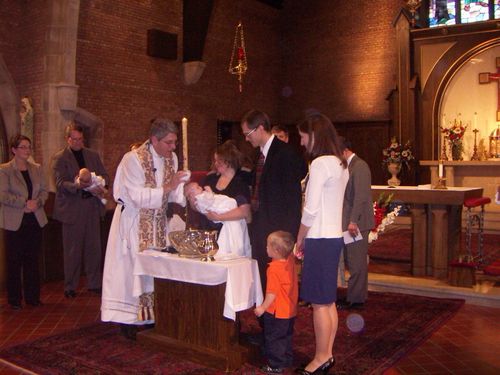
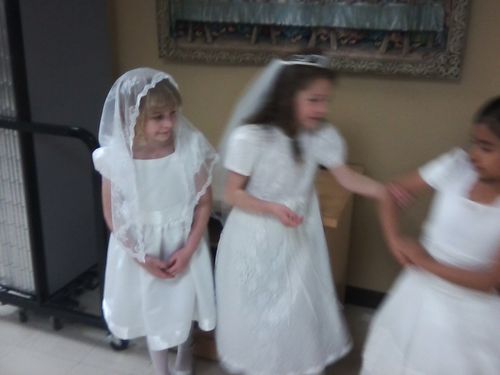
    My daughter's First Holy Communon will be this morning.  

    My intention?  Besides all the usual ones, that I don't let my hurry-up-and-don't-be-late demeanor, business as usual on any school day, show quite so much.  It's a special day.  It should feel like one.

    + + +

    Mothering a little girl can seem so different from mothering a little boy, especially through the milestones.  For instance, this never happened on the eves of my older sons' First Holy Communions:

    10313824_4117732439750_2213791160193177443_n

    10389974_4117732479751_5603277307160717706_n


    10322772_4117731679731_522287758506997969_n


    10325208_4117732319747_1095638070525121391_n

    10380961_4117734479801_6980657475478680932_n


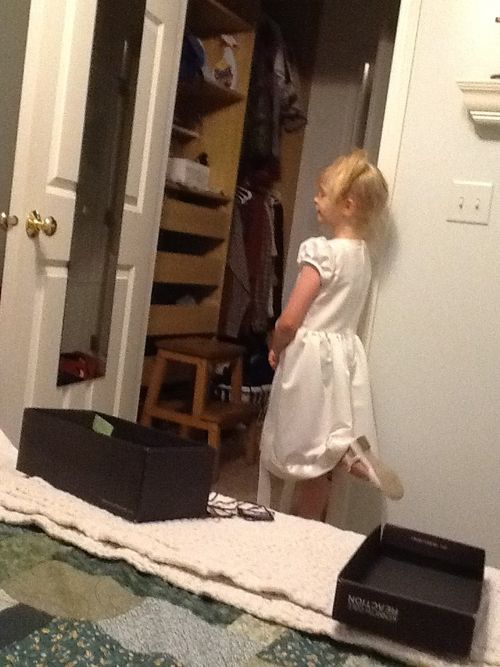
    You try not to make it all about the dress and the veil and the shoes.  You really, really try.  

    (Check out that little foot kicking up so she can admire her shoes, the ribbon trim on which matches the dress Grandma made perfectly.)

    + + +

    This is not, of course, entirely anyway, a Boy vs. Girl thing.  They are all individuals with personalities of their own.  Surely some boys would be too eager to wait to check out themselves, looking like Dad in a real necktie and shiny shoes, and who would be sure to try it all on the night before just to make sure it will all go together right.  

    And I know darn well there are many girls who won't be able to wait to get out of their scratchy, stiff dress and back into their jammies so they can eat pizza back home, the shiny shoes kicked into a corner without a thought except when she reaches down absentmindedly  a week later to pick at the blister on her little toe.

    But you know, when we look back at them, we can't help ourselves from projecting what's inside of us.  

    (I know, I don't speak for everyone.)

    Sons and daughters make us feel… differently, don't they?  I think when we watch our sons play and our daughters play, we say to ourselves "Boys and girls are so different, it's true!" and a lot of the time (not all of the time) they aren't actually doing anything all that different, certainly not Representative Of Their Respective Classes, but we the watchers overlay our own interpretations on them.  

    She does X and her brother did Y when he was that age; boys and girls are so different!

    (I wonder if it's worse for kids who grow up with exactly one sibling of the opposite sex:  if they end up, by default, being the sole Representative of Their Class.  Having four boys gives me a chance to see up close some — a tiny fraction — of the many different ways there are to be a boy.)

    The interpretations we project don't have to be the traditional ones — boys with their trucks and girls with their dolls, athletic boys and bookish girls, the "tomboy" trope.  They can be the pressures to rail against traditional constraints; we feel those pressures differently for sons and for daughters.  Since each of us parents is an individual, the spin we put on "raising boys is different from raising girls" is individual; but we all have that spin, I think.  

    Maybe it would be better simply to note that "raising Jack is different from raising Jane."  It would certainly be safer to mix it up a bit.  No kid should be made to feel that they have to be a representative of their class all the time.  

    More importantly:  being a girl, or being a boy, is part of each child's identity, and that identity is unique.  They should get to figure out how they live out femininity and masculinity, how it's expressed uniquely in their own personalities.  I'm not sure how best to encourage that, but it's a goal.

    + + +

    Later today, my girl gets her first taste of the mystery of being doubly feminine, of being a part of the Bride of Christ.  

    There's no escaping that she lives this mystery differently from the boys. Where she and her companions in their white dresses and veils are a sign of fittingness, the little boys in their blazers and suits today must be  a sort of a sign of contradiction, a masculinity that must become receptive to the life Christ offers as free gift to us.   

    Equal, yet living out the gift they receive in purely individual ways.  

    Time to get dressed, beloved.


  • Ramping up and focusing on what’s mine.

    Now that May has rolled around again, I am already turning my thoughts toward the next school year.  

    0509141419-01

    To be honest, I've kind of given up on this one.  

    0509141419-00

    After the baby was born at Christmastime, and then H.'s twins in February, and then some drastic changes in plans for our friends in the other family we co-school with —

    it became pretty clear that we were not going to finish out the year as planned.

    This happens a lot in home schools, when babies are born.

    So instead we have turned to a sort of schooling that I think of as "rehearsal for next year."    The big changes have already come.  Now we can try to get used to them, and work around them.

    + + +

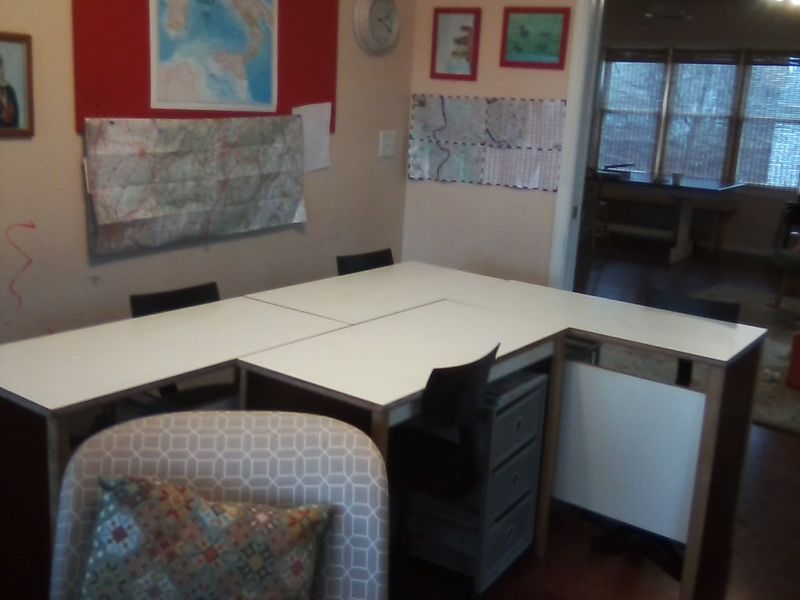
    Those pictures up above are my new schoolroom layout.  I think I've finally found the best desk arrangement for the space.  I don't know why it took me so long to come up with it, other than I have been stuck inside the "rectangle" box.  

    • The extra space it creates in the corner by the windows gives me enough room to put a bassinet (or later, a playpen type thing, maybe).  
    • Students sitting in three of the desks can see the dry-erase board, and all four of them can see the windows, which I sometimes use as a dry-erase surface.  
    • The easy chair can be turned to face the desks, so a nursing mom can sit while teaching.
    • My seven- and ten-year-olds can be seated out of arms' reach of one another.

    + + +

    H. and I have been getting together to teach for a little while, once or twice a week, only for half days.  I re-started teaching geometry first, a double lesson once a week; then H. began working on English literature again.   That's kind of our limit for now; Latin is on hiatus.  We'll return to a simplified, but complete, schedule in the fall for our oldests' ninth grade year.

    Yesterday was the first time H. came to my house since the twins were born.  I cleaned up an old bassinet for the occasion, the one I kept in my office when I had my first baby while I was in grad school.  H. brought a portable one and added that to another portable one that I had set up in the living room.

    Photo on 5-8-14 at 12

    (Action shot:  nursing singleton in the foreground, diaper changing twins in the background.)

    H. arrived around eleven; we had a cup of coffee together; I taught geometry for 45 minutes; lunch (turkey sandwiches) was served by our daughters; then I worked on next year's curricula while H. taught language arts, and then we had tea.  

    The weather turned poor, so H. stayed to share in our pizza dinner while waiting out the storm.  A good day.  I think we're going to be able to make it work pretty well, and believe me, ramping back up slowly is a big part of that.

    + + +

    My house is beautifully clean, as clean as it gets, because the housecleaner just left.  I've decided that Every Three Weeks is the right frequency to get a deep cleaning, and the best way for it to happen is to hire someone else to do it.

     We all still have to work the night before to clear the floors and counters, make room in the laundry and so forth, so that we really get our money's worth.  But do the math:  it takes the housecleaner about four hours to vacuum, dust, scrub, and mop the house from top to bottom.

    Meanwhile, I teach a half day of school.  

    I resisted hiring outside help for a long time.    I finally started hiring cleaners after my now-four-year-old became a toddler.   It took me a while to get used to having some other person come into my home and clean my stuff, but now I'm sold on it.  The woman who comes in to clean now is the second regular housecleaner we have hired; the first was a young man who was wonderfully cheap — that's what finally convinced me to give outside help a try — but in the end could not keep his business afloat.  I pay more now, but since she really does a better job, I don't mind.

    I know plenty of homeschoolers prefer to save their money and put their kids to work instead.  I think this is largely a matter of choice. Yes, it's important to teach kids to care for a home, and so technically we could spend a half day or a full day on cleaning projects every month and it would still have educational value.  Yes, it's money that could be spent on other things.  I get that. 

    But specialization is not a bad thing.  We have the money, and I think it does good work when I spend it this way; it stays in our local economy, after all, and helps support another family.  She's faster than I would be, and definitely more thorough; while she was here, I was supervising math and oil painting.   And (unlike when the kids help me clean) I didn't feel the need to yell at anyone, so the money bought me a measure of emotional peace as well.  

    I've definitely figured out that next year, my duties have to be streamlined if I want to do them well.  

    + + +

    H. is making some similar changes, at least temporarily while the twins are small.  She laughs about how everything comes on a truck now:  clean cloth diapers arrive (and dirty ones leave); groceries come in a truck; clothes for the children, school supplies, everything.  Errand-running had to be trimmed back to the absolute minimum, hence, no shopping in physical stores anymore.  

    Focus will be the watchword for next year.  Both of us need to focus our energies.  She, because she finds herself in such a rare and intense kind of parenting; me, because I'm always tempted to sprawl them all out onto everything except one-on-one connection with my children, and I sense that with the birth of my fifth child I have tipped past the point of being able to pretend I have a handle on everything and everyone.

    I can outsource the housecleaning.  I can outsource some of the teaching.  I can't outsource being wife and mother.  I have always known this, but it's finally sinking in.


  • First expansion of the token-for-chores system: Laundry.

    A couple of months ago I described my plan to use a token economy pour encourager les enfants to keep their rooms cleaner than they had been.  I reported some preliminary results in a subsequent post.

    Now the second month is drawing to a close.  Tomorrow I will count up the children's remaining tokens and issue allowance.  But I'm too curious to wait!  So I'm going to run upstairs right now and see how they did.

    [insert sound of me pounding up the stairs, a pause, and then the sound of my footsteps returning to the computer]

    Of the 30 tokens I put into their jars at the start of the month, assuming they keep their rooms clean tomorrow and don't lose one more:

    • My thirteen-year-old son has 28, and will receive $14 in allowance
    • My ten-year-old son has 21, and will receive $10.50
    • My seven-year-old daughter has 17, and will receive $8.50

    Meanwhile, even though they didn't all meet the standards I set every day —

    — and a reminder, the standards were "floor clean, covers pulled up, closet door shut" —

    every room was cleaner every day than it typically was before starting the system.  Before, we had periodic marathon room-cleaning sessions, one day before the paid housecleaner showed up for the monthly vacuuming.  

    So from my point of view, this system is a spectacular success.  I am doing almost zero nagging.  Once each day, I pop into their rooms for a check.  If I forget, they get to keep a token (so I'm not actually obligated to check).  

    + + +

    Only once did I use the promise of a token for something extra.  One day I needed the kitchen cleaned up really fast, so I challenged my two big boys to speed through it in under fifteen minutes and without complaining, with a promise of one previously-lost token returned to each of them if they could do it.

    They did.

    There's no way they would have done it if I'd said, "I'll pay you fifty cents."

    The psychology of gains and losses is very interesting.

    + + +

    My teenage boy still hates the system.  He explained to me this morning that it makes him feel sad and angry every single day to see his jar of tokens on his shelf.  He asked again if he couldn't start from zero and gain tokens, rather than starting from thirty and lose tokens.  "It feels like a punishment," he said, "instead of a payment."

    "I do pay you," I said, "at the end of the month, almost just like a paycheck works.  Think of the tokens as an easy way for me to keep track of what you are going to be paid for the work you do."  But he said the tokens were the same as money as far as he was concerned, and when I remove one it is like having his money taken away.

    I acknowledged that this system is probably not the best system to fit with his particular personality, but that I was going to keep it going for now because it was working pretty well for the family as a whole.  "It isn't perfect," I said.  "It will evolve and adjust as we all learn what works and what doesn't.  I will make changes to it.  But I am going to make the changes slowly.  This is a long-term project."

    + + +

    On Thursday we begin a new month, and the children will receive a refreshed jar of thirty tokens.  They will also become responsible for their own laundry.

    Now, Mark and I see eye-to-eye on most of the important issues that face today's married couples, but one of them is not "How To Tell If The Laundry Is Caught Up."   Therefore, I broached the subject with some trepidation, which turned out to be well-founded.  

    (I think the laundry is caught up if no baskets are actually overflowing with dirty laundry yet.  Mark will tell me if I have gotten this wrong, but my current understanding is that he thinks it is caught up if there is less than a full load of dirty laundry total in the entire house AND all the clean laundry is put away.)

    About thirty minutes later, we were ready to discuss the new laundry system for kids.  My teenage son also participated, strenuously insisting that it would be inappropriate to treat him exactly like his younger siblings, since he is already in the habit of putting clothes in the wash when he's about to run out.  After some discussion, we decided that he was correct, and modified the system accordingly.

    We made our plan based on the answer to the question, "What problems do I want this system to solve?"  

    + + + 

    Number one, I don't want to hear, "But I don't have any clean clothes!"  On Sunday morning, I want there to be clean clothes for church.  If there's a Scout or AHG meeting, I want each child to have a clean uniform.  If it's swimming lesson day, their towels and suits should be ready to go.  No one should run out of clean pants and shirts.

    Number two, I don't want clean clothes to accumulate in the laundry room.  We have room on the shelves and counter for about five baskets full of clean clothes.  Occasionally we will stack towers of clean baskets, but I don't like that because the dirty bottoms of the baskets sit on clean clothes.  Also, we risk losing items that fall behind the washer and dryer.  So five baskets is really the capacity.

    That's basically it.  I don't have high standards.  I just want the kids to make sure they don't run out of clothes, and I want them to keep moving items OUT of the laundry room as they move their clothes IN.

    + + +

    Today, two days before the month starts, we had a dry run.  I distributed to each child two brand-new square black laundry baskets, labeled with names.  And I pointed them to a brand-new sign posted in the laundry room, headed "Kids' Laundry Responsibilities."

    It said:


    Your clothes (uniforms, church outfits, etc.) clean when you need them (3 tokens)


    You may have 1 black basket of your clothes in this room at a time (1 token)


    In other words:  If ever they don't have the clothes that they need clean when they need them, they'll lose three of their tokens.   And, if ever I find more than one basketful of a particular child's clothes in the laundry room, he'll lose one token.

    There's more to this.  Such as, when must laundry be done?

    I am allowing my oldest to decide when he needs to put his laundry in; but the younger two, I expect I'll have to micromanage just a bit more to start with.  So for now, my daughter is required to wash her dirty clothes on Tuesday mornings, and my second son is required to wash his dirty clothes on Wednesday mornings.  Each of them pays a penalty of one token per day that the weekly load is delayed.  

    Once those younger kids are in the weekly laundry habit, I hope to lift the specific-day requirement.

    + + +

    It seems a bit too fussy for our family to insist that each person wash his own clothes, dry his own clothes, and then remove his own clothes from the laundry room and put them away.  We have one washer and one dryer, conveniently located on the same level with the bedrooms, and laundry is a continuous operation.  So instead, the ideal we've always had in mind is "one load in, one load out."

    Whoever wants to put a load into the washer mus first:  

    • make room for a new basket on the shelves by delivering at least one basket of clothes to the correct part of the house
    • move dry clothes from the dryer to a basket on the shelves
    • move wet clothes from the washer to the dryer, and start the dryer

    In this way, we are all helping each other get the laundry done.  But everyone has the responsibility of putting his own clothes into the system (and dealing with the basket of clean, dry clothes that he might find awaiting him on his bed at the end of the day).

    Now I just have to confer with my husband about whether to raise the value of a token along with the increased responsibility.  I'm inclined not to raise it until I find out how well they take on their new jobs.


  • “By means of images.”

    From today’s Office of Readings, the second reading, from the Jerusalem Catecheses:

    When we were baptized into Christ and clothed ourselves in him, we were transformed into the likeness of the Son of God. Having destined us to be his adopted sons, God gave us a likeness to Christ in his glory, and living as we do in communion with Christ, God’s anointed, we ourselves are rightly called “the anointed ones.” When he said: Do not touch my anointed ones, God was speaking of us.

    We became “the anointed ones” when we received the sign of the Holy Spirit. Indeed, everything took place in us by means of images, because we ourselves are images of Christ. Christ bathed in the river Jordan, imparting to its waters the fragrance of his divinity, and when he came up from them the Holy Spirit descended upon him, like resting upon like. So we also, after coming up from the sacred waters of baptism, were anointed with chrism, which signifies the Holy Spirit, by whom Christ was anointed and of whom blessed Isaiah prophesied in the name of the Lord: The Spirit of the Lord is upon me, because he has anointed me. He has sent me to preach good news to the poor.

    The bit that I have underlined is what struck me this morning.

    Sometimes I wonder where Western Civilization got the idea of reading so much into everything (and, I suppose, writing so much into everything). It reminds me of English class, sometimes, sifting through a novel or a poem, looking for this or that object that serves as a symbol or a totem. I remember in an essay in a college literature class, writing something about one character playing keepaway with another’s keys; a violation, I wrote, because the keys were “symbols of autonomy.” I remember students teasing one of my high school teachers as she tried to squeeze a little extra meaning out of the discarded fruit rinds being carted away on the mornings after Gatsby’s parties. The habit of looking for hidden meanings in the words and objects that we find in our books is one I enjoy, a bit of a game I play with an author (but be careful; some authors bite). Certain books yield up new shoots every year if we read them regularly, so we’ve learned.

    + + +

    In any case, we have these tools of literary analysis, and we are willing to use them even on fruit rinds, so by gosh we are going to use them on the Bible too, no? So, you see, when the Israelites passed dry shod through the sea, it was a kind of foreshadowing. All that bit with the scapegoat, too. And the Ark is a type of Mary, and that bit about the snake-crushing means that Mary is to be another Eve, and…

    Water. Oil. Fire. Snakes!

    Is it possible that we read the Old Testament a bit too much as we would read a modern novel? Do we come to it with a habit from English class? Is that really the right tool, or is it only the tool we have and therefore we wish to use it? Or is it that the notion of symbol and hidden meaning is common to both? Or is this literary habit something we inherit from an older tradition? Why should it be so?

    + + +

    Lines like the one I highlighted above, which date probably to the fourth century, reassure me a bit that we are still on track. Because I’m really confident in the idea that human beings are made “in the image of God,” and that we are meant to become images of God-in-flesh-made-manifest, of Christ. God made us to look a certain way — like an animal — but carry something unseen and intangible, yet real — intelligence, and will. We have meaning. Each of us looks like a thing but what each of us is, is a person.

    We do not look like gods, we are not gods, but we represent the God. We can do something that is like what a Creator does, in a smaller way; we also craft artifacts that bear meaning. For instance, we can assemble a pile of vegetable matter, clay, and blackened bits into something that tells a whole story to anyone who has time to curl up with it on a lazy afternoon. And we can tell the story too, and put into it shadowy people who represent real people, and pasteboard props (like keys, or fruit rinds) that represent real virtues or vices, and in the moving-about of these characters and props, transmit secret messages. Indeed we could have saved time by merely writing out the message; but where would have been the fun in that?

    And of course, when one remembers (in the middle of a blog post, say) that Jesus spoke in parables, one has another reason to have confidence in symbolic readings.

    If we are made an image, then we should be able to speak the language of image.

    How fun to think, reading over this, that we have such pasteboard props in our real, physical lives. We have water that looks like water, but when we put on a certain washing-up play with this water as a necessary prop, it enacts a real (though unseen) rebirth:


    This baptism is no removal of physical stain, but the pledge to God of an irreproachable conscience through the resurrection of Jesus Christ. (1 Peter — today’s first reading in the Office)

    The same with our oil, and our wine, and our bread.

    It’s because we are images that we make these transitions best by means of images, say the Jerusalem Catecheses. If nothing else, the materials of the sacraments provide us with a means of feeling confident that we have done, at least in this area, what God requires of us. They are a balm against the constant fear that we are not good enough to attain God’s mercy: of course we are not good enough, cannot make ourselves good enough, but we can do the things He has asked us to do as signs of our interior commitment — as a pledge — and we can trust in the promises He has made regarding them, not because we are good but because He is trustworthy, and he asks us to do no more than what we can do… which is to put on these little plays with intention to do His will.

    I like to think that the sets and the props and the scripts were carefully designed so that the hidden messages are passed onstage exactly the way they need to be passed in the unseen reality. Baptism requires water, and (crucial if you ask me) it requires one other person who need not himself be a baptized person; it is not possible, even in the direst of emergencies, for a person to baptize himself, but any other willing person can do it; the one to be baptized can even instruct his baptizer. Somehow this sacrament — which is the only method on earth by which we are permitted to feel sure we can enter heaven — requires two to be gathered together, and a few drops at least of a substance we cannot live without. Somehow, maybe, that kind of life is really — not just in the play — propagated only from human contact.


  • A new birth story. (A few months after the first draft disappeared.)

    I hope I never forget the last part.

    I have given birth five times now, and one thing I have noticed is how quickly the sensations fade from memory. Probably some protective evolutionary feature: I joke that if women did not forget the pain of labor, none of us would ever want another pregnancy. But it's true; it fades. Already it is hard for me to remember exactly what it felt like to be heavy and lumbering, even though the weight of a swollen abdomen was (must have been) the dominant sensation for months. Already it is hard to find the words to describe the pains of early and active labor, although they occupied all my attention at the time. Even the fear and worry that marked almost every moment of the last week of my pregnancy — even that has faded into the background, and what seemed so urgent now seems foolish, as if it was a foregone conclusion that all would end happily.

    I hope I never forget the last part.

    Because when the pushing force flooded me, I knew instantly that it would all be over soon, and it thrilled me. I stood, leaning on my fists on the children's bed in our room, gasped all I could ("Here we go…!"), and pushed. I don't remember (damn!) if I expended any conscious effort or if my body just took over, but I do remember that I felt the baby's head descending through me already, and I could tell it was moving fast and I was opening up, and that it would be only a moment.

    I didn't bother to warn anyone or to worry about catching. Two midwives were behind me somewhere, and one of them would catch. Mark seated on the bed, several feet away, watching but staying out of the way; three times we've had dystocia, this is what midwives are for.

    Three shoves. Down, and down, and… Out. No burning, no moment of crowning; the baby's head filled me, and then the sweet release; and the second thrill was to feel all the rest of him following, bumpety-bump, no sticking place at all, and despite all the other sounds in the room — the whir of the space heater, the shouts of children downstairs, the murmuring of the two midwives — I heard over all that the tiny gasp, the first breath, and it rang in my ears. And a moment later I held him in my arms, gasping myself:

    "You're… you're beautiful."

    + + +

    This story starts a week earlier, when I was waving goodbye to Mark and the bigger kids as they finished loading the minivan with skis and boots and helmets, headed to the local hill. I was not quite 36 weeks along, and as I turned to close the door, thinking about making a snack for my three-year-old, a gush of fluid soaked my pants.

    I opened the door, called to Mark: "Can you come back in for a few minutes?" And when he came back in: "I have to call the midwife. Because, um, I think my water just broke."

    + + +

    How to describe the week that followed… It is very hard now. Because now I know that the ending is good, that we stayed in my warm house, that he was born quickly, that he breathed. But then, I didn't know. When I was waiting for the midwife to call me back, going over the facts in my mind —

    — it isn't 36 weeks yet

    — that fluid coming out of me is definitely not urine

    — labor usually starts within 24 hours of membrane rupture

    — this baby is not ready yet. I am not ready yet

    — anytime after 34 weeks the standard medical advice post-rupture is to induce labor to avoid infection in the sac, and let the NICU sort the babies out

    — the midwives typically don't attend labor at home before 37 weeks

    — if I go to the hospital they WILL do a manual check of my cervix, and that is what will start the Infection Clock and therefore the It's-a-good-idea-to-induce-labor Clock, but I'll also get IV antibiotics which will most likely solve the infection problem, while creating others, and the baby will likely be taken to NICU because of being born preterm

    — if I don't go to the hospital I can improve my chances of never getting an infection, but I can't eliminate the possibility, and I'll be saying no to antibiotics, and if against the odds there is an infection, I will know my decision played a part in the outcome —

    When I was waiting all this flickered from one to another in my mind in an endless loop.

    The midwife called, and agreed that labor was likely in the next day or two, but that Mark and the kids could go skiing since it wasn't very far away and since the midwife was only a few minutes' drive away. So they went. I stayed home and fretted. Labor did not start that evening. Mark came home. And then the long vigil began.

    + + +

    Days went by, punctuated by leaks and gushes. Each time I froze in place, waiting to see how much would come out of me. Is that "the rest of it?"

    The midwives said, "Sometimes it seals back up."

    I did not seal back up.

    No choice seemed good.

    I could go to the hospital if I wanted; it's less than two miles from my house, one of the best NICUs in the state and a labor and delivery ward steps away.

    But if I went there it would be an induction before term, and I feared for the baby.

    I could stay home if I wanted, and wait and let the baby mature, which everyone said would be reasonable as long as I had no signs of trouble.

    But although the midwives and Mark and the few friends I confided in assured me that it was reasonable, I still hated that idea too; because I always tell people who express worries to me that of course I am confident in home birth… because I am low-risk. Everything in my pregnancies has always been in conformity with Being A Good Candidate For Home Birth.

    Now I was pushing the envelope of the obstetrical paradigm, which holds that avoiding infection is better than avoiding preterm birth, that the womb with ruptured membranes is a dangerous place for a baby to live and grow. Even though I know that the medical paradigm is based on the idea that immediate preterm birth problems can be solved by applying more medical paradigm in the form of NICU, and also on the blithe idea that those obstetricians won't be the ones to deal with the long-term problems that may occur, even though I really do know all these things; the obstetrical paradigm has sunk into my psyche anyway.

    I felt:  I am a dangerous place for my baby to live and grow.

    I felt:  I am an open wound that at any moment might fester.

    And I kept thinking:

    …Right now my baby is fine. His heart beats, he moves. I can walk out the door and I can be in the hospital in ten minutes. And if I go there they will (eventually) give me my baby, whole and breathing. Probably.

    And if they don't it'll be on them, not me.

    Right?

    No, I know the answer to that, too.

    + + +

    Here is what one does if one is a ruptured-waters mother and one does not want to fester:

    — Immediately swear off putting anything in the vagina.

    — Stay home. Avoid having visitors.

    — Take oral temperatures at least twice a day to be sure there is no fever.

    — Stay out of pools and bathtubs. Take a lot of showers.

    — Have a bathroom all to oneself, a bathroom kept scrupulously clean.

    — Take megadoses of vitamin C.

    — Have the midwife come every day to listen to the baby and palpate to see that some fluid is still in there. (That last part was my idea, not theirs.)

    — Pay attention to the color of the fluid.  Be suspicious if it ever turns away from clear.

    I did all these things. It had been the Fourth Sunday of Advent when Mark dressed the kids for the ski outing and my water broke. We would not go to Christmas Mass this year. We would not see the trees lit in the sanctuary at all that season. We stayed home.

    We did have visitors once. H. and the rest of her family came to keep me company one evening. We ordered from the local taqueria and feasted, while I confessed my fears over and over.

    Day after day I broke down in tears, those tears alternating with fragile hopefulness, only to have the hopefulness shatter when I would feel another gush of fluid.

    One midwife said, "This is the longest I have seen someone go without going into labor after a membrane rupture."

    The other midwife said, "I have seen people wait as long as a month."

    They both said: "Right now you're fine. Right now there are no signs of trouble. You can keep waiting. It is your choice."

    Mark said: "If you decide you want to go in, we can do it. But if you are comfortable waiting, I am comfortable too."

    I fretted.

    + + +

    Eventually we made a plan. Full term for me — 37 weeks — would come on Tuesday, December 31.

     I would hang in there, monitoring all the signs, until then (or until the signs went bad). Only on the 31st would I consider going in to the hospital. When I was at term.

    On second thought — I would wait till the holiday was over. Who wants to be induced on New Year's Eve?  With all the people trying to get their tax deductions and clock-watching doctors wanting to get to the holiday party?  

    Not me.

    I pushed my interior deadline to Thursday, January 2.

    Once I had the "deadline," as I thought of it, I felt a little bit better.  I had a plan.  I could change it if I wanted.  But I had a plan.  Knowing there was an "end" in sight helped me wait out the days and hours.

    + + +

    In the middle of the night, about 2:30 in the morning on the last Saturday of the year, I turned on the bathroom light to check the color of the fluid on the pad, and found it was no longer clear.  It was pink.  

    In previous pregnancies I might have fretted about whether to call about such a small thing or whether to wait till morning.  Not anymore.  I picked up the phone and I called the midwife.  

    First she took a minute to wake up.  (Even midwives have their limits).  Then she said:  Maybe something is getting ready to happen.  No contractions?

    No.

     All right.  Go back to bed.  Call me in the morning, or if there are any contractions, or if the fluid changes again.

    Across town on the other side of St. Paul, she was writing in her notes:  

    "2:30 AM call — concern about fluid color  – after talk determine some pink — this is good — perhaps labor close"

    I went back to bed.  You might think that I would have had trouble sleeping, but exhaustion overtook me. 

    + + +

    It was still dark when I woke up with a strong, painful contraction radiating from under my belly, at the crease between belly and lap.  I reached up to the shelf and found my phone, checked the time:  five-something in the morning.  Dozed off again.  Another contraction woke me; I still had the phone in my hand, and I checked the time.  This went on for a while; I thought about waking Mark, but it was close enough to morning that I waited; and while I waited, the contractions slowed and stopped.  I fell back to sleep.

    + + +

    We woke up together much later.  I felt rested and glad to be spending a Saturday at home.  As we puttered around the kitchen, making breakfast and getting the coffee started, I had a few contractions, similar to the early-morning ones, but stronger and still irregular.  As they went on they started to get my attention more and more.  

    I got some paper and pencil for Mark to keep track of the time between  them (I never can do it myself; something about having contractions makes me incapable of managing numerical data).  

    Sixteen minutes.  

    + + +

    Twelve minutes.

    + + +

     Six minutes.

    + + +

    By now I was leaning on the arm of the rocking chair, unable to speak during the contractions.

    "Let's wait to call until we've timed them for an hour," suggested Mark.   

    At an hour they were five minutes apart.

    + + + 

    The notes say:

    11:00 AM — Talk with Mark — he is feeling this is it — not sure ready for us to come — he will call [the other midwife, who lives closer]

    11:12 AM — Mark calls — Talked with [the other midwife] — they have asked her to come to check in.  Share — "Well, I think I will just come also".

    11:21 AM — [the other midwife] calls — she is almost there — I share will be getting in my car shortly.

    I have the other midwife's notes too.  They are in a fluid hand, on a sheet of notebook paper she took from my bedside table.

    11:25 am  she is walking when I arrive — restless — some cntx stronger than others — [first midwife] on the way

    11:35  fht 144-156 baby ROA, lower in pelvis leaking clear fluid cntx strong

    Around this time we left the older children downstairs with strict instructions to clean up the kitchen.  As I climbed the steps I remembered climbing the same steps the last time….before I had my now-four-year-old… and wondering then whether I would come down them again before I had a baby in my arms.  

    That time?  Nope.

    And now here I was climbing the same steps and wondering the same thing.

    + + +

    I knelt by the side of the bed and labored there for a while.  The contractions were intensely painful and entirely low under my belly, and each brought a whisper of a suggestion of opening, of descending.    Someone brought me a glass of orange Gatorade and a glass of water; in between contractions I picked up a glass of one or the other and swigged it.  The second midwife arrived and did a little quiet bustling around.   Mark was at my side; I needed space, space to move, urgently, and I told him, "Don't touch me!"  

    He removed himself to the other side of the room.  

    In my memory the room is darkened with the shades down, but I'm not sure that it really was.  In my memory the two midwives are seated on the floor watching me, and Mark is on the bed, watching.  I felt sleepy and said so.  Contractions are tiring.

    + + + 

    Somewhere in there, H. arrived.  Heavily pregnant herself with twins, she greeted me, but soon got to work keeping my very curious four-year-old downstairs.  

    After a while I wanted to try a supported squat, so I got someone to help me assemble a sort of birthing stool out of a half-dozen purple yoga blocks that I'd bought for this exact purpose some weeks before.  (Last time, my legs had given out and couldn't squat anymore just before delivery.)   I settled myself down on them, my black knit maternity dress tented over my knees.  It wasn't the most comfortable position for my sitting apparatus, what with the yoga blocks digging into either side of my glutes, but it was a pretty good approximation of a squat.  

    Ugh, though, it didn't make the contractions any easier.  And what an awkward position.  My sit-bones were slipping off the blocks, my back leaning against the end of the bed, the closet doorway a couple of feet in front of me.

    The senior midwife came over in front of me, stepping over my ankle and into the closet.  She was holding a glove, and asked if she could do a vaginal exam.    I assented, feeling pretty darn sure that birth was imminent — but after a week of obsessing about not contaminating my birth canal, my "yes" seemed to come from far away outside of me.  

    At least I didn't have to move, because of the yoga blocks.  She put on her glove.  She was gentle.  I watched her eyes turn up and to the side as she felt, and thought.  She withdrew.

    "Six, I think," she said to me, then to the other midwife.  "The floor is a little puffy, there's a bit of a lip."

    FUCK THE FUCKING LIP.   I doubt that I said that out loud, but I  assure you I was thinking it.

    "Why don't you try another position?" suggested someone.  "Maybe lie on the bed a while, take the weight off your pelvic floor through a few contractions."

    The yoga blocks were still hurting me, after all.  I crawled up onto the bed and stretched out on my side.  "Yes," I said thoughtfully, "this is what I need to be doing."

     And then the next contraction started — low under my belly — and I immediately said, "But WOW that really, really hurts.  Lying here really hurts.  I mean — " I went on talking, gasping — "I think I need to be here, lying here on the bed right now, the rest of me — the rest of me feels good — tired — but — OH my gosh this position. Really. Hurts."

    + + +

    Sometimes, when I am running, when my legs are tired, I can think to myself:  it's only the legs; the arms and the breathing and the chest and the shoulders and the neck, they are all fine; they can relax and I can breathe deeply and comfortably; the legs pump away but I can pretend they are not really part of myself, and their soreness and pain don't actually matter.

    I did this now; concentrating on the lovely rest that so many parts of my body were getting; the pressure of the mattress against my temple, cheek, shoulder, hip, thigh; the weight of my body sinking into it; the whirr of the space heater, the drowsing of the lids half over my eyes.  It only helped a little; I managed to feel both the waves of pain and the good stretching rest.

    I spent ten minutes there.  I must have had four contractions or so, each time remarking on how very painful they were.  And then someone suggested I go to the bathroom.

    I don't remember getting up and being helped to the toilet, which is just a few feet away from where I was lying; I do remember sitting on the toilet and thinking:  I need NOT to be on the toilet right now.  I came back to the edge of the bed, the children's bed, and leaned on it.

    Blood spattered onto the paper pads under my feet.  I closed my hands into fists.  I leaned forward. 

    "Here we go," I gasped.

    I have not forgotten that last part.

      DSCF1247


  • Shadows. A very quick post.

    Today’s reading in the Office of Readings: the beginning of the tenth chapter of Hebrews, starting with

    Since the law has only a shadow of the good things to come, and not the very image of them, it can never make perfect those who come to worship by the same sacrifices that they offer continually each year. Otherwise, would not the sacrifices have ceased to be offered, since the worshipers, once cleansed, would no longer have had any consciousness of sins?

    But in those sacrifices there is only a yearly remembrance of sins, for it is impossible that the blood of bulls and goats take away sins. For this reason, when he came into the world, he said: “Sacrifice and offering you did not desire, but a body you prepared for me; holocausts and sin offerings you took no delight in. Then I said, ‘As is written of me in the scroll, Behold, I come to do your will, O God.’”

    I never noticed that bit about the shadow and the “very (I.e., true) image.” Quite like Plato and the cave. I googled around a bit this morning to see if scholars thought that Plato had actually influenced the epistle (though obviously many people, including presumably translators, have been influenced by both), and I came upon a Google Books reference on the subject.

    I can’t copy the whole piece, or even read it all online, but at least part of the discussion touched on the nuances in the Greek of the relationship between the “shadow” and the “true form.” Does it suggest that the “shadow” is an inferior, flat sort of copy of an original “true image” that precedes it, or does it suggest that the “shadow” is a preliminary sketch or draft version of a perfected form that is yet to come?

    I just thought I would like to draw attention to this specific kind of distinction between two ways of viewing the same sort of concept, that the material world is an inferior or “flat” version of a higher reality. I have always thought of Plato’s cave as a proto-Christian concept; but I really like the notion that one kind of inferior-image-of-a-greater-reality is a shadow or copy cast by an original, and another kind is a prefiguration or draft that is to be fulfilled by its perfected form.

    We can, of course, go all meta on the subject by suggesting that Plato’s concept was itself a shadow of the Christian version. And that the directionality of that relationship gives us a hint, embedded in the universe of human culture, to the direction we should assign to the relationship of image-and-reality.

    Now I feel like rereading Anathem and Flatland and The Last Battle and drawing directed graphs.


  • Token economy (results).

    In the last post, I described my plan to use a token system to monitor my three oldest kids' keeping their rooms clean.  In this post, I'll tell you how it went.

    Before I get into this, I want to reiterate that the "new system" is a perfect example of Mark and I working through parenting problems by making it up as we go along.  

    I am trying hard not to think too far forward in this endeavor.  I'm afraid if I start asking questions like

    • "How long can we keep this up?" and
    • "Is my oldest going to still have a jar of popsicle sticks on his shelf when he's seventeen and a half?" and
    • "Will we ever be able to just dispense with the sticks and have them do their job without worrying about it?"

    then I will become paralyzed by the fear of being inconsistent.  

    And the truth is… their rooms are all cleaner now.

    + + +

    So.  I wrote a checklist for each of them.  The checklist has three items on it.

    1. Floor clear
    2. Covers pulled up  and no big piles of stuff on the bed
    3. Closet doors shut.

    Yes, this does in fact imply that they can totally clear their floor — if not by putting everything on the bed — then by stuffing everything in the closet and shutting the door.  I didn't actually tell them that.  I was hoping they could discover it as a sort of Easter egg hidden in the checklist.  

    I set an alarm on my phone to remind me to check their rooms, but I warned them I might do it at any time between breakfast and bedtime.  If any of the three items doesn't pass muster, I pull a token from their jar. At the end of the month we count them up and pay allowance.

    + + +

    The first month was March, but I didn't come up with the idea until there were only twelve days left in the month.  At the time, we had built up an indeterminate backlog of unpaid allowances, so first Mark gave them each a generous lump-sum payment to settle up the past months.  That's when we sprang our new plan on them.

    Since there were only twelve days left in the month, I figured it would make a good dry-run month.  I issued each of the three children a jelly jar containing twelve tokens (popsicle sticks that I signed with Sharpies).   I told them that each popsicle stick that remained at the end of March would be worth a dollar to them, because we were starting with a partial month, meaning that they could get a maximum of $12 allowance in March.  

    "But next month, assuming your dad and I decide we like how this is going, you'll get thirty tokens, and each will be worth fifty cents at the end of the month."

    "Will we get thirty-one tokens in May?" the oldest wanted to know.

    "No.  I like round numbers.  Keeps it simple.  Thirty tokens every month."  I was determined not to let the system get bogged down with too many details.

    "But that isn't fair! That's like having a day where we get nothing!"

    "Do you really want to talk about what's fair?" interjected Mark.  "If we go by fairness, you'll owe us money."

    You'll get a bonus in February," I helpfully added.   I don't think he was impressed.

    + + +

    Fast forward twelve days.   After dinner on March 31st, Mark sang, "Bring out yer tokens!"  I opened up my wallet.

    The seven-year-old had four remaining tokens.  She was proud, and pleased to get four one-dollar bills.

    The ten-year-old had seven remaining tokens.  He was happy to receive a five and two ones.

    The thirteen-year-old showed me his ten tokens, and received his two five-dollar bills.  He had stopped complaining, but he still wasn't terribly happy about it.

    + + + 

    That's not the only important result.  From this morning:

    0404141236-00 0404141237-00

    Trust me, this is immaculate compared to before.  And I didn't have to say anything to them about it.  

    Even though the bottom picture does not show that only one of the boys got to keep his token this morning, because the other one left a pair of underwear on the floor in front of his closet door (out of the frame).

    + + +

    An additional positive result:  As soon as this experiment started I realized that I was not going to have much moral authority unless I, too, endeavored to keep my own room clean to the same standards that I was insisting the children absolutely must learn to do.  

    So I've been making my bed every morning and throwing stuff from the floor into my closet and closing the door.

    I like it.

    + + +

    Another thing:  Because I'm checking their rooms every morning, I didn't forget to have cash in my wallet (including singles) on the Day of Reckoning.  So I didn't have to owe anyone any allowance.

    + + +

    As I was sorting clean laundry yesterday I discovered another bonus:  I don't have to tell them to put away their laundry anymore.  I can just put the basket of clean laundry on each child's bed and leave it there.  It will have to be stuffed into the closet by morning.  Win.

    + + +

    And I also decided that next month, Doing One's Own Laundry Once A Week will be the targeted task.  I hope to let you know how that goes, mid-May.


  • Token economy.

    As a minor protest against April Fool's Day, I am writing a post that is utterly mundane and not an attempt to fool people.   If not for this desire I probably wouldn't have gotten around to posting at all, what with the baby on my lap.

    + + +

    As you all know, there are competing Parenting Theories out there on absolutely every topic imaginable about what parents might or might not do regarding their children.  

    I subscribe to a few of them myself.  

    Some of them really are moral imperatives — not gonna say which ones I classify that way right now because that's beside the point — my point is, yeah, there are things people do to their kids (mostly babies) that are objectively wrong, and it's important to spread the word and try to get fewer people to do 'em.  

    And there are things that all kids really need, that many kids don't get; things that their parents and caregivers and teachers owe to them, and must give them if they can.  Those needs aren't imaginary and they aren't fads, even if they are sometimes more conveniently ignored.

    Such things exist.   

    + + +

    On the other hand, there's also a lot of stuff out there that WHO KNOWS what's best, for which the answer to "What's the best way to do it?" is likely "It depends," and maybe there isn't a right way or a wrong way.  There's no harm in exchanging ideas in case you learn of a new approach that might work for you; and sometimes people come up with truly novel approaches that "work" wonderfully — but there's also virtually no chance that any of the ideas are going to be The One Right Way to do it.  

    A great deal of the learning curve of parenting is working out which things fall into which categories.  (I wrote a post a couple of years ago about how that turned out.)

    My way of working it out?  

    1. Obsessively attempt to adhere to every practice that seemed like it might fall into the first category.
    2.  Predictably, fail to do so perfectly.
    3.  Observe the results of said failures — the outcome over the whole family — to determine where there was more flexibility of okayness, and loosen up there when circumstances warrant.  Continue adhering, however imperfectly, to those practices that prove their worth.

    I believe this is called learning from one's mistakes.  I stumbled into it by accident, but I recommend it heartily.

    + + +

    Sometimes, "what to do" calls for actual experimentation.  And that is what we are doing right now in the area of allowance.

    You know there have to be competing theories of kids' allowances, right?  There must be.  Because there are competing theories about everything.  

    Is the money a free gift that they can do whatever they want with?  Including spending it all on candy?  Or does the money come with strings?  Do they learn charitable giving because you make them give ten percent, or because you let them see that you give ten percent?  Is allowance tied to chores, so they can learn the value of earning their money?  Or do they have to do chores just because they are part of a family and family members all must participate because that's what families do?  If they're paid for chores, are they allowed to opt out of the chores?  Do they save if they want and spend if they want, or do you make them save?  Do they get cash or an instant bank transfer?  Can they have a debit card?  Is there a spending limit?  Do older kids get more and younger kids get less, or is it all the same? Do they have to buy their own school lunches out of the money, and if so, are they allowed to skip lunch so they can have more money?   Do they lose their allowance as punishment?  Do they not get any allowance and they have to earn it all?  When they set up a lemonade stand or a tomato patch do you front them the capital or charge them rent?  Marx, Keynes or Hayek?

    Bleargh.  I never had the energy to work out which of these approaches was "best" in a theoretical sense (although you bet other people have and they are willing to tell you why all the other people are wrong).  

    At some point when my oldest was six or so we got tired of telling them "no" about candy at the store, so we started giving him a tiny allowance and then we would not have to say "no" at the store because he would be limited by the amount of money he had.  At first it was "one treat" and then we decided to give him $1.50 because that's how much it would cost to buy the sorts of treats that *I* would choose.  Things like a nice little cup of sweetened organic yogurt or maybe, if I was feeling especially liberal, a package of fruit snacks.

    (I did mention that this was my first child, right?)

    Very quickly we ran into problems with the laissez-faire approach when he figured out how to buy worryingly huge quantities of cheap, disgusting candy for $1.50.  That was when we realized that the allowance question was not going to be simple.

    + + +

    Fast forward seven years and several more kids.  Skip over all the reasoning and the "why" and the "how we got here."  Don't assume it makes sense.  (Some of it has to do with how things that seemed like great ideas turned out to be time-consuming or inconvenient.)  Up till a couple of weeks ago, we were giving each kid eleven dollars in cash every week month, and one of those dollars they were expected to put in the basket at church, and yes it was absolutely eleven dollars and not ten because THAT WAY WE DIDN'T HAVE TO MAKE CHANGE EVERY FREAKING SUNDAY MORNING.

    And we weren't micromanaging beyond that.  They could save or spend the rest however they wanted, and we took them to the bank now and again for a deposit.  My oldest set a goal once to save a certain amount of money, which he did, and I believe he felt some sense of accomplishment, and so did we of course, but I think that was the only time that happened.

    And we didn't tie it to chores, ostensibly because we're a family and everybody in a family has to work together and that's that, and also because what a pain to keep track of it, although once in a great while we would agree to pay a kid to do some odd job.

    But a couple of weeks ago, inspired by a speaker at one of our co-op meetings, I decided I wanted to try something different for a while.  I'll save time by sending you straight to the book she recommended which contained this idea. It's called Cleaning House:  A Mom's Twelve-Month Experiment to Rid Her Home of Youth Entitlement, by Kay Wills Wyma.  

    Unknown-3

    I may or may not have been seduced by the word "experiment" in the title.

    Anyway, I haven't actually read the whole book yet, just a couple of chapters, but let me sum up the basic approach here, which we are totally trying.  In Wyma's story, she got sick of her kids assuming (correctly) that she would take care of all the stuff for them — laundry, cooking, finding lost items in their rooms, etc. — so she set about gradually increasing their household responsibilities, which were rather abruptly tied to their allowance.

    She did it by the dollar-bills-in-a-jar method.  Each kid got thirty one-dollar bills in a jar at the start of the month.  Each day that he or she failed to meet the clearly communicated expectations, Mom removed a dollar from the jar.  At the end of the month they could keep what was left.  

    Thirty dollars was more than they had been getting previously, so it represented a (potential) raise; and she started small.  The first month, the expectation was only to keep their rooms to a minimum standard of order.  After that, each month the stakes were raised:  getting an assigned day to cook dinner for the family, doing laundry, and more.


    I quite deliberately have not read the whole book.  I'm reading it one chapter at a time.  But I've decided to do the experiment on my three oldest children (13, 10, and 7).

    + + +

    Right away I realized we'd have to do it a little differently.  There is no way we will ever have it together enough to have that many dollar bills ready at the start of every month.  I'd have to write IOUs and borrow from the future, and then I would lose my credibility and my authority would go out the window with it.  The reason this system has a shot of working is that the kids can see the money actually leaving their jar every week.  (And it just feels differently from a system where you pay them money each day.)  

    But I need reusable money or I will run out.

    So we went with tokens.   I used craft sticks, of the popsicle size.  Each craft stick represents some money they can have at the end of the month.  I got some Sharpies, one color for each kid, and signed a bunch of craft sticks to turn them into a medium of exchange.  I put the sticks in a jar and handed them out. I sternly outlawed counterfeiting, and for now, transferring them between kids (because I need to collect data about the incentives).   The amount of potential money represented a modest raise, from eleven to fifteen dollars per month.

    And then I set the expectation that, when they leave their room, they must pull up the covers on the bed, pick up the floor, and close the closet doors.   Later in the day I'll check, and if they haven't done it, they lose a token.  At the end of the month we count tokens and pay them allowance based on the tokens.

    I'm not exactly sure what my husband thinks of this scheme but on the outside he is backing me up firmly, and that is good enough for me.

    + + +

    When we announced the experiment, my ten- and seven-year-olds were pleased at the prospect of a raise.  But my thirteen-year-old reacted with dismay and fury.  Something about it that he could not quite articulate offended him deeply.  He wanted something different – something where we paid them extra for extra jobs?  something where there was a guaranteed minimum income, a "base allowance"?  something where he didn't partly depend on his brother, with whom he shared a room?  something where he didn't have to be subjected to the same rules as his younger siblings? 

    "This doesn't make sense," he kept saying.

    completely sympathized.  Really.  I could very easily put myself in his shoes.  And I wasn't giving him a choice in the matter, although we did want to hear how he felt about it and we wanted to see how it worked as time went on.

    "Let me explain something to you that you may not have realized about us," I told him. "Your dad and I are totally making it up as we go along.  This is just something we are trying to see if it helps you and your siblings learn to do a few things that haven't been getting done around the house."

    "If you want us to clean our room every day then why don't you just tell us to clean our room every day?"

    "Because I want you to do it without being asked," I said.  "I don't like asking all the time."

    "But if you want me to keep the room clean every day I'll just start doing it!" he said.  "I don't need the sticks to keep track."

    I do,  I thought.  "Look," I said, "if you're so sure that you would rather just be told to clean your room every day and have it not be tied to your allowance… then do that.  Clean your room every day, and you'll get the full amount.  You'll come out just the same — better, even, because it would be like getting a four-dollar raise."

    "What if a kid doesn't do it because he decides he doesn't want the money?"

    I was going to say "Fine" but Mark beat me to it and said he wasn't allowed to not do it on purpose.  "Your mother wants the room clean and so you should make a good faith effort to do it." 

    I bit my tongue and went with that.  "Yes, and also it wouldn't be fair to your brother who shares the room with you."

    "Wait, you mean if he doesn't clean his stuff then I can lose my token?!?!"

    More making it up as I go along.  "Hmmmm….. When I check your room, if I can tell that one person has done his share and the other hasn't then I'll only take that person's token — for instance, if one bed is made and the other isn't. But if I can't tell, like if there's just a bunch of laundry on the floor, I'll pull both tokens."  

    (They know well that I do not keep track of whose underwear is solids and whose underwear is stripes.)

    "And you're going to give us more to do later?  Will we get more money if you make us do more?"

    "I don't know.  Probably not right away.  But," I promised, "we won't change the rules in the middle of the month.  At the beginning of the month we'll be very clear about the expectations, and even if I decide I didn't do a good job setting them, we'll stick by what we said we'd do until the end of the month."

    In the end, he submitted to the plan… but he was not happy about it.  I really, honestly, felt bad about it.  I like it when the things I make my kids do make sense to them.  I like there to be some buy-in.  

    On the other hand… I had never worried whether it made sense to give them their string-free eleven dollars, either.  We hadn't made a plan to do it that way because it was a good idea or because it fit our theories about how children should learn to manage money.  We just settled into doing it that way.   The new way would not be any less logic-based than the old way.  It would simply be different.  And we would not know if we liked it till we tried it.

    + + +

    Tune in next time and I'll tell you how that first month — actually it was a pro-rated, partial month — went.


  • Count your bites: a super-simple measure to check overeating?

    From the annals of simple anti-gluttony* systems:

    Remember the No-S diet? It isn’t what I do, but it has always impressed me with its simplicity, and it makes a great starting point for anyone who wants to learn to eat less.

    (Its rules are: no snacks, no sweets, no seconds, except on days that start with S. There is also a caveat along the lines of don’t be an idiot on S days, but it only comes up in hard cases.)

    I know I have mentioned No-S as a viable, simple way of checking one’s overeating, but I may have just found something simpler. I came across a testimonial post at the Everyday Systems website, home of No-S, where the writer mentioned that she had modified her No-S approach by including “bite counting.”

    Curious, I followed a link to the testimonial writer’s blog. Yep, she means what she says: count your bites.


    What was needed was a simple, less stressful method to enable the patient to reduce his intake of food, and give him short term goals that would mark his progress visibly and also offer encouragement….Count bites, not calories.

    It consists simple of using a tally register… to check off every bite or swallow you take, keeping a register of your weight and the number of bites taken every day, and establishing a baseline for the number of bites that lets you lose weight at the rate you find comfortable.

    Some measure was necessary to control the quantity of food intake, not necessarily the type of food intake, which is more controlled by the individuals lifelong eating habits. A simple convenient method was to measure actual intake, not by portion, but by bites, as people will always revert to their standard size bite, no matter how much they might attempt to take extra large or extra small bites at the beginning. Attempts to cheat are inevitable, but not lasting. The individual relapses quickly enough to his normal bite pattern…

    No Matter what you eat, if your chart shows no weight loss, you simply have to take fewer bites.


    Here’s what about this that strikes me, the data addict, as genius: it’s one easily-measured number. So anyone can do the experiment on themselves: can count bites, and observe weight patterns, and see if there is a correlation between the two. It would be straightforward to use as the x-axis of a plot.

    Here’s what about this that strikes me, the foodie, as genius: you wouldn’t have to consciously change what you eat unless you find you want to.

    Here’s what about this that strikes me, the slacker, as genius: no preplanning or measuring required. There is a little work involved: tallying bites (the author suggests keeping one of those handhed push-button counters discreetly in your lap as you eat), keeping track of the daily number, and evaluating the results to see if the number of bites should be adjusted up or down.

    I’m not going to be trying this one out, but I did think it interesting enough to note.


    [Editing note.  Years and years later, I wish I’d done a better job distinguishing gluttony from other problems with food, like clinical eating disorders and other kinds of compulsiveness.  

    I want to emphasize that, whereas I identified some behaviors in myself that probably qualified as self-centered gluttony in the technical sense, I am not and never have been qualified to make that distinction for anyone else.

    I hope to add some commentary to all the posts that have this problem as I find the time to review them.  Here’s a more recent post where I acknowledge some of the problematic material I wrote and set new ground rules for myself going forward.]

    (Also, looking back on the idea that sparked this post, it no longer appears “interesting enough to note,” but now completely insane. Just thought I would add that.)


  • Patterns of behavior: exploiting what you’ve learned.

    The notion that there are "competing versions of the self" is a recurring theme in my thinking and writing here at bearing blog.

    You know, when you say, "Part of me wants to eat that doughnut, but part of me knows it's bad for me."

    Or, "Part of me wants to get up and get started on my day, but part of me wants to sleep in."

    I've written about this before:

    •  Here's an old post looking at an Atlantic article on the topic of the "multiplicity of the self" — link still active — and also to Romans 7 ("What I do, I do not understand.  For I do not do what I want, but I do what I hate.")  
    • Here's my review of the book Switch:  How to Change Things When Change is Hard, a book that divides the self into a metaphorical "elephant" and "rider."  (The elephant is the emotional, powerful, driven-by-desire part of the self; the rider is the intelligent part of the self that knows where he wants to go but has little power to get there on his own.  The challenge is for the rider to intelligently direct the elephant, channeling its strengths to achieve the desired outcome.)

    Often, the best advice is to pre-plan:  at a time when you are detached from temptations and short-term gratifications (i.e. sometime when your stomach is not growling, when you are not lying in bed dreading the snooze alarm to go off), to consider how to set up your environment to reduce access to  "bad" choices and improve access to "good" choices in the moment, how to restructure your incentive system.  Putting fruit on your shopping list instead of doughnuts; moving your alarm clock across the room; preparing yourself a little treat to have ready as a reward for doing the right thing.

    The concept is to schedule "choice-making" time at the time when you are strong and in control, thereby restricting the choices available to you when you are comparably vulnerable and weak.

    + + +

    I've internalized this for a long time in some areas of my life; I mastered it with respect to food issues (probably aided by divine intervention) about six years ago.

    Just yesterday, I noticed that it's quite similar to something else I do.

    One evolutionary biology textbook was on my lap, another one propped open against the wall, and a third book — this one on general biology — was spread out between my keyboard and my computer screen.  I had a spreadsheet open and I was dividing up chapters among the thirty-two weeks that will be left in our school year after we deduct a month for our family trip.

    Most of the readings will be from this introductory college text… a few supplemental readings from this more advanced text that has a truer philosophical attitude toward human evolution…  Week one it'll be the chapters about the development of evolutionary theory… week two, Mendelian genetics… somewhere in here I'll assign some readings from The Origin of Species… I think I'll assign some Richard Dawkins stuff, probably from The Ancestor's Tale, and we can discuss it… let's see, that should go later in the course…

    My goal at the beginning of every year, for every subject in which there's a set amount of material I want to cover, is to have a week-by-week schedule completely fleshed out.

    If the material is such that earlier concepts build on later concepts, so that you can't safely skip chapters, I schedule for fewer weeks than there are in the school year — it leaves room for illnesses and emergencies and still staying on track.  If material is skippable or the order of assignments don't matter, I'll spread it out through the whole school year, and if you're sick we just skip that day, maybe to make it up when we have extra time another day.

    I put a ton of work into this organization.  It's the primary work of my late-spring and early-summer school year.  It helps that I enjoy it:  it's solo work that reminds me of computer programming, an activity that I wasn't any damn good at but that I enjoyed immensely back when that was what I did every day.  I do it far ahead of time, and why?

    So that when I get up in the morning and have to teach my kids, I don't have the excuse of "ummm what was I supposed to do today?" as a reason to pour another cup of coffee and sit down in front of the computer to find "something to do today."

    I already have a Thing To Do Today.  And I don't actually have an excuse not to do it.

    Planning down to the exact day ("on day 122 of the school year I will do this… on day 123 of the school year I will do this…") is too fine-grained.   Planning the month is too loose.  I plan week by week, and each week I have to figure out how to distribute the schoolwork and teaching, and that's just about right.

    + + +

    But it strikes me that in an important way, it is very like the elephant-rider metaphor.  I set the boundaries of our school weeks in advance, when I can think about them clearly and when I have the overall philosophy of education, the big picture, before my attention.  Day to day I try to live by the rules I have set by myself.

    This way of organizing the homeschool year and week was obvious to me as "the way that would feel right for me to do it" from the very beginning of homeschooling.  I wonder why I never noticed before how similar it is to a certain technique of practicing self-control in general?  I wonder why I had to independently discover it in other areas of my life?  

    Like the Mandelbrot fractal, personality exhibits the same patterns wherever you look and on whatever scale, the deep and the superficial.  One of these days I will learn to generalize and to re-apply the lessons, and save myself a whole lot of trouble.  Maybe.