bearing blog


bear – ing n 1  the manner in which one comports oneself;  2  the act, power, or time of bringing forth offspring or fruit; 3 a machine part in which another part turns [a journal ~];  pl comprehension of one’s position, environment, or situation;   5  the act of moving while supporting the weight of something [the ~ of the cross].


  • A new birth story. (A few months after the first draft disappeared.)

    I hope I never forget the last part.

    I have given birth five times now, and one thing I have noticed is how quickly the sensations fade from memory. Probably some protective evolutionary feature: I joke that if women did not forget the pain of labor, none of us would ever want another pregnancy. But it's true; it fades. Already it is hard for me to remember exactly what it felt like to be heavy and lumbering, even though the weight of a swollen abdomen was (must have been) the dominant sensation for months. Already it is hard to find the words to describe the pains of early and active labor, although they occupied all my attention at the time. Even the fear and worry that marked almost every moment of the last week of my pregnancy — even that has faded into the background, and what seemed so urgent now seems foolish, as if it was a foregone conclusion that all would end happily.

    I hope I never forget the last part.

    Because when the pushing force flooded me, I knew instantly that it would all be over soon, and it thrilled me. I stood, leaning on my fists on the children's bed in our room, gasped all I could ("Here we go…!"), and pushed. I don't remember (damn!) if I expended any conscious effort or if my body just took over, but I do remember that I felt the baby's head descending through me already, and I could tell it was moving fast and I was opening up, and that it would be only a moment.

    I didn't bother to warn anyone or to worry about catching. Two midwives were behind me somewhere, and one of them would catch. Mark seated on the bed, several feet away, watching but staying out of the way; three times we've had dystocia, this is what midwives are for.

    Three shoves. Down, and down, and… Out. No burning, no moment of crowning; the baby's head filled me, and then the sweet release; and the second thrill was to feel all the rest of him following, bumpety-bump, no sticking place at all, and despite all the other sounds in the room — the whir of the space heater, the shouts of children downstairs, the murmuring of the two midwives — I heard over all that the tiny gasp, the first breath, and it rang in my ears. And a moment later I held him in my arms, gasping myself:

    "You're… you're beautiful."

    + + +

    This story starts a week earlier, when I was waving goodbye to Mark and the bigger kids as they finished loading the minivan with skis and boots and helmets, headed to the local hill. I was not quite 36 weeks along, and as I turned to close the door, thinking about making a snack for my three-year-old, a gush of fluid soaked my pants.

    I opened the door, called to Mark: "Can you come back in for a few minutes?" And when he came back in: "I have to call the midwife. Because, um, I think my water just broke."

    + + +

    How to describe the week that followed… It is very hard now. Because now I know that the ending is good, that we stayed in my warm house, that he was born quickly, that he breathed. But then, I didn't know. When I was waiting for the midwife to call me back, going over the facts in my mind —

    — it isn't 36 weeks yet

    — that fluid coming out of me is definitely not urine

    — labor usually starts within 24 hours of membrane rupture

    — this baby is not ready yet. I am not ready yet

    — anytime after 34 weeks the standard medical advice post-rupture is to induce labor to avoid infection in the sac, and let the NICU sort the babies out

    — the midwives typically don't attend labor at home before 37 weeks

    — if I go to the hospital they WILL do a manual check of my cervix, and that is what will start the Infection Clock and therefore the It's-a-good-idea-to-induce-labor Clock, but I'll also get IV antibiotics which will most likely solve the infection problem, while creating others, and the baby will likely be taken to NICU because of being born preterm

    — if I don't go to the hospital I can improve my chances of never getting an infection, but I can't eliminate the possibility, and I'll be saying no to antibiotics, and if against the odds there is an infection, I will know my decision played a part in the outcome —

    When I was waiting all this flickered from one to another in my mind in an endless loop.

    The midwife called, and agreed that labor was likely in the next day or two, but that Mark and the kids could go skiing since it wasn't very far away and since the midwife was only a few minutes' drive away. So they went. I stayed home and fretted. Labor did not start that evening. Mark came home. And then the long vigil began.

    + + +

    Days went by, punctuated by leaks and gushes. Each time I froze in place, waiting to see how much would come out of me. Is that "the rest of it?"

    The midwives said, "Sometimes it seals back up."

    I did not seal back up.

    No choice seemed good.

    I could go to the hospital if I wanted; it's less than two miles from my house, one of the best NICUs in the state and a labor and delivery ward steps away.

    But if I went there it would be an induction before term, and I feared for the baby.

    I could stay home if I wanted, and wait and let the baby mature, which everyone said would be reasonable as long as I had no signs of trouble.

    But although the midwives and Mark and the few friends I confided in assured me that it was reasonable, I still hated that idea too; because I always tell people who express worries to me that of course I am confident in home birth… because I am low-risk. Everything in my pregnancies has always been in conformity with Being A Good Candidate For Home Birth.

    Now I was pushing the envelope of the obstetrical paradigm, which holds that avoiding infection is better than avoiding preterm birth, that the womb with ruptured membranes is a dangerous place for a baby to live and grow. Even though I know that the medical paradigm is based on the idea that immediate preterm birth problems can be solved by applying more medical paradigm in the form of NICU, and also on the blithe idea that those obstetricians won't be the ones to deal with the long-term problems that may occur, even though I really do know all these things; the obstetrical paradigm has sunk into my psyche anyway.

    I felt:  I am a dangerous place for my baby to live and grow.

    I felt:  I am an open wound that at any moment might fester.

    And I kept thinking:

    …Right now my baby is fine. His heart beats, he moves. I can walk out the door and I can be in the hospital in ten minutes. And if I go there they will (eventually) give me my baby, whole and breathing. Probably.

    And if they don't it'll be on them, not me.

    Right?

    No, I know the answer to that, too.

    + + +

    Here is what one does if one is a ruptured-waters mother and one does not want to fester:

    — Immediately swear off putting anything in the vagina.

    — Stay home. Avoid having visitors.

    — Take oral temperatures at least twice a day to be sure there is no fever.

    — Stay out of pools and bathtubs. Take a lot of showers.

    — Have a bathroom all to oneself, a bathroom kept scrupulously clean.

    — Take megadoses of vitamin C.

    — Have the midwife come every day to listen to the baby and palpate to see that some fluid is still in there. (That last part was my idea, not theirs.)

    — Pay attention to the color of the fluid.  Be suspicious if it ever turns away from clear.

    I did all these things. It had been the Fourth Sunday of Advent when Mark dressed the kids for the ski outing and my water broke. We would not go to Christmas Mass this year. We would not see the trees lit in the sanctuary at all that season. We stayed home.

    We did have visitors once. H. and the rest of her family came to keep me company one evening. We ordered from the local taqueria and feasted, while I confessed my fears over and over.

    Day after day I broke down in tears, those tears alternating with fragile hopefulness, only to have the hopefulness shatter when I would feel another gush of fluid.

    One midwife said, "This is the longest I have seen someone go without going into labor after a membrane rupture."

    The other midwife said, "I have seen people wait as long as a month."

    They both said: "Right now you're fine. Right now there are no signs of trouble. You can keep waiting. It is your choice."

    Mark said: "If you decide you want to go in, we can do it. But if you are comfortable waiting, I am comfortable too."

    I fretted.

    + + +

    Eventually we made a plan. Full term for me — 37 weeks — would come on Tuesday, December 31.

     I would hang in there, monitoring all the signs, until then (or until the signs went bad). Only on the 31st would I consider going in to the hospital. When I was at term.

    On second thought — I would wait till the holiday was over. Who wants to be induced on New Year's Eve?  With all the people trying to get their tax deductions and clock-watching doctors wanting to get to the holiday party?  

    Not me.

    I pushed my interior deadline to Thursday, January 2.

    Once I had the "deadline," as I thought of it, I felt a little bit better.  I had a plan.  I could change it if I wanted.  But I had a plan.  Knowing there was an "end" in sight helped me wait out the days and hours.

    + + +

    In the middle of the night, about 2:30 in the morning on the last Saturday of the year, I turned on the bathroom light to check the color of the fluid on the pad, and found it was no longer clear.  It was pink.  

    In previous pregnancies I might have fretted about whether to call about such a small thing or whether to wait till morning.  Not anymore.  I picked up the phone and I called the midwife.  

    First she took a minute to wake up.  (Even midwives have their limits).  Then she said:  Maybe something is getting ready to happen.  No contractions?

    No.

     All right.  Go back to bed.  Call me in the morning, or if there are any contractions, or if the fluid changes again.

    Across town on the other side of St. Paul, she was writing in her notes:  

    "2:30 AM call — concern about fluid color  – after talk determine some pink — this is good — perhaps labor close"

    I went back to bed.  You might think that I would have had trouble sleeping, but exhaustion overtook me. 

    + + +

    It was still dark when I woke up with a strong, painful contraction radiating from under my belly, at the crease between belly and lap.  I reached up to the shelf and found my phone, checked the time:  five-something in the morning.  Dozed off again.  Another contraction woke me; I still had the phone in my hand, and I checked the time.  This went on for a while; I thought about waking Mark, but it was close enough to morning that I waited; and while I waited, the contractions slowed and stopped.  I fell back to sleep.

    + + +

    We woke up together much later.  I felt rested and glad to be spending a Saturday at home.  As we puttered around the kitchen, making breakfast and getting the coffee started, I had a few contractions, similar to the early-morning ones, but stronger and still irregular.  As they went on they started to get my attention more and more.  

    I got some paper and pencil for Mark to keep track of the time between  them (I never can do it myself; something about having contractions makes me incapable of managing numerical data).  

    Sixteen minutes.  

    + + +

    Twelve minutes.

    + + +

     Six minutes.

    + + +

    By now I was leaning on the arm of the rocking chair, unable to speak during the contractions.

    "Let's wait to call until we've timed them for an hour," suggested Mark.   

    At an hour they were five minutes apart.

    + + + 

    The notes say:

    11:00 AM — Talk with Mark — he is feeling this is it — not sure ready for us to come — he will call [the other midwife, who lives closer]

    11:12 AM — Mark calls — Talked with [the other midwife] — they have asked her to come to check in.  Share — "Well, I think I will just come also".

    11:21 AM — [the other midwife] calls — she is almost there — I share will be getting in my car shortly.

    I have the other midwife's notes too.  They are in a fluid hand, on a sheet of notebook paper she took from my bedside table.

    11:25 am  she is walking when I arrive — restless — some cntx stronger than others — [first midwife] on the way

    11:35  fht 144-156 baby ROA, lower in pelvis leaking clear fluid cntx strong

    Around this time we left the older children downstairs with strict instructions to clean up the kitchen.  As I climbed the steps I remembered climbing the same steps the last time….before I had my now-four-year-old… and wondering then whether I would come down them again before I had a baby in my arms.  

    That time?  Nope.

    And now here I was climbing the same steps and wondering the same thing.

    + + +

    I knelt by the side of the bed and labored there for a while.  The contractions were intensely painful and entirely low under my belly, and each brought a whisper of a suggestion of opening, of descending.    Someone brought me a glass of orange Gatorade and a glass of water; in between contractions I picked up a glass of one or the other and swigged it.  The second midwife arrived and did a little quiet bustling around.   Mark was at my side; I needed space, space to move, urgently, and I told him, "Don't touch me!"  

    He removed himself to the other side of the room.  

    In my memory the room is darkened with the shades down, but I'm not sure that it really was.  In my memory the two midwives are seated on the floor watching me, and Mark is on the bed, watching.  I felt sleepy and said so.  Contractions are tiring.

    + + + 

    Somewhere in there, H. arrived.  Heavily pregnant herself with twins, she greeted me, but soon got to work keeping my very curious four-year-old downstairs.  

    After a while I wanted to try a supported squat, so I got someone to help me assemble a sort of birthing stool out of a half-dozen purple yoga blocks that I'd bought for this exact purpose some weeks before.  (Last time, my legs had given out and couldn't squat anymore just before delivery.)   I settled myself down on them, my black knit maternity dress tented over my knees.  It wasn't the most comfortable position for my sitting apparatus, what with the yoga blocks digging into either side of my glutes, but it was a pretty good approximation of a squat.  

    Ugh, though, it didn't make the contractions any easier.  And what an awkward position.  My sit-bones were slipping off the blocks, my back leaning against the end of the bed, the closet doorway a couple of feet in front of me.

    The senior midwife came over in front of me, stepping over my ankle and into the closet.  She was holding a glove, and asked if she could do a vaginal exam.    I assented, feeling pretty darn sure that birth was imminent — but after a week of obsessing about not contaminating my birth canal, my "yes" seemed to come from far away outside of me.  

    At least I didn't have to move, because of the yoga blocks.  She put on her glove.  She was gentle.  I watched her eyes turn up and to the side as she felt, and thought.  She withdrew.

    "Six, I think," she said to me, then to the other midwife.  "The floor is a little puffy, there's a bit of a lip."

    FUCK THE FUCKING LIP.   I doubt that I said that out loud, but I  assure you I was thinking it.

    "Why don't you try another position?" suggested someone.  "Maybe lie on the bed a while, take the weight off your pelvic floor through a few contractions."

    The yoga blocks were still hurting me, after all.  I crawled up onto the bed and stretched out on my side.  "Yes," I said thoughtfully, "this is what I need to be doing."

     And then the next contraction started — low under my belly — and I immediately said, "But WOW that really, really hurts.  Lying here really hurts.  I mean — " I went on talking, gasping — "I think I need to be here, lying here on the bed right now, the rest of me — the rest of me feels good — tired — but — OH my gosh this position. Really. Hurts."

    + + +

    Sometimes, when I am running, when my legs are tired, I can think to myself:  it's only the legs; the arms and the breathing and the chest and the shoulders and the neck, they are all fine; they can relax and I can breathe deeply and comfortably; the legs pump away but I can pretend they are not really part of myself, and their soreness and pain don't actually matter.

    I did this now; concentrating on the lovely rest that so many parts of my body were getting; the pressure of the mattress against my temple, cheek, shoulder, hip, thigh; the weight of my body sinking into it; the whirr of the space heater, the drowsing of the lids half over my eyes.  It only helped a little; I managed to feel both the waves of pain and the good stretching rest.

    I spent ten minutes there.  I must have had four contractions or so, each time remarking on how very painful they were.  And then someone suggested I go to the bathroom.

    I don't remember getting up and being helped to the toilet, which is just a few feet away from where I was lying; I do remember sitting on the toilet and thinking:  I need NOT to be on the toilet right now.  I came back to the edge of the bed, the children's bed, and leaned on it.

    Blood spattered onto the paper pads under my feet.  I closed my hands into fists.  I leaned forward. 

    "Here we go," I gasped.

    I have not forgotten that last part.

      DSCF1247


  • Shadows. A very quick post.

    Today’s reading in the Office of Readings: the beginning of the tenth chapter of Hebrews, starting with

    Since the law has only a shadow of the good things to come, and not the very image of them, it can never make perfect those who come to worship by the same sacrifices that they offer continually each year. Otherwise, would not the sacrifices have ceased to be offered, since the worshipers, once cleansed, would no longer have had any consciousness of sins?

    But in those sacrifices there is only a yearly remembrance of sins, for it is impossible that the blood of bulls and goats take away sins. For this reason, when he came into the world, he said: “Sacrifice and offering you did not desire, but a body you prepared for me; holocausts and sin offerings you took no delight in. Then I said, ‘As is written of me in the scroll, Behold, I come to do your will, O God.’”

    I never noticed that bit about the shadow and the “very (I.e., true) image.” Quite like Plato and the cave. I googled around a bit this morning to see if scholars thought that Plato had actually influenced the epistle (though obviously many people, including presumably translators, have been influenced by both), and I came upon a Google Books reference on the subject.

    I can’t copy the whole piece, or even read it all online, but at least part of the discussion touched on the nuances in the Greek of the relationship between the “shadow” and the “true form.” Does it suggest that the “shadow” is an inferior, flat sort of copy of an original “true image” that precedes it, or does it suggest that the “shadow” is a preliminary sketch or draft version of a perfected form that is yet to come?

    I just thought I would like to draw attention to this specific kind of distinction between two ways of viewing the same sort of concept, that the material world is an inferior or “flat” version of a higher reality. I have always thought of Plato’s cave as a proto-Christian concept; but I really like the notion that one kind of inferior-image-of-a-greater-reality is a shadow or copy cast by an original, and another kind is a prefiguration or draft that is to be fulfilled by its perfected form.

    We can, of course, go all meta on the subject by suggesting that Plato’s concept was itself a shadow of the Christian version. And that the directionality of that relationship gives us a hint, embedded in the universe of human culture, to the direction we should assign to the relationship of image-and-reality.

    Now I feel like rereading Anathem and Flatland and The Last Battle and drawing directed graphs.


  • Token economy (results).

    In the last post, I described my plan to use a token system to monitor my three oldest kids' keeping their rooms clean.  In this post, I'll tell you how it went.

    Before I get into this, I want to reiterate that the "new system" is a perfect example of Mark and I working through parenting problems by making it up as we go along.  

    I am trying hard not to think too far forward in this endeavor.  I'm afraid if I start asking questions like

    • "How long can we keep this up?" and
    • "Is my oldest going to still have a jar of popsicle sticks on his shelf when he's seventeen and a half?" and
    • "Will we ever be able to just dispense with the sticks and have them do their job without worrying about it?"

    then I will become paralyzed by the fear of being inconsistent.  

    And the truth is… their rooms are all cleaner now.

    + + +

    So.  I wrote a checklist for each of them.  The checklist has three items on it.

    1. Floor clear
    2. Covers pulled up  and no big piles of stuff on the bed
    3. Closet doors shut.

    Yes, this does in fact imply that they can totally clear their floor — if not by putting everything on the bed — then by stuffing everything in the closet and shutting the door.  I didn't actually tell them that.  I was hoping they could discover it as a sort of Easter egg hidden in the checklist.  

    I set an alarm on my phone to remind me to check their rooms, but I warned them I might do it at any time between breakfast and bedtime.  If any of the three items doesn't pass muster, I pull a token from their jar. At the end of the month we count them up and pay allowance.

    + + +

    The first month was March, but I didn't come up with the idea until there were only twelve days left in the month.  At the time, we had built up an indeterminate backlog of unpaid allowances, so first Mark gave them each a generous lump-sum payment to settle up the past months.  That's when we sprang our new plan on them.

    Since there were only twelve days left in the month, I figured it would make a good dry-run month.  I issued each of the three children a jelly jar containing twelve tokens (popsicle sticks that I signed with Sharpies).   I told them that each popsicle stick that remained at the end of March would be worth a dollar to them, because we were starting with a partial month, meaning that they could get a maximum of $12 allowance in March.  

    "But next month, assuming your dad and I decide we like how this is going, you'll get thirty tokens, and each will be worth fifty cents at the end of the month."

    "Will we get thirty-one tokens in May?" the oldest wanted to know.

    "No.  I like round numbers.  Keeps it simple.  Thirty tokens every month."  I was determined not to let the system get bogged down with too many details.

    "But that isn't fair! That's like having a day where we get nothing!"

    "Do you really want to talk about what's fair?" interjected Mark.  "If we go by fairness, you'll owe us money."

    You'll get a bonus in February," I helpfully added.   I don't think he was impressed.

    + + +

    Fast forward twelve days.   After dinner on March 31st, Mark sang, "Bring out yer tokens!"  I opened up my wallet.

    The seven-year-old had four remaining tokens.  She was proud, and pleased to get four one-dollar bills.

    The ten-year-old had seven remaining tokens.  He was happy to receive a five and two ones.

    The thirteen-year-old showed me his ten tokens, and received his two five-dollar bills.  He had stopped complaining, but he still wasn't terribly happy about it.

    + + + 

    That's not the only important result.  From this morning:

    0404141236-00 0404141237-00

    Trust me, this is immaculate compared to before.  And I didn't have to say anything to them about it.  

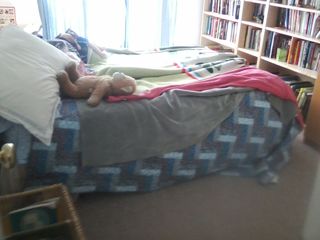
    Even though the bottom picture does not show that only one of the boys got to keep his token this morning, because the other one left a pair of underwear on the floor in front of his closet door (out of the frame).

    + + +

    An additional positive result:  As soon as this experiment started I realized that I was not going to have much moral authority unless I, too, endeavored to keep my own room clean to the same standards that I was insisting the children absolutely must learn to do.  

    So I've been making my bed every morning and throwing stuff from the floor into my closet and closing the door.

    I like it.

    + + +

    Another thing:  Because I'm checking their rooms every morning, I didn't forget to have cash in my wallet (including singles) on the Day of Reckoning.  So I didn't have to owe anyone any allowance.

    + + +

    As I was sorting clean laundry yesterday I discovered another bonus:  I don't have to tell them to put away their laundry anymore.  I can just put the basket of clean laundry on each child's bed and leave it there.  It will have to be stuffed into the closet by morning.  Win.

    + + +

    And I also decided that next month, Doing One's Own Laundry Once A Week will be the targeted task.  I hope to let you know how that goes, mid-May.


  • Token economy.

    As a minor protest against April Fool's Day, I am writing a post that is utterly mundane and not an attempt to fool people.   If not for this desire I probably wouldn't have gotten around to posting at all, what with the baby on my lap.

    + + +

    As you all know, there are competing Parenting Theories out there on absolutely every topic imaginable about what parents might or might not do regarding their children.  

    I subscribe to a few of them myself.  

    Some of them really are moral imperatives — not gonna say which ones I classify that way right now because that's beside the point — my point is, yeah, there are things people do to their kids (mostly babies) that are objectively wrong, and it's important to spread the word and try to get fewer people to do 'em.  

    And there are things that all kids really need, that many kids don't get; things that their parents and caregivers and teachers owe to them, and must give them if they can.  Those needs aren't imaginary and they aren't fads, even if they are sometimes more conveniently ignored.

    Such things exist.   

    + + +

    On the other hand, there's also a lot of stuff out there that WHO KNOWS what's best, for which the answer to "What's the best way to do it?" is likely "It depends," and maybe there isn't a right way or a wrong way.  There's no harm in exchanging ideas in case you learn of a new approach that might work for you; and sometimes people come up with truly novel approaches that "work" wonderfully — but there's also virtually no chance that any of the ideas are going to be The One Right Way to do it.  

    A great deal of the learning curve of parenting is working out which things fall into which categories.  (I wrote a post a couple of years ago about how that turned out.)

    My way of working it out?  

    1. Obsessively attempt to adhere to every practice that seemed like it might fall into the first category.
    2.  Predictably, fail to do so perfectly.
    3.  Observe the results of said failures — the outcome over the whole family — to determine where there was more flexibility of okayness, and loosen up there when circumstances warrant.  Continue adhering, however imperfectly, to those practices that prove their worth.

    I believe this is called learning from one's mistakes.  I stumbled into it by accident, but I recommend it heartily.

    + + +

    Sometimes, "what to do" calls for actual experimentation.  And that is what we are doing right now in the area of allowance.

    You know there have to be competing theories of kids' allowances, right?  There must be.  Because there are competing theories about everything.  

    Is the money a free gift that they can do whatever they want with?  Including spending it all on candy?  Or does the money come with strings?  Do they learn charitable giving because you make them give ten percent, or because you let them see that you give ten percent?  Is allowance tied to chores, so they can learn the value of earning their money?  Or do they have to do chores just because they are part of a family and family members all must participate because that's what families do?  If they're paid for chores, are they allowed to opt out of the chores?  Do they save if they want and spend if they want, or do you make them save?  Do they get cash or an instant bank transfer?  Can they have a debit card?  Is there a spending limit?  Do older kids get more and younger kids get less, or is it all the same? Do they have to buy their own school lunches out of the money, and if so, are they allowed to skip lunch so they can have more money?   Do they lose their allowance as punishment?  Do they not get any allowance and they have to earn it all?  When they set up a lemonade stand or a tomato patch do you front them the capital or charge them rent?  Marx, Keynes or Hayek?

    Bleargh.  I never had the energy to work out which of these approaches was "best" in a theoretical sense (although you bet other people have and they are willing to tell you why all the other people are wrong).  

    At some point when my oldest was six or so we got tired of telling them "no" about candy at the store, so we started giving him a tiny allowance and then we would not have to say "no" at the store because he would be limited by the amount of money he had.  At first it was "one treat" and then we decided to give him $1.50 because that's how much it would cost to buy the sorts of treats that *I* would choose.  Things like a nice little cup of sweetened organic yogurt or maybe, if I was feeling especially liberal, a package of fruit snacks.

    (I did mention that this was my first child, right?)

    Very quickly we ran into problems with the laissez-faire approach when he figured out how to buy worryingly huge quantities of cheap, disgusting candy for $1.50.  That was when we realized that the allowance question was not going to be simple.

    + + +

    Fast forward seven years and several more kids.  Skip over all the reasoning and the "why" and the "how we got here."  Don't assume it makes sense.  (Some of it has to do with how things that seemed like great ideas turned out to be time-consuming or inconvenient.)  Up till a couple of weeks ago, we were giving each kid eleven dollars in cash every week month, and one of those dollars they were expected to put in the basket at church, and yes it was absolutely eleven dollars and not ten because THAT WAY WE DIDN'T HAVE TO MAKE CHANGE EVERY FREAKING SUNDAY MORNING.

    And we weren't micromanaging beyond that.  They could save or spend the rest however they wanted, and we took them to the bank now and again for a deposit.  My oldest set a goal once to save a certain amount of money, which he did, and I believe he felt some sense of accomplishment, and so did we of course, but I think that was the only time that happened.

    And we didn't tie it to chores, ostensibly because we're a family and everybody in a family has to work together and that's that, and also because what a pain to keep track of it, although once in a great while we would agree to pay a kid to do some odd job.

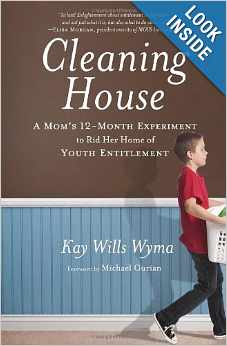
    But a couple of weeks ago, inspired by a speaker at one of our co-op meetings, I decided I wanted to try something different for a while.  I'll save time by sending you straight to the book she recommended which contained this idea. It's called Cleaning House:  A Mom's Twelve-Month Experiment to Rid Her Home of Youth Entitlement, by Kay Wills Wyma.  

    Unknown-3

    I may or may not have been seduced by the word "experiment" in the title.

    Anyway, I haven't actually read the whole book yet, just a couple of chapters, but let me sum up the basic approach here, which we are totally trying.  In Wyma's story, she got sick of her kids assuming (correctly) that she would take care of all the stuff for them — laundry, cooking, finding lost items in their rooms, etc. — so she set about gradually increasing their household responsibilities, which were rather abruptly tied to their allowance.

    She did it by the dollar-bills-in-a-jar method.  Each kid got thirty one-dollar bills in a jar at the start of the month.  Each day that he or she failed to meet the clearly communicated expectations, Mom removed a dollar from the jar.  At the end of the month they could keep what was left.  

    Thirty dollars was more than they had been getting previously, so it represented a (potential) raise; and she started small.  The first month, the expectation was only to keep their rooms to a minimum standard of order.  After that, each month the stakes were raised:  getting an assigned day to cook dinner for the family, doing laundry, and more.


    I quite deliberately have not read the whole book.  I'm reading it one chapter at a time.  But I've decided to do the experiment on my three oldest children (13, 10, and 7).

    + + +

    Right away I realized we'd have to do it a little differently.  There is no way we will ever have it together enough to have that many dollar bills ready at the start of every month.  I'd have to write IOUs and borrow from the future, and then I would lose my credibility and my authority would go out the window with it.  The reason this system has a shot of working is that the kids can see the money actually leaving their jar every week.  (And it just feels differently from a system where you pay them money each day.)  

    But I need reusable money or I will run out.

    So we went with tokens.   I used craft sticks, of the popsicle size.  Each craft stick represents some money they can have at the end of the month.  I got some Sharpies, one color for each kid, and signed a bunch of craft sticks to turn them into a medium of exchange.  I put the sticks in a jar and handed them out. I sternly outlawed counterfeiting, and for now, transferring them between kids (because I need to collect data about the incentives).   The amount of potential money represented a modest raise, from eleven to fifteen dollars per month.

    And then I set the expectation that, when they leave their room, they must pull up the covers on the bed, pick up the floor, and close the closet doors.   Later in the day I'll check, and if they haven't done it, they lose a token.  At the end of the month we count tokens and pay them allowance based on the tokens.

    I'm not exactly sure what my husband thinks of this scheme but on the outside he is backing me up firmly, and that is good enough for me.

    + + +

    When we announced the experiment, my ten- and seven-year-olds were pleased at the prospect of a raise.  But my thirteen-year-old reacted with dismay and fury.  Something about it that he could not quite articulate offended him deeply.  He wanted something different – something where we paid them extra for extra jobs?  something where there was a guaranteed minimum income, a "base allowance"?  something where he didn't partly depend on his brother, with whom he shared a room?  something where he didn't have to be subjected to the same rules as his younger siblings? 

    "This doesn't make sense," he kept saying.

    completely sympathized.  Really.  I could very easily put myself in his shoes.  And I wasn't giving him a choice in the matter, although we did want to hear how he felt about it and we wanted to see how it worked as time went on.

    "Let me explain something to you that you may not have realized about us," I told him. "Your dad and I are totally making it up as we go along.  This is just something we are trying to see if it helps you and your siblings learn to do a few things that haven't been getting done around the house."

    "If you want us to clean our room every day then why don't you just tell us to clean our room every day?"

    "Because I want you to do it without being asked," I said.  "I don't like asking all the time."

    "But if you want me to keep the room clean every day I'll just start doing it!" he said.  "I don't need the sticks to keep track."

    I do,  I thought.  "Look," I said, "if you're so sure that you would rather just be told to clean your room every day and have it not be tied to your allowance… then do that.  Clean your room every day, and you'll get the full amount.  You'll come out just the same — better, even, because it would be like getting a four-dollar raise."

    "What if a kid doesn't do it because he decides he doesn't want the money?"

    I was going to say "Fine" but Mark beat me to it and said he wasn't allowed to not do it on purpose.  "Your mother wants the room clean and so you should make a good faith effort to do it." 

    I bit my tongue and went with that.  "Yes, and also it wouldn't be fair to your brother who shares the room with you."

    "Wait, you mean if he doesn't clean his stuff then I can lose my token?!?!"

    More making it up as I go along.  "Hmmmm….. When I check your room, if I can tell that one person has done his share and the other hasn't then I'll only take that person's token — for instance, if one bed is made and the other isn't. But if I can't tell, like if there's just a bunch of laundry on the floor, I'll pull both tokens."  

    (They know well that I do not keep track of whose underwear is solids and whose underwear is stripes.)

    "And you're going to give us more to do later?  Will we get more money if you make us do more?"

    "I don't know.  Probably not right away.  But," I promised, "we won't change the rules in the middle of the month.  At the beginning of the month we'll be very clear about the expectations, and even if I decide I didn't do a good job setting them, we'll stick by what we said we'd do until the end of the month."

    In the end, he submitted to the plan… but he was not happy about it.  I really, honestly, felt bad about it.  I like it when the things I make my kids do make sense to them.  I like there to be some buy-in.  

    On the other hand… I had never worried whether it made sense to give them their string-free eleven dollars, either.  We hadn't made a plan to do it that way because it was a good idea or because it fit our theories about how children should learn to manage money.  We just settled into doing it that way.   The new way would not be any less logic-based than the old way.  It would simply be different.  And we would not know if we liked it till we tried it.

    + + +

    Tune in next time and I'll tell you how that first month — actually it was a pro-rated, partial month — went.


  • Count your bites: a super-simple measure to check overeating?

    From the annals of simple anti-gluttony* systems:

    Remember the No-S diet? It isn’t what I do, but it has always impressed me with its simplicity, and it makes a great starting point for anyone who wants to learn to eat less.

    (Its rules are: no snacks, no sweets, no seconds, except on days that start with S. There is also a caveat along the lines of don’t be an idiot on S days, but it only comes up in hard cases.)

    I know I have mentioned No-S as a viable, simple way of checking one’s overeating, but I may have just found something simpler. I came across a testimonial post at the Everyday Systems website, home of No-S, where the writer mentioned that she had modified her No-S approach by including “bite counting.”

    Curious, I followed a link to the testimonial writer’s blog. Yep, she means what she says: count your bites.


    What was needed was a simple, less stressful method to enable the patient to reduce his intake of food, and give him short term goals that would mark his progress visibly and also offer encouragement….Count bites, not calories.

    It consists simple of using a tally register… to check off every bite or swallow you take, keeping a register of your weight and the number of bites taken every day, and establishing a baseline for the number of bites that lets you lose weight at the rate you find comfortable.

    Some measure was necessary to control the quantity of food intake, not necessarily the type of food intake, which is more controlled by the individuals lifelong eating habits. A simple convenient method was to measure actual intake, not by portion, but by bites, as people will always revert to their standard size bite, no matter how much they might attempt to take extra large or extra small bites at the beginning. Attempts to cheat are inevitable, but not lasting. The individual relapses quickly enough to his normal bite pattern…

    No Matter what you eat, if your chart shows no weight loss, you simply have to take fewer bites.


    Here’s what about this that strikes me, the data addict, as genius: it’s one easily-measured number. So anyone can do the experiment on themselves: can count bites, and observe weight patterns, and see if there is a correlation between the two. It would be straightforward to use as the x-axis of a plot.

    Here’s what about this that strikes me, the foodie, as genius: you wouldn’t have to consciously change what you eat unless you find you want to.

    Here’s what about this that strikes me, the slacker, as genius: no preplanning or measuring required. There is a little work involved: tallying bites (the author suggests keeping one of those handhed push-button counters discreetly in your lap as you eat), keeping track of the daily number, and evaluating the results to see if the number of bites should be adjusted up or down.

    I’m not going to be trying this one out, but I did think it interesting enough to note.


    [Editing note.  Years and years later, I wish I’d done a better job distinguishing gluttony from other problems with food, like clinical eating disorders and other kinds of compulsiveness.  

    I want to emphasize that, whereas I identified some behaviors in myself that probably qualified as self-centered gluttony in the technical sense, I am not and never have been qualified to make that distinction for anyone else.

    I hope to add some commentary to all the posts that have this problem as I find the time to review them.  Here’s a more recent post where I acknowledge some of the problematic material I wrote and set new ground rules for myself going forward.]

    (Also, looking back on the idea that sparked this post, it no longer appears “interesting enough to note,” but now completely insane. Just thought I would add that.)


  • Patterns of behavior: exploiting what you’ve learned.

    The notion that there are "competing versions of the self" is a recurring theme in my thinking and writing here at bearing blog.

    You know, when you say, "Part of me wants to eat that doughnut, but part of me knows it's bad for me."

    Or, "Part of me wants to get up and get started on my day, but part of me wants to sleep in."

    I've written about this before:

    •  Here's an old post looking at an Atlantic article on the topic of the "multiplicity of the self" — link still active — and also to Romans 7 ("What I do, I do not understand.  For I do not do what I want, but I do what I hate.")  
    • Here's my review of the book Switch:  How to Change Things When Change is Hard, a book that divides the self into a metaphorical "elephant" and "rider."  (The elephant is the emotional, powerful, driven-by-desire part of the self; the rider is the intelligent part of the self that knows where he wants to go but has little power to get there on his own.  The challenge is for the rider to intelligently direct the elephant, channeling its strengths to achieve the desired outcome.)

    Often, the best advice is to pre-plan:  at a time when you are detached from temptations and short-term gratifications (i.e. sometime when your stomach is not growling, when you are not lying in bed dreading the snooze alarm to go off), to consider how to set up your environment to reduce access to  "bad" choices and improve access to "good" choices in the moment, how to restructure your incentive system.  Putting fruit on your shopping list instead of doughnuts; moving your alarm clock across the room; preparing yourself a little treat to have ready as a reward for doing the right thing.

    The concept is to schedule "choice-making" time at the time when you are strong and in control, thereby restricting the choices available to you when you are comparably vulnerable and weak.

    + + +

    I've internalized this for a long time in some areas of my life; I mastered it with respect to food issues (probably aided by divine intervention) about six years ago.

    Just yesterday, I noticed that it's quite similar to something else I do.

    One evolutionary biology textbook was on my lap, another one propped open against the wall, and a third book — this one on general biology — was spread out between my keyboard and my computer screen.  I had a spreadsheet open and I was dividing up chapters among the thirty-two weeks that will be left in our school year after we deduct a month for our family trip.

    Most of the readings will be from this introductory college text… a few supplemental readings from this more advanced text that has a truer philosophical attitude toward human evolution…  Week one it'll be the chapters about the development of evolutionary theory… week two, Mendelian genetics… somewhere in here I'll assign some readings from The Origin of Species… I think I'll assign some Richard Dawkins stuff, probably from The Ancestor's Tale, and we can discuss it… let's see, that should go later in the course…

    My goal at the beginning of every year, for every subject in which there's a set amount of material I want to cover, is to have a week-by-week schedule completely fleshed out.

    If the material is such that earlier concepts build on later concepts, so that you can't safely skip chapters, I schedule for fewer weeks than there are in the school year — it leaves room for illnesses and emergencies and still staying on track.  If material is skippable or the order of assignments don't matter, I'll spread it out through the whole school year, and if you're sick we just skip that day, maybe to make it up when we have extra time another day.

    I put a ton of work into this organization.  It's the primary work of my late-spring and early-summer school year.  It helps that I enjoy it:  it's solo work that reminds me of computer programming, an activity that I wasn't any damn good at but that I enjoyed immensely back when that was what I did every day.  I do it far ahead of time, and why?

    So that when I get up in the morning and have to teach my kids, I don't have the excuse of "ummm what was I supposed to do today?" as a reason to pour another cup of coffee and sit down in front of the computer to find "something to do today."

    I already have a Thing To Do Today.  And I don't actually have an excuse not to do it.

    Planning down to the exact day ("on day 122 of the school year I will do this… on day 123 of the school year I will do this…") is too fine-grained.   Planning the month is too loose.  I plan week by week, and each week I have to figure out how to distribute the schoolwork and teaching, and that's just about right.

    + + +

    But it strikes me that in an important way, it is very like the elephant-rider metaphor.  I set the boundaries of our school weeks in advance, when I can think about them clearly and when I have the overall philosophy of education, the big picture, before my attention.  Day to day I try to live by the rules I have set by myself.

    This way of organizing the homeschool year and week was obvious to me as "the way that would feel right for me to do it" from the very beginning of homeschooling.  I wonder why I never noticed before how similar it is to a certain technique of practicing self-control in general?  I wonder why I had to independently discover it in other areas of my life?  

    Like the Mandelbrot fractal, personality exhibits the same patterns wherever you look and on whatever scale, the deep and the superficial.  One of these days I will learn to generalize and to re-apply the lessons, and save myself a whole lot of trouble.  Maybe.


  • More quick takey things.

    I talked to H. this morning about pivoting, like I wrote about in the last post.  It does sound like it's time for us to re-imagine and re-invent our school days together, and probably the rest of the year will be spent figuring out through trial and error how we are going to manage it.

    I imagine a great deal of "can you believe this?!?" laughter will ensue.  

    The photo below was snapped right after H. said to me:  "Can you believe we now have TEN children between us?"

    1959507_3893538555043_1934011350_n

    (Please ignore my weirdly distorted, huge baby-holding arm.  I believe it is an artifact of the cell phone picture.)

    + + +

    We have started to think about curriculum.  

    • Next year, the ninth-grade boys will be studying modern world history (History Odyssey, Level Two, Pandia Press).  
    • I'll still be teaching them (and maybe our friend's daughter, too) proof-based geometry, since we're doing it at half speed and have missed a bunch of weeks anyway.  
    • H. will surely be teaching them English composition and literature, somehow.
    • The elementary school kids will all study geography for social studies next year, because none are developmentally ready to move on to the next level of the history curriculum yet.   H. and I just settled on the curriculum Mapping the World with Art by Ellen Johnston McHenry.  It remains to be seen how we'll adapt it to our situation.

    Beyond that, I'm going to keep an open mind until we evaluate realistically what we can do together.

    + + +

    In the just-our-family department, my 13yo — who will be 14 and a freshman in high school next year — has made up his mind which courses he wants to take.   

    For his science credit, he decided on evolutionary biology.  This sent me on a wild goose chase to find a high school biology textbook that 

    (a) was not creationist and

    (b) was not hostile to religion.

    Never found one, so it looks like I'm going with introductory college textbooks.  I decided to use two:

    I found used copies of the student book easily.

    + + +

    And then I discovered how the college textbook publishers are making it hard to be an independent student these days:  

    You can't buy used  instructors' editions or printed copies of the answers anymore.

     Instead, institutions pay hundreds of dollars to the publisher to purchase subscription-only access to web-based content, including all the answers to the questions in the textbook.

    In many cases no print version of the instructor's content even exists.

    While the best is to buy used books at used-book prices, I would be fine with paying full price for a new student textbook that included, say, one year's access to the web content.   Some K-12 publishers are making that option available for the homeschool market (for instance, my 8th grader is using ScienceFusion by Harcourt this year, and I'm pretty pleased with it.) But that isn't available, as far as I can see, for college textbooks at any reasonable individual price that I can find.

    Which means I will have to find the answers on my own.  I guess there's no free lunch, or used lunch, or whatever.

    + + +

    Speaking of lunch, I had a fruit salad and a very nice wrap-type sandwich made from a whole wheat tortilla, goat cheese, and roasted vegetables (red bell pepper, portabella mushrooms, red onion, and zucchini).  The packet has four ounces of goat cheese, so I roasted a quadruple batch of veggies, and I plan to eat this for lunch for the next three days.  I do not think I will get tired of it.

    Since I started my postpartum/nursing experiment of spreading my calories equally throughout the day, plus ice cream after dinner, I have lost about eight pounds of post-baby weight.

     Also, I have not had any episodes of lightheadedness or low-blood-sugar crabbiness, except on the way home from the eleven o'clock Mass, which always happens no matter what I eat.

    Since it seems to be working, I will stick with this regimen and not try to innovate until it stops working.  If this rate continues, I'll be back to the old me by mid-August, which would make me deliriously relieved as then I will not need YET ANOTHER new fall wardrobe.


  • Pivoting.

    Once I heard a very, very good piece of homeschooling advice, perfectly tailored to my besetting character flaw of Stick-To-The-Schedulism.  You know, the kind of thing that makes me inordinately upset about unexpected changes of plan.

    It was this:

    When the s#!t hits the fan,

    or something entirely unexpected (good or bad) falls into your lap,

    and your entire day is knocked off kilter,

    and you're unhappily surveying the list of Stuff I Was Supposed To Do Today,

    at the same time that you are looking at the clock and wondering how on earth you will catch up,

    particularly if, against all reason, you are tempted to try to cram the whole day's work into the remaining hours…

    … that is the time to pivot to a new mission for the rest of the day:

    The remaining hours of this day will be spent putting tomorrow in order,

    so that tomorrow will be the best it can possibly be.


    Look at  it this way.  The few hours you have left in this "ruined" day must be spent one way or another.  You can take them as "extra time for tomorrow" or you can take them as "remnants of today."  Extra time for tomorrow is much more fun, more relaxing, and probably more valuable in the long run, at least for me. 

    Sometimes, when I've written off Today in favor of a head start on Tomorrow, we clean the schoolroom.  Sometimes I catch up on records.  Sometimes I make a meal plan or precook tomorrow's dinner.  Sometimes I do long term planning.  Sometimes I read to the kids or cue up a good movie.  The next morning always feels like a fresh start, and usually it really is a good day.

    + + +

    I bring this up because recent turns of events have led me to apply this same principle to the entire third quarter of our school year.   Maybe the fourth quarter too, it's hard to tell.

    Our baby was born Christmas week, just before the start of what I would call the third quarter, and three weeks earlier than expected.   Then just as we were starting up again, H., my partner in co-schooling, pregnant with twins, had to go on bed rest.  She delivered the twins five weeks early, around what would have been week 21 of my school year.

     A month later, of course, we are still nowhere near starting up our "together" subjects again.   My oldest hasn't quite stopped completely; he's working his way through Robinson Crusoe on assignment from H., and he's keeping up with history, but Latin and Geometry have been indefinitely suspended.  H.'s twins (one beautiful girl and one beautiful boy) are doing pretty well, but feeding them is a round-the-clock job for her right now and for who knows how long?  

    So it's make-the-best-of-it territory.

    •  I have been experimenting with an unschooling approach on the two free days, while I take the extra time to work on next year's curriculum and organize thoughts for the overall high school program.  
    • We are using some of the time to polish up our Italian and French for our planned trip in the fall.  
    • In a similar vein, we're working through a DVD lecture series on Greek and Roman engineering which we bought last month ($250 would have been steep, but it's been completely worth the $70 or so that we paid to get it on sale.)
    • My seven-year-old has rediscovered our favorite chess-learning program.  And she's decided to work towards a sports pin (Bowling) for AHG, so we've checked some books out of the library so she can learn the scoring system.  (Now she wants her own bowling ball, which might not actually be a bad idea since there are never any 6-lb house balls at the local lanes and I have two smaller children coming up behind her.)
    • My thirteen-year-old has been building computer circuits out of redstone in Minecraft, which must set some kind of record for meta.
    • I've had some time to sit down with my four-year-old and start working on letter-sound correspondence.
    • And we're working on handwriting again using a new-to-me program that everyone is much happier with, especially me, because the exemplar font is not unlike the way I really write when I'm writing neatly but comfortably — a sort of joined-italic-printscript.  (I've had it with handwriting programs that don't have as their primary goals speedy and legible writing.)  One thing that made this program, BFH, good for our family is that you can purchase a "handwriting intervention" program (Fix It Write) for older students.  So my thirteen-year-old is using that, while the younger kids are doing beginners' sheets.
    • Finally, I'm still working on my new time management resolutions (see previous posts starting here).

    And you know, I think it's going all right.  The truth is, with a new baby myself, I'm not really feeling all that energetic right now.  I'm physically well, but I'm out of shape and tired, and having decided to take it a bit easy is turning out to feel like a better and better idea as the weeks go by and it gets more and more impossible to "catch up."

    At some point, we'll just have to declare it Starting Over time.

    + + +

    I have a feeling that when H. and I come back together again, we're going to be putting together something entirely new, based on our new needs.

    But we've done that before, and it worked out beyond our wildest dreams.   So I'm pretty sure that starting over again will work just fine.


  • Quick takey things.

    Once again, I am not giving up Facebook for Lent, nor blogging, nor Twitter, nor email, nor (snort) snail mail, nor Morse Code.  

    But holy smoke, a lot of people I look forward to seeing on FB are.  So — *I* should suffer?

    + + + 

    Not giving up any food or drink either.   Usually I do the required fasting and abstinence but no more; this year I'm excused from either, nursing a newborn as I am, and I'm not even looking twice at the fasting.

    Meatless is easy enough, so that I can do on Fridays and Ash Wednesday, no problem.  Except when I forget and start to eat a Thai chicken wrap left over from dinner, and get halfway through it before I notice the chunks of chicken falling out of it onto my plate and think, "oh yeah, I forgot what was in this."

    But I didn't really have to abstain from it, so I didn't even bother feeling guilty.  I did stop eating it, though, and put the rest of it back in the fridge.

    + + +

    I've found it's not really a great idea for me to give up ANYTHING for Lent that would be "good for me to give up" in general.  Before you know it, I'm skipping sweets because I need to lose the baby weight and I'm getting up early because I need to get extra stuff done.  I am the queen of mixed motives sliding into Nice Enough Motives.  Lent is not just a self-improvement program, and if I try to make it a both/and then I will quickly make it into a Nothing More Than.

    I really have to give up something pointless for me to get the point.

    + + +

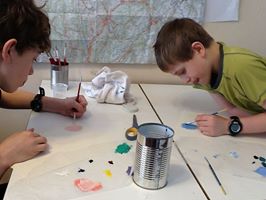
    Highlights of today included our first-ever day of working with oil paints.

    1656355_3888947000257_1427303580_n 1978864_3888947320265_2056808649_n

    Two of my kids have been gifted little suitcase-shaped art boxes in the past year, boxes that included a set of oils.  

    I forbade them from using the oils until we could systematically learn about oils.  And then they had to suffer through a semester of watercolors first, because my painting book suggested that it was good to learn basic watercolor techniques first.

    1925272_3888947120260_1129505463_n 1656203_3888947200262_576468662_n

    I've never played with oils either.  They're so different from watercolors, it was really a treat.  These are special student oils that are formulated to be miscible with water, so you don't have to mess around with linseed oil and turpentine.

    Today's lesson was:

    1. Me lecturing them on the properties of oils and how they differ from those of watercolors (cheating by reading two sentences ahead from my paint book as I wrote things on the board – I wonder if all those people who think homeschooling is Too Hard realize that parents are allowed to use the teacher's manual?)
    2. Looking at my collection of postcard art prints to see the variety of different effects that oil paints can produce
    3. Explaining how the water-miscible oils will make our lives easier
    4. Mixing a few new colors using wax paper as a palette and painting the newly mixed flat colors thickly into a row of circles on a piece of canvas paper

    Next time they'll blend colors on the paper.

    + + +

    A couple of days ago I related on FB  a Minnesotan homeschooling story:  my three oldest children, ring-led by the 13-year-old, decided to have a "Who Can Stand Barefoot In The Snow Longest?" contest while I was upstairs nursing the baby in the bed and they were supposed to be cleaning up the lunch dishes.

    It would have been smart of them to check the status of the knob-lock on the door first.  

    Eventually I stopped yelling "Stop that awful pounding!" from my bedroom and went downstairs to investigate, where I discovered some unhappy children.  My seven-year-old daughter fared the worst, since just as I was coming down the stairs she had run around to the front (barefoot, in about two feet of snow) to try to ring the doorbell, and then she ran back.  She had to have a very weepy, painful, warm footbath.  No one was damaged and everyone learned a lesson. 

    Foresight-related winter exposure is a risk that is not borne only by Minnesota's homeschoolers, though, as this bit someone posted on my wall shows:

    Teen:  Teachers Made Me Stand Outside In Wet Bathing Suit, Barefoot

    It happened around 8:30 a.m. Wednesday at Como Park High School in St. Paul. Fourteen-year-old Kayona Hagen-Tietz says she was in the school’s pool when the fire alarm went off.

    While other students had gotten out earlier and were able to put on dry clothes, Hagen-Tietz said she was rushed out with just her towel.

    On Wednesday morning, the temperature was 5 below, and the wind chill was 25 below.

    “So the alarm went off, and I thought it was like just a drill, like: Do I  have to go outside?” Hagen-Tietz said. “And then he was like no, we usually don’t have fake ones in the winter.”

    There's a lot wrong with this story.  So…

    This is Minnesota, where we can easily have snow on the ground in 7 out of the 9 months of the school year, and you don't have fire drills in the winter?

    So… do you expect everything to, you know, go okay when there's a fire in the winter?  Or do you only expect fires to occur during the 22 percent of the school year that is somewhat reliably NOT cold and snowy?

    And you typically allow students to ignore fire drill alarms because they're "like just a drill" and it would be inconvenient to practice? 

    Greeeeeeeaaat.

    + + +

    I must be doing something right.  My 13-yo today:

    "Maybe 42 is the determinant of a matrix that stores all the data in the universe." 

    Could be, son, could be.


  • Mardi Gras recipe hack: Bread Machine king cake.

    Reposting from 2012.  (Original post is here)

    + + + 

    Back just after Epiphany, I received this great email from a reader named Jenny:

    I just wanted to let you know that I tried your faux cinnamon roll recipe… but not for cinnamon rolls. 

    Down here in New Orleans, Epiphany heralds not so much the end of the Christmas season as the beginning of the Mardi Gras season. The famous parades don't really happen until a couple of weeks before Mardi Gras itself–but the balls and banquets begin on "Twelfth Night". An important (hee) part of this whole Mardi-Gras-season is, of course, King Cake. Every local bakery makes them–you can get them at coffee shops, grocery stores–just about anywhere, in this town, at this time of year.

    King Cakes are usually a brioche made into a circle and decorated with icing and purple, green, and gold sugars (the "official" colors of Mardi Gras). I tried my hand at making one a few years ago, but I find brioche difficult to work with. And then I started having babies. And I stopped trying to get a handle on homemade brioche and started using a bread machine. 

    But your bread-machine cinnamon roll recipe has saved me! It makes a delicious King Cake bread!

     I used your recipe…

    [added by bearing:  here's what you put in the bread machine, taken from the link above]:

    •    2 and 1/4 cups whole wheat flour
    •    1 and 1/2 tsp bread machine yeast
    •    1/2 tsp salt
    •    1/2 tsp cinnamon (cardamon is also nice, as is chai spice)
    •    3/4 cup plus 2 Tbsp milk (or you can use apple juice; omit the sugar)
    •   3 Tbsp sugar
    •   1 Tbsp coconut oil (or butter)
    •   1/2 cup raisins or currants


    ….but when I took the dough out of the machine, I sort of stretched it into a long snake–which I then flattened out and dotted with small pats of butter and an additional sprinkling of cinnamon and white sugar down the center. I folded up each side to enclose the cinnamon/sugar/butter and then laid the whole thing in a ring on a baking sheet.

     [After the second rise of about 30 minutes, bake it at 350 degrees for 30-35 minutes — edited by bearing].

    When it came out and had cooled a bit, I did a simple powdered sugar/milk/vanilla glaze and then added the colored sugars.

    Everyone loved it. My husband, an actual New Orleans native, proclaimed it "the best King Cake he'd ever had", even after I'd accused him of just trying to get in good with the chef (ha).

    Anyway, thanks for the recipe! The good/bad news is that now we've decided that since it is, in fact, better than store-bought King Cake, I am now assuming the role of Official King Cake Baker from now until Mardi Gras… 

    I've attached some photos of the cake, in case you're interested.

    Am I? Am I?

    6a00d8341c50d953ef016760aeeae5970b-800wi


    .

    6a00d8341c50d953ef0168e5b015b9970c-800wi


    I almost feel bad about this because… this is a reasonably healthy recipe!  That's why I use it for an everyday, if fun-to-eat, breakfast bun.  It's made from 100% whole wheat flour, a little bit of coconut oil, milk (or apple juice if you want), and not even very much sugar.  No eggs even.  Heck, you can make this recipe vegan if you want!  Not exactly in the spirit of Mardi Gras!

    It is possible to make non-faux cinnamon rolls in the bread machine, with a brioche-style dough, if you want a richer version (e.g. with eggs and milk and butter and not so much whole wheat flour).  But Jenny is right that brioche dough is harder to work with, so this may be a lower-stress version as well as a lower-sugar-buzz version.

    Traditionally you're supposed to hide a trinket inside the cake, and the person who gets the trinket has some kind of obligation or wins a prize or is lucky or something like that.  Be careful not to choke on it!  


  • “The secret to not getting overwhelmed”

    This post by Jen Fulwiler fits nicely into the “new baby’s resolutions” series I have been working on.

    It occurred to me that Mother Teresa must have had more demands on her time than she could ever even come close to addressing — and considering the type of work she did, serving the poorest of the poor all over the world, she must have often felt daunted by how many important things needed to be done compared to how little she could do.

    So I asked Fr. Langford: What did Mother Teresa do when it seemed that there was more work than she could possibly handle?

    His response was simple and wise, and it marked a turning point in my life.

    Go and read.


  • Correction

    I noticed an error in my bread machine chart from the last post, so I updated the file just now.  If you downloaded, you might want to re-download.