bearing blog


bear – ing n 1  the manner in which one comports oneself;  2  the act, power, or time of bringing forth offspring or fruit; 3 a machine part in which another part turns [a journal ~];  pl comprehension of one’s position, environment, or situation;   5  the act of moving while supporting the weight of something [the ~ of the cross].


  • Bearing on bearing.

    Rebecca Frech at Shoved To Them is writing about playing the self-presentation game, something that's become necessary as she has searched for a diagnosis for the apparent degeneration of her  ten-year-old daughter's lower-body strength.

    All morning, I've been thinking back to the girl I was in junior high and high school. I was a little bit hopeless. While my friends could execute the eleborately sculpted hairstyles of the 80s and 90s, and perfectly swipe on the latest make-up trends, I couldn't. I wanted to, but I always ended up looking as if I'd gotten ready in a very dark room. I would slide back to my comfortable default of tomboy, and hang out there. 

    As a young mom, my go-to look became either a naked face and simple ponytail, or the bare minimum of mascara and lipgloss. I wanted to look pulled together, but it was really a lot more work than I was willing to do. Which makes mornings like this amusing and a little sad to me. 
     
    In the time since Ella's arthritis journey began, I've become an expert with a flat iron. I've learned more than I ever wanted to know about the nuances of eyeshadow, and have debated the merits of different mascara brands. My jewelry box overflows with accessories, a far cry from the few funky pieces I once owned and loved.
     
    Part of my transformation is due to maturity and the influence of one very style savvy friend, but more so to the quest for credibility.
     
    Two years ago in a rheumatologist's office, I realized that my intelligence is tied into the perfection of my eyeliner. The more put-together I look, the more seriously medical professionals take what I have to say. My naked face makes me invisible, while a full face of make-up makes me worthy of being heard. It's a game of perception.
     
    Authority figures are perfection. That's what I've learned in the past two years.
     
    If all the world is a stage, and we are merely players, I'm playing my part today. I've painted on the mask of rational and reasonable motherhood. I put on my visible intelligence along with my jewelry. I spritzed on confidence along with my perfume. It's an act, a carefully fashioned persona. It's ridiculous and maddening, and dead necessary.
    One last check in the mirror, and a final tug at the shape wear that's smoothing out my imperfections. My two year old pats my leg and smiles up at me, "Pretty mama" comes from behind her paci. And I know I'm done.
     
    The flawless image of calm perfection this morning is all part of a absurd game, but it's the most important one I'll ever play. I didn't make the rules, butI've learned how to play by them, and I'm going to win.

    I don't have an urgent reason to put on a mask, the way Rebecca does right now.  But I relate to a lot of what she says here anyway.  I understand defaulting to a not-wanting-to-bother-with-all-that crud.  I couldn't quite figure any of it out, either, and couldn't see the point.  Ridiculous.

    I didn't want to play some stupid game of presentation.

    Much later, I understood that other people are going to play the game of perceiving whether we want them to or not, and opting out of that game is … not exactly impossible… but let's say, it's a privilege to be able to  opt out of it.

    You sometimes don't run up against it until, all of a sudden, a gatekeeper of some kind finds a reason to interpret their perception of you in the worst possible way.  

    Rebecca needs to look like an intelligent adult, concerned for her child because of a non-imaginary reason.  Above all she needs the professionals she deals with to be able to see themselves in her place:  concerned that time is running out, frustrated by a diagnosis because it is difficult to pin down, not because it is not real.  For her daughter not to be dismissed, she needs to be undismissable. 

    + + + 

    As for me, I don't have the urgent problem that Rebecca is facing; but in a way that seemed a bit backward at the time, my morning self-care routine started to get slightly more complicated the more children I had.  

    As I finished up graduate school in the wake of having had my first baby (and my second), and as I realized I wasn't likely to be looking for a job anytime soon after graduate school, I neglected "professional" behavior:  I skipped out on every seminar and extra duty I could get away with, I brought the baby with me to my office and to conferences,  I worked from home, I dropped to part-time.  All this worked well enough for me given my priorities — we kept the kids out of childcare, I graduated — but I could feel the air turn just a bit colder.  I developed a strong aversion to the sense of not appearing to belong.    I still carry that aversion with me.  

     I do not have a "personal style" to speak of.   When it comes to dressing myself, I'm constantly waffling between two mostly-false personae:  

    • the Deliberately Low-Maintenance, Vaguely Athletic (Tevas, performance-fabric hoodies, quick-dry skorts — see the Title Nine catalogue for what I'm going for) ; and
    • Simple, Classic, A Bit Retro (less-outrageous John Fluevog shoes, tailored pants and fitted dresses, lots of black, jeans carefully selected at considerable time and expense, a curated closet of a few versatile pieces).   

    What these two personae have in common is only what they are not:  Sloppy Mommy.  

    They are the two things I can somewhat convincingly be — in order not to be Sloppy Mommy.  

    I felt that Sloppy Mommy was somewhat forgivable, early in my parenting years.  But nowadays, when I am liable to show up at the art museum at noon or at a local family restaurant late on a Tuesday evening with five children, I'm very, very determined to avoid it.  

    + + +

    Sometime during my fifth pregnancy, I went from Bare-Faced But With Decent Hair to  mascara and tinted lip balm.  

    I can't decide if this is an advance or a retreat.

    + + +

    As time goes on, though, it's less about who I don't want to be, and more about who I want to be.  And there's another thing those two personae have in common, another thing that separates them from the specter of Sloppy Mommy:  they look like they did it on purpose.   Athletic Me, at least in my mind, might have just came from the gym (wet hair, therefore, is totally okay) or is about to go kayaking or something.  Simple But Classic Me might be on her way to work, or to meet her husband for a dinner date.  

    Both personae appear to have plans.  Options.  I'm choosing to be here, where I am, with you.  

    + + +

    In college sometimes, a classmate here or there, normally unshaven in a grunge shirt and jeans full of the tiny holes that mark you as having done your time in organic chemistry lab, would suddenly show up to class in a pressed button down shirt and suit-pants, the coat hung carefully in the back of the classroom.  Or if it was a woman, the Birks traded for heels and pantyhose.  Everyone knows what that means:  Job interview today.  We accept it.  But everyone knows, yes even the interviewer knows, that The Suit is not who we really are. 

    It's necessary, I guess, so we can prove that we can play the game if it's called for.  Because unwillingness to play the game is one thing, but inability is another.  

    + + +

    How to maintain a belief — simultaneously — that invisible character is far more important than appearance — at the same time as conceding the practical advantage of cultivating a useful appearance?  These questions never seemed to matter too much until I had children to teach.  We are trying to teach them to see beyond appearances while, simultaneously, teaching them to give no one else a reason to dismiss them because of their own appearances.  

    Does the one lesson undermine the other?

    I can grasp at a few ways to reconcile the disconnect.  Rebecca has found one, an adversarial interpretation:  it's a game she didn't choose to play, but having been dropped into the arena, she intends to win.  Those polished nails are sharp.

    I tend to take a fake-it-till-you-make it approach, dressing as the woman I would like to be (only I'm a bit schizophrenic about exactly who that is).  Self-confidence is good to have, I might say, and it's the kind of thing that travels both directions:  when we feel confident we look polished, or at least purposeful; and when we take time to be deliberate about appearance, we feel more confident.   

    Opting out is a possibility, too, but I fear it only really works when it's authentically radical:  St. Francis of Assisi, Frida Kahlo.

    How about you?  Is that a mask, or is it real?


  • (Two-)Armed and ready.

    I mentioned a few days ago that I was going in to see a sports medicine specialist about my old wrist injury to find out whether it had any implications for starting a strength training program.

    I had called my dad and asked him if he still had my medical records from the surgery; indeed he did, and Fed Exed them to me in time for me to carry them to my appointment. It was interesting to read the surgeon’s report and compare it to my memory of the event. Yes, the medial nerve (which goes to the thumb, first, and second finger) had been completely severed and reattached; the ulnar nerve had not been severed. Two tendons completely severed, one partly severed. I had really done a number on that one.

    “Was your injury a fracture?” asked the nurse. He was clad in scrubs that were doing their best to imitate a Hawaiian shirt and beachcomber pants. “No? Oh good then, we won’t need an x-ray.”

    “I have my medical records,” I said. I was carrying them in a yellow folder that the baby kept grabbing for and trying to eat; I shifted them, plus the carseat and the diaper bag, to the other arm and disentangled my hair from his grip as I followed the nurse down the hall.

    “That will help a lot,” he said. We had reached the examination room and he was sitting down at a computer, executing a rapid, practiced password entry. “Now, let’s see… how to put this… you’re not here for an injury exactly…Patient about to start exercise program… needs consultation…”

    “You could maybe put that I am concerned about whether I should modify my exercise program because of my old injury?”

    “I have to decide which category to put you in. I don’t write the categories, it’s whoever came up with this data entry program.” He scanned down the list. “Let’s call this a ‘consultation prior to beginning exercise program.’” He chucked the baby on the chin, said “Two shakes” and headed back out the door to fetch the doctor.

    I bounced the baby on my lap and looked around. The sports med doctor’s office displayed two shadow boxes on the wall; each contained a race number and a marathon finisher’s medal. There wasn’t anything else to look at. I set the carseat on the floor, buckled the baby into it, and played peek-a-boo with the baby from behind my yellow folder until the doctor came in.

    She was a slight woman, with dark pixie cut hair and a Spanish last name, no taller or older than me. She listened to my story, how the injury happened, how I easily drop things in my right hand, how I am afraid of re-injuring the wrist every time I lift something heavy. She took the surgeon’s report and read it all the way through in front of me — which is, now that I think of it, the first time that a doctor has ever read any material that I brought along with me, and it isn’t the first time I have brought any along.

    Then she scooted her chair over to me and said, “Show me your hands. No, not that one, both of them.” She put out her own hands expectantly.

    I put my hands out. She examined them together, the normal, dominant left one, the injured right one. She pinched the muscles at the bases of the thumb. She asked me to spread my fingers, and resisted them by applying force with her own fingers. She had me touch each finger to the thumb in turn, and resist her as she hooked her own finger in mine to pull finger and thumb apart She moved each finger, murmuring approvingly: “They did a good job with you. Where was this hospital?”

    “Dayton, Ohio. Well, a bit south of there.”

    “They must have got you in soon after the injury. The tendons…”

    “I think so… I think maybe six hours or so afterward. It was a Friday afternoon, after school.”

    “Your range of motion is almost totally normal. At least, it is the same as the other. Squeeze my hands.” I did. “Grip strength is the same too.”

    I stared, and tried again, this time one hand at a time. Same. “You’re kidding. I was sure it was much weaker!”

    She rummaged in her desk drawer and took out a tiny probe, nothing more than a wand with a single plastic fiber emerging the tip. “Can you feel this? No, don’t look. Tell me when you feel this.” She pressed it into my fingers, asking. Then she put it away and brought out a business card. “Pinch this between your left index finger and thumb. Hold tight.” I gripped the card as she tugged, my three other fingers outstretched in an OK sign. “Okay, other hand.” She tugged and laughed: “There’s the difference.”

    I watched: when she tugged at the card I was gripping between my right index finger and thumb, my middle, ring, and pinky fingers snapped down and clutched involuntarily at the card, silently assisting, a reflex I didn’t know I had.

    She took a couple of paper clips out of her desk and started to unbend them. “Is this the do you feel one or two pokes test?” I asked. I looked at the ceiling while she prodded the pads of my fingers with one paper clip point, then with two of them at the same time. I could distinguish two on all five fingers of my left hand, and on my right pinky finger and my ring finger. Two felt like one on my middle finger and thumb, and the index finger could not even feel a poke, just a gentle pressure, as if she had put her fingertip on my fingertip and pressed. I looked down to see the paper clip pressing deeply into the pad of the fingertip, leaving a dent.

    “So. That’s different too.” She quizzed me about the sensations, about heat and cold, pressure and pain and texture. And then she asked about my plans.

    I told her that I was hoping to start training with free weights. She said, “The wrist isn’t any more likely to be injured than your other wrist because of strength or flexibility. But the neurological damage, the loss of sensation, the proprioception, that could cause a problem. So.

    “I don’t want you to try to do pullups or chinups or negative pullups. Too easy for you to lose your grip, and you might drop yourself. Now, the lat pulldown, that is a machine, but that will be an okay substitute. The weight is too heavy, you just let go. It’s the weight that falls. You can’t hurt yourself.”

    “What about the pain I used to get with the lat pulldown?” I asked, remembering the shooting sensation that scared me off that machine several years ago.

    “You just back off the weight, stay at the same weight till you are stronger and the pain doesn’t happen. You are afraid of hurting yourself. But you will let go before you hurt yourself. It isn’t going to tear.

    “Another thing. I want you to tape your wrists, both of them. For support.”

    I didn’t understand; I encircled my right wrist with my left thumb and forefinger, squeezed, wondered, “How does that help?” it isn’t as if my wrist will come apart by bursting outward.

    “It will keep your wrists from flexing forward.” She demonstrated a biceps curl, with a straight wrist. “You want all the work to be done with your arms.” Then she repeated it, curling her fist inwards at the wrist: “But some people will involuntarily try to lift by bending the wrists. The tape keeps the wrist stiff. This is a way to avoid wrist injuries.”

    “What about pushups?” I asked. “Do I need some special handle thing because I can’t put my hand flat on the floor?”

    “You can put your hand flat on the floor.”

    “I can?”

    “Yes. The range of motion is the same. Go on, see.”

    Drop and give me twenty. (Okay, one.) I set down my bag, knelt next to the carseat on the carpet in the examination room — the baby looked at me quizzically — and put my hands down flat on the floor for a girlie pushup.

    “Your arms aren’t parallel,” she pointed out.

    I corrected that, then lowered myself to the floor, bending at the elbows.

    She was right. The range of motion was the same. The right felt tighter, harder to flex. But although the left one didn’t hurt or feel stretched, it stopped flexing at the same place.

    I had been saying I couldn’t do pushups because of the range of motion limitation for 25 years longer than I needed to.

    I began to wonder if this idea had originated as an excuse to get out of trying too hard in gym class, and if it had been that long ago that I started to believe it.

    She advised me not to increase the pulling force on the wrist by more than 5 lbs. every two weeks (meaning I will have to get some one-pound plates to bring to the gym), and sent me on my way clutching a card full of notes from the appointment.

    I mused as I left that it was possibly the single most valuable “well adult” exam I’d ever had. And here I am, cleared to start lifting, sooner than I expected. I don’t even have a notebook yet, let alone micro plates and some tape. Looking forward to it, though.


  • Looking for the magic words to push back with.

    This was going around on FB the other day:  Two parenting stories from the country that used to be America:

    Hardened Criminal #1: Stay-at-home suburban mom lets kids ride scooters on her cul-de-sac. Pain-in-the-ass neighbor calls to complain. Idiot cops fail to tell neighbor to get bent, and instead arrest the mother for child endangerment: overnight in jail, orange jumpsuit, 18 hours behind bars and all.

    Hardened Criminal #2: Working, lower-income mom gets daughter a laptop so the daughter has something to do while she waits in McDonald’s for mom to finish her shift. Laptop gets stolen. Daughter asks if she can play in a nearby park with fresh air and cool water rather than soaking up the atmosphere in the nation’s primary fat factory. Mom gets daughter a cell phone so she can check on her and then let’s her go play. Mom is arrested for child endangerment and daughter is given to social services. 

    I passed it on, too, mostly because I liked the following comment from Tom McDonald, who put together the post:

    People are acting like every child is assigned a stalking kidnapping pedophile at birth who follows him around waiting to pounce.

    And people are letting their desire to feel comfortable trump parents' right to make reasonable judgment calls.  

    Once a meeting my nearly-12yo was at, at church, was running late, so his dad and I gave him a cell phone and went to run a quick errand 1/4 mile away, telling him to call us when he was done and wait outside in front of the church — in broad daylight, I might add, on a suburban street with plenty of foot and vehicular traffic.

    My cell phone rang all right — from one of the other parents, who called me to let me know that he had arranged for someone to babysit my 12-year-old inside the youth group room because he just didn't Feel Right about letting my son call us on the phone from outside the church to say "I'm done with training, come pick me up now."  

    This annoyed me on several levels, some of which you will no doubt be able to come up with on your own.  I found myself really at a loss on the phone to come up with the right language for this situation, which was not, I believe, "Thank you for your concern."  In retrospect, I wish I had handed the phone to my husband and let him deal with it.

    I just didn't know what to say that would help.

    Isn't this what we are all most afraid of, the thing that keeps us from letting our kids develop responsibility and self-reliance?  Not the nasty kidnapper, but the nosy neighbor?  The person who "just couldn't forgive herself if something happened and she didn't say something?"  The person who then gets to go about her day thinking of herself as a swooping rescuer, and doesn't have to live with the long-term consequences?

    Jamie, however, says:  "Push back."  I quote her in toto:

    You guys, things have gone too far. I just saw this link on Facebook, followed by a bunch of worried comments. It is time for a Sane Mom Revolution, in which we decline to take any more of this crap.

    In case you have forgotten or are new around here, I was the subject of a full-on investigation by CPS. I can attest that it is NO FUN to be asked how many of your children tested positive for drugs at birth. (I have wondered, in the years since I wrote those posts, if I would have been less agitated in a non-pregnant state.) I can also attest that my husband's words were true: we are not living in a Kafka novel. I can attest that you can have a calm conversation with a CPS representative about why you let your kids out of your sight now and again, and you can be persuasive. Declaration: unfounded.

    You can have an awkward conversation with a neighbor who thinks your kid shouldn't walk around the block, and it can go smoothly. You can talk to the cops when the cranky neighbor calls them about a lemonade stand, and the cops will probably be reasonable.

    We can't live in fear that our kids will be kidnapped, and we can't live in fear of the people living in fear that our kids will be kidnapped either. CPS and the police need to hear from American parents: we are not going to expose our kids to unnecessary risks. In keeping with this commitment we are going to stop driving them all over the damn place because that's the thing most likely to kill them. Let 'em walk — save a life!

    There's a lot at stake here. Independence and good judgment do not suddenly descend upon 18-year-olds who have spent their lives being driven about from place to place — kept safe from mustachio-twirling strangers, perhaps, but not from their own stupidity. 

    She's right.  

    I'd wager that the number of children whose parents are investigated by CPS because they let their kids play outside is preeeeeeetttty small, even if it seems that we all know someone who know someone that happened to, including witty and popular Catholic mom-bloggers.   

    Are we letting ourselves be ruled by that fear?  It's a poor substitute for being ruled by the fear of kidnappers or pedophiles or dingoes, you know.

    The truth is, I have been.  There may not be that many CPS investigations, but there are a lot of nosy people who are worried about their sensitive ability to forgive themselves, it seems.

    This past Saturday I was taking a walk with my four-year-old.  I had the baby in a carrier on my back.  We were on our way home, chatting happily, and as we approached the last crosswalk before our block, the four-year-old said to me:  "Mama, I want to try walking next to you without holding your hand."

    "Okay, we can practice that," I said as we got closer.  "Remember to walk right next to me the whole time, just exactly as if you were holding my hand, because the cars can see taller people like me better.  And don't go until we both see the little walking man light up."

    He hopped with excitement and let go of my hand as we waited on the corner, and when the little walking man lit up, we started across the street.  He took carefully timed steps to stay close, and I touched him lightly on the top of his head, pleased at his idea.

    Just as we stepped up onto the opposite curb a big SUV slowed down abruptly next to us and a bit in front, and the driver shouted something that I didn't quite hear.  Was he asking for directions?  I tilted my head inquiringly — he shouted again — I walked forward with my sons and said "I'm sorry?"

    "You holding that boy's hand?" demanded the man behind the wheel.

    Oh, I get it.  "It's okay!" I shouted back cheerfully. "We're practicing!"

    "All right then!" shouted the driver, and accelerated away.

    I stood there for an instant watching him go, wondering what had come into my head to say We're practicing! and also wondering what about those two words, or about us or about me, had given that neighborhood stranger the message that he was looking for, to feel that he had seen enough to stop shouting at me.  I felt a tug at my hand:  my son was grinning from ear to ear and asking, "Mama, did you see me?  Did you see I stayed close to you?"

    "I saw it all right," I said, and we went home.  Later at dinner he bragged to his dad about what he had done, proud and happy.  

    We're practicing.  

    It may not make all the specters fly away, but it's a start.


  • Newfangled language learning.

    My name is Erin.  My husband's name is Mark.

    Je m'appelle Erin.  Mon mari s'appelle Mark.

    Mi chiamo Erin.  Mio marito si chiama Mark.


    We live in Minneapolis, Minnesota.  It's in the north of the U. S.

    Nous habitons à Minneapolis dans l'état de Minnesota.  C'est dans le nord des États-Unis.

    Abitiamo a Minneapolis nello stato di Minnesota. È una città nel Nord dei Stati Uniti.


    There are no mountains there.  Only hills and river bluffs.

    Il n'y a pas de montagnes chez nous. Seulement des collines et des falaises le long des rivières.

    Non ci sono montagne in quel luogo. Solamente delle colline e scogliere lungo le fiume.


    We have five children:  four sons and a daughter.

    Nous avons cinq enfants:  quatre fils et une fille.

    Abbiamo cinque figli:  quattro figli maschi e una figlia.


    The older children are homeschooled.  

    Les enfants les plus grands reçoivent l'instruction en famille.

    I figli più grande sono insegnati a casa.   


    First we are going to Chamonix for two weeks, then we are going to Rome for ten days.

    D'abord nous allons à Chamonix pendant deux semaines, puis nous allons à Rome pour un séjour de dix jours.

    Dapprima andiamo a Chamonix-Mont-Blanc nella Francia… 

    let's see…

    …do I want to think "during two weeks" as it would be in French, or "for" or "through?"  Prepositions are so tricky.  

    + + +

    I learned how to translate with a pair of dictionaries, French ones:  the big hardcover Harper-Collins-Robert dictionary, all five pounds of which I lugged in my suitcase to France when I did my study tour in college; and a paperback Le Robert Micro Poche dictionary that I bought while I was there, French words with French definitions.    I have pulled them out a few times since finishing college, mostly because Mark wanted to read ice climbing trip reports.  

    There is a trick to doing this with dictionaries, especially when you're trying to go from your native language to a target language.  You have to look everything up twice, because the target language side of the dictionary is often where the specific examples are.  So, taking the Cassell's Latin & English dictionary for an example, if I want to say I don't speak fluent Latin, and I look up "fluent," I find,

    fluentvolubilis, disertus; adv. volubiter

    The "adv." bit means that volubiter probably means the adverb fluently, which makes me think, "I bet it would be more likely to come out okay if I try to translate speak Latin fluently instead of speak fluent Latin."  I turn to the Latin side and look up the first word and get

    volubilis, -e rolling, revolving, turning round; changeable; inconstant; of speech, rapid, fluent; adv.  volubiter, fluently.

    The -e tells me for sure how to decline the adjective so I can apply it to a noun that's (as in this example) a feminine direct object (linguam Latinam volubilem), and the definition here with its note "of speech" confirms that it's the sort of meaning I want.  It also tells me that, while in English the adjective literally means something that water does, in Latin the adjective literally means something that, say, a spool does.  

    (Now I will remember it:  deleting the idea of a rapidly flowing river, I substitute  the mental image of an old audiocassette, the spindles revolving, spooling tape from one side to another as Latin phrases burble  from a speaker.)

    I pick the adverb form because I have to fuss less with word order that way, and write Linguam latinam non volubiter loquor.  (Choosing loquor itself requires several lookings-up, as "speak" in the dictionary gives me three choices and I need to check them all to see if one is more correct than the others; imagine someone telling you, "I don't talk fluent English" or, worse, "I don't lecture fluent English"  and you see what I mean.)

    + + +

    So, French is the only language that I have been taught in a formal setting, but I was fortunate to have had fantastic teachers who gave me exactly the right foundation for springboarding into self-teaching other languages — Romance languages anyway; I haven't tried it on anything else.  I'm guessing my grasp of Latin is about equivalent to two years of high school Latin by now, which is certainly enough to teach younger kids to go "amo, amas, amat" and is usually enough for me to assist my high-school-aged kid to navigate a textbook.  

    (People are always asking me why, since I already speak it pretty well, I'm not making the kids study French.  My thought is, if I'm going to spend all this time working with my kids on a second language, why waste it on something I already know?  I want to learn a new one!  So we learn it together.)

    I do make mistakes from time to time, most of which I can blame on the textbook.  So, for instance, the primary-school Latin curriculum doesn't bother to mention the natural-gender rule:  although nauta, nautae, "sailor," belongs to a class of nouns that are nearly all feminine, you always use a masculine adjective to describe a male sailor.  (It's terra bona, good earth, but nauta bonus, good sailor.)   The primary-school curriculum doesn't get as far as attaching adjectives to nouns and making them agree with each other, so it isn't in there.  But of course the minute that the children have bonus and malus they want to be able to talk about good barbarians and bad barbarians, good bears and bad bears, good sailors and bad sailors.  

    And that's when the parent decides that it's okay to depart from the curriculum and reads a little bit about adjective agreement and thinks they get it and teaches the kids to say "barbarus bonus et barbarus malus, ursa bona et ursa mala, nauta bona et nauta mala" and then about eight months later when next year's textbook arrives has to say "Guess what, I taught you wrong.  We have to unlearn something now."

    (For the record, I have also had to backtrack concerning various points of word order and the entire list of I-stem nouns of the third declension.  I made a game of it with the high school age kids.  If they catch me making a mistake, they win a piece of candy.)

    + + + 

    Anyway, I am now trying to teach myself as much Italian as I can before traveling to Rome with the family later this fall.  It's probably not entirely necessary; Mark, who never had a particular interest in languages, gets by happily with a phrasebook wherever he goes on business (well, there was the one time when he glanced too quickly at the dictionary entry and ordered "deaf coffee" instead of "decaf coffee").   It's more of a personal challenge:  how well can I do with a few months' preparation?  

    My oldest son has also embraced the challenge.  He's mostly using Duolingo online, and has gotten farther with it than I have.  I'm dabbling a little bit in Duolingo but I'm mostly using Pimsleur audio lessons in the car.  The result is that he has more vocabulary than I do, but I feel more comfortable with the flow of conversation.  I'm pretty sure I can make decent cognate-based guesses about vocabulary.  I'm also studying lists of prepositions (before, after, around, across) and common adverbs (left, right, more, less, always, never) because in my experience these are extremely helpful cues to the meaning of entire sentences.  And are good for asking directions, a useful skill when you visit an unfamiliar place.

    And then, I'm writing out the "who are we and what are we doing here in Europe" script.  I want to have the vocabulary for our names, our kids' ages, where we are from, what we hope to see in town, how we managed to get away for a month during the school year, that sort of thing.   I managed most of the French without lots of research, but the Italian is trickier.

    And you know what?

    Foreign language dictionaries?

    You don't really need them anymore, if you have an Internet connection.  I'm discovering that the English-Italian resources at Wordreference.com and Wikibooks.org have everything I need to figure out — closely enough — how to write what I want to say in Italian.  It's very easy to look up fluently and get two examples:

    • (language:  with ease) fluentemente, correntemente
    • (motion:  gracefully, smoothly) in maniera aggraziata, agilmente


     followed by links to the entry for the English word "eloquently" and the Italian phrase parlare correntemente, which would give me a clue that the "to speak" verb I want is parlare (if I wouldn't have already guessed that from the French parler).  Not only that but there are links to a forum where people are discussing several different ways to say "she speaks fluently" and "we should speak Italian fluently by year 12"; the words fluentemente and correntemente are themselves links to the Italian-English "side" of the dictionary; and if you click the "in context" link on the fluentemente page you'll go to Google News articles that contain the word, for example, an obituary in America Oggi about an orchestral conductor:

    "…oltre al francese, parlava fluentemente anche l'inglese, l'italiano, il portoghese, lo spagnolo e il tedesco."

    I can tell you what that means:  besides French, he also fluently spoke English, Italian, Portuguese, Spanish, and… er…

    (back to WordReference.com)

    … German.  (Tedesco?  Really?  What does that have to do with Germania?  Or  Deutsch?  I guess I can kind of see it in there somewhere.  The cognate approach can only get you so far.)

     Which brings me to an interesting question.  

    How does this change teaching translation?

    Last year I gave the 8th- and 9th-graders an introduction to Spanish (another language that I've dabbled in self-teaching).  I approached it experimentally, to see if we could use what we'd already learned in Latin to save time on grammar; they already knew about masculine and feminine nouns, for example, and adjective agreement, and verb conjugations.   I was really pleased with it — we got through a year's worth of grammar in about three months, and then we settled into a routine of listening to audio lessons and translating paragraphs from a YA novel.  (Here's the novel, by the way.)

    I gave them all English-Spanish dictionaries and showed them how to use them, including teaching them the look-it-up-twice technique — but it did not take long for them to discover that they could do better with a website called Spanishdict.com .  I checked it out and I had to admit it was much faster to decipher text with a web-based dictionary tool (including conjugation tables at a glance) than with a paper dictionary.  I forbade them from typing entire sentences into the machine translator box and made them proceed word-by-word, which seemed to have the effect I was going for.  But I wondered if the different technique would somehow change the way they incorporated new words and grammatical structures into their mental model, and if so, whether it would be for better or for worse.

    The whole experience reminds me of teaching my kids how to use the library.  When I was a child, I intuitively understood the threefold mapping of the shelves of books — author, title, subject — onto the cards in the card catalogue.  The orderliness of it satisfied me deeply, and like so many bookish people my age and older, I can instantly recall the scent of the cards and the feel of the thumb running along the edge of the stack, and remember taking slips of paper (cut-up sheets that had been printed on one side) from a tray and writing down the call numbers with a pen chained to the massive oak cabinet. 

    Of course now we don't have a card catalogue and in many ways it is much easier; you type in a search field and the call numbers are returned from a databas.  But in my mind the idea of the online library database is a superstructure built on the idea of the card catalogue, with its neat nested subjects, its titles and authors.  (Ask me how often I use this newfangled 'keyword' field to find a book.)  So I found it difficult, pedagogically speaking, to explain how the whole thing works.  I wound up starting with a history lesson explaining how the old card catalogues worked, and then going from there to say, "but today we type the subject we are looking for in the 'subject' search field."  

    Nobody has to alphabetize anything anymore; is that an unadulterated advance, a saving of time spent on tedium, or is it a lost chance to develop the mental circuits that help us organize all kinds of information?

    I wonder the same thing about language learning.  It's faster and easier to translate because of the web-based tools we have on hand.  This is great for quickly understanding a news article or quickly composing a message so that the content will be understood (especially if you don't care too much about getting the grammar precisely correct).    I wonder how to take advantage of the new tools while still getting the benefits, whatever they might be, of having to puzzle through sentences the old-fashioned way.  

    There aren't nearly as many online tools available for Latin as for languages of the non-dead variety, so I'm guessing my kids will be forced to do some things the old-fashioned way, at least for a while.  But our forays into Spanish and Italian have looked very different from the way I learned French il y avait une fois.  


  • Upcoming consultation.

    Last night I made an appointment with a sports medicine doctor, the same one Mark has been seeing ad libitum to deal with his assorted chronic injuries.

     I've never had a single sports-related injury in my entire life.   

    For the first 34 years of my life, I attributed this to having assiduously avoided the number one risk factor for sports-related injuries:  participating in sports.

    The last six years, since I took up swimming and running, I've been attributing my aging yet injury-free lifestyle to, variously, luck; naturally flexible joints; and a reluctance to go very fast when trying new things.  

    Swimming didn't really scare me, since it's famous for being the thing you do when other sports hurt you.  But running is different — believe me, I surprised myself when, the first time I hesitantly raised my speed on the treadmill above "trot," my knees did not immediately swell up and fall apart.  I really thought that Never Having Done That Before would make me liable to break an ankle or something the first time I tried it.   I pictured that RUN FORREST RUN scene, only in my imagination it wouldn't be a bunch of metal leg braces that would be coming apart and sending shrapnel in all directions, but my actual legs.

    Granted, I may have gotten this impression from observing my husband, who has been dealing with one bodily pain after another since he was in about eighth grade:  spinal compression fracture, pulled hamstring, pulled quads, plantar fasciitis, tibial stress fractures, some thing that happened once when he played racquetball too hard, and the inevitable Just A Flesh Wounds that come with rock and ice climbing.  

    After a while Mark had an epiphany.  He stopped going to see doctors who would tell him that he should quit doing things that hurt him.  He started going to see doctors who would tell him how he could keep doing things that hurt him for as long as possible, up to and including banging his head against a wall.  Enter sports medicine.

    + + +

    So what is my appointment for, if I'm not hurt yet?  Well, actually I am, sort of, just not because of sports.  Check out this scar on my right wrist (it extends just down to where the bracelet rests):

    Wrist_scar

    I have had that scar since I was about twelve years old.   Faded now, once it was an angry purple, with the stitch marks like railroad tracks. The story goes like this:

    Once upon a time I started down the steps of my friend's front porch with a pint mason jar of ice water in my hand, and I tripped.

    [Sensitive to gore?  You've been warned.]

    I caught my weight on my palms on the concrete.  The glass went SMASH and big old shards of that pint jar (along with a hell of a lot of teeny splinters)  were thrust up into my wrist.  The glass sliced right through the flexor tendons and nerves servicing my index and middle finger, while severely damaging (but not quite severing) the thumb's flexor and nerves, and nicking the connections that travel to the ring finger and pinky. 


    Hand_anatomy_6

    Commence dreamlike sequence:

     Blood everywhere, and my friend's mom's dishtowel around my forearm, and my friend running to get my mom, and the front seat of the car on the way to the hospital, and waiting for the doctor, and the horrible horrible moment when he turned my arm from palm down to palm up and my hand went FLOP BACKWARDS A LOT FARTHER THAN HANDS ARE SUPPOSED TO FLOP and that's when I started screaming my head off.  Then the big needle with the local anesthetic, which to this day is the thing I say was the worst pain ever, and yes I have had five natural childbirths thankyouverymuch, and eventually the mask and the darkness as they sent me in for orthopedic surgery, which besides the effort that went into the  reconstruction of my wrist, must have involved a great deal of tweezing.

    End dreamlike sequence.  Commence many weeks of physical therapy,  months of wearing a series of casts and braces on my arm, and years of fascinating neurological symptoms as my body dealt with linking up the nerves that the surgeon had reattached.    

    + + +


    I write with my left hand anyway, so that has never been a problem.  I took typing the year after the accident and I can type quite fast and almost normally, as long as I don't think about what I'm doing (which means that this paragraph is not going very fast).

    This wrist is the reason why I never even tried to find out if I would share my husband's love of rock climbing.

    + + +

    Some years before I took up swimming and running, I tried weightlifting for a while.  I enjoyed it, especially squats, but there were a number of exercises that I never could get very far with because of that damn wrist.  

    —-I can't do a pushup, even a girlie pushup, because I can't put my palm flat on the floor.  

    —-I can't do a chinup, even a negative chinup.  I just drop down and hang there.

    —-I can only do the very lightest of lat pulldowns.  The muscle strength is there, but the fear of my wrist coming apart has always stopped me.

     I have been favoring this wrist for twenty-seven years.   I take extra care in the kitchen with hot things because I never have developed complete sensation in the ends of my thumb, index finger, and middle finger.  If I must button a shirt or manipulate a small object, you'll see me use my thumb in opposition to my third and fourth finger rather than the first and second.  I'm afraid to lift anything really heavy, like a suitcase, because once the weight gets too big I feel these odd little shooting twinges deep in my forearm, and I have a mental image of that hand FLOPPING BACKWARDS, and I have to drop the suitcase. 

    Anyway, it occurred to me that I don't actually know whether I can, in fact, lift weights without my wrist coming apart.  I'm afraid of it happening, but it isn't actually based in any knowledge.  I haven't had the wrist examined since my last PT appointment as a teenager.  I don't know if weightlifting is even dangerous for the wrist at all.  I don't know whether it would be possible to strengthen the wrist and improve my grip and make the shooting twinges go away.  I don't know whether there are ways I could modify barbell exercises and lat pulldowns to make them work even with one bad wrist.  I have heard of ways to modify pushups, but I don't know whether it might be better to try to regain enough range of motion to be able to do a normal one.

    And I think I'd like to try getting stronger, doing more with my hands and arms.  Maybe the wrist is a real obstacle to that.  But the truth is that I've never run up against that obstacle, because I've been running up against my own ignorance about it instead.  Time to change that.


  • Quick one-liner: wedding advice.

    We attended a wedding this past weekend on Mark's side of the family.  

    0705141700-00

    Afterward, as we arrived at the reception, we encountered a table where guests could leave a thumbprint, in our choice of several shades of green, on a black-and-white image of a bare-branched tree — leafing the tree — that would form a framed memento.  I thought that was a nice variation on the guestbook idea.

    As I struggled in with one teenager and four more children in tow, my eye was caught by a glass container and a stack of notecards and a pen, with a sign inviting us to write our advice for the newlyweds on a card and drop it into the container.

    This is not such an unusual variation, and I might have expected it, after all.  

    As Mark and the kids went on down the hall towards the kids' room with the movies and coloring pages and the grownups' room with the open bar and the trays of hors d'oeuvres, I was the only one who paused to write something, but I did not have time to think for more than a few seconds.  On the other hand, I take questions like this rather seriously.

    A number of things went through my mind.  I summed them up with this one line:

    Never try to get even.

    If I had had more time to think, I would have added:  "Interpret that as broadly as possible."

    What one line would you write?


  • Packing lightly.

    While Mark is tasked with assembling most of the gear for our family’s upcoming European trip — we’ll be going to the mountains, so “gear” includes, e.g., things that clank when you walk — I am tasked with assembling wardrobes, at least for the smaller children and myself.

    Because of the large amount of gear, it almost seems like a fool’s errand to attempt to pack “light,” but I figured that the exercise would be good for us anyway. Ever since I had the first chance to remake my closet during the Year of Four Wardrobes (tl;dr: significant weight loss followed by my fourth pregnancy) I’ve been playing around with paring things down to a small collection of pieces I like and wear, pieces that all go together in a variety of ways so that each has its role: a designed collection. There are numerous advantages of having such a design in mind: you buy fewer garments and accessories overall, wear the things you buy more frequently, have a less cluttered closet, and make it easier to quickly grab an outfit that works by thinning out the clutter of things you don’t really ever wear.

    On a side note, while I was posting about this on FB, ChristyP suggested the Project333 website. This is another minimalist-wardrobe blog, with a twist and a challenge – the idea is to pare down to thirty-three items for each three months of the year. You rotate different collections of thirty-three as the seasons change (and, of course, replace items as they wear out or become less useful). I rather liked this concept, as the rotation keeps it fresh, and weather extremes aren’t much of an issue. The whole thing appeals to me a lot; I like planning, I enjoy shopping for clothes when I have a purpose in mind, and I hate clutter.

    The author has some other articles here and there pertaining to the be-free-of-your-excess-clutter philosophy. Fortunately, I never developed an obsession with cosmetics, so I am ahead in the minimalist lifestyle there; I almost never wore them when I was younger and now, as I have occasionally wanted to look a bit more put together, I took time to curate a targeted kit (exactly one mascara, exactly one foundation, exactly one lip color, 4 brushes, etc.)

    I cannot really brag about my minimalist makeup drawer, however. First of all, I am not inclined to wear much anyway, so buying too many lipsticks is just not a temptation I experience. More importantly, whatever simplifying cred I may have earned by not having much of that I make up for in spades with my recurring belief that all my problems will be solved if I just buy one more bag. But the wardrobe-simplifying, facilitated by a few size-changes necessitating several do-overs, has been going well.

    Going on a trip is an opportunity to pare down even further. It wasn’t till I started trip-planning that I learned the name for the entire concept: “capsule wardrobe.” Here is a sample article from TravelFashionGirl, a website that I enjoyed perusing as I started thinking about putting together a travel capsule wardrobe for my upcoming 28-day trip.

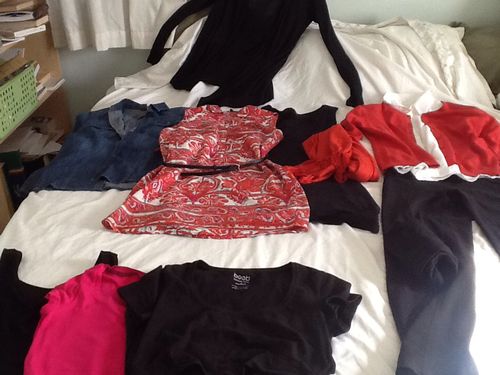
    My first draft looked like this:

    It includes the following 15 pieces, not counting pajamas and underwear and socks and hiking boots and the like:

    • Black trousers
    • Black leggings
    • Red-orange performancewear skort
    • Black tank (nursing openings)
    • Black tee (nursing openings)
    • Black short sleeve empire waist top (nursing openings)
    • White tank
    • White “button-down” style shirt, 3/4 sleeves, lightweight
    • Hot pink scoop-neck tee
    • Lightweight black long-sleeve cardigan/wrap (rolls up really small)
    • Denim shirt
    • Red-orange cardigan
    • Black tank dress (no nursing openings, but stretchy enough I can pull down the neck)
    • Sleeveless shirtwaist-type dress with hot pink/red-orange/white pattern
    • Red-orange scarf

    Shoes that go with this:

    • Black sandals
    • Black ankle boots

    I’m really pleased with how this turned out. It only needs a couple of extra things, in fact, to be a complete non-travel capsule wardrobe for late summer/autumn — mostly things I already have, like bootleg jeans and a few more long-sleeve tees.

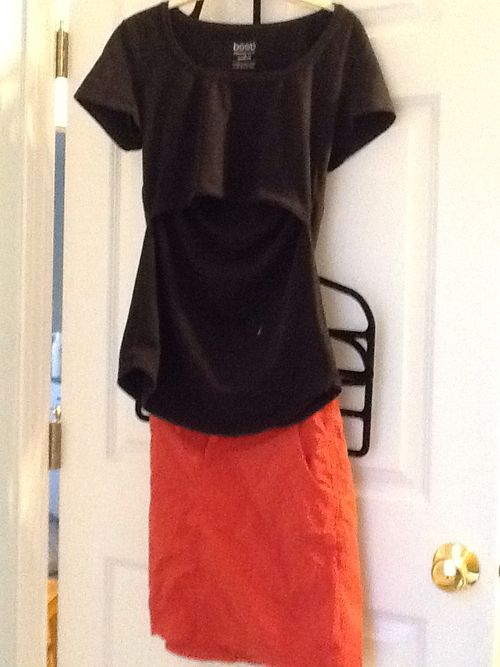
    Some of the combinations:


    But I need to swap a few things out for my trip, because I think that once I add the fleece, hiking pants, rain gear, and base layers that I need for the mountains, the overall wardrobe will be unnecessarily heavy on warm items. I will probably drop the denim shirt and add another tee and a pair of lightweight capris. This will bring the total up to 18-20 items, which is not bad considering it is for two seasons, requires enough warm layers for an emergency overnight in the mountains, and has to last 28 days.


    + + +

    I also made a capsule wardrobe for my daughter, which was fun since I had to get her late summer/autumn clothes anyway. I made her neutral color be navy and her accent color be turquoise, since she has a little purse and a pair of Keen sandals that color, and I got almost everything from Old Navy on one of their big sale weekends. Add a pair of navy espadrilles, some fleece and hiking pants, and she is set for the city and the mountains. I think I am going to keep up the capsule approach as she gets bigger.


  • Cooperating, not competing, priorities.

    That put-on-your-swimsuit-for-your-kids’-sake post that I wrote about has spread its influence throughout the feminine half of the blogosphere, at least the sector* populated by mothering mothers. Elizabeth Duffy, writing at Patheos, had a good post the other day:

    One of the swim coaches stood on the side of the pool in a handsome black tank, and she was as plump and dimply as the rest of us, but she stood up straight, shoulders back, making bold demonstrations of each stroke for her pupils. I remember thinking that her confidence paired with an obvious tendency not to take herself too seriously was very appealing, and not just to the eyes.

    She was not slouching out of sight, and it wasn’t just because she found the right suit for her body type, or because she had memories to make. She had a job to do, an important one, and she clearly found her work fulfilling enough that she could be at peace with herself and delight in her body’s ability to do its job well.

    This is really the way that I prefer to think about it; indeed, though getting in the water and splashing with your kids is important, this it’s the reason behind that reason. We’re raising kids, and so everything we do teaches them how to be. If we want to teach them what their bodies are good for — doing and being, as part of their human wholeness; not just appearing and seeming, and certainly not merely things to be used and abused; well, being ashamed of the appearance of our own is only going to teach the wrong lessons.

    Too, being focused on the jobs you have to do and the joys you want to have is better than being hyperfocused on What People Will Think When They See Me.

    More from Elizabeth:

    The irony is, that when a woman of a certain body type or a certain age decides to get thin–I count myself here–you really do end up giving everything else up as your mental energy goes into counting calories, planning meals, and incorporating strategies to prevent yourself from eating. There are many hours spent in the gym, many hours spent working on self-image rather doing things of interest to yourself or of import to other people.

    Not every woman who decides to get fit loses their perspective this way, but I certainly have, and I have corroborated my experiences with female friends. When I decide to be thin, I become a very boring person, a stressed out person, someone who only thinks about food and mentally scourges herself for mistakes made when eating.

    You don’t usually get to have it both ways–you don’t get to be a skinny woman, and at the same time, a woman who’s happy to sit at a bar and drink pints with her husband. You don’t get to be someone who is fully invested in being thin, and at the same time finds herself interesting enough in her own right to forget occasionally her body and its tendency to grow fat when it’s having fun.

    I can also corroborate this. The year that I achieved my big weight loss was a year of absolute concentration and obsession. It consumed almost all my attention. I don’t regret it, and I have found the effort to be fruitful in more ways than one — it was an achievement I had never thought possible, and it opened up all sorts of possibilities for me as well as leading to a lot of reflection on my identity. But it was so costly.

      [Editing Note. That’s why, several years later, I’m now going through a lot of these weight loss and gluttony posts and adding disclaimers to them. I failed to make clear distinctions between technical, theological “gluttony” and other problems like clinical eating disorders. Some of that thinking might have been helpful to me personally because of the specifics of my own issues, but I was not and never have been qualified to imply that the same was true for others. I don’t think these writings were worthless, but they should definitely be taken with a grain of salt.]

      But I wasn’t bored.

      I wasn’t bored because, to put it bluntly, I am a geek, and I can really get into that which bores other people. Whatever my project, I must love it and dig deeply into it, understand it and analyze it, take it apart and put it together in different ways. This is how I cook, how I gestate and give birth and care for babies, how I educate my kids, how I approach faith. My life is a little laboratory, and it’s okay if the results are not repeatable by others because they’re highly tailored to my own surroundings. The year that I lost all that damn extra weight and learned to be an athlete was the first year that my own body became the laboratory for the sake of itself.

      (And I do call it “becoming an athlete” for a reason. I won’t call it just “fitness,” it was more than that, an identity crisis was involved. I wanted not just to appear thin, but to feel like Elizabeth’s swim instructor, strong and capable.)

      So I wasn’t bored. And if my spouse was bored, he did a good job of hiding it. We sat at the bar and drank pints together — only we split them, and he drank more deeply than I did, for that year.

      We still share pints that way. And that’s emblematic of the difference.

      Some friends speculated that it was possible for me to temporarily prioritize becoming an athlete in a way that it might not have been for me today, had I put it off. I was six years younger, I had only three children. And maybe that’s so.

      But staying an athlete, even an amateur one only competitive against herself, is a priority — not in competition with the priorities of raising my family and accompanying my husband, but in union with them.

      I am married to a person who aspires to be always training for the next goal. His sports are downhill skiing and climbing (both rock and ice); seeing as how we live in the northern plains instead of the western mountains, he’s never going to be able to find the time to do either of them frequently enough to excel at either, but he can always be training for his next trip so he can have more options and have more fun. And so he tries to get to the gym three times a week if he can. And so it’s something we do together — not so much the climbing (I have an old wrist injury) but the training. Neither of us has the time to train very well or thoroughly, but it’s something we can talk about over those single shared pints.

      And since he’s a geek too, and also since training involves chemistry and physics that neither of us has ever mastered, we can talk about it over and over and over again. That’s a lot of pints.

      Athleticism of a certain individualistic type is a family value for us. (It runs in Mark’s family of origin; his siblings and their spouses have been runners, mountain-bike and road-cycling racers, equestrians, and collegiate-level wrestlers, along with the occasional dabbling in climbing and downhill skiing.) We are working to pass it on to our kids. That priority meshes with our other family and marriage priorities, so it isn’t in competition with them (although it has to be balanced with them: I have to teach and feed the children, and Mark has to go to work). I think this more than anything else is why the changes I made six years ago have remained permanent. They reinforce, and are reinforced by, the other good things I have in my life and want to keep.

      _______

      *Yeah, I couldn’t stop myself from googling just to double check that “sector” was the correct geometrical term with respect to a piece of a sphere, as I knew it was for a circle. Although it isn’t quite as satisfying because the arcs that define the sectors of a circle, being one-dimensional, perfectly tessellate the “surface” (i.e., the circumference) of the circle — cf. pie charts — but the domed spherical sectors by necessity have gaps between. Unless, of course, there are an infinite number of them in just the right distribution of volumes, much as you can fill a rectangular box perfectly with an infinite assortment of differently-sized spheres.**


      **Yeah, I finished writing the footnote before I went on to write the rest of this post.


    • Embrace the suit.

      Simcha Fisher pointed at a HuffPost piece entitled "Moms, Put On That Swimsuit:"

      You've got two choices every summer — to put on a swimsuit or to skip it.

      I have a lot of friends who do the latter.

      They go to the pool with their kids, but they only put their feet in the pool. They sit on the sidelines, too concerned about what they look like and what others will think to embrace the joy of swimming with their kids.

      Or they go to the beach, but stay under the umbrella instead of running into the ocean.

      And it makes me incredibly sad.

      Because when women stay on the sidelines because of insecurity, we are modeling unhealthy behavior to our children and we are missing out.

      Your swimsuit does not define you.

      Simcha's take:

      More than once last year, I just felt too damn fat to put on a bathing suit. Just couldn’t do it. So I would go to the beach with the kids, and they would ask me to take them in the water and do that swishing thing, or catch them when they jump off the big rock — and I couldn’t, because I didn’t have a suit on.

      They were crushed. It didn’t make any sense to them. Why would you not wear your swimsuit to the beach?  And they were right. Yeah, there are skinny, perky teenagers at the beach. Yeah, there are other moms who are frolicking around with their kids, and they’re wearing the same size bikinis as their toddlers. Not even with stretch marks! How do they even do that? And here I am, and I weigh more than I did when I was nine months pregnant with the youngest kid, who is now 2 1/2. How did I even do that?

      More to the point, who cares? Feel fat? Stay in the damn water. No one will see you, and you can feel light and graceful for once. Sitting on the sand getting gritty and trying to tug your shorts and tank top over your flabby bits while the kids beg you to jump in? That is a great way to have a lousy afternoon.  If you want to be attractive, have fun. Laugh and be happy. That’s beautiful, even when you’re fat.

      Here's my theory on the swimsuit problem:  

      A lot of us just aren't used to seeing ourselves in swimsuits.  It's not like it isn't common to be seen in public dressed unflatteringly (baggy tops and ill-fitting jeans, I'm talking about you).   Unless you're wearing the wrong size, swimsuits aren't actually much worse.  

      When I was about 30 (and, incidentally, about 50 pounds overweight, which is a lot when you're under five feet tall), I started taking adult swim lessons at the YMCA.

       I had taken lessons as a kid, enough not to drown if I fell in the pool, but I'd never swum "a lap" in my life.  

      The first swimsuit-related lesson that I learned was that my suit, which had been carefully chosen to make me look as not-fat as possible, was not made for swimming.  The straps wanted to fall off my shoulders.  That week between my first-ever lesson and my second-ever lesson, I went to a sporting goods store and bought a basic Speedo-brand lap suit.  Something like this:  

      12847-9325-2A-zoomin

      No shirring.  No skirts.  No color illusions.  No underwires.  No sweetheart necklines.  No nothing.  Just a suit that would stay on when I moved in the water.  Because that's what they sold at the sporting goods store.

      The big surprise, though, was it turned into the suit that I felt best in.  Because it was the suit that I put on, week after week after week, as I learned how to swim the way that swimming people swim.  I got used to how I looked in it, because I put it on every week in front of the mirror in the locker room.  

      And I was surrounded by other people wearing the same kind of suit.  Some of them were fit and strong.  Some of them were enormously fat and disabled.  A lot of them were mothers of children in swimming lessons, like me.  And all of them got into the water, in their boring lap suits, and moved their bodies faster and more sleekly than they could move them out of the water.  Some of them smiled and leaped into the pool, and some of them worked doggedly at paddling from end to the other with looks of great concentration on their faces.  

      And eventually it sank into my brain that how you look in your suit is so far from being important, compared to what you can do in your suit — namely, get wet and possibly sandy, splash and play or work in the water, raise your heart rate and build upper body strength, exert yourself or relax and cool off.  

      Just getting into any suit, regularly, can do wonders for how you feel in a suit.  I think it's a vicious cycle:  if you don't put it on often, you don't get used to how you look in one, and you associate it with feeling out-of-place, which feels visible.  When you are focused on how you look, you tend to imagine other people are too (when really, they don't care all that much).  Wearing a swimsuit frequently, especially if you use it to help you do something you want to do (like swim laps, or play with your kids at the beach) tends to make you realize that it's a totally normal thing to do, no matter what your shape:  put on a swimsuit and get in the water.  

      So my advice to women who are looking for the perfect suit to minimize their thighs or whatever:  The most flattering suit is the suit you put on to do things in.  Find one that fits comfortably and doesn't want to fall off, and put it on every week.  If you don't live near the beach or belong to a YMCA like I do, go out in the sprinkler with your kids or something.  Make at least one outing somewhere where you will see lots of people of all shapes enjoying the water.  Do it often enough that you realize that the swimsuit is not something scary.  It's just a tool, a uniform.  And nobody's really looking at you anyway, except the people who love you and the little people who look up to you and are counting on you to show them how to be.


    • Homeschool assignment: Reading Augustine on Genesis as a prelude to studying evolutionary biology.

      I finished writing my assignment on Augustine for the beginning of the 9th-grade evolutionary biology course my son will be taking next year.  I thought I'd share it freely here, in case any other homeschoolers are interested in using classical authors to put modern science into long-term perspective.

      Suggestions are welcome as I won't be assigning it till fall 2014.

      + + +

      Augustine lived from 354 to 430 A. D. and was one of the most influential early theologians of the Church.

      Page numbers refer to readings from The Literal Meaning of Genesis, appearing in the volume On Genesis, ed. by John E. Rotelle, trans. by Edmund Hill, New City Press, 2002.  

       1. Read Book I, no. 1 (p. 168) for an introductory idea of the multiple meanings of Scripture.  List the different kinds of meaning that Augustine thinks Scripture can have.

       2. Skim over nos 2-28 (pp. 168-181) to get a flavor of the way Augustine lists questions to establish the difficulty of interpreting Genesis. Dip in here and there and read paragraphs in more detail.  Give three examples of problematic questions Augustine mentions.

       3. Read closely no. 29-30 (p. 181-182).   Why does Augustine believe that it is necessary to list the parts of creation in a certain order?   Why does Augustine believe that the scripture uses the words “earth” and “waters” to represent formlessness?

       4. Skip ahead to Book II, no. 25 (p. 205), about the creation of plants. Why does Augustine say plants are described as a separate creation from that of the land, but on the same “day” as the creation of land?

       5. Read the episode in Book III, par. 12 (pp. 222-223), in which Augustine refutes someone's scriptural interpretation (that a certain language is used of fishes because fishes lack any kind of memory) by pointing out that direct scientific observation of fish contradicts such an interpretation.

       What does this episode demonstrate that Augustine believes about the relationship between the interpretation of truth as revealed in Scripture and facts that are learned by observation of the natural world?

       6. Read nos. 18-19 (pp. 227-228). (It may help you understand if you begin at par. 16 on page 225.)

       Pay particular attention to this:

       The reader may also wonder…whether the phrase 'according to kind' comes up again and again just by chance… or whether there is some meaning in it, as though they were already in existence beforehand, though the account of their creation is only now being given… In fact this expression begins to be used about the grasses and the trees, and so on until we get to these terrestrial animals… Is it because these things sprang into being in such a way that others would be born of them and in succeeding to them would preserve the shape and form of their origin?… 

      This then is the significance of 'according to kind,' where we are to understand both the efficacious force in the seed and the likeness of succeeding generations to their predecessors, because none of them was created just to exist once and for all by itself, whether to continue for ever, or to pass away without none to succeed it.

       Does the above passage refer to the possibility of God creating animals that would then produce new ones of the same kind, or does it refer to the possibility of God creating animals that would eventually give rise to animals of different kinds?

       7. Read no.s 22-23 (pp. 229-230).   Augustine subscribes to the then-current scientific theory of “spontaneous generation,” i.e., that maggots and flies spontaneously come to life in rotting meat. (Never mind for the moment that moderns know the maggots are not spontaneously generated, but come from eggs which are laid in the meat by insects.) What philosophical problem does Augustine say the theory of spontaneous generation creates for those who study creation?

       Augustine's answer is phrased as follows: “…possibly there was some natural tendency in all animated bodies, so that they already had seeded and threaded into them beforehand, as it were, the first beginnings of the future animalcules, which were going to arise.”  How might we apply this same principle, based on a now-outdated scientific theory, to the more current idea of biological evolution?

       8. Read par. 30 (p. 234). What does Augustine say is the defining aspect of humankind, the aspect in which man is made “in the image of God?”

       Do you think that the distinctive characteristic of humanness is something we can measure with current technology? Why or why not?

       9. Read Book V, no. 12 (p. 282).  Does Augustine argue that the act of creation is a single act, or a series of acts?  Was there a time before the beginning of the universe, according to Augustine?  Tell what you know about what cosmology, a modern branch of physics, says about this question.

       10. Read Book V, no. 41 (p. 297; note that it is two paragraphs long).  Can this philosophy be said to admit the possibility of biological evolution?

       11. Optional: If you are interested in Augustine's mathematical interpretation of why there are six days of creation and not some other number, see Book IV, beginning on page 241.  


    • Augustine and evolution.

      Today I cracked open St. Augustine's On The Literal Meaning of Genesis in order to find bits for my ninth-grader's evolutionary biology course.  

      I plan to begin the course with some cultural and social context for evolutionary theory, and I was irritated to discover that the summary in the college textbooks went straight from Plato's and Aristotle's ideas to "Later, Christians interpreted the biblical account of Genesis literally and concluded that each species had been created individually by God in the same form it has today."  I've been familiar with the idea that Augustine's philosophies allowed for evolutionary development for a long time (since reading the sci-fi classic A Canticle for Leibowitz, I think!) , so I set about going to the source.

      The first 22 paragraphs or so should cure anyone of the notion that asking probing questions about the logical contradictions in Genesis is a modern phenomenon.  Augustine lists many such questions.  For example:

      So why was the sun made with authority over the day to give light upon the earth if that light which had also been called 'day' had been sufficient for the making of the day? Or was that earlier light illuminating higher regions far from the earth so that it could not be perceived on earth, and thus it was necessary for the sun to be made? … It can scarcely be supposed, after all, that it was put out so that nocturnal darkness might follow, and then lit again so that morning might be made, before the sun took on this task.

      Augustine says that the six-day structure and series of creative events that are described in Genesis has a literary and pedigogical, not a historical, purpose:

      It is not because formless matter is prior in time to things formed from it, since they are both created simultaneously together… but because that which something is made out of is still prior at its source, even if not in time, to what is made from it, that scripture could divide in the time it takes to state them what God did not divide in the time it took to make them.

       …Since both [matter and form] had to be mentioned by scripture and both could not be mentioned simultaneously, can anyone doubt that what something was made out of had to be mentioned before what was made out of it?

      … If two things cannot be named simultaneously, how much less can their stories be told simultaneously! So then, there can be no doubt at all that this formless basic material, almost the same as nothingness though it be, was still made by none but God, and was simultaneously created with the things that were formed from it.

      The particular choice of which things are created on which days is not to establish order in a sense of a timeline, but order in a sense of classification.  For example, why plants are included on the third day:

      Here we should note the skillful touch of the one who put the text into shape; because grasses and trees are sorts of creatures quite distinct from the specific form of the lands and the waters… they are spoken of separately as coming from the earth… it is also separately indicated that God saw that it was good.

      But all the same, because being fixed there by their roots they are continuous with the soil of the earth and entwined in it, he wished these things as well to belong to the same day.

      He also goes on to explain, for example, that the creation of sun, moon, and stars is described as following the creation of land and plants because "fixed" things come before "moving" things in the logical structure.

      I got the impression as I read that just as Augustine would disapprove of insisting on a six-day creation, he would disapprove of insisting that the scripture "got the science right" with respect to, e.g., light coming first, water-animals preceding land-animals, and so forth. Trying to put together some sort of "Genesis Code' that matches what we observe about the early days of Earth and the life on it, point by point, with the events of the six days of creation, would be missing the point entirely.

      Nevertheless, Augustine spends a great deal of time talking about natural philosophy as it existed in his time and as it was handed down from earlier times. He is interested in setting up a correspondence in the sense of dialogue between the two bodies of knowledge. 

      For example, here's a place where he essentially says to an interlocutor, "Your scriptural interpretation is invalid, and you wouldn't make that mistake if you knew more science":

      Some people…have expressed the opinion that the reason fishes are not called [in Genesis] 'live souls' but 'reptiles of live souls' is that they lack any kind of memory or form of life even remotely approaching rationality. But this opinion comes simply from insufficient experience, because there are authors who have described many wonderful things that they have been able to observe in fish-ponds… It is still absolutely certain that fishes have memory. This is something I have myself experienced, and anyone who wants to can experience it too.

      There is, you see, a large fountain in the district of Bulla that is chock-full of fish.  People are habitually looking down into it and throwing in things which the fish will rush at together to grab first, or fight among themselves to tear them to bits.  Being now used to this kind of feeding, whenever people stroll round the rim of the fountain, the fish too will swim back and forth with them in a shoal, waiting for those whose presence they are aware of to throw something in.  

      From what I can tell, it sounds like some naturalists of Augustine's day said that Genesis was obviously boneheaded because it said "Let the waters produce" (besides crawling things) "flying things," when everyone knew that birds are clearly of the airy element, or perhaps of the earthy element.  He spends some time, therefore, pointing out logical inconsistencies in his day's settled science:

      If the reason they give [for fish being watery and birds being earthy] … is that fishes do not have feet, then it means seals do not belong to the water, nor serpents or snails to the land or earth… As for dragons, which lack feet, they are said to take their rest in caves and to soar up into the air. While these are not too easy to come across, this kind of animated creature is for all that definitely mentioned not only in [scripture] but also in that of the [pagan Greek and Latin legends].

      (I liked the bit about dragons not being too easy to come across. It's like he's saying he's never personally observed the effect but it has been attested to in the literature.)

       He finds particular significance in the repeated phrase "according to kind":

      The reader may also wonder…whether the phrase 'according to kind' comes up again and again just by chance… or whether there is some meaning in it, as though they were already in existence beforehand, though the account of their creation is only now being given… In fact this expression begins to be used about the grasses and the trees, and so on until we get to these terrestrial animals… Is it because these things sprang into being in such a way that others would be born of them and in succeeding to them would preserve the shape and form of their origin?… 

      This then is the significance of 'according to kind,' where we are to understand both the efficacious force in the seed and the likeness of succeeding generations to their predecessors, because none of them was created just to exist once and for all by itself, whether to continue for ever, or to pass away without none to succeed it.

      This doesn't actually talk about evolution, of course, but of the generations of animals producing offspring of the same kind.  Still, it sets the stage for Augustine to talk about the arising of animals which were not present in the beginning and which can be observed in his time by the best natural scientists available…

      …and no, we're not talking of evolution, but spontaneous generation!  Augustine subscribes to the then-current scientific belief that maggots and such are spontaneously generated in rotting meat, and for completeness explains how they could then have been created in the original establishment of things.

      As for [those tiny creatures] that are generated from the bodies of animals, especially dead ones, it wold be quite ridiculous to say that they were created at the same time as the animals themselves were, unless possibly there was some natural tendency in all animated bodies… as it were, the first beginnings of the future animalcules, which were going to arise… all things being put in motion without any change in him by the creator.

      Note that bit about God having created the "natural tendency in all animated bodies… the first beginnings of the future animals which were going to arise."

      As I read through this, I can hear in my head the voice of innumerable adolescents and overgrown adolescents, and possibly some esteemed biologist-authors as well, challenging, "Oh yeah?  Well if your religion can co-exist with science then how come it says the earth was created before the stars then?" and thinking they were the first ever to come up with such a wise and brilliant argument.  It's partly to head this sort of thing off at its source that I want my kids to read classical Christian authors, even in bits and pieces.

      A great deal of thought (as well as contemplation of observations from the natural world) went into ancient metaphysics, and that it's simply not true that Christians before Darwin uniformly believed in a young earth and a literal six-day creation.  

      In Book V,  Augustine argues that the act of creation of everything material (including time) had to have been a single instantaneous act rather than a series of acts:

      Creatures [including inanimate objects] once made began to run with their movements along the tracks of time, which means it is pointless to look for times before any creature, as though times could be found before times….

      So it is time that begins from the creation rather than the creation from time, while both are from God…

      Nor should the statement that time begins from the creation be taken to imply that time is not a creature…

      Accordingly when we reflect upon the first establishment of creatures in the works of God from which he rested on the seventh day, we should not think either of those days as being like these ones governed by the sun, nor of that working as resembling the way God now works in time;

      but we should reflect rather upon the work from which times began, the work of making all things at once, simultaneously, and also endowing them with an order that is not set by intervals of time but by the linking of causes, so that the things that were made simultaneously might also be brought to perfection by the sixfold representation of the day."

      BAM.

      And people think this is a *modern* idea, because Stephen Hawking, or something.

      Once we get to the particular creation of man, things continue to get interesting:

      After saying 'to our image,' he immediately added, 'and let him have authority over the fishes [etc.],' giving us to understand that it was in the very factor in which he surpasses non-rational animate beings that man was made to God's image. That, of course, is reason itself, or mind or intelligence… it was not in the features of the body but in a certain form of the illuminated mind." 

      From this I get: "Man" cannot said to have been "created" until we are talking about rational man. Man with a certain form of the illuminated mind.  And it isn't clear that we would be able to discern which fossils would have come from organisms who possessed that "certain form."

      It seems to me that we don't have to understand precisely what the distinction is between the mind of a human and the brain-processes of other animals.  Without that, we can still accept that scripture is telling us that there is some distinction, possibly unmeasurable, some illumination that belongs properly to humans but not to nonhuman animals, and that illumination is what is meant by "in the image of God."

      I think we run off the rails by trying to force that distinctive characteristic of human-ness to be described by only what we can measure with our current technology. Augustine's writing records a time when people were wasting a lot of brain power either trying to get the scriptures to match up with earth/air/water/fire concepts of matter, or trying to use those concepts to refute scripture.

      Augustine says that the "seventh day" is the division between "how God worked then" and "how God is still working."  "How God is working now" includes, then, all the eons of work between the act of creation and the present day.  God doesn't "create through evolution."  He created; now, creation evolves, as long as he works in it.

      "Let us believe, or if we are able to, let us even understand that God is working until now in such a way that if his working were to be withheld from the things he has set up, they would simply collapse…

      "If we suppose that he now sets any creature in place in such a way that he did not insert the kind of thing it is into that first construction of his, we are openly contradicting what scripture says, that he finished and completed all his works on the sixth day. Yes, within the categories of the various kinds of thing which he set up at first, he manifestly makes many new things which he did not make then. But he cannot rightly be thought to set up any new kind, since he did then complete them all.

      And so by his hidden power he sets the whole of his creation in motion, and while it is whirled around with that movement, while angels carry out his orders, while the constellations circle round their courses, while the winds change, while the abyss of waters is stirred by tides and agitated by cyclones and waterspouts even through the air, while green things pullulate and evolve their own seeds, while animals are produced and lead their various lives, each kind according to its bent, while the wicked are permitted to vex the just, he unwinds the ages which he had as it were folded into the universe when it was first set up. These, however would not go on being unwound along their tracks, if the one who set them going stopped moving them on by his provident regulation."

      I posted much of this on Facebook, and along the way snagged a couple of recommendations for future reading:

      • Amy Welborn suggested In the Beginning:  A Catholic Understanding of Creation and the Fall by Pope Benedict I né Joseph Ratzinger.
      • Melanie suggested The Mind of the Maker by Dorothy Sayers.

      I don't know if I'll get to them in time to put them in my course, but they do sound like good suggestions.  The Ratzinger book probably would have saved me a lot of time had I known about it before I started…


    • In case of emergency.

      Here’s a repost from last May, with some new material at the bottom.

      +++

      Last week I unwittingly worried a friend of mine in Facebook chat.

      I’d mentioned that Mark was out in Colorado on a climbing trip. The last exchange of the chat went like this:

      FRIEND: Prayers ’till Mark gets home!

      ME: Thanks! If he doesn’t call by 11 pm I have to call search and rescue.

      Would love to chat longer but have to teach history now. Take care!

      + + +

      On Sunday at coffee and donuts she mildly chastised me for joking about the search and rescue. “I wasn’t sure whether to be worried about you or not!” she said.

      Of course, I hadn’t been joking, but I also hadn’t thought that it would have been the kind of thing that would worry a friend. Why did I throw the offhand comment out?

      I suppose it’s one of those things you do in the Twitter age. We are now masters of the Short Enticing Comment Intended To Give The Appearance Of Having A Much Longer Story Behind It.

      The idea is, of course, that in your interlocutor’s imagination, the story you merely hinted at will grow to hilarious proportion, and your interlocutor will project their own imaginings onto you, and you will be lauded for your sparkling wit. When in fact all you wrote was something like “OMG NO NOT THE MOLASSES #twoyearolds #bathtime #gin”

      + + +

      Anyway, the truth is that I was not, in fact, joking about the search and rescue — well, I did abbreviate a bit, as one is wont to do. My actual instructions were to wait until 11 p.m. for contact from Mark, and then start calling these numbers in order:

      1. Mark’s cell
      2. His climbing buddy’s cell
      3. The backcountry guide’s cell
      4. His climbing buddy’s wife back at home in Tennessee
      5. The mountain climbing school and guiding service
      6. A climbing gym that serves as the after-hours contact number for said service
      7. The county search and rescue (SAR) dispatch

      If you’re wondering whether it isn’t the job of the mountain climbing school and guiding service to decide whether it’s time to call SAR, you’re right — the service has a protocol for keeping tabs on their guides in the field. If one doesn’t check in after a trip, they are supposed to follow up. (That’s why I’m supposed to call the guiding service before going straight to SAR myself.)

      But redundancy is a good thing, and nobody’s more interested in having Mark come home safely than I am, so nobody’s better suited for the task of checking up on him should he go missing. Besides, he was planning to climb a different mountain two days later with his buddy and no guide, and in that case there wasn’t going to be a mountain school looking over his shoulder.

      + + +

      “I’d be so worried if my husband gave me a set of instructions like that,” a different friend said to me on a differnet occasion.

      I said, “I’d be more worried if he didn’t.”

      One of the first rules of safe backcountry travel is to let someone else know exactly where you intend to go and when you intend to get back. You’ll find this advice everywhere; here it is in a well-written .pdf about backcountry safety:

      One important rule too often forgotten is to let others know exactly where you are going, with whom and when you can be expected back. I hate to sound maternal, but search and rescue teams often spend hours driving around on back roads looking for a subject’s vehicle before they know where to enter the field to begin a search.

      By letting someone know EXACTLY where you intend to go, when you expect to return and where your vehicle will be parked, you can eliminate the possibility of searchers having no idea of where to look. Should your plans change in route to your destination, stop and notify that person of your new itinerary. In addition, if you leave pertinent information on the dash of your car (e.g. name

      and phone number of your contact in town, location of travel/campsite and so on) search teams will have a very timely idea of your plans. Otherwise, search teams can be of little assistance when all that is known is that you “went camping somewhere in the Gore Range.”

      And then, it’s nice to have specific instructions. That’s one of the things I insist on, whenever Mark heads off to go backcountry skiing or climbing — guided or not: a specific set of “deadlines” and directions for what to do if he misses each one.

      If he were to tell me, “I’m parking at the such-and-such trailhead and planning to summit such-and-such a peak; we’re going to turn back by 11 a.m. at the latest and I expect to be back in cell phone range by 5 p.m.,” that would be … a good start. But that doesn’t answer the actionable question, which is… so what do you want me to do if you haven’t called me by 5 p.m.?

      I can’t read his mind (too bad, that would come in handy for backcountry travel), and I’m hundreds of miles away and not familiar with the area he’s in. Furthermore, it’s his job to set up the safety procedures for his trip, not mine — even if I have a role to play in those procedures.

      Some people might think that the right thing to do is call the authorities the minute someone is overdue. But this would be premature. SAR is expensive, and part of backcountry ethics is being prepared to deal with delays and unexpected events. You’re not supposed to have SAR be your first line of defense if anything goes wrong; you’re expected to do what you can to aid in your own shelter and rescue. So, for example, if there’s a signficant chance that a delay could force you to spend the night on the mountain (rather than trying to follow a difficult trail down in the dark), you bring bivy gear and extra food, and you instruct your contact person that your arrival time could be delayed by twelve hours or whatever with no cause for alarm. It would be silly to send out the dogs for someone who’s comfortably ensconced in warm waterproof layers, seated on an insulated pad, munching energy bars, and waiting for nothing more dramatic than daylight.

      In this case, even though he expected to be back in cell phone range by 5 pm, he definitely didn’t want me calling SAR at 5:01 . He figured on giving himself several hours of leeway time — time to accidentally go down the wrong trail, figure it out, and backtrack if necessary; time to sustain an ankle injury and slowly crawl back to the vehicle, should that happen; time to arrive at the climb, find it occupied by another party, and wait for them to finish before starting. None of those delays, not even an injury, are an emergency that requires calling out the authorities; they’re all the kind of things that you’re supposed to be prepared to deal with yourself. And if you wind up dealing with something like that, you’ll be delayed. And that’s okay.

      It’s not terribly fun to have to wait the few hours between “overdue time” and “call out the dogs time,” but it’s much better than sitting there wondering, “Should I call out the dogs, or is it too soon? I wonder how long I should wait? If I make the wrong decision SOMEBODY COULD DIE.”

      I told Mark, he has to own the when-should-I-call-search-and-rescue decision. And he owns it by giving me specific instructions about when to call, and whom to call. And also by telling me everything pertinent: where he’s starting, what he plans to do, and even what he’s carrying (I like to know, for example, if he’s prepared to spend the night outdoors and what weather he’s prepared for, and for him to confirm that he has a GPS, map, and compass).

      + + +

      Every once in a while I run into the opinion that it’s irresponsible for anyone, but especially a parent of young children, to engage in common adventure sports at all. Backcountry hiking, black-diamond skiing, rock climbing, etc.

      (Occasionally this extends to activities as banal-sounding as bicycle commuting. There’s a lot of victim-blaming in the comments to news stories about cyclists who get struck by cars. It’s very depressing. I have a theory that a large number of people simply don’t believe that bad things can happen to good people.)

      I think it’s irresponsible to think you can remove all risk from life. Every day we’re surrounded by common risky activities: from the acutely risky, like riding in cars or taking showers in slippery bathtubs, to the chronically risky, like occupational exposure to low-frequency noise or sitting around getting no exercise. And many culturally-not-considered-extreme hobbies carry a surprisingly high risk; for example, recreational boating is well accepted here in Minnesota, but it’s also relatively risky (one estimate from Ohio: about 1 fatality per million operator-hours; anotherestimate has 1 canoeing fatality per 720,000 outings.)

      Rock climbing is riskier than boating, but not the OMG IT MUST BE MANY TIMES RISKIER HOW COULD YOU EVEN THINK ABOUT DOING THAT WHEN YOU HAVE SMALL CHILDREN AT HOME!!! that you might expect from all the teeth-gnashing about it. Do you ever hear anyone say, “Gosh, I’d never have elective surgery under general anesthesia while I still had young children at home?” Well, that’s more likely to kill you than a rock climbing trip.

      All this is to say: Hobbies are important. It’s good to have them. And it’s okay to have hobbies that carry some risk. The important thing is to diligently take reasonable precautions and follow well-accepted safety protocols; to keep your head and know your limits; and to talk about safety and comfort with the people who depend on you, to make sure that no one is forced into a situation where they’re uncomfortable with the level of “adventure.” Mark and I have worked pretty hard over the past few years to create an atmosphere in which I’m always on board with what he’s up to, and if I’m not, we work together to figure out what needs to change until I am.

      +++

      End of repost.

      I did it again on Sunday. “Is Mark having a good Father’s Day?” asked a friend after church.

      “I assume so,” I said, “He’s out in Colorado rock climbing.”

      Her jaw dropped a little and she said “Oh my gosh! I’ll pray for his safe return!”

      “Go to Blessed Pier Giorgio,” I said cheerfully, “it’s what we always do.”

      On Saturday I had run into a little bit of an issue because Mark forgot to tell me which time zone he meant when he sent me my schedule of whom to call when. Was that “call SAR if you haven’t heard from me by 6 pm” Denver time or Minneapolis time? The difference is only an hour, so I sent him a text message letting him know that I was going to split the difference and call out the troops at 5:30 Denver time. Fortunately he got that message in time, because they took longer climbing on the glacier than they intended and the schedule had to change; he sent me a text later to let me know I should extend the deadline.

      So that was one thing learned on this particular trip. Another one — not so much “lesson learned” as “detail that occurred to us for the first time” — was that he really should tell me the make, model, color, and license plate number of the rented car he is driving to the trailhead.

      People still ask me if I am not worried about him. We are, a little bit, I guess. I definitely start to get a little antsy when the “I will probably be done by X-o’clock” time approaches. But it is an enormous help to know that I will never have to sit at home wondering if I should do something or not. I know I can drop that worry and leave it behind, trusting him to take care of himself if he can, trusting in the grace of the sacrament of marriage to take care of the kids and me if he can’t. And he knows that I know, and so that thread of intention connects us, whether we are both in cell phone range or not.