bearing blog


bear – ing n 1  the manner in which one comports oneself;  2  the act, power, or time of bringing forth offspring or fruit; 3 a machine part in which another part turns [a journal ~];  pl comprehension of one’s position, environment, or situation;   5  the act of moving while supporting the weight of something [the ~ of the cross].


  • Split up day: morning.

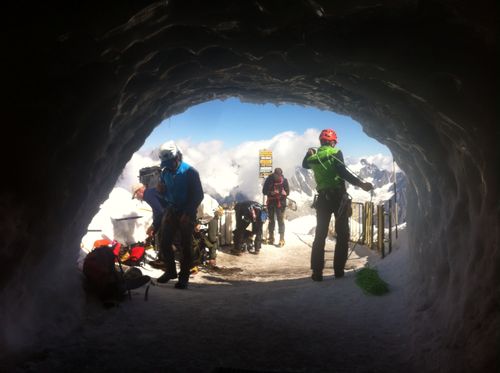
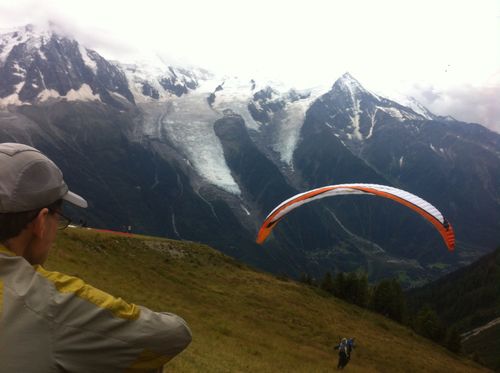
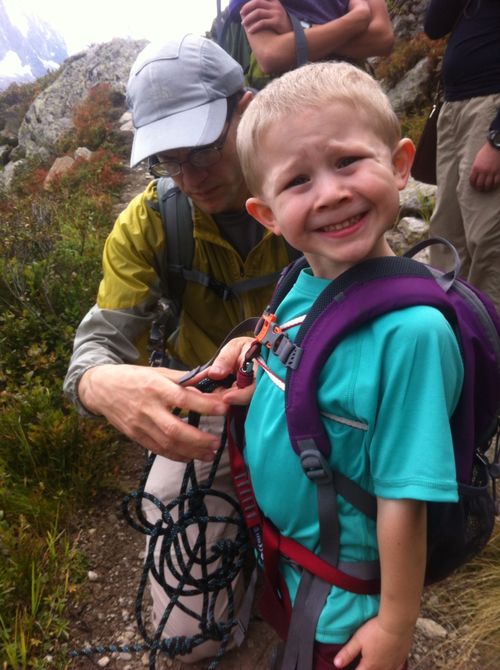
    On Monday, Mark and the big boys suited up in a mixture of gear that happened not to have been packed in the lost suitcase, gear borrowed from me and the 8yo, and gear they rented in town. They headed across the footbridge to the train station to meet the guide.

    The guide’s name is Jeff (further complicating things: I am certain that “Jeff” must be the male version of “Jennifer” because there are so many Jeffs in our life, all between 35-45 years old, that I am constantly having to ask which Jeff Mark is talking about. Jeff your brother-in-law? Jeff my friend’s husband? Well. This is Jeff the Guide.) Mark has had the bizarre luck to travel on business near here several times, and so he has been climbing in Chamonix several times, and so for the last few years we have been joking that he has a guide in Chamonix on retainer, therefore he is not allowed to complain about anything because obviously he is doing pretty well.

    Anyway, off they went to meet the guide so they could go do glacier travel and ice climbing on the Mer de Glace, which is the second longest glacier in Europe or something like that.

    I stayed in the apartment with the three smaller kids and let them sleep while I wrote a blog post, then we ventured out. Mark had suggested that I take them on the train to the next town, but that seemed intimidating to me — who knows what I would find there and how easy it would be to walk around with a baby and a small boy and a medium-sized girl? I thought to myself, “What’s happened to me?” remembering that twenty years ago I was studying in Lyon and I took several train trips all by myself to towns and cities I had never been before, and I never worried that I’d have trouble navigating or figuring out what to do when I got there. When did I get so timid?

    Anyway so instead I planned two in-town outings.

    + + +

    Today was the boys’ day to play and we have two whole weeks, so I expected to have to deal with a number of practical matters. I needed to buy food and diapers and coffee filters. I expected to have to do laundry at some point, and tidy the apartment. Of course I would have to feed the children. Mark had given the 4yo and the 8yo each some money to buy things; the elder had €20 and the younger had €4 with the promise of more if he spent it instead of losing it. (“My allowance,” he said proudly, and was sure he had the better deal since his money was in the form of two shiny and interesting-looking €2 coins, not boring paper bills.)

    I buckled the baby on my back. I made each child carry a backpack, and I put the diapering supplies in the 8yo’s pack. Out we went.
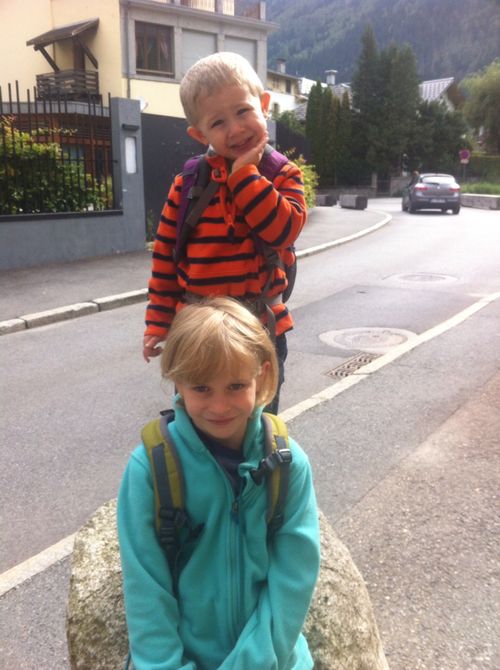
     

    We walked around town, planning to go to the grocery store last of all so that we could then carry the groceries home. We looked into souvenir shops. One was selling little plastic centimeter rulers with children’s names and name-days printed on them — here in France the trend of alternative spellings has not taken off, so it still makes sense to have popular names pre-printed on things. My 4yo’s name was represented (not the others — my daughter has a double name and she could have put two of the rulers together to make it, at least the French form, I suppose) so we bought one for him. He was pleased with that. There were many stuffed-toy marmots (sort of the town mascot) and plush St. Bernards with the little barrel around their necks. There were many cowbells, hand painted with alpine flowers and hanging from leather straps, some authentically cowbell-sized and others tiny. There were leather goods (my daughter admired a tiny heart-shaped wallet FIFTY-FIVE EUROS HOLY COW) and postcards and coffee table books full of mountain photography. Bedroom slippers and baby shoes that looked like ski boots. Wrapped chocolates with mountain scenes printed on each wrapper.

    The children got hungry and so we stopped in a Salon de Thé that sold pastries.

    The 4yo took his time choosing three little macarons. Despite the name, these are not “macaroons” — they are a sandwich cookie, roughly Oreo-sized, with an intensely flavored and sweet paste between two colorful meringue wafers. Stores that have them invariably display a rainbow’s worth of colored macarons, and the children are drawn to them. Eventually the 4yo picked raspberry tart (white with pink sprinkles and red paste), myrtille (which I don’t think is exactly a blueberry, but close enough — it was a deep blue), and salted caramel (toasty brown).

    The 8yo, having heard me tell of such things, chose a petit pain au chocolat, which is a rectangular croissant with a stripe of dark chocolate running through its center.

    Et moi, je n’ai pas faim,” I said to the young woman who was running the tea shop. As for me, I don’t have hunger. “Merci de votre patience,” I added, because the children had taken quite a long time in choosing their snacks.

    “Mama,” said the 4yo urgently, “How do you say ‘I do not speak French?’” This is my child who talks to everybody about everything.

    “Je. Ne. Parle. Pas. Français,” I told him, right in front of the shopkeeper.

    He looked her in the eye. “Je ne parle pas français,” he repeated.

    “You can talk to me English,” she told him, “If you talk it slow-ly.”

    So he told her his name, and then all about how we were going to the grocery store after we had a long walk and how his daddy and big brothers were going out on the glacier and how he was four years old and by the way, was she the owner of this shop or did she just work there?

    She looked back at me nervously. I grinned and told her that he does that to everybody.

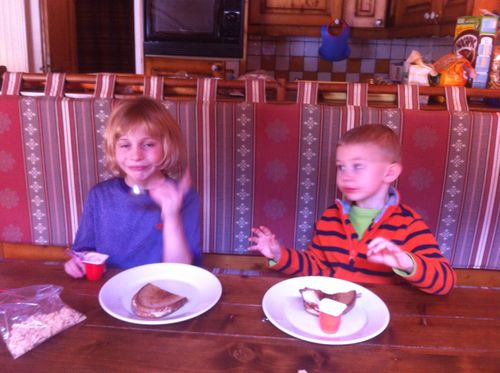
    Outside we took a seat and the children eagerly opened up their little packages.

    “It’s bitter,” said my daughter in surprise about the chocolate bread, “but it’s good.”

    The 4yo ate just the raspberry macaron, which he refused to let us taste, and carefully wrapped the others up for later.

    We wandered around — I had to consult the map once or twice. I stopped once to nurse the baby on a bench, and watched interestedly to see if passersby would notice and if so how they would react. I got a few sideways glances, but I actually think people were wondering about my older children; throughout the morning, three separate people asked me if they were on their way to school.

    I found this a bit surprising, since it was (I thought) obvious that we weren’t from around here and the children were speaking English to me. But maybe there are expat Brits living in town with families? Or maybe two children wearing backpacks just send a “schoolchildren” signal that overcomes the other cues.

    One, a shopkeeper, she wasn’t really looking for an answer, she went immediately around me to coo at the baby.

    The second was a pedestrian going the same direction as me, who had already cooed at the baby and asked me if he wasn’t too cold, before asking about the older ones, so I told her: “Oh non, nous sommes touristes ici.” And then I added, “Nous faisons l’instruction en famille,” to see what would happen.

    She said, “Oh, c’est merveilleux!” and I think she meant it, I don’t think that was French for “Homeschooling? That must be so nice for you.” I agreed and said that I enjoyed it very much. “Bonne journée,” she said, “bye, bébé,” and went on her way.

    The third was the grocery store cashier, while we waited for a manager to sort out my misbehaving credit card, and to her I just said, “oh no, for them school is in the United States.” “Oh, you are on vacation, how lovely,” she said, “and you have three children? How brave of you!”

    “Actually,” I said, remembering not to say actuellement which means currently, “I have five. The other two are on the Mer de Glace with their father.”

    Her eyes got very very big.

    + + +

    Navigating the Super U, which I couldn’t help thinking of as a “western-style” grocery store in that it had all the things you could buy in a grocery store at home in one place, was tricky with two excited children and also a baby on my back. The tank of live lobsters! The chocolate display! It seemed as if we bumped into every other shopper at least three times.

    + + +

    Back at the apartment I fed the children grilled cheese sandwiches made with individually wrapped slices of processed cheese, which were pure white, very soft and fragile, and tasted faintly of Camembert. The 8yo erinkled her nose at it and got a yogurt instead. The 4yo said, “At first I didn’t like it, then I took very small bites and I liked it.”

    So I ate the children’s sandwich leavings, and did not mind. Also we had some lovely greengage plums, which are hard to find in the Midwest but everywhere here, and which I remembered fondly from twenty years ago in Geneva.

    The 4yo wanted to eat his leftover macarons, but they had crushed and mingled together in the backpack into a blueberry-salted-caramel paste.

    + + +

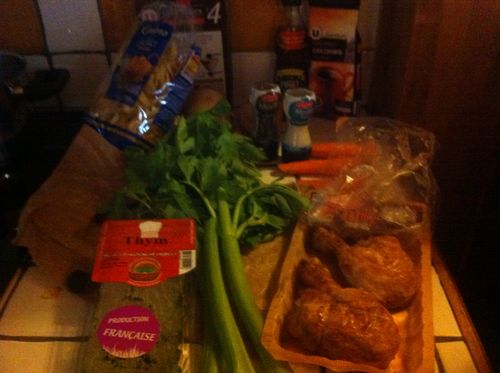
    I started cooking dinner, chicken soup, using the French equivalent of grocery store rotisserie chicken, and Alsatian egg noodles:


    Then we went out again to buy a few items I had forgotten (diapers; wine). We stopped to look in the windows of a toy store:


    And we bought candy from a store called “L’univers du bonbon.” I translated the name for the children, and when we got inside and the 4yo saw the massive bin of pick-and-mix candies for €3,80 per 100 g, he said in awe, “This really is a world of candy.”

    + + +

    When the boys and Mark came back to the scent of chicken noodle soup, rich with thyme and carrots, and a fresh baguette and a salad (from a bag!), Mark sniffed the air and said, “It smells like love in here.”

    “Is this wine okay?” I asked, showing him the vin de savoie.

    “It’s the exact right kind of wine,” he said, “it’s right here in front of me.”

    We sat down to dinner, said grace, and shared stories of our day.

    + + +

    Later in the evening, when I ran out the door by myself to the laverie with a bag of laundry, I heard the clanking of the train pulling into the station, and imagined myself hopping on the train as it pulled out of town, without a plan, except to get off somewhere interesting and to get back on and come back whenever that seemed like a good idea. And it seemed easy and simple — certainly I could do that. In truth I have not become more timid. The difference is that toting the children along with me leaves me less room for error.

    And — this part is really crucial — with the smaller children, with three of them, it’s so much more difficult to just stop and think for a minute if I need it. When I plunge forward without a plan and I figure things out as I go along, sometimes I have to pause, sit down, maybe grab a cup of coffee, look at the map (literally or figuratively) and get my bearings. Preferably alone. I might mentally rehearse the next conversation I have to have (is there a place here I can get change? What type of store around here would sell me such and such an item? How much are the sandwiches? Where can I find a bookstore? What time is the last train going west?) I might have to psych myself up for any sort of interaction, actually, even one in my own language. And then I can get up and go on. But with the children I cannot retreat into my own head even for a few minutes. I can’t stop and get my bearings. Have you ever tried to sit down and look at a map and look at the street signs and figure out where you are and how to get where you are going, while nursing a baby, and while one child tugs and says “Mom! Look at me!” and the other says “Moooooooooommmm when are we going to gooooooooo?” Not that easy.

    That is the part that I know from experience is intimidating. If I could hop on that train all by myself, I could let it take me absolutely anywhere.

    But tomorrow with the kids, maybe I can be as brave as everyone keeps telling me I must be.



  • Settled in.

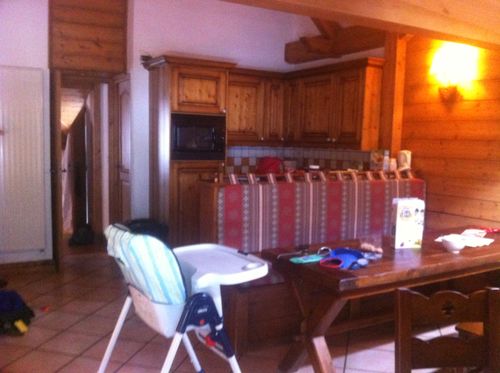
    Kitchen and dining area of our Chamonix apartment


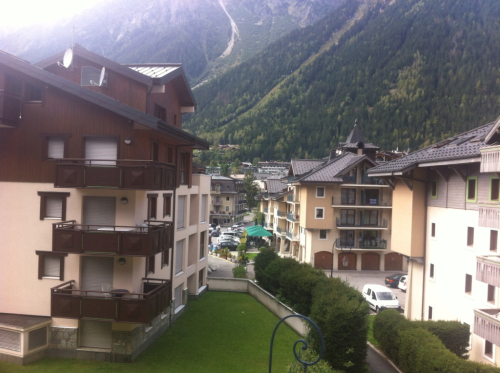
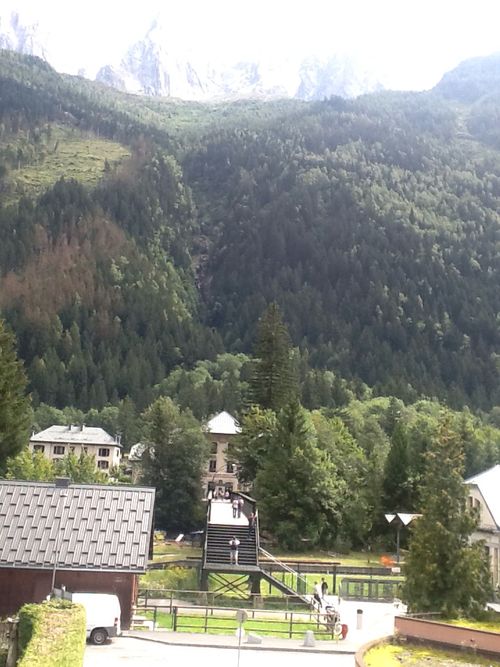
    View from our bedroom window towards the centre-ville

    + + +

    The first thing we did on our first full day in Cham was go to mass, since it was Sunday. There is a lot of variation in, shall we say, pomp, in masses; I was charmed, because this little tourist-town parish seemed exactly matched to our own. It was completely full. There were maybe eight young male altar servers, and my 14yo said he could easily have served that mass and known exactly what to do. We felt very at home in the liturgy, and of course everything is the same, even in a different language; you know what is being said when. The children had their Magnifikids, but I don’t think they looked at them much. There were two priests, a young fellow who was the main celebrant, and an older one who gave the homily.

    Perhaps because he is used to an international audience, he spoke very slowly and clearly, and the homily was carefully structured as if given from an outline according to the rule of three. I had no trouble following him at all. (Mark had taken the baby to the vestibule, which had been retrofitted with glazing to turn it into a sort of cry room, so I didn’t have too much to distract me). The Gospel being Matthew 18:15-20 (“If your brother sins against you, go and tell him his fault…”) the theme of the homily was “fraternal correction” — that correction is not fraternal and cannot be received peacefully unless it is given out of real love for the brother and for Christ, with discussion of three examples: between spouses, parents correcting children, and between nations.

    After that, most of the day was the business of feeding and clothing ourselves. For lunch we ate some pasta in our teeny kitchen — rotini with sinoke tomato sauce and some fresh ravioli with asparagus filling, which I boiled and then sautéed in butter with minced ham. The big boys and Mark planned to go out on the glacier with a guide the next morning, but much of the boys’ gear had been in the lost suitcase. Air France gave us an allowance so they went out to replace items. Then after they returned, having found some kind of clearance store that stocked most of what they needed, I went out with a couple of nylon shopping bags in search of food for dinner.

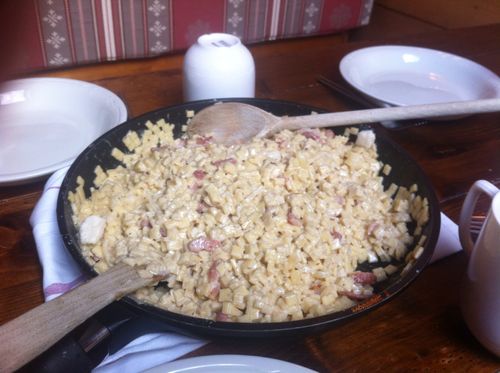
    It being Sunday, the big stores were all closed, but I found a little grocery that was open, sort of a convenience store. I needed to keep it simple: I had in mind to try to buy chicken, noodles, carrots, and onions for a soup, and also to buy bacon, tomatoes, and onions for pasta sauce. I found almost all of that: two cold, packaged, roasted chicken leg quarters which I thought would make a broth, a fresh chicken breast, carrots and onions; packaged bacon cut into lardons; a local pasta shape called crozets, little squares about 7mm on a side; cream. Also milk and bread, frozen haricots verts, and some grated parmesan. I came home and with the help of my Haute-Savoie cookbook I made crozets with lardons and cream and onions.

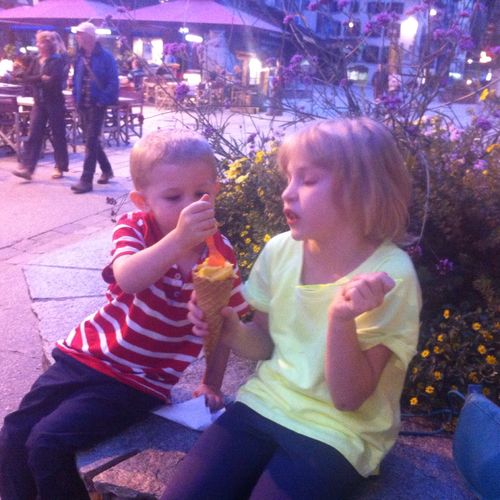
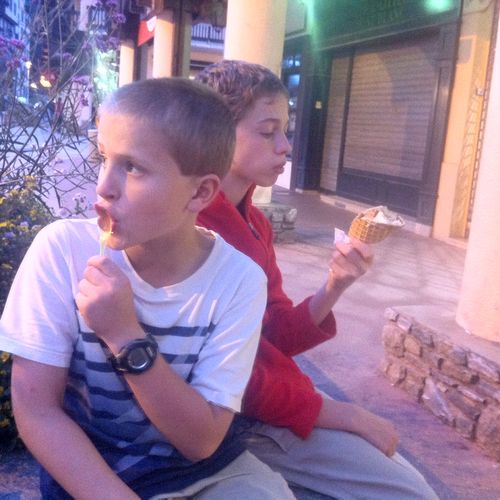
    And then we all went out for ice cream.


    Enjoyed the chilly night air and the sight of the sunset on the mountains. (Having iOS photostream syncing trouble — will try to add that later…)

    Walked around the town, completely deserted at 8 pm on a Sunday except for a few people lingering in a few restaurants. Picked out a pizza place and a raclette place to eat at later.

    This morning I am heading out with the youngest three while Mark and the big boys practice glacier travel. They are ready, so I’d better go…


  • Travel day.

    This is just going to be a quick recap, because it covers about 24 total hours of travel.

    + + +

    Friday morning, as we were getting up having breakfast and cleaning so the house would be ready for us to leave, the baby threw up all over me. He was tested and found slightly feverish. He fell asleep on my lap.

    This did not ease my nervousness. After some discussion, we elected not to change plans, except that we weren’t going to feed him anything but breastmilk, and Mark and I quickly redistributed things in the bags to make room in the carryons for extra clothes, some receiving blankets, and paper towels. Also we took extra ibuprofen. On we go.

    + + +

    Cab to the airport. My heart was absolutely pounding. I just had so much to keep track of, between children and bags. Mark carried the stack of seven passports and the tickets for the baby.

    Once at the ticketing counter we rediscovered that the airlines seem not able to handle the “traveling with a lap infant” scenario. Every time it happens, it is as if no one has ever heard of this strange and obscure process. Much rapid, loudly clicking typing on the keyboard. Many additional agents called over to peer at the screen. Eventually the correct combination of boarding passes was issued for everyone except Mark, who only got his boarding pass for the first leg from Minneapolis to Boston. This enabled Delta to pass the buck to Air France.

    + + +

    In Boston we got briefly lost because of a sign with directions that would have been correct had the sign been located elsewhere in the terminal, and then were alarmed to discover we had to go through security again to get to the international terminal, which Mark could not do without his boarding pass. So back to the ticketing counter we went, hungry and unable to pass through to where the restaurants were. We watched Mark waiting in line with several other families, all of whom were also, strangely, attempting to travel with their babies on their lap and being thwarted. Eventually the appropriate passes were issued and we struggled through security to wait there. We grabbed dinner in the food court at 9:15.

    + + +

    Stepping onto Air France was instantly relaxing, though. The flight attendants greeted us in French and explained to me how to attach the “ceinture-bébé” to my own seatbelt so I could buckle the baby. The children were ecstatic about each of them having their own video screen with a choice of games and movies . Mark took the window seat and tried to sleep, since he has to do all the driving. I held the squirming baby. Everyone else was well pacified by the seatback screens. They brought dinner. Most of us skipped it, having just eaten. The 4yo wanted cake, so he got a dinner. The 14yo had a pasta with tuna sauce and said it was awesome. I managed to sleep a little, but not much. I don’t think the 8yo slept at all. She was enraptured by her display. I decided not to complain.

    In the morning they gave us a muffin and plain yogurt. I love plain yogurt. It was really good yogurt.

    + + +

    At Charles de Gaulle we established camp in a commuter lounge, waiting for our flight to Turin. I shuttled children to and from the snack shop so they could buy drinks and candy. I suggested sandwiches but everyone just wanted candy. The 8yo was exhausted and dehydrated; you could see her wilting over the chairs. We made her drink lemonade, which she said was perfect, sour and not sweet.

    I ate a cappacolla and emmental sandwich in the sort of a wedge-shaped plastic container that one buys gas station sandwiches in.

    The flight was delayed due to an Italian ATC strike. We very nearly missed our flight because they put the announcement on a different board than the one we were watching; our names were up on yet another board with a “See the desk immediately” notice for who knows how long. But we made it on. That flight was only an hour, and with no seatback screens, the children slept.

    + + +

    In Turin we recovered all our bags … except the one with the 14yo and 10yo boys’ clothes and alpine gear. Even if the bag is located and sent to us, this presents a bit of a problem because we had already hired a guide to take them out with Mark on the glacier for Monday. So Mark was fairly stressed out. By the time we finished at the baggage counter, and with the flight delay and then the rental car, we had barely any time to shop for groceries before the store closed. My new European SIM card claimed not to have a cellular data subscription (a problem that got fixed the next morning), and we had no map, and Mark’s cell phone was nearly out of power, so finding our way to the Aosta grocery store in time was difficult. Happily, my 10yo had purchased a rechargeable power pack thing so that his iPod would never run out, and we quickly appropriated it to juice Mark’s phone. As time ran out, I navigated, with Mark asking urgently “Left or right?” while I went “uh… it’s a roundabout… let’s see… you need to come out of it going almost but not quite left…” or “uh… neither… there are four straight aheads, you need to take the middle one on the right…”

    + + +

    I will just skip to the important part. We got enough groceries for dinner, breakfast, and lunch, and we’re still married.

    + + +

    No, it’s better than that. Mark’s trip through the grocery store, I missed, because I was outside in the car nursing the baby. He took the 14yo and they ran through in twenty minutes, which I sort of imagine was like one of those game shows where people rush through supermarkets trying to spend as much as they can before the buzzer rings. We arrived back at our little apartment with wine and cured meats and cheese and a loaf of sourdough bread and Nutella and Wasa crackers and butter and jam and eggs and a brick of milk and three boxes of cereal (the 14yo reported that he was able to get directions to these by asking “Dov’è cornflakes?” , a feat of which he was quite proud).

    We ate and drank and fell exhausted into bed. And in the morning there was this:


    Mass this morning. More later.


  • Getting ready.

    Our family trip to France and Italy looms on the horizon, and the children are by turns excited and nervous.

    Our 8yo daughter woke us in the middle of the night, sobbing with fear.  "I'm so worried that I'll get lost from you and I won't be able to speak the language," she told us.  "I'm looking forward to seeing new things and trying new foods, but I can't stop thinking about the airplane crashing or falling off the mountain or getting lost and not being able to find you."

    "We will make a plan each day," I said into the darkness from my spot in the bed.  "We'll give you a card to carry that has our names and phone numbers."

    "And will it say, 'Please help me,' in French?" she asked.  "Because I didn't learn as much French as I was supposed to.  I wish I had now.  I hardly know anything," she said ruefully.

    "It's all right," I said.  "We didn't expect you to learn enough to really get by.  Just enough to try it a little, and to be polite."

    + + +

    Our 4yo wanted to light a candle and say a prayer before Mass on Sunday, so I gave him a quarter to put in the box for the votive.  He knelt down in the Divine Mercy chapel and prayed, "Please God and Saint Leo, let the barbarians not come to Rome while we are there.  Amen."

    Previously he has asked us if there is a king of France and if he will be the boss of us while we are in France, and whether anyone will throw him out of a window if he does not know how to speak the local language politely.  

    I get where the king thing comes from, but I confess that when it comes to linguistic defenestration, I'm stumped.  Mark thinks it's because this particular 4yo is intensely interested in being part of society; he walks right up to people, introduces himself, compliments them on their earrings (no, really; that's what he switched to after Mark explained to him that it wasn't nice just to tell people "You're pretty"), asks questions, chats about the weather.   Without a common language, maybe he feels completely at sea.  I'll have to do a lot of coaching.

    + + +

    I spent my summer practicing French and learning Italian; I thought I might be up to the challenge.  My oldest son did the most work, cramming Italian with Duolingo.com .  

    We filled a composition book with ideas, notes, words and phrases to use, tips we got from other travelers.  We got a new set of luggage.  Mark brought home cash in euros from his last business trip.  Passports were prepared.  

    I froze several meals for the week we get back.  We arranged for someone to watch the house, and for a friend to come open it up the day we return, turn on the heat if necessary, put milk in the fridge.  I set up the first week of schoolwork so it would be ready as soon as we return.

    + + +

    I feel in-between now:  literally, in between excavating the freezer and cleaning out the fridge, but also in between living at home and being on vacation.  The suitcases are packed in the front hall; the kitchen is a shambles.  For tea snack I'll make strawberry sauce out of some ancient, freezer-burned berries I found at the bottom of the freezer, and we'll have vanilla ice cream sundaes with the last of the opened cartons.  I don't know what we're eating for dinner tonight or tomorrow.

    A few days ago I went shopping, carefully.  Thinking of the chaotic first few days of returning from any long trip, I bought frozen pizzas.  It didn't occur to me until I was tossing them into my chest freezer that the cheap frozen Pepperoni Deluxe might possibly look a bit unappetizing, even to the four-year-old two days after grabbing lunch just off the Campo dei Fiori.

    I hope so.  Keep 'em hungry for more.


  • The Salesian preventive system, or, how to not punish kids.

    My personal parenting/discipline ideal has always been to avoid punishing kids.

    I get the impression from other people that the idea alarms them, because it sounds a lot like "avoiding discipline;" perhaps it calls to mind the stories of parents who insist their offspring can do no wrong.  You know, the kind who sue the school when their child is suspended for cheating on a test or something like that.

    That's not my point.  By punishment, I mean those arbitrary unpleasantnesses inflicted in return for misbehavior:  the spanking, the grounding, the confiscation. Mrk and I aren't what you'd call permissive parents.  We try to be authoritative, if not authoritarian.  We use the term "obedience" with the kids and are clear about what it means and why it's important.   But (this is our ideal, mind you, not always the way we manage to make it work) we try not to get to the point where we need a "punishment" in the first place.  

    We try to let them experience the consequences of their actions, insofar as it isn't dangerous.  

    • Didn't pack an extra dress like you were supposed to?  Well, I guess you'll be wet and uncomfortable now that you've run through your friend's sprinkler in your clothes.  
    • Refused to eat your lunch at lunchtime?  Ooooops, snack time isn't till 3:30, I guess you can have some of these plain almonds I keep in the car for emergencies.
    • Shrieked at each other in the car while we were running errands?  After all that, I (honestly) don't feel anymore like taking you out for lunch, so instead we're going home and having tuna sandwiches.

    On the occasion when something truly egregious happens — such as when one of my kids came to me and admitted that a long string of perfect scores on math assignments had been faked — consequences are meted out rather than merely allowed to happen; but we really try to have it make sense.  In the case of the spurious perfect scores, since I had no way to know whether the child understood the material, the child was assigned double math lessons for as many days as the lessons had been faked, each day doing the regularly scheduled lesson and at the same time re-doing one of the lessons from before.  That plus a long conversation about honesty.  And dangerous misuse of a tool around here is very likely to result in revocation of privileges to use said tool until competency and proper respect for risk is demonstrated; that's just common sense, not a punishment.  

    It was difficult for us to figure out when our first was very young, but we hit our stride eventually, and he grew out of the normal frustrations of toddlerhood into an earnest child and now a delightful teenager, and that has given us a lot of confidence as we continue to bring him up, him and the four that have followed.  It's true that I yell more than I wish I did, and lose my temper.  It's an ideal I fail to measure up to.  But I still strive for that "no-punishment" ideal.

    + + + 

    I notice, however, that this isn't language I tend to hear from my fellow Catholic parents much.  Indeed, at more than one parish I've seethed while listening to a priest (including in the homily at my daughter's baptism) cheerfully recommend vigorously and frequently spanking small children.  

    I think this is an American Catholic phenomenon, borne of being caught between a decadent permissive culture and an army of evangelical Protestants — in many ways, serious American Catholics are constantly playing "keeping up with the Bob Joneses," and so, for better or for worse, we have been inculturated with what I personally see as a break-the-child's-sinful-will, thou-shalt-honor-us-because-of-the-ten-commandments sort of  attitude toward child discipline.  

    The exceptions are the super-crunchy attachment parenting Catholics.  Am I one of those?  Sort of; as a young parent, AP wasn't good enough for me and if you were foolish enough to ask me about it I would talk your ear off about how I was into "CC" parenting, which stands for "continuum concept," which, well, some other time….    

    I did have plenty of role models for the way that I felt was right for me to parent my kids, but I lacked Catholic ones.   And that's why I was so excited when I first learned about the educational philosophy of St. John Bosco.  AKA "Don" Bosco (1815-1888) because that's what you call a diocesan priest in Italy.   Here's Wikipedia on him, for some background:

    At that time the city of Turin had a population of 117,000 inhabitants. It reflected the effects of industrialization and urbanization: numerous poor families lived in the slums of the city, having come from the countryside in search of a better life. In visiting the prisons Don Bosco was disturbed to see so many boys from 12 to 18 years of age. He was determined to find a means to prevent them ending up here. Because of population growth and migration to the city, Bosco found the traditional methods of parish ministry inefficient. He decided it was necessary to try another form of apostolate, and he began to meet the boys where they worked and gathered in shops, offices, market places. They were pavers, stone-cutters, masons, plasterers who came from far away places, he recalled in his brief Memoirs.

    The Oratorio was not simply a charitable institution, and its activities were not limited to Sundays. For Don Bosco it became his permanent occupation. He looked for jobs for the unemployed. Some of the boys did not have sleeping quarters and slept under bridges or in bleak public dormitories. Twice he tried to provide lodgings in his house. The first time they stole the blankets; the second they emptied the hay-loft. He did not give up. In May 1847, he gave shelter to a young boy from Valesia, in one of the three rooms he was renting in the slums of Valdocco, where he was living with his mother. He and "Mamma Margherita" began taking in orphans. The boys sheltered by Don Bosco numbered 36 in 1852, 115 in 1854, 470 in 1860 and 600 in 1861, 800 being the maximum some time later….

    In 1859, Bosco selected the experienced priest Vittorio Alasonatti, 15 seminarians and one high school boy and formed them into the "Society of St. Francis de Sales." This was the nucleus of the Salesians, the religious order that would carry on his work….In 1871, he founded a group of religious sisters to do for girls what the Salesians were doing for boys. They were called the "Daughters of Mary Help of Christians." In 1874, he founded yet another group, the "Salesian Cooperators." These were mostly lay people who would work for young people like the Daughters and the Salesians, but would not join a religious order.

    Bosco's capability to attract numerous boys and adult helpers was connected to his "Preventive System of Education."

    Don Bosco explained his "preventive system" in an essay, "The Preventive System in the Education of the Young," which can be found here.  It begins by contrasting his "preventive" system with the "repressive" system.  The "repressive" system, he says, has its place "in the army and in general among adults and the judicious, who ought of themselves to know and remember what the law and its regulations demand."  

    The repressive system consists in making the law known to the subjects and afterwards watching to discover the transgressors of these laws, and inflicting, when necessary, the punishment deserved.

    According to this system, the words and looks of the superior must always be severe and even threatening, and he must avoid all familiarity with his dependents.   

    In order to give weight to his authority the Rector must rarely be found among his subjects and as a rule only when it is a question of punishing or threatening.  

    But Don Bosco's system is different:

    [The preventive system] consists in making the laws and regulations of an institute known, and then watching carefully so that the pupils may at all times be under the vigilant eye of the rector or the assistants, who like loving fathers can converse with them, take the lead in every movement and in a kindly way give advice and correction;  in other words, this system places the pupils in the impossibility of committing faults.

    This system is based entirely on reason and religion, and above all on kindness; therefore it excludes all violent punishment, and tries to do without even the slightest chastisement. 

    "Excludes all violent punishment, and tries to do without even the slightest chastisement" being what I was going for all along, I was so glad to find this.  

    The basic idea is that children are closely supervised at all times by leaders who care for them, model good behavior, encourage reception of the sacraments, participate in their games, and converse with them frequently about behavior norms in a way that "appeals to [their] reason" and "generally enlists [their] accord."  Close supervision and "forewarning" means that there is little chance for a child to commit a fault. Don Bosco believes that young people misbehave, initially at least, because of inattention, not malice:

    The primary reason for this system is the thoughtlessness of the young, who in one moment forget the rules of discipline and the penalties for their infringement.  Consequently, a child often becomes culpable and deserving of punishment, which he had not even thought about, and which he had quite forgotten when heedlessly committing the fault which he would certainly have avoided, had a friendly voice warned him.

    To apply this system Don Bosco lists several principles of education and discipline.

    1.  Close supervision by the people entrusted with the children.  "[The Rector] must always be with his pupils whenever they are not engaged in some occupation, unless they are already being properly supervised by others."

    2. Moral teachers who actively lead the pupils to and in each new place or activity. "Teachers, craftmasters, and assistants must be of acknowledged morality… As far as possible the assistants ought to precede the boys to the place where they assemble; they should remain with them until others come to take their place, and never leave the pupils unoccupied."

    3.  Allow rowdiness and physical activity.  "Let the boys have full liberty to jump, run, and make as much noise as they please.  Gymnastics, music, theatricals, and outings are most efficacious means of obtaining discipline and of benefiting spiritual and bodily health.  Let care be taken however that the games… are not reprehensible.  'Do anything you like,' the great friend of youth, St. Philip [Neri] used to say, 'as long as you do not sin.'"

    4.  Encourage and promote, don't force, the sacraments.  "Frequent confession and communion and daily mass are the pillars which must support the edifice of education, from which we propose to banish the use of threats and the cane.  Never force the boys to frequent the sacraments, but encourage them to do so, and give them every opportunity…. [L]et the beauty, grandeur, and holiness of the Catholic religion be dwelt on…"

    "Avoid as a plague the opinion that the first communion should be deferred to a late age… When a child can distinguish between Bread and bread, and shows sufficient knowledge, give no further thought to his age… St. Philip Neri counseled weekly and even more frequent communion."

    5.  Exclude bad materials and trouble-making people.  "[P]revent bad books, bad companions, or persons who indulge in improper conversations from entering the college.  A good door keeper is a treasure for a house of education."

    6.  Brief daily reflections — a sort of community examen.  "Every evening after night prayers before the boys go to rest, the Rector or someone in his stead shall address them briefly, giving them advice or counsel concerning what is to be done or… avoided.  Let him try to draw some moral reflection from events that have happened during the day… but his words should never take more than two or three minutes."

    7.  Love before fear.   "An educator should seek to win the love of his pupils if he wishes to inspire fear in them.  When he succeeds in doing this, the withholding of some token of kindness is a punishment which stimulates emulation, gives courage, and never degrades…. With the young, punishment is whatever is meant as a punishment…. in the case of some boys a reproachful look is more effective than a slap in the face would be."

    8. Do not  shame children.  "Except in very rare cases, corrections and punishments should never be given publicly, but always privately and in the absence of companions."

    9.  Employ patient reason and religion. "[T]he greatest prudence and patience should be used to bring the pupil to see his fauly, with the aid of reason and religion."

    10.  No corporal punishment.  "To strike a boy in any way, to make him kneel in a painful position, to pull his ears, and other similar punishments, must be absolutely avoided, because the law forbids them, and because they greatly irritate the boys and degrade the educator."

     11.  Clear communication of expectations.  "The Rector shall make sure that the disciplinary measures, including rules and punishments, are known to the pupils, so that  no one can make the excuse that he did not know what was commanded or forbidden."

    + + +

    I think these principles of Salesian education and discipline are sound ones that speak for themselves, principles that seek to form and transform human nature rather than to fight against it, and principles that respect and elevate the dignity of both child and educator.    When I discovered Don Bosco I felt I'd finally found someone who was truly on my side.    

    If only I'd known about him when I was having to make post-baptism chitchat with Father Spare-the-Rod!


  • Francis de Sales: The patron saint of to-do lists?

    I know I said in my last, introductory post to Salesian spirituality that I was going to look first at Don Bosco’s “Preventive Method,” what with the school year starting up now and all.

    But I changed my mind, because I happened to be looking at a short work of St. Francis de Sales, the Spiritual Directory. It’s sort of a rule of life for the religious he supervised — only instead of specifying so mant hours of work, so many of sleep, so many of prayer, etc., he specifies little acts of devotion and intention to be performed throughout the day, connected to rising, worship, work, meals, bedtime — the whole cycle of an ordinary day. They are, so to speak, spiritual exercises, not for a novena or a retreat but for every day.

    It is true that the Directory proposes many exercises,” Francis writes,

    Yet it is good and fitting to keep one’s interior orderly and busy in the beginning. When, however, after a period of time, persons have put into practice somewhat this multiplicity of interior actions, have become formed and habituated to them and spiritually agile in their use, then the practices should coalesce into a single exercise of greater simplicity, either into a love of complacency, or a love of benevolence, or a love of confidence, or of union and reunion of the heart to the will of God. This multiplicity thus becomes unity.

    I like this idea of patiently developing little habits that “coalesce” over time into character.

    + + +

    The ordinary thing for me to do would be to start where Francis starts, at the beginning of the day, with “Article #1: Rising.”

    But I was struck instead by Article #2, “Meditation.” Or rather, preparation for meditation.

    Francis devotes only a short paragraph to instruction on meditation, “the serious practice of [which] is one of the most important of the religious life.” Mainly he suggests going to other sources, including his own other works. But he devotes several paragraphs of this article to the preparation.

    To form themselves for meditation they will prefer to all other means the exercise of the preparation of the day….By this means they will endeavor to be disposed to carry out their activities competently and commendably.

    Invocation. They will invoke the help of God, saying,

    “Lord, if you do not care for my soul, it is useless that another should do so.” (Ps 127:1)

    They will ask him to make them worthy to spend the day with him without offending him. For this purpose, the words of the psalm may be helpful,

    “Teach me to do your will, for you are my God. Your good spirit will guide me by the hand on level ground, and your divine majesty by its inexpressible love and boundless charity will give me true life.”

    Foresight. This is simply a preview or conjecture of all that could happen during the course of the day. Thus, with the grace of Our Lord, they will wisely and prudently anticipate occasions which could take them by surprise.

    Plan of Action. They will carefully plan and seek out the best means to avoid any faults. They will also arrange, in an orderly fashion, what, in their opinion, is proper for them to do.

    Resolution. They will make a firm resolution to obey the will of God, especially during the present day. To this end, they will use the words of the royal prophet David, “My soul, will you not cheerfully obey the holy will of God, seeing that your salvation comes from his?”

    Surely this God of infinite majesty and admittedly worthy of every honor and service can only be neglected by us through lack of courage. Let us, therefore, be consoled and strengthened by this beautiful verse of the psalmist:

    “Let evil man do their worst against me. The Lord, the king, can overcome them all. Let the world complain about me to its heart’s content. This means little to me because he who holds sway over all the angelic spirits is my protector.” (Ps. 99:1)

    Recommendation. They will entrust themselves and all their concerns into the hands of God’s eternal goodness and ask him to consider them as always so commended. Leaving to him the complete care of what they are and what he wants them to be, they will say with all their heart:

    “I have asked you one thing, O Jesus, my Lord, and I shall ask you again and again, namely that I may faithfully carry out your loving will all the day of my poor and pitiable life.” (Ps 27:4; 40:9)

    “I commend to you, O gracious Lord, my soul, my life, my heart, my memory, my understanding and my will. Grant that in and with all these, I may serve you, love you, please and honor you forever.” (Ps. 31:6, Lk 23:46)

    Okay. Do you see what he did there?

    St. Francis has just unified the concepts of “the morning offering” and “the to-do list.”

    + + +

    Before meditation, in fact as part of the preparation for meditation, St. Francis prescribes thinking about all the things that you expect to encounter during the day, anticipate difficulties, carefully plan (with an eye towards avoiding faults — I tend to skip that step when making to-do lists), then “arrange in an orderly fashion what … is proper… to do.”

    Did you catch those last two words?

    You finish up your orderly-arranged to-do list with two more steps I commonly skip: resolving to obey the will of God, and entrusting yourself, with all your “concerns” (including, we are to assume, all the items on your aforementioned to-do list), into God’s hands.

    It turns out that you don’t have to try hard to push back the items that are rushing at you and demanding your attention while you are trying to make your morning offering.

    It turns out that you don’t have to guiltily say to yourself, “I’ll do my morning offering as soon as I write my to-do list.”

    It turns out that you’ve been a bit silly, trying to add “Say Morning Offering” to the top of the to-do list.

    St. Francis suggests that the to-do list can itself be the morning offering. He sanctifies it: embedding it in an exercise of invoking God’s help, planning tasks with an eye to avoiding faults, resolving to do God’s will, and ultimately entrusting the outcome to God’s providence.

    And this is a perfect example of why St. Francis draws me. I am used to being made to feel, oh, I don’t know, insufficiently go-with-the-flowish, insufficiently trusting of God; that my desire for order and efficiency is somehow a marker of a lack of love. That I should want to run to God in prayer more than I should want to make an Action Plan, and that my itchiness until All The Things are safely written down, that itchiness which so interferes with making prayer my first act of the day, is a sign of weakness and a thorn in the flesh.

    What’s this? Rather than putting holiness on my to-do list, I can make my to-do list holy. This is a spiritual exercise I can roll up my sleeves and tackle, true multitasking: setting out my daily plans, right there, on the altar of offering.


  • Salesian spirituality: Four examples.

    Shifting gears a little bit to write about what I've been thinking as a spiritual anchor for my upcoming school year, which we'll be starting late.  

    Ever since I first got deeply into the Western classic Introduction to the Devout Life, by St. Francis de Sales, I've been reading bits here and there about the Salesian tradition of spirituality.   I've read bits about Benedictine and Dominican spirituality, thinking at first that these would appeal to me because of their intellectual foundation; but it's really the Salesian material that has spoken to my center.

    This path to devotion doesn't seem very common in my circles, and I think that's odd.  The dominant spiritual trends at my own parish appear to be those of St. Louis de Montfort, St. Josemaria Escriva, and (maybe most widespread) Carmelite; there's a Carmelite weekly study group, for instance.  

    I know that Carmelite spirituality promises a certain retreat from the world, of staying aloof from it in order to remain focused on the eternal.  St. Thérèse, the little Carmelite flower, brings it back down to earth in her "little" way of scrubbing floors and serving others with great love, while the mind remains turned away from worldly concerns.  I understand that the interior castle is far more expansive than our homes and workplaces, and that for those who are up to their elbows in the frustrations of daily life, Carmel offers a place of refreshment.  

    But Salesian spirituality seems to me tailor-made for ordinary moms, working mothers, anyone who is very, very busy with worldly concerns, wealthy as we are by global standards; and in a particular way, those who are daily enmeshed in the work of educating young people:

    • Francis de Sales was a spiritual director, most notably, of married women living in the world, women of a comfortable-enough social class, women with familial and social duties.  His Devout Life is directed at "Philothea," a female figure who is assumed to be able to scrape together a little time for solitary meditation, but not a lot.  He directs her to move back and forth between the prayer life and the ordinary life of duties, sanctifying the ordinary with acts of intention, and bringing the ordinary life to prayer in the form of frequent self-examination.   


    • Jane Frances de Chantal, Francis's protégée, was a widowed mother of four who had to defer her calling to religious life until she had provided for her children; the Order of the Visitation that she started with Francis's help in Annecy was an unconventional sisterhood of women, many of them older, some of them sick or disabled, who eschewed asceticism in favor of public, active outreach.


    • John Bosco was an Italian priest who dedicated his life to the education of disadvantaged and delinquent youth, whom he attracted to his "little oratory" with games and magic tricks.  He rejected the "repressive" or punitive systems of educating children; his own "Preventive System" of child discipline is "based entirely on reason and religion, and above all on kindness; therefore it excludes all violent punishment, and tries to do without even the slightest chastisement."  He called the religious institute he founded the "Society of St. Francis de Sales."


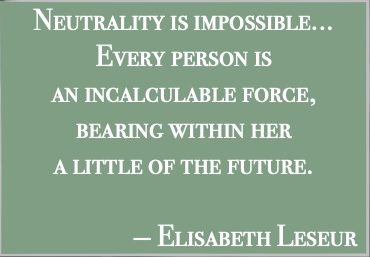
     I've explored quite a bit about St. Francis and Elisabeth Leseur here on the blog, although I haven't come close to exhausting the material I have.  In upcoming posts I hope to share thoughts on Don Bosco's "Preventive System," reflections on Jane Frances, and some of St. Francis's rules of life for the Visitation sisters he helped found.  Planning to tie all this together into some recommendations for worldly, well-off, working women — the group that St. Francis seems (to me) to speak to the most.  

    Come along and we'll see what we can see.


  • Pre-pre-departure.

    The big trip is looming closer.  We have arranged for neighbors to keep an eye on the house.  We have arranged for a friend to open the house and bring food to it the day we arrive.  We have a mountain guide and two "kids-and-family" city tours booked.  

    I haven't started panicking yet.  I'm still simply excited.

    For some reason, the part about it that I'm most excited for?  Just having Mark be off work for weeks, plural, and traveling with us instead of apart from us.  Lucky, lucky family that he was able to gather together all that time off in one place.

    + + +

    Last weekend I packed the 8yo's clothes completely, and gathered into a laundry basket the 4yo's clothes.

    IMG_0016

    My 8yo daughter's clothes, shoes, and accessores all fit in two nylon bags in that plastic bin.  I expect to manage the same for the 4yo's.  Later this weekend I'll pack mine and the baby's.

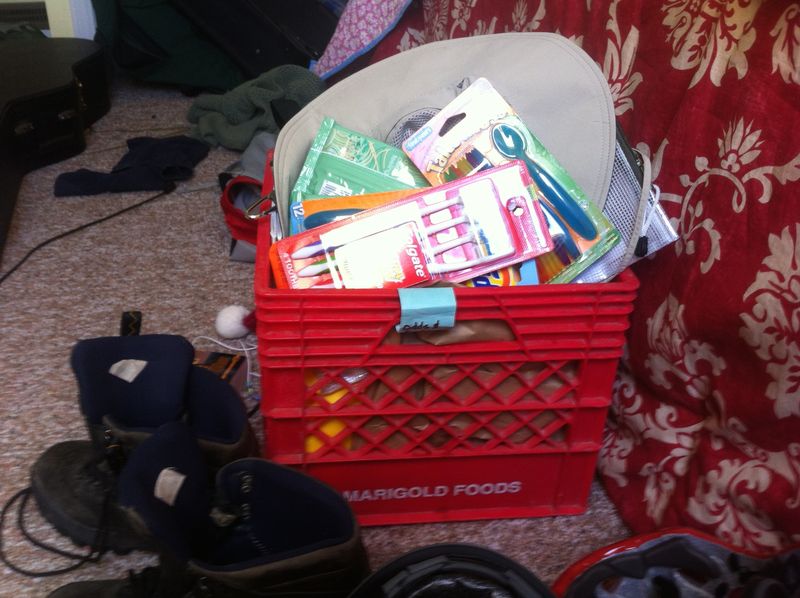
    Here we have a now-overflowing crate of random small things we want to take with us:

    IMG_0017

    Toothbrushes, gum, sunhats, disposable baby spoons, document wallet, guide books, glove cats, roll of masking tape…

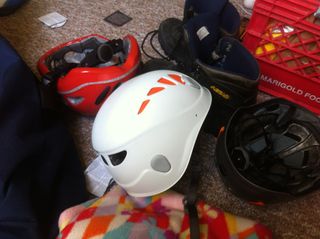
    Mark has a bag of climbing gear and ropes, and three cute little helmets:

    IMG_0018 IMG_0019

    I have set up a shutterfly account to upload our photos as we go.  I have assigned my 14yo/9th grader a journal to keep during the trip in order to squeeze a little school credit out of it.  I have also given my 8yo a journal because she asked for one.   I have several e-books saved in my Kindle library.  

    I have a refurbished iPhone with a UK phone number, even though I said I wanted to hold out against having a smartphone for as long as possible.  

    I have a set of resistance bands, so maybe I won't completely lose all the progress I made in the last six weeks that I've been weightlifting.

    I have packed two big zip-lock bags of toiletries, first aid, and medicines.  We have anti-diarrheals, decongestants, NSAIDs, migraine tablets, PEG laxatives, lip balm, bandages, gauze, tape, tweezers, clippers, antifungal cream, a baby thermometer, antihistamines, eyeglass wipes, diaper cream, Dum Dum pops, lidocaine gel, flossers, ponytail holders, throat lozenges, sunblock, immunization records.

    I've dealt with almost everything that needs to be dealt with before we get back or very soon after.  The homeschool paperwork has been sent in.  I have a new drivers license.  There are several dinners in the freezer.  All the schoolwork is ready to go as if we were starting on Monday.

    I feel as if my brain has been separated into a dozen tiny pieces and the shards are resting in various places in the house — in the school cabinet with the few papers and books that come along; in the closets with the clothes I haven't packed yet; in the car's glove box where I keep my spare sunglasses; in the medicine cabinet with a few items I still need to have out; in the filing cabinet with the passports; in the still-not-cleaned-out refrigerator; in the room upstairs, one little piece tucked away into each open suitcase. Resting each in their spot and pulsing quietly, sending out a little homing signal so that I can gather them all up when it's time to go.


  • Sane Mom Revolution: Discussion question, boys v. girls.

    "It is time for a Sane Mom Revolution, in which we decline to take any more of this crap."  – Light and Momentary

    —–

    I've been pushing a hashtag, here and on Facebook (where, fyi, I only friend friends; it isn't personal) and on Twitter:  #sanemomrevolution .  Check it out.  It's for sharing stories of kid-independence.  The stakes are high; a Reason/Rupe poll the other day showed that a large fraction of Americans (originally reported as 63%, later corrected to 43%) would criminalize letting 12-year-olds go to the park unsupervised.

    I find that the #sanemomrevolution sparks some interesting discussions, though.  Here's some of one I had on FB the other day.  What do you think?

     
    #Sanemomrevolution discussion question, parents of teenagers especially invited. So, I'm sending my 14yo son off on urban errands with the bus and the train and the bike and the mall and the downtown Target and library and things. I feel pretty confident about this. I find myself wondering: Will I feel as confident about sending my *daughter* (when she is 14) on similar errands? And if I don't, is that reasonable or unreasonable? Discuss.
     
     
    Me — "However I *feel* about it, I promise to try to be ruled by reason when the time comes."
     
     
    C.B. —  "Our neighbor's daughter, 14, recently went to the nearby park and waited for friends to arrive. She ended up getting beaten up by a bunch of kids there and required facial reconstruction surgery. And I thought I lived in a nice neighborhood. I want to join the #sanemomrevolution but after this I need to wait and see what the police do about it."
     
    C. B. — "She was sitting at the park at a picnic bench near the basketball courts and playground. It was during daylight hours, but close to dusk. That is all I know FOR sure."
     
    J. M. S. — "I do not know if it is reasonable or unreasonable, but I feel much more cautious about my daughter. Much."
     
    Me — "Troubling anecdotes like the one C. B. just shared, I am trying to consider what the Sane Mom does with them. Because it isn't right to ignore them; they exist in a context, though. Mostly I think they become data points about specific locations."
     
    C. P.  – "Who knows what will be in 6 years?"  

     Me — "Yeah, I can't help but think that part of my 'Will I feel the same?' uneasiness is because right now she's 8. Having been a 14yo girl myself at one point, I'm annoyed at myself for having extra protective impulses. And at the same time don't want to be stupid about it."

     C. B. — "I wish I knew more of the details so I COULD make a sane decision. Right now, our 14 year old girl walks her dog by herself. He's 55 lbs and goofy, so I don't know that he would "protect her" per se. We were just having a discussion. I want the 16 year old to ride 2 miles to the library on his bike and dad is worried."

    J. M. S. — "I'm curious about the data: are girls more vulnerable than boys? I know it is exceedingly unlikely that someone would snatch my 5yo daughter from the sidewalk, but my perception is that the risk is less teeny-tiny for her than it was for her brothers at 5 (still teeny-tiny, but less so). Teen girls get catcalled and propositioned more than teen boys do, but how does that actually affect them?"

    Me — "I get being worried about the risk of assault (and I would be more concerned if I had recent evidence that gangs of violent kids were roving my near neighborhood without interference by local police or parents). It's a matter of balancing that with the risk of your kid reaching age 18 without ever being allowed to take risks. (But as I said, if there had been a recent assault in my neighborhood I might wait for more info)"

    K. M. M. — "I'm not sure I feel that boys are less vulnerable than girls. You've read The Gift of Fear right? Does [your 14yo] know what to look for in grooming behavior from sexual predators? How to handle men in bathrooms? I would have said that I feel boys would be more likely to be beaten up by roving gangs of teenagers but I see the anecdote above kind of contradicts that."

     K. M. M. —  "But these are all issues that continue on well through college, and will need to be handled at any point. Maybe a self-defense class would be good for teenagers of either gender? I'm glad you're having this discussion, it's giving me a lot to think about. Although we're still not exactly in the urban public transit area."

    C. B.  – "I AM frustrated by not having more details. I understand the 14 year old's desire for privacy and the mom's respecting that. I just wish she would help me understand. During the Neighborhood Night Out, the police officer that visited our street talked to us a little bit about it and that while they don't think it was a "random" thing, they also don't think it was provoked by her behavior in anyway and asked for patience as they get more information. We also live where lots of drug deals go on – Parker's Picnic area was (don't know if it is anymore) a common "exchange location" and the park we live next to seems to be a magnet for kids to go down below near the river to party. Our seemingly nice suburban location seems more worrisome at the moment."
     
    K. J. C. — "I am more afraid of a daughter being sexually harassed or violated on her own in public in our culture. I base that fear on statistics. What I think might be the *feeling* part of it is, is this kind of assault worse for them than the types of assault my boys might be more statistically likely to encounter."

    K. M. M. — "I think that male statistics are grossly under reported because of stigma."

    K. J. C.  – "K.M.M. do you think there are underreported stats of men being catcalled or rubbed up against in the subway or bus, etc? Because I have so many of those stories I can't even number them, and my husband, who is unlikely to lie to me, has zero."

    Me — "I believe that men are propositioned less than women. I also believe they're non-sexually assaulted more often. Boys and girls might be equally at risk but from different kinds of risk."

     J. M. S. — "See, I just don't think that kind of crap is as common for boys. I think Kelly is right about underreporting, but even so: people feel license to comment on my daughter's appearance in a way that just doesn't happen for my sons once they're older than about 3. I mean, the stuff that happens around me is all well-intended: beautiful girl, cute haircut, nice outfit, blah blah blah. But I think it arises from an unspoken view that girls' physical selves are regarded as community property in a way that boys' are not. Agree or disagree?"

    J. T.  – "A woman is more likely to be groped. A man is more likely to get punched. Neither is fun."

    K. J. C.  – "I agree that neither is fun… I think where 'feeling' comes in, is, is it more damaging to the lives and psyche of our girls to experience *sexual* damage, or is the *physical* damage the same. My gut leans towards yeah, neither is fun, but the sexual part is more damaging. Which I base on no evidence."

    J. M. S. — "And that feels risky for me. Most of the world would never make the leap from "You are a beautiful girl and I want your mother to know that" to "You are a beautiful girl and I'm going to violate you," but how large is that most? NOT LARGE ENOUGH for me at this moment, I'm telling you."

    J. M. S.  – "If I had to pick between physical bullying and sexually tinged bullying, I'd pick physical any day of the week."

    K. M. M.  – "I agree that girls receive more of the catcalls and rubbing up against. But I agree with the others that there are different risks for the genders. How often do women get propositioned in bathrooms? How often do you think your daughter will hear 'Hey, come here, I want to show you something' by a woman in a bathroom stall who has a porn magazine in her hand? I think any discussion of who has it worse or who is more damaged is not productive. We need to take any individual's experience seriously and not diminish it by saying 'Well, so and so has it worse.'"

     Me — "I agree with that part — individuals' experiences can't be compared directly in that way. The question for the #sanemomrevolutionis whether sane parenting means treating girls' permissions/curfews/errands/adventures differently from boys.' "

     P. G. B. — "My kids are still little, but I am starting to let them outside in the back or in front of our house unsupervised for short periods. I get nervous about giving them more freedom, but I hope we allow them what they can handle. Ultimately I think it's about making sure they are mature enough to send them off on their own, and to teach them to be aware of surroundings at all times. Especially to keep their phones/music tucked away. A few years ago I was held up at gunpoint near the shoe zoo, on a Sunday afternoon. But I was yapping away on my iphone, covered in a bright green case, walking to my car, compelety unaware and with my guard down as I was in a "nice" neighborhood. I really do think awareness and being on guard makes a big difference and possible less of a target?"

     B. H.  – "I think any differences in permissions would be personality based, not sex based. I [male] was allowed a lot more independence on that kind of thing in my teens, both because I was better at not getting lost and because my brother had the kind of vagueness which projects "fun and easy to beat up" to other teens….Our oldest are girls, an I don't have an issue with letting the older ones (12 and 10) walk through town to the library and such. We don't live in an urban core, so I haven't had to deal with that so much."

     K. J. C. — "The reason I am considering potential consequences of each gender's more likely assault, is because it is an assessment of, do I treat my girls differently, because being raped is more likely to cause a lifetime of mental issues and will affect her sexuality forever, whereas being propositioned in a bathroom or punched in the face might not do the same to my boy? If true (and as I repeatedly say above, I have nothing to back it up with but "feel", which is why I'm musing) then YES I absolutely will treat my girls differently and curtail their freedom to just walk around in public as teens."

    Me — "I do think the question of "which risk do I feel ickier about, physical assault or sexual harassment" is germane to the discussion because one is more likely for boys and one more likely for girls."

     Me – I wonder if it does not feel just as violating (subjectively speaking) for a young male adolescent to be assaulted, if he doesn't have comparative experience with sexual violation. Many of us mothers have some experience either with sexual violation or sexual intimidation [not to do the yes all women thing again!] and if we haven't been non-sexually, physically assaulted as well, maybe that "doesn't seem so bad" to us.

    Me – Obviously *most* of our decisionmaking hinges on the perceived maturity of the specific kid in question, relative to perceived external circumstances… so all things being equal are the external circumstances also equal? Sexual assault in broad daylight or physical assault is quite rare (even if more rare for one gender than the other). Harassment, not so rare (and let's not forget that some young boys in some places will be more vulnerable to race-based harassment, an experience which I imagine feels quite violating). We really need to teach boys a similar set of awarenesses to fend off sexual harassment, because even if more rare overall than sexual harassment of females, we send boys (not usually girls) into all-male environments and males are more likely to be perpetrators.

    K. M. M.  – "From my perspective: 1) We want to help our adolescents to learn independence as well as how to assess the safety of situations while being aware of the dangers. 2) We need to be aware that both males and females are vulnerable to verbal, physical, and sexual aggressions, but of different types and in different situations. 3) We need to be able to assess what the dangers are for the particular kid and situation we are considering allowing."

    K. M. M. — "I really doubt of us would keep a daughter home while sending a son out late at night to a sketchy area because the "worst" that could happen to him is that he'd be beaten up while she might be raped. We're trying to give them freedom while avoiding obviously dangerous situations, right? I was thinking earlier on the idea that physical assault isn't violating–you often read that people feel violated by having their house robbed when they aren't home. Violation involves a loss of sense of security and feeling that your body or in the case of a house, personal space, was used by someone else and you had no control over it. I think someone absolutely could feel violated by being physically assaulted. If I can still have some ptsd symptoms regarding my c-section when I'm in a medical setting, then yes, someone could possibly have lifelong effects from a physical assault. Those feelings are probably different from violation and trauma from a sexual assault but I'd like my children to avoid feeling any sort of assault if possible."

    Me — "I wonder if my confidence in my kids' ability to navigate the city safely is on the high side because (a) I've lived in cities/urban-style suburbs pretty much all my life, and am not startled anymore by random encounters with people who don't look like me; (b) I perceive busy urban areas as objectively safer, because busier, than relatively isolated parts of the suburbs or rural areas; (c) my experience with harassment as a young woman was largely not in unsupervised situations but in "supervised" situations such as school or my first job as a teenager."

    Me — "Don't you sometimes feel that it sucks that the responsible thing to do is to be the bearer of the Bad News about the world outside? I feel like preparing my kids to avoid being violated by the outside world is itself damaging. And feels wrong because it's me who has to inflict it. Like inoculation."

    L. H. B. — "Well. My daughters are 16, 14, and 11. I haven't had a teenage son yet (he's 8) but I will guess that I do restrict them more than generally teenage boys are restricted in exercising their freedom. I try not to be irrational about it. The reality is, we live in a pretty safe small town. They walk within a mile radius or parents drive them places. Public transit is inconvenient. …

    My daughters each have a black belt in taekwondo, which is something of a comfort when they are walking to school alone on dark winter mornings. I try to encourage freedom by having them take care of errands on their own, but they are driven places, not biking or bussing, it's too far and takes too long. My 16yo is working on her driving license and for some reason, driving doesn't seem risky in the same way taking public transport does. 

    I get concerned comments sometimes from well meaning friends when they see my girls walking to school or shopping alone. I get stressed about being perceived as a Bad Mom or a negligent, foolish, and permissive one, more so because I am a widow and feel vulnerable myself (though I have a black belt too, it doesn't protect against determined violence). 

    My most irrational rule I think is that they can't wear dresses if walking to school in the morning. It just sets off my Spidey sense…vulnerable female walking alone in the dark! 

    In contrast, I walked to school alone at 5 several blocks, at 10 rode my bike all over, at 14 took the city bus to downtown Seattle to buy comics at the market and visit my hairdresser aunt, where I did get the catcalls and creepy guys following me, but nothing really bad happened."

    Me — "Liking the black belt idea in a big way, L. H. B."

    H. V. P. — "Rightly or wrongly, I am feeling better about my children being out in public without adults in pairs or, for my 9 yr old, groups.  It definitely was helpful to me when I was about her age and some middle school aged boys started throwing rocks, that my parents had arranged a walking co-op for me with other elementary school girls."

     M. S.  "As a scout mom, I believe in the buddy system. Groups of 2-3 just make safer errands/trips/events….."

    J. F.  – "My on-going rule is, "Is this kid likely to encounter a problem he or she won't be able to safely handle?" We teach our kids situational awareness and danger-avoidance / deterrence. Lots of open discussion of which dangers are found where, because our neighborhood is dangerous in different ways (see: loose dogs) than the national forest (see: hypothermia) than downtown (see: traffic). The goal is that by the time they're 16 (see: driver's license), they can independently go all the places they have any business being, and they can intelligently decide which times / places are the ones to avoid, and which times / places are the ones to take modest additional measures for personal safety. [Example: You take a stick when you go for a walk in my neighborhood. Universal rule. But downtown we don't need a stick, like you say, lots of safe people milling about, and no dogs.]"
     
     
    A number of very good points were raised in that discussion.  Let me sum up the ones I think are the most germane, and close with a personal observation.
     
     
    It's rare for teenagers to be assaulted by strangers.  It's not particularly rare for teenagers to be harmed by people close to them, and it's not particularly rare for teenagers to be verbally threatened and harassed, sexually or otherwise, even by strangers.
     
    Many of us who'd like to be counted as "sane moms" have direct experience with sexually-themed harassment that we have experienced as threatening; fewer, but still a significant number, have direct experience with unwanted sexual touching or outright assault.  We'd like to protect our kids from that, particularly our daughters.  
     
    Some of us do "feel" more protective when it comes to the threat of sexually-themed aggression.  We're maybe more protective of girls to the extent that we perceive them, and not boys, to be the target of sexually-themed aggression.  But as K.M.M. pointed out, boys can be such a target.  And as I noted later, boys experience a common risk that girls don't:  we send them regularly, alone, into environments where all the adults and older boys are male, i.e., public men's restrooms and locker rooms.  
     
    Individual maturity, problem-solving skill, and environment are all more important than arbitrary age-cut0ffs.     The Sane Mom attitude was, I think, best exemplified by J. F.'s "on-going rule" in the last comment:
     
    "Is this kid likely to encounter a problem he or she won't be able to safely handle?"
     
    This question depends on the kid, depends on the environment, and depends on how the parents have equipped the kid.  With a cell phone?  With a big stick?  With a healthy appreciation for the importance of keeping eyes and ears open, not distracted by music?  
     
    Careful decisions made on an individual case-by-case basis are likely to be perceived, even by the decisionmaker, as gender-based.  This will color our feelings about these individual decisions.  Gender is one of the most obvious differences that can be perceived about individuals, and usually the first observation we make about someone.  Perpetrators will assess it.  Nosy neighbors will assess it.  Our kids' gender is, in a crazy way, part of their environments as well as part of their selves, because it affects how they are going to be treated.    And so the question "is this an individual case-by-case assessment of an individual kid in an individual situation?  or is this a gender-based decision?" is kind of meaningless.
     
    This is what we are mainly up against: 
     
    There is a tension between "protecting" kids (of either gender) and "equipping them to protect themselves."  No getting around that.  Every time we step in to pre-emptively protect, we are removing an opportunity for them to build self-reliance.    Even the simple decision not to protect is part of equipping them, because they have to start navigating somewhere.  Protecting them as long as possible will mean that they emerge into adulthood without any of the shell that develops from encountering hazards on their own.
     
    I was sexually harassed at my first job, groped and subjected to demeaning language, not by another kid but by a 26-year-old man.  Do I wish my parents had prevented me from getting a job so I wouldn't get harassed?  No, I don't.  I'd rather have had the job with the harassment than no job and no harassment.  It might have been nice to have a different job with no harassment, but before it actually happened to me I would not have thought to screen jobs for the possibility.  I was 14.   It was a learning experience.  An extremely uncomfortable one that I still carry with me at times and don't like to think about.   But a learning experience nonetheless.
     
    At the same age, I was propositioned and forcibly embraced by a middle-aged man in a hotel elevator when I was on vacation with my grandmother in a foreign country.  Do I wish my grandmother had not allowed me to take the elevator down to the lobby by myself?  No.  My favorite memories of the trip are the parts where I was allowed to step away from the group and test my independence.  If my grandmother had acted to prevent the possibility of encountering weirdos in elevators, she would have prevented a lot of other experiences.
     
    The experience of being twice a victim of unwanted sexually-themed aggression at age 14 has for me been far outweighed by the experience of feeling independent and capable — working for pay, shopping on the street and buying things via a different language in a bustling European capital.  Granted, nothing "worse" happened to me, and something worse might've.  I might feel differently then… 
     
    It's serious business to decide for someone else that potential victimhood outweighs potential empowerment.    I'm glad that no one (in that circumstance) decided it for me, even with 25 years to look back on it — although I reiterate, I was wronged in both circumstances — not by my parents for letting me get a job, or for my grandmother for letting me explore, but by the assholes I worked with and the asshole I encountered in the elevator.
     
     Assholes are part of the environment out there.  Don't stay inside in case it rains; but bring an umbrella.  Perhaps a very heavy, pointy one.
     

  • Sane Mom Revolution. Let’s start here.

    I just created a new category:  Sane Mom Revolution.  This title is an homage/theft directed at Jamie, who came up with the phrasing in this great post that I've already written about.

    I decided the phrase was so awesome, and so exactly what is needed, that it should be a hashtag:  #sanemomrevolution.  I have not much chance of going viral with it, but I'll try.  Here's what I put on Twitter:

    —————————————————————————————-

    //platform.twitter.com/widgets.js

     —————————————————————————————–

    //platform.twitter.com/widgets.js

    //platform.twitter.com/widgets.js

    Jamie later wrote another post on the subject:

    But maybe my best argument today for a Sane Mom Revolution is this: my two teenagers, now 14 and 17, were slouching in front of screens this afternoon when I said, "Hey, did you guys want to see that Shakespeare tragedy? This matinee is your last chance. You'd have to go right now." I kid you not: they jumped up and put on their shoes. My oldest said, "What's the best way to walk to that building?" and then answered his own question. They marched over to the box office and bought their own tickets, and I have every confidence that they are sitting quietly through the performance right now.

    It might not be Shakespeare for your family…..maybe the leisure activity you hope your kids will enjoy as adults is running or biking or museum-ing or coffeehouse chess or something entirely different.

    Or maybe you just wish your kids could run down to CVS and pick up a new toothbrush while you cook dinner.

    Entertaining oneself in the real world, running errands capably alone– these are important life skills that do not descend on kids like an anvil made of competent adult-ness. It used to be completely normal for kids to walk themselves to the ice cream store, allowance in hand.

    I'm with Jamie on this.  We want it to be completely normal, once again.  Hence, this new category, and the hashtag.  There's not a lot there yet, but check in on #sanemomrevolution at Twitter and see if you don't have anything to add.

    Q.  Don't we already have Free Range Kids?  Isn't that a good hashtag to stick with?

    A.  We are all indebted to Lenore Skenazy for sending her 9-year-old on the subway, getting branded "Worst Mom In America," and subsequently writing a book and appearing on talk shows.  I heartily recommend her website for resources and inspiration.  However, one of her tools is shaming cops and nosy neighbors by publicizing outrageous stories about mothers being arrested for letting kids play in the park, etc.  

    I'm all for shaming these people, but repeatedly reading these stories is not without cost. The problem, so well articulated by Jamie, is that when we pass around stories of Moms Who Got Arrested And/Or Reported To CPS, it adds another layer of media-instilled fear.  We need success stories and conversation among other sane moms.  And that's what the hashtag #sanemomrevolution is for.  Not more outrage, but less.

    Q.  Is #sanemomrevolution just for success stories, then, or can we use it to discuss how to bring the revolution about?

    A.  Not just success stories, but questions and discussions among fellow sane moms.   Questions like:  How old was your kid when you first let him do X?  What real data do we have about risks to children?  What are the risks of "safety first?"  How do we evaluate our kids' readiness?  Stuff like that.  What #sanemomrevolution questions will have in common is that they are ordered towards encouraging age- and maturity-appropriate independence… not towards SAFETY AT ALL COSTS.

    Q.  Do you have other thoughts on this subject in the queue?

    A.  Indeed, I do, thanks to my FB friends I have a discussion all pre-loaded and ready to post soon.

    Q.  Do you envision a moderated discussion group of some kind for this?

    A.  I am seriously considering it, so stay tuned, and if you have suggestions for which platform to use, please leave them in the comments.


  • Twin friends.

    H took this picture yesterday afternoon.   My 7mo is on the far left, with his twin friends who are 5 weeks younger.  H's E is in the middle (please to check out the knee crease on that chubster girl!) and O is on the right, determined that he will not look into the camera.  

    IMG_20140814_134606814

    Someday, if the long haul keeps getting longer, his co-schooling cohort.  


  • Weightbearing III. Three weeks in.

    I'm pleased with the results of lifting weights three times a week, so far.  

    The timing couldn't have been better for me.  Six months after giving birth, my weight had stalled out two-thirds of the way down from immediately postpartum.   I had been getting frustrated seeing the same number on the scale every morning.  Time for a different metric!  

    Watching your weight when you are strength training doesn't make a whole lot of sense unless you are an already-lean male and building muscle mass without having a bunch of fat to lose.  I found a cloth tape measure in my mending kit and measured around my hip and left thigh, and wrote those measurements down.  I'll come back in a month or so and see if there's any change.

    + + +

    The rapidly changing numbers representing how much weight I can lift are more interesting to me.   Here is the data for the worksets of my first ten workouts (weight in pounds):

    Squat, lbs

    x 5 reps x 3 sets

    Overhead press, lbs

    x 5 reps x 3 sets

    Dumbbell Bench Press, lbs

    x 5 reps x 3 sets

    Deadlift, lbs 

    x 5 reps x 1 set

    45 30
    50 60
    55 35 65
    60 30 69
    65 40 73
    70 34 75
    75

    42 (x 4 x 1, then fail)

    77
    85 40 (x 5 x 1, then fail) 79
    90 42 81
    95 34 x 8 x 3 84

    On my third workout I unracked the bar from the squat rack and it felt too light.  Possibly someone had switched it.  I took it away and went to get a different bar from the incline bench.  Nope.  That was the same 45-lb bar I'd struggled to lift the first time.  I really am getting noticeably stronger.

    The smallest plates at the gym are 2.5 lbs, so the smallest barbell increment is 5 lbs.  I can't go up 5 lbs each time in anything but the squat, and sooner or later I will hit the limit there, too.  In order to increase my deadlift (and eventually, my squat) by increments that are less than five pounds, I bought a set of "micro" plates.  They are eight little plates, color coded, two each in 1-lb, 3/4-lb, 1/2-pound, and 1/4-lb weights.  I wrote our last name on them in gold marker pen.  The microplates are necessary.  Last night I tried to deadlift 85 lbs (that's the 45-lb bar plus four 10-lb plates) and couldn't.  I took off the outermost pair of 10-lb plates and replaced them with two 5-lb plates, two 2.5-lb plates, and my pairs of 1-lb, 3/4-lb, and 1/4-lb plates.  I deadlifted 84 lbs, no problem.   That's an increment of 3 lbs over my last deadlift.

    The idea is to lift a weight every time that is heavier than the last time, even if it's just a little bit heavier.  But I still have an increment problem with the presses. One will resolve with time; the other, I'll probably have to solve with more gear.  

    First increment problem:  I do overhead presses, aka shoulder presses, aka military presses, with a barbell.  But I'm not yet able to press the 45-lb standard ("Olympic") bar, so I can't use my Oly-bar microplates.  I have to use the fixed-weight barbells, which have a narrower-diameter bar and are pre-loaded in five-pound increments; the lightest is 25.  We have a couple of two-pound wrist weights, the kind that wrap around and secure with velcro.   I managed to wrap one around the center of the bar (it hits my nose on the way up and down) to go from 40 to 42.  Hopefully  I can use two of them, on my wrists, to press 44 next time or maybe the time after that.  Then maybe I'll be able to press the 45-lb Oly bar and at that point I can use my microplates to inch up from there.

    Second increment problem:  I don't want to bench press with the barbell because, frankly, it scares me.  You need an attentive spotter or a proper squat cage to bench press safely, i.e., without risking dropping the bar on your throat or chest.  My Y, embarrassingly, has no cage.  I don't want to ask the staff to spot me for several reasons (one of which is just my normal resistance against talking to people unless I have to), and Mark cannot always come with me to spot.  So instead I am working with dumbbells, which are fixed-weight and come in five-pound increments, meaning that the smallest increment I can do with two dumbbells is 10 lbs.  And that is not going to happen.

    For the time being I'm using the pair of 2-lb wrist weights to divide that increment into 4- and 6-lb chunks, but it really isn't enough.  There are microweights available for fixed-weight dumbbells, most of them weighted magnets, but our Y dumbbells are rubber-coated and the customer reviews report mixed results trying to use magnetic weights on rubber-coated dumbbells.  More wrist weights would do the trick, I guess.  I tried 40 (pair of 20-lb dumbbells) and couldn't do it last night, so I backed down to 34 (pair of 15-lb weights plus the pair of 2-lb wrist weights) and, since that was really too light, I did more reps per set as a temporary solution; but I would really prefer to keep the reps at three sets of five and make the weight go up every time.

    + + + 

    One temporarily pleasant effect is that it is inadvisable to cut calories while training.   Rather, one is supposed to eat plenty of protein (rule of thumb:  one gram per pound of bodyweight per day) to give your body something with which to repair and construct muscle.  Accordingly I have totally abandoned my previous dietary strategy (moderate-carb, high-fat, moderate-protein) and am now eating luxurious breakfasts of three-egg omelettes with cheese and tomato, wonderful sandwiches of pita bread bulging with turkey and avocado, and fantastic dinners of steak and broccoli or poached salmon and chopped salad.  

    Also protein shakes post-workout.  I have a nifty little sports cup with a wire-whisk ball inside for shaking the whey protein up.  It tastes okay even with just water.  Chocolate is better than vanilla.

    But I don't think my overall calorie load is much higher than it was before, because I find I don't really want to snack much, and I cut back on bread and pasta and the like to make room for more protein.  Last night when the rest of the family ate chili (made by my 10-year-old!) on spaghetti, I had mine in a bowl without the pasta, for example.  Plenty of carbs in that meal anyway, what with the beans, and the watermelon we had on the side.

    Overall, weight training is interesting.  I have a little notebook, and there are numbers, and there is a lot of sitting around in the gym in between sets.  I get to eat large cheesy omelets and red meat.  Mark has joined me, so we can check each other's progress, and that's fun too.  I do miss swimming (not enough time to do both), but I can put up with it for the time being.

    Not yet sure what'll happen when I have to take a month off to travel, but I guess I'll cross that bridge when I come to it.