bearing blog


bear – ing n 1  the manner in which one comports oneself;  2  the act, power, or time of bringing forth offspring or fruit; 3 a machine part in which another part turns [a journal ~];  pl comprehension of one’s position, environment, or situation;   5  the act of moving while supporting the weight of something [the ~ of the cross].


  • Terrifying ride.

    For about half an hour today, I sat in the passenger seat of the trusty Fiat Scudo staring at Google Maps calling out things like, “In 70 meters turn left, it will be the second left, after the light — no not that one — oh man, this is hard — wait! it doesn’t know where we are! it’s rerouting! I think you actually need to go straight!” while Mark made high-pitched whimpering noises and gripped the steering wheel.

    That’s right, folks: we had elected to return the rental car to the Avis location that, despite being called the location associated with the Roma Termini train station, isn’t actually at the station, but buried in a parking garage at the end of a dead end street in the middle of Central Rome. And we had elected to do so at 4:30 pm on a Monday.

    Theoretically, the people on the motorcycles and the pedestrians must know how this all works. The double white line that serves as the center divider on major Roman streets seems to have an oddly wide gap down the middle; I theorized that it actually serves as a skinny motorcycle lane.

    “In both directions,” observed Mark through clenched teeth.

    What can I say? There was a traffic jam caused by fresh asphalt being laid right at the merge of an off ramp. There was a bus on the left and a motorcycle on the right. There were pedestrians who stepped right out in front of us. There was the obligatory stalling-of-the-car-on-an-uphill and the frantic shifting and key-turning and clutch-stomping. There were roundabouts.

    Mark later told me that he hadn’t had such a high level of continuous anxiety for twenty straight minutes in years.

    + + +

    But we did it, and we split up into two cabs — Mark with the 10- and 8-yos, me with the baby and the 4yo and the 14yo — and I messed up the address (“dieci-sei” instead of “sedici” — it’s the French) but the cabbie corrected me (“uno-zero-sei? o uno-sei? Alora, sedici”) so we got where we were going. Mark told me later that he found the cab ride nearly as troubling as the driving, but not me — I trust the Roman cabbies know what they are doing. The only scary bit was the giant piazza where all the cars appeared to be going in random directions, witn pedestrians weaving among them, a huge fraction of them too busy taking pictures to watch where they stepped.

    The advent of handheld mobile devices has not made Rome any less frightening.

    + + +

    Alora, we came to our apartment, met the landlady, received instruction on how to separate the recyclables and how often to empty the pots of condensate from the different air conditioners and which appliances not to run at the same time. She showed Mark the washer and dishwasher and said, “I will show your wife how to use them.”

    Mark said, “You could just show me how to use them.”

    “I forgot,” sne said, “you are American. Italian men do not do laundry or dishes.”

    She complimented me on my Italian, which since she spoke pretty good English consisted mostly of my spitting out isolated words and phrases if they happen to come to mind at the right time: solamente, non ci sono, adesso, píu buono, and lots of numbers because (despite the earlier “dieci-sei” faux pas) I am fairly handy with those. I explained that I had been working on it for about six months but that it wasn’t so hard because I speak pretty good French and also some Spanish and Latin. “Where are you from?”

    “Minnesota. È nel nord degli Stati Uniti —

    “No, originally. Australia, maybe?”

    No… born in the States. Because Americans don’t ever learn any Italian, she explained, they aren’t very interested in languages. So, thanks, I guess?

    + + +

    There is a grocery store literally across the street, thank goodness, and the 14yo and I went there right away, bought cured meat and bread and cheese and fruit and some token greens and milk and yogurtand chocolate and cereal. The family sat down and ate, and then we sent the younger kids off to watch Horrible Histories DVDs in the living room while we did laundry, drank wine, and caught up with social media.

    Oh, and put away all the breakable stuff. Why do apartments we rent insist on having nice things? Really? A basket of porcelain spheres? A set of ceramic horses? Glass vases everywhere?

    + + +

    My daughter is homesick.

    My four-year-old is too, I think; he is more obstinate than usual. We have had to separate him from his sister; instead of them sharing a room, she is on the couch in the living room (by her choice) and he is with Mark. I just have the baby with me.

    My two big boys are doing better. They are used to sharing a room. The 14yo is tired of having to have his siblings with him wherever he goes; he is a little bit bitter that we couldn’t finish either of our long hikes because of small children’s limitations, but he truly appreciates the chances he had to go climbing three times. He doesn’t quite believe that Rome requires as much caution as we have been stressing we need to take. In Cham he could walk all over town by himself. Here in Rome we will be sticking together more, and need to check out the neighborhood before letting them go look around.

    My 10yo is just raring to go. No complaints from him, except that I snagged his USB charger and haven’t given it back yet.

    And the baby is asleep. And so should I be. We shall see what tomorrow brings.


  • Driving day.

    After a Friday spent alternately packing and shopping in town, and a Saturday spent climbing again at Les Gaillands — with a brief detour for me and the younger kids to McDonalds because they wanted to see what that was like — and Mass on Saturday evening in Les Houches —

    Sunday morning we headed out of town. It was raining in Chamonix as we waved goodbye to France; cloudy, but not raining, as we emerged from the Mont Blanc tunnel into Italy.

    Mark drove and I navigated. It was not difficult navigation. We followed Google Maps on a smooth highway to Genoa, hugged the coast almost all the way to Livorno, then swung around Florence to stop and spend the night outside a small city called Arezzo, so we could come into Rome fresh in the morning instead of exhausted by several hours’ drive.

    + + +

    The countryside is really beautiful. When you come out of the tunnel you are in the Valle d’Aosta, in which despite the lack of large cities, you could easily stay busy in for two weeks or more. Aosta itself is worth a couple of days, and then there are castles, and the St. Bernard pass with the hostel/hospital at the top — you know, the one with the dogs — and lovely hiking and climbing and skiing if you are into that kind of thing.
     

    Once out of the valleys you enter a plain — Mark was impressed by a sharp, high, and long ridgeline that marked the end of the Alpine landscape — but it is not long before you come to hills again, green hills with lusher vegetation, palm trees, and steep bluffs. And where those hills plunge down to the Mediterranean Sea is nestled the city of Genoa.

    All we did was drive through it on the highway, but Genoa amazed me. It looks as if a giant tossed it by the handful onto the steep green hillsides, where it rolled like so many marbles and settled thickly into the crevices and cracks, leaving some especially forbidding hilltops green, encrusting others with dwellings; but all of them, all of them, story upon story, craning to look toward the sea. And the surface of the sea a mess of wharves and boats and shipping cranes, and beyond that, sparkling, with the shadow of some great vessel just visible through a foggy mist.

    If you had asked me before yesterday what I knew about Genoa, I could have talked about city-states and Christopher Columbus, and rattled off a few recipes maybe. I did not know it had such a striking landscape. No wonder they became a maritime power; I marveled at those hills. How else could they have gone anywhere at all?

    If we were having a See All The Things kind of trip, I would have taken us to the new maritime museum in Genoa, but we are not, so we drove on.

    Lunch and snack were in two gas stations along the toll road. I split a sandwich with Mark in one, and ate an Italian species of Lunchables in the other.

    My oldest, who was seated behind me, was disappointed that we weren’t stopping in Florence. “You mean we’re just going to drive around the outside of it?” he said incredulously. “Why aren’t we going there?”

    “Because your mom and I decided to keep this trip simple,” said Mark, eyeing his side mirror for speeding Ferraris before changing lanes.

    “Will I at least be able to see the big dome when we go past?”

    “I don’t know,” I said. “We will be swinging pretty wide of the city center.”

    He leaned forward in his seat and watched as Mark and I turned our attention to not missing the highway exit. Suddenly he shouted in my ear: “I see it! There it is!”

    “Ow! Not so loud!”

    “No shouting in the car!”

    “Sorry.”

    “Where?”

    He pointed and described where to look. I hunted, among the outlines of the industrial buildings hurtling by, and I caught a glimpse of it too, just for a second,. I had forgotten how very large and impressive that great red cathedral dome is. Even though we were quite a ways outside the city, it rose above, unmistakable. The 14yo sat back satisfied.


    + + +

    Arezzo is a smaller city south of Florence. Mark had booked us one cheap night in an agriturismo “camping” resort that mainly serves locals who want to get out of town for a week. It is two kilometers up a winding road at the top of a hill overlooking the town. The lodgings are in little individual cabins lined up in rows in the middle of a grove of —

    “Olive trees!” exclaimed my 14yo, who had a look on his face that said “I can’t believe my crazy dad found the cheapest place possible and it’s an agriturismo embedded in a Tuscan olive grove.”

    The sun was setting and the city lights below us were twinkling. I remembered flashlights; the kids dug a couple out of the van, and we walked up the dirt path to the resort buildings. The 4yo picked two poppies for me from the side of the path, and I admired them. The children asked to taste an olive from the trees; we acquiesced, and they picked, bit, spat (and spat and spat). “Not ripe yet!” said Mark.

    The center of the resort had a patio and a pool. There was a foosball table that took half-euro coins, so the kids played for while. Only two other families — actually, couples, no other kids — were staying here on this Sunday night in late September; the staff was standing around, and enthusiastically began exclaiming over our baby. Bellissimo!

    I need to learn how to say “No, it scares him,” because strangers in Italy keep wanting to take him out of my arms.

    The restaurant did not open for dinner till 7:30 so the kids ran around until then, and then we went in and sat down — there were high chairs for the baby! “Non ci sono in Francia,” I said to the waitress, pointing at the high chair — she laughed and said, “But in Italy, yes!” — and we ate pizza. One of the cooks came out, made a show of counting the children, then went away and came back with five lollipops. The 4yo got to keep the one for the baby. We turned on our flashlights and made our way back to cabin number six, in the dark, the lights of Arezzo now brightly twinkling below us, and the baby reaching his arms up into the night to grab hold of the stars.


  • Aosta (part 2)

    Part 1 is in the previous post.

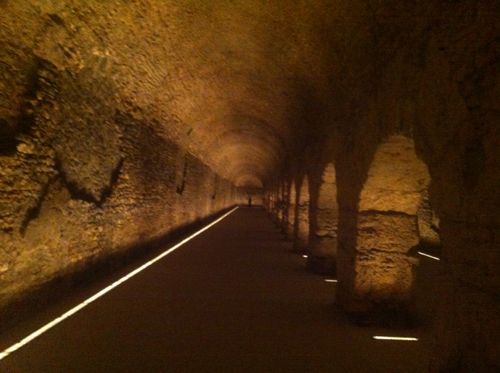
    After exploring the theater we moved on to the Cryptoporticus. I wasn’t sure what to expect of this except that it would be underground. We passed by a wooden door in a wall, a side entrance into Aosta’s cathedral that leads to the “Treasure Museum” kept inside; the sign there informed us that the cathedral and its treasure museum would not re-open until three. (Lots of things in this region close for two or three hours around lunchtime.) We walked around the corner of the church to the façade, which was Neoclassical — pillars and a pediment — but which framed a porch that was ornately bedecked with painting and statuary. The porch and façade were set at an angle to the rest of the building, giving it a crane-necked appearance.

    A little garden on the other side of the church hosted signs directing us to the cryptoporticus. It was a charming little French-style garden with a graceful spreading tree in the center, red flowers and shrubbery, and a circular path of crunchy, dark-gray pea gravel, and a few benches. The four year old promptly started to run in circles around the path. But the 14yo was already starting down the stairs in the back of the garden, down to the Cryptoporticus. I followed.

    Down below: an arcade. It wrapped around the corner and continued much farther than I expected — a vast double hallway. The younger children immediately began to race back and forth among the columns. I could not think of a reason why I should hush them and yet I felt the impulse to call them back. The air had a stale scent, the up-lighting cast a creepy glow, and the ancient concrete seemed to swallow up their laughter.


    The 14yo had found a brochure that explained the structure and gave a map of the original layout showing the extant parts in red. The cryptoporticus was around the Forum of Augusta Praetoria. French Wikipedia tells me it originally formed a rectangle, 89 meters long by 73 meters wide, and that two temples were situated atop the area it surrounded.

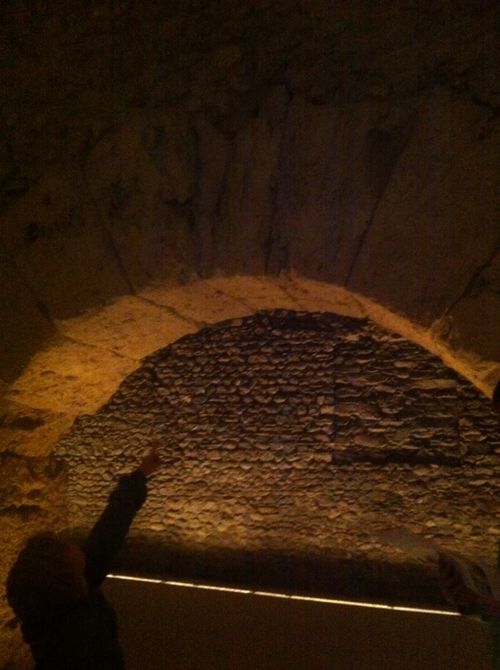
    These arches being fairly low and accessoble, it was a good place to examine their construction, and ask the 8yo to find the keystone of the arch.

    Back outside, I nursed the baby in the garden while we let the 4yo run in circles and waited for the cathedral to open. Then at three we went in.

    + + +

    The Aosta cathedral turned out to be totally worth the trip. You can’t get enough information from the English Wikipedia page, but the French one is sufficiently detailed.

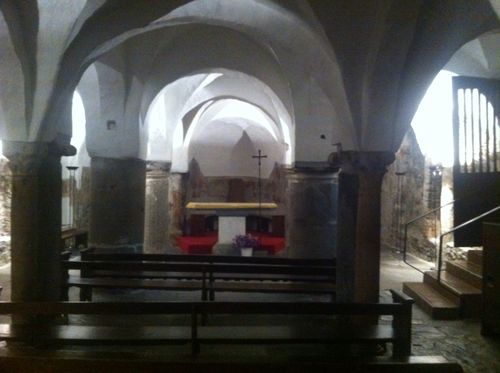
    Aosta had quite an early Christian community. There has been a significant Christian building there going back at least as far as the 4th century — by then, it was 40 meters long and had two baptistries and several annexes — and before that there was an even older building backed right up against the cryptoporticus. In the 11th century, the bishop St. Anselm likely was the one who called for a new church. It was built in a nordic style and frescoed. Successive centuries added their mark: marvelous floor mosaics date to the 13th century, gothic choir stalls to the 15th, stained glass windows and the frescoes in the portico to the 16th, an altar in the 18th, the façade in the 19th, and most recently, the organ.


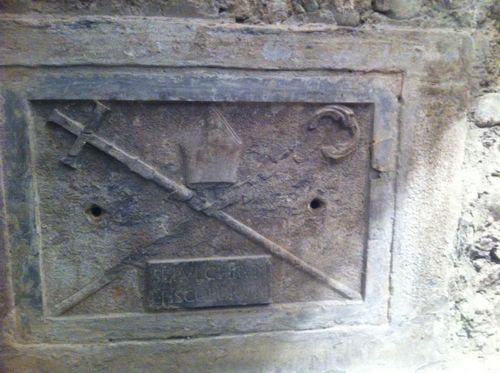
    Bishop’s tomb in the undercroft:


    Undercroft, including repurposed Roman columns:


    Ceiling frescoes:


    We finished up with ice cream. If we’d had more time and fewer tired children, there would have been castles to see, too; there are eight or ten castles from various periods scattered around the region. But by then we were exhausted, so instead headed back to France.


  • Aosta (part 1)

    Thursday was supposed to be drizzly and gray — as good a day as any to drive through the Mont Blanc tunnel and emerge into Italy for a day trip.

    Hannibal and his elephants never had it so good. The tunnel is more than 10 km long, right through the mountain; it’s only one lane in each direction. Driving is tightly regulated. You must travel no faster nor A slower than a certain range of speed. The sides of the tunnel are illuminated by white lights interspersed at regular intervals by blue ones; the distance between two blue lights is the minimum following distance. All trucks must be inspected before entering the tunnel; the inspection points are in towns some distance away. The authorities also control commercial traffic entry times so as to smooth out usage peaks.

    A lot of these controls, as well as extensive physical safety features, were put into place after the 1999 truck fire that killed 38 people and closed the tunnel for three years. We read about that from the Wikipedia page — I translated the French page on the fly for Mark, because it was more extensive than the English one — after I noticed a memorial marker near the tunnel entrance.

    + + +

    You can get completely different weather on the opposite side of the mountains, but it was just as drizzly and gray when we emerged in Italy. It’s about an hour to Aosta altogether. Even with the drizzle it’s a lovely drive with the mountains rising up all around you, many of them terraced and quite built up.

    Aosta was once Augusta Praetoria Salassorum, a Roman camp-turned-planned-city strategically located near two mountain passes. It had a squarish layout crossed by two main roads that exited the city at four main gates. One such gate, the Porta Praetoria, remains in very good condition.

    I wish I had a better picture. The gate is truly awesome. It is double-walled, and each wall is doubled in thickness. There is a beautiful, ripply stone on the outside, and some of the marble facing remains. There are niches on the outside for statues. It is still embedded in the Roman city wall, much of which continues around the city.

    We stopped near the gate at the tourism office, where an English-speaking staffer gave us a nice big paper map and circled the specifically Roman sites on it, pointing out a path to walk from east to west through the city that was once the Roman castrorum.

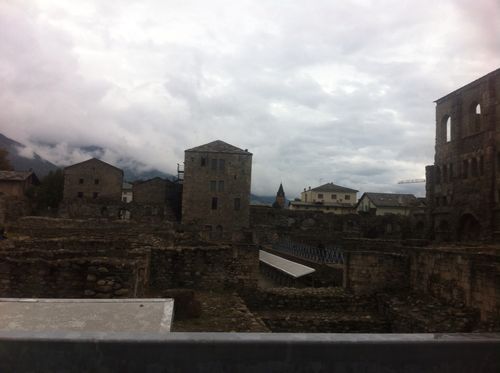
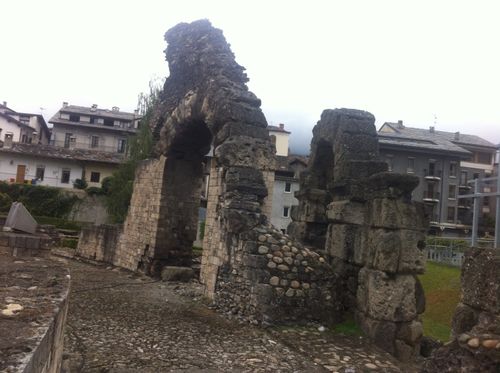
    Not far down we came to the remains of the theater:

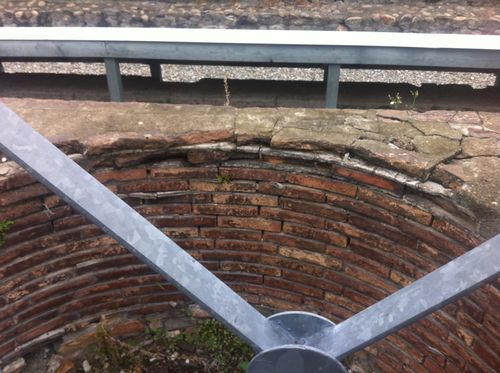
    They have erected scaffolding all over the site so you can walk through and around it. You can get quite close to the Roman brickwork that went under the stage.


    And see the wall stones, cut into triangular shapes so as to present more surface area for adhesion to the concrete.

    Rows of “bleachers”


    Underneath the theater floor

    An entrance


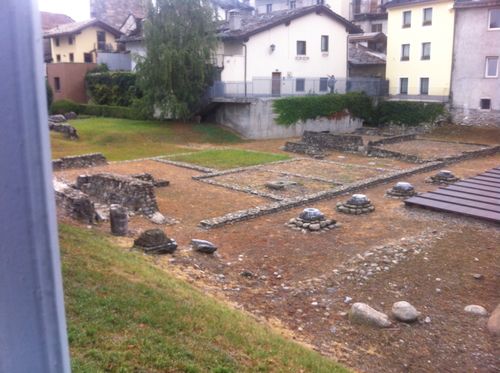
    Remains of buildings outside the theater


    more…


  • Life-changing vacations.

    Whenever I get away from my usual routine for more than a few days, I imagine all the ways I am going to return a changed woman. Distance from the ordinary tasks and duties makes all the little obstacles seem surmountable; exposure to new things makes me want to bring them home with me. Anything seems possible when my daily life is so far away that it can become a figment of my imagination; until I actually have to get back there and go grocery shopping and make my bed.

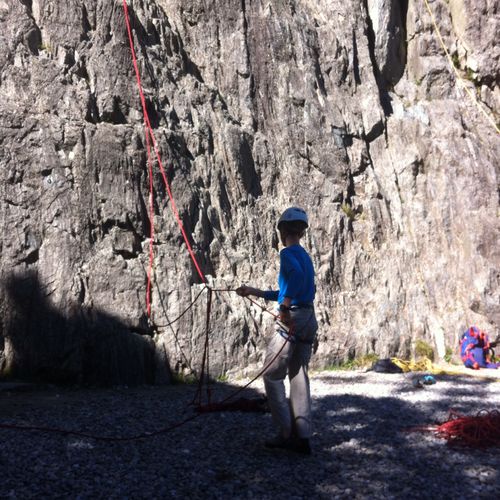
    So, for instance, our family had a great time out climbing on the rock the other day with a guide at Les Gaillands. Everybody took a turn, the extra adult helped it all go smoothly (because otherwise who would belay me and still leave Mark to hold the baby?) and when the small kids were tired and after I had even had a chance to try it a few times, I went back to the apartment and the bigger boys and Mark were able to tackle something really interesting (my 10yo’s first multipitch climb). It was a fantastic family day out with something for everyone. We have never done that before.

    “But we could do this, at home,” I said.

    “There’s no rock like this at home,” Mark said.

    “But there is some rock, not that far away,” I persisted, “and we could hire someone to come with us and be another belayer so that everyone could climb. And then I could take the little ones home just like today and you could have a grand day with the big ones.”

    “We could,” Mark said, “but it takes time.”

    Time.

    + + +

    And then there’s the food. Since I have been here I have made a new vow at every meal, it seems. When I get home I am going to find a supplier of tiny sour French pickles and I will never again eat a ham sandwich without them. I will buy the beer at Surdyk’s which is attached to the city’s best cheese shop and I will find out if they sell Abondance and Tomme de Savoie, and I will make salads with fine ribbons of white, soft-rinded cheeses and twists of proscuitto. I will throw out all the bottled salad dressings and make only pungent mustard vinaigrettes and luscious cream dressings with herbs. I will buy a crêpe pan and an electric fondue pot, or at least a correctly-sized enameled cast iron saucepan that will hold the heat. I will buy the expensive butter, maybe not for the whole sticks that are melted to go into waffles, but at least to spread on my sandwiches. I will make pan sauces again with cream and wine.

    I know better than to think, even for a minute, that I have time to do much of the fancy sort of French cooking. But surely I have time to make my quick meals more civilized? With the good kind of canned tuna that is packed in olive oil? With better cheeses on my salad? With tiny, ice-cold glasses of fresh-squeezed grapefruit juice?

    Because even the quick things are so very much better here. Some things would be impossible to find. My favorite gelato flavor is Fior di Latte, ideally combined in a cone with a scoop of some luscious fruit like peach. You never see Fior di Latte at home. I won’t be able to get it and that is that. But maybe I could put a poached egg and cream on my homemade ham-and-tomato pizzas, you know? Maybe I could find the time to stock up once in a while at the good grocery store? Buy the expensive eggs from happy chickens, the ones with the deep yellow yolks?

    + + +

    Yesterday in Aosta we stopped to shop for groceries at a really large store, the Gros Cidac, the only store I have seen over here that was bigger than the average American grocery store. It was almost Wal-Mart sized. I went into the dairy department just to grab some grated Parmesan, because I was going to make minestrone soup for dinner and there isn’t a grater in the apartment, and I was completely gobsmacked by the sight of the cheese section. There were dozens of different brands of fresh mozzarella, just to name one type, and they were packaged (among other ways) as convenience food in three-packs of individually sealed plastic bags, as if they were Fritos for your kids’ lunch boxes. The cooler labeled just for goats’-milk cheeses was bigger than the entire bin of all “better” cheeses in our grocery store at home. I was almost thrown into a panic (how can I be in the presence of this and not at least buy one package of the good cheese? but which package would I buy?) and in the end I just left with the grated Parmesan I came for.

    I cannot take the cheese section in the Gros Cidac home with me.

    I am not sure what I can take home with me. Something.


  • Me, rock climbing.

    When I was a rather little girl, playing alone in my neighborhood, I liked to sharpen sticks. I sat on the sloping concrete ledge behind our fence, by the garage, and grated them against the rough concrete, turning them to shape a point. I would make several in different lengths, imagining I was a blacksmith forging tools, or that I was whittling them each for a purpose.

    An enormous tree grew back there, and around its base there were always many shoots or suckers of a woody sort of bush — shoots that grew tall and long with few branches coming off. I would break one off, five or six feet in length, and strip what leaves and branchlets there were. It made a long whip, one that whistled as I swung around my head; a switch of it would smart, all right. I would carefully peel away the bark from the end, leaving a green tip, and imagine that this final step transformed it into a trusty weapon to have by my side. I would stalk around the neighborhood, sometimes using the switch to snap leaves off of overhead branches, imagining I was the possessor of a collection of weathered tools selected and shaped by my own hand, a craftsman, an expert, a MacGyver, ready to solve any problem with the few versatile items in my kit.

    + + +

    Every once in a while some toolkit reminds me of that longing. A set of chisels. A box of watercolors. A fly fisherman glimpsed at the edge of the lake with his trays of lures and pliers open and visible. Though I don’t work wood, or paint, or fish. I felt a little bit of it when I was in organic chemistry lab, pipetting, clamping, titrating, distilling; sadly it was not my calling, and neither was the scanning electron microscope I encountered in graduate school.

    Some time ago I was chopping an onion in my kitchen and realized that without knowing it I had, in fact, surrounded myself with such a toolkit: saucepans and paring knives and zesters and strainers. I can do quite a lot with that, and I had never appreciated it.

    + + +

    This is a rather long way of getting to the point that, although rock climbing is my husband’s hobby, and I never gave it a thought for the years that I was certain my bad writst prevented me from taking it up, I’ve always been attracted to… the rack.

    Mark has teased me since we got here in Chamonix that if I felt that I did not fit in well enough, he could lend me a harness and a bunch of quickdraws and carabiners and other bits of metal to dangle from the harness, and possibly an ice tool or two for good measure, and I could walk around clanking like all the other cool people.

    What he doesn’t know (until he reads this) is how terribly jealous I am of people who have such a collection and know how to use it. And really it is just because of the collection. I want it like my four-year-old wants a pirate’s chest of gold coins. I would not know what to do with it if I had it. I just want to run my fingers through it and maybe stalk around a little bit.

    + + +

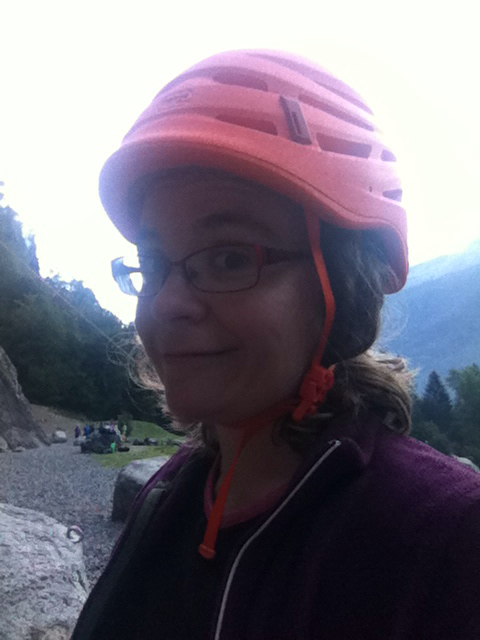
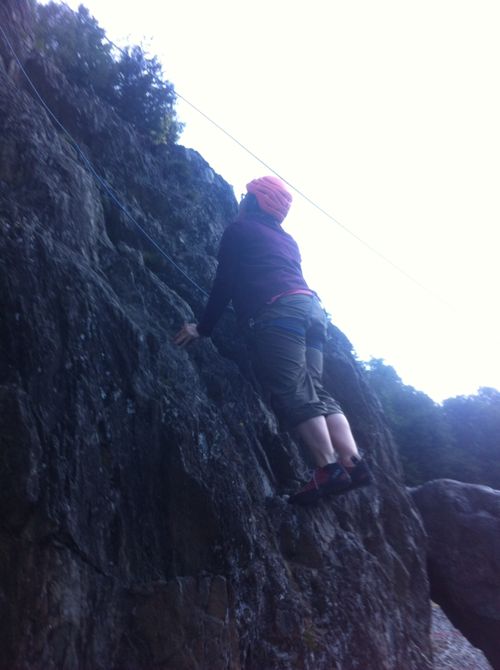
    But! I did get to try rock climbing this week. The whole family went out to Les Gaillands and for the very first time I put on a harness and a helmet and roped up and put my hands and feet on rock and left the ground behind.


    The guide was my belayer. I started up. It isn’t actually very hard (well this stuff wasn’t) to climb.

    There are lots of handholds here, plenty of places to step and grab, and it isn’t perfectly vertical. I thought it would feel taxing to the strength; but it doesn’t, no more than climbing a ladder. Actually, what it reminded me of most of all was climbing at a playground. You climb a ladder because you have to fix the gutters or hang a picture or something. Why was I climbing the rock? Not to work.

    To find out if I liked it and could do it. To see what Mark and the kids see when they do this. To get a physical understanding of the meaning of the words Mark uses when he comes home and tells me how his climbing day went.

    You just… go up.

    Occasionally there were little surprises. (Besides how pleasant and easy it was to climb this particular face.) A little lizard scampered over the rock near the bottom. Higher up, there were tufts of soft-looking grass growing on ledges, and I put my hand on one — “Ow! This grass is pointy! It’s hurting me!”

    Laughter floated up. “You found the angry grass,” said Jeff the guide.

    Occasionally I turned to look down. It was a long way, but I did know that the rope would keep me from falling, so I wasn’t afraid. Not with my head anyway. I enjoyed the lovely view.

    (this is from the ground, but it is what I was looking at from up high)

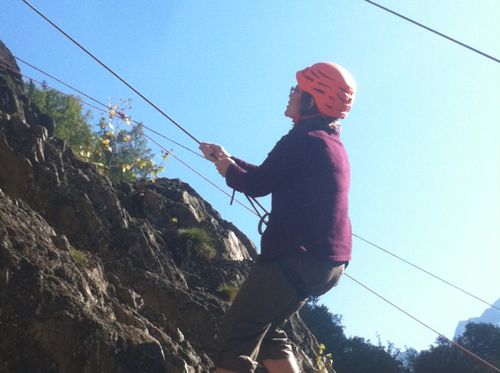
    The tough part came when it was time to be lowered down. It isn’t actually scary, I think. I knew I was safe. But it is hard to make your body do what has to be done: put your feet against the wall, push gently away, lean…. way… back. Trust the rope not just with mind but with body.

    (me, beginning to trust the rope. note death grip.)

    Once on the ground I wanted to try again and again. There was something of the roller-coaster exhiliaration in it. You trick your body into thinking you are in some kind of danger, but you are really not, so you are free to feel the rush. I climbed four times and went a little higher each time.

    And I watched my kids climbing, and my oldest child practicing belaying the other children. I was generally aware that this is the sort of thing that is supposed to strike fear in a mother’s heart, as she is also supposed to be saddened over her children getting big and striking off on their own.

    But I am not such a great-hearted mother, so instead I was nothing but excited and pleased to see them striking upward so confidently, and supporting each others’ weight on the way.


  • An unusual thing for me to do.

    The first day we were at Les Gaillands, while the oldest was climbing, I came back from the concession stand just in time to see some of my children tussling with some other children standing by with their mother, and Mark telling one of our children “You apologize to him so he can forgive you,” and at the same time the other children’s mother was instructing her child on the correct way to apologize. At first I thought — Hey! She sounds exactly like what we sound like when we instruct our kids to apologize. And then I thought — Hey! She’s speaking English with an American accent, and so are the kids.

    “You sound just like us,” I said to her in surprise, and really I meant that the children were busy with the same script: I’m sorry that I hit you with the thing, will you forgive me? And I’m sorry I tried to take your stick, will you forgive me? although I probably sounded like I meant Americans!

    Her name was L. and she was an expat, living here in the Chamonix valley, and she had a blond son the same age as my 10yo and dark-haired twin boys the same age as my 8yo. At first she assumed we were also expats, Americans in the same valley that somehow she had managed not to meet yet, but we explained that we were only vacationing here. “What brought your family to France?” I asked, expecting the answer to be a job or a French spouse, but she answered immediately “The mountains.” We chatted about homeschooling, about having American kids in the French school system, about Utah (where they’d lived before coming here), about climbing. I liked her immediately. Meanwhile the kids were running around and getting along famously, particularly her older boy and my 10yo, and she invited me to bring the rest of the family up to visit them at their house before our vacation was over, maybe Wednesday after her kids were done with ski-jumping practice.

    This is not the sort of thing I usually am comfortable accepting ten minutes after meeting someone, but it flashed through my mind that Mark would appreciate it, and something about the kid-apology-style and about the positive reaction to our explanation of homeschooling the kids — those made me trust the invitation. So I scrabbled in my bag for a notebook, and L. wrote her email address in it. And that evening I emailed her with the subject line “Americans you met @ Les Gaillands.” And this afternoon we drove to Argentière, the next town over, for a playdate.

    I brought a loaf of bread and a box of cookies as an offering, feeling that it was the civilized thing to do. We arrived at the same time they did, driving up a narrow road out of the town into what looked like a combination of pasture land and campground. The three children hopped out of their mom’s car and ran up to our van excitedly. The house was three-story — each floor was an apartment — and there was a garage (full of skis) and a nice-sized yard with a zipline, a slack line, a swingset, and some other climbing structures. L. put the kids’ skis and helmets away into the garage while our kids hurled themselves at the yard toys, and we went up for tea.

    The third-floor apartment was airy, not large by American standards — “Eleven hundred square feet,” L. told us — but cleverly outfitted with space-saving shelves and cubbies. The washer and condensing dryer were in the boys’ bedroom, because there had, oddly enough, been a bathtub in the bedroom, which was covered over and turned into a play space but furnished the drain for the washer. The kitchen had been opened up and remodeled (“Look what we found in the wall when we tore it open to find out why the circuit kept shorting out,” said L., rummaging in a drawer and then handing me a heavy, six-inch-long nail). The views from the window were stunning: the bedroom opened onto a narrow metal-railed balcony and the mountains were right there, with the gondolas visible at the top for the Grands Montets ski area. It was right at the edge of the woods.

    We walked up to the forest with the children, passing on a narrow path between two stone fences: one of flat, lichen-crusted rocks laid upon each other to make a low wall, the other of broad stones set on end into the earth like so many irregular gravemarkers. The floor of the path was roots and rocks. In the shade of the forest we came to a sign, the familiar buff-colored sign with green type marking the hiking paths, part of the Tour de Mont Blanc, and here was a little stream, only a foot wide, trickling down, and a little clearing and a bench to rest on, a perfect place for children to play. L. explained that it was her task, as the mother living furthest up the hill and closest to the woods, to generally keep an eye out for any kids wandering up near the edge of the forest, while a different mother farther down watched out for children coming too far down near the busy road.

    Back in the apartment, while the kids watched Mythbusters, we munched on cheese and French boxed cookies and talked about skiing, and the bureaucracy of living as a resident alien, and school for the children. L. supplemented her kids’ education in the French schools with American history and lots of travel; her husband worked out of London most weeks, but they had been all over, recently to Iceland, planning a trip to Greece. The apartment had a certain look I associate with homeschooling: an enormous fraction of the space given over to books, a periodic table hanging in the kitchen, a chemistry experiment in a cooking pot in the garage, a microscope on a low shelf in the playroom, bins of Playmobil and Lego and assorted magnetic building toys. At one point she asked me which Latin curriculum I used, then found a notebook to write it down. I almost got the impression that this was a homeschooling family that had chosen to have the core curriculum provided by the French school system as an immersion learning program.

    We also got to hear about some of the craziness that is French child-raising. On the one hand, everything is heavily regulated. Each child needs to have something like eight cards: identity, and civil liability insurance, and school membership, etc. You need the permission of the school director to take your child on a vacation during term (“They’ll stop you at the border if you try to leave the country with your child,” said L.) Every child must take swimming lessons. The pedagogy includes actual socialization training, with board games and getting-along practice. And yet… children can run around free in the neighborhoods, and you can leave your kid in the car when you go into a store, and at least in the mountains the children have an active life and learn to climb and ski terrifyingly well at a young age. It was fascinating.

    All in all it made for a thoroughly enjoyable afternoon, one that had fallen randomly into our laps. And the kids — our kids — badly needed the time running around, unstructured. L. kept telling me, “I never invite people over. I need a lot of personal space.” and I kept telling her, “I never just accept invitations like this. I’m really quite terribly antisocial.” Mark vouched for my antisocialness. We exchanged un bisou and I got in the car, and we drove off feeling very lucky indeed.

    As my 4yo told me the other day, “We have so many vacations in our vacation. You wake up every day and you just don’t know what will happen.”


  • Pilgrimages.

    I have really mixed feelings about our trip to Annecy, and I thought I would hash them out before we went to Rome.

    The Basilica of the Visitation was breathtaking. To take it in, I would have liked to sit there for a while, twenty minutes at least, contemplating the mosaic of Christ on the cross. Then slowly walk around looking at all the chapels. Maybe stop in and join the sisters for the Office (their chapel, though it is behind a grille on the church side, is open to anyone.) Pause at the ossements of the two great saints who rest, beneath gilded lids strung through with red ribbons and sealed each with a splotch of wax, in the chapels that flank the main altar: two saints whose writings I know well, giving me a feeling sometimes that they walk beside me on the way.

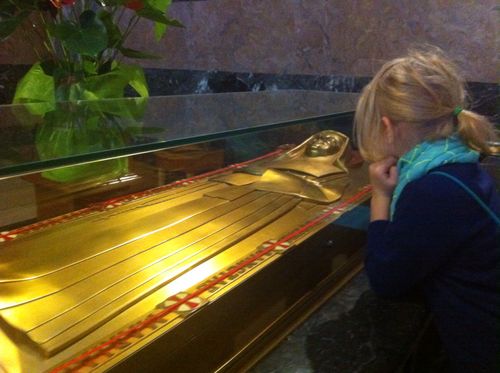
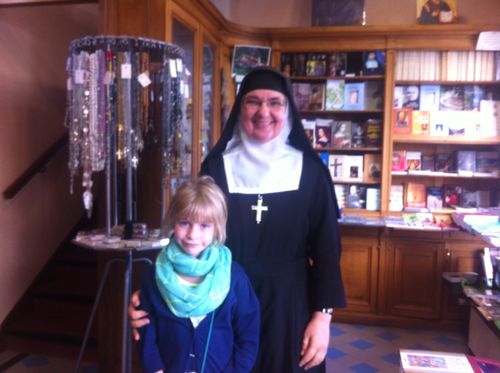
    But instead I spent my time showing the chapels to my daughter who was positively starstruck by being in the presence of her name saint. I took pictures of her standing before St. Jane Frances, perhaps praying there, I don’t know, but she stood there quite a long time. I shepherded children around and looked for someone to ask the way to the bathroom for the 4yo. I helped children talk to the non-English-speaking sister who ran the gift shop, and chose a few mementos.

    I am pretty sure I spent more time in the gift shop than in the Basilica.

    Afterwards I read through my souvenir brochure that described the art and devotional objects in the Basilica and realized that I had taken hardly any time to look at them while I was actually there. I had not noticed the daisies (marguerites) and roses growing at the foot of the mosaic cross — although daisies are an unusual devotional flower — there to memorialize Ste. Marguerite-Marie and Ste. Thérèse, a detail that would have delighted me had I noticed it. (I love daisies.) My attention was focused on the children.

    We picked up a paper brochure called “In the footsteps of Francis de Sales in Annecy.” It has a little walking tour that begins at the first House of the Visitandines, passes the second monastery (now occupied by Sisters of St. Joseph), the house of Mme. de Charmoisy who was the “Philothea” addressed in Introduction to the Devout Life, the house where St. Francis wrote Treatise on the Love of God, the church of St. Francis. I am just looking at it now. We did not try to follow it in the town. We needed lunch, the children wanted to spend time playing at playgrounds, and after a bit of walking and admiring the beautiful lake, it was time to go home.

    + + +

    I need to adjust my expectations before we get to Rome. I knew I would have to expect a slower pace and a less ambitious itinerary because of the needs of the children. I didn’t realize that I would also have to expect less of myself, that interiorly as well I would only skip lightly over the surface instead of plunging in to plumb to the depths. I cannot stop being a busy and distracted mother of five, unless I have the chance to step away for a moment and breathe; and it takes time to shuffle out of that cloak and leave it at the door, and leave the heart barer, more exposed. Busy-ness, tasks, responsibilities, are a kind of defense against penetration.

    I am not a solitary pilgrim. That paradigm will not work. I am some other kind. I must either find another way to clear aside the busy-ness from my heart, as I shuffle children from place to place, or else I must find a way to sanctify it.


  • I don’t think that word means what you think it means.

    The second Monday, I insisted on having some time to wander around town by myself. I left the apartment at around eight in the morning, and I have to tell you, I was amazed at how few people and vehicles were about.

    Here it is, the start of the week, well into what would be rush hour in the United States — and who did I see out?

    –Street sweepers driving cubical little sweeping trucks, occasionally getting out to push brooms.

    –Kids on their way to school.

    –People with ice tools and trekking poles sticking out of their backpacks.

    Yeah, that was about it.

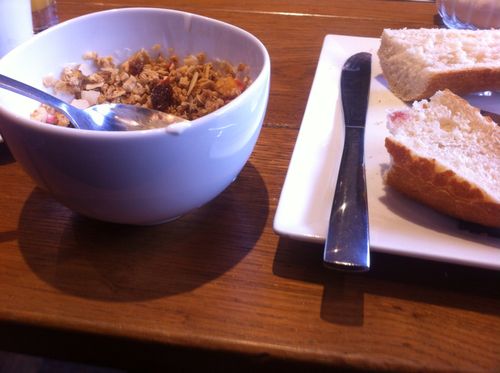
    I walked around, looking at the stores. A very few cafés and bars were opening — not yet open, but someone was unchaining tables and unstacking chairs, writing on the menu boards. The very first places started to open around 8h30 for “formule petit dejeuner.” I searched for something that was neither Carbs-‘n’ Caffeine (French breakfast) nor Carbs ‘n’ Caffeine Plus Yer Money’s Worth O’Meat (English breakfast) and finally settled on a place that had fromage frais with muesli (plus the carbs and caffeine).

    Along with the fromage frais: Baguette, butter, jam, coffee, and a petite cylindrical shot of fresh-squeezed blood orange juice.

    I think the fromage frais is distinct from yogurt, but to me it tastes similar — maybe not as acidic, but as thick and creamy as Greek yogurt. Wikipedia seems to think that it is thickened from raw milk using rennet, at lower temperatures than one cultures yogurt.

    + + +

    I came back and Mark announced that we were going on a nice relatively flat hike along a river in a valley. I looked it up — the Vallon de Bérard — and the hike was described as a gentle two-hour hike for the whole family that ended up at one of the mountain refuges for hikers, where there would be a full restaurant with fabulous desserts. It sounded like a grand day out, and it would have us out there by snack time and back by dinnertime. Perfect.

    We parked at the train station in the little hamlet of Le Buet, walked across the street, and started up the trail. Not far up we found a sign for the Refuge Pierre Bérard, 1h45, and another for a Cascade Bérard — a waterfall — 0h15.

    The trail started out through farm fields. We were separated from the cattle by an electric fence.

    Then, after we passed a tiny cluster of houses, it started to climb steeply.

    Within fifteen minutes we were at the promised waterfall. A little restaurant was built right above it, with a porch that went right over the river. Like everything here it was bedecked with bright flowers, the easy kind like geraniums in pots. The children wanted to stop but we reminded them that we were going to have bilberry tarts at the refuge, and kept them going.

    Not far past the cascade there was another sign that announced the refuge was 1h45 away. “Wait a minute,” said Mark, “isn’t that what the last one said?” We pressed on.

    The trail seemed awfully steep and rocky for a gentle hike for the whole family.

    Still, it was a beautiful forested hike, right next to a lovely rushing stream of glacier meltwater.

    We went on and on, and up and up. Saw a slug:

    And eventually put the four-year-old on a short rope for safety, as the cliffs plunged rather far down to the stream.

    We stopped for lunch after an hour or so, eating all our sandwiches. Mark saved back a few M&Ms for an emergency. We planned to have snack at the refuge, so we did not bring another snack. I nursed the baby, but only a little, because he wanted to crawl around instead. When I put him back on my back he fussed angrily for a long time before going to sleep.

    After a while — by which time Mark had started carrying the 4yo on his back to make better time — we seemed to have come to a flat place and the valley opened up all around us. There were wild raspberries growing. It was gorgeous. I think it is the most beautiful hiking terrain I have ever seen.

    This is really where we should have planned to hike all day and spend the night at the refuge before hiking out. That would have worked. We came prepared for an overnight hut trip. But we didn’t know till we got here.

    The terrain remained gorgeous, but it wasn’t flat for long. It began to climb steeply again. We saw many signs warning us not to stop because of falling rocks, and other signs warning us that the river could rise swiftly even in good weather because of power plants upstrem.

    The next time someone passed us going the other direction, I asked how far to the refuge. “One hour,” said the French lady.

    Twenty minutes later here came another couple: this time, British. “How far to the refuge?” I asked.

    “Oh, at least one hour and a half, maybe two since you have all these children,” said the British lady.

    The third person who came by had a German accent. “Forty minutes,” he said. “And the cake is really worth it.”

    + + +

    Quite possibly we had fallen into a joke.

    + + +

    Anyway, we eventually came to the place where we could see the refuge, far off in the distance and at least another hundred meters vertical gain. We looked at it. We looked at our watches. We looked at the sky. “Turn around time is 3 pm,” said Mark, “because there’s a chance of rain. So can we do it fast, or not? Can we get there in twenty minutes?”

    The 8yo, who had been griping about being hot and cold and being annoyed by her brothers’ singing and had claimed she had a twisted ankle until it was taped up and then she claimed that made it worse, said “I’m not sure I can go really fast but I’ll try.”

    The 14yo wanted to go for it.

    The 10yo looked and said: “I think we can do it, but not in twenty minutes.”

    “You sure?” said Mark.

    He was sure.

    “Okay,” said Mark, “thank you for the information. Executive decision: we turn around.” And he started back down the trail.

    The 14yo was horrified. The 8yo started to cry. I felt disappointed, but also a little bit relieved that the decision was made. The 10yo was stony-faced, his expression hidden behind sunglasses. We followed.

    “Anyone in the party can make the call to decide not to go to the summit,” Mark called back cheerfully over his shoulder. “It is important to practice being okay with turning around sooner than you expected.”

    “But the cake!” said someone.

    “We can stop for cake at the waterfall,” I said quickly.

    And that is exactly what we did.

    It was faster going down, but still unsteady. The baby tired of being on my back and began to lunge his weight around in a way that threw me off balance, so I traded with Mark and held the other end of the 4yo’s rope. He was well rested, having been carried so far, so he hopped about excitedly.

    At the buvette two children got lemon ice cream, one child got a Schweppes Agrum’ (a really amazingly good citrus soda that we have never seen in the States), one child split a fruit tart with Mark, and I had a cheese crepe which I shared with the baby and anyone else who wanted a bite.

    Crepes are pretty good. I think I should learn how to make them at home. “Kind of like a French quesadilla,” someone said. My 8yo wrinkled her nose and said she thought they would be better with normal cheese.

    + + +

    On the way out we passed a map that we had not looked closely at before. For some reason we had not been able to find the refuge on this map. But this time when we looked at it, it popped out immediately. Along with altitude numbers.

    I did a quick mental calculation. Five hundred eighty seven meters of vertical gain between the red dot marked “Vous êtes ici” and the refuge.

    A “gentle hike for the whole family?!?”

    I am not relying on adjectives any more. Only numbers. And not time estimates either!

    We went home. To my trail-stained clothes I added some spots of cream sauce from the veal I made for dinner. I collapsed into bed. And Mark made plans to take us rock climbing the next day.

    As the 4yo said to us the other day, “There sure are a lot of vacations in our vacation.”


  • So how are the children?

    It pays, I think, not to dwell too much on what we would be doing if we didn’t have small ones with us. Long high-altitude hikes, overnight mountain stays, lengthy evening meals. Walks in the town, drinks at the bars, trips to the museum. None of this is happening, at least not at length.

    But we have discovered that lots of people come to say hello to a fat baby in a carrier. Lots of people will smile back and try to chat with our 4yo when he walks right up to them and says, “I don’t speak French, but my hobby is talking. Bonjour!” Lots of people say: “Cinq enfants! Bonne courage! Bravo! Et seulement une fille — la princesse!”

    The 14yo is chafing a bit. He wanted badly to practice belaying while we were at the crag yesterday, but Mark said no because he had to pay close attention to the smaller kids, so it was a matter of taking turns and being patient. He doesn’t like that he has to take his 10yo brother around so much — we won’t let the 10yo wander quite as far on his own, but we want to give him a chance to wander, so we make the 14yo go with him.

    The kids are excited, not always about what you’d expect. Right now I am in the apartment alone with the baby, because the other four wanted to go to THE FAIR. For some reason we have not yet figured out, a tiny midway with a handful of county-fair rides and games has set up in the parking lot around the corner. Mark agreed to take the kids over there to get them out of my hair so that I could lie down and try to nurse the quite-overstimulated baby.

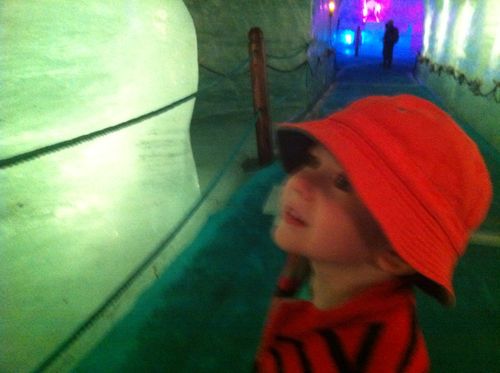
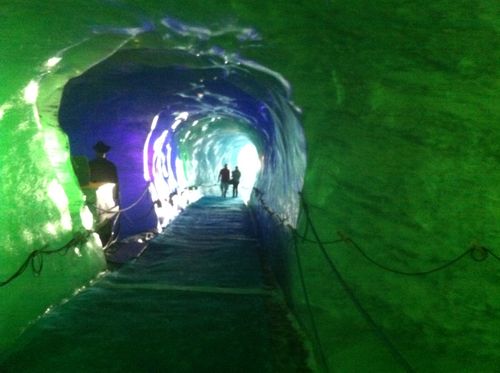
    They surprise me. The four year old climbed about 400 steps this morning up from the glacier to the gondola.

    And yet they have limits. I think the 4yo burst into tears three or four times this morning. Once because I ate a piece of salami out of a sandwich that I thought he was done with. Once when Mark ate the second complementary mint out of a package of two instead of giving both to him. Once when his sister bit him because he kept sticking his fingers in her mouth. We need to come back to the apartment from time to time and rest. We have a laptop and a few DVDs that are helping a lot.

    Possibly we will try to hire a babysitter in a few days for the eight- and four-year-olds, so that the big boys and Mark and I can attempt a longer hike, carrying the baby. It does seem as if we should try to do something at least a bit ambitious, now that we are here.


  • Climbing at Les Gaillands.

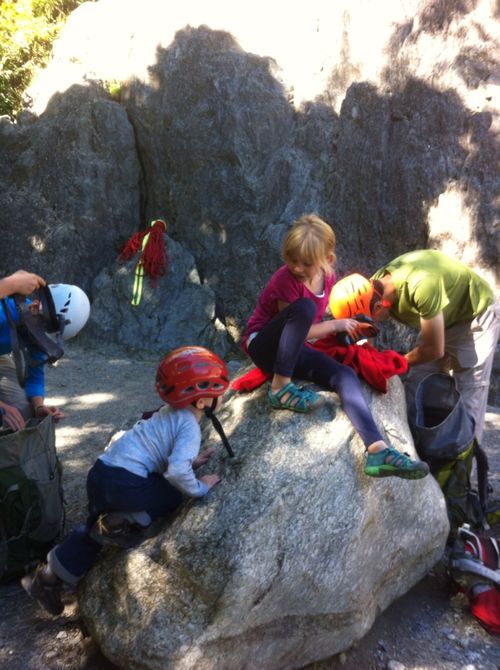
    Not far from Chamonix, in a tiny town called Les Gaillands — you could walk there in an hour or so, although we drove — there is a pleasant park with a well-bolted climbing crag, a pond for fly fishing, and a few nature trails. We spent Saturday afternoon there.


    I carried the baby around and entertained the four-year-old between his turns. I was more interested in watching and listening to the French climbing instructor charged with about a dozen children from ages seven to twelve. Mark noted, “It’s a good thing she’s using a Grigri to belay those kids, since it leaves one hand free for her lit cigarette.” She also used the cigarette hand to gesture as she called up to the approximatelt eight-year-old girl which way to look for the bolts. The eight-year-old clambered all the way up, setting quickdraws as she went, then ran the rope through at the top and came back down, cleaning the quickdraws. Mark said to me, “Hey Erin, can you ask the instructor to ask the girl if she can bring down the carabiner I left up there?” He had abandoned one when he soloed up to look for a new attachment point, decided he didn’t want to go any farther, and rappelled down.

    Before I could say anything the instructor said “Ze red one?”

    “Yes, thanks,” said Mark, and the instructor called up to the girl to bring down the carabiner “pour le m’sieur à côté.” Which she did. When the little girl got back down, the instructor left her and a second little girl came. The first little girl belayed, with no supervision whatsoever, and up went the second little girl. Occasionally the instructor came back, watched a moment, and went away again.

    I’m thinking they have a different attitude about safety here.


  • Catching up with a few travel notes.

    The hotel wifi has been whiffling in and out, causing me to go down to the front desk and have conversations with the staff along the lines of, “The weefee, it works but not very well. It begins, it stops, it begins, it stops. From time to time it can find the network but then it tells me ‘Impossible to rejoin.’ Yet the box with the green lights, they are illuminated all the time.”

    + + +

    The unreliability of the weefee is the main reason I haven’t blogged the last couple of days. The photostream hasn’t been syncing. But ! It has now. So here are some notes.

    + + +

    There is a little amusement park within walking distance of our apartment, tucked at the base of a little ski hill, the sort where you bring your little kids for lessons. There is no fee to enter the park and a few things are free, for example, there is a play structure — actually two, one for toddlers and one for ages 3 to 12. The rest of the things take either tokens, wristbands, or tickets, which you buy at a cash window.

    There appeared to be about three staff members running the whole thing. The 4yo wanted to ride the little train, which was apparently abandoned, and we stood around looking confused until a staff member ran up, took his token, helped him on, and started the train.

    The train was not very different from American kiddie rides, but the bumper cars sure were. Regardez:

    No attendant. No seatbelts. No rules. You put a token in the side of the little trike, it starts up, and it goes for about 10 minutes controlled only by a foot pedal (off-on, no speed control) and the steering handles. It was awesome. It doesn’t go backwards, so if you run into a wall you have to get out and push it back while other people are zipping around you. You could totally get hit and hurt yourself. Kids loved it.

    + + +

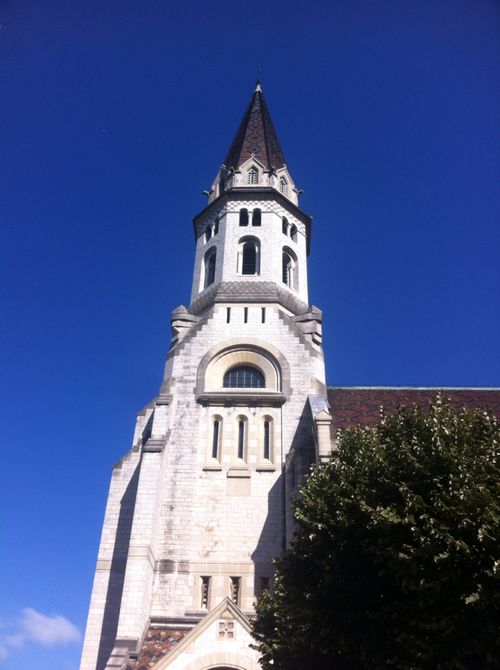
    Friday we drove an hour to Annecy to see the Basilica of the Visitation, have lunch, and walk around the old town.

    Basilica campanile.

    I found it hard to have a proper pilgrimage attitude. I was herding children around, and I felt more… I guess like a tourist! But my daughter made up for that. She was so excited to meet her name saint up close.

    Reliquary containing the body of St. Jane Frances de Chantal

    The basilica is twentieth-century, but the Visitation Sisters have been here since the time of St. Francis de Sales (who is in a similar reliquary on the opposite side of the basilica). The central viewpoint is a large mosaic of Christ suffering on the cross. The face is suffering yet peaceful; the Lord is flanked by Mary, John, the Magdalene, and Marie-Salomé; angels catch the blood of Christ in vessels while some of it falls upon an image of a chalice and host “signifying the identical sacrifice of the Cross and of the Mass.” My favorite detail: Daisies (marguerites) and roses grow beneath the cross, memoralizing Ste. Marguerite-Marie, the Visitandine who received the apparitions of the Sacred Heart, and Ste. Thérèse.

    I have a picture, but it hasn’t synced yet.

    The stained glass windows depict the lives of St. Francis and St. Jane Frances. My daughter liked the one of the saint with her four children. One is shown as a toddler holding a doll.

    We went into the gift shop to buy some mementos. I told the Visitation Sister (who guessed I was maybe Canadian!) that my daughter had Jane Frances for her name saint, and she was delighted. “Une petite américaine qui est nommée Jeanne-Françoise!” she told several other people that came through the shop as she greeted them. She went into the back and came out with a slip of folded paper that contained a little square of silk touched to the garments of the saints: a third-class relic, which she gave to my daughter, who was equally delighted.

    + + +

    Also enjoyed in Annecy: two well-designed playgrounds, each encircled by a gated fence, you know, so the small children can’t get out without you knowing and you don’t have to actually keep WATCHING them. So sane!


    Nice artificial turf! The baby liked crawling around on it.

    And lunch. Note the existence of chicken nuggets and ketchup in France. We told the 4 yo he could eat ketchup on his fries if he ordered it himself. “Je voudrais ketchup,” he said and the waiter whisked away to fetch it. “They are really going to let me have ketchup?!” he asked in amazement. (We had warned him that it might not be available everywhere.)

    More later…