bearing blog


bear – ing n 1  the manner in which one comports oneself;  2  the act, power, or time of bringing forth offspring or fruit; 3 a machine part in which another part turns [a journal ~];  pl comprehension of one’s position, environment, or situation;   5  the act of moving while supporting the weight of something [the ~ of the cross].


  • Crunchy Hawaiian Chicken Wrap: or, How to get a dozen kids to eat their vegetables, courtesy of the USDA and some of that mayo-vinegar-sugar dressing.

    You guys!  Believe it or not, this sandwich wrap (in which broccoli slaw figures prominently) was just proclaimed unanimously a hit by three families' worth of homeschooling kids.   And also their moms. 

    I adapted it from the USDA school lunch recipes by taking the 50-serving quantity and, approximately, quartering it.  The filling is gluten-free, so have a corn tortilla option for the GF kids.

    Our kids, oddly enough, thought it was a little too sweet.  It does have a lot of sugar — but I thought the sweetness was perfect.

    Crunchy Hawaiian Chicken Wrap  (12 generous servings)

    Dressing:

    • 1/2 cup       mayonnaise
    • 6 Tbsp        white vinegar
    • 1/2 cup        sugar
    • 1/2 Tbsp    poppy seeds
    • 1 Tbsp        garlic powder
    • 1 Tbsp        chili powder
    •                     Salt to taste

    Also:

    • 2.5 lb         frozen, boneless skinless chicken breasts, cooked and diced
    • 12 oz          bagged "broccoli slaw"
    • 6 oz            bagged julienned/matchstick carrots
    • 5 oz            baby spinach leaves, chopped
    • 20 oz        canned crushed pineapple, drained
    • A mix of burrito-sized and taco-sized tortillas

    Combine dressing ingredients with a whisk.  In a large bowl, combine broccoli slaw, carrots, spinach, and pineapple.  Fold in dressing.  Chill. 

    At mealtime, serve about 2/3 cup of for a burrito-sized wrap, less for smaller taco-sized wraps.

    It took me about ten minutes to throw the filling  together in the morning before school (with chicken I'd cooked ahead of time). I served these with peas and with string cheese on the side.  We all agreed that a bowl of honey roasted peanuts would have been a nice topping for added sweet-and-salty crunch.  Some of the kids requested a side of beans to make it more "taco-like."  

    Definitely going in the permanent rotation…


  • Poetry for high school Brit Lit.

    Our high schoolers are attacking British literature this year.  H. chose the novels and asked me to choose the poetry.  I knew all too well I had to choose a concise list, which meant being rather cliché about it — or canonical, take your pick.  I ended up selecting about three dozen poems.  You decide if it's adequately represented or not — and if you would put in something else, tell me what you'd take out!

    The kids have already studied some pre-Elizabethan poetry in earlier grades.  They've read Beowulf, for instance, and parts of The Faerie Queene, and more.  (They've also read The Comedy of ErrorsRomeo and Juliet, and Julius Caesar.)  So I begin with…

     Elizabethan Courtly Poetry

    • "The Passionate Shepherd toHis Love" — Christopher Marlowe, pub. 1599, but written earlier.
    • "The Nymph's Reply to the Shepherd" — Sir WalterRaleigh, 1596, a response to Marlowe. 

    Hamlet, 1599–1602 and The Tempest, 1610–1611, this year's two Shakespeare plays, fit chronologically into this section.  


    Post-Elizabethan poetry comes in three strands:

     -Metaphysical Poets: inventive conceits, speculative about love,religion

    • "Song" (Go and catch a falling star);
    • "Holy Sonnet X" (Death be not proud);
    • "Holy Sonnet XIV" (Batter my heart, three-personed God) –all by John Donne, pub. 1633.
    • "Easter Wings" — George Herbert, included as a sample of a "concrete poem" aka "shape poem," 1633.
    • "To His Coy Mistress," Andrew Marvell, 1649-1660.

     - Cavalier Poets, mostly courtiers in a time when Charles I supported the arts; Herrick, not a courtier, matches them in style.

    • "To Celia," Ben Jonson, 1616
    • "On My First Sonne," Ben Jonson, 1603
    • "To the Virgins, to MakeMuch of Time" — Robert Herrick, 1648
    • "Upon Julia's Clothes" — Robert Herrick
    • "Cherry-ripe" — Robert Herrick

     - Admirers of Spenser (e.g. Milton).  I skipped these.  I think they might have encountered Milton before.

     Then we have …

     Restoration poets (e.g. Samuel Johnson, Pope,Bunyan).  I skipped these too; I believe they have run into some of them before.  

    (Personally, I'm rather fond of Pope, though, and had I more time I'd have included an excerpt from The Rape of the Lock.)

    Sentimental, nature-themed poems of the later 18th century:

    • "Elegy Written in a Country Churchyard" — Thomas Gray, 1751
    • "To A Mouse, On Turning Her Up in Her Nest with the Plough" — Robert Burns, 1785 


    Then come the

     ENGLISH ROMANTICS (Blake, Wordsworth, Coleridge, Shelley, Byron, Keats)

    • "Rime of the Ancient Mariner" — Samuel Taylor Coleridge, 1798
    • "The Lamb" (fromSongs of Innocence,1789)…
    • …and "The Tyger" (fromSongs of Experience,1794) — both by William Blake.
    • "The World is Too Much With Us"– William Wordsworth, 1802
    • "I Wandered Lonely As a Cloud"– Wordsworth, 1804
    • "Kubla Khan" — Coleridge, 1816
    • "Ozymandias"– Shelley, 1818
    • "On the Sonnet" — Keats1819
    • "Ode on a Grecian Urn" –Keats 1819

    The novel selection Pride and Prejudice, 1813, fits in here. 

    Victorians

    • "My Last Duchess" –Robert Browning, 1842
    • "Pied Beauty," …
    • "The Windhover," …
    • …and "Spring and Fall" — all by Gerard Manley Hopkins, 1877.
    • Bab Ballads (e.g. "The Baron Klopfzetterheim") by W. S. Gilbert of "Gilbert and Sullivan" fame, 1864. 
    • "The Ballad of Reading Gaol"– Oscar Wilde, 1897.  

    Here go three novel selections for this year:  Bleak House (1852–1853),  Silas Marner(1861), and The Moonstone (1868).

    This brings us up to

    The 20th century.

     The final novel selection is The Man Who Was Thursday (1908).  Following come these poems, beginning with the master Eliot:

    • "The Love Song of J.Alfred Prufrock" T. S. Eliot, 1910

    Three borrow their themes from WWI:

    • "The Parable of the Old Man and the Young" (with thelast line) — W. E. S. Owen, 1918
    • "The Second Coming"W. B. Yeats, 1920
    • "The Glory of Women" Siegfried Sassoon, 1918

    Another, prescient, has to do with the state and corporations peering into every aspect of the modern citizen's life:

    • "The Unknown Citizen" W. H.Auden 1938

     I included this Auden poem too, purely because I am fond of it: 

    • "Funeral Blues," Auden, 1938

     There is one WWII-themed poem:

    • "The Naming of Parts" Henry Reed, 1942

    And finally, 

    • "Do Not Go Gentle Into That Good Night," Dylan Thomas, 1951

    All these fall chronologically before our two twentieth-century plays:  A Man for All Seasons,Robert Bolt (1960), and Tom Stoppard's Rosencrantz and Guildenstern are Dead, 1966.


  • Handwriting and script.

    A perennial lament about modern education:  kids don't write in script or learn cursive anymore.  Must be all that texting!  

    Here's an article from The Atlantic that argues, indeed, new technology had something to do with the decline of cursive — but it was technology of a couple of generations ago. It's entitled, "How the Ballpoint Pen Killed Cursive:"

    The ink used in a fountain pen, the ballpoint’s predecessor, is thinner to facilitate better flow through the nib—but put that thinner ink inside a ballpoint pen, and you’ll end up with a leaky mess. Ink is where László Bíró, working with his chemist brother György, made the crucial changes: They experimented with thicker, quick-drying inks, starting with the ink used in newsprint presses. Eventually, they refined both the ink and the ball-tip design to create a pen that didn’t leak badly. (This was an era in which a pen could be a huge hit because it only leaked ink sometimes.)

    The ballpoint’s universal success has changed how most people experience ink. Its thicker ink was less likely to leak than that of its predecessors. For most purposes, this was a win—no more ink-stained shirts, no need for those stereotypically geeky pocket protectors. However, thicker ink also changes the physical experience of writing, not necessarily all for the better.

    I wouldn’t have noticed the difference if it weren’t for my affection for unusual pens, which brought me to my first good fountain pen….Its thin ink immediately leaves a mark on paper with even the slightest, pressure-free touch to the surface. My writing suddenly grew extra lines, appearing between what used to be separate pen strokes. My hand, trained by the ballpoint, expected that lessening the pressure from the pen was enough to stop writing, but I found I had to lift it clear off the paper entirely. Once I started to adjust to this change, however, it felt like a godsend; a less-firm press on the page also meant less strain on my hand.

    My fountain pen is a modern one, and probably not a great representation of the typical pens of the 1940s—but it still has some of the troubles that plagued the fountain pens and quills of old. I have to be careful where I rest my hand on the paper, or risk smudging my last still-wet line into an illegible blur. And since the thin ink flows more quickly, I have to refill the pen frequently. The ballpoint solved these problems, giving writers a long-lasting pen and a smudge-free paper for the low cost of some extra hand pressure.

    …[M]y own writing morphed from Palmerian script into mostly print shortly after starting college. Like most gradual changes of habit, I can’t recall exactly why this happened, although I remember the change occurred at a time when I regularly had to copy down reams of notes for mathematics and engineering lectures….[I]f joined handwriting is supposed to be faster, why would I switch away from it at a time when I most needed to write quickly? 

    I loved this article, not least because it describes a wonderful example of how technology changes daily life right under our noses without our even noticing.  

    Here, the argument is that the older technology — low-viscosity ink —  caused our "traditional" script to develop ligatures between letters.  It was natural, the kind of thing that happened unless you were being especially careful, and so standard scripts, in which the joins proceeded from letter to letter in a repeated, predictable way, made it so we'd all still be able to tell one letter from another.  It was possible to print separate letters that did not have trails of ink joining them, but it took extra care and attention — and took longer.

    Viscous ink of the kind used in ball point pens does not make accidental ligatures, any more than it typically bleeds all over a paper — yes, we've all known a pen to leak in our bag or pocket from time to time, but I'm willing to chalk that up to a defective pen — do you notice all the pens that don't leak?  This state of affairs would be a miracle in the days of fountain pens only.  Since it doesn't make accidental ligatures, standardized ligatures are no longer, technically needed.

    (Yes — an individual, today, still needs to be able to recognize them, because many people choose to write in joined script.  But now, it's a choice to write in joined script, whereas in the days of fountain pens, it was a necessity.)

    Furthermore, modern pens (because they require at least some pressure to roll the ball and make the ink flow) strain your hand, especially if you're pushing instead of pulling the pen, as lefties do.  So — more ligatures means more ink to force out, and that means more strain.

    + + +

    There's a lesson here to learn (ha) about pedagogy, too.

    My second-grade classroom had a big poster on the wall showing the proper way to sit while writing and the proper way to hold a pen, the barrel angled far back and cradled by the right hand — much less upright than I held it.  I have a memory, too, of there being a picture showing how left-handers should write, with the pen-hand a mirror image of the normal writers' hand, and paper turned at an odd angle that wasn't even close to the angle I turned it.  I still suspect that no actual left-handed writers were consulted in the creation of the latter picture.

     I always thought the difference between how I hold a pen and how they told us to in school came from my being left-handed.   It never occurred to me it was because schools were still insisting in the 1980s on a grip that was developed to manage the quirks of fountain pens:

    Sassoon’s analysis of how we’re taught to hold pens makes a much stronger case for the role of the ballpoint in the decline of cursive. She explains that the type of pen grip taught in contemporary grade school is the same grip that’s been used for generations, long before everyone wrote with ballpoints.

    However, writing with ballpoints and other modern pens requires that they be placed at a greater, more upright angle to the paper—a position that’s generally uncomfortable with a traditional pen hold. Even before computer keyboards turned so many people into carpal-tunnel sufferers, the ballpoint pen was already straining hands and wrists. 

    …I wonder how many other mundane skills, shaped to accommodate outmoded objects, persist beyond their utility. 

    + + +

    I predict the Atlantic will get a LOT of letters about it, particularly angry handwritten ones.

    I have never held a fountain pen — the experience that gave the author the insight to suggest the real cause of the decline of ligatured handwriting – but other than that  my experience with my own handwriting is similar.

    Engineering school forever altered my script.  Today it is a mix of block capitals and sometimes-joined lowercase, with the "weird" cursive forms jettisoned in favor of r's that look like r's (and can't, for instance, be mistaken for the Greek letter mu).

    Photo (8)

    Three representative samples of my handwriting.  Using a gel rollerball pen, my preferred tool, although I'm also fond of a super-sharp pencil.


    Although I taught my kids to read script, I stopped bugging them to write in it when it occurred to me that the point of handwriting is to be legible, rapid, and non-injurious to the hand, in that order. My observation is that flowing script is none of these — unless you use fountain pens, I guess!

    I've moved my homeschool over to teaching Barchowsky Fluent Handwriting, a flexible print that can be joined, not-joined, or sometimes-joined however the student desires.

    Photo (9)

    There's a lot less grumbling about this; it's legible; and we can move on to other things.

    + + +

    I don't actually have any vitriol towards cursive, and I'm always charmed to receive a piece of real handwriting that's been written with great care.   It is a lovely art form that can bring grace to mundane occasions.  And I've experienced many times the fleeting sense of encounter that comes from picking up some scrap of household litter and discovering on it a slip of a loved one's writing.  If the loved one has been gone a long time, it is almost as if they live again, for the instant it takes your eye and mine to register it.

    What I don't like is the suggestion that lack of cursive is Another Thing Wrong With Kids These Days. It would be like shaking your head that I buy bedding for my family instead of laboriously piecing together fabric scraps from their old clothes, because quilts are pretty.

    Anyway, reading this essay is definitely going to help me move forward with a casual approach to handwriting — without guilt.  Legible, rapid, and painless.  Those are my criteria.  If one of the kids wants to, we can study Palmer script or even calligraphy — in art class.


  • Aylan Kurdi.

    In the past few days, a particular Reuters photograph has gone viral, as they say:  a small boy in a red shirt and blue shorts, eyes closed, head turned to the side, knees tucked slightly under him, face down in the surf on the sand of a beach, dead, drowned, lost.  We are told now that his name is Aylan Kurdi, that his brother and mother also drowned.  That his father lives, distraught.  The family fled Syria for Turkey, and then attempted to reach Europe in a smuggler's boat, hoping to reach Aylan's aunt in Canada.  The boat foundered, and the father lost his children, and little Aylan in his blue velcro sneakers washed up on the beach.

    I saw the photo, and I did not linger long over it, but I did not stop seeing it all that day.  Four times I have had little boys of my own.  I have pulled little red shirts over their heads and helped them into their little blue shoes to prepare for going out.  I have seen them curled up, still wearing their shoes, with their knees tucked under them and their bottoms in the air, tired out.  

    Yesterday I drove to a doctor's office, to a pharmacy.  I listened to Aylan's aunt giving an interview to the press, telling her brother's story.  I wept behind the steering wheel.  I stopped at traffic lights, I stood in line at the pharmacy.  Everywhere I saw small boys, holding the hands of their mothers, begging their fathers for candy in the aisles.  I closed my eyes and I saw the same small boys, this one in his yellow shirt and cartoon sneakers, that one in his plaid shorts with his shock of blond hair, face down on the beach.  I can still hear Aylan's aunt speaking to the English-language broadcasters, how Aylan's father would bring home a banana for his sons to divide between them, how he says now he wants only to sit by his sons' grave, and to buy a whole banana every day to bring there, to place on the earth.  

    + + +

    Some people have asked why the photo matters.  Why did people like me not really pay any attention, or not much attention, to the Syrian refugees (to any refugees in particular), and then all of a sudden this one child has the fortune to be snapped by a Reuters photographer and everyone is talking about them?  If Aylan matters then don't they all matter?

    Why are we upset by the sight of this one boy?  We should be more upset by the thousands upon thousands who die every day of hunger, of trauma, of violence, no?  

    Some of the voices are angry.  It shouldn't be this way.  It shouldn't matter that there is a photo.  You should have cared without having to see the photo.  The facts are all there in the newspapers.

    + + +  

    There's no point in being angry at human nature.  "It is what it is," a cliché if there ever was one, but well suited for the situation.  We are creatures who evolved in close societies, not global ones.  We evolved to come forth out of still tinier societies, that is to say families; to form new ones, and to raise up our young ones within them.  We are designed to respond to the sight of a lost child before us — because (being members of a species born in families and of close societies) if we find ourselves in close proximity to a child in desperate need of help, the long experience of the generations is that the child is probably one of our own.  The sight of a lost child triggers a sense of "one of us," of belonging, and a desire to reach out and draw the child out of danger.  Stories, too, like Aylan's aunt speaking to the English-language press in her own broken voice with no translator in the way, telling about the half-banana Aylan begged daily from his daddy, do this.  For stories have also been with us from the beginning; if your voice tells me a story in my language, then the chances are good that we belong to each other, somehow.

    No newspaper report can reproduce this kind of primal trigger.  The numbers can get larger and larger.  The adjectives, more and more florid.  We can learn to understand the numbers, but we aren't wired to have a physical response.  We can't make ourselves be wired that way, unless we devote time to carefully meditating upon the numbers, upon the sobering facts, to turn them into imagined individuals.

    (And notice that the facts and numbers are "sobering" — rather the opposite effect of Aylan's half-submerged face — the photograph raises passions we sometimes forget we have; the numbers suppress them.)

    + + + 

    In the photograph, Aylan is beyond our help, and we know it, if not from the position of his body, then from the caption.  In the next photo, if we can go on to the next photo, a uniformed man tenderly cradles the boy.  And then, maybe we stop looking, or wish we had, later, when we pick up our own sleeping child.

    No, there's no point in being angry at people for caring when they see one lost boy.   You might as well be angry that we salivate at the sight of food or recoil at the sight of a scorpion.  It's a reflex for the survival of our species, and we've never developed the reflex to weep at the sight of newsprint.  We might be able to muster the will, but it is not a reflex.

    + + +

    What the governments involved decide to do about the Syrian refugees — this is a question of the newsprint sort.   I'm not saying it isn't important.  I'm not saying that the governments involved, which are after all made up of human beings, can't make their decisions from a place that is affected by photographs of lost children as well as by lists of numbers, facts, quotes.  It's possible that ordinary people (people responding to photographs of lost children) can nudge these decisions — there are ways of sending messages to the decision-makers, after all, in all but the most repressive regimes.

    There is nothing, though, that I can do for Aylan Kurdi, and not just because he is already lost, in the photograph.  It is, of course, true that the uniformed man has already tended to his body and delivered him into the hands of his grieving, remaining family; they will do for him everything else that it is fitting to do.  There is nothing I can do, and I know it at the instant that I behold the lost little body, and yet I cannot stop the leaping of the heart that would power my arms to reach out to him.  If I look at the photograph again, I feel it again.  It is physical.  I can't believe the strength of it.  And it is entirely impotent.  Not just because the little boy is dead and beyond help; it arouses me to a physical drive to rescue, and there is no object of rescue, primarily because the little lost boy I can see is not really here with me.  The photograph has tricked my deep brain.  

    It has presented me with an illusion that here is a child, that we are together, that the child is in need, and because I am the one who is near and who sees him lost and alone, I must reach him before it is too late.

    The physical response to the nearby child, the child who must be (reflexively) held dearly, remains and the higher mind cannot entirely overrule it.  Even though the higher mind has to know it's an illusion.

    + + +

    It isn't bad or wrong that we should have such a reaction to a photograph when we haven't had a reaction to mere news articles — and it shouldn't surprise us, either.   It is what it is, human nature.   Some are arguing that the lesson here (now that we've finally been touched by the previously-ignored Syrian refugee problem) is that we should channel our reaction into communications with the relevant governments, in some way that will help other little boys and girls and their parents, keep them from washing up on the beach.  And perhaps that is true.  At least the people who are closest to the refugees and can reach them, those who can make a difference — maybe they too will be moved to act, one at a time, and help.

    As for me, an ocean away:  I'm left wondering what it is that holds back the reflex, every day of my life, as I walk among the wounded who are still breathing and within my reach.


  • Changing room, II.

    I wanted to highlight this beautiful comment on my post Changing room, about the mixed feelings I had on putting away the diaper-changing table.

    Monica wrote:

    Wow, I'm having the same issues now that my fifth is walking.

    I nearly died after he was born, so we're thinking no more, although we always acknowledge the fact that God is in charge and may have an alternate plan.

    I read somewhere else that all the work we do to be open to life really does make us open to life (by the grace of God, of course), which means that it's hard to get to the end of the child bearing, no matter what the reason is.

    Maybe the solution is to focus our openness-to-life skills in other areas?

    There are so many ways, like being open to the life God is unfolding for my older kids, for a simple and practical start…

    This is really, really smart, and beautiful, and the last bit is exactly what I needed to hear right now.

    "Open to life" has a specific meaning when we Catholics are talking about marriage, one that we can't gloss away or substitute.  It means, rather bluntly, that we do not attempt to render our sexual intercourse sterile.  It can't mean less than that.  But it also can mean more than that, and (in my experience) it usually does.  Something different for everyone.

    Being "open to life" in the specific, ordinary way is sometimes, well, terrifying.  A few elite souls may get off lucky, and traipse through the fertile years exulting about the joy of just letting things happen as they will.

     For most of us, though, I'll bet — sooner or later comes an encounter where — forget "lie back and think of England" — you'll be lucky not to be thinking (as your newborn sleeps not far away) of that one friend you have who has two babies eleven months apart.  Or of the tone in the doctor's voice when, as you swelled near the end of your last pregnancy, she described the stress that another one could put on your circulatory system.  Or of that last, terrible grief that you don't think you can face again.

    We have our own version of morning-after regrets, too.  It seemed like a good idea at the time, but probably we should have waited another day.  I'll try not to think about it for, er, ten days or so.  

    + + + 

    And what is it all?  Acts, and consequences, sometimes sad, sometimes joyful.  Something that we cannot control — no, that's not quite right — something we deliberately choose not to pretend we can control.  

    Life, in other words.  All of it.

    (This doesn't mean we can say "we are open to life" and still leave room for the sterilizing, you understand, in the guise of being generally open to the different things life can throw at us.  It just means that Monica is right, we can apply what we've learned.)

    We can be properly terrified about everything!  Not just getting pregnant.

    OK, I didn't mean that.

    No, actually, I did.  I did mean that.  

    We can have the healthy fear — the awe — that inhabits the knowledge that our lives have meaning — all the time — whether we want them to or not.

    But we can also acknowledge that our control of the situation is limited.  And that the people under our care and surrounding us are individuals with their own right to be regarded as full human beings, independent of their utility or of their demands.  And we can choose every day to treat them as such, and to be thankful for what they bring us.

    Love.  It's risky.  It's terrifying.  It's … what we do.


    (edited to fix missing "do not")


  • What can I write in 10 minutes?

    I have 2 minutes to drink my coffee before it is 30 minutes before Mass. Slurrrp.

    The last time I stopped in before Mass the guy behind the counter said, “Free refills!”

    I said, “No thanks, I barely have time for one.”

    “Give it to you in a to-go cup,” he suggested. I just said no thanks. Probably someone who was a little more awake would have used it as an opportunity to give a reason for her hope, so to speak. I hadn’t had the coffee yet. It isn’t in my skill set anyway. Settled for a smile.

    + + +

    I am the only morning person in my family, except maybe for the 11-yo, and one of the sacrifices I make week after week is pretending to go along with the idea that the eleven o’clock Mass is just as good as the nine o’clock Mass, or the eight o’clock or seven o’clock that we could all be going to if we went to different parishes where there are more morning people.

    Today I had a bunch of stuff to do in the afternoon, like make 24 portions of chicken salad for the homeschooler’s picnic, and we have been spending church apart for the last couple of months anyway, taking turns hiding in the basement with an extremely cheerful but loud toddler. I announced that I was going to an early Mass and my husband was going to take the children (minus the toddler) to the regular one. And what do you know, I was up early enough to grab a coffee first.

    + + +

    Yesterday I posted a mild comment on FB about not being humble or kind enough to submit to playing nice with baristas at Starbucks who are required to ask me if I want “tall, grande, or venti?” I always say, “Twelve ounces.” The result was that I was gently mocked on FB for wanting to go to Starbucks at all, cf. crap coffee and unethical business practices.

    I am in my neighborhood local independent coffee shop this morning. The dark roast is, I believe, decent, although it is a bit more high in acidity than I prefer. The environment is nice and there is reliable wifi. You know, I have no idea what the owner’s personal ethics or business ethics are like. I suppose I could go up and ask him to fill out a questionnaire before I deign to buy coffee from him. I understand that in some circles it is popular to punish business owners and companies medium to large for their politics, unrelated to the stuff they sell. Suit yourself, but I can’t really get behind that attitude.

    + + +

    17 minutes to go. It is a short drive to the parish I am going to Mass at. Time to get going.


  • First week back.

    A partial week, anyway, and only a partial schedule. Many years have taught me that it doesn’t pay to go from zero to one hundred percent overnight. I won’t start up with my co-schooling partner till September 14th, so till then we’ll work three days a week; and this week, we are only covering some of our subjects.

    Yesterday (Tuesday) we began by practicing waking up on time. Everyone out of bed by eight-thirty. That was hard for some of us.

    And then, eating breakfast. New thing we are trying this year: My daughter-who-can’t-face-food-till-later officially has permission to skip regular breakfast and get herself a snacky breakfast later in the morning. She has a limited set of things to choose from, though, because if you’re going to choose to eat in the middle of the morning, I want you to do it quickly and get it cleaned up. She can have Uncrustables, cold cereal, a packet of instant oatmeal, yogurt, or one of her best-beloved snacks, a mini-can of tuna. So far, so good.

    The first school-thing I do in the morning is set up checklists for the 9yo and the 11yo. On the first day they only had a couple of things: take a math test to see how much they needed to review, read for 25 minutes (9yo: Witch of Blackbird Pond; 11yo: Lord of the Flies — hey, he liked Hunger Games, so why not?), and meet me for 30 minutes to discuss the Acts of the Apostles, which we’re going to study together this year. Today was similar, except for math review instead of a test, and no Bible study. Instead I gave them each an “extra” — the 9yo was to spend time playing the recorder, the 11yo to spend time working through a drawing lesson from a book.

    My high school sophomore sat down with me to work on precalculus. I won’t be able to do a full lecture for him this hear, but I can spend ten minutes or so previewing each of the upcoming lessons. We are using an older Dolciani book, Introductory Analysis, which starts out pretty straightforwardly with set theory and logic. It’s the perfect sort of book for us because it has all the odd-numbered answers in the back, meaning I can assign the odd problems and he can check them himself, and then I can use the even problems to see how he is doing. Four lessons per week.

    This year, I have finally been pushed by time constraints to a set weekly lunch menu. Tuesday will be pizza and fruit. Wednesday will be bagels and cream cheese with cucumber slices. Friday will be either quesadillas, or (if I happen to have leftover pasta) macaroni and cheese. I will continue to rotate through this until the kids stage a hunger strike.

    (Monday and Thursday are co-schooling days, so that menu is a little more variable. H often makes salmon cake, and I often make spaghetti and meatballs, so let’s just say that’ll be the default menu.)

    The most fun part of my week was working with my brand-new kindergartener, who is excited to have his own school desk right next to my easy chair.


    I didn’t make him get out of his pajamas, which suited him just fine. Whereas all the other kids are ramping up slowly, I started right away with the full schedule for this 5yo.

    It feels marvelous to him. He has never had so much one-on-one time with me. Ninety minutes every day! A math lesson with a real worksheet! (He took it so seriously, and colored his squares so carefully, telling me all the while how he was working very hard to color very neatly.) A pre-writing exercise with a dry erase marker! Practice reading words! And — this never happens — half an hour to cuddle in my lap and listen to stories.

    We shall see how long the novelty lasts… but for now, it feels good to work with him.

    + + +

    Tonight: date night at the cheap family restaurant around the corner, thanks to a gift certificate from a friend!


  • Changing room.

    After a few weeks of working on it, I decided that our 19-month-old was toilet-trained enough to be sure we weren't turning back.  

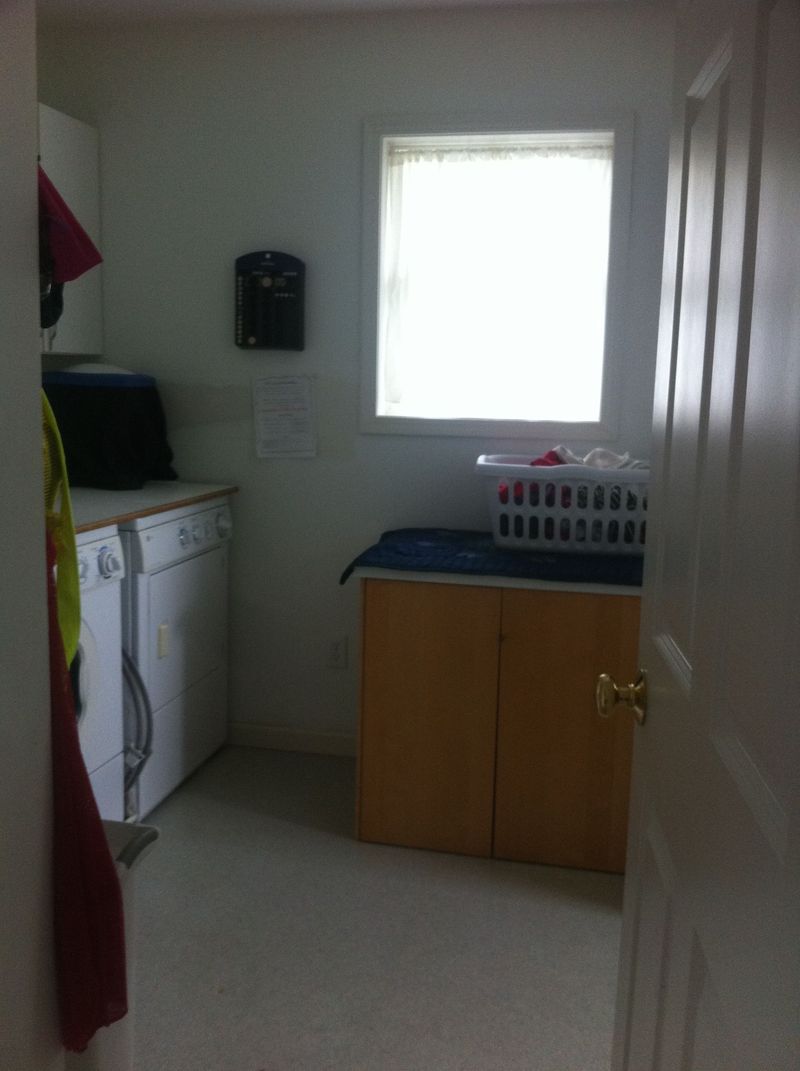
    So I pulled all his clothes off the changing table shelves in the laundry room, carried them downstairs, and hung them in the first-floor closet.  

    IMG_0890

    I asked Mark and my 15-year-old to carry the changing table downstairs to store it in the basement, and when that was done they carried up an old kitchen cabinet and put it in the place of the changing table.  It took some cleaning up and a cloth to hide the wood-glue stains on the laminate, but now it's another clothes-folding surface, and a place to stow the trash receptacle and some baskets for sorting outgrown clothes and lone socks.

    IMG_0893

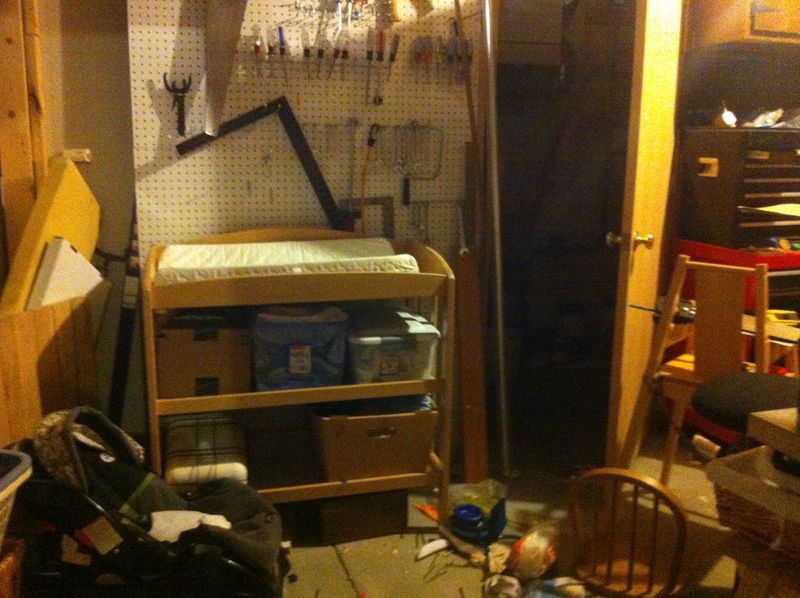
    Today I gathered up all the cloth-diaper covers and put them in a tub and snapped on the lid, and carried it to the basement, where I left it on the changing-table shelf.  In another tub, I packed up all the infant cloth diapers, and in yet another, threw some more baby items (bibs, the bag of jumbled pieces of the manual breastpump, receiving blankets).  Down they went.

     While I was at it, I carried down the infant car seat and stowed it next to the changing table.  Then I boxed up some infant clothes in good condition, clothes that had been lying around waiting for me to do something with them.

    IMG_0894

    I hesitated with the box.  Take it out to the car, to deliver it to charity?  Or set it aside to be stowed in the deep recesses of the attic?

    + + +

    It's a matter of probability, I tell myself, not so much a matter of plans.

    Very soon I will be forty-one years old.  I have three to seven years left, perhaps, in which Mark and I might decide to try for another baby, or in which we might find ourselves surprised by one.   I've not had a surprise yet, not in seventeen years of NFP, so I count that probability low; and I don't expect that we will try for another baby, certainly not the way I expected it when we had one, two, three children.  I didn't exactly expect it when we had four; I hoped, though.  

    I'm not sure if I hope or not now.  Five is lovely, and my most recent pregnancy was hard.  

    And we talk about the future differently these days.  "Three years from now," we say, "four years from now, perhaps we can do such-and such," and we've mostly stopped adding "if we don't have another baby."

    + + +

    "We can get rid of these things," Mark pointed out, "because if it turns out that we need them again, we can afford to buy new ones."

    Yes.  I've already gotten rid of a number of things.  And on the other hand, I saved all the maternity clothes that I really liked, on the grounds that if I needed them again it would be sad not to have the good ones.  Those clothes take up  just a box or two.  And it's really only for a few years.  When I'm forty-eight I will have no reason not to toss the sealed box in the car and tote it down to the crisis pregnancy center or the charity thrift store.  It's not like I risk keeping it around for the next twenty years because I won't know if I need it or not.

    And the same for the changing table, right?  And the diaper covers?  And the last box of baby clothes?  It's just a few more years that they might come in handy.   And then I can get rid of them.

    + + +

     Probability:

    "By age 40, a woman's chance is less than 5% per cycle, so fewer than 5 out of every 100 women are expected to be successful each month. Women do not remain fertile until menopause. The average age for menopause is 51, but most women become unable to have a successful pregnancy sometime in their mid-40s."

    It's nothing you would want to count on if you were intent on avoiding pregnancy for some terribly serious reason.  And I have plenty of friends who had babies in their early-to-mid-forties.  

    Still, I also have plenty who didn't.

    + + +

    Then there's this:  If I lived as long as my own mother lived, I would not see my youngest, now a toddler, finish high school.   If I had another baby, and lived as long as my own mother lived, I wouldn't see that new one start high school.

    I can't help but be troubled by this one.

    + + +

    Packing all the baby stuff up felt awfully final, and not in a good way, even though I'm not actually getting rid of it yet.  Somehow I'm reluctant to say, "Probably we won't have another," even if that is, literally, true.   Which leaves me reluctant to do the things that one does when probably one (two, really) won't have another, like give away the favorite baby clothes and the good maternity jeans.

    I'm not sure whether the reluctance is based on a desire to mother a baby again; or on the very practical consideration that (probably) to do so would never be regretted while to choose not to do so might well be regretted, or being slow to accept this first limitation brought on by age and age alone; or simply the bitterness that always accompanies the closing of a door to the past.

     I remember feeling something like this when I was finishing college, getting ready to move on to new things, and some small part of me wanting to stay, knowing to do so wasn't possible.

    In other words, I don't know what I'm trying to hold onto here.  Is it a gift of life I desire to give?  Or is it clinging to a notion of myself as a life-giver?

    + + +

    It's a frightening freedom we enjoy.  I am healthy, Mark is healthy; we could go for it again, play the fearful and wonderful game.  We are completely aware that we could.  If we were sure we desired it, or sure we were called to it, we could rise to the challenge.

    At the same time, not being called in particular, without a particular desire (only this empty feeling at the boxing up), we are also aware that we can go on as we are, shouldering our bags and hiking off into the sunset with these five.

    Love is not a zero-sum game, but energy can be; and I sense a need to direct greater energy to my older children than I have had since the youngest first fluttered to life.  My last pregnancy was hard:  not dangerous to my life and health, just hard, as pregnancy often is.  Mothering this youngest one from babyhood into toddlerhood was beautiful, and I feel at the top of my powers; but all along I felt a pull towards those older children that went unsatisfied, and heard my voice saying "no" what felt like far too much.  "No, we can't do that because of the baby."  "No, I need you to do this instead because of the baby."

    I had to push them all away, just a bit.  My arms were full, my energy went to produce milk, the hours of the day slipped by.  I'm not saying it was the wrong thing to do; they learned to sweep the floor and cook dinner and clean their rooms, they learned to take the bus.  They learned that I wouldn't always be there for them.  Which is true.  I won't.

    But I'm not saying I liked that part of it.  And looking at my five beautiful children, one of whom I have to look up to now, I wonder if there really is enough of me to go around.   I think there is, barely, now.  But I know what it would take to push that over the edge.  Not that I'd do a bad job.  I would keep it together.  I always do.  

    But I do want my kids to remember a mother who had time for each of them.  And — looking back on the last two years — I have not.

     It was for a good cause.  A great cause!   The youngest will be there for them far longer than I will.   I'm not sorry.  

    But … which to choose in the future?  Let's just say it is not obvious.

    + + +

    "Three years from now," we say.  "Four years from now."  We think of places we'll go, things to show each other, things to experience with the growing children.  We have a vision of a new phase of our lives, the phase with no little children in it, the phase where even our youngest walks on his own two feet.

    None of it is a guarantee.  None of it is ever a guarantee.  

    I've never put the changing table away before.  I guess that is different.  I guess this is the first bifurcation between what might be and what else might be.  It feels important.  

    And at the same time it's just housecleaning.


  • The next step of Kondo… where to start in the “household equipment” category?

    More on Marie Kondo's book can be found here, here, and here.

    + + +

    I'm now partway through decluttering the most baffling meta-category, what Marie Kondo (in her Life-Changng Magic of Tidying Up) calls komono.  I've already done several of the categories within it — the ones that were easiest to select items that belonged within them — and am about to embark on the more difficult ones.

    Many items within the home… are placed, stored, and accumulate "just because," without our giving them much thought.  I call this category komono, a Japanese term that the dictionary defines variously as "small articles; miscellaneous items; accessories; gadget or small tools, parts, or attachments; an insignificant person; small fry."  It's no wonder people don't know what to do with things that fall into such a vague and all-encompassing category.  Still, it's time to bid farewell to this "just because" approach.  These items play an important part in supporting your lifestyle and therefore they, too, deserve to be handled one by one and sorted properly.

    Unlike clothes or books, this category includes a diverse range of items, and the thought of trying to sort and organize them may seem daunting.  If you deal with them in the proper order, however, this task is actually quite simple.  The basic order for sorting komono is as follows:

    1. CDs, DVDs —— Done
    2. Skin care products –———– Done
    3. Makeup ————– Done
    4. Accessories ————– Done
    5. Valuables (passports, credit cards, etc.) ——– Skipped; already well organized
    6. Electrical equipment and appliances (digital cameras, electric cords, anything that seems vaguely "electric") ————- Done
    7. Household equipment (stationery and writing materials, sewing kits, etc.)
    8. Household supplies (expendables like medicine, detergents, tissues, etc.)
    9. Kitchen goods/food supplies (spatulas, pots, blenders, etc.)
    10. Other (spare change, figurines, etc.)

    If you have many items related to a particular interest or hobby, such as ski equipment or tea ceremony articles, treat these as a single subcategory.)   —— I just did one of these, because I decluttered all the school supplies.

    00So, I'm up to #7, "Household equipment."

    I had to stop for a while and think:  What exactly does this encompass?  When I have collected all my "household equipment" together, what items will be in the pile?  In what way should they be similar to stationery and sewing kits, but not to medicine, spatulas, or figurines?

    By looking at the rest of the list, I could deduce a few things.

    o   "Household equipment" doesn't include JUNK.  ("These items play an important role in supporting your lifestyle.")  Or at least, it's time to get rid of the junk that may be hiding among the equipment.

    o  "Household equipment" includes some kinds of tools, but not ALL tools.  The sewing kit is given as an example — and a sewing kit includes scissors, seam rippers, needles.  Writing supplies are an example — and that means things like pens.  But kitchen tools are excluded, as well as anything that's part of a large hobby-related collection.  (Presumably if your hobby is sewing, most sewing items  go outside "household equipment" and in with the hobby items — I think she's thinking of a small mending kit that's employed as needed for maintenance tasks, like replacing buttons, repairing seams, and adjusting hems.)

    o   "Household equipment" excludes most consumable items, but not all.  Food, detergent, medicine, tissues — all things that get "used up" — belong to other subcategories.   But "stationery" is also something that's used up, and it is included, along with the thread that is presumably part of a sewing kit.

    o    "Household equipment" excludes items already sorted:  the other types of komono as well as clothes, books, and papers.  It also excludes sentimental items.

    What I'm seeing so far is that "household equipment" means durable tools, kits, and other things that are useful.  Consumable goods are part of this only insofar as they are part of a kit or set, like the  thread in the sewing kit.   Kitchen items are not included, I presume because kitchen items are a big enough category on their own in any household; whereas in smaller households, "household equipment" might be a small enough category the deal with all at once.

    So:  useful items for household tasks, but not kitchen items, not sentimental items, not related to a specific hobby, and generally not consumables.   I went through my house with a clipboard and pen and wrote down the kinds of items that I thought fell into this category, to see if I should do it all at once or if there are some subcategories to break it into.  Here's what I came up with:

        Baby care items.  Cloth diapering paraphernalia, child carriers, portable changing pads.

        Clothing care.  Laundry baskets, hangers, lingerie bags, eyeglass and jewelry repair kits, mending kit. 

        Cleaning tools.  Brooms, mops, totes, scrub brushes, rags, dishpans.

        Linens.  Bedding, towels, napkins, tablecloths.

        Quasi-furniture.  Folding chairs, stepstools, little-kid workbenches, rolling carts.

        Travel items.  Suitcases, backpacks, toiletry kits, picnic coolers.

        Board games and other gaming paraphernalia.  Cards, chess timers, extra dice.

         "Tool" tools.   Hammers, pliers, screwdrivers, twine, etc.

        Containers and organizers.  Boxes, bins, racks, bookends, baskets.    


    Excluded from all that:  homeschooling paraphernalia, camping gear, athletic gear, fishing gear.  

    In our household, most of the "tool" tools are also excluded from my responsibility, as they're stored out of sight in Mark's shop and he knows better than I do what is extraneous and what is necessary.  I can find most anything I need in there, if I look long enough.  But you will find others here and there throughout the house — needle-nose pliers in a kitchen drawer, wire cutters in my guitar case and in the school science box, a small screwdriver that lives on my dresser, a couple of pocketknives and a set of Allen wrenches — things I've squirreled away so that I won't have to hunt for them in Mark's shop should I need them.

    What order should they be attacked in?  Marie Kondo:

    [I]t is easier if you start with more personal items and clearly defined content first.

    The "personal items" won't help me organize them since by now we've gotten to things that belong to "the household" rather than to any one person, although in my role as homemaker some of them (clothing care items) fall more under my domain than others (board game paraphernalia).

     So (prior to publishing the post here) I roughly sorted them from "mostly my domain" to "mostly someone else's domain."  And then I stuck "containers and organizers" at the end, because it strikes me as ridiculous to get rid of any of those until you've finished organizing everything.  I think those come right before sentimental items.

    So… I guess that's what I attack next.  Baby care items.  It's about time to get rid of some of those anyway, I think.


  • Meditation on French saints. A few passages from d’Elbée.

    A week or two ago I posted briefly about I Believe in Love, originally published in 1969 as Croire à l’Amour (that is, To believe in love). It was gifted to me in a spiritual direction session that I’d sought out for some very specific advice, and the priest handed it to me almost apologetically explaining for the cover design, with its prominent headshot of St. Thérèse of Lisieux in her habit. “This isn’t one of those sentimental books about St. Thérèse,” he said, and I had to give him points for having pegged me pretty well.

    (I can appreciate kitsch as well as the next person, but the porcelain-and-roses holy-card drawings of Thérèse, um, actually offend me. The embalmer has done his work so thoroughly that the beloved is not visible.)

    + + +

    Anyway, d’Elbée turned not to be writing about St. Thérèse very much at all. The book is subtitled (in the English editions at least) A personal retreat based on the teaching of St. Thérèse of Lisieux, and indeed, in the first “conference” (as the chapters are called), d’Elbée announces, “During this retreat I intend to talk to you about confident love, following the teaching of St. Thérèse of Lisieux, of whom Pope Pius XII said, ‘she rediscovered the Gospel itself, the very heart of the Gospel.’”

    But the various quotes and examples from the life of that saint are pulled out more as crumbs of inspiration that support the various themes that d’Elbée is writing about. There are many quotes from Scripture — many more than there are quotes from Thérèse — and also quotes and anecdotes from many others. St. John Vianney, St. John of the Cross, St, Teresa of Avila, St. Augustine, St. Francis de Sales, but also lesser-known figures, principally French ones: St. Claude de la Colombière, ordinary journalists and authors. I get the impression that d’Elbée assumes his reader, his retreatant, already knows St. Thérèse very well — the unsentimental, audacious, mischievous, wildly courageous St. Thérèse — and points out her features to one who already recognizes them in context.

    + + +

    I don’t know why the good theological books that have crossed my path in the last several years have so often been the work of French thinkers and saints, or occasionally of others who were heavily influenced by them. It’s a happy coincidence, because that’s the one modern language (besides English) that I read really well, and so I have the opportunity of consulting the untranslated originals from time to time. But it’s also interesting to me — why do I so often find that the French-speaking writers (Francis de Sales, Jeanne de Chantal, Thérèse, Elisabeth Leseur, and now d’Elbée have good and sensible answers to my particular problems?

    Sometimes I think that particular features of the history of the French-speaking Church must have generated a sort of Christian response that happens to be just the sort to respond to particular features of the history of me. Cathars and Calvinists, Jansenists and Jacobins, [Third-]Republicans…. all a slow forging of a particular kind of blade, one that feels at home in my hand.

    But the blade metaphor doesn’t really work for me, as nicely as it seems to work in a blog post; the effect of these French saints on me is demulcent, a healing balm, or a cool slaking fountain. The challenges both inside and outside the French Church have been harsh and punishing and unforgiving and frightening ones. The response from the French saints is a response of confidence, good humor, and serenity. “Blessed are the meek” in French comes out as “Heureux les débonnaires,” often footnoted “litt., ‘ceux qui sont doux’” — “mild” with all its connotations of calm weather, “good-humored” with all its connotations of an unruffled, un-ruffle-able disposition. It makes me think of the disciples waking Jesus in alarm, only to see him calm the waves with a word.

    I am convinced that the French connotation is the correct one, and I believe that the term “meek” has damaged English-speaking Christianity in a way that’s going to be difficult to recover from.

    Something in my nature — it precedes my conversion and reaches far back into childhood — looks critically upon the self and despairs. I am forever working in vain to silence, or at least drown out, an unrelenting, unforgiving, driving, punishing inner voice. The French saints, I think, had to deal with (and continue to deal with) a shape-shifting and ever-constant specter, of which the extant anticlericalism is only the latest outer appearance: the depressing philosophy of total, unredeemable human depravity. The message of confident love, the belief that Jesus’ goodness >> any individual’s weakness, is the corrective to both. This is what I find in the French saints.

    + + +

    The whole book is good, but judging by the frequency of my pencil scratches on the pages, the earlier chapters are the ones that I most needed to read at this time. Here is a selection of my marked passages.

    + + +

    Prior dilexit nos: God loved us first that we might love him. That is the explanation of it all: of the Creation, the Incarnation, Calvary, the Resurrection, the Eucharist.

    Corrective: The love we have is evidence that God loves us; but we don’t have to love him in order for him to love us. We are loved without any effort on our own and do not have to earn that love before we can access it.

    + + +

    We do not read the Gospel enough in the light of the love of Christ. Thus, sixteen centuries after the Last Supper and Calvary, the most satanic of all heresies, Jansenism, was able to appear and spread: a heresy which turned a God of love, saying “Come to me, all of you, come because you are unworthy, come because you are sinful, come because you need to be saved,” into a God whose arms are raised to strike, a demanding God, a vengeful God. Under the pretext of recognizing our unworthiness, Jansenism diabolically led souls away from Jesus.

    Thus, no longer willing to endure this heresy, Jesus appeared to St. Margaret Mary [Alacoque] at Paray-le-Monial and through her gave His Heart to the world.

    + + +

    When someone asked little Thérèse to summarize her little childlike way, she answered, “It is to be disturbed by nothing.” … Naturally this means not to be voluntarily disturbed, not consciously or deliberately disturbed, because nature always worries…. The main thing is not to consent consciously to anxiety or a troubled mind.

    The moment you realize you are worrying, make very quickly an act of confidence: “No, Jesus, You are there…” Perhaps He is sleeping in the boat, but He is there…. It is really an offense against Him when we worry voluntarily about anything….

    I emphasize this concept of “worrying with the full consent of the will,” for it is very important in the spiritual life to make a distinction between our nature and our will, united to the love of Jesus. “Homo duplex:” my nature says “No”; my will says “Yes.” …My nature is troubled and afraid; my heart recalls the divine testament: “Peace I leave with you”… My nature revolts; I force myself to say, “All is well, Jesus; do not change anything.” It is a fight which we must take up again and again without ceasing, for our fallen nature always rears up its head. St. Francis de Sales says it dies a quarter of an hour after we do! This is the drama of our life. But the beautiful thing is that Jesus sees our will united to his by a fundamental choice — the profound, habitual disposition of having only on
    e will with Him. All those movements of our nature, if we do not consent to them, do not exist for Him. There is no sin without consent.


    This is precisely the passage I needed to see most right now. A handful of events in my life recently have shown me the degree to which I was reared to confuse nature and will, not to believe in the fundamental inner freedom of voluntary choice. I come from the land of “this is the way that you are and always will be: accept it.” This is the way it has to be, because the alternative is to live in a land of understanding right and wrong, of calling good good and evil evil, and that is uncomfortable.

    But not to see the distinction between nature and will is to sink into one of three terrible errors about the totality of being human, because our nature is truly a mess.

    — Some, falling into the error of total human depravity, preach hopelessness: the best we can do is pretend to be among the elect, only to find out at the very end whether we really are.

    — Or, rejecting that (because who wants to stay totally depraved?) some of us *cough* strive endlessly to redeem our own nature by the powers of that nature, in endless programs of self-improvement and collective social reform. (A little progress appears to be made, as we harvest a little waste heat and turn it into power for good, but it’s nothing more than a slight improvement in efficiency; there is a theoretical limit that is inherent to the material system. Thank you, Jules Carnot, for yet another French contribution to my philosophy.)

    — Or, rejecting that too, recognizing correctly that there is something good in all of us, concluding that human nature is usually not depraved at all, is fundamentally good, at least in a wide variety of its forms, and must be affirmed and celebrated everywhere — except where they infringe upon the inclinations of other natures.

    + + +

    The saints learned to rejoice in humility and humiliations… I speak here, obviously, of a love that is pure will, for our fallen nature does not seek humiliations or love them.

    I wrote in the margins, “We forget again the distinction between nature & will & we often ascribe to the saints a holy Nature instead of a holy will, & then we see our own nature & despair.”

    + + +

    Frequently make what I call the examination of the prayer “O Jesus, I thank you for everything.” It should be the fruit of your disposition of will, of heart, and of soul to bless Jesus for everything that He wills or permits for you, for everything that happens to you… In this short and simple prayer there is at the same time humility, an immense confidence in merciful love, abandonment, and thanksgiving.

    + + +

    There is a repeated theme that Jesus rejoices with us in our wretchedness because it enables him to act in his role as Savior. That we should be thankful even for our misery because it leads us to seek mercy, and that the act of seeking mercy is itself a joy. And to be completely confident in that mercy.

    The Curé of Ars: “Our sins, grains of sand beside the great mountain of the mercies of God.” St. Thérèse..: “All possible crimes, a drop of water thrown into a blazing furnace.”

    One reproach sometimes made to this spirituality of confident love is that it would entail the danger of presumption and of letting ourselves go. You shall see… how abandonment and obedience do away with this danger. I think, on the contrary, that there is a double danger in the method which diminishes the role of confidence and stresses the role of personal effort, subjected to numerous self-examinations. If we are successful, there is the danger of pride, of attributing to ourselves what is in reality the work of grace; on the other hand, if we see no signs of progress, nine times out of ten we fall into wretched, sterile discouragement…. But in order to live this sound doctrine to the fullest, we must be very convinced…

    [E]ven the most beautiful souls… do not want to believe that confidence is the key which will open the door for him, becau this door is a wound made by love. They look for other ways, as if this way were too beautiful to be reliable.

    …So what then? He calls me just as I am? I can go to him with all my miseries, all my weaknesses? He will repair what I have done badly? He will supply for all my indigence?

    Yes, provided that you go to Him, that you count on Him, that you expect everything of Him…

    + + +

    [W]e must live a presently existing love…What would a husband think who, when asking his wife, “Do you love me?” received the response “I have a great desire to love you; I shall work toward it; I hope one day to achieve it by dint of my efforts and generosity and sacrifice.” You are right to smile. But is this not the spiritual disposition many excellent souls adopt toward Jesus?

    Make rather the admirable response of St. Peter: “Lord, You know all things; You know that I love you.”

    That gave me a rueful little laugh of recognitin, because that’s how I often phrase it when I greet my spouse. Not the first way, but the second. “You know I love you,” I will say. There is something a little desperate in that phrasing, I think, because always — always — I am tempted to think I do not love enough. I want, I think, to be reassured that, at least, I love enough for it to be known.

    One of the great fruits of a good marriage has been the realization, no less astonishing to me for the frequency with which I realize it, of being beloved. I know and see my own faults constantly. And yet, someone (a pretty great person, if I may inject my opinion) loves me, really and for real. I wake up to it every morning and marvel, because it is marvelous, but at the same time I don’t doubt it even for a minute. And I try with all my will to apply the same marvel as well as the same confidence to divine love and mercy, unfathomably vaster and more constant.

    I have found d’Elbée’s meditations to give me a helpful little nudge toward that confidence.


  • More on adapting Latin curriculum for middle-and-elementary kids.

    I started this post yesterday, here.

    At the same time that I was starting to approach Latina Christiana I for the second time, with my second group of elementary school kids, I was just getting deep into First Form Latin with the older set.  Having a couple of kids beginning to start a study of Latin grammar that was more rigorous, and finally being able to see the road ahead, helped me work out exactly what fundamentals I wanted to work on in the earlier years.

    Namely, I wanted them to be able to recite all the declensions and conjugations by the time they got to them.

    I wound up designing a "Latin workbook" of my own for the younger kids, one that contained space to write out the declensions and vocabulary groups in whole. 

    Photo 2 (1)

    The writing is from my daughter when she was age seven, I think.

    Photo 1 (1)

    Eventually I dropped the workbook entirely.  I used the flash cards, and I just trucked on through, reciting mensa, mensae, mensae… and amabam, amabas, amabat…  and eventually res, rei, rei … and audiebam, audiebas, audiebat…

    I did very little writing with them because of the range of writing abilities.  We tended to work orally from a dry-erase board.  I played a lot of Carnifex, eventually getting up to [S-DO-V] sentences that contained adjectives and adverbs (Aquila alta ursam parvam non videbat.)  

    This coming year, everyone is finally able to work in a workbook, so I'm putting all four of the middle-size kids — fourth, fifth, sixth, and seventh-graders — through FFL.  (The youngest two are on the precocious side and have always been quick to translate orally; if they can't write fast enough to keep up with the writing, they can finish the work orally.  I am confident they'll be able to keep up inside their heads.)  But we only meet twice a week, so we'll be going reeeeeeeallly slowly — a bit less than half time.  

    I plan to augment FFL this year with readings about ancient Rome.  This past year the first of my students sat for the National Latin Exam (and did very well!  I feel validated), which was the first time that I got a good idea of what is expected of high school Latin students. I hadn't been teaching much of the "social studies" content.  I think I'm going to try to start bringing that material in earlier:

    • History of the Roman empire
    • Roman myths (well, we're going to do that with D'Aulaire's Greek Myths and memorize everybody's Roman names, mostly)
    • Names of items in a Roman domus
    • Maps and the Latin names of significant geographical and political features
    • Architecture
    • Daily life in Rome and in the outlying provinces

    Once you've learned this they aren't likely to forget.

    The other thing I'm going to do is continue reciting all the declensions and conjugations that they've already learned, so that they are still there when they finally arrive at them in the junior high and high school years.


  • Latin for middle- and elementary-age kids. How I rocked the cymbam.

    I recently got a request to blog about teaching Latin to elementary school students.

    First, I went through old blog posts to dig up what I can on the subject of Latin:

    I also embarked on a project to use what we've learned in Latin to experiment with teaching a sort of accelerated, but reading-and-writing focused, Spanish:

    A side note:  Since I tried that, by the way, I've come to believe that it's simply NOT true that the only valid way to teach a living language is with the goal of fluent conversational speech.  I can think of lots of reasons why it's worthwhile to teach a foreign living language with a text, translation, and grammar focus.

    (1) There's plenty opportunity to practice what you've learned even if there are not many native speakers or you don't travel, because there is plenty of text-based interaction out there:  literature, news articles, and Internet fora

    (2) Some kids enjoy translation and grammar; it's a myth that only being able to speak motivates kids.

    (3) It's less important to work directly with a native or fluent speaker, and can thereby be self-taught.

    (4) It teaches the standard syntax of the language.

    (5) It can lay the groundwork for a conversational course later on.

    (6) It's better than not learning at all because you're afraid to try to learn the language on your own.

    + + +

    But this is a post about teaching elementary- and middle-school-aged kids Latin…

    When I was teaching a single, reading child at home, we started with Prima Latina from Memoria Press.  I have relied on Memoria Press from the beginning because they publish materials that are laid out for the teacher who is not herself an expert in Latin.  The teacher can easily learn along with the student, which is exactly what I needed for the first several years that I was facilitating children.

    I followed Prima exactly as it was presented in the curriculum.  But then, when we moved on to Latina Christiana and I picked up some other students, I began to run into problems.  

    The organization of Latina Christiana I is… kind of spiral? The grammar marches along in a reasonable succession; but the vocabulary is added erratically.  Ten or twelve new words are learned in each lesson along with a new grammar concept.  But the new words are often a mix of parts of speech:  you might learn six nouns, three verbs, and a preposition.  

    I think there are probably kids who could handle this with no problem, but it proved to be very difficult for the learners I was working with.  I wound up adapting the program.   As soon as we'd get to the first lesson on, for example, second-declension nouns:

    1. I would halt the new grammar lessons — we'd stop right there at the first lesson on second-declension  nouns.
    2. I would go through the rest of the workbook and flashcard pack to find all the second-declension nouns that they would encounter in the rest of the course.
    3. I would teach the second-declension vocabulary words all at once.  
    4. We would practice — flash cards, reciting the cases, copywork, games like charades and "carnifex" (hangman), etc. — until I had maybe 70–75% mastery of the vocabulary.
    5. We would go on with the grammar lessons.

    I had a hunch that it would be easier to remember which declension a noun belonged to, or which conjugation a verb belonged to, if they were always introduced in like groups.  This turned out to be correct, at least for my particular group of kids.  The method lent itself well to flashcards and games, besides.  Frankly, I liked learning the words this way too.

    Later I began to stretch the LCI curriculum even more.  Near the end, LC1 introduces a spate of third-declension nouns – without teaching the declension or specifying the gender of any of the nouns.  I halted the grammar lesson; then, I looked them all up myself and taught them in three groups, one for masculine, one for feminine, and one for neuter.  I also taught how to decline them.   It took a really, really long time.

    (It turned out that I had missed some of the subtleties of the differences between "i-stem" and "non-i-stem" nouns, and a couple of years later I had to un-teach some of my mistakes.  The kids eventually figured it out and it turned out okay anyway.)

    Meanwhile, they were all getting dissatisfied with the slow progress of the grammar.  Everything in LC1 is in the nominative case, but they enjoyed making sentences and they wanted direct objects!  So I taught myself how to construct [Subj]-[DO]-[Verb] sentences, and then started making my own translation worksheets.  The queen loves the girl.  The slave carries the table.  The waves frighten the sailors.   

    Before long I had almost entirely abandoned the LC1 workbook, at least in the order that the lessons were presented.  I started doing them out of order, in a way that made sense to me.

    More later…