bearing blog


bear – ing n 1  the manner in which one comports oneself;  2  the act, power, or time of bringing forth offspring or fruit; 3 a machine part in which another part turns [a journal ~];  pl comprehension of one’s position, environment, or situation;   5  the act of moving while supporting the weight of something [the ~ of the cross].


  • Death on a Sunday afternoon.

    You remember how Laura got in trouble for blurting out “I hate Sundays!” right? If I remember right, that was the time that Pa whipped her for it. Or maybe I am thinking of the time she slapped Mary?


    Anyway, I sometimes think about that Little House episode, because every time Sunday afternoon rolls around, I want to blurt out “I hate Sundays!” too.


    I have trouble articulating the reason; it is more like a jumble of associations. Some of it is undoubtedly that feeling of the weekend being almost over, and wanting to push it back just a little bit farther. Why can’t it be a three-day weekend? It is not that I don’t want to work on Monday, but that I don’t want to return while it is still Sunday to the getting-ready-for-tomorrow part. I wish I could just rest all afternoon, go to bed on Sunday night, and begin the work in the morning, when I am fresh.


    I think it’s hard for me to be part of a family on Sundays. I don’t get my way. I am not supposed to get up and be productive; nobody is; so the house gets messier and messier all day long, the dishes pile up in the sink, and at the end of the day after dinner (when we have decreed the restful part of Sunday is over) there is so much that we can’t clean it up before bed. I can’t lounge around and relax in the presence of such chaos. I get tense and irritable. I want to clean everything up and then relax in a clean house. I imagine myself sitting peacefully on the couch with a book, the living room uncluttered and serene, like a magazine spread. My imagination even helpfully inserts a verdant houseplant in the foreground, tastefully blurred. I don’t have any houseplants.


    (After I finished cleaning and making the lovely space in which to relax, I wouldn’t, because I would just keep cleaning, and then I would do school planning because how can I relax knowing that the work still remains to be done?)


    If I had my way I wouldn’t be like we are, wouldn’t sleep in on Sunday and go to the eleven o’clock Mass. I would get up at six or seven and go to an eight or nine o’clock Mass, and then have so much more day stretched out before me, and some morning left before lunch. It’s all these non-morning people I live with, my husband who gets up and goes to work early five days a week, takes a child to the ten a.m. swim lesson on Saturdays, and then, inexplicably, wants to sleep as long as possible on Sunday mornings. Not only that but he actually does it! Stays asleep! The sun comes in and he rolls over and continues, undisturbed. How does that work, I murmur to myself as I clomp down the stairs in my shoes, fully dressed, to make my own coffee (my OWN coffee!) which he makes for me six days out of seven? How can he stay blissfully snoozing? Why can I only do that when I have the flu?


    Practically speaking, I flee from Sunday afternoons. Everything around me on the first floor is nothing but a box to check on a to-do list that never ends. The kitchen’s dishes piling high as people don’t clean but mysteriously continue to eat. The living room floor becoming more and more obscured by toys and snow boots. The computer, accusing me from the corner, concealing fossilized patterns of tiny electric charges that I was supposed to reply to yesterday. The schoolroom.


    I go upstairs and burrow under the blankets and try to nap. I can’t see it from my bedroom. That works pretty well if I have a white-noise app, or else I give up on sleep and maybe I can read a good book.


    Today the ennui got to me after a while and I pulled on my boots, threw the iPad into my bag, and announced that I was leaving the house. Nobody seemed to want me for anything: the kids are playing Minecraft and climbing on the wall in the basement; the baby is napping; it is Phase II. Dinner was still a couple of hours away. I jammed a hat on my head and walked out into an impossibly gray and dreary afternoon, half a mile to a cheerful neighborhood coffee shop.


    Here I sit. I have bought a four-ounce cup of premium ice cream but it turned out I only wanted half of it, so it is melting at my elbow. The coffee is good (maybe a bit too high-acid) but I had better not drink any more lest I be kept up tonight.


    The act of walking in the cold, slightly underdressed for it, helped a little bit. I should have gone for a run, maybe. Maybe I am just seeking stimulation. Well, I have a stimulant, anyway.


    I am a terror, I think, forever insisting that the people around me help me fix my environment so that my nerves stop jangling. Stop making that noise before I lose my mind. Clean up the living room so I don’t trip on this stuff. Clear your desk top so I don’t have to look at a pile of books and papers. Handwash the dishes so there’s no pile in the sink.


    If I allowed the kids to get away with it, let the dishes sit where I can see, let them chew gum where I could hear it, even only some of the time, I would die a thousand deaths, a thousand tiny, imperceptible deaths, every day.


    Sunday is the day when I don’t get my way, because my way is not to take a day of rest, nor to let anybody else have one either.


    + + +


    I have heard people say that every Friday is a little Lent and every Sunday a little Easter. Or to turn it around, while Easter is all Sunday feasting, Lent is all Friday, all sorrowful mysteries, every day a penance.


    As for me, backward anti-social Christian that I am, I think that a real penance for me would be a Lent full of Sundays, surveying the feasts and the revelry and the easygoing laughter and thinking This is all very well while it lasts, but when it’s over somebody is going to have to clean this mess up.


    + + +


    I don’t have any profound ending for the post here. I need to close it and put on my coat and go home, because it is getting dark and my family will want to eat dinner, and after dinner we will all stop resting and get to work, getting ready for tomorrow and tomorrow and tomorrow. That’s when the kids will grumble but I will cheer up, because for some reason I like the doing of things. I like when there is nothing to do, too; the hard part for me is when there is something to do but it isn’t time yet.


    This year I must learn to suffer this a little more than I do, instead of laying the burden of my constantly-jangled nerves on the people around me. I am not sure what kind of Lent that could mean, but letting Sunday be Sunday, and finding times of rest and retreat (when I want to attack) the rest of the week, might be part of it for me this year.


  • How I teach my kids to read, an empirical approach: VII. Script for two more early lessons, including the game of Honk.

    Seventh post in a series.  See here for:   

    • Materials:
      •  Part II.  "Sandpaper phonemes," a basic set of flashcards
      • Part III. Lists, slates, and readers
      • Part IV.  Advanced set of flashcards.
    • Method:
      • Part V.  Beginning with a one-to-one code.
      • Part VI.  Script for the first two lessons (including the Word Building exercise).

    + + +

    In Part VI, I gave a script for the first two lessons using the "sandpaper phonemes."   

    • Lesson 1:  /m/ spelled m, /a/ spelled a; introduction to sandpaper letters
    • Lesson 2:  /s/ spelled s, /o/ spelled o; word building exercise

    The first lesson functions as an introduction to the whole concept of the sandpaper letters.  

    The second one includes the first of several types of exercise I use to review, the "word building" exercise.  The Word Building exercise has several steps:

    • Lay out  several of the sandpaper phonemes where they are all visible, in random order
    • Announce that we are going to use those cards to spell a word
    • Speak the word and listen for the sounds in the word
    • "What is the first sound?…. Find the spelling that spells that sound."
    • Place the correct letter card
    • "What is the sound that comes after? … Find the spelling." 
    • Place the next card
    • And so on until the word is built
    • Read the word.

    If you want to see how I used the Word Building exercise, go back to the last post and check out Lesson 2.

    In this part, I'll give you a script for Lessons 3 and 4.  Each one begins with a review of some kind, then goes on to add something new.  In lesson 3, the review is very simple, just going over the previously learned sounds.  In Lesson 4, a flashcard game called "Honk" is introduced.  If the student is older, plain old flashcard-type practice may be preferable.

    (I did not come up with "Honk" myself.  It is adapted from one that appears in Phonics Pathways: Clear Steps to Easy Reading and Perfect Spelling, by D. G. Hiskes.  The latest edition is the 10th, and was published in 2011.)

    ——

    LESSON 3

    review of /s/ s, /a/ a, /m/ m, /o/ o

    /k/ spelled c  as in  cat

    /t/ spelled as in cat

    ——

    "You have already learned four sounds."

    • Show the textured letter a.

    "Read this card.  What sound does this shape spell?"

    • Show the textured letter m.

    "Read this card.  What sound does this shape spell?"

    • Repeat with textured letters  s, o.
    • Spread all four textured letters on the table.

    "Show me /mmmm/."

    • Allow the child time to choose the letter m.

    "Trace the spelling of /mmmm/ with your writing finger."

    • Help the child to trace the letter with the index finger of his writing hand.  Encourage the child to say "/mmmm/" while tracing.
    • Repeat with the other cards.


    "Now you're going to learn two new sounds and the shapes that spell them."

    "The first sound is this:  /k/.  Say /k/."

    "Are my lips closed or open when I say /k/?"

    "/k/ is a very short sound.  When I say /s/ I can make it last as long as I want:  /sssss/."  But when I say /k/ I am done with it very fast."

    • Show the textured letter c.

    "Sometimes we spell the sound /k/ with this shape."

    "Practice tracing the letter that spells /k/ with your finger."

    • Help the child trace the letter with the index finger of his writing hand.  Encourage the child to say /k/ while tracing the letter correctly three or four times.

    "Now we will learn another sound.  The sound is /t/.  Say /t/."

    "Are my lips open or closed when I say /t/?"

    "Can you feel where you put your tongue to say /t/?"

    "How long can you make /t/ last? As long as you want, or is it over quickly?"

    • Show the textured letter t.

    "We spell the sound /t/ with this shape."

    "Practice tracing the letter that spells /t/ with your finger."

    • Help the child trace the letter t with the index finger of his writing hand.  Encourage the child to say /t/ while tracing the letter correctly three or four times.
    • Help the child complete a worksheet with the letters t and c to trace.


    ——

    LESSON 4

    the game of Honk (or plain flashcard practice) with a  c  m  o  s  t

     reading mat and sac

    ——

    Preparation for the game of Honk:  

    Get a stack of 21-25 index cards (or half-cards) and on the blank side of each, in pencil, print one letter.  Draw a line underneath each letter to indicate orientation.  There should be three cards each of a, c, m, o, s, t.  On each of the remaining cards, draw a silly face or animal.  These cards are "Honks." 

    Mix the cards, but ensure that the top two cards are letters and the third one is a Honk.

    Worksheet preparation:

    Prepare a worksheet with the word mac printed at the top and a place to trace it at the bottom.  Prepare another sheet with the word sac.  Or prepare a dry erase board, a magnet-sketch tablet, or a tablet of lined paper.


    "You have learned six sounds.  Let's practice them once."

    • Help the child complete a worksheet with one each of letters a c m o s t, or have the child trace each of the textured letters a c m o s t with the index finger of his writing hand.  Encourage the child to say the sound while writing or tracing each letter.

    "Today we're going to play a game."

    • Show the prepared stack of cards.

    "I'm going to turn over one of these cards.  Then we're going to say the sound that the card spells, as fast as we can.  Like this:"

    • Turn over the card to show a letter.  If it is, for example, an m:

    "/mmmmmm/!"

    "I'm going to do it again.  Ready?"

    • Turn over the next card to show a letter.  If it is, for example, an a:

    "/aaaaaaa/!"

    "Just to make the game more fun, though, some of the cards are different."

    • Turn over the third card to show a Honk.

    "This is not something that spells a sound.  But when we see it we will make a sound:  HONK!"

    "We will start slow and then we will go faster."

    • Shuffle the cards and begin, dealing them one at a time.  Try to turn them so the cards are right-side-up for the child.  If one lands upside down, turn it immediately into the correct orientation.  Wait to deal the next card until both of you have made the correct sound.
    • After all of the cards have been dealt, play again, faster.
    • Variations:  Child deals the cards; parent lets child try to make the sound first; both play to try to make the sound first.  For older children: beat the clock.
    • Go through the deck three or four times.


    "You are going to read two words today."

    "Here is the first word.  It has three sounds in it, and you know all of the sounds."

    • Show the mat worksheet; or print the word mat on the tablet or lined paper.

    "Read the sounds from left to right."

    • Indicate the direction on the paper or tablet.
    • Help the child to say "/m/, /a/, /t/" in order as separate sounds.  Point to each letter as the sound is said.

    "You just read all the sounds in order."

    "When we slide the sounds all together, we'll be reading the whole word."

    "I will slide the first two sounds together."

    • Point to each letter as you say the sound, saying slowly:  "/mmmmmmaaaaaaaaa/" without stopping between /m/ and /a/.

    "Now I will slide all three sounds together."

    • Point to each letter as you say the sound, saying slowly:  "/mmmmmmaaaaaaaaat/." The /t/ cannot be drawn out, but it should be well enunciated.

    "Now you say the word."

    • Encourage the child to say "mat."  Point to each letter as its sound is made as you tell him:

    "The word is 'mat.'"

    • Have the child complete the worksheet, tracing or writing the word mat once; or have the child copy the word on a tablet or paper.
    • Repeat with the word sac.


    + + +

    It's possible that this first foray into blending — converting discrete sounds into smoothly pronounced words — will not go very smoothly.  After some experience working with five- and six-year-olds, I actually suspect that the ability to hear how the separate sounds blend together to form a word is something that has a developmental component.  It's the kind of thing that they might not "get" for a while until it clicks.

     I will add some notes on "blending" in a future post.


  • Cabbage with onions and potatoes, Greek-ish style.

    This is one of those posts where I blog a recipe just so I won't forget it exists.  My 15yo son loved this side dish that I threw together out of leftover vegetables, and I want to remember to make it again.

    I was making what I call "skillet gyros" last night, because it was the day before grocery shopping and I'd found some ground beef and a package of pita bread in the freezer.  "Skillet gyros" means that I brown the ground beef with nothing but salt and oregano, and I serve it with a sauce I make by stirring together yogurt, garlic, dill, and chopped cucumbers.   

    Trust me, it works.

    Anyway, I also had three-quarters of a green cabbage and some leftover roasted new potatoes, so I googled "Greek cabbage potatoes" to see what turned up.  I wound up with this composite recipe:

    Greek-style cabbage and potatoes (empty fridge edition)

    • Half to one green cabbage, chopped
    • 1 yellow onion, chopped
    • 5-6 cooked red potatoes, diced
    • Oregano and salt to taste
    • 1 six-ounce can tomato paste
    • Olive oil

    Preheat oven to 375 degrees.  Sauté onion in olive oil until soft in a medium oven-safe skillet with a lid.  Add cabbage and toss to wilt; cover the pan and let steam for a few minutes.  Stir occasionally to avoid sticking and burning, and continue cooking until cabbage begins to soften.  

    Add potatoes, tomato paste, oregano, and salt, and stir to combine.  Cover and transfer to oven and bake about 30 minutes.

    If you have less time, sauté a little longer and bake it less (or you can even do the whole thing on the stove top).   If you have more time, let it bake longer.

    Works great. 

    There was one recipe I found that made me wish I had had bell peppers too.  It was here (although the slightly passive-aggressive language about the blogger's parents turned me off some).   Next time!


  • How I teach my kids to read, an empirical approach: VI. Script for two lessons.

    Fifth post in a series.  See here for:   

    • Materials:
      •  Part II.  "Sandpaper phonemes," a basic set of flashcards
      • Part III. Lists, slates, and readers
      • Part IV.  Advanced set of flashcards.
    • Method:
      • Part V.  Beginning with a one-to-one code.

    + + +

    In the first lesson with the child, we sit down with the two sandpaper phonemes "m" and "a."  Here's the script I wrote for myself to use seven or eight years ago, and have used three times since.   

    In the second lesson, we start with a word made from those two sounds, and then we go on to learn two new sounds.

    A note on notation:  Recall that I enclose sounds in slashes, like this: /m/

    ——

    LESSON 1

    /m/ spelled m  as in  mouse

    /a/ spelled  as in hat

    ——

    "You're going to learn two sounds and the shapes that we use to spell them."

    "The first sound is this:  /mmmmm/.  Say /mmmmm/."

    "Are my lips closed or open when I say /mmmm/?"

    "We use our voice to say /mmm/.  Put your hand on your throat and you can feel your throat vibrating."

    • Have the child say /mmmm/ while feeling his throat vibrate.  Make sure he notices it before continuing.

    "Your throat vibrates when you use your voice to make a sound.  It stops vibrating when you stop using your voice."

    • Show the textured letter m.

    "We spell the sound /mmmmm/ with this shape."

    "Practice tracing the letter that spells /mmmm/ with your finger."

    • Help the child trace the letter m with the index finger of his writing hand.  Encourage the child to say "/mmmm/" while tracing the letter.  Trace it correctly three or four times.

    "Another sound we will use is /aaaaa/.  Say /aaaaa/."  

    • Pronounce the vowel as in "hat" or "bat."

    "Is my mouth open or closed when I say /aaaaaa/?"

    "Do you use your voice when you say /aaaa/?"

    "Put your hand on your throat and see if you can feel it."

    • Show the textured letter a.

    "We spell the sound /aaaa/ with this letter."

    "Practice tracing the letter that spells /aaaaa/ with your finger."

    • Help the child trace the letter with the index finger of his writing hand.  Encourage the child to say "/aaaa/" while tracing the letter.  Trace it correctly three or four times.
    • Help the child complete a worksheet with letters a and to trace.  (See note)

    Note on the worksheet I mentioned:  You can literally just grab a piece of paper, write a big a and m on it, and ask the child to trace the letters with his finger or go over it with a marker or crayon.  Or you can download something.  


    —————–

    LESSON 2

    Word building exercise with a and m

    /s/ spelled s  as in  sock

    /o/ spelled o  as in sock

    ——————

    "Last time you learned how to spell two sounds."

    • Show the textured letter a.

    "Read this card.  What sound does this shape spell?"

    • Show the textured letter m.

    "Read this card.  What sound does this shape spell?"

    "We are going to use these letters to build a word that has two sounds in it."

    "We are going to build the word am on your work mat."

    "What is the first sound you hear in the word am?"   (/a/)

    "Find the letter that spells the sound /a/."

    • Allow time for the child to find the letter a.  Place the card on the work mat.

    "What sound comes after the sound /a/ in the word am?"

    • Prompt and assist the child to listen for the sound until the answer /m/ is elicited.

    "Find the letter that spells the sound /m/."

    • Place the letter card m on the work mat to form a m.
    • Read the word am indicating each letter as its sound is vocalized:  "/aaaaaaa/ /mmmmm/."
    • Give the child a worksheet with a m on it and help the child to trace and say "am."

    "Now you're going to learn two new sounds and the shapes that spell them."

    "The first sound is this:  /sssss/.  Say /ssssss/."

    "Are my lips closed or open when I say /sssss/?"

    "Can you feel where you put your tongue to say /sssss/?"

    "Put your hand on your throat to feel it.  Do you use your voice to make the sound /sssss/?"

    "You do not use your voice to make the sound /ssss/, so your throat does not vibrate.  You only use your breath."

    • Show the textured letter s.

    "We spell the sound /sssss/ with this shape."

    "Practice tracing the letter that spells /ssss/ with your finger."

    • Help the child trace the letter s with the index finger of his writing hand.  Encourage the child to say "/ssss/" while tracing the letter.  Trace it correctly three or four times.

    "Another sound we will use is /o/.  Say /o/."  

    • Pronounce the vowel as in "hot" or "bot."  Extend it so it's more like "ahhhhh."

    "Is my mouth open or closed when I say /o/?"

    "Do you use your voice when you say /o/?"

    "Put your hand on your throat and see if you can feel it."

    • Show the textured letter o.

    "We spell the sound /o/ with this letter."

    "Practice tracing the letter that spells /o/ with your finger."

    • Help the child trace the letter o with the index finger of his writing hand.  Encourage the child to say "/o/" while tracing the letter.  Trace it correctly three or four times.
    • Help the child complete a worksheet with letters o and s to trace.  

    + + + 

    So, that's the pattern for my first couple of lessons.  In lesson 3 we review the four sounds learned, and introduce /k/ spelled c and /t/ spelled t.  The next lesson has a simple flashcard game and the exercise of reading ammat, and sac.   I'll write those out in a later post.


  • How I teach my kids to read, an empirical approach: V. Beginning with a one-to-one code.

    Fifth post in a series.  See here for:   

    • Materials:
      •  Part II.  "Sandpaper phonemes," a basic set of flashcards
      • Part III. Lists, slates, and readers
      • Part IV.  Advanced set of flashcards.

    In today's post I'm going to start writing about method.

    + + +

    I have, so far, begun formal reading instruction (meaning, I sit down with them and "practice learning to read" regularly) around age five. 

    Two of my children exhibited definite readiness signs before then.  My daughter was two when I discovered that she had somehow learned all the letter names (she spilled a set of Bananagrams tiles on the floor and began announcing them as she gathered them up).   My #4 developed an obsession with writing his own name at age four and a half.  So, they were definitely interested in words and letters.

    The first two hadn't really been interested prior to age five.   I respect the notion of waiting until readiness signs are apparent to begin sitting down and working with a child, but I'm okay with starting earlier too.   We are the ones who get to direct their education; I trust we can respect their developmental stage along the way.  I figure that the important thing is not to push them past the point of frustration, only to encourage going a little bit past the point of comfort.

    + + +

    One thing I do NOT start with is the alphabet.  

    I picked up the idea that it might be better to avoid stressing letter names from a book that influenced me, Reading Reflex by Carmen and Geoffrey McGuinness.  I found passages like this (pp. 52-53) convincing:

       Many children fail to understand that letters are pictures of sounds.  At some point in their literacy development they espouse the notion that letters "make" sounds.  This thinking is precisely the reverse of our goal.  It's confusing… because it implies that the letter has meaning in and of itself… What we want them to understand is that [the letter] is a symbol for a sound which they need to remember.  It helps if they understand the nature of symbols, that they are arbitrary, that they stand for something else just because we agree that they will.  

     As parents, we can help our new readers to establish a clear understanding of the sound picture nature of text by avoiding certain language when we work with them.  "What does that say?" can be replaced with, "Do you remember what we say when we see that?"  The term "sound picture" [for a letter or digraph]…[has] been found to be a very powerful and descriptive term which gently forces the logic we seek.

        Another common mistake that some parents and teachers make that children find confusing is the use of letter names in referring to the sound pictures.  If we refer to 'see' and 'tee' and 'ef', etc.  in helping our young readers, we are forcing them to learn two names for each symbol, the letter name and the sound.  This is completely unnecessary.  Many children can't do this easily and end up remembering only the letter name.  They are forever trying to access or remember the sound by cueing off some part of the letter name, "'ef' um 'e'?, no um 'f'?"  

    Although this translation step is completely unnecessary and confusing, it does work for some letters.  The sound that corresponds to the letter 'tee' <t> is found right at the beginning of the letter name.  But what about 'see' <c> which usually represents 'c', not 's', and 'em' <m> which represents 'm', not 'e', and 'wie' <y> which usually represents the sound 'ee' as in the word 'happy', and never represents the sound 'w'?  If you take the time to analyze the alphabet names and sounds you realize why so many children have trouble.  We recommend that you never use letter names when working with your child.  Always refer to sound pictures by the sound they represent, not their letter name.  The futility of letter name instruction is proven over and over again with every adult nonreader who can recite the alphabet with ease.  

    When posing a question for your child in which you feel inclined to use a letter name, for example, "What sound does 'tee' represent?" you can easily sidestep the letter name by simply indicating the letter with your pencil or pointer finger and saying, "What sound does that represent?"  


    I am no longer as dogmatic about it as I used to be (I was dismayed when I found out my two-year-old had stealthily learned the alphabet!)  – I'm not convinced that it will necessarily derail kids if they happen to learn the letter names first.  But I have definitely learned to talk about reading without emphasizing the letter names, at least not until the child really understands what it is we're asking them to do.

    + + +

    The "one-to-one" code, the beginner's code, is a limited set of spellings arranged such that each of the common English phonemes (loosely defined, as you'll see) is represented by a unique spelling.  All of these spellings are either single letters or digraphs (letter pairs).    

    I introduce one or two sounds in each lesson.  From the very beginning, we read words containing the sounds in our toolbox; every new lesson, we add another sound or two.   After four or five lessons I stop introducing new sounds.  We continue reviewing and practicing words that contain nothing but the sounds that are already in our toolbox, until I'm sure that we're ready to add another group of sounds.  At any time if the child seems unready to learn more, we can pause where we are and keep practicing what we know, for as long as we like; then when we're ready to go on, we do.

    Here are the sounds I introduce in the first group of five lessons.  Notation:  I enclose the sound between a pair of slashes, and put the letter in quotation marks.

    • Lesson 1.  /m/ spelled "m"  and /a/ (as in bat) spelled "a"
    • Lesson 2.  /s/ spelled "s" and /o/ (as in lot and log*) spelled "o"
    • Lesson 3.  /k/ spelled "c" and /t/ spelled "t"
    • Lesson 4.  /p/ spelled "p" and /n/ spelled "n"
    • Lesson 5.  /f/ spelled "f"

    I took a page from Teach Your Child to Read in 100 Easy Lessons  for my first lesson.  One of the things I liked about that book is how the child starts reading words quite early in the process.  One of the first words that is read in that book is "am," and that's where I start.  I teach the sounds /m/ and /a/, and then I put them together and I show that we spell "am" by putting together the spellings "a" for /a/ and "m" for /m/.

    In the second lesson we can review "am" before introducing the basic spellings of /s/ and /o/.  This gives us a few more words:  "mom" and "Sam," plus you can try "mass" and "moss" and (if it doesn't bother you) "ass" to find out if your child takes easily to your matter-of-fact explanation that a doubled letter almost always* spells the same sound as the single letter would.

    In the third lesson we can practice all the words from the previous two, and now the number of words we can spell begins to rise.  Once they have learned /k/ spelled "c" and /t/ spelled "t," they acquire the ability to read:

    act, acts, ascot, at, cam, Cass, cast, cat, cats, cost, costs, cot, cots, Mac, mascot, mascots, mast, masts, mat, mats, Matt, sac, sacs, sat, sass, scam, scat, scats, Scot, Scots, tact tam, tat, tats, Tom, tomcat, tomcats, toss, tot, tots

    Notice that they get "cats" and "tats" but do not get "cams" or "tams."  The plural of "cam" or "tam"  is formed by adding a /z/ sound, not a /s/ sound, and they haven't learned /z/ yet!

    By the time the fourth lesson comes around the word list has really expanded.  As you add sounds to your child's toolbox, they can read more and more words, without ever having to resort to a sight word.    I'll provide more details about the lists, and an overview of the basic code, in future posts.   Next post, I'll give a sort of a script for the lessons in this first group.

    ____________________________

    *Assuming you choose to simplify by collapsing the two vowel variations into one, as in the cot-caught merger.

    **Almost always, but not always:  cf.  the two c's in "access."


  • How I teach my kids to read, an empirical approach: IV. Materials: more advanced cards.

    Fourth post in a series.  See here for:   Part I.  Part II.  Part III.

    + + +

    It takes me a good long time to be ready to move on from the large "sandpaper phonemes" that I described in Part II of this series.  I think that I worked with my current emerging reader for about a year using the large cards, from age 4 ½ to age 5 ½.  The (optionally textured) letters on the large cards are nice to trace with a finger, and they're unlikely to go missing since they're so big.  But after you've got more than about 20 of them, they begin to feel a bit unwieldy to use.

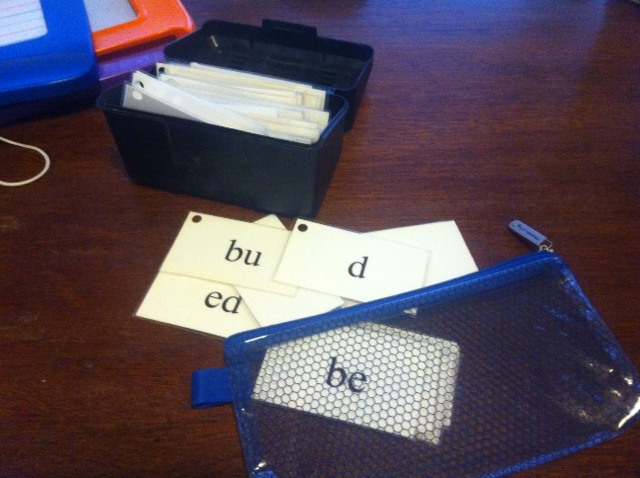
    My advanced cards are much smaller.  Three-by-five cards might be the most popular size of homemade flashcards, probably because the 3×5 size is so widely available and cheap; but I really like the "business card" size, as it fits in a child's hand so well.  Another convenience:   you can buy pre-perforated sheets of business cards that fit in your printer.

    Photo 3

    The basic features of the advanced cards are:

    • Small (business-card sized).
    • Durable.
    • Any manuscript style or font.  

    Some options that I have found helpful:

    • Laminated for durability.
    • Hole punched in the top left corner (so they can be kept on a ring, which orients them correctly).
    • Printed rather than handwritten.  

    A note on lamination:  After I printed the cards and separated them, I took them to a print shop and had them laminated for durability.  I did not use the little individual card-size laminating pouches at the self-serve station — that would have taken forever.  I had them send it through the wide-format, roll laminator, and then took the roll home and cut the cards out.  If you have a laminator at home, you can do this yourself.  

    A note on fonts:  I used Times New Roman.  Now is a good time to introduce the other shapes of "a" and "g" — kids need to be able to recognize both eventually.   But if you prefer, you can choose a font that has the a-shape and the g-shape that the child is used to seeing.  

    Cards in this set:

    b bb bu be d dd ed de ld or
    our ore oar ar oor oo u ou l ll
    le n nn ne kn gn j g ge dge 
    o au aw a ough augh s ss c ce
    st sc orr m mm me mb ng oe oa 
    ow er ir ur re ear y i t tt 
    te f ff ph gh ie igh ue ew
    rr wr re g gg gu w wh sh ti 
    e ai ay ey ea eigh ei h p pp 
    pe k ck ke ch oi oy th x ui 
    v ve si ure tch z ze zz ee  


    Did you remember how, back in Part I, I said that I taught 4-5 spellings of each phoneme, and the total number of combinations was about 175?  You'll notice that my set contains not 175, but 109 cards.  That is, of course, because some of them are used for more than one sound, which is the entire reason why English is such a pain to learn to read.  

    (The reason English is such a pain to learn to spell is because it employs more than one spelling for the same sound.  Kind of the reverse of the first problem.)

    It's probably apparent that there is a semblance of order, but only a semblance of one.  What's happening here, in this advanced set of cards, is that we are marching through the forty-or-so phonemes of English, introducing the most commonly seen spellings for each one.

     The first phoneme that is studied is — I hope you deduced quickly — /b/.   That would be (from left to right) /b/ as in bag, /b/ as in rubber, /b/ as in globe, and /b/ as in build.

    The next phoneme is /d/.  Why yes, we are dealing with b-d reversal up front.  And wait a minute:  "ed" spells /d/?  Why yes, as in "braised" or "blazed."  

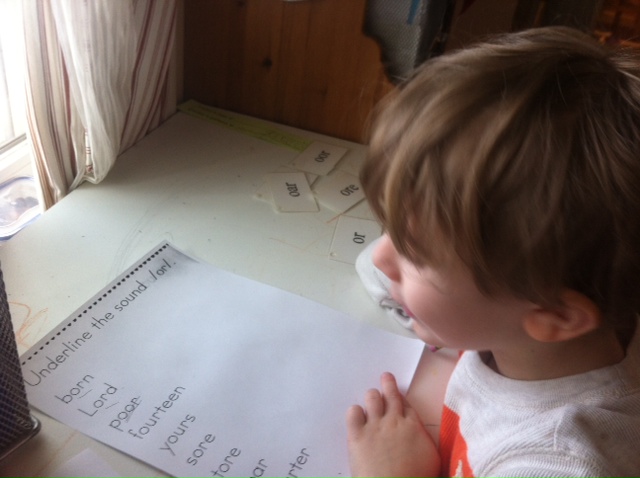
    The next phoneme is, well, it isn't exactly a phoneme — it's a rhotic vowel together with its r.  /ɔ˞/ is how it is written in IPA (at least if that came through on your web browser) — it's the same as pronouncing the word "or."   I have it spelled six different ways, as in born, poor, four, sore, roar, quart.  

    (Kelly — who lived a long time in Kentucky — pointed out to me in the comments that she pronounces "poor" and "pore" differently.  Wherever these distinctions sometimes exist, I tried to merge them in order to cut down on the number of phonemes that must be learned; in my experience, it's only necessary for a child to hit reasonably close to the pronunciation to be able to recognize it.  I tried to apply this to my own dialect too — I happen to pronounce "cot" and "caught" differently, but I treated the two vowels as one for the purpose of my program.)

    I don't have duplicate cards in this set.  By the time I get to the pirate phoneme (/ɑ˞/, mateys), I have already introduced a card for the spelling "ar," so we only need to introduce "orr" (as in sorry — unless you're Canadian, in which case you ought to have introduced it earlier along with "oor" and "ore" and the like.) 

    + + +

    So, that's the "advanced" card set.  I'll write about how I use both sets of cards in future posts. 


  • How I teach my kids to read, an empirical approach: III. Materials: lists, slates, and readers.

    Third post in a series.  See here for: Part I.  Part II.

    + + +

    In the last post, I started writing about the materials I use, and explained just one:  a set of large phoneme flashcards, optionally made with textured letters (like "sandpaper letters" but including some digraphs like "ee", "ai", "th", etc.)  

    The blog series would have been more tightly organized had I hit "save draft" instead of "publish," and continued by adding this material to the bottom of the previous post.  Instead, I am publishing the bits as I write them here.   I'm trying to restart the blogging habit by intentionally beginning a long and easy-to-write series.  Bear with me.

    + + +

    So, more materials today.

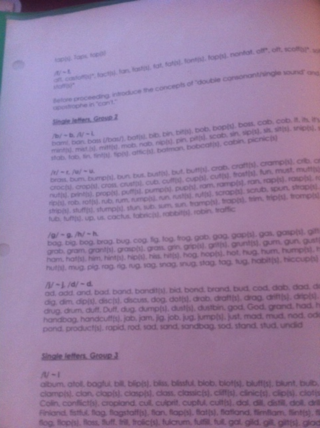
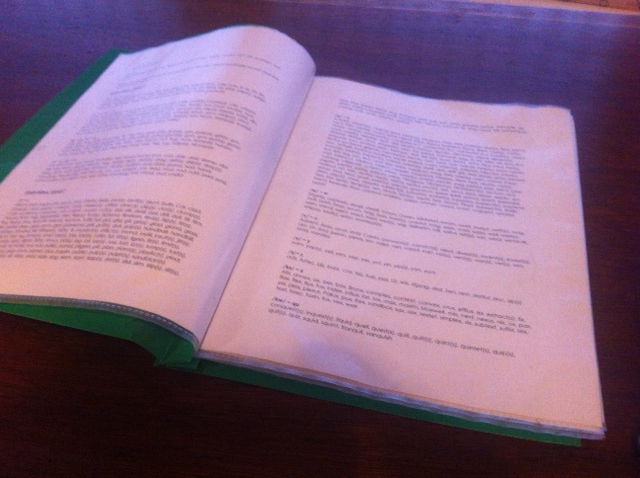
    Item 2.  "Progressive" lists of words prepared in advance.  

    Photo 4

    We'll get to the content of these progressive lists, specifically, later in the series.   Also, why I call them progressive.  For now I want to make two points:

    First, that this packet of word lists is ready to go as a prepared material.  On a given day I can pick up my packet, flip to the page where I left off, and choose reading-practice words from the current list.  When it's time to teach a new sound, I move on to the next list.  This keeps me from having to think what to teach on the fly.  

    (I don't like to think on the fly what to teach much, because it requires a lot of my attention and self-discipline to interact positively with children, unless they are having a really good day.)

    Second, it's a good place to point out that the majority of the time early on, I'm asking children to read individual words.  I don't rely on a regular diet of early reader books, at least not in the very beginning.  Those are available (you'll see the readers coming up in my materials list), but it's not the bread and butter of my program.  My kids have always been frustrated by the process of  slowly struggling through a sentence one sound at a time.   If, by the time you've made it through one word, you've forgotten the previous word, you're not going to be really engaged with the text.  So — while we dip into sentences and stories now and again — I concentrate on word lists until decoding is more rapid.


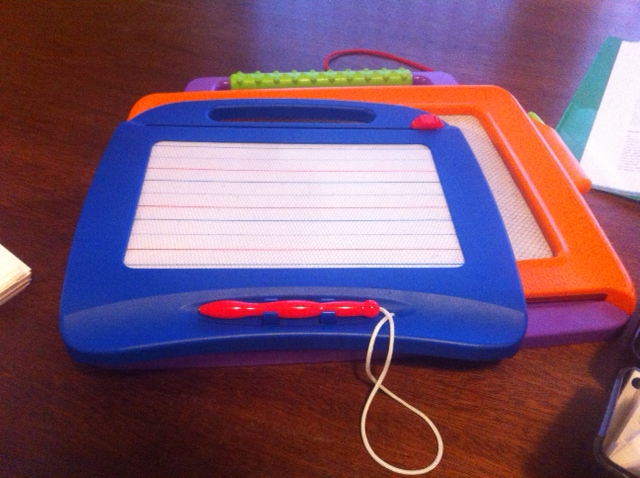
    Item 3.  Large magnetic slates with attached stylus.

    Photo 2 (2)

    Two common brands of magnetic slate are Doodle Pro® and Magna Doodle®.  The larger the size, the better, for this application.  The orange one on the bottom in the photo is a Doodle Pro®.  

    At the beginning of this school year I went to a Learning Resources brick-and-mortar store in my town and found the blue slate with the primary-handwriting lines permanently scribed on it.  I really like this one.  I wish I'd bought a couple of them; maybe I'll return to the store, because for the life of me I can't find it online.  If you wanted to make your own from a blank magnet slate, I'm thinking that red and blue Sharpies would do the trick.

    So, I use the magnet slate to write the words for the child to read, and sometimes the child uses the slate to spell.  This is so much less wasteful than paper, and so much less messy than dry-erase boards.  I love it.  Write the word, read the word, wipe the word, and move on.

     It's also easier for a child to write with the stylus than to write with pencil and paper.   Mind you, this means that you're not really working on the pencil-holding, pencil-pushing skill at the same time, if that was your goal; but I'm all about reducing frustrations here, and if your child is ready to read before he is ready to manage a pencil and paper, I say let's go ahead with the reading.  The pencil can wait.


    Item 4.  A set of phonics readers.


    Photo 5

    Pictured above: Bob Books®.  (You might prefer to use something else.)

    I know, I just got done saying that I mostly teach decoding using word lists.  But I do use readers sparingly, and more and more frequently as the child either (a) asks for them or (b) appears to show readiness for sentences of the length in the books.  It's the kind of thing that I pull out once in a while when we get a little tired of word lists, or when it seems like a good idea to remind the child of the point of this whole exercise.  Also, you need at least a little bit of practice with things like going left to right, noticing the capital letters and periods that denote sentences, turning pages, and the like.

    No set of readers is perfect, and I think that many different sets will work with my plan.  There are, I think, two features to be avoided.  

    Feature to avoid, number one:  an over-reliance on "sight word" reading.  These are words that the child is supposed to learn to recognize from memory, on sight, without decoding.   Ideally, especially early on, the child will encounter zero words that he does not yet have the skills to decode.   We are going for phonics, as pure as possible.

    Practically speaking, that's difficult to arrange. It's really hard to write a story that sounds okay but doesn't contain the word "the."  (Though not impossible, as you will see.)  In my experience, kids can deal with one or two of these here and there, so it isn't a deal-breaker.  The Bob Books use "the" and "O.K." fairly early on, and I just tell the child what the word is and we move on.

    Feature to avoid, number two:  Over-emphasis on alphabetic order and/or the initial letters of words.  There's no good reason for the most prominent feature of your readers to be "Here are a lot of words that begin with the letter A" followed by "Here are a lot of words that begin with the letter B" and so on.  Later this can be useful for teaching capital letters, but really, the order of the alphabet is not germane to decoding, and the initial letter of words is a red herring.

    Again, there are lots of reader sets out there that I think would work.  I have seen, and like, the BRI readers (you can see them here — I'm a little confused about how you obtain them, though).  I know a lot of people like the Little Stories for Little Folks, sold by Catholic Heritage Curricula, and I think those would work.   

    I am pretty sold on Bob Books, though.  They are inexpensive, widely available, appealing, and small (nice for little hands).  They come in progressive sets (so you can buy them 8-10 at a time) and within each set, the order you use them in isn't all that important.   You don't need to do a lot of research on them, just buy and use.  

    + + +

    More materials to come in another post.


  • How I teach my kids to read, an empirical approach: II. Materials: the “sandpaper phonemes.”

    Continuing from here.

    + + +

    Today I'll begin commenting on the materials I reliably use in my reading instruction.  These aren't necessarily the only things that I use; I have some other stuff that I pull out from time to time just to shake things up.  There are a lot of literacy toys and tools out there.  But these are the core materials without which the rest of my series won't make much sense.


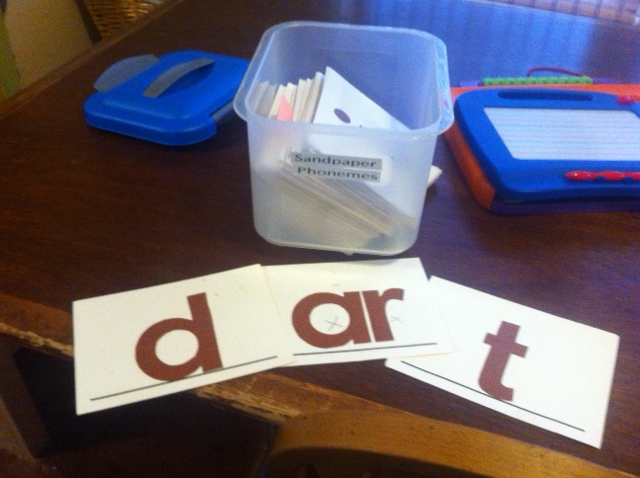
    Item 1.  A set of 44 large phoneme cards (not just an alphabet, as you'll see).   Optional feature:  Tactile letters.

     Photo 1 (2)


    Here are the basic features of these first cards:

    • They are large and fairly stiff (made of better-quality 5×7 cards).
    • There is a horizontal base line along the bottom edge, to help a child keep them right-side-up.
    • The letters are drawn with broad strokes, a fingertip's breadth.
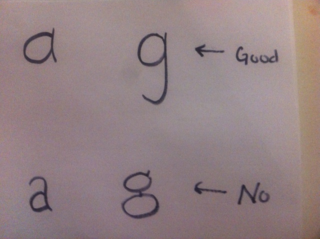
    • You can use any manuscript style or font (D'Nealian, Zaner-Bloser, Century Gothic, whatever) you like, with one caveat:

    Photo (11)

    And one not-basic, optional feature:

    • My set is made of a textured paper cut into letter shapes and affixed with spray adhesive to the cards.  The idea here is to make homemade "sandpaper letters" (they are a Montessori-school thing) that the child can trace with his finger, in order to get a little more sensory input for the kinetic/tactile learners.  
      • Further notes on the making of these cards:   You can buy sandpaper letters, but generally not including digraphs; that's why I made my own.  I do not think the texture is necessary for learning to read and recognize the letters; it's just a bonus feature.    An easier way to get a similar benefit is to buy a separate set of sandpaper letters, and use them along with the large phoneme cards. Here is an affordable set of sandpaper letters made of cardboard.
      •   If you go the make-your-own-tactile-cards route, do not bother with actual sandpaper!  It is very hard to cut into letter-shapes.  Textured paper will work fine and, unlike sandpaper, can be cut with scissors.    Honestly, I don't think the texture needs to be that pronounced; the letters just ought to be raised and rougher than the card they're pasted on.  Construction paper is probably sufficient.  If I were doing it today, I'd try to find a nappy-sort of textured paper that would fit in my printer.  But I did it years ago when I had a little more time to spend on projects, and so mine are made from a pebbly scrapbook paper which I cut out around templates I printed from a word processor. 

    Cards in this set:

    a b c d e f g h i
    j k l m n o p qu r
    s t u v w x y z  
    er sh ai th ee ng ch ar ew
    oy ie ck oe oo ou or ue  


    *N.B.  I don't know what kind of font you're seeing, but caution on the cards that have an "a" or a "g."  Look up at the photo!  

    Here's the concept that underlies this particular set of cards:  Each card can be matched to one of 43 English phonemes.   So, at the earliest stage of teaching decoding, I can pretend that English makes some sense.  I save the bad news about English for later.

    There is one additional phoneme — too important to leave out — which requires me to reuse just one card.  Who wants to be the first to deduce which card has to do double duty?

     More materials coming up.


  • How I teach my kids to read: an empirical approach. (A series)

    Once I was seated at a dinner next to an elementary school music teacher.   It was impossible to avoid the topic of homeschooling, and the conversation turned to how I spend my typical day.  At the time one of my children was in first grade, and I commented that I was in a stage where I needed to budget quite a lot of one-on-one time with that child, because he was learning to read.  "I've found that reading instruction is intensive," I said, "it takes a lot of care and attention."

    She nodded sagely.  "Of course," she replied, "that's because you haven't had any training."

    I believe I changed the subject soon thereafter, in order to avoid ruining everyone's dinner.

    + + +

    In 2009, more than a quarter of high school graduates performed below the basic level in reading on the NAEP.  Is it because their teachers didn't have any training?

    I don't think so.  Reading instruction takes a lot of care and attention even for classroom teachers who have had specialized training in reading instruction (incidentally — many don't).   A few children are able to work it out on their own, of course, and the kind of instruction they are provided isn't going to matter much.  At the other end of the spectrum, there are children for whom the necessary care and attention simply isn't made available — either they need a great deal, or their environment can't meet ordinary needs —  and those children never do achieve basic literacy.   

    What about the broad middle?  Pretty much everyone agrees that parents — even the ones who haven't had any "training" — should be deeply involved in their own child's reading instruction.  That parents should spend time reading to children and helping children practice reading and writing at home.   Check out this list of literacy activities recommended by the U. S. Department of Education.  Care and attention, and time.   Here's a paper strongly implying that the effort made by (untrained) parents is the most important factor in literacy development.  And that's for kids who expect to attend "away school."  

    If we've taken on the task of teaching our own kids to read, we're basically looking at doing the same things that parents are always expected to do with their children, only more of it, and perhaps — if it suits our personalities — more systematically.

    + + +

    I am nothing if not systematic, but I can also throw things together quickly if I have the motivation.  

    A decade ago, three critical factors were converging:

    • I had just finished graduate school (engineering, not education or linguistics or anything like that) and still possessed the stamina to analyze the hell out of things in enormous spreadsheets.  
    • One of my closest homeschooling friends, frustrated by pedagogical difficulties related to her children's special needs, had thrown herself into the literature on reading instruction in order to develop her own reading program.  She was regaling us all twice weekly with everything she learned. Her husband (whom I'd gone to school with) had written a nifty computer program for her, which searched dictionary databases to generate lists of words that possessed certain spelling combinations.  He gave me a copy of the program to play with.
    • My first child was learning to read.


    Although my friend's program was far more involved, comprehensive, adaptable, and attractive, I managed to take some of her basic concepts and set up a "quick and dirty" method that I enjoyed using with my own kids. Hers was the idea around which I organized my own approach:

     Instead of teaching dozens of contradictory phonics "rules" , I would just directly teach — one at a time — every phoneme-spelling combination that appears frequently enough in English.  

    So, for example, I might start out by teaching that "m" spells the sound /m/, but later I'd teach that "mm" also spells the sound /m/.  Still later, I'd layer on top of that a lesson that "me" and "mb" sometimes spell the sound /m/ too, in words like "come" and "dumb."

    In my system there would be no silent letters.  I would not say about words like "sign" or "gnome" that "the 'g' is silent."  Instead I would (eventually) teach that "gn" is one of the ways to spell the sound /n/. 

    At every stage, I would give the child practice words that incorporated only sound-spelling combinations they already knew.  So, I'd never ask a child to read the word "sign" when the only /n/-spellings they knew were "n" and "nn."  

    Obviously, one skill that would need to be developed:  trying out the different possible sounds that a given spelling might represent.  Faced with "come," the child would simply have to get used to trying different possible pronunciations. "Comb? Comm?  Comm-ie? Come?" 

    Eventually, the clues would come from context.  But at first the clues would come from me, the teacher, sitting by the child's side:  "It could be 'comb,' but that's spelled another way; try another sound that you know for the letter 'o.'"  That's because I planned not to emphasize reading books or even sentences until the child could read individual words with confidence.  It might be a little boring, but I was determined to get the fundamentals of word-decoding mastered before attacking lines and blocks of text.

    + + +

    I didn't have a lot of theory to back me up.  Still don't.  And of course, I don't pretend that this system will work really well for every child.  But I did find it to be "a thing that worked" for my own children.  

    Does it sound daunting?  It is a bit daunting, but maybe not as bad as you think. Before my friend did her analysis and reported the results to me over tea, I believed that English was completely un-analyzable.  I mean, we don't speak Finnish; aren't there effectively an infinite number of English sound-spelling combinations?  

    But my friend showed me that the total number is countable — somewhere between 200 and 300 in a really comprehensive list.  If you exclude the ones that only appear in obscure words or in just a couple of words, the list becomes manageably short.    In the end I settled on 41 phonemes (plus the lowly schwa, which is kind of a special case).  On average, I taught 4-5 spellings of each phoneme.  I think the total number of combinations was 175.

    Yes, it takes a while.  But it isn't impossible.  And it seemed to work for us.  In fact, I never have gotten through all 175 spellings, because the three kids I've taught so far have all taken off reading, partway through the list, and stopped needing help.

    + + +

    In this series of posts, I'll walk you through my whole homemade program:

    • How I set up my materials.  (Not much more than writing tools and a really big pack of flashcards.)
    • The first phase:  one letter equals one sound.   
    • The second phase:  Remaining sounds are introduced which are each spelled by one digraph.
    • Interlude:  A few "overlaps" are introduced, namely long vowels and s-that-sounds-like-z.  Practice having to test out different possible sounds for the same letter.
    • The third phase:  Revisiting each phoneme with all its common spellings.  (About sixteen weeks' minimum.
    • A few ideas for building fluency as you go.

    Again, this isn't something that I am exactly recommending.  I never did any research to measure its effectiveness relative to commercially available reading instruction programs.  

    And, you know, I don't have any training.

    But hey, the price is right.  I hope you enjoy reading along.

      Photo (10)


  • How’s that geography curriculum going, Erin?

    Melanie asked me if I would write an update on the geography curriculum I have been using on our co-schooling days with the middle school kids.

    That would be, Mapping the World with Art by Ellen J. McHenry. It’s a combined history, art, and geography program that walks you through the history of cartography while kids learn, progressively, to draw maps of the world and produce a series of geographical art projects. There are a couple of games, too, and the whole thing culminates in a project of creating a large, attractive world map (or even drawing a world map from memory, if that is more your thing).

    I have posted some pictures here and there over the last year and a half.

    Since we meet with our co-schooling partners two days a week, and since the book is comprehensive with lots of activities, H and I decided to spend two school years on it. The kids were in 3rd-6th grades when we started and now are in 4th-7th (with the oldest kids having also taken on an additional history curriculum this school year).

    Melanie asked me,

    How did you like the book as it progressed? Did you finish it or will you finish? What have you liked and disliked about it? I’m seriously thinking of adding it to my slate for next year, but wanted a later term review.

    I answered,

    1. I still love it. It is one of the most successful curricula I have ever bought. I needed something that would challenge and interest a mixed-age group of middle schoolers, including one poor reader and one who had never been interested in history read-alouds.

    2. We aren’t done yet. I decided to spread the curriculum over 2 years at 2 one-hour sessions a week. I think you could finish it in a year if you planned ahead and did it daily, and under those circumstances it would “count” for all your social studies, art, and considerable copywork (because of all the map labeling). But I have to say the pacing seems just right at twice a week.

    3. I have barely changed anything. A few activities, we have skipped. I went through the book ahead of time and figured out what we would do and not do.

    4. Best: it engaged a mixed group, 2nd through 6th graders, and is definitely multisensory (both DVD and text instructions are included; I make the kids watch the DVD and give them the text to refer to while they draw.) Drawback – required a fair amount of materials and prep. I made a chart ahead of time listing the lessons I’d do in order and the needed materials, and I bought every art material I would need for 4 kids for the whole 2 yrs at once and stored it in a big labeled tub, pencils and dice and tagboard and paint and all. But once I had done that (and you know I like to pre-plan rather than last-minute scramble) the weekly prep was pretty simple.

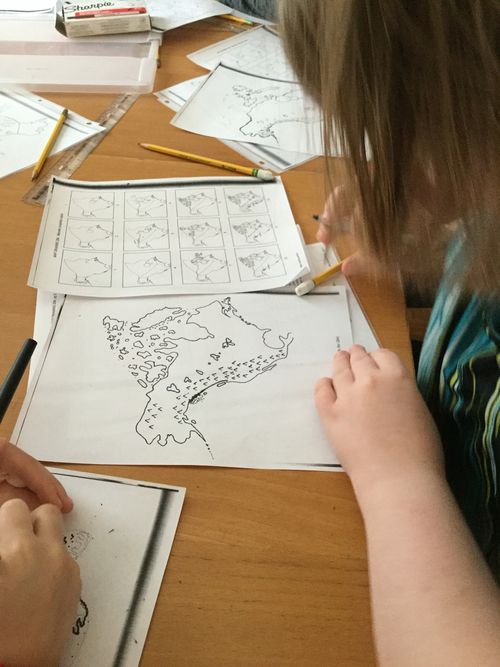
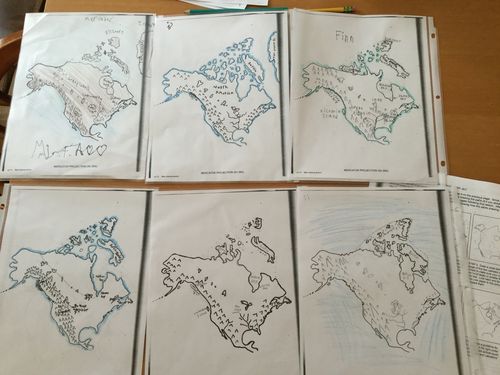
    Today’s work was to draw a complete North America using the Mercator projection, having drawn one last tine with a conical projection.

    They saved time by using a worksheet with the southern part of the continent already outlined, since what they need to see is the difference that the projection makes in the northern part. In the above picture, the top left drawing was done by a fourth-grader, the bottom right by a seventh-grader, and the others are of kids whose ages fall between that.

    Highly recommended still.


  • On eating while small of stature.

    Jenny commented on my last post:

    Not to complain too bitterly about being short, but my normal, weight-maintenance meals are already small. If I eat to lose, we are talking child-sized portions which is a drag without significant motivation.

    Isn't it a drag, though? I took a minute to write out a 1500-calorie menu that sort of mimics the pattern that is most comfortable for me (fairly light but egg-based breakfast, medium-sized lunch, fairly hearty dinner). This is what I came up with:

    A 300-ish calorie Breakfast

    • 2 soft-boiled eggs
    • 1 slice pumpernickel toast with a pat of butter and optional smear of marmalade (alternatively, scramble the eggs in the butter and leave it off the toast)
    • 6 ounce mini can of V-8

    A 500-ish calorie Lunch

    • A couple of cups of chopped mixed salad greens and raw vegetables
    • 5-ounce can of oil-packed tuna
    • Half a cup of cooked chickpeas
    • Balsamic vinegar to taste (just rely on the tuna for oil)
    • 1/4 cup fresh grated parmesan


    A 700-ish calorie Dinner


    • 1 roasted, spiced chicken thigh, with skin
    • 1/2 cup raita (half yogurt, half chopped vegetables)
    • 3/4 cup grated carrot salad with spices and lemon
    • Steamed green vegetables — say, 10 spears asparagus
    • 1 cup grain pilaf
    • *Allowing for about 1.5 tablespoon of added oil total from the chicken, salad, and pilaf.

    + + +


    All that is fairly hearty-looking because of lots of vegetables and because it was homemade to my tastes. Nevertheless, it is quite possible to have a depressingly small-looking plate. If you want to stick to 500 calories or so for lunch at your typical sandwich place, you get the sandwich, generally, and nothing else. You might be able to manage a half-sandwich and a cup of soup, depending on the soup. Coleslaw will set you back farther than you think. Fries are most likely right out.

    For instance, let me grab some lunch data from a casual chain restaurant that has it online, Chili's. Lunch off the menu that would suit someone my size would be:

    • On average, about half a burger or half a burrito. No sides.
    • Shrimp fajitas will work and probably taste great, and I would get to eat all the sizzling innards — but only one tortilla. (Ordering the shrimp option is a good trick for right-sizing meals, incidentally. They never give you much, and the cost will help you appreciate it.)
    • Nachos are one of my favorite things, but I have to split them with two friends. And I am done with lunch already!
    • A "Fresh Mex" bowl sounds like the sort of thing that I should be able to eat, and looks tasty, but I only get half.
    • Kids' meals? Okay, this strategy can work. If I happen to be in the mood to eat a circular burger, the teeny pair of sliders come in under the bar, at least if I stick with fruit on the side. Actually most of the kids' meals would work that way, except the pizzas. This is how I could also get a piece of plain grilled chicken that gives me room for fries and fruit.
    • Main-dish salads? I only get part of them. Less than half the buffalo chicken salad, about three-quarters of the Caribbean salad with grilled chicken, a third of the "quesadilla explosion salad." Oh, by the way, that is without any dressing. Fortunately salsa makes an excellent dressing substitute.
    • Bowl of soup? Those work. A lone bowl of chicken enchilada soup is just about right.
    • Tacos? There are three in an order, and for most varieties, two of them makes your meal.
    • Lunch combos! They are supposed to be smaller lunch portions. With salad and the included fries, will any work? The short answer is "No." You could give away your fries… no, wait, still too big. How about if you only eat half the lunch combo? Now we are getting somewhere, as most of these are eligible if you only eat half of it (half a salad, half a portion of fries, half a chicken burrito or whatever).
    • What about the "lighter choices?" If I am hellbent on cleaning my plate, I could choose some of these (though not all). They don't look bad, actually. There's a steak, for example, or various grilled chicken meals with pico de gallo and salad or broccoli, even a little rice.

    In sum, a not-quite-five-foot-tall woman like me — fairly physically active — gets to eat approximately half of the average restaurant meal, without fries, unless she doesn't mind sticking with a simple bowl of soup.

    And that is without saving any room for a dessert — or rather, for a couple of bites of someone else's dessert.

    This gets old really fast — unless you can really internalize the notion that restaurants portion for big, hungry males, and small women are second-class citizens.

    …Oh, wait, it still gets old really fast.

    Yes, yes, I could think of it as free leftovers that I get to take home in a box. I used to be in the habit of taking an insulated lunch bag with me when I went out for the day, and could probably be induced to do it again. Still — the only way to avoid feeling like you are stuck with a child's portion (or convincing yourself to overdo it) is to deeply internalize what "right-sized" food looks like. This is possible, I have found, but it takes a lot of practice — meaning, for me, a lot of deliberately ordered, deliberately half-eaten meals, to disconnect my notion that cleaning my plate is the norm.


  • The belated twice-yearly post on weight maintenance.

    Usually I write this post in May (around the anniversary of the "click" in my head that changed things) and November (around the anniversary of reaching my goal weight, around six months later).   I'm writing the November post late this year, in January, not because I want to cash in on all the New Year's resolution stuff, but just because I've been a delinquent blogger.

    Let's grab something as it flies by and slap it up on the page to make things look current.  Here's a year-old article that has been going around on FB the last few days, it being January:  Diet and exercise alone are no cure for obesity, experts say.  Here is an extended excerpt from the  newspaper's summary of the information:

    Take note, glib-talking doctors and legislators, rail-thin commentators, and fat-haters of all stripes: For most of the nation's 79 million adults and 13 million kids who are obese, the "eat less, move more" treatment, as currently practiced, is a prescription for failure, these experts say.

    In a commentary published  [ed: in the May 2015 issue] in the journal Lancet Diabetes and Endocrinology, four weight-loss specialists set out to correct what they view as the widespread misimpression that people who have become and stayed obese for more than a couple of years can, by diet and exercise alone, return to a normal, healthy weight and stay that way.

    "Once obesity is established, however, body weight seems to become biologically 'stamped in' and defended," wrote Mt. Sinai Hospital weight management expert Christopher N. Ochner and colleagues from the medical faculties of the University of Colorado, Northwestern University and the University of Pennsylvania.  

    The human body, evolved to endure through periods of food scarcity, has adapted a host of methods to ensure that lost weight will be restored, the authors say. It will respond to weight loss by powering down its use of calories as fuel, pumping out hormones to increase hunger, boosting fat storage capacity, and tricking the brain to demand overconsumption.

    "Few individuals ever truly recover from obesity," the authors wrote. Those that do, they add, "still have 'obesity in remission,' and are biologically very different from individuals of the same age, sex and body weight who never had obesity." They are constantly at war with their bodies' efforts to return to their highest sustained weight.

    …Why would an influential foursome see the value in recapitulating these ideas in a respected medical journal?

    "It's not just that most people still stigmatize obesity–as they say, it's the last acceptable form of stigma," said Ochner. "What really bothers me working around and with clinicians, is that some of them–a disturbing percentage–still believe it's all about personal choice: that if the patient just tries hard enough, and if we can just figure out how to get them a little more motivated, then we'd be successful. And that's just not right."

    Lifestyle changes are undoubtedly a necessary condition for enduring weight loss, Ochner said. But they're far from sufficient, and when physicians believe they are–when they say "you already know what to do, I told you what to do," he said–"that's certainly cruel, and it's harmful: It prevents them getting the care they need."

    Physicians, he said, should be doing more than exhort patients to eat less and move more. They should[:]

    • "intervene more quickly to encourage weight loss in overweight patients before they become obese."
    •  "discuss with obese patients … medications, surgery and device-based treatments…to supplement diet and exercise…"
    • "make weight-loss maintenance–an aspect of obesity treatment that is neglected–a part of their treatment plan."

     + + + 

    I'm one of the odd people that did manage to correct long-term obesity through diet and exercise.  It required a level of focus that bordered on the obsessive; I paid a price in mental health.  I'm not saying it was the wrong choice to make; the sacrifice was temporary, and it worked.  

     I think I'm mentally more balanced now, but it's also been harder to maintain the habits that seem to correspond with keeping my weight off.  It could just be because I'm under a lot of demands in this season of my life; but sometimes I wonder if I will always have to choose between staying thin and staying relatively sane.

    + + +

    Maintenance?

    It really is very difficult.  I understand intimately what they mean by "obesity in remission."  I was obese for about 25 years, and I've only been not-obese for 7.5 years, and I feel — deeply — that the lifestyle which maintains it is something I put on, not something that's really sunk in fully.  

    For a while, between my last two pregnancies, I thought it really had sunk in.  Post-weight-loss, I'd maintained for several months, gotten pregnant, had an amazingly healthy pregnancy and an easy delivery, and then I picked up my old, good habits where I left off.  I returned to my desired weight range and maintained that for three years or so before my fifth pregnancy.  

    But after my youngest child was born I was much more sluggish.  He is two now, and I have never quite gotten back to where I was.  I'm about ten pounds and one clothing size over my desired weight.  I'd be okay with it, I think, if it weren't for the frustration and fear that's all wrapped around the knowledge that I've simply not been able to hold myself tightly enough to a plan.

    Again, I have a lot of demands on me right now, and I well remember the level of obsession that it required for me to lose the weight the first time.  Maybe there simply isn't enough of my attention to go around, and maybe I could do it if I could only clear my schedule and clear my head.  But it's all hypothetical.  I can't seem to stick to anything very long.  And that "can't" is very scary to me.  

    I wonder all the time:  Am I out of remission?

    + + +

    Let's take a look at these words again:

    The human body, evolved to endure through periods of food scarcity, has adapted a host of methods to ensure that lost weight will be restored, the authors say. It will respond to weight loss by powering down its use of calories as fuel, pumping out hormones to increase hunger, boosting fat storage capacity, and tricking the brain to demand overconsumption.


    I don't know if the three other response mechanisms are active, but the last one?  Tricking the brain to demand overconsumption?

    It is so very, very real.

    My brain is a traitor.  It has completely gone over to the side of the body in this one.  How to explain it?  My brain doesn't try to get me to break my resolutions, to foil my plans, anymore.  It's learned that this does not work.  

    I don't do the emotional-eating thing.  I don't get tempted to break my resolutions.  If I am conscious of a plan I have made (say "Don't eat dessert tonight") you can wave a chocolate cake in front of me all evening and I will not take that first fatal bite.   My brain has given up trying to tempt me away from my plans.

    Instead my brain has learned a better way:  it causes me to forget I had a plan in the first place.  "Ha ha!" the brain says.  "If I refuse to do my job of remembering important things, there's nothing that the rest of you can do about it!" And when dinnertime comes it's all like "Plan?  What plan?  Pass the potatoes."

    I realize that this sounds absolutely insane.

    I can't think of a better way to describe it.

    I make plans.  I literally forget them, or at least forget that they matter, when I sit down at the table.  And then immediately after we are all done eating, I seem to remember them again.  Shit.  And then the remorse.

    This is not a good mental situation.  I really have to do something about it, because it is the kind of mental situation that eating disorders are made of:  a cycle of self-recrimination that begins immediately after a meal.  It's bad.

    + + +

    There are definitely things I could do about this.   I think that the best course is probably to pick one good habit, one tried and proven one from my old life, and concentrate on that until it's second nature again.   But panic overtakes me.  "Just one habit" is too scary; I fear I'll let all the others go.   For example:  If I concentrate only on not snacking between meals (a worthy goal, part of the way I want to live my life), I fear, I'll destroy all the practice I've made at having reasonably-sized meals.  And so on.  I keep starting off with single habits, but eventually I try to do all the habits at once, get overwhelmed, and start forgetting them again.  

    + + +

    And make no mistake:  while I might be able to develop and reinforce habits that maintain my weight where it is, I really have to be conscious at every meal if I am going to run a calorie deficit and live off my stores even for a few weeks.  I am under five feet tall.  Maintaining my weight as it is  requires, roughly, only 1850 calories per day.   Losing it at a noticeable pace means going down to something like 1400-1500.  This is not that much food, people!  Unless you are the sort of person who forgets to eat under stress, it takes attention to maintain that for more than a couple of days, and it is shockingly easy to make up several days' deficit in only one meal.  

    Example.  If I am trying to stay at 1500 cal/day, chances are good I'll really manage closer to 1650.  Let's say I do that for 4 days in a row.  Great! I'm running an 800-calorie deficit.  Then on day 5 I go to a restaurant for lunch and in a fit of forgetfulness I order a cheeseburger and a fountain Coke with a vinaigrette side salad (no fries, please).   That's all it takes!  The deficit is gone, and I'm back to square one.  Without ever really departing from reasonable, moderate eating!  We're talking a single, culturally normal-sized meal (too big for my body size, but it isn't an amount of food anyone would call "overeating") after 13 carefully-restricted meals in a row.  If I kept up that pattern (13 restricted meals, one culturally normal meal) over and over, I would never change.  The only thing that would be different is that I would feel very frustrated.  Would you be able to keep that up without going slowly insane or developing an eating disorder?

    It requires attention.  I have found that it requires counting.

    + + +

    Still, I can point to areas of relatively easy improvement.  Someday I will have the attention available to make a final push through those two-year-old postpartum pounds, and I could concentrate on developing the habits that support the drive, make it a little easier.  Cutting back on alcohol, making easy-to-remember resolutions like eliminating snacking and seconds, making rules like "half sandwiches only," splitting things with Mark at restaurants (and NOT using that as an excuse to go ahead and have dessert).  

    I could do these things.  The question is, will I?

    IMG_1710

    A series of older pictures can be found here.