bearing blog


bear – ing n 1  the manner in which one comports oneself;  2  the act, power, or time of bringing forth offspring or fruit; 3 a machine part in which another part turns [a journal ~];  pl comprehension of one’s position, environment, or situation;   5  the act of moving while supporting the weight of something [the ~ of the cross].


  • Repost: The difference between faith and belief.

    I am going to try to get back in the blogging habit by reposting some old stuff when I can't think of anything new to say. This post is from March 2012.

    + + +

    I do believe; help my unbelief!" — Mark 9:24

    + + +

    Darwin excerpts a cordial discussion between some theists and some atheists about the meaning of the word "faith."

    It's worth reading on its own, and I am not going to respond to the entire excerpt, but just make my own comment and expand on it here.

    Some proposed definitions from the excerpt:

    • "Faith is knowing by testimony rather than by experience. I believe that the Earth orbits the Sun, because the scientists tell me so, and I believe them. "
    • "[F]aith is what fills in the gaps of the probabilities. If, say there is a 70 % probability something is the case then to conclude more than that 70% probability is faith…"

    Darwin chimes in to make two points. First, what "faith" originally means:

    The old Catholic Encyclopedia in its article on faith describes the Old Testament use of the term to be essentially "trustfulness" or "steadfastness"…. This usage still informs the way that we use the term in reference to interpersonal relationships. I have faith that my wife loves me. She has faith that I am faithful to her. Etc.

    Second,

    faith is an act of the will.

    Darwin's points are both correct, but he does not go as far as I do. He classifies "faith" as being an act, and this is correct; but it seems that he identifies it too much with "belief," or with being convinced "enough" of something. Here is the statement of Darwin's that I disagree with:

    This usage still informs the way that we use the term in reference to interpersonal relationships. I have faith that my wife loves me. She has faith that I am faithful to her. Etc.

    Obviously, in this sense one can have faith in any number of things or people, and as it notes, faith in this sense necessarily presupposes belief. I can hardly have faith in my wife's love (as in, trust in its existence and steadfastness) if I don't really believe that I have a wife or don't really believe that she loves me. When Christians talk about "having faith" however, they're pretty specifically talking about "having faith in God" — that combination of believing in God's existence and of trusting in God to remain steadfast and trustworthy in His love for us.

    Darwin is failing — at least clearly — to make a distinction between "I am faithful to my wife" and "I have faith in my wife."

    The first is concrete. The second is the metaphor.

    The faith that Christians are supposed to have is not the same thing as trust that God's love exists and is steadfast to us. The faith that we are supposed to have, I am certain, is faithfulness *to* God — fidelity to the laws and precepts that He sets out for us insofar as we are aware of them. When we are told to have faith, this is not at all a command to believe something. (How can you be commanded to be convinced of a truth?) It is a command to do something: to live your life, in your body, in your mind, in accord with the will of a God.

    Faith is not trust in God's steadfastness; it is a firm determination to remain steadfast to God. It is as the original Hebrew meant.

    And the point that I want to make, the point where I disagree with Darwin, is that faith understood in this way does not presuppose belief.

    Faith understood the way (I think) Darwin is trying to understand this would presuppose belief, because he is identifying faith with belief. "I can hardly have faith in my wife's love if I don't really believe that she loves me." Well, of course, if "faith in my wife's love" == "belief that my wife loves me."

    But my understanding of faith does not presuppose belief. Darwin could choose to remain faithful to his wife — by which I mean nothing more nor less than the earthy sort of "faithful," i.e., he could remain sexually faithful to his wife, forsaking all others, and not abandoning her or their children — even if he lost all confidence in her love for him. Indeed, he could (and should) choose to remain sexually faithful if Darwin became thoroughly convinced that MrsDarwin did not love him at all.

    And what if he did not believe that he even had a wife? Well, millions of still-single people find themselves in that situation every day, not having promised marriage to anyone, and yet they can still be "faithful" to the future spouse they might or might not have by living a chaste life. Su
    ch is faith: steadfastness.

    One may be "faithful" while having severely impaired belief, even no belief at all. (Which raises the question: Why would someone who did not believe in God ever strive to live according to God's laws? I will not answer the question here, and maybe will bat that question back to Darwin, but I will simply note that it is not logically impossible to be faithful in this way without belief; whereas if faith == belief, it does become logically impossible to have faith without belief.)

    The idea of "faith" as a purely mental or spiritual assent to a theological statement is, I suspect, a highly Protestant innovation. Because if you understand "faith" to mean "faithfulness" or "fidelity," then there is no distinction, none at all, between faith and works. The whole concept of "faith vs. works" presupposes that it is even possible to segregate a thing called "faith" away from the daily acts of living and interacting with other human beings and with our God. I say, it is not possible.

    Here is the second chapter of James:

    What good is it, my brothers, if someone says he has faith but does not have works? Can that faith save him?i 15If a brother or sister has nothing to wear and has no food for the day, 16and one of you says to them, “Go in peace, keep warm, and eat well,” but you do not give them the necessities of the body, what good is it?j 17So also faith of itself, if it does not have works, is dead.

    18Indeed someone might say, “You have faith and I have works.” Demonstrate your faith to me without works, and I will demonstrate my faith to you from my works. 19You believe that God is one. You do well. Even the demons believe that and tremble. 20Do you want proof, you ignoramus, that faith without works is useless? 21Was not Abraham our father justified by works when he offered his son Isaac upon the altar?k 22You see that faith was active along with his works, and faith was completed by the works. 23Thus the scripture was fulfilled that says, “Abraham believed God, and it was credited to him as righteousness,” and he was called “the friend of God.”l 24See how a person is justified by works and not by faith alone. 25And in the same way, was not Rahab the harlot also justified by works when she welcomed the messengers and sent them out by a different route?m 26For just as a body without a spirit is dead, so also faith without works is dead.

    The Greek word for "faith" in James 2 (the faith and works discourse) is the same Greek word (pistis) translated as "belief" in the passage from Mark that I quoted above. Does pistis mean "steadfastness" in any way? Or does it only mean an intellectual assent? It goes on to use pisteuis in the next verse to mean "believe" as in "You believe that God is one" and then "pisteuousin" in "Even the demons believe, and shudder." The "faith" mentioned in James is then the same as the "belief" which even demons can have.

    I don't really think of demons as "steadfast."

    Anyway, as I said in my comment to Darwin's post, the image of a faithful spouse is apt. Faith in, and faithfulness to, a spouse are very precisely designed to be an image of faith in, and faithfulness to, God. They are so bound up in each other as to not be separable; but at the same time, it is possible to "be faithful," to "do faithfulness," even in times of doubt or — God forbid — abandonment.

    This is what I would like to get across to anyone who says they wishes they could have faith but that it has never come to them. Anyone can, without committing a single act of intellectual dishonesty. It is simply a matter of becoming a faithful servant, or spouse, or child of God. To act faithfully — the precise nature of the "acts of faith" depends on our state in life and our circumstances — is to have faith. The ability to act faithfully, the possession of faith, both come from grace, the only thing by which we are saved.


  • Mother’s Day — in the life.

    I got up early on Mother's Day to go for a run around Lake Calhoun before Mass. I think this will be my summer Sunday routine — I like running outdoors, and I much prefer the cool mornings before the paths get crowded.

    The Lake Calhoun loop is a near-exact 5K. To make the circuit is to be treated to a pleasant series of vistas: the downtown skyscrapers in the distance, sailboats and kayaks on the lake, families of waterbirds, children swinging from the play structure at the 32nd Street Beach, blue water reflected in the plate-glass faces of the sprawling homes atop the bluff, towering apartment buildings standing sentinel where Lake Street dives into the bustling neighborhood of Uptown.

    Something there is in me that loves apartment buildings. I lived in one-bedroom city apartments by myself for about two and a half years at the end of college and the start of graduate school, and I think back with nostalgia. I liked their smallness, the ease of keeping them tidy, the door that opened a few steps away from a noisy city street. I liked that it was never quiet, that the sound of human activity just outside never stopped. I liked that the space was all mine. I liked the foompf sound of the gas furnace in the first apartment coming online in the winter, and the faint scent of warm dust rising from the electric baseboard heaters in the second apartment when I turned them on for the first time. I liked the sound of sirens and car horns coming in through the windows when I first slept with them open in the spring. I liked having my own mailbox in the row, to open with a little key. I liked never having to think about snow shoveling, or clogged gutters, or lawns, and that when the ceiling leaked it wasn't my job to fix it or pay for it, but only to call and ask.

    I have a house now, because I have a whole family to raise in it. (Still a city house, with sirens and car horns and a short walk from a busy commercial district.) When I run around the lake and see the sprawling big houses, I wonder who lives there, wonder how much the house costs, but don't want to trade places with them. Sometimes, though, I feel a little pull towards the upscale apartments at the edge of Uptown. Or towards the ones near the university, in a different part of the city. I think how lovely it would be not to have to get in my car to drive to the lake, but just to step out the front door to go for the run. I think about walking to restaurants and shopping and movies. I think how much better the sirens and car horns of Uptown would sound than the sirens and car horns of south Minneapolis. I think about living in a building with a concierge.

    For a long time I assumed that as an empty nester someday I would return to apartment living. I am neither a gardener nor a bird watcher. Even sitting in my own space outdoors with a good book could be accomplished just as neatly on a balcony as in a yard. I could maybe have a few potted plants there, which would never require mowing. I am a strange sort of introvert: I like nothing more than to be alone in a crowd. I want to be near where people are, but in no way obligated to interact with them. I am a city person. I want to live where there is a sidewalk (and have never understood why suburbs seem to treat this accoutrement as optional or undesirable). Maybe I won't grow old in Minneapolis, because the icy winters can be dangerous when frailty sets in, but a small city apartment somewhere — not necessarily a cheap apartment! — is how I pictured retirement. I let myself think of that when I ran around the lakes.

    And then one day recently I sat up straight and exclaimed to Mark: "Wait a minute! I'm going to be the matriarch of a large family! What if they all want to spend Christmas with us?"

    Yes, folks, I had been a mother for fifteen years, had given birth to five children. I had updated my self-image many times since then: from future scientist to ever-present homemaker, from sedentary to sometime athlete, from chemistry/engineering nerd to Nerd Across The Catalogue of elementary and secondary education. From expecting to travel whenever and wherever and however I wanted to waiting twenty years to visit another country. I stopped shoving a wallet and keys in my back pocket, and became a carrier of voluminous handbags stuffed with a change of someone else's clothes. All this happened quite naturally.

    And yet in all that time I had not gotten around to updating my vision of the future.

    + + +

    I am not saying I won't have my city apartment to retire to. I have a suspicion that we will turn into the snowbird types (possibly reverse snowbirds), with a place to call home in the city and a place to call home near the mountains, and maybe we'll have both a place that is small enough for two and a place that is big enough for all our descendants. I don't know; it is still far too early to make plans, and maybe even too early to dream about it.

    My point here is just that motherhood, parenthood, has a way of sneaking up on you. After all, I still think of Mother's Day as primarily a day I need to acknowledge for other people, not a day meant for someone like me; eventually my associations may shift, but they haven't yet, even though my children wrap me little presents to open each year. I guess it may go on happening my whole life, this transformation, outside and in.


  • Empty spaces: an Ascension repost.

    I need to make a test post anyway, so here's a repeat from two years ago:  "Empty Spaces."

     + + + 

    The feast of the Ascension is transferred to the following Sunday in this diocese, and [in 2014] that was yesterday [June 1] . Mark was not home, so I was bouncing a baby on my lap while trying to keep my four- and seven-year-olds from making too much noise grabbing MagnifiKid!s from each other. The oldest boys were serving at the altar.

    The Ascension is one of the stories that sticks in my mind, possibly because of that enigmatic, "He will return in the same way that you saw him go" bit. One reads the description of how they saw him go, and imagines it unspooling in reverse, and wonders how that is supposed to work. But it's curious for other reasons, too.

    For one thing: why couldn't, or didn't, Jesus send his spirit right away? Or "send" it at all: couldn't he have handed it over while they stood around him? Why leave like that, then string them along for ten days till Pentecost?

    I know, I know: he didn't really leave them; I am with you until the end of the age. In his departing, I suppose, he was making himself more present, because ubiquitous; instead of localized in a body whose feet pressed his weight into the earth, he is outside of it all somehow, everywhere in general because nowhere in particular. But why the gap?

    They waited, prayerful and perhaps frightened, in Jerusalem for a promise, and a few days later it came true. But why the empty space in between?

    + + +

    Not much later I was sitting in the rocking chair in my living room, nursing the baby and juggling the iPad, and sipping from a cup of hot coffee. All was quiet; lunch was over, and the four bigger children had scattered to play Minecraft and watch movies in other rooms. I had just finished exchanging texts with Mark, who had been traveling for several days.

    Possibly it was the combination of a bit of self-pity mixed with the general positive effects of caffeine on my sense of well-being, but as I sat there I felt an odd sensation that I can only describe as the purest bittersweetness I remember having.

    I was lonely. I missed my husband. (And I knew it was really missing him, and not just wishing he were here to help me with the kids, because they weren't asking for anything at that moment; I was perfectly content.) I would have liked to share the Sunday afternoon with him, me in the rocking chair, him lying on his back on the living room rug with his head propped on a pillow — he will never sit on a chair when there is a perfectly good floor to sprawl on. I would have liked it, but I was alone. I felt that sensation: a hollowness, a wishing, deep inside my chest.

    But at the same time, the very sensation of loneliness, of missing, seemed to spread wings and reveal something else within it: a glowing coal, an ember of pure gratitude at its core. Longing for my love hurt, and the hurt was a proof that I have love. I would not feel this "missing," this hole, if no one had left it behind. In the keenness of my sensation of emptiness I knew that I am ordinarily in possession of fullness and great beauty. Maybe it has been a while since I knew it, or acknowledged it. At any rate, I overflowed with thankfulness that I should enjoy such abundance every day, so as to create real longings. I have something to long for, and that is something exquisite.

    I wrote on Facebook:

    Discovering now that an interlude of absence can truly be sweet; an empty space that is *felt* is a reminder and an evidence of the blessings that ordinarily fill it to overflowing.

    I don't know if there is a connection; but may be, may be.


  • An uneasy feeling this morning.

    It just occurred to me that my encounter with a creep in the swimming pool the other day could be a warning parable about the looming presidential election. From my discussion with Mark afterward:

    “I had a lot of time in the pool to contemplate why the man’s behavior, even though objectively it doesn’t seem like much, was so threatening,” I said.

    “It’s because he communicated, in several ways, ‘I am not going to abide by the normal limits of behavior,’” Mark suggested.

    “Yes, I think that’s it,” I mused. “You’re forced to wonder, ‘What other rules of appropriate behavior are you going to ignore?’”

    “Which made him not actually dangerous, since you weren’t going to ignore those signals. Threatening but ultimately not competent enough to be dangerous.”

    An as-yet-unknowable chunk of the electorate is willing to ignore those signals.


  • Big losers and metabolism and me.

    More than one person alerted me to this article by Gina Kolata that appeared in the New York Times over the weekend. Check it out: “After ‘The Biggest Loser,’ Their Bodies Fought to Regain Weight:”


    I read the article with interest as a formerly obese (but not morbidly obese) person. I once lost a lot of weight, and… this is the place where I have trouble answering pithily. I didn’t quite “keep it off,” because I have had two pregnancies since. I didn’t maintain my lowest weight, because I decided I looked gaunt, and settled on a larger target. Nor have I quite maintained that, because after the more recent pregnancy I didn’t come quite all the way down. I’ll tell the story in jeans sizes instead of scale numbers: from 14 to 2 to, now, 4. The 4 puts me on the border between normal and overweight, but it is fairly easy to maintain and so I have parked there for a while.

    And seriously, I can’t get too worked up about wearing a size 4 instead of a 2. I am 41 and a half years old and have given birth five times. This is not so bad, I keep telling myself. It could be worse.

    + + +

    The gist of the article is that post-weight loss, a person experiences at least three separate mechanisms that tend to drive weight back up, even past the starting point.

    First, weight loss measurably drops resting metabolism — the energy that one’s body burns steadily in the background just to operate basic life processes, not the extra that it burns to fuel spurts of exercise and exertion. “Just about anyone… has a slower metabolism” after losing weight; if there is less of you to run, less fuel is needed. That is the well-understood part, I believe. The not-so-well-understood part is that, apparently, if you begin gaining weight again, the metabolism stays low. Some kind of check has been lost forever, and you might not even be able to get back to where you were before.

    Second, a drop in the hormone leptin increases feelings of hunger. Not everyone realizes that the gnawing feelings of hunger that normal people associate with “empty stomach feelings” are not really us feeling our emptiness — they are hormonal signals, and have more to do with what is in our bloodstream and gut than with what is in our stomachs. Some of the contestants, according to the article, had such low levels of leptin that the doctors presumed them to feel hungry most of the time.

    Third, persistent cravings — desires to eat, not associated with hunger. Those seem to be an unknowable mixture of habitual behavior (conditioned responses to external cues) and of additional, even less well-understood hormonal signals.

    + + +

    I really, really hate the “hopeless” narrative of obesity reversal: the idea that there is nothing we can do to get rid of excess fat and keep it off. Very hard work and obsessive attention can make it happen under some circumstances. We know this because a few people succeed, and none call it easy.

    But I also really hate its opposite, the “slacker” narrative of obesity reversal: the idea that, because weight loss is possible, those who stay obese must be greedy, lazy, or stupid.

    I prefer a “heroic” narrative of obesity reversal. Every piece of evidence points to the conclusion that it is massively difficult to reverse obesity long-term. Failing to lose a great deal of weight is no more proof of a person’s sloth and greed and self-indulgence, than his failing to run the Ironman would be.

    + + +

    So, I didn’t have to lose a three-digit number. My body didn’t have to take quite as large a hit as the “Biggest Loser” contestants who were followed in the study.

    Did I experience a diminished metabolism after coming down 40 pounds, the first time? I must have, because I ate, to maintain that low weight, between 1/3 and 1/2 of my previous intake — and while getting more exercise. But I doubt I experienced the subjects’ permanent metabolic depression. I’m pretty sure that my current habits have me eating more calories than prior to my first post-loss pregnancy; even so, my weight is apparently stable (although 15 pounds heavier).

    How about “constant feelings of hunger?” No — I haven’t experienced that at all. I get a growly stomach before meals, faster if I have been swimming or running. After eating I feel satisfied. If I have a supper that’s later or larger than usual, I don’t wake up hungry for breakfast right away. Also, I can live with hunger for a couple of hours without feeling compelled to fix it. I have learned to enjoy the “hunger is the best sauce” phenomenon, and to wait for the next meal.

    (Despite that, I do take people at their word if they say they struggle because they feel unpleasantly hungry all the time. Not fun, and a hard signal to learn to be patient with.)

    What I do get is “head-hungry” — the vague feeling of fuzziness and sluggish mental power that I associate with low blood sugar. It mostly strikes when I’ve put off breakfast too long, and sometimes in the late afternoon.

    Sometimes, to be honest, I think my body creates the feeling on purpose to reverse any weight loss I may have managed. But it is very difficult to resist — there’s this general feeling that I can’t think, and I will be able to think if I just have a sandwich. Maybe that is what I get instead of the constant hunger thing, now that I have learned that a growly stomach won’t kill me and I can wait a couple of hours to silence it. A new tactic, and a more effective one, since I hate the “can’t think” feeling.

    And then there are still cravings: the desire to eat when not hungry, or to have seconds and thirds after an already-satisfying plate. It’s moderately hard to resist these; I can do it, usually without a great deal of effort, but not effortlessly. And all those little efforts add up to fatigue.

    This is the part about working on weight maintenance that has been so frustrating, if not entirely unexpected. It costs. I feel permanently, or at least periodically, diminished. Fuzzy in the head, fatigued from saying “no thank you” to every impulse, chilly enough to put on a sweater, wanting a nap, irritable. I drink more coffee and snap at children. I have to spend some of the time and motivation that could have gone to create, or write, or analyze, or plan — instead on getting from meal to meal. I feel that weight maintenance has made me slightly stupider.

    So, I don’t know. Is it worth it?

    Probably. I will be more likely to live longer. I can do more things. I look better, and that privileges me in a society that judges people harshly by appearances. But I want to acknowledge the cost. It really does feel like having a medical condition — a manageable medical condition, but (as anyone with a manageable medical condition knows) just the fact that it must be managed creates a mild disability, diverts resources. The question is, do the benefits outweigh the cost.

    The answer to that is not actually obvious. I guess it must be worth it, because that is what I choose to do; even if it isn’t a conscious calculation. But by that measure, maybe those who don’t keep it off are making the same calculation. Maybe nobody appreciates that in their current condition, maintenance simply costs too much — too much effort, too much suffering, too much attention, too much time, too much diversion of resources. They have lives, and life itself costs a lot; and when you work all the time, there are joys you miss out on.

    I mean, it’s also possible that they, and I, are just doing it wrong. Give it time and someone will step up to let me know.


  • Tired, in the pool.

    Yesterday evening I arrived at the YMCA pool to find it moderately crowded — three lanes occupied by swim lessons, and three lap lanes each occupied by one swimmer.   I picked the swimmer closest to the wall, waited until she came up for air at my end, and asked, "Can I split with you?"  She agreed, and moved towards the wall to give me half the lane.   I kicked off my flip-flops, sat down with my feet in the water, and fiddled with my goggles to make sure I would get them right side up.

    Here's how lap pool etiquette works:

     If NswimmersNlanes, each swimmer gets his or her own lane (unless you came with a friend or child and you want to share).  As additional swimmers arrive, the swimmers who are already there must allow the new arrivals to share:  that's the posted rule.   Common courtesy and safety call for the arriving swimmer to get a swimmer's attention and ask to share, as I did; this prevents collisions.

    If you're a new arrival and you join a lane with one other swimmer, then the two of you "split" the lane:  each goes back and forth in his own half-lane.  This works up to Nswimmers ≤ 2 Nlanes .  

    Once there are two swimmers in every lane, and another person arrives — getting the attention of both the people who occupy it, of course — three swimmers can share a lane, not by splitting it, but by "circling."  This means you swim along one half of the lane, turn, and come back along the other half of the lane, keeping to your right.  With only three in the lane it isn't too hard to pass slower swimmers (on the left).  As you get up to four and five in the lane, it still works if everybody swims close to the same speed.  

    One thing you don't do:  get in a lane that has two people already in it when it still holds that NswimmersNlanes.  Because it's much more inconvenient to circle-swim than to split a lane, and everybody knows it.

    I got my goggles on my head and looked up, and there was a man slowly water-jogging in the lane, next to the wall, about 8 yards away.  Where did he come from?  He saw my confused look, smiled widely, and beckoned me into the water with both hands.

    I pointed to the other lane.  "There's room in that lane," I said.

    "It's all right!" he beamed at me.  "Come on in!"  He said something else, but it was garbled by the noise of the pool.

    "I can't hear you," I called.  I pointed across at the other swimmer, who was just about to turn and head back.  "Does she know you're in this lane?"

    "It's all right!"  He opened his arms widely and beckoned again.  "Come on in, it's all right!"

    It seemed a little dumb to say "I was here first!" since I could move into the next lane just as easily as he could, but I suspected that the other swimmer didn't know he was in there and wasn't expecting him — and he was occupying her half of the lane.   Occasionally you run into people who aren't aware of the rules.  I literally ran into someone, once, who hadn't been aware of the "get the other swimmer's attention before entering an occupied lane" rule.  My neck hurt for a week.   So I was just about to explain:  You have to ask first.

    And then he got closer and said, "Hey!  It's all right!  Come on in!  I'm not bothering anybody, I'm just showing off my awesome body!  I've been working out, you know?  So come on in with me!"

    And he flexed.

    IMG_1367

    Really.

    Gross.

    I don't know how well the subtleties of the expression change from "You are clueless about lane etiquette and I should help you out by explaining it" to "You are, in fact, an asshole" are communicated when one is wearing goggles.  Anyway, I very quickly calculated that I was not getting into the lane with this guy, nor was I getting into the lane next to this guy.  I grabbed my flip-flops and started to stand up, and before I even reached a standing position (which was the position in which I was going to think about how to get the other swimmer's attention), the lifeguard was at my side and the man was moving away.

    "Excuse me," said the lifeguard, a young man whose name I don't know but whom I have seen many times.  "What's the issue here?"

    I told him how the water-jogging flexer had appeared in the lane without asking, briefly described the exchange in which the water-jogger extolled the awesomeness of his body, and aped the flexing motion.

    "I'll take care of it," he said.  "You go ahead and swim in this lane."

    So I did — eventually.  At the far end of the pool, the lifeguard spent several minutes standing poolside in conversation with Mr. Wonderful who was still in the lane.  The other swimmer came up and asked what happened, so I explained.  The man in the next lane came up and asked, "Do you need to split with me?" and I confused him, probably, by saying "I don't think so…"  But eventually the asshole got out of the pool, so I got in and started swimming my laps along with the first woman.

    And then Mr. I'm-so-awesome came back to the end of the lane and stood there and watched us for a good ten minutes.  I ignored him.  Eventually he walked away… but only as far as the lifeguard's chair.  I kept an eye on him as I swam.  There were two lifeguards on duty that evening, and the stranger engaged them in conversation for something like twenty more minutes.  Which is ridiculous in lifeguard minutes.  You can say hi to the lifeguard, you can ask a question about which lane you should choose or how long until open swim ends, but they have a job to do which is not chatting.  

    I began to wonder whether I was going to have a problem when I got out of the water.

    Fortunately, the attention span of this particular asshole was shorter than my workout.  He left (through the Family Changing Room) and I didn't see him again. 

    When I finished my 45 minutes, I went over to the lifeguard and let him know I appreciated him dealing with the asshole so that I did not have to.  "No problem," he said.  "That guy was behaving really inappropriately even before you got here.  The manager dealt with him.  Said he smelled something on his breath."  I thanked him again and went to change.

    + + +

    Over a bottle of wine at dinner I told the story to Mark.  "I had a lot of time in the pool to contemplate why the man's behavior, even though objectively it doesn't seem like much, was so threatening," I said.  

    "It's because he communicated, in several ways, 'I am not going to abide by the normal limits of behavior,'" Mark suggested.

    "Yes, I think that's it," I mused.  "You're forced to wonder, 'What other rules of appropriate behavior are you going to ignore?'"

    "Which made him not actually dangerous, since you weren't going to ignore those signals.  Threatening but ultimately not competent enough to be dangerous."

    "Yes, I have a pretty well-refined asshole detection algorithm."  

    + + +

    But I thought to myself:  Lots of people are socialized to suppress a reaction to those signals:  they have their boundaries damaged or destroyed at a young age, or they are taught to be nice, or ridiculed for objecting to unwanted attention ("Don't flatter yourself!" — as if there is no such thing as unwanted attention, as if swaggering boundary-pushing had anything to do with real interest in persons as persons instead of as some kind of icon that can be clicked).

    (In my case, there in the pool, I was mainly pissed off that the guy was in my way.  I only had an hour free for my workout.  I was there first, and he should have gotten in the lane with one of the lone swimmers instead of interfering with the only lane that happened to contain two women.  Asshole.)

    So, no, not dangerous.  Not to me, in that place.  And the Y staff dealt with him fast enough that my workout was only diminished by about five minutes.  Props to them.

    But still: a symptom, a reminder, of all the things that make it incrementally just a bit more exhausting to be female.  I'm lucky.  I go a long time between these events; my lifestyle insulates me a bit.  But they're still out there.  


  • Mindfulness and irritation.

    Last week or so I wrote a post explaining why I am suddenly, and somewhat reluctantly, reading about “mindfulness” (short answer: therapy. Long explanation — just go read the post).

    I have been trying to be mindful, or to think about mindfulness, as I go about my day doing different sorts of things. One of the funny things about mindfulness, unlike most other things I have tried to take on, is that when you are thinking about it you are almost by definition not practicing it.

    But old habits die hard. Most of my experience with taking on new things has been that time spent thinking about what I am taking on is time “working on” my new direction, because it helps me understand it thoroughly, or ar least to form a theory about it. I have a nagging suspicion that this may not be the case here, but I can’t help myself.

    So, for instance, today I was running around the track at the YMCA while my 6yo was in his swimming lesson. I thought to myself that I should try being mindful, so for a while I concentrated on thinking about nothing except to carefully notice the sensations of the soles of my shoes striking the floor.

    But my mind wandered and wandered again, and eventually I got a little bit bored and decided to think about mindfulness for a while.

    I was not alone on the 1/18-mile track, although I was the fastest runner there today. There was an older gentleman walking along, absorbed in whatever auditory stimulus was being spooled into his ears via a wire emerging from the pocket of his tracksuit. There was a father and his daughter about the age of my daughter, having just stretched in the little alcove off the track, jogging along. There was a slim woman chatting on a cell phone while she walked easily around the track.

    And there was a woman who was ignoring the posted rule that slower walkers are supposed to walk next to the inside rail of the track and allow faster people to pass on the outside. She was walking pretty slowly, and she was hugging the outside wall. So even though the rule is “Runners must pass on the outside,” she made me have to shift over to pass her on the inside. Every. Time. I. Went. Around.

    This irritated me. It made me want to throw her an annoyed glance, or pass extra fast and a little bit too close. And then I scolded myself for being irritated about something that didn’t actually hurt anyone, at least not much.

    But I went on thinking about mindfulness as my soles struck the floor, around and around. I thought: Mindfulness is supposed to mean “allowing what is, to be.” Or something like that. Not fighting against, or being judgmental about, your circumstances. And this is supposed to be good for me because I am never satisfied with my circumstances, or with myself within them, or something like that.

    The first step, if I was a little more practiced at the mindfulness thing, would be: I would notice my irritation at the woman walking on the wrong side of the track, and then — understanding that it is natural to feel irritated when I see someone ignoring a posted rule — I would observe, also, that it is possible to pass the woman easily on the inside, and so I would allow my irritation to pass away naturally, without feeling that I should act on it or communicate that irritation to the walking woman. The irritation would be as a cloud in my mental sky, which would arrive in its own time and which I would be confident would depart in its own time.

    If I were a bit more advanced, I mused: I might never get to the irritation stage at all. Instead of noticing my irritation I might only notice the woman walking, and simply adjust my stride to pass her appropriately, without ever feeling, you know, judgy. It is what it is. There is someone in my path, and I can just go around her, so I will, and I do not even need to have a feeling about it. The observation of a person in my path would be as a cloud in my mental sky, which would arrive, be noticed, be acted upon, and then not be thought of anymore.

    It strikes me that both of these would be better, objectively, than shooting the irritated side-eye at the woman every time I passed. Probably I should try to cultivate, first the easier ability, then the more advanced one.

    + + +

    On further contemplation (I had plenty of opportunities, since I had to pass on the inside every time I came around) it struck me that a still better way would be a way, not of merely observing in a detached way, but of connecting with the woman as a human person. Not just allowing the things around me, as they are, or at least as I observe them, to be; but accepting the persons around me, as they are, to be as complex as they are, in a way that is much richer than my powers of observation can ever know.

    Things are (usually) no more than we observe them to be, and so it is right and good for us to detach from any irritableness about how they seem, and from our wishes that things might be different (at least when we are relatively powerless to change them, or when we know we won’t make the choices that would change them because we have other priorities).

    But people are infinitely more than what we see when we look at them.

    It is possible, I thought to myself as I went around the track, that the woman is keeping so close to the outside wall because she is staying as far away from the railing overlooking the basketball court as she can. Maybe she is afraid of heights, or gets attacks of vertigo. If that is so, then it’s good that she is sticking as close to the wall as she is; she is making it easy for me to pass her on the “wrong” side, instead of making it equally difficult to pass on either side as she would be doing if she walked in the center of the track.

    It is just a possibility, but it is enough to change irritation into — not detachment — but something closer to compassion.

    + + +

    The last way is not really something new for me. I have spent a lot of my time trying to abolish “bad” irritable feelings in the third way, by trying to come up with a theory by which it might be possible that some bothersome behavior is actually a good behavior under the circumstances, or at least the best that someone can do. I still think it might be a better way (at least when dealing with people instead of inanimate objects) than mere detachment.

    Still, I think it will be a worthy exercise to try to step back and cultivate the detachment as a separate process. Maybe I will leave an empty space behind where compassion will have even more room to grow.


  • Being v. doing.

    IMG_1553

    Apparently, I have an existence problem.

    I wrote those words just now and thought to myself, "That sounds like there is a mathematics joke to be made here," so I Googled "existence problem" and found this, at Wolfram MathWorld:

    Existence Problem:

    The question of whether a solution to a given problem exists. The existence problem can be solved in the affirmative without actually finding a solution to the original problem. Such a demonstration is said to be nonconstructive, and is called a nonconstructive proof or an existence proof.

    I don't know if I am any closer to getting this blog post started, but I feel slightly more satisfied having gone down that rabbit trail.

    + + +

    I operate all the time with a kind of compulsion to be doing something.

    Not, like, always the same thing. I don't have to count traffic lights or rearrange the furniture or clean. But I'm always restless. Endlessly I tick off items on an invisible to-do list in my head; endlessly I scribe more items to its bottom. Not only that, but at any particular moment, my mind is never (or rarely) fully on the activity that I am engaged in. I am thinking of the next thing I have to do, and the next; if I am not sure exactly what the next thing will be, I am scanning for something undone that will do.

    If I get all the chores done, with a few hours till dinnertime, then I think: "I could stop now. On the other hand, there is this other thing I have to do tomorrow. If I could get that thing out of the way, then I could really relax. Or at least I can get a head start on it. After all, I have a few hours until dinnertime!" And off I go. If I do get that thing out of the way, there is always another thing that I could get a head start on. And if I finish that thing, there is still another waiting behind it.


    It doesn't really end.

    You would think that having this type of a personality would mean that I polish off lots of tasks, am super organized, and am always on top of everything. After all, I never rest! But there is a catch. Actually, there are at least two.


    + + +

    The first catch is that in fact, NO ONE can keep going and going and going and never resting, and continue to produce good output. And my body knows this even if my conscious mind will not admit it.

    Periodically, therefore, a sort of temporary insanity befalls me. Most mornings upon waking, the internal urge to keep getting something done inspires me to down a couple of cups of coffee and briskly do All The Things; but on these occasional mornings, instead, I flee. I find myself sitting in my pajamas in front of the computer screen, desperately clicking through progressively less thought-provoking links on Facebook or Twitter, having "just one more" cup of coffee over and over again before waking up the children, until lunchtime rolls around and I start to feel as if I am Really Behind.

    I have learned to compensate, to pivot midday. Often after lunch I shower and dress and scrape control back together and make the best of it; but sometimes it turns into several days of deep procrastination. I become afraid to check my email for fear that someone will assign me a task. It usually takes me a week or two to dig myself out of the hole that this creates. And I feel terrible about it afterwards, because it clashes horribly with my self-image as Somebody Who Always Has Her Shit Together.

    + + +

    The second catch is that some of the most important responsibilities of my "job" as mother to a family involve a more receptive and responsive and fluid and repetitive and slow-change kind of activity.

    Holding a child quietly on my lap. Listening to teenagers talk. Helping them practice something over and over again. Enjoying leisure time in each other's presence.

    I have a lot of trouble doing this because sometimes — even though I know better — it feels like wasted time. The to-do list hangs inside my head, accusingly, distracting me. I am always thinking: I should take care of such-and-such first, then I can sit down and really focus on this child. And if that feeling came to me just once in a while, perhaps, it would be the right thing to do: "I'll spend time with you as soon as I finish that email, run that errand, put away a load of laundry."

    But when the feeling never goes away, I can't be a slave to it. And yet the compulsion is always there.

    + + +

    Back to my existence problem.

    About eleven months ago I sought the services of a licensed marriage and family therapist (LMFT) It probably sounds like I'm about to issue a tell-all about Mark and me, because MARRIAGE THERAPY!, but, no. I thought an LMFT could help me understand better some of the dynamics in my family of origin. I narrowed my search to someone who advertised experience with certain pathologies that I suspect are involved there. I wanted to understand how those patterns are continuing to play out today, and how I might move past them.

    The timing is good for me to take this on now. My oldest can be left in charge. I have appointments about every two weeks, in a nearby residential neighborhood, at midday — between "morning school" and "afternoon school."

    The first few appointments were spent, to put it in psychobabble terms, validating my experience. (It turns out that I'm not imagining the pathologies.)

    The next few appointments were spent helping me work through strategies for speaking and relating to people whom I care about deeply but who are enmeshed in bad situations — situations I can't rescue them from, or comfort them much while they are in them, because I'm keeping out of there for my own safety and well-being.

    So, having moved on from the background material that led me to seek therapy in the first place, I am working now on my personal problem with that metaphorical background noise.

    Noise that I am starting to understand and decipher.


    It means: Your worth is in your accomplishments.

    Nipping at my heels, always:

    You — you — are not enough.


    + + +


    A great many people experience impostor syndrome at least once in their lives. It's common among graduate students, or young people in their first professional job, or first-time managers of other employees.

    They'll see through my act — they'll realize that I don't belong here! How can I fake it more convincingly?

    I had it in graduate school for sure. That wasn't surprising. Lots of people did. We used to go out for coffee and talk about it, laugh at ourselves, tell stories about how we were coping with it. It was a disorienting feeling for someone who had always been near the top of the class, but at least I could read about it and hear others discuss it and know it was a fairly normal experience. A lot of sources mention it as if it is an especial problem for women in STEM fields, but that isn't quite true; it can affect anyone.

    So that was a normal kind of incorrect sense of unbelonging.

    But I've come to realize that I have always unconsciously felt like an impostor, not as part of a job or in a role, but as — there really is no other way to put this — as an adequate human being.

    And the breakneck pace I feel compelled to keep up with?


    That's all part of faking it.


    I'm faking it just as fast as I can, and maybe someday I'll actually feel like I'm making it, and then maybe I can quiet the chatter that urges me on.

    + + +

    The thing is, I don't believe any of this unbelonging, this worth-testing, is true, not with my conscious mind, not with my fundamental grounding philosophy and values.

    I affirm that all human beings have inherent dignity and worth, no matter whether they are of any "use" to anyone or not, no matter whether they are successful by the world's standards; even if they do evil and fail to do good, they have dignity and worth, simply because they are human beings.


    I reject the notion that there can be, or ever has been, a worthless human being.


    I believe the quotation from Elisabeth Leseur highlighted in the upper right corner of my blog:


    Every person is an incalculable force, bearing within her a little of the future.


    I believe, with St. John Paul II, that a person is an entity to which the only acceptable response is love.


    Logically, I should think of myself the same way.


    But it's very hard for me.

    And none of that helps to shut up the chatter in the back of my brain, the "what must I make happen next? and then? and then? and then?"


    + + +


    So, anyway, oddly enough, at least according to my LMFT therapist, none of what I've described rises to the level of any sort of DSM-worthy diagnosis.


    I don't exhibit the necessary symptoms at the necessary frequency to count as exhibiting, say, generalized anxiety disorder, or an obsessive-compulsive personality disorder.

    (Not even an eating disorder or some kind of body image dysmorphic disorder. I did ask to be evaluated for that, too. Nope.)

    This was a little bit disappointing to me at first, because I was looking for answers. I was perfectly prepared to be told that I had A Diagnosis of some kind, a personality disorder or a mental illness. I expected it. I might even have been hoping for it. But it turns out that I am not sick in any way.

    Maybe wounded, a bit.

    I don't get to be a member of the community of People With A Diagnosis.


    It turns out that I just have a sort of compulsive-flavored personality: if I had a job, I'd probably be a bit of a workaholic; I exhibit what is called in a certain jargon, "perfectionistic self-presentation."

    Dahhhhling, it is always better to look good than to feel good.


    I think there are more reasons than I realized at first, that I chose to see a marriage and family therapist.


    The job of a marriage and family therapist is often to help people who are not necessarily mentally ill, or disturbed, or disordered, navigate the ups and downs of their relationships.


    Sometimes relationships hit rough spots, places that are hard to navigate, not because the humans in them are terribly impaired, but just because they are humans.

    Well, I have trouble navigating a relationship with the person I see in the mirror.


    That's it.


    + + +


    The current strategy is to try to quiet the chatter in my head, through practice deliberate calming, breathing, focusing.

    Mindfulness.

    I am trying to think of the prescribed exercises as "mindfulness training" or "focusing practice."

    The common term for what the therapist wants me to try is "meditation," but using that term bugged me, and I had to think about it for a while to figure out the source of my resistance. I finally decided that the problem was that the meaning-slot for that word is already taken, by something else. In my personal lexicon, meditation means a different kind of practice, for a different kind of purpose.


    When I meditate on the mysteries of the Rosary or meditate on the meaning of a passage of Scripture, or even meditate on what I am thinking of having for lunch, it is a very active and busy, if receptive, kind of thinking. I am usually hoping that thoughts will come to me and that they will be interesting and insightful.

    Also, the purpose of these practices (well, except for the lunch one) is to increase religious devotion.

    But the purpose of the therapist's suggestion is to take some control back from the panicky, chattering noise in the back of the mind, to learn how to choose what thoughts will occupy your attention and which won't.

    In my very specific case, I am to try to learn how to think about what I am doing now and let go of thoughts of what I ought to do later.

    And it is not an active and busy kind of thinking; it's an effort to think about, or notice, only one thing at a time, and to keep bringing myself back to that one thing I've chosen to notice.

    + + +

    I will probably write some more about the mindfulness thing, because it is giving me a lot to think about, which is almost too meta for me to take. Meanwhile, from day to day I have been trying to let go of the endless to-do list in my head, and just do one thing at a time, and not think about the next thing until it is time to begin it. This is very difficult, not least because apparently I have been relying on that habit to stay organized, and I am not sure how to be any other way without, well, screwing up. Or at least disappointing someone.

    (No, really! There are people who need things from me! Not just my kids! I have promised to do tasks for people and organizations! I can't just…. stop doing those things! At least I have to clear my existing to-do list first! Don't I?)

    Well, maybe. Maybe not. I guess I will try to find out if I can be enough without worrying about being enough. One day at a time, maybe. One hour at a time. Twenty minutes, maybe, just breathing.



  • “Upon the Annunciation and Passion Falling Upon One Day,” 1608. By John Donne.

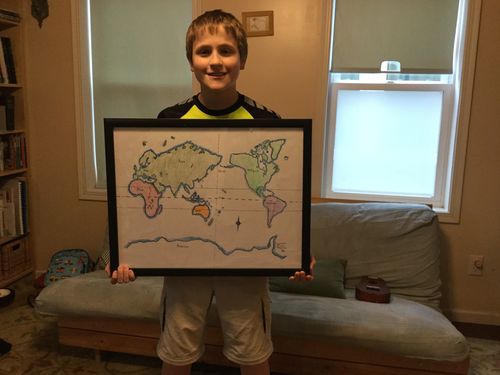
    In 1608, as in 2016, Good Friday fell upon March 25, the traditional date of the Annunciation.  Here is John Donne's take on this juxtaposition.

    Upon the Annunciation and Passion Falling upon One Day
    1608

    Tamely, frail body, abstain today; today
    My soul eats twice, Christ hither and away.
    She sees Him man, so like God made in this,
    That of them both a circle emblem is,
    Whose first and last concur; this doubtful day
    Of feast or fast, Christ came and went away;
    She sees Him nothing twice at once, who’s all;
    She sees a Cedar plant itself and fall,
    Her Maker put to making, and the head
    Of life at once not yet alive yet dead;
    She sees at once the virgin mother stay
    Reclused at home, public at Golgotha;
    Sad and rejoiced she’s seen at once, and seen
    At almost fifty and at scarce fifteen;
    At once a Son is promised her, and gone;
    Gabriel gives Christ to her, He her to John;
    Not fully a mother, she’s in orbity,
    At once receiver and the legacy;
    All this, and all between, this day hath shown,
    The abridgement of Christ’s story, which makes one
    (As in plain maps, the furthest west is east)
    Of the Angel’s Ave and Consummatum est.
    How well the Church, God’s court of faculties,
    Deals in some times and seldom joining these!
    As by the self-fixed Pole we never do
    Direct our course, but the next star thereto,
    Which shows where the other is and which we say
    (Because it strays not far) doth never stray,
    So God by His Church, nearest to Him, we know
    And stand firm, if we by her motion go;
    His Spirit, as His fiery pillar doth
    Lead, and His Church, as cloud, to one end both.
    This Church, by letting these days join, hath shown
    Death and conception in mankind is one:
    Or ‘twas in Him the same humility
    That He would be a man and leave to be:
    Or as creation He had made, as God,
    With the last judgment but one period,
    His imitating Spouse would join in one
    Manhood’s extremes: He shall come, He is gone:
    Or as though the least of His pains, deeds, or words,
    Would busy a life, she all this day affords;
    This treasure then, in gross, my soul uplay,
    And in my life retail it every day.


  • What I see.

    I am not writing this for people who are fans of Donald Trump.

    Here’s what I see in the man: a certain type of abuser, courting the abused, in a certain stage of the relationship.

    It’s the stage of You are special; I am special; we are special; you are the only one who really understands me; I am the only one who really understands you.

    Those other people: they’re going to try to get between us. They’ll never understand how important it is, this thing we have, you and me. They just don’t get it.

    Those other friends of yours — they’re trying to turn you against me. And I am the only one who really understands you. They’re trying to destroy us. This thing we have together.

    The rest of your family — they are manipulating you, lying to you. They don’t know me like you do. Don’t listen to what they say. They’re crazy. They’re out to get us. I am the only one who really understands you.

    Oh, she said what to you about me? Really? Wow. She’s really over the edge. Of course she would say that. Do you really think you should be listening to her? I can’t tell you what to do, but I know I wouldn’t put up with someone who says the things she does about you. You do what you feel comfortable with.

    The rest of us can no more hope to change the minds of someone in thrall to this than we can hope to make the smitten see, early on, that the abuser is No Good. The abuser takes on a different personality, a plausibly deniable personality, depending on the audience. The enthralled really do understand the abuser differently from how the rest of us understand him, because they see one carefully-cultivated side while the rest of us see another.

    We may attempt an intervention. We may try to describe what we see. In doing so, we confirm to the lover everything the abuser has laid out in his case against us, behind closed doors. The lover, once our friend and companion, concludes, “You are crazy; he is right; you are trying to drive a wedge between us. I understand him; you do not. He understands me; you do not. You are against him, against us, against us both.”

    We have no credibility anymore with anyone in thrall to this certain kind of abuser, the kind who can convincingly manipulate appearances and reality. Usually this happens slickly, skillfully, intuitively.

    Occasionally something misfires and the abuser lets fly with something so blatantly a lie that no one could ever fall for it. Up is down, black is white, I own the successful business that produced these steaks; never mind the packaging. The lie is so amazingly obvious that the rest of us are left wondering what the hell just happened. Did he really say that? Did he really say that thing that could be proved wrong with a simple photograph? Did he really contradict what was right in front of every single one of us? And look what has happened — we are actually questioning our own experience, because it’s just so damn insane. This kind of an abuser is so used to having power over people that he tries it with everyone, even us, and it almost works — sort of (he can’t possibly have lied about something so obvious — he can’t possibly — it can’t really have happened — did it?)

    That’s what I see.


  • Homeschooling high school: ideals versus reality.

    “Here’s what’s wrong with me as a homeschooler,” I said to my husband as we got ready for bed last night. “I would rather spend hours making a spreadsheet that divides up the chapters in my college physics textbook into ‘AP Physics 1’ and ‘AP Physics 2,’ than spend any time at all teaching children how to spell or punctuate.”

    He refused to comment, except to laugh at me.

    + + +

    I am now getting to the point where it seems that most of the circulating articles about home education turn out to be written by people whose children are all younger than mine. Thus, they often have limited utility. Not that I can’t still benefit from ideas about how to teach my younger children, but I can only really use the ideas that work in a family that ranges from toddler to tenth grade. So why is that?

    Some friends of mine pointed out that those with older kids might not want to write about them, in order to protect their teens’ privacy; true enough. Still, it seems that there should be plenty to write about without oversharing. As for me, I try to write about my own experiences rather than details about my oldest sons’ life: how I designed the curricula, how I organize my day, how the co-schooling works. I confess to posting the occasional photo, with permission.

    Another point: a lot of people change their approach from homeschooling to institutional school, when the high school years come around. I have never taken a survey, but it seems to me that on the order of half the members of our local Catholic home education support group send their teenagers to some kind of “away school.”

    (Incidentally, I have served on the board of that group for a couple of years now. The group used to host a monthly meeting every winter on the general topic of “high school.” Last year, after uniformly annoyed feedback from membership about the lack of focus, we decided to start a new tradition of alternating: in odd years, we hold a meeting on the topic of “homeschooling high school,” and in even years, we hold a meeting on the topic of NOT homeschooling high school, a.k.a., “high school alternatives,” a.k.a. “how to discern where to send your previously homeschooled children.”)

    And then, of course, there’s the halfway house called PSEO here in Minnesota — high school juniors and seniors, including those not enrolled in traditional high school, can take tuition-free college courses that count both towards high school graduation credits and towards college credits. It still feels like homeschooling or at least a natural extension of it — most of us have been delegating parts of our children’s instruction to various paid and unpaid instructors for years by then — but it is definitely an institutional school, and Mom and Dad definitely aren’t running the show anymore.

    + + +

    One of the most common questions that we get, when we tell people we educate our kids at home, is “Are you going to do it all the way through high school?” My answer has always been that we will take it one year at a time, one child at a time, continually evaluating our family’s needs. And that has always been true. But I have always been confident that we could do a good job directing our kids’ high school education. I will go even farther for myself and say that I’ve been more confident about high school than about elementary or middle school. I feel like I had to wait so very long before I could teach proof-based geometry, precalculus, chemistry, physics. The years of teaching children how to read, spell, cipher, and punctuate… ugh.

    (On the other hand, helping elementary school and middle school kids to learn art, art-based geography, and Latin has been really fun. Probably because I got to learn a lot along the way.)

    Competency in home education is, apparently, a thorny question. Professional educators often (not always) see educating children as something one should be “qualified” for, ideally by some kind of licensed gatekeeper. I pass most of the spoken and unspoken qualifications: I hold an advanced STEM degree, which theoretically qualifies me to teach at the college level, and possess a rather generous helping of class- and race-based privilege.

    I normally don’t mention the degree to strangers who question my qualifications, however, because I believe that the competency to educate our own children is something that belongs to us by right and by nature, just as the competency to feed and clothe them does. It’s possible for parents to squander or destroy that competency, but it’s presumed to belong to us otherwise. Last fall Leila Lawler @_Leila of Like Mother, Like Daughter tweeted this, which I think sums it up perfectly:

    But families are the experts in education. If they lay claim by means of their commitment.

    And I think that’s right. It is not unconditional; but the “if” of that condition is entirely up to us. We choose to lay claim, by means of our commitment, or not.

    The thing is, you can still be a home educator and delegate the instruction of one or more subjects to some outside expert, or at least someone who’s better at it than you are. Delegation is part of laying claim to our roles as primary educators. I do this with music: my young children are enrolled in preschool music classes, and some of my older children are enrolled in a children’s choir taught by genuine, professional, paid music educators and choral experts. I also do this with English literature and composition, in a sort of barter fashion: I have turned it all over to my close friend H, with her English degree, her apparently boundless patience, and her great interest in teaching children and teens to write and to read critically. My children are reading way more interesting stuff with her than they would be reading with me.

    (The middle way is, of course, to learn a subject along with your offspring. And that’s my favorite way, at least when I am interested in the subject.)

    + + +

    Let’s see, where am I going with this. When people heard that I was willing, even eager, to teach high school kids, they often responded, “I could never do that!” Before I had a high schooler myself, I often marveled (privately) at what I saw as their lack of confidence. Hadn’t they graduated from high school themselves, or even college? Didn’t they realize how much work a high school student does independently? Didn’t they know how many resources there were out there for the odd subject that they weren’t comfortable teaching themselves? Didn’t they know that anyone can get their hands on the teacher’s manual these days?

    I am less snobbish about that now, because while I am happy and confident teaching some high school subjects and delegating others, I have enough experience now to know that it’s actually a lot of work. Enjoyable work, but work, not leisure, and not just a special kind of family life.

    I still think that anyone who wants to educate their high school student at home can do so. But I appreciate better than I did before that not everyone will want to, for reasons that might well be good ones and are certainly personal ones. The most obvious difficulty I have right now i
    s that I am spread very thinly over the educations of a kindergartener, two middle-school students, and the high schooler, not to mention the demands of a toddler and, to put it bluntly, my own aging body. Caffeine can only keep me going for so long.

    Today, Saturday is my school planning day. I am spending part of it on this blog post, because the big picture is good for me, I guess. I am spending part of it on dividing up my physics materials into Physics I and Physics II, roughly along the lines that the AP people divide it, so I can start putting together next year’s syllabus. (My homemade high school science program, so far, is 1 year of evolutionary biology, 1 year of chemistry, and 2 years of physics. I use college textbooks.) I am spending part of it on shopping for art supplies for middle schoolers’ final geography project, and browsing for ideas for a high schooler to self-teach at least one credit of fine arts. I am spending part of it on copying worksheets for a child who is still learning to read. I am spending part of it on reworking my daily schedule for the rest of the year to incorporate more practice with spelling and mechanics for my one child who lags well behind grade level in that area.

    Oh my, I hate teaching spelling. Some kids do just fine. Others never seem to get it. You can pour so much time and attention on it into some children, and eke out so little payoff. But really, would any more progress be made in a classroom of twenty children? So we keep pouring, and eventually find the point of diminishing returns, the point where you stop; fifteen more minutes a day on, say, math, or reading a good book, will do him more good (won’t help the spelling, but will do him more good) than studying spelling for fifteen more minutes. We educate the whole child, not just the subject with his lowest test scores.

    And that’s how it is. But I won’t deny that every minute I am going over spelling (“Doesn’t. What’s the basic word? Do. How do we get from do to does? Add ee ess. How do we get from does to doesn’t? Add en apostrophe tee”) I am looking forward to the Pauli exclusion principle, and the vector product, and the conservation of angular momentum, and the Arrhenius equation, and the fundamental lemma. It feels strange now, while I sit by my kindergartener helping him tell “b” from “d” that I don’t have to wait years for it any longer, but (sometimes) only until after lunch.


  • How I teach my kids to read, an empirical approach: VIII. A quick overview to get to the advanced flashcards, with a phoneme index.

    Eighth post in a series.  See here for:   

    • Materials:
      •  Part II.  "Sandpaper phonemes," a basic set of flashcards
      • Part III. Lists, slates, and readers
      • Part IV.  Advanced set of flashcards.
    • Method:
      • Part V.  Beginning with a one-to-one code.
      • Part VI.  Script for the first two lessons (including the Word Building exercise).
      • Part VII.  Script for two more early lessons (including the game of Honk).

    + + +

    This post is a bit of a digression into the future, by request of commenter GeekLady, who wants to go straight to the phoneme index for the advanced set of flashcards.

    Really I should already have given an overview of the basic one-to-one code first.  I'll try to do a quick explanation as background, followed by an overview of the advanced code.

    + + +

    Okay, to sum up:  I divided my program into two parts:  the basic, "one-to-one" code, and the advanced, "many-to-many" code.  

    Overview of the basic, one-to-one code

    My goal, in the basic part, is to cement in the student's mind that what we're doing, when we read, is decoding: each spelling represents a sound.   I try to completely avoid confusion during this crucial period, essentially, by concealing the fact that English spelling is difficult to read.  There are already many difficult things going on here:  the child is learning the symbols, learning to blend a series of discrete sounds into a smoothly pronounced word, and (eventually) having to sort out the digraphs (e.g., learning to recognize that "ch" as a pair is not to be read as /k/ /h/).  

    I teach those sound/spellings in groups, practicing each group until they are mostly learned, and then moving on to the next group.   During this time, I never present the student with any words that contain a sound/spelling I haven't taught.  I have pre-decided the order in which I will introduce the spellings, so that I could compose a progressive series of lists of available words.  The list gets longer the more sounds the student knows.

      Photo (12)

    Here's the order in which I introduce them.  I've enclosed the sounds in slashes and the tilde ~ stands for "spelled."

    • Single letters, Group 1:  /m/~m, /a/~a (as in hat), /s/~s (as in sat), /k/~c, /t/~t, /p/~p, /n/~n, /f/~f
    • Single letters, Group 2:  /b/~b, /i/~i (as in hit), /r/~r (as in red — not as in her), /u/~u (as in cut), /g/~g (as in big), /h/~h, /j/~j, /d/~d
    • Single letters, Group 3:  /l/~l (as in lab OR as in pal), /e/~e (as in led), /w/~w, /v/~v, /y/~y (as in yell), /z/~z, /ks/~x, /kw/~qu, /k/~k  (see note below)
    • Essential digraphs, Group 1:  /er/~er, /sh/~sh, /ae/~ai (as in pain), /th/~th (as in bath), /ee/~ee, /ng/~ng
    • Essential digraphs, Group 2: /ch/~ch, /ar/~ar, /oo/~ew (as in threw), /oi/~oy, /ie/~ie (as in pie), /k/~ck
    • Essential digraphs, Group 3:  /dh/~th (as in them), /oe/~oe (as in toe), /oo/~oo (as in wood), /ou/~ou (as in cloud), /or/~or, /ue/~ue (as in cue)

    Note:  In the Single Letters, Group 3, I've included a peek ahead at the notion of digraphs (qu) as well as a peek ahead at the notion of multiple spellings for the same sound.  The child already knows that the sound /k/ is encoded by the letter "c," and now he is introduced to the notion that it is also encoded by the letter "k."  Along the way, incidentally, he's encountered the notion that double letters like "ss" or "bb" encode a single sound — which should set us up, later, to accept that "ck" also encodes a single sound.

    At this point, the student knows 42 sounds, in nearly one-to-one correspondence with 43 spellings.

    Then I transition to the Advanced Code by teaching just a few very important "code overlaps."  Where "multiple spellings" means that the same sound may be spelled several ways (such as /k/ being spelled either by "c" or by "k" or by "ck"), I use the term "code overlap" to mean that the same spelling may represent several different sounds.  Here are the code overlaps that I teach at the end of the basic one-to-one code:

    • Essential code overlaps:  /z/~s, /ee/~e, /oe/~o, /ae/~a, /ie/~i, /oo/~u (as in truth)

    The first gives us access to a great number of plurals, while the next five — I hope it is apparent — are the so-called "long vowels."  

    We get a little bit of practice reading words in which we have to try both the "short" vowel and the "long" vowel – none of which involve a so-called "silent E" — before moving on.  What's that?  Long vowels without silent e?  Sure: a as in  "safest" and "crater," e as in "helix" and "Swedish," i as in "tiger" and "wild," o as in "banjo" and "nomad," u as in "brutish" and "tulip."  Plenty of words to work on without getting into silent e.

    So that's what's known before moving onto the advanced code.

    Overview of the advanced code

    I teach the advanced code in groups of sounds, just as I did the one-to-one code.  I introduce one sound every lesson for five lessons, and then I spend five lessons (or more if necessary) practicing those five sounds.  There are two differences:

    • First:  The student has encountered almost all these sounds before, in the one-to-one code, and already knows one or two spellings for each one.
    • Second:  This time, I introduce the sound with several of the most-common spellings for that sound.

    What is a most-common spelling?  It's a spelling that occurs in more than two or three common-enough words (and I admit that I judged whether a word is "common-enough" sort of arbitrarily).  If a super-common word or two contains a unique spelling, I taught that word as a one-off along the way:  "Weird Words."  There aren't very many of them.  More on those another time.  

    At five lessons per week, alternating weeks of introducing new sounds and weeks of reviewing sounds, this phase would take about sixteen weeks.  There are eight groups of sounds, and about forty sounds.  I tried to arrange them so that there were about the same number of spellings in a group, and so that we weren't forced to practice already-learned spellings using words with yet-t0-be-learned spellings.

    Without getting into the minutiae of the lessons (yet), here is the index of lessons for the advanced code.  

    Index of lessons in the advanced code

    Unit 1.  Here I deliberately introduce "ld" for /d/ in the same week I introduce "ou" for /oo/ in order to use the words could, would, should.

    Sound Common spellings Example words
    /b/ b, bb, bu, be bed, rabbit, build, globe
    /d/ d, dd, ed, de, ld dig, add, canned, side, solder
    /or/ or, our, ore, oar, ar, oor corn, four, more, board, warm, door
    /oo/ oo, u, ou book, put, could
    /l/ l, ll, le left, dill, bubble, stole

     Unit 1 Weird Words:  woman, Catholic


    Unit 2.  This unit merges the vowels in "cot" and "caught;" even though my family speaks a dialect that distinguishes them, I find it simplifies things to teach the two together.

    Sound Common spellings Example words
    /n/ n, nn, ne, kn, gn no, cannot, nine, knit, gnat
    /j/ j, g, ge, dge job, angel, large, bridge
    /o/ o, au, aw, a, ough, augh pot, Paul, draw, father, bought, caught
    /s/ oo, u, ou book, put, could
    /ar/ l, ll, le left, dill, bubble, stole

     Unit 2 Weird Words:  one, once, broad, honest, honor, psalm, sword, answer


    Unit 3.  Did you ever notice that "ng" does not spell /ng/ in the word "hunger?"  And I introduce the schwa here, over the course of a couple special lessons just for it.   I call it the "Lazy Sound" with small children. Why do I teach it here?  Because you need it in order to read nearly all the common words in which "i" spells /y/, like "million" and "billion" and "savior."

    I'll write a post all about the schwa later.

    Sound Common spellings Example words
    /m/ m, mm, me, mb map, hammer, lime, climb
    /ng/ ng, n ring, think
    /oe/ oe, o, oa, ow toe, most, boat, own
    /er/ er, ir, ur, ar, or, re, ear her, bird, turn, worm, Oscar, fire, earth
    schwa (lots) (this is subject for another post)
    /y/ y, u, i yell, cure, million

     Unit 3 Weird Words:  soul, shoulder, though, dough, weresugar


    Unit 4.

    Sound Common spellings Example words
    /t/ t, tt, te, ed ten, attic, stopped, gate
    /f/ f, ff, ph fan, stuff, phone
    /ie/ ie, i, y, igh flies, fly, wine, fight
    /ue/ ew, u, ue few, cube, fuel
    /ou/ ou, ow about, tower

    Unit 4 Weird Words:  cough, enough, laugh, rough, tough, goodbye, diaper, island, eye


    Unit 5.

    Sound Common spellings Example words
    /r/ r, rr, wr, re brick, carrot, wrap, share
    /g/ g, gg, gu gas, egg, guess
    /w/ w, wh water, when
    /sh/ sh, ti crash, lotion
    /ae/ a, e, ai, ay, ey, ea, eigh, ei bagel, very, saint, day, they, break, eight, reindeer

    Unit 5 Weird Words:  rhyme, rhythm, rhino, ghost, who, whom, whose, machine, special, passion, pressure


    Unit 6.

    Sound Common spellings Example words
    /h/ h hello
    /p/ p, pp, pe path, apple, hope
    /k/ c, k, ck, ke, ch garlic, milk, rock, alike, stomach
    /u/ u, ou, o shut, touch, some
    /oi/ oi, oy coin, boy

     Unit 6 Weird Words:  who, whole, yolk, conquer, unique, ache, was, what, blood, flood, does


    Unit 7.

    Sound Common spellings Example words
    /i/ i, y big, gym
    /dh/ th smooth
    /gz/ x exist
    /e/ e, ea chess, bread
    /oo/ ew, oo, ue, u, ui, ou, o chew, loom, glue, flute, fruit, soup, move

     Unit 7 Weird Words:  bathe, breathe, clothes, exhaust, friend, canoe, shoe


    Unit 8.  In this unit we mention one extra spelling of an earlier sound, "ure" for /er/, because it so commonly follows an "s" that spells /zh/.

    Sound Common spellings Example words
    /v/ v, ve van, cave
    /er/ ure* injure
    /zh/ s, si measure, explosion
    /ch/ ch, tch, t, ti lunch, itch, picture, question
    /z/ z, ze, zz, s, se, ss zipper, freeze, fuzzy, is, close, dessert
    /ee/  ee, ea, ie, y,e, i, ei, ey wheel, speak, priest, empty, equal, ski, weird, turkey

    Unit 8 Weird Words:  calves, halves, beigegaragexylophone, business, react, people, pizza

    *Other spellings of /er/ were taught in Unit 3.


    The way this works on the level of the lesson:  We have three worksheet activities for each sound, given in three consecutive lessons.

    • The first activity introduces all the new spellings.  I give a list of words containing the new sound, circle the spelling in each word, and have the child read it.
    • In the second activity, the child finds the spellings and circles them, then reads the words.
    • In the third activity, we study code overlaps involving the sound.  Given words containing the same spelling but different sounds for that spelling, the child sorts the words.

    More details another time!