bearing blog


bear – ing n 1  the manner in which one comports oneself;  2  the act, power, or time of bringing forth offspring or fruit; 3 a machine part in which another part turns [a journal ~];  pl comprehension of one’s position, environment, or situation;   5  the act of moving while supporting the weight of something [the ~ of the cross].


  • Compassion, pity, and blame.

    Even though it’s probably irresponsible to diagnose, amateurishly, from a distance via the Internet, I’ll tell you what I think to be true: Donald Trump is mentally ill.

    Or, more specifically, and more fundamental to his nature from the very beginning — after all, mental illness can come upon a person late in life — I think he has a personality disorder, almost certainly one of the Cluster B disorders, probably narcissistic personality disorder.

    I’m not going to take the time to marshal the evidence here — it is easy enough to find. Here’s my point.

    If Donald Trump’s mind and personality is as deeply disordered as I think it is, then there is not much point in hating and blaming and cursing the man. If there is ever an appropriate place for hating and blaming and cursing a person, it is surely not because of a mental condition that he has probably been affected by since he was a small child. Indeed, there’s even something unseemly in mocking him, the person, as ridiculous and clownish and mean as his words and actions have been.

    The man is sick. I truly believe that. If we are human persons and he is a human person, the only acceptable response to him is a response of love. And if the only form of love we can muster for a mean, small, twisted, stunted mind and heart like his is the form we call “pity,” then we should muster it with all the strength that we can.

    If a saint can overcome her instinct of fear and disgust to clean and bind the sores of a dying, diseased, homeless person, then surely we can overcome our disgust at the sight of a festering and starved spirit.

    What good will it do? They all die in the end.

    A question to ponder, no?

    + + +

    Pity and forgiveness does not compel us to stand within reach of an abuser, however. Dangerous tools must be removed from the reach of the people who would hurt themselves and others. That’s prudence. That’s justice: we protect the innocent, even from people who can’t help being who they are. Justice also demands that we insist on right and just behavior, we forcefully condemn injuries and wrongs.

    There’s no excuses here.

    But where mocking ceases, pity can remain.

    + + +

    And on the other hand:

    There are a large number of people who, let’s put it bluntly, out of pure self-interest and the love of money and power, colluded to put dangerous weapons in the reach of a literal madman, colluded to excuse his ravings and to call them sane.

    Those people?

    Not born that way.

    I’ll leave you to draw your own conclusions about what compassion for them should look like.


  • Cognitive dissonance and 2016.

    One significant casualty of the Trump candidacy might arise from massive cognitive dissonance among well-meaning early supporters, like the primary voters who made this all possible, and people like them who told their friends and family and/or local news crews that they planned to pull the lever for Trump in the general election.

    It is well-established that people will unconsciously go through all sorts of mental gymnastics to avoid admitting in the face of new evidence–even to themselves–that they have made a serious error in judgment. See the Wikipedia article “Cognitive dissonance” for an overview of the details:

    In psychology, cognitive dissonance is the mental stress or discomfort experienced by an individual who holds two or more contradictory beliefs, ideas, or values at the same time; performs an action that is contradictory to one or more beliefs, ideas, or values; or is confronted by new information that conflicts with existing beliefs, ideas, or values.

    A key tenet of cognitive dissonance theory is that those who have heavily invested in a position may, when confronted with disconfirming evidence, go to greater lengths to justify their position….

    Dissonance is felt when people are confronted with information that is inconsistent with their beliefs. If the dissonance is not reduced by changing one’s belief, the dissonance can result in

    • restoring consonance through misperception,
    • rejection or refutation of the information,
    • seeking support from others who share the beliefs,
    • and attempting to persuade others.

    So let’s review what we have got out there. Unless you assume that most Trump supporters (instead of a small fraction) consciously relish the notion that girls and women are objects, seethe with more-than-implicit contempt for minority groups, and argue that Constitutional checks on executive power are part of the problem —

    — and I don’t think that’s true —

    — there’s a large bloc of people out there who are being faced with numerous pieces of evidence that they have judged very, very poorly, but are already “invested” in that judgment.

    A population experiencing cognitive dissonance.

    Some of them undoubtedly will walk back their support. A number will do so in the privacy of the voting booth, and then will hope that their mistake will just go away. Some will renounce their former support even publicly. They will admit that they were taken in — they might come up with some way to save face, to insist that given the information they had at the time, it wasn’t such a crazy idea (the past, even the 1990s, is a foreign country). Those people will attempt to start fresh.

    Good for them.

    But some fraction of this well-meaning voting bloc, faced with the choice of either accepting evidence that shows they chose poorly, or of forcing the evidence to fit their own unconscious desire to avoid that discomfort —

    — some as-yet-unknown fraction of what is a pretty large chunk of the electorate —

    — some of those are going to adapt by a psychic doubling-down on the notion that “what America needs is someone like Donald Trump.”

    For a number of this fraction of the electorate, the doubling-down is on “Trump is objectively bad, but the spectre of a Clinton presidency is probably worse.” This development is not what I would call surprising, given the state of political discourse; America has already demonstrated, in spades, that we are willing to think and believe massively terrible things of even decent people in the Other Party. And because it maintains some hold on the evidence, it isn’t quite as alarming — “who will be worse as president” is, technically, a matter of opinion and prediction of an unknown future — even as the question is sidestepped: How bad would your candidate have to get, anyway, to change your mind?

    I’m concerned about the fraction who can’t comfortably think of themselves even as reluctant supporters of an objectively bad man, or who are already invested in the notion that Donald Trump is the leader that America positively needs.

    A number of people will not be able to deny that Trump said the things he said and did the things he did, but they also will not be able to divest themselves of their enthusiastic early support. And these people have only one refuge: to maintain that what Trump evidently is…

    … is what America really needs.

    This population, nudged by our common human need to not be wrong, is going to become invested in the notion that we need exactly what Trump is dishing out.

    America needs, e.g., more honest talk, of the sort that goes on in locker rooms, where deal-making men don’t have to worry about political correctness. (link)

    America needs, e.g., to be tough on crime, not soft like that New York DA who let those five confessed black rapists out of prison just because of some so-called DNA evidence. They confessed, didn’t they? (Link)

    America needs, e.g., someone who will order U.S. troops to commit war crimes… what do people in faraway Geneva know about American interests? America needs someone who isn’t afraid to offend people — no, America need someone who takes visible pleasure in offending people. America needs someone who will stand up to obstruction in Congress, who won’t let legislation or advice and consent stop him. America needs a strong man, a proud man, a man whose gospel glitters with prosperity, smells of it.

    America needs to call evil good, and good evil.

    That’s what we will hear, because a number of formerly well-meaning Americans will need it, at a deep level, and they will need the rest of us to approve of it too.

    They are going to say it out loud, and it will take an effort to fight this notion, because the more people are invested, the harder it is to cut their mental losses. It will also take more than a little self-discipline for the rest of us to fight it without sinking to that level ourselves, and to fight it effectively — because what effectiveness requires is for the rest of us to craft a way that initially-well-meaning Trump supporters and endorsers can save some kind of face, emerge with their tattered dignity intact. And that means forgiveness, something that is hard for every human, because forgiveness itself requires overcoming cognitive dissonance of our own.

    + + +

    To sum up: This is on the GOP leadership. By signing on enthusiastically, by squelching voices of principled dissent — I watched the convention feed with my own eyes, don’t tell me they couldn’t see what I saw and hear what I heard — by throwing their weight behind this man — they legitimized a bad, bad candidate. They gave voice to ugly ideas. And they’ve harnessed human psychology to assemble an army of people whose easiest mental exit from the discomfort of what they’ve created is via 1930s-level nationalism.

    We are going to be fighting this army with one hand, the other held out in an offer of peace-through-repentance, for a very long time.


  • Pulled pork from a giant frozen slab.

    Earlier this year Mark was offered the opportunity to buy many, many pounds of pork loin at a very reasonable price.  He did not realize when he agreed to purchase said pork loin that it would be delivered frozen in the form of "whole pork loin," which I think is a beast he had never before encountered.

    Here is one of the pork loins inside my large deep freezer (baking soda box added for scale):

    IMG_1880

    I'm not actually sure how many pounds this thing weighs, because I would have to take it upstairs and weigh it using the Baby Method, where by you step on the scale holding the frozen pork loin, then hand the frozen pork loin to someone else ("Here, hold my pork loin"), and then perform a subtraction, presumably while your loin-weighing partner is daintily juggling the meat from hand to hand so that it does not conduct enough thermal energy away from his or her skin to generate frostbite.

    I do know that it does not fit in my microwave oven, crockpot, or sink.   Had it been delivered unfrozen, I might have cut it and its brother loins (we had something like eight of them) into reasonably sized pieces, wrapped them individually, and then frozen them as roasts and steaks and the like.  As is, I let them sit in my freezer most of the summer as I brooded over the best way to deal with them.  A repentant Mark offered to cut them up with some sort of power tool, but I accepted that, just as bringing home the bacon (so to speak) falls under his sphere of domestic responsibilities, preparation of said bacon mostly belongs in mine.*  

    + + +

    Anyway, the frozen pork loin almost fits in my picnic cooler, so (after reading up on related topics, viz. the brining of Thanksgiving turkeys) I jammed it into the long-diagonal dimension of the picnic cooler.  Then I set the picnic cooler on my kitchen counter, with the little drain hole oriented over the sink for safety (but closed), and filled it with water by holding down the trigger of my sink-sprayer-on-a-hose for, like, ever.  I mostly closed it (it wouldn't quite close) and went away.

    The first time I did this, I dutifully changed the water surrounding the pork loin, as food-safety experts say you should now and again when you are thawing meat by submerging it in cold water.  This turned out to be more trouble than I expected.  After the drain plug, which is attached with a flexible strip of plastic to the outside wall of the cooler, the rest position of the pluggy bit interrupted the jet of water, deflecting a spray in all directions.  Just as I had had to stand there filling the cooler by holding down the trigger of my sink-sprayer with my aching thumb — indeed, just as I would have to stand there again to refill the cooler by holding down said trigger — I had to stand there holding the pluggy bit out of the way so that the water would course down into the sink, tracing a neat ever-diminishing parabola.

    A very cold parabola.  After a while I thought to go find a thermometer (after momentarily re-plugging the drain) to discover the temperature of a cooler of water in which a fresh-from-the-deep-freezer, plastic-encapsulated pork loin has been resting for several hours.  I discovered that the temperature was, in fact, colder than my refrigerator, which food-safety experts assure me is a delightful and life-affirming location for thawing meat.  I decided not to bother changing the water again.  By this time the pork loin was squishy enough that I could close the cooler all the way, so I did.

    + + +

    I did all that stuff right after breakfast.  The pork loin was thawed enough to cut into pieces by about two in the afternoon.  I cut it into about six pieces.  About a third of it went into my smaller slow cooker (the round one — I think it's a 3-quart, but I'm not sure — why the heck didn't Crock-Pot® print the size on the outside somewhere?), and about two-thirds of it went into my bigger slow cooker (the oval one).  And then I added a carefully researched liquid, divided proportionally to match the proportional division of the pork loin, as follows:

    Liquid What I Cooked The Slab O'Pork In

    • One liter of Coca-Cola
    • 3/4 cup of apple cider vinegar
    • 2 Tbsp salt
    • 1 Tbsp garlic powder
    • 1 Tbsp chili powder
    • A whole lot of freshly ground pepper

    Oh, and I think the first time there was some pork sticking up out of the liquid, so I put a piece of bacon on that bit.

    I put the slow cookers on low, and I cooked it for twenty-four whole hours.  I mean, it was three o'clock by the  time I had it all in the cookers, I couldn't exactly have it ready for dinner.  And I didn't want it for breakfast or lunch.  So, yeah, I cooked it for an entire day.

    And then I shredded it and froze it in Ziploc bags with enough liquid to moisten, and I had something like 13 pounds of cooked pulled pork.

    + + +

    Most of the time when I try new recipes, I figure out something I should do to tweak them.  None of that here.  The Coca-Cola plus vinegar is just the right blend of sweet and sour, the garlic and chili powder just the right kind of spicy, to be sufficiently neutral for all manner of applications.  

    The first day we had the pulled pork on homemade wheat buns with an assortment of bottled barbecue sauces, cole slaw, and applesauce.  

    Later I put the meat plain on telera rolls, topped them with sautéed peppers and onions, and melted Provolone cheese on it under the broiler — sort of a cheesesteak, or rather, a cheesepulledpork.

    Another time I made banh mi out of them, on baguette with pickled carrots, cilantro, Braunschweiger standing in for the French pâté, sliced jalapeños, and fish sauce.

    Another time I made pork fried rice, with pineapples.

    Another time I mixed it with hoisin sauce and we rolled it up in tortillas with gingery cole slaw.

    Last week I stuffed it with barbecue sauce into baked potatoes and melted cheese on top — a Budget Bytes inspiration.  (There are many recipes there that use pre-cooked shredded meat — this was one.)

    Anyway, just about anything that calls for shredded meat, this will work in, from pizza to enchiladas to tacos to stir-fry.  I highly recommend it.  If you are using a smaller piece of a pork loin that fits in one crock pot, use between one-third and two-thirds of the cooking liquid amount that I described.  Or go ahead and invest in a giant slab of frozen meat and a picnic cooler.  You won't be sorry, even if you wind up with an aching thumb.


    _____

    *Unless the propane grill is involved, the investigation of the reasons for which is a cultural-anthropology dissertation for another day.


  • Turning a little knowledge into more.

    Refugees are people:  men, women, old people, young people, teenagers, children, infants.  

    I typed and retyped the introductory sentence for my post and settled on that one, because apparently there's some controversy about that point.  Now I'll move on.

    + + +

    Mark and I decide yearly where to send our family's charitable donations.   The summer's news moved me to look this year into helping and welcoming the families who are being directly resettled here after fleeing the violence in Syria.   Of course, there are national and international organizations who could use our money, but I also wondered who, if anyone, was doing that work locally.  

    Although Gov. Mark Dayton sharply criticized those state governors who refused to accept people from Syria, I discovered, nobody in Minnesota really expects anyone from Syria to be directly resettled here.  There isn't an established community.  But Minnesota does expect to have welcome an increased number of refugees by the end of 2016.  The largest number, as for the last few years, are from Somalia.  

    I knew this, of course, because I live in South Minneapolis, which is home to one of the largest communities of Somali people outside Somalia itself.  The greatest concentration, as well as the most visible cluster of businesses owned by and catering to Somali immigrants, is the Cedar-Riverside neighborhood a bit north of us.   But many Somali people live in our neighborhood as well.  Yesterday evening, a Tuesday, I was at the YMCA a mile from our house, running around the track that circles the second level of the gym; the gym was crowded, half by badminton players and half by basketball pick-up games, and the basketball side was (I estimate) 90 percent Somali.  Mostly young men and teenage boys, but a few little girls in brightly colored hijabs darted in and out, and there were a couple of teenage girls, too, practicing free throws.  Much of the signage in the YMCA is printed in English, Spanish, and Somali, and you'll see this in other places too, like on bank machines and sometimes shop windows.  In the winter, when everyone else at the bus stop seem to disappear under fluffy parkas, the distinctive skirts and hijab of Somali women still stand out above and below the winter coats, orange and green and turquoise and purple against the snow and the gray pavement.

    + + +

    We will probably make a donation this year to one or more of the local organizations that work with refugees.  (See below* for a list.)  In the meantime I realized how very little I know about the community of refugees that already lives all around me.  I decided to change that.  

    511xiQY8AOL._SX331_BO1,204,203,200_I picked up a book published in 2012 by the Minnesota Historical Society Press, part of the People of Minnesota series: Somalis in Minnesota by Ahmed Ismail Yusuf.  It's less than 70 pages long and well footnoted.  The book describes the history of the nation of Somalia, how the fighting started and how its refugee crisis began.  It tells how Somalis began to be resettled in the United States in the early 1990s, almost all in the San Diego area, where there was already a small community of ethnic Somalis that had settled there from Ethiopia earlier.  But at the time, job prospects in the area were poor.  
    Minnesota, at the time, had relatively low unemployment.   So when the owners of a single poultry plant in Marshall, MN wanted to expand operations from two shifts to three, they advertised in other states, hoping to draw workers with a starting rate of $6.95/hour (forty percent higher than the federal minimum wage at the time) plus benefits.  A few young men drove to Minnesota to check it out, an event which Yusuf places neatly in the context of the Somali nomadic tradition, in which a few members of a large group would travel ahead to scout out a new, high-quality living site that would support the community.  Those young men were hired immediately; they passed the news to the rest of the community in San Diego; more followed; and that became the cradle of the Minnesota Somali-American community.  Once that community had become established, additional refugees from Somalia began to be settled directly in Minnesota.

    Yusuf goes on to describe some of the challenges that this first generation of Somali-Americans has had as it integrates into the wider communities of the local public school system, the Twin Cities, and the state of Minnesota.  Some of these early difficulties, I remember from the local news (kids fighting at Roosevelt High, some taxicab drivers — Yusuf calls them "ignorant" — who wouldn't transport dogs or alcohol from the airport) but that publicity had mostly faded away by the time the situations had been resolved.  These conflicts, Yusuf frames optimistically, pointing out that similar conflicts have marked the arrival of many other communities of immigrants who are now well accepted in American society.  He argues that the rapid growth of Somali-American businesses and the emergence of political and social leaders in the first generation is evidence that Somalis are doing relatively well, considering that they have been here less than 25 years and face significant cultural and language barriers.

     The most serious problem at this time is one that Yusuf treats at some length, and that is the active targeting of Somali boys and young men by paramilitary and terrorist organizations overseas.  Not long after I began reading the book, a 20-year-old Somali man injured 10 people in a mass stabbing at a St. Cloud mall before being shot by an off-duty police officer.   (As I write this, the nature of the attacker's connection to overseas terrorist organizations has not yet been clearly established.)  St. Cloud is 65 miles northwest of here, a much smaller city; earlier this year, a local and widely-read free newspaper proclaimed it "the worst place in Minnesota to be Somali."  But dozens of Minneapolis parents have lost sons,  some only teenagers, directly to recruitment from an al-Qaeda affiliate organization  in the Horn of Africa.  One became the first American citizen to commit murder-suicide by bomb in Somalia.  The FBI counterterrorism investigation in Minnesota is large and ongoing, and the topic casts a dark shadow.

    Still, Yusuf's book is optimistic and informative, and it left me wanting to know more still.

    + + +

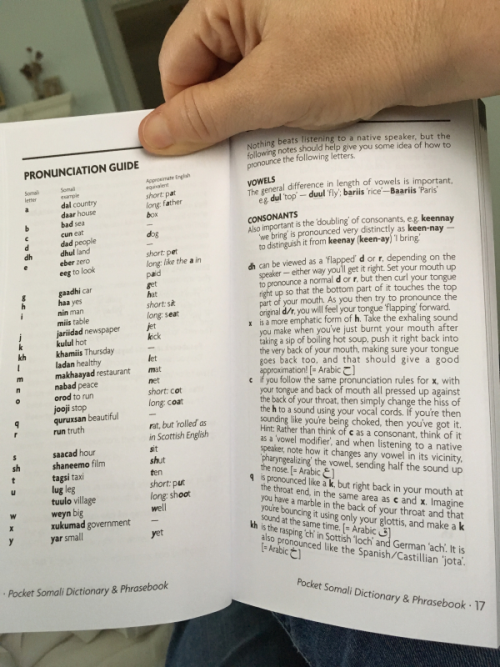
    The next thing I wondered was whether I could learn any of the Somali language.  Signs everywhere around here bear phrases of Somali  – some repeat the information on public signage, others are the names of shops and restaurants, still others appear in advertisements.  Qoraxey is the name of a home health care agency.  Dayax is the name of a grocery store.  I couldn't find any online tutorials; neither Duolingo nor Rosetta Stone nor Pimsleur offer courses in Somali.  The only textbook I found was kind of expensive, more than I wanted to spend for a brief introduction, so I started with a slim phrasebook and dictionary by Awde, Axmed, and Orwin.

    I started at the pronunciation section.  Somali has used a Roman alphabet since it was imposed in 1972, which makes it a bit easier on English speakers, but there are some phonemes not found in English.

    IMG_1842

    Got all that?  

    I did find a helpful video online called "Somali Pronunciation:  Just The Tricky Ones."  The narrator, who has a British accent, demonstrates how to pronounce the graphemes x, c, kh, r, q, dh,  and d/t.  I only find c and dh hard, though; the is just a trill, the kh is the familiar ending of loch and ach!x is just a throaty h  and just a really-far-back-in-your-throat k.  There's a glottal stop too.  Nothing complicated.  I think I can get the dh with a little practice.  The c will take a lot.

    (It also left me wondering why the Somali spelling reformers decided to go with the c instead of something else.)

    + + +

    I've been driving around and noticing signs and looking them up in the dictionary.  The Dayax grocery store is named "Moon."  The Qoraxey home health care agency appears to be named something like "sun" or "sunrise"  (qurax).  The Gargar clinic's name means "help," I think — at least, that's what the dictionary says gargaar means.  Clearly I have a lot to learn.

    Somali isn't Indo-European — it is a Cushitic language, which means that it is in the same language family (Afro-Asiatic) as Arabic and ancient Egyptian but on a branch between them.  The grammar, therefore, is something entirely foreign to me, but maybe not so foreign as (say) a Sino-Tibetan language would be.  But there are words that leap out at me when I go through the dictionary:  aadami means human (hello, Adam!), roodhi is bread (must be a cognate of India's roti).  Colonialism and technology has left the language with many Western loanwords:  capsicum (sweet) peppers are berberooni, which has to be from the Italian peperoni; a physician is a dhakhtar or dhakhtarad; cheese is farmaajo; oven is foorno.

    The other day, while I was running around the lake, I practiced the consonants, pronouncing the Somali word for "beautiful" over and over:  quruxsan, quruxsan, quruxsan.  A soft "k" in the back of the throat, the vowel of "put" twice with a trilled "r" between, then a throaty "hhh-san."

    I haven't even started to look at how to put together a sentence, or assign the right endings to nouns and verbs, or differentiate between masculine and feminine nouns (except to delight in the trivia that a masculine singular noun often has a feminine plural, and vice versa).  I have to start with words and spellings and pronunciations, and then move on to a little grammar.  I know many people would start with "Hello" and "My name is" and "Thank you," but I'm a visual learner and an analytical one; I'm going to try to get an idea of the way sentences are put together first, and how words can vary; and I'm going to remember these things better if I think of the words as things that are spelled and seen rather than spoken and heard.  I know, it's not natural-language-learning, but I know myself — when I hear words in English I see them inside my head, behind my eyes — and I need the spelled-out words to be the hooks on which I can hang and remember spoken ones.

    So this is my tiny side auto-didact project  for the fall.  I can already tell that I am going to need another book, probably the textbook that I'm now going to be willing to invest in, because the Awde book's grammar section emphasizes the importance of nouns' gender while its dictionary section does not list the gender of the nouns (!).  As soon as I can find a Somali-language newspaper in a rack of free publications at the front of a coffee house, I will be snatching one up.  And I'll visit the library around the corner, which boasts a small section of Somali-language children's books.

    I'm a long way from even saying "hello," but I hope to crawl a little farther along.

    _______

    *Catholic Charities of St. Paul and Minneapolis serves refugees through their Reception and Placement program, to which donors can designate donations.  The Minnesota Council of Churches provides refugee services as well. ECHO Minnesota provides multilingual broadcast programming and communication.  I'm particularly interested in finding out more about the International Institute of Minnesota, which I noticed when I lived near it in graduate school and looked into when I was considering taking Spanish classes myself; they provide immediate resettlement help but also offer job training and ongoing language education.


  • Honesty and the alternative lifestyle.

    Just before Labor Day weekend, on vacation at family camp, Mark and I found ourselves sharing a table with a couple, their own kids younger than most of ours, who inquired whether our kids hadn’t started school yet. Here in Minnesota most schools do start after Labor Day by statute, though many districts have waivers to start earlier, so ‘not yet’ would have explained us; “we homeschool” is more accurate, and that’s what we said.

    “Must be nice to get to vacation whenever you want.”

    I have a few canned small-talk responses for strangers who comment about homeschooling. It’s better than it used to be, now that almost everyone knows someone who does it or who gave it a shot; we are no longer (necessarily) weirdos on the fringes of society. You really never know what people are carrying around with them, though, and I have learned to take a light approach.

    Yes, it is nice. It’s why we do it. We can start when we want, we can finish the school year when we want, we can take vacations when we want. We can get up when we want, go to bed when we want. We can ski during the off season, when tickets and lodging are less, and travel for a whole month during the school year. We can send the kids to stay for two weeks with Grandma and Grandpa any time of the year. I get up in the morning, the kids are all still in bed, and I stand on the porch with my coffee and watch the school buses rumble by, and I am still glad every year. I never have to sit in my car waiting in a pickup line for anyone. We aren’t beholden to anyone else’s schedule, and I love that.

    He was young, bearded, with a natural and affable laugh that carried across the room. His hat and flannel shirt and jeans could have belonged unironically to the Minnesota north-woods surroundings, or it could have been the urban hipster’s autumn uniform. The communal meal had begun with two camp songs: I had noticed him singing cheerfully with his kids to “Zip-a-dee-doo-dah” but when the “Johnny Appleseed Grace” began — Oh, the Lord is good to me, and so I thank the Lord — he’d sat down and attended to pouring juice for one of his kids.

    Now he looked straight at me and grinned. “Now that’s a reason for homeschooling I can respect,” he said, “a selfish reason!”

    I described the parent support group that I belong to, a Catholic group, and he expressed surprise that Catholics were into such a thing. In return, I was surprised that he was surprised by the existence of Catholic homeschoolers. It came out that he had experienced a fundamentalist religious background as a child, and he strongly associated homeschooling with that particular tradition. “Most of the time you run into people who are doing it for religious reasons, but I like your reason better.”

    “Well, we do it because it’s what’s best for our family. It’s basically the only reason we homeschool — I don’t really have any religious reasons.”

    That’s me speaking off the cuff, probably wanting to seem like Normal People to this friendly and likeable person who carried a certain prejudice — other comments he made throughout the conversation made that clear — towards religious families in general. In retrospect I thought of how I phrased that. I find that when I answer questions off the cuff I don’t make the responses I would make if I had time to think and to write out what I believe I ought to have said. The question I often ask myself is, which is the honest answer? The one that comes out of my mouth without thinking, or the edited version, the one produced on the staircase steps afterward, with the benefit of careful thinking?

    + + +

    In some ways I have been asking myself this question ever since my late teens.

    It is widely assumed that honesty is rapidly blurted out without thinking, that the careful presentation is usually a falsehood. I think there is a bit in C. S. Lewis about that, that the true nature of a man is revealed in the instant after you accidentally step hard on his foot.

    But I am not sure this applies to everybody in every context. I have, or had, a sort of self-preservation instinct, or habit, that I have noticed for a long time — in company I don’t know well, I will hear myself blathering all manner of lies about my own opinions and history. Mostly they are about completely inconsequential matters — one real example that I remember from years ago, whether I prefer crunchy peanut butter to creamy peanut butter. I almost can’t stop myself and will not notice the lie until it’s out of my mouth. I was aware of the habit by the time I was in high school, but I didn’t realize how often I did it until I had been dating Mark for a while — he was the first person outside my own family who both knew me intimately and frequently accompanied me to places crowded with strangers, and he would call me out on it (later, in private).

    I think I do it less now than I used to, but I am not sure. It’s unconscious, and I suspect that I don’t always notice myself doing it.

    I am absolutely sure that it doesn’t stem from a deliberate desire to mislead anyone. Sometimes I think it comes from not really having a firm conviction or opinion, and wanting to say something; afterwards I sometimes find myself unsure (crunchy or creamy?) of my own opinion, and wonder if false opinions, like false memories, can be generated by describing them. Other times I wonder if I am ashamed of my own thoughts and have to hide them.

    I think it’s a sort of misfiring of the mirror neurons: I am trying at a basic social-instinct level to play well with others, which doesn’t come naturally to me, and my brain guesses what people will be happy to hear from me and tries to produce it. Sometimes I think it is a result of growing up moving between two households which were in many ways deeply suspicious of each other, and not feeling safe in one home to express an opinion or attitude that might be imputed to the influence of the other.

    + + +

    So which is true: that I don’t have any religious reasons to homeschool and it’s just a lifestyle choice, or that I do homeschool “for religious reasons?” I have thought about this many times since that conversation ended, and I am on the fence — it seems both true and not true, depending on how you look at it. The cognitive dissonance comes entirely from wondering how it looked to my interlocutor. Was I denying my faith so I would look reasonable to someone inclined to think it unreasonable? (I know I said it reflexively, so I’m not consumed by guilt here, but such a reflex isn’t exactly something to be proud of.) Or is this actually a true statement, if awkwardly worded, so that I was being honest?

    In retrospect, the truth is subtler than that. Reasons rooted in the existential philosophy and moral system called Catholicism lie far back in the background, and permeate my daily routine at the level of structure while not always being explicitly called upon. I think this is probably true for a great many people with diverse philosophies.

    We homeschool as a lifestyle choice. And why do we choose this lifestyle? Well, we want our family’s daily rhythm to be decided by us and not by institutions around us. And is that just because we prefer one to the other, or do Mark and I actually think we can do a better job if we set our own rhythm than if we teach our children to accommodate to the rhythms of the majorities around us? Well, when you get right down to it I think our rhythm is really better, at least for us — maybe a different rhythm is best for different families, but for our family the rhythms of institutional school would be okay but this is better. And why do I think that this rhythm is better? Well, for one thing this particular rhythm keeps us all on the same schedule, keeps us together as a family, keeps the siblings together. We aren’t all on different schedules of the different schools we’d be in and of Mark’s workplace, but we are on the same schedule. It keeps us together more. And why is togetherness better tha
    n separateness, than individually? Well, because the family is the unit of society. We are meant to learn to be fully human as part of the family, not as individuals.

    And bam, there’s the existential part.

    Take everything we do (at least the things we’re sure and confident of, not the things that we wonder about, that maybe we aren’t doing right), keep asking “why?” and you get down to the bottom of it all, the structure, and that is where “religious reasons” usually reside. In that sense, we homeschool for religious reasons. I could have said so and that would be true, coming out of my mouth. Would it have gone into the young father’s brain and still been true? I don’t think so. He was primed to think of “religious reasons for homeschooling” as something more plain on the surface: people protecting their children from learning about evolution or from reading the wrong books or making the wrong friends. Or maybe something additive instead of subtractive: school time spent in memorizing scripture, opening and closing the day with prayer. And he might have imagined, knowing at least that religious convictions are often strong and absolute convictions, that a religious choice to homeschool implies a condemnation of the opposite choice.

    But of course, if the conviction is structural rather than superficial, it can be strong and even absolute while the superficies differ tremendously. Mark and I, in our particular environment and with our particular strengths, may begin with the notion that the family is the unit of human society — in the company of all the other notions that together make up our understanding of the proper ends of the human person — and derive “we should homeschool.” Another Catholic couple, in their particular environment and with their particular strengths, may begin with the same fundamental understanding but derive an entirely different “should.”

    What good reason do I have for anything that is not at bottom shaped by my understanding of the human person, of the nature and purpose of the human person in general and of my own powers as an individual person? And what is religion but that, those understandings?

    And yet, can you imagine if I were to say to the young father, for example, that I stay home and Mark works because of “religious reasons?” Would it be true for me to say that, if I knew for sure (instead of just thinking it probable) that he would immediately form a network of inaccurate assumptions about us? It isn’t false, and yet it is so incomplete as to leave the listener room to fill in the blanks — predictably — with a very, very wrong picture of me — and possibly a very, very wrong picture of Catholicism as a whole.

    + + +

    I have gone off on a tangent here, but this post was inspired by Amy Welborn’s second “quick take” from this post. I’ll quote most of the relevant part below.

    I finally arrived at the insight, such as it is, that a fundamental appeal of homeschooling today is as a lifestyle. This is something that people who don’t do it, and especially people who are antagonistic to homeschooling don’t understand: its great appeal as a lifestyle.

    I hope readers of my blog over the last few years have picked this up from what I have written. Much of what moved me to homeschool in the first place was a dissatisfaction with the lifestyle school forces on a family. We have so little freedom in the way we lead our daily lives anyway: work limits our families, as do economic concerns. School – with its daily, weekly and yearly schedules, with its homework and projects, with its fundraisers – slams one more constraint on. As I have written over and over again, the reason we accept this is that we accept that what school gives is worth what we must give over to it. The tipping point for many of us comes when we realize that what the school gives is not worth it and what it demands is counterproductive to our children’s flourishing and our family lives and that the resources available to us, our own schools, and our childrens’ not-yet-deadened curiosity means that we can do the same thing at home just as well or even better, and have a lot more fun doing it.

    So yes. I miss that lifestyle right now. I’m consciously and intentionally trying to help us be as efficient as we can in schoolwork so that outside school hours are still ours as much as possible. And the younger son and I have settled on a vision of the future which, given the assumption that he stays in school for middle school (which he doesn’t have to if he doesn’t want to) which takes traditional high school completely out of the picture.

    The thing about the “lifestyle” reason is that it resonates with people whose foundations are built on a wide variety of philosophies, many different from mine, but who recognize instinctively or naturally some things that I hold to be true with great conviction. If “religion” is about the nature of the human person, then many “religious” truths are accessible, observationally, to all humans — via scientific investigation, or via introspection. I think the lifestyle argument comes from a place of truths that are accessible to everyone, including people who think of “religious” truth as something pinched and narrow, and for whom the word is an instant turnoff.

    What’s the conclusion? I don’t know; it’s fair to say that I am motivated to believe myself reasonable, to believe myself honest, and to believe that I am not so eager to appear reasonable that I will deny what I know to be true.

    Flannery O’Connor famously described one of her characters in this way: “She could never be a saint, but she thought she could be a martyr if they killed her quick.” It’d have to be very quick, in my case, like before I could open my mouth.


  • First day of school.

    IMG_1786

    Starting with the photo that makes me look like a fantastic homeschooler.

    Yesterday I:

    • baked raisin bran muffins
    • went over to-do lists
    • made my bed and put away laundry
    • taught a calculus lesson to the 16yo — really a precalculus review, just graphs and slopes and intercepts
    • taught an algebra lesson to the 12yo — simplifying numerical expressions and evaluating variable expressions
    • met the three middle kids to assign Bible reading, find out who was the saint of the day, and introduce the 6yo to his catechism copybook
    • went through a math lesson with the 6yo — comparing two-digit numbers and reviewing how to tell time by the hour
    • phonics sheet with the 6yo — sorting words with "ou" pronounced as in "cousin" from words with "ou" pronounced as in "mouth"
    • had 6yo read to me the first few pages of Mr. Putter and Tabby Pour the Tea by Cynthia Rylant
    • cut up 6 apples out of each of which the toddler had taken 1 bite
    • ate leftover lentil vegetable soup and cheese sandwich on sourdough bread, while children ate their favorite brand of frozen pizza and cut-up apples
    • messed with FB while the children cleaned up lunch

    IMG_1787

    • put vegetarian taco soup contents into crockpot
    • cooked, for the freezer, two chili-pots' worth of ground turkey, onion, and spices
    • rested, flung onto made bed, for a little while, while children played video games
    • hoisted the toddler on my back in the carrier and walked to the library to find books about geckos
    • brought home books about sharks, sea otters, and T. rex instead because gecko books were not located where the library said they would be
    • welcomed the 6yo's biweekly playdate, who arrived dressed in a superhero costume with padded muscles
    • called 6yos down to read to them from the introduction to Story of the World Vol. 1.  Playdate child said "I'm kind of tired of having people read to me."  I said "Your mother said it would be good if I read history to the two of you while you were here, so you have to."  Read as animatedly as I possibly could, and managed to keep their attention.
    • called 10yo back to her math 50,000 times
    • showed 10- and 12-yos how to check their own work in the mechanics practice book
    • made a salad for my 16yo who had to leave for climbing team tryouts before Mark got home for dinner, and let him get his own soup
    • set up dinner for the rest of us buffet-style

    IMG_1789   IMG_1790

    • had dinner together
    • nursed toddler
    • took everybody to the Y.  Ran at medium-to-high intensity for 20 minutes.  The hip is getting better.
    • picked up 16yo from the climbing gym on the way home
    • drank a glass of red wine while messing with Facebook and reading bits out of a French novel
    • went downstairs and ate almost all the Goldfish crackers left over from the toddler's bedtime snack
    • collapsed into bed.

    What, I have to do it again today?

    IMG_1788


  • In which I am an amateur linguist, just for fun.

    Today I feel like blathering about an academic subject in which I am completely untrained, and yet have Opinions.

    + + +

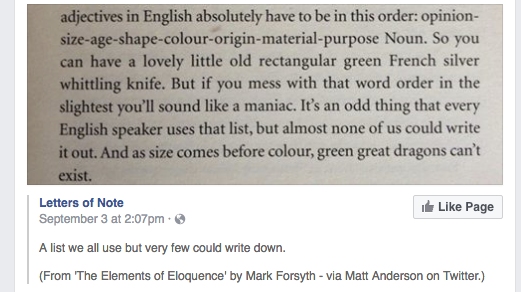
    Friend of mine on Facebook yesterday shared this post from Letters of Note, the photograph grabbed apparently from a book called 'The Elements of Eloquence,' author Mark Forsyth, and posted originally on Twitter by Matt Anderson.

    Screen Shot 2016-09-05 at 7.55.53 AM

    Said friend and I — alright, it was Melanie — had a blast discussing it.  The most fun I've had on a Sunday afternoon in a long while.  It must be the long weekend.

    Before we start to criticize, let's discuss the overall pattern.  Have you noticed this feature of spoken English before?  That when you prepend — without conjunctions — more than one adjective to a noun, often there's a particular way to order the adjectives in series that sounds better than the other possible orders?  

    Native English speakers would say, unless there was some special reason of emphasis,

     The little red wagon

    not

    The red little wagon


    Or

    The old brass key

    not

    The brass old key

    Or

    The enormous antique rocking chair

    not

    The antique enormous rocking chair

    nor

    The antique rocking enormous chair

    nor

    The rocking antique enormous chair

    and so on.  

    (Even though the author used an amusingly long string of adjectives as an example, I'm not going to go with more than three or four of them here, since our test of validity is simply to see what sounds okay.  Overlong strings of adjectives don't sound like natural English to begin with, so they don't make good test examples.)

    How do we know which order is right?  And is there a permanent pattern?  Mark suggested to me that we simply know what is right because we are used to hearing it some ways and not others, but I don't think so because I can construct an entirely novel phrase and we still know that one is better than another:

    The delicious square German vegan liverwurst

    is obviously (to me) preferable to

    The German square vegan delicious liverwurst

    but it isn't obvious why.

    Some kind of pattern production program exists in our language brain.  This isn't mere mimicking.  We have a pattern inside our heads, and we know when something doesn't fit the pattern, without ever having been explicitly taught it.  What is this pattern?

    + + +

    The author of the photographed excerpt considers pre-nominal adjective sets as a string.  Like beads, they go onto the noun one after another, and since we apparently prefer some permutations to others, he looks for a pattern that tells us what order we automatically identifies an ordered list of attributes that, supposedly, describes the order in which English speakers string adjectives.  Here's the order again:

    Opinion – size – age – shape – colo(u)r – origin – material – purpose – Noun.

    This doesn't of course mean that we are likely, in ordinary speech, to craft sentences in which we describe a noun with a string of eight adjectives.  It just means that we supposedly put size-adjectives before material-adjectives, opinion-about-the-thing-adjectives before origin-adjectives, and so on.

    Let's see the examples I wrote just now:

    "little red" wagon is size-color …. Check!

    "old brass" key is age-material…. Check!

    "enormous antique rocking" chair is size-age-purpose I guess… Check!  


    Or is it size-age-shape?  What if the chair is, er, shaped like a rocking chair but intended for an office?  Then it would be an enormous antique rocking office chair.  Still fits the pattern, I suppose.  Check!

    "delicious square German vegan" liverwurst is opinion-shape-origin-(material or maybe purpose) … Check!

    + + +

    So far so good.  But!  If one sits and thinks for a while, one may come up with contrary examples.  So the "absolutely" in the author's paragraph must certainly be struck out.

    The first one I thought of was

    She has a new little baby.

    This pattern puts shape before age, yet it is clearly better than 

    She has a little new baby.

    Later I thought of

    The white crescent moon shone above

    which, though it puts the white color before the crescent shape, sounds more correct than

    The crescent white moon shone above.

    + + +

    Okay, so the "absolutely" isn't warranted for our pattern.  Yet it seems almost right.  Is there a way we can generalize?  And what makes this pattern appear in the first place?

    One of our interlocutors suggested that it had to do with "essence" — that the more essential qualities are placed closer to the noun, and the more superficial ones are placed farther away.   So, for example, a little red wagon is more essentially red and only superficially little.  A German rocking chair's rocking-ness is more essential to its nature, and its German-ness less so.

    This seems like it is on the right track towards the pattern, but not so much on the how-we-apply-the-pattern.  Deciding about the essential nature of things is a philosophical exercise.  But we don't stop to practice philosophy every time we order our tall skinny decaf latte.  We just ask for it, and make the poor barista hunt for the keys in a different order.  (From the perspective of the cashier, the size of the latte is more essential, since it specifies the cost of the item; options like decaf and skinny are not.)

    But there is something to this notion, and I think if we carry it farther we will find something better than the "string-of-attributes" theory.  

    Let's start by asking the question:  Why is purpose placed in the closest spot to the noun?

    + + +

    I don't think it's because the purpose of the object is the most essential quality of the object, but because of the natural way in which English speakers form compound nouns made up of multiple words.

    tennis racket is a thing.  We aren't speaking French:  We do not have to say "a racket of tennis."  For all practical purposes, in English tennis racket is a single noun.  We've never joined the words into tennisracket — we aren't speaking German — and that has created a bit of a red herring, in that, yes, "tennis" is a modifier, behaving like an adjective, describing the purpose of the racket — but face it, a tennis racket is a thing.  It is not a racket that might or might not be for tennis, at least not in the same way that it might be green or lightweight or expensive or homemade.  It functions as a noun.  You don't drop the  "tennis" part of the noun unless it's obvious that you're in a tennis context.

    Because a tennis racket is a thing, we don't divide the "tennis" from the "racket" by interspersing any other kind of adjective, any more than we divide the "dish" from the "washer" when I describe to you my new household appliance.  I don't have a dish shiny washer, and for the same reason, I don't have a tennis new racket.

    Is this because tennis-ness is the most essential quality of the racket?  Indirectly, maybe; but the proximate reason is linguistic.  When we talk of a tennis racket, we join the two words into a compound.  

    So the handheld implement for striking the ball in tennis, having a certain color and size is not described with a string of three adjectives:  large-blue-tennis RACKET.  Rather, tennis is joined to RACKET:  blue (tennis racket).

    + + +

    But purpose isn't the only kind of modifier that we make functional compounds with.  I talked of liverwurst up there.  We stick that together because, I suppose, liverwurst is German in origin, but we're really discussing liver sausage here — "liver" denoting the material of which the sausage is made.  And doesn't it often function as a compound too?  Liver sausage is a thing.  If you say "liver sausage" I get a mental image of a package of braunschweiger at the supermarket, followed by a strong association with rye bread and mustard — I don't imagine a sausage (different mental picture) and then, thinking of liver, modify my mental picture.  

    "Pork sausage," same thing, until you want to mention that it's pork breakfast sausage (material-purpose-noun).  But "pork breakfast sausage" is also a thing, although not as securely as is breakfast sausage and pork sausage.

    I propose that in English, when we increase the number of modifiers on a noun, what we are really doing is creating nested compounds.  Not sausage that is made of pork, and intended for breakfast, and which I think is expensive, and which is of a brown color, all on a string; but

    expensivebrownporkbreakfast sausage ) ) )

    That is, it's breakfast sausage that happens to be pork.

    And, it's pork breakfast sausage that is brown.

    And, it's brown pork breakfast sausage that is expensive.

    + + +

    Let's look at our counter examples:  the white crescent moon and the new little baby, both of which violate the prescribed order.

    The white crescent moon is easy to explain.  "Crescent moon" is a common compound.  Yes, "crescent" literally describes the shape of the moon.  But in the English language, a "crescent moon" is a thing in and of itself, much more strongly than is a "white moon."  So while you might write about a crescent white moon, you are much more likely to write about a white (crescent moon).

    Too, look at this:

    white full moon  (color before, nominally, shape)

    but

    round white moon (shape before color)

    And that's because a "full moon" is an established compound and a "round moon" is comparatively only an adjective plus a noun.

    How about that new little baby?

    "Little baby" definitely functions as a compound in many contexts.  Sweet little baby, good little baby, third little baby.  Little almost goes  before baby as a tic.

    "New baby" is also a common utterance.  

    Why, then, "new little baby" and not "little new baby?"  I think it's because new babies are by definition little, whereas little babies may or may not be new; so when we want to say, "She has recently given birth to a child!" we say "She has a new (baby)!" or "She has a new (little baby)!" almost interchangeably.  The newness is up front.  It's what we're emphasizing.

    But if we want to say "She has a BIG new baby!" we are probably talking about a nine- or ten-pounder.  It's a big (new baby).

    + + +

    And what of compound adjectives?

    Check out this triplet of adjectives along with the noun "baby", two nominally denoting size and one nominally denoting age, and consider how it works:

    tiny new baby (but not new tiny baby)

    little tiny baby = tiny little baby (interchangeable)

    new little baby (but not generally little new baby)

    What's up with this?  Tiny must go pairwise before new.  New must go pairwise before little.  But tiny and little are pairwise interchangeable.  

    I think this is because "tiny little" and "little tiny" function, and equally well, as compounds.  "Little baby" can be a compound, but we can force it apart with the right choice of modifiers and then you can get something like

    (tiny little)(American baby).

     With new, tiny, and little, there's six possible orders:

     little tiny new baby

    tiny little new baby

    new tiny little baby

    new little tiny baby

    little new tiny baby

    little tiny new baby

    Some of these sound better to me than others.   How about to you?  

    + + +

    Anyway, that's my untrained blathering about English syntax for the day.  I have a vague notion that the concept of a "parse tree" is the one that trained linguists would use to point out the flaws in my crackpot analysis is.  As they say, any fool can criticize, and I am always happy to play the fool for that purpose.  But, as I said to Melanie via FB, the fun thing about linguistics is that any nerd can do original amateur research on your own brain and your friends' brains, something that is hard to do in other sciences unless you have an MRI machine in your cheerful spacious well-equipped American kitchen laboratory.


  • Labor day weekend, after the vacation.

    We just finished a family vacation in the North Woods of Minnesota at YMCA Camp du Nord. Every time we go it is a bit different; some years we have struck up many conversations with the other campers; some years we have spent a great deal of time closely together as a family. This year Mark’s parents joined us, which was lovely, and so we got a larger cabin —

    — well, it was more that we snagged a larger cabin, so they were able to join us. Cabin assignment is by a lottery system, and we were lucky this year — at first, we didn’t get anything at all, but went on the waiting list, and they called us later to offer us a cabin that slept ten in the last week of the summer. We took it.

    Anyway, this year it felt like a quiet retreat.

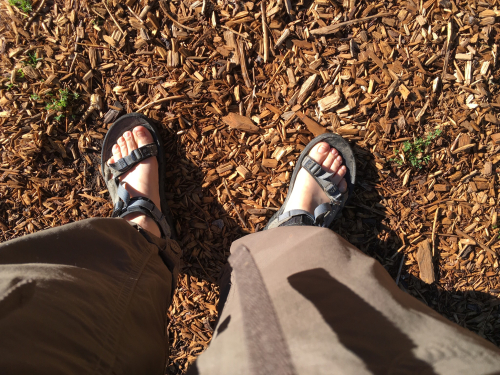
    I’ve owned these Teva sandals for more than twenty years.

    I determined to take no work with me, and requested recommendation for novels. My chief activity was sitting in a camp chair on the beach, where the creek trickles down to the clear cold lake and endlessly lays down its light sandy burden, reading in the sun. Late summer in northern Minnesota: the sun would go behind a cloud and I would put on my hat and cover my shivering knees with my fleece, then the sun would come out and I would take off my hat and fleece, slide my toes into the suddenly hot sand.

    Nominally I was supervising the 2yo and the 6yo, but they didn’t take much supervising. The 6yo and a band of his fellows and a lot of plastic shovels were busily damming up the creek with a series of sandy terraces and logs dragged from the edge of the forest. I imagine the creek is dammed over and over, week after week, all summer long. The 2yo commandeered somebody else’s plastic dump truck and drove it endlessly in and out of the very edge of the lake. The first full sunny day he would not touch the water, the second day he splashed at it, and by the fourth and last sunny day he was brave enough to venture knee-deep.

    I am not really a beach person, but I drank in the sun this last week of the summer. Lately, living as I do in Minnesota, and growing older, I feel more and more acutely the swiftness of the warm sunny days and the slow march of the coming chill. Summer no longer stretches out before me indefinitely. I know the snow and ice is coming back too soon. It isn’t that I don’t like winter up here — I do; it’s just that it overstays its welcome, and I never quite feel that I have had enough of the warmth in each year. As a child in southern Ohio, where winters are not as interesting or beautiful but where they last the correct amount of time, I used to comfort myself in January, at the bus stop, by imagining how pleasant it would feel to swelter under hot sun, and I also used to long in July for a single gust of frigid wind and a few pricks of refreshingly icy sleet. Now I still sometimes fantasize about the former. But not the latter, no matter how sweaty we get. Why bother fantasizing about the wind and cold? It’s going to be here soon enough, you can count on it.

    + + +

    It occurs to me just now that I speak from a certain place of privilege, namely (a) my house is air-conditioned and (b) mosquitoes really don’t seem to like me very much. So there is that.

    + + +

    Besides reading and being the designated person to “watch” my youngest boys on the beach — I must have put at least twelve to fifteen hours in on the beach in a course of a week — I had a few hours to spend with Mark. We went on two trail runs together and also a two-hour kayak paddle. I found that the trail runs seemed to make my troublesome hip feel better rather than worse. Need to find a new way to move around that is less monotonous, perhaps, than padding around and around the flat paved lakeside paths.

    + + +

    I brought no work with me, but only leisure, which is to say that I brought a few books of botany and plant idenfication, several novels to read of the challenging and literary kind, and also a novel in French — I saved weight by downloading an offline dictionary app. My mother-in-law had brought a basket of crocheting along with her, and I contemplated that as I considered the knitting class that was offered as a camp activity.

    What is your personality type? We are always asking this question, it’s a new kind of horoscope we tell. Sometimes it’s silly and fun (what Jane Austen character are you?), other times pseudoscientific (introvert or extrovert? INTJ or ESFP?), veers from time to time into quackery (Eat Right 4 Your Blood Type anyone?) and occasionally it hits on something that — not everyone — but some people find genuinely useful, even life-changing (I hear that pretty often about 5 Love Languages).

    I have this one completely nonstop friend, whose six children cover a range as wide as mine but a little bit older. Her previous life was technical corporate training, so we have a kind of affinity there, each of us having turned a ridiculously analytic personality towards managing and educating a house full of children. She is constantly doing something, running something, creating something. I often suspect her of dealing with stress, or solving logistical problems, by becoming more busy. It is the kind of thing that in movies portends everything coming crashing down because no one can just keep going like that, right? But it seems to work for her — I suppose there may be a deep internal disaster that none of us can see, isn’t that always a possibility, but I can’t see one. I am fully ready to believe that what would exhaust me is what inspires, fuels, even soothes her.

    We were talking the other day about cooking, and she commented how restful it is for her to be creating and producing things — how making something complicated and multistep, baking Bavarian pretzels I think we were talking about, puts her in touch with family members from long ago, soothes and comforts even in the busy-ness, when there is a tangible thing taking shape under her capable hands.

    I am not like that, and that looks like work to me instead of rest. But what is rest to me is work to someone else. And superficially useless work at that!

    What refreshes and re-creates me is learning. I told Mark as we picked our way rapidly among winding tree-roots on the trail, “One time when we were here — I believe it was in 2009 — I brought that one botany coursebook up with me, and I spent the whole week learning to identify different families of plants by sight. It’s so weird to think so, because there is no foreseeable use for this knowledge for me. But it felt so satisfying just to learn their names and to recognize them. I don’t understand what is so satisfying about nothing more than putting a label on a thing, but it is deeply satisfying to me. I don’t even expect or desire to use the knowledge to impress anyone, and the kids aren’t very interested in it either. It’s like the same thing that makes some people collect coins, or butterflies — you catch one and you put a pin through it and a label on it and you keep it in a case. Except it’s only in my head, I don’t even have a gallery to show anyone. But there is something just as satisfying, as if merely by learning to recognize the butterfly and knowing its name, I have collected it. I don’t need the physical butterfly, but somehow I have caught it and I possess it if I know it by sight and by name.”

    And it is restful to me: study for the sake of study, knowledge for the
    sake of knowledge. I try things for a while and enjoy the trying and sometimes never pick them up again because I don’t have to, there are so many other things to try. I read French for fun and write down the vocabulary just as I did in school; but I don’t teach my children French because to do so would be to miss an opportunity to learn a new language with them, so we learn Latin and dabble here and there in other languages, Italian, Polish, as opportunity moves us. I buy textbooks and struggle through them. I play with apps designed to teach children how to program computers; even though I once wrote code, I am rusty, and never was all that good at it anyway, and the latest app promises to award points for shorter code with fewer steps, and has constraints that make it interesting. I find that fiction, really good fiction, is too difficult for me unless I have uninterrupted time, which is why I took good novels with me on vacation, but I am constantly reading nonfiction as my light mindless reading to settle the brain before bed: a lot of history, but also sciences and disciplines of engineering, especially the ones that are more of a mystery to me because I didn’t have them much in school.

    We say that introverts and extroverts (by one common and fairly useful definition) are distinguished by whether they seek solitude or company in order to recharge the batteries, so to speak. I wonder if we can also usefully classify ourselves by what sort of work we find restful. Not just what we find agreeable; There is work that I enjoy and have an aptitude for but that is still work to me — I am thinking of the school-planning here. I do it because it saves me a kind of work I like less (winging it in front of the children), but I wouldn’t do it for fun. But I learn for no good reason at all except that it makes me deeply contented and happy.

    + + +

    Just one short note here without explanation: I erred gravely in thinking that this feature of my personality would make me an excellent academic.

    + + +

    “Usefully classify ourselves.” That sounds like the lepidopterist-of-ideas in me again. No, I think it is useful — in the way that some find the five love languages useful — it can help us understand each other and give each other the space and resources that we need to recharge, so important in families; and help us to understand why apparent frivolities can be so desperately important — how close we come to striking someone else to the heart, sometimes, when we lightly tease them about wasting their time!

    And also to give us permission to be ourselves and to love what we love. Extroverts and morning persons dominate, and maintain their hegemony by ridiculing night owls for laziness and introverts for backwardness, but why should there be only one schedule of wakefulness, one pattern of sociability? Is it taking it to an extreme, this claiming of being marginalized even in these areas of comparative unimportance, a sign that our culture is unhealthily obsessed with victimhood? Maybe, or maybe it’s just noticing the large pattern writ small, that humans tend to crush and shame differences of all types everywhere we are.

    Anyway. What is work for some is refreshment to others; “leisure” is relative. What leisure of yours is work to someone else?


  • Laïcité, freedom from and freedom to.

    France is in the news this week because of an incident in Nice which four armed police officers forced a woman on a beach, in front of onlookers, to remove some of her clothing, consequent to the city’s ban on “clothing that overtly manifests adherence to a religion.” Since that occurred, possibly in an attempt to demonstrate that they weren’t discriminating against Muslims, the city’s deputy mayor insisted that habited nuns weren’t welcome on the beach either, and then a French high court overturned the rule — probably setting precedent for dozens of similar rules enforced at the municipal level all over France. This still leaves open the possibility that the national legislature could craft a law explicitly empowering local officials to ban beach clothing that contravenes their sense of laïcité, or could even craft one that sets national policy.

    Here are a few related links that set some context for the matter:

    Wikipedia article on the 1905 French law concerning the separation of church and state

    Wikipedia article on the 2004 French national law banning certain religious symbols and clothing

    Raphael Liognier writing in the Macquarie Law Journal in 2009: “Laïcité on the edge in France: Between the theory of church-state separation and the praxis of state-church confusion.” This article is critical of French policy, but it provides a good historical review of how the French state put itself in this situation, explains the cultural concept that now bears the name “laïcité,” and describes some of the incongruities in the existing law.

    At Feministing, “A Guide for White People on the #BurkiniBan and Discussing Muslim Women” by Mahroh Jahangiri. This piece reminds us of the political history of colonialists’ efforts to police Muslim women’s dress, reminds us that there isn’t just one true feminism, and, I should hope, reminds us not to treat Muslim women as political objects. Her seven pointers for writers are worth reading.

    (I don’t go as far as the author to say that it’s always wrong to make analogies to other kinds of societal clothing-policing, but I sympathize. A well-crafted analogy can powerfully force an honest interlocutor to “see it from the other side” and thus open minds, but a poorly-crafted analogy can be legitimately offensive. If you’re not sure how well yours is crafted, it’s likely better to keep it to yourself.)

    + + +

    So, not wanting to repeat what other people have written on the topic, I’ll just make a couple of comments.

    + + +

    First of all, I have a strong preference for American-style civil liberties. I come very close to being a free-speech absolutist, interpreting “freedom of the press” to be a freedom possessed by the owner of the press, and “press” interpreted broadly to mean any means of publishing, paying for, or disseminating speech, and interpreting “freedom of expression” to mean one’s entire way of life in and out of the public sphere. So I don’t like the French system, no.

    At the same time, I am interested in different possible ways to assemble a consistent legal approach to philosophical diversity. I like our ideal of massively free expression; but no real system is perfect, and one does run up against conflicts from time to time, and lurking behind it always is the logical problem of tolerating intolerance, or of somehow having to respect philosophies that themselves do not respect philosophies — the fundamental logical flaw of all relativism. Could there be better ways to deal with it than ours? Maybe. And it’s interesting to explore systems that may have solved some of our own persistent problems while creating problems that we don’t have. Also, I’d like to pay a little lip service to state sovereignty and to there being the possibility of having a set of priorities that is different from ours, that wouldn’t fly in U. S. culture, but that makes sense and respects human persons in its own way. So I don’t want to write them off entirely right off the bat — at least not just because it’s not the American way.

    + + +

    So, it strikes me that one of the inherent weaknesses in the French approach to law here is in banning a kind of “symbol.” An inherent with symbols is that they are not universally agreed upon, and that they are context-dependent. So the French have a truly fundamental legal problem here, namely, that they have written their law in inherently ambiguous language. Perhaps it is impossible to write laws that contain no ambiguity whatsoever, but zero ambiguity is the standard for which all laws ought to aim; one could even say that to remove ambiguities is the entire point of having laws at all, so that people can securely know how to comport themselves so that the state will not lock them up or seize their property, and so that the people have a means of creating a state whose power extends to agreed-upon bounds and no farther.

    So we’re stuck, because sometimes a cigar is just a cigar, and sometimes an article of clothing is just an article of clothing. Jahangiri’s piece in Feministing points out that it is the white colonialist mindset that first interpreted Muslim women’s wear as a symbol of Islam, imposing a meaning upon it from outside. White feminists and rejected males alike continue to say implicitly or explicitly, “this is not clothing, it is a symbol.” French laïcité means a freedom from certain symbols in the public square; maybe this sounds okay, a legitimate expression of a state (not consistent with the American expression, but trying to be open-minded and tolerant here toward la peuple française and their distinct culture); the problem is that apparently, for the French majorité to be free from what they see as symbols, some French minority women have to be free from what they see as their clothes.

    It would be less problematic if the French had just come out and said “We are banning visible crucifixes that are longer than 325 mm, and little round hats worn on the back of your head, and when we said that you have to show your face in public, we also mean your hair, unless it’s below a certain temperature Celsius or raining enough that drivers have to turn on their windshield wipers.” At least the ambiguity would be gone, and though we might object to the infringement on personal freedom, we could at least say, “Well, it’s clear,” and then we could debate its rightness or wrongness. But no, they had to ban “religious symbols,” which means one thing to one person and another thing to another. Which puts government in charge of deciding what your clothes really mean. And which means that you will never be judged on what they mean to you, but only on how they are received by other people, whom you cannot control. In other words, in a regime that bans “symbols” rather than banning specific objects and articles, individuals are liable for other people’s thoughts about them, whether those thoughts are correct or incorrect. And that is about as illiberal as you can get.

    + + +

    Third, it is important for Americans to understand the French system as a kind of warning of where we might go, if the forces of “freedom from” get out o
    f balance with the forces of “freedom to.”

    Already there are hints of this in all the parts of the First Amendment. Politicians are speaking, it seems, more and more often of religious freedom interpreted as a “freedom to worship,” which is rather closer to the traditional French understanding than to the more expansive American one; our tradition is one of “freedom of expression,” meaning the freedom to live our lives, private and public, in accord with our beliefs. Speech codes which attempt to give people the freedom to live without hearing offensive speech are constantly being crafted at government institutions, struck down, and tweaked to sneak back in; they enjoy a great deal of popular support; and yet they exist in opposition to the American ideal (I won’t say tradition, because it has been so unevenly lived by minority communities in this country) of the freedom to express minority ideas. Interpreting expensively produced publications and expressions as a financial transaction that can be regulated — for some government-friendly spending entities and some points of view and not others — is another way the definition of “freedom of the press” is being interpreted narrowly. Some “presses” are favored as shrines of freedom of expression; other “presses” derided as mere businesses, the speech they produce interpreted as a product for consumption, and subject to intense regulation.

    The French problem is a warning to us. They have tried to favor “freedom from” over “freedom to.” If we object to the results of that effort, we can learn from it and try to craft a balance between the two that will result in something more to our particular American taste.


  • Writing your own charter.

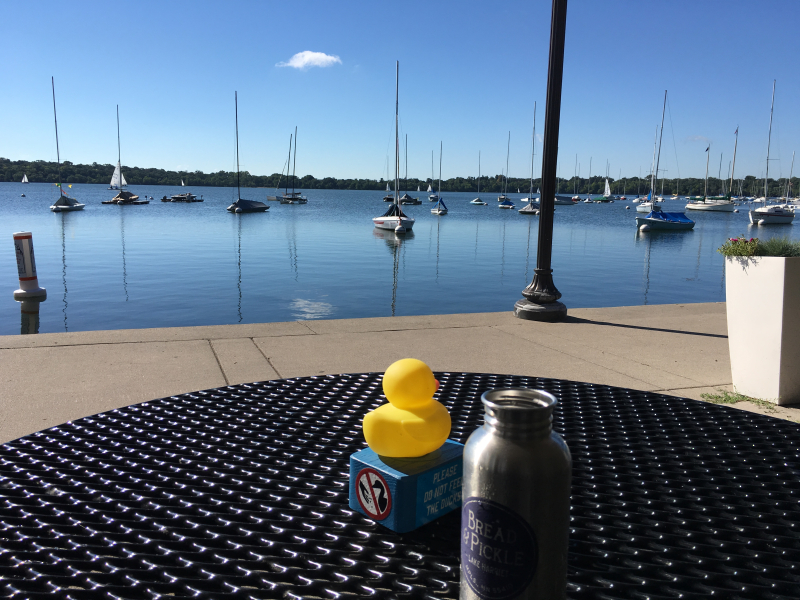
    Saturday morning I took a walk from Lyndale Farmstead Park, where I left the car, a mile and a half to the Lake Harriet bandstand.  I'm taking a break from running, because of my hip, and wore no athletic gear; just a tank dress and sandals. The late-summer sun beckoned me to the lake.  From the lakeside restaurant Bread & Pickle I bought ice water for $3 in a reusable stainless steel water bottle.  The cold bottle sweated big drops of water.  I took it to a table and rested my hip there for a while before walking back.

    IMG_1729

    There was a 5K going on at the lake, a walk-and-run, and bluegrass-tinged rock music wafted from the bandstand.  August in Minneapolis can be brutally humid, but it usually looks beautiful, with lots of sunny days and blue skies.  There's something about August here that makes me wistful:  the cool weather will be here soon, and fall is sometimes cut short, with the snow arriving before the trees have even lost their leaves.  

    It's hot now, but.  You know that the bitter cold is coming.  

    I don't like to hide from the heat in August, at least not in the daytime, at least not all day.  I want to stand in the sun and soak it up, like a house of adobe, and radiate it inwardly all winter long.

    + + + 

    As I wandered back with my empty metal bottle swinging by its lid-loop from my finger, I was passed by a woman and a tween boy walking quickly, a mother and son.  She was dressed in sunglasses and running clothes, he in the ten-year-old-boy uniform of basketball shorts and a graphic tee and well-worn-in sneakers, and they were chatting easily.  It sounded as if she were explaining something, and he was nodding with real interest.  They walked faster than me and soon disappeared ahead, one parent, one child, being together, here at the lake.

    I find I don't spend a lot of one-on-one time with any of my children.  It's the kind of thing that you have to deliberately create, in a family of five children at home (practicing that terminology; it will feel soon enough before one of them has aged out).   I do try to create it:  take one with me to the grocery store, take another on a trip all by himself to buy shoes, drive my daughter to camp. A biteback effect of safety regulation on family life:  no one younger than twelve is legally allowed to ride in the front seat with me, and who knows how many would-be conversations were thereby squelched before they came to be.

    Maybe the mother and son on the walking path are like me, stealing time away from a large family on a Saturday afternoon.  Or maybe the boy is the one child at home.  I considered what it could have been like, me homeschooling a smaller family, one where I felt that I had enough time to get around to everybody.  Things would be different for sure.  I have a few homeschooling friends with one or two kids, or maybe just one or two left at home after the others have grown and gone, and it always seems as if they get to go very deep and run very far, and all together, not so much sending the middle-schooler with another family to see plays, not so much dropping the teenager off to go with the group to the museum exhibit that frowns on toddlers.  

    + + +

    Of course, I'll have a chance to find some of that out eventually, when the ones who are little now become big and there aren't more coming up behind them.  We'll see if I do all the things I imagine I would do.

    + + +

    Comparing yourself, inside and out, to what you can see of other people, that's a losing game.  I know this.  I also know that I wouldn't have it another way:  the large family is exhiliarating and challenging (in a good way) and I'm so glad I have every one of the children, and am grateful that we were gifted with them, and aware of those who long for many children and haven't seen that longing become reality.  

    The most important thing to remember — I don't know why it seems so hard sometimes — is that whatever you are, whatever your family is, you too have strengths that others don't have.  It's not a kind of "I'm better than they, so there" mentality, it's more — let's restore some balance to our vision.  Instead of constantly seeing "They can do things I can't — she has advantages I don't — he accomplishes what I don't — they can give their kids something I can't –"  see that you too have your specialties.  

    There's something to the Incredibles message "When everybody's super, then no one is."  But there is another side of this,  entirely true: the differences among us mean we can excel in different things, for real, not in a wishful way.  We can be our own self better than anyone else.  

    Sometimes the things in which we are uniquely gifted are not things that are widely celebrated, and that's too bad, but we can work to appreciate those things in our own quiet way, when we see them in ourselves and in others.

    + + +

    Last week I was talking to a friend of mine, a homeschooling parent of four, a part-time working professional musician herself married to a music professor.  They're in almost the opposite academic position from Mark and me — we are both engineers, one PhD between us, and Mark working full time.  She fretted about finding good science teachers for her bright science student (who, by the way, is also a gifted musician himself — none of those in our family!) while I commiserated in an analogous sort of way because I'm nearly hopeless in the arts and am not a gifted English or writing teacher.  Both of our families have solved this problem by outsourcing the relevant subjects to someone better qualified, one way or another.  It's a common thing for homeschooling families to do, urban ones anyway.

    "Think of it this way," I said, "it's not that your kids are unusually handicapped in a subject you aren't expert in.  You've had at least a high school education in everything, college classes in some of it, and you get to have the teacher's manual.  Lots of public schools put first-year teachers into classes that they've never taught before and don't have particular expertise in.  You meet the minimum standards in every subject, and you far exceed them in others.  And you can find tutors where necessary."

    The notion of being Adequate not seeming to be comforting, I went on —

    "If you have to compare your family's achievement to a school, then think of your family as a super-exclusive, super-specialized magnet school, or charter school.   You run an arts magnet school.  I run a STEM academy.  And where we both are only so-so in the other sorts of things, we do make up for it with, you know, small class size and a lot of personalized attention.  

    "Also an extremely flexible schedule."

    + + +

    We all have to be who we are.  It's tempting to see that as only limiting.  There have certainly been times in human history where the limiting aspect was emphasized even more than it is now, where people were chastised for dreaming too much of things that were closed to them for purely arbitrary reasons — or for reasons that were thought incorrectly to be rational but really weren't.  It turns out that we do well to eliminate the arbitrary limitations, but we can swing too far the other way in insisting that anyone can do and be anything or everything, and excel in it.  The main problem with that is that inevitable difficulties are sometimes cast as "not working hard enough," "not wanting it bad enough," "not believing in yourself enough."  There are certain realities that are not arbitrary, and except for the extraordinarily gifted and/or extraordinarily privileged, wanting is not enough to overcome them.

    Buried within the truth that we all must be who we are, though, is that it isn't just a limitation but also an encouragement, an identity.  If I must be who I am, then no one else can be it for me.  I have unique gifts and I should exploit them, use them to every advantage.  If they are the sort of thing that is not recognized as a strength, or even if they are the sort of thing that some call out as a liability, then I still have options:  go where these qualities are rarer and valuable, or, well, surprise people.

    + + +

    One precondition is logically necessary, and it cannot be taken for granted:  the philosophical conviction that every human person has equal value, whatever his or her circumstances.  It's a sad truth that not everyone agrees with that, and even fewer behave in accord with it.  Some people see the good in everyone except themselves;  such a reflex has a useful side, in that it maintains humility, but it has a dark side too, one that misses opportunities for gratitude and tempts to despair and apathy, and risks swallowing others in its wake.   You have to practice finding it in yourself too, as an exercise in truth-seeking if nothing else.

    Anyway, once you have this conviction, the conclusion boils down to:  whoever you are, you have strengths.  They aren't the same as mine.  You can exploit them to your advantage, to your family's advantage.  Go forth and win at your own game.


  • Catchup post: a good son, a Chicago getaway, my IT band, and something to read.

    On account of the two weeks since I last wrote a post, I'm going to do a catch-up roundup.  Here we go:

    + + +

    In mid-July I wrote about sending my oldest off to World Youth Day.   He spent  twelve days there, and returned safely.

    I didn't make it a secret that I wished I could have gone along (even if I didn't have small children to care for, the chaperone spots filled up rather quickly).  "Text me and send me pics," I asked, "not because I'm trying to be a super helicoptery parent, but because I want to see the things."  And… he did!  I didn't expect him to send me so much, but he sent me pictures every day that he had access to wifi.

    IMG_0976


    IMG_0962


    FullSizeRender


    IMG_0778


    13681035_10201892224185362_4164495903966472560_n


    He told me about the deafening, constantly circling military helicopters, the grapefruit-flavored Oshee brand soda (so ubiquitous he was sure that Oshee was sponsoring the event), the crush of the crowd waiting for the Popemobile to pass by, the poutine he bought from a stand.  He told me about the huge arena for English-speaking pilgrims, and how a few rogue groups of young people impulsively ran in circles around the arena with their big national flags, an unauthorized parade of nations, to pass the time while waiting for the start of catechesis.  He told me that Filipino Cardinal Tagle gave a great talk and that NY Cardinal Dolan gave him a pat on the back while he was venerating the relics at the stadium.  He told me about the food in the pilgrim package ("This stuff had the same dimensions and texture as bird food blocks.  Tasted awful") and how a couple people in his group got heatstroke.  He told me about how their group hashtag became #InDmitriWeTrust, Dmitri being their local escort employed by the tour service they had contracted with.  He told me that when they got tired of singing hymns they walked along singing "Hotel California."


    IMG_1693

    And he told me about the ambient noise of a million people sleeping in the field, of his surprise to find that the daily routine never got repetitive but was different every day, about how the park was sometimes loud and sometimes peaceful, about how the exuberant atmosphere almost changed instantly when Mass began.

    I don't know if I've been able to express to him how appreciative I was and am that he took me along, so to speak.  I was moved.

    He asked to go out to a barbecue restaurant for his sixteenth birthday, just a few days after coming back, and we gladly obliged.


    + + +

    I went to Chicago for a couple of days, the day after my son got back from Poland.  

    The occasion:  my youngest child, at 2.5 years old, is now night weaned and sleeping all the way through the night.  And I am not pregnant.  So I took the opportunity to spend two nights in a row away from my entire family… for the first time in sixteen years.

    I'm a little sheepish even writing that.  Doesn't it seem like I should have managed to get away once in all that time?  But, you know, we set up our family to work a certain way, and I haven't needed to for any reason, and there's nearly always been a nursling around.  I've been away from home, yeah, but I've generally had a baby to tote with me.  IMG_1675

    So when I realized this was possible, a few months ago, I texted my good friend from high school, the one I used to hang out at the mall with when we were twelve, and asked what she thought of a Chicago getaway (Chicago is close to midway between where I live and where she lives), and — bless her, may she live long and prosper — she did not say "maybe" or "I'll check and see what's on my calendar" but immediately said YES and figured she would work out the details later, which she did.  She reserved a hotel room, I bought a plane ticket, and off we went!

    I know.  It is not that big of a deal to buy a plane ticket and spend two days away from home.  But it felt like a big deal.  

    Here's the thing.  I could have done stuff like this at times over the past sixteen years if I had made it a priority.  Generally I'm pretty good at giving myself the things I need, rather than letting the needs of the family always take precedence over mind.  And the things I need, on a daily basis, to keep myself fed, are a steady diet of little things, which I've made space for by insisting on a few hours to myself every Saturday.  Breakfast out by myself, a quiet coffee shop in which to knock out a few items on my to-do list in peace, time to shop for my own clothes or get my hair cut, a visit to a local museum, Mass on my own, a run around the lake.  All that keeps me satisfied enough that I haven't felt the need to ask more of my family.

    So it suddenly got to the point where it wasn't really asking too much to be gone for two whole days, and I took it.

    It wasn't a complicated itinerary.  We stayed at the Drake and had access to the executive lounge for the free fancy breakfast (thank you, friend's husband's Hilton points) with a view of the lake.  We went out for nachos and margaritas close to our hotel the first night.  The next day we walked up and down Michigan Avenue (she bought candy for her daughter; I bought a hat for myself) and spent 3 hours in the Art Institute.

     Then we got gratuitously dressed up, and had dinner and drinks in the historic hotel restaurant.  And the next morning she dropped me off at the airport, where I killed time happily browsing through bookstores and finding a tasty box lunch to take on the plane (sixteen years of only traveling with kids can make solo airport time not suck at all), and I flew back home and took the train back to our 'hood.

    + + +

    I think my hip pain is getting better.  After a frustrating few days of attempting to exercise carefully, and then hobbling around with pain for hours afterward, I settled on the following regimen:

    • Assume, arguendo, that I have bursitis.
    • Take sodium naproxen faithfully every twelve hours to reduce inflammation.
    • Stop running.  Switch to swimming and the occasional walk of no more than a couple of miles.   Get full rest days after exercise.
    • Stretch the IT band whenever I think about it.
    • If it's not better in two months, go see the sports med doctor.

    I'm kind of bummed that I'm missing the best time of the year to go running outside (well, if you're like me and don't get bitten by mosquitoes much, and like to get up early), but I'm already seeing some improvement.  So maybe I self-diagnosed correctly after all.  One piece of evidence:  Taking the naproxen makes the pain go completely away for at least eight hours, which makes me think that all the pain is coming from inflammation and that I haven't actually torn or sprained anything.

    A nice thing about IT band stretches, relative to other kinds of therapeutic stretches, is that they are very easy to work into your daily life.  There are standing IT stretches, sitting IT stretches (I'm doing one now while I type!), and lying-down IT stretches that you can do in bed.  So wherever you are, if you think of doing one, you can do one without interrupting your activity much.  You don't need to take off a shoe or go find a towel or a yoga block or clear a space on the floor. 

    + + +

    That takes care of three old things.  Now here's one new thing.  I've recently discovered the webcomic (graphic serial?) Stand Still, Stay Silent by Minna Sundberg, a Swedish-Finnish artist who writes in English and paints in digital.  

    I encountered SSSS by accident via a link to a piece of her art, a language tree from the comic, reproduced below (link to full size at her site):

    196

    I'm a sucker for linguistics, and this really drew me into the SSSS world.  Post-apocalyptic literature is fun enough on its own, of course, but this comic is especially fun if you are interested in languages, because linguistic and cultural differences between the characters drives a fair amount of the plot.  

    I would classify this as a near-future post-apocalyptic novel of the Zombie Plague type, although it isn't exactly zombies.  The general background is that a worldwide plague has shrunk the size of the "known world" of the comic to Iceland and scattered parts of Denmark, Sweden, Norway, and Finland.  (That's why the language family page only includes two families).  Fantastic elements (e.g., some characters are mages) draw heavily on Nordic and Finnic mythology and traditional culture.  

    The world is well built and intricate.  The art is beautiful:  spare in its color scheme, eerie, and (though digital) resembles brushed watercolor.  People and animals have wonderfully expressive faces.  There's plenty of action scenes with monsters to chop up and buildings going boom, but the real drama is psychological and interpersonal so far.  Another fun aspect of the website:  the well-populated fan forums and comment sections, which include people from all over the world, sometimes offering fanfic and fan poetry, and helpfully translating text that appears in the background art for the benefit of non-Nordic, non-Finns.  

    Catching up on the nearly six hundred pages already posted was a weekend's leisure reading, and now I have to settle down and resign myself to reading updates just one day at a time.  

    Cats are extremely important, so if you are particularly fond of kitties, there are many drawings of them to enjoy.

    Screen Shot 2016-08-16 at 10.51.18 AM

    To start reading SSSS from the beginning, go here.


  • New IT experience.

    In the summer, I like to get up early on Sunday mornings and go for a run around Lake Calhoun.  

     A breeze comes off the lake even in high summer.  Most of the way around is tree-shaded.  It's never crowded at 7 am on a Sunday.  The scenery is pretty all the way around, at least to my urban tastes:  the busy waterfront restaurant, wheeling gulls, a small forest of boat-masts, big houses up on the hill, public beaches, dogs and frisbees and volleyball nets, the sun glinting off the water.  The running path around measures exactly 5K, and I'm not in a season in my life where I have time to train for longer runs than that.  

    Sometimes I try to go fast, and I check my watch to see how well I did against previous timed 5Ks I've run.  Sometimes I just go out with the goal of enjoying the morning.  My PR is a not-embarrassing but not-particularly-special twenty-seven-something; for lazy Sunday runs I am happy to come in between 30 and 38 minutes; if I try to go fast I want to be between 28 and 32 minutes.  

    A couple of Sundays ago I went for a lazy Sunday run in which I did not check my watch.  I specifically did not try to go fast, and was thinking to myself that the victory was just in showing up that morning.  I was just ending an unusually symptomatic menstrual period.   I don't typically experience much in the way of cramping, heavy/prolonged bleeding, or mood swings; for me it's more lower back pain, fatigue, and general feelings of crappiness.  I crave extra rest, and if I can just take a couple of extra naps and some ibuprofen, I weather it fine.

    This past cycle I felt like I had been hit by a truck, with pronounced achiness and several days of exhaustion.  For the first half of it I wondered if I was pregnant, I felt so exhausted.  For the second half of it I wondered if I actually had some kind of intestinal bug.  In the end I decided it was just my normal menstrual symptoms, just intensified.   I'm old enough now that things are starting to fluctuate and get weird, and I guessed I had just had some kind of hormone surge that made all the usual stuff feel a lot worse.  I spent several evenings in bed.  I skipped one swim workout, which is not unusual, and took the second one a bit easier than usual.

    So anyway, back to this Sunday.  I went on my easy run, enjoying the feel of moving a bit faster.  At the end I got in the car and drove a short distance to one of my favorite breakfast spots, where I  enjoyed coffee and toast and eggs and a very nice fruit cup.  Everything was perfectly lovely until it was time to get up out of the booth and OH MY WHAT IS WRONG WITH MY HIP.

    I limped out the door, bent like an old person, and eased myself into the driver's seat of the Prius.  Once I got all the parts aligned in the seat, with my foot on the pedal and such, the pain disappeared.  "A bit stiff," I thought, and drove home, and then when it was time to get out of the car again OW OW OW.

    I spent the whole day and most of the next day being totally fine except when I had to change from sitting to standing and from standing to sitting, and it was worse the longer I had been sitting.  Just this intense irritation in the outside of my right hip, wrapping around a bit to the back and shooting a bit down the outside of the thigh.   It diminished over the next few days.

    I skipped another swim workout for good measure and then tried a very slow and easy swim.  There was the pain again, not as bad as after that Sunday run, but still annoying.  I quit early and took ibuprofen, but I still spent the next couple of days stiffly and painfully sitting down and getting up out of chairs.

    I'm a little afraid to go for another run.  

    + + +

    I fretted aloud to Mark about my injury that came out of nowhere.  He was unsympathetic.  "I hurt every time I do anything," he pointed out.

    "But this is new!  I'm not you!  I don't hurt when I run!  I definitely don't hurt when I swim!  This is terrible!"

    He observed that I was still walking just fine and that I had not even tried increasing my ibuprofen dose.  I realized I was not going to get any sympathy for my very first ever running-related pain from a man who has had (mostly in series, not parallel) plantar fasciitis, shin splints, a compressed disc, tibial stress fractures, and chronic injury to an assortment of muscles in both legs, and who wants to do a lot more than I want to do.

    + + +

    First, since the only unusual thing about the past week was the massively worse-than-usual menstrual syndrome, I thought that maybe I'd had some kind of immense hormone surge that had loosened up my joints and the like.  But all the information on that seems to be about knee injuries, so that rabbit trail was inconclusive.  

    I did some more reading and convinced myself that the best match to my symptoms was greater trochanteric bursitis, although the match wasn't perfect.  Pain when changing positions: check.  Tenderness over the greater trochanter:   not really.   Then I found out that gluteus medius tendinopathy is often mistaken for trochanteric bursitis.  So maybe it's one of these things?  They're both associated with scoliosis among other things.   I have a type of scoliosis that tilts my pelvis to one side (can't remember which side is higher than the other); in my twenties I had a spate of back pain that was treated by an OMPT, by putting a lift in one of my shoes to force the pelvis back to level.  Maybe I should go see an OMPT or sports med physician to see if that is part of the problem.

    At any rate, it seems that iliotibial band stretches — "IT band" stretches — are the thing to try for both diagnoses, so I guess I'll be doing that for the time being.  I tried a few of them this morning and the stretches felt good, so that's one thing in their favor.  It's inexpensive and unlikely to cause more problems, so it's worth a try, especially since the pain isn't severe enough to interfere with most of my activities, just really annoying.  

    + + +

    The one significant thing I am not clear on is whether I should stop running and swimming for a while, or whether to cut back on either or both.  And here's where the silver lining lies:  I find myself hoping that I don't have to cut back.

    Not looking for an excuse to skip workouts, but hoping I can keep up my (admittedly time-constrained and not very rigorous) routine.

    I've unlocked a new achievement:  my first encounter with running-related pain — and with hoping to keep running, or at least swimming, hopefully both, right through it.

    I'm one of you, athletes.

    But if Mark is any indication, I probably still shouldn't whine about it to the rest of you.