bearing blog


bear – ing n 1  the manner in which one comports oneself;  2  the act, power, or time of bringing forth offspring or fruit; 3 a machine part in which another part turns [a journal ~];  pl comprehension of one’s position, environment, or situation;   5  the act of moving while supporting the weight of something [the ~ of the cross].


  • Constituent.

    Undoubtedly the news will keep changing even as this post stays the same, frozen in time, like the photos from my children's births, like the one-liner I thought of and couldn't help sharing, like the story of one child struggling with math on some random day a few years ago.

    + + +

    I strive to live and vote my Catholic faith, which defies classification at a point on a political spectrum, and defies alignment with either of the two major parties.

    For that reason I resist the label and don't fit the mold; but it would not be unreasonable to take a weighted average of sorts, or to scrutinize my voting history, and to call me a political conservative.

    I've lived most of my adult life in areas that are represented by political liberals.  My Congressional district is represented by Rep. Keith Ellison — currently touted as a potential candidate for DNC Chair — in one of the safer seats held by the Democratic Party; in the 2016 election he was re-elected with 69.2% of the vote.  

    My Senators, Sens. Amy Klobuchar and Al Franken, are both Democrats as well, although their last wins were by a much narrower margin, outstate Minnesota being much less likely to vote for the Democratic Party — the "DFL," we call it here, short for "Democratic-Farmer-Labor" party, and a nice counterpoint to the term "GOP."  We currently have a Democratic governor, too.

    When one lives in a district or a state that is predominantly populated by the "opposite" party, it is common to complain about how your vote doesn't really count or some such thing.  I think that apathy is probably higher, too:  what's the point of voting when it isn't going to be close enough for my vote to matter?  I won't get that little rush that you get from being on the winning team.

    And maybe there is a tendency to look around, especially at local issues that you might rather have managed by people who, you know, agree with you more and would rather do things your way, and harrumph about how you wish things were different, and throw up your hands and say whaddaya gonna do, with THEM in charge.  Even if you do go and vote.  

    Democratic policies are popular enough in my district, I think, that there isn't much pressure to reach out to political conservatives, to social conservatives, to address their concerns and to try to gain their support.  I suppose that there are many districts out there in the United States, districts that always come up red, where there are progressive voters, people who vote for Democrats, but not enough of them that the local leadership faces significant pressure to reach common ground.  I can't imagine that it is any less frustrating for blue voters in red places than it is for red voters in blue places.

     + + +

     I have found myself reflecting a lot in the last several months on the fact that my family chose to live where we live.

    I understand that this isn't true for everybody who finds themselves in the living-under-the-opposite-color problem.  Some people don't live where they would like to live, because of various pressures that trap them in a house, in a neighborhood, in a region.  

    We're not trapped, though.  We chose this place.   And so did many, many of our neighbors in this Congressional district, in this densely populated precinct that is even more strongly blue than the district as a whole.

    And what can that mean except that I have some values and priorities in common with my neighbors?

    Surely some of these priorities and values are nothing more than preferences.  Some things that run deeper, might only be coincidences:  we like the same surroundings, but for different reasons.  But surely some of it means that we also have some true and deep common visions of the good life.

    I like the sounds that a city makes; I don't dream of drifting off to sleep to the chirping of crickets on a background of dark silence, at least not enough for it to dim my fondness for the voices of people calling out to one another, the rise and fall of a car engine passing by, the wail of a siren, the airplanes on their way in.  I hear the sounds of people and I know there are people out there.  There's nothing wrong with crickets and songbirds, and I know many good people love them; I just also like city sounds.  Sounds aren't a reason to leave for me.

    I like walking out my front door with my husband and in less than half a mile of sidewalk, settling down at a table in a coffeeshop, restaurant, or bar.  I like that a lot less than I would like living where there was no sidewalk or no place to walk to.  Other people don't mind this and might even prefer a quiet residential neighborhood to the mixed-use areas I enjoy living in.  That's fine.  I like the city.

    I like that my son who doesn't have his  driver's license yet can hop onto public transit and get to any sort of place he might want to go:  to the facility where he practices his sport, to the mall to see a movie, downtown to shop for clothes to replace what he's outgrown, to church to serve Mass, to take a class.  It's harder to get out to see friends in the suburbs, but everything else is within reach of the bus pass.  

    My kids don't go to any local schools — something that often neighbors have in common — because we homeschool. But that doesn't really set me apart from the neighborhood kids much, since we live in a city where there's quite a lot of schooling options: open-enrollment public schooling, charter schools,  private schools both religious and nonreligious, and a wide acceptance of homeschooling as one expression of parents' responsibility to educate their children as they see fit. I know the neighbor kids don't all go to the neighborhood school up the street or to the geographically closest high school.  They have choices, as do we, and I like that.

    I tend to be an introvert, which might make it sound like I'd prefer to avoid crowds.  But the anonymity of crowds is my favorite kind of anonymity.  I like to be among lots of people, but not have to talk to any of them.  I like to watch people, take them in the way one takes in art at a museum:  admire, goggle, pause and be moved.  I like the urban balance of the Upper Midwest best of all, the size of the average personal space, its particular spot between warmth and coolness — one can walk right past a stranger on the street without making eye contact, lost in one's own world; but it's also usually acceptable to smile and say "Good morning!" It surprises people a little, but it's not rejected.  And so you can really do what you want.  Also, you help your neighbors shovel out their cars after a blizzard, even if you hardly ever do more than say hi most of the time.

    I have a tiny urban yard with one tree and a high fence all around.   I don't mind that much; you can't have everything, and at least mowing goes very fast.  We do put up with a level of property damage and theft that seems just part of the background of city life; and the occasional news of a more serious crime; but on the other hand, we feel entirely safe walking around, and neighbors do talk to each other about issues that come up.

    I have a new house in an old neighborhood, carefully constructed so that it will not stand out as obviously different from the others.  We have seasons here, some of them intense.  We have big snows, and (compared to other cities in the region) really quick and responsive snow removal; I can see those city taxes are well used, and as a result, I don't feel bad at all about paying them.  I live near a public branch library and use it, maybe not as much as I would if I had more time or less money, but I am glad it's there — both for the books, and for the behalf of the people that keep it a busy place.  Our gym membership is the local YMCA, which through a mix of public grants and private donations makes membership available on a sliding scale to everyone.  Neighbors on my block speak Spanish, Somali, English, and Korean.  

    + + +

    All this is by choice and by preference.  I expect that many of my neighbors live here, choose central Minneapolis, in part because they care about the things I care about, because they would rather live in the middle of the city than in the middle of the country, or because something about the area gives them what their household, their family, needs to survive.  I expect that those who are like me in that they have choices, must also be something like me in that they chose something I chose.  And with all of us living together in the same area — we must have some common goals.  

    Common ends, common visions — not everything in common; not always agreement about how to get there; but I have a sense that we have common desires, a desire that we find some way to make common sense.

    + + +

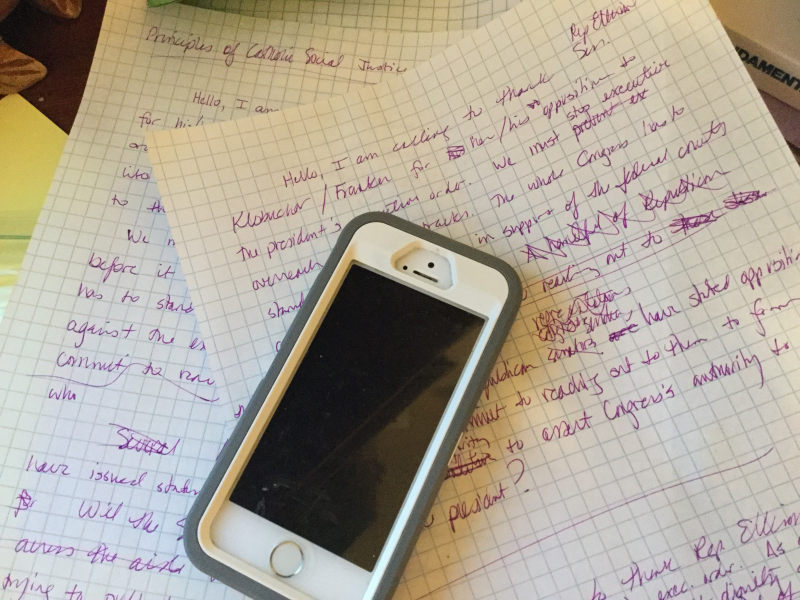
    Today I thought a lot about common goals, spent some time with paper and a purple pen writing those thoughts down.  Then I picked up my phone and I called, one after another, the district offices of my two Democratic senators and my one Democratic congressman.  In each case I got a staffer on the line right away.  In each case I identified myself as a Minneapolis constituent.

    I told the Senators' staff, each in their turn:  

    I'm calling to thank the Senator for opposing the President's executive order.  We must stop executive overreach in its tracks.  The whole Congress has to stand together as a body in support of the federal courts against the executive branch.  What I'd really like to see the Senator doing is reaching out across the aisle to try to work with the handful of Republican Senators who have expressed opposition to the executive order.    Bipartisanship is really important to me and I want to see the Senator working to forge a bipartisan coalition to assert Congress's authority to check the President.

    I was a little braver after having called the Senators, so when I called my representative's office, I talked more.  I told the Congressman's staff:

    I'm calling to thank the Congressman for opposing the President's executive order and for getting out there and being a visible support to refugees, especially the ones who live in our community.  I am probably one of the Congressman's more conservative constituents.  I want him to know that I believe all human beings have equal value from the moment of conception, regardless of nationality or religion, and that we have the responsibility to protect the innocent and shelter the homeless.  So I want him to know that he has conservatives in his district who support what he's doing to oppose the executive order and to stand up for immigrants and refugees.

    I also want to urge the Congressman to reach out to those Republicans who have spoken out against executive overreach and try to work together with them.  I know it is not easy to work with people on the other side of the aisle.  I am asking the Congressman to try.  I believe that bipartisan unity is necessary to push back against the President and to remind the President that it's Congress who is the tribune of the people, and that Congress has the authority to check the President.

    Everyone I talked to was very pleasant.  They listened, they thanked me, they said that they would pass the information on.

    + + +

    I don't know what good it did.  

    + + +

    Do we ever know what good we do?

    IMG_1867

    + + +

    But I told them the truth, and I asked them for something that I want, and that I believe they have the power to seek.  And the duty to seek, if they think enough of their constituents also want it.  


  • Co-schooling lunch: why so fancy?

    I got a new Instant Pot electric pressure cooker for Christmas.  The first thing I made in it was frijoles negros, which worked beautifully, last week.  

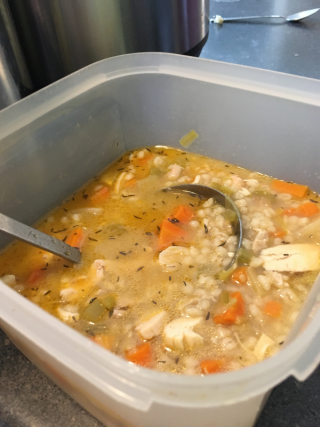
    The second thing I am making in it right now is chicken stock — I hope — from two rotisserie chickens which I chilled overnight and picked not-quite-clean of meat in the morning.  

    The third thing, I will make in it right after the chicken stock is done:  soup with barley, leeks, and carrots, to which I will return some or all of the chicken meat at the end.

    + + +

    IMG_2176

    This soup is for lunch on a co-schooling day, along with a loaf of whole wheat bread from my bread machine and a clementine or two for everyone.  While the pressure cooker I thought I'd stop and write a bit about hot lunches in general for the homeschooling family, and then about hot lunches on co-schooling day.

    + + +

    If I could poll a hundred homeschooling families and get a detailed answer out of all of them, I think I'd love to ask this question:  How do you manage lunch?  Not because I can't manage it:  After eleven-plus years of trying to feed children in between their lessons and studies, and especially now that I am out of the nothing-but-small-ones years, we have a system that works pretty well.   (More on that below.)  No, I just am curious to hear about the ways that diverse families have solved the problem.  

    And it is a problem, in the sense of a series of questions to answer:  

    • How long after breakfast do you have lunch?  
    • Must you clear off a schoolwork surface to make room for cooking and eating?
    • Is lunch to be a dinner-like occasion, with a set table and everyone at their places on time?
    • Does everyone eat the same thing?  Do all the kids eat the same thing but the parent has something different?
    • Who makes lunch?  Is it the parent?  A particular child?  Do children take turns?  If children make lunch, may they choose the menu?  Do people make their own lunch from what's available?
    • Is lunch-making time a time for the parent to teach food preparation to young children?
    • Do you insist on a balanced meal or that children eat their vegetables at lunch time?
    • How much time can you take for lunch?
    • Do you have a rest time or "recess" afterward?
    • Do you decide what to make in advance?
    • Do you try to use dinner leftovers in your lunch?
    • Do you have a regular rotation of lunches-of-the-day?  Or do you often eat the same thing day after day?
    • Who cleans up? Will you completely clean up the lunch before going back to the rest of your day, or will dishes wait till later?

    Different families:  different lunches.

    + + +

    I keep it relatively simple in my three at-home days.  This year, the regular rotation is sandwiches on Tuesday, pizza (usually from frozen) on Wednesday, and quesadillas on Friday; all with fruit on the side. 

    On Thursdays, when I host, there are twelve to fifteen people here for lunch, and the adults have quite a lot to do.  You would think I would want to go even more simple on those days, but in fact I do not.  Here is why.

    Point one:  Scale-up.

    It turns out that it is not actually simple or quick to prepare most sandwiches, frozen pizzas, or quesadillas for twelve to fifteen people, nor to let those twelve to fifteen people prepare their own sandwiches.  

    • Assembling large numbers of sandwiches is a surprisingly fiddly, messy affair.
    • You can really only do a couple of frozen pizzas in your oven at once.  That'll feed maybe five children?
    • Quesadillas also have the sandwich problem combined with the heat source problem.

    No, what you want to feed people simply and easily in your house is probably a couple of deep pans of something you can cut into pieces, or a vat of something scoopable. 

    A960a0ac740d9b1e1a6250ec130b3ea4a7c0f2a79de6a058feb55eeaded97408


    Point two.  The co-schooling kids' time is better spent on schoolwork than on lunch.

    On our home days, helping me put lunch together is part of my kids' job.   My "simple" lunches for days at home are chosen in part because I need to be able to bark down the stairs, "Elder Teenager!  Please start the quesadillas while I clean up this mess!"  or to be able to ask, "Younger teenager, can you put the pizzas in the oven at eleven-ten so they're ready when I get home from toddler music class?"

    But the co-schooling time is short, and we really need all of the kids to be either productively schooling or productively having recess together most of the day.  I'm not going to have them make their own sandwiches by digging through my fridge looking for the fillings they like best (although sometimes in warmer weather I'll set out a tray of meat and cheese and a basket of buns on the table).  Usually there comes a time in the late morning when the students are working independently, and that gives me time to set out lunch trays.

    We do assign a pair of children each day to be "servers." It's the servers' job to keep the water pitchers refilled, to fetch second servings, and to retrieve condiments from the fridge (in between bolting down their own lunches).  This little innovation from a few years ago made it a lot easier for  us parent-teachers to sit down and eat.  Servers also have to clear the table so it's ready for schoolwork.  


    Point three.  Once you've got comfortable with a dish that really works, it's not always all that hard.

    Chicken noodle soup from scratch is, on the surface, a bit complicated.  One must immerse the whole chicken in a big pot of cold water, add a few flavoring vegetables, bring to a boil,  and turn down to a simmer.  One must skim the scum that floats to the surface, then an hour or so later remove the chicken and let it cool.  Diced vegetables go into the pot, and that boils again for thirty to sixty minutes; meanwhile the meat must be picked off the bones, and the broth salted and tasted.  Towards the end, in go the noodles, and you must stir so they don't stick.  Once the noodles are all done, the meat goes back in.  If you are frugal, you'll put the bones to boil again in another pot, because there's another pot of broth left in them.

    So yes, many steps, spread out throughout a whole morning.  But if I am in the kitchen anyway — and I teach my co-school students in my kitchen — I can make chicken noodle soup practically in my sleep.  I have done it so many times that I know exactly when the pot will come to a boil, when to skim, when the chicken will be done, how long the noodles have to go and when to wander back and stir them.  So a vat of chicken noodle soup is something I can make for a co-school day.  It sounds hard.  But because it's one of the things I know how to make work for me — I make it work for them.

    It can be even easier than that.  A perennial favorite is meatballs (read:  from a bag, frozen), heated all morning in my crockpot in a simple tomato sauce (read:  straight from a can — even plain crushed tomatoes will do because the meatballs flavor them).  I boil spaghetti — that's the most complicated part — and serve with buttered rolls and green beans (frozen, steamed in the microwave).  Another is chili (it all goes in the crockpot in the morning) with tortilla chips and a bowl of cheese to pass around.  Mashed potatoes (made in the morning, kept warm in the crockpot) and a tray of oven-baked chicken legs is another.    I also like to do a pot of coconut rice (thanks, rice cooker) with plain poached chicken breasts, steamed broccoli, and pineapple chunks.  Give them a bottle of soy sauce and those are some happy kids.

    H. tends more to casseroles than I do, and usually preps them the night before so they can be popped in the oven.  The three things she makes most often are a ridiculously plain and ridiculously delicious salmon loaf (it's so great, you must try feeding it to your kids),  a sort of cheesy noodle bake made with mostly parmesan, and … hm, I think number three might be little mini meatloaves.  I hope so, because I love mini meatloaves.

    These things are not as hard to get on the table as you might think, at least not once you have the routine down.


    Point four:  You might want to eat something tasty, too.

    Let's be real:  although my children are happy to eat it, I do not want frozen pizza for lunch.  Certainly not every week.  I do like quesadillas and eat them sometimes, but not every week.  

    On the other hand, I would be perfectly happy to eat H.'s salmon loaf or meatloaves or cheesy noodle bake every week.  They are yummy.  A bag of steamed vegetables on the side of any of those, and I'm very happy.  (Salmon loaf especially makes me happy.  We make a sort of rémoulade of mayonnaise mixed with homemade hot sauce for it, and it's really nice.)

     Likewise, I could eat chicken noodle soup — my own homemade chicken noodle soup, that is — every week for the rest of my life, and I would not tire of it, at least if I had copious amounts of saltine crackers and black pepper.  Or mashed potatoes and chicken, or even the spaghetti and meatballs.  

    Co-schooling days are very busy, especially traveling to the other's house in the morning — what with gathering together all the stuff and piling it in the car, fighting morning rush hour traffic, setting up all the stuff again — and it's nice to have a good meal to look forward to, shared with a friend.


    Point five:  It's welcoming.

    I can get stressed out by the details of hosting everyone, to be sure.    But in the long term, I want my house to be a place that kids remember fondly being a guest in.  Sometimes I get frustrated when I teach.  Sometimes I get irritated picking up after people.  I'm sure the kids see this all the time.  But I do hope they like sitting around my table with their friends scarfing down my chili.  Maybe they'll remember that as a good time, remember a feeling of being welcomed and fed and among friends once or twice a week (between being hounded for their history homework and quizzed on their Latin grammar).    I have to believe that it makes a real difference to them to sit down to (say) a bowl of hot soup with fresh rolls and a piece of fruit.


    Point six:  You can always order pizza.

    Which sounds like a jokey way to end a post, but in fact, it is actually a real point.  Once, maybe eight years ago, H. and I sat down and worked out about how much it cost per serving to feed the kids a home-cooked lunch.  I am sure the price has gone up significantly since then, partly because food prices have risen significantly, and also since we now have some teenagers.  If I remember right, we figured that we spent about $2 per serving back then.

    That turned out to be a very useful thing for us to have calculated, because we realized that it didn't actually cost us significantly more to order Domino's pizza for the kids (at $5.99 for a two-topping medium pizza, the lunch special that has been going for years in this area).

    We didn't want to order pizza all the  time; we wanted to have balanced meals that would be good for everyone, as much as possible.  But we'd also been assuming that pizza delivery was kind of a luxury, and so we definitely didn't want to order pizza all the time.

    Turns out that it's not.  I think it might even be less expensive relative to home-cooked meals now, because the prices of a delivered pizza have not risen as fast as the prices of groceries.  (Although four teenage boys can put away a lot of pizza, it should be noted — probably more pizza than salmon loaf.)

    Anyway, the point of this is that if your home-cooked meal backfires somehow, or if you wake up in the morning and you just can't stand the idea of cooking, you could order pizza (provided you live somewhere that you can get it).  H. and I have given each other carte blanche to resort to pizza whenever that seems necessary.  I think we're both committed to making a good-faith effort to a lunch that is not pizza, for the sake of balance and variety; but we're not fanatics, and sometimes the pizza is the best thing to happen to the day.

    Remember to tip the driver, and then make your peace and get back to your school day.


  • Semi-sick day.

    I have no idea if it is evidence-based or not, but when it comes to treating a bad cold, I believe with almost fanatical devotion in the importance of One Full Day of Rest and Fluids.

    I always give kids permission to take one such day off when they are really sick — the test of sickness being, “Are you willing to stay in bed and really rest, even if I confiscate all your electronic devices and leave you with nothing but books, a radio, and your pillow?”

    I usually give myself permission to take such a day off too. But now I have been ill for about the last ten days of Christmas with a hacking cough that keeps me up at night, a stuffy head that makes it hard to propel air through my vocal apparatus, and assorted aches and pains. I have not yet taken my Day of Rest and Fluids because the holiday season intervened. There was driving, and visiting, and houseguests, and the like.

    The first week back at school things still has some of the flavor of holiday, normal rules being suspended, and so I am going to take today, Friday, as my last chance to scrape together a Day of Rest and Fluids.

    But I really don’t want to give the kids a complete day off, so we shall see what I can do from bed.

    + + +

    Mark started me off right by bringing the coffee carafe and a mug up to my bedside. When the 3yo woke up, I sent him downstairs to find my iPad, and he happily curled up next to me watching PBS Kids. Then when my 10yo daughter woke up I sent her to wake the others and feed the 3yo breakfast. Then I had her and the 13yo bring their to-do lists, which I wrote from under the blankets. I have made it so far to 10:24 a.m. without leaving my room.

    What about when the coffee runs out, you ask? I am plotting to go downstairs and efficiently perform several necessary tasks in the time it takes to brew the second pot. These will be:

    • gather all the school material I need to teach my first-grader from bed, plus some picture books
    • hunt through my purse for the roll of masking tape that my oldest two need for art later (kids aren’t allowed to rifle through my purse)
    • grab my planning notebook
    • secure a supply of fluids (hot water thermos, packets of tea, bottles of energy drink, broth)
    • find out what I was planning to make for dinner and determine if any of it requires action before lunch

    Then I swear I am going to come back to bed and not leave. I will be teaching algebra, calculus, and first-grade math from bed, thankyouverymuch, not to mention all the readalouds and checking the science workbooks. The rest is up to them, and the magic of checklists.

    I have assigned my 13yo to make tuna salad for lunch. I think that covers most of what they need.

    And the rest of the time, I guess I will work on stuff like email. And rest and fluids.


  • A new pan for me, and some pain de mie.

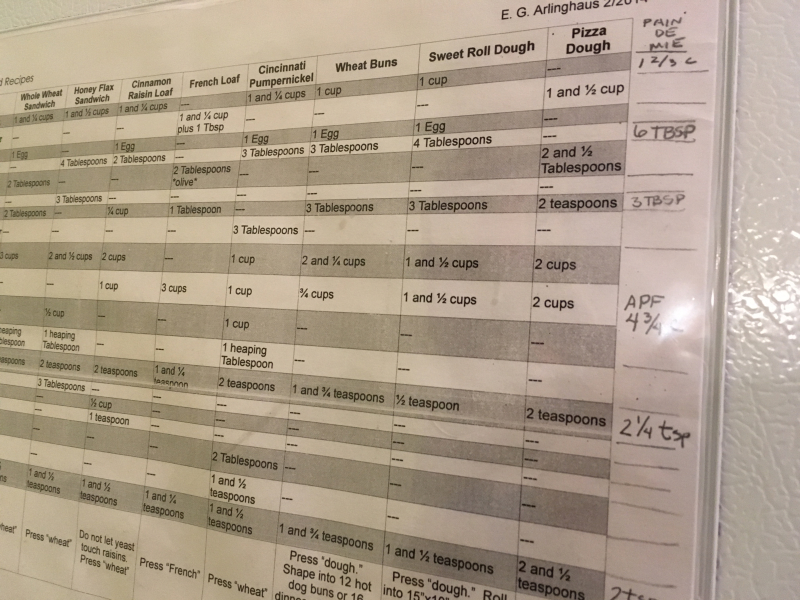
    I have added a new bread recipe to my Bread Machine Recipe Spreadsheet!

    The last time I updated the spreadsheet (mentioned in the link above), it was 2014.  Almost three years later, I have found a new worthy loaf.

    + + +

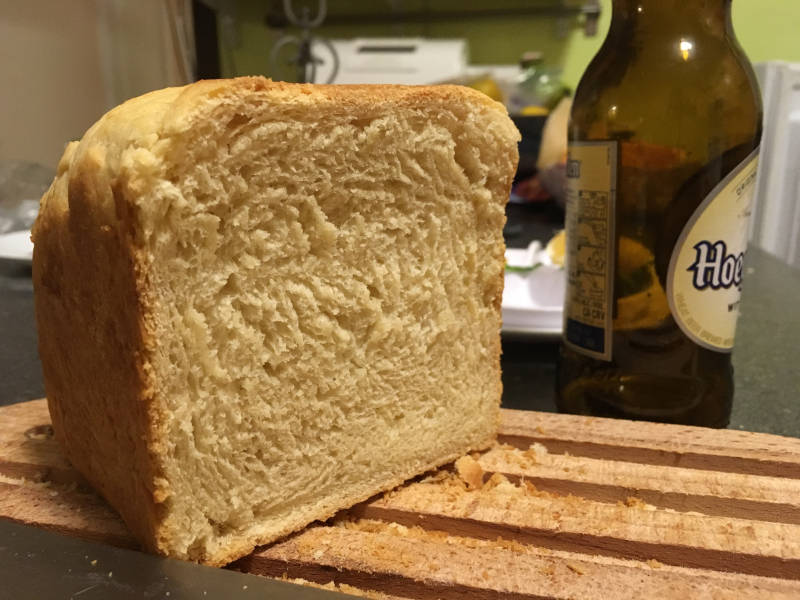
    The French version of white sandwich bread, which I really encountered for the first time on our family trip to Europe a couple of years ago, is called pain de mie.  The word mie means crumb, or it can mean the inside part of bread (the part that is not the crust); so this is "crumb-bread," bread that is almost all "inside."

    It is white and tender, and makes square slices that are not very large.  But even the store-bought kind is (as you would expect) superior to your average American white sandwich bread, even kinds from bakeries.   It is made with milk and lots of butter, and all-purpose flour rather than bread flour, which produces a smooth, unsticky, and easy-to-handle dough.  It is baked in a buttered, lidded pan that confines the oven-spring to make a square, dense loaf with a fine crumb.

    IMG_2146

    I bought a 13" × 4" × 4"  Pullman loaf pan with some Christmas money, especially for learning to make pain de mie.   Here it is on Amazon.  I paid $25 on sale.

    And today I set about making my first loaf of pain de mie.  My basic working recipe, for now, is adapted from this recipe at King Arthur Flour, with some attention to various recipes around the net for "Pullman bread."


    Working Recipe:  Pain de Mie for the Bread Machine

    • 1 and 2/3 cups whole milk
    • 6 Tbsp salted butter
    • 2 and 1/4 tsp salt
    • 3 Tbsp sugar
    • 4 and 3/4 cups all-purpose flour
    • 2 tsp bread machine yeast
    • Additional butter for greasing the pan

    Put all the ingredients in the order listed into the bread machine on the "Dough" cycle, so that it mixes, kneads, and rises twice.   

    Preheat the oven to 350° F.  Butter (don't spray) the inside surfaces and inner lid of a 13" × 4" × 4" aluminum Pullman loaf pan.  

    Transfer the completed dough to a nonstick cutting board.  Press it gently into a 13" × 8" rectangle, then roll it up from the long end into a log.  Place it seam side down into the loaf pan, with the ends of the log right up against the inside of the pan, and slide the cover almost all the way on.  Allow to rise until the loaf is just below the lip of the pan, and the pan is at least 3/4 full, 45 minutes to an hour  – or longer in a cool kitchen.  

    Close the pan all the way and bake 25 minutes.  Remove the pan from the oven, remove the lid, and allow the bread to bake for an additional 20 minutes or until an instant-read thermometer inserted into the center reads 190° F.

    Remove from the oven, turn immediately out of the pan onto a rack, and cool completely before slicing.

    The bread had a buttery, almost flaky-thin crust that reminded me of a croissant, and sliced easily into thin and sturdy slices.  We spread butter on it and ate it still a little warm — I admit, our impatience left the center a bit unstable and soft, still steaming — and it was delicious and dense.  I expect it will make marvelous grilled-cheese sandwiches and buttered toast.  But to find out, we will have to wait for the next loaf.

    I'll be tweaking this recipe over the next few weeks, until I settle on a version worthy of a new printed edition of the spreadsheet.  The first thing I may try is increasing the yeast a bit to speed up the rise.  The second thing I may try is leaving the lid on the pan for longer in the hopes of getting a truly square, evenly browned loaf.

    IMG_2137


  • Francis de Sales: The patron saint of to-do lists? (A repost for the new year.)

    I wrote this post originally in August of 2014, when I was working through some ideas I'd drawn from various figures in Salesian spirituality.  Its themes of resolution make it, I think, appropriate for the first post of the new year.

    Three years later, although I haven't made a daily habit out of the insights I described in this post, they are still bearing fruit for me when I remember them.

    + + + 

    I know I said in my last, introductory post to Salesian spirituality that I was going to look first at Don Bosco's "Preventive Method," what with the school year starting up now and all.

    But I changed my mind, because I happened to be looking at a short work of St. Francis de Sales, the Spiritual Directory. It's sort of a rule of life for the religious he supervised — only instead of specifying so mant hours of work, so many of sleep, so many of prayer, etc., he specifies little acts of devotion and intention to be performed throughout the day, connected to rising, worship, work, meals, bedtime — the whole cycle of an ordinary day. They are, so to speak, spiritual exercises, not for a novena or a retreat but for every day.

    "It is true that the Directory proposes many exercises," Francis writes,

    Yet it is good and fitting to keep one's interior orderly and busy in the beginning. When, however, after a period of time, persons have put into practice somewhat this multiplicity of interior actions, have become formed and habituated to them and spiritually agile in their use, then the practices should coalesce into a single exercise of greater simplicity, either into a love of complacency, or a love of benevolence, or a love of confidence, or of union and reunion of the heart to the will of God. This multiplicity thus becomes unity.

    I like this idea of patiently developing little habits that "coalesce" over time into character.

    + + +

    The ordinary thing for me to do would be to start where Francis starts, at the beginning of the day, with "Article #1: Rising."

    But I was struck instead by Article #2, "Meditation." Or rather, preparation for meditation.

    Francis devotes only a short paragraph to instruction on meditation, "the serious practice of [which] is one of the most important of the religious life." Mainly he suggests going to other sources, including his own other works. But he devotes several paragraphs of this article to the preparation.


    To form themselves for meditation they will prefer to all other means the exercise of the preparation of the day….By this means they will endeavor to be disposed to carry out their activities competently and commendably.

    Invocation. They will invoke the help of God, saying,

    "Lord, if you do not care for my soul, it is useless that another should do so." (Ps 127:1)

    They will ask him to make them worthy to spend the day with him without offending him. For this purpose, the words of the psalm may be helpful,

    "Teach me to do your will, for you are my God. Your good spirit will guide me by the hand on level ground, and your divine majesty by its inexpressible love and boundless charity will give me true life."

    Foresight. This is simply a preview or conjecture of all that could happen during the course of the day. Thus, with the grace of Our Lord, they will wisely and prudently anticipate occasions which could take them by surprise.

    Plan of Action. They will carefully plan and seek out the best means to avoid any faults. They will also arrange, in an orderly fashion, what, in their opinion, is proper for them to do.

    Resolution. They will make a firm resolution to obey the will of God, especially during the present day. To this end, they will use the words of the royal prophet David, "My soul, will you not cheerfully obey the holy will of God, seeing that your salvation comes from his?"

    Surely this God of infinite majesty and admittedly worthy of every honor and service can only be neglected by us through lack of courage. Let us, therefore, be consoled and strengthened by this beautiful verse of the psalmist:

    "Let evil man do their worst against me. The Lord, the king, can overcome them all. Let the world complain about me to its heart's content. This means little to me because he who holds sway over all the angelic spirits is my protector." (Ps. 99:1)

    Recommendation. They will entrust themselves and all their concerns into the hands of God's eternal goodness and ask him to consider them as always so commended. Leaving to him the complete care of what they are and what he wants them to be, they will say with all their heart:

    "I have asked you one thing, O Jesus, my Lord, and I shall ask you again and again, namely that I may faithfully carry out your loving will all the day of my poor and pitiable life." (Ps 27:4; 40:9)

    "I commend to you, O gracious Lord, my soul, my life, my heart, my memory, my understanding and my will. Grant that in and with all these, I may serve you, love you, please and honor you forever." (Ps. 31:6, Lk 23:46)


    Okay. Do you see what he did there?

    St. Francis has just unified the concepts of "the morning offering" and "the to-do list."

    + + +

    Before meditation, in fact as part of the preparation for meditation, St. Francis prescribes thinking about all the things that you expect to encounter during the day, anticipate difficulties, carefully plan (with an eye towards avoiding faults — I tend to skip that step when making to-do lists), then "arrange in an orderly fashion what … is proper… to do."

    Did you catch those last two words?

    You finish up your orderly-arranged to-do list with two more steps I commonly skip: resolving to obey the will of God, and entrusting yourself, with all your "concerns" (including, we are to assume, all the items on your aforementioned to-do list), into God's hands.

    It turns out that you don't have to try hard to push back the items that are rushing at you and demanding your attention while you are trying to make your morning offering.

    It turns out that you don't have to guiltily say to yourself, "I'll do my morning offering as soon as I write my to-do list."

    It turns out that you've been a bit silly, trying to add "Say Morning Offering" to the top of the to-do list.

    St. Francis suggests that the to-do list can itself be the morning offering. He sanctifies it: embedding it in an exercise of invoking God's help, planning tasks with an eye to avoiding faults, resolving to do God's will, and ultimately entrusting the outcome to God's providence.

    And this is a perfect example of why St. Francis draws me. I am used to being made to feel, oh, I don't know, insufficiently go-with-the-flowish, insufficiently trusting of God; that my desire for order and efficiency is somehow a marker of a lack of love. That I should want to run to God in prayer more than I should want to make an Action Plan, and that my itchiness until All The Things are safely written down, that itchiness which so interferes with making prayer my first act of the day, is a sign of weakness and a thorn in the flesh.

    What's this? Rather than putting holiness on my to-do list, I can make my to-do list holy. This is a spiritual exercise I can roll up my sleeves and tackle, true multitasking: setting out my daily plans, right there, on the altar of offering.


  • The spirit of the season.

    I came back from my Christmas gathering on the second day of Christmas, collapsed into bed, and slept for about two and a half hours. And then I woke up, and I felt much, much better. Until it was time for the next one.


    I was grateful during the last couple of weeks of Advent to come upon a couple of pieces of writing that acknowledged the dark side of Christmas.

    Anne Kennedy at Preventing Grace taps the nail in, just far enough, with a precise little hammer:

    The trouble is, the world demands untempered joy. It’s Christmas. Get it together. So what if you lost someone last week, or your marriage just ended, or your child was diagnosed with something hideous, or you just don’t have the emotional furniture required to deal with all the extra work and demands of the season. Turn that frown upside down and tuck all that trouble away.

    …This is why it’s so important not to conflate the church’s celebration with the world’s. The world has its own measures of success and happiness, its own ways of rejoicing, and they usually involve you showing to everyone else who much you have it together and the beauty of your life overall. And you showing yourself that.

    Whereas the church’s celebration is about God overcoming the darkness of our human condition. These are two very different kinds of joy. The one floats on clouds of tinsel. The other passes through the valley of the shadow of death.

    Kate Cousino at The Personalist Project puts an optimistic spin on Christmas pessimism:

    We often have occasion to remember that no joy in this life comes to us entirely unmixed with sorrow. The wheat and the tares grow together until the harvest, and the poor we will have always. It’s clear that an earthly, here-and-now paradise is not promised to us…

    …God became man and came to live among us, not despite our sins and the darkness and hardness of our hearts, but—o happy fault!—because of them, in response to them…

    …”There is a crack, a crack in everything/That’s how the light gets in.”

    + + +

    I didn’t even have the emotional furniture, as Anne put it, to write the post before Christmas, when I might have been a useful witness to other people in the same situation, but I will do it now anyway.

    Christmas is when I feel most cut off from the universal Church, and when I feel most deprived of grace and strength.

    Mark asked me a few weeks ago, when I was starting to despair about the rapid approach of Advent, what he could do to make Christmas easier for me, and I immediately answered, “To stay here in our own home, and not give or receive any presents, except some things for the kids.”

    And then I followed that up with “I know we can’t do that, and I know it doesn’t make any sense.” Because it doesn’t make any sense. It is entirely irrational. It comes from nothing and it ends in nothing. And I know that it will not actually make me feel better, in the long run, to give in — for Christmas — to my own Christmas anxiety.

    For one thing, like fear of flying, like fear of open spaces, it’s probably better not to give an inch lest it take a mile: better to confront it every year and push it back as hard as I can.

    For another thing, I am entirely aware that the problem is inside my own heart and mind and soul. I have already pared away as much excess as I can, and done my best to surround myself with people who are kind and joyful. I am aware that I have the power to put one foot in front of another for twelve days (or whatever) and I am aware that many of the anxious negative messages my brain feels like bringing to my attention are illusions. I remind myself of that every day, and it doesn’t make the feelings go away, but it helps me keep moving.

    For another thing, I don’t want my husband’s Christmas, my children’s Christmas, to be ruled by my own interior and temporary (if yearly) insanity. They are normal people who appear to love Christmastime, presents, gatherings, feasts. They can have a good Christmas and I should get out of the way and let them. I just hope they can do it without a great deal of support from me.

    + + +

    Let me go back to just one aspect: feeling cut off from the Church.

    I have been anxious and exhausted at Christmas for as long as I can remember. Last year, I wrote a relatively frank post about that.

    I was in college before I really found out that Christmas had an other side, and just as I was discovering it, in darkness and unfamiliar music, lit by purple candles, I had to go back to the house(s) I grew up in for the holidays. I stalked out into the night on Christmas Eve, took the car, and would not say where I was going.

    I went, but I wasn’t yet allowed to participate. And Christmas still feels like that to me. I am looking in through the glass.

    + + +

    I almost get there, and every year, mid-Advent, I lose my grip on it.

    Part of it is location. I am homesick. Every year we leave town, leave our lovely parish where my sons serve and my daughter sings in the choir, and I find myself at Christmas Day mass at a strange parish with unfamiliar music set to unfamiliar drums. After communion I squeeze my eyes shut and pray fervently for mercy on my judgmental and elitist heart, so that I can’t see the usher dressed as a Coca-Cola Santa Claus come in and kneel down and give a present to the Baby Jesus before the accompaniment music is over. Because if I watch it, I am going to roll my eyes and embarrass my teenage sons.

    And part of it is my own reaction to the location. At the same time that I am trying not to roll my eyes I am trying to stop thinking mean thoughts about the Santa suit because it just goes to show what a terrible Christian I am at the time of the year when everyone else is much better at it than usual. I try to think, in measured tones in my head, “I am surrounded by people who love Jesus and care for each other. Jesus is here in the tabernacle. It is all the same.” But my heart is two sizes too small and can’t make the leap. This is, I know, a stupid, ridiculous cross. All of my crosses are completely stupid and worthless. The things that get between me and Jesus are so very stupid and transparent and superficial dumb and even I can see how dumb they are.

    And part of it is that it lasts so long. Exhausted by people — all people. I find myself, at the holidays, making my way through crowds of relatives — they aren’t even my own relatives, and they are actually wonderful human beings — but making my way through feels like swimming on days when it’s really tough and I have no energy — there are days when I get to the pool and it feels like swimming in syrup. And making my way through the relatives can feel like that. It is not any one individual, it’s just that it is so relentless. Three days, maybe more, and a party every day.

    After a while when I have to be at a party every day my mind plays tricks on me. I start to get impostor syndrome, like in graduate school, only instead of having faked my way into being a research engineer I feel like I have faked my membership in the human race. Everyone is just playing along to avoid e
    mbarrassing me. This year was worse than most, and I retreated into the corner with my wine and looked stuff up on my phone.

    + + +

    Why so bad this year? Mark has a theory that it’s because a lot of things were up in the air. My grandmother is having more health problems, and we weren’t sure what Christmas would look like, what schedule I could keep. Mark said: “I think it is hard for you to have to operate without a fixed plan. You like to have it all figured out ahead of time, because you are afraid that otherwise you’ll have to wing it and that you’ll be blamed if something goes poorly.”

    I think he is probably right about that.

    But at the same time I could feel glad that I had pared some of the stressors away. I tried buying fewer presents this year, especially for people whom I didn’t know well enough to actually shop thoughtfully for, and do you know what happened?

    Nothing. No one complained.

    Instead of visiting absolutely everyone I felt an obligation to go see in my few days in town, I tried going to see the people I wanted to see, and instead of visiting the others, sending flowers and a card. I hope you have a merry Christmas, I wrote. I didn’t mention visiting. And do you know what happened?

    Nothing. No one complained. When I stopped offering my time to those folks, no one even asked why I didn’t come.

    I felt relief.

    + + +

    Despite what progress I have made, I go on feeling pretty insane at Christmas, even though I guess I am not insane enough to deserve the title. Two mental health professionals have confirmed me to be insufficiently off-kilter to merit a diagnosis of any kind in the off-season, and apparently there is nothing in the DSM about an anxiety or depression that only lasts six predictable weeks every year.

    So the good news is that it might be all in my head.

    But I feel it in my body. I feel it like fear or like grief, a round hard thing in my chest, the heart two sizes too small, perhaps, or a lump of poorly digested shortbread cookies. Like tension in my shoulders, low-grade nausea, sleepiness. I know it is irrational but I can’t make it go away by thinking the right thoughts about it. Just pick it up and carry it into next year, and in a week or two it will be as if I never left.

    But for now: I pour out my weakness to the Mother of Sorrows. I try to embrace the terrible coda to the Annunciation, the words of Simeon and Anna. Christmas has a dark side, and maybe it could be okay that I live there, in the terrible stillness, if only I felt I could get away with it.


  • Tween-related maternal depression: what about family size?

    Time for a short mental-health blog post while I work on a different, longer one behind the scenes.

    This article at NPR is going around on Facebook today: “Being Mom to a Middle Schooler Can Be The Toughest Gig of All:

    Many women assume that the first year of motherhood is the most precarious time for their mental health. But a recent study published in Developmental Psychology finds that maternal depression is actually most common among mothers of middle school children as they catapult into the tween years.

    …[The study authors] discovered that the years surrounding the onset of adolescence are among the most difficult times for mothers. During this period of transition, women can feel lonely, empty and dissatisfied with their mothering roles. The researchers also found that compared to mothers of infants, these women experience the lowest levels of maternal happiness and are even more stressed out than new parents.

    Luthar says that tweener moms reported feeling the most unhappy or depressed when their children are in middle school, but that the transition begins when children are 10 years old. Parents of teens are actually happier than parents of middle schoolers.

    Two of my five children have already passed from tween years into teen years, and my third is entering that stage. I am familiar with how tricky it can be to adjust my parenting style towards each individual child in the years between ten and thirteen — it encompasses a big change in autonomy, skills, and responsibility. They go from being baby-sat to being babysitters; they learn to walk to the store to buy a carton of milk; they learn to cook dinner, to manage their own schoolwork time, to make judgments about the media they consume. There is a lot going on, for sure, and it is not always easy. Sometimes I have despaired of my own competence — whether I could figure out the right balance between guidance and self-guidance, between rules and freedom, for each young person.

    But I was struck by one big difference between my experience and the experiences of the women who were profiled in the article:

    I have never been totally immersed in my own feelings of incompetence. And that is, I believe, because I never have and never will have all my children going through those years at once.

    When my very first child turned ten, I also had a seven-year-old, a four-year-old, and a baby. You might think that this would be tough, and of course I was very busy and frequently overwhelmed by how much there was to do. I had feelings of incompetence. But I wasn’t paralyzed by feelings of incompetence (as if I had time for that) — I believe that’s because I got to feel competent at the same time.

    Raising a ten-year-old was hard because it was new to me. And I was leery about my seven-year-old turning eight, because I remembered it being difficult to teach an eight-year-old. But at the same time as I was struggling to figure those out, I had the privilege of mothering a four-year-old who was utterly delightful, as all four-year-olds have been in my experience. And I was carrying around on my hip in a wrap sling a beautiful eight-month-old nursling that year, too — lucky me, because I have always felt at the height of my powers with those nursing babies. Despite having a cerebral and analytical approach to life in general, I always felt able to tap into an intuitive, biological mothering style, towards babies, that has rarely steered me wrong during the first three years of life.

    From the article:

    Brizendine says that for most women, estrogen and progesterone levels start decreasing after age 42. With estrogen depletion, women may feel less nurturing. As a result, they can feel more agitated with themselves, their partners and their children. Additionally, mothering tweens doesn’t offer the hormonal reward — the oxytocin “love rush” — that caring for little children provides.

    But see, I am 42, and I am still caring for little children. I always wanted to have a teenager and a baby at the same time, and I got that. I got all the benefits of oxytocin (am still getting it — my three-year-old nurses a couple of times a day) at the same time as I get to teach physics and set teens up with drivers’ ed.

    Just as things were only starting to get tricky at the upper end of my family, I was deeply immersed in parenting children during the years when I feel most competent and powerful. At least given that I did not suffer from any clinical depression, I could never have been fooled into thinking I was a bad mother in general, even if I might have wondered if I was any good at this older-kid thing.

    I am looking forward to the mirror image of my experience at the end of my childraising years. When my very youngest becomes a tween, I will not have any babies or preschoolers to enjoy at the same time; but I will still have two teenagers in the house and grown-up children to enjoy as well. I will have, I hope, the perspective of having ferried several kids to the other side.

    In short, for me — grown woman that I am — there are no “years surrounding the onset of adolescence.” Each child will have his or her tween years, but I will not have any years that are all-tween, all-the-time. I could be wrong about the causality, but it seems like the broad age-span of my offspring has helped me feel less incompetent, less of a good-mom impostor, at every stage than I might have otherwise.

    Smaller families and shorter periods of child-raising have accompanied many changes in living standards that are regarded generally as positive, I know, but there are unlooked-for consequences to all social change. I wonder if the feeling of “I totally don’t know what I am doing here” is more widespread than it used to be when four kids wasn’t a completely ridiculous number of children to have.


  • An algorithm for co-schooling in the face of norovirus.

    H and I have been getting together twice a week for years now, sometimes with a third family, for co-schooling. We have always tried to minimize the number of skipped days, so that the kids' education doesn't get too interrupted and so we can keep a steady routine; and that's felt more important as children have grown into high school students.

    A long time ago, we made up our minds that there was no point in skipping school days together because of rhinovirus symptoms. Colds last a long time, and when you only go three days without seeing one another, chances are good we already passed it on. We also don't typically skip school for conjunctivitis, head lice, or strep (once the antibiotics have started).


    We do typically skip school if someone has been vomiting recently. Nobody wants to pass that along! But we had always lacked an algorithm for deciding when to resume getting together after symptoms have disappeared.

    Part of that has been that our families have different attitudes about GI illness. This is in turn because we tend to experience GI illness differently.

    H and her kids always seem to be hit very hard by any stomach bug, a couple of times every winter. The children need to be rehydrated a teaspoon at a time and can't keep anything down for days, everyone is miserable, and her older kids are petrified of catching the bug. So in H's family, as soon as someone shows sign of illness, H and her older kids go into high-alert transmission prevention:

    • Well people isolate themselves to a different floor of the house with its own bathroom
    • The ill person uses only one bathroom
    • No well people except H cares for sick people, unless she is too sick to do it herself
    • Ill people and the person caring for them don't cook or prepare food
    • Everything is laundered with bleach on the sanitize cycle
    • Dishes are washed on the sanitize cycle
    • Surfaces are disinfected as soon after vomiting as is practical using a wet bleach solution left to sit 5-15 minutes
    • Until the twin toddlers are recovered, they stay on the main level of the house only
    • H sleeps with the twin toddlers on a blanket on the wood floor so all sleep surfaces are bleachable or washable in the machine
    • H personally supervises all toddler vomiting, toileting and handwashing
    • Young recently-potty-trained children must wear diapers
    • Vomit basins are disinfected with bleach between episodes
    • Hard toys that children had while sick are disinfected with bleach

    In other words, it's really important to H and her kids that they try as hard as they possibly can to avoid passing the bug to each other.

    Whereas, in my family, my kids tend to throw up a couple of times and sleep a bit more, and then feel pretty good in between vomitings. And I know that you have to work hard to avoid transmitting, say, a norovirus in close quarters. So my attitude has tended to be more like, "We are all doomed anyway; let's just get this over quickly."  I tend to put the sick kid on a couch with an iPad and a bucket and go about my business, but with extra handwashing and a supply of saltines, applesauce, and Gatorade on hand.

    I suspect that over the years this difference in attitude has caused H to regard me, privately, as astonishingly lax; and me to regard H, privately, as bordering on obsessive. (She'd be the first to tell you that the obsession originates not in her but in her older kids, who voluntarily isolate themselves and compulsively wash their hands until the danger appears to be past.)

    + + +

    One thing that's guaranteed to happen every time:  a phone conversation between me and H where we wonder, "Is it safe for us to get together or should we skip another school day?"

    We recently passed an apparent norovirus around between our families, and got to talking about developing an algorithm for figuring out how long we should wait, after someone has GI symptoms and then they resolve, before getting together again.  The problem is, we had a lot of unanswered questions.

    We do want to avoid passing the bug to people who are still well, but what is a reasonable time to wait?  We knew that people can pass noro to each other for weeks, and it truly isn't feasible to skip our school days together for more than a few weeks — especially when the risk of transmission drops fairly low. Also, is it even possible to prevent transmission? Maybe waiting an extra half-week will make a difference, but on the other hand maybe we would have been doomed anyway. And given that we get together every 3 or 4 days, has everyone in one family already been exposed before one kid starts throwing up in the middle of the night? And given our asymmetric attitudes toward illness, should we have an asymmetric algorithm for infection prevention? We were not sure.

    Fortunately, this blog has its own epidemiologist on retainer: commenter ChristyP, also known as my friend from high school and college, also known as Prof. Christy Porucznik of the Department of Family and Preventive Medicine at the medical school at the University of Utah. 

    I sent Christy an email with the subject line "Practical Epidemiology Question!" and included data about our get-together schedule. She replied (the following has been lightly edited, and two emails have been combined, for blog-reading clarity):

    Contagious period (= time of viral shedding in stool) for norovirus can be up to 6 weeks (Centers for Disease Control website says 2 weeks or more, my advisor in grad school was doing a trial and it was on the order of 6 weeks in some people).

    I'd go for a similar algorithm as used in public schools and daycare centers which is exclusion from school (in your case, attempt to isolate the sick person) for 24 hours after last vomiting.

    Incubation period is 24–48 hours (median of 36 hours), and if an exposed household has gone 2 incubation periods without a new case then you are likely home-free. If practical within a household, you might be able to reduce transmission by reserving one bathroom for use of the sick person and try to keep everyone else out of there. In your situation, I wouldn't see a reason to exclude a kid who wasn't ill from co-schooling unless s/he had a massive exposure (nearby when a sibling vomited or participated in cleanup).

    In a norovirus situation parents are likely doomed, but also able to practice Excellent Hygiene Behavior. I would even Clorox-wipe your glasses, wash your face and rinse out your mouth in addition to any exposed skin if you were nearby someone vomiting. If you can, you might even employ a vomit shirt (or lab coat) so that you don't inadvertently carry the particles from the room of doom to the rest of the house. The infectious dose is SO LOW. It's on the order of 10 virus particles and they aerosolize! A really intense family hygiene suggestion is to make sure that toothbrushes are in a closed container so that they are not inadvertently contaminated by aerosolized evacuations generated in the same room. Also close the toilet lid. Every time. But that doesn't help with people actively engaged in generating biological aerosols by vomiting.

    It is possible that one is shedding virus before the dramatic GI symptoms start, but the time that a person is most contagious is when s/he is experiencing vomiting and/or diarrhea, which is thankfully short. The virus is relatively hardy and can persist on surfaces longer than one might expect (hence long outbreaks on cruise ships and in hotels). Changing towels frequently is probably a good idea….

    FWIW, there are several strains of norovirus, and immunity to the strain you most recently had lasts only about 12 weeks.

    When I teach Infectious Disease Epidemiology I say that caring for someone with norovirus is the surest way to see your own future. I will also share here one of my favorite bits of advice to share at La Leche League meetings, which is that when your child is still in the vomiting-every-hour phase is when you should prep some snacks that s/he can grab from the fridge the next day, when the child is feeling fine but starving and you are the sick one.

    I went back to H and issued my judgment about the correct algorithm, using the more conservative estimate (48h) for the incubation period.

    Co-Schooling Gastrointestinal Illness Algorithm

    Rule 1:   If anyone gets GI symptoms, skip the next scheduled co-schooling day.

    We only go 75 hours between meetings, and it takes 96 hours to find out if the other household has escaped.


    Rule 2:    When GI symptoms appear in the first family:

    • If we last met more than 48 h ago, consider the second family unexposed.
    • If we last met less than 48 h ago, consider the second family possibly exposed.
    • But if the second family makes it to 96 hours with no symptoms, consider them again to be unexposed.

    This rule doesn't bear directly on co-school cancellations, but it does help the second family decide what precautions would be prudent.


    Rule 3:   If everyone in one family has been sick, we can return to co-schooling after they have all gone 24 hours without symptoms.

    Rule 4:   If only some people in one family have been sick, we can return to co-schooling when the sick family has gone 96 hours without symptoms.

    This is under the assumption that the not-yet-sick could be incubating the illness and could show symptoms at any time, combined with a strong preference to avoid exposing the unexposed.


    Rule 5:   If there are some who have been sick and some who have not been sick yet in BOTH families, we can get together after 

    • my family has gone without symptoms for 48 hours, and
    • H's family has gone without symptoms for 24 hours.

    The asymmetry is because H's family is more willing to try to avoid exposing family members; as soon as one person in my house gets sick, I assume we're all going to get it anyway, so I don't care about skipping school to wait out an entire incubation period.  H, however, does think it worthwhile to try.


     Rule 6:  If unexposed people are to meet at a house where some have been sick within the past couple of weeks, we must aggressively disinfect surfaces they might reasonably come in contact with.

     This means the kitchen, first-floor bathroom, first-floor light switches and doorknobs and the like; if the very young children haven't all been sick already, then the hard toys too.  Older unexposed people should take responsibility for themselves to practice good handwashing and the like.


    Rule 7:  When recovered people first meet at an unexposed household, the whole family should shower or bathe before coming and wash hands on arrival.

    This sounds like it should go without saying, but it's worth remembering since our younger kids don't ordinarily bathe more often than once a week or so in the winter because of dry skin.


    + + +

    In addition to the rules for get-togethers, there are two best-practice guidelines, to be followed if practical:


    Guideline 1:   To limit spreading the virus to public areas in the house, consider isolating sick people to a single bedroom and bathroom upstairs that is not used often by guests.

    Because norovirus can persist on surfaces for weeks, the best practice is to keep it off those surfaces in the first place — especially the ones guests and visitors are likely to use.


    Guideline 2:  Carefully supervise young children's toileting for 2 to 6 weeks after they have been ill.

    They need to be monitored to make sure they wipe, wash hands, put their pants back on, and don't leave used potties lying around.


    + + +

    It's too late for these rules and guidelines to save us in the current round of noro, but we can keep this in our back pocket for the next time.   


  • Coming apart at the joints.

    I mentioned this past summer that I Did Something To My Hip while running routinely around the lake up here.  It was the first time I'd ever had a running-related injury, and I couldn't stop exclaiming in shock and surprise about how odd it was that something like an easy jog around the lake might, for weeks, send pain shooting down my right leg and up into my back.

    At the time I tentatively self-diagnosed the problem as bursitis and decided to treat it with NSAIDs, iliotibial-band stretches, and ice for a while.  I resolved to go see the sports medicine doctor if it didn't get better in about six weeks.  

    And it did!  Mostly.  There's still a little bit of irritation there, but I've apparently gotten used to it as it's receded in to the background; I only notice it if I concentrate while I move the joint, and then I'm not sure that I'm not imagining it.  

    So I never did go to the sports medicine doctor.

    (Why can't I just say "sports doctor?"  It sounds wrong.  But "sports medicine doctor" sounds redundant, although clearly there should also exist sports medicine nurses and the like.  If there is such a thing as "sports medicine" and doctors practice medicine, there should be "sports doctors."   A quick look at Wikipedia has taught me just now that the preferred term is "sports and exercise medicine," abbreviated SEM.  "SEM doctor?"  "Sports and exercise medicine doctor?" "Sports and exercise doctor?"  Whatever.  Mostly Mark and I get around it by calling her Dr. F.)

    + + +

    On a Monday three weeks ago I found myself absent-mindedly rubbing my left hand and twisting my rings.  The ring finger felt very slightly sore.  I commented about it to H — "I wonder if I caught my ring on something" — but didn't think much more about it until one morning a few days later.

    On that day I woke up with my whole left hand stiff and sore — curling the fingers hurt.  I flexed it experimentally and as I moved each finger I thought I could detect that the pain was in that left ring finger, and the pain in the other fingers was just an accident of the nerves, referred pain.  The pain seemed to get better as I worked the hand, and indeed, an hour after waking up it was completely gone.

    The experience repeated the next day and the next, and rather than going away slowly as I'd expect if I had "caught my ring on something," it only seemed to get worse.  But every day the pain was gone after a couple of hours of being up and around.  One night I got up several times in the night with a sick child, instead of sleeping straight through; that morning I didn't have any pain, but it was back again the next morning that I'd been well-rested.

    Hmmm.

    I moved my rings to the other hand, in case the knuckle swelled up, and started reading and taking notes.

    IMG_2072

    + + +

    If you Google "joint pain in the morning," you get lots of arthritis links.  This seemed to be a premature possibility.  Really?  I'm only 42.  But on the other hand, I have a bilateral family history of psoriasis (father, mother's sister) and also a family history of connective tissue disorders (oldest son).   So.  I called the nurse hotline provided by our insurance company and asked whether to wait and see, go to my primary care provider, who is a family doctor — family medicine doctor? — I guess by analogy sports doctor should work — or go straight to the sports doctor Dr. F.  They sent me to the PCP, so I went.

    I got a hand X-ray.   I didn't get to see it because I didn't have time to stick around that long, and instead agreed to be telephoned with results.  The results came back:  nothing visibly wrong with the joint.  No visible inflammation or deterioration.

    I guess that's good, although, you know, it still hurts.

    So my instructions are to "monitor, ibuprofen if helpful.  If worsening, swelling, catching, locking, other changes, then see sports medicine specialist."

    Hey!  "Sports medicine specialist."  

    At least the doctor's visit solved that problem.

    Now I guess I just wait to see if it gets worse.  

    + + + 

    I suppose we are all aging at the rate of one second per second.  I have enjoyed many years relatively free of injuries, for which I am grateful.  Mark has not been so lucky:  he is constantly rehabilitating one thing or another.  He's just gone ahead and made the sports medicine specialist his primary care provider — did you know you can do that?  A good idea for active individuals whose biggest problem is joint and muscle injury — and this week he consulted a physical therapist for the first time, and will probably start going in for weekly appointments.  

    When you are relatively pain-free and flexible, as many of us are when we are younger, you can interpret most pain as a warning sign and as a signal to stop what you're doing and rest.  But when pain becomes part of your daily life, it no longer makes sense to calculate:  "If I am in pain, that is not a good day to exercise, or to do my daily work."  Provided that the pain is not disabling, it becomes necessary to do the daily things despite the pain, that and the exercise we do to maintain fitness and strength.  For a long time I have been able to say, "I will skip my workout, because part of me is hurting; I'll rest, and get better faster."  But those are the words of someone who is privileged with confidence that there will be a day without pain, quite soon.  

    Maybe I am now entering the phase of life where I cannot use a little pain as an excuse to take a day off, because the days without a little pain will not be numerous enough.   I suppose it happens to a lot of people eventually.  I suppose, too, that the more active you are in conjunction with your pain, the more easily you can see which activities seem to help and which activities seem to make it worse, and maybe the quicker you can be to adapt your activities to best manage your strength and flexibility and comfort.

    We are planning to go to the climbing gym tonight – a very finger-strength-centered sort of physical activity! I guess I'll take a page from Mark's book and start today, managing soreness and activity simultaneously, instead of either-or.  And beginning to find out what makes it worse and what makes it better, without being focused on making it go away.


  • Anxiety and peace.

    I have this theory that it is possible, if difficult, for a person who is sick or physically suffering to find mental peace in the midst of it. That it helps anyone to know that suffering isn't total and can't last forever; that it helps a humanist to know that, since everyone suffers, in his suffering he shares in a common humanity that links him to everyone who has lived; that it helps the Christian to believe that suffering has redemptive value and to ask for grace.

    I have a little experience with this, but not lots. Mostly when I have been physically ill — and I have never dealt with misery that was both terrible and indefinite — I have retreated to bed, resolutely consuming fluids and determinedly resting, planning to be done with it as quickly and responsibly as possible. I have five childbirths to look back on, of course, and in only one of them (number two) do I remember the physical sensations coming at me faster than I felt I could cope; and that one was over before too long. I know that mild discomfort, the kind that is too mild to justify retreating to bed, makes me irritated and whiny, so that I can't help but let everyone around me know that I have an ache; I limp, I wince.

    Still I have this theory that one could achieve mental peace in physical suffering of illnesses, the sorts of things that happen to some unlucky people. Gratitude, perspective, transcendence, fellow-feeling, petition, and redemption are all accessible — in theory — to people who are physically suffering, alone or in combination. A few sufferers, the lucky from among the unlucky, even report gratitude for the suffering itself, for the lessons it has taught and the graces it has conferred. We can believe those tales without casting aspersions on sufferers who don't manage to find gratitude and peace, I think, since everyone is entitled to tell his own story. So it is possible, and maybe it even is possible to everyone, if we knew how to access it.

    Mind you, though, nobody thinks that the inner peace, when it comes, makes the suffering go away.

    + + +

    So what about mental suffering? Can you find inner peace when you suffer from crippling anxiety? Can you rejoice in clinical depression?

    It seems that anxiety, compulsions, depressions, addictions, are illnesses like any other; if they are more mysterious, still they seem to be thorns in the flesh. So just like any other kind of illness, the suffering they create is real in the body. Therefore they ought to be subject to the same "rules" of redemption. They are a way to share in the world's great penance, in the suffering of Christ. They also don't last forever, and connect us to the great mass of humankind stretching back through and beyond history. We can ask for grace to help us bear them.

    But it seems a bit of a contradiction in terms to imagine that one can find or be graced with peace in the midst of, say, anxiety. I can imagine being at inner peace in the midst of suffering pain from a pulled muscle or an intestinal illness. I can imagine being at inner peace despite physical limitations from damaged limbs or a weakened immune system. But what can it mean to have found peace at the same time as experiencing the suffering that comes from anxiety? How can peace and anxiety co-exist, be co-experienced in the same consciousness?

    I do not have a clinically diagnosed anxiety disorder or compulsion disorder, but I have a compulsive-type personality and I experience subclinical anxiety in certain situations. It is often heightened at the holidays. I was sitting meditatively the other day and contemplating the roil of tension that swirled in my brain, knowing that worry and perfectionism is not the reason for the season, and unsure what the most transcendent and redemptive response to this particular misery might be.

    Obviously one asks politely for the grace to cope with one's duties despite the suffering, and one can also ask that it be taken away if that is convenient, please. And I am able to acknowledge that the anxiousness won't last forever, that I will have good days as well as rough ones over the next few weeks, that I will be past the roughest patch eventually, and I won't have to live with it for longer than the rest of my life.

    But is the redemptive peace in this sort of suffering found by detaching oneself from it, denying it, forcing oneself up and out of it as much as one can? Or is it found by entering fully into the suffering somehow?

    With respect to ordinary, physical pain, it seems that common spiritual advice is never to squelch and deny your sensations, but to embrace the cross so as better to bear up under it. But is embracing a cross of anxiety and depression a way to find peace, or a rejection of it? Does this kind of cross work in the reverse of the physical one? Or is there a way to experience and embrace the cross of anxiety in your body and mind, while experiencing calm and peace in some third area of your consciousness — your full human person — at the same time? And what does that feel like, and how would you know when it is happening?

    Or do you just have to trust — based on what you know of what you have done, said, thought in response to your pain — that it is there, insensible, radiating outward from some center you cannot touch or see?

    I don't have answers to this question.


  • Children, safety, and the sixth commandment.

    At home we say that my six-year-old, who will turn seven in January, is in first grade. He is an outgoing and cheerful child who loves to meet people. So I was really looking forward to starting him in religious ed at our parish this year, because that is one of the first "classroom" experiences our kids tend to have. Meanwhile, I looked forward to starting him slowly at home with memory work from the St. Joseph First Communion Catechism, as I have done for all the other kids. I have a little personalized copybook printed just for him, and we take two years to work through memorizing and copying the answers to the questions:

    Who made me?

    "God made me."

    Did God make all things?

    "Yes, God made all things."

    Why did God make me?

    "God made me to show his goodness and to make me happy with Him in Heaven."

    It is not just memorizing and copy work, although I find it is a good vehicle for practicing handwriting and for stretching the child's memory. As I introduce each one we talk about it: what it means, why we use some words and not others, sometimes different ways to think about the answers, which of the answers seem easy to grasp and which answers are so difficult that grownups still argue about them when they go to college and other grownups write whole books about what they mean. Six- and seven-year-olds, I find, are proud to be learning about things that are so important and difficult that grownups argue about them.

    We add one or two of these per week, and to get through the whole First Communion catechism it takes about two school years, so I start in first grade. By the time second grade rolls around and the parish sends home the packet of things To Be Learned before First Confession and then First Communion, our children have hardly balked at learning the Ten Commandments and the Act of Contrition and the Five Steps To Prepare For Making A Good Confession and the like. I have rolled it right into their copybook and each year it has become part of the memory work.

    + + +

    But as I have said, I look forward to enrolling our kids in our very good parish religious ed program in part because I like them to have a classroom experience with other kids and a teacher, just that little experience of collegiality and being a school-kid, complete with chairs and desks and chalkboards, evenings in the parish school.

    So I was more than a little disappointed when my 6yo arrived for his first day and there weren't any other first graders in his class.

    Demographics, the religious ed director told me. The recession. There are only about 15 six-year-olds among all the families registered in the parish, and the others go to the school and so they don't need Wednesday night religious ed. There just were not a lot of kids born in 2009-2010. My ten-year-old daughter in the same parish had 43 First Communicants in her cohort, maybe a dozen of whom were in religious ed classes with her.

    The school was willing to devote a first grade teacher to my one little boy, but in the end — he will turn seven this year — we decided to send him to second grade, and so everything is accelerated. It is the better option for him under the circumstances, but I wanted for him to get a year older first. I wanted to have time to teach him my way for a little while.

    + + +

    I was talking with a good friend over coffee the other day. She wanted to pick my brain about sex education for children and teenagers, something that I thought was kind of funny because she seems like the sort of person who would have absolutely no difficulty talking about anything at all with anyone. But as we talked it became clear that she is thinking hard about how to thread the needle between a healthy sex-positivity and anything goes, between encouraging moral behavior and fueling shame (or worse, shaming others), between a culture of chastity and the dark side of what she called "purity culture" (the notion that purity can be lost and afterwards you are permanently worth less; cf. comparing human beings, usually girls, to used wads of chewing gum and the like).

    I am not sure I added anything to that idea other than "back to the Theology of the Body for you!" Because that is what authentic and sex-positive Catholicism looks like. But we talked a little bit about our different styles and how she is very assertive ("let's sit down, son, it is time for us to talk about Internet porn") and at least for young children I tend to be watchful about questions and respond to them instead. I don't want to burden them, too early, with things that they might not be ready for, I said. But as they grow older I try to spark the questions when it seems time, mostly via artful curriculum choices. So, for instance, my 10yo daughter and 13yo son are both getting Life Science this year with human reproduction included. I tend to stick to the clinical and academic, and I surround it with the social and moral context to it as we go, as it seems necessary.

    I called that a "retreat" compared to her style, but she didn't think so. "The other Catholic homeschoolers I run with, it seems like they are afraid to teach their kids about the biology, because it might get them interested in sex." She felt social pressure.

    "But what did you mean, specifically," she asked me, "about 'burdening' them too early? Like, what specific knowledge is a burden to a child who is too young for it?"

    And that question really gave me pause. I realized I had been saying that for a long time, without ever articulating something specific to myself. I ended up telling her that I remembered a deep sense of revulsion, something not quite shame or fear, but a desire to get away, at the ages of eight-nine-ten if ever one of my parents wanted to speak to me about sex or puberty or any such thing. I have heard it said that this is a natural impulse, possibly self-protective, that many children have; I have also wondered if I felt unusually unsafe in that territory because that was around the time that my own family broke down around me, and there was no context in which it would have been safe to discuss morality or justice or consent. So I don't know, but the memory of that feeling of horror has made me reluctant to impose the feeling on my own kids. I "retreat" (at least in theory — we shall see if I managed it, I guess) to a clear and age-appropriate explication of biology and a clear and age-appropriate explication of our duty to act justly to other human beings and never to use them as a means to an end, and draw the connections when I get the chance.

    + + +

    From that conversation I discovered at least one thing that I think can burden a child too young for it, and that is a certain way of looking at the sixth commandment: "Thou shalt not commit adultery."

    My six-year-old, the one thrust a bit too soon into the first-communion-prep program, is supposed to memorize the ten commandments because of the first-confession-prep which precedes it. Memorizing the ten commandments is completely fine with me. I get that the ten commandments can also be used as a handy memory aid when one is examining one's conscience. But I have always been a little bit bothered by the "child's ten commandments" they offered to us to make it easy for the kids.

    "God comes first" is fine. "God's name is holy" is fine. "God's day is holy" is fine. All of them are fine until you get to number six, and then the children are offered as an alternative to "Thou shalt not commit adultery,"

    "Be pure."

    And — I don't want to teach a six-year-old that this is what the sixth commandment means.

    For one thing, it isn't accurate.

    For another thing, none of the real ten commandments are about what you should "be" — they are about what you should "do." Breaking one does not change you from who you are — a human being, a child of God — into something else.

    For a third thing, "thou shalt not commit adultery" is a call to acting justly towards others, whereas "be pure" sounds like something you do within yourself, without reference to anyone except yourself and God.

    I know where this comes from. It comes from the commendable practice of using the ten commandments as a sort of mnemonic for examinations of conscience, or possibly from the way that the Catechism organizes its discussion of the moral life around the structure of the ten commandments. All the possible sins against chastity are gathered together in section six.

    And the teachers are trying to come up with a way that they can teach the children to start obeying the sixth commandment right away. They think "Be pure" is a child-sized version of it.

    "Be chaste" would be better, I think.

    But even better would be to teach the seven-year-olds this: Seven-year-olds cannot violate the sixth commandment.

    The sixth commandment is for their sake. It is meant to protect them. But it is not aimed at them.

    When they get older, they will need to incorporate it into their own behavior.

    But right now, it is not aimed at them.

    The St. Joseph First Communion Catechism pointedly reassures its readers that young children do not commit mortal sin. Before going on to explain that grownups do commit grave sins, and sometimes so do even big boys and girls, it says about young children: God protects them in a special way. They learn about both venial and mortal sin now for completeness, and because later they will have to wrestle with both kinds; but for now we reassure them that they cannot endanger their own souls at the age of seven.

    I like this formula, and I think we should adopt it for the sixth commandment.

    I don't think seven-year-olds need to be burdened with the worry about whether they are "being" pure.

    I think seven-year-olds should understand clearly that if they are exposed to unchastity in their families, if someone inapproriately sexualizes them, if they come upon explicit materials or media — it is because someone else has sinned against them.

    + + +

    This post turned out way more rambly than I thought it would, but it has been helpful.

    I always have taught the meaning of "Thou shalt not commit adultery" to my young children like this: It exists to protect children and families. The sixth commandment means that mothers and fathers should work hard to make a safe home for children. It means, "Do not find another person who is not your husband or wife to be with," because children need to grow up with their mother and their father.

    I have always felt confident about teaching that. In part because kids get it: They know that their parents, and other adults, are supposed to take care of them and keep them safe. And also because as they get older, they can come to understand that all of chastity serves justice for children. Chastity exists to put the needs of children above the desires of adults. I want my kids to know my marriage as a mantle of safety wrapped around them, and I want them to remember that mantle when they grow up and know where it came from, and what that means for their own decisions.


    Will they be safe people for children?

    Not "be pure" but "be safe."

    image from https://s3.amazonaws.com/feather-client-files-aviary-prod-us-east-1/2016-11-29/fb9e8d48-0332-4a4d-84f1-ed5dda769198.png

    "Be safe," in the sense of "be a person who offers safety to others." Especially children, I think I will be more purposeful about rejecting the "be pure" formulation, starting today. Even when we are well-meaning, we take serious risks when we teach simplified versions of the words of Scripture or of sound doctrine. It may be more difficult, but it is always safer to stick with the original.


  • Many faces.

    I will probably stop writing about politics soon enough — I mean, start writing about other things.

    Winter blew in on Friday, many weeks late here in Minneapolis: the morning rain turned into spitting snow, and the temperature fell, permitting a crust of ice crystals to linger on the sidewalk grates around the boulevard trees, the window-ledges, the corners of windshields. Saturday morning as I started this post, I was wearing a warm hat and a scarf and a double layer of light jackets, lingering over my fourth pour of coffee and considering buying a pot of ginger tea to rent my booth a little longer without adding caffeine.

    One of the reasons why it’s so difficult to pin down the worries about the incoming presidential administration is that there is so damn much that is wrong with it. Every time I have written a post I look back on it later, annoyed with myself for leaving out some point that might even be more important than the ones I remembered to mention.

    During campaign season, I didn’t mind at all telling people that I thought both frontrunners had disqualified themselves, for completely different sets of reasons that made comparison a pointless exercise. At the very end I decided to promote Bad Candidate over Insane Candidate (as the French said in 2002 about the Chirac-Le Pen matchup, “Votez l’escroc, pas facho“) although, confident that Mrs. Clinton’s supporters would win Minnesota without my help, I voted third party.

    (I was more confident than I should have been, but I wasn’t wrong.)

    Campaign season was pretty terrible, what with people arguing over which of two very bad candidates was the worse. Now it strikes me that we are still — sort of — having a “which is worse?” argument.

    Which attribute of President Trump will be the worst thing about President Donald Trump?

    We are having this argument, implicitly if not explicitly, because we are wondering which battles to pick. Which of the appointees, for example, are relatively good news — the best we can expect, or someone who will temper President Trump’s excesses, or genuinely qualified people in a position to do some good? Which are bad news? Which are really bad news? We can’t know the answer without knowing which of Trump’s faces is likely to be the biggest problem. And that means… we won’t know the answer until we get there. Which is too bad, because we do have to pick those battles. The Republican-controlled Senate is going to approve most of the appointees. They might oppose some of them, if we press hard enough on them. But which ones should we press about?

    A subjective list of the faces of President Donald Trump (still forcing myself to write it out every time) which large numbers of people will oppose:

    President Trump, the Republican. Allow me to indulge myself, conservative readers, in identifying this as something that many ordinary people consider to be a problem in more normal times; that is why there are so many straight-ticket Democrat voters, because a lot of the country doesn’t like Republican policies. Allow me to indulge myself, liberal readers, in identifying this as the smallest of all the potential problems with Donald Trump: the likelihood that he will advance a number of subjectively wrong-headed policies that are ordinarily associated with Republican presidents. (I say this knowing that different readers will identify different sets of said policies as wrong-headed.) He isn’t the first president called a Republican and he (probably) isn’t going to be the last.

    President Trump, the liar who would promise anything to get what he wants. Not going to lie, over the next few months I and many others will be relieved to see some of the worst campaign promises turn out to have been lies to get elected. I wish we knew in advance which ones would go down easy, and which would go down without a fight. But the greater lesson of Candidate Trump the Liar is that he will turn into President Trump the Liar. I am glad that he could not be trusted to immediately press to jail his political opponents. Will we remember that he cannot be trusted to do anything else that sounds good to enough supporters? Will we get too exhausted to keep pointing out every falsehood he blathers because it is what he thinks people want to hear? Does the truth even matter?

    President Trump, the admitted assaulter of women and otherwise apparent moral reprobate. As dismaying as this is, in terms of affecting the presidency it is largely over as an issue. The damage is already done. The battle has moved into more private spaces: into the Republican party, which now has an uphill battle to recover what is left of its image; into Christian communities, where, to put it as neutrally as possible for one with a dog in the fight, bitter divisions have been revealed; into families, where our children will mature four to eight more years with a proudly homewrecking pussy-grabber as a head of state that was welcomed by many self-styled moral leaders.

    President Trump, the white nationalist, or at least the exploiter of white-nationalist undercurrents in the American social fabric. I am tired of people arguing about whether Trump is or isn’t personally sincerely racist, as if it matters. I don’t think the man has a personally sincere bone in his body about anything. Whatever he himself thinks, he has extended a hand up to the white nationalist elements of the United States. Every one seems to have taken a step forward from the margins in a giant game of “Mother May I?” Vague feelings of resentment have become considered opinions, private opinions have become voiced ones, and safety-in-numbers means that real harassment and threats become normalized — not to mention violence and property damage. On the one hand, I suppose it is better to be aware that white nationalism and antisemitism are still here and that real people are still really hurt by them. On the other hand, the less we are aware of them because social pressure drives them underground everywhere, then (I think) the less there actually will be. Anyway, this face of Mr. Trump is a truly dangerous one, and to the extent that any of his appointees carry a whiff of white nationalism, we must call on the Senate to oppose them.

    Note: Here I am not talking about ordinary Republican policies that we might view as detrimental to minority groups, but to overt white nationalism (remember the pick-your-battles lecture from earlier?) To give an example, I am as opposed to the War On Some Drugs and to mass incarceration as anyone, and I believe systemic racism is a huge part of the foundation on which that folly rests — but it’s not in the same category as white nationalism. It probably has more victims and needs to be opposed, but opposed through ordinary political action because (sadly) it is an ordinary policy, in the sense that many ordinary policies have bad consequences. Overt white nationalism is dangerous in an entirely different way.

    President Trump, the ignorant and incurious about the way government works. This renders him vulnerable to becoming somebody else’s useful idiot, and weakening American interests as the state is captured to serve foreign interests or enrich someone. In theory this problem could be mitigated if good people step up to serve in a Trump administration and if opportunists or additional ignorant people are rejected; there r
    emains considerable hope of this outcome, especially if the Senate does its job with the “advice and consent.”

    President Trump, the corrupt businessman, currying favors from foreign governments and corporations. This appears already to have started in Argentina and Scotland. Even if President Trump does not ask for favors, deals will be offered to him without him having to ask. And he doesn’t appear even to understand why he should avoid the appearance of conflicts of interests, let alone why he should want to. This idea of his children running his businesses in a “blind trust?” It is not blind if your children are running it, and it is definitely not blind if the people running your business come to meetings with you and foreign leaders.

    President Trump, the narcissist desperate for his regular supply of adulation, hungry for respect and fawning admiration. This is the source of the childish temper tantrums at everyone who dares to criticize him, from Broadway creatives to CNN and the New York Times. He can’t abide criticism of any kind, and he can’t interface with any reality that contains criticism of him. Maybe he thought the power that came with the presidency would mean people would not dare to criticize him. He aims, I believe, to shape a future in which people do not dare to criticize the President of the United States. And that brings us to…

    President Trump, the authoritarian. If I had to guess, I would bet money that this is the most dangerous face of President Trump (although it stems immediately from the narcissist). All of the above are bad; all could cause considerable suffering directly and indirectly, but in the worst case scenario, each problem would pass into history at the end of a President Trump’s first term. Authoritarianism, however, is a cancer which threatens to spread at all times within our government. The revelations of NSA domestic spying without sufficient civilian oversight is just one example of the violation of popular sovereignty and of limited government that has surfaced during the previous administration (to choose one that has bipartisan appeal). President Trump will have entered office, in part, on a strongman’s promises, praising foreign strongmen. Build the wall (no mention of legislature involvement), appoint justices who will certainly overturn Roe v. Wade (no mention of the inappropriateness of pre-screening members of the judiciary based on how they promise to rule in specific instances), lock up his political opponents… all of this is bad news, no matter what party it comes from. And it’s worrying that he came into office in part by firing up a large segment of the population with excitement about Constitutional violations.

    Good and bad policies come and go. People with integrity, and people stained with corruption, come and go. Even different intepretations of American ideals like fairness, equality, and justice — right ones, and wrong ones — can come and go. Authoritarianism threatens to carry its gilded throne into the halls of government, seize on some excuse like the need for security and order in these dangerous and unpredictable times (all times are dangerous and unpredictable), and never leave again. I think Fascist President Trump is the worst President Trump. Fighting that also has the advantage of being, potentially, a bipartisan effort.

    + + +

    I told you this post was going to be about picking battles. None of us can fight all of them. Maybe the most important thing for me to do in the next 4-8 years is just to teach civics to the approximately eight kids I can expect to tutor over that time period, especially inculcating a respect for the protective effect of not-always-intuitive features of the Constitution. Donate some money to local organizations that support refugees and other newcomers to the U. S. Donate some money to organizations that litigate for First and Fourth Amendment rights.

    I think it is about time I put some thought into how I live online, too. It is not virtual. It is a real part of my life, where I interact with real people, disseminate ideas, listen to ideas, take some personal risk. I dislike virtue-signaling of all kinds in the outside world, deliberately don’t sport bumper stickers on my actual car, avoid talking politics in person. I don’t like the way political differences have often turned into fear and distrust towards one’s neighbor, but at the same time I acknowledge that fear and distrust is only a symptom sometimes of serious problems that aren’t being addressed.

    What to do? What to do that will make a difference instead of just satisfying the urge to look like making a difference? What battles to pick, or to eschew battles at all and find a different sort of good to do?