bearing blog


bear – ing n 1  the manner in which one comports oneself;  2  the act, power, or time of bringing forth offspring or fruit; 3 a machine part in which another part turns [a journal ~];  pl comprehension of one’s position, environment, or situation;   5  the act of moving while supporting the weight of something [the ~ of the cross].


  • First week back.

    A partial week, anyway, and only a partial schedule. Many years have taught me that it doesn’t pay to go from zero to one hundred percent overnight. I won’t start up with my co-schooling partner till September 14th, so till then we’ll work three days a week; and this week, we are only covering some of our subjects.

    Yesterday (Tuesday) we began by practicing waking up on time. Everyone out of bed by eight-thirty. That was hard for some of us.

    And then, eating breakfast. New thing we are trying this year: My daughter-who-can’t-face-food-till-later officially has permission to skip regular breakfast and get herself a snacky breakfast later in the morning. She has a limited set of things to choose from, though, because if you’re going to choose to eat in the middle of the morning, I want you to do it quickly and get it cleaned up. She can have Uncrustables, cold cereal, a packet of instant oatmeal, yogurt, or one of her best-beloved snacks, a mini-can of tuna. So far, so good.

    The first school-thing I do in the morning is set up checklists for the 9yo and the 11yo. On the first day they only had a couple of things: take a math test to see how much they needed to review, read for 25 minutes (9yo: Witch of Blackbird Pond; 11yo: Lord of the Flies — hey, he liked Hunger Games, so why not?), and meet me for 30 minutes to discuss the Acts of the Apostles, which we’re going to study together this year. Today was similar, except for math review instead of a test, and no Bible study. Instead I gave them each an “extra” — the 9yo was to spend time playing the recorder, the 11yo to spend time working through a drawing lesson from a book.

    My high school sophomore sat down with me to work on precalculus. I won’t be able to do a full lecture for him this hear, but I can spend ten minutes or so previewing each of the upcoming lessons. We are using an older Dolciani book, Introductory Analysis, which starts out pretty straightforwardly with set theory and logic. It’s the perfect sort of book for us because it has all the odd-numbered answers in the back, meaning I can assign the odd problems and he can check them himself, and then I can use the even problems to see how he is doing. Four lessons per week.

    This year, I have finally been pushed by time constraints to a set weekly lunch menu. Tuesday will be pizza and fruit. Wednesday will be bagels and cream cheese with cucumber slices. Friday will be either quesadillas, or (if I happen to have leftover pasta) macaroni and cheese. I will continue to rotate through this until the kids stage a hunger strike.

    (Monday and Thursday are co-schooling days, so that menu is a little more variable. H often makes salmon cake, and I often make spaghetti and meatballs, so let’s just say that’ll be the default menu.)

    The most fun part of my week was working with my brand-new kindergartener, who is excited to have his own school desk right next to my easy chair.


    I didn’t make him get out of his pajamas, which suited him just fine. Whereas all the other kids are ramping up slowly, I started right away with the full schedule for this 5yo.

    It feels marvelous to him. He has never had so much one-on-one time with me. Ninety minutes every day! A math lesson with a real worksheet! (He took it so seriously, and colored his squares so carefully, telling me all the while how he was working very hard to color very neatly.) A pre-writing exercise with a dry erase marker! Practice reading words! And — this never happens — half an hour to cuddle in my lap and listen to stories.

    We shall see how long the novelty lasts… but for now, it feels good to work with him.

    + + +

    Tonight: date night at the cheap family restaurant around the corner, thanks to a gift certificate from a friend!


  • Changing room.

    After a few weeks of working on it, I decided that our 19-month-old was toilet-trained enough to be sure we weren't turning back.  

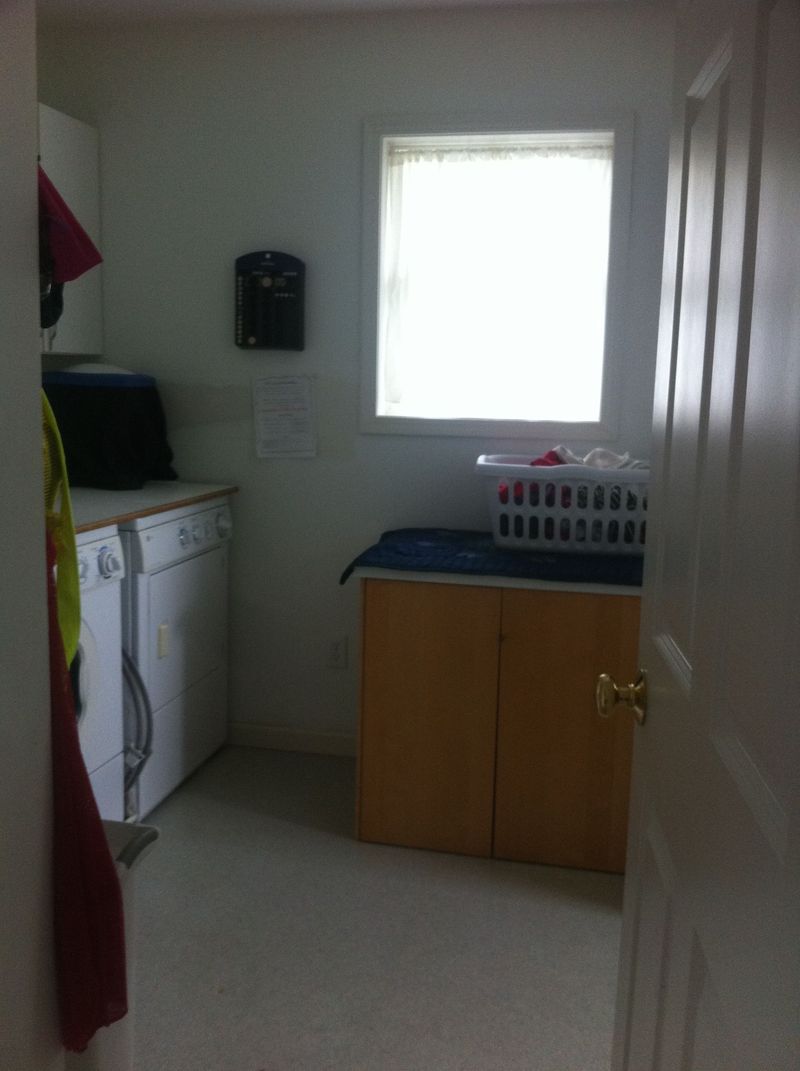
    So I pulled all his clothes off the changing table shelves in the laundry room, carried them downstairs, and hung them in the first-floor closet.  

    IMG_0890

    I asked Mark and my 15-year-old to carry the changing table downstairs to store it in the basement, and when that was done they carried up an old kitchen cabinet and put it in the place of the changing table.  It took some cleaning up and a cloth to hide the wood-glue stains on the laminate, but now it's another clothes-folding surface, and a place to stow the trash receptacle and some baskets for sorting outgrown clothes and lone socks.

    IMG_0893

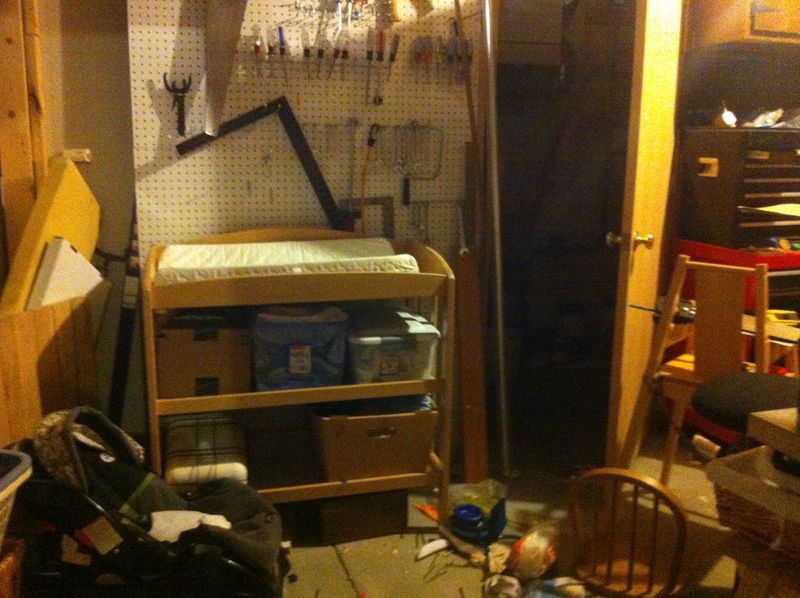
    Today I gathered up all the cloth-diaper covers and put them in a tub and snapped on the lid, and carried it to the basement, where I left it on the changing-table shelf.  In another tub, I packed up all the infant cloth diapers, and in yet another, threw some more baby items (bibs, the bag of jumbled pieces of the manual breastpump, receiving blankets).  Down they went.

     While I was at it, I carried down the infant car seat and stowed it next to the changing table.  Then I boxed up some infant clothes in good condition, clothes that had been lying around waiting for me to do something with them.

    IMG_0894

    I hesitated with the box.  Take it out to the car, to deliver it to charity?  Or set it aside to be stowed in the deep recesses of the attic?

    + + +

    It's a matter of probability, I tell myself, not so much a matter of plans.

    Very soon I will be forty-one years old.  I have three to seven years left, perhaps, in which Mark and I might decide to try for another baby, or in which we might find ourselves surprised by one.   I've not had a surprise yet, not in seventeen years of NFP, so I count that probability low; and I don't expect that we will try for another baby, certainly not the way I expected it when we had one, two, three children.  I didn't exactly expect it when we had four; I hoped, though.  

    I'm not sure if I hope or not now.  Five is lovely, and my most recent pregnancy was hard.  

    And we talk about the future differently these days.  "Three years from now," we say, "four years from now, perhaps we can do such-and such," and we've mostly stopped adding "if we don't have another baby."

    + + +

    "We can get rid of these things," Mark pointed out, "because if it turns out that we need them again, we can afford to buy new ones."

    Yes.  I've already gotten rid of a number of things.  And on the other hand, I saved all the maternity clothes that I really liked, on the grounds that if I needed them again it would be sad not to have the good ones.  Those clothes take up  just a box or two.  And it's really only for a few years.  When I'm forty-eight I will have no reason not to toss the sealed box in the car and tote it down to the crisis pregnancy center or the charity thrift store.  It's not like I risk keeping it around for the next twenty years because I won't know if I need it or not.

    And the same for the changing table, right?  And the diaper covers?  And the last box of baby clothes?  It's just a few more years that they might come in handy.   And then I can get rid of them.

    + + +

     Probability:

    "By age 40, a woman's chance is less than 5% per cycle, so fewer than 5 out of every 100 women are expected to be successful each month. Women do not remain fertile until menopause. The average age for menopause is 51, but most women become unable to have a successful pregnancy sometime in their mid-40s."

    It's nothing you would want to count on if you were intent on avoiding pregnancy for some terribly serious reason.  And I have plenty of friends who had babies in their early-to-mid-forties.  

    Still, I also have plenty who didn't.

    + + +

    Then there's this:  If I lived as long as my own mother lived, I would not see my youngest, now a toddler, finish high school.   If I had another baby, and lived as long as my own mother lived, I wouldn't see that new one start high school.

    I can't help but be troubled by this one.

    + + +

    Packing all the baby stuff up felt awfully final, and not in a good way, even though I'm not actually getting rid of it yet.  Somehow I'm reluctant to say, "Probably we won't have another," even if that is, literally, true.   Which leaves me reluctant to do the things that one does when probably one (two, really) won't have another, like give away the favorite baby clothes and the good maternity jeans.

    I'm not sure whether the reluctance is based on a desire to mother a baby again; or on the very practical consideration that (probably) to do so would never be regretted while to choose not to do so might well be regretted, or being slow to accept this first limitation brought on by age and age alone; or simply the bitterness that always accompanies the closing of a door to the past.

     I remember feeling something like this when I was finishing college, getting ready to move on to new things, and some small part of me wanting to stay, knowing to do so wasn't possible.

    In other words, I don't know what I'm trying to hold onto here.  Is it a gift of life I desire to give?  Or is it clinging to a notion of myself as a life-giver?

    + + +

    It's a frightening freedom we enjoy.  I am healthy, Mark is healthy; we could go for it again, play the fearful and wonderful game.  We are completely aware that we could.  If we were sure we desired it, or sure we were called to it, we could rise to the challenge.

    At the same time, not being called in particular, without a particular desire (only this empty feeling at the boxing up), we are also aware that we can go on as we are, shouldering our bags and hiking off into the sunset with these five.

    Love is not a zero-sum game, but energy can be; and I sense a need to direct greater energy to my older children than I have had since the youngest first fluttered to life.  My last pregnancy was hard:  not dangerous to my life and health, just hard, as pregnancy often is.  Mothering this youngest one from babyhood into toddlerhood was beautiful, and I feel at the top of my powers; but all along I felt a pull towards those older children that went unsatisfied, and heard my voice saying "no" what felt like far too much.  "No, we can't do that because of the baby."  "No, I need you to do this instead because of the baby."

    I had to push them all away, just a bit.  My arms were full, my energy went to produce milk, the hours of the day slipped by.  I'm not saying it was the wrong thing to do; they learned to sweep the floor and cook dinner and clean their rooms, they learned to take the bus.  They learned that I wouldn't always be there for them.  Which is true.  I won't.

    But I'm not saying I liked that part of it.  And looking at my five beautiful children, one of whom I have to look up to now, I wonder if there really is enough of me to go around.   I think there is, barely, now.  But I know what it would take to push that over the edge.  Not that I'd do a bad job.  I would keep it together.  I always do.  

    But I do want my kids to remember a mother who had time for each of them.  And — looking back on the last two years — I have not.

     It was for a good cause.  A great cause!   The youngest will be there for them far longer than I will.   I'm not sorry.  

    But … which to choose in the future?  Let's just say it is not obvious.

    + + +

    "Three years from now," we say.  "Four years from now."  We think of places we'll go, things to show each other, things to experience with the growing children.  We have a vision of a new phase of our lives, the phase with no little children in it, the phase where even our youngest walks on his own two feet.

    None of it is a guarantee.  None of it is ever a guarantee.  

    I've never put the changing table away before.  I guess that is different.  I guess this is the first bifurcation between what might be and what else might be.  It feels important.  

    And at the same time it's just housecleaning.


  • The next step of Kondo… where to start in the “household equipment” category?

    More on Marie Kondo's book can be found here, here, and here.

    + + +

    I'm now partway through decluttering the most baffling meta-category, what Marie Kondo (in her Life-Changng Magic of Tidying Up) calls komono.  I've already done several of the categories within it — the ones that were easiest to select items that belonged within them — and am about to embark on the more difficult ones.

    Many items within the home… are placed, stored, and accumulate "just because," without our giving them much thought.  I call this category komono, a Japanese term that the dictionary defines variously as "small articles; miscellaneous items; accessories; gadget or small tools, parts, or attachments; an insignificant person; small fry."  It's no wonder people don't know what to do with things that fall into such a vague and all-encompassing category.  Still, it's time to bid farewell to this "just because" approach.  These items play an important part in supporting your lifestyle and therefore they, too, deserve to be handled one by one and sorted properly.

    Unlike clothes or books, this category includes a diverse range of items, and the thought of trying to sort and organize them may seem daunting.  If you deal with them in the proper order, however, this task is actually quite simple.  The basic order for sorting komono is as follows:

    1. CDs, DVDs —— Done
    2. Skin care products –———– Done
    3. Makeup ————– Done
    4. Accessories ————– Done
    5. Valuables (passports, credit cards, etc.) ——– Skipped; already well organized
    6. Electrical equipment and appliances (digital cameras, electric cords, anything that seems vaguely "electric") ————- Done
    7. Household equipment (stationery and writing materials, sewing kits, etc.)
    8. Household supplies (expendables like medicine, detergents, tissues, etc.)
    9. Kitchen goods/food supplies (spatulas, pots, blenders, etc.)
    10. Other (spare change, figurines, etc.)

    If you have many items related to a particular interest or hobby, such as ski equipment or tea ceremony articles, treat these as a single subcategory.)   —— I just did one of these, because I decluttered all the school supplies.

    00So, I'm up to #7, "Household equipment."

    I had to stop for a while and think:  What exactly does this encompass?  When I have collected all my "household equipment" together, what items will be in the pile?  In what way should they be similar to stationery and sewing kits, but not to medicine, spatulas, or figurines?

    By looking at the rest of the list, I could deduce a few things.

    o   "Household equipment" doesn't include JUNK.  ("These items play an important role in supporting your lifestyle.")  Or at least, it's time to get rid of the junk that may be hiding among the equipment.

    o  "Household equipment" includes some kinds of tools, but not ALL tools.  The sewing kit is given as an example — and a sewing kit includes scissors, seam rippers, needles.  Writing supplies are an example — and that means things like pens.  But kitchen tools are excluded, as well as anything that's part of a large hobby-related collection.  (Presumably if your hobby is sewing, most sewing items  go outside "household equipment" and in with the hobby items — I think she's thinking of a small mending kit that's employed as needed for maintenance tasks, like replacing buttons, repairing seams, and adjusting hems.)

    o   "Household equipment" excludes most consumable items, but not all.  Food, detergent, medicine, tissues — all things that get "used up" — belong to other subcategories.   But "stationery" is also something that's used up, and it is included, along with the thread that is presumably part of a sewing kit.

    o    "Household equipment" excludes items already sorted:  the other types of komono as well as clothes, books, and papers.  It also excludes sentimental items.

    What I'm seeing so far is that "household equipment" means durable tools, kits, and other things that are useful.  Consumable goods are part of this only insofar as they are part of a kit or set, like the  thread in the sewing kit.   Kitchen items are not included, I presume because kitchen items are a big enough category on their own in any household; whereas in smaller households, "household equipment" might be a small enough category the deal with all at once.

    So:  useful items for household tasks, but not kitchen items, not sentimental items, not related to a specific hobby, and generally not consumables.   I went through my house with a clipboard and pen and wrote down the kinds of items that I thought fell into this category, to see if I should do it all at once or if there are some subcategories to break it into.  Here's what I came up with:

        Baby care items.  Cloth diapering paraphernalia, child carriers, portable changing pads.

        Clothing care.  Laundry baskets, hangers, lingerie bags, eyeglass and jewelry repair kits, mending kit. 

        Cleaning tools.  Brooms, mops, totes, scrub brushes, rags, dishpans.

        Linens.  Bedding, towels, napkins, tablecloths.

        Quasi-furniture.  Folding chairs, stepstools, little-kid workbenches, rolling carts.

        Travel items.  Suitcases, backpacks, toiletry kits, picnic coolers.

        Board games and other gaming paraphernalia.  Cards, chess timers, extra dice.

         "Tool" tools.   Hammers, pliers, screwdrivers, twine, etc.

        Containers and organizers.  Boxes, bins, racks, bookends, baskets.    


    Excluded from all that:  homeschooling paraphernalia, camping gear, athletic gear, fishing gear.  

    In our household, most of the "tool" tools are also excluded from my responsibility, as they're stored out of sight in Mark's shop and he knows better than I do what is extraneous and what is necessary.  I can find most anything I need in there, if I look long enough.  But you will find others here and there throughout the house — needle-nose pliers in a kitchen drawer, wire cutters in my guitar case and in the school science box, a small screwdriver that lives on my dresser, a couple of pocketknives and a set of Allen wrenches — things I've squirreled away so that I won't have to hunt for them in Mark's shop should I need them.

    What order should they be attacked in?  Marie Kondo:

    [I]t is easier if you start with more personal items and clearly defined content first.

    The "personal items" won't help me organize them since by now we've gotten to things that belong to "the household" rather than to any one person, although in my role as homemaker some of them (clothing care items) fall more under my domain than others (board game paraphernalia).

     So (prior to publishing the post here) I roughly sorted them from "mostly my domain" to "mostly someone else's domain."  And then I stuck "containers and organizers" at the end, because it strikes me as ridiculous to get rid of any of those until you've finished organizing everything.  I think those come right before sentimental items.

    So… I guess that's what I attack next.  Baby care items.  It's about time to get rid of some of those anyway, I think.


  • Meditation on French saints. A few passages from d’Elbée.

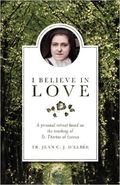
    A week or two ago I posted briefly about I Believe in Love, originally published in 1969 as Croire à l’Amour (that is, To believe in love). It was gifted to me in a spiritual direction session that I’d sought out for some very specific advice, and the priest handed it to me almost apologetically explaining for the cover design, with its prominent headshot of St. Thérèse of Lisieux in her habit. “This isn’t one of those sentimental books about St. Thérèse,” he said, and I had to give him points for having pegged me pretty well.

    (I can appreciate kitsch as well as the next person, but the porcelain-and-roses holy-card drawings of Thérèse, um, actually offend me. The embalmer has done his work so thoroughly that the beloved is not visible.)

    + + +

    Anyway, d’Elbée turned not to be writing about St. Thérèse very much at all. The book is subtitled (in the English editions at least) A personal retreat based on the teaching of St. Thérèse of Lisieux, and indeed, in the first “conference” (as the chapters are called), d’Elbée announces, “During this retreat I intend to talk to you about confident love, following the teaching of St. Thérèse of Lisieux, of whom Pope Pius XII said, ‘she rediscovered the Gospel itself, the very heart of the Gospel.’”

    But the various quotes and examples from the life of that saint are pulled out more as crumbs of inspiration that support the various themes that d’Elbée is writing about. There are many quotes from Scripture — many more than there are quotes from Thérèse — and also quotes and anecdotes from many others. St. John Vianney, St. John of the Cross, St, Teresa of Avila, St. Augustine, St. Francis de Sales, but also lesser-known figures, principally French ones: St. Claude de la Colombière, ordinary journalists and authors. I get the impression that d’Elbée assumes his reader, his retreatant, already knows St. Thérèse very well — the unsentimental, audacious, mischievous, wildly courageous St. Thérèse — and points out her features to one who already recognizes them in context.

    + + +

    I don’t know why the good theological books that have crossed my path in the last several years have so often been the work of French thinkers and saints, or occasionally of others who were heavily influenced by them. It’s a happy coincidence, because that’s the one modern language (besides English) that I read really well, and so I have the opportunity of consulting the untranslated originals from time to time. But it’s also interesting to me — why do I so often find that the French-speaking writers (Francis de Sales, Jeanne de Chantal, Thérèse, Elisabeth Leseur, and now d’Elbée have good and sensible answers to my particular problems?

    Sometimes I think that particular features of the history of the French-speaking Church must have generated a sort of Christian response that happens to be just the sort to respond to particular features of the history of me. Cathars and Calvinists, Jansenists and Jacobins, [Third-]Republicans…. all a slow forging of a particular kind of blade, one that feels at home in my hand.

    But the blade metaphor doesn’t really work for me, as nicely as it seems to work in a blog post; the effect of these French saints on me is demulcent, a healing balm, or a cool slaking fountain. The challenges both inside and outside the French Church have been harsh and punishing and unforgiving and frightening ones. The response from the French saints is a response of confidence, good humor, and serenity. “Blessed are the meek” in French comes out as “Heureux les débonnaires,” often footnoted “litt., ‘ceux qui sont doux’” — “mild” with all its connotations of calm weather, “good-humored” with all its connotations of an unruffled, un-ruffle-able disposition. It makes me think of the disciples waking Jesus in alarm, only to see him calm the waves with a word.

    I am convinced that the French connotation is the correct one, and I believe that the term “meek” has damaged English-speaking Christianity in a way that’s going to be difficult to recover from.

    Something in my nature — it precedes my conversion and reaches far back into childhood — looks critically upon the self and despairs. I am forever working in vain to silence, or at least drown out, an unrelenting, unforgiving, driving, punishing inner voice. The French saints, I think, had to deal with (and continue to deal with) a shape-shifting and ever-constant specter, of which the extant anticlericalism is only the latest outer appearance: the depressing philosophy of total, unredeemable human depravity. The message of confident love, the belief that Jesus’ goodness >> any individual’s weakness, is the corrective to both. This is what I find in the French saints.

    + + +

    The whole book is good, but judging by the frequency of my pencil scratches on the pages, the earlier chapters are the ones that I most needed to read at this time. Here is a selection of my marked passages.

    + + +

    Prior dilexit nos: God loved us first that we might love him. That is the explanation of it all: of the Creation, the Incarnation, Calvary, the Resurrection, the Eucharist.

    Corrective: The love we have is evidence that God loves us; but we don’t have to love him in order for him to love us. We are loved without any effort on our own and do not have to earn that love before we can access it.

    + + +

    We do not read the Gospel enough in the light of the love of Christ. Thus, sixteen centuries after the Last Supper and Calvary, the most satanic of all heresies, Jansenism, was able to appear and spread: a heresy which turned a God of love, saying “Come to me, all of you, come because you are unworthy, come because you are sinful, come because you need to be saved,” into a God whose arms are raised to strike, a demanding God, a vengeful God. Under the pretext of recognizing our unworthiness, Jansenism diabolically led souls away from Jesus.

    Thus, no longer willing to endure this heresy, Jesus appeared to St. Margaret Mary [Alacoque] at Paray-le-Monial and through her gave His Heart to the world.

    + + +

    When someone asked little Thérèse to summarize her little childlike way, she answered, “It is to be disturbed by nothing.” … Naturally this means not to be voluntarily disturbed, not consciously or deliberately disturbed, because nature always worries…. The main thing is not to consent consciously to anxiety or a troubled mind.

    The moment you realize you are worrying, make very quickly an act of confidence: “No, Jesus, You are there…” Perhaps He is sleeping in the boat, but He is there…. It is really an offense against Him when we worry voluntarily about anything….

    I emphasize this concept of “worrying with the full consent of the will,” for it is very important in the spiritual life to make a distinction between our nature and our will, united to the love of Jesus. “Homo duplex:” my nature says “No”; my will says “Yes.” …My nature is troubled and afraid; my heart recalls the divine testament: “Peace I leave with you”… My nature revolts; I force myself to say, “All is well, Jesus; do not change anything.” It is a fight which we must take up again and again without ceasing, for our fallen nature always rears up its head. St. Francis de Sales says it dies a quarter of an hour after we do! This is the drama of our life. But the beautiful thing is that Jesus sees our will united to his by a fundamental choice — the profound, habitual disposition of having only on
    e will with Him. All those movements of our nature, if we do not consent to them, do not exist for Him. There is no sin without consent.


    This is precisely the passage I needed to see most right now. A handful of events in my life recently have shown me the degree to which I was reared to confuse nature and will, not to believe in the fundamental inner freedom of voluntary choice. I come from the land of “this is the way that you are and always will be: accept it.” This is the way it has to be, because the alternative is to live in a land of understanding right and wrong, of calling good good and evil evil, and that is uncomfortable.

    But not to see the distinction between nature and will is to sink into one of three terrible errors about the totality of being human, because our nature is truly a mess.

    — Some, falling into the error of total human depravity, preach hopelessness: the best we can do is pretend to be among the elect, only to find out at the very end whether we really are.

    — Or, rejecting that (because who wants to stay totally depraved?) some of us *cough* strive endlessly to redeem our own nature by the powers of that nature, in endless programs of self-improvement and collective social reform. (A little progress appears to be made, as we harvest a little waste heat and turn it into power for good, but it’s nothing more than a slight improvement in efficiency; there is a theoretical limit that is inherent to the material system. Thank you, Jules Carnot, for yet another French contribution to my philosophy.)

    — Or, rejecting that too, recognizing correctly that there is something good in all of us, concluding that human nature is usually not depraved at all, is fundamentally good, at least in a wide variety of its forms, and must be affirmed and celebrated everywhere — except where they infringe upon the inclinations of other natures.

    + + +

    The saints learned to rejoice in humility and humiliations… I speak here, obviously, of a love that is pure will, for our fallen nature does not seek humiliations or love them.

    I wrote in the margins, “We forget again the distinction between nature & will & we often ascribe to the saints a holy Nature instead of a holy will, & then we see our own nature & despair.”

    + + +

    Frequently make what I call the examination of the prayer “O Jesus, I thank you for everything.” It should be the fruit of your disposition of will, of heart, and of soul to bless Jesus for everything that He wills or permits for you, for everything that happens to you… In this short and simple prayer there is at the same time humility, an immense confidence in merciful love, abandonment, and thanksgiving.

    + + +

    There is a repeated theme that Jesus rejoices with us in our wretchedness because it enables him to act in his role as Savior. That we should be thankful even for our misery because it leads us to seek mercy, and that the act of seeking mercy is itself a joy. And to be completely confident in that mercy.

    The Curé of Ars: “Our sins, grains of sand beside the great mountain of the mercies of God.” St. Thérèse..: “All possible crimes, a drop of water thrown into a blazing furnace.”

    One reproach sometimes made to this spirituality of confident love is that it would entail the danger of presumption and of letting ourselves go. You shall see… how abandonment and obedience do away with this danger. I think, on the contrary, that there is a double danger in the method which diminishes the role of confidence and stresses the role of personal effort, subjected to numerous self-examinations. If we are successful, there is the danger of pride, of attributing to ourselves what is in reality the work of grace; on the other hand, if we see no signs of progress, nine times out of ten we fall into wretched, sterile discouragement…. But in order to live this sound doctrine to the fullest, we must be very convinced…

    [E]ven the most beautiful souls… do not want to believe that confidence is the key which will open the door for him, becau this door is a wound made by love. They look for other ways, as if this way were too beautiful to be reliable.

    …So what then? He calls me just as I am? I can go to him with all my miseries, all my weaknesses? He will repair what I have done badly? He will supply for all my indigence?

    Yes, provided that you go to Him, that you count on Him, that you expect everything of Him…

    + + +

    [W]e must live a presently existing love…What would a husband think who, when asking his wife, “Do you love me?” received the response “I have a great desire to love you; I shall work toward it; I hope one day to achieve it by dint of my efforts and generosity and sacrifice.” You are right to smile. But is this not the spiritual disposition many excellent souls adopt toward Jesus?

    Make rather the admirable response of St. Peter: “Lord, You know all things; You know that I love you.”

    That gave me a rueful little laugh of recognitin, because that’s how I often phrase it when I greet my spouse. Not the first way, but the second. “You know I love you,” I will say. There is something a little desperate in that phrasing, I think, because always — always — I am tempted to think I do not love enough. I want, I think, to be reassured that, at least, I love enough for it to be known.

    One of the great fruits of a good marriage has been the realization, no less astonishing to me for the frequency with which I realize it, of being beloved. I know and see my own faults constantly. And yet, someone (a pretty great person, if I may inject my opinion) loves me, really and for real. I wake up to it every morning and marvel, because it is marvelous, but at the same time I don’t doubt it even for a minute. And I try with all my will to apply the same marvel as well as the same confidence to divine love and mercy, unfathomably vaster and more constant.

    I have found d’Elbée’s meditations to give me a helpful little nudge toward that confidence.


  • More on adapting Latin curriculum for middle-and-elementary kids.

    I started this post yesterday, here.

    At the same time that I was starting to approach Latina Christiana I for the second time, with my second group of elementary school kids, I was just getting deep into First Form Latin with the older set.  Having a couple of kids beginning to start a study of Latin grammar that was more rigorous, and finally being able to see the road ahead, helped me work out exactly what fundamentals I wanted to work on in the earlier years.

    Namely, I wanted them to be able to recite all the declensions and conjugations by the time they got to them.

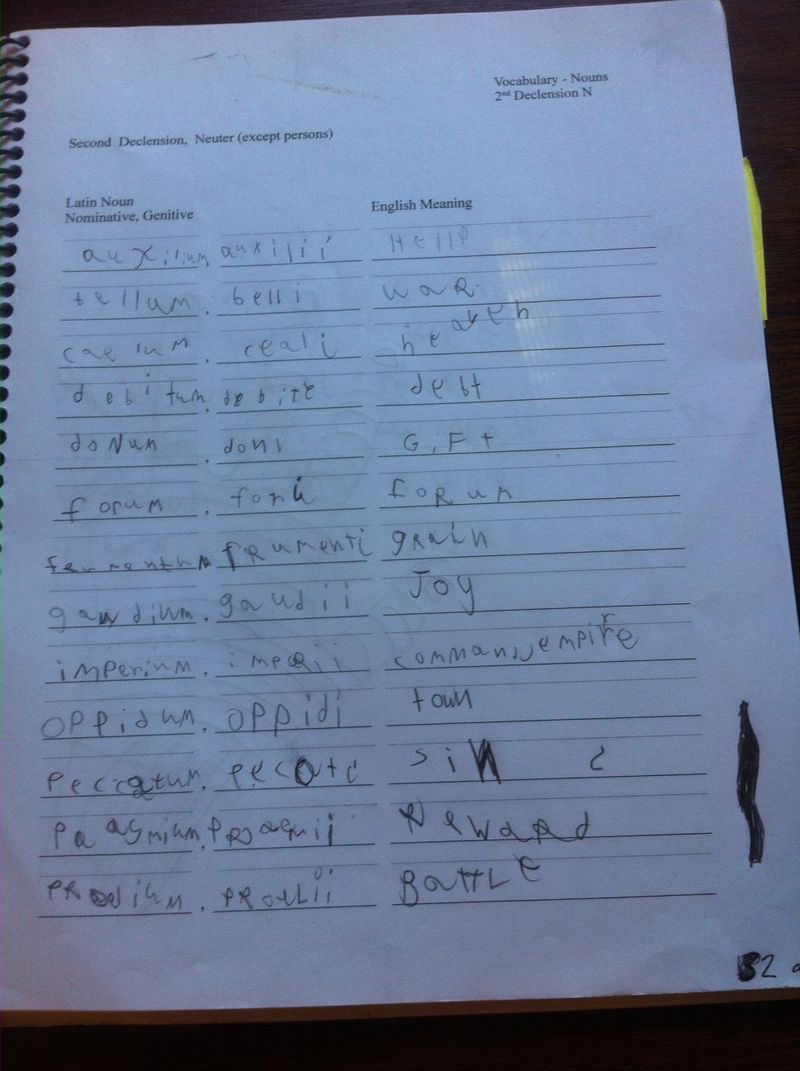
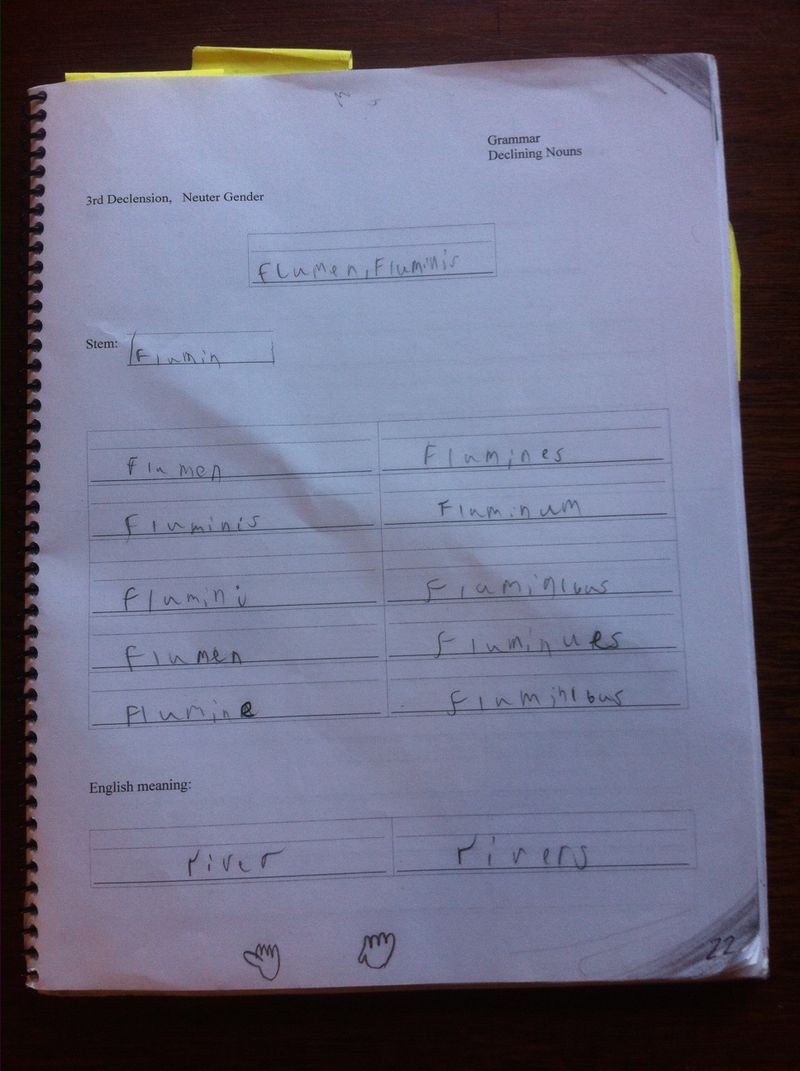
    I wound up designing a "Latin workbook" of my own for the younger kids, one that contained space to write out the declensions and vocabulary groups in whole. 

    Photo 2 (1)

    The writing is from my daughter when she was age seven, I think.

    Photo 1 (1)

    Eventually I dropped the workbook entirely.  I used the flash cards, and I just trucked on through, reciting mensa, mensae, mensae… and amabam, amabas, amabat…  and eventually res, rei, rei … and audiebam, audiebas, audiebat…

    I did very little writing with them because of the range of writing abilities.  We tended to work orally from a dry-erase board.  I played a lot of Carnifex, eventually getting up to [S-DO-V] sentences that contained adjectives and adverbs (Aquila alta ursam parvam non videbat.)  

    This coming year, everyone is finally able to work in a workbook, so I'm putting all four of the middle-size kids — fourth, fifth, sixth, and seventh-graders — through FFL.  (The youngest two are on the precocious side and have always been quick to translate orally; if they can't write fast enough to keep up with the writing, they can finish the work orally.  I am confident they'll be able to keep up inside their heads.)  But we only meet twice a week, so we'll be going reeeeeeeallly slowly — a bit less than half time.  

    I plan to augment FFL this year with readings about ancient Rome.  This past year the first of my students sat for the National Latin Exam (and did very well!  I feel validated), which was the first time that I got a good idea of what is expected of high school Latin students. I hadn't been teaching much of the "social studies" content.  I think I'm going to try to start bringing that material in earlier:

    • History of the Roman empire
    • Roman myths (well, we're going to do that with D'Aulaire's Greek Myths and memorize everybody's Roman names, mostly)
    • Names of items in a Roman domus
    • Maps and the Latin names of significant geographical and political features
    • Architecture
    • Daily life in Rome and in the outlying provinces

    Once you've learned this they aren't likely to forget.

    The other thing I'm going to do is continue reciting all the declensions and conjugations that they've already learned, so that they are still there when they finally arrive at them in the junior high and high school years.


  • Latin for middle- and elementary-age kids. How I rocked the cymbam.

    I recently got a request to blog about teaching Latin to elementary school students.

    First, I went through old blog posts to dig up what I can on the subject of Latin:

    I also embarked on a project to use what we've learned in Latin to experiment with teaching a sort of accelerated, but reading-and-writing focused, Spanish:

    A side note:  Since I tried that, by the way, I've come to believe that it's simply NOT true that the only valid way to teach a living language is with the goal of fluent conversational speech.  I can think of lots of reasons why it's worthwhile to teach a foreign living language with a text, translation, and grammar focus.

    (1) There's plenty opportunity to practice what you've learned even if there are not many native speakers or you don't travel, because there is plenty of text-based interaction out there:  literature, news articles, and Internet fora

    (2) Some kids enjoy translation and grammar; it's a myth that only being able to speak motivates kids.

    (3) It's less important to work directly with a native or fluent speaker, and can thereby be self-taught.

    (4) It teaches the standard syntax of the language.

    (5) It can lay the groundwork for a conversational course later on.

    (6) It's better than not learning at all because you're afraid to try to learn the language on your own.

    + + +

    But this is a post about teaching elementary- and middle-school-aged kids Latin…

    When I was teaching a single, reading child at home, we started with Prima Latina from Memoria Press.  I have relied on Memoria Press from the beginning because they publish materials that are laid out for the teacher who is not herself an expert in Latin.  The teacher can easily learn along with the student, which is exactly what I needed for the first several years that I was facilitating children.

    I followed Prima exactly as it was presented in the curriculum.  But then, when we moved on to Latina Christiana and I picked up some other students, I began to run into problems.  

    The organization of Latina Christiana I is… kind of spiral? The grammar marches along in a reasonable succession; but the vocabulary is added erratically.  Ten or twelve new words are learned in each lesson along with a new grammar concept.  But the new words are often a mix of parts of speech:  you might learn six nouns, three verbs, and a preposition.  

    I think there are probably kids who could handle this with no problem, but it proved to be very difficult for the learners I was working with.  I wound up adapting the program.   As soon as we'd get to the first lesson on, for example, second-declension nouns:

    1. I would halt the new grammar lessons — we'd stop right there at the first lesson on second-declension  nouns.
    2. I would go through the rest of the workbook and flashcard pack to find all the second-declension nouns that they would encounter in the rest of the course.
    3. I would teach the second-declension vocabulary words all at once.  
    4. We would practice — flash cards, reciting the cases, copywork, games like charades and "carnifex" (hangman), etc. — until I had maybe 70–75% mastery of the vocabulary.
    5. We would go on with the grammar lessons.

    I had a hunch that it would be easier to remember which declension a noun belonged to, or which conjugation a verb belonged to, if they were always introduced in like groups.  This turned out to be correct, at least for my particular group of kids.  The method lent itself well to flashcards and games, besides.  Frankly, I liked learning the words this way too.

    Later I began to stretch the LCI curriculum even more.  Near the end, LC1 introduces a spate of third-declension nouns – without teaching the declension or specifying the gender of any of the nouns.  I halted the grammar lesson; then, I looked them all up myself and taught them in three groups, one for masculine, one for feminine, and one for neuter.  I also taught how to decline them.   It took a really, really long time.

    (It turned out that I had missed some of the subtleties of the differences between "i-stem" and "non-i-stem" nouns, and a couple of years later I had to un-teach some of my mistakes.  The kids eventually figured it out and it turned out okay anyway.)

    Meanwhile, they were all getting dissatisfied with the slow progress of the grammar.  Everything in LC1 is in the nominative case, but they enjoyed making sentences and they wanted direct objects!  So I taught myself how to construct [Subj]-[DO]-[Verb] sentences, and then started making my own translation worksheets.  The queen loves the girl.  The slave carries the table.  The waves frighten the sailors.   

    Before long I had almost entirely abandoned the LC1 workbook, at least in the order that the lessons were presented.  I started doing them out of order, in a way that made sense to me.

    More later…


  • Not very far into my book before I had to blog it.

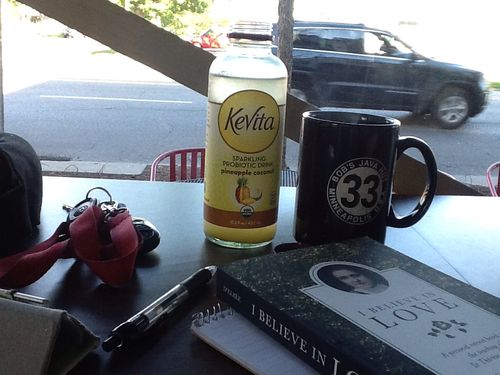
    I was gifted a book yesterday from someone who thought it would help me with some issues I've been having.  The book is I Believe in Love:  A Personal Retreat Based on the Teaching of St. Thérèse of Lisieux, by Fr. Jean C. J. D'Elbée.

    51+Mvc43+JL._SX321_BO1,204,203,200_(1969; English translation, 1974, by Teichert and Stebbins; this edition, Sophia Institute Press, 2001.)

    The giver assured me that this would be an unsentimental look at St. Thérèse (I've no time for the pursed-lips, porcelain-skinned holy-card version of this audacious and daring young woman), so I settled down to read some with an open mind this morning.

    + + +

    Anyway, I didn't get very far in — not even far enough to reach a single mention of St. Thérèse! — before finding something that I wanted to remember.  I find the turns of phrases provocative and I hope you do too.


    In the first pages of the very first meditation, "Love for Love,"  Father D'Elbée writes:

    Jesus bought a twofold right on Calvary at the price of all His Blood:  the right, for Him, to love us in spite of, or even because of our sins, our unworthiness; and the right, for us, to love Him from the depths of our immense misery and to contemplate His divine attributes, including His justice, within His infinite mercy.

    …At Gethsemane He appears before His Father, covered with our sins — He, who "bore our sins in His body" [1 Pet 2:24].  He obtains for us the right to appear one day before the Father covered with the Blood flowing from every pore of His body under the pressure of His agony and shed on Calvary to the last drop.  Then the Father will not recognize us as sinners, but as His children, regenerated and renewed by the baptism of this Blood; He will take us for His beloved Son.

    See this sublime exchange:  Jesus takes our sins upon Himself, and we make His merits our own.  And the Father receives us as if we were His beloved Son, through infinite mercy, but in all justice.

    After a retreat in which I had preached this with great conviction, a retreatant said to me, "I want most especially to retain one thought from your retreat:  my sins on Him, His Blood on me."

    I read this, and I instantly thought:

    What a remarkable spin on "His Blood be on us and on our children."  No?


  • The Righteous Mind. Inside out with the rider and the elephant.

    Last weekend Mark and I took our three youngest children to see the new Pixar movie Inside Out. Without spoiling too much, the movie is an imaginative look inside the human mind: a landscape of “islands of personality,” deep chasms of the subconscious, rows of storage banks, and the like; linked by somewhat a somewhat unpredictable “train of thought” on a track that is laid down as it chugs from place to place. “Headquarters” in the human mind in question (an 11-year-old girl) is occupied not by any kind of rational thinking — that’s represented only by the train, I think — but by five anthropomorphic emotions. They are Joy, Disgust, Fear, Anger, and Sadness. They sometimes work together and sometimes squabble for control, but the movie’s theme is to elucidate that each one of them has a vital job to do to protect the host mind. Rejecting one of them as a troublemaker nearly has terrible consequences.

    The themes and imagery of Inside Out meshed well with a book that Mark and I read recently on our last driving trip. The Righteous Mind: Why Good People Are Divided by Politics and Religion by Jonathan Haidt is also a peek inside the human mind, the tasks of which he divides up into metaphorical “workers” in a way that is a bit similar to Pixar’s five anthropomorphic emotions — but on several levels.

    The first division is into two different kinds of cognition which we use to make judgments — the controlled cognition of language-based reasoning, and the automatic cognition of rapid response to pattern recognition. Haidt pictured these as a rational “rider” on the back of an intuitive “elephant.” (We have met the rider and the elephant before — the metaphor was co-opted by Chip and Dan Heath in the book Switch, about which I blogged a few years ago.) Haidt marshals evidence from psychological experiments to argue that our moral and ethical judgments — our philosophies of life and of right and wrong — and in fact a lot of our daily decisions — are mostly governed by the big, powerful elephant. Then, our rational mind — the rider — leaps into action with a post hoc rationalization of what we have already started to decide.

    This isn’t an argument that our “emotions” are more important than our “cognition.” What was new to me was the understanding that intuitive leaps are a kind of cognition — just one that operates outside of our conscious control. To appreciate the power and the importance of such unconscious judgments — to give them the respect they deserve alongside reason — consider the example of visual processing. We do not have to reason to discover patterns in the photons that are projected onto our retinal tissue and then to extract useful information from them. We simply see, automatically, like any higher mammal, and our elephant-brain handles the intepretation most of the time without bothering our rider-brain.

    Visual processing is obviously cognition — a constant work of pattern identification, coupled to evolved snap judgments that prepare us to respond appropriately to the patterns in a variety of physical environments. Haidt argues that our moral processing, also taking place largely at this subconscious level, is a kind of cognition that uses pattern recognition to make rapid “snap judgments” that prepare us (often by means of emotions) to respond appropriately to patterns in a variety of social environments.

    Evolutionarily speaking, the elephant has been around for a long time; we are the descendants of many, many generations of organisms, reaching back beyond primate history, whose elephants kept them alive. The intuition which the elephant represents is the process by which “a judgment, solution, or other conclusion appears suddenly and effortlessly in consciousness without any awareness by the person of the mental processes that led to the outcome.” It is the kind of cognition that all mammals have — including primates like ourselves. And evolution has sharpened it into something exceedingly well designed.

    I found this concept really thought-provoking. I have been as guilty as anyone of arguing that someone-or-other comes to a faulty conclusion because of “emotion-based reasoning.” If someone cannot articulate a logical reason for his or her judgments, I have been inclined to dismiss them out of hand. Having read Haidt’s book, and grasped the analogy to visual processing, I am now somewhat more open-minded about the value of intuitive judgments. They are not always correct — just as vision is not always correct and can be fooled in unusual or artificial physical environments (remember the ambiguously photographed dress? or any well-crafted optical illusion?). But they are powerful, and can handle a huge amount of information without taxing our resources. Anyone who has tried to work with visual recognition software has to come away with a renewed respect for what the human mind can process without our conscious help. So we should probably also grant some respect to other kinds of automatic judgments, while appreciating their limitations in a world that is sometimes different from the one our intuitions evolved to expect.

    Haidt argues that “the rider evolved to be useful to the elephant.” The rider, who represents language-based reasoning, is a human thing; if other primates have one, it isn’t very far along. The rider is capable of long-term forecasts, of mastering new skills and technologies, and — crucially — of “fabricating post-hoc rationalizations” to explain, supposedly, why the mind came to the decisions and judgments that it did. No matter who we are — educated or uneducated, Eastern or Western, liberal or conservative — many of our judgments and decisions occur very rapidly at the intuitive level, and then we take time to tell ourselves a fairy tale in which we came to those decisions through a process of conscious, logical reasoning. This is kind of a disturbing notion if you value (or think you value) logic and reason. But Haidt gives plenty of examples of psychological laboratory experiments that appear, over and over again, to demonstrate that the elephant acts first, the rider justifies afterward.

    So what’s so useful about this? Well, we live in societies, in networks of relationships. Humans are distinguished by language-based reasoning because we use that language to influence each other. Our post-hoc rationalizations are articulated in order to convince other people. What’s funny about this is that the riders do not appear to speak most effectively to other people’s riders — rather, it’s the elephants who are listening! We do hear or read people’s arguments, and the argument itself becomes part of the whole pattern that our automatic cognitive processes take in and rapidly judge. We take into account our snap judgments about the deliverer of the message — do we know him? trust him? is he one of us? — as well as the elephant’s particular “buttons” that the other rider has managed to push with the content of his message.

    And then — after we have made a rapid unconscious judgment about the message — our own rider takes over, and explains our judgment to ourselves with that post-hoc reasoning — all the better to justify ourselves to some other person’s elephant. It turns out — and this is also supported by some of the psychological experiments detailed in the book — that the main benefit that we unconsciously seek, in telling our stories to other riders, is actually to make ourselves look good — to protect our status in the network of relationships to which we belong. The collective outcome of all this post-hoc rationalization influencing other people’s snap judgments which in turn create more post-hoc rationalization is — well — human society. And we might be better able to understand ourselves, and each other, if we appreciate the roles that both rider and elephant play in the human mind, and let them do the jobs that they are both well-suited for.

    Haidt does not stop at this two-fold model of human cognition, but digs a little bit deeper into the “elephant.” He identifies six distinct adaptive elements of the automatic cognitive processes — a couple of which correspond closely enough to some of Pixar’s anthropomorphic emotions that I have to wonder if the screenwriters were familiar with Haidt’s own influences. Like each of the the five emotions in Inside Out, each of the six elements has its own particular “job” — navigating a particular social challenge that was encountered over the millennia of primate and human evolution.

    Haidt argues that our moral judgments stem from our own particular combination of these six elements, whicb he calls “moral foundations.” I will pick these up in a future post.


  • Laudato Si’: Finally finished it.

    Sometimes, when we're on a long drive, I read to Mark while he drives.  We pick some nonfiction book that we think will spark an interesting discussion — usually something we think we'll like, sometimes a work that we'll have more fun attacking and poking holes in.    On our recent trip to Ohio, our book for the way down was a 2013 book called The Righteous Mind:  Why Good People are Divided by Politics and Religion by Jonathan Haidt.  That was a really thought-provoking one, which emerged with only a few holes in it, and I hope to blog a review pretty soon.  On the way back up, we read Laudato Si' from start to finish.

    As I read it, I "took notes" by posting little paraphrases on Facebook.  I mostly didn't quote, but tried to distill it down to my own takeaways from the document.  It wasn't by any means a comprehensive summary.

    Mark and I are using the long drive to finally read Laudato Si', the ecological encyclical. Chapter 1 tl;dr: Humans can't just do anything they feel like doing. The consequences hit the poor hardest. There are many possible solutions, but only some respect human beings and put the poor first.

    ___

    Laudato Si' ch2.I tl;dr: So if this encyclical is for everybody, why am I writing about Christian doctrine? 1. Cultural diversity means our thoughts count! 2. Don't you think if I can call on faith to motivate millions of Christians to steward the earth, I should? (not mentioned: because I am the pope and it's totally in my wheelhouse)

    ___

    More Laudato Si' ch2 tl;dr: Actually, we *don't* steward the earth just for the benefit and use of all the peoples of the earth and future generations. The earth and its creatures are a good worth stewarding for its own sake as well as humans'. "Till it," AND "keep it."

    ___

    LS ch2: Neither absolute property rights, nor renunciation of them. "If we make something our own, it is only to administer it for the good of all."

    ___

    LS ch3: The bad kind of technocratic paradigm is: all problems worth solving are solved by completely controlling material objects, and by the way, everything is a material object.

    ___

    LS ch3: The throwaway culture that wastes resources and pollutes the planet is the exact same throwaway culture that disposes of inconvenient human beings and buys and sells the bodies of the poor.

    ___

    LS ch3. Better laws aren't going to save you in a culture immersed in utilitarianism, because the powerful will always see the utility of subverting the law.

    ___

    LS ch3. Genetic modification techniques are to be judged case by case, depending on their impact on human relationships, labor, and well being.

    ___

    LS ch4. One problem with trying to solve problems via high-level regulations binding equally everywhere is that their inflexibility limits the flourishing of local institutions and cultures. Consumerism also levels differences instead of allowing them to flourish.

    ___

    LS ch4. Overcrowded cities might make people live in uprootedness and chaos, but if people weave strong networks of human bonds this can be transformed into belonging and closeness instead.

    ___


    LS ch5: proposals. Developing countries get to prioritize development and quality of life; let the rich countries bear the heavier burden of environmental restrictions.

    ___

    LS ch5: Somehow, we need both to respect national sovereignty and local conditions, while instituting a real global transnational political structure to make rules about global problems — with the teeth to enforce them, somehow. Meanwhile, lots can be accomplished by local projects.

    ___

    LS ch5: The burden of proof should be on the proposers of a new project, that it will not cause serious irreversible damage to the human ecology of an area — not on the local inhabitants to show incontrovertible evidence that it will.

    ___

    Cell phone coverage prevented me from liveblogging the sixth chapter of Laudato Si' as I read it, which is too bad, because that is where the advice is. Here goes: "Purchasing is always a moral, not simply an economic, act."

    ___

    LS ch6, my paraphrase: Environmental education needs to mean drawing out an *ethics* of ecology, instilling not just info, but habits of solidarity, responsibility, and compassion.

    ___

    LS ch6, my paraphrase. For those who can afford to consume a lot, it is meaningful to instead make small daily acts of conservation (turn down the thermostat, reduce food waste, turn off lights). It's a sort of "little way" of simplicity and self-control wth respect to resources that are not unlimited, and may pay off in ways we can't see immediately.

    ___

    LS ch6: "Christian spirituality proposes a growth marked by moderation and the capacity to be happy with little… That simplicity which allows us to stop and appreciate the small things, to be grateful for the opportunities which life affords us, to be spiritually detached from what we possess, and not to succumb to sadness for what we lack."

    ___

    LS ch6. One way to restore the right attitude, on several levels, towards resources is the traditional thanksgiving/blessing before and after meals.

    ___

    LS ch6, my paraphrase. Encouraging beauty locally, by joining together in groups to preserve a building, a landscape, etc., also is meaningful.

    ___

    LS ch6. My paraphrase. To do away with intentional rest is to do away with the most important thing about work: its meaning. In resting we enjoy the fruits of our labor, experience gratitude, and see that it (what we have made) is good.

    ___

    LS ch6. Interestingly enough, the encyclical ends with two prayers, one of which is a Christian prayer (i.e., a Trinitarian one) and one of which is suggested for non-Christian believers in God to use, a "prayer for the earth." They are long, so I recommend checking them out yourself.

    ___


    Then after I finished paraphrasing, I went back and recorded a few thoughts on the encyclical as a whole, and on our family.


    LS thoughts (1): Utilitarianism is the wrong way to calculate which policy and personal decisions to make. You could read the whole encyclical as "the state of the planet is evidence that utilitarianism is wrong."

    ___


    LS thoughts (2). If I have a lot of resources, and can spend more of my resources (money, time) to reduce damage or impact, I should. E.g. If it costs me more to repair an item than to buy new, but I can afford it, maybe I pay for the repair instead of discarding the item and buying new.

    ___

    LS thoughts (3). We do the traditional blessing before meals, but maybe we ought to incorporate the blessing after meals, like before we excuse the children from the table so we can finish the wine and talk together.

    ___

    LS thoughts (4). Private property's purpose is the common good. I think this is a "parable of the talents" situation. You can have stuff to use it, to restore it, to share it, to protect it for later, to turn it into more stuff that can be spread around — lots of possibilities. But if you can't use that item in some way that furthers the common good, why acquire it?

    ___

    LS thoughts (5). Be glad for what you have, that's an easy way to start.

    ___

    Yeah, I know, the last one is a quote from a Veggie Tales song.  It's from"Madame Blueberry," which I maintain is the most relevant Veggie Tales episode ever.  But I digress.

    I have to say, and a couple of my FB friends also had this to say, that the repeated calls for transnational governing bodies to take up the problems of global environmental health and to enforce agreements make me a bit… uneasy.  Reckless, was the word that one of my FB friends used for it, and I think I actually agree with that designation.  We all know how willing powerful people are to take things out of context to justify doing things the way they want to do them.  

    When we hear "transnational governing bodies" we think of the UN, and of the UN often the best thing that can be said of it is that its intentions were good, once.  It hasn't just been a corrupt body; it's been a body bent on calling evil good and good evil, off and on throughout its history.  

    If you take the document as a whole, it is pretty clear that Pope Francis is not calling for organizations that operate the way the UN does, with the kinds of goals and governing principles that the UN has.  He is calling for massive conversion of heart at all levels of society including the transnational.  But:  the sound bites will never reflect that.  One can argue that the media will never stop taking Popes (and anyone else who is invested by enough people with moral authority) out of context, and that there are no words which cannot be twisted to suit someone else's purposes.  And Francis does seem to be more "reckless" than his last few predecessors, in a lot of ways.  He's not as precise.  He seems to be more easily taken out of context.  

    This is a high-risk situation for a Pope to be in, to be sure, that's what "reckless" means, but high risk might also bring high reward, and I'm hopeful.  St. Francis was himself reckless in many ways and is still taken out of context all the time, and yet, those who look beyond the popular image and deeper at the ascetic, at the historical St. Francis, the holiness of the man himself (not either the pious legend or the impious legend) will find something that calls to conversion of heart and of life.

     + + +

    Besides the bits that I summarized above, I took away from the encyclical some concrete advice at the level of family life.  We are squarely in the class of people who have plenty of resources to live a life that is in accord with human dignity, and then some, and so it's that advice for people who live in rich countries that speaks more to us.

    We can afford not to externalize the costs of our lifestyle.  It is a false economy, for example, to buy cheap junk which breaks, can't be repaired, is landfilled and then must be replaced with more cheap junk.  Even if a thing costs more to be repaired than to be replaced, perhaps it is more fitting to pay a worker to fix it than to landfill it and cheaply replace it.  We should continue to use a thing until it becomes unusable, and then try to recycle it, rather than get a new version just because a new one is available.  This is frustrating with electronics, which are subject to a system in which they are designed to become functionally obsolete and to force us to replace them before they are "broken;" but we can use them longer than we might, if we are willing to put up with minor irritations for a while, and over a lifetime we might consume significantly fewer electronic devices than if we had listened to the culture of new-and-shiny.

    We are tempted to use climate control unnecessarily.  Mind you, climate control isn't evil; we are having a heat advisory right now, and I have the air conditioning on.  Climate control saves lives, in fact, especially in the case of the elderly and sick, and people who suffer from windborne allergies and can't function well with open windows.  But I have found myself over the past few winters slipping into a "doggone it, I can afford to turn the heat up" mentality, and stabbing the button to take it from 68 F to 73 F.  It's true, I could put on a sweater and a pair of fingerless gloves.  It's a small sacrifice, which means that the turning-up of the heat is a very petty luxury.

    We can choose to maintain beautiful things no matter where we are, either as individuals or as communities.  One of the things that I really liked about this "ecological encyclical" — it really isn't an "environmental" one so much as an "ecological" one — is that it included manmade beauty as well as natural beauty as worthy of preservation.  Pope Francis mentioned buildings and fountains and city squares, along with landscapes and rivers, as worthy for human beings to rally around, form an identity of place around, and preserve.  I have a bias toward cities and the beautiful and useful things that people design and build, the way that we transform the earth into something new and the ways that we concentrate in urban areas and build social networks that have a sense of unity and identity despite a diverse population, and I was delighted to find that this human ecology has received plenty of attention.  So yes, we can join together in civic groups to preserve wetlands and forests, but it's also good to join Friends of the Library, a local historical association, or any number of other civic groups that strengthen human bonds and keep the city from becoming impersonal and ugly. 

    We could all do with a little more gratitude for the good things we enjoy.  The Holy Father reminded us that the blessing before and after meals is a fitting way to pause and exercise that gratitude; we do, as a family, regularly give thanks before meals, but we haven't really done the after-meals thing.  We tried for a little while some years ago, but trailed off as we couldn't really find a good time that was the "end" of the meal, as kids asked to be excused one by one.  Mark and I talked about that and we decided we would try to bring that back.  I left it up to him to figure out exactly how it's going to work.  Maybe instead of excusing the kids one at a time as they finish, we'll excuse them all at once, say the after-meal blessing, and then they'll run away and we can finish the wine together.

    We could be careful only to acquire the things that we can "administer for the good of all" — where that might mean for the genuine benefit of our family (the education of the children, the care for each member's bodily needs) or might mean to care for it so it can be enjoyed by others.  (I'm struck by how this resonates to the same frequency as the Marie Kondo book that I read a couple of months ago.  It feels pretty wasteful to get rid of so much unused, non-joy-sparking stuff, but once you've done it, an a-ha! goes off in your head and there's a reluctance to allow any more non-joy-sparking stuff back in.)

    We can do all those small things that, we are told, add up to making a difference:  reduce food waste, reuse and recycle containers, cut down on unnecessary car trips, live more simply.  Sure, it's annoying, and it seems to be a drop in the bucket, but in a spirit of sacrifice it may do some good; like fasting, it has worth beyond the value of the food not consumed, if the sacrifice is made as an offering.  Purely technological solutions that do not ask any sacrifice from us don't have the same dimension of value; self-gift is always effective somehow, even if only interiorly, but technical solutions might have unforeseen consequences and risk becoming just a signifier, a status symbol.  Also, small acts of self-sacrifice are available to everyone.  

    In our family, one of those drop-in-the-bucket things might be to change our patterns of meal planning so that we don't waste so much food (I throw out SO MUCH RICE it's ridiculous) and consume a more sustainable mix of protein sources.  

    • Meatless Fridays are just a starting point (and of course, there are lots of reasons to choose that as a starting point, here in the US where meatless Fridays are optional — the primary reason one being to take up the penance that belongs to the rest of the Church as a matter of course).  
    • We can recognize that in some countries the people must rely on ocean fish as a primary protein source, and it's a limited resource, and we can abstain from it to leave enough for them — in economic terms, to keep its price low.   (Similar logic might need to be applied to some imported plant foods, such as quinoa, but the economics are complicated.)  
    • We can think of poultry meat as more "expensive" than eggs and dairy protein, pork as more "expensive" than beef, and beef as the most "expensive" of all — not just based on the dollar value at the supermarket, but based on the amount of agricultural land required to support it.  Maybe a three-pound chub of ground beef on sale is not actually as great a deal as it looks.  I'm not saying never eat beef — if you're in need of dietary iron, for example, it's very hard to beat it — but it seems a reasonable sacrifice to regularly abstain from it, save it for legitimate feasts.  Some of the costs of that sale beef have been externalized, and if we pay more for less (as we would if we restricted ourselves to, say, grass-fed small-farmed animals) maybe we can take up more of the responsibility for the real costs as well as supporting family farms.

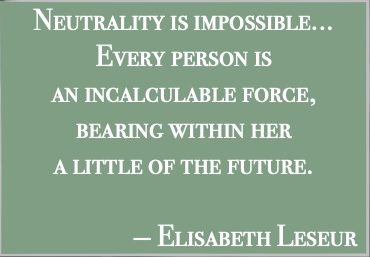
    I think that we have a lot to think about here, as a family, and even more to do.  Fundamentally, though, Laudato Si' recommends a change in attitude.  I think that it's very compatible with the spiritualities I have become most interested in over the past few years:  for example, Elisabeth Leseur's ideas that our tiniest actions and words may affect others in ways that we could never fathom, spreading outward like ripples through time and from person to person, which means that we never have the luxury of apathy.   If Elisabeth Leseur's special gift was to integrate her married life with her spirituality, then I think what Pope Francis is calling here is to integrate our economic lives with our spirituality.  Too often we separate them, but in fact we must integrate all of ourselves into Christ, and that means every decision we make is a moral decision.  Yes, even a choice of taste, like whether your ice cream is chocolate or vanilla or strawberry – or maybe that's a bit extreme; how about, whether your tacos are  carne asada or pollo or frijoles. 


  • Put up or shut up (III): lunch edition.

    I know this isn’t the most fascinating of post series to read, but at least it isn’t going to upset anyone. I guess.

    So, a few days ago I mentioned that I’m about to make a six-week push to get back on maintenance habits, and started out by making a list of meals — first dinners, then breakfasts. I really never do the whole-month-at-a-time meal planning, so this is kind of a first for me. Especially in the middle of all the preplanning I have to do for school, which starts right after the six weeks is up.

    But… moving right along, in my six weeks of summer lunches I can expect

    • 17 ordinary weekdays at home with the kids
    • 10 lunches out with the kids on our way to or from somewhere
    • 8 times I can expect to come home hungry at lunchtime and will need something quick
    • 6 times I might host other families for lunch
    • 5 times I will come home from the grocery store and need to have lunch ready soon.

    I categorized the lunches at home with kids according to the kind of thing I typically have ready for the kids to eat. I’m afraid they are going to have to go without macaroni and cheese for a few weeks, though, except maybe on date night.


    • When the kids have sandwiches, I’ll have the same: 3 oz ham/0.5 oz cheese or 2 oz turkey/2 oz roast beef on whole wheat with mustard, lettuce, and tomato. Fruit on the side.
    • When the kids have quesadillas, I’ll have a roasted veggie wrap with 1 oz goat cheese and fresh fruit. (The roasted veggies are the kind of thing that you do ahead of time and freeze in portions. Eggplant, bell peppers, zucchini, mushrooms, onions. I have made this before, it is really easy to do about 6 portions at once.)
    • When the kids have tuna salad, I will too, made with white beans and parsley and sun-dried tomatoes, packed in a whole wheat pita with fruit and baby carrots.
    • When the kids have hot dogs on homemade wheat buns with corn, I will cook a frozen white fish fillet and have that on a bun with lettuce and pickles.
    • When the kids have frozen pizza and fruit, so will I, but I’ll choose a thin-crust vegetable pizza like Amy’s roasted vegetable or Amy’s pesto or DiGiorno thin and crispy.
    • When the kids have spaghetti, so will I, with red bell peppers and a lean smoked sausage to flavor the sauce.
    • A random emergency lunch is an entire bag of frozen vegetables with whatever protein is handy and a slice of bread.

    Hosting another family calls for kid-friendly meals that scale up to a crowd. My ideas are:


    • Mini bagels with turkey and cheese, lettuce and tomato, fresh snap peas and apples.
    • Spaghetti and red sauce — it stays warm in the crockpot — with sliced smoked sausage and red bell peppers. Plenty of breadsticks and cheap grated Parmesan for the kids, but not for me.
    • Poached chicken, brown rice, steamed broccoli, and pineapple chunks with assorted sauces. For me, soy sauce, rice vinegar, and sesame oil.


    Expecting to arrive home hungry calls for some planned ready-to-eat meals. My ideas are:


    • Half a cup of hummus, half a pita, and some red bell peppers, carrot, and celery.
    • Veggie burger patty on a bun with lettuce and tomato and a scoop of avocado or guacamole.
    • One of the Amy’s vegetarian Indian food entrées with some Greek yogurt and cucumber.
    • Half a package of a Birds-Eye Steamfresh Protein Blend.
    • As a last resort, any ~400-calorie frozen entrée will do, or a combination like a frozen sandwich and a can of vegetable soup.

    Coming home hungry right after grocery shopping is a bit less grim, since I can bring something nice from the store. The kids often opt for bagels and cream cheese or a rotisserie chicken. For me, how about

    • A premium bag salad topped with a pouch of tuna or salmon, or maybe some of that rotisserie chicken, plus bread.
    • A bowl of fresh berries and a hot container of some hearty take-out soup.


    Lunches out with the kids — there always seem to be a lot of these in the summer as we go back and forth to day camps and the like — are a pretty important part of rebooting my habits, I have found, because they offer excellent opportunities to practice portion control.


    • The Chinese buffet — a pretty good deal since they charge less for younger kids, and one of my kids’ favorite places — can be dealt with by measuring 1 8-ounce bowl of hot-and-sour soup and 1 equally-sized bowl of all other choices put together, as long as enough of the latter is vegetables.
    • There are several workable choices at a Bruegger’s Bagels: an egg/cheese or spinach-cheddar omelette bagel, any eight-ounce soup plus the “bagel bites” that come with it, any café salad, a “skinny” veggie bagel sandwich.
    • Noodles and Company has some new bowls where they have swapped out the noodles for a pile of spinach. Highly recommended. Similarly, salads at Chipotle with no rice work well.
    • At least one kids’ meal choice at most fast food restaurants is within limits, e.g., hamburger Happy Meal with apple slices, fries, and a water bottle. Other places make it pretty easy to put together something under 400 calories — Subway is a decent example, thanks to good menu labeling and a custom-order culture.
    • It is even possible to navigate newfangled burger places such as Smashburger if I am willing to split the burger with someone, or have a small one with lettuce wrap instead of bun.
    Here’s hoping this is a start for a well-planned six weeks.


  • Put up or shut up (II): Meal planning, breakfast edition.

    A few days ago I explained my upcoming 6-week habit reboot, intended to put the last annoying pregnancy weight behind me for good. I started general meal planning by making a list of dinners that would work with the kind of schedule I will be keeping over those summer weeks. I didn’t assign dinners to dates yet, though — I will do specific meal planning week by week when I make my grocery lists.

    Today I attacked the same problem, only for breakfast. Normally I do not plan breakfasts ahead of time. I usually just have whatever I feel like having, typically some combination of eggs or yogurt, toast, and fruit or V-8. I probably don’t have to do this, because I rarely have an excessive breakfast, but I thought I would make a list anyway and then I would at least have portions all figured out.

    I figured that I have four kinds of mornings coming up:

    • Five breakfasts out by myself, early on a Saturday morning.
    • Seven weekend breakfasts at home with the family. This calls for muffins, pancakes, or similar.
    • Thirteen weekday breakfasts soon after shopping, when we still have fresh fruit around.
    • Twenty weekday breakfasts after I can expect all the fresh fruit to be gone.

    Breakfasts out by myself need a strategy, not a plan, and I already have such a strategy. At the Ordinary Breakfast Place I always have buttered pumpernickel toast, one egg, and a big glass of tomato juice. At the Fancy Breakfast Place I usually order the delicious breakfast quesadilla, on a house-made sprouted tortilla with black beans, spinach, and guacamole, and take half of it home for later.

    I raided my cookbooks for some good weekend-morning breakfasts, around 400 calories, and came up with this list:

    • Lemon-blueberry muffin (150 cal), scrambled egg + eggwhite + onions + mushrooms, 2/3 c whole milk
    • Coffee cake muffin (220 cal), 1/2 c plain yogurt, 1 c berries
    • Chocolate-chip scone (160 cal), 1 c strawberries, 1/2 c yogurt or cottage cheese, 1 Tbsp sliced almonds
    • 1 waffle with blueberries and 1 Tbsp maple syrup, 2/3 c whole milk
    • 2 cornmeal pancakes (1/4 c batter each) with 1 c blueberries and 6 oz blueberry yogurt

    Why the 2/3 cup of whole milk everywhere? Well, published meal plans always call for 1 cup of skim milk. Bleah. I like whole milk, so I only pour 2/3 of a cup.

    I think the best plan for weekday breakfasts is to eat the same breakfast a few days in a row; change it to something else when I run out of fresh fruit; then, change it again when I buy more fresh fruit a few days later.


    My “there is fresh fruit in the house” weekday breakfasts might include


    • Toasted whole wheat English muffin, 2 tsp whipped butter, 2/3 cup plain yogurt with a teaspoon of honey, and 1 cup sliced strawberries
    • 1 egg scrambled with bell pepper, tomato, 1.5 oz turkey kielbasa, red onion, garlic; 1 slice wheat toast, 1 cup blueberries
    • 2 eggs scrambled with cream and spinach or broccoli and bell pepper, half an English muffin, butter
    • Ham, egg, and cheese (or bacon, egg, no cheese) sandwich on an English muffin with tomato and a cup of fruit salad
    • 3/4 cup plain whole Greek yogurt, 3/4 cup chopped fruit or berries, 1/4 cup granola or other crunchy cereal, drizzle of honey


    After the fresh berries run out, I could have one of these:

    • 2-egg frittata with green pepper, onion, cheese, and salsa; 1 slice toast; half a grapefruit or some canned mandarin oranges
    • Toasted English muffin with 4 tsp peanut butter, half a banana, and 2/3 c whole milk
    • Toasted English muffin half, spread with a wedge of Laughing Cow cheese; hard boiled egg; fruited yogurt cup; tomato juice or V-8
    • 3 ounces of bagel (e.g., mini or half), 2 Tbsp hummus, cucumber and tomato, 1/2 c canned fruit
    • 2 soft-boiled eggs, (six minutes for me), 1 slice of toast with plenty of butter, glass of V-8 or tomato juice
    • 2 scrambled eggs with cream and butter, half an English muffin with a bit of honey, glass of V-8

    You might notice the total absence of bowls of cereal in this breakfast plan. This is because once I start eating bowls of cereal, I usually fall into an iterative loop of “Oops, I ate all the cereal but there is still milk in the bowl; add cereal” followed by “Oops, there is no more milk in the bowl but I still have cereal; add milk.” I do better with oatmeal, but I don’t really want that in the summer.