bearing blog


bear – ing n 1  the manner in which one comports oneself;  2  the act, power, or time of bringing forth offspring or fruit; 3 a machine part in which another part turns [a journal ~];  pl comprehension of one’s position, environment, or situation;   5  the act of moving while supporting the weight of something [the ~ of the cross].


  • Presenting as imperfect.

    I'm so glad that Anne at Preventing Grace gave me this kind shout out in her piece If I Work Hard Enough I Win the other day:

    … I am about to turn in all my school reports. And I have made a detailed book list for the fall. And two friends were chatting away about bullet journaling (which turns out not to be at all what I imagined). And then Bearing Blog wrote about how she divvies up her time and keeps her mental health always in view. (Oh how I love Bearing Blog and her calm, rational way of thinking.) And it reminded me that, when I’m in the thick of a school year, I do get into an ugly, constraining loop of not being able to stop working.

    In fact, sometimes when I am on holiday I am not able to stop working. And sometimes, when it’s a nice, pretty day outside, I am not able to stop working. Last year I spent most of our sunny weeks away cleaning, picking up, and neglecting the stack of books I had brought to read….

    So, obviously, as per usual, of course, necessarily, as I vow every year, I don’t want to do this again. I want to find The Perfect Organizational System that will remove entirely the existential gaping maw of failure. Because, of course, if I just do all the work, I won’t fail. Right. I mean, that’s what it comes down to. It’s me just working hard enough and not forgetting anything that is the difference between life and death.

    I was going to leave a comment at Anne's blog along the lines of "You really should say, 'Bearing Blog wrote about how she TRIES to keep her mental health always in view,'" but then I remembered my own advice to myself in the linked blog post, the one where I resolved to blog before I get any work done or do anything else.  Well, there was more to it than that, but  anyway, I should blog before I write the key to the chemistry test, and if I leave the comment at her blog first, my thought will be spent.

    (One of my problems is that my mental health is always in view.  I am forever craning my neck to see over and around it.)

    + + +

    At any rate, today I want to share a post from the excellent physics blog, Gravity and Levity.

    Momentary digression.   I first started blogging in 2005, not quite a year after I finished my Ph.D. in chemical engineering.  It was probably right about the time that I was deciding to hang up the idea of switching to technical editing and developing a free-lance network.  And I hadn't yet gotten to  the place where I would accept that I wasn't ever going to get around to cutting and polishing the three publishable pieces of my thesis and shopping them to the appropriate journals, a place of acceptance that I wouldn't finally reach until my academic adviser passed away about two years later.

    At the time, I thought that I might do quite a lot of science blogging, in between the recipes and the self-help, commentary on news articles and the like, and so I read some science blogs.  But as time went on, I got bored with all but a few.  It turns out that I don't have time to write commentary on all the Science News that passes by the world's eyes day after day, shining for a moment, inspiring a burst of chatter, then passing back into oblivion.  

    It also turns out that a steady diet of Science News is extremely irritating — maybe not to everybody with research training and a grasp of mathematics and statistics, but at least to me.  Oh my.  I don't even want to go there right now, lest I lose the whole point of my post, but Science Journalism is bad.  It's not all bad, but so much of it is very bad.  And Science Facebook is also very bad.  Painful, even.   Ok, I don't want to get into this, but just so I can be a little less vague, the features that bug me the most are 

    • Identifying non-science (e.g., engineering, technology, and nature-education) as "science"
    • The disturbing lack of a word other than "science" for fields in which reproducible experimentation is impossible, meaning that those fields' findings acquire an undeserved aura of certainty and universality that should be reserved for physical law
    • Identifying the policy opinions of a person who is employed as a scientist as "science"
    • Appeals to authority — the logical-fallacy form, that is
    • Ascribing magical certainty to anything called "science"
    • Statistics deployed for any reason by people who do not understand them
    • The entire system of publish-or-perish and peer review, which discourages negative results and which relentlessly pressures working scientists to get "good" results, thereby undermining the scientific method

    There's also the problem of specialization.  I only studied in depth one little tiny area in materials science and engineering.  I can't comment with a post-graduate level of expertise on anything else, except for the general skills that one develops along the way (mostly math and procedure).  

    Anyway, the gist of that is that I don't read many science blogs anymore.  I do read some scientists' blogs, though, because people who write generally and well and bring their perspective as a complete nerd to whatever interests them are the people I like to hang out with, virtually speaking.

    Ahem.

    + + +

    So, back to Brian's recent post at Gravity and Levity, Toward a Culture of Tolerating Ignorance.   He begins with some words about impostor syndrome, and then dives into the practical advice, which I'll quote at length.

    There is one practice that I have found very helpful in my pursuit of a scientific career, and which I think is worth mentioning.  It’s what I call fostering a “culture of tolerating ignorance.”

    Let me explain.

    As a young (or even old) scientist, you continually feel embarrassed by the huge weight of things you don’t know or don’t understand.  Taking place all around you, among your colleagues, superiors, and even your students, are conversations about technical topics and ideas that you don’t understand or never learned.  And you will likely feel ashamed of your lack of knowledge.  You will experience some element of feeling like a fraud, like someone who hasn’t studied hard enough or learned quickly enough.  You will compare yourself, internally, to the sharpest minds around you, and you will wonder how you were allowed to have the same profession as them.

    These kinds of feelings can kill you, and you need to find a way of dealing with them.

    I have found that the best strategy is to free yourself to openly admit your ignorance.  Embrace the idea that all of us are awash in embarrassing levels of ignorance, and the quickest way to improve the situation is to admit your ignorance and find someone to teach you.

    In particular, when some discussion is going on about a topic that you don’t understand, you should feel free to just admit that you don’t understand and ask someone to explain it to you.

    If you find yourself on the other side of the conversation, and someone makes such an admission and request, there are only two acceptable responses:

    1. Admit that you, also, don’t understand it very well.
    2. Explain the topic as best as you can.

    Most commonly, your response will be some combination of 1 and 2.  You will be able to explain some parts of the idea, and you will have to admit that there are other parts that you don’t understand well enough to explain.  But between the two of you (or, even better, a larger group) you will quickly start filling in the gaps in each others’ knowledge.

    A culture where these kinds of discussions can take place is a truly wonderful thing to be a part of.  In such an environment you feel accepted and enthusiastic, and you feel yourself learning and improving very quickly.  It is also common for creative or insightful ideas to be generated in these kinds of discussions.  To me, a culture of tolerating ignorance is almost essential for enjoying my job as a scientist.

    The enemies of this kind of ideal culture are shame and scorn.  The absolute worst way to respond to someone’s profession (or demonstration) of ignorance is to act incredulous that the person doesn’t know the idea already, and to assert that the question is obvious, trivial, and should have been learned a long time ago.  (And, of course, someone who responds this way almost never goes on to give a useful explanation.)  An environment where people respond this way is completely toxic to scientific work, and it is, sadly, very common.  My suggestion if you find yourself in such an environment to avoid the people who produce it, and to instead seek out the company of people with whom you can maintain enthusiastic and non-scornful conversations.

    + + +

    Of course, I have two general responses to Brian's post, which you should really go read in its entirety (if only so you can follow the embedded links — they are also very good — and read some of the comments).

    The first response is the almost obligatory, "I wish I had read and assimilated this before I started graduate school."

     High school, even.   I emerged into adulthood with a defensive habit of pretending I knew things instead of asking dumb questions or even shutting up and listening, because I feared scorn.  Even though I only had this habit in some contexts, not others, it didn't serve me well in the long term.  (Being able to bullshit very well can be a lucrative skill, but I don't possess that kind, at least not in person.  Maybe Anne's praise is evidence that I can do it in writing a little bit.) 

    The second response is that one does not have to be working in academia to put this advice into practice.  Almost any collaborative community in which you find yourself is one in which people have varying levels of knowledge of the subjects at hand.  You can use it at work, in your volunteer groups, in your teams, and in your family.   

    Ask questions.  Honor questioning.  The higher your position, the greater your responsibility.  Answer questions.   Eliminate scorn.   

    (The hardest part?  Resisting the temptation to conversationally scorn for their ignorance people who are not present, including public figures in the news.  And yet, if you wish to send the message "You are valued, unconditionally, and it is no crime to be ignorant," to impressionable and vunerable people around you, you must demonstrate to them that your tone will be the same even when the vulnerable people are out of the room.)

    + + +

    There are so many things I didn't have figured out when I was starting out, things I realize now that I wish I could have known then.   It was true about my brief time in academia, and it's true about my longer life making a home and raising children.   But that's the nature of living in time:  you get wiser as you go, and logically that means you must have started out pretty green.  Embracing that logic really does relieve a lot of stress.  

    But that, too, is the sort of thing you get better at with practice.


  • College prep — for us.

    I had an appointment with Mark yesterday, put on our calendar a few weeks ago.  

    It was the "Sit down and figure out what we need to do to help our firstborn navigate getting ready for college" meeting.

    + + +

    This is not the first time we have thought about it, but it was the first time we sat down and tried to make a to-do list for ourselves.   Part of me is tempted to say, "Hey, 15-year-old, this is for you to figure out."  It's not our job to make him hit all the deadlines, I know it isn't our job to fill out his college applications or to tell him what to do.  

    On the other hand, ordinary students in ordinary high schools have guidance counselors.  It's their job (ostensibly) to let kids know when they can take the ACT, to help them find information from different post-college programs, and to review each young person's high school plans for consistency with what they say they want to do afterwards.  If I am homeschooling, I figure that "guidance counselor" is one of my hats.  And I want to be one of the good guidance counselors, not one of the crappy ones that I often hear about.

    + + +

    It's my first time navigating through this from the homeschooled-student point of view, and we are slowly getting a handle on how to scrape together the information we need.

    We've done a little bit of work already.  Mark went to a workshop a few years ago about record-keeping and credit-accounting, and that's been helpful as we planned the high school program.  He stopped in at one potential university a few years ago to find out what they want from their homeschooled applicants, and that information has guided my attitude towards grades.  (Yes, it's stupid that they want grades assigned by the student's own parents.  Nevertheless, if they want them, I guess we'll provide them.)  We've queried our student, and he has two specific and different ideas of what he might major in; he wants to know more about them.  He seems confident that he wants to go to a big public university, which narrows it down nicely, and which is also compatible with wanting to keep open two specific and different options.  

    Too many options on the table tend to paralyze; so Mark and I decided on a strategy of outlining in detail a few options at each step and a default high school path, while making it as clear as we can that if he wants to swap out one strategy for another, or change paths, we'll support him and help him figure it out.   The ACT people will send your score to four schools for free.  If it's the day before the test and you still don't have the first idea where to send them, I'm happy to say, "well, the Universities of X, Y, Z, and Q would all be good places to send them, but by all means, if you have a different idea, send the scores there instead."  And so on with other questions.  When should he take driver's ed?  Should he get a job this summer or next summer?  Should he take college courses as a high school student or not?  We mapped out some ideas for the rest of high school that, we think, would work.

    + + + 

    Which feels… embarrassing?  It is a truth universally acknowledged that offering strong suggestions for what your kid should do for college means that they will write angsty poetry and/or join a theater and/or burst into tears while spending Saturday in detention with the Cute Girl and the Jock.   I feel compelled to explain to my son, over and over again, that our suggested defaults do not constitute big bad PARENTAL PRESSURE.  The wind blows where it will; we're not just going to let the boy drift.  We'll show him some ways to set the sails before we step back.  

    + + +

    Mark had the idea to assign him to write several short research papers.  In each one, he'd investigate and describe a particular possible career path and reflect on how his interests and aptitudes intersect with what he has learned.  Then, said Mark, he would help our son meet with a couple of working people (not us) and talk to them, or interview them, about their education and work.  (Mark called this the "two lunches" plan).   It sounds like I will be working this up into a half-credit's worth of high school "career exploration" for the junior year.   Because I can turn anything into a syllabus.

    + + +

    I really hope the kids are listening to us when we tell them, "You know, we are just making this parenting thing up as we go along.  Don't ever forget that."


  • Clocking out.

    A little more than two years ago, when my fifth baby was small, I wrote a series of February posts about resolutions — not belated New Year's resolutions, not early Lenten resolutions, but "new baby's resolutions."  I knew that our lives had been upended, yet again, and I couldn't go back to spending my time the way I'd been spending it; I needed to reset my priorities.

    I've been getting overwhelmed again, and (more importantly) unhappy with life's balance.  I "wasted" a couple of mornings in the last week or two, sitting outside in the spring weather with a book and sunglasses while my two-year-old played in the sandbox.  I liked it.  I decided I needed to do it more.  I decided that I have been working all the time again and I need to put a stop to it.  End of the school year is as good a time as any.

    + + + 

    So, I mentioned a couple of months ago being in therapy.  I went for about a year, and then just recently I decided to stop and see if I felt like I still needed or wanted it.  But I'm still trying to put into practice some of the recommendations — the mindfulness exercises, for one thing, and also the therapist suggested I make time for myself to blog, as a sort of grounding exercise, probably because I kept talking about how much I wanted to get back in the habit.  Anyway, it's clear to me that I need to spend some dedicated time on my mental health, on my interior life, on examining my priorities.

    So I adjusted my "six things to spend time on."  

    I decided to chop it up a little bit differently this time, based on relationships.  Here's what I came up with:

    Screen Shot 2016-06-04 at 1.18.04 PM

    (What's that?  "Top-level homemaking?"  That's stuff I can't or won't delegate.  The kids can load the dishwasher and pick up the floor and even cook dinner.  I'm going to be the one making the grocery list and scheduling the pediatrician.)

    + + +

    Then I sat down and worked out time requirements.

    Eight hours of sleep.  Thirty minutes each for meals (I realized shortly after this that "breakfast" is almost exclusively in the green "me alone" box — win.)  I probably get to sit with Mark having coffee or after dinner for an hour a day.  Forty-five minutes for getting up and dressed in the morning.  Activities, let's say two and a half hours.  Five hours a day for schoolwork.  

    I subtracted those things and left myself with five-and-a-quarter hours per day.  Then I took a deep breath and committed one of those hours to "mental health" activity:  mindfulness, blogging, Mass maybe, priority-setting.  Remaining for work:  4.25 hours, that is, 255 minutes, which feels nice because of all the 8-bit NES games I played as a child.

    That's a bit less than I figured back in 2014, which is fine.  Good, even.

    The 4.25 hours is really only for Tuesdays, Wednesdays, and Saturdays.  I employed a very rough estimate to figure out the work time for the other days of the week:

    • 2 hours on Mondays
    • 3.25 hours on Thursdays
    • 3 hours on Saturdays
    • 2.5 hours (from after dinner to bedtime) on Sundays

    Add all that up and you get… 20.5 hours a week.  So, about twenty.  It turns out that my "work" is a part-time job.  Not counting the teaching-the-children part of homeschooling, which brings it up to full time.

    + + +

    So, my idea here is a little bit more ruthless than the last idea.  

    Last time, I was going to use my knowledge — how many minutes in the day — to stop feeling bad about all the stuff that I tried to get done but couldn't.  That actually worked pretty well — I've done a better job of letting go of the things I didn't get to.  I still tried mightily to cram in as much as I could, and if I had extra time I always put it into work.

    This time, I want to use my will.  Not just to stop feeling bad… but to stop.

    I want to use those times to set a ceiling, not a floor.   

    If it's Tuesday, and I've been school planning for four hours, I need to wrap it up and go outside with a good book and an iced tea.  Or read somebody a story.

    And if I don't work for four hours, I need to let it go.

    + + +

    The other thing I want to do is make sure that I hit that "mental health" requirement.  One hour – before the work starts.  

    So this is sort of a dual resolution:  Before I "clock in" and try to polish things off my to-do list, I want to spend an hour every day on my own mental and spiritual health — not resting exactly, but thinking about the things that help me keep perspective.  

    And at the end of the time I've decided to allow myself, even if I'm not done, I want to "clock out" — put the work away and not return to it till the next day.

    + + +

    I'm not sure I have the self-discipline to do this.  It requires thinking ahead and prioritizing.  I mean, there are some things I need to get done.  I've already committed to writing a chemistry test for next week, for example.  And I have… uh… sixteen work hours between now and when it has to be ready.  I mean, that should be plenty for doing the chemistry test, but I have other things too.  So I'm going to have to budget my time.

    And (quick back of the envelope calculation) there are about 240 work hours between now and the start of school in the fall.  Is that enough to set everything up?  I don't know!  I guess it will have to do! 

    + + +

    Well, I wrote a blog post.  It took more than an hour.  I guess I'll deduct from my Saturday work time.  Let's hope nobody minds having waffles for dinner.


  • Unreasonable expectations in design.

    True or false:

    It is irresponsible and negligent for a parent to take a picture of his or her small child in public, especially at a crowded, dangerous place like the zoo. Every photograph of grinning, sticky-faced siblings, posing in front of the aquarium or the cat house, is evidence of the crime of child endangerment.

    Silly?

    Well, let's think about what has to happen for a parent to take a photo of her child in public. First the parent has to let go of the child. She needs both hands to manipulate the camera or the smart phone. Then she has to step a few feet away — maybe a dozen feet or more, certainly out of arms' reach. She has to take her eyes off her charges for long enough to select the proper settings or apps before finally locating them in the viewfinder. Once the picture is taken, she may pause to stow the camera away before returning and once again securing the child in a firm grip.

    She lets go. She steps several feet away. She looks elsewhere. It is long enough.

    + + +

    What I see in the great rush to condemn the mother (it is always the mother) of a small child who crawled into the gorilla exhibit at the Cincinnati Zoo this week: a widespread refusal to believe that bad things can happen to "good people like me." She MUST have done something wrong (i.e., "something I would never do") for a terrible thing to happen to her child.

    It's very important for some people to put distance between the grieving and themselves. I see this elsewhere; I often read articles about cycling accidents, because I am interested in traffic safety in my town, and let me tell you, getting hit by a drunk driver when you had the right of way is no excuse: you should have been more aware or you shouldn't have been on that road, you two-wheeled freak. We all know that many cyclists today completely ignore the law. So it goes.

    I think we can extrapolate from the evidence (many small children at zoos, the existence of preschool educational programs at zoos) that it is widely believed (whatever some folks may think) that a zoo is a good place to take small children for a fun family outing. So to go so far as to say "well, of course you don't take a 3-y-o to a zoo, that's for older children" is, shall we say, OUTSIDE THE MAINSTREAM of thinking.

    The notion that no reasonable parent would ever enter a situation where a 3-year-old might escape her notice long enough to get into serious trouble is a little more understandable, given the low amount of experience that many people have with the wide variety of three-year-olds. Most people only ever parent zero to two of them.

    Some commenters who take a position closer to my own have been focusing on "It's not possible to keep your eyes on a three-year-old 100% of the time so they can't escape." I'd like to point out that we don't really WANT mothers (it's always mothers, isn't it) to do what would be necessary to prevent three-year-olds from escaping. Because we would have to do more than just watch them all the time. We would have to grip them all the time. That is why I began by having you think about picture-taking, how it is an utterly normal thing for parents of children to do at zoos, take their child's picture; and how the act of taking a picture contains within it all the possibility that allows for an escaping child.

    There's this strange thing about children: they want to explore the world around them. They will pull and actively try to escape you. The zoos, along with science museums and other places that attract children, incidentally, have this odd feature (often, not always) — they have exhibits here and there that seem to encourage children to explore the environment. "Please touch," they will have signs up for the petting zoo, or they will have fish tanks that are down near the eye level of toddlers, or they will have buttons to push and things like that. It seems almost as if the zoos…. EXPECT there to be three-year-olds with their parents, three-year-olds who are not buckled into strollers! I think the last few times I've been to the zoo I've even seen groups of preschoolers on a field trip, not with their parents, but with teachers and chaperones!

    + + +

    I'm very sorry that the zoo had to shoot the gorilla. I'm thrilled that they apparently had a backup plan with a "dangerous animal response team" that included a take-down-the-animal plan. This was good planning for a situation that, however unthinkable it may be, clearly someone had thought about it in advance. It's the zoos' job to keep people away from the animals and animals away from the people.

    And yet… sometimes people get in.

    Isn't it also the zoos' responsibility to protect the animals from people who might harm them? Is it really reasonable to assume that visitors will police themselves sufficiently that the exhibits need not be made secure?

    I'm thinking back to the last time a determined adult got into an exhibit (it does happen) and wondering if anyone was discussing whether zoos have a responsibility, grounded in the welfare of the animals, to make it impossible for determined persons to get into the exhibits. I think they do have a responsibility to make it very difficult for a determined adult to get into an exhibit. It is a completely foreseeable risk that a determined adult will TRY to get into an exhibit, and it really ought to be harder for a determined child to get in than a determined adult — so if the zoos designed to make it extremely difficult for determined adults to get in, it ought to be that much harder for a determined child to get in.

    It is a known risk that people occasionally attempt to breach the barriers — not just children, but also adults. Zoos face a design problem that we should probably acknowledge: their mission is to bring us close to the animals while their responsibility is to keep us separated from them. I have some respect for the argument that this design problem, with its inherent tension, represents a set of risks that is not worth the benefits; that is a value judgment and we can come to different conclusions about it. I don't have any respect for the argument that this design problem doesn't exist.

    Without saying anyone was at fault, I'm going to say that the design of the exhibit is probably the ultimate cause of this disaster.

    OK, then… why don't you go so far as to say "the zoo was at FAULT," then?

    Because design problems that involve inherent tensions between two design goals are notoriously difficult, and designers can act in good faith from start to finish, with the best of analyses, but still bad things can happen. I simply don't know enough details, and likely you don't either.

    Is it possible to design a zoo in which all barriers CANNOT be breached? Yes; would people want to go to that zoo? Would those who argue for better habitats for the animals' welfare be pleased with that zoo? It's possible that the designers really did act in bad faith, that they designed an exhibit that they knew was not up to whatever the commonly accepted standards of zoo barriers were at the time. That would be a kind of fault. It's possible that the zoo staff acted in bad faith: that they disabled safeguards that were part of the system put into place by the designers, or that the barriers were not well maintained, or something like that. That would be a kind of fault. But it's possible to have a design that turns out to BE FAULTY (in retrospect) without any person actually being "at fault."

    The public may have unreasonable expectations of the designers here. Not that it isn't reasonable to have as your GOAL "no one shall breach this exhibit.&
    quot; But that the public hasn't taken the time to really imagine what the tradeoffs would be that would make it literally impossible for no determined person to breach the exhibit, and they haven't considered that some of the things that make exhibit-breaches possible would make them enjoy the zoo less. Might even make them complain about the poorly-designed exhibits.

    Here are some links for your perusal.

    Last week at the zoo in Santiago, Chile, a determined man got into the lion enclosure, and the zookeepers shot the lions.

    Last month a determined woman got into the tiger enclosure at the Toronto zoo.

    This one goes the other direction. Less than three months ago, at the same zoo in Cincinnati, the polar bears breached their first enclosure.

    About six months ago, another woman was determined enough to pet a tiger that she got into the enclosure at the zoo in Omaha.

    2014. Copenhagen. A determined man entered the polar bear enclosure.

    2009. Berlin. A determined woman entered the polar bear enclosure.

    In the last link, a zoo official says of the exhibit, "It is already safe… People who want to jump in will always find a way."

    For the sake of the animals as well as the people, maybe we should be asking why that is good enough. It simply isn't true that a zoo can't be built with barriers that visitors can't breach. We certainly try to manage it in prisons that hold human beings and in museums that hold valuable artifacts.

    To ask why we accept risks is not necessarily to mandate that we remove risks. I respect those who argue that the benefits of zoos aren't worth the risks of bringing the public in close contact with animals. That Even though we don't come down in the same place, they and I recognize that there is a tension between the risks and benefits of zoo design, that it is acceptable to run some risk in order to reap some benefit, if the benefit is good enough.

    It turns out that there is also a tension between the risks and benefits of bringing children out into the world. If we are going to cut the zoo enclosure designers any slack here, if we are going to say about those who build barriers to protect the animals "You can't be expected to stop every determined person from getting in," then we also have to be ready to say about all those charged with children, "You can't be expected to stop every mischief that could possibly happen."

    In both cases, we could. But we choose not to. Because there are risks in that direction too.


  • In case of emergency (repost).

    Here's a repost from a couple of years ago. Updated a bit to make it read more smoothly now that I have reposted it a couple of times.

    +++

    Once or twice now I have unwittingly worried a friend of mine in Facebook chat.

    I'd mentioned that Mark was out in Colorado on a climbing trip. The last exchange of the chat went like this:

    FRIEND: Prayers 'till Mark gets home!

    ME: Thanks! If he doesn't call by 11 pm I have to call search and rescue.

    Would love to chat longer but have to teach history now. Take care!

    + + +

    On Sunday at coffee and donuts she mildly chastised me for joking about the search and rescue. "I wasn't sure whether to be worried about you or not!" she said.

    "I wasn't joking," I said. Her eyes got wide.

    Of course, I hadn't been joking, but I also hadn't thought that it would have been the kind of thing that would worry a friend. Why did I throw the offhand comment out?

    I suppose it's one of those things you do in the Twitter age. We are now masters of the Short Enticing Comment Intended To Give The Appearance Of Having A Much Longer Story Behind It.

    The idea is, of course, that in your interlocutor's imagination, the story you merely hinted at will grow to hilarious proportion, and your interlocutor will project their own imaginings onto you, and you will be lauded for your sparkling wit. When in fact all you wrote was something like "OMG NO NOT THE MOLASSES #twoyearolds #bathtime #gin"

    + + +

    Anyway, the truth is that I was not, in fact, joking about the search and rescue — well, I did abbreviate a bit, as one is wont to do. My actual instructions were to wait until 11 p.m. for contact from Mark, and then start calling these numbers in order:

    1. Mark's cell
    2. His climbing buddy's cell
    3. The backcountry guide's cell
    4. His climbing buddy's wife back at home in Tennessee
    5. The mountain climbing school and guiding service
    6. A climbing gym that serves as the after-hours contact number for said service
    7. The county search and rescue (SAR) dispatch

    If you're wondering whether it isn't the job of the mountain climbing school and guiding service to decide whether it's time to call SAR, you're right — the service has a protocol for keeping tabs on their guides in the field. If one doesn't check in after a trip, they are supposed to follow up. (That's why I'm supposed to call the guiding service before going straight to SAR myself.)

    But redundancy is a good thing, and nobody's more interested in having Mark come home safely than I am, so nobody's better suited for the task of checking up on him should he go missing. Besides, he was planning to climb a different mountain two days later with his buddy and no guide, and in that case there wasn't going to be a mountain school looking over his shoulder.

    + + +

    "I'd be so worried if my husband gave me a set of instructions like that," a different friend said to me on a differnet occasion.

    I said, "I'd be more worried if he didn't."

    One of the first rules of safe backcountry travel is to let someone else know exactly where you intend to go and when you intend to get back. You'll find this advice everywhere; here it is in a well-written .pdf about backcountry safety:

    One important rule too often forgotten is to let others know exactly where you are going, with whom and when you can be expected back. I hate to sound maternal, but search and rescue teams often spend hours driving around on back roads looking for a subject's vehicle before they know where to enter the field to begin a search.

    By letting someone know EXACTLY where you intend to go, when you expect to return and where your vehicle will be parked, you can eliminate the possibility of searchers having no idea of where to look. Should your plans change in route to your destination, stop and notify that person of your new itinerary. In addition, if you leave pertinent information on the dash of your car (e.g. name

    and phone number of your contact in town, location of travel/campsite and so on) search teams will have a very timely idea of your plans. Otherwise, search teams can be of little assistance when all that is known is that you "went camping somewhere in the Gore Range."

    And then, it's nice to have specific instructions. That's one of the things I insist on, whenever Mark heads off to go backcountry skiing or climbing — guided or not: a specific set of "deadlines" and directions for what to do if he misses each one.

    If he were to tell me, "I'm parking at the such-and-such trailhead and planning to summit such-and-such a peak; we're going to turn back by 11 a.m. at the latest and I expect to be back in cell phone range by 5 p.m.," that would be … a good start. But that doesn't answer the actionable question, which is… so what do you want me to do if you haven't called me by 5 p.m.?

    I can't read his mind (too bad, that would come in handy for backcountry travel), and I'm hundreds of miles away and not familiar with the area he's in. Furthermore, it's his job to set up the safety procedures for his trip, not mine — even if I have a role to play in those procedures.

    Some people might think that the right thing to do is call the authorities the minute someone is overdue. But this would be premature. SAR is expensive, and part of backcountry ethics is being prepared to deal with delays and unexpected events. You're not supposed to have SAR be your first line of defense if anything goes wrong; you're expected to do what you can to aid in your own shelter and rescue. So, for example, if there's a signficant chance that a delay could force you to spend the night on the mountain (rather than trying to follow a difficult trail down in the dark), you bring bivy gear and extra food, and you instruct your contact person that your arrival time could be delayed by twelve hours or whatever with no cause for alarm. It would be silly to send out the dogs for someone who's comfortably ensconced in warm waterproof layers, seated on an insulated pad, munching energy bars, and waiting for nothing more dramatic than daylight.

    In this case, even though he expected to be back in cell phone range by 5 pm, he definitely didn't want me calling SAR at 5:01 . He figured on giving himself several hours of leeway time — time to accidentally go down the wrong trail, figure it out, and backtrack if necessary; time to sustain an ankle injury and slowly crawl back to the vehicle, should that happen; time to arrive at the climb, find it occupied by another party, and wait for them to finish before starting. None of those delays, not even an injury, are an emergency that requires calling out the authorities; they're all the kind of things that you're supposed to be prepared to deal with yourself. And if you wind up dealing with something like that, you'll be delayed. And that's okay.

    It's not terribly fun to have to wait the few hours between "overdue time" and "call out the dogs time," but it's much better than sitting there wondering, "Should I call out the dogs, or is it too soon? I wonder how long I should wait? If I make the wrong decision SOMEBODY COULD DIE."

    I told Mark, he has to own the when-should-I-call-search-and-rescue decision. And he owns it by giving me specific instructions about when to call, and whom to call. And also by telling me everything pertinent: where he's starting, what he plans to do, and even what he's carrying (I like to know, for example, if he's prepared to spend the night outdoors and what weather he's prepared for, and for him to confirm that he has a GPS, map, and compass).

    + + +

    Every once in a while I run into the opinion that it's irresponsible for anyone, but especially a parent of young children, to engage in common adventure sports at all. Backcountry hiking, black-diamond skiing, rock climbing, etc.

    (Occasionally this extends to activities as banal-sounding as bicycle commuting. There's a lot of victim-blaming in the comments to news stories about cyclists who get struck by cars. It's very depressing. I have a theory that a large number of people simply don't believe that bad things can happen to good people.)

    I think it's irresponsible to think you can remove all risk from life. Every day we're surrounded by common risky activities: from the acutely risky, like riding in cars or taking showers in slippery bathtubs, to the chronically risky, like occupational exposure to low-frequency noise or sitting around getting no exercise. And many culturally-not-considered-extreme hobbies carry a surprisingly high risk; for example, recreational boating is well accepted here in Minnesota, but it's also relatively risky (one estimate from Ohio: about 1 fatality per million operator-hours; another estimate has 1 canoeing fatality per 720,000 outings.)

    Rock climbing is riskier than boating, but not the OMG IT MUST BE MANY TIMES RISKIER HOW COULD YOU EVEN THINK ABOUT DOING THAT WHEN YOU HAVE SMALL CHILDREN AT HOME!!! that you might expect from all the teeth-gnashing about it. Do you ever hear anyone say, "Gosh, I'd never have elective surgery under general anesthesia while I still had young children at home?" Well, that's more likely to kill you than a rock climbing trip.

    All this is to say: Hobbies are important. It's good to
    have them. And it's okay to have hobbies that carry some risk. The important thing is to diligently take reasonable precautions and follow well-accepted safety protocols; to keep your head and know your limits; and to talk about safety and comfort with the people who depend on you, to make sure that no one is forced into a situation where they're uncomfortable with the level of "adventure." Mark and I have worked pretty hard over the past few years to create an atmosphere in which I'm always on board with what he's up to, and if I'm not, we work together to figure out what needs to change until I am.

    +++

    I did it again on another Sunday a year or so later. "Is Mark having a good Father's Day?" asked a friend after church.

    "I assume so," I said, "He's out in Colorado rock climbing."

    Her jaw dropped a little and she said "Oh my gosh! I'll pray for his safe return!"

    "Go to Blessed Pier Giorgio," I said cheerfully, "it's what we always do."

    On the Saturday before I had run into a little bit of an issue because Mark forgot to tell me which time zone he meant when he sent me my schedule of whom to call when. Was that "call SAR if you haven't heard from me by 6 pm" Denver time or Minneapolis time? The difference is only an hour, so I sent him a text message letting him know that I was going to split the difference and call out the troops at 5:30 Denver time. Fortunately he got that message in time, because they took longer climbing on the glacier than they intended and the schedule had to change; he sent me a text later to let me know I should extend the deadline.

    So that was one thing learned on this particular trip. Another one — not so much "lesson learned" as "detail that occurred to us for the first time" — was that he really should tell me the make, model, color, and license plate number of the rented car he is driving to the trailhead.

    People still ask me if I am not worried about him. We are, a little bit, I guess. I definitely start to get a little antsy when the "I will probably be done by X-o'clock" time approaches. But it is an enormous help to know that I will never have to sit at home wondering if I should do something or not. I know I can drop that worry and leave it behind, trusting him to take care of himself if he can, trusting in the grace of the sacrament of marriage to take care of the kids and me if he can't. And he knows that I know, and so that thread of intention connects us, whether we are both in cell phone range or not.

    + + +

    I bring all this up now because today the man is in Colorado again, attempting to summit Hallett's Peak (via the "chimney" route, in case you are the sort of person who is interested in that), with a buddy and a guide.

    And this year, he remembered to give me the car description without being asked. So it gets better each time. I noticed partway through the day that I was totally at peace. And the main reason is that I don't, at least, have any uncertainty about what I am supposed to do "in case of emergency." That helps a lot.


    Well, the insurance policy helps too, not gonna lie.


  • Wrapping up the year, and getting ready to change the space.

    Slowly we're coming to the end of our school year.  I don't usually plan it that way, but the various subjects tend to run out at different times, so that the children's workload diminishes bit by bit as they head into the summer.

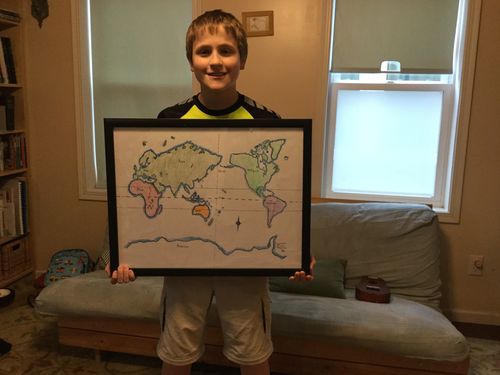
    The first subject to peel off was middle-school geography.  This one is actually the culmination of a two-year curriculum; we spent two full school years working two days a week with Mapping the World with Art by E. J. McHenry.   The kids have, over the past couple of months, wrapped up their final project:  a world map in the medium of their choice.  My 12-year-old used pen-and-ink to produce a map centered on the Pacific, then decided to color it with pencils:

    IMG_1783

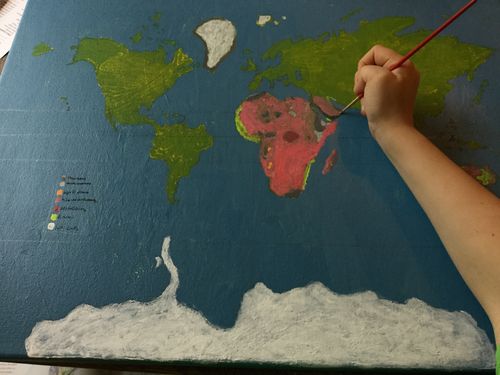
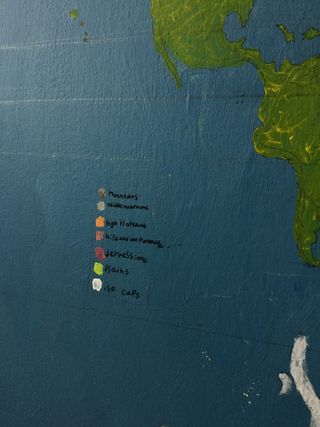
    Here's H's 11-year-old, working acrylics on canvas, from a few weeks ago:

    IMG_1789  IMG_1790

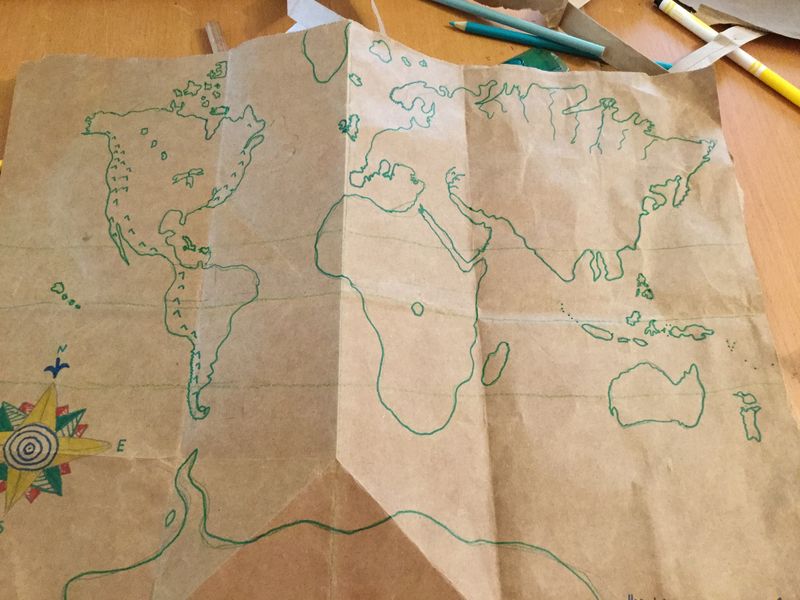
    The same 11-year-old produced this map on a cut-up grocery bag, completely from memory and without reference to any map or instructions, in about an hour.

    IMG_1764

    (As an aside, I highly recommend this curriculum.  If you do it 3-4 days a week, it's for sure enough to "count" for both social studies and art for anyone in 3rd through 8th grades, and with a little supplemental reading I think it also could form the core of a one-credit 9th-grade geography course).


    So, geography is complete.  My 9- and 12-year-olds will finish their ridiculously-unsupervised-by-me, self-taught and self-corrected science and language arts workbooks here in a week or two.  I should just tell them to go as fast as they want and be done sooner if they like.   My 15-year-old will not quite finish his precalculus book, but since I designated the last chapter (it's about probability) as optional, neither of us are concerned; and he likes probability, so he'll probably get reasonably far into it anyway.

    The high school Latin II students will finish their 32-week syllabus in about two weeks.  And next week I'll cover the last new material in their U. S. History course, which really deserves its own post — I'll write that when I do the course summary for H and M to put in their kids' portfolios.  They still have to take a test and turn in a project.  Which means I have to write the test.  Chemistry will be done in three weeks.  I have to write the test for that one too.  It'll be more fun to write than the history test.

    As for younger kids, some things (math, Latin) are never done done because I reserve the right to assign a lesson here and there all summer long as needed.

    + + +

    As usual, my workload doesn't diminish — it just turns more and more towards thinking about next year.   Lesson plans are moving along — not as fast as I wish — but I'm distracting myself from that by thinking about a major change I'm about to make in the first-floor workspace.

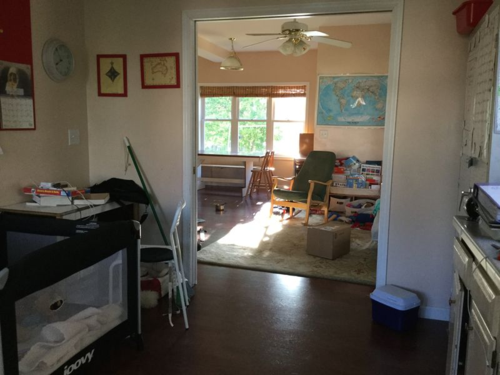
    Here is what it looks like to walk from the front door (to the right) through the schoolroom this very morning before anyone wakes up:

    IMG_1808

    Step a bit farther in…

    IMG_1810

    Take a left and head through all the way to the living room:

    IMG_1811

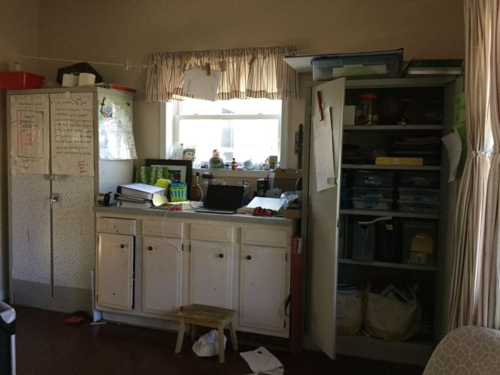
    Do you see those large, functional (mostly) metal cabinets and the reclaimed wooden kitchen cabinet, which I've lived with more-or-less peacefully since we moved into the house nine years ago?

    All about to go!

    + + +

    I have to wait about a month to order them, because IKEA won't let you order for delivery more than two weeks in advance, but over the Fourth of July weekend we'll be installing a bank of new cabinets in my schoolroom.  

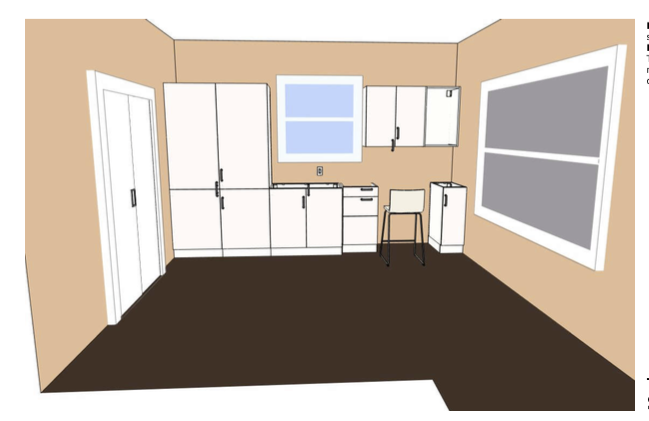
    I had trouble getting the handles to work in the online planner, and you have to imagine the countertop.

    Screen Shot 2016-05-18 at 8.42.18 AM

    Isn't it delovely?

    I'm especially excited about having countertop seating.  Yes, I'm going to have to decrease the storage space in the schoolroom.  But really, I keep too much stuff in there anyway, and I don't actually have a storage problem in my house — I have school supplies in the walk-in pantry, extra art supplies on the coat closet shelf, and materials from past and future years on the bank of shelves in Mark's shop.  I'm looking forward to streamlining a little bit and having more workspace.  Most of what will be removed from the space is toy storage, which will find another home.

    The leftmost "cabinet" is actually two 24-inch wide cabinets — I only wish there was a single 48-inch wide one.  It's deeper than my existing cabinets, countertop-deep.  The 36"-wide base cabinet to its right could store things that little children are allowed to get out for themselves.  The narrower base cabinet next to it will be one of those pull-outs with space for a trash can and a recycling bin.  The far-right one I'll probably leave without shelves so I can slide big flat things in there — dry erase boards, puzzles, whatever.   The bigger wall cabinet will have shelves from side to side — possibly a place to store Big Paper.  And the small open wall cabinet will have five shelves in it — one for each child — to hold his or her "in-basket" where I toss things we want to save, the basket that I put in order and store at the end of each year.

    Obviously it won't look so spare when in use.  I'll hang a big dry erase board on each of the high-cabinet doors.  And the children's school desks will have to stay.  And my countertop will inevitably become cluttered with charging laptops and microscopes.  And someone will write in crayon on the cabinets.  

    And someday, it will all need to be repurposed, or else demolished and turned into something else.

    But that someday is quite a long way off, I hope (my youngest is two, and I enjoy homeschooling) so I think it will be well spent.  I'm already wishing I'd done it years ago.

    What do you think?


  • Repost: The difference between faith and belief.

    I am going to try to get back in the blogging habit by reposting some old stuff when I can't think of anything new to say. This post is from March 2012.

    + + +

    I do believe; help my unbelief!" — Mark 9:24

    + + +

    Darwin excerpts a cordial discussion between some theists and some atheists about the meaning of the word "faith."

    It's worth reading on its own, and I am not going to respond to the entire excerpt, but just make my own comment and expand on it here.

    Some proposed definitions from the excerpt:

    • "Faith is knowing by testimony rather than by experience. I believe that the Earth orbits the Sun, because the scientists tell me so, and I believe them. "
    • "[F]aith is what fills in the gaps of the probabilities. If, say there is a 70 % probability something is the case then to conclude more than that 70% probability is faith…"

    Darwin chimes in to make two points. First, what "faith" originally means:

    The old Catholic Encyclopedia in its article on faith describes the Old Testament use of the term to be essentially "trustfulness" or "steadfastness"…. This usage still informs the way that we use the term in reference to interpersonal relationships. I have faith that my wife loves me. She has faith that I am faithful to her. Etc.

    Second,

    faith is an act of the will.

    Darwin's points are both correct, but he does not go as far as I do. He classifies "faith" as being an act, and this is correct; but it seems that he identifies it too much with "belief," or with being convinced "enough" of something. Here is the statement of Darwin's that I disagree with:

    This usage still informs the way that we use the term in reference to interpersonal relationships. I have faith that my wife loves me. She has faith that I am faithful to her. Etc.

    Obviously, in this sense one can have faith in any number of things or people, and as it notes, faith in this sense necessarily presupposes belief. I can hardly have faith in my wife's love (as in, trust in its existence and steadfastness) if I don't really believe that I have a wife or don't really believe that she loves me. When Christians talk about "having faith" however, they're pretty specifically talking about "having faith in God" — that combination of believing in God's existence and of trusting in God to remain steadfast and trustworthy in His love for us.

    Darwin is failing — at least clearly — to make a distinction between "I am faithful to my wife" and "I have faith in my wife."

    The first is concrete. The second is the metaphor.

    The faith that Christians are supposed to have is not the same thing as trust that God's love exists and is steadfast to us. The faith that we are supposed to have, I am certain, is faithfulness *to* God — fidelity to the laws and precepts that He sets out for us insofar as we are aware of them. When we are told to have faith, this is not at all a command to believe something. (How can you be commanded to be convinced of a truth?) It is a command to do something: to live your life, in your body, in your mind, in accord with the will of a God.

    Faith is not trust in God's steadfastness; it is a firm determination to remain steadfast to God. It is as the original Hebrew meant.

    And the point that I want to make, the point where I disagree with Darwin, is that faith understood in this way does not presuppose belief.

    Faith understood the way (I think) Darwin is trying to understand this would presuppose belief, because he is identifying faith with belief. "I can hardly have faith in my wife's love if I don't really believe that she loves me." Well, of course, if "faith in my wife's love" == "belief that my wife loves me."

    But my understanding of faith does not presuppose belief. Darwin could choose to remain faithful to his wife — by which I mean nothing more nor less than the earthy sort of "faithful," i.e., he could remain sexually faithful to his wife, forsaking all others, and not abandoning her or their children — even if he lost all confidence in her love for him. Indeed, he could (and should) choose to remain sexually faithful if Darwin became thoroughly convinced that MrsDarwin did not love him at all.

    And what if he did not believe that he even had a wife? Well, millions of still-single people find themselves in that situation every day, not having promised marriage to anyone, and yet they can still be "faithful" to the future spouse they might or might not have by living a chaste life. Su
    ch is faith: steadfastness.

    One may be "faithful" while having severely impaired belief, even no belief at all. (Which raises the question: Why would someone who did not believe in God ever strive to live according to God's laws? I will not answer the question here, and maybe will bat that question back to Darwin, but I will simply note that it is not logically impossible to be faithful in this way without belief; whereas if faith == belief, it does become logically impossible to have faith without belief.)

    The idea of "faith" as a purely mental or spiritual assent to a theological statement is, I suspect, a highly Protestant innovation. Because if you understand "faith" to mean "faithfulness" or "fidelity," then there is no distinction, none at all, between faith and works. The whole concept of "faith vs. works" presupposes that it is even possible to segregate a thing called "faith" away from the daily acts of living and interacting with other human beings and with our God. I say, it is not possible.

    Here is the second chapter of James:

    What good is it, my brothers, if someone says he has faith but does not have works? Can that faith save him?i 15If a brother or sister has nothing to wear and has no food for the day, 16and one of you says to them, “Go in peace, keep warm, and eat well,” but you do not give them the necessities of the body, what good is it?j 17So also faith of itself, if it does not have works, is dead.

    18Indeed someone might say, “You have faith and I have works.” Demonstrate your faith to me without works, and I will demonstrate my faith to you from my works. 19You believe that God is one. You do well. Even the demons believe that and tremble. 20Do you want proof, you ignoramus, that faith without works is useless? 21Was not Abraham our father justified by works when he offered his son Isaac upon the altar?k 22You see that faith was active along with his works, and faith was completed by the works. 23Thus the scripture was fulfilled that says, “Abraham believed God, and it was credited to him as righteousness,” and he was called “the friend of God.”l 24See how a person is justified by works and not by faith alone. 25And in the same way, was not Rahab the harlot also justified by works when she welcomed the messengers and sent them out by a different route?m 26For just as a body without a spirit is dead, so also faith without works is dead.

    The Greek word for "faith" in James 2 (the faith and works discourse) is the same Greek word (pistis) translated as "belief" in the passage from Mark that I quoted above. Does pistis mean "steadfastness" in any way? Or does it only mean an intellectual assent? It goes on to use pisteuis in the next verse to mean "believe" as in "You believe that God is one" and then "pisteuousin" in "Even the demons believe, and shudder." The "faith" mentioned in James is then the same as the "belief" which even demons can have.

    I don't really think of demons as "steadfast."

    Anyway, as I said in my comment to Darwin's post, the image of a faithful spouse is apt. Faith in, and faithfulness to, a spouse are very precisely designed to be an image of faith in, and faithfulness to, God. They are so bound up in each other as to not be separable; but at the same time, it is possible to "be faithful," to "do faithfulness," even in times of doubt or — God forbid — abandonment.

    This is what I would like to get across to anyone who says they wishes they could have faith but that it has never come to them. Anyone can, without committing a single act of intellectual dishonesty. It is simply a matter of becoming a faithful servant, or spouse, or child of God. To act faithfully — the precise nature of the "acts of faith" depends on our state in life and our circumstances — is to have faith. The ability to act faithfully, the possession of faith, both come from grace, the only thing by which we are saved.


  • Mother’s Day — in the life.

    I got up early on Mother's Day to go for a run around Lake Calhoun before Mass. I think this will be my summer Sunday routine — I like running outdoors, and I much prefer the cool mornings before the paths get crowded.

    The Lake Calhoun loop is a near-exact 5K. To make the circuit is to be treated to a pleasant series of vistas: the downtown skyscrapers in the distance, sailboats and kayaks on the lake, families of waterbirds, children swinging from the play structure at the 32nd Street Beach, blue water reflected in the plate-glass faces of the sprawling homes atop the bluff, towering apartment buildings standing sentinel where Lake Street dives into the bustling neighborhood of Uptown.

    Something there is in me that loves apartment buildings. I lived in one-bedroom city apartments by myself for about two and a half years at the end of college and the start of graduate school, and I think back with nostalgia. I liked their smallness, the ease of keeping them tidy, the door that opened a few steps away from a noisy city street. I liked that it was never quiet, that the sound of human activity just outside never stopped. I liked that the space was all mine. I liked the foompf sound of the gas furnace in the first apartment coming online in the winter, and the faint scent of warm dust rising from the electric baseboard heaters in the second apartment when I turned them on for the first time. I liked the sound of sirens and car horns coming in through the windows when I first slept with them open in the spring. I liked having my own mailbox in the row, to open with a little key. I liked never having to think about snow shoveling, or clogged gutters, or lawns, and that when the ceiling leaked it wasn't my job to fix it or pay for it, but only to call and ask.

    I have a house now, because I have a whole family to raise in it. (Still a city house, with sirens and car horns and a short walk from a busy commercial district.) When I run around the lake and see the sprawling big houses, I wonder who lives there, wonder how much the house costs, but don't want to trade places with them. Sometimes, though, I feel a little pull towards the upscale apartments at the edge of Uptown. Or towards the ones near the university, in a different part of the city. I think how lovely it would be not to have to get in my car to drive to the lake, but just to step out the front door to go for the run. I think about walking to restaurants and shopping and movies. I think how much better the sirens and car horns of Uptown would sound than the sirens and car horns of south Minneapolis. I think about living in a building with a concierge.

    For a long time I assumed that as an empty nester someday I would return to apartment living. I am neither a gardener nor a bird watcher. Even sitting in my own space outdoors with a good book could be accomplished just as neatly on a balcony as in a yard. I could maybe have a few potted plants there, which would never require mowing. I am a strange sort of introvert: I like nothing more than to be alone in a crowd. I want to be near where people are, but in no way obligated to interact with them. I am a city person. I want to live where there is a sidewalk (and have never understood why suburbs seem to treat this accoutrement as optional or undesirable). Maybe I won't grow old in Minneapolis, because the icy winters can be dangerous when frailty sets in, but a small city apartment somewhere — not necessarily a cheap apartment! — is how I pictured retirement. I let myself think of that when I ran around the lakes.

    And then one day recently I sat up straight and exclaimed to Mark: "Wait a minute! I'm going to be the matriarch of a large family! What if they all want to spend Christmas with us?"

    Yes, folks, I had been a mother for fifteen years, had given birth to five children. I had updated my self-image many times since then: from future scientist to ever-present homemaker, from sedentary to sometime athlete, from chemistry/engineering nerd to Nerd Across The Catalogue of elementary and secondary education. From expecting to travel whenever and wherever and however I wanted to waiting twenty years to visit another country. I stopped shoving a wallet and keys in my back pocket, and became a carrier of voluminous handbags stuffed with a change of someone else's clothes. All this happened quite naturally.

    And yet in all that time I had not gotten around to updating my vision of the future.

    + + +

    I am not saying I won't have my city apartment to retire to. I have a suspicion that we will turn into the snowbird types (possibly reverse snowbirds), with a place to call home in the city and a place to call home near the mountains, and maybe we'll have both a place that is small enough for two and a place that is big enough for all our descendants. I don't know; it is still far too early to make plans, and maybe even too early to dream about it.

    My point here is just that motherhood, parenthood, has a way of sneaking up on you. After all, I still think of Mother's Day as primarily a day I need to acknowledge for other people, not a day meant for someone like me; eventually my associations may shift, but they haven't yet, even though my children wrap me little presents to open each year. I guess it may go on happening my whole life, this transformation, outside and in.


  • Empty spaces: an Ascension repost.

    I need to make a test post anyway, so here's a repeat from two years ago:  "Empty Spaces."

     + + + 

    The feast of the Ascension is transferred to the following Sunday in this diocese, and [in 2014] that was yesterday [June 1] . Mark was not home, so I was bouncing a baby on my lap while trying to keep my four- and seven-year-olds from making too much noise grabbing MagnifiKid!s from each other. The oldest boys were serving at the altar.

    The Ascension is one of the stories that sticks in my mind, possibly because of that enigmatic, "He will return in the same way that you saw him go" bit. One reads the description of how they saw him go, and imagines it unspooling in reverse, and wonders how that is supposed to work. But it's curious for other reasons, too.

    For one thing: why couldn't, or didn't, Jesus send his spirit right away? Or "send" it at all: couldn't he have handed it over while they stood around him? Why leave like that, then string them along for ten days till Pentecost?

    I know, I know: he didn't really leave them; I am with you until the end of the age. In his departing, I suppose, he was making himself more present, because ubiquitous; instead of localized in a body whose feet pressed his weight into the earth, he is outside of it all somehow, everywhere in general because nowhere in particular. But why the gap?

    They waited, prayerful and perhaps frightened, in Jerusalem for a promise, and a few days later it came true. But why the empty space in between?

    + + +

    Not much later I was sitting in the rocking chair in my living room, nursing the baby and juggling the iPad, and sipping from a cup of hot coffee. All was quiet; lunch was over, and the four bigger children had scattered to play Minecraft and watch movies in other rooms. I had just finished exchanging texts with Mark, who had been traveling for several days.

    Possibly it was the combination of a bit of self-pity mixed with the general positive effects of caffeine on my sense of well-being, but as I sat there I felt an odd sensation that I can only describe as the purest bittersweetness I remember having.

    I was lonely. I missed my husband. (And I knew it was really missing him, and not just wishing he were here to help me with the kids, because they weren't asking for anything at that moment; I was perfectly content.) I would have liked to share the Sunday afternoon with him, me in the rocking chair, him lying on his back on the living room rug with his head propped on a pillow — he will never sit on a chair when there is a perfectly good floor to sprawl on. I would have liked it, but I was alone. I felt that sensation: a hollowness, a wishing, deep inside my chest.

    But at the same time, the very sensation of loneliness, of missing, seemed to spread wings and reveal something else within it: a glowing coal, an ember of pure gratitude at its core. Longing for my love hurt, and the hurt was a proof that I have love. I would not feel this "missing," this hole, if no one had left it behind. In the keenness of my sensation of emptiness I knew that I am ordinarily in possession of fullness and great beauty. Maybe it has been a while since I knew it, or acknowledged it. At any rate, I overflowed with thankfulness that I should enjoy such abundance every day, so as to create real longings. I have something to long for, and that is something exquisite.

    I wrote on Facebook:

    Discovering now that an interlude of absence can truly be sweet; an empty space that is *felt* is a reminder and an evidence of the blessings that ordinarily fill it to overflowing.

    I don't know if there is a connection; but may be, may be.


  • An uneasy feeling this morning.

    It just occurred to me that my encounter with a creep in the swimming pool the other day could be a warning parable about the looming presidential election. From my discussion with Mark afterward:

    “I had a lot of time in the pool to contemplate why the man’s behavior, even though objectively it doesn’t seem like much, was so threatening,” I said.

    “It’s because he communicated, in several ways, ‘I am not going to abide by the normal limits of behavior,’” Mark suggested.

    “Yes, I think that’s it,” I mused. “You’re forced to wonder, ‘What other rules of appropriate behavior are you going to ignore?’”

    “Which made him not actually dangerous, since you weren’t going to ignore those signals. Threatening but ultimately not competent enough to be dangerous.”

    An as-yet-unknowable chunk of the electorate is willing to ignore those signals.


  • Big losers and metabolism and me.

    More than one person alerted me to this article by Gina Kolata that appeared in the New York Times over the weekend. Check it out: “After ‘The Biggest Loser,’ Their Bodies Fought to Regain Weight:”


    I read the article with interest as a formerly obese (but not morbidly obese) person. I once lost a lot of weight, and… this is the place where I have trouble answering pithily. I didn’t quite “keep it off,” because I have had two pregnancies since. I didn’t maintain my lowest weight, because I decided I looked gaunt, and settled on a larger target. Nor have I quite maintained that, because after the more recent pregnancy I didn’t come quite all the way down. I’ll tell the story in jeans sizes instead of scale numbers: from 14 to 2 to, now, 4. The 4 puts me on the border between normal and overweight, but it is fairly easy to maintain and so I have parked there for a while.

    And seriously, I can’t get too worked up about wearing a size 4 instead of a 2. I am 41 and a half years old and have given birth five times. This is not so bad, I keep telling myself. It could be worse.

    + + +

    The gist of the article is that post-weight loss, a person experiences at least three separate mechanisms that tend to drive weight back up, even past the starting point.

    First, weight loss measurably drops resting metabolism — the energy that one’s body burns steadily in the background just to operate basic life processes, not the extra that it burns to fuel spurts of exercise and exertion. “Just about anyone… has a slower metabolism” after losing weight; if there is less of you to run, less fuel is needed. That is the well-understood part, I believe. The not-so-well-understood part is that, apparently, if you begin gaining weight again, the metabolism stays low. Some kind of check has been lost forever, and you might not even be able to get back to where you were before.

    Second, a drop in the hormone leptin increases feelings of hunger. Not everyone realizes that the gnawing feelings of hunger that normal people associate with “empty stomach feelings” are not really us feeling our emptiness — they are hormonal signals, and have more to do with what is in our bloodstream and gut than with what is in our stomachs. Some of the contestants, according to the article, had such low levels of leptin that the doctors presumed them to feel hungry most of the time.

    Third, persistent cravings — desires to eat, not associated with hunger. Those seem to be an unknowable mixture of habitual behavior (conditioned responses to external cues) and of additional, even less well-understood hormonal signals.

    + + +

    I really, really hate the “hopeless” narrative of obesity reversal: the idea that there is nothing we can do to get rid of excess fat and keep it off. Very hard work and obsessive attention can make it happen under some circumstances. We know this because a few people succeed, and none call it easy.

    But I also really hate its opposite, the “slacker” narrative of obesity reversal: the idea that, because weight loss is possible, those who stay obese must be greedy, lazy, or stupid.

    I prefer a “heroic” narrative of obesity reversal. Every piece of evidence points to the conclusion that it is massively difficult to reverse obesity long-term. Failing to lose a great deal of weight is no more proof of a person’s sloth and greed and self-indulgence, than his failing to run the Ironman would be.

    + + +

    So, I didn’t have to lose a three-digit number. My body didn’t have to take quite as large a hit as the “Biggest Loser” contestants who were followed in the study.

    Did I experience a diminished metabolism after coming down 40 pounds, the first time? I must have, because I ate, to maintain that low weight, between 1/3 and 1/2 of my previous intake — and while getting more exercise. But I doubt I experienced the subjects’ permanent metabolic depression. I’m pretty sure that my current habits have me eating more calories than prior to my first post-loss pregnancy; even so, my weight is apparently stable (although 15 pounds heavier).

    How about “constant feelings of hunger?” No — I haven’t experienced that at all. I get a growly stomach before meals, faster if I have been swimming or running. After eating I feel satisfied. If I have a supper that’s later or larger than usual, I don’t wake up hungry for breakfast right away. Also, I can live with hunger for a couple of hours without feeling compelled to fix it. I have learned to enjoy the “hunger is the best sauce” phenomenon, and to wait for the next meal.

    (Despite that, I do take people at their word if they say they struggle because they feel unpleasantly hungry all the time. Not fun, and a hard signal to learn to be patient with.)

    What I do get is “head-hungry” — the vague feeling of fuzziness and sluggish mental power that I associate with low blood sugar. It mostly strikes when I’ve put off breakfast too long, and sometimes in the late afternoon.

    Sometimes, to be honest, I think my body creates the feeling on purpose to reverse any weight loss I may have managed. But it is very difficult to resist — there’s this general feeling that I can’t think, and I will be able to think if I just have a sandwich. Maybe that is what I get instead of the constant hunger thing, now that I have learned that a growly stomach won’t kill me and I can wait a couple of hours to silence it. A new tactic, and a more effective one, since I hate the “can’t think” feeling.

    And then there are still cravings: the desire to eat when not hungry, or to have seconds and thirds after an already-satisfying plate. It’s moderately hard to resist these; I can do it, usually without a great deal of effort, but not effortlessly. And all those little efforts add up to fatigue.

    This is the part about working on weight maintenance that has been so frustrating, if not entirely unexpected. It costs. I feel permanently, or at least periodically, diminished. Fuzzy in the head, fatigued from saying “no thank you” to every impulse, chilly enough to put on a sweater, wanting a nap, irritable. I drink more coffee and snap at children. I have to spend some of the time and motivation that could have gone to create, or write, or analyze, or plan — instead on getting from meal to meal. I feel that weight maintenance has made me slightly stupider.

    So, I don’t know. Is it worth it?

    Probably. I will be more likely to live longer. I can do more things. I look better, and that privileges me in a society that judges people harshly by appearances. But I want to acknowledge the cost. It really does feel like having a medical condition — a manageable medical condition, but (as anyone with a manageable medical condition knows) just the fact that it must be managed creates a mild disability, diverts resources. The question is, do the benefits outweigh the cost.

    The answer to that is not actually obvious. I guess it must be worth it, because that is what I choose to do; even if it isn’t a conscious calculation. But by that measure, maybe those who don’t keep it off are making the same calculation. Maybe nobody appreciates that in their current condition, maintenance simply costs too much — too much effort, too much suffering, too much attention, too much time, too much diversion of resources. They have lives, and life itself costs a lot; and when you work all the time, there are joys you miss out on.

    I mean, it’s also possible that they, and I, are just doing it wrong. Give it time and someone will step up to let me know.


  • Tired, in the pool.

    Yesterday evening I arrived at the YMCA pool to find it moderately crowded — three lanes occupied by swim lessons, and three lap lanes each occupied by one swimmer.   I picked the swimmer closest to the wall, waited until she came up for air at my end, and asked, "Can I split with you?"  She agreed, and moved towards the wall to give me half the lane.   I kicked off my flip-flops, sat down with my feet in the water, and fiddled with my goggles to make sure I would get them right side up.

    Here's how lap pool etiquette works:

     If NswimmersNlanes, each swimmer gets his or her own lane (unless you came with a friend or child and you want to share).  As additional swimmers arrive, the swimmers who are already there must allow the new arrivals to share:  that's the posted rule.   Common courtesy and safety call for the arriving swimmer to get a swimmer's attention and ask to share, as I did; this prevents collisions.

    If you're a new arrival and you join a lane with one other swimmer, then the two of you "split" the lane:  each goes back and forth in his own half-lane.  This works up to Nswimmers ≤ 2 Nlanes .  

    Once there are two swimmers in every lane, and another person arrives — getting the attention of both the people who occupy it, of course — three swimmers can share a lane, not by splitting it, but by "circling."  This means you swim along one half of the lane, turn, and come back along the other half of the lane, keeping to your right.  With only three in the lane it isn't too hard to pass slower swimmers (on the left).  As you get up to four and five in the lane, it still works if everybody swims close to the same speed.  

    One thing you don't do:  get in a lane that has two people already in it when it still holds that NswimmersNlanes.  Because it's much more inconvenient to circle-swim than to split a lane, and everybody knows it.

    I got my goggles on my head and looked up, and there was a man slowly water-jogging in the lane, next to the wall, about 8 yards away.  Where did he come from?  He saw my confused look, smiled widely, and beckoned me into the water with both hands.

    I pointed to the other lane.  "There's room in that lane," I said.

    "It's all right!" he beamed at me.  "Come on in!"  He said something else, but it was garbled by the noise of the pool.

    "I can't hear you," I called.  I pointed across at the other swimmer, who was just about to turn and head back.  "Does she know you're in this lane?"

    "It's all right!"  He opened his arms widely and beckoned again.  "Come on in, it's all right!"

    It seemed a little dumb to say "I was here first!" since I could move into the next lane just as easily as he could, but I suspected that the other swimmer didn't know he was in there and wasn't expecting him — and he was occupying her half of the lane.   Occasionally you run into people who aren't aware of the rules.  I literally ran into someone, once, who hadn't been aware of the "get the other swimmer's attention before entering an occupied lane" rule.  My neck hurt for a week.   So I was just about to explain:  You have to ask first.

    And then he got closer and said, "Hey!  It's all right!  Come on in!  I'm not bothering anybody, I'm just showing off my awesome body!  I've been working out, you know?  So come on in with me!"

    And he flexed.

    IMG_1367

    Really.

    Gross.

    I don't know how well the subtleties of the expression change from "You are clueless about lane etiquette and I should help you out by explaining it" to "You are, in fact, an asshole" are communicated when one is wearing goggles.  Anyway, I very quickly calculated that I was not getting into the lane with this guy, nor was I getting into the lane next to this guy.  I grabbed my flip-flops and started to stand up, and before I even reached a standing position (which was the position in which I was going to think about how to get the other swimmer's attention), the lifeguard was at my side and the man was moving away.

    "Excuse me," said the lifeguard, a young man whose name I don't know but whom I have seen many times.  "What's the issue here?"

    I told him how the water-jogging flexer had appeared in the lane without asking, briefly described the exchange in which the water-jogger extolled the awesomeness of his body, and aped the flexing motion.

    "I'll take care of it," he said.  "You go ahead and swim in this lane."

    So I did — eventually.  At the far end of the pool, the lifeguard spent several minutes standing poolside in conversation with Mr. Wonderful who was still in the lane.  The other swimmer came up and asked what happened, so I explained.  The man in the next lane came up and asked, "Do you need to split with me?" and I confused him, probably, by saying "I don't think so…"  But eventually the asshole got out of the pool, so I got in and started swimming my laps along with the first woman.

    And then Mr. I'm-so-awesome came back to the end of the lane and stood there and watched us for a good ten minutes.  I ignored him.  Eventually he walked away… but only as far as the lifeguard's chair.  I kept an eye on him as I swam.  There were two lifeguards on duty that evening, and the stranger engaged them in conversation for something like twenty more minutes.  Which is ridiculous in lifeguard minutes.  You can say hi to the lifeguard, you can ask a question about which lane you should choose or how long until open swim ends, but they have a job to do which is not chatting.  

    I began to wonder whether I was going to have a problem when I got out of the water.

    Fortunately, the attention span of this particular asshole was shorter than my workout.  He left (through the Family Changing Room) and I didn't see him again. 

    When I finished my 45 minutes, I went over to the lifeguard and let him know I appreciated him dealing with the asshole so that I did not have to.  "No problem," he said.  "That guy was behaving really inappropriately even before you got here.  The manager dealt with him.  Said he smelled something on his breath."  I thanked him again and went to change.

    + + +

    Over a bottle of wine at dinner I told the story to Mark.  "I had a lot of time in the pool to contemplate why the man's behavior, even though objectively it doesn't seem like much, was so threatening," I said.  

    "It's because he communicated, in several ways, 'I am not going to abide by the normal limits of behavior,'" Mark suggested.

    "Yes, I think that's it," I mused.  "You're forced to wonder, 'What other rules of appropriate behavior are you going to ignore?'"

    "Which made him not actually dangerous, since you weren't going to ignore those signals.  Threatening but ultimately not competent enough to be dangerous."

    "Yes, I have a pretty well-refined asshole detection algorithm."  

    + + +

    But I thought to myself:  Lots of people are socialized to suppress a reaction to those signals:  they have their boundaries damaged or destroyed at a young age, or they are taught to be nice, or ridiculed for objecting to unwanted attention ("Don't flatter yourself!" — as if there is no such thing as unwanted attention, as if swaggering boundary-pushing had anything to do with real interest in persons as persons instead of as some kind of icon that can be clicked).

    (In my case, there in the pool, I was mainly pissed off that the guy was in my way.  I only had an hour free for my workout.  I was there first, and he should have gotten in the lane with one of the lone swimmers instead of interfering with the only lane that happened to contain two women.  Asshole.)

    So, no, not dangerous.  Not to me, in that place.  And the Y staff dealt with him fast enough that my workout was only diminished by about five minutes.  Props to them.

    But still: a symptom, a reminder, of all the things that make it incrementally just a bit more exhausting to be female.  I'm lucky.  I go a long time between these events; my lifestyle insulates me a bit.  But they're still out there.