bearing blog


bear – ing n 1  the manner in which one comports oneself;  2  the act, power, or time of bringing forth offspring or fruit; 3 a machine part in which another part turns [a journal ~];  pl comprehension of one’s position, environment, or situation;   5  the act of moving while supporting the weight of something [the ~ of the cross].


  • Grading.

    Thursday, like every other Thursday, there were three other women friends and their seven children (plus my own two, so nine children all together) at my house from about 10 till 4.  I made mini-pizzas for lunch. 

    The kids were all down in the basement playroom and we were just getting settled into our coffee — those of us who had schoolwork to do with our older kids hadn’t started it yet — when I heard a diesel engine idling out front and turned to see a Bobcat parked just outside my front windows.   I ran out front and there was Archie the excavator, here a day early, shouting at me over the rattling engines, could we please move all our cars?

    Well.  No letting the kids play outside today; they’d have to make do with the basement, which turned out to be okay because it had apparently flooded to a depth of several inches with HOT LAVA THAT MUST BE AVOIDED BY STEPPING ON TOYS AND SCRAPS OF CARPET REMNANTS LEST THE HAPLESS VICTIM BE SUBJECTED TO AGONIZING TORTUROUS DEATH ACCOMPANIED BY PROLONGED SHRIEKING.

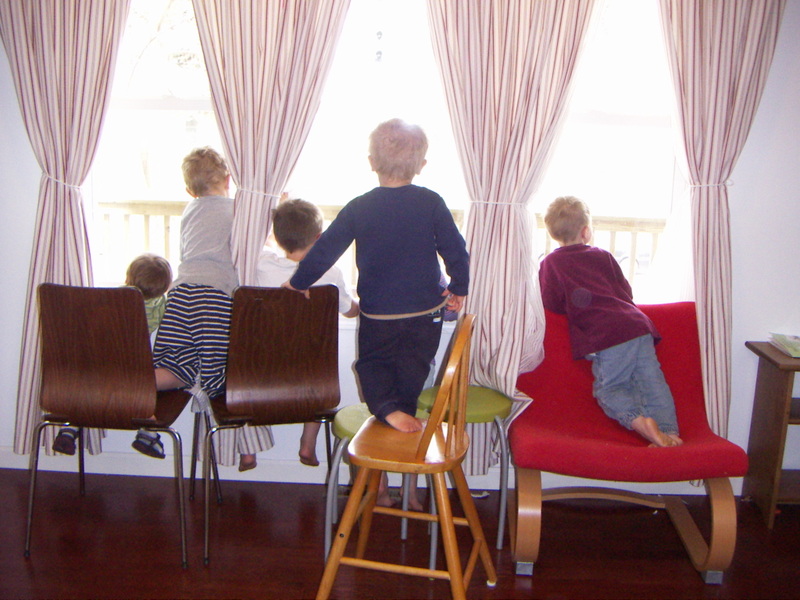
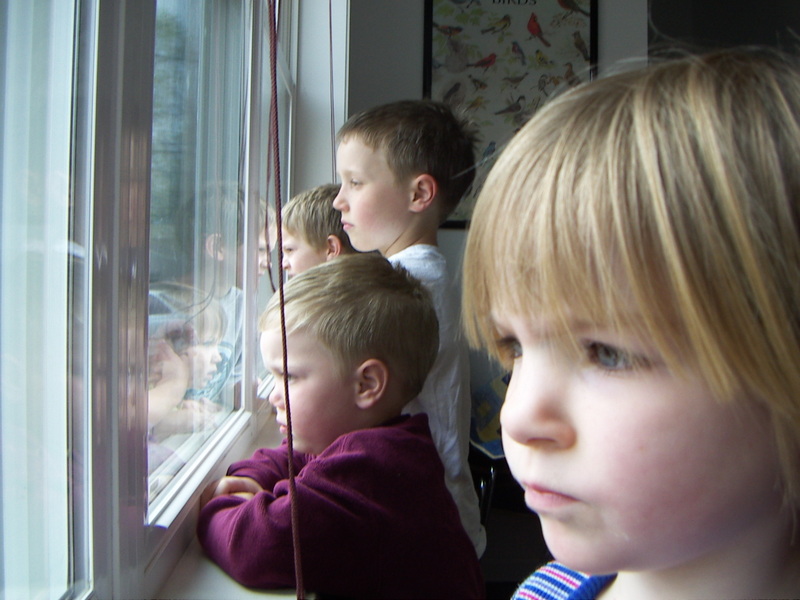
    It also afforded opportunities for watching out the window.  Later, when Oscar jumped up and fled his math worksheets for the third time, Hannah said to me pointedly, "Erin, you have to have recess when a dump truck arrives in your back yard."  She has a point.  Otherwise, why homeschool?

    April_2006_and_before_201_1

    April_2006_and_before_205


  • “How do we learn to die?… How do we practise dying?”

    A brief and powerful post by John da Fiesole at Disputations

    (Much of the credit goes to Fra’ Lawrence at Fruit of Contemplation, whose post John excerpts.)

    I’ll not look at Compline ("Night Prayer") the same way again.


  • The myth of the inventor: A somewhat fictionalized account of a discussion.

    Mark was musing last night about something he learned at a training seminar.  "Who invented the light bulb?" he asked.

    Rhetorically, I assumed, staring up at the ceiling (I was putting my feet up after a pretty long day). "I suppose I am supposed to say Thomas Edison." 

    "Right," said Mark.  "So why, then, if Edison invented the light bulb, did he have to buy out the rights to an existing patent for a light bulb?"

    "I suppose," I said, "that someone else came up with the idea for the light bulb, and consequently got a patent for it, but never managed to actually make one.  At least not one that worked.  You don’t have to have a working prototype to get a patent, just the idea."

    "So why do we say that Edison invented the light bulb?" pressed Mark.  "Why don’t we say that he improved on the light bulb?"

    "Or engineered it?  Or marketed it?  Or made money off it?  Where are you going with this?" I asked.

    "Could it be," he speculated dramatically, "because the original patent was a Canadian patent?!"

    "Is that so?"

    "Yes!"

    "I don’t really care.  Who cares who had the patent?  They didn’t do anything with it.  Edison tried something like hundreds of different designs, with different filaments."

    "Still," insisted Mark, "the word inventor isn’t appropriate."

    "Are you suggesting that the light bulb myth is an example of American exceptionalism?"  I asked.  He indicated that, yes, he did.

    "Because I don’t think so," I said.  "I think it’s an example of our need to have the myth of the inventor."

    "Ah yes," Mark said.  "The single inventor."

    "We have to have a hero," I continued.  "We have to have a single person that we can pin the whole thing on.  Nobody ever improves on the work of previous people."

    "Nothing is ever developed, by, say, a committee."

    "Yes.  James Watt," I raised my voice as Mark left the kitchen in search of a broom and dustpan, "JAMES WATT, AND NO ONE ELSE, INVENTED THE STEAM ENGINE.  Philo T. Farnsworth invented the television.  Alexander Graham Bell invented the telephone.  And so on, and so on.  And why do you think this is?" I continued.  "We need to believe that science, engineering really, is the work of heroes.  Geniuses!"

    "Who sit in their laboratory until the inspiration strikes, and then… they invent something."  Mark shook his head.  "It gives people wrongheaded ideas about how engineering works."

    "When really, everything — just about — that is invented, I mean developed, engineered, is part of a whole chain of innovation.  But we only pick out the most prominent person in the chain, whether they’re some rich guy who funded the project, or the one who got interviewed on the news, or just the most personable of a whole bevy of potential ‘inventors.’" 

    "Yeah — And ‘inventor’ hardly describes the most significant role that Edison played.  He founded a company.  General Electric."

    "But ‘company founder’ doesn’t sound as snappy."  We sat in silence for a while.  "I blame elementary school teachers, I think.  Everything’s got to be so simplified."

    Later we decided that the whole myth of the inventor comes from the same sort of simplification and desire for a tidy, engaging story that gives us, say, patriotic legends about American historical figures (e.g., Washington/cherry tree, Lincoln/log cabin).  The secular hagiography, I call it. 

    (Mark liked that term, but it ended our conversation, because he went off on a tangent trying to come up with a good line about "I’m writing my autohagiography.")


  • No more love nests on the university’s dime.

    News from a local Catholic university:

    The University of St. Thomas announced today that it will not allow employees who accompany students on university-sponsored trips to room together if they have a romantic attachment to each other and are not married.

    ….St. Thomas’ president, the Rev. Dennis Dease, said in a statement that the policy "is not about the private lives or consciences of faculty and staff.

    "Rather, it is about the University of St. Thomas, in its institutional acts, being what it purports to be: a Catholic university," he said. He said the new policy maintains "the integrity of the university’s Catholic nature and faithfulness to its Catholic mission."

    Note that the university isn’t going to do bed checks; it’s announcing simply that it will no longer pay for unmarried couples to room together in hotels, and instead a separate room must be reserved.  Nevertheless, and predictably, opponents are calling the move a violation of nondiscrimination policies. 


  • An encounter with greatness.

    Yesterday evening was lovely and warm, so we took the boys for a walk by the lake after dinner.  The bike paths and walking paths were crowded, and the playground was full of children.  Milo said that the setting sun made the lake look like orange juice.

    Mark was helping Milo in the port-a-potty and I was waiting outside with Oscar.  A young mom with one boy joined the line.  She nodded at my pregnant belly and asked, "So how much longer ya got?"

    I paused to count, and told her, "About four months."

    Then, her jaw went slack with horror and she repeated "Four months…?"

    "Um.  Well, with number three, everything happens a lot… sooner."

    She nodded, but that look of horror never went out of her eyes…


  • What I dreamed last night.

    I was back on campus, walking late at night with an unspecified acquaintance across the plaza in front of the chemical engineering building.  Suddenly, several yards away from me, a crazed man attacked a passerby, causing him great injury, and then ran off.  I ran toward the victim lying on the ground, dialing my cell phone, and the attacker turned to come after me.  The scene ended with me trying to decide whether to keep running or whether to stop calling for help and to pretend I hadn’t seen the attack in the hopes that the pursuer would leave me alone.  That’s when I woke up.

    I don’t think this is just a run-of-the-mill nightmare, though, because the weapon used in the attack was a moderately common piece of laboratory equipment.   Anyone want to hazard a guess in the comments what it means?

    N. B.  Although it’s been many years since I used one of those things, I don’t remember it being cordless.  Probably running away in a straight line was a decent strategy.


  • Green vegetables.

    We’ll see if this works.  In an effort to consume more water and more green vegetables, I went to Whole Foods on Saturday (on the pretext of buying creme fraiche for Easter Sunday’s potatoes au gratin) and bought many 1.5-L bottles of spring water (hey! Only 79 cents!) and also a stack of boxes of frozen, organic, broccoli-and-cheese-sauce.  And some shelf-stable boxes of saag paneer.  And a couple of aseptic packages of creamy broccoli soup.  And some Spinach Feta Pockets.   Also I bought some sweet potatoes, though they are not green, as they are easy to make for lunch.  And some grapefruit.

    And, just because it looked good, a nice spinach salad with strawberries and blackberries and pistachios and balsamic vinaigrette and a big fat patty of goat cheese on top.   Even though I’ve had an aversion to raw greens, I managed to choke that one down.  Wonder why? 

    Anyway, I haven’t dug into the veg yet (haven’t had to — still working on the leftover Easter asparagus), but the 1.5-L water bottles seem to be working:  (a) even though intellectually I know that tap water is just fine, for some reason I am more tempted to drink spring water, and (b) I make sure I drink at least one bottle per day, which is about 4 times the water I was drinking before.


  • Triduum reportage.

    (Some of the links play music, so be warned.)

    Maybe it would be tacky, as if the Triduum services were a series of concerts-in-the-park, but I wish they would give us a program or a list of the musical pieces that the choir and the organist are performing during Holy Thursday Mass, the Good Friday service, and the Easter Vigil.  I think the acoustics and/or amplification in our parish church must be pretty good; I have no idea how they manage to sound like such a BIG HUGE CHOIR on particularly solemn occasions. 

    We heard what I think is a very good mix.  It includes traditional hymns and pipe-organ compositions as well as some carefully selected more-contemporary pieces.  Gregorian Chant may be the height of liturgical perfection; but if you ask me, Were You There? (which is originally an African-American spiritual) has found its place in the Holy Week canon.  So have certain Taize’ pieces:  we heard Stay With Me at the close of Thursday, Jesus, Remember Me during Good Friday service, and Christus resurrexit during the Easter Vigil. 

    But we also heard plenty of old standards:  O Sacred Head Surrounded, for instance, and At the Lamb’s High Feast ("He has washed us in the tide/Flowing from his opened side.")  We also got a hefty dose of Latin, which is always fun, including the usual things like Pange Lingua, and also that first Gloria when all the lights come on.

    Oscar’s favorite part of the Vigil was the reading from the book of Exodus, which was sung; I’ve heard that arrangement at other parishes, so I assume it must be relatively common, but I can’t find it online and don’t know the composer.  "Sing a song of freedom, God has won the victory; horse and chariot are cast into the sea."  The refrain has a kind of, oh, I don’t know, lilting Jewish-traditional (think havah nagilah) beat to it, while the "verses" are just the chanted text of Exodus 14:15-15:1 (see the readings here).  Anyway, he likes that horse-and-chariot bit, and sang lustily.

    All in all, very well done.

    (Oh, I almost forgot.  Obligatory Holy Thursday footwashing blogging:  Yes, they were all male.)


  • Triduum, with little ones.

    We did it:  attended the (7:30 p.m.-9 p.m.) Mass of the Lord’s Supper, the (2 p.m.-3:30 p.m.) Celebration of the Lord’s Passion, and the (8 p.m.-10:15 p.m.) Easter Vigil, all with a five-year-old and a two-and-a-half-year-old.

    It is tricky, going to long late-evening Masses with toddlers.  It works best if your toddler still reliably takes a nap every day.  Then, the secret is to keep them awake all day, prodding them when necessary, until the family gets in the car to head to the church, at which point they are allowed to fall asleep, soundly enough (we hope) to remain in that state through Mass.  Miraculously, Milo complied with my strategy last night, and not even the choir belting out Christus resurrexit could startle him awake.

    Oscar, the five-year-old, did not too well on Holy Thursday (he put his head in my lap and whimpered that he was hot) and much better on Good Friday (the drama of the procession before the Veneration of the Cross interested him, what with the flail and the crown of thorns and the spear and the hammer and nasty-looking nails.  Plus I had allowed him to wear his "summer" church clothes) and, I thought, very good at the Easter Vigil (although I wished afterwards I had brought a putty knife to scrape up all the wax he had dripped from his candle on the kneeler, pew, floor, and my shoes).

    <confession>Perhaps part of his good behavior came from the fact that we promised him ice cream if he were quiet.</confession>

    Other than bribery, there are several things that help a medium-sized child get through the Triduum services.  The first, alluded to in the previous paragraph, is to make sure that the children are comfortably dressed. 

    Another is to sit on the center aisle, which is easier than it sounds even when the church is jam-packed — people who like to sit "on the aisle" in order to make an inconspicuous escape tend to sit on the ends.   During the Triduum, there is so much procession, the center aisle is where the action is, and there’s plenty to see.    (On Good Friday, we wound up sitting in extra chairs in front of the front pew in the back section — in the aisle that bisects the church perpendicular to the center aisle  — and we turned out to have a really good view of the procession.) 

    A third is to be a little extra generous with granting favors like a trip to get a drink of water, provided the timing is right (etiquette tip:  if you have to elbow several candle-bearers out of the way, it is not an appropriate moment to excuse yourself from the sanctuary).

    And as always, expect and encourage children to participate as fully as they can:  sitting, standing, and kneeling at the appropriate times; holding their own candles; joining in the prayers, songs, and responses that they have learned. 

    After Mass we took the children to a nearby ice-cream parlor for a late-night Easter treat.  We did the same thing last year, so I suppose it’s officially a Family Tradition now.  Milo woke up and cheerfully, if a little confusedly, ate a cup of chocolate ice cream.  I had banana rum.  Oscar had coffee ice cream (boy takes after me), and Mark had a malt.  We agreed that it was much better than chocolate bunnies, which was fortunate as I had not gotten around to putting together any Easter baskets.

    Have a blessed Easter Season!


  • Burning crosses.

    I’m really struck by the photograph seen at the top of this post at Amy Welborn’s.


  • Going numb.

    A couple of weeks ago, my left hand started to go numb from time to time.  At first I thought my arm was falling asleep; then I realized that only the first three fingers were affected, meaning the problem was the nerve, not poor circulation. 

    A few minutes’ Googling, and I’d learned that carpal tunnel syndrome is common in the second half of pregnancy.   Apparently, the slight swelling that accompanies the normal increase in blood volume can create the same hand and wrist problems that inflammation can.

    I’ve never had this symptom before — swelling hasn’t been a problem for me in my two previous pregnancies, except for a day here or a week there at the height of summer.  Still, I’m aware that my diet hasn’t been what it should, so I’ll take it as a wake-up call.  I need to drink more water (she says as she sips her third cup of coffee).  I have hardly been able to look at green leafy vegetables — time for a new strategy.

    The hard part is just scheduling them in, given that I have a terrible aversion to salads.   Maybe I need to buy a stack of boxes of frozen microwaveable broccoli, or something, and force myself to eat one every day.


  • Phenomenology and the Passion.

    Morning of Holy Thursday

    Lots of people, especially in conservative circles, don’t like phenomenology, which is the philosophical movement that John Paul II drew upon in formulating his Theology of the Body.  Here is a brief explanation of phenomenology as the late Holy Father understood it:

    Phenomenology is a subjective, inductive, and experiential philosophical method. [Edmund] Husserl[, its founder,] was interested in discovering how things are in the world (the being of things—what philosophy always investigates) through the interior perception of the world by individual people.  …. Through his studies, which focused on ethics, [Karol] Wojtyla saw that phenomenology was able to provide a link to reality, a way to ground ethical norms in reality, and not only in interior ideas. … Wojtyla saw that phenomenology provided a way to re-link ethical norms to reality… [and] a powerful tool for the study of Christian ethics.  If the Christian norms taught by Revelation could be understood as interior norms, i.e., if these norms could be perceived through experience, they would cease to have the character of external laws imposed on one from the outside. Further, one could speak about these values in a subjective way appropriate to the modern world.

    Phenomenology studies human experiences from the interior point of view.  … It is precisely because the person is vital to revealed truth that there can be a synthesis of phenomenology and the faith. Phenomenology … begins with our conscious experience of ourselves as acting agents. Phenomenology then leads to the mystery of human personhood. Phenomenology, subjective as it is, “opens the door” to the full truth about man revealed in the objective order by God. John Paul II makes this link between phenomenology and the objective order of the faith through the text in Genesis: “Let us make man in our image.” 

    Conservative critics of phenomenology construct a dichotomy between "experience" and "truth."  They argue that St. Thomas Aquinas’s scholastic philosophy, dependent as it is on reason with its postulates, proofs, and corollaries, is far superior; or indeed, that Aquinas’s approach

    Morning of Holy Thursday

    Lots of people, especially in conservative circles, don’t like phenomenology, which is the philosophical movement that John Paul II drew upon in formulating his Theology of the Body.  Here is a brief explanation of phenomenology as the late Holy Father understood it:

    Phenomenology is a subjective, inductive, and experiential philosophical method. [Edmund] Husserl[, its founder,] was interested in discovering how things are in the world (the being of things—what philosophy always investigates) through the interior perception of the world by individual people.  …. Through his studies, which focused on ethics, [Karol] Wojtyla saw that phenomenology was able to provide a link to reality, a way to ground ethical norms in reality, and not only in interior ideas. … Wojtyla saw that phenomenology provided a way to re-link ethical norms to reality… [and] a powerful tool for the study of Christian ethics.  If the Christian norms taught by Revelation could be understood as interior norms, i.e., if these norms could be perceived through experience, they would cease to have the character of external laws imposed on one from the outside. Further, one could speak about these values in a subjective way appropriate to the modern world.

    Phenomenology studies human experiences from the interior point of view.  … It is precisely because the person is vital to revealed truth that there can be a synthesis of phenomenology and the faith. Phenomenology … begins with our conscious experience of ourselves as acting agents. Phenomenology then leads to the mystery of human personhood. Phenomenology, subjective as it is, “opens the door” to the full truth about man revealed in the objective order by God. John Paul II makes this link between phenomenology and the objective order of the faith through the text in Genesis: “Let us make man in our image.” 

    Conservative critics of phenomenology argue that St. Thomas Aquinas’s scholastic philosophy, dependent as it is on reason with its postulates, proofs, and corollaries, is far superior; or indeed, that Aquinas’s approach is the only legitimate thinking about God and man. They are suspicious of phenomenology’s "subjective" nature, arguing that human experience leads us to error and that excessive reliance on experience tempts us to moral relativism.  In doing so, they construct a dichotomy between "experience" and "truth."   Here’s an extreme example, taken from a sedevacantist (i.e., schismatic) website:

    Phenomenology attempts to base human knowledge on the "phenomena," that is, what appears to the human mind, rather than on an exploration of external existing things. Whether a thing truly exists or not is unimportant to a phenomenologist; only what he cogitates exists for him.

    Moreover, phenomenology describes "meaning" as the combined observations of a multitude of observers, past, present, and future. Thus, meaning can never be isolated. The true meaning of a symphony may never be known, because it resides alternatively in the written score, what was in the mind of the composer, the variety of performances different orchestras and different conductors, and also involves future performances.

    One can easily see how this philosophy is one of the modernist "subjectivist" philosophies, basing itself not on an external reality or standard, but upon one’s own personal conceptions. Thus, it easily leads to moral relativism and dependence upon personal or subjective opinion ("what feels good") as opposed to external or objective reality (e.g., the Ten Commandments).

    Of course, John Paul II viewed experience not as an alternative to objective reality, but as a means of grappling with objective reality.  The dichotomy is false:  Thomist rationality, and (???) Johannine-Pauline (???) experience, both help us find the truth.  (Anyway, human reason isn’t exactly infallible — and leads to sins of pride and presumption as easily as human experience leads to relativism.)  And even Aquinas recognized that we come to knowledge of the truth first through our senses.  Human experience, fallible though it is, is a necessary means of encountering objective reality.

    More important than these arguments is one single fact, which silently and incontrovertibly and eternally proves that human experience can be, and must be, united with Truth:  God Himself chose to experience life on earth through the senses of a human being; indeed, chose to experience death. 

    We do not know how the Atonement works, but we agree that it was accomplished through
    God’s experiencing of human life, human suffering, and human death.

    God is omniscient.   Even were there no Incarnation, he would understand human bodily being, its sensations, pains, and  joys, completely.  Even were there no Passion, He would have perfect knowledge of suffering and of death. 

    Yet God did not deem His perfect intellectual comprehension of human life, suffering,
    and death sufficient to accomplish the Atonement.  In His Wisdom, He deemed it necessary also
    to experience these things, in flesh taken up of His own free will.

    If God can accomplish something through His experience, then man can accomplish something through man’s experience.

    Have a blessed Triduum!