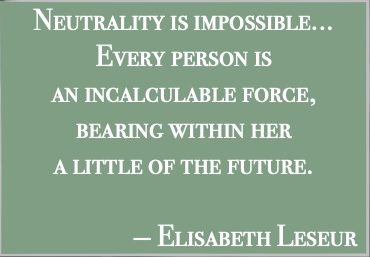
A recipe for self-medication at Dooce.
bearing blog

bear – ing n 1 the manner in which one comports oneself; 2 the act, power, or time of bringing forth offspring or fruit; 3 a machine part in which another part turns [a journal ~]; 4 pl comprehension of one’s position, environment, or situation; 5 the act of moving while supporting the weight of something [the ~ of the cross].
-
-
Bilingual signage.
I stopped in Sears today, sans kiddos, to get a couple of pairs of maternity pants. It’s been a while since I shopped there; the place has a new look; and one new thing I noticed was that all the signs for the different departments had a Spanish subtitle in smaller print. For example:
JUNIORS
jovenes
and
WOMENS
tallas especiales
and
MISSES
ropa para damas
The first thing I thought when I saw those signs was: "Thank goodness. Now I know what those categories actually mean."
-
Harsh truths about Catholicism.
From holyoffice’s livejournal:
I, a card-carrying Catholic (in fact, I got my Popery ID card renewed just yesterday; you can do it at Triple A), would like to step in and offer some "red meat" for both sides to chew on.
The problem, as I see it, is that there are a lot of misconceptions about the Catholic Church – but many of these misconceptions are actually held by Catholics themselves. So, in the interest of furthering a sense of understanding with my separated brethren, here are some honest-to-goodness, take-the-log-from-my-eye truths about Mama Church. But I will also do my part to correct some mistaken impressions about the church.
CLAIM: Catholic belief is unscriptural.This is true. During every Mass, there are two readings from the Old Testament and two from the New Testament, including (always) a Psalm and a reading from one of the Gospels. But this is all for show. In fact, Catholics are forbidden from reading the Bible. The only Catholic who is allowed to own a Bible is the pope, and he won’t tell the rest of us what it says.
There’s lots more. h/t Orthonormal Basis, who has a spiffy new blog header of which I very much approve.
-
The pause that refreshes.
It’s Friday night. What wild good times are rolling around the bearing household?
The kids are watching a movie.
Mark is building a bench for the mudroom.
I am sitting on the futon blogging and enjoying a rare treat: Mark brought me home a can of Coke from the vending machine at work.
He also brought home two 12-packs of Guinness, full of widgety goodness, which he won in an office bet. Technically that is a rarer treat. I already had one of those. (One bottle. Not one 12-pack.)
So, not bad for a Friday night.
-
-
An honest and raw look at the difficulties of natural family planning.
In the comments on this post at Amy Welborn’s.
The whole discussion is excellent. Comments from people whose experience was great, from those whose experience was not so great and so they quit, from those whose experience was not so great but they didn’t quit, from priests and seminarians, from people with medical difficulties, from NFP instructors.
We’ve experienced NFP mostly positively, with a few very trying times during my brief periods of lactational amenorrhea. All our pregnancies were planned, but then, we tend to practice NFP pretty conservatively, and Mark tends to be more conservative than I do about defining the edges of the fertile time (which, anecdotally from talking to people, seems to be less stressful on a marriage than when it’s the wife who wants to be more conservative).
One thing I can say unreservedly is that, although it has at times been very challenging, I don’t think we’ve ever been through a time when contraception has looked like a better option. I can think of a few times when TOTAL ABSTINENCE has looked like a better option.
-
Classroom simulation.
"Mrs. Anonymous Teacherperson," religion teacher in a Catholic high school, describes a creative classroom simulation to drive home the importance of the "which gospels are canonical" question.
-
No more Number Two Pencil.
Kimberly Swygert of Number Two Pencil, one of my favorite education-related blogs, is moving on:
N2P was intended to be a place where readers could come to peruse, at a leisurely pace but a reasonable depth, discussions of the basics of psychometrics and statistics, the myths and realities of testing, and the media’s attitude towards testing at the K-12 and college level…. As much as I would like to keep this blog active, I don’t feel it’s the right thing to do, given the limitations of my time.
However, I do still have some time to lend my expertise and opinions to the lively discussions in the edublogging world, and I would like to stay involved as much as my life and time permit. Thus, I’ve decided to join the staff of The Education Wonks as a guest blogger. I feel very honored that they’ve agreed to have me in a guest spot on their site, which I consider to be one of the brighter new stars in the edublogging world. My psychometric knowledge and my general opinions will, I hope, add something meaningful to the discussion there.
Best wishes to Kimberly! I’ll be checking out the Edu-Wonks over the next few days…
-
No experiments here.
I was helping Hannah pack boxes in her living room when I came across a plastic box containing what looked like someone’s forgotten snack. "Ew, what’s this?"
She came over and peeked in the box. "Oh, it’s the mummification project!" I looked at her quizzically and she took it from me and showed me how one piece of apple, which had not been mummified, had shriveled and dried up and turned brown, while the other, mummified apple slice, although dried, was not nearly as shriveled and retained a youthful, pinkish glow, at least as much as a slice of mummified apple can. She explained the steps of the process, which included burying the apple in salt among other things.
"Sounds like a good experiment," I said as we went on with our work.
"It was a good experiment," she agreed, heading back to the kitchen with the packing tape.
"Although," I called out to her in the kitchen, "that’s not really the right word."
"Yeah, yeah, I know," she said, sounding as if she’d heard it before.
Doubtless she has. We both know better — I’m an engineer by training, and we’re both married to one, I mean we’re each married to one, that is. But it’s hard to break bad habits, even if you detest them.
Most (ahem) "science experiments" aimed at children — such as the ones here ("28 page booklet includes 12 experiments!"), here (The Everything Kids’ Science Experiment Book), here ("Potato Clock — Kids Science Experiment"), here ("180 Experiment Kids Science Fair Kit") — are NOT experiments. Neither are most "science lab" activities performed in schools, whether grade schools or high schools.
Wikipedia has a good definition of "experiment:"
In the scientific method, an experiment (Latin: ex-+-periri, "of (or from) trying"), is a set of actions and observations, performed in the context of solving a particular problem or question, to support or falsify a hypothesis or research concerning phenomena. The experiment is a cornerstone in the empirical approach to acquiring deeper knowledge about the physical world.
But most of the "experiments" that parents buy in kits or that teachers set up for classrooms of children are carefully contrived, not to acquire deeper knowledge about the physical world, but to demonstrate some principle or law that is already well known. Thus, the correct word for these is not experiments, but demonstrations.
There is nothing wrong with this, of course. A demonstration is an excellent way to teach those principles, along with laboratory skills such as proper technique and appropriate safety precautions. Some of the best demonstrations are re-enactments of important experiments from the past, and so they are good history lessons as well as lessons about the natural world. And many demos are lots of fun to set up and discharge. (Of course, many others are tedious and repetitive, which — if you ask me — is also a useful introduction to the realities of a career in scientific research.) I’d rather call it what it is, though, and teach accurate concepts of what is and isn’t "science."
Mind you, it’s perfectly possible to perform true experiments in the home or school setting. Here’s the key: If whoever planned the activity knows in advance what the outcome is "supposed to be," it’s a demonstration; if not, it may be an experiment. If my kids and I decide to plant seeds in different parts of my yard to find out which will grow fastest, that is an experiment. If, however, I encourage them to lean out the window with a stopwatch, dropping marbles and bowling balls and feathers onto the sidewalk, hoping that they will discover the wonders of gravity, that’s a demonstration.
I know a few people who even refuse to apply the term "science" to children’s study of the natural world. I usually don’t go that far, but I don’t blame them. People can get some weird ideas with that slip of usage: Somehow my kids have picked up the word "scientist" as a verb, as in "Give me that sharp stick, I’m going to scientist that dead bird."
Science is, appropriately, reserved for original work that adds to the body of human knowledge. A child who’s "doing science" is, generally, one who’s doing real experimentation.
("Studying science" is a little more broad; that would include learning about the history of science, reading the biographies or writings of scientists, and practicing laboratory techniques, among other things.)So what words can we use instead? Well, all of the -ologies and associated words are available, and (bonus!) are much more precise: biology, zoology, chemistry, anatomy, physics, geology, paleontology, and the like all appropriately mean "the study of" or "the practice of the arts of" a particular sector of human knowledge. If you’re looking for a generic term to replace "science," as in "What are you doing for science for your third-grader this year?" you could try "natural phenomena" or "nature study" (for some reason we typically use this to encompass only botany and zoology, maybe rocks, but it’s properly applicable to any of the so-called "natural sciences.")
Bringing back the term natural philosophy might not be a bad idea either.

-
More art from today.
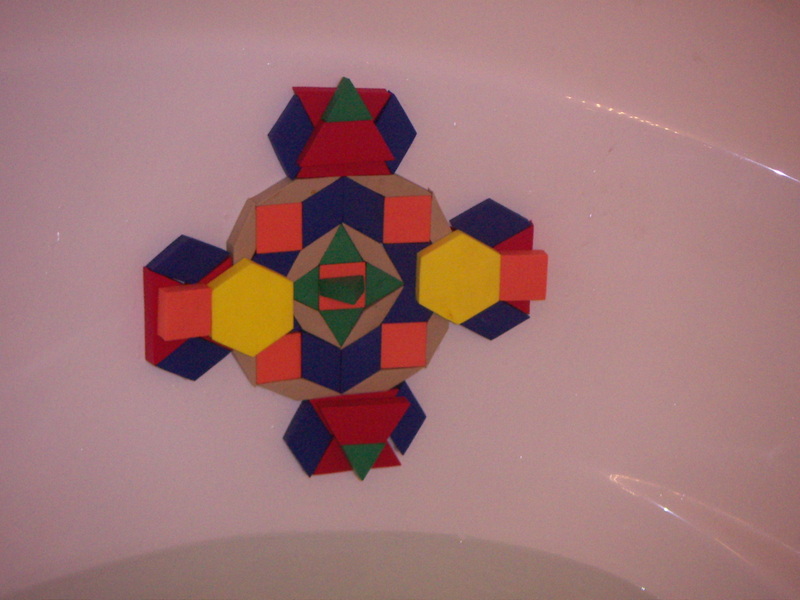
Okay, I know it was kind of geeky to give my kids a set of closed-cell foam pattern blocks for bath toys. But they were really cheap, and… I don’t know what got into me, honestly.
Still, I think it was a good present:
He says it’s "Jesus’s cross."
I never imagined it with the multicolored marquetry, but it speaks to me, somehow.
-
Art imitating upholstery.
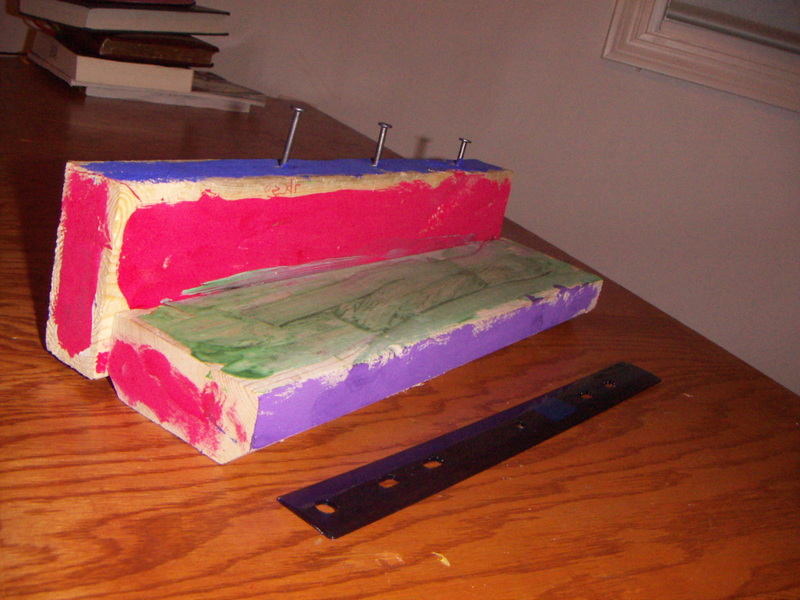
This is our living room futon:
This is a spontaneously produced sculpture of our living room futon:
The three nails represent the three throw pillows, according to the artist.
-
Divine Mercy, complete with eggrolls.
Our parish, it turns out, throws a pretty big bash for the Feast of Divine Mercy. I had no idea.
We’ve only been members for a little over a year, and last year on Divine Mercy Sunday, I was in Salt Lake City for a ski trip (and let me tell you, Salt Lake City is a disconcerting place to be when CNN is in all-Pope-death-watch-all-the-time mode — the biggest news in the local paper was the Latter Day Saints’ General Conference being held that weekend, and on the Feast Day itself, the morning after John Paul II passed away, the front page of the religion section featured President Gordon Hinckley). I went to Mass that morning, including confession for the plenary indulgence, in a tiny neighborhood church. (It was one of those confessions where I take both kids into the confessional with me? You know, because my husband is off skiing? That kind?) The priest, almost apologetic, announced at the end of Mass that the ladies of the church had prepared tea and sandwiches and cake to celebrate his birthday that morning.
Anyway, this year we went to the late morning Mass so that I could stay after for the DM celebration while Mark took the kids home afterwards. It turned out that people showed up from parishes all over, squeezing us to standing-room only — I think it was less crowded at any of the three Triduum services. We were lucky to get two chairs in the back, right next to the door that goes downstairs to the bathrooms. Miraculously, the kids did fine, didn’t block the floor too much.
Afterwards I went downstairs for the box lunch and had the good fortune to find a seat next to Desperate Irish Housewife, whom I will get around to adding to my blogroll one of these days. The lunch featured egg rolls, which were apparently being deep-fried by the thousand in the kitchen by a team of devout Filipinas. The way Father told it, it sounded as if the egg roll idea had been cooked up specifically by them to lure lots of people to the parish for Divine Mercy Sunday, starting a few years before John Paul II officially re-inaugurated it as a major feast day. It sure would have worked on me. Who knew that the way to the Sacred Heart is through my stomach. Or something like that.
The celebrant, also the event guest speaker, was Father Thomas Sullivan of the Congregation of the Fathers of Mercy. On his way up to the podium, he stopped to talk to three sisters wearing the distinctively recognizable sari-style habit of the Missionaries of Charity — you know, Mother Teresa’s religious society — and convinced them to move to the front pew. I think they must have accompanied Fr. Sullivan, as I don’t know of any MoC houses locally.
Anyway, the place was packed. The confessional lines on both sides stretched the length of the aisles, all before and during Fr. Sullivan’s talk. Also the Eucharist was exposed for adoration the whole time. And the Parish’s large painting of the Divine Mercy image was taken out of its alcove and set up in a place of honor. And we had incensing, and blessing of religious articles (I had brought a little medallion bearing the Divine Mercy image, which had been sitting in m dresser drawer ever since I forgot to bring it with me to Salt Lake City last year), and the Divine Mercy chaplet, and a litany of St. Faustina, and a rosary with meditations taken from St. Faustina’s memoir, and finally Benediction. Quite a full day!
I’m glad that last year I happened to choose St. Faustina’s writings as my Lenten reading. Anyone who wants to understand the Divine Mercy devotion would do well to read them, of course, but last year it seemed particularly well-timed — because, of course, Lent and Easter culminated in the passing of her countryman Karol Wojtyla, i.e. John Paul the Great, who had done so much to bring the Feast of Divine Mercy back into the Church year and for whom that day’s anticipatory Mass was the last Mass of his life. I wrote this last year on Palm Sunday:
I thought of how singular it is that Palm Sunday Mass contains both Hosanna and Crucify him, how close together they are, how quickly popular sentiment can change. St Faustina writes in her Diary:
March 21, 1937. Palm Sunday. During Mass, my soul was steeped in the bitterness and suffering of Jesus. Jesus gave me to understand how much he had suffered in that triumphal procession. "Hosanna" was reverberating in Jesus’ heart as an echo of "Crucify."
What reverberates in our hearts?
I was an unchurched kid, a converted adult. It took me a very long time — years — to assimilate a mental picture of a Jesus I could feel that I knew personally, one that didn’t come laden with baggage or treacle. Even that came long after I formed one of God the Father, and even long after I formed one of the Blessed Mother. The mental picture that works for me has turned out to be an interior image of the Divine Mercy. I prefer the older painting, seen here on this page.

Recent Comments
Recent Posts
- Lifelong conversion.
- The conversation.
- “Unprofitable servant”… of God.
- Mardi Gras recipe hack: Bread Machine king cake.
- Minnesota furious.
Categories
…more to come later