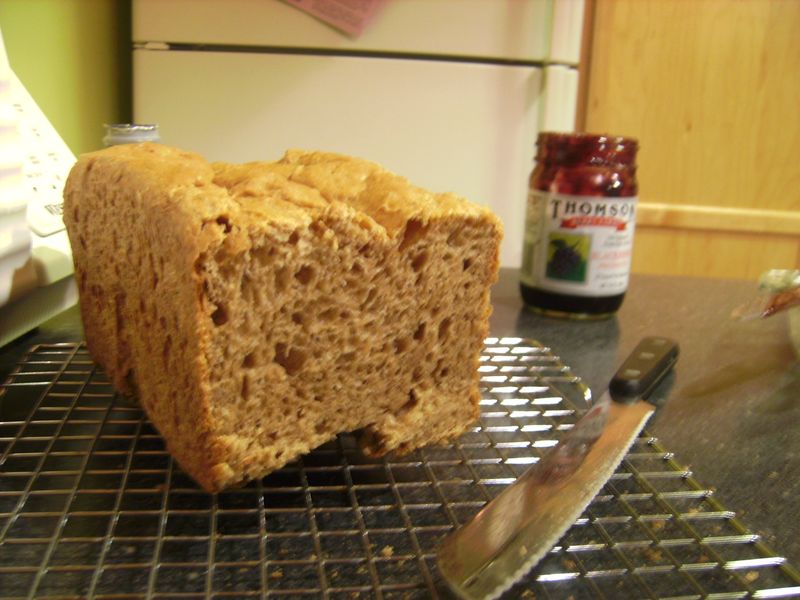
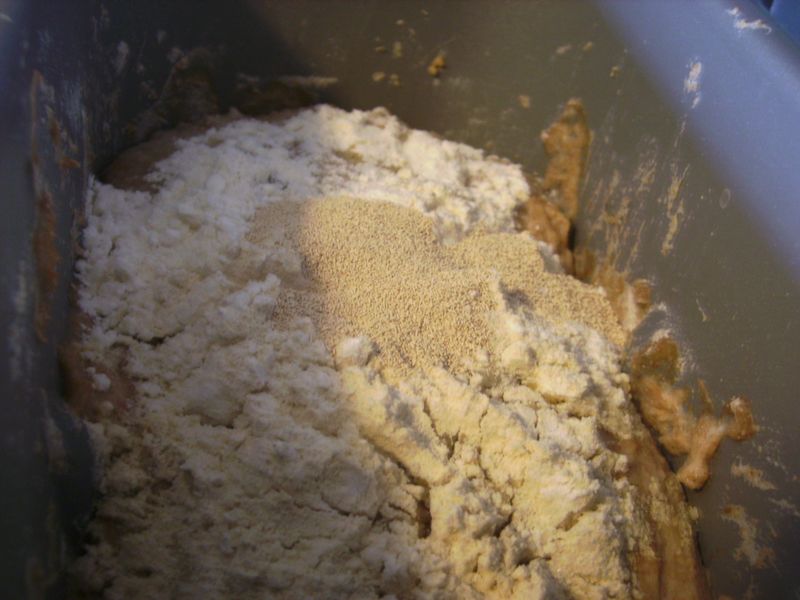
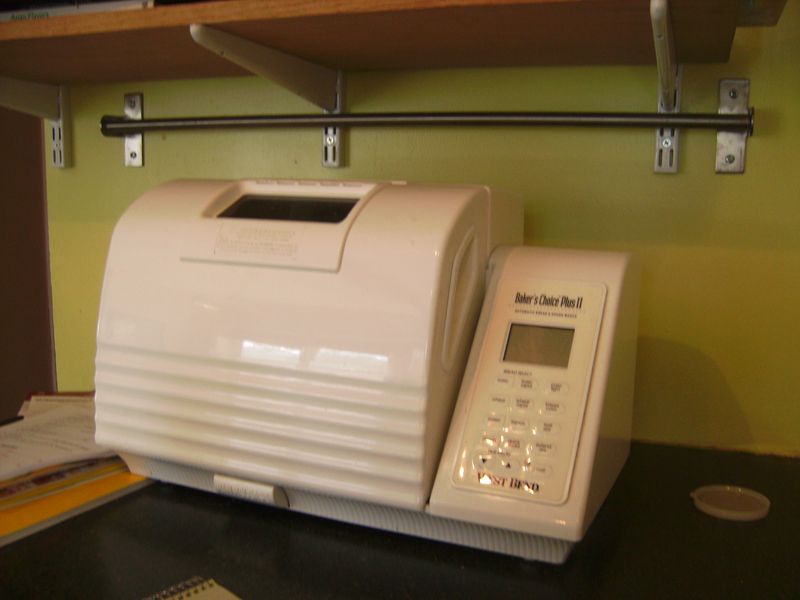
Since protecting the yeast with layers of dry ingredients worked so well in my two previous experiments with soaking flour in the bread machine, I decided to abandon other ideas of protecting the yeast from moisture during the soak.

bear – ing n 1 the manner in which one comports oneself; 2 the act, power, or time of bringing forth offspring or fruit; 3 a machine part in which another part turns [a journal ~]; 4 pl comprehension of one’s position, environment, or situation; 5 the act of moving while supporting the weight of something [the ~ of the cross].
Since protecting the yeast with layers of dry ingredients worked so well in my two previous experiments with soaking flour in the bread machine, I decided to abandon other ideas of protecting the yeast from moisture during the soak.
Worked pretty well, I think:
I decided to stop Experiment #1 early, and baked the bread after about 4 hours of soaking. Here's why:
(Mark, later: "Why didn't you just weigh it to find out if it lost an appreciable amount of water?" Well. Duh. Even though I have two degrees in chemical engineering, I have been cooking for far longer than I have been using laboratory equipment, and I tend to forget to replace my (imaginary) chef's toque with my (imaginary) lab goggles when I need to do any sort of analytical cooking, or cooking analysis. See here for another example.)
See, it occurred to me that the gluten, sugar, and salt don't need to be soaked (in fact it's probably better if they're not mixed in there, and if kept dry, they could add to the total volume of dry ingredients and provide a thicker blanket with which to cover the wet flour mixture.
Believe it or not, I'm getting tired of writing about diet and exercise all the time. I know I've lost a lot of readers since last year (though I've gained more); I never intended for this to become a weight loss blog, and I hope to go back to my previous mix of homemaking, mothering, politics, nerdy stuff, and theology at some point. But I kind of want to finish out the series and make a nice handy index of all those diet and exercise posts.
I have a few ideas for how to do this, and am going to investigate them over the next few loaves of bread.
Idea #1. Protect the yeast from moisture in a pile of dry white flour: Decrease whole wheat flour by 2 tablespoons. Mix the flours, oil, liquid, and sugar in the bread machine. Then put 2 tablespoons of all-purpose flour in a pile on top of the wet mixture. Make a little well in the pile and add the yeast and salt. Question: How long (up to 24 h) will the yeast stay dry?
Idea #2. Protect the yeast from moisture in a capsule of solid fat: Mix the flours, liquid, and sugar in the bread machine. Then make a little "cup" of 2 Tbsp solid coconut oil and add the yeast and salt to the cup. Dig a little well in the wet mixture and place the capsule in the well. Question: How long will the yeast stay dry? Question: Will it still mix, moisten, and rise properly if it's been embedded in a fat phase? (Note: Coconut oil melts at 76 degrees F.)
Idea #3. Protect the yeast from moisture in a pool of liquid fat: Mix the flours, liquid, and sugar in the bread machine. Dig a little well in the wet mixture and add 2 Tbsp vegetable oil. Add the yeast and salt to the oil phase. Question: How long will the yeast stay dry? Question: Will it still mix, moisten, and rise properly if it's been embedded in a fat phase?
Idea #4. Don't bother protecting the yeast, just use less of it: Mix the yeast right into the flours, add the salt to a corner of the pan after mixing the flours (so it won't interfere with the deactivation), and use less yeast so that the bread will rise only very slowly during soaking. Question: What is the empirical function y(T) where y is the optimum quantity of yeast and T is the duration of soaking? Question: What adjustments must be made for ambient temperature over the range 68-90 degrees F?
Idea #5. Pre-presoak: Mix the flours and liquid in a bowl at least 7 hours ahead of time. At a convenient bread-making time, add the soaked flour/liquid mixture and the other ingredients to the bread machine pan. Set the time delay as usual, perhaps protecting the yeast as in Ideas 1-3. Question: Is this more convenient than mixing the flours and liquid in the bread pan?
Idea #6. Forget yeast and learn to make sourdough bread in the machine.
Whole Wheat – Buttermilk Bread (really soured-milk)
3 cups whole wheat flour
1 and 1/2 Tbsp wheat gluten
1 tsp kosher salt
1 and 1/2 Tbsp sugar
2 Tbsp coconut oil
1 and 1/2 cups whole milk, soured with 1 and 1/2 Tbsp white vinegar
1 and 1/2 tsp bread machine yeast
Idea #7: Protect the dough from getting dry and the yeast from getting wet by covering the whole wet layer of dough with a layer of dry white flour, and putting the yeast on top. Question: How thick a layer of dry white flour is necessary? (I want to use as little as possible, because I want the bread to be mostly whole wheat.)
Idea #8: Protect the dough from getting dry with an oil layer. In this scenario I would brush liquid oil on top of the mixed ingredients, and then put the yeast on top of that, protected by a couple tablespoons of dry white flour.
Idea #9: Compensate for the dough drying out by adding more liquid to begin with. Question: How much to add?
(Parts 1 2 3 4 5 6 7 8 9 10 11 12 13 14 15 16 17 and 18)
I wrote before that it's important to keep your workout plan (time slots, activity, route, people-taken-care-of) simple and do-able, especially for a beginner, or for someone who's had trouble with quitting in the past. Too much variety may "spice things up" but it can keep you from seeing measurable improvement from week to week, from developing an identity, or even from evaluating whether your plan is working. And if you start small, saving "doing more" for later, you're much more likely to see yourself following through with your commitments to yourself.
But even though the main plan needs to be simple, it also has to be ready for changes, expected and unexpected. That's what the backup plan and the transition plan are for: to keep your induced exercise from falling through when your circumstances change. If they are to work, they (and you) must be ready before you need them.
The backup plan is what you rely on when your main workout plan becomes temporarily impossible. The pool is closed; it's too hot to safely run outside; you're traveling out of town; your spouse who usually watches the kids for you can't do it today; you have a dentist appointment at the time you usually work out. Your backup plan provides a temporary substitute for your normal exercise plan, to be deployed when your normal plan falls through.
The primary goal of a backup plan is to preserve the habit of "showing up" for exercise. As such, it doesn't have to fit into your "vision" of who you are; it doesn't have to match your usual plan in any way, or supplement it; it doesn't have to give you the same kind of a workout; you don't have to enjoy it very much, as long as you're willing. It is only a secondary goal of a backup plan to maintain your fitness until the normal plan can resume within a few days. So if you have some discretion in designing your backup plan, you can try to have it give you a workout of similar intensity to your normal plan; but your number-one-goal is to have a backup plan that you can deploy successfully on short notice. One you can show up for.
A transition plan is different—and not everyone needs one. Transition plans are necessary when your vision for your induced exercise has "seasons" — traditional climate-based seasons ("I cross-country ski in the winter and bike in the
summer") or life-change-based seasons ("I run and lift weights most of the time, but when I'm pregnant I prefer yoga and swimming") or a season of recovery ("I'm walking right now but when my knees get better I'm going to start running").
The transition plan prepares you for the change in seasons. It helps you make a smooth transition between them so you're not caught off guard with the sudden failure of your workout plan (e.g., all the snow melts overnight and though your skis are still ready to go, your bike is in pieces in the garage!) The primary goal of the transition plan is to maintain your discipline and your athletic identity as you cross from one season to another.
Here is where the four parts of a workout plan — time slot, activity, route, and people-taken-care-of — can really help you: they can be a step-by-step process of designing your backup plan and your transition plan.
Designing the Backup Plan
Since a workout plan has four parts that all need to work together, it's pretty easy to see that your plan will fail if any one of the four parts falls through. So, write your workout plan down on a piece of paper where you can see it all laid out. I find it easiest to make a separate mini-plan for each time slot. My current plan looks like this:
Monday 10:30 a.m-11:45 a.m. Swim 40 min, shower, and change at the YMCA while kids are in Y child care.
Thursday evening. Run 40 minutes on the treadmill at the YMCA while husband makes sure kids get in and out of swim lessons and Y child care.
Saturday morning 7:45-9:45. Meet friends to swim 40 min, at the Y on the other side of town while husband takes kids grocery shopping.
You see that each time slot has an activity, a place, and a plan for the children. You see that I blocked out extra time for the swims to allow for showering and changing. Also, you see that while there is some variety (swim or run? which YMCA?) there is not a lot of variety. My workouts are the same length and always at a YMCA. There is more consistency about it that you can't see from this plan: for one thing, I keep all my gear, toiletries, and clothes, for swimming or for running, always packed together in the same gym bag (along with my YMCA membership card). I don't even have to look in the bag: if I have the bag, I know I am ready for any of my three workouts for the week.
For each of your time slots, write down these questions:
1. What will I do if I can't exercise at this time?
2. What will I do if I can't do my usual activity?
3. What will I do if I can't exercise at this place (or along this route?)
4. What will I do if my arrangements for caring for my people fall through?
Any one of the four pieces might fail. The backup plan is not complete unless it is ready for any of the four failures.
Here are some things to think about as you go about answering the questions:
The backup plan does not have to be only one answer. You might choose one alternative if your time slot fails, or a different alternative if your activity fails. For example, if I have to take the kids to a doctor's appointment at 10:30 on Monday, I might simply go with the kids to the Y in the afternoon instead. If I get an ear infection and am advised not to swim until it clears up, I might substitute running for swimming at 10:30 on Monday.
Changing as few parts of your plan as possible keeps your plan simple and do-able. If I can't swim because of the ear infection, I try to run at the same time and in the same place as I would have had my swim.
A given problem might be interpreted as any one of the four failures. Let's say I arrive at the YMCA at 10:30 on Monday only to find a sign taped up across the pool door announcing that the pool is unexpectedly closed. I might interpret this in several ways:
(a) I can't exercise now. I have to find another time to swim.
(b) I can't exercise here.
(c) I have to do something besides swimming.
I can pick the backup plan that seems easiest in the moment. At ten-thirty on Monday, with the kids already comfortably ensconced in the child care, that's probably to put on my running shoes and hit the treadmill instead of the pool. But in other circumstances (say when Mark was watching the kids at home and I was really looking forward to a swim) I might instead head back out to the car and drive to the next nearest pool. And in yet other circumstances I might have said "Let's go home kids," and rescheduled my workout for the next day. Because I have a backup plan in mind for any of the four failures, I have extra flexibility.
This is what my backup plan looks like:
Time failures: If I can't exercise at 10:30 Monday, I'll exercise at 4:30 and we'll have a late dinner. If I can't exercise Thursday evening, I'll exercise Friday morning before Mark leaves for work. If I can't exercise Saturday morning, I'll exercise Sunday morning.
Activity failures: If ever I can't swim, I'll run instead. If ever I can't run or swim, I'll walk, either on the treadmill or on the track.
Place failures: If I can't exercise at this YMCA, I'll exercise at some other YMCA.
My people-care arrangements fall through: If I can't put my children in the YMCA childcare, I'll have to reschedule my exercise. I'll ask my husband or my friend if they can watch my children while I exercise at a different time.
Notice that in my plan, I interpret "people-care" failures as equivalent to "time" failures. It doesn't have to be that way, though. One mother might keep a yoga video at home just for using when the babysitting falls through, and do that yoga tape at the same time as the "normal" workout. Another parent might decide that when the child care falls through, it's time to hit the playground with the kids, and try to run around with them a little bit… it wouldn't really be enough to count as a weekly workout, but it is a fun way to get everyone moving and more importantly to keep that appointment with yourself. Remember, the crucial feature of a backup plan is that it gives you an alternative that you can show up for.
Using the Backup Plan
Once you have the backup plan designed, you must get everything ready so that you can switch to your backup plan quite literally at a moment's notice. Sometimes you will know a few days in advance that you will have to rely on your backup plan: for example, I usually know ahead of time when my husband is going to be out of town, and have a chance to arrange alternative child care or to reschedule my exercise. Other times, however, you will be "caught out.&quo
t; For me the classic example is arriving at the pool to find it closed for cleaning (translation: some kid pooped in the pool). Another example might be a sudden rainstorm that keeps you from going out for a run, or maybe your power goes out and you can't use your treadmill or your exercise videos. Unexpected failures are not an excuse to skip your workout; instead, build into your backup plan the possibility of unexpected failure. Get ready to switch.
Being ready to change my workout time means that the minute I realize I can't make my usual time slot, I'm on the phone with my husband figuring out when he can watch the kids so that I can make it up. Being ready to change my workout place means that I always have my YMCA member card, so that I can be admitted to any YMCA in the city (or indeed in the country). Being ready to change my workout activity means that I keep my gym bag packed, always, with everything I need to swim OR to run. (That in turn means that I have two complete sets of running clothes and two lap suits, one in the laundry and one in the bag).
I'll save the detailed discussion of the transition plan for the next post.

(Parts 1 2 3 4 5 6 7 8 9 10 11 12 13 14 15 and 16 and 17)
Drawn from comment box, email, and my own life. The first one is my beginner's plan:
Plan #1: "I'm a swimmer, an individual athlete."
Swim Monday evenings at the YMCA for 40 min while husband watches the kids.
Swim Thursday evenings at the YMCA for 40 minutes while kids are in lessons and husband watches the baby.
Later, the "baby" became comfortable in the YMCA child care and that became:
Swim Monday mornings at the YMCA for 40 minutes while the kids stay in the child care (and the oldest does his schoolwork.)
Swim Thursday evenings at the YMCA for 40 minutes while husband shuttles kids back and forth between lessons and child care, and squeezes his own lifting sessions in between.
Here's another plan:
Plan #2. "I'm a runner, working on the basic fundamentals."
Block off the time every weekday, and exercise at the local Y three or four days a week, from 11:45 to 1, while the kids are in the YMCA child care.
This is a good plan once your kids are comfortable staying in the child care. (It doesn't happen immediately upon signing up for a gym membership.) I have suggested that a beginner plan a firm two days a week; but it also can work to block off the same block of time every day and then each week decide which two or three days you're going to do it. The important thing is that you're keeping that consistent minimum.
Plan #3. "I'm a runner, staying fit off-season (during pregnancy)."
Walk every fair weekday three miles through the neighborhood with two toddlers in the jogging stroller.
Very nice! Walking through the neighborhood, even with the kids in the stroller, is a good "easy on, easy off" activity, as long as you keep the stroller and shoes handy. Because of this it's an ideal activity for attempting to do every day, even beginning at five minutes and working you way up to distances measured in miles.
By the way, when you begin an activity that requires your kids to behave a certain way (stay strapped into a stroller or play quietly in their room), working your way gradually from five minutes to longer periods might be m
ore important for them than it is for you. If you decide your solution is, for example, to train your children to play in their rooms while you walk on your treadmill for 30 minutes, you might well have to begin by training the children to play in their rooms every day for 5 minutes (set a timer) and then gradually lengthen the time. Even if you can walk for more than 5 minutes, it may take some work on your part to be able to focus on walking for more than 5 minutes.
I haven't actually tried this. Maybe it won't work. Just throwing it out there.
Plan #4. "I'm a runner."
Run two days a week, plus one weekend day, through the neighborhood, while husband watches the kids.
Sounds fun… and sounds like a great opportunity to focus.
Plan #5. "I'm an individual athlete who does strength training."
Follow the program in The New Rules of Lifting for Women at home with home equipment:
Tuesday afternoons, Thursday afternoons, or both, while the baby naps and the older children watch a video.
One weekend day, taking turns watching the children with husband.
This athlete comments that the nap/video arrangement is reaching its limit. I learned while I was in grad school that it is incredibly frustrating to count on The Nap as a reliable source of free time. You just can't control when The Nap starts or stops, or whether it happens at all, and sooner or later they start to grow out of them. Yes, certainly, before The Nap disappears, find some other way of carving out the time.
Plan #6. "I am a runner."
Run 4 miles, 3 to 5 times a week, at 6:30 am while husband is still home with the children.
Recently added swimming, in the same time block, 1-2 times a week at the rec center of the local college.
Plan to swim in the "off season" of pregnancy.
What I really love about this plan, what this person has done that is really, really, really smart, is that she is starting NOW (even though she is still in the season of running) to practice her "off-season" conditioning sport of swimming. She knows she won't be able to run much during mid-to-late pregnancy, and so she's starting now to develop the alternative routine that will carry her through that time. Which brings me to this example:
(Partially Successful) Plan #7. "I am a cyclist."
Bike in the neighborhood, a few evenings a week, while husband is home with the children, after dinner. When winter comes, switch to walking through the neighborhood.
This is a friend of mine who successfully bicycled like this all last summer. Her plan fell through, though, when winter came. She stopped biking and somehow didn't start walking. She has told me that she thought perhaps the problem was that she never tried going for walks in the summer as an occasional alternative to cycling. Maybe if she had done that, it would have been a smoother transition from biking most of the time to walking most of the time.
Plan #8. "I am a runner, in rehabilitation."
Exercise at the Y three times a week: using the elliptical trainer while husband or friend watches the children. If that's not possible, walk on the track with the baby while the older children stay in the child care.
What's so great about this plan is that it has a "backup plan" built right into it. More on backup plans later.
Now here's a plan from the combox that didn't work:
Failed plan: Meet a friend at the Y, three times a week, to do "nautilus machines, maybe treadmill, and occasionally an aerobics class." While the kids were in childcare. Plus toddler gymnastics afterward. Stopped because it took "all morning three times a week." I never got to the place where I loved the activity or had an identity in it…where my body missed the workout when I missed one."
I hope Tabitha can write a little more about why she thinks this plan failed for her. A couple of things stand out:
First, could it have been more about socializing with her friend than about getting exercise? There's nothing at all wrong with that, and lots of people do very well when they exercise with other people; but if the activity "felt" more about getting together with a buddy than about taking care of yourself, it might have gotten in the way of developing an identity as an athlete. It seems that it would help in developing the identity of the friendship as "we're the kind of friends who meet at the gym." But not necessarily in developing your own personal identity. The other thing is that if you are with a friend, you may not be able to focus on the activity — to generate psychological "flow." The activity can be an annoying thing that makes you huff and puff too much to carry on a conversation.
Second, were they trying to do too much? If it really took all morning, it was probably unrealistic to expect you could keep that up as a lifestyle change.
Third, were they trying for too much variety? If you do nautilus sometimes, and aerobics sometimes, and treadmill other times, maybe you don't have a chance to improve and to set goals at any one of them.
Next up: Backup plans and transition plans.
(Parts 1 2 3 4 5 6 7 8 9 10 11 12 13 14 15 and 16)
Readers who are still with me most of the way through what is turning into a very lengthy series: Help me out. I need some material to work with.
Got any exercise plans? Ones you hope to do, are thinking of doing, are already doing?
Let's see if we can't get it into the TARP (or whatever) format that I described in this post, and append to it some thoughts about athletic identity and attitude.
So… in the exercise plan or plans that you are considering, that you would like to do if you could just figure it out, or are already doing….
(1) What's your athletic identity?
a. "I'm an individual athlete"
b. "I play a sport"
c. "I'm working on the very basic fundamentals" e.g. walking to become a runner
d. "I'm rehabilitating myself"
e. "I'm cross-training—I do several different things"
f. "I'm staying fit in the off-season, so to speak"
(2) What's your sport? What's the activity that defines what you are or what you hope to become? Running, swimming, dancing… (It's not necessarily what you actually do to exercise each week. My husband would tell you he's a skier, not a runner; he runs all year to stay fit for 6-10 days of skiing.)
(3) What are your time slots (in your plan, whether it's active or only thought of)?
(4) What activity?
(5) Where?
(6) What arrangements have you made, or might you make, for people in your care during the workout?
****
My example is my Winter '08, brand-new exercise plan:
I wanted to become a swimmer, an "individual athlete." I planned two workouts per week, Monday and Thursday, for forty minutes. Swimming both times. I went to the local YMCA, where we have a family membership. On Monday nights, I left the children with my husband Mark. On Th
ursday nights, the family went to the gym together, and Mark would stay with the baby (who wouldn't stay by herself) in the child care center while I swam. (He'd get his turn to exercise after I was done.)
****
So, those of you who do get regular exercise, tell us how. Or if you had a plan that worked great in the past, especially a beginner plan, describe it. Those of you who have a plan only in mind, throw it out there for us to hear. I really want to hear from as many readers as I can on this one, because I want to use the results as a jumping-off point to write about making backup plans.
One of the perils of reading too many blogs by homeschoolers is that we often write about our best ideas and our best days. Too much of that, and you can easily start to feel as if everybody is doing a better job than you are.
(Parts 1 2 3 4 5 6 7 8 9 10 11 12 13 and 14)
Even though we have picked up on some other threads that need to be covered — psychological "flow," and feeling like an athlete when you mostly need to use exercise tapes or books at home — I have to finish out the Big Four parts of an exercise plan.
I have already made recommendations about two of these:
The other two are route—the place or path where you exercise—and people—making sure that the people you're responsible for are taken care of during your time. For these I am not going to recommend, so much as I am going to try to suggest some ideas and principles.
Let's talk about place and path. What might those be?
Outside, beginning and ending at your front door. Around the neighborhood, around the block, in your own yard. Outside there is weather; weather can be worked around, or met head on. How will you feel when it is wet, cold, or slippery? How will you feel when it is hot and sunny? Is your neighborhood safe by day? By night?
Outside, beginning and ending at some other door. The neighborhood where your children take piano lessons for an hour each week, or the park right next to the grocery store. The track behind the school. The little wooded nature center that offers classes for kids. The area around your best friend's home, or your kids' grandparents' house. Where do you go every day, week, or month? What outdoor places can be found nearby?
Outside, beginning and ending at your car door. Around (or in!) a lake, along a hilly trail, up and down some long set of stairs you've driven by countless times but never climbed; over the snow, or through the puddles; around the walking or running track; near the play structure at the park. In some other neighborhood that's safer or pleasant than yours. A big open field, with room for everyone to run as fast as they can, where everyone can be seen. Where could you drive a couple of times a week? Where could you stop on the way home?
Outside, going from one place to another. The trip to the grocery store, to the local coffee shop. The way to your best friend's house, the way to work, the way home. From church to your friend's house, from the store to work. Too far? What if you drive partway and leave your car behind? What will you need to carry? How will you carry it? If you have no path you could create one: Take a bus a few blocks away, come back under your own power. Every week you could ride a little farther.
Inside, in your own house. The bedroom, the family room, the basement, the attic. Behind a locked door or no door at all. Up and down the flights of stairs. Before the TV or the computer or the Wii. There may be a place to use equipment; a place for heavy things to lift and move, maybe a machine of some kind. Maybe the equipment is already there? Are you using it already? What's getting in your way? What do you see while you're deciding whether to exercise, while you're exercising? Is it a pile of laundry to sort or some other work to do? Should you go somewhere else or should the laundry go somewhere else? Are you energized and renewed from being at home, or from leaving it? Is it a lot of trouble to leave, or a lot of fun? Is your home a private place, a refuge, a place of safety, a place where you feel confident? Or is it a place where it's difficult to do anything different?
Inside, in someone else's house. Has your best friend got a treadmill, or a flight of stairs, a place to use your exercise tapes, or a big back yard? A set of weights in a comfortable basement, and a teakettle upstairs whistling your reward when you're done? Somewhere homey and friendly, private and safe, but… where the piles of laundry and dishes are not calling out to YOU?
Inside, in a public place. A mall in the early-morning hours; a local community gym, a couple of bucks to use the place. Are there open gyms in your town? Municipal recreation centers? Indoor parks? Field houses? Networks of tunnels or skywalks? Schools or churches with gyms and classrooms for public use? Have you checked the local parks and recreation departments? How about community education? Maybe even the local senior center? All may offer free or low-cost access to public areas for exercise. Visit the different possibilities in your community. Consider the cost of daily use fees and parking, and figure out the cost to you per workout, per month, per year.
Inside, in a private gym. What is there in your town? For-profit, full service gyms? For-profit, no-frills storefront gyms? Does your city have a partnership with any private gyms offering low-cost passes for city residents? How about nonprofits like the YMCA and YWCA? Places to get to know the staff, to take classes, to meet other people? Or a place to go by yourself, shutting out the world with headphones or with swim cap and goggles. Is this a place to find a new entry ritual, changing from one uniform, one persona, to another? Is it a place with good hot showers and friendly staff in the child care? Does it cost too much? Run the numbers: Might you qualify for low-income discounts, or for reimbursement to your health insurance company? Can you pay for daily use or month-to-month, using a gym only part of the year? Are classes offered to non-members for a fee, and can you use the child care if you sign up? Conversely, can nonmembers use the facility while their children are in a paid class? Most of these offer a free tour or guest pass for prospective members. Even if you think you can't afford it, consider paying visits to the possible sites. See what sort of scenarios you can construct, and how much they cost: per workout, per month, per year.
What places could you go? Visit them all, and see what ideas they spark.
Commenter "4ddintx" had a good comment on the post about choosing activities to form a self-image as an athlete:
Just had a thought this morning that being a dancer is another identity that someone may have in terms of their fitness. Not usually what I think of under the category of "athlete" but definitely in the same vein.
What a great point! The point is to cultivate a self-image that inherently implies regular physical exertion and training. "Athlete" is the one that I've worked to develop in myself; "dancer" is another. I suppose some dancers think of themselves as athletes first and performers second!
Really, any descriptor that appeals to you will do, as long as it implies the need for physical training and fitness to keep up the skill, and as long as the activity you choose makes sense within that context. Can we come up with more? Gymnast? Circus artist? I can't think of a concise noun for it, but an image of someone who is capable of fairly hard physical labor might also be helpful — think of how fit you'd have to be if you worked, say, as a landscaper.
Are you a parent, homeschooling or otherwise, or another sort of mentor? How about cultivating a self-image as a trainer, coach, fitness instructor? I'm just throwing it out there. Does your work, paid or not, make you a role model? (Health care professional? Educator?) How about internalizing that and turning it into "I am a person who sets a good example by getting regular exercise?"
There's room for a lot of creativity here, and you may even think of a completely original self-image. Reinhard Engels (he of the No-S Diet and other everyday systems) came up with an excellent one for, well, walking wherever you have to go: he calls it the Urban Ranger. The image is borrowed from Lord of the Rings:
Remember Strider, in Lord of the Rings? They didn't call him Sneaker or Sprinter or Sworder, though he possessed these skills in abundance. His distinctive quality, the important, even lethal skill, for which he was named, was that of walking rapidly and mindfully over great distances. Not only could he thus outpace his enemies, but he came to outknow them.
A lethal skill? Well, you say, that's fantasy. OK, skeptic, how did the army of Alexander the Great get to India? They walked. How about the Grande Armee of Napoleon, how did they get all the way from Paris to Moscow? Not on the concorde. For thousands of years winning a war was largely a matter of being there before your enemy. Forced marches routinely left a great deal more than every tenth man dead from exhaustion. So get the aqua sweatpants out of your mind, this is man stuff!
See what I mean? Reinhard totally made that up, but it's a fantastic reimagining of the self, no? (At least for anyone who doesn't have kids between ages 3 and 11).
What else can you think of? Who else can you be?
ADDED: I happened upon the blog of Deb, a Search and Rescue volunteer, who happened to mention:
Well, it's time to trade my pajamas for spandex and a cotton tee and head to Jazzercise. I'm still trying to lose some pounds off of me and up my fitness level in preparation for that "3 miles in 45 minutes with a 45-pound pack" test for the Technical Rescue Team.
Add "technical rescue team" to the list of helpfully motivating self-images. If it's your volunteer calling, or job, to save other people's butts, it helps if yours gets off the couch now and then.

Recent Comments
Recent Posts
Categories
…more to come later