
bearing blog


bear – ing n 1  the manner in which one comports oneself;  2  the act, power, or time of bringing forth offspring or fruit; 3 a machine part in which another part turns [a journal ~];  pl comprehension of one’s position, environment, or situation;   5  the act of moving while supporting the weight of something [the ~ of the cross].


  • Flow? A side note to induced exercise.

    This is just a short note from the road, to be filled in later.

    Mark was skeptical about my definition of an athlete, pointing out that high school athletes (he's been one, I haven't) aren't exactly characterized as long term thinkers, and also that many athletes are willing to risk permanent injury to make the big play (not exactly health conscious.)  He said, "I think what you want is to tell your readers that they deserve to experience flow, and that this will help them be motivated to keep up their physical fitness.  And you're trying to use the concept of being an athlete as a proxy for experiencing flow through fitness activities."

    What's "flow?"  I know what he means, because we've both read the same book. "Flow" is a psychological concept described by Mihaly Czikszentmihalyi in a book by the same name.   There's a wikipedia article on flow here.

    I think Mark is right on, and I'll write more about flow later when I've had a chance to review Czikszentmihalyi's book, which I own but don't have with me.  IIRC there's a chapter on athleticism and flow.  In the meantime, see the wiki article and see if you don't see what he means.  Gotta go.

    I'll follow up on this, though I still have to cover the remaining parts of TARP: choosing a route or location, and making sure your people are taken care of.


  • The athlete’s attitude: Induced exercise, part 14.

    and 13)

    In the last post, I urged you to take up at least one activity that will help you claim the title "athlete."  Commenter Mary asked rhetorically, "If I just do exercise videos, what kind of athlete would that be?"

    A reasonable question.   It's hard to feel like an athlete if you're "just" doing exercise tapes at home… all the more reason I encourage people to try to find ways to add activities that seem "real athlete stuff."  It's worth a great deal of sacrifice, at least for a short time period, to remake your self-image in that way.

    When I began to exercise, I took up swimming precisely because it engendered feelings of "being an athlete" in me:  I could measure my time in a 50-yard sprint, or see how many yards I could swim in 40 minutes, or how many breaths I had to take in one lap, and so I could easily measure my improvement from week to week.  And I could read articles about swimming, by competitive swimmers and swim coaches both amateur and professional.  I felt very soon that I was a member of a group, even though I don't belong to a team or anything like that; that I could call myself "a swimmer."  And as I put in time at the pool and got to know the lifeguards by name, recognize other regular swimmers at the Y, I began to feel even more part of a group.  This redefining of myself from basically sedentary, to athlete, gave me a huge confidence boost.

    But many people have constraints, and have to deal with them.  If you can't run, swim, or bike, can you still have an athlete's attitude toward your sport?

    Here are five different athlete's attitudes.  One may fit you.

    1.  You're an individual athlete.
    2.  You play a sport.
    3.  You're working on the fundamentals.
    4.  You're in rehabilitation.
    5.  You're a cross trainer.

    Who fits each profile?

    1.  You're an individual athlete.  Some activities are tailor-made to develop this attitude:

    running
    swimming
    rock and ice climbing
    cross-country and downhill skiing
    weightlifting
    cycling
    mixed competitions like triathlons
    kayaking, canoeing, and rowing

    Let's check this against the list of characteristics of an athlete I developed in the last post:   Their enthusiasts claim an identity, e.g.,  "I am a runner."  They are specializations.  Performance goals are easy to set, as are levels of ability.   Lots of books and articles are available for enthusiasts, as well as personal trainers, coaches, and other experts.  Self-care is necessary, and in seasonal activities, such athletes can look to the sport for motivation to train year round.   Depending on where you live, you may be able to sign up for competitions, community outings, and races that give you a medium-term training goal.  Yup:  athletes.

    2.  You play a sport.  Sports you play with other people, as in a club, with a regular partner, or in an amateur league, can also turn you into an athlete:

    basketball
    softball
    volleyball
    soccer
    tennis
    racquetball
    squash
    Ultimate Disc
    broomball
    golf (carry your own clubs)

    You have to stay in shape in order to keep up!  Just as with seasonal activities, even if you meet to play your sport less than twice a week or only part of the year, you can work on your game in your other weekly exercise sessions.  Targeted strength training, balance work, cardio, or skill drills on "workout days" can be motivated by the upcoming "play day."

    * * *

    After you set aside all the obvious sports, there's a whole series of activities that may not exactly connote "athletics" in and of themselves… but which you might regard as a stepping stone to more athletic activities.  One example is moderate walking. 

    Now, taking a moderate walk is recommended for just about everyone, because it's a basic human skill; almost everyone can do it at least some, and if you can't do it much then you stand to benefit a lot from getting better at it.  It's especially good for people who are very movement-impaired or whose joints can't handle much impact.  But let's be real here—it's hard to feel like an athlete when you're just walking around the block.  What to do?  Depending on your reasons for choosing such a gentle activity, there are at least two good ways of looking at these, which brings us to attitudes number 3 and 4.

    3.  You're developing the fundamentals.  Beginning athletes need attitude too, even when they are working on developing the basic, basic skills, the pre-fundamentals, of a "real" sport.  If you have some hope of improvement—and most of us do—then walking is not "just" walking, but is a fundamental skill that must be mastered before you are fit enough to go on to something else.  You have to walk before you can run—or hike on hills, or race-walk, or carry your golf clubs.  Set your sights on the activity that you have some realistic hope of someday engaging in.  Walk there.  Set performance goals along the way.  And practice those markers of being an athlete that I alluded to in the last post.

    4.  You're in rehabilitation.  Physical therapy and rehabilitation is something that athletes have to do when they are recovering from injury or illness.  Has a football player ceased to be an athlete just because he's recovering from knee surgery and is only up to walking on the treadmill?  The athlete's attitude says that this too-wussy-to-count-as-a-sport stuff is a kind of physical therapy prescribed to correct your particular injuries, weaknesses, and debilitations.  Yes, even if the debilitations come from years of sedentary living.   You may say you've always been this way, but that's not really true, is it?   Imagine you're under doctor's orders (maybe it's not your imagination) to undergo gentle activity as a sort of "sports therapy" to improve your fitness.  What will you take on when you are fit enough? Running, hiking, walking to the grocery store?  Imagine yourself getting better and better, stronger and fitter and faster.  What will you do then?  Instead of setting performance goals—since you're in therapy—look just ahead for the next milestone in health and fitness.   How's your blood pressure doing?  What about your resting heart rate? How many steps can you climb before getting out of breath? 

    I mentioned walking above.  Other "stepping stones to sport" or physical therapy regimens:

    • water exercise classes taken with an eye towards land exercise classes,

    • strength training classes taken with an eye toward gaining confidence to try the free weights,

    • winter snowshoeing taken with an eye toward learning to cross-country ski,

    • swimming lessons

    • very gentle weight-bearing exercises and stretching exercises

    • actual physical therapy

    Now, what about activities that are intended to improve body function, but don't qualify as sports because they lack any element of competition or, well, pressure?  Yoga, Pilates, and other stretching or balance disciplines are obvious examples.  One doesn't compete in yoga, not against others and not even really against oneself.  Instead, yoga is a method of improving your general balance, strength, flexibility, and breathing, possibly also for relaxation or meditation.  Another such activity might be following along with aerobics tapes at home, or playing with the Wii Fit.  Again, there's not really a competition here, you use the tapes as a method or a tool to get your heart rate up.  How to develop the athlete's attitude?

    Alone, these activities are less like athleticism than they are like, well, medicine.  You "take" them because you want them to do something to your body.  It may be that the medicine tastes pretty good!  Maybe you really enjoy yoga classes because they're so relaxing and they get you out of the house.  Maybe the Wii Fit is really fun and addictive.  Fantastic!  Maybe you don't need to think of yourself as an athlete at all because you have these activities that you really enjoy and that you stick with with not much trouble.

    And of course, you can also think of them as stepping stones towards an activity you expect to be able to do in the future, or as physical therapy to correct problems you have that stand in the way of more active endeavors.

    But.  If you do want to think of yourself as an athlete, I suspect that all these activities are best used in combination with something else—however infrequently—that DOES turn on the "I'm an athlete" pathways in your brain.  Then you can regard the different physical activities in combination as a sort of training program that turns you into an athlete, precisely because each activity supports your development of the skills in the other.  This attitude can work really well if you can only swing part of your schedule towards an athletic endeavor, and you find you have to make up the difference with something like an exercise tape.   All is not lost if you can only schedule one run per week, or even one run per month!

    For example:  You might find that your schedule supports one weekly run and one yoga class.  The yoga improves your balance and your breathing, which helps you run better.  The running increases your lung capacity, which helps you hold yoga poses.   Or perhaps you can manage to schedule one swimming workout and one appointment with an aerobics tape.  Swimming is a whole-body workout that incorporates some resistance and some cardio; adding aerobics helps keep bones strong in a way that swimming, a non-weight-bearing exercise, can't.

    In other words, you're not just cobbling together a bunch of unrelated activities as time allows….
      5.  You're cross-training!   If you are consistent in your efforts from week to week, and especially if you pay attention to the ways that the different activities support and complement each other, you will find it much easier to create an identity as an athlete.

    Some final notes.

    1.  Let's step outside the realm of "induced exercise" for a minute and acknowledge that there are fun or useful everyday activities that work together with your induced exercise to develop your overall fitness.  Maybe you love taking family hikes on weekends, maybe you like turning up the music and cleaning the house at a frenetic pace, maybe you've discovered an open field near your house where you and all your kids can chase the dog for twenty minutes every fair afternoon, maybe you walk to the grocery store twice a week.  Once you have established  a good, solid, predictable plan for induced exercise, you can draw these activities in and begin to think of them as part of the whole fitness package.  The key is to see them as part of the whole, and to recognize that your induced exercise makes you stronger and fitter and faster for those activities, and also to see that because you engage in those fun or useful extras, you'll have a more well-rounded fitness plan.  The weights you lifted on Saturday helped you carry the groceries more easily on Tuesday.  The dog-chasing on Wednesday helped you sprint faster on the treadmill on Friday.  That's how it all comes together.

    2.  Beware of activities that feel like a chore or seem pointless.  If you can't see obvious benefits—weight loss does not count—to the activity or sport; if it feels like a drag even after you have dutifully worked at it for a few months; if you are not getting a sense of accomplishment from the improvements you have made (or if you cannot see any improvement); AND if you cannot see how this activity could prepare you for some other thing you'd like to take up, either in the change of seasons or when your skills develop… then maybe you need to do something else. 

    3.  Even though I started this post with a hopeful note for them, and even though I think reforming your attitude will probably help, I admit to worrying about people who rely entirely on exercises done at home from a book or a videotape.  It is hard for me to imagine developing a sense of athleticism through such activities in the same way that swimming and running has changed my view of myself.  It is also hard for me to imagine that one doesn't get bored with such a routine.  But maybe those of you who have stuck to home-based exercise programs can tell me more about what they've done for you.  Can  you feel real improvement, stay motivated, and feel like an athlete while using mostly book- or videotape-led exercises at home?  Do you think you can apply the athlete's attitude to your activity and transform it into something life-changing?  Tell me what you think.

  • Small thankfulness for the day.

    I was reflecting on the gifts we've received as a family, and about how many blessings have come to us, we believe, as fruits of our decisions to live the Church's teachings on marriage and family life.   

    It came to me that one of the greatest gifts we have both received is the gift of having become thoroughly, personally, and completely convinced of the truth of those teachings.  Being totally convinced (for example) of the rightness of rejecting contraception, of embracing NFP even though it's sometimes confusing and sometimes demands a lot of abstinence—well, being totally convinced that it's right makes it, well, not actually all that difficult to live by it, even during the tougher times like postpartum return of fertility.   I'm not saying that it's never annoying.  I'm just saying that it's almost impossible for us to imagine choosing to go against the Church's rules on the subject.  We're convinced.

    And it occurred to me that this is something to be thankful for.  Because not everybody is convinced, obviously.  We NFP backers often write as if all the world needs is better catechesis, and as soon as everyone understands why the Church teaches what she does, everyone will see the wisdom in it and the problem of widespread contraception (at least among Catholics) will go away.  But this is pretty naive, and it also puts all the onus on people's power of logic and persuasion; it doesn't leave room for God to work in people's hearts.   Don't you know people who were very well catechized, but make other choices because they could not be personally convinced? 

    It struck me that complete personal conversion of the intellect is a gift of grace, sort of like consolation in prayer.  Some people receive it, and some people don't.  Many of the greatest saints have gone through long dry periods of prayer without consolation.  

    When we realize that personal conversion of the intellect is a gift, we can admire all the more the many people who keep the Church's teachings out of pure obedience, despite being unconvinced; despite struggling to understand why such a thing is necessary, and never coming to a satisfactory answer.  In my online writings and discussions with NFP and FAM users, I have encountered more than a few who are willing to come right out and say, "If the Church changed its teaching on this, we'd do something different immediately.  We only put up with the ban on contraception because it's required."  I think that's got to be a lot more difficult, and so more admirable, than obeying because/and, because we're supposed to and because we are convinced that it's right and good and best.

    So.  Thankfulness for the gift of intellectual certainty, without which many of us would surely fall away.  And compassion and prayers for those who struggle with honest uncertainty, for whom being taught all the "right" answers isn't enough.   


  • My own personal madeleines, or… maybe there is a time and place for excess.

    When I was a child, my mother would take us on Saturday mornings to a tiny little pretzel bakery on Xenia Avenue in Dayton, Ohio — just about every Saturday that we remembered to do it in time to get there before they closed at 1 p.m.  If we were especially lucky, we would arrive just as the hot soft pretzels were coming out of the oven, their steamy, bready smell filling the building no larger than a single-wide trailer.  “Extra salty ones,” Mom would request, and the bakers would pick over the pile cooling in the bin to find the ones that were totally encrusted in crystals of salt.  We would get a dozen and a half in a paper bag, an armload for a little girl, the bag almost too hot to touch, and grab a handful of mustard packets from the basket on the counter.  We’d sit in the front seat of the car and we’d each eat three or four pretzels, burning our fingers and mouths, before taking the rest home — to be finished by the end of the day, because the fresh homemade pretzels would be break-your-teeth hard by morning.  No preservatives or dough conditioners here.

    To this day, no butter-soaked mall pretzel will ever compare to the taste of plain salt and dough, slightly bitter from the mild alkaline bath that seals the surface and helps the salt stick.  No SuperMegaJumboBallpark pretzel will ever be as satisfying as those hand-sized, golden-yellow twists.  The closest I have come to the right flavor and texture is the top half of a salt bagel from Bruegger’s.  Nope, Smales Pretzel Bakery near the corner of Xenia and Wayne is the standard by which all pretzels will forever be judged.

    So yesterday I was in Dayton, and I took my kids to the pretzel bakery.  A baker (the same guy I remember from my childhood, I think) gave the kids lumps of dough and showed them how to twist them into pretzels, while I paid for my pretzels.  They were still a little warm.  And we sat in the car and wolfed them down.  I ate three, right there, with mustard from the little packets.  Over the next hour I ate three more.  “Grandma Susan used to take me here when I was a little girl,” I told the kids.  They nodded at me, their mouths full of pretzel.  I was pregnant with Milo when my mother passed away; but they know her as Grandma Susan anyway.

    What about gluttony and the pretzels?

    In the years since I moved away from Dayton, I’ve been back to the pretzel bakery five or six times.  Each time I have eaten several pretzels in the front seat of my car.  And each time the memories that the flavor brought back were mixed with guilt at having eaten so much.  A guilt I never felt when I was sitting with Mom in her car on Saturday mornings, exclaiming about our good luck at arriving just when the pretzels were coming out of the oven, or digging through the paper bag looking for the very saltiest one (for mom) or the one that was just the slightest bit burned (for me).

    Yesterday I ate three pretzels one after another and discovered that the guilt was gone.

    Even though I wrote only a few days ago about the dangers of binge-like inhaling-instead-of-eating… I think I have to temper my remarks a little bit.  There is a place for “the feast,” for celebration of plenty.  There is a place for having something that is so good that you want to eat a lot of it, and for eating a lot of it.  The thing is, part of my good memories about the bags of hot soft pretzels… inseparable from the experience… was the fact of eating three at once in the front seat of the car, there in the gravel parking lot, next to my mom, and all of us sharing that experience.  That is what the memory is made of.  I can just hear how Mom would have reacted if my teenage self had said, “No pretzels for me… they’re full of calories,” or “I’ll stay home, because I just know if you buy a whole bag of hot pretzels, I’ll eat way too many.”  I can’t imagine ever declining a trip to the pretzel bakery.  Sitting in the car and inhaling fresh hot salty pretzels was one of the few loves that Mom and I ever had in common. 

    Yesterday I ate a half-dozen pretzels because eating a half-dozen pretzels is, well, the tradition I shared with my mom.  She’s not here anymore and the pretzels still are; I can take my kids there and give them a little bit of what my mother gave me.

    I am sure that many diet writers would tell me this is an unhealthy thing to do.  That I am trying to recapture a relationship through food, and that the food can never fill the hole that is missing.  And that I ought to be satisfied with a reasonable portion:  half a pretzel, or just one.  But I don’t think that’s quite correct. 

    I have no guilt about it anymore because now I know in my bones that I can compensate.  I am free from guilt because those six pretzels (that’s how many I ate yesterday all together) weren’t added on top of my normal or normally excessive eating.  Knowing where I was going, I had only a boiled egg and some fruit for breakfast that morning.  Those six pretzels (and a vanilla Coke from Frisch’s; I’m loading up on nostalgic food while I’m in Ohio) were my lunch.  Even as I ate them, I knew I wasn’t going to want anything more than a big green salad and some protein for dinner, and indeed that’s what I ate.  No, it wasn’t a really well balanced day, not in terms of nutrients, but… it was not a gluttonous day.  It was instead a rare, very rare, treat, tempered  by light eating in the hours before and after.  So much less dangerous than it used to be, because now I know how to make room for it.

    In the end, I believe, we have to give ourselves permission to feed our memories and hearts from time to time.  Careful though:  It’s a good idea to steer clear of this kind of thing while you’re still learning how to compensate, because if you haven’t developed the necessary skills, it’s true, you can derail your confidence.  Such an experience can wait a few months until you’ve really learned how to absorb the impact:  Don’t try it before you are sure you are ready.  And even after you’ve learned how to compensate, you’ve got to  save such “treats” for the ones that are really important.  Because you can’t feed your body like this every day.  But… there can be room for those rare experiences, not for your physical health, but to bring balance to your well-being.  After you’ve learned how to compensate for excesses, excess can be enjoyed. 

    But only in careful, careful moderation.


  • Become an athlete: Induced exercise part 13.

    (Parts 1 2 3 5 6  7  8   10 11 and 12)

    It's time now to consider different kinds of activities you might take on.  But before we move to specific sports, I want to suggest the principle that should guide your selection, as much as you can within the constraints you have.  This is the principle:

    I don't just want you to "get some exercise."  I want you to become an athlete.  Fix in your mind the intention of becoming an athlete.  Choose your activity, and design your routine, with becoming an athlete as your goal.

    What makes a person an athlete?

    1.  An athlete incorporates her sport into her identity.   I'm a skier.  I'm a swimmer.  I run triathlons.  There are a thousand ways to answer questions about "who you are," or "what you do;" for an athlete, the sport appears as one of the first answers, right up there with job and family.

    2.  An athlete specializes.  She may take part in lots of different activities, but one or two of them become "her" sport, the one in which she measures herself as an athlete.  She has moved beyond "Oh, I try to stay active" and has claimed one or two activities as her very own, even if she has fun trying lots of different things.  The specialties may change as she moves through the seasons of life, but there is always a concentration.

    3.  An athlete sets performance goals.  She goes beyond vaguely trying or hoping to see "results," and instead has specific, measurable goals in mind that she is working towards.  At any given time she can name and describe them, whether they are physical ("I'm trying to break 50 seconds in the 50-yard crawl") or mental ("I'm trying to run for 20 minutes without letting a complaining or whiny thought surface in my mind!") 

    4.  An athlete masters the fundamentals before moving up to the next level.  Even if she has a long-term goal in mind, she identifies the steps along the way and focuses on one level at a time, not getting ahead of herself.  She knows that overreaching can lead to discouragement or to injury.

    5.  An athlete learns from experts.  She reads books and articles written about her sport, mining them for new workouts to try, ways to correct bad form, inspirations and motivations.  She finds out what community resources, teams, classes, and competitions are available to her and uses them as she can.  She uses what she learns to set her performance goals and to design a workout plan that will help her reach them.

    6.  An athlete listens to her body.  She notices when she needs more rest, or when she needs to change her workout schedule for better balance.  She observes pains and twinges and stiffness, takes them seriously, finds out if she needs to rest the muscle or make it stronger.  She modifies her routines, adds strength and balance training if necessary, remembers to stretch.  She seeks medical attention when it's warranted, and learns self-care skills to manage chronic injuries or weaknesses.  She cares for her body with the aim of preserving and extending its athletic competence.

    7.  An athlete trains all the time.  Some sports never change:  swimming indoors is the same night and day, winter and summer, and running just moves to an indoor track.  Other sports have definite seasons:  skiing, mountain biking.  In the off-season, an athlete keeps moving, choosing activities that preserve fitness until the weather changes again.  A skier runs and strengthens his lower body all summer long, or maybe cruises the bike paths on skate-skis; a cyclist enrolls in spinning classes and lifts weights all through the cold winter, or maybe buys a set of studded tires and plows through the slush.

    8.  An athlete looks to the future.  Imagine the life you want to be leading at age sixty, sevety, eighty.  What can you do now to fit yourself for that reality?  Should you learn a "lifelong" sport now?  Should you make the most of your young years, enjoying a sport that's mostly for the young, and save the low-impact stuff for when you can't take the impact anymore?  Some combination?  Taking the long-term view helps in another way:  we remember that we don't have to plow ahead fast, but can take the time to master the fundamentals before moving on to higher levels of the sport.  There is always something new to learn, and a single sport can hold interest for many years when new goals are set one at a time.

    I urge you to take up at least one activity that will help you claim the title "athlete."

    You may be able to choose a sport that easily makes you feel like one.  If so, great!  But even if you are constrained to activities that don't feel "athletic," you can approach them with an athlete's attitude.  I will write more about applying the athlete's attitude to specific kinds of physical activities in the next post.


  • Easy breakfast recipes: pancake/waffle/biscuit mix, granola, and breakfast casserole.

    Leila at the fantastic homemaking blog Like Mother, Like Daughter has them all for you.  The pancake/waffle/biscuit mix keeps in your fridge (the butter is already in it);  personally, I would want it with a higher proportion of whole grain flour, but I bet lots of you will like her recipe as is.

    Go to the blog to read her posts (first, second) and see the lovely pictures;  if you just want to go straight to the printable sheet of recipes, here they are.

    The blog itself is not to be missed… if you like my "Homemaking for Engineers" series, trust me, you will like the analytical way she breaks down the steps and shows you how to get things done.  Besides, she is older and wiser and had more children than I do, so I assume she knows what she's talking about as opposed to merely having the gift of sounding convincing.


  • Small houses.

     [UPDATE:  link fixed] Jen at Conversion Diary is soliciting comments and tips from people who live (or have lived) in small spaces (defined as less than 300 square feet per person).  

    The last time we lived in less than 300 square feet per person was in the two months after our wedding when the two of us squeezed into my teeny grad school apartment.  But I'm curious what her readers come up with, because who doesn't need tips about using space more efficiently?  In this housing market, we could be in our house for quite a while…


  • Learning to juggle: Induced exercise, part 12.

    (Parts 1 2 3 5 6  7  8   10 and 11)

    Let's talk about juggling. 

    Juggling is the sort of thing that is learned in stages:  one object at a time.   First you learn to handle one bean bag, tossing it from hand to hand, feeling its weight.  Then two, passing the first from hand to hand while the other comes down from the top of the arc.  Eventually you can add more:  three, then four.  Once you can handle four bean bags, you're looking pretty impressive.

    This is where you are, busy person that you are, handling your four bean bags nicely, hardly ever dropping one.  And if you've never really managed to fit personal exercise in your life, I'm not asking you to add one more bean bag.  I'm asking you to juggle three bean bags and a bowling pin.

    How are you going to do this?  Do you start by swapping one bean bag for one bowling pin? Give it a try if you like, but please, when everything winds up on the floor, I hope you won't tell yourself "Bowling pins are not for me."   No, the way to learn to do it is to become a beginner all over again:   set down ALL the bean bags and pick up just the one bowling pin.  Toss it back and forth, feel its weight, how the new size, shape, and weight changes the timing of your tosses.  It doesn't behave the same as the things you're used to handling, and you need to understand how it rotates, how it smacks into your palm.  Those bean bags aren't gone forver, they're just waiting:  Once you get good at tossing and catching that bowling pin all by  itself, then you can start adding the bean bags back, one at a time.

    What are these bean bags?

    • some of your kids' lessons and classes
    • some of the work you put into meal preparation and cleanup (please,  do not sacrifice planning time—but be willing to plan simpler fare)
    • some of the work your family puts into housekeeping and home projects
    • some of your family's recreational activities
    • daily Mass, weekly holy hour, and other scheduled devotions (I am not a spiritual director, BUT… see this fantastic post by Jen at Conversion Diary.  Remember, we have a minimum obligation for a reason… and mothers of families have got different duties from cloistered contempatives, however attractive their duty-set can sound sometimes.
    • volunteer work and other obligations you've made to people outside your family

    These are all bean bags that can be set aside, temporarily, to produce the time you need to learn to juggle the awkward, scary bowling pin of personal exercise.  Get good at the bowling pin, and you can start adding the beanbags back one at a time.  If you think about paring these activities less as "quitting" and more as "a temporary measure that is part of my plan to increase my weekly physical activity" perhaps it will be easier.  I suggest that you and your family set some date several months out—not a date to add things back in, but a date to re-evaluate whether to add something back in.

    * * *

    So… how much time do you need to scavenge?  There's a short answer.

    Start with less.  Leave room for more.

    There is a useful minimum, and at that minimum you should begin.  It is not "30 minutes of vigorous exercise, three times a week," no matter what the researchers say.  The minimum amount for beginners is "enough to feel like a real change. " It is enough for you to say, "I am regularly exercising.  It's not a LOT, not yet, but it is certainly regular."  It is the amount that sends a signal to yourself that you are taking a real step and are really the kind of person who gets regular exercise.  It is the beginning of working up to the new you.

    Assuming that the single biggest hurdle preventing you from of getting regular exercise is finding the time and showing up for it, there are two basic ways to start small and work up to more:  ultra-short daily sessions, to be gradually lengthened; or normal-length sessions, to be gradually made more intense and possibly more frequent.  I suggest beginning with one or the other: 

    (a) Five minutes a day  OR

    (b) Two sessions (20-60 minutes) a week.

    In one approach, you'll begin with very short blocks of time, taken every day, and gradually lengthen them.  Ultrashort sessions are workable in "easy-on, easy-off" scenarios, such as walking on a home treadmill (see shovelglove.com for another idea that's well outside the box).  I suspect this approach is best for people who begin with profound physical challenges and need to work up verrrrry slowly towards sustaining normal activity.  Five minutes every day can be slowly increased to six minutes, to ten, and so on (no more than ten percent increase per week).  Once you get up to a time block long enough to need to be "fit" into your schedule — somewhere between twenty and sixty minutes — you can begin increasing the intensity and decreasing the frequency, if you like.   You can even switch to the twice-a-week approach.

    I took that approach, the twice-a-week approach.  This is where you start if you settle on a scenario that demands longer time blocks from the very beginning—enrolling in a thirty-minute exercise class, or using a gym you have to drive to, or deciding to ride your bike to work.  I suggest beginning with twice a week.  I can write more about this from experience, because this is how I started swimming.  I imagined that a swimmer should swim forty minutes, several times a week; so I started swimming forty minutes, twice a week.

     Twice a week is enough to shake up your weekly schedule, to make a real change, one that allows you to do different things on different days.  It's enough that one missed day doesn't equal "Oh man, I missed a whole week."  It is enough to get your attention.

    Is it enough to turn you into that person you imagined you might become?  Did you think that she probably got to the gym three or four times a week?  If so, don't forget that; but save it for later.  Twice a week is not inferior to three times a week; it is the necessary step that comes before three times a week. 

    Believe me, once you get past the initial thrill of something different, twice a week will feel difficult enough.  Not the actual exercise, most likely, but the arrangements, the schedule changes, the working out who has the kids when, the asking for help from a friend.  Perhaps real courage will be called for, to appear where you weren't before, feeling that you don't belong; that can be exhausting.  (I still remember how nervous I was the first few times I had to share a lane at the pool!  I always over exerted myself, thinking if I was too slow I'd annoy the other swimmers.)  Go easy on yourself.  Twice a week is a really good beginning.  And you can go on being a beginner for a long time.Stay there until twice a week feels easy.  Until you've had experience fitting it in through various obstacles and challenges, until you've had to use your backup plan (more on that later), until you've really learned and internalized that you can make a plan and stick to it.  You can stay there as long as you need to.  I stayed there for a year, a whole year at twice a week and no more.  That was the first year I never quit, the year I committed to only twice a week, the year I committed NOT to increase it to three.

    When you begin at twice a week, you should set aside the whole block of time you hope for, even if you're not yet physically able to exert yourself for that long.  If you hope to run on the treadmill for thirty minutes, but you can only manage to run for two minutes, then begin by running for two minutes and walking for twenty-eight.  If you hope to swim for forty minutes (and it takes twenty to shower and change), then set aside that whole hour, even if you can only swim for twenty; spend the twenty extra minutes stretching, or sitting in the whirlpool, or practicing your breathing. You have months to work your way up to filling the whole time block with vigorous exertion.  If the time block is already set aside, you are free to use the whole in the way that is best for you exactly where you are.

    Now a word about consistency.  Your a-number-one priority is not to complete a workout, but to show up for it.  If you start, but you quit early, you have still done the most important thing:  you have shown up.  Give yourself credit for arriving at the gym, getting changed, and getting started.  Give yourself credit for stepping onto the treadmill in your house and turning it on.  Did you plan thirty minutes?  If you finish ten minutes, you didn't do "ten minutes instead of thirty," you did ten minutes instead of nothing.  Fantastic!  Did you plan five minutes today?  If you stop after one minute, you didn't do "one minute instead of five," you did one minute instead of nothing.  You get a gold star! 

    When the habit of consistently showing up is well and truly established, then you can raise your expectations of performance.  For now:  Schedule the time, and show up.  Put down the bean bags, promise yourself you'll revisit them later; pick up that bowling pin and toss it around a little.  See how it feels.  Give it time:  a few weeks for certain, maybe months.

    But, of course, the time block is only part of the scenario.  In the next post I'll write about place and path. choosing a sport.  (Corrected 3/10/09)


  • Lay down the TARP, or some other inane mnemonic acronym: Induced exercise, part 11.

    (Parts 1 2 3 5 6  7  8  and 10)

    I posted number 10, "Use your imagination," just yesterday, and really, I think if you haven't read it first, you should go read it, and maybe give yourself a couple of days of thinking about it before moving on to this post.  I personally spent about four months contemplating the image I describe in that post, before I went on to make some real plans concerning my physical fitness.  I hope it doesn't take you that long, but I do think it deserves your attention.

    * * *

    Now for the nitty gritty work.  There are four variables you need to nail down before you will have a jen-you-whine regular exercise program.

    OK, really there are five.  Four, and you have a plan for an exercise program.  The fifth variable concerns whether you actually, you know, show up for it or not.

    But here they are, the big four:

    • T – Slots of time in which to exercise.  The slot must include time for transportation, changing clothes, etc.:  all the things that transform you from Your Normal Life into Exercise Woman and back.
    • A –  One — yes, one — activity that's good for your body and that you should be able to do a few times a week for the next several months.  
    • R – Your route, that is, the place where you will exercise, or the path along which you will travel to get there and back.  Also, how you get there and back, and the stuff you'll need to carry with you or wear.
    • P – Provision made for the needs of all the people who depend on you while you're exercising. 

    (Yes, I could have suggested you "do your PART" or "take a PRATfall" or "get out of the TRAP", or swapped "activity" for "sport" or "location" for "place" and gotten ALPS or SLAP.  I don't care.  If you don't like my TARP, come up with your own DMA.)


    ( That's "damn mnemonic acronym.")

    Time slot.  Activity.  Route.  People's needs.

    These four things are not, it turns out, independent.  You cannot really work on them individually:  you can't, for example, decide first when you're going to exercise, and THEN figure out what kind of exercise you're going to do, and so forth.  Well, you could do that, but you would be unintentionally limiting yourself along the way.    

    Instead you need to imagine whole scenarios at once, and figure out what you'd have to do to get there. 

    •  Perhaps you'll be a twice-a-week swimmer… in a pool… then you need to join a gym… and if you join a gym, there's a child care there, and that takes care of the people… well, now you know what you need, you just have to go and find out how much it costs, and consider whether you could afford it.  
    •   Or perhaps you will be a runner… outside or at home?  Well, if at home, you might need a treadmill… but then your ten-year-old could be in charge of the younger kids… if you leave the house you would really feel more comfortable with a baby-sitter.  Which makes more sense to pay for?  The treadmill or the babysitter?  What about yoga?  Hm, there's a parent-and-child class available!  But it's offered at a particular place and at a particular time.  So if you choose that, the time and place are decided for you.
    •    What about yoga?  Hm, there's a parent-and-child class available!  But it's offered at a particular place and at a particular time.  So if you choose that, the time and place are decided for you.

    You see what I mean?  

    So the Big Four aren't a four-step guide to figuring it out.  There are many ways you might become the person you imagine becoming.  Each possible scenario, though, has to account for the time, the activity, the route, and the people who depend on you.  If you haven't figured that out, the scenario isn't complete.

    Perhaps, as you weigh your options, you'll want a separate piece of paper for each one.  The name of the possibility across the top:  "Scenario:  Swimming while the kids are in swimming lessons."  Then down the left side of the page, T. A. R. P.  "Time:  once a week when the class is scheduled.  Activity:  swimming laps.  Route:  the community center, and I really have to change and shower at home to maximize my pool time.  People:  the kids are in the lesson, so I know they're okay."  At the bottom of the page you can leave room for notes about pros and cons, cost, phone numbers to call to ask questions, things like that.

    I'm going to write in more detail about each of the Big Four.  But here are some notes first.

    1.  I'm going to suggest that you start by doing less, much less, than you think you're capable of (or especially less than you think you "should" do) and leave room in your psyche, if not your schedule, to add more.  Your mantra should be:  I have the rest of my life to become the person I wish I could be.  Right now I am working on the basics.  When I have mastered the basics, then I can do more, if that seems right.


    2.  Nevertheless, you should endeavor to send a signal to yourself that you are, in fact, serious about change.  Have you failed to keep up with your hoped-for goals in the past?  Are other people openly skeptical that this time is going to be any different?  If so, it's all the more important that this time really BE different.  If you've tried a dozen times to stick to a home workout program, maybe this is the time to try leaving the house.  If you've always tried to exercise three times a week and never managed to keep up with it for longer than a month or two, maybe this is the time to set a goal of one or two times per week.    What can you do that will tell yourself, This is the beginning of my becoming an athlete?  Maybe it's just going slowly, telling yourself you're going to master things one at a time.  Maybe it's a new pair of shoes.  Maybe it's a schedule, or signing up for a class, or making an agreement to meet a friend for an exercise appointment.  You know best.  Send that signal.

    3.  The number one goal is to build the habit.  The first habit is to decide what to do, and then to show up for it.  Showing up is at least half the battle, maybe more.  So do yourself a favor.  Make it easy for you to show up.

    4.  You might need more than one scenario to take you through a whole year, depending on the climate, kids' class schedules, et cetera.   Here in Minneapolis, urban bicycling in June is not exactly the same sport that it is in January (just ask my husband, who bike commutes year round).  But bear in mind your past history:   have seasonal changes triggered seasonal quitting?  If so, plan something to prevent this.

    5.  Don't forget the fifth variable making TARP in to TARPS:  S for "will I actually show up for this?"  


  • Use your imagination: Induced exercise, part 10.

    (Parts 1 2 3 5 6  7  8 and 9)

    Begin with the thought experiment I alluded to in post #9 about motivation.  Imagine a person who is not you, but who is like you in many ways:  the same age and gender, the same number of children; the same kind of daily work; the same challenges; if you're married, a spouse with the same sort of temperament and work schedule.  All the things that control what you can and can't do, and when:  she is like you.  This person is like you, that is, in every way but one:  she is an athlete.  She is the kind of person who makes sure she gets regular exercise, of some kind, a certain number of times every week.  Perhaps you imagine she is the kind of person who loves it, too.  She hardly ever misses a workout.  It's a habit, part of her daily rhythm.  The rest of the family accepts it because it's part of who she is.

    How does she do it?  This imaginary person?   

    She probably has to choose to do some other things differently from how you do them, I suppose.  Maybe she doesn't spend as much time cooking dinner — maybe her family eats sandwiches for dinner twice a week.  Maybe she leaves her kids in the gym child care while she exercises.  Maybe her house is messier than yours.  Maybe she has fewer other hobbies.  

    She's probably been doing it for a while, of course.  You don't get this way overnight.  She's been making sure she gets her daily or weekly doses of exercise for long enough that she's confident.  Wherever she goes, she's at home there.   Yeah, sometimes the schedule gets a little hairy, she and her spouse have to plan ahead a bit to make sure everybody's needs are met, but for the most part she doesn't need to ask permission from anyone.  She grabs her bag and goes.  Everybody expects that it's part of the schedule.   It is part of living with this person.

    Watch her, in your mind's eye, as she heads out the door with her gym bag or her running shoes or whatever.  You have imagined the choices she's made.  What is your reaction to her?  Is she a "bad mom?"  Are you judgmental of her?  Or are you envious of her?  

    If you just can't see how she can be a reality—this person who is like you, except that she is practiced at taking care of her own needs for physical exercise—please, spend some time contemplating her.  See if you can imagine her clearly enough—her schedule, her appearance, the stuff she carries around with her in the car, where the children are while she exercises, what kinds of activities she does….  See if you can imagine her clearly enough that she begins to seem like a possible real person.  A character in a novel you could write, and have it make sense.  A friend you might be able to meet for a real cup of coffee.  Imagine her until you see that she could, she really could, be real.

    Because the truth is, she can be real.  Trust me on this one.


  • Yet another piece of evidence.

    From Katie Allison Granju:  "New research:  Lack of breastfeeding doubles risk of SIDS."

    Hopefully, if the information gets out and is really internalized by pediatricians, this will help convince many on-the-fence mothers, and those who struggle with difficulties getting breastfeeding started, to hang in there at least for the window of time that's most important for SIDS prevention:  four to six months after birth.

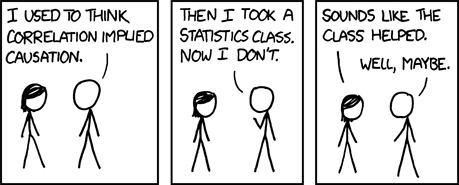
    By the way, in case you were wondering, "Didn't we know that already?", the new study appears to demonstrate causality, not just correlation.  

    Correlation

  • Revelation on a personal problem with food.

    A little more than three months after reaching goal, I'm still developing and strengthening skills I need to maintain my weight.  Lately, though not at every meal, I've been concentrating on sitting down, eating slowly, and trying to really taste every bite I put in my mouth.  

    This is more difficult than you'd think.  Even though it's immediately obvious that I really do enjoy my food more.  Even though I am more satisfied by them.  Even though I'm less tolerant of low-quality food (say, a cheap grocery-store doughnut) and am more likely to get up and throw the junk away, maybe replacing it with something nicer, or maybe just doing without.  

    Why did I get in the habit of plowing so fast through my food in the first place?  Surely that I'm busy and have to do other stuff, surely that's one reason.  But as I considered the question it became clear that I must actually derive some pleasure from, well, stuffing a mouth-filling bite of food into my mouth, swallowing it only partly chewed, taking a brief gasp of air, and then stuffing another large bite.  One after another, fast, full, large.  The sensation is not so much one of taste as it is of volume.  Big bites, big food, big meal.  From this there comes a rush.

    I can almost feel the rush as I type this and remember what it's like.  There is some fix I get about having LOTS and eating it FAST.  It feels good, on its own.  It is comforting because it the feeling of having PLENTY.   It is soothing, releases some brain-numbing soma, just the fact of stuffing.  It doesn't matter what food it is, whether it is a vending-machine bologna sandwich or a crispy Maryland crab cake on a bed of organic greens, the stuffing-my-face fix feels the same.   And, of course, if you're busy seeking the stuffing-your-face sensation, the flavor doesn't matter.  It is hard to notice flavor when you are simply biting, chewing, swallowing as fast as you can.

    And yet there is a desire to do it.  A desire to take a BIG bite of the cookie, instead of a little one.  The cookie is partly eaten; I could bite off this little point that is sticking out, and enjoy it before moving on.  Or I could fit half of what's left of the cookie into my mouth, an amount three or four times what could be a bite, and bite that.  Sometimes I literally bite more than I can easily chew.  Why do I want to take the BIG bite?  I can identify a real urge to do it.  There is a pleasure that comes from taking the one big bite instead of three small ones.  It makes no sense.  It's disordered, folks.

    (I wonder if other people also seek that drug out.  I suspect this is part of the reason why heavily engineered, concentrated flavors (Now With Super Xtreme Jalapeno Cheese!) are so popular.  Those flavors are noticeable even if you're scarfing food down as fast as you can.)

    So if what I'm seeking is really the sensation of filling my mouth and gullet with substantially-textured stuff, it's not actually any sort of food I am interested in.  It is, even if it is at the dinner table, the sensation of secret bingeing.  

    It hit me like a new insight.  There's a drug-like addiction going on here.  It is exactly like an addict who doesn't eat because he would rather spend his time and effort getting a hit from drugs.   I didn't realize it before because it seemed obvious the addiction is to food.   But no, food isn't the hit, food is just the drug delivery mechanism!  The singleminded pursuit of the sensation of the binge, over enjoyment of a meal, is like the addict preferring the hit from the needle to the eating that nourishes him.     There's nothing nourishing about a binge.  Just because the binge addict looks fat instead of wasted away doesn't mean the same sort of mental-emotional-addictive brain process isn't going on.  They are both seeking a druglike stupor instead of authentically meeting their needs, body and soul.

    So there's even another reason to learn to slow down.  Every time I scarf down a meal or snack without really noticing it, I'm feeding the tendency to binge.  I'm rewarding the part of my brain (will it ever die away?) that reacts pleasurably to the stuff-n-swallow, the feeling of plenty.  

    I want  to starve that part of me into submission, the part that eats like a machine to soothe the imaginary  demons.

     I want to waken and nourish the part of my brain that can taste the difference between two varieties of ripe June strawberries, between the two layers in a wedge of Cypress Grove Humboldt Fog chèvre; the part that notices the tender-crisp and tart-sweet balances in a wilted-spinach salad with onion, cumin, green apple and avocado; the part that waits months, passing up countless cheap imitations, to taste a soft pretzel fresh from the oven at the bakery in my own hometown, or a real homemade cinnamon roll with a mug of good black coffee.  The part that can enjoy something good even if — especially if? — it is a small something.

    if it is possible to kill this addiction, the only way is to steadfastly refuse to feed it — to refuse to eat quickly or with large bites.  Not secretly in the car or in front of the fridge, and not openly at the dinner table — never again.  Oh, I hope that this insight will help motivate me to take it seriously, because I've really convinced myself it's important.
