bearing blog


bear – ing n 1  the manner in which one comports oneself;  2  the act, power, or time of bringing forth offspring or fruit; 3 a machine part in which another part turns [a journal ~];  pl comprehension of one’s position, environment, or situation;   5  the act of moving while supporting the weight of something [the ~ of the cross].


  • Feeling fear.

    I've never had trouble with the concept that Jesus felt physical pain, that He physically suffered.  Seems obvious to me:  If you have a body, it hurts sometimes.  And that doesn't feel good, even if you know the pain is necessary and a sign of something good.  Anybody who's given birth knows this.  Pain is more bearable if you understand where it's coming from, but it is still pain and it would be nicer if there were less of it.  Right?

    But the fear?  How does that work?  How on earth can the omnipotent and omniscient and eternal "fear" his own willed temporal suffering?  Fear comes from a lot of places — not knowing, for example.  (But God knows all.)  And being out of control.  (But God is in control, even in the person of Jesus who submitted to others.)  And the threat of annihilation.  (But God is eternal.)  Isn't fear something that is fixed by knowing, by control, by the promise of continued existence?  Well?

    I wasn't thinking about that when I began the sorrowful mysteries of the rosary yesterday, when I arrived at the story of Gethsemane.  I was thinking about Amy Welborn's meditation on the resurrection of the body and her quote of a post by Fr. Longenecker , about the resurrected body being "the soul in every cell," that she said helped her feel relieved:  "I could not begin to parse it philosophically or theologically, and nor did I have any desire to. Something within got it, and I was able to trust." 

     Of course, I took that to prayer thinking I would try to parse it philosophically or theologically.  A lot of what Amy writes about difficult-to-grasp assertions of our faith resonates me. I have a very cerebral, historical approach to the Catholic faith, and aspects that can really only be approached so far with the intellect, further progress having to be made obliquely or with intuition, leave me with a permanent sense of unease.  So that's what I was trying to understand.

    What came to me was something that happened to me years ago.  Have you ever had a genuine panic attack?  I have.  I had a string of maybe five panic attacks over a period of about six months when I was in college.  I never knew why they appeared, and I never knew why they went away again — I've never had any since.    I remember it vividly though, one of the most surreal things ever to happen to me.

    It was surreal because at every moment I knew exactly what was happening to me.  I recognized the sensation as a panic attack.  I knew I was, in fact, safe.  I knew there was no thing that could have triggered a legitimate fear response.  And yet my body was behaving as if I was in terrible danger.  My heart was pounding, my skin was sweating, the prickly hairs were standing up on my neck and arms, my blood was dumping adrenaline into my muscles, my breath came swift and panting, the lights brightened as my pupils dilated.  

    I suffered.  Not because I knew fear but because I felt it in my body.  My physical response created an unbearable restlessness — my very cells shrieked, Run! Fight!  And in a way that made it even worse, because I knew there was, in fact, no point in running and nothing to fight.  And yet my body urged me to do something — I kept having this urge to leave the house I was in, to run away into the night.  But since I knew I was safe, I had to bring all the strength of my will to bear against the irrational urges of my body to flee.   I told myself "This is a panic attack, it will pass," but the one thing I did not know was how long it would last.   In the end I sought help, called a friend (to my embarrassment, waking up his parents in the middle of the night) and begged him to keep me company on the phone until the terrible sensations passed.  I didn't feel wholly better until after I had fallen asleep (completely physically exhausted) and awoken hours later.

    So I remembered that, and then it made a little bit more sense to me how Jesus could know all and yet suffer from His fear, as we believe He did in Gethsemane.  I'm not saying that I know how it works, I just say that I see now a way that it could work.  Because He could certainly have willed His body to yield the fear response, just as He could (and we know, did) will His body to experience pain, to send distress signals to His brain.   If a panic attack can feel physically even worse to one who knows there's nothing to fear, because of the constant effort for the wiser mind to suppress and overrule the wild urges from the body, the urges of muscle and bone — then I don't doubt that the fear response generates real suffering even to the omniscient.

    * * *

    That permanent sense of unease, about things that can be grasped only so closely by the intellect — it is not a bad thing.  For me, "to trust God" means above all else to accept "I can not understand this except when You decide to gift me with insight."  The habit grows easier with time, but the unease remains, part of that restlessness that belongs to this life.  St. Augustine wrote:  Our hearts are restless until they rest in you.  It doesn't make sense — that's a kind of restlessness, an urge to do something, to find out something, to write and write to try to figure it out, to read and read, to argue and understand.  And restlessness isn't always made easier by knowing that there's really nothing more that can be gained by action.

  • What the heck are the “Catholic Cannonball Awards?”

    I need to know, because, like, I've been nominated for one.

    In the "Susan Boyle" category.

    I am not sure how to take this.  Which one of you is responsible for this?


  • “Food doesn’t have to drive your life.”

    That is the message written on a billboard I pass most days, advertising a local center for the treatment of eating disorders. 

    I'm all for the treatment of eating disorders, medical and otherwise.  I can't help but be struck by the message on the billboard, though.

    Because it's demonstrably and indisputably false.

    I get what they're trying to say, of course.  But — really — food does have to drive your life.  If you stop consuming food, you know, you DIE. 

    It's an interesting juxtaposition of the metaphorical and the real meaning of "drive your life."  Of "have to."  Isn't it funny how the metaphorical meaning can be considered so awful that one needs a treatment center to divest people of it?  How at the same time a return to the literal meaning of a statement can be just exactly what is needed?  (Because in a way, having an eating disorder might be defined as having a poor sense of the reality that food is for fueling your body — for driving your life.  Treating an eating disorder in part means training people to really understand that food is indeed primarily for "driving your life.")

    Interesting — maybe a comment on our oddly dualistic idea of life, of body, of purpose.


  • A new path.

    I did something new yesterday.  I stole a bunch of pictures off the web.  No, wait a minute, I did something else.
     

    Vfiles19037


     I ran around Bde Mka Ska.*


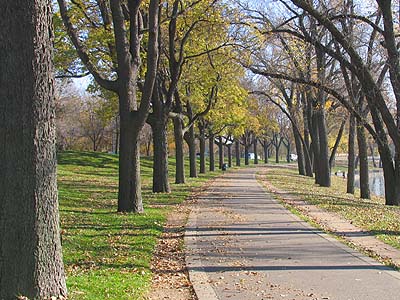
    Bde Mka Ska is one of the “Chain of Lakes” here in Minneapolis, and is a prime walking/running/blading/cycling route.   Peoplewatching too.  There is a restaurant at the boathouse (haven’t been there yet).  Like all the water in the city (just about), it’s parkland all the way around, though the other side of the street is mixed residential and business.  The homes that surround the lake are a mix of gigantic mansions, condominiums, and much more modest dwellings.  Somebody will be waiting in the wings to buy those, knock ’em down, and put something more expensive in its place to sit and gaze out at the lake.


    I ran counterclockwise today.  I have probably walked around Bde Mka Ska before, how could I not have?  I’ve lived in Minneapolis for almost 12 years now.  I have definitely never run around it before.  And when I started, even though I know I can run that far, I have run this far on the treadmill lots of times, and it’s not like there are any big hills, as I looked across the lake I could hardly believe that I was actually going to make it all the way around.  I am still at the point where I don’t ask myself, “I wonder how fast I can run this?”  I still ask, “I wonder if I can really run that far at all?”


    5102903KsHKbNkoWK_fs


    The lake is 3.1 miles around, which makes it perfect training for a 5K.  I don’t know if you’d call what I did yesterday evening “training.”  It was more like, “Gee, I’ve been running on a treadmill.  I wonder what it feels like to run on asphalt in the wind.  I guess I’d better try it once before I run that 5K on Saturday.”


    Did I mention I’m running a 5K on Saturday?


    I met Mark after work in the West 36th Street parking lot.  We pulled the jogging stroller/bike trailer out of the car and threw his bike in the car.  M.J. got in the stroller, the boys jumped excitedly (Get OUT of the bike path!  Onto the grass!  I said get OUT of the bike path before you get run over!  Oscar, tell your brother to stay off the bike path!), Mark set his watch and ran off, and I set out walking with the children. The boys were instructed to race to the next park bench, turn around, and come back — my favorite method for getting them good and tired.  When we got within striking distance of the 32nd Street playground, I let ’em go.


    2248


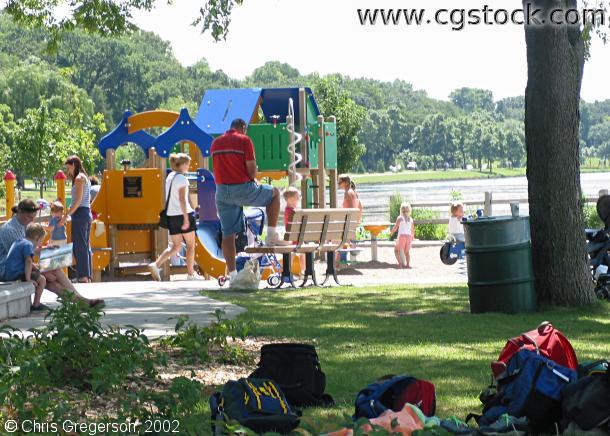
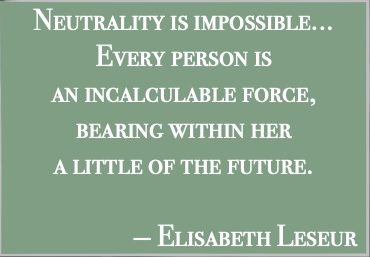
    (Yes, in the summer in Minneapolis the clouds spontaneously form themselves into web addresses of stock photo companies.)


    It wasn’t nearly as vernal as the pictures above, last night.  Things are just starting to go green.  And it was fifty degrees and windy.   I had dressed the kids in layers, and they were glad to have their hats, even the hated orange one.  My head was a little cold, because the only thing I could find quickly was a fleece ear band with the logo of an artificial sweetener on it, given to me by a friend of mine.  One of those corporate engineering types, with a big head.


    My ears thank you for it, Chris.


    Ab0ut 20 minutes after we got to the park we spied Mark coming up behind us, having finished his loop.  “How’d you do?” I asked as I wiggled my running shoes out of the extra pants I was wearing over my running pants?


    “Pretty good,” he said, “just good enough that I have hope I might break 20 minutes on Saturday.”


    “Well!”  I said, “I have absolutely no idea how long it will take me to get around.”  Really, I didn’t know.  “So — bye!”  I walked briskly back to the last distance marker, by way of warming up, set my cell phone stopwatch, and… ran north.


    I think the whiny voice in my head (“You can’t possibly be expected to run the whole way around!”) surfaced maybe 5 times.  I’d only gone 4/10ths of a mile when I passed the snack bar, and the tiniest suggestion entered my mind that perhaps Mark would not be any wiser if instead of running around the lake in the cold wind I were to stop, buy a cup of hot coffee, and then run back along the street and pretended I’d gone all the way around.  I laughed at myself, but still.  Good thing I wasn’t carrying any money!


    As I rounded the curve up by Lake Street and the sound of traffic filled my ears, I thought of how often I drive around that curve.  A dozen times a week, maybe.  And every time, I gaze across the lake and notice the runners, bending at the waist slightly to come up the very slight hill that takes them over the bridge.  There are always at least some runners, whatever the weather.  How startling to think what I look like from one of those cars — an anonymous runner.  Just like so many others I have driven past.  Wearing running shoes and running clothes that I purchased just for running, and that do not hang mockingly in my closet, but that I actually put on and, you know, run in.  
     
    I passed people on my way around the lake.  People going the same direction as me, even.  Yes, others passed me too.  Not as many as I passed, I think.  It wasn’t crowded today.  There was much nicer weather earlier in the week.


    I passed that same mile marker at 31 minutes.  And in a few more I had reached the playground where Mark and the kids were waiting.


    “How’d you do?”


    I told him.  “Well, I guess I have a nice round goal now.”


    He nodded.  “You’ll knock a minute off your time easily, with all the people around you on race day.”


    ‘It was fun.  Let’s do it again.  Not when it’s really hot or anything, though.”


    We went home, and I made pizza, and ate a LOT of it, and marveled at how very far I’d run.
    _________
    *Edited to reflect the lake’s restored Dakota name, finalized at all levels in 2020


  • A little relief.

    I wonder if Margaret feels slighted or concerned in any way that 

    (a) I didn't mention yet on my blog that she rescued me from a terrible mood on Wednesday by agreeing to meet me with the kids at an indoor playground for a couple of hours and that I feel much better now, and 

    (b) when I finally got around to blogging, sauerkraut got higher billing than she did?

    Such is life in the Bearing Blog Hierarchy of Attention.

    * * *

    Mark was to get back that afternoon from a business trip in Italy that had turned into an eight-day-long business trip.    I have gotten pretty good at weathering business trips without ordering pizza every night, but EIGHT NIGHTS is taxing.  I really appreciated having somewhere to go for a little while in the afternoon that last day.  This is where people who know me in real life have to be careful:  if you offer "Call me if you need anything or just need to talk!" I will take you up on it. 

    Between breaks like that, and spending a couple of nights over at Hannah's here and there (thank you Hannah), I stayed sane.  Contact with other adults is crucial for me, it really is.

  • I sing the praises of The Ugly Dinner.

    Thursdays the tribe is coming over, which means not much time to cook, and then we're gone to the YMCA from 5:40 till almost 8.  We either have to have an early dinner or a late one, and minimal clean-up, please.  Unless we just decide to eat cereal and fruit, that means the slow-cooker.  (Reheating leftovers does NOT produce minimal clean-up.)

    One of the best choices for the late-dinner option is what I call "The Ugly Dinner." I call it that because it is completely beige.  It looks very unappetizing:  don't take it to a potluck to impress people.  And yet it is flavorful, filling, and easy easy easy.  I suppose I could dress it up with minced parsley, or add a gratuitous red bell pepper,  but I have come to believe that this is missing the point.  Why not eat beige food once in a while?  It's good just the way it is.  

    Why make The Ugly Dinner?  Many reasons!  It stretches a little bit of meat, OR it's a way to cook an entire roast.  You don't brown the meat beforehand.   It's dairy-free, egg-free, and gluten-free too.  Skip the side dishes and it's fairly low carb and low calorie.  Use lean pork, and it's low-fat.  My version has separate side dishes, but you could put the side dishes inside and transform it into a VERY ugly one-pot meal.  The ingredients are cheap, or can be.   I have never left out the meat, but I suspect if you did, and put in some chickpeas instead, it would make a tasty, rustic, (and ugly!) vegan meal.  Proportions, by the way, are flexible here.  This is how I made it last night:

    The Ugly Dinner, Including Side Dishes

    • Chops or any other cut of pork, 3-6 ounces per person, or more if your family likes generous portions of meat.  I used a package of 2 pork chops weighing 1.1 pounds to feed my family of five.  You could easily do a whole roast this way — cut it into a few flat pieces first.  Do not bother trimming fat or treating the pork in any other way.  
    • 1 package refrigerated sauerkraut, 16 to 24 ounces.  Canned will do in a pinch and has the benefit of being shelf-stable. 
    • Turnips, trimmed and peeled, sliced 1/4 inch thick, enough to be the main vegetable of the plate.  I used one big turnip, softball-sized and quartered before I sliced it, but many small ones also work.
    • 2 yellow onions, peeled and sliced
    • 1 small baking potato per person (optional if you have bread)
    • Some broth or stock if you have it, or maybe some white wine or apple juice, but it's really not important 
    • Black pepper to taste 
    • Applesauce (from a jar is totally okay) or just some sliced tart apples
    • Bread if you have some 


    Use a big slow cooker.  Cover the bottom with 1/4 inch thick slices of turnip.   On top of that, place the pork in a single layer.  (No browning!)  On top of that, a layer of sliced onions.  Dump in the sauerkraut with all its juices and add maybe a half to one cup of stock, wine, or apple juice if you have it.  (Don't bother if all you have is water).  Grind the black pepper on top, cover and cook on LOW for 7-8 hours.

    Towards the end, produce plain baked potatoes by your favorite low-maintenance method.  I put them in a low oven while we were gone; you could also microwave them or use your second slow cooker.  Alternatively, the potatoes could have been sliced and put into the pot with the turnips.  Even more alternatively, you could have put the apples sliced in with the turnips as well.

    To serve, extract the meat, discard any bones, slice it, and either pass it separately or mix it back in. Give everybody a split baked potato (butter and sour cream are optional and coordinate with the color scheme) and a side dish of applesauce or raw sliced apples, and a big ladleful of turnips, onion, and sauerkraut, with some of the meat.  

    I like my potato in a bowl with the veggies on top and lots of the sauerkraut broth making it into a sort of soup, and only a little bit of the meat.  My pickier children like the meat  scraped clean of sauerkraut, a plain baked potato and applesauce on the side, which is a fine meal I think, and they will practice liking the turnips.  My dear husband likes to scoop out his potato and put the sauerkraut on top of the mash.  Bread to sop up the juices is also a plus, but not necessary; or you could have bread instead of the potato.  We happened to have some leftover Irish soda bread last night, which went beautifully with it.

    Revel in the ugliness that is the ugly dinner.    And don't you think that's a better name than "sauerkraut and turnips with pork?"

    I'm really curious if my readers think this sounds good or disgusting, if they think their pickier family members would like it or hate it, and — if you try it — how you rate it.

  • To make or to buy?

    Perhaps apropos of the post I made a while back — “What counts as ‘homemade?’” — Christy sent me this short, fun article from Slate comparing the cost and quality of making vs. buying several grocery-store staples.


    Obviously, homemade bread tastes better than Wonder, but does playing Martha Stewart really save you money? While packaged food is mostly lousy, some of it can be spectacularly inexpensive. Out of work and increasingly obsessed with our grocery budget, I decided to test my intuition and run a cost-benefit analysis on how much I’d save—if anything—by making from scratch six everyday foods that I usually purchase from Safeway and my local bakery.


    The author, Jennifer Reese, tried making her own bagels, cream cheese, yogurt, jam, crackers, and granola. Now if she’d just tried making yogurt cheese out of her own yogurt, she’d have been even more pleasantly surprised.


    I’ve made my own bagels and crackers exactly once each, and will probably make bagels again but not crackers.  Granola is on my list of things to try making, someday, so I’ll save the recipe she recommends, especially since we love maple syrup around here and buy reasonably-priced Grade B in bulk at our local co-op (what a great place!  Has a nice website too and an online store for, sadly not bulk maple syrup, but other odds and ends including expensive non-bulk maple syrup).


     I do make my own yogurt once in a while, with a Donvier brand yogurt maker (frankly, the idea of doing it without temperature controls, as she suggests, kind of scares me — bearing blog epidemiologist, please comment! Thank you!)  Jam and cream cheese do not interest me, possibly because I rarely eat either.

  • Could be a fun Earth Day building project with older kids…

    The human-powered two-wheeled personal transporter, the "Legway."

    http://www.instructables.com/static/flash/viewer.swf
    Steampunk Segway ( Legway )More DIY How To Projects

    Instructions are available here, where the builder hastens to add, "…before the comments come in…This was not meant to be a real effective means of transportation. This was more for the fun of the build and coolness factor."

    Video here.

  • Easy as apple pie.

    In other news, Mary Jane and I baked an apple pie together yesterday for the first time. 

     I recently took a cue from Hannah, who decided to make a good toaster oven a centerpiece in her kitchen.  Do you know, cooking with small children gets a lot easier and, I think, safer when you put a toaster oven down at their level? 

    It sounds a little bit counterintuitive, but hear me out.  Stovetop cooking is really, really tough for a little one.  You can put them on a stool or something like the Learning Tower and stand right by them, and indeed I do that with my little ones, helping them stir things while they learn about Safety With Hot Things.  But look, you're up on a stool (meaning falling is a real possibility), there's actual flames inches from your kids' clothes, and the surfaces are extremely hot.  I advocate cooking with children, so they can learn safety and competency from a young age.  But there is no denying that stovetop cooking with small children requires great care and attention.

    Baking things in the oven, say, a casserole, is not so bad.  Casseroles are great things for medium-sized kids to make when they are old enough to be put in charge of dinner once in a while.  Everything goes in a pan and the pan goes in the oven.  Cheese and onion enchiladas are Oscar's favorite dinner to make, there's no raw meat to handle and no browning, just layering and baking.  Recently he's learned to make buttermilk biscuits and egg bake, too.  But the oven door is so big!  It's tough for a kid to put anything in the oven, it's tough for a kid to take anything out of the oven, it's really tough for a kid to stick a toothpick in to see if it's done.  Whenever Oscar's doing that, I'm torn between calling out "Be careful!  Remember the door is really hot!" and "Hurry up, check it and close the door!  All the hot air is getting out!"

    This is where the toaster oven is so great.  The most important thing is that it be stable so it can't be knocked down.  But if you place it on a low table so there's no getting on and off a stool to mess with, and have enough low-table space next to it to set a hot pan, a three- or four-year old can be taught how to put things into the oven, how to set up a trivet so there's a place for the hot pan to go, how to wear hot mitts, and how to take the pan out of the oven.  Really.  I mean, you have to know your own child, and you have to know how much supervision is necessary, but believe me, the toaster oven is far superior to either the stovetop or the regular oven here.  And yes, there is a possibility of them burning themselves, but I think the likelihood of minor burns (Teachable Moment Burns, we call them around here) may be higher, the likelihood of catastrophic burns is much lower than either with the stovetop or the regular oven.  At my house, we like our teachable moments to come without skin grafts.

    So, I followed Hannah's lead and I got a few pans sized for my (pretty small) toaster oven:  an 8-inch cake pan, a set of mini loaf pans, an 8-inch fluted tart pan (the kind with the bottom that pops out), a "broil and roast" pan (a rack inside a little roasting pan), and a cookie sheet.  I can also fit a regular-sized loaf pan and a 9×9 Pyrex dish in there.  What I haven't found yet is a 6-cup muffin tin — I bought one, but the handles turned out to be just big enough to prevent its fitting in my toaster oven.  Damn!  I gave it to Hannah, whose toaster oven is bigger.

    I've been experimenting a little bit with preparing food in the toaster oven, and collecting recipes for the children to follow.  Meatballs baked in spaghetti sauce are very do-able, even for the smallest.  Oscar successfully made chili cheese egg bake a couple of weeks ago.  Two nights ago Mary Jane cooked the hot dogs in the broil 'n' roast pan, all by herself.  And last night, like I said, M.J. and I made our first apple pie.  I took it out of the oven, but she put it in.

    I won't belabor the recipe here except to say that if you halve the recipe for a 10-inch, two-crust apple pie, you come pretty close to the right size for an 8-inch two-crust apple pie, with a little extra pastry (which is a good idea when you have nibbly helpers).  Our pie got a little burned on the top before it was done in the middle, but I slipped a piece of aluminum foil in there to protect the top crust a bit and it turned out very tasty.  And it was a really nice size, too!  One mom and three kids don't need an entire 10-inch pie.

    I wish I had a spot in my kitchen for the toaster oven to live permanently available to kids, but I'm afraid that's not to be — my spaces have to multitask pretty hard.  But I do have a little table in my kitchen that is big enough for the oven and a trivet, and so a little bit of setup is all I need.

  • Oversoaking the bread may not work: a lesson from a power outage.

    For a variety of reasons including a power outage, yesterday's attempt at honey-oatmeal bread soaked and rose for 21 hours before I got the machine turned on.  By that time, it had nearly filled the pan.  I had added 2 Tbsp extra liquid to see if I could fix the gnarly top that I got last time, and indeed the top was very smooth, but it just didn't rise very high at all — it made a short, dense, almost gummy loaf.  It's okay toasted, but not much better than okay.  This was the second attempt at honey-oatmeal bread, my family's mainstay for peanut butter sandwiches.

    I don't know why it would have done this — it was almost as though the yeast had spent itself.  I mean, that was my unscientific impression.  But I think I'm going to stick with 8 hours soaking time.  For one thing, since it takes almost 4 hours to bake the bread, that makes for an easy calculation of when the bread will be done:  start it now, and it'll be done in 12 hours.

    I think we'll be having French toast for a couple of days. 

  • Topic synergy here at bearing blog: Contraceptives and muscle mass.

    Where we love to rant about how bad contraceptives can be for you, and also about how important it is to stay healthy and fit.


    CHICAGO (Reuters) – Young women seeking a sculpted, muscular silhouette may want to avoid taking oral contraceptives, U.S. researchers said on Friday.


    They found women who were not taking birth control pills gained 60 percent more muscle mass after a 10-week weight training program than those who were.


    The study, led by Chang-Woock Lee and Steven Riechman of Texas A&M University in College Station and Mark Newman of the University of Pittsburgh in Pennsylvania, will be presented at the American Physiological Society meeting in New Orleans this weekend.


    The researchers studied 73 generally healthy women between 18 and 31 who completed a whole-body resistance exercise training program. About half took the pill and half did not.


    Both groups exercised three times a week under the supervision of exercise physiologists, performing the same number and intensity of exercises.


    At the end of the 10 weeks, the women who were not taking oral contraceptives had built significantly more lean muscle.


    And blood samples before and after the training period showed the women on the pill had lower levels of muscle-building hormones such as testosterone and far higher levels of muscle-breaking hormones such as cortisol.


    Remind me again why this s#$t is so popular?


    I suspect that men like it.  A certain type, anyway.