bearing blog


bear – ing n 1  the manner in which one comports oneself;  2  the act, power, or time of bringing forth offspring or fruit; 3 a machine part in which another part turns [a journal ~];  pl comprehension of one’s position, environment, or situation;   5  the act of moving while supporting the weight of something [the ~ of the cross].


  • Reader bleg: Your chance to practice social engineering on me.

    So, piggybacking off various recent posts about my spring wardrobe and dressing myself after weight loss, let me tell you something about me and clothes.

    I'm not naturally very good at dressing myself.  

    (Fun fact:  I even have trouble operating a buttonhole, because of an old injury to my wrist.  But that's not really what I'm talking about.  I am talking about my fashion sense.)

    I watch my four-year-old daughter happily change her outfit six times a day, and I sort of marvel at it.  She loves clothes and dressing up or down (up mostly) to suit the occasion.  When I was a child and young teen, though, I was pretty clueless about clothes.  It wasn't that I only wanted to wear comfortable things, or even that I didn't care how I looked — in fact I could get very anxious about what people would think if I wore something unusual-for-me to school, or even out to dinner with my family.  And I was, of course, very self-conscious of being heavy, and wouldn't wear anything that I thought exacerbated that problem.

    I can remember having some fights with my dad and stepmom because I had arrived at their house without having packed any clothes that were "nice enough" to go to dinner, in their view, and refusing to do things like tuck in my blouse and wear a belt because I thought I looked less fat with my blouse untucked.  I have always been pretty hopelessly unstylish by nature.

    A few years ago, however, I figured something out:  It is not necessary to be naturally stylish to avoid looking decidedly unstylish.  It is only necessary to avoid certain pitfalls.  It is, of course, possible to get very creative and interesting with color if you are gifted at putting them together, but if like me you are not so gifted, well, I avoid clashes by setting rules for myself like "one colored thing, everything else neutral"   and "throw it away when it gets holes in it."

    Anyway, it's really only recently (you can guess since when) that I've tried to expand my horizons just a little bit slightly.  For example, I have been tentatively doing things like buying pairs of what I hear are called "cute shoes."  Not, you know, "black shoes that will last forever and go with everything so you won't have to worry about whether they look dumb with your outfit," but "cute shoes."   I even (whisper) found a shoe designer label that I reliably like and have now gotten a couple of different pairs from. And I have on occasion bought, say, a dress that looked not merely inoffensive, but, you know, kind of pretty, or at least interesting.  Don't worry, I'm not taking my black tee shirts, Dr. Martens, and olive cargo pants to the thrift store just yet.  I'm just saying:  I've been branching out a little.

    This has caused something to happen for which I was unprepared.

    Sometimes — I know, it's weird — I will greet a neighbor or a friend from church, and she will say:  "Wow, those are cute shoes!  Where'd you get them?"

     And get this:  I do not know how to answer this question.   Readers.  Help me out here.

    First of all, what does "where did you get these shoes" mean?  Duh, I bought them from the internet.  Does it really matter whether I got them from Amazon or Overstock.com or Zappos or eBay?  I googled them, and there they were.  It is this question that makes me suspicious of the entire encounter — I don't ask my friend where she got her sturdy yet practical new coffee grinder, nor my husband where he got his ice axe.  Obviously these things were bought from an establishment which sells coffee grinders, ice axes, or ballet flats (as the case may be).  Does it matter where?  It can't matter where.  This question must mean more than it appears to mean on the surface.

    Second of all:  what is the proper response to this question?  Is this just a polite bit of small talk to which I am supposed to make up an inoffensive answer?  Does the woman who is asking me about my shoes want to know, for example, the information I would want to know if I was going to buy the shoes for myself, namely, the label?  Should I say, for instance, "Oh, they're from Clarks" (assuming that was what they were) because, well, then you could go to Google and search for "clarks flats mary jane pewter" and find my shoe?   Do I say, "Thank you, I really like them too?"  Is this some kind of a test?

    And what if they happened to be an actual designer label?  What if by some thrift-store/eBay/outlet sale miracle I was wearing a pair of Manolos  or Kate Spades?  Do you say so?  Is that pretentious or is that something that a cute-shoe-admirer wants to know?  Am I supposed to use this question as a means of indicating the kind of shoe-shopper I am, whether I am a thrift-store-hound or a Craigslist maven or Imelda Marcos?

    Same thing with dresses — if someone says about my one — one — designer dress*, "Cute dress, where'd you get it?" which of these true answers is the one that the woman is looking for?  (A) "At the Mall of America," (B) "Nordstroms," (C) "It's BCBG Max Azria," (D) "Thanks, I picked this up on sale a couple of years ago?" 

    I have enough trouble dealing with small talk, which famously is not intended to transmit meaning at the level of the actual words spoken, but instead is a social ritual through which people defuse potential hostilities before entering into more personal communications.   I have this vague feeling that women talking to other women about their clothing is partly small talk and partly shot through with hidden implications and messages that I am hopelessly unable to decode, let alone respond with the correct countersign.

    Please help me navigate this unknown territory.

    —————————-

    *the one I'm wearing in two photos in this post


  • Filling in the gaps.

    It stormed today, so between trips to the basement to hide from the tornadoes, I spent the afternoon editing my closet.

    Yesterday I finally got a chance to buy a bunch of spring clothes — the first time since I dropped five dress sizes — because two springs ago I was pregnant, and last spring I had been recently pregnant (too recent to buy new spring clothes).  I had picked up some odds and ends along the way, like some hiking skorts and a dress or two, and there were a couple of skirts that I bought on sale in the off season, and some stuff that's good year round like twill pants.  I had plenty of autumn-type things, which looks a little out of place but at least it works with the kind of weather we're having.  So it's not like I had nothing to wear.

    Still, yesterday — after Mark got back from nine days in Europe on (mostly) business — I got a chance to steal away with a written list of wardrobe gaps.  

    I never liked clothes-shopping until I learned to shop with a list.  I used to have this theory that it worked like this:   you go to the mall, and you try on a bunch of stuff, and if it remotely looks okay and doesn't cost too much, you buy it.  And then you take it home and stick it in your closet and it mixes in with all the other random stuff that looked okay and didn't cost too much.  Not that planning was never a part of it:  Sure, you might go to the mall thinking "I need pants," or "I need a bra," but you still try on a bunch of random stuff and buy some.  

    For a while I thought the secret was to pick one catalogue store (Lands' End was it for a while), pick one size pants, one size shirt, etc., and then just order some from time to time.  That worked pretty well.  Boring, but well enough.

    Then, a few years ago, I had to buy an entire wardrobe of clothes.  Twice.  The first time (passing through sizes eight and six on my way down) I screwed it up.  I bought  things randomly.  I had too many pants and not enough shirts.  I had duplicates in one color and none in another.  I spent way too much money because I was over-eager.  I did not do it well.  

    Fortunately, I had to do it again a few months later when those sixes and eights were, in turn, too big.  And this second time I did it right, or at least much better.

    It was late fall, and I sat down and made a list.  I wanted my new wardrobe to be small, efficient, and made of better-quality stuff than I had been wearing before.  If it was going to be small and nimble, I needed as few clashes as possible.  And as few extraneous things as possible.

    The first narrowing decision I made was this:  Black would be my neutral color for the rest of my life.  I was never again going to buy a pair of brown shoes, or a brown belt, or a brown bag.  And I would never again buy an outfit that required brown shoes, belt, bag, or any other brown accessory.  Same for navy.  I still have one pair of brown heels (just in case — you never know), but I have sworn off any new brown and I have sworn off any new navy.  

    This has turned out to be wonderfully focusing.  It's not for everyone, I guess.  I am sure there are lots of people who just love to wear black or navy or brown anytime they want, and who would find it too constraining to stick with just one.    But I love to wear black, and it saves me money in accessories and  in clothes not to introduce that variable.    It's not strictly the only neutral I wear — I also have things that are charcoal or heather gray, which of course work with black, and I have some metallic things like silver ballet flats, which of course work with black, and I found a faux leopard-print nylon bag a couple of weeks ago that I really love and that, you guessed it, works with black.  But my point is, by swearing off anything that I couldn't wear with black, I saved myself a lot of closet space and, I hope, money.

    Anyway, I sat down back then and made my list.  It was fall.  I blogged my list here.

    It was actually fun to go shopping for clothes with a list in hand (not to mention that, thanks to the weight loss, for once in my life, I really did need to buy clothes).  Instead of wandering randomly through stores, I could scan the racks purposefully and quickly figure out whether there was anything worth looking at more closely.   I knocked out a lot of the items on one marathon shopping day during the Christmas season with my best friend from high school.  I carried the list around with me and snagged items from it here and there when I saw a good price.  And I managed to put together a decent, but small, cool-weather wardrobe of dressy-enough clothes, in the not-very-original but certainly classic black-white-gray-red palette.  

    There are still some items on the autumn list that I don't have.  I never did get a suit (and I'm not sure I need to now).  Which means that I still have some things to keep an eye out for.  And I made some substitutions, like a black trench-type raincoat instead of a leather coat, which has turned out to be a better choice anyway.

    So, that was a few autumns ago.  Finally it is time to complete my spring wardrobe.  And after I pulled all the extra stuff out of my closet — I realized that I do not have to keep everything that fits me in my closet all the time, I can put some things away for fall even if only to save the red and green stuff for the holidays — I really had quite a short list.  One red or orange hiking skort, a pair of light-colored performance-wear capris, one dress, and several good-quality tee shirts in black, white, and a couple of spring colors.   I struck out at REI (what is with their clothes this year?  Ugly) but did fine at two ordinary mall stores, and got everything I wanted on sale.  (OK, I think I paid full price for the capris.  It was worth it to check them off the list.  Time is sometimes money.)

    I think the best thing about it is that I have made enough room in my closet that I can see everything at a single glance.  There's less in there (I took time today to get rid of a lot of too-big clothes that were still filling up space), but it's better stuff.

    UPDATE.  Just to show you what I mean by "small but efficient," here are some pictures.

    DSCN0924 

    The dresser is full of things like socks, underwear, pajamas, workout clothes, bathing suits, and broken digital thermometers.  So it doesn't really count.  Also, I have another closet in which most of my winter things are living, and also the maternity clothes.  So I haven't pared everything down.

    But on a daily basis, this is what I see:  Six colored tee shirts, eight tee shirts (different sleeve lengths) that are either black or white, three button down shirts, one white cardigan;  one jeans, one twill pants, one capri pants, four skirts, two pair shorts.  Also four dresses.  

    This being Minnesota, a few sweaters are still up on the shelf, with the out of season shoes.

    DSCN0926
     
    Note the lack of brown or navy shoes.   (Also, you can't see my favorite sandals because they are on my feet.  Or my Tevas because they live in the car or the mudroom.)

    I think this is a pretty well-edited wardrobe.


  • Difficulty parsing.

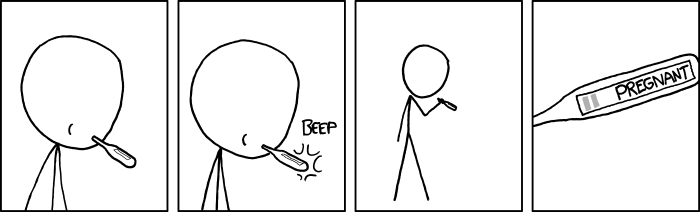
    For a minute I thought this comic was about NFP. 

    Temperature

    And then I thought:  Wait a minute, this stick figure is a guy.


  • Retrieval.

    It's the end of the school year, almost, which means I'm already thinking about the next one.  Right now, that's mostly — gosh I hope I get a better handle on my schoolroom cabinets.

    That's a metaphorical handle (mostly — The pull on the bottom right does keep coming off).

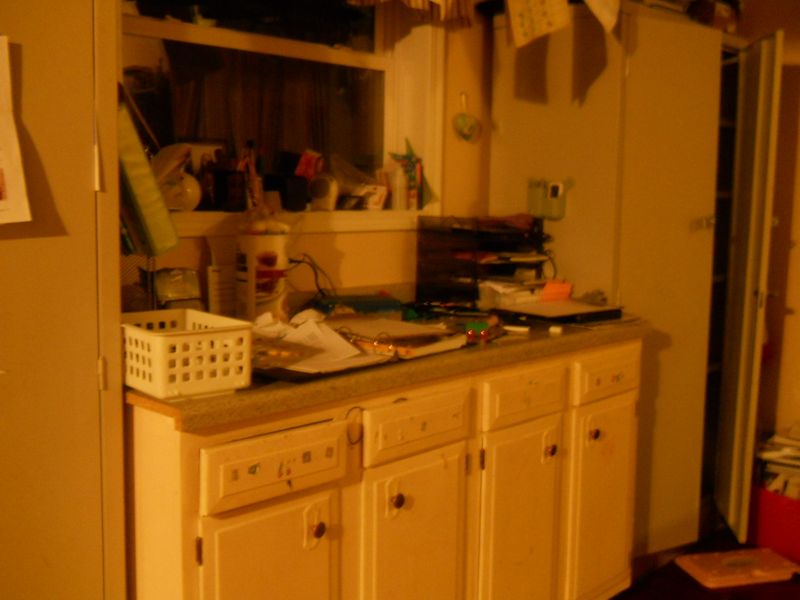
    DSCN0917

    This is my command center during the school day.  It's funny, in many ways I am a laughably organized person, but I can't keep this countertop clear to save my life.

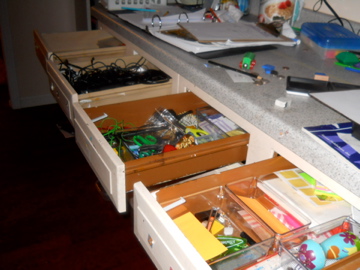
    The drawers are even worse, since they are out of sight.  From time to time I just must clear off the counter, because it is crushing all my psychic energy under the weight of the bits that are piled on it; but the drawers attract every possibly-useful-in-the-future item in the entire first floor.  

    Also adapters to devices we don't have anymore.  Also broken pieces of saint statues.  But I defy you to find a rubber band or a paper clip or a pencil sharpener in there … that is, if you want one.

    DSCN0919


    It's not too hard to find a pair of scissors, but that's only because I deliberately salted all the drawers with about two dozen pairs at the start of this year.   

    I have cleaned it out before, but I find the same stuff mostly just goes right back in where I put it.  This year, however, I achieved 25% success:  The leftmost drawer was designated "the drawer that holds scrap paper and crayons and colored pencils," and it stayed that way all year.  It finally found its calling.  Good for that drawer.  I still have three more to go, and I still can't find any paper clips.  Maybe by the time my oldest is in high school I will have a working set of drawers.

    Never stop trying, though.  This is my latest attempt:

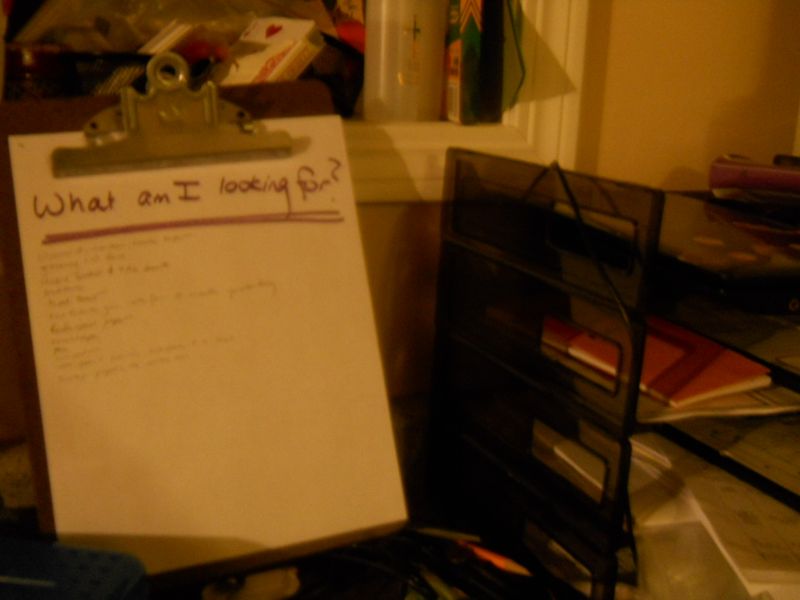
    DSCN0920

    Ah yes, the "What am I looking for?!?" clipboard.  We shall see.  The idea is that every time I come up to the counter top to try to find something or use something, I will write down what item I am searching for.  Then, maybe, after a week or two, I will figure out what I actually need to keep here.  Maybe then I will feel better about stowing everything else somewhere I don't have to paw through it every time I want an eraser.

    Now's the time to do it, while school's still in so the data will be good, but with summer — re-organization season — just around the corner.


  • More on vanity and physical fitness…

    Kate Wicker is adding some commentary to the vanity/physical fitness discussion. Here’s  a post she calls “Being a Hottie v. Being Healthy — Part I.”  After a useful summary with links, she writes:

    The problem I have with pursuing hotness over health is that there often exists a schism between what is healthy and what is perceived as “hot.” In my personal experience, our health and how we feel physically, spiritually, mentally, and emotionally rather than just how we look seems to be a better gauge for whether or not we’re perversing food and/or pandering to vanity or to gluttony rather than our level of hotness as perceived by ourselves, the world, and even our spouses.

    Over a series of posts I’m going to explore why I’ll continue to champion health over perfect proportions/a hot body.

    I’ll start with this: A hot body doesn’t necessarily mean we’re healthy in mind, body, and/or spirit.

    I definitely don’t want to give the impression that I would champion “having a hot body” over health.

    I just want to encourage people to be honest about their mixed motives.  Doing so frees other people to admit the motives we’re not allowed to admit.

    I wrote this, or something similar, in Kate’s combox (it’ll show up after it comes out of moderation):

    + + +

    Boy, you hit it on the nail with your boldfaced line!

    I think it’s important for me to acknowledge my mixed motives, and I really encourage everyone to do it. I want to be fit because I want to be healthy and strong (AND because I want to look good). I want to look good because I want to honor the body God gave me, because I want to please my husband, because I want to show my children that my vocation is joyful (AND because, face it, I’m a little vain.)

    Name it and claim it, you know?

    Commenter LeeAnn quoted a definition of humility as ” an honest facing of facts, admitting them, and acting according to them.” If one of the facts is your own mixed motives, then, ironically, admitting that you have some vain reasons as well as some pure reasons is a step on the road to humility.

    But, as you were saying, just because you’re hot doesn’t mean you’re healthy either physically, mentally, or spiritually. It’s a good thing the devil never offered me the choice back in the day to get thin without getting, for lack of a better word, “better!” Change from the inside out is the thing to desire, *even if* the change never goes as far as the places that other people can see.

    Sometimes I think that change can go from inside to out — and then reflect back inward and spur further change. I never thought of myself as having a “vanity problem” at all (mostly because I didn’t think I *looked* like a person who could possibly struggle with vanity, or wear the same kind of clothes as such a person). Then I attacked the gluttony problem, lost weight, got better looking, and bought nicer clothes. WHOA do I realize now that I have had a vanity problem, and what’s more I always did and never knew it. So… I understand now that it’s something I need to grapple with. (Along with many other faults of course. But I see now that it’s really a besetting problem for me, and deserves more of my attention than I thought it was.)

    + + +

    I don’t think it’s inherently bad to want to look good.  I agree that it’s fraught with not a little spiritual danger.

    As my fingers hover over the keys, I’m not entirely sure I want to say, “It’s far more important to try to be healthy than to try to be beautiful!”  I think that different people may be called to emphasize one or the other or neither, depending on their circumstances or their besetting spiritual weaknesses.  We probably all should seek both health and beauty to some extent — along with many, many other things — in accord with the duties of our state in life.

    Both health and beauty come partly from natural gifts — some people are gifted with naturally good health, some are natural beauties — and from our own efforts — almost anyone is capable of working to improve their health or of destroying it through sabotage and neglect; and almost anyone can enhance their natural beauty through presentation, self-improvement, and attitude OR can disfigure themselves to repel others.  Both are a cooperation with God to bring forth fruit from whatever gifts He has given us.  The analogy to being open to God’s grace in spiritual matters is clear.

    I think we can learn a lot from seeking health OR from seeking beauty.  A lot of us are just having trouble disentangling the two because health is usually inherently beautiful .   The two are rarely opposed, as the “v.” in Kate’s headline might be read to mean.

    Occasionally they are:  some measures to improve or repair health are disfiguring (chemotherapy, amputations).  But I don’t think most of us are dealing with that kind of situation.  Maybe if we were, it would be easier to make clear distinctions.  For most of us, though, it will always be hard to decouple health from beauty.


  • First Holy Communion. The second one, I mean. For me.

    Kneelers on rehearsal day.

    DSCN0804

    .

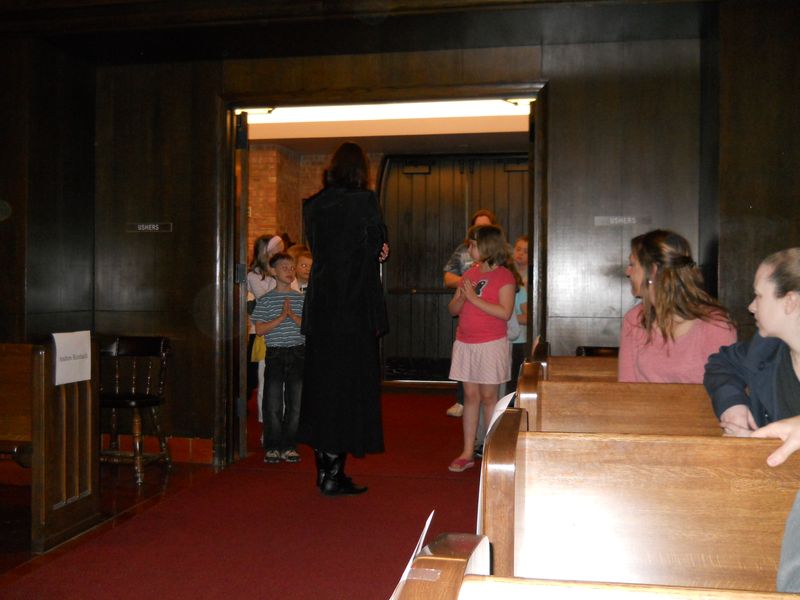
    Practicing the procession.

    DSCN0812

    .

    He made it to the correct pew.  I guess he's ready.

    DSCN0813

    .

    Enjoying the bubble wrap that his present from Mark was wrapped in

    DSCN0848

    .

    Is it time to leave for church yet?

    DSCN0850

    .

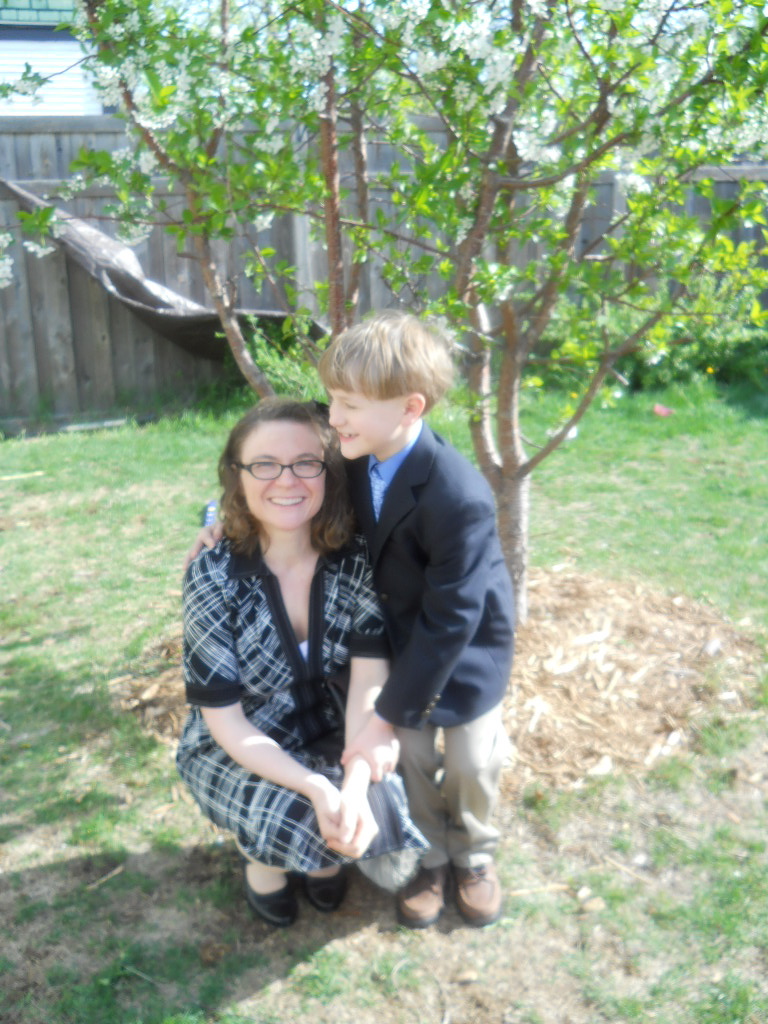
    The cherry tree cooperated for the day.

    IMG_9433

    DSCN0856

    DSCN0874


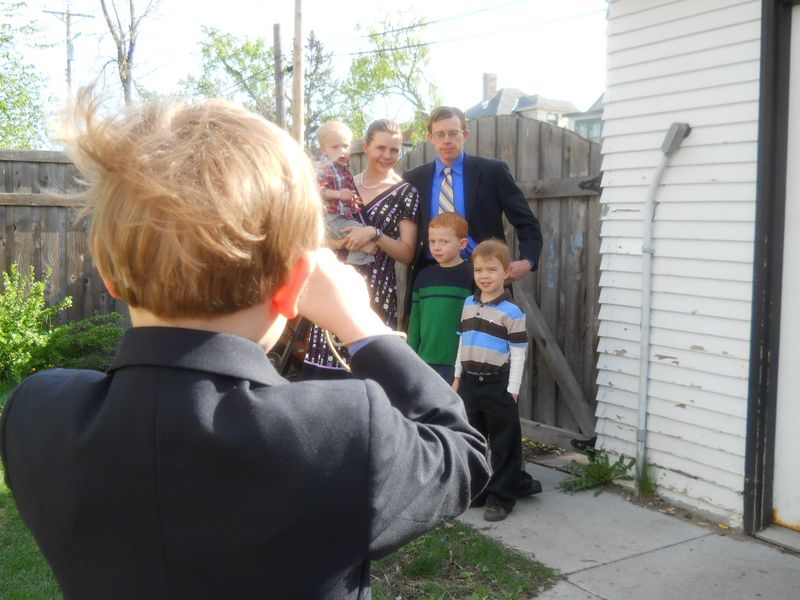
    Even the first-communicant is pressed into service, taking a picture of his godparents and their children:

    DSCN0889


    The redhead is my godson.  The two boys were baptized on the same day:

    IMG_9455

    From the baptism day - Seb and Milo


    .

    .

    Awful cute, aren't they?

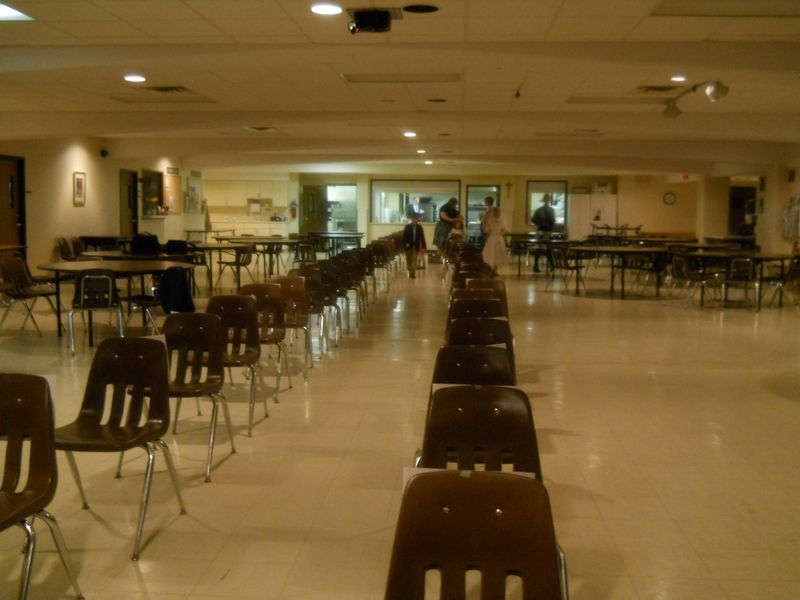
    These chairs will soon be full of first-communicants.

    DSCN0902


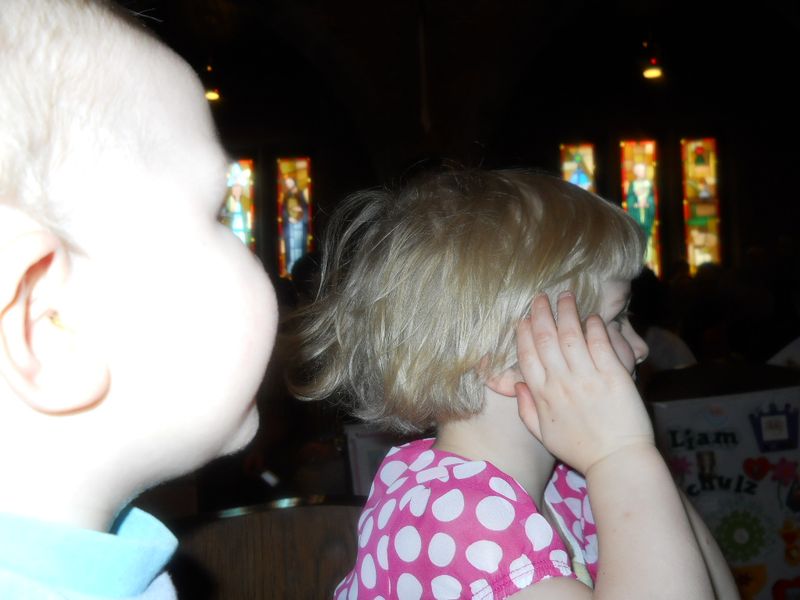
    We love to watch girls in pretty dresses around here.

    DSCN0909


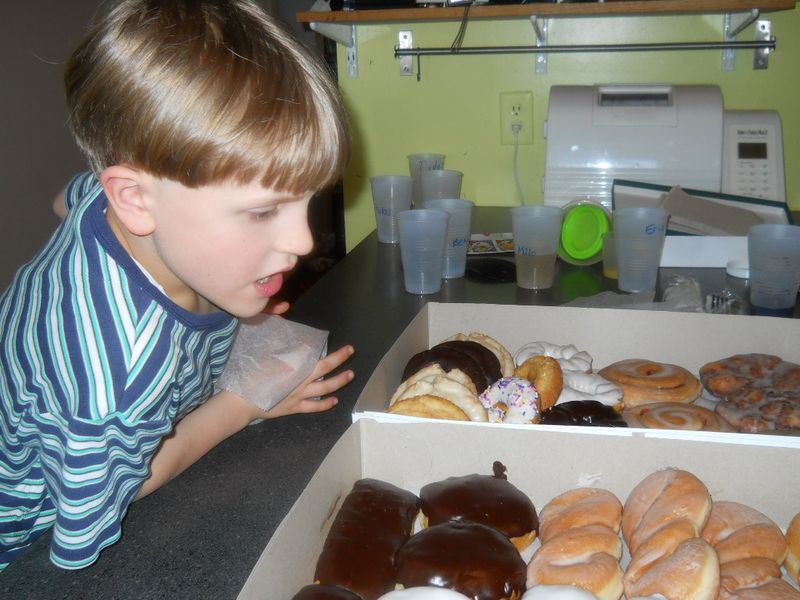
    Party time.  Who needs a cake when you can have first dibs on an entire assortment of donuts from the GOOD grocery store?

    DSCN0915


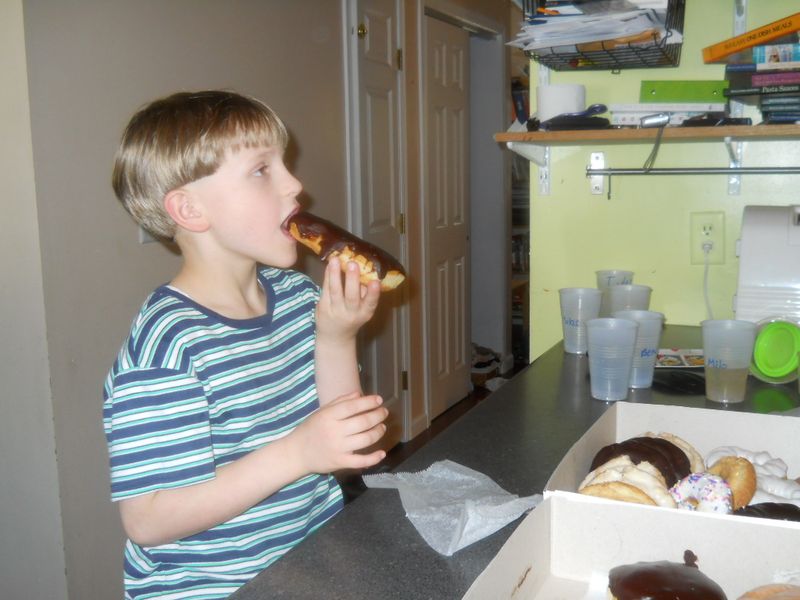
    I may have missed the shot of him receiving first Communion, but at least I got this one:

    DSCN0916


  • What this is not.

    I seem to have been added to a few blogrolls in the last several days, because there's been a giant uptick in my traffic.  (Or maybe it was just the Blogger outage.  Thank you, Typepad!  Fifty bucks a year has so far been pretty well spent.)  Maybe we have some new folks around?  

    In the last post in the "acceptance" series, I identified a particular habit of mine (gobbling pinches of shredded cheese out of the bag while cooking, even though I always drop cheese on the floor) as an example of gluttony according to my own expanded definition.  A commenter disagreed with me:

    Surely you *could* eat cheese while cooking and not get in on the floor. It's not *that* difficult. So "This isn't so much a problem because of the cheese calories" really doesn't ring true. It IS the calories that are the problem, no? That's the whole point of these posts.

    I answered in the combox, but I've been thinking.  I wrote the posts, didn't I?  So don't I get to say what "the whole point of these posts" are?  

    Okay, then, Erin, be more clear.

    Ahem.

    This is not a weight loss blog.

    I'm glad I lost forty pounds in 2008.  But one thing I've tried to re-iterate over and over — and you'd probably have to look at old posts to see it, I know, so if you've just arrived, it may not be obvious — is that weight loss only came for me when I turned my attention to rooting out the habits of gluttony.  

    I won't lie.  I pay a lot of attention to the weight.  It is hard work keeping it down.  I've written about that.  

    Wanting to look good provides me a strong motivation to work on gluttony.  I think I've been clear about that!  

    But I'm also interested in gluttony's technical definition as a vice, a fault, a sin.  It has consequences for my health and my relationships, sure.  Most sins do.   That's why we always have mixed motives in rooting sin out of our lives.  But I'm aware that gluttony has a spiritual component.  And I want it out of my life even if I never gain another pound from it.

    As I've gone on blogging and blogging about gluttony, even though I am now at a healthy weight, I have seen a new dimension to these posts emerge.  I have a question which is emerging as a sort of obsession.  I bring it to prayer over and over again.  I write about it over and over again.  You could even say that it is the real point of these posts.  And that point is to figure out this:

    How can I use what I've learned about gluttony to defeat my other besetting vices, faults, and sins?


    So, no.  The calories are not the point.  Not at all.

    [Editing note.  Years and years later, I wish I’d done a better job distinguishing gluttony from other problems with food, like clinical eating disorders and other kinds of compulsiveness.  

    I want to emphasize that, whereas I identified some behaviors in myself that probably qualified as self-centered gluttony in the technical sense, I am not and never have been qualified to make that distinction for anyone else.  I  touch on what I’m talking about a little more clearly partway through this post.

    I hope to add some commentary to all the posts that have this problem as I find the time to review them.  Here’s a more recent post where I acknowledge some of the problematic material I wrote and set new ground rules for myself going forward.]


  • Tomorrow’s stats.

    Number of pews reserved for each first communicant:  1

    Number of pews in church:  54

    Number of first communicants:  52


    (I really hope the rest of the families in the parish are aware of this situation, because I'm afraid it's going to get ugly at about 10:35 AM.)

    UPDATE:  Milo's godfather suggests "helmet cam" as a means of getting the communion photo.


  • Acceptance #7 – Just doing it.

    “So would you mind terribly much if I started to talk your ear off about gluttony and weight loss again?  For a little while?”

    That was me, asking my husband if he is willing to step once again into the roles he willingly played while I was losing the weight.   (Here’s the guest post he wrote last year to tell his side of the story.)

    Of course he said yes.

    Check.  One off the list.

    + + +

    And of course I’m blogging about it.  Check.

    + + + 

    Another list item:  to think critically about gluttony, at least for a little while, so I can recognize it when it tempts me.   I need a condensed version of this post in the form of a question.   Something like, “That thing you’re about to put in your mouth?  Is there some reason you ought not to eat that, charity or manners or money or plain common sense, but that you’re ignoring because you Just Want It?”

    An example I was thinking of when I wrote that post:  I like to eat pinches of shredded cheese out of the food processor (or these days, plastic resealable bag) while I’m waiting to flip the quesadillas.   This isn’t so much a problem because of the cheese calories.  Instead, it’s that I always drop some on the floor while I’m elegantly sprinkling the cheese into my upturned mouth.  And then somebody steps on the cheese and tracks it into the living room.  

    Clearly plain common sense would say I should not sprinkle shredded cheese into my mouth while trying to cook quesadillas.  The virtues of multitasking only extend so far.   And yet, despite being aware of this for several months, and despite knowing what will happen at the very moment my hand snakes into the bag, I reject self-restraint, I continue to snarf shredded cheese by hand whenever I make quesadillas, and I continue to find inch-long yellow smears on the carpet.  

    That, my friends, is gluttony.

    + + +

    In the maintenance blues post (#4 in this series), I catalogued which of my habits are still working, and which aren’t.  Now I’ll take that one step past a catalogue and see if I can nail down what’s going on.

    A couple of the items have to do with availability:  there’s more of what I don’t want, and less of what I do want, coming home from the store.  That’s pretty easily fixed, in our family that already knows how to make a list and stick to it.

    1. Note on the grocery list, “no sauces or flavors on the frozen veg.”  If I don’t tell Mark what to buy, he has to guess what I want.  
    2. Ask each verbal child to pick his or her favorite packaged cookie and buy only those three kinds for a good long while, rotating through them.  Variety in real food is good; too much variety in junk food or treats is bad for everybody, not just me.
    3. Before cookies enter my pantry, preportion the big bags of cookies into Ziploc bags.  Because I have four children, I don’t have to make the bags single serving; I would guess, for example, that a standard bag of Oreos should be halved.   And it’s okay if there are a couple extra Oreos and I eat them.  The thing I want to avoid is the open bag of Oreos sitting around waiting for the next snacktime.  Because you know what?  It never makes it that long.

    These three commitments ought to be near effortless, as the decision point is at grocery shopping time.    Not at a “will I eat this, or won’t I?” time.

    The remaining items are more about respecting my own pre-decided limits even when I’m tempted to ignore them.  I’ve learned that I feel much, much better if I stop eating while the available food still promises me a little pleasure; and yet, the thought of the pleasure still attracts.  I suffer, while sitting at table, from the illusion of being unsatisfied; after I get up from the table, I can see in hindsight that I have been satisfied.  “Satisfied,” indeed, is something I am only sure about in hindsight.  Never “I can stop eating because I am satisfied,” but later, “I stopped eating, and I have been satisfied.”

    (One reason why the “Eat till you’re satisfied” admonition in Secrets of Feeding a Healthy Family (reviewed here, here, here) leaves me shaking my head.  For me it’s more like “Eat till you guess you will feel satisfied.”)

    Anyway, these are the items that I should re-test, to see whether they help me regain respect for my own chosen limits:

    1. Stick to the mealtime/snacktime schedule.  (The schedule itself may need tweaking.)
    2. Stop eating food that somebody else wasted.  It’s amazing how often I have to recommit to this one.
    3. Put the food on a plate so I can see how big it is and enjoy it more.
    4. One (1) plate.  One!

    Boy, I could print this up and put it in a fortune cookie and have room to spare.  Remember the simplicity of “Eat food.  Not too much.  Mostly plants”?  

    My fortune should say “Eat meals.  From my plate.  Then stop.”

    Check.

    + + +

    I think that takes care of all the thinking.  The next step, of course, is do.  Or (thanks, Yoda) do not.


    Editing note.  Years and years later, I wish I’d done a better job distinguishing gluttony from other problems with food, like clinical eating disorders and other kinds of compulsiveness.  

    I want to emphasize that, whereas I identified some behaviors in myself that probably qualified as self-centered gluttony in the technical sense, I am not and never have been qualified to make that distinction for anyone else.  I  touch on what I’m talking about a little more clearly partway through this post.

    I hope to add some commentary to all the posts that have this problem as I find the time to review them.  Here’s a more recent post where I acknowledge some of the problematic material I wrote and set new ground rules for myself going forward.]


  • “You pretend to be some kind of grieving mother but it’s just an act.”

    So saith Larry Vineyard, Chief Investigator with Knox County (TN) Medical Examiner, to a mother requesting a change in her son's autopsy report.

    The blogger and allegedly grieving mother — Katie Allison Granju — has a witness.


  • Acceptance # 6. Is change possible? How is it possible?

    (First post Second post.  Third postFourth post. Fifth post.)

    I know very well that it’s possible to get focused on the habits that keep me steered away from the old days of gluttony.*  I did it before, so I can do it again.

    I’m reluctant to use that argument to tell myself, “I lost weight and maintained it before by developing habits X, Y, and Z.  I developed those habits before, and so I can do it again.”  In fact, I’m pretty sure that’s a dangerous line of thinking.

    My life is in a different place now.  Can I transplant them into new soil — those specific habits that worked for me so well in another place?  Will they take root?  Will they bear fruit?  I won’t have an idea until I think through it, and I really won’t know until I try.  

    But I am confident that I can solve the problem from scratch within the new parameters.  The point is to keep from sliding back into gluttony, after all.  The weight maintenance is supposed to be a pleasant side effect of non-gluttony.  Rooting out the gluttony is the point.  I need to remember that, and what’s more, I need to act like I really believe it’s true.  That is the thing that I did before, that I can do again.

    + + + 

    Among the things I am sure I can transplant, here’s what does help me:

    1.  Thinking critically and objectively of the meaning of “gluttony” so I can identify it when it tempts me.
    2. Making a plan of habits to try.
    3. Trying out each new habit carefully to see if it sticks.
    4. Blogging openly about the strategies I’m experimenting with — specifically.
    5. Talking about my successes with my husband.

    All that, I can do.  And — I will.

    More later.


    *[Editing note.  Years and years later, I wish I’d done a better job distinguishing gluttony from other problems with food, like clinical eating disorders and other kinds of compulsiveness.  

    I want to emphasize that, whereas I identified some behaviors in myself that probably qualified as self-centered gluttony in the technical sense, I am not and never have been qualified to make that distinction for anyone else.  I  touch on what I’m talking about a little more clearly partway through this post.

    I hope to add some commentary to all the posts that have this problem as I find the time to review them.  Here’s a more recent post where I acknowledge some of the problematic material I wrote and set new ground rules for myself going forward.]


  • Bothering.

    This is a fantastic post from a mother who switched from homeschooling to what we around here call "away school" — and then back again.  I'm going to bookmark it and read it the next time I start stressing out about lesson planning.

    … I had homeschooled all the kids from birth on, and I think we all had some illusions about public schooling–just about all kid movies show kids in a public schooling lifestyle, so the kids had impressions that public school was all about shiny yellow schoolbuses and fun sports and neat science experiments. (I know, such a load of crap. Those same movies also show everyone living in massive 3-car neo-colonials decorated by Pottery Barn. It's not like Disney profits by telling the TRUTH, hello.)

    And I was taken in, too. I have many public-schooling friends, and just think……the school handles the transportation….the school pays for the textbooks…..the school offers free daycare for 6 hours a day. Man, that can get tempting when life is really real on the less-fun homeschooling days. Especially when scrounging through the bottom of the budget barrel for pennies to buy curricula. The idea of not having to buy ANY of it….wow, huh?

    So we tried it this last year. And you know what I found? That sending kids to public school is easier in some ways–yeah, it's not all on my shoulders anymore; I don't have to find testing companies; I don't have to round up every single book, etc. No lesson plans. 

    BUT it's also harder. Really. Waaaay harder than homeschooling. 

    Just yesterday, while we were waiting with our seven-year-olds in line for the First Communion interviews (he passed!  woo-hoo!  now we don't have to cancel his pizza party!), a mother from our parish told me I was a saint for being a homeschooler, and I explained once again that I am a homeschooler because, well, basically, I am a slacker except when I am a massively incurable nerd.

    There you have it, folks:  if you are a Slacker Nerd Mom, then homeschooling is for you.  That's my prescription.  I basically have two settings:  Why Bother (dealing with bureaucracies; getting library books back on time; crafting) and Geek Out (designing history curricula from scratch; pushing a shopping cart through Office Max; learning Latin grammar two steps ahead of a gaggle of middle-schoolers whose parents trust me to teach it to them).

    In fact, now that I think about it, the story of my time on earth may be nothing more than the intense drama of trying to figure out which setting I should apply to which basic life skill.  

    Since I became a parent, I've moved a number of things from one category to another.  For example, once I was Geek Out about getting good grades and earning professional praise, and that pretty much has to be Why Bother now.  Cooking elaborate dinners used to be Geek Out.  It's now Why Bother for the foreseeable future, replaced in the Geek Out category with a decidedly different style of cuisine that has its own challenges.

    What's moved from Why Bother to Geek Out over the years?  Becoming fitter, stronger, and faster.  Learning to be kind to people.  Making friends with other women.  

    I knew all along that some things, like tensor math, were kind of fun because they were difficult.  Somewhere along the way I figured out that this is true not only of the things that most people find even more difficult than I do, but also of many things that I find hard even though most people find them easy.

    But I'm also pretty sure that I will never enjoy getting up early to force someone to catch a school bus.