bearing blog


bear – ing n 1  the manner in which one comports oneself;  2  the act, power, or time of bringing forth offspring or fruit; 3 a machine part in which another part turns [a journal ~];  pl comprehension of one’s position, environment, or situation;   5  the act of moving while supporting the weight of something [the ~ of the cross].


  • Caesar with a twist?

    So I was making a cheater's Caesar salad, because I am out of anchovies:  I used Thai fish sauce instead, which works fine.  And I also substituted sriracha sauce for the more traditional dash of tabasco, because it was easier to find in the fridge.

    And that got me thinking:

    I am a sucker for a good Caesar salad.  I make a good one myself, if I may brag a bit.  I think that the Caesar salad is one of the classic blends of flavors and textures, perfectly balanced:  fruity olive oil, bright lemon, snappy garlic, spicy tabasco and mustard and black pepper, the twin fermenty flavors of anchovy and parmesan.  All on the blank but crispy background of Romaine lettuce.  With good bread for croutons, what more would you want?

    But putting the sriracha and fish sauce in made me think:

    You could substitute lime for the lemon, too.  You could substitute crispy rice noodles for the croutons.  You could maybe put a few shrimp in there instead of the whole anchovies.  You could make a Southeast-Asian inspired Caesar salad!  

    The only thing that wouldn't work very well is the Parmesan.  But perhaps for that fetid-fermenty flavor you could use a spoon or two of those fermented black beans that come in a jar?

    What do you think?


  • Hot stuff.

    Pardon the poverty of formatting. I am still getting used to blogging with the iPad.

    Margaret's recent posts about her 2-year-old's burgeoning vocabulary made me want to join in with a little vocabulary-blogging of my own.

    I know it's indulgent, and maybe only the speech pathologists among my readers will be interested — but what's a blog for if you can't post cute kid pictures and anecdotes now and again?

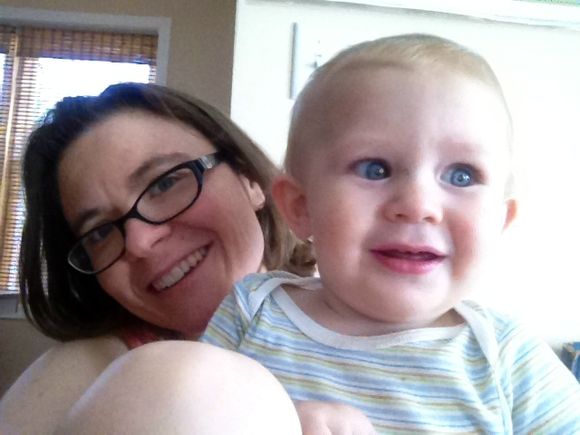
    image from https://bearingblog.com/wp-content/uploads/2011/07/6970e-6a00d8341c50d953ef01538fc5554c970b-580wi.jpg

    Number four is seventeen months old, and his language is — if not quite taking off — definitely bumping along the runway and picking up speed. The unformed "ma ma ma ma ma" babble that has referred to me for many months now has only just crystallized into a clear, two-syllable "Mama." He does not say "no" yet, which is sort of surprising — all the others had "no" early — but he does shake his head emphatically, and when he does he means it. He nods vigorously for "yes," too, with a big smile.

    We tried using sign with all four of our kids, with more or less success. This one wasn't interested until all of a sudden, around the time he started to say "mama," he began using several ASL signs at once: milk, more, toilet (which we also use for "diaper"), and an invented sign that appears to mean "HEY! THE CEILING FAN IS GOING! WHOAAAAA MY MIND IS SO BLOWN!"

    I have heard him use each of the other kids' names on occasion, but not consistently. The only food he calls by name is "egg," and if he is hungry he will bring me a spatula and announce "egg! Egg!" He will also say "nack" if asked if he wants any meal or nibble. And then there is this exciting word-fragment, "vuh-vuh-vuh-vuh," that appears to mean both (1) any animal — especially, but not necessarily, a dog — and (2) also any sort of machine or vehicle that makes a motor noise.

    But the importance of all these words and signs, useful as they are, pales in comparison with the most important word, the first one he learned, and the one he says all day long: "hot."

    "Hot" has been the first word of all four of my kids — it comes easily when every adult around you has a cup of coffee or tea in hand most of the time! — but I have never seen another kid that was so into the concept of "hot." Every time he enters the room, my little guy looks around and quickly identifies every possible source of heat, pointing to each in turn (well, not pointing exactly, more holding his hand up in a sort of "halt!" gesture). Coffee cup on the table: hot. Toaster oven on the counter: hot. Teapot: hot. Microwave oven: hot. Any plate of cooked food set before him: hot. Open dishwasher: hot. Box of birthday candles: hot. Seatbelt buckle: hot. He likes to sit on the floor and stir a wooden spoon in a saucepan, happily chattering "hot hot hot" to himself.

    The most interesting thing about this is that as time has gone on, he has generalized "hot" to mean not only "this thing could be at an elevated temperature" but also "this thing is something I am not supposed to touch." So, for example, Mama's eyeglasses are "hot." Daddy's smartphone is "hot." The bottle of wine on the dinner table is "hot." Sharpies are "hot." Mama's wallet is "hot." The older kids' schoolwork is "hot." And so on.

    "We should teach him how to say 'verboten,'" Mark suggested last night. I know he will figure out the distinction eventually. For now we are just enjoying this extremely cute stage while it lasts. Babies don't keep, you know…


  • Empty cupboard round-up: #1, the trial version.

    Just a few entries (unsurprising for a first-time offering).  But here goes:

    + + +

    Last week I suggested a call for submissions of empty cupboard meals.  My contribution:  Grilled meatloaf with three different veggie side dishes and homemade bread.

    + + +

    MilWife Mama of One at Drops in a Bucket comes up with a nice-sounding title:  "Eating on Empty."  She suggests homemade pizza night:

    Our family has a few go-to meals for when we've run out of food, ideas, or gumption.  One of my favorites is homemade pizza!  Even when our cupboards are otherwise quite bare, we always have flour, yeast, and salt on hand.  Well, and water.  But water's free.  I like free.

    Click through for a recipe for Quick and Easy Pizza Dough and some empty-pantry toppings suggestions.

    + + +

    Lissla Lisslar's Blog features several intriguing combinations.  I don't even know what Hakka sauce is, but if it goes with Thai food, hummus and nachos it must be good.

    + + +

    The always reliable ChristyP of It's a New Day Every Day adapts Linguine with White Clam Sauce from Rachael Ray.  One of my favorite dishes to order in a restaurant — oddly, I've never tried it at home.  That will have to change.  Canned pineapple on the side!

    + + +

    Donna at ecclesia domestica offers lazy pulled pork, served with coleslaw (always a great empty cupboard side dish — cabbage keeps a long time in the crisper!) and the coup de grace:

    The last addition was a side of tater tots.  What can I say about this except that we all love tater tots.  Maybe we shouldn't, but we don't eat them that often and I try not to get too hung-up on these things.!  

    I agree.   They make my family happy, at least.  Pass the ketchup!

    + + +

    Last but not least, Christy P. has a second offering:  a story of fortuitous foraging.  When life hands you free romaine lettuce, make a nice salad.

    + + +

    If you've sent one in just the last few hours, be patient, I'll catch up; I scheduled this post some time before it appeared so it would be sure to be out by dinnertime.   🙂


  • Okay, let’s get that empty cupboard round-up on.

    Consider this post a call for submissions for an empty cupboard recipe round up.  

    It's an experiment — we'll see how many posts I can get for it, and maybe tweak the process next time.  (MilWifeMamaofOne has already sent me one link, thus lighting a fire under me.  Thanks, MilWilfeMamaofOne!)

    Let's say you have about three days to get the posts in, and I'll try to post the roundup on Friday of this week (before dinnertime).

    A recap of the rules:

    1. Write a post about what you managed to throw together when you hadn't yet gotten a chance to go grocery shopping.  
    2. You have to post the whole meal, not just one recipe.  (This is especially important if no actual recipes were harmed during the preparation of the meal.
    3. It's okay if one or more of the components was packaged/prepared/processed, out of season, non-organic, or raspberry Jell-o (TM).  I'm interested in the whole picture of thinking out of the box to create a pleasant dining experience for your family.
    4. Send me a link to your post by Friday morning and I'll get it up on Friday before dinnertime.

    Shall we give it a try?


  • A summer algorithm for a pleasant family meal.

    – Prepare a one-bowl main-dish salad, such as tabbouleh with chickpeas thrown in it, or Indonesian rice salad, or lentil-red pepper-feta salad, or perhaps curried chicken salad or something like that, or a nice Caesar with some grilled steak to throw in.

    – Make sure there's plenty of bread to go with it.

    – Slice up some cheese that the children like.  Cold cuts or salami or pepperoni would also do.  I like to use mozzarella or colby.

    – Have a big bowl of fresh fruit, like strawberries or grapes.  Not a fruit salad — too much trouble.  Just some nice ripe fruit.

    – Give the kids a taste of the salad, and if they don't like it, say "Fine, that means there's more for me!  Have some bread, cheese, and fruit."

    At least, that worked for us this evening.

    Happy Fourth!


  • Internet contract for kids.

    After I wrote the Internet safety lesson I described in a previous post, I learned that my good friend IRL The Road Scholar had put up a lot of good links related to Internet use in the homeschool.  This included a set of "10 digital commandments for kids" in the form of a contract for kids to go over with their parents and sign.  (The Road Scholar's commandments were, in turn, adapted from a set found at Komando.com.)

    I thought the contract was a great idea.  And no, I don't think it's overkill.  Whenever there are complicated permission structures, where the rules are many and detailed, having "the rules" in a written form is good for everybody, so that we can refer back to it to remember exactly what we previously agreed upon.   Also, going over the rules carefully is a way to have a conversation about what the rules should be.  Parents do have authority over their kids, but sometimes kids have good ideas that should be incorporated into the agreement. 

    It's particularly important in areas where kids and teens are learning to exercise freedom responsibly:  internet use, staying home alone, learning to drive a car. In situations like that, we want them to stretch a little bit, so that they can gain experience and (it's to be hoped) wisdom; but we do not want them to stretch dangerously beyond their capabilities faster than their maturity can keep up.   That is complicated and subjective, and in a bigger family it's hard to keep track of where everybody is at a given time.

    Furthermore, I think it's important to include items that protect the child's interests as well.  At some point, I think a parent needs to demonstrate respect for a child's privacy by agreeing to limit blogging about them or writing about them on FB.  So note below that the contract includes language that could let my child ask me to remove or modify blog posts about him.  And I think it's so important that a child be honest about what he or she encounters online, that I think it's reasonable to agree up front that if the child tells us promptly about a potentially dangerous encounter, he will not be punished (though privileges might be reduced; changes in privileges should not be construed as punishments).

    So I took the contract and adapted it for my own family, in which there is an almost-11-year-old boy who is just now getting expanded access to the Internet.  I thought I'd post the text of my adapted contract here.  Feel free to use it or adapt it for your own family.

    Comments are welcome.  We haven't gone over the contract with him yet, so please tell me if you have any feedback or suggestions!  I can still make changes.

    + + +

    Internet and Computer Contract for Kids Under 18

     
    When I use computers, mobile devices, phones, and the Internet, I promise to follow these rules to keep my family, my friends and myself safe.   I will discuss these rules with my parents and initial each section as we discuss them.

    1.  My parents will decide when I am allowed to use the computer, cell phone, Wii or other game system, and the Internet.

    • I will only visit sites they say I can.
    • I will only do things we agree are appropriate.
    • I will log out when they ask me to log out.
    • I will not allow my siblings to log in on my account or use my “time” without permission.
    • I will respect the rules that my friends' parents set for them.  I will not help them break their parents' rules.
    • If I use the Internet while I am away from my parents or at a friend's house, I will let my parents know that I did.  I will tell them about any new games I played.  
    • If I or one of my friends brings a new game or video into the house, I will show it to my parents.
    • I will tell my parents if I accidentally use a device, play a game, or  visit a site I  think they might not want me to use.  I know that my parents will not punish me for accidentally doing this as long as I tell them right away.

    Initial here:   Kid _____     Parent _____

    2.   I will never tell anyone secure information without getting my parent’s permission first.

    • I will not say when I am alone or when the house is empty or tell my family's schedule.
    • I will not tell my family's last name, address, workplaces, passwords, or phone numbers.  
    • I will keep this information about my friends as private as I keep my own information.
    • I will not use the Internet to show, spread, or tell anything private.
    • If I am not sure whether something should be kept private, I will ask my parents.
    • If I want help keeping something private, I can ask my parents.
    • I know that if I ask my parents to keep private a story or a picture that features me, they will respect my wishes.  I can ask my parents to remove information that they have shared about me from social media.
    • I know that it is very easy for secrets to spread once they are in electronic form.
    • I know that any electronic message on the Internet could be read or seen by anyone, forever.
    • If I accidentally reveal information, I will tell my parents the same day so they can act to protect our family.  I know my parents will not punish me if I tell them right away.

    Initial here:   Kid _____     Parent _____

    3.   I will not participate in mean, physically dangerous, or morally wrong activities online.

    • If anyone does or says anything that bothers me, I will tell my parents.
    • I will show my parents if I see material or play a game that 
      • is obscene 
      • depicts real and severe violence or simulates realistic and severe violence
      • shows nudity, meaning pictures of people who are naked or who are showing the parts of their bodies usually covered by bathing suits
      • is cruel
      • encourages people to do things that are wrong or illegal
      • frightens or disturbs me
      • tries to trick me into revealing personal information or do something wrong
      • seems to be a lie
    • I know that my parents will not punish me for accidentally seeing such material if I tell my parents right away.
    • I will not do, say, send, or show anything obscene, illegal, immoral, frightening, or cruel.
    • I know that it is not lying if I use a fake name to protect my identity or if I refuse to tell information to a person who has no right to know it.  I know that it is always okay for a kid to refuse to tell any information over the Internet.
    • I know that search engines and online information sources such as Wikipedia could lead me to sites that are obscene, cruel, dangerous, frightening, or tricky.
    • I know that much of the information on the Internet is untrue or misleading.
    • If I want to search for information on the Internet at home, I will let my parents know before I start.  I will always search on the computer in the living room where they can observe me and help me.
    • If I want to use the computers in the library to search, I will use the computers set aside for kids in my age group (“kids” or “teens.”)

    Initial here:   Kid _____     Parent _____

    4.   I will never post or send pictures of myself, my family or friends without my parents' permission.

    • If I set up a blog or online profile, I will tell my parents where it is and how they can read it.
    • If I join a social network, mailing list, file or sharing site, or group of any kind, I will invite my parents to join.
    • I will work with my parents to set privacy and sharing settings that satisfy them.

    Initial here:   Kid _____     Parent _____

    5.   I will never, ever meet with anyone I've talked with online without first talking to my parents.

    Initial here:   Kid _____     Parent _____

    6.   If my parents ask for my password, I will give it to them.

    • I will never give out any passwords I know to any others, not even friends or siblings.
    • If I find out a password that belongs to my parents, I will tell them that I know it.

    Initial here:   Kid _____     Parent _____

    7.   If I want to download anything, I will ask for permission FIRST.

    • I know that some applications, games, music, movies, or programs are unsafe to download.
    • I know that I must pay for these things and that the cost is sometimes hidden.
    • I know that sometimes “free” content is really stolen.

    Initial here:   Kid _____     Parent _____

    8.  I will not try to win free things or buy things on a phone or on the Internet. 

    • If I get a message that I have won something, I will show my parents.
    • If I get an email asking me to enter a password or other information, I will tell my parents.
    • I will not forward messages that tell me bad stuff will happen to me if I do not forward them.
    • I will not click on any advertisements.  If I accidentally click on an advertisement, I will close any new windows that appear and go “back” to the last page I was viewing.

    Initial here:   Kid _____     Parent _____

    9.   I will not change settings, install software, or open my parents' files without permission.

    •  If I think I might have accidentally done this, I will tell my parents right away so they can fix it.
    • I know that my parents will not punish me for accidentally doing this as long as I tell my parents right away.

    Initial here:   Kid _____     Parent _____

    10.   I understand that my parents allow me to use the Internet, computers, and games on the condition that I do not hide from them what I do. 

    • My parents may examine the computer, my phone or any other device that they or I own.
    • They may see where I have gone on the Internet, what emails and text messages I’ve sent and received, the things I’ve downloaded, or what I do. 
    • I will not erase my browsing history or record of sent messages without permission.
    • I will BCC one of my parents on every email I send until they set different rules for me.
    • I promise not to turn off or alter any parental-controls settings or software installed by my parents.
    • I will not close a window when my parents come into the room to hide something I’m viewing.
    • If I use code words or abbreviations, I will tell my parents what they mean.
    • If I think I may have accidentally done something I am not supposed to, I will tell my parents right away.
    • If I want to do something that I am not sure my parents would approve of, I will ask them first.

    Initial here:   Kid _____     Parent _____


    For the child:

    • I have read the above, and I will follow these rules.     
    • If I do not follow these rules, I understand that my parents might reduce my privileges or punish me.
    • I understand that “reducing my privileges” is not necessarily a punishment.  My parents might reduce my privileges for any reason in order to keep our family safe.
    • I also understand that even if my parents do not punish me, my actions on the Internet might have consequences from which my parents might not be able to protect me or from which they might choose not to protect me.

    _____________________________________

    Child's signature                                 Date

    For the parents:

    • I agree to let my child use electronic devices as long as they follow these rules.  
    • I agree to answer any of my child's questions that will help him or her use the Internet safely and responsibly.   
    • I agree to make changes to the rules clearly and in writing, and keep them with this contract, so that my child always knows what the rules are.
    • I agree not to punish a child for accidentally breaking a rule, as explained above, as long as he promptly tells  a parent about it.
    • I agree to discuss my child's ideas for safely increasing privileges as the child learns to use the Internet responsibly.

    ____________________________________

    Parent's signature                               Date

    _____________________________________

    Parent's signature                                Date                 


    + + +


  • Heart to heart.

    Earlier this month I had a conversation with some other women in my parish about various devotions that one might take up.  I had been bemoaning how I can never make it through a novena without forgetting, and how I lack the courage to try going to daily Mass with the children, and that sort of thing.  And then I was reminded of the Five First Saturdays for reparation to the Immaculate Heart of Mary — a devotion I hadn't really thought about in several years — and I realized that I had absolutely no excuse not to at least try to make the FFS devotion, right now at exactly this point in my life.  

    Because (a) Saturday mornings are a time when I can usually rely on Mark to care for the kids,

    (b) I live within easy driving distance of a parish that actually has a Saturday morning daily Mass (even though, fyi, a Saturday night vigil Mass is sufficient for the devotion)

    (c)  it's only five, how hard can that be, and

    (d) maybe my situation will change soon and it'll suddenly get harder to make it to Mass on Saturday, who knows?

    So I resolved to give it a shot on the very next first Saturday.  Which is today!

    OK, so here I am, up and ready to head off to Mass.  And you know what I know now that I didn't realize until only a few hours ago?

    It's the Feast of the Immaculate Heart of Mary!

    Cool!

    Now I really have no excuse.

    Here's something I wrote on the same feast last year:

    I think when we speak of a "heart" that can ponder, a "heart" that can love, we are speaking of something natural, embodied, enfleshed.  Often we speak of the flesh as being opposed to things of the spirit.  The flesh, our bodies, tempt us to turn away from spiritual goods and crave selfish things.  But haven't you noticed that our bodies tempt us to love as well?   We have natural inclinations (for example) to care for our offspring, hormones that surge to reward us for nursing our babies, that overflow into strength and aggression to help us defend them from harm.  Could that be the heart that loves — the biochemical, physical mechanisms that urge us to lay down our lives for the ones we are attached to, that urge us to attach to each other in the first place? 

    A body that tempts us to love:  could this be the "heart" we mean?

    If so… this is a kind of love unknown to the angels — a kind of love unknown to the universe before the advent of the human race.  God MADE this kind of love,  the love of the human heart; He did not possess it according to God's eternal nature.  Father, Son, Holy Spirit had no heart, no body with which to love as bodies love.

    At least not until the Incarnation.

    It is interesting to think that upon the Incarnation the Son of God received for the first time a nature through which He could be tempted by Satan in the desert.  Through that nature He could also, for the first time, be tempted by the flesh to love.  God's love is perfect and always was perfect; and yet in creating human beings He created a kind of love that He did not possess, and that He only made his own upon His conception.  Think of the baby relaxing into his mother's arms; of the frightened toddler fleeing to the safety of his father's side; the grown man in justified anger, driving corruption from his Father's house; oxytocin, cortisol, testosterone; the heart, the body tempted to act in love.

    Odd, but true: that even though the Son of God, being eternal, pre-dates the Mother of God, in a sense is His mother's own creator; but Mary's heart pre-dates the Sacred Heart.  All that it is truly came from her.  And so to take a pious formula — to "flee to the shelter of the Immaculate  Heart of Mary" is to say, Shelter me where you sheltered the Lord; form my heart in the womb where the Sacred Heart learned to beat.

    Have a blessed Feast (and, in the USA, a safe and fun holiday weekend.)


  • Literature-based American History (II-b): Topical survey of the 19th-century.

    In Part II-a, I wrote about why I divided the second year of American history into two semesters and treated the Civil War all by itself, and I gave the syllabus I used for that first semester on the Civil War. 

    In the second semester, that serious business being out of the way, we moved on to other topics for the rest of the year.  They don't really arrange themselves chronologically very neatly, so I took the nineteenth century (roughly; I went from "the end of the war of 1812" to "the U. S. entry into the Great War") as a single chunk, and then covered several different topics.  I would go on to use that same approach with the twentieth century the next year (more on that in another post, natch.)

    The flow of topics went like this:

    • Pre-Civil War foreign policy and conflicts
      •  Monroe Doctrine (dealings with Europe)
      •  dealings with Indian nations, such as Seminole War, Trail of Tears, etc., Jackson
      •  dealings with Mexico/Texas
    • All that pioneer stuff – Western expansion
      • Midwest/Great Plains settlement
      • Oregon Trail, Santa Fe Trail, Mormon Trail, etc.
      • Relations with Indian nations during the Western expansion period
    • Growth of cities
      • Midcentury wave of European immigration
      • Working conditions
    • Political/social movements
      • Labor unions
      • Urban social welfare
      • Women's suffrage
    • Everyday life
      • On the frontier
      • Children's schooling
      • National parks
      • New technologies
    • Post-Civil War politics
      • Spanish-American War
      • Presidents


    Point one: selection.

    If it all seems a little haphazard, that's because it is.  If it seems that something very important has been left out, that's because it probably was.  There are only eighteen weeks in which to do it, after all.   The only way to cover everything is to cover nothing in depth.


    Point two:  This is not a neutral list.

    Some of my choices betray my own values (as I hope they should)!  For example, I made a point of including the establishment of national parks as an important historical and cultural mark.  That's because it's something that distinguishes the U. S. — other countries haven't done nearly as well in setting aside land in a more-or-less natural state for public use.  If there is such a thing as an "American character," I think our relationship with our lands is something worth exploring in depth.   It's not all gold-digging and monoculture, you know; Americans have a strong naturalist and conservationist tradition as well.  Also because our family enjoys outdoor activities, often in national and state parkland, and I wanted the kids to understand and appreciate why we have national parks to go to.  

    (Love of country may be out of style these days, but when I list my reasons to be grateful that I am an American, I don't have trouble coming up with items; and national parks are one.)


    Point three:  How I deal with teaching controversial topics to middle schoolers.

    Remember, I'm working with middle schoolers — I had two 4th-graders and one 6th-grader for this year.  At this age, I think, they are only just beginning to be ready to stake a position and defend it.  So I never asked them to do this.  I avoided putting them on the spot with "What do you think is the right choice?  Do you think this was a good law or a bad one?  Do you think such and such a person acted rightly or wrongly?"

    Instead I tried  to introduce at least two different points of view and make sure that the kids all understand two concepts that are sadly lacking in our public discourse:

    1.  Reasonable people can come down on different sides of most controversial issues.  
    2. Members of distinctly visible groups — like "workers," "black Americans," "women" — don't always line up on the same side of political questions. 

    So, instead of telling me what their position was, I required the kids to list reasonable arguments and philosophies held by people on different sides of a position.  For example, I'd want them to be able to tell me why some 19th-century people would think a law establishing a minimum wage was good for workers, business owners, and the American public; and then to come back and tell me why establishing a legally enforced minimum wage might, in the views of others, be bad for workers, business owners, and the American public.  (Note my refusal to frame the question as "Why did workers support a minimum wage and business owners fight against it?")

    Being able to competently and accurately explain a position — whether you hold it or not — is a prerequisite for defending and promoting a position you do hold.  The former, being a more fundamental skill, is what I emphasized.


    Preliminaries aside:  what did we read?


    SEMESTER II

    Week 19
    ——-
    Dangerfield G., Defiance to the Old World (explains the historical world context of the Monroe Doctrine).  First part of the book up to where Andrew Jackson comes in.
    Begin learning the names of the first 16 presidents in order.

    Week 20
    ——-
    Finish Defiance to the Old World
    Discuss Monroe Doctrine
    Hakim volume 4, chapters 18, 20, 24, 25, 26 about Jackson, the trail of tears, the 2nd Seminole War; chapter 33 on the series of presidents
    Worksheet putting the first 16 presidents in order

    Week 21
    ——-

    Downey, Texas and the War With Mexico (parts)

    Week 22
    ——-
    Downey, Texas and the War with Mexico (about the Alamo)
    Cousins, M., We Were There at the Battle of the Alamo (fiction)
    Discuss the Texas Republic
    Havighurst, First Book of Pioneers (first part.  This book deals with the settlement of Southwestern Ohio, where my kids' grandparents live.  If you live in or have ties to another part of the Midwest or Great Plains, it might be good to pick something else specific to that locale)

    Week 23
    ——-
    Havighurst, First Book of Pioneers (finish)

    Week 24
    ——-
    Tunis, Frontier Living, chapter 13 "The Harried Saints" (about the Mormon trail.  Because one of the children I teach is a member of the LDS church, it was very important to me to find a source that treated the people who participated in the Mormon migration positively or at least neutrally; many books, especially older ones, are surprisingly dismissive or hostile towards them.  At the same time, I didn't want to use material produced by LDS organizations.   This chapter fit the bill very nicely, not getting into details about religious differences, but positively appraising the hard work and endurance of the people who followed the Mormon trail.  And all the books by E. Tunis are very cool for other reasons.  If I had discovered him in time I would have used his book on the Colonial period in the previous year.)
    Draw the Mormon trail on the US Map
    Label Mississippi R., Platte R., Missouri R., Great Salt Lake; Nauvoo, IL; Salt Lake City, UT; Council Bluffs, IA
    Freedman, The Life of Crazy Horse (begin.)  I decided to use a biography of Crazy Horse as our entry point for discussing the encounters between the Indian nations of the Great Plains and settlers from the East.  This bio is long and I had to stretch the reading over several weeks, but it's well-written, interesting, and attractively illustrated.

    Week 25
    ——-
    Trace the Oregon Trail on the map from Week 24
    Tunis, Frontier Living, "The Bitter Road to Oregon"
    Freedman, The Life of Crazy Horse (continued)

    Week 26
    ——-
    Freedman, The Life of Crazy Horse (continued)
    Discuss Sand Creek massacre
    Wells, R. Streets of Gold (this is a picture book drawn from an immigrant's autobiography)
    Sandin J., The Long Way to a New Land (an easy reader, again about immigration)
    Heaps, W. A., The Story of Ellis Island (parts; this is an extremely cool book, with lots of details about what it was like for people who came through the Ellis Island bureaucracy, and I would have used more of it except it is written at too high a level for these kids)
    Discuss immigration in mid-to-late 1800s from Europe

    week 27
    ——-
    Littlefield H., Fire at the Triangle Factory (an easy reader)
    McCully E. A., The Bobbin Girl (pretty good picture book about one of those paternalistic factories that employed many young women and provided housing;  gives an entry point into the idea of unions and strikes, and also into women's economic situations)
    Hakim vol. 8, ch 16, "Harvest at Haymarket."  Discuss: maximum workday; minimum wage; minimum working age; safety regulations; tension between the economic costs and benefits of these rules.  Discuss strikes and unions.

    Began memorizing important dates:  1492, 1776, 1860, 1865

    Week 28 (two sessions this week)
    ——-
    Klingel, C., Clara Barton:  Founder of the American Red Cross
    Wooldridge, When Esther Morris Headed West: Women, Wyoming, and the Right to Vote
    Fritz, J. You Want Women to Vote, Lizzie Stanton?
    Discuss suffrage
    Everyday life in the 19th century:
    Tunis, Frontier Living, about oxen, canal locks, Iowa squatters
    Hakim vol 5, ch. 19

    Week 29
    ——-
    Bial R., One Room School
    Discuss how schooling has changed since then
    Douglas W. O., Muir of the Mountains (biography of John Muir.  Oh I love this book.  John Muir is a fascinating figure.)
    Discuss extinction of passenger pigeon; modern management of natural resources; Muir's motivation for abandoning his career in engineering and turning to the outdoors

    Week 30
    ——-
    Finish reading Muir of the Mountains

    Week 31
    ——-
    off this week — we made it up in advance in Week 28

    Week 32
    ——-
    Levine, I. E.  Inventive Wizard:  George Westinghouse (first part).  Why do yet another Thomas Edison biography when instead you can read about George Westinghouse?

    week 33
    ——-
    Levine, I. E. Inventive Wizard:  George Westinghouse (continued)

    Week 34
    ——-
    Levine, I. E. Inventive Wizard: George Westinghouse (finish)
    Fritz, J. Bully for you, Teddy Roosevelt!  (begin)

    Week 35
    ——-
    Fritz, J. Bully for you, Teddy Roosevelt! (finish)
    Discuss Panama canal, the vice presidential succession to the presidency
    Memorize that McKinley was president in 1900 (just a milestone for the turn of the century to help remember dates)

    Week 36
    ——-
    Hunter V., Stagecoach Days  (this really belonged earlier in the semester, but it was late coming from the library.)


  • Translation matters.

    Interesting comparison of the translation of certain terms in the KJV and the NIV.  Everybody's got an agenda.

    It sort of reminds me of how, in Story of the World, which is mostly a good history book, Catholics are "Christians" when they behave or display intelligence, and "Catholics" when they don't.

    And, by the way, is not the masthead/title combo of that blog one of the best you've seen in a while?

    h/t Riparians at the Gate


  • Pondering a recipe-roundup: empty cupboard meals.

    I've been bouncing around the idea of trying to host a recipe roundup, once or twice a month.  (You know the drill — write a recipe post, send me the link, I'll put it all together into a post.)  But I've been searching for a theme that hasn't been done to death.

    Today I think I might have hit upon it.  What do you think about an "empty cupboard" roundup?  I'm not sure how often — once a month or biweekly — and it doesn't lend itself to an alliterative name, maybe you all could help me with that — but here's what I'm thinking:

    The idea is to write a post about what you managed to throw together the night before you go grocery shopping.  What can you make from your pantry staples?   It's easy to eat fresh, local, seasonal, interesting, and impressively right after you come back from the farmer's market (or the co-op — or even the SuperValu).  What can you do at the end of the week, from your leftovers, odds and ends, and emergency rations?  What have you got to choose from?  What did you decide to make and why?

    Here's an example from today.  I'm pretty good about meal planning, but I often leave the last couple of days blank because I know I'll have things to use up; on the other hand, sometimes we eat up all the leftovers and I have to get suddenly creative.  I'm about to leave to go grocery shopping right after I finish this post.

    Before dinner, the only fresh veg I had in the fridge was a bunch of broccoli (and it was starting to look a little sorry, so raw was out).  No fresh fruit left except some wrinkly apples, an orange, and a lemon.  We had some leftover enchiladas and arroz con pollo, but we were kind of tired of both and needed a break (it'll still be good for lunch tomorrow).  

    So I made this:

    • Grilled Meatloaf (double onion, since I had no green pepper — there's always ground beef in my freezer)
    • Steamed broccoli with a squeeze of lemon and a drizzle of olive oil
    • Plain Fordhook lima beans cooked from frozen — just a little salt and pepper
    • A can of cut beets, drained and briefly marinated in a dressing of orange juice, balsamic vinegar, and fennel seeds
    • Homemade bread and butter.
    • Oh yeah, and rum and coke for the grownups.  (Hence the need for me to churn out a couple of blog posts before I go shopping)

    I think it turned out pretty great, and not bad for a day when I didn't know what I was going to make until about three-thirty.

    Anyway, what would you say to having a roundup on a semi-regular basis?  I think it would be a nice way to explore our creativity, celebrate frugality, and get over some of our hangups about appearing as if we only occasionally rely on convenience foods.  Also share some ideas.  And even if your answer is something like, "frozen pizza — again," well, why not fess up?  If you had an ice-cold beer on the side, you could at least tell us about that.  In fact, I'll make one of the rules be you have to tell the whole meal, not just one interesting recipe.

    What say you?  How often?  Which day of the week (or month)?  And furthermore, what should I call it?


  • Literature-based American history (II-a): 1812 through 1914, The Civil War in particular.

    Part I, prehistory through 1812, is here.

    + + +

    Stipulation:

    The American Civil War is a huge topic.  

    You could, if you wanted to, spend a whole year of social studies on the Civil War alone.  Not only is the topic huge, but — almost more importantly for my purposes — there is a lot of really good children's literature out there.  

    It's also a topic that is necessarily solemn.  And that is why I chose to avoid a purely chronological approach to the time period.  I had about a hundred years of history to cover in this year, and of course things happen in the 19th-century U.S. that seem to be part of a different world.  Soldiers fight in foreign wars.  Pioneers cross the Great Plains.  The railroad makes its way across the continent.  Various inventions transform ordinary lives.  But even though these things are all intertwined with the sorry history of chattel slavery and the great purging conflict that burned it away and the aftermath and the scars that still remain, I hated to interrupt the main thrust of the narrative for jaunty little side trips about stagecoaches and electric light bulbs.  

    So I decided to divide the year into two semesters.  In the first semester, I tried to encompass the American Civil War, including some background and also the political and social aftermath through Reconstruction.  Within that semester, the approach is chronological, out of necessity — because it does tell a coherent story, or narrative, of a kind.  (With the caveat that the whole history must be simplified drastically for any one person to grasp it as "a" story.) In the second semester, I considered other changes that happened during the nineteenth century, with an approach that was topical, rather than straightforward chronological.

    See, I figure that eventually these kids are all going to do a one-year survey of American history.  I don't need to do it now while they're little.  Right now I need to get them interested in the stories.  

    Meanwhile, a note about textbooks.

    Even with a literature-based approach to history education, I think it's helpful to have a "spine" — a textbook, to put it bluntly — that you can draw from to fill in any important gaps in the literature that is available to you.  Sometimes you just can't find a "good" book about this or that important topic, and the textbook will have to do.  It's also a good reference for what happened when and where.

    In my first year, I used the materials from Seton, which worked pretty well from my perspective because they provided material about the Catholic heritage that's often missing in the Pilgrim-o-centric materials that are usually available on the colonial period.  But I've never been particularly impressed with the literary quality of the Seton textbooks.  Still, I was happy to use them as a supplement.

    Between the first year and the second I discovered Joy Hakim's multivolume American history entitled The History of US.  I switched to Hakim's books for the spine after that.  (Also, by the end of the first year, I was co-schooling more heavily, and as a result, teaching children who are being raised in non-Catholic faiths.  So while I continued to make sure that the material we used wasn't exclusively WASP-centered — and it prompted me to take more pains to talk about the historical importance of Quakers and Mormons, both of which are pretty significant — I wasn't looking for religious content in a reference spine anymore.)   I mention this to explain that I didn't ditch Seton because I thought it was bad or anything, although I do prefer the tone and style of Hakim's books.   Tone and style of a textbook are much less important when it's being used as a supplement than when it's basically the only book you're using.  I imagine that Seton's materials will work very well as reference spines for Catholic families.  Hakim was the better choice for our co-schooling situation.

    So what did we use?   In this post I'll write about the Civil War material, and I'll save the second semester for another post.

    SEMESTER I:  THE AMERICAN CIVIL WAR

    Week 1
    ——
    Hakim Vol 4 on Missouri Compromise
    Hakim Vol 5, chapters 32, 33, 34
    Swain G, Dred and Harriet Scott:  A Family's Struggle for Freedom (first half).   I prefer telling specific stories to generalities.  It's true that Dred and Harriet Scott led unusual lives and aren't representative of slaves in general; but don't we all lead unique lives?  None of us are "representative."  Truth is in the specifics.  Anyway, some points that this book gets across:  (1) Slavery screwed up people's family lives.  (2) Slavery happened in the North as well as the South, and Northerners as well as Southerners owned slaves.  (3) Slaves were not devoid of agency and could and did use the legal system to exert what rights they did have.

    Week 2
    ——
    Continue with Swain G. Dred and Harriet Scott

    Week 3
    ——
    Kent Z., The Story of John Brown's Raid on Harpers Ferry
    John Brown's speech upon being sentenced to death 

    Much fruitful discussion can be had about John Brown.  I won't presume to tell other people which aspects of his story to emphasize.

    Week 4
    ——
    Douglass F, adapted by McCurdy.  Escape from Slavery:  The Boyhood of Frederick Douglass (This is a children's adaptation of Frederick Douglass's autobiography.  You could work with the original rather than the adaptation if the children are older.  This particular adaptation is well done.)
    Winter J., Follow the Drinking Gourd  (We included some discussion of the legends about the Underground Railroad that are fairly unsupported by data.  People love a good story about secret messages encoded in quilt blocks or laundry hanging on the line, but not all the stories seem really to have happened.)
    Field trip to Fort Snelling Historical Site:  Civil War Days (Depending on where you live in the U. S., there may be some very cool historical sites near you.  I live near Fort Snelling, which is notable because Dred Scott lived and worked there, and his time there, enslaved outside "slave states," formed part of the basis for his lawsuit.  Although annoyingly, the reenactors running "Civil War Days" seemed not to know much about it.  They were more into battlefield amputations and Morse code.)

    Week 5
    ——
    Kamma A., If You Lived When There Was Slavery in America  

    Week 6
    ——
    Levine E., Henry's Freedom Box  (The story of Henry Brown, who mailed himself north)
    Chapter 1 of A Separate Battle:  Women in the Civil War (about abolitionists H. B. Stowe, A. Grimke, S. Truth)
    "Ain't I a Woman?" speech by Sojourner Truth

    Week 7
    ——

    Here we start some biographies.  Lincoln is a necessity.  Robert E. Lee is also worth getting to know.  He raises the question:  What use is being an honorable person if you exert your honor on behalf of evil?

    St. George, J., Stand Tall, Abe Lincoln
    Material from several different books about the life of Robert E. Lee (I couldn't find one single biography that I liked enough to use exclusively)
    parts of James Daugherty's Abraham Lincoln

    Week 8
    ——

    Here we start discussing the Civil War itself.  I preferred to cover only a few battles, but to really spend time on them, with maps and showing the movement of troops and stuff.  I wanted to give the kids a taste of genuine military history.  

    Rapaport D., Freedom Ship  (About Captain Robert Smalls, a slave who seized the Confederate ship he piloted and delivered it to the Union Army)
    parts of Foster, G. Abraham Lincoln's World (election/inauguration; Scott, Lee)
    DuPuy, The Military History of Civil War Land Battles (introduction)  
    Use DuPuy to learn the symbols and vocabulary of battle maps (artillery, cavalry, infantry, flank, etc.)
    Kent Z., The Battle of Bull Run
    Discuss graphic in Hakim comparing the assets and populations of the Union and the Confederacy at the start of the Civil War

    Week 9
    ——
    Pratt F., The Monitor and the Merrimac (first half, up through the Battle of Hampton Roads).  I cannot praise this book enough.  We only had time to read half of it, but later my 10-year-old finished it in his spare time.

    Week 10  – Life on the battlefield.
    ——-
    Make hardtack for snack
    Polacco P., Pink and Say
    Murphy J., The Boys' War, parts about drummer boys, camp life, food, sutlers, supply issues and how they differ as the war lengthens

    Week 11
    ——-
    parts of Daugherty's Abraham Lincoln about Second Bull Run; replacing General McClellan; the drafting of the Emancipation Proclamation; Antietam
    Part of DuPuy, The Military History of Civil War Land Battles, about Antietam and how McClellan failed to drive Lee back
    Text of the Emancipation Proclamation; discuss its meaning.  Why did Lincoln free slaves only in the rebellious parts of the country?
    Watch DVD "Battle of Stones River" (Murfreesboro)  (We picked this up at the interpretive center at Murfreesboro when we happened to be in Tennessee for a family wedding that year.)

    Week 12
    ——-
    The Gettysburg Address (picture book illustrated by McCurdy)
    Dupuy, The Military History of Civil War Land Battles, about the battle of Gettysburg
    Elish, book about Gettysburg
    Discuss battle maps and troop movements at Gettysburg
    A Separate Battle:  Women in the Civil War, chapters on hospital duty and suffering on the home front
    Daugherty's Abraham Lincoln, parts on draft riots, Lincoln's pardoning of deserters, the "Bixby letter," and the Gettysburg address

    Week 13
    ——-
    Kent Z., Sherman's March to the Sea
    Discuss concept of "total war" and looting
    Kantor, M., Lee and Grant at Appomattox (first half).  This book is great for a couple of reasons.  First of all, it paints fine portraits of Lee and Grant.  Second, it includes a fairly exciting story of notes passed back and forth across battle lines as Lee tries to figure out how he's going to surrender.  Third, the terms of surrender are described in great detail, in a way that leaves the reader impressed by both men's characters.  It's a novel-length treatment of a subject that gets only a paragraph in most kids' textbooks.

    Week 14
    ——-
    Kantor, M., Lee and Grant at Appomattox (second half)
    Kent, Z., Ford's Theater and the Death of Lincoln  

    Notice all the books by Z. Kent?  These are from the "Cornerstones of Freedom" series, all of which are good sources.

    Week 15
    ——-
    Harness, C., biography of George Washington Carver (parts that fit into the post-civil-war time period).  This biography gives us a good chance to talk about life for African Americans in the post civil war south.
    Discuss Reconstruction, Jim Crow laws, and legally enforced segregation
    Joy Hakim, Volume 7, chapters 1, 2, 3, and 4 about Reconstruction, Andrew Johnson, "Presidential Reconstruction," and the concept of states' rights

    Week 16
    ——-

    Knowing that next year I have the Civil Rights movement to cover, I wanted to show the basic dichotomy of philosophy that appears here in the persons of Booker T. Washington and W. E. B. DuBois.  Two threads of "conservative" and "progressive" black America appear vividly here and can be carried forward into the twentieth century.  Caveat about "it's really much more complicated than that," etc.  My main point:  There isn't just one way to think about the African-American experience.

    Harness, C. continue the biography of G. W. Carver, up through 1914 or so
    Up From Slavery by Booker T. Washington — selections from Chapter II, "Boyhood Days;" III, "The Struggle for an Education;" entire chapter V, "The Reconstruction Period;" VII "Early Days at Tuskegee;" X "A Harder Task than Making Bricks Without Straw"
    Discuss B. T. Washington's philosophy of self-reliance and disdain for superficial success
    Discuss appropriate terminology for ethnic groups as used in Booker T. Washington's 1901 writings and as is considered appropriate today 

    Week 17
    ——-
    Hakim, volume 7, chapter 32 on Jim Crow laws
    Discussion of Plessy v. Ferguson  (this is absolutely necessary for comprehending Brown v. Board of Education next year, so we looked at the Supreme Court decision in detail)
    Freedman, S., Ida B. Wells-Barnett and the Anti-Lynching Crusade
    Discuss the poem, "Booker T. and W. E. B." by D. Randall.  We discussed whether we thought the poet had fairly characterized Booker T. Washington's philosophy.  The poem served as a transition from Booker T. to W. E. B.

    Week 18
    ——-
    Scott, Memorial Day
    Discuss why we have memorials for veterans and for those who fall in war
    Parts of McKissack, P., biography of W. E. B. DuBois:  chapters 1,2 about early life, chapters about Booker T. Washington, chapters about his book The Souls of Black Folk
    Discuss the differences between the backgrounds of DuBois and Washington
    Discuss how the differences between their backgrounds influenced their differing philosophies
    Short excerpt from The Souls of Black Folk to get a sense for the difference in writing style between DuBois and Washington.

    (It's a little tough to teach Booker T. Washington and W. E. B. DuBois equally to middle schoolers, because BTW writes much more approachably, in my opinion.  DuBois's writing is more high-flown and abstract and difficult to get.  I would say that BTW's work is high school level — so it can be carefully selected and presented to interested middle schoolers — but DuBois's work is college level, and I don't think the middle schoolers can grasp it.  But they can, I think, grasp a comparison and contrast of the two men's philosophy, and see where they can be reconciled and where they can't, and understand why both philosophies continue to be appealing today.)

    OK, on that note, I'll save the second semester (roughly, "The nineteenth century, but not the Civil War parts") for another post.

  • Literature-based American History (I): Prehistory through 1812.

    The weather is gorgeous, and it's the first real week of summer vacation, but I have one seven-year-old with pneumonia, and so we're all more or less stuck around the house this week. 

    I guess the timing isn't too bad, since I have a number of things I want to do to put the school year properly to bed.  I'm writing up a little summary of the year for the two older kids — sort of a report card — and trying to put together a final summary of my three-year literature-based American History survey, which I finished just a couple of weeks ago.

    There's another place where the timing is good.  I'm going to be starting all over again in the fall teaching "Prehistory through 1812" to  another crop of children.

    Anyway, I've posted on this before, but I thought I'd share my American history curriculum choices.  This is the first year:  Pre-history through 1812.  I've provided some links to other posts I've written.  Incidentally, beside what's here, we also used appropriate pages in a good history encyclopedia — Usborne has one, for example.

    I should note that I used a couple of materials from Seton in order to supplement the program with some Catholic heritage (such as, for example, the notion that converting Mexico to Christianity was on balance a good thing).   When I started this program I was not working with any other families on it — so I still have to run the Catholic materials by the parents of the other children I'm teaching, who are not Catholics, in order to find out whether I should use them with their children, or save them for use just in our own family.  I will likely draw heavily, too, from Joy Hakim's The History of US,  which I didn't discover till I was doing the second year.

    So here goes…

    American History I

    Unit 1. First Immigrants and Native Peoples   (4 weeks).  More detail in this post.

    • Fradin, Hiawatha, Messenger of Peace       
    • Yue, The Wigwam and the Longhouse   [Note:  There are a number of books by Yue about historical housing structures.  They are all good.]
    • Bauer, Story of the World, Volume II, Ch 32 "The American Kingdoms"
    • Seton, The Catholic Faith Comes to the New World, Chapter One, "The Dawn of History"
    • Seton, TCFCTTNW, Chapter Two, "The Norsemen"
    • SOTW, part of chapter 14, "The Arrival Of The Norsemen"
    • SOTW, Chapter 33 "Spain, Portugal, and the New World"

    Unit 2.  Europeans Get Interested In The Americas  4 weeks.  More detail here.  Particularly if you want to know how I handled the "Columbus problem."

    • Seton, TCFCTTNW, Chapter Three, "The Holy Land and Beyond"
    • SOTW Chapters 31, 41, 33, 28
    • A Child's History of the World Chapters 62, 63
    • Maestro, The Discovery of the Americas      
    • Optional:  Fritz, Around The World in a Hundred Years:  From Henry the Navigator to Magellan
    • Optional:  Fritz, Where Do You Think You're Going, Christopher Columbus?

    Unit 3.  The Spanish, French, Dutch, and English Settlers  (4 weeks).  More detail here.  Including what I decided not to use, and why.

    • Seton, TCFCTTNW, Chapter 5 "The Spanish Influence"
    • Jones, Protector of the Indians (novel length)  – finding this is my pride and joy.  It is a biography of Fray Bartolome de las Casas.  Even if you can't find the biography, studying him would be totally worthwhile.  
    • Whiting, Junipero Jose Serra 
    • Seton, American History for Young Catholics, Chapter 3, "The Conversion of Mexico" 
    • Seton, AHFYC, Chapter 4, "St. Augustine, Oldest City in the U. S."     
    • Seton, TCFCTTNW, Chapter 6, "The English Settlers"
    • SOTW Chapters 40, 41:  "New Ventures to the Americas," "Explorations in the North"
    • Seton, TCFCTTNW, Chapter 7, "The French, Dutch, and English Settlers"
    • Orfeo, St. Isaac Jogues:  With Burning Heart
    • Foster, 1620:  Year of the Pilgrims    
    • Dalgliesh, America Builds Homes     
    • Fritz, Who's Saying What in Jamestown, Thomas Savage? <–Note:  Includes non-sucky story of Pocahontas

     Unit 4.  Colonial Expansion and the Western Frontier  2 weeks.  

    • Seton, TCFCTTNW, Chapter 8, "Colonial Expansion"
    • Foster, The World of William Penn (1660-1718)   
    • Daugherty, Daniel Boone (fairly long)     
    • Gridley, Pontiac           

     Here's more detail, including a discussion of the surprisingly balanced treatment that Daugherty gives the Shawnee.

    Unit 5.  Life in Colonial America  (4 weeks)

    • Seton, TCFCTTNW, Chapter 9, "Life in Colonial America"
    • Foster, George Washington's World:  I, "When George Washington Was A Boy"
    • Haskins, Building a New Land:  African Americans in Colonial America (covers wider time period, though.)  James Haskins is an author I returned to again and again over all three years for material about experiences of African-Americans.  
    • Schaun, Everyday Life in Colonial Maryland
    • Benjamin Franklin, The Whistle     
    • D'Aulaire, Benjamin Franklin   
    • Meadowcroft, Benjamin Franklin  (optional; novel-length)  
    • Pinkney, Dear Benjamin Banneker
    • Benjamin Franklin, "A Narrative of the Late Massacres, in Lancaster County, of a Number of Indians, Friends of this Province, by Persons Unknown" 1764 

     More detail here.

    Unit 6.  The French and Indian War (1 week)

    • Seton, TCFCTTNW, Chapter 10, "The French and British Struggle"
    • Foster, George Washington's World:  II, "When George Washington Was A Soldier"


    Unit 7.  Setup of the American Revolution   (5 weeks)

    • Seton, TCFCTTNW, Chapter 11, "Liberty and Justice For All"
    • Foster, George Washington's World, III.  "When George Washington Was A Farmer"
    • Fritz, Can't You Make Them Behave, King George?  
    • Schanzer, George vs. George        
    • Fradin, The Boston Tea Party      
    • Fritz, And Then What Happened, Paul Revere?
    • Fritz, Where was Patrick Henry on the 29th of May?      
    • Henry, Patrick, speech:  "The War Inevitable"
    • Fritz, Why Don't You Get A Horse, Sam Adams?  <— my very very very favorite Jean Fritz book
    • Jefferson, "A Summary of the View of the Rights of British America"

     More detail here including some discussion of other good books that I didn't use for one reason or another.

    Unit 8.  The American Revolutionary War  (4 weeks)

    • Seton, TCFCTTNW, Chapter 12, "The American War of Independence"
    • Millender, Crispus Attucks, Boy of Valor (selected chapters)  
    • Seton, TCFCTTNW, Chapter 13, "The Tide Turns"
    • Foster, George Washington's World, IV.  "When George Washington Was The Commander"
    • Morris, The American Revolution (for coverage of major battles)  
    • Ferris, Remember the Ladies:  A Story about Abigail Adams
    • Holbrook, The Swamp Fox of the Revolution (optional; novel length) 

     Unit 9.  How the Government Began  (3 weeks)

    • Foster, George Washington's World, V.  "When George Washington was Just A Citizen"
    • Fritz, Shh!  We're Writing the Constitution!  (note, this is longer than most Fritz books) 
    • Morris, First Book of the Constitution (to supplement Fritz above)  
    • Fisher, Our Independence and the Constitution  
    • Madison, Hamilton, and Jay, Federalist Papers (selected)
    • Constitution of the United States (selected, particularly the entire Bill of Rights)
    • Brindze, All About Courts and the Law

     Unit 10.  Early U. S. Expansion and War  (4 weeks)

    • Foster, George Washington's World, VI. "When George Washington Was President"
    • Yero, The Bill of Rights (National Geographic)      l
    • Keller, Alexander Hamilton (second half)       l
    • Falkner, John Adams:  Reluctant Patriot of the Revolution
    • Harness, Thomas Jefferson
    • Optional alternative:  Fradin, Who Was Thomas Jefferson?  (This intermediate reader may be used if parents judge its brief but frank discussion of Sally Hemings to be appropriate)
    • Tallant, The Louisiana Purchase (some)       bought $5
    • Daugherty, Of Courage Undaunted
    • Fritz, The Great Little Madison (for the War of 1812; selected passages)   l


    Postscript:  The American Legend and overview 1 week

    • Fritz, Who's That Stepping On Plymouth Rock?

     I like the last book because it's Jean Fritz, of course, but also because it's the story of how historical facts got distorted into a myth and a local legend.  Something to keep in mind as they continue to encounter historical information!