bearing blog


bear – ing n 1  the manner in which one comports oneself;  2  the act, power, or time of bringing forth offspring or fruit; 3 a machine part in which another part turns [a journal ~];  pl comprehension of one’s position, environment, or situation;   5  the act of moving while supporting the weight of something [the ~ of the cross].


  • Packing lightly.

    While Mark is tasked with assembling most of the gear for our family’s upcoming European trip — we’ll be going to the mountains, so “gear” includes, e.g., things that clank when you walk — I am tasked with assembling wardrobes, at least for the smaller children and myself.

    Because of the large amount of gear, it almost seems like a fool’s errand to attempt to pack “light,” but I figured that the exercise would be good for us anyway. Ever since I had the first chance to remake my closet during the Year of Four Wardrobes (tl;dr: significant weight loss followed by my fourth pregnancy) I’ve been playing around with paring things down to a small collection of pieces I like and wear, pieces that all go together in a variety of ways so that each has its role: a designed collection. There are numerous advantages of having such a design in mind: you buy fewer garments and accessories overall, wear the things you buy more frequently, have a less cluttered closet, and make it easier to quickly grab an outfit that works by thinning out the clutter of things you don’t really ever wear.

    On a side note, while I was posting about this on FB, ChristyP suggested the Project333 website. This is another minimalist-wardrobe blog, with a twist and a challenge – the idea is to pare down to thirty-three items for each three months of the year. You rotate different collections of thirty-three as the seasons change (and, of course, replace items as they wear out or become less useful). I rather liked this concept, as the rotation keeps it fresh, and weather extremes aren’t much of an issue. The whole thing appeals to me a lot; I like planning, I enjoy shopping for clothes when I have a purpose in mind, and I hate clutter.

    The author has some other articles here and there pertaining to the be-free-of-your-excess-clutter philosophy. Fortunately, I never developed an obsession with cosmetics, so I am ahead in the minimalist lifestyle there; I almost never wore them when I was younger and now, as I have occasionally wanted to look a bit more put together, I took time to curate a targeted kit (exactly one mascara, exactly one foundation, exactly one lip color, 4 brushes, etc.)

    I cannot really brag about my minimalist makeup drawer, however. First of all, I am not inclined to wear much anyway, so buying too many lipsticks is just not a temptation I experience. More importantly, whatever simplifying cred I may have earned by not having much of that I make up for in spades with my recurring belief that all my problems will be solved if I just buy one more bag. But the wardrobe-simplifying, facilitated by a few size-changes necessitating several do-overs, has been going well.

    Going on a trip is an opportunity to pare down even further. It wasn’t till I started trip-planning that I learned the name for the entire concept: “capsule wardrobe.” Here is a sample article from TravelFashionGirl, a website that I enjoyed perusing as I started thinking about putting together a travel capsule wardrobe for my upcoming 28-day trip.

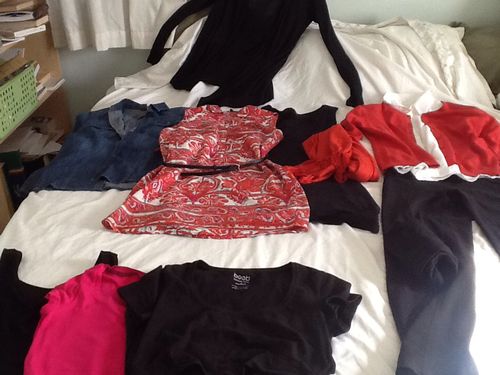
    My first draft looked like this:

    It includes the following 15 pieces, not counting pajamas and underwear and socks and hiking boots and the like:

    • Black trousers
    • Black leggings
    • Red-orange performancewear skort
    • Black tank (nursing openings)
    • Black tee (nursing openings)
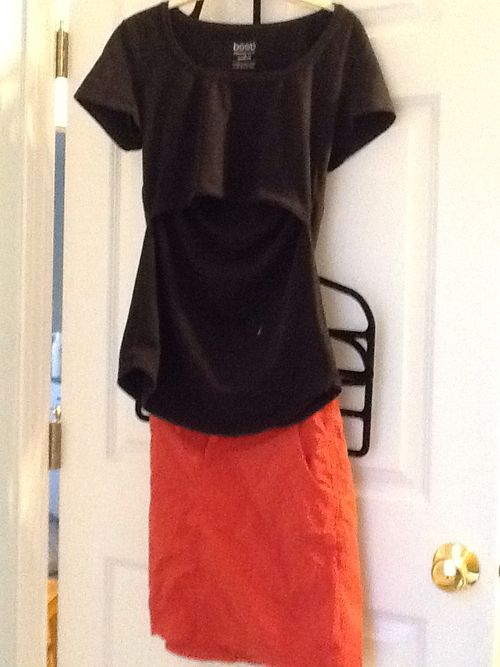
    • Black short sleeve empire waist top (nursing openings)
    • White tank
    • White “button-down” style shirt, 3/4 sleeves, lightweight
    • Hot pink scoop-neck tee
    • Lightweight black long-sleeve cardigan/wrap (rolls up really small)
    • Denim shirt
    • Red-orange cardigan
    • Black tank dress (no nursing openings, but stretchy enough I can pull down the neck)
    • Sleeveless shirtwaist-type dress with hot pink/red-orange/white pattern
    • Red-orange scarf

    Shoes that go with this:

    • Black sandals
    • Black ankle boots

    I’m really pleased with how this turned out. It only needs a couple of extra things, in fact, to be a complete non-travel capsule wardrobe for late summer/autumn — mostly things I already have, like bootleg jeans and a few more long-sleeve tees.

    Some of the combinations:


    But I need to swap a few things out for my trip, because I think that once I add the fleece, hiking pants, rain gear, and base layers that I need for the mountains, the overall wardrobe will be unnecessarily heavy on warm items. I will probably drop the denim shirt and add another tee and a pair of lightweight capris. This will bring the total up to 18-20 items, which is not bad considering it is for two seasons, requires enough warm layers for an emergency overnight in the mountains, and has to last 28 days.


    + + +

    I also made a capsule wardrobe for my daughter, which was fun since I had to get her late summer/autumn clothes anyway. I made her neutral color be navy and her accent color be turquoise, since she has a little purse and a pair of Keen sandals that color, and I got almost everything from Old Navy on one of their big sale weekends. Add a pair of navy espadrilles, some fleece and hiking pants, and she is set for the city and the mountains. I think I am going to keep up the capsule approach as she gets bigger.


  • Cooperating, not competing, priorities.

    That put-on-your-swimsuit-for-your-kids’-sake post that I wrote about has spread its influence throughout the feminine half of the blogosphere, at least the sector* populated by mothering mothers. Elizabeth Duffy, writing at Patheos, had a good post the other day:

    One of the swim coaches stood on the side of the pool in a handsome black tank, and she was as plump and dimply as the rest of us, but she stood up straight, shoulders back, making bold demonstrations of each stroke for her pupils. I remember thinking that her confidence paired with an obvious tendency not to take herself too seriously was very appealing, and not just to the eyes.

    She was not slouching out of sight, and it wasn’t just because she found the right suit for her body type, or because she had memories to make. She had a job to do, an important one, and she clearly found her work fulfilling enough that she could be at peace with herself and delight in her body’s ability to do its job well.

    This is really the way that I prefer to think about it; indeed, though getting in the water and splashing with your kids is important, this it’s the reason behind that reason. We’re raising kids, and so everything we do teaches them how to be. If we want to teach them what their bodies are good for — doing and being, as part of their human wholeness; not just appearing and seeming, and certainly not merely things to be used and abused; well, being ashamed of the appearance of our own is only going to teach the wrong lessons.

    Too, being focused on the jobs you have to do and the joys you want to have is better than being hyperfocused on What People Will Think When They See Me.

    More from Elizabeth:

    The irony is, that when a woman of a certain body type or a certain age decides to get thin–I count myself here–you really do end up giving everything else up as your mental energy goes into counting calories, planning meals, and incorporating strategies to prevent yourself from eating. There are many hours spent in the gym, many hours spent working on self-image rather doing things of interest to yourself or of import to other people.

    Not every woman who decides to get fit loses their perspective this way, but I certainly have, and I have corroborated my experiences with female friends. When I decide to be thin, I become a very boring person, a stressed out person, someone who only thinks about food and mentally scourges herself for mistakes made when eating.

    You don’t usually get to have it both ways–you don’t get to be a skinny woman, and at the same time, a woman who’s happy to sit at a bar and drink pints with her husband. You don’t get to be someone who is fully invested in being thin, and at the same time finds herself interesting enough in her own right to forget occasionally her body and its tendency to grow fat when it’s having fun.

    I can also corroborate this. The year that I achieved my big weight loss was a year of absolute concentration and obsession. It consumed almost all my attention. I don’t regret it, and I have found the effort to be fruitful in more ways than one — it was an achievement I had never thought possible, and it opened up all sorts of possibilities for me as well as leading to a lot of reflection on my identity. But it was so costly.

      [Editing Note. That’s why, several years later, I’m now going through a lot of these weight loss and gluttony posts and adding disclaimers to them. I failed to make clear distinctions between technical, theological “gluttony” and other problems like clinical eating disorders. Some of that thinking might have been helpful to me personally because of the specifics of my own issues, but I was not and never have been qualified to imply that the same was true for others. I don’t think these writings were worthless, but they should definitely be taken with a grain of salt.]

      But I wasn’t bored.

      I wasn’t bored because, to put it bluntly, I am a geek, and I can really get into that which bores other people. Whatever my project, I must love it and dig deeply into it, understand it and analyze it, take it apart and put it together in different ways. This is how I cook, how I gestate and give birth and care for babies, how I educate my kids, how I approach faith. My life is a little laboratory, and it’s okay if the results are not repeatable by others because they’re highly tailored to my own surroundings. The year that I lost all that damn extra weight and learned to be an athlete was the first year that my own body became the laboratory for the sake of itself.

      (And I do call it “becoming an athlete” for a reason. I won’t call it just “fitness,” it was more than that, an identity crisis was involved. I wanted not just to appear thin, but to feel like Elizabeth’s swim instructor, strong and capable.)

      So I wasn’t bored. And if my spouse was bored, he did a good job of hiding it. We sat at the bar and drank pints together — only we split them, and he drank more deeply than I did, for that year.

      We still share pints that way. And that’s emblematic of the difference.

      Some friends speculated that it was possible for me to temporarily prioritize becoming an athlete in a way that it might not have been for me today, had I put it off. I was six years younger, I had only three children. And maybe that’s so.

      But staying an athlete, even an amateur one only competitive against herself, is a priority — not in competition with the priorities of raising my family and accompanying my husband, but in union with them.

      I am married to a person who aspires to be always training for the next goal. His sports are downhill skiing and climbing (both rock and ice); seeing as how we live in the northern plains instead of the western mountains, he’s never going to be able to find the time to do either of them frequently enough to excel at either, but he can always be training for his next trip so he can have more options and have more fun. And so he tries to get to the gym three times a week if he can. And so it’s something we do together — not so much the climbing (I have an old wrist injury) but the training. Neither of us has the time to train very well or thoroughly, but it’s something we can talk about over those single shared pints.

      And since he’s a geek too, and also since training involves chemistry and physics that neither of us has ever mastered, we can talk about it over and over and over again. That’s a lot of pints.

      Athleticism of a certain individualistic type is a family value for us. (It runs in Mark’s family of origin; his siblings and their spouses have been runners, mountain-bike and road-cycling racers, equestrians, and collegiate-level wrestlers, along with the occasional dabbling in climbing and downhill skiing.) We are working to pass it on to our kids. That priority meshes with our other family and marriage priorities, so it isn’t in competition with them (although it has to be balanced with them: I have to teach and feed the children, and Mark has to go to work). I think this more than anything else is why the changes I made six years ago have remained permanent. They reinforce, and are reinforced by, the other good things I have in my life and want to keep.

      _______

      *Yeah, I couldn’t stop myself from googling just to double check that “sector” was the correct geometrical term with respect to a piece of a sphere, as I knew it was for a circle. Although it isn’t quite as satisfying because the arcs that define the sectors of a circle, being one-dimensional, perfectly tessellate the “surface” (i.e., the circumference) of the circle — cf. pie charts — but the domed spherical sectors by necessity have gaps between. Unless, of course, there are an infinite number of them in just the right distribution of volumes, much as you can fill a rectangular box perfectly with an infinite assortment of differently-sized spheres.**


      **Yeah, I finished writing the footnote before I went on to write the rest of this post.


    • Embrace the suit.

      Simcha Fisher pointed at a HuffPost piece entitled "Moms, Put On That Swimsuit:"

      You've got two choices every summer — to put on a swimsuit or to skip it.

      I have a lot of friends who do the latter.

      They go to the pool with their kids, but they only put their feet in the pool. They sit on the sidelines, too concerned about what they look like and what others will think to embrace the joy of swimming with their kids.

      Or they go to the beach, but stay under the umbrella instead of running into the ocean.

      And it makes me incredibly sad.

      Because when women stay on the sidelines because of insecurity, we are modeling unhealthy behavior to our children and we are missing out.

      Your swimsuit does not define you.

      Simcha's take:

      More than once last year, I just felt too damn fat to put on a bathing suit. Just couldn’t do it. So I would go to the beach with the kids, and they would ask me to take them in the water and do that swishing thing, or catch them when they jump off the big rock — and I couldn’t, because I didn’t have a suit on.

      They were crushed. It didn’t make any sense to them. Why would you not wear your swimsuit to the beach?  And they were right. Yeah, there are skinny, perky teenagers at the beach. Yeah, there are other moms who are frolicking around with their kids, and they’re wearing the same size bikinis as their toddlers. Not even with stretch marks! How do they even do that? And here I am, and I weigh more than I did when I was nine months pregnant with the youngest kid, who is now 2 1/2. How did I even do that?

      More to the point, who cares? Feel fat? Stay in the damn water. No one will see you, and you can feel light and graceful for once. Sitting on the sand getting gritty and trying to tug your shorts and tank top over your flabby bits while the kids beg you to jump in? That is a great way to have a lousy afternoon.  If you want to be attractive, have fun. Laugh and be happy. That’s beautiful, even when you’re fat.

      Here's my theory on the swimsuit problem:  

      A lot of us just aren't used to seeing ourselves in swimsuits.  It's not like it isn't common to be seen in public dressed unflatteringly (baggy tops and ill-fitting jeans, I'm talking about you).   Unless you're wearing the wrong size, swimsuits aren't actually much worse.  

      When I was about 30 (and, incidentally, about 50 pounds overweight, which is a lot when you're under five feet tall), I started taking adult swim lessons at the YMCA.

       I had taken lessons as a kid, enough not to drown if I fell in the pool, but I'd never swum "a lap" in my life.  

      The first swimsuit-related lesson that I learned was that my suit, which had been carefully chosen to make me look as not-fat as possible, was not made for swimming.  The straps wanted to fall off my shoulders.  That week between my first-ever lesson and my second-ever lesson, I went to a sporting goods store and bought a basic Speedo-brand lap suit.  Something like this:  

      12847-9325-2A-zoomin

      No shirring.  No skirts.  No color illusions.  No underwires.  No sweetheart necklines.  No nothing.  Just a suit that would stay on when I moved in the water.  Because that's what they sold at the sporting goods store.

      The big surprise, though, was it turned into the suit that I felt best in.  Because it was the suit that I put on, week after week after week, as I learned how to swim the way that swimming people swim.  I got used to how I looked in it, because I put it on every week in front of the mirror in the locker room.  

      And I was surrounded by other people wearing the same kind of suit.  Some of them were fit and strong.  Some of them were enormously fat and disabled.  A lot of them were mothers of children in swimming lessons, like me.  And all of them got into the water, in their boring lap suits, and moved their bodies faster and more sleekly than they could move them out of the water.  Some of them smiled and leaped into the pool, and some of them worked doggedly at paddling from end to the other with looks of great concentration on their faces.  

      And eventually it sank into my brain that how you look in your suit is so far from being important, compared to what you can do in your suit — namely, get wet and possibly sandy, splash and play or work in the water, raise your heart rate and build upper body strength, exert yourself or relax and cool off.  

      Just getting into any suit, regularly, can do wonders for how you feel in a suit.  I think it's a vicious cycle:  if you don't put it on often, you don't get used to how you look in one, and you associate it with feeling out-of-place, which feels visible.  When you are focused on how you look, you tend to imagine other people are too (when really, they don't care all that much).  Wearing a swimsuit frequently, especially if you use it to help you do something you want to do (like swim laps, or play with your kids at the beach) tends to make you realize that it's a totally normal thing to do, no matter what your shape:  put on a swimsuit and get in the water.  

      So my advice to women who are looking for the perfect suit to minimize their thighs or whatever:  The most flattering suit is the suit you put on to do things in.  Find one that fits comfortably and doesn't want to fall off, and put it on every week.  If you don't live near the beach or belong to a YMCA like I do, go out in the sprinkler with your kids or something.  Make at least one outing somewhere where you will see lots of people of all shapes enjoying the water.  Do it often enough that you realize that the swimsuit is not something scary.  It's just a tool, a uniform.  And nobody's really looking at you anyway, except the people who love you and the little people who look up to you and are counting on you to show them how to be.


    • Homeschool assignment: Reading Augustine on Genesis as a prelude to studying evolutionary biology.

      I finished writing my assignment on Augustine for the beginning of the 9th-grade evolutionary biology course my son will be taking next year.  I thought I'd share it freely here, in case any other homeschoolers are interested in using classical authors to put modern science into long-term perspective.

      Suggestions are welcome as I won't be assigning it till fall 2014.

      + + +

      Augustine lived from 354 to 430 A. D. and was one of the most influential early theologians of the Church.

      Page numbers refer to readings from The Literal Meaning of Genesis, appearing in the volume On Genesis, ed. by John E. Rotelle, trans. by Edmund Hill, New City Press, 2002.  

       1. Read Book I, no. 1 (p. 168) for an introductory idea of the multiple meanings of Scripture.  List the different kinds of meaning that Augustine thinks Scripture can have.

       2. Skim over nos 2-28 (pp. 168-181) to get a flavor of the way Augustine lists questions to establish the difficulty of interpreting Genesis. Dip in here and there and read paragraphs in more detail.  Give three examples of problematic questions Augustine mentions.

       3. Read closely no. 29-30 (p. 181-182).   Why does Augustine believe that it is necessary to list the parts of creation in a certain order?   Why does Augustine believe that the scripture uses the words “earth” and “waters” to represent formlessness?

       4. Skip ahead to Book II, no. 25 (p. 205), about the creation of plants. Why does Augustine say plants are described as a separate creation from that of the land, but on the same “day” as the creation of land?

       5. Read the episode in Book III, par. 12 (pp. 222-223), in which Augustine refutes someone's scriptural interpretation (that a certain language is used of fishes because fishes lack any kind of memory) by pointing out that direct scientific observation of fish contradicts such an interpretation.

       What does this episode demonstrate that Augustine believes about the relationship between the interpretation of truth as revealed in Scripture and facts that are learned by observation of the natural world?

       6. Read nos. 18-19 (pp. 227-228). (It may help you understand if you begin at par. 16 on page 225.)

       Pay particular attention to this:

       The reader may also wonder…whether the phrase 'according to kind' comes up again and again just by chance… or whether there is some meaning in it, as though they were already in existence beforehand, though the account of their creation is only now being given… In fact this expression begins to be used about the grasses and the trees, and so on until we get to these terrestrial animals… Is it because these things sprang into being in such a way that others would be born of them and in succeeding to them would preserve the shape and form of their origin?… 

      This then is the significance of 'according to kind,' where we are to understand both the efficacious force in the seed and the likeness of succeeding generations to their predecessors, because none of them was created just to exist once and for all by itself, whether to continue for ever, or to pass away without none to succeed it.

       Does the above passage refer to the possibility of God creating animals that would then produce new ones of the same kind, or does it refer to the possibility of God creating animals that would eventually give rise to animals of different kinds?

       7. Read no.s 22-23 (pp. 229-230).   Augustine subscribes to the then-current scientific theory of “spontaneous generation,” i.e., that maggots and flies spontaneously come to life in rotting meat. (Never mind for the moment that moderns know the maggots are not spontaneously generated, but come from eggs which are laid in the meat by insects.) What philosophical problem does Augustine say the theory of spontaneous generation creates for those who study creation?

       Augustine's answer is phrased as follows: “…possibly there was some natural tendency in all animated bodies, so that they already had seeded and threaded into them beforehand, as it were, the first beginnings of the future animalcules, which were going to arise.”  How might we apply this same principle, based on a now-outdated scientific theory, to the more current idea of biological evolution?

       8. Read par. 30 (p. 234). What does Augustine say is the defining aspect of humankind, the aspect in which man is made “in the image of God?”

       Do you think that the distinctive characteristic of humanness is something we can measure with current technology? Why or why not?

       9. Read Book V, no. 12 (p. 282).  Does Augustine argue that the act of creation is a single act, or a series of acts?  Was there a time before the beginning of the universe, according to Augustine?  Tell what you know about what cosmology, a modern branch of physics, says about this question.

       10. Read Book V, no. 41 (p. 297; note that it is two paragraphs long).  Can this philosophy be said to admit the possibility of biological evolution?

       11. Optional: If you are interested in Augustine's mathematical interpretation of why there are six days of creation and not some other number, see Book IV, beginning on page 241.  


    • Augustine and evolution.

      Today I cracked open St. Augustine's On The Literal Meaning of Genesis in order to find bits for my ninth-grader's evolutionary biology course.  

      I plan to begin the course with some cultural and social context for evolutionary theory, and I was irritated to discover that the summary in the college textbooks went straight from Plato's and Aristotle's ideas to "Later, Christians interpreted the biblical account of Genesis literally and concluded that each species had been created individually by God in the same form it has today."  I've been familiar with the idea that Augustine's philosophies allowed for evolutionary development for a long time (since reading the sci-fi classic A Canticle for Leibowitz, I think!) , so I set about going to the source.

      The first 22 paragraphs or so should cure anyone of the notion that asking probing questions about the logical contradictions in Genesis is a modern phenomenon.  Augustine lists many such questions.  For example:

      So why was the sun made with authority over the day to give light upon the earth if that light which had also been called 'day' had been sufficient for the making of the day? Or was that earlier light illuminating higher regions far from the earth so that it could not be perceived on earth, and thus it was necessary for the sun to be made? … It can scarcely be supposed, after all, that it was put out so that nocturnal darkness might follow, and then lit again so that morning might be made, before the sun took on this task.

      Augustine says that the six-day structure and series of creative events that are described in Genesis has a literary and pedigogical, not a historical, purpose:

      It is not because formless matter is prior in time to things formed from it, since they are both created simultaneously together… but because that which something is made out of is still prior at its source, even if not in time, to what is made from it, that scripture could divide in the time it takes to state them what God did not divide in the time it took to make them.

       …Since both [matter and form] had to be mentioned by scripture and both could not be mentioned simultaneously, can anyone doubt that what something was made out of had to be mentioned before what was made out of it?

      … If two things cannot be named simultaneously, how much less can their stories be told simultaneously! So then, there can be no doubt at all that this formless basic material, almost the same as nothingness though it be, was still made by none but God, and was simultaneously created with the things that were formed from it.

      The particular choice of which things are created on which days is not to establish order in a sense of a timeline, but order in a sense of classification.  For example, why plants are included on the third day:

      Here we should note the skillful touch of the one who put the text into shape; because grasses and trees are sorts of creatures quite distinct from the specific form of the lands and the waters… they are spoken of separately as coming from the earth… it is also separately indicated that God saw that it was good.

      But all the same, because being fixed there by their roots they are continuous with the soil of the earth and entwined in it, he wished these things as well to belong to the same day.

      He also goes on to explain, for example, that the creation of sun, moon, and stars is described as following the creation of land and plants because "fixed" things come before "moving" things in the logical structure.

      I got the impression as I read that just as Augustine would disapprove of insisting on a six-day creation, he would disapprove of insisting that the scripture "got the science right" with respect to, e.g., light coming first, water-animals preceding land-animals, and so forth. Trying to put together some sort of "Genesis Code' that matches what we observe about the early days of Earth and the life on it, point by point, with the events of the six days of creation, would be missing the point entirely.

      Nevertheless, Augustine spends a great deal of time talking about natural philosophy as it existed in his time and as it was handed down from earlier times. He is interested in setting up a correspondence in the sense of dialogue between the two bodies of knowledge. 

      For example, here's a place where he essentially says to an interlocutor, "Your scriptural interpretation is invalid, and you wouldn't make that mistake if you knew more science":

      Some people…have expressed the opinion that the reason fishes are not called [in Genesis] 'live souls' but 'reptiles of live souls' is that they lack any kind of memory or form of life even remotely approaching rationality. But this opinion comes simply from insufficient experience, because there are authors who have described many wonderful things that they have been able to observe in fish-ponds… It is still absolutely certain that fishes have memory. This is something I have myself experienced, and anyone who wants to can experience it too.

      There is, you see, a large fountain in the district of Bulla that is chock-full of fish.  People are habitually looking down into it and throwing in things which the fish will rush at together to grab first, or fight among themselves to tear them to bits.  Being now used to this kind of feeding, whenever people stroll round the rim of the fountain, the fish too will swim back and forth with them in a shoal, waiting for those whose presence they are aware of to throw something in.  

      From what I can tell, it sounds like some naturalists of Augustine's day said that Genesis was obviously boneheaded because it said "Let the waters produce" (besides crawling things) "flying things," when everyone knew that birds are clearly of the airy element, or perhaps of the earthy element.  He spends some time, therefore, pointing out logical inconsistencies in his day's settled science:

      If the reason they give [for fish being watery and birds being earthy] … is that fishes do not have feet, then it means seals do not belong to the water, nor serpents or snails to the land or earth… As for dragons, which lack feet, they are said to take their rest in caves and to soar up into the air. While these are not too easy to come across, this kind of animated creature is for all that definitely mentioned not only in [scripture] but also in that of the [pagan Greek and Latin legends].

      (I liked the bit about dragons not being too easy to come across. It's like he's saying he's never personally observed the effect but it has been attested to in the literature.)

       He finds particular significance in the repeated phrase "according to kind":

      The reader may also wonder…whether the phrase 'according to kind' comes up again and again just by chance… or whether there is some meaning in it, as though they were already in existence beforehand, though the account of their creation is only now being given… In fact this expression begins to be used about the grasses and the trees, and so on until we get to these terrestrial animals… Is it because these things sprang into being in such a way that others would be born of them and in succeeding to them would preserve the shape and form of their origin?… 

      This then is the significance of 'according to kind,' where we are to understand both the efficacious force in the seed and the likeness of succeeding generations to their predecessors, because none of them was created just to exist once and for all by itself, whether to continue for ever, or to pass away without none to succeed it.

      This doesn't actually talk about evolution, of course, but of the generations of animals producing offspring of the same kind.  Still, it sets the stage for Augustine to talk about the arising of animals which were not present in the beginning and which can be observed in his time by the best natural scientists available…

      …and no, we're not talking of evolution, but spontaneous generation!  Augustine subscribes to the then-current scientific belief that maggots and such are spontaneously generated in rotting meat, and for completeness explains how they could then have been created in the original establishment of things.

      As for [those tiny creatures] that are generated from the bodies of animals, especially dead ones, it wold be quite ridiculous to say that they were created at the same time as the animals themselves were, unless possibly there was some natural tendency in all animated bodies… as it were, the first beginnings of the future animalcules, which were going to arise… all things being put in motion without any change in him by the creator.

      Note that bit about God having created the "natural tendency in all animated bodies… the first beginnings of the future animals which were going to arise."

      As I read through this, I can hear in my head the voice of innumerable adolescents and overgrown adolescents, and possibly some esteemed biologist-authors as well, challenging, "Oh yeah?  Well if your religion can co-exist with science then how come it says the earth was created before the stars then?" and thinking they were the first ever to come up with such a wise and brilliant argument.  It's partly to head this sort of thing off at its source that I want my kids to read classical Christian authors, even in bits and pieces.

      A great deal of thought (as well as contemplation of observations from the natural world) went into ancient metaphysics, and that it's simply not true that Christians before Darwin uniformly believed in a young earth and a literal six-day creation.  

      In Book V,  Augustine argues that the act of creation of everything material (including time) had to have been a single instantaneous act rather than a series of acts:

      Creatures [including inanimate objects] once made began to run with their movements along the tracks of time, which means it is pointless to look for times before any creature, as though times could be found before times….

      So it is time that begins from the creation rather than the creation from time, while both are from God…

      Nor should the statement that time begins from the creation be taken to imply that time is not a creature…

      Accordingly when we reflect upon the first establishment of creatures in the works of God from which he rested on the seventh day, we should not think either of those days as being like these ones governed by the sun, nor of that working as resembling the way God now works in time;

      but we should reflect rather upon the work from which times began, the work of making all things at once, simultaneously, and also endowing them with an order that is not set by intervals of time but by the linking of causes, so that the things that were made simultaneously might also be brought to perfection by the sixfold representation of the day."

      BAM.

      And people think this is a *modern* idea, because Stephen Hawking, or something.

      Once we get to the particular creation of man, things continue to get interesting:

      After saying 'to our image,' he immediately added, 'and let him have authority over the fishes [etc.],' giving us to understand that it was in the very factor in which he surpasses non-rational animate beings that man was made to God's image. That, of course, is reason itself, or mind or intelligence… it was not in the features of the body but in a certain form of the illuminated mind." 

      From this I get: "Man" cannot said to have been "created" until we are talking about rational man. Man with a certain form of the illuminated mind.  And it isn't clear that we would be able to discern which fossils would have come from organisms who possessed that "certain form."

      It seems to me that we don't have to understand precisely what the distinction is between the mind of a human and the brain-processes of other animals.  Without that, we can still accept that scripture is telling us that there is some distinction, possibly unmeasurable, some illumination that belongs properly to humans but not to nonhuman animals, and that illumination is what is meant by "in the image of God."

      I think we run off the rails by trying to force that distinctive characteristic of human-ness to be described by only what we can measure with our current technology. Augustine's writing records a time when people were wasting a lot of brain power either trying to get the scriptures to match up with earth/air/water/fire concepts of matter, or trying to use those concepts to refute scripture.

      Augustine says that the "seventh day" is the division between "how God worked then" and "how God is still working."  "How God is working now" includes, then, all the eons of work between the act of creation and the present day.  God doesn't "create through evolution."  He created; now, creation evolves, as long as he works in it.

      "Let us believe, or if we are able to, let us even understand that God is working until now in such a way that if his working were to be withheld from the things he has set up, they would simply collapse…

      "If we suppose that he now sets any creature in place in such a way that he did not insert the kind of thing it is into that first construction of his, we are openly contradicting what scripture says, that he finished and completed all his works on the sixth day. Yes, within the categories of the various kinds of thing which he set up at first, he manifestly makes many new things which he did not make then. But he cannot rightly be thought to set up any new kind, since he did then complete them all.

      And so by his hidden power he sets the whole of his creation in motion, and while it is whirled around with that movement, while angels carry out his orders, while the constellations circle round their courses, while the winds change, while the abyss of waters is stirred by tides and agitated by cyclones and waterspouts even through the air, while green things pullulate and evolve their own seeds, while animals are produced and lead their various lives, each kind according to its bent, while the wicked are permitted to vex the just, he unwinds the ages which he had as it were folded into the universe when it was first set up. These, however would not go on being unwound along their tracks, if the one who set them going stopped moving them on by his provident regulation."

      I posted much of this on Facebook, and along the way snagged a couple of recommendations for future reading:

      • Amy Welborn suggested In the Beginning:  A Catholic Understanding of Creation and the Fall by Pope Benedict I né Joseph Ratzinger.
      • Melanie suggested The Mind of the Maker by Dorothy Sayers.

      I don't know if I'll get to them in time to put them in my course, but they do sound like good suggestions.  The Ratzinger book probably would have saved me a lot of time had I known about it before I started…


    • In case of emergency.

      Here’s a repost from last May, with some new material at the bottom.

      +++

      Last week I unwittingly worried a friend of mine in Facebook chat.

      I’d mentioned that Mark was out in Colorado on a climbing trip. The last exchange of the chat went like this:

      FRIEND: Prayers ’till Mark gets home!

      ME: Thanks! If he doesn’t call by 11 pm I have to call search and rescue.

      Would love to chat longer but have to teach history now. Take care!

      + + +

      On Sunday at coffee and donuts she mildly chastised me for joking about the search and rescue. “I wasn’t sure whether to be worried about you or not!” she said.

      Of course, I hadn’t been joking, but I also hadn’t thought that it would have been the kind of thing that would worry a friend. Why did I throw the offhand comment out?

      I suppose it’s one of those things you do in the Twitter age. We are now masters of the Short Enticing Comment Intended To Give The Appearance Of Having A Much Longer Story Behind It.

      The idea is, of course, that in your interlocutor’s imagination, the story you merely hinted at will grow to hilarious proportion, and your interlocutor will project their own imaginings onto you, and you will be lauded for your sparkling wit. When in fact all you wrote was something like “OMG NO NOT THE MOLASSES #twoyearolds #bathtime #gin”

      + + +

      Anyway, the truth is that I was not, in fact, joking about the search and rescue — well, I did abbreviate a bit, as one is wont to do. My actual instructions were to wait until 11 p.m. for contact from Mark, and then start calling these numbers in order:

      1. Mark’s cell
      2. His climbing buddy’s cell
      3. The backcountry guide’s cell
      4. His climbing buddy’s wife back at home in Tennessee
      5. The mountain climbing school and guiding service
      6. A climbing gym that serves as the after-hours contact number for said service
      7. The county search and rescue (SAR) dispatch

      If you’re wondering whether it isn’t the job of the mountain climbing school and guiding service to decide whether it’s time to call SAR, you’re right — the service has a protocol for keeping tabs on their guides in the field. If one doesn’t check in after a trip, they are supposed to follow up. (That’s why I’m supposed to call the guiding service before going straight to SAR myself.)

      But redundancy is a good thing, and nobody’s more interested in having Mark come home safely than I am, so nobody’s better suited for the task of checking up on him should he go missing. Besides, he was planning to climb a different mountain two days later with his buddy and no guide, and in that case there wasn’t going to be a mountain school looking over his shoulder.

      + + +

      “I’d be so worried if my husband gave me a set of instructions like that,” a different friend said to me on a differnet occasion.

      I said, “I’d be more worried if he didn’t.”

      One of the first rules of safe backcountry travel is to let someone else know exactly where you intend to go and when you intend to get back. You’ll find this advice everywhere; here it is in a well-written .pdf about backcountry safety:

      One important rule too often forgotten is to let others know exactly where you are going, with whom and when you can be expected back. I hate to sound maternal, but search and rescue teams often spend hours driving around on back roads looking for a subject’s vehicle before they know where to enter the field to begin a search.

      By letting someone know EXACTLY where you intend to go, when you expect to return and where your vehicle will be parked, you can eliminate the possibility of searchers having no idea of where to look. Should your plans change in route to your destination, stop and notify that person of your new itinerary. In addition, if you leave pertinent information on the dash of your car (e.g. name

      and phone number of your contact in town, location of travel/campsite and so on) search teams will have a very timely idea of your plans. Otherwise, search teams can be of little assistance when all that is known is that you “went camping somewhere in the Gore Range.”

      And then, it’s nice to have specific instructions. That’s one of the things I insist on, whenever Mark heads off to go backcountry skiing or climbing — guided or not: a specific set of “deadlines” and directions for what to do if he misses each one.

      If he were to tell me, “I’m parking at the such-and-such trailhead and planning to summit such-and-such a peak; we’re going to turn back by 11 a.m. at the latest and I expect to be back in cell phone range by 5 p.m.,” that would be … a good start. But that doesn’t answer the actionable question, which is… so what do you want me to do if you haven’t called me by 5 p.m.?

      I can’t read his mind (too bad, that would come in handy for backcountry travel), and I’m hundreds of miles away and not familiar with the area he’s in. Furthermore, it’s his job to set up the safety procedures for his trip, not mine — even if I have a role to play in those procedures.

      Some people might think that the right thing to do is call the authorities the minute someone is overdue. But this would be premature. SAR is expensive, and part of backcountry ethics is being prepared to deal with delays and unexpected events. You’re not supposed to have SAR be your first line of defense if anything goes wrong; you’re expected to do what you can to aid in your own shelter and rescue. So, for example, if there’s a signficant chance that a delay could force you to spend the night on the mountain (rather than trying to follow a difficult trail down in the dark), you bring bivy gear and extra food, and you instruct your contact person that your arrival time could be delayed by twelve hours or whatever with no cause for alarm. It would be silly to send out the dogs for someone who’s comfortably ensconced in warm waterproof layers, seated on an insulated pad, munching energy bars, and waiting for nothing more dramatic than daylight.

      In this case, even though he expected to be back in cell phone range by 5 pm, he definitely didn’t want me calling SAR at 5:01 . He figured on giving himself several hours of leeway time — time to accidentally go down the wrong trail, figure it out, and backtrack if necessary; time to sustain an ankle injury and slowly crawl back to the vehicle, should that happen; time to arrive at the climb, find it occupied by another party, and wait for them to finish before starting. None of those delays, not even an injury, are an emergency that requires calling out the authorities; they’re all the kind of things that you’re supposed to be prepared to deal with yourself. And if you wind up dealing with something like that, you’ll be delayed. And that’s okay.

      It’s not terribly fun to have to wait the few hours between “overdue time” and “call out the dogs time,” but it’s much better than sitting there wondering, “Should I call out the dogs, or is it too soon? I wonder how long I should wait? If I make the wrong decision SOMEBODY COULD DIE.”

      I told Mark, he has to own the when-should-I-call-search-and-rescue decision. And he owns it by giving me specific instructions about when to call, and whom to call. And also by telling me everything pertinent: where he’s starting, what he plans to do, and even what he’s carrying (I like to know, for example, if he’s prepared to spend the night outdoors and what weather he’s prepared for, and for him to confirm that he has a GPS, map, and compass).

      + + +

      Every once in a while I run into the opinion that it’s irresponsible for anyone, but especially a parent of young children, to engage in common adventure sports at all. Backcountry hiking, black-diamond skiing, rock climbing, etc.

      (Occasionally this extends to activities as banal-sounding as bicycle commuting. There’s a lot of victim-blaming in the comments to news stories about cyclists who get struck by cars. It’s very depressing. I have a theory that a large number of people simply don’t believe that bad things can happen to good people.)

      I think it’s irresponsible to think you can remove all risk from life. Every day we’re surrounded by common risky activities: from the acutely risky, like riding in cars or taking showers in slippery bathtubs, to the chronically risky, like occupational exposure to low-frequency noise or sitting around getting no exercise. And many culturally-not-considered-extreme hobbies carry a surprisingly high risk; for example, recreational boating is well accepted here in Minnesota, but it’s also relatively risky (one estimate from Ohio: about 1 fatality per million operator-hours; anotherestimate has 1 canoeing fatality per 720,000 outings.)

      Rock climbing is riskier than boating, but not the OMG IT MUST BE MANY TIMES RISKIER HOW COULD YOU EVEN THINK ABOUT DOING THAT WHEN YOU HAVE SMALL CHILDREN AT HOME!!! that you might expect from all the teeth-gnashing about it. Do you ever hear anyone say, “Gosh, I’d never have elective surgery under general anesthesia while I still had young children at home?” Well, that’s more likely to kill you than a rock climbing trip.

      All this is to say: Hobbies are important. It’s good to have them. And it’s okay to have hobbies that carry some risk. The important thing is to diligently take reasonable precautions and follow well-accepted safety protocols; to keep your head and know your limits; and to talk about safety and comfort with the people who depend on you, to make sure that no one is forced into a situation where they’re uncomfortable with the level of “adventure.” Mark and I have worked pretty hard over the past few years to create an atmosphere in which I’m always on board with what he’s up to, and if I’m not, we work together to figure out what needs to change until I am.

      +++

      End of repost.

      I did it again on Sunday. “Is Mark having a good Father’s Day?” asked a friend after church.

      “I assume so,” I said, “He’s out in Colorado rock climbing.”

      Her jaw dropped a little and she said “Oh my gosh! I’ll pray for his safe return!”

      “Go to Blessed Pier Giorgio,” I said cheerfully, “it’s what we always do.”

      On Saturday I had run into a little bit of an issue because Mark forgot to tell me which time zone he meant when he sent me my schedule of whom to call when. Was that “call SAR if you haven’t heard from me by 6 pm” Denver time or Minneapolis time? The difference is only an hour, so I sent him a text message letting him know that I was going to split the difference and call out the troops at 5:30 Denver time. Fortunately he got that message in time, because they took longer climbing on the glacier than they intended and the schedule had to change; he sent me a text later to let me know I should extend the deadline.

      So that was one thing learned on this particular trip. Another one — not so much “lesson learned” as “detail that occurred to us for the first time” — was that he really should tell me the make, model, color, and license plate number of the rented car he is driving to the trailhead.

      People still ask me if I am not worried about him. We are, a little bit, I guess. I definitely start to get a little antsy when the “I will probably be done by X-o’clock” time approaches. But it is an enormous help to know that I will never have to sit at home wondering if I should do something or not. I know I can drop that worry and leave it behind, trusting him to take care of himself if he can, trusting in the grace of the sacrament of marriage to take care of the kids and me if he can’t. And he knows that I know, and so that thread of intention connects us, whether we are both in cell phone range or not.


    • The dangers of having “putting places.”

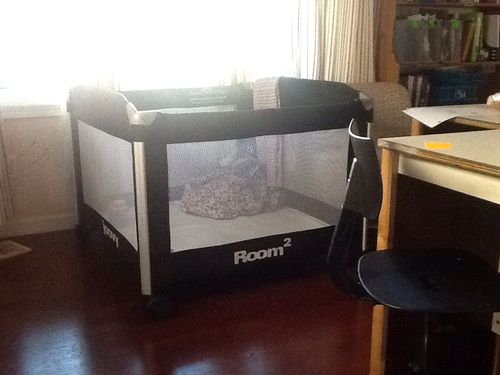
      Look closely. There’s a baby in there:


      See him now?

      I have gotten more use out of this little bassinet, bought when I was pregnant with my oldest, than I ever did with the others. This guy? He is a napper. I have almost forgotten that babies can do that, after #3 (who gave up her nap entirely at age eight months) and #4 (who readily fell asleep but was such a light sleeper that despite lots of tiptoeing we could never count on the nap lasting long).

      This little person takes a solid morning nap and a solid afternoon nap and usually a few little catnaps in between. A sudden loud noise, like a shouted “Moooooooooom!” or the blender turning on, or my husband talking loudly into the phone to someone’s voice mail, will wake him; but ordinary conversation doesn’t, and neither does picking him up (carefully) and moving him from one place to another.

      Which is good, because a few days ago he rolled out of bed (“Was it the old THUMP……..’WAHHH?’” asked my FB friend. Yep) and though he was not, of course, hurt, I resolved not to just leave him up there anymore.

      Hence, the little bassinet in the living room.

      + + +

      For this upcoming school year, I have finally purchased an item that I swore for four babies I didn’t need.

      (I choose not to remember ever swearing that I “would never need” such a thing. Let’s hope I didn’t.)

      That item is a B.F.P. (big effin’ playpen) like what they used to make:


      I am particularly amused by the brand name:


      I need a BFP like what they used to make — one that measures a square meter inside and thus takes up a lot of valuable real estate — because of H’s twins of course. We haven’t yet stuck all three babies in there yet, in part because they’re all still so young that at least one of them is nursing nearly all the time and also in part because we aren’t teaching intensively, it being summer. In the fall, though — when they’re eight and nine months old — Well, let’s just say that I expect them all to be very good friends.

      Since the newbornhood of our babies coincided with the wild popularity of The LEGO Movie and its assorted product tie-ins, I think I am going to be glad to have another option besides the old blanket-on-the-floor trick when I need to set someone down with a toy for a minute.


      Never say never. Some learn it after one child, some after two. I am a slow learner, I guess.

      I don’t use the sling as much as I did with my first two babies. I have three kids who are old enough to carry the baby themselves. My back isn’t as young as it used to be (although switching to a two-shouldered carrier, when that’s convenient, has relieved the discomfort enormously). And, well, I am out of practice. The habit of putting a baby down instead of taking him with you reinforces itself. He naps. I get used to walking around and doing things with both hands and all my balance. Once I was really good at, for example, one-handed onion-chopping. Now I feel helpless unless I give him to someone else so I can use both hands. This bothers me, not so much because I feel that I must carry him all the time (he is usually being held by someone, after all), but because I don’t like feeling helpless. I had a skill once; it’s annoying to discover it has atrophied.

      A couple of weeks ago, when I realized I was losing my ability to type accurately — a skill I have had for 25 years — I turned off the autocorrect on my iPad. Crutches have their place, but there are drawbacks to relying on them. There doesn’t seem to be a good solution to the decline of my babywearing skills, though, because I am pretty sure that the “crutches” of handing the baby off to an eager sibling or letting him nap in a nearby bassinet are here to stay.

      I will just have to force myself to carry him more often than I need to if I want to stay capable enough to carry him whenever I want to.


    • Job number 3: Cooking for the family, the first week.

      I have been writing about using a token economy to encourage the kids to keep their rooms clean and to do their own laundry.  I'm very pleased with the results.  

      The rooms have stayed clean, more or less.  I admit that I haven't always remembered to check them, and so perhaps they have been getting away with cutting the corners here and there; but when I do check them, they're almost always good enough to keep their daily token.  Also, my oldest son told me a story yesterday that warmed my heart.  He had been inspired by  The LEGO Movie to take apart his treasured Millennium Falcon and reassemble it creatively into smaller ships.  The 13yo was rummaging through the jumbled pile of gray and white and black pieces on the floor of his room, when in came his four-year-old little brother and asked, "Can I help?"

      "I was going to say No," my 13yo told me.  "But then I realized that the pieces weren't going to get mixed up with a bunch of other junk on the floor and lost, because the only thing on the floor was the LEGO pieces.  So I asked him to close the door and then I could say Yes, and he built this hilarious ship out of one flat piece and two wings that didn't match."

      WIN.  SO MUCH WIN.

      Laundry is a little slower to build habits.   Everyone only has to wash a load of laundry once a week, so that's only 1/7 the reinforcement.  I'm still occasionally finding the big kids' clothes in the place where they used to put their laundry, a common bin in the laundry room, which is now supposed to be used only for towels and the 4yo's clothes.  Also, I am pretty sure that instead of hanging up their clothes, they're just living out of a basket of clean clothes that they are storing in their closets.  But that actually works in the sense of "it doesn't cause me to have to do anything."  So I'm not complaining.

      Tuesday morning, my 7yo daughter forgot to put her laundry in the wash, and I forgot to check up on her or remind her to do it.  At the end of the day she came into my bedroom. "Here," she said, handing me one of her popsicle-stick tokens.  "I forgot to do my laundry, and you forgot to check and take my token.  I remembered."  She was obviously taking pleasure in catching me out.

      "Thanks," I said, surprised.  "Make sure you do it tomorrow."  

      "I will," she answered.  And she did.

      + + +

      With the start of summer, I've added "cooking dinner" into the mix.  Summer's really the best time to do this, because having the kids plan, shop for, and serve dinner is a serious disruption to my schedule.  Also, during the school year Mark always does the grocery shopping on Wednesday nights while the big kids are at religious ed classes; during the summer, there's no class, so the kids are free to come to the store.  If I want them to get some experience shopping for their meals, they need to come along.

      Cooking meals is different from room-cleaning and laundry in one significant way.  I want the children to keep their rooms clean and do their laundry without being told.    But in the long run, I don't want anyone to make dinner without being told to do it — or asking permission to do it.   I know what kind of messes I want in my kitchen when.  I don't want any surprises there.

      What I'd really like is for any of my three kids to be able to cook dinner anytime I ask.  I would like to be able to say to my seven-year-old while I'm making the grocery list, "Hey, I want you to cook dinner on Thursday night so I can work on school stuff in the afternoon.  What would you like to make?"  Then, ideally, she'd think of something she'd like to make, I'd make some suggestions ("I don't think you'll have time for that between when our friends leave and when we have dinner — what do you think about putting something in the crock-pot?"), she'd tell me what to put on the list, and then when Thursday rolled around she'd make it without help.  

      So the kids won't lose a token for not making dinner — I want them to gain a token for making dinner.  So at the beginning of June, after paying them for May and restocking their jars with tokens, I sat down with a dozen blank popsicle sticks and a green Sharpie and labeled them "Meal Token."  The meals will get special tokens because Mark and I decided to make them worth a different amount of money.  Whereas the cleaning-and-laundry tokens cost them fifty cents each time they lose one, each meal token in a child's jars will gain him a dollar — this month.  Next month, I promised, I'd raise the value of a meal token in recognition of the skills they would have gained.

      This whole summer, I plan to make them each make dinner once a week.  After that, what with school, the schedule will probably change.  Keeping the meals under budget will eventually be part of the plan, but to start off this month, instead of giving them a dollar limit, I asked them to calculate the cost of each meal they cooked.  We'll use that information later when it's time to make a budget.  I have a feeling that the spirit of competition alone will help them learn to keep costs down.

      + + +

      The three children used very different means to choose their meals.  

      • My 10yo thought of foods that I make which he likes — hearty black bean quesadillas and diced pickled raw vegetables — and asked me to print out the recipes for him.
      • My 13yo chose from my shelf a cookbook with an appealing title (365 Easy One-Dish Meals) and found something that we've never tried, a dish of fresh pasta with tomato, fresh basil, broccoli, and shrimp.  (It was hard not to comment about the cost of shrimp and fresh herbs as he detailed his plans, but I decided to let him learn that at the grocery store.)
      • My 7yo sat down at the computer and Googled "easy recipes."  She followed the first link, which took her to Allrecipes.com, and clicked on a pretty picture (Baked Honey Mustard Chicken).  She watched the video recipe before committing to it.  ("What side dishes will you make?" I asked her.  She promptly answered, "Salad that comes in a bag, and bread that you buy to put in the oven.")

        I handed each child an index card and told them to make a list of things they would need to buy at the grocery store.  When we all arrived at the store, I sent the 13- and 10-yos off with one cart, and I took another one with me and the rest of the children (including the 7yo).  It was fun to watch the 7yo trying to read her own handwriting as we wandered through the produce section.  I did not have to prompt her very much.  She looked over the bagged salad kits and picked Caesar salad (I did suggest that she buy two rather than just one); she looked over the locally produced take-and-bake breads in the bakery and chose a one-pound loaf of "Asiago Garlic."  

      The big boys met us at the checkout lane.  The apprehensive look on my thirteen-year-old's face told me that he had seriously underestimated the cost of cooked, peeled, deveined frozen shrimp.  "Mom, I'm sorry," he said.  "Do you want me to put it back?"

      "Not this time," I said with a smile.  "I love shrimp.  It'll be a treat.  But," I added, "I do want you to figure out how much your meal cost."

      + + +

      Here's the results.

      Fancy black bean quesadillas with pickled vegetable salad:

      10371499_4167142834979_511910233248619067_n

      Chopping all those vegetables took a long time.  "Next time I'll do the quesadillas again, but something different on the side,"  said the 10yo.  

      Tomato and basil and shrimp pasta:

      10432500_4170933369740_667591585103104948_n  It was really, really tasty. Worth almost every penny.  Since he didn't use up the entire package of shrimp, I allowed him to pro-rate it and told him I'd use up the extra few ounces in some other food later this week.

      Here's my daughter working on her salad while the chicken bakes in the oven:

      10437772_4175903293985_2280211884934669189_n

      I did have to take the casserole out of the oven for her, but she did all the rest of it herself.  She had a very heavy hand with the pepper, so my 4yo would not eat it, but everyone else loved it:  

      10447085_4176037537341_7628225358850973139_n

      In the end, I didn't actually have to do a lot of extra work.  It really did save me time.  I can't wait to see what they come up with next week. 


    • An update on a long-ago prayer request.

      Because I hate to leave people hanging.  A little more than a year ago I posted this:

      [Prayers requested] for longtime online friends facing an uncertain future and the prospect of uprooting their young family after a completely-unexpected denial of tenure, which means having to look for another job quite soon. The field is not one with lucrative alternatives in the private sector, so they face considerable hardship and a difficult job search. They are shocked and unprepared.

      (Just so nobody gets confused, the person I was posting about is *not* anyone who frequently comments on this blog.)

      The day I posted it, the professor friend started a Hail Mary tenure appeals process.  They kept friends updated on the twists and turns through Facebook, so I've been able to follow along for an entire year.   Let me just say that the word DRAMA does not begin to describe it.  According to my friend, one particular departmental colleague, apparently for personal reasons, had worked behind the scenes to subtly torpedo the  application.  

      The decision to appeal was a difficult one because it reduced the energy available to spend looking for a new position.  The husband and wife constantly worried that they were making the wrong decision to press the appeal forward.  But they were very concerned about the effect on their family of uprooting them again.  It was an awful year in many ways, one in which their faith in basic human goodness was severely challenged.

      However, today my friend was able to publicly announce the news:  success!  The appeal went through and the letter for tenure recommendation is now in. 

      So, if any of you saw the original post last May and spared a thought or a prayer:  thanks.  


    • Empty spaces.

      The feast of the Ascension is transferred to the following Sunday in this diocese, and that was yesterday. Mark was not home, so I was bouncing a baby on my lap while trying to keep my four- and seven-year-olds from making too much noise grabbing MagnifiKid!s from each other. The oldest boys were serving at the altar.

      The Ascension is one of the stories that sticks in my mind, possibly because of that enigmatic, “He will return in the same way that you saw him go” bit. One reads the description of how they saw him go, and imagines it unspooling in reverse, and wonders how that is supposed to work. But it’s curious for other reasons, too.

      For one thing: why couldn’t, or didn’t, Jesus send his spirit right away? Or “send” it at all: couldn’t he have handed it over while they stood around him? Why leave like that, then string them along for ten days till Pentecost?

      I know, I know: he didn’t really leave them; I am with you until the end of the age. In his departing, I suppose, he was making himself more present, because ubiquitous; instead of localized in a body whose feet pressed his weight into the earth, he is outside of it all somehow, everywhere in general because nowhere in particular. But why the gap?

      They waited, prayerful and perhaps frightened, in Jerusalem for a promise, and a few days later it came true. But why the empty space in between?

      + + +

      Not much later I was sitting in the rocking chair in my living room, nursing the baby and juggling the iPad, and sipping from a cup of hot coffee. All was quiet; lunch was over, and the four bigger children had scattered to play Minecraft and watch movies in other rooms. I had just finished exchanging texts with Mark, who had been traveling for several days.

      Possibly it was the combination of a bit of self-pity mixed with the general positive effects of caffeine on my sense of well-being, but as I sat there I felt an odd sensation that I can only describe as the purest bittersweetness I remember having.

      I was lonely. I missed my husband. (And I knew it was really missing him, and not just wishing he were here to help me with the kids, because they weren’t asking for anything at that moment; I was perfectly content.) I would have liked to share the Sunday afternoon with him, me in the rocking chair, him lying on his back on the living room rug with his head propped on a pillow — he will never sit on a chair when there is a perfectly good floor to sprawl on. I would have liked it, but I was alone. I felt that sensation: a hollowness, a wishing, deep inside my chest.

      But at the same time, the very sensation of loneliness, of missing, seemed to spread wings and reveal something else within it: a glowing coal, an ember of pure gratitude at its core. Longing for my love hurt, and the hurt was a proof that I have love. I would not feel this “missing,” this hole, if no one had left it behind. In the keenness of my sensation of emptiness I knew that I am ordinarily in possession of fullness and great beauty. Maybe it has been a while since I knew it, or acknowledged it. At any rate, I overflowed with thankfulness that I should enjoy such abundance every day, so as to create real longings. I have something to long for, and that is something exquisite.

      I wrote on Facebook:

      Discovering now that an interlude of absence can truly be sweet; an empty space that is *felt* is a reminder and an evidence of the blessings that ordinarily fill it to overflowing.

      I don’t know if there is a connection; but may be, may be.


    • Indecision.

      Mark wasn’t going to be around yesterday evening and I’ve been a bit burned out, so I hired a sitter for the other kids and left with the baby for a few hours. I parked on a residential street at the edge of Uptown, put the baby in a carrier and slung a bag over my shoulder, and headed off on foot.

      I meant to sit at a patio table in the shade, and drink a glass of wine or a margarita, eat a nice dinner, nurse the baby and read a book. After that, I thought, I’d walk around the lake. But as I wandered around the district (a few square blocks of shops, restaurants, and bars, surrounded by residences, and near the lakes), I couldn’t decide what I wanted to eat.

      After a while I worked out that I was not hungry. So instead I just meandered around. I stopped into The North Face and bought a practical sun hat, because it was hot and sunny and I didn’t have one. I stopped into Lunds and bought a small tube of sunblock, which I smeared on the baby’s chubby arms and legs dangling from the carrier, and a bottle of cold lemonade. I stopped into John Fluevog and admired the spring styles, looking for something that might go on sale in late summer and be comfortable for walking around in Rome in late September, while not being sport sandwals. (What do you think of these? In the burgundy and black?) I stopped in Goorin Brothers and tried on sun hats of the slightly less practical, but perhaps more Roman-holiday-appropriate, packable straw sort.

      I headed toward the lake but changed my mind because my bag (why did I pack Bleak House?) was weighing down my shoulder. So I waited twice at the intersection for the light to change — the second time, next to a man portaging a canoe — that’s Minneapolis for you — and went back to wandering, indecisively.

      In the end I settled into a deep sofa in the corner of my favorite coffee shop, with a packet of hummus and pretzels for dinner. Also a large coffee drink which the barista gave me after I specified “Something cold — abd decaffeinated — and BIG — with, um, calories — but not a flavoring.” I believe it was a 32-ounce iced decaf cold press with about a half cup of half-and-half in it. And also my iPad, which I surfed mindlessly a I nursed the baby, who smelled of sweat and coconut. And you know, that was a fine way to spend my time, even if it wasn’t what I imagined Myself enjoying,

      And what is the point of the story? Right now it feels like a metaphor for my slow blogging in this season. I only have a vague sense of wanting to write — to have the experience of writing. Ideas occur to me here and there, but I am not hungry enough to dig into them. And I only have enough time to write a few posts, so I want my few products to be good ones, and am unwilling to waste my rare “meals” on something insubstantial. Which leaves me writing nothing, only wandering.

      I need a comfy chair to fall into.


    • “Strive for perfection; encourage one another.”

      Occasionally I manage to get back into the habit of praying one or more of the Hours — rarely regularly.   Office of Readings one day in the morning; the thankfully short and repetitive Compline another day when I've already stayed up too late and am really too tired to concentrate.  Sometimes on a feast day I manage the daytime hours.

      Office of Readings is my favorite because it has something new for me every day, even though it's long and I feel like I'm cheating by doing it instead of Lauds, which I feel like I "should" be doing.  

      (I've been a little more inspired lately thanks to this book, by the way.  Highly, highly recommended, and not just for "beginners."  Will probably write more about it another time.) 

      So, anyway, one really great thing about praying the Liturgy of the Hours is that you sink right into the Psalms.  Each one comes around again every couple of weeks or so (less often if you come to the Hours all haphazardly like I do), which over the course of months and years gives you plenty of time both to be exposed to lots of psalms, and to let the repetitiveness gently impress them upon your mind and heart.  There's always something new there.  

      Today in Ps. 31 we encounter the fairly-common-psalm-theme of "I'm surrounded by enemies who are out to get me!" which sometimes seems a little overwrought to comfortable and fattened moderns as ourselves.

      In your justice, set me free, hear me and speedily rescue me….

      Release me from the snares they have hidden…

      In the face of all my foes I am a reproach, an object of scorn to my neighbors and of fear to my friends…

      I have heard the slander of the crowd… as they plot together against me…

      And I'm a little leery of sinking too deeply into this theme of "enemies."  Possibly a bit risky, lest we start thinking of "people who merely disagree with me" or "people who mildly annoy me" as "enemies who are out to get me" in our prayer.   

      But one modern interpretation came to me, an idea of "enemies" that works (for me in this season of life at least):  All those chattering faceless voices that bring distasteful news into my home, that peddle outrage and Schadenfreude.  The tearing of hair out over petty matters not worthy of attention; and, more insidious, the repeated indignation over grave matters, murmuring the conscience to sleep, spending outrage in cheap declarations of position, ever calling to action, never acting.

      There are real people on the other side of those combox handles and bylines.  Let's not forget that.  Some of them may not know what they do.  If they met us in the street they might be perfectly pleasant.   Some of them claim to be allies, fellow believers.  But make no mistake, they are out there, enemies and quislings.  

      Release me from the snares they have hidden, for you are my refuge, Lord.

      Snares of despair and outrage.  

      O God of truth, you detest those who worship false and empty gods.  As for me, I trust in the Lord; let me be glad…

      Let me be glad; not angry, irritated, snide, or superior.

      You have seen my affliction and taken heed of my soul's distress, have not handed me over to the enemy, but set my feet at large.

      We are not, in fact, in prison to the unhappy state of the world today (nor the state of the country, nor the state of the Church).  We are at large.  We are free to act real acts, in our seemingly tiny sphere of home and work and friendships, where each act and word can have unimaginable consequences.

      I have heard the slander of the crowd… but as for me, I trust in You, Lord…

      My life is in your hands, deliver me from the hands of those who hate me.

      Look, some of the voices you encounter out there… the ones that make you feel shame… they really do hate you.  Hate you for not buying enough stuff.  Sneer at you for having too many children.  Tear you down lest you feel pleased in the decisions you've made that are different from others.  Mock you so you'll feel inadequate without the snakeoil they're selling.  Nobody does negging like someone who wants your money or your vote.

      How great is the goodness, Lord,… that you show to those who trust you in the sight of men.

      You hide them in the shelter of your presence from the plotting of men; you keep them safe within your tent from disputing tongues.

      I often wonder what it means to "trust in the Lord," which we're so often told to do without much practical advice on how to do it, and I think there might be a bit of a clue here in this description.

      In part:  

      To trust in the Lord is, perhaps, not to let "the plotting of men" worry you; to remind yourself constantly that the advertisers and the policymakers are not, actually, in charge.  

      To trust in the Lord is to draw strength and protection from His Presence (his ever-present Presence) rather than be damaged by "disputing tongues."  

      (I don't think this means we always have to leave every dispute; some disputes are worth having, after all.   Truth has to be spoken and sometimes it's us who has to speak it.  But we don't have to come to every argument we're invited to just in case.)

      Love the Lord, all you saints.  He guards his faithful but the Lord will repay to the full all those who act with pride.

      The bit about "acting with pride" is maybe a clue as to when we might not want to join in with those "disputing tongues," lest we reduce ourselves to one.

      "I am far removed from your sight," I said in my alarm.

      Yet you heard the voice of my plea when I cried for help.

      In other words, what to do when we realize we've gotten in over our heads.

      Be strong, let your heart take courage, all who hope in the Lord.

      What is the world coming to, anyway?   It is coming to the same end it has been coming to for two thousand years, and today's viral video will not change it, nor tomorrow's.

      + + +

      Good advice from Augustine in the second reading, too:

      Rejoice in the truth, not in wickedness; rejoice in the hope of eternity, not in the fading flower of vanity.

      Look out for that "rejoicing in wickedness" bit.  The invitation is everywhere, isn't it?  Let's not pretend that "rejoicing in wickedness" means "doing wicked things and enjoying it."  

      It also means "hearing about wicked things and enjoying a sense of smug superiority over those who participate."  

      Or "hearing about certain people doing and/or saying wicked things and enjoying a sense of satisfaction that they are behaving as I expect them to."  

      Or "passing along news of wickedness and enjoying the recognition I get for having raised the alarm."

      When you catch yourself rejoicing in wickedness, for heaven's sake, stop.

      + + +

      And one more thought from Augustine:

      Wherever you are on earth, however long you remain on earth, the Lord is near, do not be anxious about anything.

      That's right, anything!

      Don't sweat the small stuff.  But don't save your anxiety for the important things!  Just… don't be anxious.  Be not afraid.  Really.  That's what all this means.  

      How are we supposed to do that?  We're imperfect.  We will feel anxious. We will feel unable to rejoice.  But:

      Rejoice, brothers:  Strive for perfection; encourage one another.  

      That's today's responsory to Augustine.

      Encourage one another.

      Encourage one another.

      Encourage one another.

      Remember that, next combox.  Strive for perfection… by encouraging one another.

      + + +

      This is why I love the Hours.  Ancient and ever new.