bearing blog


bear – ing n 1  the manner in which one comports oneself;  2  the act, power, or time of bringing forth offspring or fruit; 3 a machine part in which another part turns [a journal ~];  pl comprehension of one’s position, environment, or situation;   5  the act of moving while supporting the weight of something [the ~ of the cross].


  • What is WRONG with some people?

    Just before Holy Thursday, MrsDarwin posted an excerpt from Julian of Norwich, Revelations of Divine Love, chapter 76, along with her own meditations on the concept of being "dead to sin."

    I turned the first paragraph from Julian over in my mind all through the Triduum and all through the Octave of Easter. Here it is as MrsDarwin excerpted it:

    The soul that wants to be at peace must flee from thoughts of other people's sins as though from the pains of hell, begging God for a remedy and for help against it; for the consideration of other people's sins makes a sort of thick mist before the eyes of the soul, and during such times we cannot see the beauty of God unless we regard the sins with sorrow for those who commit them, with compassion and with a holy wish for God to help them; for if we do not do this the consideration of sins harms and distresses and hinders the soul…

    MrsDarwin's meditation is on being "dead to sin," the knowledge that sin has no real power over us (unless we allow it to — which means that the power is not in the sin, but in us to lend our power to sin). I think she is mostly writing about our own sin, but taking that first paragraph from Julian, of course it means the sins of others, too. The sins of others have no real power over us, if we are grafted to the vine of Christ, only the power that we give away.

    + + +

    It feels like an audacious thing to write, in this era of constant courteous awareness of, the compulsory acknowledgements of privilege, power, victimhood. Today's buzzwords obscure timeless concepts: the rich man; the eye of the needle; blessed are the poor. Outer wealth and poverty deceive us. The heart itself may be rich or poor. We have to make allowances for what we can't see in other people. Anyone might carry an invisible disability that we need to allow for; at the same time we must believe that anyone, anyone, once grafted invisibly onto that vine, lives in a new way and has access to a life in which no vileness can have real power over her ever again. An illusory outward power, perhaps; but only a power which she gives away. In Christ the Victim once for all, there are no permanent victims.

    It's hard to find that place to be, on the edge. We owe allowances for the beaten-down, the miserable, the fearful, the unbalanced. And at the same time we believe in a promise that it all can really be escaped. We have to honor the great difficulty, the bravery, the immense trust that it takes for some to die — not just to sin — but to the power of suffering and injustices that come from outside, from malicious individuals and hopeless bureaucracies. And despite honoring the difficulties we have to hold out always the firm belief that anyone, no matter how weak, can do it. Even though it's obvious that there is a vast inequality woven into human nature, that for some it will be easy and for others it will be hard, and those of us who have had it easy must bite our tongues and, standing with those who have struggled mightily and honorably prevailed, take on a dread humility, and try somehow to witness to people who have a harder road yet to travel than we can even imagine in nightmares.

    + + +

    Other people's misdeeds have no power over me, so Julian implies.

    But people — people we trust or love or respect, or whose counsel we freely seek! — assail us with invitations, demands, to contemplate vilenesses.

    Sometimes, the sinners are people we have never met except through the mass media and the social media. Sometimes these people have names and other times they are just handy totems; friends and fellow travelers invite us to abuse them and revile and renounce them personally, as a means of reviling and striking at something impersonal, like a system or a policy.

    Other times, they're friends, parents, siblings, coworkers, the occasional passerby, people who have turned their faces and hands to us. People who wound us, shallowly, irritatingly; or deeply, lastingly. People who have driven us to tears, or to rage, sometimes to wounding bystanders with new wounds.

    + + +

    We don't believe anymore in fleeing quite completely, do we? Evil grieves us, as it should. The experts in our natural minds, such as they are, tell us now that anger is a normal stage that human natures may have to traverse before we reach acceptance of any grief, or forgiveness of any wrong. If they are right about that I know of nothing that would exempt Christians. We still have flesh, and bleed if you prick us.

    + + +

    You may have intellectualized and rationalized your anger, instead of facing it, said the man in the opposite chair. It may be that forgiveness, for you, still means you have to go through that anger and fully express it.

    + + +

    I want to skip over anger, fury, weeping. I want to leap straight to peace, to acceptance, to pity for a mean and small-hearted human being, a broken one, maybe one born blind, maybe in the grip of something nameless, legion; baptized yet mayhap nearly (we are told to believe it can never be more than nearly) powerless now.

    I want to skip over it, lightly, and alight on the other side without looking back. I want to forgive, but to do so bloodlessly, coolly. "That one, mired in darkness, deserves not our anger: we regard that one with an imperious pity."

    I guess Julian holds out two ways to us. The fleeing way, the one where we beg God to stop us from even thinking about the damned misdeeds of others. I suppose this is what we ought to do with the latest Meme of Outrage.

    The other way is the one where

    we regard the sins with sorrow for those who commit them, with compassion and with a holy wish for God to help them;

    If the experts are right that by nature we may some of us have to pass through anger, face it and experience it, contemplate the sins of others, then this is how we do it.

    Com-passion.

    Which is never bloodless.

    + + +

    Tomorrow is Divine Mercy Sunday. I took up the novena on Good Friday with an intention. To embrace true Mercy, not a false and bloodless one; and if I have to pass through anger, to pass through it in the company of sorrow, and to emerge from anger into real mercy and forgiveness, grieving a true loss but living in a true hope.

    + + +

    What is WRONG with some people?

    Only God knows. That's the catch.


  • Change of plans.

    Co-schooling today was pre-empted by a vomiting baby, in this case my vomiting 15-month-old.  All the worse because it was supposed to be the first co-schooling day after Easter break.  It was going to be the first "normal" day after Easter break.  It was going to set the tone for all of the spring trimester.  

    Alas, it was not to be.

    I really thought he was done with it.  He'd had various symptoms for well over a week — it might even have been two weeks — starting with a runny nose and fever, followed by more than a week of low appetite and frequent, watery stools.  Then yesterday, he went more than 24 hours without symptoms!  Hurray!   So I made plans.  And all was well until 5:50 this morning when he threw up a bellyful of breastmilk next to my head.

    + + +

    As I wrote on FB this morning:

    • Life would be easier for me if I didn't have to pass through the five stages of grief every time my plans had to change.
       
       
    •  Stage one: that is not vomit. this is just a little spit-up.
       
       
    •   Stage two: WHY DID YOU HAVE TO THROW UP TODAY YOU DID THAT ON PURPOSE
       
    •  Stage three: If only you don't throw up any more, then maybe everything will actually turn out all right and I won't have to canc ARRRRGH STOP THAT! ON THE TOWEL! THE TOWEL!
    • Stage four: My beautiful lunch was already made and in the crockpot. The kids will get behind in schoolwork. I'll be lonely ALL DAY
       
    •  Stage five: Oh FINE we'll do school by email and we'll eat the lunch for dinner and I'll see you on Monday.
     
    + + +
     
    H sent her English assignments by email:  
     

    Today we were scheduled to start reading The Confessions by St. Augustine, Bishop of Hippo. (That's a place, not an animal, wise guys.) 

    It is widely considered to be the first autobiography in the western tradition.  In beginning this reading, I would like you to consider the following questions. 

    • What is the purpose of an autobiography in general?
    • What do you guess may be the purpose of this particular autobiography?

    Type out your answer to these questions and email me.

    Your reading assignment is Book 1, Infancy and Boyhood


    I sent my geometry assignments by email:

    (1) read Lesson 8-7 on pages 310-311, "Locus and Construction."  If you have the teacher's edition I suggest you work through the two Classroom Exercises on pages 311 and 312; I was going to do them in class as part of the lecture.
     
    (2) do written exercises 4–8 and 10 on pp. 312-313 — all of them must be turned in for a grade.
     
    (My assignments are much more prosaic than H's.)
     
    (There was other work for the high schoolers too — kicking off a week of Latin verb review, and work on a paper for modern world history.  But I didn't want to belabor the point.)
     
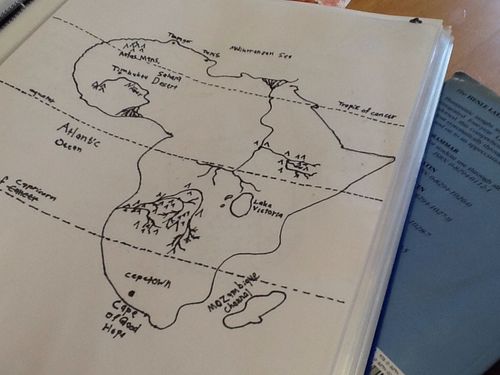
    The younger kids had stuff too — a map to draw, Latin flashcards to practice, poetry to recite, a story to retell in their own words (Belshazzar's Banquet, aka "The Writing on the Wall").  We got it all done, but it was much more boring.
     
     And now Mark is home, but he's going to spend the evening doing the taxes.  Sigh.  I mean, Yay!  I'm so glad he's doing them!  But… sigh.

  • Priorities.

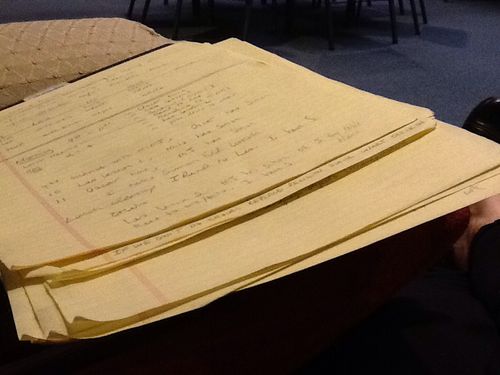
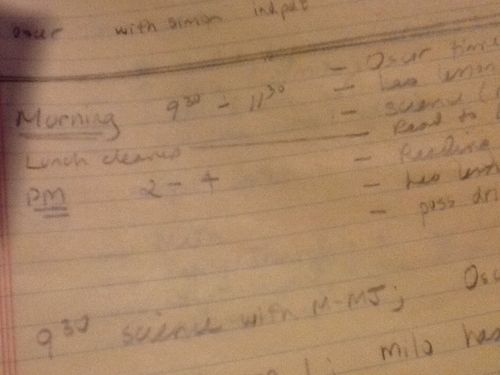
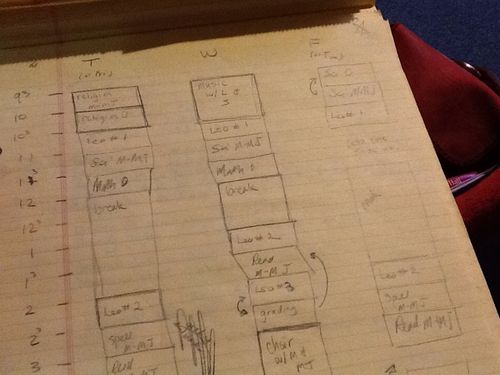
    I’ve been grappling with the schedule again. Spending a lot of time with a pencil and a yellow legal pad, one that made me feel happy when it was crisp and smooth and blank, and now makes me feel frustrated because it is stuffed full of sheets that have been ripped out and riffled and put back in order and marked with stars in the corner and crossed out and erased, and I don’t feel any closer to figuring it out, even though I know I am, if only because I have started to reject possibilities.


    Next year is already on my mind, and putting it all together has been particularly difficult because we’ve come around again in the cycle to a five-year-old who is just on the cusp of learning to read, of learning to sit still long enough to listen to a story, of learning to expect that every day there will be a math lesson and that we will work on it together until it is done.

    So for that dear, eager, boisterous, talkative five-year-old boy, I want to set aside three 30-minute blocks of dedicated one-on-one time in each of our three at-home days per week: one for learning to read, one for doing a math lesson, one for listening to stories. Everyone else has to revolve around him this year, because — I know! — this is His Year to set the pace, to set the tone, to set the relationship that is going to be him and me learning together. I want it to be a year of cuddling and stories and discovery and laughter, not hurry-up-and-get-it-done.


    But, you know, I have a toddler too, and he needs to be supervised; so I need to figure out which of the other kids will take charge of him while I work with the 5-year-old. And then, each of them needs my time too — even if out of necessity they get less individual time with me this coming year, still they need some. And yet — the high school boy is just getting into my favorite subjects; and the eight- and eleven-year-olds still seem to need supervision. And I hang my head in despair because I can make an argument for everyohe needing more time from me than I have.

    And before you know it — I am looking at a proposed schedule and saying, “This could work — as long as I figure out how to make a lunch on Wednesdays that takes zero time to set up, zero time to clean up, and that everyone will eat cheerfully without getting tired of it every week.” And wondering why bilocation appears to have been reserved for the celibate saints.

    + + +

    The whole line of thought leads to — I should take the children outside more. I should read to the children more. I should read better stuff to them. I should have more prayer time in my day. I should celebrate the feasts of the liturgical year. I should make more of our lunches from scratch. I should make them have less screen time. I should micromanage their time less, get out of their way and let them be creative. I should structure the day more. Should I put them in the church choir and call that Fine Arts for the year? But choir practice effectively conflicts with Religious Ed. Maybe it can double count, they’re singing hymns after all. Wait — here is an extra half hour — what should I use it for? Extra read alouds? Documentary-watching time? A nap?

    + + +

    “I just can’t figure out the best way to make all the time fit together,” I said. “I cannot do it all this year and something has to give.”

    Mark said to me:

    The half hours here, the half hours there — it doesn’t really matter all that much, Erin.

    Yes, it’s good to make it work in a way that feels right. It is good to be sure that you give some time to each of the children.

    But the value of you doing what you do, day in and day out — it isn’t in the value of the tasks themselves. You don’t have to choose just the right curriculum or divide up your time precisely perfectly to be doing this “right,” or doing right by the kids, or by me.

    It’s having you here, with the kids, all together. It’s your time enabling our family to live the kind of life we live. You, teaching the kids at home, lets us make schooling revolve around our family life, instead of our family life fitting in at the edges around someone else’s priorities. It means that I can do my job, travel for business or work weird hours if that is what it takes, without juggling competing schedules. It means we can leave the country for a month in the fall and take the kids skiing in the off season. The greatest value of the work you do is just in you being here in the middle to hold it all together so that our family can be, before anything else, our family.

    + + +

    I don’t spend a lot of time worrying that I am not “qualified” to teach my own children, in the academic sense. I am gifted with a (perhaps overblown) self-confidence that there is nothing I am not capable of learning well enough to facilitate the basics. I have this constant optimism that once you have a good plan, all you have to do is carve out time, stick to it, and then you can succeed. I know that for subjects I am rustier at, there are good curricula out there that I can follow along with as my child learns. All that is really necessary, to be a qualified teacher of one’s own children, is to love them, to desire their success, and — in my opinion — to appreciate the act of learning, to be willing to examine it, to have been a learner once (of any subject) and therefore to know how to encourage learning.

    I do fret more than I should about whether I do enough of the right things or too much of the wrong things.

    Mark reminded me: the important thing is not to have the right qualifications, nor to do All the Right Things, but to be the right person. Which is: mother to these children, fulfilling my vocation the way that Mark and I, together, formed our family to function. The days and the hours must be tended to, with prudence, but they don’t have to consume me, because there is great freedom in how they might be spent well. There are, in fact, many right answers to this sliding-tiles puzzle that is “how shall I spend my time.”

    ‘Tis good to be here.


  • White chicken chili for a group.

    Here is something easy for a crowd who doesn’t mind a little spice. I brought it for dinner at H’s after a co-schooling day, and everyone liked it but one girl who eschews all spiciness. H, who was born and raised in Texas, proclaimed it Rio Grande-worthy.

    Easy, too — I prepped it the night before, toted it to H’s house, put it in the crockpot during lunch cleanup, and we taught all afternoon while it stewed away.


    It is adapted from the Slow Cooker White Chicken Chili at Budget Bytes. Here is my version, doubled to feed two families of seven. Eat it with Fritos (really), shredded Jack cheese, sliced jalapeños, and Quick Curtido (recipe follows).

    Slow Cooker White Chicken Chili — Medium spicy

    Serves 10-12 with accompaniments, cooks 4 hours, prep is about 15 min at the start and at the end.

    • 1.5 to 2 lbs boneless, skinless chicken breasts — I used IQF pieces, partly thawed
    • 3 small yellow onions, finely chopped
    • 5 cloves garlic, minced
    • 2 Tbsp ground cumin
    • 4 tsp dried oregano
    • 1/4 to 1/2 tsp cayenne powder, or to taste
    • 32 oz. jarred green salsa — I used Herdez, a medium imported Mexican variety
    • Four 15-oz cans pinto beans, drained and rinsed
    • Two 15-oz cans small white beans, drained and rinsed
    • Two 4-oz cans diced mild green chiles
    • 32 oz chicken broth

    Put everything in a 6-qt slow cooker, cover, and cook on HIGH for 4 hours. Remove chicken and shred with two forks. Mash some of the beans into the broth to thicken it, then return the shredded chicken to the cooker and give it a good stir.

    Serve in bowls with plenty of Fritos, Jack cheese, jalapeños, curtido (below) and other toppings. Serves 10-12 if there are lots of Fritos.

    Quick Curtido (Mexican Slaw)

    • Eight cups thinly sliced cabbage — about half a big one or one small one
    • Four carrots peeled and shredded
    • One fresh jalapeño, ribs and seeds removed, minced
    • 6 Tbsp apple cider vinegar
    • 4 tsp white sugar
    • 2 tsp salt

    Place the cabbage, carrot, and jalapeño in a large bowl. In a small saucepan, heat the vinegar, sugar, and salt, stirring until just dissolved. Slowly pour the hot brine over the cabbage mixture and toss well. Transfer to refrigerator for at least one hour, but longer is better — 24 hours is about perfect. Serve cold as a topping for hot chili or an accompaniment for a variety of spicy dishes.


  • A soup for when it’s cold out but you want something spring-like in it.

    March is pretty awful in Minnesota, if you ask me.  My Facebook newsfeed generally fills up with pictures of other people's crocuses coming up, while outside we are still in the dreary, sloppy, sometimes frigid grip of wintry weather.  

    This year it's been Opposite Day for weeks; we had a two-week-long respite, with temperatures in the mid-fifties and sun, while my Facebook newsfeed filled up with East Coast friends' pictures of drifted snow and blizzards.

    11677_10200251406205938_9211228295485271688_n

    Me on Pi Day, probably a new record for earliest run around the lake with the jogging stroller.  I'd say earliest spring run but it was still technically winter.


    So today I have got a great soup for you!  It's cold enough that a steaming bowl of soup and a hunk of bread is exactly what you want for dinner, but don't you want one with the promise of spring-green vegetables to come?  

     The protein here comes from red lentils — please don't substitute another kind! — and chickpeas, but it seems light rather than heavy; the burst of smoky flavor doesn't come from bacon or ham, but from smoked paprika, one of my favorite kitchen secrets.   It's light enough to be the "vegetables" that accompany a simple supper of plain baked chicken or fish and rice, and it can be made from start to finish after the chicken goes in the oven.  I had the leftovers for lunch today; the kids had pumpkin waffles, and I selected a particularly crisp one to dunk in my soup.

    I only adapted this recipe VERY VERY slightly from this one at Once Upon a Chef.  

    Smoky Chickpea, Red Lentil, and Vegetable Soup from Jennifer Segal at Once Upon A Chef

    • 2 Tbsp olive oil
    • 1 finely chopped yellow onion
    • 4 minced garlic cloves
    • 1 large carrot diced small
    • Heaping 1/4 tsp smoked paprika
    • 3/4 tsp cumin
    • 1 quart chicken stock
    • 1 can diced tomatoes (14.5 oz), undrained
    • 1/3 cup red lentils
    • 1/2 tsp dried thyme
    • 2 bay leaves, optional (I was out of these — the soup was fine without them)
    • 1 tsp salt
    • Couple of grinds of black pepper
    • 1 can (14.5 oz) chickpeas, drained and rinsed
    • About 12 oz frozen vegetables:  green beans and peas, or one of those bags that has cut green beans, corn, carrots, and peas (that's what I used); or spinach.

    Sauté the onions in olive oil until soft; add garlic, carrots, smoked paprika, and cumin and cook 2 minutes more.

    Add broth, tomatoes, red lentils, thyme, bay leaves if using, salt, and pepper and bring to a boil.  Cover and simmer 10 minutes.

    Add chickpeas, cover, and simmer 10 more minutes.

    Remove bay leaves.  Use immersion blender to puree the soup about halfway — leave some chunks!

    Add remaining vegetables and simmer till hot.

    Enjoy!


  • More on othering the mother.

    My post on "I don't know how you do it" as an othering statement got a little bit of traffic and commentary.  Most of the quotes are from Facebook, so I'm not going to attribute them (unless one of the original writers should happen to read this followup and ask me to).

    Some people felt that the "othering" is not necessarily a form of dismissal, but more "an acknowledgement of the skill set of someone"else that I seem to lack:"

    We're talking about the skills that can and do develop out of necessity in times of necessity.  The statement is, I think, more a statement about grace and hope – the hope that there are skills out there that I don't have; that there is grace for surviving…  I'm not saying that it is something that should be said – because it does grate and feel like othering.

    See, now, to that I would say  that IDKHYDI is not the appropriate observation to make (out loud) because in this case it's not true.  The writer of this observation does know "how that person does it," or at least she has a theory:  out of necessity the skills develop.  She calls it grace and hope.  IDKHYDI is a statement of hopelessnessShe has put herself in that person's shoes and imagined "if I had to, I would be able to do that."  This is the antithesis of IDKHYDI, which is a statement of hopelessness.

    Others said as much:  

    If you think about it, there's a falseness to it in even those cases, though. After all, you admit you *do* know "how they do it"–by developing a skill set, by working hard, by surviving, by giving some things up (or having them taken), by relying on other's support, by making different choices. So it might actually help to mentally rephrase that into a more accurate statement: "I admire what you are able to accomplish."


    Another suggestion offered was that "IDKHYDI" is sometimes simply true:  the endurance is incomprehensible.    A reply (not from me):

    [T]here are situations where "I could never do…" can be accurate self-assessment. Given my neurological limitations, for example, I could never do anything that requires a great deal of quick memorization. 

    Of course, that's not usually what is meant by that statement. Usually what is meant is "I could never prioritize that goal the way you do."

     And I think that's exactly right about what's meant.  Another friend of mine jumped in to agree with this and added, that yes, that is what IDKHYDI means:

    For everything from "I could never be a stay-at-home mom" to "I could never be monogamous."

    That led to the reply:

    I was thinking of fitness and diet when I wrote that, since that's where I've caught myself thinking, "I could never…" when the truth is really that it's not a priority to me now… I want to say "I could never" because being faced with differing priorities can be uncomfortable; I may admire them, but that challenges me to examine my own.

    "I could never…" allows me to acknowledge the accomplishment without being challenged by it.

    And some pointed out that yes, you can come up with examples where "IDKHYDI" (or its cousin, I could never do what you do) is literally true.  (There's that plausible deniability again!)  But most of the time it's not:

    People say these things about all kinds of accomplishments that are not really incomprehensible–or are very easily answered (I don't know how you become such an accomplished pianist. Oh, it takes several thousand hours of dedicated practice? Good to know.

    Someone asked me, 

    Out of curiosity–do you think "othering" is a verb that refers to intent, to something objective about the situation or statement, or primarily to effect?

    That did get me thinking.  

    + + +

    Possibly people who find themselves being "othered" feel all kinds of ways about it.   I think the dichotomy is that in any given situation a person can either be "special" or she can "connect with" others.
     
    Sometimes that is a choice: I can choose to be special, or I can choose to connect.
     
    Otherwise it is something done to a person: I can choose to connect with you, or I can choose to identify you as special.
     
    The difficulty in discourse is that the dichotomy exists irrespective of whether "special" means especially admirable or especially deficient. Either way the identification as "special" is evidently preferable to connection. And what was consciously intended as admiration, even if unconsciously a sort of exercise in identity strengthening, can sometimes read as rejection.  
     
    More insidiously, the ambiguity inherent in the statement means that the rare person who consciously intends to invalidate someone else by deliberately othering her has a cover story to exploit.  Or maybe that is less insidiously; maybe the bigger problem is created by the legions of people who really don't mean to say anything hurtful or alienating but wind up doing it anyway because they Just. Don't. Think.

    Most of the time, however, I believe there are conscious and unconscious components to it.  The othering is itself the conscious part:   A conscious, however faint, identification and decision to verbalize "you are a different kind of person from me."

    The fact that it is often a hostile and defensive choice of verbalization (compared to alternatives that would display curiosity, attempt empathy, or seek commonality) is, I believe, largely unconscious.

    + + +

    I will not disagree with the notion that many people are just trying to say something neutral or kind when they pull out IDKHYDI. I stand by my statement that it is an instance of othering, at least unconscious, and frequently the othering is deliberate and conscious though it be without conscious malice ("you are special"). I think magical thinking is part of it sometimes (you are different from me and that reassures me that I will never be in your situation) and desire not to be challenged is part of it sometimes (I could never) and part of it is sheer tribalism (you're nuts, lady). The ambiguousness of the intent makes IDKHYDI akin to, if not as serious a social problem as, othering statements in the context of racial and gender differences. The ambiguousness provides plausible deniability that will be accepted as innocuous by members of the speaker's "tribe" and further serve as a marker of exclusion for those who object to the label. ("People like that are so sensitive, I was only trying to be nice.")

    So what if, instead of IDKHYDI, we sought and acknowledged common ground? What would that look like? Humans are adaptable, we are capable of changing our priorities, and we are capable of intense focus on our identified priorities — all of us are. We don't have to think that we would choose the same priorities in order to praise someone for doing the hard work that makes their priorities happen. Why on earth must we always get defensive when faced with someone who has done nothing more aggressive to us than arrange her own priorities in a different way?

    + + +

    Later, on Saturday morning, I thought of an example.  I was trying to get to the weekday (well, Saturday — not Sunday, I mean) eight o'clock Mass at the parish in the first suburb to the south, but I'd been sluggish in getting out of bed.  I was slurping down an espresso at 7:21 a.m., Italian-style, standing up in the coffee shop, hoping that this would get me under the wire for communion if the homilist wasn't too brief; and wondering how people (especially ones with small children) ever manage to get to a weekday morning Mass every single day.  I'm a morning person and it seems insurmountable.

    And yet I know that people do it.  Because they have different priorities (thank you, Facebook commenter).  

    No — wait — they don't have different priorities, as if specially gifted people wake up and find themselves in possession of the appropriate priorities.  

    They make from the situation they are in, priorities that fit into that situation and that satisfy their values.

    So in my imaginary dialogue with The Mother Who Is Something Like Me Except That She Goes To Weekday Masses More Often Than Only Once In A While — okay, really it's a monologue —

    — I could say:  I don't know how you do it.

    Or I could stretch my imagination just a teeny bit and say:  "Gosh, I think that if I were going to make it to an 8 a.m. Mass every day, instead of only once in a while, I would need to buy an espresso machine for my kitchen.  What's your secret?"

    That doesn't shut down a conversation — at least not on purpose.  It might start one.  I think it's better.  But it's probably not the only way.  


  • Co-schooling flow.

    This morning as I was driving the kids out to the northwest suburb where H lives, thinking over what I was going to teach today, I felt… really, really happy.

    Astonishingly, co-schooling twice a week with three toddling babies underfoot has turned out… okay.

    This year, the subjects I am teaching actually excite me. I realized that I was looking forward to introducing the third conjugation to the 3rd, 4th, 5th, and 6th graders. I was pondering which verb to use: I needed a transitive verb that could still be used without an object without sounding too weird, one that was easy to spell, one that could be used with most nouns as an object. Pono, ponere (to put or place)? Ago? Definitely not. I settled on “send.”

    I am also loving every lesson of the geography curriculum. We are having so much more fun this year than last year, when a couple of the kids (well, mostly my daughter) rebelled against Story of the World. This year all four kids love drawing maps and playing sailing games rolling dice and moving little ships around portolan charts.

    Thursday we are going to bake giant sugar cookies shaped like Africa, and paint them yellow and green for the desert and the rainforests, and decorate them with chocolate chip mountains and blue-icing rivers, and then eat them for afternoon snack. I can’t wait. The kids will love it. So will I. It is so much more fun to work with kids when they enjoy the material. Which has truly been a learning experience for me.

    I use a lot of documentaries for the high school boys’ modern world history this year. I learned my lesson two years ago when they were learning about Henry VIII: if my goal is for them to remember the story of history, a well-made documentary beats text readings every time. Text readings have their place, and I haven’t given up on them, but whenever I can find a really good documentary, we use those and the text is demoted to “supplement.” Thank you, BBC and YouTube uploaders. Today we are starting in on WWII with “The Dark Charisma of Adolf Hitler.” My 5th grader is voluntarily watching along with them instead of taking a break.

    The weather is unseasonably warm, though I would still call it “chilly.” That hasn’t stopped the younger children from going out barefoot.

    H’s crockpot is full of chicken cacciatore that I brought. It is my turn to bring dinner. Tonight the four older boys (between our two families) have Scouts and the two older girls have American Heritage Girls. I will slurp it down along with the girls before driving them to their meeting.


    And bring some planning materials with me, too. High school marches on. I need to get set up for chemistry, and for more Latin.

    And somehow figure out how the two of us are going to fit it all into our days, two days a week, next year. This year has given me so much confidence, though. It is really working very well, and I am confident that it will work next year, too.

    I started homeschooling years ago because I wanted schooling to revolve around our family life, instead of our family life revolving around a school. It has paid off many times over in that department.

    Some days there is real drudgery and frustration in it, especially when I have to deal with the tussles between my 3rd-grade daughter and my 5th-grade son. I detest whining and I have been hearing a lot of it lately. And there is the constant wish that the house would keep itself clean, the constant internal refrain of “I should really be doing more…” … more reading to the children, more field trips to local museums, more walks
    to the park; all those things.

    But as the years have gone by — I am a good ten years into it now — there has also been a great deal of delight and discovery. And challenges that feel good, not frustrating: teaching myself material so I can turn and teach it to others, learning to work with kids who learn in different ways, encountering material I learned a long time ago (meeting it as if it were an old friend).

    These days go so well, all together. The kids get English, Latin, social studies, and a bit of math for the high school boys. And they work efficiently! They know that if they finish quickly they get to play with their friends.

    My home days never seem to go quite so well for the younger ones. Maybe it’s because math and spelling aren’t as fun (they do like art and science pretty well). Maybe it’s because the dreaded DOUBLE MATH DAY that comes once a week (since we spend two days a week doing no math at all) hangs over everything like a cloud. Maybe it is because of chores.

    But my high schooler gets so much done on those days, barricaded in a quiet room with his to-do lists and his syllabi, that I have plenty of hope for the future.

    God help me, I am really starting to enjoy this. Everyone eventually comes up with theories of how the young should be educated, because theories of education are only proxies for theories of humanity. We who educate our own children are really putting our money where our mouth is, and finding out if we understand these young humans in our care the way we think we do, and finding out if we understand how to explain humanity to the humans and vice versa, as we go along. It is theoretical and it is empirical. It is exhiliarating and it is frightening. It is learn-as-you-go and throw-out-everything-you-thought-you-knew all at once. It is a life’s work that is simultaneously broad and wide, and narrowed to the very dagger’s point. I have learned so much. I have so much more to learn. Some of it is sticking, and some is falling away, and at the end the shape will be different for each one of them, and I will be different, too.


  • Othering the mother.

    Just Another Jenny wrote about "I don't know how you do it:"

    There is nothing that prompted this post except memory. For some reason this phrase bubbled to the forefront of my mind and I remembered the pain it can sometimes bring:

    I don't know how you do it.

    Lots of us have heard it from time to time.  I don't usually experience it as "painful;" rather, annoying (not this again).  But I have heard it mostly in reference to aspects of my lifestyle about which I do not have ambiguous or negative feelings.  I remember hearing it while I was a graduate student in engineering school, for instance. ("I don't know how you do…" what?  Math?)  And I hear it now about home education and about raising five children.  I channel the slight annoyance into bemusement and, I'm afraid, into a tiny sense of superiority which I really should try to quash.  

    Of course you don't know how I do it.  That's why I do it, and you don't.

    No, I don't say it out loud, but I admit to thinking it.  It's not good because, though interior, it represents a  retaliation in kind.  I am hitting back with the same stick that is being waved at me.  

    + + +

    Jenny is in a situation significantly different from mine, but one that attracts "I don't know how you do it" from mothers in situations that are more similar to mine:

    Usually the context of this phrase is when a mother who normally stays home with her children has had to leave town without them for a few days. She is struck by how much she misses her children and how happy she is to be reunited and then the fatal phrase is uttered:

    "I don't know how you working mothers do it. I missed my children so much. I could not do this everyday."

    It stabs. The intent is almost never malicious. It is an innocent wonder at how such a burden could consistently be borne. The problem with voicing such a thought is not that it isn't reasonable or true. The problem is that it very reasonable and terribly true.

    I think I've put my finger on what the "problem" with this vocalization is.  The "problem" is not that it is true and painful.  It's not even that it is an expression of pity; genuine pity is not necessarily negative (although it can be).

    Jenny is probably correct that it is not said in malice, but I think she is not correct that it is innocent.  The intent may be unconscious, but here's what underlies "I don't know how you do it:"

    It is an othering statement.

    If you don't like the slight "buzzwordiness" of the term "othering," you might try substituting the term "invalidation;" it is the same sort of thing, although personally I think the verb "to other" is a quite concise use of the English language to express what is going on here.

    Like many other examples of "othering,"  IDKHYDI exists in an ambiguous point on the spectrum between unconscious and intentional.  People do it on purpose, and people do it without realizing it, and there is usually plausible deniability ("I certainly didn't mean it that way, she was reading too much into what I said to her"); so it is impossible both to give careless speakers an appropriate benefit of the doubt and to call people out when they cross the line.  

    And so othering goes on, blithely, and no one is willing to do anything about it, because come on, what are you going to do?

    + + +

    Here is a decently written introduction to "othering:"

    By “othering”, we mean any action by which an individual or group becomes mentally classified in somebody’s mind as “not one of us”. Rather than always remembering that every person is a complex bundle of emotions, ideas, motivations, reflexes, priorities, and many other subtle aspects, it’s sometimes easier to dismiss them as being in some way less human, and less worthy of respect and dignity, than we are.

    "I don't know how you do it" is precisely a way of dismissing other women.  And yes, it's the same kind of thing as lumping into one group everybody who votes for that other political party.  It's exactly the same thing that creates "death by a thousand cuts" in the workplace, in the community, for people who visibly belong to minority ethnic groups or who have visible disabilities.

    It quite literally says:  I am unable to have empathy for you.   

    You are so different from me that I am not able to imagine myself walking in your shoes.  I will not make any reference to trying.

    It appears to be a compliment:  your abilities are beyond my imagination; but it is in fact a backhanded compliment:  your personhood is beyond my imagination.   

    It imagines that your unimaginable skills must be made possible only by the existence of some deficiency:  the working mother must lack a certain maternal love for her children, the mother of numerous closely spaced children must lack self-control or intelligence or self-respect, the parent of disabled children must be somehow "special" herself for God to have sent the children to her.  

    (Whatever; it couldn't happen to me, says IDKHYDI, because I, unlike you, am normal, normative, mainstream.)

    It says:  You must be different from me in some fundamental way.  You are a different kind of person, because "I could never" be the kind of person who would "do what you do."  

    It says:  If I were in your situation, I'd do things differently.  

    It might even mean:  I could never get into the situation you've gotten yourself into.  That's why I don't bother to imagine how I would cope:  because I know that I wouldn't get into your situation.  I don't have to imagine how I could do that, because what has happened to you would never happen to me.  I am not the kind of person that you are, the kind of person that would let that happen.

    + + +

    This is why I say it would be better if I quashed my internal reaction ("of course you don't know how I do it"); the internal reaction is a retaliatory othering, one that says, "Oh, I'm 'the other' to you?  Well, guess what, sister; you're 'the other' to me, and I rather like it that way."

    The source I linked above on "othering" is called There Are No Others; it has not been updated in a while, which is too bad, as it seemed like a really good start.  From the same page I linked:

    The concept behind this site, then, is that

    • a) humans have an undeniable and insidious inclination to engage in “othering” thought patterns for the purpose of self-preservation, and
    • b) learning to avoid and counteract these thought patterns is integral to greatly reducing the world’s hatred and suffering.

    Our intent is to raise people’s consciousness about othering behaviour, to make them more alert to these thought patterns, and to encourage alternative ways of addressing the problems that we often seek to avoid by dehumanising any one group.

    I want to be aware of mental "othering" and "othering" behavior in myself.  It may be true that we naturally do it, as a form of self-preservation and group preservation, naming certain people as our neighbors who are like us and "othering" different people, for safety.  But being human, we are more than natural, and we are called to constantly ask "who is my neighbor?" and acknowledge that the answer is "anyone."  There is no good excuse for dehumanizing anyone, even a little bit.

    This might be a good Lenten calling for anyone:  search out the othering, mental and vocal, and search out the invalidation, the defense mechanism. Notice it, and try to root it out wherever it occurs.

    Everyone is fully human?

    Even those people?

    Yep.

    Now try to behave as if it is true.


  • Lent notes.

    I started Lent off without a specific plan to give something up “for Lent.” I understand that to forgo voluntarily some specific pleasure or luxury — chocolate, or Twitter, or cream in your coffee — is a valuable penitential practice for many. My husband gives up chocolate every year, Sundays included, and reports that its absence bears fruit for him. I don’t like to do it though — I find that it doesn’t keep me in a Lenten frame of mind. It feels more like an endurance contest. I get more focused on “making it through” and on success — personal success.

    I don’t like associating Lent with “success.” This is not the point. So the longterm deprivation thing doesn’t seem to be the right personal penance for me.

    I feel drawn to an attitude suggested by this hymn which appears in the Liturgy of the Hours:

    More sparing therefore let us make

    The words we speak, the food we take,

    Our sleep and mirth, and closer barred

    Be every sense in holy guard:

    Avoid the evil thoughts that roll

    Like waters o’er the heedless soul;

    Nor let the foe occasion find

    Our souls in slavery to bind.


    (The translator is John Mason Neale, the original text, attributed to St. Gregory the Great, Ex more docti mystico.)

    I like the idea to rein in everything just a little bit, more sparing in food, in speaking, in entertainment, in sensual luxuries; rise a little earlier and go to bed a little later to make room for extra meditation and reading. Every time I remember it is Lent, to stop and take quick stock of my environment and make a little choice to spare something. It can be something small: I am pouring the tea: let me take it without milk today. I am driving: slow down to the speed limit. I am unloading the dishwasher: do it gently, without clanging pots (and definitely without sighs of annoyance). I am in the shower, one of my favorite petty luxuries especially in the winter: finish up and turn it off instead of lingering under the running hot water.

    Last week I was reviewing Introduction to the Devout Life, which counsels one who is struggling with a particular vice to practice the opposite virtue as continuously as possible. This year I seem to be struggling with my temper, with anger, quite a lot; so I was studying the chapter entitled “Gentleness.”

    I wound up ranging over quite a lot of material, reading works by St. Francis de Sales, by St. Alphonsus Liguori and also the Sermon on the Mount; in trying to work out references from St. Francis’s French original text, I discovered that “Blessed are the meek” in French is rendered “Blessed are the débonnaires,” which amused me greatly. It turns out that our derivative “debonair” is not very close to the meaning of the French word, which is something like “good-natured” or “easygoing,” meaning not easily ruffled, calm. The French in turn is a straight translation from the Latin Vulgate’s “mītēs,” which also means calm or placid, a word that is used to describe rivers or weather. (Nature. Bon aire.) Our word “meek” mainly means something like “submissive” these days, which is accurate in the sense that one “submits” one’s impulses to whatever happens to them rather than getting angry, but it really implies a kind of grovelliness that isn’t there in mītēs at all. It turns out that there is quite a bit of debate out there about the meaning of the Greek word that is rendered mītēs, meek, débonnaires, but as I am not a Greek scholar yet I will not get into that.

    Anyway, St. Francis’s advice for those struggling against a naturally short temper is to “speak and act at all times as gently as possible,” and I hit on that as a particular Lenten practice: be sparing in my motion and speech, whenever I can. As soon as I remember: slow down, stop banging into things, walk more carefully, speak more deliberately, eat more slowly, move more purposefully. Try to set this cup down noiselessly, slide the book into its spot instead of tossing it into the bookshelf, stir the sauce without splashing. I find I have to plan ahead slightly so I am not carrying more things than I can manage gently, leave myself a little bit more time so I am not rushed.

    It works. It sinks into the soul from the outside.

    Lentement.


  • Spelling reform.

    Yesterday my 5yo took a broken keyboard (from which we'd clipped the USB cable, making it a toy) and a magnetic Doodle Pro and propped them up on his wooden workbench to make a "computer" with a screen into which he could enter text.

    10471314_10200220869962551_4471121095037675867_n

    He asked me to write his name on the "screen" so he could copy it.  (That's my writing at the top of his Doodlepro.)  Then he dutifully pecked out each letter on the keyboard, and picked up the magnetic stylus on its tether to write the letter on the screen.

    I wrote the name at first with just the initial capital letter, and he insisted on my changing it to all caps.  He rejects the notion that a lowercase "e" belongs in the middle of his name.

    + + +

    We've been working on letter sounds and reading words with short vowels in them for most of this school year, not as consistently as I would like, but enough that he can blend well, even though he often needs to be reminded of the difference between a "b" and a "p" and a "d," and sometimes I have to remind him of others, especially "n" and "f."  Even though those aren't perfectly mastered, I started moving on to the digraphs:  "sh" and "er" (for /ɜr/ as in fern) and "ai" (for /eɪ/ as in fail) and "th" only for /θ/ as in both  —     /ð/ as in bother waits till much later in my system.  At first, I teach a single sound to go with each digraph.   

    A couple of days ago I introduced "ee" for /iː/ as in "seed," telling him that when we write two e's together, we usually spell the sound /iː/, and my 5yo told me:  "That is not an E.  An E has three lines that go across."

    I explained about capital letters, took my dry erase marker and wrote a capital A and a lowercase a, a capital B and a lowercase b, continued through to the E and the e.

    He said:  "In my name there is an E, and it has three lines that go across."

    I said, "We have worked with the letter "e" before, only we have always had it spell the sound /ɛ/.  Like this," and I wrote   r e d    on the board.   "Rrrrrruh.   /ɛ/.    D.     Red."

    He looked at me skeptically for a minute and then said:  "Okay, mom.  How about this.  When you want it to say /ɛ/ you will write it that way.  And when you want it to say EEEEEEE like in my name you will write it with the three lines that go across."

    Oh, child.   That would make sense, wouldn't it.  

    "That is a good idea," I told him, "to write different symbols for different sounds.  Some languages are written that way, and it makes them easy to learn to read.  But unfortunately, ours is not, and we all have to learn how to read it the way that it is written in our books."  

    My little spelling reformer.  Maybe I should have gone the medieval route and taught him to read in Latin first, adding English reading at the advanced level of decoding.  The system has its appeal.

    10930112_10200220870162556_7890903254107261916_n


  • St. Francis de Sales on “eternal happiness:” eternal multitasking.

    Wrote this post on Sunday:

    This one will be short because I just got back from celebrating my husband's 42nd birthday, which we did by — for the first time — leaving all the kids at home, under the oldest's supervision, including the napping baby, and heading to a neighborhood bar to drink fizzy drinks and eat deviled eggs. I had a second glass of cheap bubbly, and I am now sleepy. It is Sunday, though, so resting is not only a good idea, but mandatory. Hurray for feast days! And for Sunday dinners of cheese and crackers and cut veggies and dip, which mean that I don't have to cook (unless you count the four and a half pounds of sweet potatoes that I plan to peel and dice right before bed so I can take them to H's in the morning and make them for dinner tomorrow).

    + + +

    The fourth sermon in the book of Lenten sermons that I am working my way through is, happily, a sermon that was given on the second Sunday of Lent in 1622. We, of course, got the Transfiguration today; Indeed, so did St. Francis. His sermon began by riffing of the twelfth chapter of Second Corinthians, in which St. Paul speaks obliquely of himself:

    I know a man in Christ — whether he was in or outside the body I do not know, God knows — who was snatched up to the third heaven… and heard secret words, words which it is not granted to man to utter. 2 Cor 12:2-4

    St Francis comments,

    Now, if he who saw [wonders in Paradise] cannot speak of them — if even after having been snatched up even to the third heaven, he dares not say a word of what he witnessed — much less should we presume to do so…

    But then he goes on to explain that Matthew's story of the Transfiguration "treats of eternal happiness."  He begins with a parable from St. Gregory the Great, in which a mother must bring up her child from birth in a windowless prison.  She teaches him about the sun and the stars, about hills and fruit trees; she shows him samples of leaves and of fruit, but he cannot comprehend what his mother wants to teach him because "all that she shows is nothing compared to the reality itself."

    The limitations are the same, my dear souls, with all that we can say of the grandeur of eternal happiness… But be that as it may, and we may be certain that we can say nothing in comparison to the reality; still we ought to say something about it.

    The saint then goes on to discuss three "difficulties" which people have in attempting to comprehend the goodness of eternal life, all of which have to do with the idea that, in heaven, the soul will be somehow more limited in its powers.  These are:

    • wondering how the blessed can use their minds and senses while they are separated from their bodies;
    • supposing that the blessed are so "inebriated" with happiness that they are unable to act; and
    • thinking as if in eternal glory we will be "subject to distractions."

    For the first, St. Francis relates a story from St. Augustine:

    [A] physician told him that when young he began to doubt whether the soul, separated from the body, can see, hear, or understand anything.  One day, while in this error, he fell asleep.    Suddenly, a handsome young man appeared to him in his sleep and said, "Follow me."  The physician did so, and his guide led him to a large and spacious field where on one side he showed him incomparable beauties, and on the other allowed him to hear a concert of delightful music.  Then the physician awoke.

    Some time after, the same young man again appeared to him in sleep and asked, "Do you recognize me?… But how can you see and recognize me?… Where are your eyes?…  And where is your body?… And are your eyes open or closed?

    "If they are closed, they can see nothing.  Admit, then, since you see me even with your eyes closed, recognize me distinctly, and have heard the music even though your senses slept, that the functions of the mind do not depend on the corporal senses, and that the soul, even when separated from the body, can nevertheless see, hear, consider, and understand."  Then the sacred dream ended and the youth left the physician, who never after doubted this truth.

    As to the second, Francis says that happiness "will not render the soul less capable of seeing, considering, understanding, and performing the various activities which the love of her Beloved will suggest to her."

    For the third (distractions), Francis again insists that the powers of the soul will be expanded:

    We must never again allow this "difficulty" entrance into our minds, namely, whether our souls… will have full and absolute liberty to perform their functions and activities.  For then our understanding will see, consider, and understand not only one thing at a time, but several together; we shall be able to give our attention to several things at one time without one of them displacing any other.

    There you have it, folks:  without the fetters of this mortal coil, our souls will be perfect multitaskers.

     Rather, each [act] will perfect the other.  The many subjects we will have in our understanding, the many recollections in our memory, or the many desires of our will will not interfere with each other, nor will one be better understood than any other.  Why is this?  For the simple reason… that all is perfected and brought to perfection in the eternal beatitude of Heaven.

    What would you expect from the patron saint of to-do lists?

    The saint goes on to explain that all the blessed will know one another by name, again pointing to the Transfiguration ("The three disciples recognized Moses and Elias even though they had never seen them before"), and imagines the conversation we will have, with the other blesseds, with the great saints, with the angels, and with God himself, whom we will see face to face; to St. Francis, the Beatific Vision is also a participation in a conversation:

    In this vision and clear knowledge consists the essence of felicity.  There we will understand and participate in those adorable conversations and divine colloquies which take place between the Father, Son, and Holy Spirit.  We shall listen to how melodiously the Son will intone the praises due to His heavenly Father, and how he will offer to him on behalf of all people the obedience that He gave to Him all during His earthly life.  In exchange we shall also hear the Eternal Father, in a thunderous but incomparably harmonious voice, pronounce the divine words which the Apostles heard on the day of the Transfiguration:  "This is my beloved Son, in whom I am well pleased.  And the Father and the Son, speaking of the Holy Spirit, will say: "This is Our Spirit, in whom, proceeding One from the Other, We have placed all Our Love."

    Ever the intellectual, St. Francis imagines a Vision as something participatory for all the senses, senses which are not more fettered, but more free.