This is especially sweet. Read all the way to the end.
It’s a nice tradition she has going there, don’t you think?

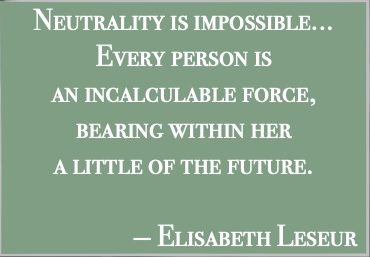
bear – ing n 1 the manner in which one comports oneself; 2 the act, power, or time of bringing forth offspring or fruit; 3 a machine part in which another part turns [a journal ~]; 4 pl comprehension of one’s position, environment, or situation; 5 the act of moving while supporting the weight of something [the ~ of the cross].
This is especially sweet. Read all the way to the end.
It’s a nice tradition she has going there, don’t you think?
Pontifications led me to Disputations, on doubt. It’s short and good, so I’m going to do what Ponty did and reproduce it all here.
Whether doubt is a virtue
Objection 1. It would seem that doubt is a virtue. For I have doubts, and I am virtuous. Therefore, doubt is a virtue.
Objection 2. Further, people who don’t have doubts are obnoxious. But being obnoxious is contrary to the virtue of charity. Therefore, doubt is a virtue.
Objection 3. Further, by doubting a man comes to accept and understand his faith more deeply. Since the fruits of doubt are good, doubt itself must be a virtue.
On the contrary, the Apostle writes, “For he that wavereth is like a wave of the sea, which is moved and carried about by the wind. Therefore let not that man think that he shall receive any thing of the Lord.” [Jas. 1:6-7] Therefore doubt is not a virtue.
I answer that, doubt is contrary to faith, and whatever is contrary to a virtue cannot itself be a virtue.
But not all forms of doubt are so opposed to faith as to be vices. A man may doubt out of ignorance, as being unsure of something because he does not know that someone trustworthy has affirmed it, and this in itself is not sinful, if he cannot be blamed for his ignorance. Or a man may doubt out of a lack of clarity, as being unsure of the meaning of what a trustworthy person has affirmed, or out of an error in reasoning, as when he fails to see that a particular consequence necessarily follows from what he believes; in neither case is his doubt a sin in itself.
If, however, a man doubts through deliberately turning his will away from attending to the intellectual principle by which an object of faith is to be accepted, this may be accounted blindness of mind and a sin, as the Doctor writes. Further, a man may doubt through obstinately refusing to assent to that which is proposed as an article of faith, which is an act of unbelief and a sin.
Reply to Objection 1. Yeah, and so’s my big toe.
Reply to Objection 2. Trust me, they’d be obnoxious even if they doubted.
Reply to Objection 3. The withholding of assent that is the act of doubt can be done in two ways. First, as an exercise of the intellect, whereby the content of faith is examined by asking such questions as, “What if it were not so?” This exercise is done with the purpose of deepening faith, and is not doubt properly so-called.
The second way, which is doubt proper, is to withhold assent unconditionally. This act terminates in a state in which the actor has less faith than before, and can in no way be held to cause an increase in faith. It may be that, subsequently, the man will grow in faith, but such growth requires other causes and cannot be regarded as the end for which the man doubts. If the man winds up with a greater faith than before he doubted, this is to be regarded as God bringing good out of evil, not of a virtuous means producing good fruit.
What I especially like about this is the bit about "because he does not know that someone trustworthy has affirmed it" and being "unsure of the meaning of what a trustworthy person has affirmed." Most discourse on doubt and belief never acknowledge that, in fact, most of what we think we "know" comes to us through other people. We depend for nearly all our knowledge on the trustworthiness of others.
(The more modern we become, the truer this is. The camera has always lied; but it’s much easier with Photoshop.)
Almost everything that an individual can know—history, science, geography—he takes on faith. Faith in the people who have taught us is a much more fundamental part of the human intellect than it usually gets credit for. Without it we can’t move beyond what we see with our own eyes or follow with our own reasoning from philosophical postulates.
I’ve been reading to my five-year-old the Children’s Everyday Bible published by Dorling Kindersley. In general, I consider DK’s books for children, especially picture books, to be of almost universal high quality and appeal. (For an example, see Children Just Like Me, a collection of photo essays of children from all over the world and living in all kinds of conditions).
I chose the Children’s Everyday Bible because the text was engaging and also because it is arranged in a daily-reading format: there is one page and a short reading, arranged in the order of the Scriptural books, for each day of the year. I thought that taking a year to get through the whole Bible was a good pace, and that it would sort of automatically remove the "what should we read about next?" problem. Indeed, we found that this works well. Once a week we read a week’s worth of pages, and that’s our Bible story for "schoolwork" (note: one day a week we work on memorization from the catechism, and a third day we read a saint’s life; so Bible reading is one-third of the religion curriculum, as well as a fair part of our informal reading.
I expect a certain amount of simplification and textual interpretation in a children’s Bible, of course. And I knew when I bought it that it would be a Protestant Bible—I have yet to find a Catholic children’s Bible that I really love—and I checked a few key places for problems. I forgot to check this one, slated for August 4:
When John the Baptist first saw Jesus, he knew immediately who he was. "This man is the Son of God," John told his disciples. Two of them followed Jesus and spent the day with him. That evening, one of the men, Andrew, went to find his brother. "Simon, we have found the Savior!" cried Andrew.
So far, so good. Then:
When Jesus saw Simon, he told him, "From now on, your name will be Peter, which means ‘rock.’ "
So far, so good. Then immediately afterward, Jesus finishes with the famous line:
"One day, you will be as strong and solid as a rock."
That’s it. Huh? When I hit this, reading it aloud to my son, I caught myself in time. This line, of course, does not appear in John 1, on which this vignette is based, nor anywhere else. I suppose the reteller, Deborah Chancellor, felt that the children needed some explanation of why Simon was renamed "Rock." But if so, why not take it from Matthew 16:18?
"…you are Peter, and on this Rock I will build my church, and the gates of Hades will not overcome it." (NIV)
It would be one thing if the explanation of Peter’s name was simply left out. In a children’s Bible, you can’t include absolutely everything. But including an explanation that is, in fact, not Biblical smacks a little bit of revisionism.
Because, of course, Catholics base a lot of our beliefs on the information Jesus imparts to Peter in this episode (as described in Matthew 16; John 1 just sort of leaves it at "your name is Rock" and doesn’t explain why). Jesus goes on:
And I will give unto thee the keys of the kingdom of heaven: and whatsoever thou shalt bind on earth shall be bound in heaven: and whatsoever thou shalt loose on earth shall be loosed in heaven. (KJV)
I’m picking Protestant translations here, incidentally, to make my point.
Jesus says in Scripture, essentially, I call you Rock, and on this rock I will build my church. We look at history, and we trace a particular line of bishops all the way back to Peter: first there was Peter, and then Linus, and then Cletus (no slack-jawed yokel, he), and then Clement, and then Evaristus, and so on. Tradition? Legend? No, plain old history, like you’ll find in any random encyclopedia. (Compare the table at that link to another historical one, like rulers of England and Great Britain, or for something a little more contemporary to the current topic, rulers of the Roman Empire.)
Given that it’s a matter of record that Linus succeeded Peter, and Cletus succeeded Linus, and Clement succeeded Cletus, and so on, down to where Benedict XVI succeeded John Paul II, it’s pretty important that Scripture tells us that on Peter Jesus will build—in fact did build—his Church.
I do own a children’s Catholic Bible, the New Catholic Picture Bible, [UPDATE: Try this link instead, to the "library-binding" edition] and it says in the equivalent passage,
"And I say to you, you are Peter, and upon this rock I will build My Church, and the gates of hell shall not prevail against it. And I will give you the keys of the kingdom of heaven; and whatever you shall bind on earth shall be bound in heaven, and whatever you shall loose on earth shall be loosed in heaven."
Maybe it is a mistake to look for engaging, childlike text. Maybe I should be looking for mature text quoted directly from the real Bible (in the above case, the Douay-Rheims translation).
UPDATE: The first link to the New Catholic Picture Bible seemed to have some errors. I got it from the ISBN off the back of the book. The link to the library-bound edition is the same book, although a different binding, of course. We own one copy of each edition. One’s in the "Mass Bag" and one’s in the school stuff.
UPDATE AGAIN: This, the Children’s Illustrated Bible, is the sort of thing I’d like to find in a Catholic version.
I was trying, the other day, to explain to a friend why one homeschooling scheduling method (Managers of Their Homes) completely turned me off, while another (A Mother’s Rule of Life) appealed so much to me.
The first (MOTH) entails making a detailed, regimented schedule for each child in the family and for the mother, budgeting time in tedious detail, the way a money-conscious family might budget spending down to the last penny. If I could follow it, it might work magic, I think. It really is rather amazing how much time the author manages to carve out for her own projects, considering the demands on her time as a homeschooling mother of… was it eight? Hers is a program that promises you will be able to "get it ALL done."
The second entails setting up a rule modeled after the Benedictine rule, focusing on transitions from one activity to the next and on making time for five basic priorities, in order of their primacy.
What is wrong with the "time budget?" Time is a limited resource after all. Why can’t it be budgeted and tracked like money? Why does the analogy break down?
Trying to articulate it helped me figure it out. Despite the saying, time is not, in fact, money. In many ways it’s very unlike money.
You can imagine a family’s money supply as a kind of reservoir. Income enters, filling it up; expenditures deplete it. It is indeed possible to count every penny that comes in and control every penny that goes out. Furthermore, though some families’ options are more limited than others, an earner can change the money inflow, speeding it up by working more or by doing higher-priced work. And a family can alter the outflow, by spending more or less.
A family can reduce the effects of a variable or unpredictable inflow by saving up enough of a buffer that the outflow can remain steady while the contents of the reservoir fluctuate. And if large expenditures are foreseen in the future, a family can save money, building up the reservoir, during the times that expenditures are low.
In short, money is conserved. As we used to write in Chemical Engineering 100:
IN – OUT + GENERATION = ACC
That is, the paychecks minus the spending, plus the growth in value of what you already own, equals the accumulation of wealth.
But time is not conserved. It is impossible to accumulate. It is impossible to generate. And most importantly (neglecting the effects of superfast vehicles and proximity to large masses), every man, woman, and child in the world acquires it, and spends it, at the exact same rate. No self-help technique, college degree, or choice of career ever changes that. We each get one thousand four hundred and forty minutes every day.
One’s supply of time is not, in short, like a reservoir. It’s more like a river, and we stand on the bank. We can turn wheels with its momentum, we can dip our faces in and drink, we can throw in a line, we can climb aboard and float downstream; but we can never have what has already flowed by, nor grab what the current hasn’t yet carried within our reach.
And that’s why the budget analogy must ultimately break down.
The city of Rockford, Illinois is weighing a new daytime curfew law:
The curfew would apply to children younger than 18 who are out in public places from 9:30 a.m. to 2 p.m. on school days. Violators would face a fine ranging from $10 to $500 and potential community service.
Homeschoolers, understandably, are worried.
James, in the comments at the link, asks,
[W]hy in the world shouldn’t [truancy laws] encompass home schoolers, all of whom should be learning when all the other kids are? Increasing the scope of the law to include home schooled kids shouldn’t make for a burden as I’m confident most home schoolers in fact do have their children engaged in learning during school time, so it’s not like a lot of home schooled kids would be picked up in truancy dragnets.
I understand why folks who are not familiar with home schooling think that home schoolers should be "having school" during "school hours," so I don’t blame James for asking. The answer is simple, though. Two reasons:
First, school at home takes less time than does school in school. A child working one-on-one with his "teacher" can plow, in a couple of hours, through material that takes six hours in school. It’s silly to make a child stay inside when he’s finished his work for the day. If the state wants to enforce standards on homeschoolers—and most do, one way or another—spending the hours from 9:30 to 2 pm indoors seems like a strange way to define "learning." (On the other hand, it gets the school off the hook if that’s all that it takes.)
Second, who’s to say that a parent doesn’t "have their children engaged in learning" at the zoo, the museum, the grocery store, for pete’s sake? One of the principles of homeschooling is that the barrier between "real life" and "learning" is dissolved.
This seems a little… excessive:
Advocates for an 11-year-old girl who was arrested on a deadly weapon charge for throwing a 2-pound rock during a water balloon fight say the charge in no way fits the crime.
But Fresno’s mayor and police chief say Maribel Cuevas’s case was handled appropriately, and that assault with a deadly weapon is the proper charge for an act that might have had fatal consequences.
I’m relieved to see she’s actually being tried as a juvenile.
This kind of thing gives me some cognitive dissonance, though. Most of the time, my vivid memories of life as a child lead me to have sympathy for the way that children see the world, or at least the way that children who thought as I did see the world.
I have memories of being a child, set upon by various bullies, and wishing that someone would take seriously other children’s threats of violence: "If we were working together in an office, instead of being kids at school, I could sue that girl for assault." It was miserably wounding to know that the frightening prospect of being punched or even humiliated by some powerful other kid would be dismissed as kid stuff by all the adults who were supposed to protect us. Maybe what was wounding about it was the whole idea that "kid stuff" was, at heart, dismissible.
And here it is, what I wished for as a child, coming to pass: A child placed under house arrest, made to wear monitoring bracelets, facing the prospect of four years’ incarceration because she threw a rock. A big rock; indeed, she could have injured him badly. And it’s taken seriously by everyone involved: no kids’ scuffle, this is a felony assault. Just what I would have wanted. So why does this bother me so?
Maybe because the other kid started it, at least according to the news reports. He pelted her with water balloons and taunted her first. She fought back.
Yeah, water balloons—that’s the "kid stuff." She fought back with a rock. That’s the "serious stuff."
But: Does a humiliated, furious eleven-year-old have the kind of control of the will to stop, to calculate whether throwing a rock is a disproportionate response to being taunted and hit with a water balloon? I suppose that is one of the questions that the juvenile court will weigh. I hope so. Another thing I remember about childhood is that the sense of proportion is very, very different from the one we develop as adults. Part of that is because children, out of our programming as human children, value connections, welcoming, and inclusion—the opposite of humiliation—more than almost anything else. Humiliation is indeed worse, for a child, than common physical injury.
The boy she struck, Elijah Vang, supposedly taunted her and soaked her with water balloons. Nothing physically wounding, of course. Kid stuff. But do you think: those weren’t fighting words? You want to tell me: that wasn’t incitement? Is it fair to put Maribel’s stone-throwing in an adult context, and not Elijah’s?
I can’t help but think that Maribel is being punished not for simple assault, but for fighting back.
Never, never, never fight back: the zero-tolerance mantra.
Feministblogs agrees.
Today, for the first time, my five-year-old is in charge of part of the grocery list—the part he should be able to read, that is:
Why so few plurals? I haven’t yet taught him that we sometimes spell the sound /z/ (the last sound of the phrase "hot dogs") with an "s."
The only item that I added to the list specifically because I know he can read it is "beets."
Part III of a series that starts here.
So I’m looking over my notes on the five p’s—the five roles that make up my vocation. They are a mess, all over the page. I can tell that what I was trying to do here was list the individual responsibilities I have in each role.
Prayer:
morning *
evening *
meals *
rosary *** GOAL —> link to some other activity
confession
mass
adorationPerson:
exercise
rest
nutrition/vitamins
coffee
water
quiet time to self
personal hygiene –> Health
correspondence
character developmentPartner:
permission and support to take care of his person — e.g. exercise, time to veg
be available at breakfast
be available in evening
phone call at work in the afternoon
KEEP MY CHART [yes, this is a reference to NFP—I have a bad habit of trying to keep my chart in my head, which actually "works" fine for us, but isn’t very fair to the aforementioned partner]Parent:
kids’ hygiene
feed
outdoors/exercise
clothes
schoolwork
read to
character development –> connection with extended family
practical life *** —> chores
direct attention other than school
(self) discipline
foster sibling relationshipsProvider:
tidiness
cleanliness
meal planning
school prep/planning
purchasing
cooking
paid work and professional development
freeing Mark to work
beautifying
appointments
optimization/system control [that is, doing stuff like analyzing my roles, time management, etc.]
filing/dealing with paper
This makes it look a lot neater than the paper, which is covered with little arrows drawn from item to item, stars, underlines, boxes, and other doodles. But you get the idea.
I’ve clicked on this a few times by now, but today is the first time I actually spread a tee shirt onto my dining room table and attempted to imitate it.
Can anyone figure out exactly how this is done? ‘Cause I can’t, no matter how many times I hit "refresh."
The Anchoress wants to know,
1) A few minutes before Mass begins, are you:
a) praying/reading
b) talking to a neighbor
c) simply sitting quietly
The answer is (d), trying to help my children to simply sit quietly. I’m surprised TA left that out!
If I had my druthers, though, I’d be (a), praying.
2) Sign of Peace:
a) I love it and look forward to greeting my neighbors
b) I hate it and wish it would go away or be moved to the start of Mass
c) I don’t love it or hate it.
I don’t love it or hate it (c), but I do hate it in the middle of Mass, where the parish we used to attend put it. At our current parish, it’s either absent or it’s at the very beginning, which I prefer immensely. Either way it is kind of patronizing to be instructed to greet people, as if I didn’t do that when I came in.
3) Holding Hands during the Our Father
a) I love it – it’s so unifying
b) I hate it, find it intrusive and wish people would stop doing it.
c) I don’t love it or hate it
(b) I think. What I hate is when it is the common practice for everyone in the parish to hold hands during the OF. I certainly don’t begrudge anyone else, say, married couples, from choosing to do so.
4) The Ushers at your parish DO or DO NOT greet you and shake your hand as you are exiting your pew for Communion:
They don’t.
If they DO:
a) I like it – it’s friendly.
b) I don’t like it. We’ve finished the sign of peace and I’m preparing for Communion.
c) I don’t like it or hate itIf they DO NOT:
a) I wish they would!
b) Please, God, don’t give them ideas!
c) I don’t really care
Shhhh! (b)!
Actually, I’ve never seen this particular behavior before. Had no idea it was a problem.
Amy Welborn wants to know,
…why do you think the mouth is a baby’s primary sensory organ?
… it seems so unsafe, on the face of it. The only thing I can figure is that it ensures the baby will get some kind of food even if it’s neglected, as it shoves everything into its mouth. But that still doesn’t seem to compensate for the danger factor.
In a "natural" environment the hazards of, say, choking would be reduced. There are no such things as coins or marbles—slippery little trachea-plugging spheres and discs that they are—in the wild. Nor are there sliced-up apple chunks. Few foods (grapes are the only example I can think of, and wild ones, of course, are tiny) are actually choking hazards when presented whole, unprocessed, uncut.
Most rocks of the right size, that is, are rough and textured and unlikely to be choked on if a baby decides to roll it around in his mouth.
Healthy babies that are allowed to stick the normal sorts of things (not marbles) in their mouths develop a pretty good gag reflex. Remember, gagging isn’t choking. A baby who gags on a rock, stick, or leaf isn’t in any danger, even if it *looks* scary. That’s just part of the oral exploratory process.
And poison isn’t likely to be a problem either, as in the wild most poisonous substances are terribly bitter.
The point is only that the serious hazards we associate with babies sticking stuff in their mouths are mainly created by our modern life, to which evolution has not had a chance to catch up.
It helps to know the difference between what gagging looks like and what choking looks like. After H., who used to work in a day care, explained that to me (and demonstrated, which was mildly amusing—she lay down on the grass and waved her arms and legs to show me ‘choking baby’)—I got a lot more relaxed about babies mouthing things.
My babies have gagged on lots of stuff. I only ever saw one choking once (on a slice of apple)—he was sitting on the floor flailing his arms in a panic—and he had brought it up by the time I got to him.
If I know that what he’ s just stuck in his mouth is a marble or a coin, though, I tend to do the Face-Down Finger Sweep. Pick him up, hold him face down (gravity should be your friend, not your enemy—contrary to what you might think, you do not need to see what you are doing), pry the jaws open and do one sweep across the tongue with the index finger.
Just quote Isaiah 45:10.
Woe to him who asks a father, "What are you begetting?" or a woman, "What are you giving birth to?"
Recent Comments
Recent Posts
Categories
…more to come later
 bearing blog