bearing blog


bear – ing n 1  the manner in which one comports oneself;  2  the act, power, or time of bringing forth offspring or fruit; 3 a machine part in which another part turns [a journal ~];  pl comprehension of one’s position, environment, or situation;   5  the act of moving while supporting the weight of something [the ~ of the cross].


  • How I teach my kids to read, an empirical approach: III. Materials: lists, slates, and readers.

    Third post in a series.  See here for: Part I.  Part II.

    + + +

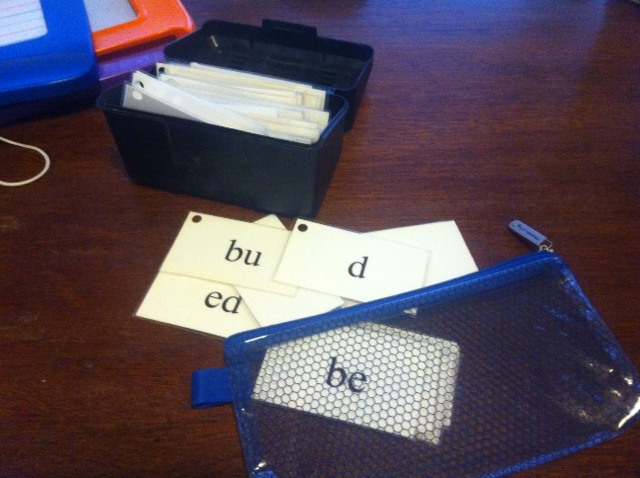
    In the last post, I started writing about the materials I use, and explained just one:  a set of large phoneme flashcards, optionally made with textured letters (like "sandpaper letters" but including some digraphs like "ee", "ai", "th", etc.)  

    The blog series would have been more tightly organized had I hit "save draft" instead of "publish," and continued by adding this material to the bottom of the previous post.  Instead, I am publishing the bits as I write them here.   I'm trying to restart the blogging habit by intentionally beginning a long and easy-to-write series.  Bear with me.

    + + +

    So, more materials today.

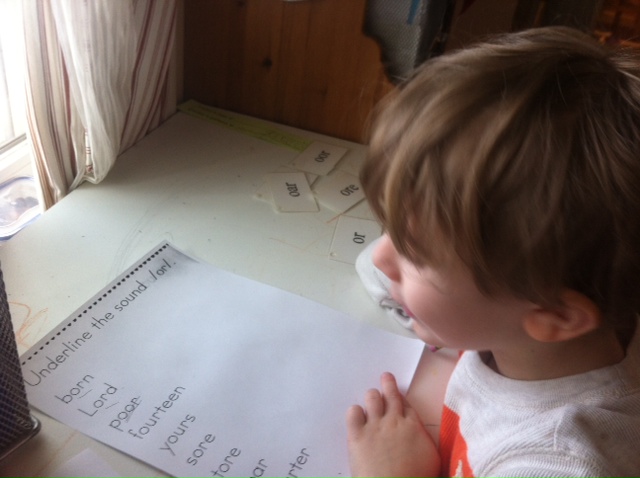
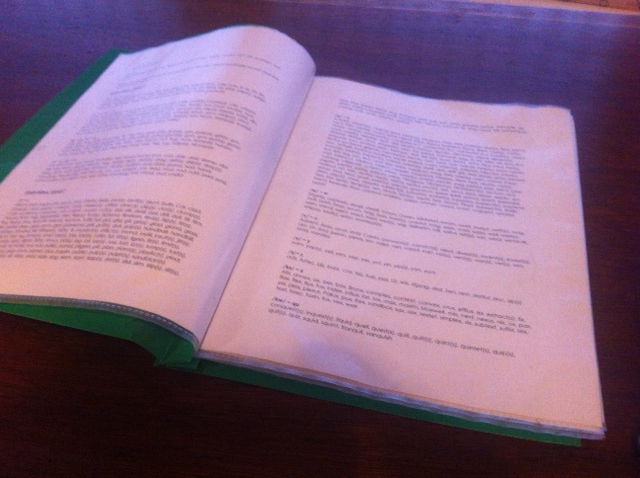
    Item 2.  "Progressive" lists of words prepared in advance.  

    Photo 4

    We'll get to the content of these progressive lists, specifically, later in the series.   Also, why I call them progressive.  For now I want to make two points:

    First, that this packet of word lists is ready to go as a prepared material.  On a given day I can pick up my packet, flip to the page where I left off, and choose reading-practice words from the current list.  When it's time to teach a new sound, I move on to the next list.  This keeps me from having to think what to teach on the fly.  

    (I don't like to think on the fly what to teach much, because it requires a lot of my attention and self-discipline to interact positively with children, unless they are having a really good day.)

    Second, it's a good place to point out that the majority of the time early on, I'm asking children to read individual words.  I don't rely on a regular diet of early reader books, at least not in the very beginning.  Those are available (you'll see the readers coming up in my materials list), but it's not the bread and butter of my program.  My kids have always been frustrated by the process of  slowly struggling through a sentence one sound at a time.   If, by the time you've made it through one word, you've forgotten the previous word, you're not going to be really engaged with the text.  So — while we dip into sentences and stories now and again — I concentrate on word lists until decoding is more rapid.


    Item 3.  Large magnetic slates with attached stylus.

    Photo 2 (2)

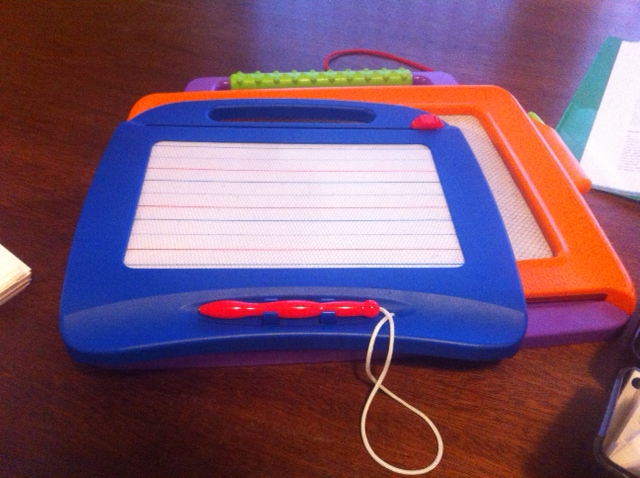
    Two common brands of magnetic slate are Doodle Pro® and Magna Doodle®.  The larger the size, the better, for this application.  The orange one on the bottom in the photo is a Doodle Pro®.  

    At the beginning of this school year I went to a Learning Resources brick-and-mortar store in my town and found the blue slate with the primary-handwriting lines permanently scribed on it.  I really like this one.  I wish I'd bought a couple of them; maybe I'll return to the store, because for the life of me I can't find it online.  If you wanted to make your own from a blank magnet slate, I'm thinking that red and blue Sharpies would do the trick.

    So, I use the magnet slate to write the words for the child to read, and sometimes the child uses the slate to spell.  This is so much less wasteful than paper, and so much less messy than dry-erase boards.  I love it.  Write the word, read the word, wipe the word, and move on.

     It's also easier for a child to write with the stylus than to write with pencil and paper.   Mind you, this means that you're not really working on the pencil-holding, pencil-pushing skill at the same time, if that was your goal; but I'm all about reducing frustrations here, and if your child is ready to read before he is ready to manage a pencil and paper, I say let's go ahead with the reading.  The pencil can wait.


    Item 4.  A set of phonics readers.


    Photo 5

    Pictured above: Bob Books®.  (You might prefer to use something else.)

    I know, I just got done saying that I mostly teach decoding using word lists.  But I do use readers sparingly, and more and more frequently as the child either (a) asks for them or (b) appears to show readiness for sentences of the length in the books.  It's the kind of thing that I pull out once in a while when we get a little tired of word lists, or when it seems like a good idea to remind the child of the point of this whole exercise.  Also, you need at least a little bit of practice with things like going left to right, noticing the capital letters and periods that denote sentences, turning pages, and the like.

    No set of readers is perfect, and I think that many different sets will work with my plan.  There are, I think, two features to be avoided.  

    Feature to avoid, number one:  an over-reliance on "sight word" reading.  These are words that the child is supposed to learn to recognize from memory, on sight, without decoding.   Ideally, especially early on, the child will encounter zero words that he does not yet have the skills to decode.   We are going for phonics, as pure as possible.

    Practically speaking, that's difficult to arrange. It's really hard to write a story that sounds okay but doesn't contain the word "the."  (Though not impossible, as you will see.)  In my experience, kids can deal with one or two of these here and there, so it isn't a deal-breaker.  The Bob Books use "the" and "O.K." fairly early on, and I just tell the child what the word is and we move on.

    Feature to avoid, number two:  Over-emphasis on alphabetic order and/or the initial letters of words.  There's no good reason for the most prominent feature of your readers to be "Here are a lot of words that begin with the letter A" followed by "Here are a lot of words that begin with the letter B" and so on.  Later this can be useful for teaching capital letters, but really, the order of the alphabet is not germane to decoding, and the initial letter of words is a red herring.

    Again, there are lots of reader sets out there that I think would work.  I have seen, and like, the BRI readers (you can see them here — I'm a little confused about how you obtain them, though).  I know a lot of people like the Little Stories for Little Folks, sold by Catholic Heritage Curricula, and I think those would work.   

    I am pretty sold on Bob Books, though.  They are inexpensive, widely available, appealing, and small (nice for little hands).  They come in progressive sets (so you can buy them 8-10 at a time) and within each set, the order you use them in isn't all that important.   You don't need to do a lot of research on them, just buy and use.  

    + + +

    More materials to come in another post.


  • How I teach my kids to read, an empirical approach: II. Materials: the “sandpaper phonemes.”

    Continuing from here.

    + + +

    Today I'll begin commenting on the materials I reliably use in my reading instruction.  These aren't necessarily the only things that I use; I have some other stuff that I pull out from time to time just to shake things up.  There are a lot of literacy toys and tools out there.  But these are the core materials without which the rest of my series won't make much sense.


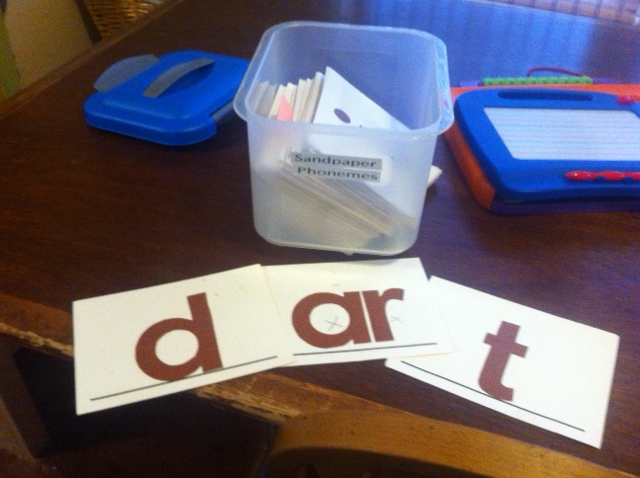
    Item 1.  A set of 44 large phoneme cards (not just an alphabet, as you'll see).   Optional feature:  Tactile letters.

     Photo 1 (2)


    Here are the basic features of these first cards:

    • They are large and fairly stiff (made of better-quality 5×7 cards).
    • There is a horizontal base line along the bottom edge, to help a child keep them right-side-up.
    • The letters are drawn with broad strokes, a fingertip's breadth.
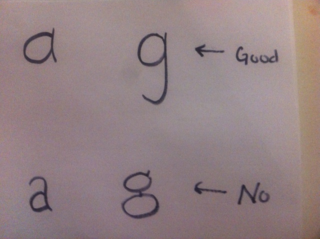
    • You can use any manuscript style or font (D'Nealian, Zaner-Bloser, Century Gothic, whatever) you like, with one caveat:

    Photo (11)

    And one not-basic, optional feature:

    • My set is made of a textured paper cut into letter shapes and affixed with spray adhesive to the cards.  The idea here is to make homemade "sandpaper letters" (they are a Montessori-school thing) that the child can trace with his finger, in order to get a little more sensory input for the kinetic/tactile learners.  
      • Further notes on the making of these cards:   You can buy sandpaper letters, but generally not including digraphs; that's why I made my own.  I do not think the texture is necessary for learning to read and recognize the letters; it's just a bonus feature.    An easier way to get a similar benefit is to buy a separate set of sandpaper letters, and use them along with the large phoneme cards. Here is an affordable set of sandpaper letters made of cardboard.
      •   If you go the make-your-own-tactile-cards route, do not bother with actual sandpaper!  It is very hard to cut into letter-shapes.  Textured paper will work fine and, unlike sandpaper, can be cut with scissors.    Honestly, I don't think the texture needs to be that pronounced; the letters just ought to be raised and rougher than the card they're pasted on.  Construction paper is probably sufficient.  If I were doing it today, I'd try to find a nappy-sort of textured paper that would fit in my printer.  But I did it years ago when I had a little more time to spend on projects, and so mine are made from a pebbly scrapbook paper which I cut out around templates I printed from a word processor. 

    Cards in this set:

    a b c d e f g h i
    j k l m n o p qu r
    s t u v w x y z  
    er sh ai th ee ng ch ar ew
    oy ie ck oe oo ou or ue  


    *N.B.  I don't know what kind of font you're seeing, but caution on the cards that have an "a" or a "g."  Look up at the photo!  

    Here's the concept that underlies this particular set of cards:  Each card can be matched to one of 43 English phonemes.   So, at the earliest stage of teaching decoding, I can pretend that English makes some sense.  I save the bad news about English for later.

    There is one additional phoneme — too important to leave out — which requires me to reuse just one card.  Who wants to be the first to deduce which card has to do double duty?

     More materials coming up.


  • How I teach my kids to read: an empirical approach. (A series)

    Once I was seated at a dinner next to an elementary school music teacher.   It was impossible to avoid the topic of homeschooling, and the conversation turned to how I spend my typical day.  At the time one of my children was in first grade, and I commented that I was in a stage where I needed to budget quite a lot of one-on-one time with that child, because he was learning to read.  "I've found that reading instruction is intensive," I said, "it takes a lot of care and attention."

    She nodded sagely.  "Of course," she replied, "that's because you haven't had any training."

    I believe I changed the subject soon thereafter, in order to avoid ruining everyone's dinner.

    + + +

    In 2009, more than a quarter of high school graduates performed below the basic level in reading on the NAEP.  Is it because their teachers didn't have any training?

    I don't think so.  Reading instruction takes a lot of care and attention even for classroom teachers who have had specialized training in reading instruction (incidentally — many don't).   A few children are able to work it out on their own, of course, and the kind of instruction they are provided isn't going to matter much.  At the other end of the spectrum, there are children for whom the necessary care and attention simply isn't made available — either they need a great deal, or their environment can't meet ordinary needs —  and those children never do achieve basic literacy.   

    What about the broad middle?  Pretty much everyone agrees that parents — even the ones who haven't had any "training" — should be deeply involved in their own child's reading instruction.  That parents should spend time reading to children and helping children practice reading and writing at home.   Check out this list of literacy activities recommended by the U. S. Department of Education.  Care and attention, and time.   Here's a paper strongly implying that the effort made by (untrained) parents is the most important factor in literacy development.  And that's for kids who expect to attend "away school."  

    If we've taken on the task of teaching our own kids to read, we're basically looking at doing the same things that parents are always expected to do with their children, only more of it, and perhaps — if it suits our personalities — more systematically.

    + + +

    I am nothing if not systematic, but I can also throw things together quickly if I have the motivation.  

    A decade ago, three critical factors were converging:

    • I had just finished graduate school (engineering, not education or linguistics or anything like that) and still possessed the stamina to analyze the hell out of things in enormous spreadsheets.  
    • One of my closest homeschooling friends, frustrated by pedagogical difficulties related to her children's special needs, had thrown herself into the literature on reading instruction in order to develop her own reading program.  She was regaling us all twice weekly with everything she learned. Her husband (whom I'd gone to school with) had written a nifty computer program for her, which searched dictionary databases to generate lists of words that possessed certain spelling combinations.  He gave me a copy of the program to play with.
    • My first child was learning to read.


    Although my friend's program was far more involved, comprehensive, adaptable, and attractive, I managed to take some of her basic concepts and set up a "quick and dirty" method that I enjoyed using with my own kids. Hers was the idea around which I organized my own approach:

     Instead of teaching dozens of contradictory phonics "rules" , I would just directly teach — one at a time — every phoneme-spelling combination that appears frequently enough in English.  

    So, for example, I might start out by teaching that "m" spells the sound /m/, but later I'd teach that "mm" also spells the sound /m/.  Still later, I'd layer on top of that a lesson that "me" and "mb" sometimes spell the sound /m/ too, in words like "come" and "dumb."

    In my system there would be no silent letters.  I would not say about words like "sign" or "gnome" that "the 'g' is silent."  Instead I would (eventually) teach that "gn" is one of the ways to spell the sound /n/. 

    At every stage, I would give the child practice words that incorporated only sound-spelling combinations they already knew.  So, I'd never ask a child to read the word "sign" when the only /n/-spellings they knew were "n" and "nn."  

    Obviously, one skill that would need to be developed:  trying out the different possible sounds that a given spelling might represent.  Faced with "come," the child would simply have to get used to trying different possible pronunciations. "Comb? Comm?  Comm-ie? Come?" 

    Eventually, the clues would come from context.  But at first the clues would come from me, the teacher, sitting by the child's side:  "It could be 'comb,' but that's spelled another way; try another sound that you know for the letter 'o.'"  That's because I planned not to emphasize reading books or even sentences until the child could read individual words with confidence.  It might be a little boring, but I was determined to get the fundamentals of word-decoding mastered before attacking lines and blocks of text.

    + + +

    I didn't have a lot of theory to back me up.  Still don't.  And of course, I don't pretend that this system will work really well for every child.  But I did find it to be "a thing that worked" for my own children.  

    Does it sound daunting?  It is a bit daunting, but maybe not as bad as you think. Before my friend did her analysis and reported the results to me over tea, I believed that English was completely un-analyzable.  I mean, we don't speak Finnish; aren't there effectively an infinite number of English sound-spelling combinations?  

    But my friend showed me that the total number is countable — somewhere between 200 and 300 in a really comprehensive list.  If you exclude the ones that only appear in obscure words or in just a couple of words, the list becomes manageably short.    In the end I settled on 41 phonemes (plus the lowly schwa, which is kind of a special case).  On average, I taught 4-5 spellings of each phoneme.  I think the total number of combinations was 175.

    Yes, it takes a while.  But it isn't impossible.  And it seemed to work for us.  In fact, I never have gotten through all 175 spellings, because the three kids I've taught so far have all taken off reading, partway through the list, and stopped needing help.

    + + +

    In this series of posts, I'll walk you through my whole homemade program:

    • How I set up my materials.  (Not much more than writing tools and a really big pack of flashcards.)
    • The first phase:  one letter equals one sound.   
    • The second phase:  Remaining sounds are introduced which are each spelled by one digraph.
    • Interlude:  A few "overlaps" are introduced, namely long vowels and s-that-sounds-like-z.  Practice having to test out different possible sounds for the same letter.
    • The third phase:  Revisiting each phoneme with all its common spellings.  (About sixteen weeks' minimum.
    • A few ideas for building fluency as you go.

    Again, this isn't something that I am exactly recommending.  I never did any research to measure its effectiveness relative to commercially available reading instruction programs.  

    And, you know, I don't have any training.

    But hey, the price is right.  I hope you enjoy reading along.

      Photo (10)


  • How’s that geography curriculum going, Erin?

    Melanie asked me if I would write an update on the geography curriculum I have been using on our co-schooling days with the middle school kids.

    That would be, Mapping the World with Art by Ellen J. McHenry. It’s a combined history, art, and geography program that walks you through the history of cartography while kids learn, progressively, to draw maps of the world and produce a series of geographical art projects. There are a couple of games, too, and the whole thing culminates in a project of creating a large, attractive world map (or even drawing a world map from memory, if that is more your thing).

    I have posted some pictures here and there over the last year and a half.

    Since we meet with our co-schooling partners two days a week, and since the book is comprehensive with lots of activities, H and I decided to spend two school years on it. The kids were in 3rd-6th grades when we started and now are in 4th-7th (with the oldest kids having also taken on an additional history curriculum this school year).

    Melanie asked me,

    How did you like the book as it progressed? Did you finish it or will you finish? What have you liked and disliked about it? I’m seriously thinking of adding it to my slate for next year, but wanted a later term review.

    I answered,

    1. I still love it. It is one of the most successful curricula I have ever bought. I needed something that would challenge and interest a mixed-age group of middle schoolers, including one poor reader and one who had never been interested in history read-alouds.

    2. We aren’t done yet. I decided to spread the curriculum over 2 years at 2 one-hour sessions a week. I think you could finish it in a year if you planned ahead and did it daily, and under those circumstances it would “count” for all your social studies, art, and considerable copywork (because of all the map labeling). But I have to say the pacing seems just right at twice a week.

    3. I have barely changed anything. A few activities, we have skipped. I went through the book ahead of time and figured out what we would do and not do.

    4. Best: it engaged a mixed group, 2nd through 6th graders, and is definitely multisensory (both DVD and text instructions are included; I make the kids watch the DVD and give them the text to refer to while they draw.) Drawback – required a fair amount of materials and prep. I made a chart ahead of time listing the lessons I’d do in order and the needed materials, and I bought every art material I would need for 4 kids for the whole 2 yrs at once and stored it in a big labeled tub, pencils and dice and tagboard and paint and all. But once I had done that (and you know I like to pre-plan rather than last-minute scramble) the weekly prep was pretty simple.

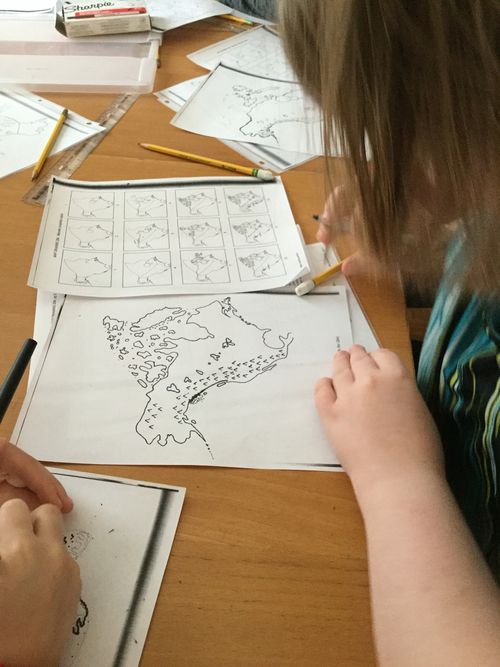
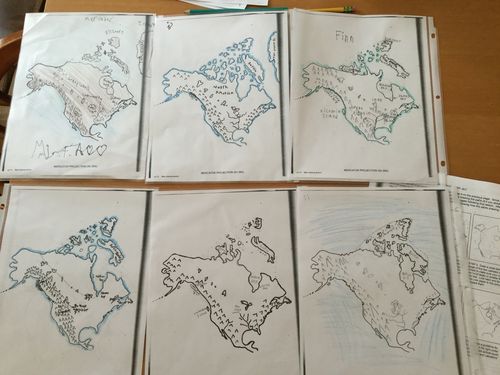
    Today’s work was to draw a complete North America using the Mercator projection, having drawn one last tine with a conical projection.

    They saved time by using a worksheet with the southern part of the continent already outlined, since what they need to see is the difference that the projection makes in the northern part. In the above picture, the top left drawing was done by a fourth-grader, the bottom right by a seventh-grader, and the others are of kids whose ages fall between that.

    Highly recommended still.


  • On eating while small of stature.

    Jenny commented on my last post:

    Not to complain too bitterly about being short, but my normal, weight-maintenance meals are already small. If I eat to lose, we are talking child-sized portions which is a drag without significant motivation.

    Isn't it a drag, though? I took a minute to write out a 1500-calorie menu that sort of mimics the pattern that is most comfortable for me (fairly light but egg-based breakfast, medium-sized lunch, fairly hearty dinner). This is what I came up with:

    A 300-ish calorie Breakfast

    • 2 soft-boiled eggs
    • 1 slice pumpernickel toast with a pat of butter and optional smear of marmalade (alternatively, scramble the eggs in the butter and leave it off the toast)
    • 6 ounce mini can of V-8

    A 500-ish calorie Lunch

    • A couple of cups of chopped mixed salad greens and raw vegetables
    • 5-ounce can of oil-packed tuna
    • Half a cup of cooked chickpeas
    • Balsamic vinegar to taste (just rely on the tuna for oil)
    • 1/4 cup fresh grated parmesan


    A 700-ish calorie Dinner


    • 1 roasted, spiced chicken thigh, with skin
    • 1/2 cup raita (half yogurt, half chopped vegetables)
    • 3/4 cup grated carrot salad with spices and lemon
    • Steamed green vegetables — say, 10 spears asparagus
    • 1 cup grain pilaf
    • *Allowing for about 1.5 tablespoon of added oil total from the chicken, salad, and pilaf.

    + + +


    All that is fairly hearty-looking because of lots of vegetables and because it was homemade to my tastes. Nevertheless, it is quite possible to have a depressingly small-looking plate. If you want to stick to 500 calories or so for lunch at your typical sandwich place, you get the sandwich, generally, and nothing else. You might be able to manage a half-sandwich and a cup of soup, depending on the soup. Coleslaw will set you back farther than you think. Fries are most likely right out.

    For instance, let me grab some lunch data from a casual chain restaurant that has it online, Chili's. Lunch off the menu that would suit someone my size would be:

    • On average, about half a burger or half a burrito. No sides.
    • Shrimp fajitas will work and probably taste great, and I would get to eat all the sizzling innards — but only one tortilla. (Ordering the shrimp option is a good trick for right-sizing meals, incidentally. They never give you much, and the cost will help you appreciate it.)
    • Nachos are one of my favorite things, but I have to split them with two friends. And I am done with lunch already!
    • A "Fresh Mex" bowl sounds like the sort of thing that I should be able to eat, and looks tasty, but I only get half.
    • Kids' meals? Okay, this strategy can work. If I happen to be in the mood to eat a circular burger, the teeny pair of sliders come in under the bar, at least if I stick with fruit on the side. Actually most of the kids' meals would work that way, except the pizzas. This is how I could also get a piece of plain grilled chicken that gives me room for fries and fruit.
    • Main-dish salads? I only get part of them. Less than half the buffalo chicken salad, about three-quarters of the Caribbean salad with grilled chicken, a third of the "quesadilla explosion salad." Oh, by the way, that is without any dressing. Fortunately salsa makes an excellent dressing substitute.
    • Bowl of soup? Those work. A lone bowl of chicken enchilada soup is just about right.
    • Tacos? There are three in an order, and for most varieties, two of them makes your meal.
    • Lunch combos! They are supposed to be smaller lunch portions. With salad and the included fries, will any work? The short answer is "No." You could give away your fries… no, wait, still too big. How about if you only eat half the lunch combo? Now we are getting somewhere, as most of these are eligible if you only eat half of it (half a salad, half a portion of fries, half a chicken burrito or whatever).
    • What about the "lighter choices?" If I am hellbent on cleaning my plate, I could choose some of these (though not all). They don't look bad, actually. There's a steak, for example, or various grilled chicken meals with pico de gallo and salad or broccoli, even a little rice.

    In sum, a not-quite-five-foot-tall woman like me — fairly physically active — gets to eat approximately half of the average restaurant meal, without fries, unless she doesn't mind sticking with a simple bowl of soup.

    And that is without saving any room for a dessert — or rather, for a couple of bites of someone else's dessert.

    This gets old really fast — unless you can really internalize the notion that restaurants portion for big, hungry males, and small women are second-class citizens.

    …Oh, wait, it still gets old really fast.

    Yes, yes, I could think of it as free leftovers that I get to take home in a box. I used to be in the habit of taking an insulated lunch bag with me when I went out for the day, and could probably be induced to do it again. Still — the only way to avoid feeling like you are stuck with a child's portion (or convincing yourself to overdo it) is to deeply internalize what "right-sized" food looks like. This is possible, I have found, but it takes a lot of practice — meaning, for me, a lot of deliberately ordered, deliberately half-eaten meals, to disconnect my notion that cleaning my plate is the norm.


  • The belated twice-yearly post on weight maintenance.

    Usually I write this post in May (around the anniversary of the "click" in my head that changed things) and November (around the anniversary of reaching my goal weight, around six months later).   I'm writing the November post late this year, in January, not because I want to cash in on all the New Year's resolution stuff, but just because I've been a delinquent blogger.

    Let's grab something as it flies by and slap it up on the page to make things look current.  Here's a year-old article that has been going around on FB the last few days, it being January:  Diet and exercise alone are no cure for obesity, experts say.  Here is an extended excerpt from the  newspaper's summary of the information:

    Take note, glib-talking doctors and legislators, rail-thin commentators, and fat-haters of all stripes: For most of the nation's 79 million adults and 13 million kids who are obese, the "eat less, move more" treatment, as currently practiced, is a prescription for failure, these experts say.

    In a commentary published  [ed: in the May 2015 issue] in the journal Lancet Diabetes and Endocrinology, four weight-loss specialists set out to correct what they view as the widespread misimpression that people who have become and stayed obese for more than a couple of years can, by diet and exercise alone, return to a normal, healthy weight and stay that way.

    "Once obesity is established, however, body weight seems to become biologically 'stamped in' and defended," wrote Mt. Sinai Hospital weight management expert Christopher N. Ochner and colleagues from the medical faculties of the University of Colorado, Northwestern University and the University of Pennsylvania.  

    The human body, evolved to endure through periods of food scarcity, has adapted a host of methods to ensure that lost weight will be restored, the authors say. It will respond to weight loss by powering down its use of calories as fuel, pumping out hormones to increase hunger, boosting fat storage capacity, and tricking the brain to demand overconsumption.

    "Few individuals ever truly recover from obesity," the authors wrote. Those that do, they add, "still have 'obesity in remission,' and are biologically very different from individuals of the same age, sex and body weight who never had obesity." They are constantly at war with their bodies' efforts to return to their highest sustained weight.

    …Why would an influential foursome see the value in recapitulating these ideas in a respected medical journal?

    "It's not just that most people still stigmatize obesity–as they say, it's the last acceptable form of stigma," said Ochner. "What really bothers me working around and with clinicians, is that some of them–a disturbing percentage–still believe it's all about personal choice: that if the patient just tries hard enough, and if we can just figure out how to get them a little more motivated, then we'd be successful. And that's just not right."

    Lifestyle changes are undoubtedly a necessary condition for enduring weight loss, Ochner said. But they're far from sufficient, and when physicians believe they are–when they say "you already know what to do, I told you what to do," he said–"that's certainly cruel, and it's harmful: It prevents them getting the care they need."

    Physicians, he said, should be doing more than exhort patients to eat less and move more. They should[:]

    • "intervene more quickly to encourage weight loss in overweight patients before they become obese."
    •  "discuss with obese patients … medications, surgery and device-based treatments…to supplement diet and exercise…"
    • "make weight-loss maintenance–an aspect of obesity treatment that is neglected–a part of their treatment plan."

     + + + 

    I'm one of the odd people that did manage to correct long-term obesity through diet and exercise.  It required a level of focus that bordered on the obsessive; I paid a price in mental health.  I'm not saying it was the wrong choice to make; the sacrifice was temporary, and it worked.  

     I think I'm mentally more balanced now, but it's also been harder to maintain the habits that seem to correspond with keeping my weight off.  It could just be because I'm under a lot of demands in this season of my life; but sometimes I wonder if I will always have to choose between staying thin and staying relatively sane.

    + + +

    Maintenance?

    It really is very difficult.  I understand intimately what they mean by "obesity in remission."  I was obese for about 25 years, and I've only been not-obese for 7.5 years, and I feel — deeply — that the lifestyle which maintains it is something I put on, not something that's really sunk in fully.  

    For a while, between my last two pregnancies, I thought it really had sunk in.  Post-weight-loss, I'd maintained for several months, gotten pregnant, had an amazingly healthy pregnancy and an easy delivery, and then I picked up my old, good habits where I left off.  I returned to my desired weight range and maintained that for three years or so before my fifth pregnancy.  

    But after my youngest child was born I was much more sluggish.  He is two now, and I have never quite gotten back to where I was.  I'm about ten pounds and one clothing size over my desired weight.  I'd be okay with it, I think, if it weren't for the frustration and fear that's all wrapped around the knowledge that I've simply not been able to hold myself tightly enough to a plan.

    Again, I have a lot of demands on me right now, and I well remember the level of obsession that it required for me to lose the weight the first time.  Maybe there simply isn't enough of my attention to go around, and maybe I could do it if I could only clear my schedule and clear my head.  But it's all hypothetical.  I can't seem to stick to anything very long.  And that "can't" is very scary to me.  

    I wonder all the time:  Am I out of remission?

    + + +

    Let's take a look at these words again:

    The human body, evolved to endure through periods of food scarcity, has adapted a host of methods to ensure that lost weight will be restored, the authors say. It will respond to weight loss by powering down its use of calories as fuel, pumping out hormones to increase hunger, boosting fat storage capacity, and tricking the brain to demand overconsumption.


    I don't know if the three other response mechanisms are active, but the last one?  Tricking the brain to demand overconsumption?

    It is so very, very real.

    My brain is a traitor.  It has completely gone over to the side of the body in this one.  How to explain it?  My brain doesn't try to get me to break my resolutions, to foil my plans, anymore.  It's learned that this does not work.  

    I don't do the emotional-eating thing.  I don't get tempted to break my resolutions.  If I am conscious of a plan I have made (say "Don't eat dessert tonight") you can wave a chocolate cake in front of me all evening and I will not take that first fatal bite.   My brain has given up trying to tempt me away from my plans.

    Instead my brain has learned a better way:  it causes me to forget I had a plan in the first place.  "Ha ha!" the brain says.  "If I refuse to do my job of remembering important things, there's nothing that the rest of you can do about it!" And when dinnertime comes it's all like "Plan?  What plan?  Pass the potatoes."

    I realize that this sounds absolutely insane.

    I can't think of a better way to describe it.

    I make plans.  I literally forget them, or at least forget that they matter, when I sit down at the table.  And then immediately after we are all done eating, I seem to remember them again.  Shit.  And then the remorse.

    This is not a good mental situation.  I really have to do something about it, because it is the kind of mental situation that eating disorders are made of:  a cycle of self-recrimination that begins immediately after a meal.  It's bad.

    + + +

    There are definitely things I could do about this.   I think that the best course is probably to pick one good habit, one tried and proven one from my old life, and concentrate on that until it's second nature again.   But panic overtakes me.  "Just one habit" is too scary; I fear I'll let all the others go.   For example:  If I concentrate only on not snacking between meals (a worthy goal, part of the way I want to live my life), I fear, I'll destroy all the practice I've made at having reasonably-sized meals.  And so on.  I keep starting off with single habits, but eventually I try to do all the habits at once, get overwhelmed, and start forgetting them again.  

    + + +

    And make no mistake:  while I might be able to develop and reinforce habits that maintain my weight where it is, I really have to be conscious at every meal if I am going to run a calorie deficit and live off my stores even for a few weeks.  I am under five feet tall.  Maintaining my weight as it is  requires, roughly, only 1850 calories per day.   Losing it at a noticeable pace means going down to something like 1400-1500.  This is not that much food, people!  Unless you are the sort of person who forgets to eat under stress, it takes attention to maintain that for more than a couple of days, and it is shockingly easy to make up several days' deficit in only one meal.  

    Example.  If I am trying to stay at 1500 cal/day, chances are good I'll really manage closer to 1650.  Let's say I do that for 4 days in a row.  Great! I'm running an 800-calorie deficit.  Then on day 5 I go to a restaurant for lunch and in a fit of forgetfulness I order a cheeseburger and a fountain Coke with a vinaigrette side salad (no fries, please).   That's all it takes!  The deficit is gone, and I'm back to square one.  Without ever really departing from reasonable, moderate eating!  We're talking a single, culturally normal-sized meal (too big for my body size, but it isn't an amount of food anyone would call "overeating") after 13 carefully-restricted meals in a row.  If I kept up that pattern (13 restricted meals, one culturally normal meal) over and over, I would never change.  The only thing that would be different is that I would feel very frustrated.  Would you be able to keep that up without going slowly insane or developing an eating disorder?

    It requires attention.  I have found that it requires counting.

    + + +

    Still, I can point to areas of relatively easy improvement.  Someday I will have the attention available to make a final push through those two-year-old postpartum pounds, and I could concentrate on developing the habits that support the drive, make it a little easier.  Cutting back on alcohol, making easy-to-remember resolutions like eliminating snacking and seconds, making rules like "half sandwiches only," splitting things with Mark at restaurants (and NOT using that as an excuse to go ahead and have dessert).  

    I could do these things.  The question is, will I?

    IMG_1710

    A series of older pictures can be found here.


  • The value of that first draft, even if it’s the only draft.

    Sometimes insight comes from unexpected places.  Let's start.

    ——

    I think I might have figured out the reason why blog posts have been so few and far between in recent months.  It's a confluence of two factors:

    (1) Mark has been working at a manufacturing plant closer to home instead of at his office out in the suburbs.  

    The proximate effect of this is that he leaves later.  I think he was out the door at 7:48 am this morning, and sometimes he doesn't leave till after eight.  

    I didn't marry a morning person.  I suppose I could wonder out loud if he could go away earlier and then come back earlier.  But the truth is that it's rather nice to sit for a while with him and drink the coffee and chat, in the quiet before the children get up.  

    (2) Against all odds, and after ten years of homeschooling, I appear to have actually developed the self-discipline to wake the children up in the morning on time.  

    That is, about 8:30.   I'm not sure why I managed it this year and not in previous years.  

    Perhaps out of necessity:  this particular year, time is tight and priorities are many.  I swore up and down I would allot 90 full minutes to spend one-on-one with my kindergartener each of the three weekdays at home, because I believe in the kindergarten year (or at least, in the learning-to-read year, whenever that is), and gosh darn it if I didn't do it.  It helps that said kindergartener is an unusually sunny and cheerful worker so that those are just about my favorite 90 minutes of the day.   I also have a teenager I want to teach pre-calculus to, and since my 4th- and 6th-graders are getting the short end of the stick as regards face-time, I really must review their work at the end of the day and give them feedback if nothing else.  But I don't mind that too much as it insulates me from direct complaining.

    Looking over that, I realize that quite possibly the reason I'm managing to put in the school time I planned is that I actually planned school time that I would personally enjoy instead of wanting to chew my own arm off to escape.

    Well, what do you know.  Perhaps I am gradually discovering the secret of self-discipline.

    Wait, haven't I discovered this before?  I think maybe it's more like discovering, forgetting, and discovering again.  

    + + +

    So, isn't forty-two minutes enough time to write a blog post?  It's enough to write one, but not enough time to drink the coffee that should help me think of something substantive to say before the post.  I have a couple of topics floating around in my mind that I intended to write about "when I can sit down and gather my thoughts."   Here they are:

    (1) Hamilton: An American Musical

    (2) My twice-yearly post about eating and exercise habits, which is quite overdue; it shows 

    (3) Negative internal self-talk (imposter syndrome stuff) and how it relates to homeschooling; the difference between trying to shut the voice up by attempting to do what it tells you you should be doing, and shutting the voice up by creating positive internal self-talk on your own terms

    + + + 

    And even as I'm writing that list I notice something:  the list items get longer and more thoughtful as I go.  

    Here's the thing about me and blogging, and by the way it was true back when it was "here's the thing about me and my dissertation," too:

     Writing is gathering my thoughts.

     It was only while I was typing out my explanation about the kids getting up at 8:30 that I clued in to the fact that my school days as scheduled, though hectic, are made up this year of kinds of teaching each child that I enjoy, and that it's possibly not a coincidence that this year I've mostly stuck to the plan.  

    (My brain is going "WRITE THIS INSIGHT DOWN WHERE YOU WILL REMEMBER IT WHEN YOU PLAN NEXT YEAR."  Okay, okay.  It's on an index card now.  The secret to sticking to your plan is to do your damnedest to plan stuff that you will enjoy.  Harness the power of people doing what they want to do!  Sounds dumb when you write it that way but I have a sneaking suspicion that someone could write a market-economics dissertation on the same subject, if she used longer words.)

    I can't prioritize revision; it's first draft or nothing on this blog, this year; but my first drafts aren't without value.  

    + + +

    And now I'm eleven minutes late for waking up those kids.  So… here's where I stop.


  • Disordered.


    Earlier this month, a meme made the rounds which I remember seeing for the first time last year:

    783b88b030078724cf1f06c8afdd3d0c

    I am the person on the right.

    + + +

    I spent many years frankly telling my friends, "I hate Christmas."   I didn't mention this sentiment much to my immediate or extended family (most of whom are represented by the person on the left in the aforementioned meme).   Nevertheless, I was open about it to just about everyone else.   

    The whole shebang represented Season of Pressure to me.  If something reminded me of Christmas in, say, May, I would feel a pit in my stomach followed by a quick calculation and then the cold sensation of relief that many months yet remained.   If I thought about it in mid-October, the same would be followed by a sense of looming dread.  

    I never quite understood the reasons, although I had my theories.   Part of it may be the introvert-raised-by-extroverts thing.  Childhood Christmases were exhausting:  up before light to exclaim over presents at my mother's house, then on to my grandmother's house for a few hours, then to my other grandmother's house, or possibly an aunt.  Somewhere, the handoff, from my mother's family to my father's family, as was no doubt cordially agreed-upon outside my hearing.  Perhaps a stop to see a friend of my father and stepmother.  Finally, an hour's drive farther, and opening more presents long after dark.  Collapsing into bed on the foldout couch, tired and a little sick from too many cookies.

    Christmas presents worried me even as a child.  Would I be convincing enough when I opened the paper and smiled and said Thank You?  I never felt that I could manage to be enthusiastic enough.  It may have been all in my head, but to me it always seemed that I disappointed people — I didn't rip the paper off fast enough, I didn't squeal loudly enough.  "You're no fun," I would hear.  "Why don't you get excited?"  I am excited — and tired, is what I would like to go back in time to say.   That wasn't really okay though.  

    And then there was the terrible situation (again, probably created in my own head) where I felt traitorous to be too excited about my father's gifts in front of my mother, or about my mother's gifts in front of my father.  I'm not sure that either of them ever were anything other than neutral about presents in front of me.  But somewhere deep down I was certain that to be too enthusiastic about one's gifts in front of the other would be met with hurt feelings (in one case) or mockery (in the other).  

    Don't even get me started on the year of the Cabbage Patch Doll shortage.

    Growing up did not make me any less  worried about Christmas presents.  I never knew what to get people.  Money wasn't a problem for us, except that the knowledge of it seemed to make its own problem.  

    I didn't want Christmas to be all about gift-giving, and I didn't want my kids to be centered around presents; but I couldn't very well tell people who meant well and wanted to be generous and had few opportunities to do so, not to spend money on my children.

    I worried that if I spent too much money on other people, I would be encouraging the gift-giving to spiral out of control, and buying into a materialistic interpretation of the season, and possibly that people would think I was showing off.  

    I worried that if I spent too little money people would think I was stingy.  

    I worried that if I bought something that a cousin or aunt disliked, that they would think I didn't care enough about them to find out what they wanted.  

    I worried that if I gave people a list of things I would be happy to receive, that they would think I was being demanding.  I didn't want to ask for a list from other people because then they would want a list from me.  

    I fretted and fretted even about the totally low-pressure $25 random buy-a-gift-for-a-person-of-your-gender, pick-a-number-from-a-hat exchange that my husband's family does every year.  Nobody ever seemed happy with the thing that I would buy (even though it was the kind of thing I would have liked).   I dreaded every year when mine would be the last gift picked.  

    The only people I enjoyed buying gifts for were children.  Still are.

    + + +

    I never hated Christian Christmas:  Advent and St. Nicholas and midnight Mass on Christmas Eve and Epiphany.  When that all came into my life the first year I lived away from home, it was like a brisk wind swirling snowflakes into a stuffy, hot room.  It gave me a brief hope that Christmas could be different.  Maybe I could adopt a new identity as A Person Who Takes The Christmas Season Seriously.  (After all, I was clearly no good at having fun with it.)  I found real peace before the manger.   Because of that, I tried to form my nuclear family into a Family Who Only Does Small Meaningful Gifts.  

    Well, that would perhaps work if I stayed in Minnesota for Christmas (which I managed to do a few times by having two winter babies and one bout of stomach flu).   But because we are not an island unto ourselves, of course, it didn't work.  I tried saying "Let's not do presents; I'm just going to give money to such-and-such a scholarship fund, and you do the same for me."  Relatives would agree, and so I would do that and not buy a present, then they would go and donate to the scholarship fund AND buy me a present.  "I just wanted you to have something to unwrap."  Sinking feeling in the pit of the stomach.  

    All this anxiety touched everything about Christmas.  I had become, from an early age, a bona fide Grinch.  The whole thing:  cards, decorations, cookie-making.  I just — I just hated it.  I procrastinated on EVERYTHING.  It all made me feel depressed and — like I had many other things that I was required to do, on top of all the many things there are to do every day anyway.   I imagined that the rest of the world could somehow do all of it at once:  perhaps I lacked the enzyme that is crucial to extract energy and motivation from the scent of gingerbread and from peppermint-flavored lattes.   I would be paralyzed almost every year.  

    I might, in mid-November, have a surge of hope and buy a box of Christmas cards and a couple of envelopes of stamps.  They would sit unopened on my counter all through December, because I kept thinking that I could not send one of them unless I sent all of them, because it would somehow be unfair.  As if a friend from high school and a great-aunt were going to compare notes and say, "What?!  She sent you one and she didn't send me one?" Apparently I would rather be the kind of person who just doesn't send cards, than navigate the minefield of prioritizing whom to send them to.

    It's the thought that counts, right?  

    Well — deep down, I just never have been able to believe that any of my thoughts count.

    + + +

    It was really only this year that I sat down and really considered what was going on with all this Christmas-related anxiety.  I tried to imagine what a good Christmas would be like.  

    It's easy to point to my favorite Christmas.   Back in 2009, we stayed in Minneapolis because I was eight months pregnant with my fourth child.  We went to our friends' house on Christmas Eve and shared cookies and played games all evening by the lights of the Christmas tree. "If we leave here soon, we can make it to Midnight Mass and not have to go in the morning," Mark pointed out.  That sounded great, and so we gathered up our tired children and went to our own parish for the first time ever.  The children fell asleep in our laps at Mass to the sound of Christmas carols.  We took them home just as the snow was beginning to fall, and put them to bed.  Next morning it was still snowing, and it snowed all day (21 inches!) The children slept in a good long while while we drank our coffee together.  We had cinnamon rolls for breakfast and chili from the crockpot later, and Mark and the children built an igloo in the back yard.  

    Even though that was a beautiful Christmas, it turned out, I missed seeing friends I usually see at Christmas.  I missed Christmas lunch at my grandma's house.  I missed my extended family, actually, but didn't miss the presents.

    So just this year I figured out:

    I don't hate Christmas.  I actually love many, many things about it.  It's just the Christmas presents.  I can't deal with them, and I have so many anxieties wrapped up in them that I have  trouble relaxing and enjoying all the other things.  Without presents there would be food, and friends, and catching up with family members I don't see often, and cookies, and music, and singing, and the Holy Child in the manger, and joy. All things I really and truly love, and wish I could just enjoy.

    I just… get really, completely irrationally, stressed out about Christmas presents.  Giving them AND getting them. It's nobody's fault, I think.  I'm just weird that way.

    + + +

    There are probably people who can't really relax and enjoy the holidays because, even though many wonderful things happen, they know they will have to deal with being around alcohol, and they can't really handle it, and it's stressful.

    There are definitely people who dread the holidays because of fear that they will lose control of themselves around all the copious cookies and mashed potatoes and pie and candy.  Or maybe that they will have an allergic reaction because Aunt Betty forgot to tell them she put pecans in the snickerdoodles.

    Me?  I, apparently, have a gifting disorder. 

    If I frame it that way, at least to myself, I think I can start groping back to a place where I can admit to myself that Christmas isn't so bad, overall.  

    + + +

    Over the years I have developed a few coping mechanisms.  

    One of them is to accept that my husband will make the Christmas shopping decisions for most people (something that often happened anyway as I covered my ears and went FALALA I CAN'T HEAR YOU every time he broached the subject.)

    For the handful of people whose presents I still had to buy myself:  I got over the notion that a gift had to be carefully picked out to express the nuances of my relationship with each person, and have defaulted to:   JUST BUY PEOPLE LIQUOR AND/OR CHOCOLATE.  This rule has served me pretty well as almost everyone seems to be happy with one or the other, if not both.

    (In the case of the girl-gift-exchange, I finally just started buying chocolate liquor.  I might not go for it myself, but it's clearly an acceptable random gift between females of the species.  And if we wind up with a bottle of it at the end, Mark will blend it into chocolate malts.)

    I also helped ease the oscillating-on-the-spectrum between "I'm stingy" and "I'm a showoff" by going for small quantities of luxury items, like chocolates that are SO FANCY that you only get nine of them in a box.  Let people wonder which end of the spectrum I am!

    + + +

    Ultimately, the stress comes from being self-focused instead of other-focused at a time when looking outward is especially important.  For reasons unknown, I have fixated on what people will think of me.  I'm hyperfocused on gift-giving as a performance, or as a statement.  This has made it nearly impossible for me to give gifts, authentically, as an expression of love for another person.  It's not that I want it to be like that; it's a cycle I'm trying hard to break out of.  It starts with thinking less about myself and how I will be perceived, and more simply about the reason that the gift-giving tradition arose in the first place

  • Teaching young children to use knives.

    Jamie asked me to write a bit, in the Sane Mom Revolution tradition, about training toddlers to use real knives.   Jamie was thinking about this post from when my 9-y-o daughter was about three and a half, which featured this shot:

    6a00d8341c50d953ef01310fd8d5a6970c-800wi

    In that picture, my daughter is using a serrated knife with a rounded tip to strip collard leaves off the stems for me.

    + + +

     When I was a young mother with my first child and all my theories were new and untested, I was very fond of a book called The Continuum Concept, by Jean Liedloff.  

    (You thought attachment parenting was crunchy?  Meet something crunchier.)

    I foresee someone raising their eyebrows that a person like me would find something to like in TCC, a book which has been roundly criticized by a large number of people across the spectrum of parenting philosophies and social positions, for a number of reasons.  I'm still fond of it.  If you should decide to pick it up, my advice is to consider it a philosophical memoir rather than a work of scientific anthropology.   The key takeaway concept:   humans thrive best in an environment which contains those cues which our nature evolved to expect* from its environment.

    [*N. B.  You can substitute for "evolved to expect" the phrase "was designed by God to expect" if you want, it works just as well.]  

    That goes for surroundings (sunlight, mother's milk, a certain cycle of seasons of hunger and plenty, earth beneath our feet) as well as social cues from others (language, interaction with siblings, adults with work that can be imitated).

    So, Liedloff is writing informal observations of a group of people living in the South American rainforest among whom she resided for a time, and she commented about how the young children are surrounded by real dangers and yet rarely (note: not "never") are seriously injured by them.

    One of the most striking [dangerous situations] is the omnipresence of machetes and knives, all razor sharp, and all available to step on, fall against, or play with.  Babies, too young to have learned about handles, picked them up by the blades and, as I watched, waved them about in their dimpled fists.  They not only did not sever their own fingers or injure themselves at all, but if they were in their mother's arms, they managed to miss hurting her either…

    The boys, from the age of about eighteen months, practiced archery with sharp arrows, some enthusiasts carrying their bow and arrows about most of their waking hours.  Shooting was not confined to designated places, nor were any "safety rules" in effect.  In my two and a half years there I saw only the one arrow wound I have mentioned.

    …And there are the rivers, in which … a child swimming farther out in the current than his strength and ability allow has a good chance of being smashed on the rocks or… branches…. The children who bathe and play in the river every day must gauge their ability accurately under all conditions.

    The operative factor seems to be placement of responsibility.  The machinery for looking after themselves, in most Western children, is in only partial use, a great deal of the burden having been assumed by adult caretakers…. The continuum [by which Liedloff means our human ability to adapt, with limitations, to our environment] withdraws as much self-guardianship as is being taken over by others.  The result is diminished efficiency because no one can be as constantly or as thoroughly alert to anyone's circumstances as he is to his own…

    + + + 

    Mind you, I am not leaving razor-sharp knives and machetes about for my children to step on and for my babies to pick up.  This is, fundamentally, because I do not live in an environment where that works, where everyone is used to the omnipresence of razor-sharp knives and machetes and treats them accordingly.  I live in an environment where knives are kept out of the way, on a magnetic strip (see photo above) where no one will accidentally step on one or slice their hand by mistake when carelessly reaching for a whisk.

     And so I work with my children and knives in a way that makes sense for that environment: the environment where knives come out when it is time to cook, and are put away when the cooking is done.

    But I still can use the takeaway here:  I prefer my child to take some of the responsibility for keeping herself safe from knife wounds.  If I take all of the responsibility, keeping the knives safely locked away — well, that only works until I make a mistake, or until she enters an environment that I cannot control.  If I teach her to use a knife correctly and carefully, and step back so she knows she has to be careful, then she can protect herself even if I forget and leave one lying about.

    + + +

    I've had the knife shown above since my first child was pretty small.  It began life as a combination knife/cheese spreader that came with a picnic set we received as a wedding present.  When I wanted it to become a child-sized knife, Mark cut the handle shorter with some power tool or another, and used a Dremel to ever-so-slightly blunt the serrations, which had been quite sharp.

    I mention this just to note that the most important thing for starting to teach a small child how to use a knife may well be to choose a "starter knife" that doesn't strike fear into your heart.  You're not going to be very confident in your child's ability if, every time he picks it up, you visualize him falling off the stepstool and landing on the point of the knife.  Choose a knife that you're going to be comfortable letting your child actually use, holding it with his own two hands.  

    The non-pointy tip of this knife means I don't worry about death-dealing stab wounds.  And that was important for me, personally.  YMMV.

    + + +

    Although the tip is rounded and the serrations have been slightly blunted, the edge of this knife is still sharp.  Sharp enough to cut most vegetables, and — crucially — sharp enough to cut your fingers, too.  Probably not a maiming, stitches-requiring wound (with blunted serrations, you'd have to saw at your thumb a little bit) — but enough to hurt and bleed and need a Band-Aid.

    And that brings me to the next point about teaching kids to use knives.  It's good for them find out that careless knife work can hurt them.  I don't particularly want to run to the ER, so for early knife work I chose a less-than-razor-sharp knife.  But I welcome that first moment when a child tries to cut the zucchini while holding it, instead of having it flat on the board, and –zzzing — she has a minor, painful cut on her palm.   And then while I'm bandaging her up we can talk about why that happened, and how she can prevent it from happening the next time.

    + + +

    Here are three types of knives that can work:

    IMG_1677

    Top:  My child-sized knife, the one my daughter is pictured using in the first photo.  Middle:  a piece of toddler cutlery from IKEA (not as sharp; will cut butter and zucchini and avocado).  Bottom:  a spreader (the tip is curved, which makes it less useful for cutting, but is good for learning how to use a knife to spread).  

    I've also heard good things about the knives that come in a pumpkin-carving set (take note!  those might still be on sale somewhere!), the plastic "lettuce knives," and a wooden-handled "crinkle-cutter" like this one.   

    (Montessori suppliers, like the one at the previous link, often have tools sized for children — here is a plastic knife that would work for a child, here is a hand drill for woodworking, here is a saw.  Although my husband, who does more woodworking than I, prefers to teach children to use a coping saw, and to saw with a miter box.)

    + + +

    Once the knife is selected, you are mostly teaching children to observe the same knife safety guidelines that the adult cook should observe.  Familiarize yourself with these!  Articles can be found all over, and some comprehensive cookbooks will include an introduction.

    See, e.g., here, here, here.

    + + +

     The next thing to do with small children who are first using knives is to prep them for success.  Some things are hard to cut; some things easy.  Some things start off hard but get easier after they have been trimmed.  

    Don't give a toddler a butternut squash or a whole carrot.  How about a peeled banana for her snack?  How about a stick of cold butter that needs to be added in pieces to the pastry flour?  How about a zucchini, halved lengthwise and placed flat side down so it can't roll, and the ends trimmed off?  

    Later, if the knife is sharp enough, the vegetable can get harder; children will be able to slice a potato, for instance.  But keep trimming the vegetables (halving the potato, for example, or cutting the cantaloupe into peeled wedges for her to cube). They may as well not deal with vegetables that will roll until they've really mastered slicing.  You're modeling a practice that's good for grownups to use too:  mise en place.  After a while  you can teach how to trim an onion or a zucchini to get it into that no-roll, easy-to-chop form.

    + + +

    Early on teach them always to put the vegetable on a cutting board, never on the counter or on a plate (a stray stroke down onto the turned-up edge can flip it), and certainly never to hold the vegetable in their other hand.  (You may have to refrain from using a paring knife to peel apples in the child's line of sight for a time, or they are sure to copy your apple-in-hand technique.)

    At first teach them how to hold the handle of the knife with one hand and place their flat palm on top of the blade, and push down to cut a large, not-too-hard vegetable.  (This works with any knife, and the crinkle cutter is particulary good.)  With one hand's fingers wrapped around the handle, and the other hand's fingers flat and above the blade, a finger cut just won't happen.  Watch, and correct the child if she bends her fingers down, or tries to cut with one hand while repositioning the food with the other hand.  

    You're not teaching a useless skill here.  This flat-hand-on-the-blade technique, with a bit of rocking added to it, is the same one that adults use to mince garlic or dice onions with a chef's knife.   

    + + +

    Advanced knife work does involve putting the fingertips more in harm's way.  We do often need to hold food in position with one hand while cutting it with the other.  This bit is tricky even for grownups sometimes, but the most fingertip-safe way to hold a vegetable while cutting it is to curl your fingertips under slightly so that the part that protrudes the closest to the blade is part of the knuckle.  Yes, you might graze your knuckle, but (unlike a fingertip) you can't actually sever it.  And it's a slightly unnatural way to hold a vegetable (until you are used to it), so while you are learning it forces you to be attentive.

    + + +

    I suppose I would be remiss if I didn't mention that in the workplace, frequent users of sharp knives sometimes use cut-resistant gloves on the non-dominant hand.  But I doubt these come in child's sizes, and anyway, I wonder if the awkwardness and loss of sensation might not create more problems than it solves for the ordinary kitchen user.

    + + +

    All along, the most important thing to teach children who use knives is attentiveness. You should stay close by, not because you need to hover to keep them safe, but because there are many opportunities to teach features of knife safety that they might not think of on their own.  Things like:

    • Don't climb down from your stool to retrieve a dropped vegetable while your knife is in your hand.  Put the knife down on the counter, then climb down.
    • Don't let any part of the knife stick out over the edge of the counter when you put it down.
    • Don't let any part of a cutting board stick out over the edge of the counter.  (If there's a knife on the cutting board, it could be knocked off).
    • Don't let the baby climb up onto your stool with you while you're cutting.  Call for help and I will take him away.
    • Don't gesture with the knife.  (NAG, NAG, NAG)
    • Don't let people take bits to eat off your cutting board while you are cutting.
    • Don't climb down from your stool to put the knife in the sink while your knife is in your hand.  Put the knife on the counter, then climb down, then carry the knife to the sink.
    • Don't try to watch a screen or read a book while you cut.

     Later, these lessons can become more advanced cooking lessons.  Time in the kitchen with a child is eventually rewarded — if nothing else, you may wind up with your own prep cook or even sous-chef.  And we all could use one of those.


  • A strange turning point.


    In the last couple of weeks, as I rushed around with Mark and without Mark trying to pull items together to help my grandmother when the relative who lives with her was hospitalized, I had the oddest impression.


    It went like this: This is the week when I began to grow old.


    Seriously: Maybe the feeling will go away, but I have taken away from it this very strange gut-level feeling that, when I am myself elderly and I look back upon my life, October 2015 will turn out to be a turning point, a hinge around which the whole neatly folds in half.


    It seems unlikely that I have received the gift of prophecy and that my span will turn out to be exactly eighty-two years, so something else is going on here. What is it?


    + + +


    Well, a lot went on in the past few weeks, for sure.


    I found myself suddenly an advocate for not one but two older relatives, my truly elderly grandmother and another, not-quite-old-enough-for-Medicare relative with a severe health problem and a lack of insurance. I wasn’t alone — I have two cousins and a brother, and the four of us passed information back and forth in a Facebook Chat window for the whole time, with one out-of-state cousin making a lot of the necessary phone calls and the other two, juggling job and other family responsibilities, stepping in where they could. And I had a lot of support from Mark and his parents, who took all the children on short notice.


    The transition, although it was temporary, was jarring. My primary work is usually my own children’s education, from the teenager all the way down to the toddler. I am engaged most of the time in the same sort of thing I was doing when I was about 27. Suddenly, instead of mother of small kids I became for a couple of weeks the adult daughter caring for elderly and ill relatives. Never mind that I am technically the granddaughter here. This is the kind of thing that I associate with women whose own children are mostly grown; the women in my family who have spent a lot of time concerned about their parents’ generation have done most of that in their own sixties. I got a taste of that this past couple of weeks. And I had more than a few moments of “Aren’t I too young to be doing this?”


    (But what else am I supposed to do, eh? My mother died twelve years ago at 54, leaving a gap between myself and Grandma, a wound that doesn’t flare up often these days but that ached awfully these past few weeks.)


    + + +


    So I nearly gave myself a plugged duct, I was away from my nursing toddler for so many hours. Trips to the hardware store, and hours scrubbing down bedframes and wiping surfaces, and moving things around in a dusty basement, standing up from time to time to stretch my back and adjust a paper dust mask that grew sweaty and moist as the hours went by.


    Mark and I nearly got in a car wreck on one of those trips from the hardware store. It was just the two of us in the van, the seats folded down to store a thick stack of new packing boxes, and as I drove and came past the front end of a queue of cars in the turn lane, a sports car coming the opposite direction turned left directly in front of me. I stomped the brake to the floor and felt the anti-lock system pulsing back at my foot; I saw the sports car’s rear quarter panel rotating towards me; Mark shouted, we braced for impact; and then we found ourselves still driving, unscathed, and both of us laughing nervously, genuinely shocked to find ourselves in the region of the multiverse where the collision did not happen.


    + + +


    I spent time with my grandmother, walking at her speed, seeing a room with her eyes. Is this chair sturdy enough to lean on? How far is it to the next doorway? Should we take the steps which are closer, or go around the long, no-steps way? How will we hold this heavy door open wide enough to go through together, with her leaning on my arm?


    I spent time explaining my ill relative’s complicated insurance history, and history of poor self-care, to the social service staff at the skilled nursing facility. Privacy laws prevented them from telling me anything about my relative’s condition, but no rule prevented me from, for example, warning them that my relative (and the relative’s belongings) had come from a house terribly infested with bedbugs. (They were visibly grateful that I told them.)


    In my grandmother’s living room emptied of its infested furniture, sitting on wooden chairs and at a table pulled from various other rooms of the house, I met a representative from a company that provides in-home services to elderly people: laundry, light housekeeping, errands, meals, eventually more intense care. We discussed what Grandma needs and doesn’t need. Gradually it became clear that Grandma, who knows what she wants and is completely mentally competent and financially solvent, does believe that she would benefit from having someone to come in and do her laundry, but emphatically does not want to bring in any hired helpers unless she is certain that doing so won’t hurt my other relative’s feelings.


    In the privacy of the car, later, I wept. I gnashed my teeth.


    + + +


    Meanwhile, my children were enjoying a last romp around Mark’s parents’ farm. Yes, a last romp: my in-laws are selling the twenty-something acres of orchards and fields and gardens and ponds, the barns and sheds and greenhouses and tractors. They are looking forward to a future with more travel, more visits to the grandchildren, more time with their three adult kids who live in three different cities. Time and attention if not love being a zero-sum game, that means less attention available for fruit trees and farmers’ markets. The weeks we stayed were also weeks of watching my mother-in-law wonder how she was going to pack up her sewing room, weeks of wondering when that appraiser was going to come through.


    The new house will be large enough to host us all at holidays, but there will be no farm nor field nor pond. We will miss it. It makes my heart hurt a little to think that my youngest son will not remember the old home place, nor sit on Grandpa’s lap to steer the tractor. Mark has known other homes in his childhood, but I haven’t known him or his family in any other place; it has been a home to me since before he and I were married.


    But even though we are going to miss it, there is no denying the sense of downsizing now while the two of them don’t actually have to, and can take the time to do it right. We have learned a lot from those two and they still have a lot to teach us.


    + + +


    Illness, hospitalization, emergency surgery, and recuperation struck in what is left of my family of origin, too, at the same time as Grandma’s crisis. My brother and I agreed: I would focus on helping Grandma and he would focus on helping in our family of origin.


    This was certainly the best possible division of labor.


    It left me introspective.


    Time runs short for everyone, at every moment. And nothing we do, say, or wish — not even when we happen to notice time running short — can ever change a person who does not want to change. This is what “acceptance” can mean. It can even lead to forgiveness, of a particularly silent and one-sided type.


    I am dead to you. This means that I am free.


    I highly recommend dying to sources of harm, of mockery and deceit. I am certain that I am not the first person to come up with the idea.


    + + +


    And then a friend of mine asked me if I wanted to help her start up an invitation-only FB group called “NFP After 40.” A bit more than 20 women immediately accepted the invitations, all of us with a collective “WTF are we supposed to do now with what we’re seeing here.” I have a feeling I will be enjoying this group. Nevertheless, beginning to think collectively about menopause, coincidentally or not, certainly added to my feeling of having hit a tipping point.


    + + +


    So what happened here? Why the sudden bout of wrinkly-navel-gazing? How is it that, if I feel that way now, I didn’t feel that way before? It’s not like I had been ignorant of my status among the middle-aged.


    I guess… This past couple of weeks, Mark and I looked the future in the eye, just a bit. We contemplated disability, decline, disease, death. Sometimes you just can’t avoid it.


    When I say “This is the week I began to grow old” I do not mean, the start of a decline. I don’t mean anything bad at all. Growing old is better than the alternative. I guess, it has been a kind of a wake-up call. I saw before me many different ways of growing older, this week. I think this was a week in which I grew wiser. I hope I will look back on it that way.


    I know two things in a concrete way I didn’t before. The wise person looks ahead with clear eyes and prepares for the future. And the wise person knows that the future can’t, actually, be seen clearly.


    What I do with this new knowledge, well, I am not sure yet. I suppose it depends still on the present.


  • Debugging Grandma.

    “We really won’t have time to miss any school this year,” I remember saying at the beginning, “we’ll have to make up any time we lose.”

    Remind me not ever to say something like that again.

    + + +

    So, I am in a hotel suite just outside my hometown with my sleeping toddler and my sleeping 94-year-old grandma. I found a place with separate sitting rooms and a pullout sofa, so the baby would not disturb Grandma, and a full-service restaurant, so we could stay here all day.

    We are here in this hotel because today Grandma’s house is being treated for a massively terrible bedbug infestation. Do you know what a scourge bedbugs are? If you do not, now is the time for you to take a side trip to Google and educate yourself. I have dealt with roaches, and I have dealt with mice, and I have dealt with head lice, and I would take all of them over bedbugs in a hurry (I guess as long as the mouse infestation did not give me hantavirus; one thing that you can say about bedbugs is that they do not carry disease).

    My grandma is really a very remarkable lady. She is frail now, but has only really been frail since she was 88 or so; up till then she always seemed the same to me, although maybe my cousins and brother would tell me that my memory is off or that my impressions were poor. She moves around by herself slowly, and you think she is tottering and in danger; but as you watch her, you see that she moves carefully, and pays attention to where she puts her feet. If you walk with her and give her your arm for support, you find (because with your arm out you are thrown a bit off balance) that you are struggling a little to keep up. She keeps track of her medications by lining them up in order on the kitchen windowsill, and every morning and evening after she takes her pills she sits down and enters them by hand in a notebook log, and marks the date. (The log also records COFFEE in its proper place, between the meds that must be taken on an empty stomach and the meds that don’t have to be.) She keeps her checkbook register meticulously, paying all her bills and carefully entering them, along with $5 checks to every direct-mail charity who asks her for money and the occasional $11.49 payment to random sweepstakes contests, which my cousin had warned me Grandma thinks she’s really going to win (more on that later).

    Grandma was widowed 35 years ago; my grandpa, a plumber with his own business, died at 59 when I was five. I barely remember him, but he is legendary, and my impressions from the family stories are of a man who could be loving and exasperating, rough and gentle both. My mother often reminisced that he would shed tears whenever he saw anyone perform anything well or beautifully. There is also a story that he refused to leave a baseball game (or some other sports event?) when my grandmother went into labor, and the baby — I don’t remember which of her three children — was nearly born on the way to the hospital. I really only remember sitting on his lap, playing with him with a deck of cards marked on the back with the name and address of the plumbing business.

    After he died, Grandma became a world traveler. She took at least one trip a year throughout my entire childhood, with the same tour group. She never made it to South America, but she has been everywhere else. Stacks of photo albums prove it. She took my older cousin to the British isles, she took the next cousin to southeast Asia, she took me to the Iberian peninsula and North Africa, all when each of us were fourteen. Her last trip was to London to go Christmas shopping. I don’t remember when that was.

    + + +

    So, another relative whom I love very much, who values privacy, has been living with Grandma and watching out for her for several years now. This relative has had some health problems of late that got worse and worse over the past few months and maybe 5 weeks ago became uncontrollable and dangerous. The relative was then suddenly hospitalized, although not so suddenly that there wasn’t time for the relative to line up half a dozen of the relative’s own friends to bring Grandma groceries and check on her every day. (Everybody who meets my grandma adores her. It was not hard to get people to promise to bring her food and fix her thermostat when it went on the fritz.)

    One of my cousins who, of the four grandchildren, lives closest (same state, different city), and on whom a lot of the responsibility has fallen because of that proximity, went to visit Grandma at Grandma’s house and discovered the bedbug infestation. They had had them before, and it had been treated by Terminix twice, but apparently neither treatment eliminated them completely; and when the population grew a third time, the health problems of my relative had interfered with her ability to act promptly, and so the infestation had grown unchecked for several months.

    So my cousin contacted the rest of us, and for a variety of practical reasons, it turned out that Mark and I were the ones best able to respond. We were delayed about three days because of some of Mark’s work responsibilities. Then we piled everyone in the hastily-packed car and drove out of town.

    + + +

    The bedbugs in Grandma’s house being descended from the badasses that had survived two applications of pesticide, my cousins had selected a different kind of treatment. Heaters and fans and blowers are to be brought in to raise the temperature to 140 degrees everywhere in the house.

    Mark and I left the kids with his parents and showed up Wednesday morning with the checklist that the new exterminator (not from Terminix) had given us. We needed to remove all loose items from the rooms, take all the clothing (except hanging clothes in closets) away to be dried on high (the kill step) and washed and dried again, disassemble all the beds, empty all the drawers, take everything off the walls, remove all papers and books to be later fumigated before returning to the house), remove all outlet covers and switchplates, unplug everything, and take the wallpaper border off the upper walls.

    Since Grandma’s house, though tiny, was packed top to bottom with her collections of antique glassware, porcelain plates and figurines, photo albums, and travel souvenirs, this was a formidable task.

    It took three days. We fell into the traditional roles that seem to work so well: Mark mostly dealt with the furniture and switchplates and things, and I dealt with the clothes. There wasn’t time to sort, really, so I packed all the clothes and towels and bedding in the house into thirty clear kitchen garbage bags, tied them shut and marked each with a knot of orange ribbon, and piled them in the living room. The next day I piled them on the lawn, put them four at a time into clear contractor bags, tied those off, and tossed them in the tarp-lined back of my van. Then I spent six hours at a laundromat with wifi, although there was little waiting time. It takes so long to load that much laundry into machines that by the time the last load was in, the first load was done. I hardly stopped moving for six hours.

    One bright and pleasant spot: my best friend from high school stopped by between places she had to be, and kept me company folding clothes with me for an hour.

    Those done, I bagged the clothes back up again, this time marked with a knot of green ribbon, and hauled them back to the house, to be stored in the bug-free basement until the treatment ended.

    + + +

    Meanwhile Mark busied himself at the house. The second and third day, we brought our 15yo son to help. He moved furniture, scraped wallpaper, fetched and carried. He also spent a fair amount of time with his great-grandma, asking questions about the items he was helping pack into boxes, sorting the old foreign coins. He was delighted to discover a small container full of steel pennies from World War Two; when Grandma offered them, we gave him permission to accept these as a gift in exchange for his work.

    Mark t
    old us later, “I can tell that it was a plumber who hung that curio cabinet, with the figurines.” It had been attached to the wall bolts with the kind of nut you use to install a toilet. We assumed it had been my grandpa who hung the cabinet, but Grandma told us my uncle — also a plumber/pipefitter — had done it.

    I do not get back to my hometown very often, mostly on busy holidays. We all spent more time talking with Grandma over those three days than we had in the past several years. As the days wore on, I grew to realize that she really is still on top of everything. Mark had to ask her a lot of questions about various papers he came across, so he could store them retrievably; she carefully explained details about each insurance policy (sometimes misremembering the most up-to-date name of the insurance companies, due to mergers and takeovers across the generations, but remembering accurately the value of each policy and an overview of the coverage details). Occasionally she picked up her checkbook register to confirm dates and amounts. Wanting to know if Grandma would need to be taken to the bank to move money from savings into checking, Mark asked about her accounts, and received more details than he needed about Grandma’s system of automatic deposits.

    At the end of the third day Grandma and I decamped for the hotel, while Mark stayed to meet the exterminator.

    We couldn’t settle in until I made Grandma change all her clothes. Nope, I said, you can’t change into new pants and then change your shirt. Nope, not even your underthings. Everything off and into the bag to be sealed, and then you can have your new things out of this sealed bag of clean clothes.

    “Really?!” She gave me an unmistakeable I’m too old for this look.

    “Really.”

    That done, with minimal help, she combed out her hair, put it back up in a bun, freshened her makeup, got into the bedroom slippers I had bought for her that morning, and picked up the new purse I had bought on the same errand. I gave her my arm and we went down to the hotel restaurant.

    I tweeted a picture of smiling grandma to my cousins.


    And then a picture of my glass of wine, which all agreed I deserved.

    + + +

    Partway through dinner Grandma looked straight at me and said, “Now Erin, I know I’m probably not going to win those sweepstakes. I have enough money, and it’s something to do. Same with giving money to my charities. It’s only five dollars for each of ’em. I don’t have a lot of things to keep me busy anymore, and I like it. So I’m going to keep doing it.”

    I looked her in the eyes. She meant it.

    Well, okay then. She knows what she wants. I’m going to listen a little harder from now on.


  • The expert’s temptation.

    This year in home education, a milestone I've looked forward to:  my eldest son, now in tenth grade, begins General Chemistry.  Also precalculus — not quite as fun for me to teach as proof-based geometry was, but still, it makes me smile.

    For a long time, I didn't expect to teach General Chem at home, even though I'm entirely capable of it.  Because:  labs.  Mark may be quite handy around the house, but I didn't expect him to construct me a fume hood.  And how to dispose of used reagents safely?  And —  all that glassware!  I knew, of course, that one can buy a fully-stocked chemistry kit for homeschoolers; all the catalogues have them.  But I guess I have been a bit snobbish about chemistry:  I never really thought a home-grown chemistry lab could be adequate.  I wanted a proper laboratory experience.

    I mean, good enough if you don't have other options, sure.  But we do have other options.  Here in Minnesota, high school juniors and seniors can take courses for credit at a number of local colleges and universities for minimal cost.  (The program's also open to high-scoring sophomores who attend institutional high schools, but not to homeschooled sophomores.  Go figure.)  I have been telling people for years that I intended to have my kids take chemistry in their junior year through the college-credit program, especially so they could take a course in a "real" laboratory.  I figured that we could do physics at home instead.

    And then as sophomore year approached, I found myself thinking:  How involved is a first-year high school course anyway?  

    I personally racked up a lot of time working with laboratory equipment in high school, it's true.  But now that I think of it, some of that was in the second-year course (yes, I had two years of high school chemistry — also two years of physics).  And a lot of it was extracurricular activity, such as setting up demos for the summer elementary school chemistry camp, and hours of prep for inter-scholastic science competitions, and sometimes just messing around in the back prep room that joined the two chemistry classrooms.  (Was there really a glass jar half full of mercury on the bottom shelf, glistening dully through a thick layer of dust? Or have I manufactured that memory?  It seems that by 1990 such things should have been long gone.)

    Anyway — what labs do first-year students really do at the lab bench?  Flame tests (not the stupid kind involving methanol, but just putting saltwater-damp probes into Bunsen flames).  Weighing a precipitate to find how close you came to theoretical yield.  Calorimetry — in practice, this consists of known masses of ice and warm water mixed in a Styrofoam coffee cup with a thermometer thrust through an insulating lid.  I remember the most difficult lab, in the sense of being easy to screw up so that you had to start over and risk being late for English class, being acid-base titration with its impressively towering buret and frustratingly sticky stopcock.  I vaguely remember doing one thing that required a crucible.

    Anyway, I spent some time researching, and I found a microchemistry lab kit and manual that began to make me think that we could do an adequate job with the laboratory at home.  Microchemistry:  why didn't I think of that before?   Tiny quantities means less waste, mitigation of safety hazards, and next to no disposal issues.   And after all, there will be a chemistry lab in college.  It's not like this is the last chance the kids have to experience laboratory work.  The fundamental skills of observation, meticulous direction-following, keeping a good notebook, writing detailed laboratory reports are the same everywhere.  

    It's the perfect example of how to play to the strengths of this homeschool while mitigating its weaknesses (like no fume hood or convenient hazmat disposal.)

    IMG_1004

    Paper chromatography lab, one of the first in the manual.  With a toddler in the house, the safest place to work is a relatively inaccessible upstairs room with a large table.  A pitcher of tap water and a plastic dish tub serves as a portable sink.  Distilled water comes in plastic jugs at the grocery store.  I purchased a plastic eyewash-station bottle (green-lidded bottle) and sterile eyewash solution from an occupational safety supplier.


    IMG_1005

    Microchemistry lab supplies use small quantities, measured dropwise from calibrated dropper bottles and reacted in the tiny wells in plastic reaction plates (there are 96 wells in the plate at my son's elbow).  The reused glass yeast jar contains fruit juice from the kitchen — one of the liquids subjected to the chromatography lab along with bromophenol blue, copper nitrate, and assorted household dyes.

    + + +

     I'm not just teaching my own son, but two other teenagers.  We meet twice a week for 45 minutes, and if you're thinking, "That's not nearly enough lecturing to teach high school chemistry," you're right.  I wish I had time to teach the teens by lecture 4 times per week.  

    If we took two years to get through general chemistry, I could do it; that's exactly how I taught proof-based geometry, which went swimmingly and was a lot of fun too.  The kids studied geometry at half-speed with me for two years, and on the other days of the week they studied algebra at half-speed for two years.  At the end of two years, they had one credit of geometry and one of algebra, just as if they'd done them sequentially.

    (It occurs to me now that for future cohorts of children, I might be able to do something similar with science:  Chemistry at half-speed in a full lecture format, while the kids study some other thing at half-speed the other two days of the week:  biology or physics, perhaps.  Two years to do two credits of science.  It could work, perhaps.  H. and I will have to talk about it.  I already have a fully written evolutionary biology curriculum that has no labs, so… it could work.)

    As it is, though, instead of following a lecture format, I am following a reading-recitation format.  I am more tutor than lecturer.  With only the barest introduction from me at the end of the previous class meeting, the students read a few sections and work assigned problems (I assign the ones with the answers in the back of the textbook, so they can check their own work).  Then when we meet around my kitchen table, I uncap my dry-erase marker and ask, "Any questions?  Did you have any trouble working any of the problems?"  We work some of the problems together, and then I tell them things like:  The most important thing to remember from this chapter is such-and-such.  Or I tell them a nifty mnemonic (how do I know it's nifty?  My high school chemistry teacher taught it to me, and I haven't forgotten it) to remember which of the gaseous elements are always found as diatomic molecules.  Or I give them a list of ions and molecular formulas that they have to memorize because they are going to come up again and again, and set them quizzes on it until they stick.

    + + +

    I'm enjoying something about this that I also enjoyed about plane geometry and am (mostly) enjoying about my son's precalculus work:  Having already set up the schedule so that I know what they are studying each week, I can walk into my class sessions cold.  There are, it turns out, a few consolations for the stay-at-home geek, and one of them is finding out twenty years on that you've still got it,  or at least can fake it in front of newbies.

    + + +

    So here's the temptation:  After a few weeks of high school mathematics and science going so well, having put a fair amount of work into designing a course that is rigorous and emphasizes the strengths of the homeschool while mitigating the weaknesses, I sometimes start to think:  Gosh, it's a good thing I've got such an extensive background in this material!  Otherwise how would I ever make sure that my kids learn this?

    It's an understandable temptation.  Who doesn't want to justify our past decisions (such as devoting years of our lives to study a field in which we never wind up employed)?  Who doesn't want to feel essential?

    But it's one that I am compelled to reject as contrary to my philosophy of education.  Not that it's bad to arrange it so that one's children can learn a subject directly from an adult who's specifically trained in that subject.  This is a great choice!  But — contrary to what many people imagine — it is not an essential choice. Being an autodidact has merits too, such as the training in self-discipline, self-examination, and resourcefulness required to find out what one does not know and then to track down the necessary resources to learn it.  Sometimes what's learned on one's own sticks better than what's drilled into one by others.  Probably the optimal mix of an education is one that includes some training by experts along with some mix of self-directed study — with the exact recipe varying quite a bit from family to family and from student to student.

    Even less essential is that the parent specifically be the expert.  Not for nothing am I teaching chemistry and geometry to two other families.  I'm their non-parent expert, brought in in an informal brain-bartering arrangement.  In return, I call on H's skills and (to me) astonishing patience and resourcefulness teaching writing and language arts to all our offspring over the age of four.  Yes, yes, I can write, but can I teach writing?  If I had to, I'd try, but I'll tell you one thing — I don't enjoy it much at all!

    I've also paid money to bring in experts (as in:  music education) and — admittedly my favorite solution — I've taught myself subjects so I could turn around and teach them to children.  I'm a quick study, but in principle anyone can do this.  One of the great advantages to this method is that the learning process is fresh in the mind.  Having just learned something presents some surprising advantages to the teacher.

    (Something I learned in engineering school:  when a graduate student is not entirely sure that he or she understands a topic, it is a normal occurrence for the student's advisor to assign the student to teach the unsteady topic to undergraduates.)

    So, yeah, we subject-experts have to watch how we talk about our expertise to other people, even to other homeschoolers, lest we plant the seeds of the idea that self-teaching is impossible, that experts are always and everywhere necessary.  The answer to "But what qualifies you to teach your own children?" always and everywhere has to be:  I am their parent.  I am motivated to give them whatever they need to see them succeed.   We often look outside ourselves for those resources, but the fundamental resource that powers it all is the resource of self-gift that resides in the very fact that we relate to them as parents are meant to relate to their children:  as mentors in all of life, and education is not really separable from that.

    The confidence that learning of some kind is out there to be grasped by anyone with the drive, whatever their immediate limitations, is a fundamental assumption of home education — and I would say, a fundamental assumption of humanity.  You can do it, if you want, and if your priorities can be so arranged.  It's an optimism that one can never have as long as one is dependent on experts.