bearing blog


bear – ing n 1  the manner in which one comports oneself;  2  the act, power, or time of bringing forth offspring or fruit; 3 a machine part in which another part turns [a journal ~];  pl comprehension of one’s position, environment, or situation;   5  the act of moving while supporting the weight of something [the ~ of the cross].


  • Mindfulness and irritation.

    Last week or so I wrote a post explaining why I am suddenly, and somewhat reluctantly, reading about “mindfulness” (short answer: therapy. Long explanation — just go read the post).

    I have been trying to be mindful, or to think about mindfulness, as I go about my day doing different sorts of things. One of the funny things about mindfulness, unlike most other things I have tried to take on, is that when you are thinking about it you are almost by definition not practicing it.

    But old habits die hard. Most of my experience with taking on new things has been that time spent thinking about what I am taking on is time “working on” my new direction, because it helps me understand it thoroughly, or ar least to form a theory about it. I have a nagging suspicion that this may not be the case here, but I can’t help myself.

    So, for instance, today I was running around the track at the YMCA while my 6yo was in his swimming lesson. I thought to myself that I should try being mindful, so for a while I concentrated on thinking about nothing except to carefully notice the sensations of the soles of my shoes striking the floor.

    But my mind wandered and wandered again, and eventually I got a little bit bored and decided to think about mindfulness for a while.

    I was not alone on the 1/18-mile track, although I was the fastest runner there today. There was an older gentleman walking along, absorbed in whatever auditory stimulus was being spooled into his ears via a wire emerging from the pocket of his tracksuit. There was a father and his daughter about the age of my daughter, having just stretched in the little alcove off the track, jogging along. There was a slim woman chatting on a cell phone while she walked easily around the track.

    And there was a woman who was ignoring the posted rule that slower walkers are supposed to walk next to the inside rail of the track and allow faster people to pass on the outside. She was walking pretty slowly, and she was hugging the outside wall. So even though the rule is “Runners must pass on the outside,” she made me have to shift over to pass her on the inside. Every. Time. I. Went. Around.

    This irritated me. It made me want to throw her an annoyed glance, or pass extra fast and a little bit too close. And then I scolded myself for being irritated about something that didn’t actually hurt anyone, at least not much.

    But I went on thinking about mindfulness as my soles struck the floor, around and around. I thought: Mindfulness is supposed to mean “allowing what is, to be.” Or something like that. Not fighting against, or being judgmental about, your circumstances. And this is supposed to be good for me because I am never satisfied with my circumstances, or with myself within them, or something like that.

    The first step, if I was a little more practiced at the mindfulness thing, would be: I would notice my irritation at the woman walking on the wrong side of the track, and then — understanding that it is natural to feel irritated when I see someone ignoring a posted rule — I would observe, also, that it is possible to pass the woman easily on the inside, and so I would allow my irritation to pass away naturally, without feeling that I should act on it or communicate that irritation to the walking woman. The irritation would be as a cloud in my mental sky, which would arrive in its own time and which I would be confident would depart in its own time.

    If I were a bit more advanced, I mused: I might never get to the irritation stage at all. Instead of noticing my irritation I might only notice the woman walking, and simply adjust my stride to pass her appropriately, without ever feeling, you know, judgy. It is what it is. There is someone in my path, and I can just go around her, so I will, and I do not even need to have a feeling about it. The observation of a person in my path would be as a cloud in my mental sky, which would arrive, be noticed, be acted upon, and then not be thought of anymore.

    It strikes me that both of these would be better, objectively, than shooting the irritated side-eye at the woman every time I passed. Probably I should try to cultivate, first the easier ability, then the more advanced one.

    + + +

    On further contemplation (I had plenty of opportunities, since I had to pass on the inside every time I came around) it struck me that a still better way would be a way, not of merely observing in a detached way, but of connecting with the woman as a human person. Not just allowing the things around me, as they are, or at least as I observe them, to be; but accepting the persons around me, as they are, to be as complex as they are, in a way that is much richer than my powers of observation can ever know.

    Things are (usually) no more than we observe them to be, and so it is right and good for us to detach from any irritableness about how they seem, and from our wishes that things might be different (at least when we are relatively powerless to change them, or when we know we won’t make the choices that would change them because we have other priorities).

    But people are infinitely more than what we see when we look at them.

    It is possible, I thought to myself as I went around the track, that the woman is keeping so close to the outside wall because she is staying as far away from the railing overlooking the basketball court as she can. Maybe she is afraid of heights, or gets attacks of vertigo. If that is so, then it’s good that she is sticking as close to the wall as she is; she is making it easy for me to pass her on the “wrong” side, instead of making it equally difficult to pass on either side as she would be doing if she walked in the center of the track.

    It is just a possibility, but it is enough to change irritation into — not detachment — but something closer to compassion.

    + + +

    The last way is not really something new for me. I have spent a lot of my time trying to abolish “bad” irritable feelings in the third way, by trying to come up with a theory by which it might be possible that some bothersome behavior is actually a good behavior under the circumstances, or at least the best that someone can do. I still think it might be a better way (at least when dealing with people instead of inanimate objects) than mere detachment.

    Still, I think it will be a worthy exercise to try to step back and cultivate the detachment as a separate process. Maybe I will leave an empty space behind where compassion will have even more room to grow.


  • Being v. doing.

    IMG_1553

    Apparently, I have an existence problem.

    I wrote those words just now and thought to myself, "That sounds like there is a mathematics joke to be made here," so I Googled "existence problem" and found this, at Wolfram MathWorld:

    Existence Problem:

    The question of whether a solution to a given problem exists. The existence problem can be solved in the affirmative without actually finding a solution to the original problem. Such a demonstration is said to be nonconstructive, and is called a nonconstructive proof or an existence proof.

    I don't know if I am any closer to getting this blog post started, but I feel slightly more satisfied having gone down that rabbit trail.

    + + +

    I operate all the time with a kind of compulsion to be doing something.

    Not, like, always the same thing. I don't have to count traffic lights or rearrange the furniture or clean. But I'm always restless. Endlessly I tick off items on an invisible to-do list in my head; endlessly I scribe more items to its bottom. Not only that, but at any particular moment, my mind is never (or rarely) fully on the activity that I am engaged in. I am thinking of the next thing I have to do, and the next; if I am not sure exactly what the next thing will be, I am scanning for something undone that will do.

    If I get all the chores done, with a few hours till dinnertime, then I think: "I could stop now. On the other hand, there is this other thing I have to do tomorrow. If I could get that thing out of the way, then I could really relax. Or at least I can get a head start on it. After all, I have a few hours until dinnertime!" And off I go. If I do get that thing out of the way, there is always another thing that I could get a head start on. And if I finish that thing, there is still another waiting behind it.


    It doesn't really end.

    You would think that having this type of a personality would mean that I polish off lots of tasks, am super organized, and am always on top of everything. After all, I never rest! But there is a catch. Actually, there are at least two.


    + + +

    The first catch is that in fact, NO ONE can keep going and going and going and never resting, and continue to produce good output. And my body knows this even if my conscious mind will not admit it.

    Periodically, therefore, a sort of temporary insanity befalls me. Most mornings upon waking, the internal urge to keep getting something done inspires me to down a couple of cups of coffee and briskly do All The Things; but on these occasional mornings, instead, I flee. I find myself sitting in my pajamas in front of the computer screen, desperately clicking through progressively less thought-provoking links on Facebook or Twitter, having "just one more" cup of coffee over and over again before waking up the children, until lunchtime rolls around and I start to feel as if I am Really Behind.

    I have learned to compensate, to pivot midday. Often after lunch I shower and dress and scrape control back together and make the best of it; but sometimes it turns into several days of deep procrastination. I become afraid to check my email for fear that someone will assign me a task. It usually takes me a week or two to dig myself out of the hole that this creates. And I feel terrible about it afterwards, because it clashes horribly with my self-image as Somebody Who Always Has Her Shit Together.

    + + +

    The second catch is that some of the most important responsibilities of my "job" as mother to a family involve a more receptive and responsive and fluid and repetitive and slow-change kind of activity.

    Holding a child quietly on my lap. Listening to teenagers talk. Helping them practice something over and over again. Enjoying leisure time in each other's presence.

    I have a lot of trouble doing this because sometimes — even though I know better — it feels like wasted time. The to-do list hangs inside my head, accusingly, distracting me. I am always thinking: I should take care of such-and-such first, then I can sit down and really focus on this child. And if that feeling came to me just once in a while, perhaps, it would be the right thing to do: "I'll spend time with you as soon as I finish that email, run that errand, put away a load of laundry."

    But when the feeling never goes away, I can't be a slave to it. And yet the compulsion is always there.

    + + +

    Back to my existence problem.

    About eleven months ago I sought the services of a licensed marriage and family therapist (LMFT) It probably sounds like I'm about to issue a tell-all about Mark and me, because MARRIAGE THERAPY!, but, no. I thought an LMFT could help me understand better some of the dynamics in my family of origin. I narrowed my search to someone who advertised experience with certain pathologies that I suspect are involved there. I wanted to understand how those patterns are continuing to play out today, and how I might move past them.

    The timing is good for me to take this on now. My oldest can be left in charge. I have appointments about every two weeks, in a nearby residential neighborhood, at midday — between "morning school" and "afternoon school."

    The first few appointments were spent, to put it in psychobabble terms, validating my experience. (It turns out that I'm not imagining the pathologies.)

    The next few appointments were spent helping me work through strategies for speaking and relating to people whom I care about deeply but who are enmeshed in bad situations — situations I can't rescue them from, or comfort them much while they are in them, because I'm keeping out of there for my own safety and well-being.

    So, having moved on from the background material that led me to seek therapy in the first place, I am working now on my personal problem with that metaphorical background noise.

    Noise that I am starting to understand and decipher.


    It means: Your worth is in your accomplishments.

    Nipping at my heels, always:

    You — you — are not enough.


    + + +


    A great many people experience impostor syndrome at least once in their lives. It's common among graduate students, or young people in their first professional job, or first-time managers of other employees.

    They'll see through my act — they'll realize that I don't belong here! How can I fake it more convincingly?

    I had it in graduate school for sure. That wasn't surprising. Lots of people did. We used to go out for coffee and talk about it, laugh at ourselves, tell stories about how we were coping with it. It was a disorienting feeling for someone who had always been near the top of the class, but at least I could read about it and hear others discuss it and know it was a fairly normal experience. A lot of sources mention it as if it is an especial problem for women in STEM fields, but that isn't quite true; it can affect anyone.

    So that was a normal kind of incorrect sense of unbelonging.

    But I've come to realize that I have always unconsciously felt like an impostor, not as part of a job or in a role, but as — there really is no other way to put this — as an adequate human being.

    And the breakneck pace I feel compelled to keep up with?


    That's all part of faking it.


    I'm faking it just as fast as I can, and maybe someday I'll actually feel like I'm making it, and then maybe I can quiet the chatter that urges me on.

    + + +

    The thing is, I don't believe any of this unbelonging, this worth-testing, is true, not with my conscious mind, not with my fundamental grounding philosophy and values.

    I affirm that all human beings have inherent dignity and worth, no matter whether they are of any "use" to anyone or not, no matter whether they are successful by the world's standards; even if they do evil and fail to do good, they have dignity and worth, simply because they are human beings.


    I reject the notion that there can be, or ever has been, a worthless human being.


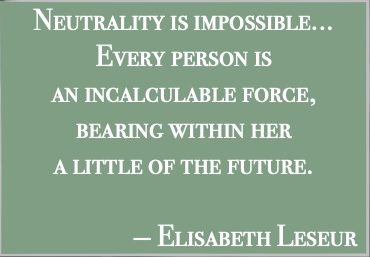
    I believe the quotation from Elisabeth Leseur highlighted in the upper right corner of my blog:


    Every person is an incalculable force, bearing within her a little of the future.


    I believe, with St. John Paul II, that a person is an entity to which the only acceptable response is love.


    Logically, I should think of myself the same way.


    But it's very hard for me.

    And none of that helps to shut up the chatter in the back of my brain, the "what must I make happen next? and then? and then? and then?"


    + + +


    So, anyway, oddly enough, at least according to my LMFT therapist, none of what I've described rises to the level of any sort of DSM-worthy diagnosis.


    I don't exhibit the necessary symptoms at the necessary frequency to count as exhibiting, say, generalized anxiety disorder, or an obsessive-compulsive personality disorder.

    (Not even an eating disorder or some kind of body image dysmorphic disorder. I did ask to be evaluated for that, too. Nope.)

    This was a little bit disappointing to me at first, because I was looking for answers. I was perfectly prepared to be told that I had A Diagnosis of some kind, a personality disorder or a mental illness. I expected it. I might even have been hoping for it. But it turns out that I am not sick in any way.

    Maybe wounded, a bit.

    I don't get to be a member of the community of People With A Diagnosis.


    It turns out that I just have a sort of compulsive-flavored personality: if I had a job, I'd probably be a bit of a workaholic; I exhibit what is called in a certain jargon, "perfectionistic self-presentation."

    Dahhhhling, it is always better to look good than to feel good.


    I think there are more reasons than I realized at first, that I chose to see a marriage and family therapist.


    The job of a marriage and family therapist is often to help people who are not necessarily mentally ill, or disturbed, or disordered, navigate the ups and downs of their relationships.


    Sometimes relationships hit rough spots, places that are hard to navigate, not because the humans in them are terribly impaired, but just because they are humans.

    Well, I have trouble navigating a relationship with the person I see in the mirror.


    That's it.


    + + +


    The current strategy is to try to quiet the chatter in my head, through practice deliberate calming, breathing, focusing.

    Mindfulness.

    I am trying to think of the prescribed exercises as "mindfulness training" or "focusing practice."

    The common term for what the therapist wants me to try is "meditation," but using that term bugged me, and I had to think about it for a while to figure out the source of my resistance. I finally decided that the problem was that the meaning-slot for that word is already taken, by something else. In my personal lexicon, meditation means a different kind of practice, for a different kind of purpose.


    When I meditate on the mysteries of the Rosary or meditate on the meaning of a passage of Scripture, or even meditate on what I am thinking of having for lunch, it is a very active and busy, if receptive, kind of thinking. I am usually hoping that thoughts will come to me and that they will be interesting and insightful.

    Also, the purpose of these practices (well, except for the lunch one) is to increase religious devotion.

    But the purpose of the therapist's suggestion is to take some control back from the panicky, chattering noise in the back of the mind, to learn how to choose what thoughts will occupy your attention and which won't.

    In my very specific case, I am to try to learn how to think about what I am doing now and let go of thoughts of what I ought to do later.

    And it is not an active and busy kind of thinking; it's an effort to think about, or notice, only one thing at a time, and to keep bringing myself back to that one thing I've chosen to notice.

    + + +

    I will probably write some more about the mindfulness thing, because it is giving me a lot to think about, which is almost too meta for me to take. Meanwhile, from day to day I have been trying to let go of the endless to-do list in my head, and just do one thing at a time, and not think about the next thing until it is time to begin it. This is very difficult, not least because apparently I have been relying on that habit to stay organized, and I am not sure how to be any other way without, well, screwing up. Or at least disappointing someone.

    (No, really! There are people who need things from me! Not just my kids! I have promised to do tasks for people and organizations! I can't just…. stop doing those things! At least I have to clear my existing to-do list first! Don't I?)

    Well, maybe. Maybe not. I guess I will try to find out if I can be enough without worrying about being enough. One day at a time, maybe. One hour at a time. Twenty minutes, maybe, just breathing.



  • “Upon the Annunciation and Passion Falling Upon One Day,” 1608. By John Donne.

    In 1608, as in 2016, Good Friday fell upon March 25, the traditional date of the Annunciation.  Here is John Donne's take on this juxtaposition.

    Upon the Annunciation and Passion Falling upon One Day
    1608

    Tamely, frail body, abstain today; today
    My soul eats twice, Christ hither and away.
    She sees Him man, so like God made in this,
    That of them both a circle emblem is,
    Whose first and last concur; this doubtful day
    Of feast or fast, Christ came and went away;
    She sees Him nothing twice at once, who’s all;
    She sees a Cedar plant itself and fall,
    Her Maker put to making, and the head
    Of life at once not yet alive yet dead;
    She sees at once the virgin mother stay
    Reclused at home, public at Golgotha;
    Sad and rejoiced she’s seen at once, and seen
    At almost fifty and at scarce fifteen;
    At once a Son is promised her, and gone;
    Gabriel gives Christ to her, He her to John;
    Not fully a mother, she’s in orbity,
    At once receiver and the legacy;
    All this, and all between, this day hath shown,
    The abridgement of Christ’s story, which makes one
    (As in plain maps, the furthest west is east)
    Of the Angel’s Ave and Consummatum est.
    How well the Church, God’s court of faculties,
    Deals in some times and seldom joining these!
    As by the self-fixed Pole we never do
    Direct our course, but the next star thereto,
    Which shows where the other is and which we say
    (Because it strays not far) doth never stray,
    So God by His Church, nearest to Him, we know
    And stand firm, if we by her motion go;
    His Spirit, as His fiery pillar doth
    Lead, and His Church, as cloud, to one end both.
    This Church, by letting these days join, hath shown
    Death and conception in mankind is one:
    Or ‘twas in Him the same humility
    That He would be a man and leave to be:
    Or as creation He had made, as God,
    With the last judgment but one period,
    His imitating Spouse would join in one
    Manhood’s extremes: He shall come, He is gone:
    Or as though the least of His pains, deeds, or words,
    Would busy a life, she all this day affords;
    This treasure then, in gross, my soul uplay,
    And in my life retail it every day.


  • What I see.

    I am not writing this for people who are fans of Donald Trump.

    Here’s what I see in the man: a certain type of abuser, courting the abused, in a certain stage of the relationship.

    It’s the stage of You are special; I am special; we are special; you are the only one who really understands me; I am the only one who really understands you.

    Those other people: they’re going to try to get between us. They’ll never understand how important it is, this thing we have, you and me. They just don’t get it.

    Those other friends of yours — they’re trying to turn you against me. And I am the only one who really understands you. They’re trying to destroy us. This thing we have together.

    The rest of your family — they are manipulating you, lying to you. They don’t know me like you do. Don’t listen to what they say. They’re crazy. They’re out to get us. I am the only one who really understands you.

    Oh, she said what to you about me? Really? Wow. She’s really over the edge. Of course she would say that. Do you really think you should be listening to her? I can’t tell you what to do, but I know I wouldn’t put up with someone who says the things she does about you. You do what you feel comfortable with.

    The rest of us can no more hope to change the minds of someone in thrall to this than we can hope to make the smitten see, early on, that the abuser is No Good. The abuser takes on a different personality, a plausibly deniable personality, depending on the audience. The enthralled really do understand the abuser differently from how the rest of us understand him, because they see one carefully-cultivated side while the rest of us see another.

    We may attempt an intervention. We may try to describe what we see. In doing so, we confirm to the lover everything the abuser has laid out in his case against us, behind closed doors. The lover, once our friend and companion, concludes, “You are crazy; he is right; you are trying to drive a wedge between us. I understand him; you do not. He understands me; you do not. You are against him, against us, against us both.”

    We have no credibility anymore with anyone in thrall to this certain kind of abuser, the kind who can convincingly manipulate appearances and reality. Usually this happens slickly, skillfully, intuitively.

    Occasionally something misfires and the abuser lets fly with something so blatantly a lie that no one could ever fall for it. Up is down, black is white, I own the successful business that produced these steaks; never mind the packaging. The lie is so amazingly obvious that the rest of us are left wondering what the hell just happened. Did he really say that? Did he really say that thing that could be proved wrong with a simple photograph? Did he really contradict what was right in front of every single one of us? And look what has happened — we are actually questioning our own experience, because it’s just so damn insane. This kind of an abuser is so used to having power over people that he tries it with everyone, even us, and it almost works — sort of (he can’t possibly have lied about something so obvious — he can’t possibly — it can’t really have happened — did it?)

    That’s what I see.


  • Homeschooling high school: ideals versus reality.

    “Here’s what’s wrong with me as a homeschooler,” I said to my husband as we got ready for bed last night. “I would rather spend hours making a spreadsheet that divides up the chapters in my college physics textbook into ‘AP Physics 1’ and ‘AP Physics 2,’ than spend any time at all teaching children how to spell or punctuate.”

    He refused to comment, except to laugh at me.

    + + +

    I am now getting to the point where it seems that most of the circulating articles about home education turn out to be written by people whose children are all younger than mine. Thus, they often have limited utility. Not that I can’t still benefit from ideas about how to teach my younger children, but I can only really use the ideas that work in a family that ranges from toddler to tenth grade. So why is that?

    Some friends of mine pointed out that those with older kids might not want to write about them, in order to protect their teens’ privacy; true enough. Still, it seems that there should be plenty to write about without oversharing. As for me, I try to write about my own experiences rather than details about my oldest sons’ life: how I designed the curricula, how I organize my day, how the co-schooling works. I confess to posting the occasional photo, with permission.

    Another point: a lot of people change their approach from homeschooling to institutional school, when the high school years come around. I have never taken a survey, but it seems to me that on the order of half the members of our local Catholic home education support group send their teenagers to some kind of “away school.”

    (Incidentally, I have served on the board of that group for a couple of years now. The group used to host a monthly meeting every winter on the general topic of “high school.” Last year, after uniformly annoyed feedback from membership about the lack of focus, we decided to start a new tradition of alternating: in odd years, we hold a meeting on the topic of “homeschooling high school,” and in even years, we hold a meeting on the topic of NOT homeschooling high school, a.k.a., “high school alternatives,” a.k.a. “how to discern where to send your previously homeschooled children.”)

    And then, of course, there’s the halfway house called PSEO here in Minnesota — high school juniors and seniors, including those not enrolled in traditional high school, can take tuition-free college courses that count both towards high school graduation credits and towards college credits. It still feels like homeschooling or at least a natural extension of it — most of us have been delegating parts of our children’s instruction to various paid and unpaid instructors for years by then — but it is definitely an institutional school, and Mom and Dad definitely aren’t running the show anymore.

    + + +

    One of the most common questions that we get, when we tell people we educate our kids at home, is “Are you going to do it all the way through high school?” My answer has always been that we will take it one year at a time, one child at a time, continually evaluating our family’s needs. And that has always been true. But I have always been confident that we could do a good job directing our kids’ high school education. I will go even farther for myself and say that I’ve been more confident about high school than about elementary or middle school. I feel like I had to wait so very long before I could teach proof-based geometry, precalculus, chemistry, physics. The years of teaching children how to read, spell, cipher, and punctuate… ugh.

    (On the other hand, helping elementary school and middle school kids to learn art, art-based geography, and Latin has been really fun. Probably because I got to learn a lot along the way.)

    Competency in home education is, apparently, a thorny question. Professional educators often (not always) see educating children as something one should be “qualified” for, ideally by some kind of licensed gatekeeper. I pass most of the spoken and unspoken qualifications: I hold an advanced STEM degree, which theoretically qualifies me to teach at the college level, and possess a rather generous helping of class- and race-based privilege.

    I normally don’t mention the degree to strangers who question my qualifications, however, because I believe that the competency to educate our own children is something that belongs to us by right and by nature, just as the competency to feed and clothe them does. It’s possible for parents to squander or destroy that competency, but it’s presumed to belong to us otherwise. Last fall Leila Lawler @_Leila of Like Mother, Like Daughter tweeted this, which I think sums it up perfectly:

    But families are the experts in education. If they lay claim by means of their commitment.

    And I think that’s right. It is not unconditional; but the “if” of that condition is entirely up to us. We choose to lay claim, by means of our commitment, or not.

    The thing is, you can still be a home educator and delegate the instruction of one or more subjects to some outside expert, or at least someone who’s better at it than you are. Delegation is part of laying claim to our roles as primary educators. I do this with music: my young children are enrolled in preschool music classes, and some of my older children are enrolled in a children’s choir taught by genuine, professional, paid music educators and choral experts. I also do this with English literature and composition, in a sort of barter fashion: I have turned it all over to my close friend H, with her English degree, her apparently boundless patience, and her great interest in teaching children and teens to write and to read critically. My children are reading way more interesting stuff with her than they would be reading with me.

    (The middle way is, of course, to learn a subject along with your offspring. And that’s my favorite way, at least when I am interested in the subject.)

    + + +

    Let’s see, where am I going with this. When people heard that I was willing, even eager, to teach high school kids, they often responded, “I could never do that!” Before I had a high schooler myself, I often marveled (privately) at what I saw as their lack of confidence. Hadn’t they graduated from high school themselves, or even college? Didn’t they realize how much work a high school student does independently? Didn’t they know how many resources there were out there for the odd subject that they weren’t comfortable teaching themselves? Didn’t they know that anyone can get their hands on the teacher’s manual these days?

    I am less snobbish about that now, because while I am happy and confident teaching some high school subjects and delegating others, I have enough experience now to know that it’s actually a lot of work. Enjoyable work, but work, not leisure, and not just a special kind of family life.

    I still think that anyone who wants to educate their high school student at home can do so. But I appreciate better than I did before that not everyone will want to, for reasons that might well be good ones and are certainly personal ones. The most obvious difficulty I have right now i
    s that I am spread very thinly over the educations of a kindergartener, two middle-school students, and the high schooler, not to mention the demands of a toddler and, to put it bluntly, my own aging body. Caffeine can only keep me going for so long.

    Today, Saturday is my school planning day. I am spending part of it on this blog post, because the big picture is good for me, I guess. I am spending part of it on dividing up my physics materials into Physics I and Physics II, roughly along the lines that the AP people divide it, so I can start putting together next year’s syllabus. (My homemade high school science program, so far, is 1 year of evolutionary biology, 1 year of chemistry, and 2 years of physics. I use college textbooks.) I am spending part of it on shopping for art supplies for middle schoolers’ final geography project, and browsing for ideas for a high schooler to self-teach at least one credit of fine arts. I am spending part of it on copying worksheets for a child who is still learning to read. I am spending part of it on reworking my daily schedule for the rest of the year to incorporate more practice with spelling and mechanics for my one child who lags well behind grade level in that area.

    Oh my, I hate teaching spelling. Some kids do just fine. Others never seem to get it. You can pour so much time and attention on it into some children, and eke out so little payoff. But really, would any more progress be made in a classroom of twenty children? So we keep pouring, and eventually find the point of diminishing returns, the point where you stop; fifteen more minutes a day on, say, math, or reading a good book, will do him more good (won’t help the spelling, but will do him more good) than studying spelling for fifteen more minutes. We educate the whole child, not just the subject with his lowest test scores.

    And that’s how it is. But I won’t deny that every minute I am going over spelling (“Doesn’t. What’s the basic word? Do. How do we get from do to does? Add ee ess. How do we get from does to doesn’t? Add en apostrophe tee”) I am looking forward to the Pauli exclusion principle, and the vector product, and the conservation of angular momentum, and the Arrhenius equation, and the fundamental lemma. It feels strange now, while I sit by my kindergartener helping him tell “b” from “d” that I don’t have to wait years for it any longer, but (sometimes) only until after lunch.


  • How I teach my kids to read, an empirical approach: VIII. A quick overview to get to the advanced flashcards, with a phoneme index.

    Eighth post in a series.  See here for:   

    • Materials:
      •  Part II.  "Sandpaper phonemes," a basic set of flashcards
      • Part III. Lists, slates, and readers
      • Part IV.  Advanced set of flashcards.
    • Method:
      • Part V.  Beginning with a one-to-one code.
      • Part VI.  Script for the first two lessons (including the Word Building exercise).
      • Part VII.  Script for two more early lessons (including the game of Honk).

    + + +

    This post is a bit of a digression into the future, by request of commenter GeekLady, who wants to go straight to the phoneme index for the advanced set of flashcards.

    Really I should already have given an overview of the basic one-to-one code first.  I'll try to do a quick explanation as background, followed by an overview of the advanced code.

    + + +

    Okay, to sum up:  I divided my program into two parts:  the basic, "one-to-one" code, and the advanced, "many-to-many" code.  

    Overview of the basic, one-to-one code

    My goal, in the basic part, is to cement in the student's mind that what we're doing, when we read, is decoding: each spelling represents a sound.   I try to completely avoid confusion during this crucial period, essentially, by concealing the fact that English spelling is difficult to read.  There are already many difficult things going on here:  the child is learning the symbols, learning to blend a series of discrete sounds into a smoothly pronounced word, and (eventually) having to sort out the digraphs (e.g., learning to recognize that "ch" as a pair is not to be read as /k/ /h/).  

    I teach those sound/spellings in groups, practicing each group until they are mostly learned, and then moving on to the next group.   During this time, I never present the student with any words that contain a sound/spelling I haven't taught.  I have pre-decided the order in which I will introduce the spellings, so that I could compose a progressive series of lists of available words.  The list gets longer the more sounds the student knows.

      Photo (12)

    Here's the order in which I introduce them.  I've enclosed the sounds in slashes and the tilde ~ stands for "spelled."

    • Single letters, Group 1:  /m/~m, /a/~a (as in hat), /s/~s (as in sat), /k/~c, /t/~t, /p/~p, /n/~n, /f/~f
    • Single letters, Group 2:  /b/~b, /i/~i (as in hit), /r/~r (as in red — not as in her), /u/~u (as in cut), /g/~g (as in big), /h/~h, /j/~j, /d/~d
    • Single letters, Group 3:  /l/~l (as in lab OR as in pal), /e/~e (as in led), /w/~w, /v/~v, /y/~y (as in yell), /z/~z, /ks/~x, /kw/~qu, /k/~k  (see note below)
    • Essential digraphs, Group 1:  /er/~er, /sh/~sh, /ae/~ai (as in pain), /th/~th (as in bath), /ee/~ee, /ng/~ng
    • Essential digraphs, Group 2: /ch/~ch, /ar/~ar, /oo/~ew (as in threw), /oi/~oy, /ie/~ie (as in pie), /k/~ck
    • Essential digraphs, Group 3:  /dh/~th (as in them), /oe/~oe (as in toe), /oo/~oo (as in wood), /ou/~ou (as in cloud), /or/~or, /ue/~ue (as in cue)

    Note:  In the Single Letters, Group 3, I've included a peek ahead at the notion of digraphs (qu) as well as a peek ahead at the notion of multiple spellings for the same sound.  The child already knows that the sound /k/ is encoded by the letter "c," and now he is introduced to the notion that it is also encoded by the letter "k."  Along the way, incidentally, he's encountered the notion that double letters like "ss" or "bb" encode a single sound — which should set us up, later, to accept that "ck" also encodes a single sound.

    At this point, the student knows 42 sounds, in nearly one-to-one correspondence with 43 spellings.

    Then I transition to the Advanced Code by teaching just a few very important "code overlaps."  Where "multiple spellings" means that the same sound may be spelled several ways (such as /k/ being spelled either by "c" or by "k" or by "ck"), I use the term "code overlap" to mean that the same spelling may represent several different sounds.  Here are the code overlaps that I teach at the end of the basic one-to-one code:

    • Essential code overlaps:  /z/~s, /ee/~e, /oe/~o, /ae/~a, /ie/~i, /oo/~u (as in truth)

    The first gives us access to a great number of plurals, while the next five — I hope it is apparent — are the so-called "long vowels."  

    We get a little bit of practice reading words in which we have to try both the "short" vowel and the "long" vowel – none of which involve a so-called "silent E" — before moving on.  What's that?  Long vowels without silent e?  Sure: a as in  "safest" and "crater," e as in "helix" and "Swedish," i as in "tiger" and "wild," o as in "banjo" and "nomad," u as in "brutish" and "tulip."  Plenty of words to work on without getting into silent e.

    So that's what's known before moving onto the advanced code.

    Overview of the advanced code

    I teach the advanced code in groups of sounds, just as I did the one-to-one code.  I introduce one sound every lesson for five lessons, and then I spend five lessons (or more if necessary) practicing those five sounds.  There are two differences:

    • First:  The student has encountered almost all these sounds before, in the one-to-one code, and already knows one or two spellings for each one.
    • Second:  This time, I introduce the sound with several of the most-common spellings for that sound.

    What is a most-common spelling?  It's a spelling that occurs in more than two or three common-enough words (and I admit that I judged whether a word is "common-enough" sort of arbitrarily).  If a super-common word or two contains a unique spelling, I taught that word as a one-off along the way:  "Weird Words."  There aren't very many of them.  More on those another time.  

    At five lessons per week, alternating weeks of introducing new sounds and weeks of reviewing sounds, this phase would take about sixteen weeks.  There are eight groups of sounds, and about forty sounds.  I tried to arrange them so that there were about the same number of spellings in a group, and so that we weren't forced to practice already-learned spellings using words with yet-t0-be-learned spellings.

    Without getting into the minutiae of the lessons (yet), here is the index of lessons for the advanced code.  

    Index of lessons in the advanced code

    Unit 1.  Here I deliberately introduce "ld" for /d/ in the same week I introduce "ou" for /oo/ in order to use the words could, would, should.

    Sound Common spellings Example words
    /b/ b, bb, bu, be bed, rabbit, build, globe
    /d/ d, dd, ed, de, ld dig, add, canned, side, solder
    /or/ or, our, ore, oar, ar, oor corn, four, more, board, warm, door
    /oo/ oo, u, ou book, put, could
    /l/ l, ll, le left, dill, bubble, stole

     Unit 1 Weird Words:  woman, Catholic


    Unit 2.  This unit merges the vowels in "cot" and "caught;" even though my family speaks a dialect that distinguishes them, I find it simplifies things to teach the two together.

    Sound Common spellings Example words
    /n/ n, nn, ne, kn, gn no, cannot, nine, knit, gnat
    /j/ j, g, ge, dge job, angel, large, bridge
    /o/ o, au, aw, a, ough, augh pot, Paul, draw, father, bought, caught
    /s/ oo, u, ou book, put, could
    /ar/ l, ll, le left, dill, bubble, stole

     Unit 2 Weird Words:  one, once, broad, honest, honor, psalm, sword, answer


    Unit 3.  Did you ever notice that "ng" does not spell /ng/ in the word "hunger?"  And I introduce the schwa here, over the course of a couple special lessons just for it.   I call it the "Lazy Sound" with small children. Why do I teach it here?  Because you need it in order to read nearly all the common words in which "i" spells /y/, like "million" and "billion" and "savior."

    I'll write a post all about the schwa later.

    Sound Common spellings Example words
    /m/ m, mm, me, mb map, hammer, lime, climb
    /ng/ ng, n ring, think
    /oe/ oe, o, oa, ow toe, most, boat, own
    /er/ er, ir, ur, ar, or, re, ear her, bird, turn, worm, Oscar, fire, earth
    schwa (lots) (this is subject for another post)
    /y/ y, u, i yell, cure, million

     Unit 3 Weird Words:  soul, shoulder, though, dough, weresugar


    Unit 4.

    Sound Common spellings Example words
    /t/ t, tt, te, ed ten, attic, stopped, gate
    /f/ f, ff, ph fan, stuff, phone
    /ie/ ie, i, y, igh flies, fly, wine, fight
    /ue/ ew, u, ue few, cube, fuel
    /ou/ ou, ow about, tower

    Unit 4 Weird Words:  cough, enough, laugh, rough, tough, goodbye, diaper, island, eye


    Unit 5.

    Sound Common spellings Example words
    /r/ r, rr, wr, re brick, carrot, wrap, share
    /g/ g, gg, gu gas, egg, guess
    /w/ w, wh water, when
    /sh/ sh, ti crash, lotion
    /ae/ a, e, ai, ay, ey, ea, eigh, ei bagel, very, saint, day, they, break, eight, reindeer

    Unit 5 Weird Words:  rhyme, rhythm, rhino, ghost, who, whom, whose, machine, special, passion, pressure


    Unit 6.

    Sound Common spellings Example words
    /h/ h hello
    /p/ p, pp, pe path, apple, hope
    /k/ c, k, ck, ke, ch garlic, milk, rock, alike, stomach
    /u/ u, ou, o shut, touch, some
    /oi/ oi, oy coin, boy

     Unit 6 Weird Words:  who, whole, yolk, conquer, unique, ache, was, what, blood, flood, does


    Unit 7.

    Sound Common spellings Example words
    /i/ i, y big, gym
    /dh/ th smooth
    /gz/ x exist
    /e/ e, ea chess, bread
    /oo/ ew, oo, ue, u, ui, ou, o chew, loom, glue, flute, fruit, soup, move

     Unit 7 Weird Words:  bathe, breathe, clothes, exhaust, friend, canoe, shoe


    Unit 8.  In this unit we mention one extra spelling of an earlier sound, "ure" for /er/, because it so commonly follows an "s" that spells /zh/.

    Sound Common spellings Example words
    /v/ v, ve van, cave
    /er/ ure* injure
    /zh/ s, si measure, explosion
    /ch/ ch, tch, t, ti lunch, itch, picture, question
    /z/ z, ze, zz, s, se, ss zipper, freeze, fuzzy, is, close, dessert
    /ee/  ee, ea, ie, y,e, i, ei, ey wheel, speak, priest, empty, equal, ski, weird, turkey

    Unit 8 Weird Words:  calves, halves, beigegaragexylophone, business, react, people, pizza

    *Other spellings of /er/ were taught in Unit 3.


    The way this works on the level of the lesson:  We have three worksheet activities for each sound, given in three consecutive lessons.

    • The first activity introduces all the new spellings.  I give a list of words containing the new sound, circle the spelling in each word, and have the child read it.
    • In the second activity, the child finds the spellings and circles them, then reads the words.
    • In the third activity, we study code overlaps involving the sound.  Given words containing the same spelling but different sounds for that spelling, the child sorts the words.

    More details another time!


  • Death on a Sunday afternoon.

    You remember how Laura got in trouble for blurting out “I hate Sundays!” right? If I remember right, that was the time that Pa whipped her for it. Or maybe I am thinking of the time she slapped Mary?


    Anyway, I sometimes think about that Little House episode, because every time Sunday afternoon rolls around, I want to blurt out “I hate Sundays!” too.


    I have trouble articulating the reason; it is more like a jumble of associations. Some of it is undoubtedly that feeling of the weekend being almost over, and wanting to push it back just a little bit farther. Why can’t it be a three-day weekend? It is not that I don’t want to work on Monday, but that I don’t want to return while it is still Sunday to the getting-ready-for-tomorrow part. I wish I could just rest all afternoon, go to bed on Sunday night, and begin the work in the morning, when I am fresh.


    I think it’s hard for me to be part of a family on Sundays. I don’t get my way. I am not supposed to get up and be productive; nobody is; so the house gets messier and messier all day long, the dishes pile up in the sink, and at the end of the day after dinner (when we have decreed the restful part of Sunday is over) there is so much that we can’t clean it up before bed. I can’t lounge around and relax in the presence of such chaos. I get tense and irritable. I want to clean everything up and then relax in a clean house. I imagine myself sitting peacefully on the couch with a book, the living room uncluttered and serene, like a magazine spread. My imagination even helpfully inserts a verdant houseplant in the foreground, tastefully blurred. I don’t have any houseplants.


    (After I finished cleaning and making the lovely space in which to relax, I wouldn’t, because I would just keep cleaning, and then I would do school planning because how can I relax knowing that the work still remains to be done?)


    If I had my way I wouldn’t be like we are, wouldn’t sleep in on Sunday and go to the eleven o’clock Mass. I would get up at six or seven and go to an eight or nine o’clock Mass, and then have so much more day stretched out before me, and some morning left before lunch. It’s all these non-morning people I live with, my husband who gets up and goes to work early five days a week, takes a child to the ten a.m. swim lesson on Saturdays, and then, inexplicably, wants to sleep as long as possible on Sunday mornings. Not only that but he actually does it! Stays asleep! The sun comes in and he rolls over and continues, undisturbed. How does that work, I murmur to myself as I clomp down the stairs in my shoes, fully dressed, to make my own coffee (my OWN coffee!) which he makes for me six days out of seven? How can he stay blissfully snoozing? Why can I only do that when I have the flu?


    Practically speaking, I flee from Sunday afternoons. Everything around me on the first floor is nothing but a box to check on a to-do list that never ends. The kitchen’s dishes piling high as people don’t clean but mysteriously continue to eat. The living room floor becoming more and more obscured by toys and snow boots. The computer, accusing me from the corner, concealing fossilized patterns of tiny electric charges that I was supposed to reply to yesterday. The schoolroom.


    I go upstairs and burrow under the blankets and try to nap. I can’t see it from my bedroom. That works pretty well if I have a white-noise app, or else I give up on sleep and maybe I can read a good book.


    Today the ennui got to me after a while and I pulled on my boots, threw the iPad into my bag, and announced that I was leaving the house. Nobody seemed to want me for anything: the kids are playing Minecraft and climbing on the wall in the basement; the baby is napping; it is Phase II. Dinner was still a couple of hours away. I jammed a hat on my head and walked out into an impossibly gray and dreary afternoon, half a mile to a cheerful neighborhood coffee shop.


    Here I sit. I have bought a four-ounce cup of premium ice cream but it turned out I only wanted half of it, so it is melting at my elbow. The coffee is good (maybe a bit too high-acid) but I had better not drink any more lest I be kept up tonight.


    The act of walking in the cold, slightly underdressed for it, helped a little bit. I should have gone for a run, maybe. Maybe I am just seeking stimulation. Well, I have a stimulant, anyway.


    I am a terror, I think, forever insisting that the people around me help me fix my environment so that my nerves stop jangling. Stop making that noise before I lose my mind. Clean up the living room so I don’t trip on this stuff. Clear your desk top so I don’t have to look at a pile of books and papers. Handwash the dishes so there’s no pile in the sink.


    If I allowed the kids to get away with it, let the dishes sit where I can see, let them chew gum where I could hear it, even only some of the time, I would die a thousand deaths, a thousand tiny, imperceptible deaths, every day.


    Sunday is the day when I don’t get my way, because my way is not to take a day of rest, nor to let anybody else have one either.


    + + +


    I have heard people say that every Friday is a little Lent and every Sunday a little Easter. Or to turn it around, while Easter is all Sunday feasting, Lent is all Friday, all sorrowful mysteries, every day a penance.


    As for me, backward anti-social Christian that I am, I think that a real penance for me would be a Lent full of Sundays, surveying the feasts and the revelry and the easygoing laughter and thinking This is all very well while it lasts, but when it’s over somebody is going to have to clean this mess up.


    + + +


    I don’t have any profound ending for the post here. I need to close it and put on my coat and go home, because it is getting dark and my family will want to eat dinner, and after dinner we will all stop resting and get to work, getting ready for tomorrow and tomorrow and tomorrow. That’s when the kids will grumble but I will cheer up, because for some reason I like the doing of things. I like when there is nothing to do, too; the hard part for me is when there is something to do but it isn’t time yet.


    This year I must learn to suffer this a little more than I do, instead of laying the burden of my constantly-jangled nerves on the people around me. I am not sure what kind of Lent that could mean, but letting Sunday be Sunday, and finding times of rest and retreat (when I want to attack) the rest of the week, might be part of it for me this year.


  • How I teach my kids to read, an empirical approach: VII. Script for two more early lessons, including the game of Honk.

    Seventh post in a series.  See here for:   

    • Materials:
      •  Part II.  "Sandpaper phonemes," a basic set of flashcards
      • Part III. Lists, slates, and readers
      • Part IV.  Advanced set of flashcards.
    • Method:
      • Part V.  Beginning with a one-to-one code.
      • Part VI.  Script for the first two lessons (including the Word Building exercise).

    + + +

    In Part VI, I gave a script for the first two lessons using the "sandpaper phonemes."   

    • Lesson 1:  /m/ spelled m, /a/ spelled a; introduction to sandpaper letters
    • Lesson 2:  /s/ spelled s, /o/ spelled o; word building exercise

    The first lesson functions as an introduction to the whole concept of the sandpaper letters.  

    The second one includes the first of several types of exercise I use to review, the "word building" exercise.  The Word Building exercise has several steps:

    • Lay out  several of the sandpaper phonemes where they are all visible, in random order
    • Announce that we are going to use those cards to spell a word
    • Speak the word and listen for the sounds in the word
    • "What is the first sound?…. Find the spelling that spells that sound."
    • Place the correct letter card
    • "What is the sound that comes after? … Find the spelling." 
    • Place the next card
    • And so on until the word is built
    • Read the word.

    If you want to see how I used the Word Building exercise, go back to the last post and check out Lesson 2.

    In this part, I'll give you a script for Lessons 3 and 4.  Each one begins with a review of some kind, then goes on to add something new.  In lesson 3, the review is very simple, just going over the previously learned sounds.  In Lesson 4, a flashcard game called "Honk" is introduced.  If the student is older, plain old flashcard-type practice may be preferable.

    (I did not come up with "Honk" myself.  It is adapted from one that appears in Phonics Pathways: Clear Steps to Easy Reading and Perfect Spelling, by D. G. Hiskes.  The latest edition is the 10th, and was published in 2011.)

    ——

    LESSON 3

    review of /s/ s, /a/ a, /m/ m, /o/ o

    /k/ spelled c  as in  cat

    /t/ spelled as in cat

    ——

    "You have already learned four sounds."

    • Show the textured letter a.

    "Read this card.  What sound does this shape spell?"

    • Show the textured letter m.

    "Read this card.  What sound does this shape spell?"

    • Repeat with textured letters  s, o.
    • Spread all four textured letters on the table.

    "Show me /mmmm/."

    • Allow the child time to choose the letter m.

    "Trace the spelling of /mmmm/ with your writing finger."

    • Help the child to trace the letter with the index finger of his writing hand.  Encourage the child to say "/mmmm/" while tracing.
    • Repeat with the other cards.


    "Now you're going to learn two new sounds and the shapes that spell them."

    "The first sound is this:  /k/.  Say /k/."

    "Are my lips closed or open when I say /k/?"

    "/k/ is a very short sound.  When I say /s/ I can make it last as long as I want:  /sssss/."  But when I say /k/ I am done with it very fast."

    • Show the textured letter c.

    "Sometimes we spell the sound /k/ with this shape."

    "Practice tracing the letter that spells /k/ with your finger."

    • Help the child trace the letter with the index finger of his writing hand.  Encourage the child to say /k/ while tracing the letter correctly three or four times.

    "Now we will learn another sound.  The sound is /t/.  Say /t/."

    "Are my lips open or closed when I say /t/?"

    "Can you feel where you put your tongue to say /t/?"

    "How long can you make /t/ last? As long as you want, or is it over quickly?"

    • Show the textured letter t.

    "We spell the sound /t/ with this shape."

    "Practice tracing the letter that spells /t/ with your finger."

    • Help the child trace the letter t with the index finger of his writing hand.  Encourage the child to say /t/ while tracing the letter correctly three or four times.
    • Help the child complete a worksheet with the letters t and c to trace.


    ——

    LESSON 4

    the game of Honk (or plain flashcard practice) with a  c  m  o  s  t

     reading mat and sac

    ——

    Preparation for the game of Honk:  

    Get a stack of 21-25 index cards (or half-cards) and on the blank side of each, in pencil, print one letter.  Draw a line underneath each letter to indicate orientation.  There should be three cards each of a, c, m, o, s, t.  On each of the remaining cards, draw a silly face or animal.  These cards are "Honks." 

    Mix the cards, but ensure that the top two cards are letters and the third one is a Honk.

    Worksheet preparation:

    Prepare a worksheet with the word mac printed at the top and a place to trace it at the bottom.  Prepare another sheet with the word sac.  Or prepare a dry erase board, a magnet-sketch tablet, or a tablet of lined paper.


    "You have learned six sounds.  Let's practice them once."

    • Help the child complete a worksheet with one each of letters a c m o s t, or have the child trace each of the textured letters a c m o s t with the index finger of his writing hand.  Encourage the child to say the sound while writing or tracing each letter.

    "Today we're going to play a game."

    • Show the prepared stack of cards.

    "I'm going to turn over one of these cards.  Then we're going to say the sound that the card spells, as fast as we can.  Like this:"

    • Turn over the card to show a letter.  If it is, for example, an m:

    "/mmmmmm/!"

    "I'm going to do it again.  Ready?"

    • Turn over the next card to show a letter.  If it is, for example, an a:

    "/aaaaaaa/!"

    "Just to make the game more fun, though, some of the cards are different."

    • Turn over the third card to show a Honk.

    "This is not something that spells a sound.  But when we see it we will make a sound:  HONK!"

    "We will start slow and then we will go faster."

    • Shuffle the cards and begin, dealing them one at a time.  Try to turn them so the cards are right-side-up for the child.  If one lands upside down, turn it immediately into the correct orientation.  Wait to deal the next card until both of you have made the correct sound.
    • After all of the cards have been dealt, play again, faster.
    • Variations:  Child deals the cards; parent lets child try to make the sound first; both play to try to make the sound first.  For older children: beat the clock.
    • Go through the deck three or four times.


    "You are going to read two words today."

    "Here is the first word.  It has three sounds in it, and you know all of the sounds."

    • Show the mat worksheet; or print the word mat on the tablet or lined paper.

    "Read the sounds from left to right."

    • Indicate the direction on the paper or tablet.
    • Help the child to say "/m/, /a/, /t/" in order as separate sounds.  Point to each letter as the sound is said.

    "You just read all the sounds in order."

    "When we slide the sounds all together, we'll be reading the whole word."

    "I will slide the first two sounds together."

    • Point to each letter as you say the sound, saying slowly:  "/mmmmmmaaaaaaaaa/" without stopping between /m/ and /a/.

    "Now I will slide all three sounds together."

    • Point to each letter as you say the sound, saying slowly:  "/mmmmmmaaaaaaaaat/." The /t/ cannot be drawn out, but it should be well enunciated.

    "Now you say the word."

    • Encourage the child to say "mat."  Point to each letter as its sound is made as you tell him:

    "The word is 'mat.'"

    • Have the child complete the worksheet, tracing or writing the word mat once; or have the child copy the word on a tablet or paper.
    • Repeat with the word sac.


    + + +

    It's possible that this first foray into blending — converting discrete sounds into smoothly pronounced words — will not go very smoothly.  After some experience working with five- and six-year-olds, I actually suspect that the ability to hear how the separate sounds blend together to form a word is something that has a developmental component.  It's the kind of thing that they might not "get" for a while until it clicks.

     I will add some notes on "blending" in a future post.


  • Cabbage with onions and potatoes, Greek-ish style.

    This is one of those posts where I blog a recipe just so I won't forget it exists.  My 15yo son loved this side dish that I threw together out of leftover vegetables, and I want to remember to make it again.

    I was making what I call "skillet gyros" last night, because it was the day before grocery shopping and I'd found some ground beef and a package of pita bread in the freezer.  "Skillet gyros" means that I brown the ground beef with nothing but salt and oregano, and I serve it with a sauce I make by stirring together yogurt, garlic, dill, and chopped cucumbers.   

    Trust me, it works.

    Anyway, I also had three-quarters of a green cabbage and some leftover roasted new potatoes, so I googled "Greek cabbage potatoes" to see what turned up.  I wound up with this composite recipe:

    Greek-style cabbage and potatoes (empty fridge edition)

    • Half to one green cabbage, chopped
    • 1 yellow onion, chopped
    • 5-6 cooked red potatoes, diced
    • Oregano and salt to taste
    • 1 six-ounce can tomato paste
    • Olive oil

    Preheat oven to 375 degrees.  Sauté onion in olive oil until soft in a medium oven-safe skillet with a lid.  Add cabbage and toss to wilt; cover the pan and let steam for a few minutes.  Stir occasionally to avoid sticking and burning, and continue cooking until cabbage begins to soften.  

    Add potatoes, tomato paste, oregano, and salt, and stir to combine.  Cover and transfer to oven and bake about 30 minutes.

    If you have less time, sauté a little longer and bake it less (or you can even do the whole thing on the stove top).   If you have more time, let it bake longer.

    Works great. 

    There was one recipe I found that made me wish I had had bell peppers too.  It was here (although the slightly passive-aggressive language about the blogger's parents turned me off some).   Next time!


  • How I teach my kids to read, an empirical approach: VI. Script for two lessons.

    Fifth post in a series.  See here for:   

    • Materials:
      •  Part II.  "Sandpaper phonemes," a basic set of flashcards
      • Part III. Lists, slates, and readers
      • Part IV.  Advanced set of flashcards.
    • Method:
      • Part V.  Beginning with a one-to-one code.

    + + +

    In the first lesson with the child, we sit down with the two sandpaper phonemes "m" and "a."  Here's the script I wrote for myself to use seven or eight years ago, and have used three times since.   

    In the second lesson, we start with a word made from those two sounds, and then we go on to learn two new sounds.

    A note on notation:  Recall that I enclose sounds in slashes, like this: /m/

    ——

    LESSON 1

    /m/ spelled m  as in  mouse

    /a/ spelled  as in hat

    ——

    "You're going to learn two sounds and the shapes that we use to spell them."

    "The first sound is this:  /mmmmm/.  Say /mmmmm/."

    "Are my lips closed or open when I say /mmmm/?"

    "We use our voice to say /mmm/.  Put your hand on your throat and you can feel your throat vibrating."

    • Have the child say /mmmm/ while feeling his throat vibrate.  Make sure he notices it before continuing.

    "Your throat vibrates when you use your voice to make a sound.  It stops vibrating when you stop using your voice."

    • Show the textured letter m.

    "We spell the sound /mmmmm/ with this shape."

    "Practice tracing the letter that spells /mmmm/ with your finger."

    • Help the child trace the letter m with the index finger of his writing hand.  Encourage the child to say "/mmmm/" while tracing the letter.  Trace it correctly three or four times.

    "Another sound we will use is /aaaaa/.  Say /aaaaa/."  

    • Pronounce the vowel as in "hat" or "bat."

    "Is my mouth open or closed when I say /aaaaaa/?"

    "Do you use your voice when you say /aaaa/?"

    "Put your hand on your throat and see if you can feel it."

    • Show the textured letter a.

    "We spell the sound /aaaa/ with this letter."

    "Practice tracing the letter that spells /aaaaa/ with your finger."

    • Help the child trace the letter with the index finger of his writing hand.  Encourage the child to say "/aaaa/" while tracing the letter.  Trace it correctly three or four times.
    • Help the child complete a worksheet with letters a and to trace.  (See note)

    Note on the worksheet I mentioned:  You can literally just grab a piece of paper, write a big a and m on it, and ask the child to trace the letters with his finger or go over it with a marker or crayon.  Or you can download something.  


    —————–

    LESSON 2

    Word building exercise with a and m

    /s/ spelled s  as in  sock

    /o/ spelled o  as in sock

    ——————

    "Last time you learned how to spell two sounds."

    • Show the textured letter a.

    "Read this card.  What sound does this shape spell?"

    • Show the textured letter m.

    "Read this card.  What sound does this shape spell?"

    "We are going to use these letters to build a word that has two sounds in it."

    "We are going to build the word am on your work mat."

    "What is the first sound you hear in the word am?"   (/a/)

    "Find the letter that spells the sound /a/."

    • Allow time for the child to find the letter a.  Place the card on the work mat.

    "What sound comes after the sound /a/ in the word am?"

    • Prompt and assist the child to listen for the sound until the answer /m/ is elicited.

    "Find the letter that spells the sound /m/."

    • Place the letter card m on the work mat to form a m.
    • Read the word am indicating each letter as its sound is vocalized:  "/aaaaaaa/ /mmmmm/."
    • Give the child a worksheet with a m on it and help the child to trace and say "am."

    "Now you're going to learn two new sounds and the shapes that spell them."

    "The first sound is this:  /sssss/.  Say /ssssss/."

    "Are my lips closed or open when I say /sssss/?"

    "Can you feel where you put your tongue to say /sssss/?"

    "Put your hand on your throat to feel it.  Do you use your voice to make the sound /sssss/?"

    "You do not use your voice to make the sound /ssss/, so your throat does not vibrate.  You only use your breath."

    • Show the textured letter s.

    "We spell the sound /sssss/ with this shape."

    "Practice tracing the letter that spells /ssss/ with your finger."

    • Help the child trace the letter s with the index finger of his writing hand.  Encourage the child to say "/ssss/" while tracing the letter.  Trace it correctly three or four times.

    "Another sound we will use is /o/.  Say /o/."  

    • Pronounce the vowel as in "hot" or "bot."  Extend it so it's more like "ahhhhh."

    "Is my mouth open or closed when I say /o/?"

    "Do you use your voice when you say /o/?"

    "Put your hand on your throat and see if you can feel it."

    • Show the textured letter o.

    "We spell the sound /o/ with this letter."

    "Practice tracing the letter that spells /o/ with your finger."

    • Help the child trace the letter o with the index finger of his writing hand.  Encourage the child to say "/o/" while tracing the letter.  Trace it correctly three or four times.
    • Help the child complete a worksheet with letters o and s to trace.  

    + + + 

    So, that's the pattern for my first couple of lessons.  In lesson 3 we review the four sounds learned, and introduce /k/ spelled c and /t/ spelled t.  The next lesson has a simple flashcard game and the exercise of reading ammat, and sac.   I'll write those out in a later post.


  • How I teach my kids to read, an empirical approach: V. Beginning with a one-to-one code.

    Fifth post in a series.  See here for:   

    • Materials:
      •  Part II.  "Sandpaper phonemes," a basic set of flashcards
      • Part III. Lists, slates, and readers
      • Part IV.  Advanced set of flashcards.

    In today's post I'm going to start writing about method.

    + + +

    I have, so far, begun formal reading instruction (meaning, I sit down with them and "practice learning to read" regularly) around age five. 

    Two of my children exhibited definite readiness signs before then.  My daughter was two when I discovered that she had somehow learned all the letter names (she spilled a set of Bananagrams tiles on the floor and began announcing them as she gathered them up).   My #4 developed an obsession with writing his own name at age four and a half.  So, they were definitely interested in words and letters.

    The first two hadn't really been interested prior to age five.   I respect the notion of waiting until readiness signs are apparent to begin sitting down and working with a child, but I'm okay with starting earlier too.   We are the ones who get to direct their education; I trust we can respect their developmental stage along the way.  I figure that the important thing is not to push them past the point of frustration, only to encourage going a little bit past the point of comfort.

    + + +

    One thing I do NOT start with is the alphabet.  

    I picked up the idea that it might be better to avoid stressing letter names from a book that influenced me, Reading Reflex by Carmen and Geoffrey McGuinness.  I found passages like this (pp. 52-53) convincing:

       Many children fail to understand that letters are pictures of sounds.  At some point in their literacy development they espouse the notion that letters "make" sounds.  This thinking is precisely the reverse of our goal.  It's confusing… because it implies that the letter has meaning in and of itself… What we want them to understand is that [the letter] is a symbol for a sound which they need to remember.  It helps if they understand the nature of symbols, that they are arbitrary, that they stand for something else just because we agree that they will.  

     As parents, we can help our new readers to establish a clear understanding of the sound picture nature of text by avoiding certain language when we work with them.  "What does that say?" can be replaced with, "Do you remember what we say when we see that?"  The term "sound picture" [for a letter or digraph]…[has] been found to be a very powerful and descriptive term which gently forces the logic we seek.

        Another common mistake that some parents and teachers make that children find confusing is the use of letter names in referring to the sound pictures.  If we refer to 'see' and 'tee' and 'ef', etc.  in helping our young readers, we are forcing them to learn two names for each symbol, the letter name and the sound.  This is completely unnecessary.  Many children can't do this easily and end up remembering only the letter name.  They are forever trying to access or remember the sound by cueing off some part of the letter name, "'ef' um 'e'?, no um 'f'?"  

    Although this translation step is completely unnecessary and confusing, it does work for some letters.  The sound that corresponds to the letter 'tee' <t> is found right at the beginning of the letter name.  But what about 'see' <c> which usually represents 'c', not 's', and 'em' <m> which represents 'm', not 'e', and 'wie' <y> which usually represents the sound 'ee' as in the word 'happy', and never represents the sound 'w'?  If you take the time to analyze the alphabet names and sounds you realize why so many children have trouble.  We recommend that you never use letter names when working with your child.  Always refer to sound pictures by the sound they represent, not their letter name.  The futility of letter name instruction is proven over and over again with every adult nonreader who can recite the alphabet with ease.  

    When posing a question for your child in which you feel inclined to use a letter name, for example, "What sound does 'tee' represent?" you can easily sidestep the letter name by simply indicating the letter with your pencil or pointer finger and saying, "What sound does that represent?"  


    I am no longer as dogmatic about it as I used to be (I was dismayed when I found out my two-year-old had stealthily learned the alphabet!)  – I'm not convinced that it will necessarily derail kids if they happen to learn the letter names first.  But I have definitely learned to talk about reading without emphasizing the letter names, at least not until the child really understands what it is we're asking them to do.

    + + +

    The "one-to-one" code, the beginner's code, is a limited set of spellings arranged such that each of the common English phonemes (loosely defined, as you'll see) is represented by a unique spelling.  All of these spellings are either single letters or digraphs (letter pairs).    

    I introduce one or two sounds in each lesson.  From the very beginning, we read words containing the sounds in our toolbox; every new lesson, we add another sound or two.   After four or five lessons I stop introducing new sounds.  We continue reviewing and practicing words that contain nothing but the sounds that are already in our toolbox, until I'm sure that we're ready to add another group of sounds.  At any time if the child seems unready to learn more, we can pause where we are and keep practicing what we know, for as long as we like; then when we're ready to go on, we do.

    Here are the sounds I introduce in the first group of five lessons.  Notation:  I enclose the sound between a pair of slashes, and put the letter in quotation marks.

    • Lesson 1.  /m/ spelled "m"  and /a/ (as in bat) spelled "a"
    • Lesson 2.  /s/ spelled "s" and /o/ (as in lot and log*) spelled "o"
    • Lesson 3.  /k/ spelled "c" and /t/ spelled "t"
    • Lesson 4.  /p/ spelled "p" and /n/ spelled "n"
    • Lesson 5.  /f/ spelled "f"

    I took a page from Teach Your Child to Read in 100 Easy Lessons  for my first lesson.  One of the things I liked about that book is how the child starts reading words quite early in the process.  One of the first words that is read in that book is "am," and that's where I start.  I teach the sounds /m/ and /a/, and then I put them together and I show that we spell "am" by putting together the spellings "a" for /a/ and "m" for /m/.

    In the second lesson we can review "am" before introducing the basic spellings of /s/ and /o/.  This gives us a few more words:  "mom" and "Sam," plus you can try "mass" and "moss" and (if it doesn't bother you) "ass" to find out if your child takes easily to your matter-of-fact explanation that a doubled letter almost always* spells the same sound as the single letter would.

    In the third lesson we can practice all the words from the previous two, and now the number of words we can spell begins to rise.  Once they have learned /k/ spelled "c" and /t/ spelled "t," they acquire the ability to read:

    act, acts, ascot, at, cam, Cass, cast, cat, cats, cost, costs, cot, cots, Mac, mascot, mascots, mast, masts, mat, mats, Matt, sac, sacs, sat, sass, scam, scat, scats, Scot, Scots, tact tam, tat, tats, Tom, tomcat, tomcats, toss, tot, tots

    Notice that they get "cats" and "tats" but do not get "cams" or "tams."  The plural of "cam" or "tam"  is formed by adding a /z/ sound, not a /s/ sound, and they haven't learned /z/ yet!

    By the time the fourth lesson comes around the word list has really expanded.  As you add sounds to your child's toolbox, they can read more and more words, without ever having to resort to a sight word.    I'll provide more details about the lists, and an overview of the basic code, in future posts.   Next post, I'll give a sort of a script for the lessons in this first group.

    ____________________________

    *Assuming you choose to simplify by collapsing the two vowel variations into one, as in the cot-caught merger.

    **Almost always, but not always:  cf.  the two c's in "access."


  • How I teach my kids to read, an empirical approach: IV. Materials: more advanced cards.

    Fourth post in a series.  See here for:   Part I.  Part II.  Part III.

    + + +

    It takes me a good long time to be ready to move on from the large "sandpaper phonemes" that I described in Part II of this series.  I think that I worked with my current emerging reader for about a year using the large cards, from age 4 ½ to age 5 ½.  The (optionally textured) letters on the large cards are nice to trace with a finger, and they're unlikely to go missing since they're so big.  But after you've got more than about 20 of them, they begin to feel a bit unwieldy to use.

    My advanced cards are much smaller.  Three-by-five cards might be the most popular size of homemade flashcards, probably because the 3×5 size is so widely available and cheap; but I really like the "business card" size, as it fits in a child's hand so well.  Another convenience:   you can buy pre-perforated sheets of business cards that fit in your printer.

    Photo 3

    The basic features of the advanced cards are:

    • Small (business-card sized).
    • Durable.
    • Any manuscript style or font.  

    Some options that I have found helpful:

    • Laminated for durability.
    • Hole punched in the top left corner (so they can be kept on a ring, which orients them correctly).
    • Printed rather than handwritten.  

    A note on lamination:  After I printed the cards and separated them, I took them to a print shop and had them laminated for durability.  I did not use the little individual card-size laminating pouches at the self-serve station — that would have taken forever.  I had them send it through the wide-format, roll laminator, and then took the roll home and cut the cards out.  If you have a laminator at home, you can do this yourself.  

    A note on fonts:  I used Times New Roman.  Now is a good time to introduce the other shapes of "a" and "g" — kids need to be able to recognize both eventually.   But if you prefer, you can choose a font that has the a-shape and the g-shape that the child is used to seeing.  

    Cards in this set:

    b bb bu be d dd ed de ld or
    our ore oar ar oor oo u ou l ll
    le n nn ne kn gn j g ge dge 
    o au aw a ough augh s ss c ce
    st sc orr m mm me mb ng oe oa 
    ow er ir ur re ear y i t tt 
    te f ff ph gh ie igh ue ew
    rr wr re g gg gu w wh sh ti 
    e ai ay ey ea eigh ei h p pp 
    pe k ck ke ch oi oy th x ui 
    v ve si ure tch z ze zz ee  


    Did you remember how, back in Part I, I said that I taught 4-5 spellings of each phoneme, and the total number of combinations was about 175?  You'll notice that my set contains not 175, but 109 cards.  That is, of course, because some of them are used for more than one sound, which is the entire reason why English is such a pain to learn to read.  

    (The reason English is such a pain to learn to spell is because it employs more than one spelling for the same sound.  Kind of the reverse of the first problem.)

    It's probably apparent that there is a semblance of order, but only a semblance of one.  What's happening here, in this advanced set of cards, is that we are marching through the forty-or-so phonemes of English, introducing the most commonly seen spellings for each one.

     The first phoneme that is studied is — I hope you deduced quickly — /b/.   That would be (from left to right) /b/ as in bag, /b/ as in rubber, /b/ as in globe, and /b/ as in build.

    The next phoneme is /d/.  Why yes, we are dealing with b-d reversal up front.  And wait a minute:  "ed" spells /d/?  Why yes, as in "braised" or "blazed."  

    The next phoneme is, well, it isn't exactly a phoneme — it's a rhotic vowel together with its r.  /ɔ˞/ is how it is written in IPA (at least if that came through on your web browser) — it's the same as pronouncing the word "or."   I have it spelled six different ways, as in born, poor, four, sore, roar, quart.  

    (Kelly — who lived a long time in Kentucky — pointed out to me in the comments that she pronounces "poor" and "pore" differently.  Wherever these distinctions sometimes exist, I tried to merge them in order to cut down on the number of phonemes that must be learned; in my experience, it's only necessary for a child to hit reasonably close to the pronunciation to be able to recognize it.  I tried to apply this to my own dialect too — I happen to pronounce "cot" and "caught" differently, but I treated the two vowels as one for the purpose of my program.)

    I don't have duplicate cards in this set.  By the time I get to the pirate phoneme (/ɑ˞/, mateys), I have already introduced a card for the spelling "ar," so we only need to introduce "orr" (as in sorry — unless you're Canadian, in which case you ought to have introduced it earlier along with "oor" and "ore" and the like.) 

    + + +

    So, that's the "advanced" card set.  I'll write about how I use both sets of cards in future posts.