bearing blog


bear – ing n 1  the manner in which one comports oneself;  2  the act, power, or time of bringing forth offspring or fruit; 3 a machine part in which another part turns [a journal ~];  pl comprehension of one’s position, environment, or situation;   5  the act of moving while supporting the weight of something [the ~ of the cross].


  • There’s a house parked out front.

    I went to bed worried that an impending snowstorm would derail the setting of my modular home, scheduled for this morning.  So when flashing yellow lights moved slowly across my bedroom ceiling at 3:45 a.m., I thought:  oh no, it’s the snowplow — already.

    I got up to see how bad it was.  But no — the roads were only wet.  Instead, there were two semi trucks parked in front.  Down the block I could see a third.

    The porch is already on it!

    My good camera is charging and my cheap camera can’t take pictures out the window at night, so you’ll have to wait.


  • Registration is now ON. Sorry for the inconvenience.

    I started getting comment spam and wanted to nip it in the bud, so you now have to register with Typepad to post a comment.

    Sorry about that.

    Unless you’re a spammer.  In that case I’m not sorry at all.


  • Want some poetry this morning? Say no more, it’s Donne.

    Posted at Pontifications.

    Wilt thou love God, as he thee? Then digest,
    My soul, this wholesome meditation,
    How God the Spirit, by angels waited on
    In heaven, doth make his Temple in thy breast.
    The Father having begot a Son most blest,
    And still begetting, (for he ne’er be gone)
    Hath deigned to choose thee by adoption,
    Co-heir t’ his glory, and Sabbath’ endless rest.
    And as a robbed man, which by search doth find
    His stol’n stuff sold, must lose or buy ‘t again:
    The Son of glory came down, and was slain,
    Us whom he’d made, and Satan stol’n, to unbind.
    ‘Twas much that man was made like God before,
    But, that God should be made like man, much more.

    Mmm.


  • Oh yes, they’re completely at odds.

    Charles McGrath betrays a collossal unfitness to write on the subject, only two sentences into this snide piece on C. S. Lewis:

    The movie of course has the benefit of studio bean counters and recognizes that this could be the mother of all screen battles – not just your basic struggle of good and evil but a $200 million smackdown between the religious right and godless Hollywood, between C.S. Lewis and J.R.R. Tolkien. . .

    He goes on to speculate about Lewis’s sexual masochism, among other things.


  • Science, philosophy, technology.

    Good post on why we don’t need "intelligent design," by MrsDrP over at Marriage is a Vocation.  I’m going to keep an eye on that one, as she and I seem to be interested in similar stuff.

    I noted in the comments that science, philosophy, and technology are three separate fields of human intellectual achievement, often confused by careless or ignorant people.

    It is a mistake to say that they inform each other.  Rather, the chain goes like this:

    science ———–>  philosophy ————–> technology

    What we learn about the world and ourselves from science must inform our philosophy.  No philosophical system that ignores data about the real world can be complete, although some can be complete in a theoretical sense and even those can prove useful (e.g. Euclidean geometry, which is entirely made up — have you ever seen two parallel lines?) 

    Then, our philosophy must guide us in deciding how we use our knowledge — that is, our technology.  To put it bluntly, there are some things we should do and some things we should not do, and neither technology nor science can tell you which is which.  Technology without philosophy is capricious and dangerous — who knows what you will get?  Technology informed by an evil philosophy will likely produce evil works.  Only technology that is informed by a morally correct philosophy can be trusted to produce good works.

    The chain does, in the end, come full circle:

      science —> philosophy —> technology —> science …

    because improved technology (e.g. better microscopes) gives us more ways to learn about the world.

    Confusion among the roles of these three fields can royally screw up public policy.  For example, many people are very concerned about technologies that they consider to be morally evil.  Take cloning of human beings.   Almost everyone thinks either that human cloning is universally morally wrong, or that using human clones for some particular, envisionable purpose is morally wrong.  In other words, people share widespread agreement that some technology associated with human cloning should not be done, even if we figure out how to do it.   

    But then, a lot of either careless or ignorant people, depending on what side they’re on, turn around and make one of the following logically incorrect statements, which are really two sides of the same coin:

    • It is wrong to study the possibility of human cloning, either theoretically or through animal studies.
    • People who want to ban human cloning are anti-science and have no business being called scientists.

    Cloning, whether of humans or animals, is not science.   It is a family of technologies.  It is something you do (and therefore something you can choose to do or not do). It is not something you know.

    Choosing not to learn or know something is willful ignorance — which is sometimes neutral and often useful, but not in general virtuous.    This should not be confused with choosing not to do something.  The goodness of that kind of choice depends, of course, on the wisdom of doing the thing in question.  Just because doing something is called "bad" does not mean that learning things about it is wrong.  And even if the "something" has an aura of the scientific about it, it is not automatically okay to do it — not in the same way that it’s automatically okay to increase knowledge through science. 

    That’s because if the "something" is technology, it’s NOT science.  I happen to believe that all science is an inherent good, and that its goodness is measured by its accuracy.

    Here’s the short, sound-bite version, ready to rattle off to the next careless or ignorant person you meet:

    • Science tells us what is and what we can and can’t do.
    • Philosophy explains why and what we should and shouldn’t do.
    • Technology is doing.

    Up till now I haven’t invoked religion at all.  In all of the above, the philosophy mentioned can be a wholly secular one that is informed by nothing other than science, i.e., by data gathered from the natural world. 

    Christians have to add a fourth field:  revelation.  Revelation, like science, informs philosophy.  It is data that is not gathered, but given, by supernatural means (although it can concern the natural world).  Revelation and science are two independent means of "inquiry," so to speak.  For Christians, then,

    science AND revelation —–> philosophy —–> technology —-> science

    This circle only closes partly, because we can’t use our technology to get more and better revelation, only more and better science.

    A complete Christian philosophy has to account for everything we know from both science and revelation.   A Catholic philosophy includes the Tradition of the Church and in that aspect is, we believe, something more than a human philosophy, because it is (in that aspect) protected by the Holy Spirit.  It must, of course, include an answer to the question "What if there’s an apparent contradiction between science and revelation?" and it has to include a moral code that tells us how our technology can be used for the benefit of humankind and for God’s greater glory.

    There’s nothing wrong, incidentally, with trying to come up with a philosophy that is informed only by science or only by revelation.  It may be a useful rhetorical exercise, and it may serve our ends in convincing people who accept only one or the other to adopt our program of technology.  But we must be aware at all times of the limitations of such a system.


  • Zapped!

    Here at bearing blog, we* feel it is our duty to blog the latest wacky adventures in sex-without-consequences. 

    So I’m linking here.  Thanks, Darwin!

    —————-

    *Royal "we."


  • The house comes Tuesday.

    On five trucks, accompanied by a crane. 

    Pictures to follow.


  • “Sustained by intense interest.”

    A fragment of text from an op-ed that appeared on my thirty-first birthday has been wandering through my mind for more than a month, searching for a connection:

    …a talent — a skill acquired, as intellectual skills are, by years of practice sustained by intense interest.

    Last night Mark was telling me about how his boss had suggested he go to grad school, and as the Riesling level sank in the bottle we turned to musing about how much we knew, how much we didn’t know, and how much we knew we didn’t know. 

    When I graduated from college, he said, I knew more about engineering than I’ve ever known or ever will know.  Not so much about business and management, I’ve picked that up at work.  But at the same time, I’ve forgotten so much of what I learned as an undergrad.

    I thought about it for a minute.  I think my actual knowledge and competency was always monotonically increasing, I said, tracing with my finger in the air a rising graph of knowledge vs. time, from freshman year, all the way through when I finished my PhD. 

    I then smiled and traced another graph, this one with a sharp cusp in the middle.  But my perception of my competency and my knowledge took a big dive not too long after I started graduate school.  I never felt that I really knew what I was doing ever again.

    Then that wandering fragment of text — sustained by intense interest — connected in my mind and I said:

    You know, deep down I think that after I had Oscar, I just didn’t have enough interest in my subject to apply to it the kind of work that would have really helped me excel.  I still have some interest.  I still love science.  I still love applying my mind to problems and thinking hard about them.  But after I had the kids, devoting more time and effort to my studies came at too high a cost.  And my interest in the subject wasn’t enough to overcome that.

    This is probably a good thing, because my interest in my children drove me to devote lots of my time and effort to my kids instead.  If I had been more interested in my work — and perhaps a different research problem would have captivated me like this — I might have been motivated to devote more time to my research instead.    And I might have become a better scientist — but, to put it frankly, the way things are I am a better mother instead of a better scientist.

    With this I am content.  This is not to say that I might not have been content the other way.  We would be living a different life, though, to be sure.

    Sustained by intense interest.  Although I like math a lot, it was the drive to get good grades that sustained me through years of engineering coursework.  But there was always some stuff that I worked hard on purely because it fascinated me.

    Like when I first learned about NFP, I read tons of research about it, and corresponded with others about it, and eventually wrote a whole website to introduce others to the idea.  I surveyed dozens of NFP users to find out the real average length of abstinence time is (it’s 12 days, for the record) and collected personal stories to post on my website.

    And when I was pregnant with my first child, I read voraciously about childbirth and learned all kinds of things about it and researched the risks and concluded that it would be best to birth at home and then researched what I would do if different emergency situations came up.  I also learned all about newborn bonding, breastfeeding, postpartum health… you name it.  (At the same time, I should note,  I was increasingly irritated with the homework I had to do for my graduate rheology class.  I didn’t get a very good grade, and I didn’t really care.)

    And ever since I was about sixteen I’ve been very, very interested in theology.  I could not possibly count how many hours I’ve spent in reading, writing, occasional public speaking, and correspondence about religion in general and Catholic theology in particular.   And I’ve never had a single college class on that subject, unless you count the English elective "Bible As Literature," so grades are most certainly not involved.

    And recently I’ve been highly motivated to figure out how best to teach my son to read, so I’ve been plugging lots of hours into organizing the day-to-day work of a reading program (much of the brainwork having already been done  by my friend — also sustained by her intense interest —- who showed me how bad the existing curricula are, and came up with a better way.)

    Maybe someday I will figure out how to leverage intense interest in something into a marketable skill.  But for the time being, I am doing something I’ve not until now taken the time for:  enjoying my interests for what they are and for the benefits they bring me in and of themselves.


  • Remarkably civil abortion discussion…

    … Going on at Asymmetrical Information.  Her commenters are diverse, reasoned, articulate, present some original information, and are interesting to read.  Pretty amazing, given the topic!  The first post is here and you can proceed through the followups by clicking links at the top of the page (moving to the right).

    I’m very impressed by the level of the discussion.


  • Look! I can be a foodblogger too!

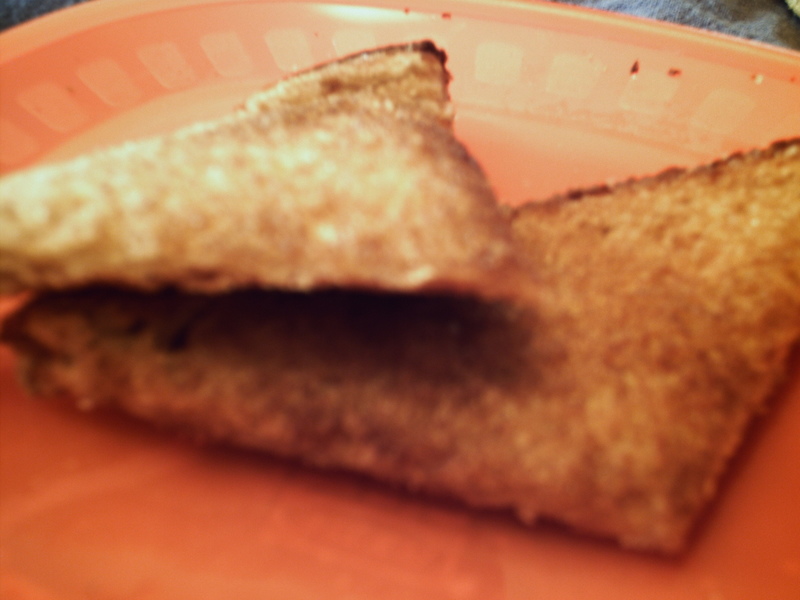
    Cinnamon toast!

    Toast_003 Okay, it’s a little blurry (because Oscar was impatient to eat it and kept poking the plate…)

    But don’t you love my stylin’?  IKEA child’s plastic plate, Target napkin, and all!

    (Do I really have to tell you how I made it?)

    Well, I’ll tell you one thing… that triangle shape isn’t just for looks.


  • She who eats.

    The Scent of Green Bananas today mentioned a foodblog I didn’t know:  She Who Eats.  Go there and check it out.  The food photography is almost as luscious as tsogb’s. Some samples:

    If this keeps up I may have to create a new category in my blogroll.


  • Legal ramifications of overturning Roe.

    An important post at Mirror of Justice:  What would be the aftermath if Roe v. Wade were overturned?

    First, the removal of Roe v. Wade would remove the misguided but nonetheless persistent and widely-accepted argument that nearly-unrestricted access to abortion must be a good thing because it is, after all, a constitutional right….

    Second, and related to the first, after an initial period of confusion and probably heightened public distress (more on this below), the presumptions in the argument about abortion would shift toward those who unselfishly advocate protection of unborn human life….

    Third… the current legislative movements toward protection of human life, even indirectly and imperfectly, would stand on firmer ground without Roe...

    [Fourth], as a jurisprudential black hole that draws in and deforms everything that comes near its wandering path through spacetime, Roe’s gravitational pull has tended to collapse every nearby area of law into a pro-abortion singularity….constitutional jurisprudence in general will move onto a more healthy path once Roe v. Wade is overruled….

    [Fifth], overturning Roe v. Wade would enhance democratic governance, the most fundamental freedom of all. …[because meaningful debate would return to the representative branches of government and to the public sphere, among other things]…

    Supporting arguments for these assertions can be found in the post.  Sisk also has an important warning for us:

    I anticipate that any overturning of Roe v. Wade would be followed explosively by inflammatory rhetoric from “pro-choice” advocates, portraying the result as the death of civil liberties in the United States and the dawn of a moralistic and paternalistic tyranny. Given that support for abortion rights is nearly universal among the cultural elite, especially those who control most of the national news and entertainment media, we should expect a full-throated and extreme reaction that would achieve, for a time, the desired apprehensive response from the general public, with a resultant effect on opinion polling about abortion. During that initial aftermath, a public that understandably is anxious about any significant change in the status quo (that is, a public that is naturally conservative in attitude) would likely be sincerely (if mistakenly) distressed by the judicial removal of a supposed constitutional right.

    We’ve seen that the legalization of same-sex unions as "marriages" has mobilized heterosexual marriage advocates to enshrine male-female marriage in state constitutions. 

    I predict that abortion-access advocates would try to ride the public backlash sentiment that Sisk describes towards a true constitutional enshrinement of the right to abortion — that is, were the specious "right to privacy" struck down, there would be a push for the insertion into the constitution of the words "the right to abortion shall not be infringed."

    UPDATE.  The post I linked to was carefully crafted and well-argued.  This post, on the other hand, relies mainly on sarcasm — reasonably well, I think.  H/t Asymmetrical Information.