bearing blog


bear – ing n 1  the manner in which one comports oneself;  2  the act, power, or time of bringing forth offspring or fruit; 3 a machine part in which another part turns [a journal ~];  pl comprehension of one’s position, environment, or situation;   5  the act of moving while supporting the weight of something [the ~ of the cross].


  • Transcript number 1.

    This week my oldest son, now a homeschooled high school junior, needed an "official high school transcript" for the first time.   

    (He's applying for PSEO programs next year — that's "post-secondary enrollment options," i.e., earning college credit and high school credits simultaneously — and  one local university that's rather selective about its PSEO applicants required it.)

    I knew this was coming, and of course I am going to need it for college applications in the fall anyway, so I have been pulling together materials for a while.  

    + + +

    I feel much more excited and confident about guiding my offspring through the high school years than I ever did about dealing with elementary school or early middle school.    Perhaps it mirrors my own feelings at those ages:  I struggled a lot with fitting in, and with not being able to control my own environment, when I was younger, and don't have many happy memories, but in high school I began to find subjects to delight in (chiefly chemistry and physics, but also French and literature) and what's more significant, people who also liked that sort of thing. It was then that I began to see a light at the end of the tunnel, so to speak.  

    Now that I write that, it doesn't seem a particularly unusual story and so it can't possibly be the sole explanation for why I find a lot of elementary school stuff tiresome and boring compared to some of my colleagues who seem to have an endless, envious capacity for crafts and reading aloud and seeing the world as fresh and new all the time.  Perhaps I am the tiresome one!

    + + +

    The institution whose application we are mailing today, wisely in my opinion, does not wish to see grades issued by a student's parent, so my transcript has no grades.  

    To this I say:  Excellent.  

    Not only is it a pain to calculate and assign grades to your own child, it's stupid.  Why on earth should a university believe what I have to say about my own child in an application for admission to anything?  Presumably the obvious conflict of interest would be enough to say "you know what?  Just:  no.  We're going to go off the test scores and maybe an essay."  And then there's the question of how meaningful grades can be when there are literally no other students in the class to compare this one to. 

    You would think that all the colleges would see the essential worthlessness of grades produced by a homeschooling parent and actively discourage the student from sending any grades issued by a parent.   But I'm here to tell you that, at least as of last fall, several of the colleges which my oldest is thinking of applying for as a freshman not only encourage homeschooled students to submit a transcript with grades, but they require them.  

    I will issue those graded transcripts if I have to, but I really would like to include a disclaimer that says, "You know, I essentially made these grades up.  On a rational basis, of course, me being who I am, but a truly rational basis would mean that you and I should both admit that I could give any grade I wanted to this student. And by the way, so could everybody else who chose to go the non-umbrella-school route."  

    + + +

    So:  this time anyway, no grades.  Don't even send 'em! says the university (good).  But they do want to know what the student's coursework was like, and in particular how challenging it was.  So:  "Home School transcripts should include a narrative of the material a student has covered and a listing of courses they have taken, if appropriate."

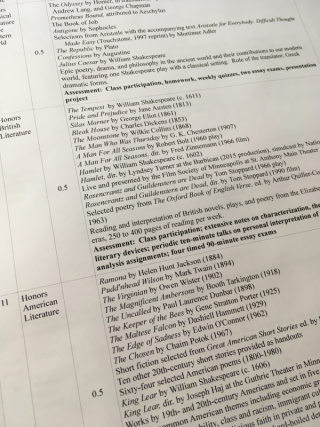
    So I pulled out all my records for the various subjects that my oldest has worked on for ninth, tenth, and eleventh grade, and I made lists of the textbooks we used and the material we covered.  I asked H., who has run pretty much all of my kids' English literature and composition, for a course summary, and she provided me a nicely detailed one.  I wrote up a set of end-goals for each area of study (e.g., in Mathematics, one of my oldest's goals is "advance to differential and integral calculus by early in Grade 11 in order to apply them to the study of Physics I").  And then I sorted it all out first by topic and then grade level.

    + + +

    So, not everyone chooses to do it this way — lots of homeschoolers have a free-form, holistic, or interdisciplinary philosophy of education, where the boundaries of the different areas are soft or nonexistent, and that is fine — but I am naturally a put-it-all-into-boxes sort of person, and so from the very beginning I set up my son's high school years with discrete courses and credits in mind.   There would be a chemistry class, and we'd do these chapters from this book.  There would be a civics class, and we'd have three meetings a week for thirty-four weeks.  There would be a Latin class, and we'll work through this syllabus published by an umbrella school.  Physical education?  Each session of the indoor climbing team is thirty hours of instruction, and at 120 hours = 1 credit (the Carnegie unit), that means 1/4 credit each session.

    When you start off thinking this way, there is definitely a tendency to get boxed into rigid ideas about the boundaries of disciplines.  On the other hand it is pretty straightforward to add up credits at transcript time.

    Another reason I have thought this way from the beginning is because of my co-schooling arrangement.  I set up physics and chemistry for a few high school students to learn in a group, facilitated by me.  Their parents weren't watching me do it (at the time, for example, H. was busy at the moment, teaching language arts to 3 of my other children and 2 of hers).  They trust me but they still need a record of what the students learned; after all, I'm not their "official" teacher; more like a tutor to which they've delegated some of the physics oversight.  So from the very beginning I had a weekly schedule for the whole year, and I kept careful records of what we did and didn't cover.  At the beginning of the year I write a course plan with my objectives; at the end of the year I write a new one where I write how I actually wound up making it all work.  And I do give grades, which is not so hard to do objectively with the kind of coursework I facilitate.  (Whether they are representative or not of what the student would be getting in an institutional school, I don't know.  I hardly ever give anyone an A.  I have a deep suspicion that it would depend on the school.)

    + + + 

     My son and I went to an informational session last week on campus, where you could ask questions of the full-time PSEO advisors and the program admission staff.  I hung back to ask my question at the end while everyone was filing out — "What exactly are you looking for in a homeschooler's 'narrative transcript?'"

    The staffer explained that the point was so that they could understand the scope of the material the student had covered in his classes, and in particular, whether he demonstrated the ability to do college-level work; it is very important to them that the PSEO students do not overextend themselves.

    "So," I suggested, "you would want to see a list of the texts he read in his English classes, that sort of thing?"

    "Oh my goodness, no, you would not need to go into that level of detail!" he chuckled.  

    I looked at him levelly for a moment.  "Supposing I did go into that level of detail…" I said carefully, "would that be a problem?  I mean, would you all hate me if I sent you, er, a rather detailed transcript?"

    He assured me that this would not be a problem either, and I went away hoping that if the transcript was an outlier, that it would not at least be the sort of outlier that the office would laugh at.  Because I wasn't about to delete all that stuff I'd written (although I did cut it down).

    + + +

    One of the things that feels weird about writing out the transcript is that it feels like my son should be writing it.   I rather don't like stories of helicopter parents (and I have enough friends who are college professors that I have heard such stories).   I have a great distaste for filling out parts of applications for my student.  He should do the application himself!  You don't want your parent filling out an application for you, not for anything.

    But:  Transcripts are never made by students for themselves.  They are made by institutions for students.  They are sealed in smooth blank envelopes to be transmitted cleanly and with no signs of tampering from one institution to another.  

     I am not the student's educational institution.  I am a mother, the original alma mater.   This identity feels positively warm and sticky compared to the cool, blank, efficiency of the transcript.  And so there is no way I can produce this document and be wholly comfortable with it.  I know the institution is used to a column of numbers, and that from me the column of numbers is no good, so instead they get a document which I can't help but see as smudged all over with maternity.  And that is something that I have never been comfortable with sending out into the world.  I feel I want to run after the transcript with a corner of my skirt and dab it off, except that to do so would give away the truth.

    But still, he can't do this part.  I have to do this part, because I am the school.  So I write the damned thing anyway.

     + + +

    Deep breath.  I open up the transcript file again and read my own deathless prose from the introduction to the Science section.  I want it to be as much like a column of numbers as a narrative description can be:

    The student chose to fulfill the biological sciences requirement with a non-laboratory course in evolutionary biology. Introductory college textbooks on evolutionary biology are supplemented with additional textbooks, videos, and assorted readings covering necessary fundamentals of biology and touching on the historical context and social impact of evolutionary theory.

    Physical sciences are taught directly by the parent, who holds a PhD in chemical engineering, in a small group of high school students. Because texts are college-level and syllabi are modeled after AP courses, we have designated these as honors courses.

    I am second-guessing myself already (why did I mention the doctorate?  does it make me sound like the sort of person who insists on being called Doctor all the time?  does it make me sound insecure?  will they look up my thesis?  oh no) but at least I am sure have properly formatted the registered trademark symbol.  

    + + +

    Here's the thing.  It's … not about me.  There is a temptation to look over it and think that it is, at least a little bit, about me, or at least about me-and-this-kid's-wonderful-dad.  It's not about me.  It's about our son, this particular young man, this bright and earnest and funny young man, and about demonstrating that we all have good reason to expect he won't fall on his face when he takes his first college classes.

    + + +

    In any case, it's done.  They certainly will have an idea of the applicant's coursework.    Probably several ideas.   I'm glad I had a chance to do this, my first one, under relatively low stakes.   I might be less detailed next time.

    As I have five children, however, I must say that I am already wondering if high school transcripts, like baby-picture albums, get progressively less detailed as one moves through the younger children in the family.  You know the trope:  your first child has a beautifully kept scrapbook, your third has a stack of photos in a manila envelope, and — did you even take any pictures of that fifth child?

    I would bet there was a correlation.  

    (Except that I never managed to make any baby albums.)

    IMG_2293


  • The choice to be civil. (3 and 4)

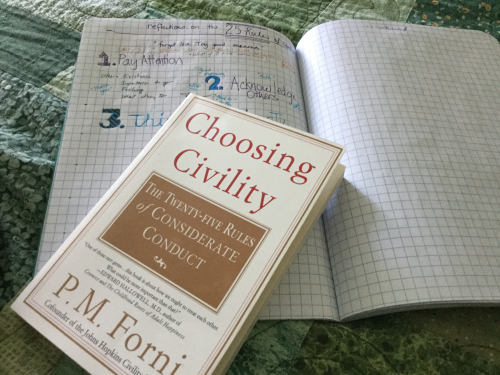
    I wrote about P. M. Forni's book Choosing Civility about a month ago, and I have been meaning to come back to it. In that post I introduced the book:

    The first part of the book is a brief reflection on the importance of civility in human relationships both brief and lasting; the middle of the book is the "twenty-five rules of considerate conduct" mentioned in the title; and the last bit appears to be a few meditations on rudeness. The chapters are quite short, almost meditations; each rule is discussed over maybe six pages.

    Then I blogged a little bit about the first two rules, "Pay Attention" and "Acknowledge Others."

    Today I am going to continue with the next two rules (three if I have time). They are

    • (3) Think the best
    • (4) Listen
    • (5) Be inclusive.

    A little foreshadowing: If you are the sort who is already getting riled up with snark in anticipation that number (5) is going to be about diversity, tolerance, gender-neutral language, and multiculturalism, don't have a heart attack. It is much simpler than that. And while you are at it, consider numbers (3) and (4).

    Ahem. Let's go on.

     + + +

    Rule 3 is Think the Best.

    Think the best of your fellow humans and act accordingly…. Thinking the best of others is a decent thing to do and a way of keeping a source of healthful innocence in our lives…. In my role as a teacher, my drive and enthusiasm in the classroom owe much to my assumption that all of my students are essentially good human beings, interested in the pursuit of knowledge, and willing to work hard. Believing that they are good, I want to be good for them…

    Even outside the classroom I expect that everyone I meet will turn out to be good rather than bad… What I find exciting in a new acquaintance is the thought: Maybe I'm making a discovery here; maybe someone is entering my life who is nice. …Of course I am aware that not all those I meet can be paragons of goodness. Still, my bet with myself is that they will be nice to me. I think of my goodwill as an unspoken challenge to them…

    I like the notion, for those who are unused to giving strangers and interlocutors the benefit of the doubt, of a "bet" with oneself, an "unspoken challenge" to the stranger. It seems to harness — and make benign — the energy of a habit of confrontation.

    I do not find it too difficult to keep an attitude of good will and expectation of reasonableness towards, for example, political opponents I encounter on the Internet and strangers I encounter on the street (well, except for the occasional apparently-reckless driver — that always takes me a moment of recollection, and did just now as I had to go back and add the "apparently"). I think this is because of a political belief of my own: I count it essential to the functioning of a polity of diverse people — essential that we assume good will in our opponents, that we all seek ends that are apparent goods, and that we can appreciate that common striving even as we argue about the rightness and efficacy of various means. I am committed to a sort of political ecumenism, and like all ecumenisms it is impossible without an assumption of good will and reasonableness.

    As a parent/teacher it can sometimes be really difficult in the moment. A child misbehaves, or doesn't follow directions, and (especially after some repetition) it can be really easy to jump straight to "This kid is just trying to spite me." And that is not a good thing to jump to. Not that deliberate disobedience doesn't happen ever, but that if you think for ten minutes about it, kids don't have "disappoint and anger my parents and teachers" as an end. Much more likely they hope to get away with whatever they are trying to do without the inconvenience of facing our disappointment and anger! And often not even that. They want a thing and they go about what seems to them a direct way of getting it. And they don't see with the same eyes that we do.

    Similarly, and this is something I have to work really, really hard to remember: The child is not making that awful noise — the one that drives me up the wall — because he wants to drive me up the wall. The simplest and kindest set of answers to why he has not stopped making the noise is that he doesn't realize he is doing it, doesn't realize I can hear it, or doesn't realize that it is making me crazy. And how hard is it just to ask, "Please, would you stop making that noise, at least here where I can hear it?"

    + + +

    Rule 4 is Listen.

    What prevents us from doing a good job of listening is that instead of focusing on other people, we focus on ourselves and our own needs. This is what we do, for instance, when we interrupt. We just can't sit still—and silent—as someone else speaks, for we feel the urge to seize the limelight for ourselves. Thus we will rudely push others offstage…

    Sudden redirections of attention are interruptions as well. Although your interlocutor has completed his or her sentence, this gives you no license to leave it unacknowledged as you rush to utter one of your own. Unfortunately "disregard and proceed" is one of the most common patterns in verbal exchanges, even among friends…[and] very common in the workplace, especially among competitive people.

    Ouch. This one hits home. I mean, especially the calling-out of interruptions and disregard-and-proceed as refusals to listen and therefore violations of civility. I have always known myself to be prone to these, but I have often excused myself as being (1) socially awkward (2) impenetrable to socialization in accord with conventionally "feminine" conversational behavior (3) totally unable to prevent my reactions from being readable on my face if I keep my mouth shut.

    All of these are true and maybe explain a lot about me, but none of them are excuses for not trying. I mean, just to take the middle example, interrupting and redirecting attention to oneself may be rewarded more often when males do it and punished more often when females do it, but it's uncivil regardless.

    Forni very usefully gives three basic components of good listening, which makes it sound almost like a skill that I could intentionally develop:

    • Plan your listening. "Make the conscious effort of making listening your goal… Silence is, of course, your tool of choice… Rediscover the power and allure of [your] silence… Eliminate sources of distraction."
    • Show that you are listening. "Establish eye contact" [I would add "if you can" — I find keeping eye contact to be rather difficult and I know many others have it worse than I do]…nod…interject brief expressions…restate briefly what [you] have heard."
    • Be a cooperative listener. Forni suggests not rushing to agree or to disagree, but to try to understand, to invite the speaker to focus, to "separate what is important from what is not", and to ask open-ended questions — not with the goal to satisfy your own curiosity [ouch again], but to help the speaker "achieve a higher level of clarity."
    • "Although you may be forming your opinions on what is being said, voice them only if you have a clear sense that that is what your interlocutor expects…and if you are comfortable doing so. The same rule applies to giving advice."

    I have certainly been guilty of the assumption that people would not tell me about their problems if they didn't expect me to try to solve them. These components of good listening will serve me well, I think, if I can keep them in mind.

    + + +

    Rule 5 is Be inclusive.

    Part of our identity is shaped by and within groups; within our groups we find shelter, meaning, and direction. Thus attitudes and words that exclude rather than include are rarely funny. In most cases they hurt.

    Shouldn't we be allowed to draw boundaries as we go through our everyday lives? Of course we should… become good at defining and protecting our own spaces. But we should be careful never to engage in self-serving, unfair, and mean-spirited strategies of exclusion.

    Being inclusive means applying the principle of respect for all persons TO all persons. When it comes time to show respect and consideration to others, we do not pick and choose. Selectively conferred respect is a commonly used weapon in the power games played by men and women of all ages.

    I emphasize the last bit in order to show how very simple this rule to "be inclusive" means. In order to be merely civil, inclusivity does not have to get bogged down in certain details. It simply means that everyone gets respect and consideration because they are persons, and for no other reason at all.

    There is a certain sort of man who never holds the door open for a woman, insisting it is because he can never tell whether a woman will be pleased or offended, and since you cannot win, then why try? Unfortunately, the end result is often either that the man in question holds the door open for nobody at all (signifying general thoughtlessness), or that he holds the door for women only while verbalizing his discontent with the situation (signifying quite clearly that he thinks of said woman as not just an "other," but an especially unpredictable and unreasonable sort of other), or makes a point of not holding it for women (the same, and also letting the door slam in someone's face).

    Me? I'm for holding the door for anyone whose hands are full, who has difficulty opening the door, or who is following closely behind you as you reach the door. But I'm also for assuming good will in the person who has held the door for me (see Rule 3).

    There are at present differing philosophies regarding whether we ought to show equal respect to all persons, or whether we ought to show extra respect to certain persons who merit them by birth or by action, or whether we ought to show respect for certain offices through acts that pay visible obsequies to the persons holding them. Some of us may hold our particular philosophy with a strong conviction that the others are not just wrong but harmful and should be argued against. Others of us may hold our own philosophy of respect-of-persons with a strong conviction of live-and-let-live.

    I would just like to suggest that, should you be of the former persuasion, the time for arguing against it is not while someone is holding the door.

    And that, even if special respect is not due a particular person, no person is exempt from respect and consideration.

    The whole book, of course, argues this in general: respect and consider others. The "be inclusive" rule is just there to remind us that humans often do decline to do so on basis of group membership in particular. So: don't do that.

    See? Simple.


  • Where to find your cross: A repost for Lent.

    I wrote this about four years ago, just before the start of Lent.  

    + + +

    All this spring I've been coming back again and again to this passage from The Imitation of Christ (Book 2, Chapter 12, "On the Royal Road of the Cross").   

    What I like about it is that it answers a question I have often had:  But my life is actually pretty good; so many people are suffering so much more than I am; what does it mean to carry my cross when things are going so well for me?

     There is no other way to life and to true inward peace than the way of the holy cross and daily mortification. Go where you will, seek what you will, you will not find a higher way, nor a less exalted but safer way, than the way of the holy cross.

    Arrange and order everything to suit your will and judgment, and still you will find that some suffering must always be borne, willingly or unwillingly, and thus you will always find the cross.

    • Either you will experience bodily pain
    • or you will undergo tribulation of spirit in your soul.
    • At times you will be forsaken by God,
    • at times troubled by those about you
    • and, what is worse, you will often grow weary of yourself.

    You cannot escape, you cannot be relieved by any remedy or comfort but must bear with it as long as God wills.

    I think this passage kind of functions very similarly to the famous passage from First Corinthians about love ("Love is patient, love is kind…") which we heard in the readings last Sunday.  It's a description that can be thought of as a definition.

    Just as "Love is patient, love is kind" can be thought of as implying a definition of love ("Love is that which is patient, love is that which is kind, etc.") or as setting the boundaries of love ("What isn't patient, can't be loving.  What isn't kind, can't be loving, etc.") — so this can be a sort of description of the cross.

    Whatever suffering must be borne is the cross.

    Even if it's very small.

    The small crosses can be the hardest to bear correctly, because we can brush them off so easily without thinking… and when we do, they — since they must be borne – land on someone else.  

    Because I was grumbling about some little inconvenience, I've snapped at some poor cashier and ruined her day.   Because I'd failed to plan ahead, I've dragged cranky, tired, hungry preschoolers to the grocery store.  Because I was feeling too tired to cheerfully do the dishes, I've sneaked upstairs and left them for my spouse.

    Somebody had to bear a cross here, and in each case it wasn't me.

    If we imagine that we don't have any "real" crosses, and wonder why we've been so lucky as to do without them — disabilities, bereavements, chronic pains — we can fail to take up the cross we've been sent.

    Does your body feel bad or painful in any way, or are you sick or injured?  If you can't make the suffering go away entirely, that can be the cross — whether you know why you're sick, or whether you don't.

    Is there any kind of "tribulation of spirit in your soul" — any sort of interior turbulence, depression, grouchiness, fear, or any other discomfort, whether from an identifiable cause or whether it seems to come from nowhere?  If you can't quite shake it even after reasonable effort — trying to gain perspective, count your blessings, cheer yourself up, take your meds — that can be the cross.

    Do you lack spiritual consolation?  Does your prayer seem to do nothing?  Does your meditation yield no fruits?  That, too, can be the cross.

    Do your kids drive you crazy?  Do your parents bug you?  Does your spouse annoy you?  Is your co-worker chewing his gum too loudly in the next cubicle?  Is anybody anywhere getting on your nerves?   That, too, can be the cross.

    Finally, don't you get on your own nerves sometimes?  Don't you ever say to yourself, "Self, you're an idiot?"

     (This is, in my opinion, the single wisest point in the whole Imitation.  Go read No Exit again:  Sartre didn't get it completely right.  It should have been "Hell is other people.  And yourself too.") 

    If it must be borne by somebody, it's the Cross.

    The cross, therefore, 

    • is always ready; 
    • it awaits you everywhere. 
    • No matter where you may go, you cannot escape it, for wherever you go you take yourself with you and shall always find yourself. 
    • Turn where you will–above, below, without, or within–you will find a cross in everything, 
    • and everywhere you must have patience 

    if you would have peace within and merit an eternal crown.

    It's probably a good idea to look out for these things.

    If you carry the cross willingly, it will carry and lead you to the desired goal where indeed there shall be no more suffering, but here there shall be. If you carry it unwillingly, you create a burden for yourself and increase the load, though still you have to bear it. If you cast away one cross, you will find another and perhaps a heavier one. 

    It's also possible to choose voluntary crosses, which is part of the point of Lent:  to practice, so that we may better carry the involuntary ones.  

    Something to think about as we plan for the next few weeks.


  • The choice to be civil. (1 and 2)

    Lately I have been dissatisfied with the quality of my interactions with one of my children: lots of frustration from me, lots of upset from the child. I talked it over with Mark and he suggested I try a little focused reading, since that’s often my first step when I have a problem to solve.

    And so on my Saturday morning I wandered into a brick-and-mortar bookstore so I could browse the shelves. Even though the selecton in such a store is more limited than online, I often find it much more satisfying to pick up books and page through them, dipping in here and there with the instant responsiveness that paper still has over web pages in spades, hefting the books to see if they will fit in my bag, comparing tables of contents side by side.

    I chose a couple of books on the specific topic I was after, but while I was hunting around found myself drawn to a slim little book somewhere in the Psychology And Relationships section. On a whim, I unslotted it from its place and took it home.

    From the author description on the back:

    Dr. P. M. Forni teaches Italian literature and civility at Johns Hopkins University…. A native of Italy, he lives with his wife in Baltimore, Maryland.

    “Italian literature and civility?” Don’t you want to know more? I did. I think that’s what drew me in. The first part of the book is a brief reflection on the importance of civility in human relationships both brief and lasting; the middle of the book is the “twenty-five rules of considerate conduct” mentioned in the title; and the last bit appears to be a few meditations on rudeness. The chapters are quite short, almost meditations; each rule is discussed over maybe six pages.

    What follows is not so much a book review as an invitation to think about civility and the “twenty-five rules” Forni proposes, and meditates upon, in his little book.

    + + +

    I’m not sure whether the average reader would find the book to be especially profound or insightful. I think most of us know already a great deal of what’s presented in here. Reading through the list of rules in the table of contents, I certainly don’t disagree with the inclusions — although one could debate whether to expand or contract this “top 25” list, or whether to swap in different rules.

    I think what appealed to me most was the idea that I might pick it up and read just one chapter every day or two, and then — being reminded rather simply of something I already knew, rather than being motivated by any special profundity — strive harder than I had been to live by its rule. Maybe some of it would stick. I also liked the universality of the approach: it appears to be meant for everyone, a sort of distillation of “getting along peacefully with others” wisdom. Different people may have different philosophies that underlie their notions of why we might want to be kind and considerate to others; this book is mainly about “how.”

    The author quotes a novel I read long ago: “Forget love. Try good manners.” It is a flippant line from one character to another, but it does underline the point that good manners can be the first step to forming a heart of love, or — if one is paralyzed by the theory of love — the first act that makes the idea a visible reality.

    + + +

    And so for the past few days I have been turning over in my mind Forni’s first and second rules. And trying to practice them — for want of many other people to practice on — with the children, at home.

    Rule 1 is Pay Attention.

    [A]ttention is a tension connecting us to the world around us. Only after we notice the world can we begin to care for it. Every act of kindness is, first of all, an act of attention. We may see a coworker in need of a word of encouragement, but it is only if we pay attention that we may do something about it. We may hear a child cry, but again, our help is contingent upon our stopping and taking notice….

    I am not just talking with a colleague but with this colleague… I am not just critiquing the work of a student. I am speaking to this individual student…

    …When we pay attention we do justice to the presence of others in our lives… Through it we confer value upon the lives of others. When I show you that you are worthy of attention, I am acknowledging and honoring your worth.

    I immediately thought of how important it is to give full attention to children talking to us, how easy it is to answer their questions without ever turning a face toward them. I do that a lot, and I thought it would be a small thing to keep in mind and try to work on.

    I considered, too, how I signify attention in other ways. Some years ago, frustrated by how often I got distracted during the homily in Mass, I tried a trick to activate the attention-paying parts of my brain: I started taking notes, at least when the child-minding situation allowed for it.

    Mind you, I never ever looked at the notes I took a second time. I already was in the habit of keeping a throwaway notebook and a pencil in my bag, the sort of thing you keep in case you have to write down a phone number or something. I didn’t buy a special journal just for reflections on the homily. I didn’t even make reflections on the homily; I just took notes as if there would be a test on the material. I spent a lot of years taking notes in my previous life, you know. It was back before everyone had their laptop open in college classrooms (and I am still an old-fashioned believer in paper-and-pen notetaking, at least until tablets become responsive enough to register the fine pressure differences that signal faint variations in emphasis from an interested scribe). I found that the act of taking notes made me pay attention, as I worked to distill the main points and use the space on the page to put them in relation to each other. I don’t know that I remembered more afterwards — but I was more present in the moment.

    (I don’t know if I looked more present to others, but they should have been minding their own business.)

    Anyway, thinking about that, I decided to take the notebook with me the next time I sat down with my temporarily frustrating, frustrated child for the lessons we were finding so hard. As we talked about the material and I heard back, I took notes — just a few — not a lot — I didn’t want to give the impression I was psychoanalyzing, just that I was paying attention. I watched closely, eye to eye, and memorized which parts were hard so that I could jot it down there in our session.

    It is too early to tell if it will make a big difference, but it feels like a way that might help me to remain focused. Above all to remember that one of my goals in every lesson is not just “get through this lesson,” “convey facts and teach skills,” but also — connect. Connecting is not something that comes naturally to me, not connecting to people. Perhaps it seems a little weird but I will have to try it — connect the way I know how to connect in my bones, pretend that people are information — it isn’t untrue if it is a bit reductive — and that might well be better than nothing, maybe my best, and turning our best face to someone in honesty is perhaps all we’re asked to do.

    + + +

    Rule 2 is Acknowledge others.

    Acknowledge others’ existence, their importance to you, their feelings, and the things they do for you…

    A greeting is a minimal yet meaningful conferral of honor on a person for just being a person. With it, not only do we acknowledge and validate, but we also put at ease and wish well. We announce that we intend no harm and express our concern for the well-being of others. As we do so, we invite others to look upon us with the same benign disposition we have toward them. This is the stuff civility is made of.

    And yet we often play the game of invisibility. We see someone we know coming our way, but instead of saying hello or even just nodding our acknowledgment, we proceed as if that someone weren’t there…

    We can’t feel gregarious every moment of our lives. At times we will be… protective of our space and mind. And that’s all right. Sometimes we need that… We can, however, do without the invisibility game.

    I was relieved to read Forni’s acknowledgment (hm) that we need, sometimes, to protect ourselves from too much outreach. But I think he’s right that — at least when we are not dealing with people known to violate boundaries aggressively and take every acknowledgment as an invitation — we don’t, probably, have to preemptively protect ourselves from merely acknowledging people, even when we’re already feeling extended.

    As for applying this one to my own interactions, it’s back to the very beginning, where Forni lists the four aspects of persons to acknowledge:

    • their existence
    • their importance to me
    • their feelings
    • the things they do for me.

    Greetings; expressions that say “I value you;” some room for difficult or exuberant inner states; and gratitude. I could do with putting those out there more often than I do. This next few days I am going to try.


  • Planning again, and the problem of the lonely 7yo.

    Something about February makes me hate everything about my schedule. And that is why I am already thinking about next year.


    Instead of making a spreadsheet right away, I got myself a fancy quad-ruled notebook and set up a little chart in it, with colored pens and rulers, for no particular reason. I wanted to see which kids — including both mine and H’s — were going to be in which grade in which years.

    Fun fact: In 2020-2021, between us, we will have four high schoolers: one freshman, one sophomore, one junior, and one senior.

    I was thinking I’ll teach civics again that year, because I can teach them all at once. (Physics I also.)

    And I just now realized that will be the next election year.

    I hope I am in a better mood about U. S. politics by then.

    + + +

    I love co-schooling with H’s family. It solves a lot of my problems. I am, however, having trouble seeing how to solve the problem of my lonely 7-year-old.

    It is not his fault. It is just that, unlike any of the other nine children in our two families, he doesn’t have a cohort. There is no primary-school-aged child in H’s family: no one between the current 6th-grader and the three-year-old twins. And in my own family, there’s a four-year gap on either side of him. Meaning that not only is he basically alone in elementary school, but he will spend his four years as the only high school student.

    I realize that for many homeschooling parents this sounds like a dream — just one high school kid to teach for four whole years! — but I am used to a very group-centered experience, and it sounds lonely to me. Especially since the kid in question is absolutely the most outgoing and gregarious kid of them all.

    + + +

    It’s a long time before I really have to worry about exactly what I will do — he is now a first-grader — so I guess I will think about it later, only making a mental note to remain open to new and different possibilities for him. I’ll be about fifty years old when he starts high school, which seems somehow farther away than “this child of mine will be fifteen,” and I imagine many things will be different then. Already things are very different from how I imagined they might be, and I am different from what I imagined, eight years ago, when I was thirty-four.

    + + +

    I think we will be juggling the order of some things around, because of the different grades our kids will be in. For a long time the school-age kids have been divided, mainly, into the “olders” and the “youngers.” Our oldests are in the same grade, and so they have tracked along together. Our “youngers” are four fence posts, now in 5th-6th-7th-8th grade. The youngers took geography together, all are at the same level in middle school Latin, and (although for various reasons they use two different curricula) are going to converge in history eventually.

    Next year we expect the two oldest high schoolers to spend at least some time taking college classes through PSEO, but I am hoping we can still make time for me to teach them Physics II and Latin IV.

    I will start with proof-based geometry with the older of the youngers, the two boys who will be in eighth and ninth grade. They’ll do both geometry and Algebra II at half pace for two years.

    I will continue doing about a half-credit’s worth of Latin with all four of those middle kids — they’ll be in 6th through 9th grade — and the 9th grader will do some extra work, either more Latin stuff or something else, but not with me, to make the other half of that language credit. (I thought about it, but I am not up for doing two full credits’ worth of Latin two days a week at two different levels. That would be three hours of oral Latin in a day, yo. My voice can hardly take it as it is.)

    And then I am going to try like mad to bring my new second-grader into the world history class with the 6th and 7th grade girls. Even though they don’t really need the personalized attention, we do that work as a read-aloud because it’s fun and it lets us discuss the material; so he probably will be able to keep up, and might even be able to do the workbook if his sister helps him. (My eighth grader will keep on keeping on with the third year of the fairly independent history study.)

    + + +

    Right now I am thinking about prioritizing, on our home days, having that seven-year-old work together with his older sister, even though she will be in sixth grade. I think I might choose a science lab kit that is aimed at lower elementary — she is coming off of two years of a fairly rigorous science lab, with notebook and everything, and maybe she would enjoy having a little break and doing something that would be more “fun exploration with your younger sibling” and less “arguing about turn-taking and trying to keep up with your older sibling.” I am thinking about throwing them together for art, religion, and readalouds, and letting her two-years-older brother — whom she has been working with, and generating friction with, for years now — have a little bit more distance from her.

    All along I am guided by my philosophy that we are part of a family that learns together first, that it’s balancing the needs of the family as a whole that has to happen from year to year, and that each individual has to give sometimes and take some times. I literally cannot optimize each individual child’s education — not overall and not in any one year. I can try to meet many goals for each child in a way that is adequate for all, and in which our whole family can — one way or another — thrive.

    There are surprises around every corner, too. Best make room for them when they come.


  • St. John Bosco and how to *not* punish kids (a repost).

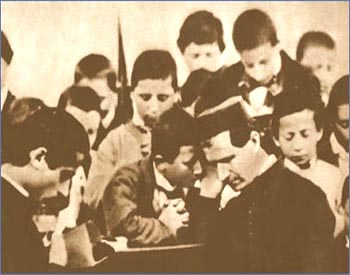
    St. John Bosco, like St. "Mother" Teresa or St. "Padre" Pio, is one of those whose names started to sound a little weird when their popular monikers got altered by the application of sainthood.  He's often "Don" Bosco even though his name is John-actually-Saint-John-now, "Don" being the honorific applied typically to diocesan priests in Italy.  I think this is because he, like they, like some others — Thérèse comes to mind too — is one of those saints that once you know them, you just sort of make friends with.  The "saint" can feel a little embarrassing between friends.  Or because a straightforward humility, a groundedness, is so much a part of their persona that they succeed in never feeling… I don't know, lofty.  

    Here's a repost about Don Bosco for his feast day, Jan. 31.  In which I write about why I take him as my personal role model in his approach to child discipline.
    165_Bosco_hearConfession

    + + +

    My personal parenting/discipline ideal has always been to avoid punishing kids.

    I get the impression from other people that the idea alarms them, because it sounds a lot like "avoiding discipline;" perhaps it calls to mind the stories of parents who insist their offspring can do no wrong.  You know, the kind who sue the school when their child is suspended for cheating on a test or something like that.

    That's not my point.  By punishment, I mean those arbitrary unpleasantnesses inflicted in return for misbehavior:  the spanking, the grounding, the confiscation. Mrk and I aren't what you'd call permissive parents.  We try to be authoritative, if not authoritarian.  We use the term "obedience" with the kids and are clear about what it means and why it's important.   But (this is our ideal, mind you, not always the way we manage to make it work) we try not to get to the point where we need a "punishment" in the first place.  

    We try to let them experience the consequences of their actions, insofar as it isn't dangerous.  

    • Didn't pack an extra dress like you were supposed to?  Well, I guess you'll be wet and uncomfortable now that you've run through your friend's sprinkler in your clothes.  
    • Refused to eat your lunch at lunchtime?  Ooooops, snack time isn't till 3:30, I guess you can have some of these plain almonds I keep in the car for emergencies.
    • Shrieked at each other in the car while we were running errands?  After all that, I (honestly) don't feel anymore like taking you out for lunch, so instead we're going home and having tuna sandwiches.

    On the occasion when something truly egregious happens — such as when one of my kids came to me and admitted that a long string of perfect scores on math assignments had been faked — consequences are meted out rather than merely allowed to happen; but we really try to have it make sense.  In the case of the spurious perfect scores, since I had no way to know whether the child understood the material, the child was assigned double math lessons for as many days as the lessons had been faked, each day doing the regularly scheduled lesson and at the same time re-doing one of the lessons from before.  That plus a long conversation about honesty.  And dangerous misuse of a tool around here is very likely to result in revocation of privileges to use said tool until competency and proper respect for risk is demonstrated; that's just common sense, not a punishment.  

    It was difficult for us to figure out when our first was very young, but we hit our stride eventually, and he grew out of the normal frustrations of toddlerhood into an earnest child and now a delightful teenager, and that has given us a lot of confidence as we continue to bring him up, him and the four that have followed.  It's true that I yell more than I wish I did, and lose my temper.  It's an ideal I fail to measure up to.  But I still strive for that "no-punishment" ideal.

    + + + 

    I notice, however, that this isn't language I tend to hear from my fellow Catholic parents much.  Indeed, at more than one parish I've seethed while listening to a priest (including in the homily at my daughter's baptism) cheerfully recommend vigorously and frequently spanking small children.  

    I think this is an American Catholic phenomenon, borne of being caught between a decadent permissive culture and an army of evangelical Protestants — in many ways, serious American Catholics are constantly playing "keeping up with the Bob Joneses," and so, for better or for worse, we have been inculturated with what I personally see as a break-the-child's-sinful-will, thou-shalt-honor-us-because-of-the-ten-commandments sort of  attitude toward child discipline.  

    The exceptions are the super-crunchy attachment parenting Catholics.  Am I one of those?  Sort of; as a young parent, AP wasn't good enough for me and if you were foolish enough to ask me about it I would talk your ear off about how I was into "CC" parenting, which stands for "continuum concept," which, well, some other time….    

    I did have plenty of role models for the way that I felt was right for me to parent my kids, but I lacked Catholic ones.   And that's why I was so excited when I first learned about the educational philosophy of St. John Bosco.  AKA "Don" Bosco (1815-1888) because that's what you call a diocesan priest in Italy.   Here's Wikipedia on him, for some background:

    At that time the city of Turin had a population of 117,000 inhabitants. It reflected the effects of industrialization and urbanization: numerous poor families lived in the slums of the city, having come from the countryside in search of a better life. In visiting the prisons Don Bosco was disturbed to see so many boys from 12 to 18 years of age. He was determined to find a means to prevent them ending up here. Because of population growth and migration to the city, Bosco found the traditional methods of parish ministry inefficient. He decided it was necessary to try another form of apostolate, and he began to meet the boys where they worked and gathered in shops, offices, market places. They were pavers, stone-cutters, masons, plasterers who came from far away places, he recalled in his brief Memoirs.

    The Oratorio was not simply a charitable institution, and its activities were not limited to Sundays. For Don Bosco it became his permanent occupation. He looked for jobs for the unemployed. Some of the boys did not have sleeping quarters and slept under bridges or in bleak public dormitories. Twice he tried to provide lodgings in his house. The first time they stole the blankets; the second they emptied the hay-loft. He did not give up. In May 1847, he gave shelter to a young boy from Valesia, in one of the three rooms he was renting in the slums of Valdocco, where he was living with his mother. He and "Mamma Margherita" began taking in orphans. The boys sheltered by Don Bosco numbered 36 in 1852, 115 in 1854, 470 in 1860 and 600 in 1861, 800 being the maximum some time later….

    In 1859, Bosco selected the experienced priest Vittorio Alasonatti, 15 seminarians and one high school boy and formed them into the "Society of St. Francis de Sales." This was the nucleus of the Salesians, the religious order that would carry on his work….In 1871, he founded a group of religious sisters to do for girls what the Salesians were doing for boys. They were called the "Daughters of Mary Help of Christians." In 1874, he founded yet another group, the "Salesian Cooperators." These were mostly lay people who would work for young people like the Daughters and the Salesians, but would not join a religious order.

    Bosco's capability to attract numerous boys and adult helpers was connected to his "Preventive System of Education."

    Don Bosco explained his "preventive system" in an essay, "The Preventive System in the Education of the Young," which can be found here.  It begins by contrasting his "preventive" system with the "repressive" system.  The "repressive" system, he says, has its place "in the army and in general among adults and the judicious, who ought of themselves to know and remember what the law and its regulations demand."  

    The repressive system consists in making the law known to the subjects and afterwards watching to discover the transgressors of these laws, and inflicting, when necessary, the punishment deserved.

    According to this system, the words and looks of the superior must always be severe and even threatening, and he must avoid all familiarity with his dependents.   

    In order to give weight to his authority the Rector must rarely be found among his subjects and as a rule only when it is a question of punishing or threatening.  

    But Don Bosco's system is different:

    [The preventive system] consists in making the laws and regulations of an institute known, and then watching carefully so that the pupils may at all times be under the vigilant eye of the rector or the assistants, who like loving fathers can converse with them, take the lead in every movement and in a kindly way give advice and correction;  in other words, this system places the pupils in the impossibility of committing faults.

    This system is based entirely on reason and religion, and above all on kindness; therefore it excludes all violent punishment, and tries to do without even the slightest chastisement. 

    "Excludes all violent punishment, and tries to do without even the slightest chastisement" being what I was going for all along, I was so glad to find this.  

    The basic idea is that children are closely supervised at all times by leaders who care for them, model good behavior, encourage reception of the sacraments, participate in their games, and converse with them frequently about behavior norms in a way that "appeals to [their] reason" and "generally enlists [their] accord."  Close supervision and "forewarning" means that there is little chance for a child to commit a fault. Don Bosco believes that young people misbehave, initially at least, because of inattention, not malice:

    The primary reason for this system is the thoughtlessness of the young, who in one moment forget the rules of discipline and the penalties for their infringement.  Consequently, a child often becomes culpable and deserving of punishment, which he had not even thought about, and which he had quite forgotten when heedlessly committing the fault which he would certainly have avoided, had a friendly voice warned him.

    To apply this system Don Bosco lists several principles of education and discipline.

    1.  Close supervision by the people entrusted with the children.  "[The Rector] must always be with his pupils whenever they are not engaged in some occupation, unless they are already being properly supervised by others."

    2. Moral teachers who actively lead the pupils to and in each new place or activity. "Teachers, craftmasters, and assistants must be of acknowledged morality… As far as possible the assistants ought to precede the boys to the place where they assemble; they should remain with them until others come to take their place, and never leave the pupils unoccupied."

    3.  Allow rowdiness and physical activity.  "Let the boys have full liberty to jump, run, and make as much noise as they please.  Gymnastics, music, theatricals, and outings are most efficacious means of obtaining discipline and of benefiting spiritual and bodily health.  Let care be taken however that the games… are not reprehensible.  'Do anything you like,' the great friend of youth, St. Philip [Neri] used to say, 'as long as you do not sin.'"

    4.  Encourage and promote, don't force, the sacraments.  "Frequent confession and communion and daily mass are the pillars which must support the edifice of education, from which we propose to banish the use of threats and the cane.  Never force the boys to frequent the sacraments, but encourage them to do so, and give them every opportunity…. [L]et the beauty, grandeur, and holiness of the Catholic religion be dwelt on…"

    "Avoid as a plague the opinion that the first communion should be deferred to a late age… When a child can distinguish between Bread and bread, and shows sufficient knowledge, give no further thought to his age… St. Philip Neri counseled weekly and even more frequent communion."

    5.  Exclude bad materials and trouble-making people.  "[P]revent bad books, bad companions, or persons who indulge in improper conversations from entering the college.  A good door keeper is a treasure for a house of education."

    6.  Brief daily reflections — a sort of community examen.  "Every evening after night prayers before the boys go to rest, the Rector or someone in his stead shall address them briefly, giving them advice or counsel concerning what is to be done or… avoided.  Let him try to draw some moral reflection from events that have happened during the day… but his words should never take more than two or three minutes."

    7.  Love before fear.   "An educator should seek to win the love of his pupils if he wishes to inspire fear in them.  When he succeeds in doing this, the withholding of some token of kindness is a punishment which stimulates emulation, gives courage, and never degrades…. With the young, punishment is whatever is meant as a punishment…. in the case of some boys a reproachful look is more effective than a slap in the face would be."

    8. Do not  shame children.  "Except in very rare cases, corrections and punishments should never be given publicly, but always privately and in the absence of companions."

    9.  Employ patient reason and religion. "[T]he greatest prudence and patience should be used to bring the pupil to see his fauly, with the aid of reason and religion."

    10.  No corporal punishment.  "To strike a boy in any way, to make him kneel in a painful position, to pull his ears, and other similar punishments, must be absolutely avoided, because the law forbids them, and because they greatly irritate the boys and degrade the educator."

     11.  Clear communication of expectations.  "The Rector shall make sure that the disciplinary measures, including rules and punishments, are known to the pupils, so that  no one can make the excuse that he did not know what was commanded or forbidden."

    + + +

    I think these principles of Salesian education and discipline are sound ones that speak for themselves, principles that seek to form and transform human nature rather than to fight against it, and principles that respect and elevate the dignity of both child and educator.    When I discovered Don Bosco I felt I'd finally found someone who was truly on my side.    

    If only I'd known about him when I was having to make post-baptism chitchat with Father Spare-the-Rod!


  • Constituent.

    Undoubtedly the news will keep changing even as this post stays the same, frozen in time, like the photos from my children's births, like the one-liner I thought of and couldn't help sharing, like the story of one child struggling with math on some random day a few years ago.

    + + +

    I strive to live and vote my Catholic faith, which defies classification at a point on a political spectrum, and defies alignment with either of the two major parties.

    For that reason I resist the label and don't fit the mold; but it would not be unreasonable to take a weighted average of sorts, or to scrutinize my voting history, and to call me a political conservative.

    I've lived most of my adult life in areas that are represented by political liberals.  My Congressional district is represented by Rep. Keith Ellison — currently touted as a potential candidate for DNC Chair — in one of the safer seats held by the Democratic Party; in the 2016 election he was re-elected with 69.2% of the vote.  

    My Senators, Sens. Amy Klobuchar and Al Franken, are both Democrats as well, although their last wins were by a much narrower margin, outstate Minnesota being much less likely to vote for the Democratic Party — the "DFL," we call it here, short for "Democratic-Farmer-Labor" party, and a nice counterpoint to the term "GOP."  We currently have a Democratic governor, too.

    When one lives in a district or a state that is predominantly populated by the "opposite" party, it is common to complain about how your vote doesn't really count or some such thing.  I think that apathy is probably higher, too:  what's the point of voting when it isn't going to be close enough for my vote to matter?  I won't get that little rush that you get from being on the winning team.

    And maybe there is a tendency to look around, especially at local issues that you might rather have managed by people who, you know, agree with you more and would rather do things your way, and harrumph about how you wish things were different, and throw up your hands and say whaddaya gonna do, with THEM in charge.  Even if you do go and vote.  

    Democratic policies are popular enough in my district, I think, that there isn't much pressure to reach out to political conservatives, to social conservatives, to address their concerns and to try to gain their support.  I suppose that there are many districts out there in the United States, districts that always come up red, where there are progressive voters, people who vote for Democrats, but not enough of them that the local leadership faces significant pressure to reach common ground.  I can't imagine that it is any less frustrating for blue voters in red places than it is for red voters in blue places.

     + + +

     I have found myself reflecting a lot in the last several months on the fact that my family chose to live where we live.

    I understand that this isn't true for everybody who finds themselves in the living-under-the-opposite-color problem.  Some people don't live where they would like to live, because of various pressures that trap them in a house, in a neighborhood, in a region.  

    We're not trapped, though.  We chose this place.   And so did many, many of our neighbors in this Congressional district, in this densely populated precinct that is even more strongly blue than the district as a whole.

    And what can that mean except that I have some values and priorities in common with my neighbors?

    Surely some of these priorities and values are nothing more than preferences.  Some things that run deeper, might only be coincidences:  we like the same surroundings, but for different reasons.  But surely some of it means that we also have some true and deep common visions of the good life.

    I like the sounds that a city makes; I don't dream of drifting off to sleep to the chirping of crickets on a background of dark silence, at least not enough for it to dim my fondness for the voices of people calling out to one another, the rise and fall of a car engine passing by, the wail of a siren, the airplanes on their way in.  I hear the sounds of people and I know there are people out there.  There's nothing wrong with crickets and songbirds, and I know many good people love them; I just also like city sounds.  Sounds aren't a reason to leave for me.

    I like walking out my front door with my husband and in less than half a mile of sidewalk, settling down at a table in a coffeeshop, restaurant, or bar.  I like that a lot less than I would like living where there was no sidewalk or no place to walk to.  Other people don't mind this and might even prefer a quiet residential neighborhood to the mixed-use areas I enjoy living in.  That's fine.  I like the city.

    I like that my son who doesn't have his  driver's license yet can hop onto public transit and get to any sort of place he might want to go:  to the facility where he practices his sport, to the mall to see a movie, downtown to shop for clothes to replace what he's outgrown, to church to serve Mass, to take a class.  It's harder to get out to see friends in the suburbs, but everything else is within reach of the bus pass.  

    My kids don't go to any local schools — something that often neighbors have in common — because we homeschool. But that doesn't really set me apart from the neighborhood kids much, since we live in a city where there's quite a lot of schooling options: open-enrollment public schooling, charter schools,  private schools both religious and nonreligious, and a wide acceptance of homeschooling as one expression of parents' responsibility to educate their children as they see fit. I know the neighbor kids don't all go to the neighborhood school up the street or to the geographically closest high school.  They have choices, as do we, and I like that.

    I tend to be an introvert, which might make it sound like I'd prefer to avoid crowds.  But the anonymity of crowds is my favorite kind of anonymity.  I like to be among lots of people, but not have to talk to any of them.  I like to watch people, take them in the way one takes in art at a museum:  admire, goggle, pause and be moved.  I like the urban balance of the Upper Midwest best of all, the size of the average personal space, its particular spot between warmth and coolness — one can walk right past a stranger on the street without making eye contact, lost in one's own world; but it's also usually acceptable to smile and say "Good morning!" It surprises people a little, but it's not rejected.  And so you can really do what you want.  Also, you help your neighbors shovel out their cars after a blizzard, even if you hardly ever do more than say hi most of the time.

    I have a tiny urban yard with one tree and a high fence all around.   I don't mind that much; you can't have everything, and at least mowing goes very fast.  We do put up with a level of property damage and theft that seems just part of the background of city life; and the occasional news of a more serious crime; but on the other hand, we feel entirely safe walking around, and neighbors do talk to each other about issues that come up.

    I have a new house in an old neighborhood, carefully constructed so that it will not stand out as obviously different from the others.  We have seasons here, some of them intense.  We have big snows, and (compared to other cities in the region) really quick and responsive snow removal; I can see those city taxes are well used, and as a result, I don't feel bad at all about paying them.  I live near a public branch library and use it, maybe not as much as I would if I had more time or less money, but I am glad it's there — both for the books, and for the behalf of the people that keep it a busy place.  Our gym membership is the local YMCA, which through a mix of public grants and private donations makes membership available on a sliding scale to everyone.  Neighbors on my block speak Spanish, Somali, English, and Korean.  

    + + +

    All this is by choice and by preference.  I expect that many of my neighbors live here, choose central Minneapolis, in part because they care about the things I care about, because they would rather live in the middle of the city than in the middle of the country, or because something about the area gives them what their household, their family, needs to survive.  I expect that those who are like me in that they have choices, must also be something like me in that they chose something I chose.  And with all of us living together in the same area — we must have some common goals.  

    Common ends, common visions — not everything in common; not always agreement about how to get there; but I have a sense that we have common desires, a desire that we find some way to make common sense.

    + + +

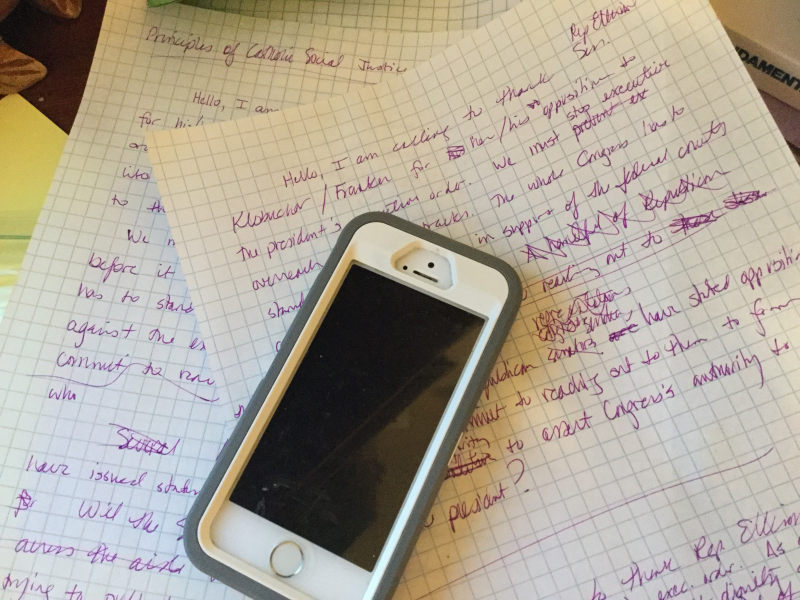
    Today I thought a lot about common goals, spent some time with paper and a purple pen writing those thoughts down.  Then I picked up my phone and I called, one after another, the district offices of my two Democratic senators and my one Democratic congressman.  In each case I got a staffer on the line right away.  In each case I identified myself as a Minneapolis constituent.

    I told the Senators' staff, each in their turn:  

    I'm calling to thank the Senator for opposing the President's executive order.  We must stop executive overreach in its tracks.  The whole Congress has to stand together as a body in support of the federal courts against the executive branch.  What I'd really like to see the Senator doing is reaching out across the aisle to try to work with the handful of Republican Senators who have expressed opposition to the executive order.    Bipartisanship is really important to me and I want to see the Senator working to forge a bipartisan coalition to assert Congress's authority to check the President.

    I was a little braver after having called the Senators, so when I called my representative's office, I talked more.  I told the Congressman's staff:

    I'm calling to thank the Congressman for opposing the President's executive order and for getting out there and being a visible support to refugees, especially the ones who live in our community.  I am probably one of the Congressman's more conservative constituents.  I want him to know that I believe all human beings have equal value from the moment of conception, regardless of nationality or religion, and that we have the responsibility to protect the innocent and shelter the homeless.  So I want him to know that he has conservatives in his district who support what he's doing to oppose the executive order and to stand up for immigrants and refugees.

    I also want to urge the Congressman to reach out to those Republicans who have spoken out against executive overreach and try to work together with them.  I know it is not easy to work with people on the other side of the aisle.  I am asking the Congressman to try.  I believe that bipartisan unity is necessary to push back against the President and to remind the President that it's Congress who is the tribune of the people, and that Congress has the authority to check the President.

    Everyone I talked to was very pleasant.  They listened, they thanked me, they said that they would pass the information on.

    + + +

    I don't know what good it did.  

    + + +

    Do we ever know what good we do?

    IMG_1867

    + + +

    But I told them the truth, and I asked them for something that I want, and that I believe they have the power to seek.  And the duty to seek, if they think enough of their constituents also want it.  


  • Co-schooling lunch: why so fancy?

    I got a new Instant Pot electric pressure cooker for Christmas.  The first thing I made in it was frijoles negros, which worked beautifully, last week.  

    The second thing I am making in it right now is chicken stock — I hope — from two rotisserie chickens which I chilled overnight and picked not-quite-clean of meat in the morning.  

    The third thing, I will make in it right after the chicken stock is done:  soup with barley, leeks, and carrots, to which I will return some or all of the chicken meat at the end.

    + + +

    IMG_2176

    This soup is for lunch on a co-schooling day, along with a loaf of whole wheat bread from my bread machine and a clementine or two for everyone.  While the pressure cooker I thought I'd stop and write a bit about hot lunches in general for the homeschooling family, and then about hot lunches on co-schooling day.

    + + +

    If I could poll a hundred homeschooling families and get a detailed answer out of all of them, I think I'd love to ask this question:  How do you manage lunch?  Not because I can't manage it:  After eleven-plus years of trying to feed children in between their lessons and studies, and especially now that I am out of the nothing-but-small-ones years, we have a system that works pretty well.   (More on that below.)  No, I just am curious to hear about the ways that diverse families have solved the problem.  

    And it is a problem, in the sense of a series of questions to answer:  

    • How long after breakfast do you have lunch?  
    • Must you clear off a schoolwork surface to make room for cooking and eating?
    • Is lunch to be a dinner-like occasion, with a set table and everyone at their places on time?
    • Does everyone eat the same thing?  Do all the kids eat the same thing but the parent has something different?
    • Who makes lunch?  Is it the parent?  A particular child?  Do children take turns?  If children make lunch, may they choose the menu?  Do people make their own lunch from what's available?
    • Is lunch-making time a time for the parent to teach food preparation to young children?
    • Do you insist on a balanced meal or that children eat their vegetables at lunch time?
    • How much time can you take for lunch?
    • Do you have a rest time or "recess" afterward?
    • Do you decide what to make in advance?
    • Do you try to use dinner leftovers in your lunch?
    • Do you have a regular rotation of lunches-of-the-day?  Or do you often eat the same thing day after day?
    • Who cleans up? Will you completely clean up the lunch before going back to the rest of your day, or will dishes wait till later?

    Different families:  different lunches.

    + + +

    I keep it relatively simple in my three at-home days.  This year, the regular rotation is sandwiches on Tuesday, pizza (usually from frozen) on Wednesday, and quesadillas on Friday; all with fruit on the side. 

    On Thursdays, when I host, there are twelve to fifteen people here for lunch, and the adults have quite a lot to do.  You would think I would want to go even more simple on those days, but in fact I do not.  Here is why.

    Point one:  Scale-up.

    It turns out that it is not actually simple or quick to prepare most sandwiches, frozen pizzas, or quesadillas for twelve to fifteen people, nor to let those twelve to fifteen people prepare their own sandwiches.  

    • Assembling large numbers of sandwiches is a surprisingly fiddly, messy affair.
    • You can really only do a couple of frozen pizzas in your oven at once.  That'll feed maybe five children?
    • Quesadillas also have the sandwich problem combined with the heat source problem.

    No, what you want to feed people simply and easily in your house is probably a couple of deep pans of something you can cut into pieces, or a vat of something scoopable. 

    A960a0ac740d9b1e1a6250ec130b3ea4a7c0f2a79de6a058feb55eeaded97408


    Point two.  The co-schooling kids' time is better spent on schoolwork than on lunch.

    On our home days, helping me put lunch together is part of my kids' job.   My "simple" lunches for days at home are chosen in part because I need to be able to bark down the stairs, "Elder Teenager!  Please start the quesadillas while I clean up this mess!"  or to be able to ask, "Younger teenager, can you put the pizzas in the oven at eleven-ten so they're ready when I get home from toddler music class?"

    But the co-schooling time is short, and we really need all of the kids to be either productively schooling or productively having recess together most of the day.  I'm not going to have them make their own sandwiches by digging through my fridge looking for the fillings they like best (although sometimes in warmer weather I'll set out a tray of meat and cheese and a basket of buns on the table).  Usually there comes a time in the late morning when the students are working independently, and that gives me time to set out lunch trays.

    We do assign a pair of children each day to be "servers." It's the servers' job to keep the water pitchers refilled, to fetch second servings, and to retrieve condiments from the fridge (in between bolting down their own lunches).  This little innovation from a few years ago made it a lot easier for  us parent-teachers to sit down and eat.  Servers also have to clear the table so it's ready for schoolwork.  


    Point three.  Once you've got comfortable with a dish that really works, it's not always all that hard.

    Chicken noodle soup from scratch is, on the surface, a bit complicated.  One must immerse the whole chicken in a big pot of cold water, add a few flavoring vegetables, bring to a boil,  and turn down to a simmer.  One must skim the scum that floats to the surface, then an hour or so later remove the chicken and let it cool.  Diced vegetables go into the pot, and that boils again for thirty to sixty minutes; meanwhile the meat must be picked off the bones, and the broth salted and tasted.  Towards the end, in go the noodles, and you must stir so they don't stick.  Once the noodles are all done, the meat goes back in.  If you are frugal, you'll put the bones to boil again in another pot, because there's another pot of broth left in them.

    So yes, many steps, spread out throughout a whole morning.  But if I am in the kitchen anyway — and I teach my co-school students in my kitchen — I can make chicken noodle soup practically in my sleep.  I have done it so many times that I know exactly when the pot will come to a boil, when to skim, when the chicken will be done, how long the noodles have to go and when to wander back and stir them.  So a vat of chicken noodle soup is something I can make for a co-school day.  It sounds hard.  But because it's one of the things I know how to make work for me — I make it work for them.

    It can be even easier than that.  A perennial favorite is meatballs (read:  from a bag, frozen), heated all morning in my crockpot in a simple tomato sauce (read:  straight from a can — even plain crushed tomatoes will do because the meatballs flavor them).  I boil spaghetti — that's the most complicated part — and serve with buttered rolls and green beans (frozen, steamed in the microwave).  Another is chili (it all goes in the crockpot in the morning) with tortilla chips and a bowl of cheese to pass around.  Mashed potatoes (made in the morning, kept warm in the crockpot) and a tray of oven-baked chicken legs is another.    I also like to do a pot of coconut rice (thanks, rice cooker) with plain poached chicken breasts, steamed broccoli, and pineapple chunks.  Give them a bottle of soy sauce and those are some happy kids.

    H. tends more to casseroles than I do, and usually preps them the night before so they can be popped in the oven.  The three things she makes most often are a ridiculously plain and ridiculously delicious salmon loaf (it's so great, you must try feeding it to your kids),  a sort of cheesy noodle bake made with mostly parmesan, and … hm, I think number three might be little mini meatloaves.  I hope so, because I love mini meatloaves.

    These things are not as hard to get on the table as you might think, at least not once you have the routine down.


    Point four:  You might want to eat something tasty, too.

    Let's be real:  although my children are happy to eat it, I do not want frozen pizza for lunch.  Certainly not every week.  I do like quesadillas and eat them sometimes, but not every week.  

    On the other hand, I would be perfectly happy to eat H.'s salmon loaf or meatloaves or cheesy noodle bake every week.  They are yummy.  A bag of steamed vegetables on the side of any of those, and I'm very happy.  (Salmon loaf especially makes me happy.  We make a sort of rémoulade of mayonnaise mixed with homemade hot sauce for it, and it's really nice.)

     Likewise, I could eat chicken noodle soup — my own homemade chicken noodle soup, that is — every week for the rest of my life, and I would not tire of it, at least if I had copious amounts of saltine crackers and black pepper.  Or mashed potatoes and chicken, or even the spaghetti and meatballs.  

    Co-schooling days are very busy, especially traveling to the other's house in the morning — what with gathering together all the stuff and piling it in the car, fighting morning rush hour traffic, setting up all the stuff again — and it's nice to have a good meal to look forward to, shared with a friend.


    Point five:  It's welcoming.

    I can get stressed out by the details of hosting everyone, to be sure.    But in the long term, I want my house to be a place that kids remember fondly being a guest in.  Sometimes I get frustrated when I teach.  Sometimes I get irritated picking up after people.  I'm sure the kids see this all the time.  But I do hope they like sitting around my table with their friends scarfing down my chili.  Maybe they'll remember that as a good time, remember a feeling of being welcomed and fed and among friends once or twice a week (between being hounded for their history homework and quizzed on their Latin grammar).    I have to believe that it makes a real difference to them to sit down to (say) a bowl of hot soup with fresh rolls and a piece of fruit.


    Point six:  You can always order pizza.

    Which sounds like a jokey way to end a post, but in fact, it is actually a real point.  Once, maybe eight years ago, H. and I sat down and worked out about how much it cost per serving to feed the kids a home-cooked lunch.  I am sure the price has gone up significantly since then, partly because food prices have risen significantly, and also since we now have some teenagers.  If I remember right, we figured that we spent about $2 per serving back then.

    That turned out to be a very useful thing for us to have calculated, because we realized that it didn't actually cost us significantly more to order Domino's pizza for the kids (at $5.99 for a two-topping medium pizza, the lunch special that has been going for years in this area).

    We didn't want to order pizza all the  time; we wanted to have balanced meals that would be good for everyone, as much as possible.  But we'd also been assuming that pizza delivery was kind of a luxury, and so we definitely didn't want to order pizza all the time.

    Turns out that it's not.  I think it might even be less expensive relative to home-cooked meals now, because the prices of a delivered pizza have not risen as fast as the prices of groceries.  (Although four teenage boys can put away a lot of pizza, it should be noted — probably more pizza than salmon loaf.)

    Anyway, the point of this is that if your home-cooked meal backfires somehow, or if you wake up in the morning and you just can't stand the idea of cooking, you could order pizza (provided you live somewhere that you can get it).  H. and I have given each other carte blanche to resort to pizza whenever that seems necessary.  I think we're both committed to making a good-faith effort to a lunch that is not pizza, for the sake of balance and variety; but we're not fanatics, and sometimes the pizza is the best thing to happen to the day.

    Remember to tip the driver, and then make your peace and get back to your school day.


  • Semi-sick day.

    I have no idea if it is evidence-based or not, but when it comes to treating a bad cold, I believe with almost fanatical devotion in the importance of One Full Day of Rest and Fluids.

    I always give kids permission to take one such day off when they are really sick — the test of sickness being, “Are you willing to stay in bed and really rest, even if I confiscate all your electronic devices and leave you with nothing but books, a radio, and your pillow?”

    I usually give myself permission to take such a day off too. But now I have been ill for about the last ten days of Christmas with a hacking cough that keeps me up at night, a stuffy head that makes it hard to propel air through my vocal apparatus, and assorted aches and pains. I have not yet taken my Day of Rest and Fluids because the holiday season intervened. There was driving, and visiting, and houseguests, and the like.

    The first week back at school things still has some of the flavor of holiday, normal rules being suspended, and so I am going to take today, Friday, as my last chance to scrape together a Day of Rest and Fluids.

    But I really don’t want to give the kids a complete day off, so we shall see what I can do from bed.

    + + +

    Mark started me off right by bringing the coffee carafe and a mug up to my bedside. When the 3yo woke up, I sent him downstairs to find my iPad, and he happily curled up next to me watching PBS Kids. Then when my 10yo daughter woke up I sent her to wake the others and feed the 3yo breakfast. Then I had her and the 13yo bring their to-do lists, which I wrote from under the blankets. I have made it so far to 10:24 a.m. without leaving my room.

    What about when the coffee runs out, you ask? I am plotting to go downstairs and efficiently perform several necessary tasks in the time it takes to brew the second pot. These will be:

    • gather all the school material I need to teach my first-grader from bed, plus some picture books
    • hunt through my purse for the roll of masking tape that my oldest two need for art later (kids aren’t allowed to rifle through my purse)
    • grab my planning notebook
    • secure a supply of fluids (hot water thermos, packets of tea, bottles of energy drink, broth)
    • find out what I was planning to make for dinner and determine if any of it requires action before lunch

    Then I swear I am going to come back to bed and not leave. I will be teaching algebra, calculus, and first-grade math from bed, thankyouverymuch, not to mention all the readalouds and checking the science workbooks. The rest is up to them, and the magic of checklists.

    I have assigned my 13yo to make tuna salad for lunch. I think that covers most of what they need.

    And the rest of the time, I guess I will work on stuff like email. And rest and fluids.


  • A new pan for me, and some pain de mie.

    I have added a new bread recipe to my Bread Machine Recipe Spreadsheet!

    The last time I updated the spreadsheet (mentioned in the link above), it was 2014.  Almost three years later, I have found a new worthy loaf.

    + + +

    The French version of white sandwich bread, which I really encountered for the first time on our family trip to Europe a couple of years ago, is called pain de mie.  The word mie means crumb, or it can mean the inside part of bread (the part that is not the crust); so this is "crumb-bread," bread that is almost all "inside."

    It is white and tender, and makes square slices that are not very large.  But even the store-bought kind is (as you would expect) superior to your average American white sandwich bread, even kinds from bakeries.   It is made with milk and lots of butter, and all-purpose flour rather than bread flour, which produces a smooth, unsticky, and easy-to-handle dough.  It is baked in a buttered, lidded pan that confines the oven-spring to make a square, dense loaf with a fine crumb.

    IMG_2146

    I bought a 13" × 4" × 4"  Pullman loaf pan with some Christmas money, especially for learning to make pain de mie.   Here it is on Amazon.  I paid $25 on sale.

    And today I set about making my first loaf of pain de mie.  My basic working recipe, for now, is adapted from this recipe at King Arthur Flour, with some attention to various recipes around the net for "Pullman bread."


    Working Recipe:  Pain de Mie for the Bread Machine

    • 1 and 2/3 cups whole milk
    • 6 Tbsp salted butter
    • 2 and 1/4 tsp salt
    • 3 Tbsp sugar
    • 4 and 3/4 cups all-purpose flour
    • 2 tsp bread machine yeast
    • Additional butter for greasing the pan

    Put all the ingredients in the order listed into the bread machine on the "Dough" cycle, so that it mixes, kneads, and rises twice.   

    Preheat the oven to 350° F.  Butter (don't spray) the inside surfaces and inner lid of a 13" × 4" × 4" aluminum Pullman loaf pan.  

    Transfer the completed dough to a nonstick cutting board.  Press it gently into a 13" × 8" rectangle, then roll it up from the long end into a log.  Place it seam side down into the loaf pan, with the ends of the log right up against the inside of the pan, and slide the cover almost all the way on.  Allow to rise until the loaf is just below the lip of the pan, and the pan is at least 3/4 full, 45 minutes to an hour  – or longer in a cool kitchen.  

    Close the pan all the way and bake 25 minutes.  Remove the pan from the oven, remove the lid, and allow the bread to bake for an additional 20 minutes or until an instant-read thermometer inserted into the center reads 190° F.

    Remove from the oven, turn immediately out of the pan onto a rack, and cool completely before slicing.

    The bread had a buttery, almost flaky-thin crust that reminded me of a croissant, and sliced easily into thin and sturdy slices.  We spread butter on it and ate it still a little warm — I admit, our impatience left the center a bit unstable and soft, still steaming — and it was delicious and dense.  I expect it will make marvelous grilled-cheese sandwiches and buttered toast.  But to find out, we will have to wait for the next loaf.

    I'll be tweaking this recipe over the next few weeks, until I settle on a version worthy of a new printed edition of the spreadsheet.  The first thing I may try is increasing the yeast a bit to speed up the rise.  The second thing I may try is leaving the lid on the pan for longer in the hopes of getting a truly square, evenly browned loaf.

    IMG_2137


  • Francis de Sales: The patron saint of to-do lists? (A repost for the new year.)

    I wrote this post originally in August of 2014, when I was working through some ideas I'd drawn from various figures in Salesian spirituality.  Its themes of resolution make it, I think, appropriate for the first post of the new year.

    Three years later, although I haven't made a daily habit out of the insights I described in this post, they are still bearing fruit for me when I remember them.

    + + + 

    I know I said in my last, introductory post to Salesian spirituality that I was going to look first at Don Bosco's "Preventive Method," what with the school year starting up now and all.

    But I changed my mind, because I happened to be looking at a short work of St. Francis de Sales, the Spiritual Directory. It's sort of a rule of life for the religious he supervised — only instead of specifying so mant hours of work, so many of sleep, so many of prayer, etc., he specifies little acts of devotion and intention to be performed throughout the day, connected to rising, worship, work, meals, bedtime — the whole cycle of an ordinary day. They are, so to speak, spiritual exercises, not for a novena or a retreat but for every day.

    "It is true that the Directory proposes many exercises," Francis writes,

    Yet it is good and fitting to keep one's interior orderly and busy in the beginning. When, however, after a period of time, persons have put into practice somewhat this multiplicity of interior actions, have become formed and habituated to them and spiritually agile in their use, then the practices should coalesce into a single exercise of greater simplicity, either into a love of complacency, or a love of benevolence, or a love of confidence, or of union and reunion of the heart to the will of God. This multiplicity thus becomes unity.

    I like this idea of patiently developing little habits that "coalesce" over time into character.

    + + +

    The ordinary thing for me to do would be to start where Francis starts, at the beginning of the day, with "Article #1: Rising."

    But I was struck instead by Article #2, "Meditation." Or rather, preparation for meditation.

    Francis devotes only a short paragraph to instruction on meditation, "the serious practice of [which] is one of the most important of the religious life." Mainly he suggests going to other sources, including his own other works. But he devotes several paragraphs of this article to the preparation.


    To form themselves for meditation they will prefer to all other means the exercise of the preparation of the day….By this means they will endeavor to be disposed to carry out their activities competently and commendably.

    Invocation. They will invoke the help of God, saying,

    "Lord, if you do not care for my soul, it is useless that another should do so." (Ps 127:1)

    They will ask him to make them worthy to spend the day with him without offending him. For this purpose, the words of the psalm may be helpful,

    "Teach me to do your will, for you are my God. Your good spirit will guide me by the hand on level ground, and your divine majesty by its inexpressible love and boundless charity will give me true life."

    Foresight. This is simply a preview or conjecture of all that could happen during the course of the day. Thus, with the grace of Our Lord, they will wisely and prudently anticipate occasions which could take them by surprise.

    Plan of Action. They will carefully plan and seek out the best means to avoid any faults. They will also arrange, in an orderly fashion, what, in their opinion, is proper for them to do.

    Resolution. They will make a firm resolution to obey the will of God, especially during the present day. To this end, they will use the words of the royal prophet David, "My soul, will you not cheerfully obey the holy will of God, seeing that your salvation comes from his?"

    Surely this God of infinite majesty and admittedly worthy of every honor and service can only be neglected by us through lack of courage. Let us, therefore, be consoled and strengthened by this beautiful verse of the psalmist:

    "Let evil man do their worst against me. The Lord, the king, can overcome them all. Let the world complain about me to its heart's content. This means little to me because he who holds sway over all the angelic spirits is my protector." (Ps. 99:1)

    Recommendation. They will entrust themselves and all their concerns into the hands of God's eternal goodness and ask him to consider them as always so commended. Leaving to him the complete care of what they are and what he wants them to be, they will say with all their heart:

    "I have asked you one thing, O Jesus, my Lord, and I shall ask you again and again, namely that I may faithfully carry out your loving will all the day of my poor and pitiable life." (Ps 27:4; 40:9)

    "I commend to you, O gracious Lord, my soul, my life, my heart, my memory, my understanding and my will. Grant that in and with all these, I may serve you, love you, please and honor you forever." (Ps. 31:6, Lk 23:46)


    Okay. Do you see what he did there?

    St. Francis has just unified the concepts of "the morning offering" and "the to-do list."

    + + +

    Before meditation, in fact as part of the preparation for meditation, St. Francis prescribes thinking about all the things that you expect to encounter during the day, anticipate difficulties, carefully plan (with an eye towards avoiding faults — I tend to skip that step when making to-do lists), then "arrange in an orderly fashion what … is proper… to do."

    Did you catch those last two words?

    You finish up your orderly-arranged to-do list with two more steps I commonly skip: resolving to obey the will of God, and entrusting yourself, with all your "concerns" (including, we are to assume, all the items on your aforementioned to-do list), into God's hands.

    It turns out that you don't have to try hard to push back the items that are rushing at you and demanding your attention while you are trying to make your morning offering.

    It turns out that you don't have to guiltily say to yourself, "I'll do my morning offering as soon as I write my to-do list."

    It turns out that you've been a bit silly, trying to add "Say Morning Offering" to the top of the to-do list.

    St. Francis suggests that the to-do list can itself be the morning offering. He sanctifies it: embedding it in an exercise of invoking God's help, planning tasks with an eye to avoiding faults, resolving to do God's will, and ultimately entrusting the outcome to God's providence.

    And this is a perfect example of why St. Francis draws me. I am used to being made to feel, oh, I don't know, insufficiently go-with-the-flowish, insufficiently trusting of God; that my desire for order and efficiency is somehow a marker of a lack of love. That I should want to run to God in prayer more than I should want to make an Action Plan, and that my itchiness until All The Things are safely written down, that itchiness which so interferes with making prayer my first act of the day, is a sign of weakness and a thorn in the flesh.

    What's this? Rather than putting holiness on my to-do list, I can make my to-do list holy. This is a spiritual exercise I can roll up my sleeves and tackle, true multitasking: setting out my daily plans, right there, on the altar of offering.


  • The spirit of the season.

    I came back from my Christmas gathering on the second day of Christmas, collapsed into bed, and slept for about two and a half hours. And then I woke up, and I felt much, much better. Until it was time for the next one.


    I was grateful during the last couple of weeks of Advent to come upon a couple of pieces of writing that acknowledged the dark side of Christmas.

    Anne Kennedy at Preventing Grace taps the nail in, just far enough, with a precise little hammer:

    The trouble is, the world demands untempered joy. It’s Christmas. Get it together. So what if you lost someone last week, or your marriage just ended, or your child was diagnosed with something hideous, or you just don’t have the emotional furniture required to deal with all the extra work and demands of the season. Turn that frown upside down and tuck all that trouble away.

    …This is why it’s so important not to conflate the church’s celebration with the world’s. The world has its own measures of success and happiness, its own ways of rejoicing, and they usually involve you showing to everyone else who much you have it together and the beauty of your life overall. And you showing yourself that.

    Whereas the church’s celebration is about God overcoming the darkness of our human condition. These are two very different kinds of joy. The one floats on clouds of tinsel. The other passes through the valley of the shadow of death.

    Kate Cousino at The Personalist Project puts an optimistic spin on Christmas pessimism:

    We often have occasion to remember that no joy in this life comes to us entirely unmixed with sorrow. The wheat and the tares grow together until the harvest, and the poor we will have always. It’s clear that an earthly, here-and-now paradise is not promised to us…

    …God became man and came to live among us, not despite our sins and the darkness and hardness of our hearts, but—o happy fault!—because of them, in response to them…

    …”There is a crack, a crack in everything/That’s how the light gets in.”

    + + +

    I didn’t even have the emotional furniture, as Anne put it, to write the post before Christmas, when I might have been a useful witness to other people in the same situation, but I will do it now anyway.

    Christmas is when I feel most cut off from the universal Church, and when I feel most deprived of grace and strength.

    Mark asked me a few weeks ago, when I was starting to despair about the rapid approach of Advent, what he could do to make Christmas easier for me, and I immediately answered, “To stay here in our own home, and not give or receive any presents, except some things for the kids.”

    And then I followed that up with “I know we can’t do that, and I know it doesn’t make any sense.” Because it doesn’t make any sense. It is entirely irrational. It comes from nothing and it ends in nothing. And I know that it will not actually make me feel better, in the long run, to give in — for Christmas — to my own Christmas anxiety.

    For one thing, like fear of flying, like fear of open spaces, it’s probably better not to give an inch lest it take a mile: better to confront it every year and push it back as hard as I can.

    For another thing, I am entirely aware that the problem is inside my own heart and mind and soul. I have already pared away as much excess as I can, and done my best to surround myself with people who are kind and joyful. I am aware that I have the power to put one foot in front of another for twelve days (or whatever) and I am aware that many of the anxious negative messages my brain feels like bringing to my attention are illusions. I remind myself of that every day, and it doesn’t make the feelings go away, but it helps me keep moving.

    For another thing, I don’t want my husband’s Christmas, my children’s Christmas, to be ruled by my own interior and temporary (if yearly) insanity. They are normal people who appear to love Christmastime, presents, gatherings, feasts. They can have a good Christmas and I should get out of the way and let them. I just hope they can do it without a great deal of support from me.

    + + +

    Let me go back to just one aspect: feeling cut off from the Church.

    I have been anxious and exhausted at Christmas for as long as I can remember. Last year, I wrote a relatively frank post about that.

    I was in college before I really found out that Christmas had an other side, and just as I was discovering it, in darkness and unfamiliar music, lit by purple candles, I had to go back to the house(s) I grew up in for the holidays. I stalked out into the night on Christmas Eve, took the car, and would not say where I was going.

    I went, but I wasn’t yet allowed to participate. And Christmas still feels like that to me. I am looking in through the glass.

    + + +

    I almost get there, and every year, mid-Advent, I lose my grip on it.

    Part of it is location. I am homesick. Every year we leave town, leave our lovely parish where my sons serve and my daughter sings in the choir, and I find myself at Christmas Day mass at a strange parish with unfamiliar music set to unfamiliar drums. After communion I squeeze my eyes shut and pray fervently for mercy on my judgmental and elitist heart, so that I can’t see the usher dressed as a Coca-Cola Santa Claus come in and kneel down and give a present to the Baby Jesus before the accompaniment music is over. Because if I watch it, I am going to roll my eyes and embarrass my teenage sons.

    And part of it is my own reaction to the location. At the same time that I am trying not to roll my eyes I am trying to stop thinking mean thoughts about the Santa suit because it just goes to show what a terrible Christian I am at the time of the year when everyone else is much better at it than usual. I try to think, in measured tones in my head, “I am surrounded by people who love Jesus and care for each other. Jesus is here in the tabernacle. It is all the same.” But my heart is two sizes too small and can’t make the leap. This is, I know, a stupid, ridiculous cross. All of my crosses are completely stupid and worthless. The things that get between me and Jesus are so very stupid and transparent and superficial dumb and even I can see how dumb they are.

    And part of it is that it lasts so long. Exhausted by people — all people. I find myself, at the holidays, making my way through crowds of relatives — they aren’t even my own relatives, and they are actually wonderful human beings — but making my way through feels like swimming on days when it’s really tough and I have no energy — there are days when I get to the pool and it feels like swimming in syrup. And making my way through the relatives can feel like that. It is not any one individual, it’s just that it is so relentless. Three days, maybe more, and a party every day.

    After a while when I have to be at a party every day my mind plays tricks on me. I start to get impostor syndrome, like in graduate school, only instead of having faked my way into being a research engineer I feel like I have faked my membership in the human race. Everyone is just playing along to avoid e
    mbarrassing me. This year was worse than most, and I retreated into the corner with my wine and looked stuff up on my phone.

    + + +

    Why so bad this year? Mark has a theory that it’s because a lot of things were up in the air. My grandmother is having more health problems, and we weren’t sure what Christmas would look like, what schedule I could keep. Mark said: “I think it is hard for you to have to operate without a fixed plan. You like to have it all figured out ahead of time, because you are afraid that otherwise you’ll have to wing it and that you’ll be blamed if something goes poorly.”

    I think he is probably right about that.

    But at the same time I could feel glad that I had pared some of the stressors away. I tried buying fewer presents this year, especially for people whom I didn’t know well enough to actually shop thoughtfully for, and do you know what happened?

    Nothing. No one complained.

    Instead of visiting absolutely everyone I felt an obligation to go see in my few days in town, I tried going to see the people I wanted to see, and instead of visiting the others, sending flowers and a card. I hope you have a merry Christmas, I wrote. I didn’t mention visiting. And do you know what happened?

    Nothing. No one complained. When I stopped offering my time to those folks, no one even asked why I didn’t come.

    I felt relief.

    + + +

    Despite what progress I have made, I go on feeling pretty insane at Christmas, even though I guess I am not insane enough to deserve the title. Two mental health professionals have confirmed me to be insufficiently off-kilter to merit a diagnosis of any kind in the off-season, and apparently there is nothing in the DSM about an anxiety or depression that only lasts six predictable weeks every year.

    So the good news is that it might be all in my head.

    But I feel it in my body. I feel it like fear or like grief, a round hard thing in my chest, the heart two sizes too small, perhaps, or a lump of poorly digested shortbread cookies. Like tension in my shoulders, low-grade nausea, sleepiness. I know it is irrational but I can’t make it go away by thinking the right thoughts about it. Just pick it up and carry it into next year, and in a week or two it will be as if I never left.

    But for now: I pour out my weakness to the Mother of Sorrows. I try to embrace the terrible coda to the Annunciation, the words of Simeon and Anna. Christmas has a dark side, and maybe it could be okay that I live there, in the terrible stillness, if only I felt I could get away with it.