bearing blog


bear – ing n 1  the manner in which one comports oneself;  2  the act, power, or time of bringing forth offspring or fruit; 3 a machine part in which another part turns [a journal ~];  pl comprehension of one’s position, environment, or situation;   5  the act of moving while supporting the weight of something [the ~ of the cross].


  • Rest day for little ones and me. And a lot of food.

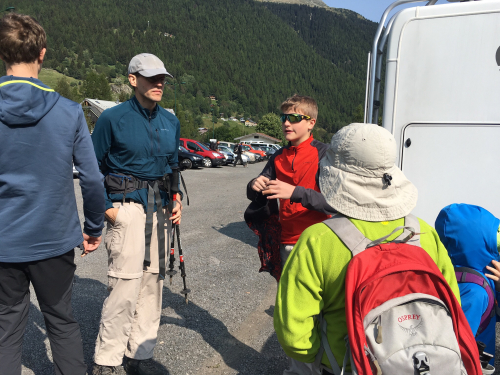
    On Thursday Mark had scheduled an alpine climbing day for himself and our two teen boys with Jeff the guide. More of a traverse, really, to the summit block of the Aiguilles Marbrées and back from the lift in Courmayeur, Italy. (Route is pictured here, and described in French.)

    My job was to hang out with the younger kids all day. I planned two outings: the grocery store in the late morning, and a trip to buy macarons for afternoon snack. In between, we would rest. The kids are still fairly jet lagged, and Friday would be a bigger day for them.

    Region 2 DVDs and chill, you might say.

    + + +
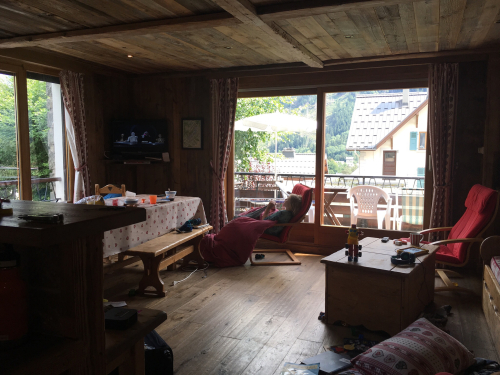
    Let me introduce you to our apartment.
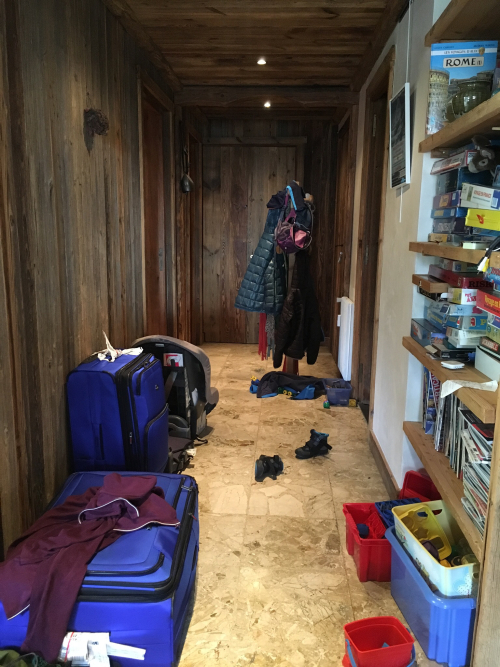
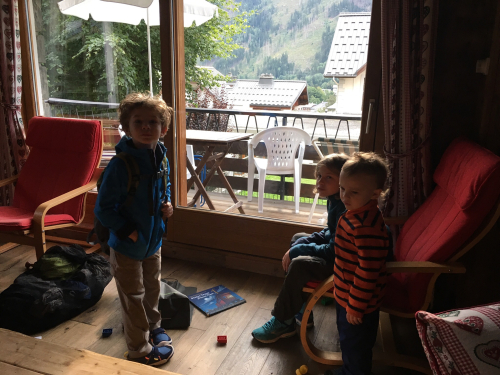
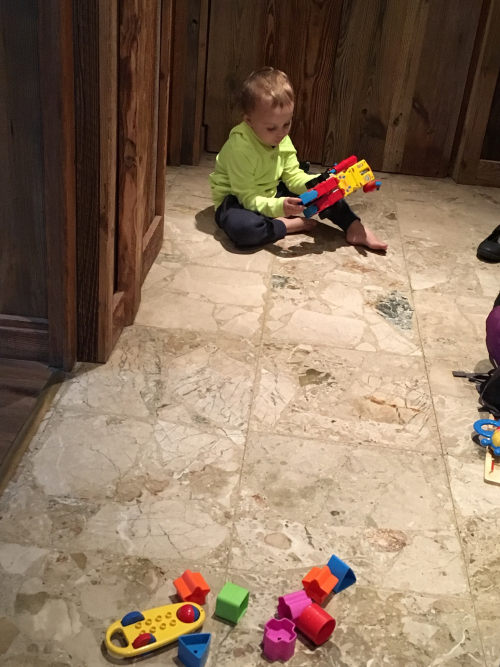
    The first thing I noticed when we went in is that it is well stocked with Duplos, toy trucks, stuffed animals, and some kind of plastic fortifications-building set with little plastic soldiers. Also lots of board games and children's books (all French of course, but some of them recognizable). This was also the first thing our 3yo noticed. He has been happily playing with Duplos and toy trucks since we got here.
    It has a washer and a dryer, plus a big folding drying rack, which is important because European clothes-dryer technology is apparently not very advanced. The first load of laundry I did (immediately after getting our suitcases containing something else we could wear while our traveling clothes washed), I ran through the dryer 3 times—the last time on the hottest and longest setting—and they still were damp to the touch. Finally I gave up, found a place in a corner of one bathroom to set up the drying rack, and hung them all up to finish the job.
    I have a theory that Europeans believe strongly in the health effects, or possibly the environmental virtues, of airing out one's clothes such that they distrust a clothes dryer that would take the clothes all the way to dry without the vital final step of hanging them up for a couple of hours. That the sole virtue of the clothes dryer is its ability to speed up the process so that you can have a bit less of your floor space taken up by the folding rack should you wish to do more than one load of laundry in a day.
    I completely made this theory up, but I like it, so I am going to quietly go with it until I am corrected by someone who knows better.
    We have three bedrooms, plus a daybed couch in the living room, where our daughter has been authorized to decamp in the middle of the night in the event that her roomie and next-younger brother bothers her. There are a couple of trundles under some of the beds; we took one of the mattresses and put it on the floor in our room for the 3yo. There is a full bath off Mark's and my room, with a soaking tub and a rain shower; and two separate washrooms, one with a tiny handwashing sink and a toilet (also the stacked laundry machines) and one with a shower and a vanity sink (also just enough room to fit the drying rack).
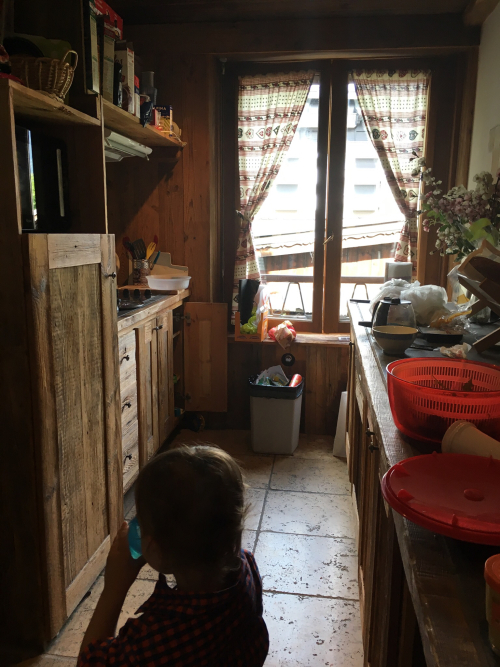
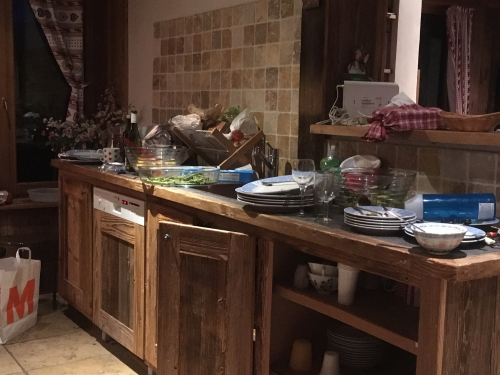
    The galley kitchen is tiny but serviceable with enough counter space to work. It has a dishwasher and a small fridge and an electric stovetop. No oven, but there is a combination microwave/convection oven thingy; it is capable of crisping a take-and-bake pizza. There is a nifty toaster with one wide slot and two little metal wings that rise up over the slot at the turn of a dial, which are apparently for warming a whole loaf, say a ciabatta or a small baguette, from the underside. There is a drip coffeemaker and a fondue pot and a raclette set.
    I brought my own chef's knife, paring knife, and bread knife. This was the right decision. The bread knife here is okay, but the only other knives I can find are steak knives. I wonder if rental properties lose knives a lot. If Mark and I are going to travel more often, I may need a travel knife case.


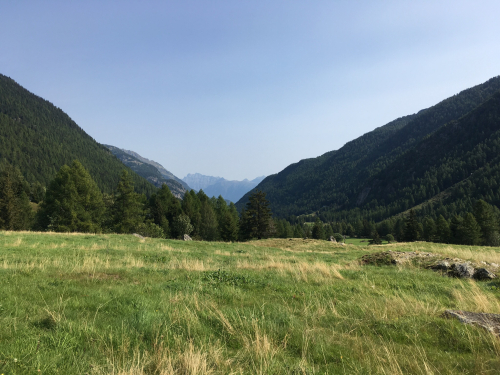
    There is a tiny balcony off the boys' room facing west, and a larger balcony off the great room facing east. Mark refuses to say "north" or "south" around here and only says "up valley" or "down valley," which works when I am dealing with Google Maps in the passenger seat if I can remember which way the river Arve runs. Still, it makes sense to get your bearings primarily by the landmarks that rise up impossibly close and tall on either side, every day stretching out the dawn, every day hastening the sunset, the first and last points glowing with the direct daylight.
    Anyway, we can see the gondolas of the lift rising up out of town from our large balcony, and the spire at the top of the Aiguille de Midi, perfectly.
    We have a long dining table with a mix of chairs and benches, a TV with a DVD player (there is a collection of DVDs; we brought our small collection of British Region 2 DVDs with us), and a fireplace we are not supposed to use, with a madonna-and-child hanging above it.
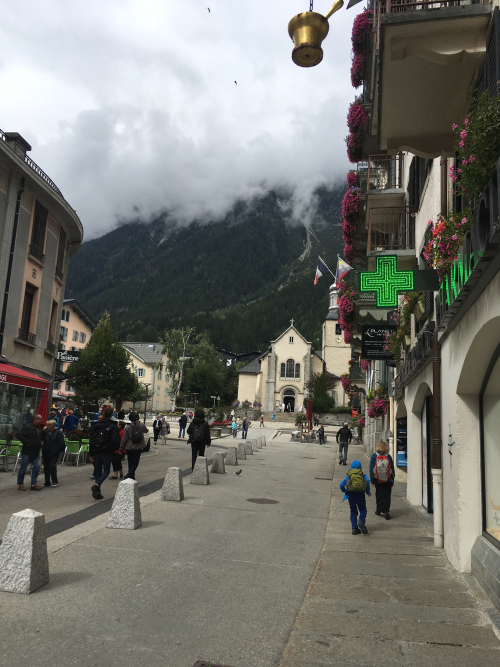
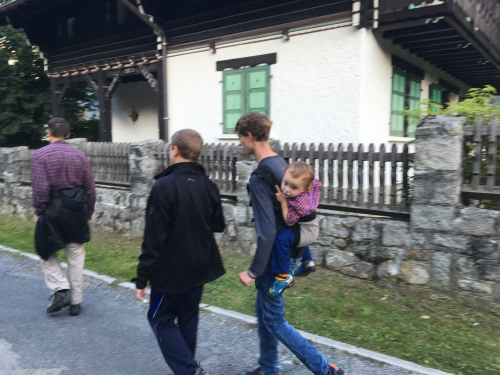
    The apartment is more than halfway up the steep hill that leads from the town center to the base of the lift. By the time we have hiked with the groceries, we are always sweaty and hot. It is steep enough to make it bother your knees on the way down, at least if you are carrying a 3yo on your back.
    + + +
    I let the kids sleep in and have a slow start, figuring that my biggest challenge would be passing the time. In late morning we walked to the grocery store. I promised them they could choose things for their lunches.
    The 11yo was instructed to navigate to and from the store, because she has to prove she can do it reliably before we let her go by herself.
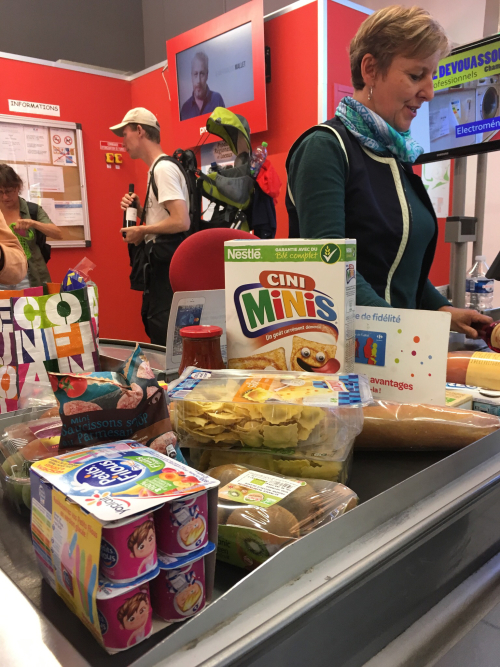
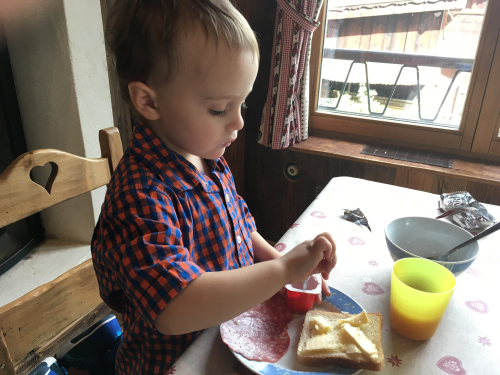
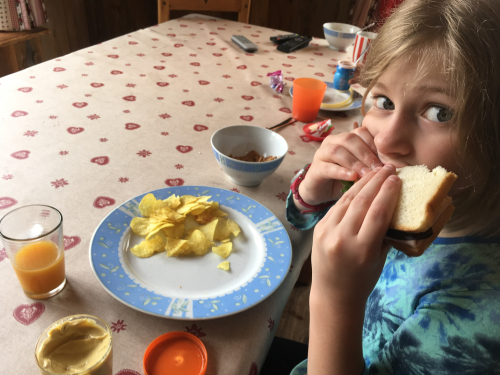
    I bought coffee and milk and cream and vegetables and wine (Graves, just about my favorite white, €6) and pain complet. The 11yo chose sliced turkey and Lay's potato chips, "moutarde et pickles" flavor, and asked for a Coke, which I allowed. The 7yo chose a new kind of Babybel that was like string cheese coiled up in a little sealed cup, and juice. The 3yo asked for "salami" (rosette de porc). I also bought a couple of toy trucks and pens and a notepad. We piled it all into the backpacks and hiked back, the 11yo in the lead.


    I made the kids' lunches, with buttered pain de mie and tiny yogurts.
     
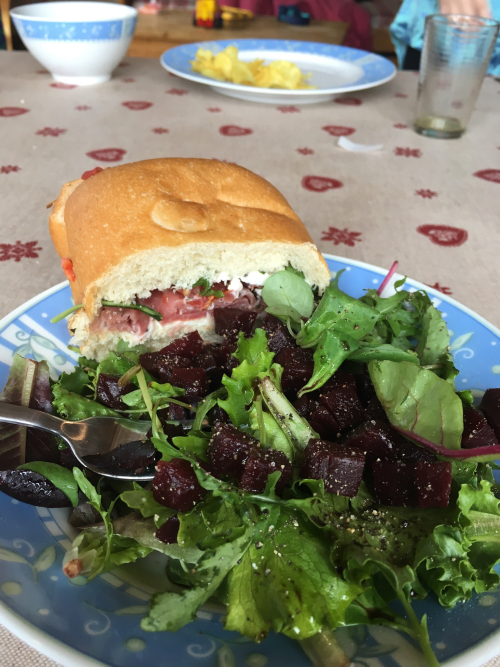
    My lunch was part of a leftover proscuitto sandwich and a salad of leftover greens and cubed cooked beets with vinaigrette.
    Then we relaxed for a couple of hours. I read. The kids played with toys and read and watched a DVD. And then we cleaned up the lunch and swept up the toys, and went out again, this time for snack.
    Goûter, I mean.
    + + +
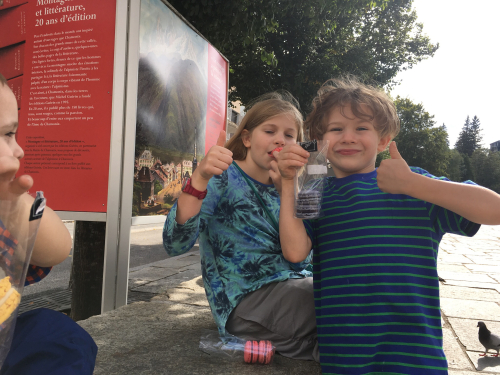
    I instructed the two older kids on how to order, and forbade them from ordering more than one flavor each. "You can get three macarons of one flavor, and then you can trade them with each other; I don't want to make her have to get you nine different kinds."
    We looked in one shop, then the other, and examined the flavors. The 7yo is intrigued by the mysterious name "passionfruit" but afraid to commit to it in the presence of so many others. Café, "equatorial" (dark chocolate), noix de coco, framboise, myrtille, fraise, citron vert, vanille, chocolat-mangue.
    Finally we went in, and I greeted the proprietaire. I nudged the 11yo, who recited: "Je voudrais trois macarons framboises." (Actually she said "frambois" but it was ok.) The woman smiled and took a silver tray and a pair of tongs and carefully picked out three brilliant pink macarons with deep-pink paste filling.
    And the 7yo nervously followed: "Je voudrais…trois…" he paused, panicky, hyperventilating.
    "Merci de votre patience," I said to the woman with the tongs and the silver tray.
    "You can order in English," she said to him.
    He exhaled with so much relief that he nearly fell over. "I would like to order three blueberry macarons, please," he said, and she nodded and began adding macarons to the tray.
    "Et pour le petit, trois macarons 'tarte de citron,'" I added, "et trois petit sacs, s'il vous plaît, parce qu'il y a trois enfants."
    Soon we had our three little sacks with three macarons each, and I set the 3yo down in the plaza where he could watch pigeons to his heart's content while eating.


    I am more of a protein snack person myself. Behold, the magic that is the petit saucisson sec:
    + + +
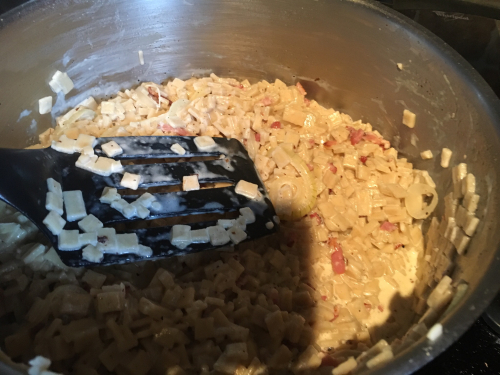
    For dinner I sautéed onions and lardons in olive oil…
    …added cream…
    …and stirred in cooked crozets, a local buckwheat-semolina pasta in a square shape.
    For the salad: Chilled cooked broccoli florets and raw, thinly-sliced red peppers, mushrooms, and zucchini, in balsamic vinaigrette with grana padano cheese.
     
    + + +
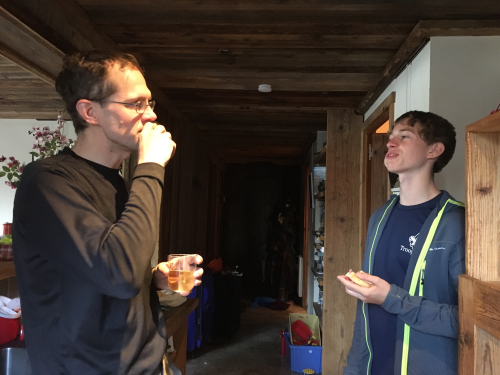
    Mark and the boys returned tired and happy. The 13yo went straight to bed, still jet-lagged and suffering a bit from the altitude and a blister. The 17yo was nothing but pleased (and hungry).
     
    Good wine, good food, and a good rest.


  • Climbing day and pizza.

    Up early on Wednesday for our first family day of climbing at Les Gaillands, the magnificent crag just outside of town.

    Mark dropped me and the 17yo off in front of the bakery across from the Aiguille de Midi lift, and I bought six sandwiches and a bunch of pastries and a couple of quiches. (I did a fine job ordering the sandwiches according to the placards that were posted in front of them, but we discovered later that the placards had not been placed in front of the corresponding sandwiches, so we had different ones than we wanted.) For pastries: two petit pains au chocolat, one croix de Savoie (a local specialty), a fat brioche chocolat-orange, and something with nuts on it called a “canadienne” (maybe it had maple? I don’t know, I didn’t get any).
    The quiches Lorraines for breakfast between Mark and me, even though the women behind the counter at the bakery will laugh at you if you commit the faux pas of thinking that it is all right to eat a quiche for breakfast. Quiches are lunch food in France as far as I can tell and only weird people and Englishmen would think of having so much protein before noon. You are supposed to have something healthier, I guess, like black coffee and a cigarette.
    But I think the little quiches make a marvelous breakfast.
    Mark picked us up after stopping at the grocery store for drinks and snacks for the next day’s outing, and we were off — only a ten-minute drive.
    + + +

    We have been here before. It is a great climbing place for a family, because there are often children there; not French children now, because they just started school, but there was a large passel of British children climbing next to us. There’s a big grassy field with boulders here and there to climb on, and a little lake for fishing, and some caves and interesting old building foundations. Also a little café/concession stand thing that sells drinks, snacks, and crêpes, and public toilets.

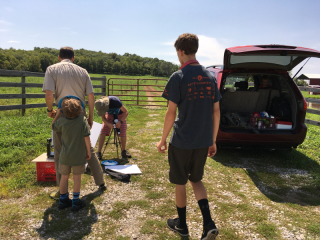
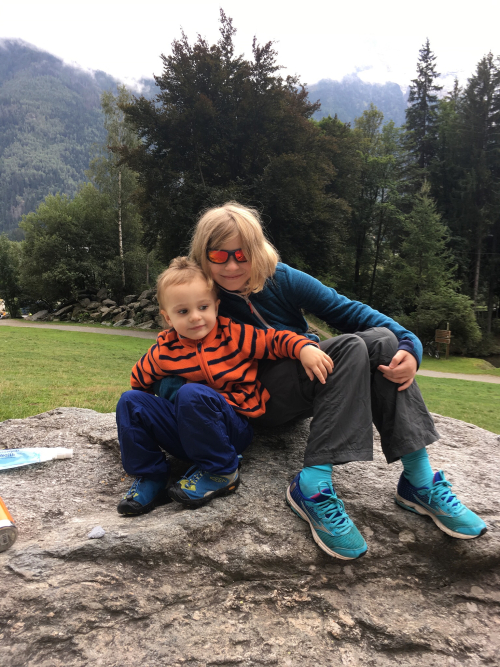
    Also, the ground by the crag is covered with interesting small rocks. Which is good when you are a three-year-old with a toy dump truck, and your siblings are going to take turns supervising you. My daughter took the first shift, and was promised more climbing than she could stand later in the morning.

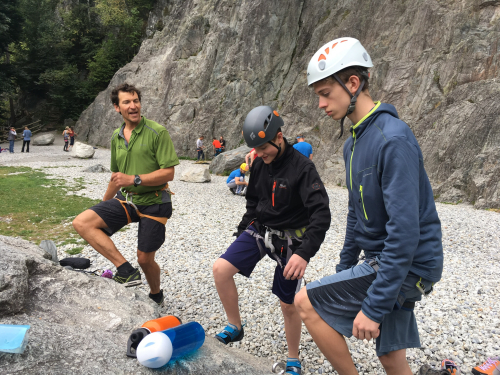
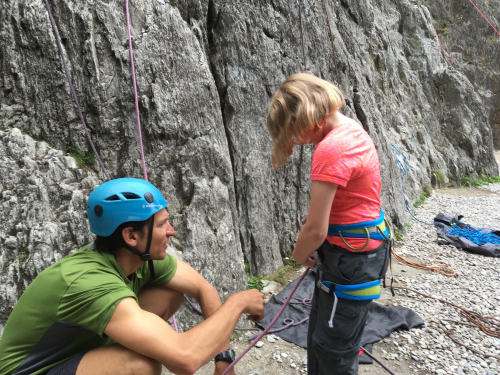
    Jeff (green shirt) is an American who splits his time between Colorado and Europe. He couldn’t believe it had been three years since our last trip. I think he’s great with our kids, and Mark has been out with him several times. Nothing we will do here at this crag will be very technically difficult, so we don’t really need a mountain guide for this; but we do need another adult who can belay, since somebody has to be watching our younger boys all the time, and Jeff needs to get an idea of how well our older boys can take instruction since they’re going out with him on the mountain the next day. So he spent some time taking them through a few drills which he suggested they could practice at home.


    Meanwhile, the rest of us put on our harnesses and shoes. Mark prepared to belay the 7yo. He is quite small for his age, so we still have him in a chest harness; flipping upside down is more of a possibility for small ones, and so you want them in a harness with shoulder straps.

    After the 7yo came down, Mark belayed me for a quick and easy warmup climb; and then when it was my turn to be lowered, which entails leaning back into the rope and “walking” backwards down the rock, I was surprised to find that it was kind of scary. Surprised only because I have spent enough time in the climbing gym on auto-belay to not find that scary; but it turned out the comfort didn’t transfer very well. I got used to it, though, and found my feet.

    The 11yo girl got her chance soon to have some instruction from Jeff and then to start climbing.

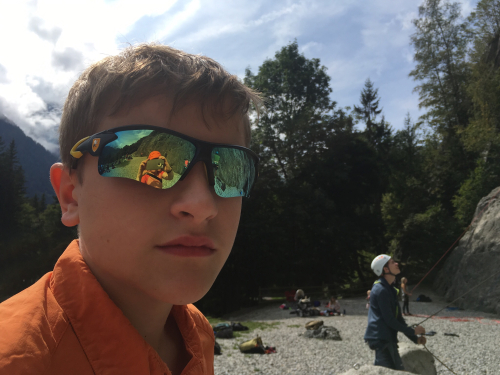
    Meanwhile the 13yo, looking cool, was to take over the 3yo (still not a difficult job; he was making avalanches by piling small rocks on top of the boulders and pushing them down). The 17yo, a member of the high school climb team at the local gym, earned his keep by belaying the 7yo.

    I don’t belay. Most of the time, there’s no need for me to do so. I have learned how (theoretically) but have not practiced enough for it to become second nature. Mark showed me how with his easiest belay device and practiced with me for a couple of hours, and then declared me competent enough to pass the belay exam at the climbing gym, which he said was just a formality because you only had to be good enough to get started and then you could get better by practicing in the gym. I wasn’t sure I believed him, but I went along with him anyway and we got a gym employee to give me the belay test. I failed immediately and humiliatingly, humiliatingly enough that I think Mark was embarrassed on his own behalf.

    Anyway, I am not sure that I want to belay my own kids; it seems like the sort of thing that would make me very nervous. I also don’t like very much to have my oldest belay me, although I have, a few times. Oddly enough though, I am completely comfortable with the 17yo belaying the other children.

    Which is handy when you are all out at the crag.

    + + +

    The lit
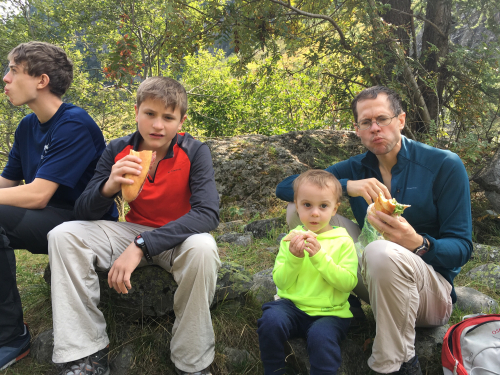
    tler ones did not like the sandwiches, and they did not like the petit pains au chocolat (it is a dark and bitter chocolate, perfect à mon goût but not to theirs), but they did like the croix de Savoie and so they ate it for lunch. Along with some fruit snacks that were left over in the 3yo’s back pack from the supplies I had packed for the plane.

    My daughter is fond of tuna subs, so I had made sure to order one sandwich de thon. She was surprised how much she liked it. “The tomato and lettuce are good,” she said. “I don’t like how the hardboiled eggs are sliced instead of chopped up into the tuna, because you get a lot of egg in every bite, but it’s okay. The tuna part tastes amazing.”
    I tasted it too and thought about it. “I think there’s more mayonnaise, possibly better mayonnaise, and it’s probably different tuna than you are used to. We might have to try recreating it at home.”
    The other sandwiches were proscuitto-and-goat-cheese on ciabatta and ham-and-butter on baguette. Very nice. We also had some lovely green plums, “reines claudes,” a fruit I cannot get enough of when I am in Europe. They are sweet and apricot-sized, and the skin is tender, without the jaw-clenching tartness that you sometimes get with fat purple American plums. They are juicy enough to be flavorful but not juicy enough to drip down your chin or to fall apart into mush as you eat them. The stone is free so you can eat all the lovely pale green flesh in a few bites.
    + + +
    After lunch everyone had a chance to climb a longer and more interesting route. The 7yo is not frightened at all anymore.
     

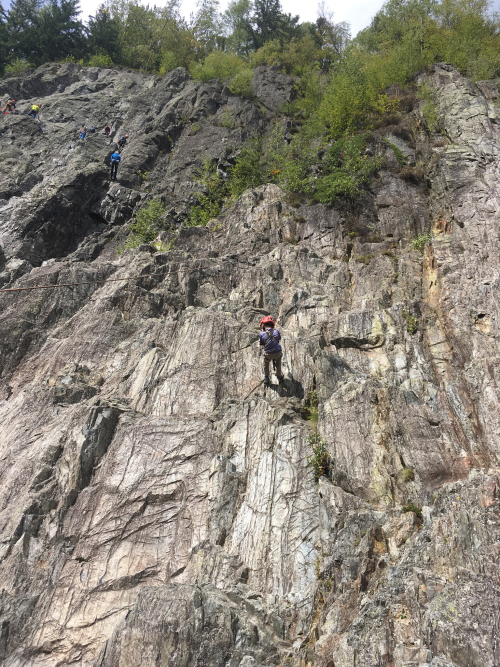
    The wall had a long smooth section with very few toeholds, good for technical practice; but practically had stairsteps on either side. I really can’t overstate how marvelous the rock is. It is very rugged and steppy, easy to find footholds and handholds almost anywhere you look, with ledges here and there on which grow spiky grasses and tiny tufts of mountain flowers. The rock glitters with mica in places and in other places so iron-red and smooth you wonder if it would attract a magnet. And yet there are smooth sections where you must “step on nothing and trust it will hold you,” as Jeff put it. There are bolts fixed in places to practice lead climbing; in the afternoon, my oldest would get some practice and instruction with those, after I went home with the other four kids for a rest, to let Mark and the 17yo profit from the afternoon with the guide.

    Before I left I wanted to get some vigorous exercise, so I asked to be belayed several times on the same route one after another. First Jeff belayed me, and then after a while, Mark took over the belay. I watched from the top as they transferred my rope from one to the other, and Jeff teased me: “You’ll only be off belay for a couple of minutes. I think. I’ve only done this a couple of times.”

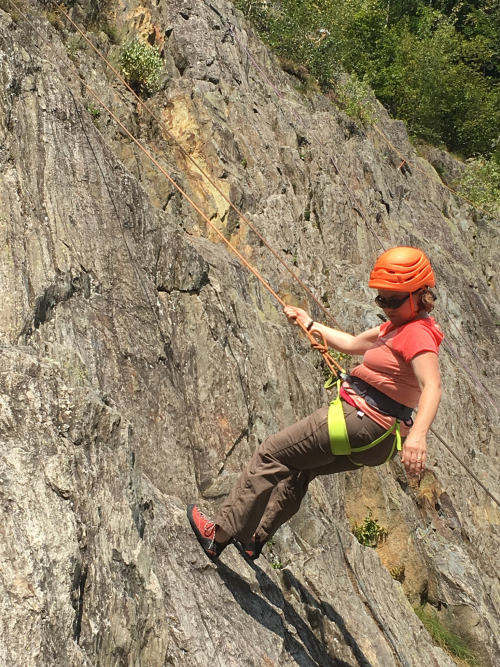
    I got the 17yo to take some pictures of me climbing. I swear I am better at it than I was three years ago, even if I still kind of look like a dork.

    I am not at all happy with what the harness, under load, does to the abdominal material left over from my pregnancies. Good thing it is not a fashion show.
    After I went up and down quickly a few times, I felt ready to take the younger kids home. We intended to let the 13yo climb more, but he still suffered pretty terribly from jet lag, and wanted to sleep. So we loaded most of the stuff in the van (as well as the 3yo, who had to be dragged weeping away from his beloved pile of little rocks), and Mark drove us back to the apartment. Then he returned to finish the day out with Jeff and the 17yo.
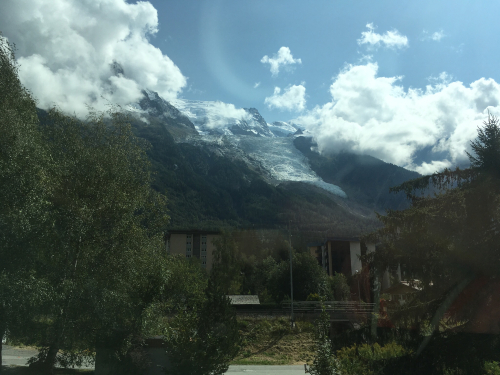
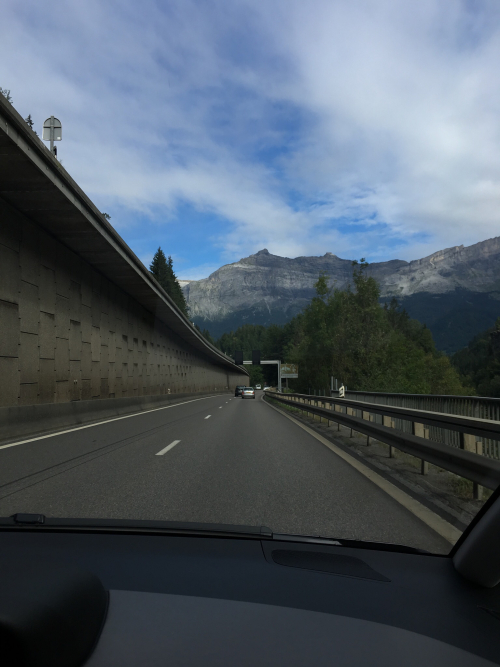
    I snapped this picture of the Bossons glacier from the car. It’s one of my favorite views from town.
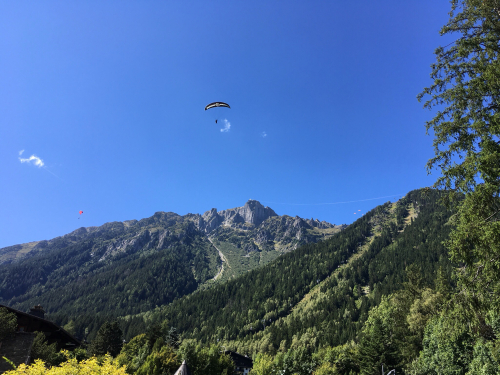
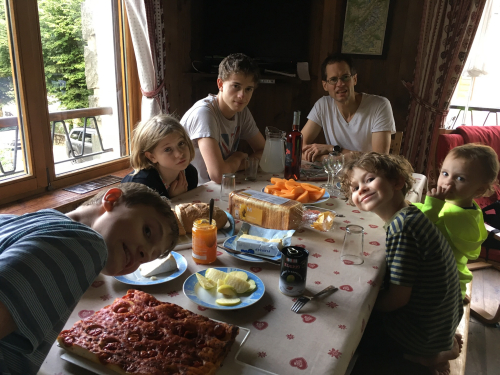
    We rested all afternoon, until Mark and the 17yo returned, pleased with himself for having had lots of lead climbing practice. And then we all got dressed and headed out for pizza. Our walk took us past the field where the parasailers land and through the town to a little pizza place that we had eaten at before: a sort of a wooden train-car-shaped shack, cash only, with a Neapolitan-style pizza oven inside and a couple of picnic tables outside.
     
    I ordered a pizza margherita with black olives on top; a pizza “quatre saisons” with capers, mushrooms, cheese, and ham; a spicy pizza with a tangy tomato sauce, hot peppers and spicy pepperoni; and a pizza “di parma” with proscuitto, herbs, and white sauce. Also some Sprites and two plastic cups of red wine.

    The only other party dining on the premises was a group of about seven Brits, one of whom had come up to the window next to me as I was paying, carrying a bottle of wine to ask after a corkscrew and some plastic cups. “Oh, you speak French, that’s lucky,” said the nice British lady. “I got him to sell me a whole bottle of wine but we haven’t any cups, can you ask?”

    He came back, I asked, he showed her a single plastic cup and said, “Last one, no more.” (I had already been given my two cups of wine). She was perplexed and stammered.

    I peered into the window and saw a tall stack of black-and-white-printed styrofoam cups, the sort you use for coffee. “Est-ce que vous pouvez lui donner ces… uh (the word for “cup” momentarily escaped me, darnit)… choses-là, pour les boissons chauds? Les noirs et blancs?”

    He looked irritated and came back and pulled a few of them off the stack. “These are not for wine.” He handed them to her and as she went away, pleased, explained to me rapidly something that might have been: “How was I expected to know she would be willing to drink wine out of a coffee cup?” and might also have included: “She should have asked for the cups when I sold her the wine.” and definitely included an explanation that he was closing up shop tomorrow to go on vacation for ten days so he was letting his inventory run low on purpose. I am not sure whether he was being defensive or whether he was complaining about the bizarre willingness of the nice British lady to (a) ask for a whole bottle of wine or (b) drink wine out of an inappropriate container.

    Anyway, we waited quite a while for the pizzas, as he was doing a brisk takeout business, but it was a lovely night and the little boys were pretty well-behaved. And when they arrived, the pizzas were delicious, and just the right amount of food; and my wine tasted lovely, perfect with the pizza, so that I was glad I had managed not to drink it all while we waited.
    Even from a plastic cup.


  • Plans that didn’t require our luggage.

    We still didn’t have our seven checked bags when Tuesday dawned, so we needed to make new plans. Plans that did not require any of our gear or more layers than the clothes on our backs.


    Mark walked down to the place where you can pay an expert parasailer to take you flying off the mountain in a sort of tandem rig, and signed up the teenage boys for an eleven o’clock flight. Then he and I went to one of the stores in town to buy gloves for them, since it’s cold up there, and approach shoes for me, just in case hiking became necessary. (I had picked great versatile shoes for airport sprinting and for urban walking around — comfortable black leather flats in a sort of sporty mary jane style — but it wouldn’t do to hike in them.) The boys got dressed to fly.

    Then Mark took our daughter up on the gondola to watch them take off, and to find out if she might want to go flying, too.
     
    She wasn’t sure before she went up, but once she saw the boys take off, she really wanted to go. The parasailer who took my oldest down suggested that our daughter, being relatively lightweight, would do best on a day early in the morning with calm winds, and said she would call us when the weather was just right.

    I stayed at the bottom with the two little boys. The 7yo begged to be taken to a French McDonald’s to find out if it was the same or different. I thought this outing might be best if it was gotten out of the way as soon as possible, so I packed up a backpack with spare clothes and the child carrier, and ventured down into the town with a little boy’s hand in each of mine.

    We found the Golden Arches with no trouble, and I ordered two happy meals with the touchscreen kiosk with no trouble, but when it came time to pay I had trouble: the machine would not take either of my credit cards, and it displayed a command to pay cash at the counter. I had neglected to get cash from Mark that morning, so I rushed out the door (one perplexed child at each hand) to ask directions for the nearest ATM; upon arriving, I found that my cash card did not work either.

    So I had to explain to the two children that we couldn’t buy any food, and did they want to walk around and look at things instead? No, they both started to cry. So back up the hill to the apartment.

    On the way up, towing my two sad little boys by the hands, I bumped into an Englishwoman who exchanged pleasantries with me and then asked, “Have you been up on the gondola yet?”

    “Yes,” I said, “well, not this time yet, a few years ago. But my kids are doing parasailing from there right now,” and I gestured with my head at a few colorful sails which were circling down at the moment from the sky. (Probably not them, although it could have been.)


    “Oh my,” she said, “that must be scary to watch.”

    I thought about it for a moment. “No,” I said, “they are seventeen and thirteen. I am sure they are having fun.”

    When Mark arrived with two happy teenage boys, I made him take the small kids back into town for their Happy Meals. The 11yo went too. It probably made their day.

    Our oldest had taken a GoPro on his flight. I hope to post it later when he sends it to me.


    + + +

    We had been told the bags would arrive that evening, either by 6 pm or at 6 pm, so someone had to stay and wait. We took turns heading out on little errands. Our 13yo went out looking for gear with Mark. The 17yo went for a run. I took the 11yo out window shopping and to a bookstore, where we browsed for a long time and where I bought her an Asterix book and myself a cookbook.

    When I got home there were still no bags, and it was time to make dinner. The TV was on, where French news covered Hurricane Irma, paying closest attention to the French islands. We were listening too, because we had friends staying on St. Kitts that night, and were hoping for the best for them.


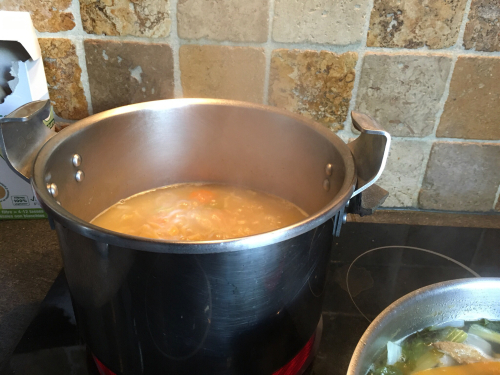
    I made chicken noodle soup, with a cold rotisserie chicken; carrots, onions, parsley and celery; and egg tagliatelle sold rolled in little nests.


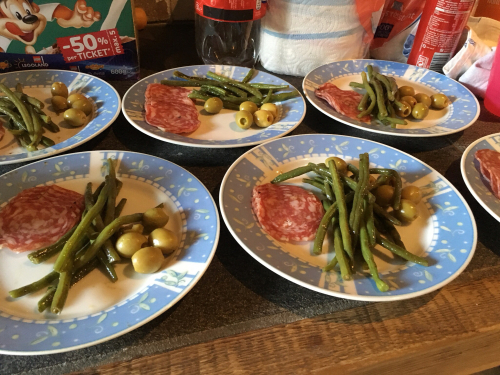
    And I made a first course with olives, cured meat, and last night’s haricots verts tossed in vinaigrette.


    We had a good family dinner, alt
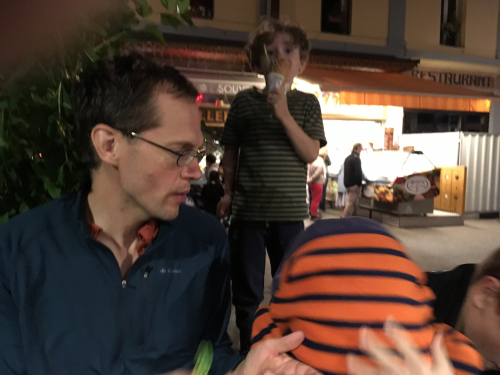
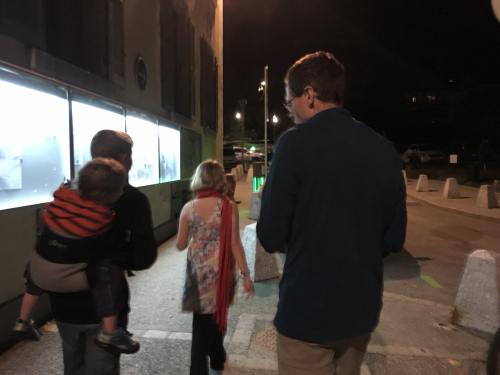
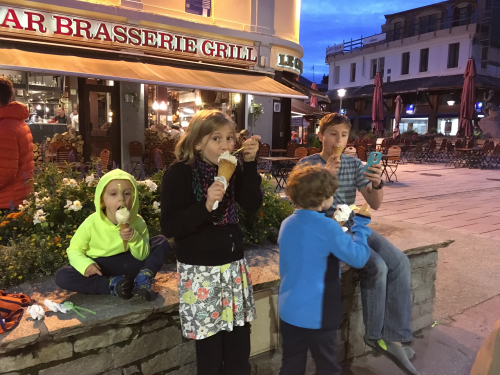
    hough the teen boys had to take it in turns, alternating with waiting outside in case the bags arrived. And then we walked into town for ice cream, except for the oldest, who stayed behind to keep the same vigil, but was brought a cone on the way back.


    (I had rhum raisins. And those raisins were really, really rhummy. Perfect. Although I think I spilled some on my new approach shoes.)


    + + +

    Not long after 10 the phone rang, and Mark thrust it at me, saying, “I think it’s about the bags!” I took it and said “Hello?” and was greeted with a bad connection, a static-and-gaps-punctuated stream of absolutely incomprehensible rapid French, with what sounded like the wind roaring past the window on the highway. I tried to reply. I told him I couldn’t hear him well. I asked him to speak more slowly. He didn’t slow down. I tried again and he hung up on me.

    “He hung up,” I said.

    “Call back!” said Mark.

    I called back and he picked up, sounding irritated. Something something — and a string of numbers that I thought might be our street address. Was he asking what address to deliver to? I ran and fetched the paper with our address written on it and repeated the address back. “Okay, okay,” he was saying, but then there was more. Was he out there trying to be let in at the automatic gate? I struggled to hear and understand, running barefoot outside, and finally I heard him say “SMS.”

    Which left me wondering why I didn’t think of that. “Oui, bien sûr,” I said, “ce sera bon, envoyez-moi un SMS.”

    He hung up, this time I did not call back, and a second later Mark’s phone pinged in my hand. J’arrive en 50m.

    “He’ll be here in fifty minutes!” I said to Mark, who was reading over my shoulder.

    “He’s just now leaving the airport, maybe,” said Mark.

    “I guess he was only trying to confirm the address.”

    I tapped back, slowly because Mark has autocorrect on and it kept “fixing” my French: Qqn vous attend devant le numéro 269. “You have two q’s in that word,” said Mark, and I irritatedly explained that it was an abbreviation for somebody.

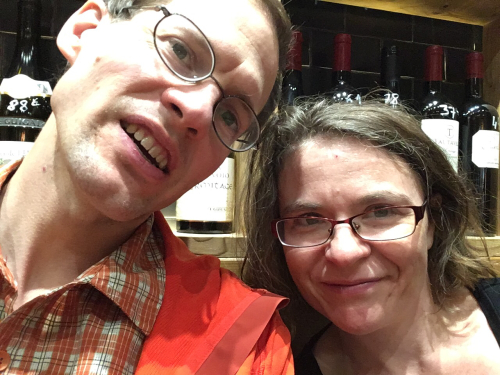
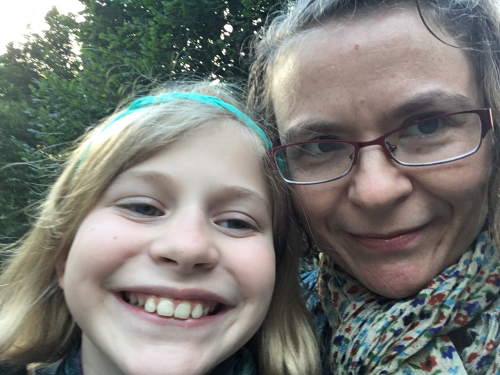
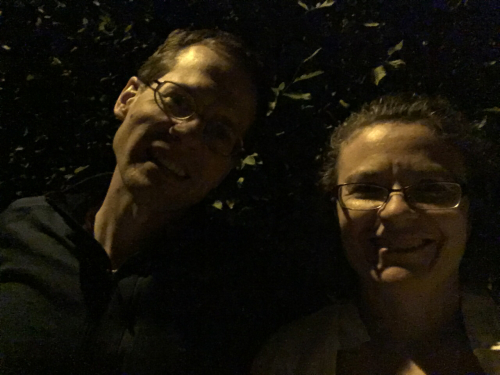
    So Mark and I sat outside on a bench and waited. And checked our phones for news of the hurricane. And took selfies.


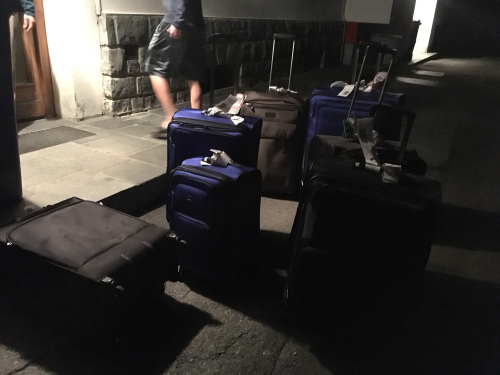
    And finally a van came up the hill slowly, and the driver stopped, and it was the driver we wanted to see, with all seven of our bags in the van. I apologized and explained that I was no good on the phone, and he said it was no problem, and I signed for the bags and Mark counted them, all there. Did we need help carrying? Non, nous avons deux grands fils, I told him, and indeed Mark had already texted the 17yo who was jogging down the long driveway to help us with our bags.


    We had to stay up at least another hour divvying up pajamas and toothbrushes and laying out climbing gear for the next day. And Mark and I finished the bottle of wine. And then, much relieved, we went to bed.


  • Day two: shopping and cooking, mostly.

    I didn’t take many pictures on Monday, but here is a brief rundown.

    i

    .

    Even before our luggage got delayed, we had planned to make a trip down the valley to the big sporting goods store, to buy some fleeces and jackets and shoes that we would take home. So, after coffee and breakfast (cereal for kids; plain yogurt with apples for me) we piled into our rented Citroën Picasso and hit the road.

    t

    The Decathlon is like an REI, except that the selection is a little smaller and the stuff is more affordable, though still well made. No fancy American brands like Patagonia or North Face; instead it is Quechua and XPM. Great kids’ clothes. We bought something for everyone: climbing shoes, fleeces, soft-shells, approach shoes, neck gaiters, water bottles.

    I bought underwear.

    And then we were hungry, so we ate in the little cafeteria that was attached. Panini with eggplant, tomato, pesto, and a couple different kinds of cheese for me and my 17yo, plus salads of cucumber, haricots, and tender lettuces. A thick, bready pizza with tomato and potato slices for Mark. The smaller kids were alarmed by the strange food; but there were Babybels in the grab-and-go case, along with mini baguettes. So they ate bread, familiar cheese, and fruit.

    The next stop was to be a sizable grocery store to stock up for the week. Mark suggested an Aldi, thinking that here in France it would be more like a normal grocery store; but no, it was as haphazardly laid out and oddly stocked as any Aldi at home. So I couldn’t get quite everything I needed, but I got most of it: milk, butter, cream, olive oil, cheese, cured meats, bread, onions, little yogurts, cereal, a cold rotisserie chicken, pasta, fresh pork cutlets, coffee, flour.

    Then after we got back to the apartment, Mark and I walked together to the Super U in town to buy a few remaining items. Carrots and celery, wine, fresh vegetables, little golden potatoes, parsley, mustard.

    We rested awhile and I finished my blog posts while Mark tried to get information about our suitcases (no luck) and tried to get our guided climbing rescheduled for later in the week (we were lucky there; another client wanted to climb in our prepaid slot, so the guide was willing to move us). Then I settled in to make dinner.

    I boiled the potatoes and tossed them with butter, salt, and parsley. I coated the little pork medallions in egg, flour, salt, and pepper, and sautéed them in a mix of olive oil and butter; then made a pan sauce with white wine, cream, and mustard. I steamed green beans and tossed a salad with vinaigrette and cubed, pre-cooked beets, then topped the salad with shaved apple and a few cubes of Comté on each plate.

    After dinner, well after sundown, Mark and I went out for a walk around town, looking in the shop windows, people-watching. We stopped in a wine bar called Bar des Sports, and indeed there was a television above the bar displaying a soccer match, England vs. Slovakia. I had the house Bourgogne, Mark tried the Rasteau (I didn’t know it; it turned out to be a slightly sweet, fortified red wine from the southern Rhône valley; mine was better) and we talked about soccer, and about the articles on the front page of the well-used newspaper lying there on the bar. Special edition for the rentrée scolaire (back to school): should the French copy these educational practices from other countries? The highlighted American was a high school student who said the most useful thing about his school was that he met with his guidance counselor every week. I am skeptical that this is representative.

    Back to the apartment, and back to bed. Clean in the morning,


  • Travel day.

    And we’re off!

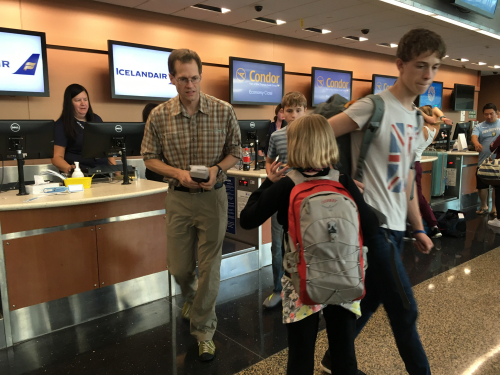
    Saturday we cleaned the house, piled up our twelve bags (six to check, six to carry on) and headed for the airport.

    My nerves were beyond jangled. I love traveling, but the parts that take place in the airport are my least favorite when small children are involved. Mark kept grinning at me and telling me everything would be fine, and I kept saying, “I will be fine when we are all on the plane. The second plane, come to think of it. And who has the 3yo?”

    One of the carryons turned out to be too big for Icelandair and had to be checked; before relinquishing it we pulled out two climbing helmets, a little backpack for 3yo, and spare traveling clothes for the two youngest children. In the end we checked seven rolling suitcases, packed with climbing gear, warm clothing, guidebooks, kitchen knives (yeah, I travel with the three essential kitchen knives now), toys, and shared full-size toiletries.

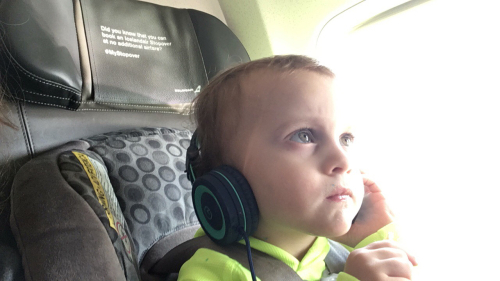
    We flew Icelandair, which was pleasant; it had a sleek Euro feel about it, and the option of watching Disney movies dubbed into Icelandic. I did this for a while (verdict: Brave is amusing in Icelandic, because of the Celtic accent, and because people shout “hvað!?” a lot) but then switched to reading and drinking wine

    Both activities went a long way toward de-jangling me.

    Once arrived in Reykjavik there was a disconcerting rush to make it to our connecting flight (always fun with a 3yo strapped to your back), but they held it for us and we made it onto the plane and to Geneva.


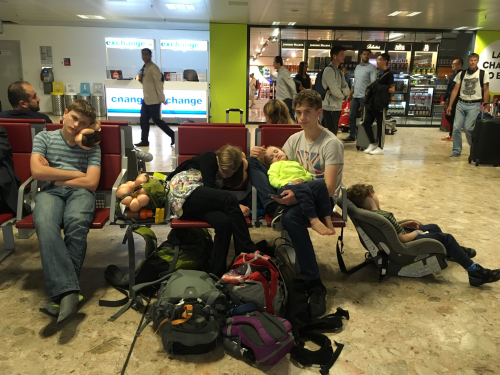
    The very worst part about flying with young children is the part in the airport where you wait for first your baggage and then the rental car. In our case it was especially long because the seven bags (including, you’ll remember, some stuff that we had planned on carrying on the plane) had not made it onto the connecting flight with us. Not a single one! So there was an interlude of waiting to talk to the baggage claim office.


    After nearly nineteen years of marriage, Mark and I work together quite seamlessly most of the time; we each have the roles we have settled into and know what to expect from each other. I supervise the three youngest children’s packing and he supervises the teen boys’. He makes sure we have all the gear, I make sure we have all the clothes and toiletries (and we check with each other at the interfaces of the categories, like “fleece jackets” and “sunblock.”) Normally, travel crises are Mark’s department. But it turns out that if the baggage claim people don’t speak English very well, he wants me to help. Fortunately our 17yo could watch over the bags and small children, who were not going anywhere.

    The Swiss airport agent conversed with me in a mix of French and English (I don’t know what the quality is that make some bilingual conversations work smoothly like that without slipping at the boundaries, but this one did; maybe because he was Swiss and probably had to deal with switching a lot). Icelandair had not perdu nos grandes valises, but knew exactly where they were, and they would be delivered, but no sooner than mardi soir. I remembered to turn to Mark and translate “Tuesday evening,” upon which his “relax, everything will be just fine!” mien cracked–just a little. (He had pre-reserved a climbing guide for us Tuesday morning and afternoon, and of course all the gear was in the checked bags.)


    Mark canceled the van transport by which we had been planning to move the teenage boys and some of our bags to the apartment (it would not all fit in the rental; European minivans are designed to carry people or cargo but not both). He bought wine at the duty free shop in the airport, a Swiss rosé, and then we schlepped everything to the train station attached to the airport, where we had been promised was a full grocery store.


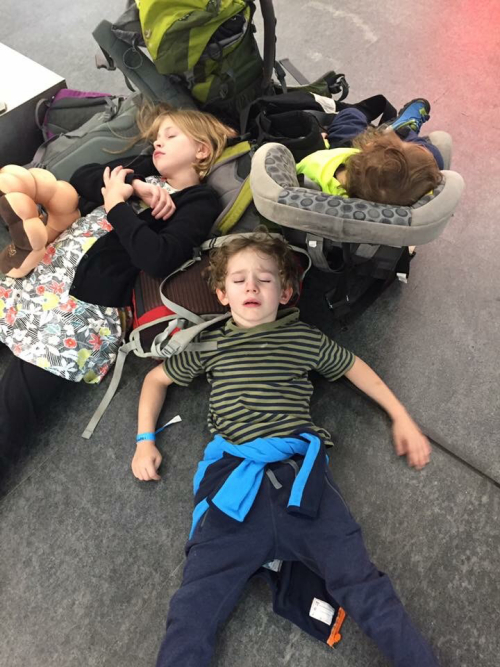
    The three smallest kids stayed behind, on the floor, with Mark and the oldest.

    I went in with the 13yo and we filled two shopping baskets with enough food for dinner and breakfast: Charentais melon and some pre-packaged apples (neither of which required us to navigate the self-serve produce scale), dried beef and jambon cru, a take-and-bake tomato focaccia, Saint-André and Comté cheeses, bread, butter, milk, yogurt, and jam, and of course coffee.

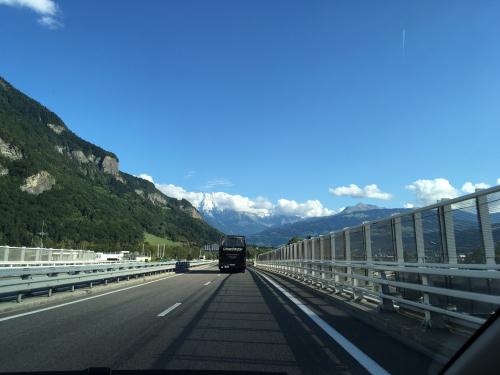
    We had another long wait before we got our seven-passenger van, which we had to locate in the rental garage by wandering around and pressing the unlock looking for the flashing headlights, and finally we were on the road.

    Chamonix is not very far from Geneva, so in only an hour or so we were pulling into a little gated driveway, and the caretakers were waving to us and welcoming us in to our apartment. Between my French and their English we came to understand how to access the weefee, how to find the washing machine, and how not to get locked out of the apartment by accident. But long before Mark and I had absorbed all that, the kids had gotten absorbed on their own.

    .

    I got dinner on the table as fast as we could and we devoured it. The star of the show, by far, was the Charentais melon, which didn’t surprise me at all; it is ripe, bright-orange, and deeply sweet without being mushy. But the smallest children were content to eat bread and butter and jam, and I was very inclined to let them.


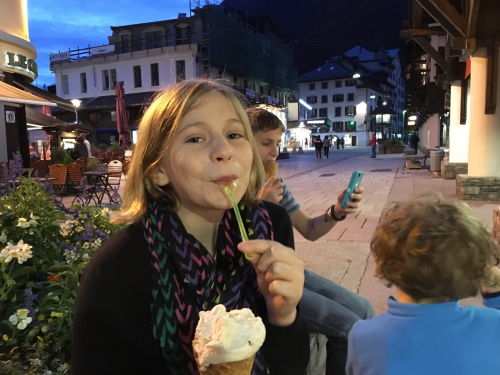
    Later we went out in search of glace, and ordered too much and got very full. And then we walked back to our apartment, me with Simon on my back, almost all the way uphill to the lift that takes you up the mountain.


    .

    And that was arrival day, Sunday.
    + + +
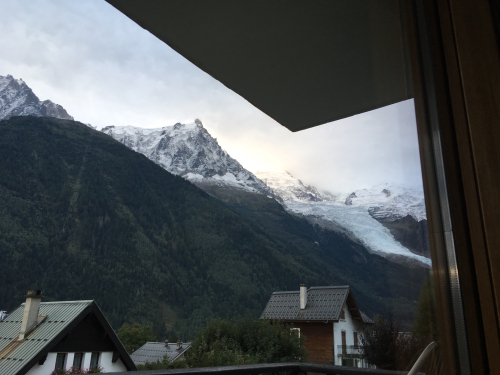
    Next morning I finally got enough coffee and drank it with this view out the window.
    I will have to end here for now…


    .

    .

    .

    .


  • Riverfront.

    One of my pre-trip errands was to stop at the Guthrie Theater box office to pick up some tickets that I’d ordered over the phone.

    It was sunny on Wednesday, and I left the kids at home with their to-do lists for the morning. I parked and put money in the meter, enough for thirty minutes, in front of the Guthrie, and went in and got my tickets; but on an impulse, instead of turning around and retracing my steps through the cavernous entry hall, I walked out the back door, where an expanse of green grass met me.

    + + +

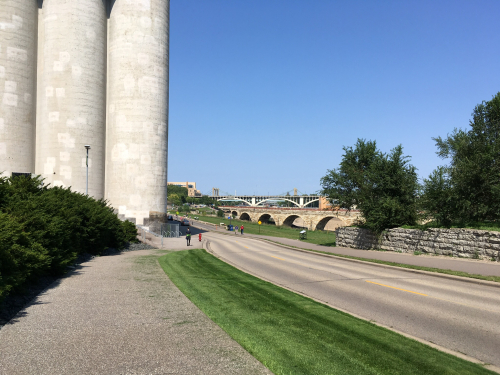
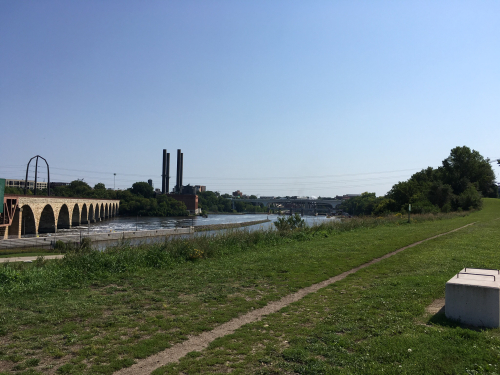
    The river, and especially the waterfall, is Minneapolis’s raison d’être. Flour mills and saw mills, and later hydroelectric power, all congregated here. There are still tall grain elevators; you can see the old Stone Arch Bridge that curves in a long arc across the river.


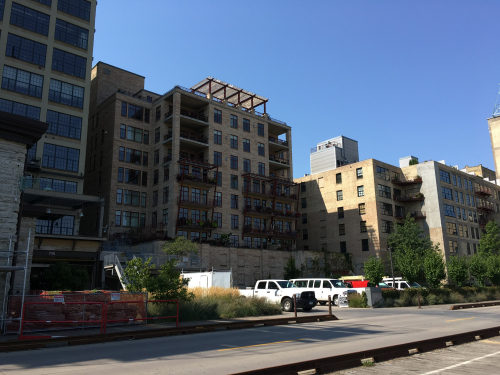
    A number of apartment buildings have gone in where warehouses and mills used to be. I admire this one with its red-painted balconies facing the river, most of them bedecked with plants and flowers. They look like good places to sit and drink a cup of coffee.

    The Mill City Museum, run by the Minnesota Historical Society, is built among the remains of what was once the world’s largest flour mill. If you ever find yourself in Minneapolis and want some local history, I recommend it; it is not too big, and it is very child-friendly, with a hands-on water lab (build the stone arch bridge across the river! make a log jam!) and a ride in the big elevator with a boom from a simulated dust explosion. Groups can have field trips that include a farm-to-table baking lab and recipe testing of chocolate chip cookies. The tour takes you through remaining parts of the mill, which famously exploded in 1878 and burned again finally in 1991.

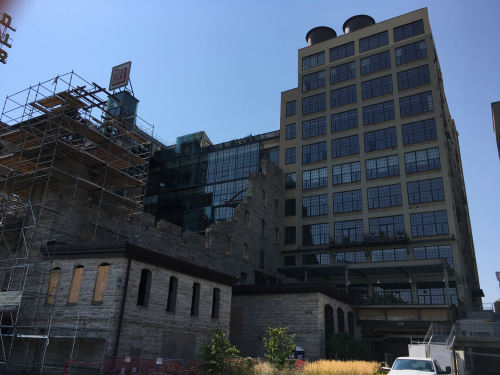
    Since then the historical society has turned the whole area into a park. In some places down by the river, walking trails wind around the crumbling limestone. The tallest mill remains, nearest the museum, are this summer covered in scaffolding, marked with signs advertising a masonry restoration firm.

    I walk a little farther and can see the observation deck on top of the museum, which I know commands a grand view of the riverfront. There is a group of children in matching bright tee shirts on top, jostling and waving. I wave back.
     
    The caution sign speaks the truth. Many pointy bits below.
    The “Pillsbury’s Best Flour” sign, on the other hand, doesn’t really, because it is owned by a developer who turned the building beneath into artists’ studios and apartments. The sign is a sort of Minneapolis landmark, along with a few other historic signs on the riverfront (North Star Blankets, Gold Medal Flour, Grain Belt Beer) and was refurbished a couple of years ago, so that it is lit up at night once again—now with LEDs instead of neon.

    Before climbing back up the steep street that leads away from the waterfront, I turned and took one last picture up the river, towards the rebuilt 35W bridge.

    This past summer the aforementioned Mill City Museum hosted an exhibit commemorating the tenth anniversary of the evening rush-hour collapse, which killed 14 and injured 145. They even one of the infamous inadequately-engineered gusset plates on display (photo at the link).

    I am kind of sorry I missed the exhibit. At the time, Mark (along with who knows how many other locals) usually drove across the bridge twice daily on his way to and from work; it was an upsetting afternoon. Fortunately, I learned relatively quickly that Mark had left work well before the collapse and was at the gym and not in the river. The twisted remains of the old bridge were left in place on the banks of the river for a disturbingly long time, even after the new and very sturdy-looking bridge went back up.

    Just a short break in the middle of a busy day to take in some of the views of my home city.

    Next: pictures from somewhere else, I hope.


  • Setting off.

    "Are you ready to go yet, Mom?  Are you ready?  Are you ready?"

     No.  No, I am not ready.

     And at the same time I am so very, very ready.

     + + +

     Remember how a few years ago we went abroad for a month, took all the kids to the French Alps and then down to Rome?   

     (If not, the first post is here, and you can page through subsequent posts at your leisure).

     So here is a piece of news I have been sitting on:  We are about to take another Big Trip With The Whole Family. 

      IMG_2991

     It's likely to be the last chance for such things, as our oldest is now writing college applications, and that's why it is now and not later. 

    + + +

    The first part of the trip is a return to the Alps, back to Chamonix.  It's my husband's favorite place.   Early in the late-summer morning the only sound that can be heard, besides little street-sweeping trucks, is the clinking and clanking of carabiners and ice tools hanging about the persons of people shuffling to gather coffee and wrapped sandwiches before heading up the mountain.

    Last time our big boys went with Mark and a guide for an adventure day of crampon practice and glacier climbing, and later for a long multipitch  climb on rock.  Last time I rock-climbed for the first time ever on a well-known crag outside of town, and had a great time.  Last time we attempted several "family hikes" that completely wiped us out but that took us through some of the most beautiful country I had ever seen.  Last time we met a family of expats who welcomed us into their home and became long-distance friends.

     I am not sure what awaits us this time.   Mark has been living with chronic back pain for years, which some months ago erupted to a new level — possibly because of a herniated disc which an MRI earlier this month has revealed, but you cannot really be sure–and left him unable to do any climbing or to hike while carrying weight.   So the trip will look different for him, and consequently for the whole family, than it did when we originally planned it more than a year ago.

     Change of plans.  We shall see.

     Even if it proves difficult for us to do the mountaineering-type activities that we originally planned, there are other things to do in the Chamonix Valley and on the other side of the Mont Blanc tunnel.  We enjoyed a day trip to Aosta last time, and didn't get to see everything there; there are many castles dotted throughout the Aosta Valley, some open for tours.  Lyon is a long but do-able 2-hour drive.  Simpler hiking that doesn't require us all to carry full packs is probably within our reach.  And some of our kids are determined to try parasailing, which is a thing you can pay people to take your kids to do, so there's that.

    Also there is wine in Chamonix, and a great deal of melting cheese.

    + + + 

    After a while in Cham we have a still-unplanned week which is tentatively devoted to driving somewhere in Italy and taking our chances.  Genoa?  Piedmont?  Not sure.  Probably no farther south than Genoa.  In any case we will return the car (van really — there are seven of us, after all) to the Geneva airport and fly… 

    …to London!

    + + +

    Having taken the kids to Rome, and wanting to do another Big Historical City With Plenty To Fill Multiple Days, we settled on London almost immediately.  

    London didn't settle on us, though.  We made a tentative trip budget last summer based on a survey of asking prices for AirBnB properties.   This budget was suddenly impacted by AirBnB's decision to force its hosts to abide by zoning regulations by limiting them to 90 days rental per year, which immediately decreased the supply and raised all the prices.  Besides the price increase, it took a long time even for us to find a property listing that wasn't a fake (we'd find identical photos used to illustrate multiple listings, or we'd contact an owner through AirBnB and then the alleged owner would email back with "ah, sorry, we've had a technical error, that property isn't really available on those dates after all, but if you send me an email at my other [i.e., non-AirBnB] email address I'll be able to show you a bunch of similar properties…").

    In the end it all cost a lot more than we expected.  But at just about the same time that we were having to accept that there was no way around the price increase, I received a couple of checks in the mail, part of the inheritance left me by my globe-trotting grandmother who had passed away in April.  I couldn't think of a better thing to put the money toward than traveling with our children, and I'm sure Grandma would agree.  

    So — that worked out.

     + + +

    London, then, for more than a week.  I have plans for myself.  The British Museum, of course — and Parliament — and the London Science Museum — and the Victoria and Albert.   The martyrs' shrine at a distance from the site it honors, Tyburn.  The Churchill War Rooms.  Taking the children to Kensington Gardens, and my lion-loving seven-year-old to see the statuary beasts keeping watch in Trafalgar Square.  A day in Greenwich, straddling the meridian.  Bletchley Park is supposedly an easy trip by train.   There's too much to have the lists all worked out in advance.  (I'm aware that I've left off a number of the Things You Must See in this paragraph — it doesn't mean we aren't going to go see them — I just have to stop somewhere…)

    I don't know what we'll do.  We'll just trust that it will work out.

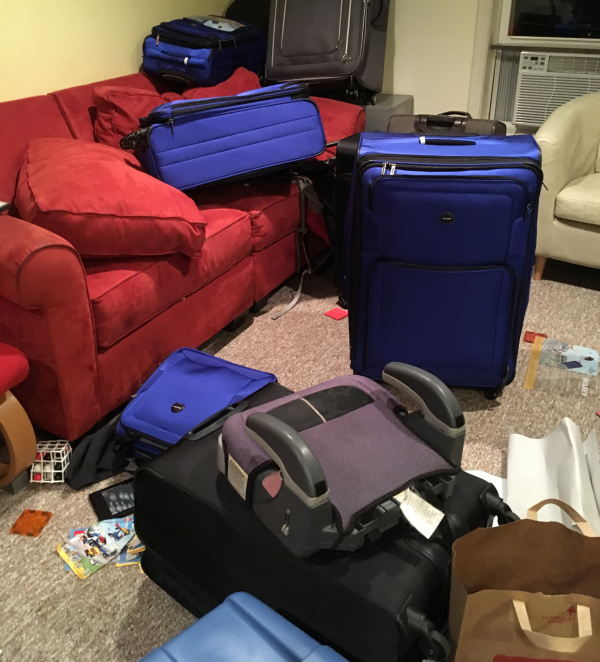
    Now if we could only get everything into these suitcases.

    IMG_2992


  • Other nerdy/sci-comm people’s takes on the eclipse.

    Just in case my own nerdy take wasn't enough for you:  I'm going to gather here just a few links to eclipse reactions from minor celebrities in the world of science communications (that's what I mean by sci-comm, of course).  

    If I come across more, I might add more.

    + + +

    Derek Mueller runs Veritasium, "a channel of science and engineering videos featuring experiments, expert interviews, cool demos, and discussions with the public about everything science."

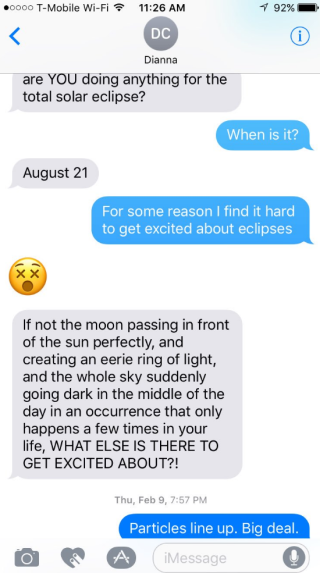
     Some months ago he had an exchange with Dianna Cowern of PhysicsGirl, which he made public recently via Twitter as "evidence of before and after."  Cowern is in gray and Mueller is in blue:

    Screen Shot 2017-08-24 at 12.42.31 PM


    "Particles line up. Big deal."

    Here's the Veritasium episode that he filmed during the eclipse.  Still no big deal?

    Mueller writes:

    As the moon passed in front of the sun turning day to night and revealing the sun’s corona, apparently all I could think to say was ‘Oh my goodness!’

     + + +

     My kids (and I) are big fans of Smarter Every Day, which is produced by Destin Sandlin.   Sandlin's best work involves high-speed videography, of things like jellyfish stings and exploding glass drops.  

    Before the eclipse he issued a couple of videos with tips about what to look for and photograph during the eclipse:


    Clearly, Sandlin didn't have the "no big deal" attitude, but he still wound up more excited than he expected.  Along with photographer Trevor Mahlmann, he traveled to the only location in the U. S. where it was possible to watch the transit of the International Space Station across the sun at the same time as the eclipse.  Here's his video — in which it is revealed that this extraordinarily precise camaraman was so blown away, he forgot to remove some of his lens caps.


    + + +

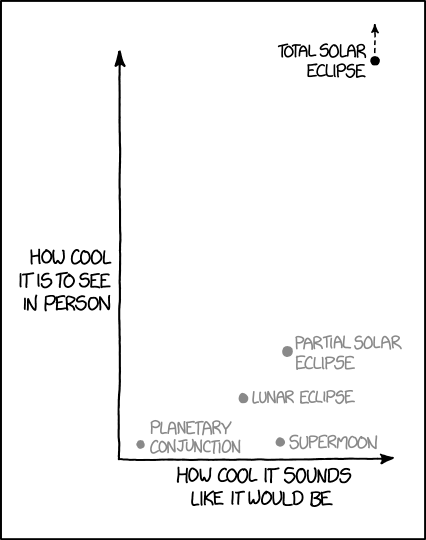
    Finally, here's the incomparable xkcd, drawn by Randall Munroe:

    Munroe's mouseover caption:  

    I watched from a beautiful nature reserve in central Missouri, and it was–without exaggeration–the coolest thing I've ever seen.

    I wasn't far away, and I agree. 


  • Totality: August 21, 2017.

    In March I suggested to Mark that we get a hotel reservation for August 20, 2017, in the path of totality somewhere, because I had heard that hotels were filling up.  Within a couple of days he had gone online, searched, easily found a couple of rooms in a motel northeast of Kansas City for $80 each, and reserved them without fanfare.   I think he may even have laughed at me a little for worrying that there would be nearly no rooms left, although he did warn me that they were not nonsmoking rooms. When we checked into that motel Sunday night, the clerk informed Mark that those rooms had only come available as a result of a computer glitch that incidentally left them underpriced for a two-day window, during which Mark had happened to log on.    That had been the start of our luck.

    + + +

    I was worried about disappointing everyone, about dragging the family down to Missouri only to see a cloudy sky; about thirteen hours of driving round-trip for a two-minute experience.   I was also worried about being trapped in a gigantic national traffic jam. I was following people on Twitter who had made three, four, six lodging reservations spaced along hundreds of miles of the eclipse path.  I knew people who would be in Tennessee, South Carolina, Wyoming.  Two weeks out I started watching the projected "sky cover" forecasts.  The center of the country did not look good.  But that was where our reservation was, so we would go there anyway and hope for the best.  

    "Maybe," Mark suggested, "we can get up in the morning, check the forecast, and drive to get away from the clouds."  I fretted, and I packed the car with 36 hours' worth of food and water.  

    + + +

    When I was a very small child I owned a paperback picture book called "Something is Eating the Sun."  I think I remember choosing it at Books & Co. in my hometown.  It was a riff on Chicken Little, a series of barnyard animals becoming increasingly worried about the bites being taken out of the sun's disk, page by page.  The last page warned readers against following the animals' example and looking directly at the sun during an eclipse.  

    When I was a bigger child (almost certainly on July 6, 1982, when I was seven) there was a total lunar eclipse visible from my street.  I remember being allowed to stand outside barefoot in the street after my bedtime.  I don't remember what it looked like, but I vaguely remember being disappointed that it did not look like something was eating it.

    I got older, and I learned about the solar system and the law of gravitation, Kepler's laws, the mathematics of ellipses, a bit of astronomy.  I learned about how the Royal Society made observations during the eclipse of May 29, 1919 that tested the theory of general relativity.  Total solar eclipses were a thing in the planetary domain that I had never seen but that I understood, the way I understood that the moon made the tides.  I had studied ebb and flow, neap tide and spring tide, the lag behind the moon and the slowing of the earth's rotation.  I had eventually been to the seashore and seen the water rise and fall, the moon's work between my feet and flowing cold around my ankles.  Someday, I might see a total eclipse too.

    I was a sophomore at Ohio State when I saw a partial phase of the annular eclipse of May 10, 1994.  The square courtyard between McPherson Lab and Smith Lab was full of people trying to look at the sun through Pop-tart wrappers and CDs.  I had no light filter and knew better than to look at the sun, but I could feel the temperature drop and see the strangeness of the light.  I stopped to sit down next to some shrubbery;  its shadow was spangled with perfectly identical crescents of light, an unexpected phenomenon that delighted me, none the less because I recognized the pinhole effect immediately even though I did not know to look for it until that moment.  No one around me had noticed the shrubbery shadow yet, and it felt for a moment like a private secret between me and the universe.

    That got me a little more interested.  And when I encountered Annie Dillard's essay "Total Eclipse," much later, I began to think seriously:  If I get a chance to experience an eclipse, I shouldn't miss it.

    + + +

    All this is to say that I knew what would happen.   I knew, too, that other people knew even better than me.  I know in the bottom of my being that the planets and the moons move in their elliptical orbits so simply and in accord with laws that are themselves so simple, that the locations and times of all the eclipses for hundreds of years in the future have already been mapped; so simple that indeed people have been predicting them for hundreds of years, before computers, before calculators, before pencils.  Eclipses are a tame thing, a trivia question, a child's picture book, a just-so story.   They may be rare, but they are a caged specimen.  A famous gem of the natural world. I knew everything about them.  I was even well informed, thanks to Annie Dillard, that they were an emotionally moving experience that was worth driving a few hours to see.  I get it, I get it; we'll go.  I knew it would be cool.

    Or so I thought.

    + + +

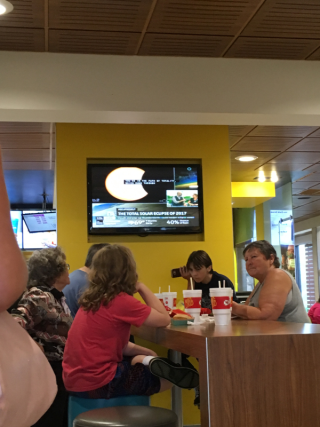
    Rain poured and lightning flashed in the morning in Kansas City.  We checked out of our hotel at 11 am and ran through the rain into a McDonald's, where patrons were watching the crescent sun on big screen teevees, a feed from the west coast where the eclipse had already started.

    IMG_2957  

    IMG_2956

    One hour and forty-five minutes to totality.

     The parking lot was flooding and the sky was leaden.  "At least we got to eat Kansas City barbecue last night," I was saying.  I was tense.  I had dragged the whole family down here for nothing.  

    Mark said:  "We'll check the weather radar and drive towards clear skies."

    I said:  "There will be traffic jams.  Maybe we had better stay put and hope that the rain passes."

    Mark grinned at me and said:  "You know what this is?  This is an adventure.  This is a weather-dependent activity.  I do these all the time."  And in that moment, I realized that whether we saw the sun or not, it was going to be okay.

     + + +

    Fifteen minutes later we were in the car.  Mark was driving fifty miles an hour in the pouring rain, twisting left and right between fields of tall corn, and I had a phone in each hand: one displaying the static, zoomable map of the totality path, and one tracking our little pulsing blue circle along the back roads northeast of Kansas City.  "Does this road go east?" Mark was saying.  "The skies are clearer to the south, but the car says it's going east."
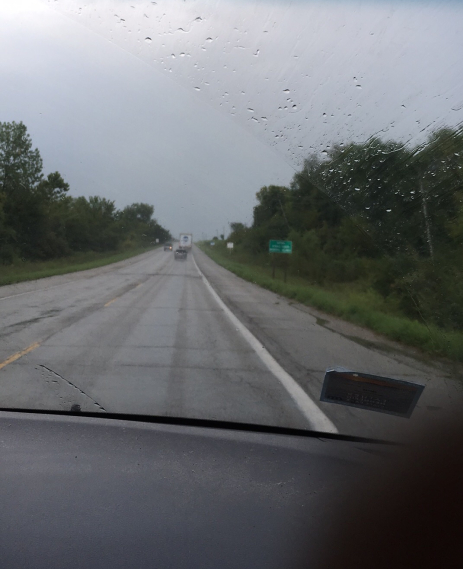
    IMG_2958

    One hour and twelve minutes to totality.

    "It goes southeast," I repeated through the thunder of the rain on the roof of the car.

     "The car is going east–"

    "It zigzags.  On average, it's southeast.  We have to stay on this road to cross the river."

    Our oldest, from the back seat, with a third phone open to live weather radar:  "After we cross the river we need to cut west."

    "West?  Really?"

    "West!  After we cross the river."
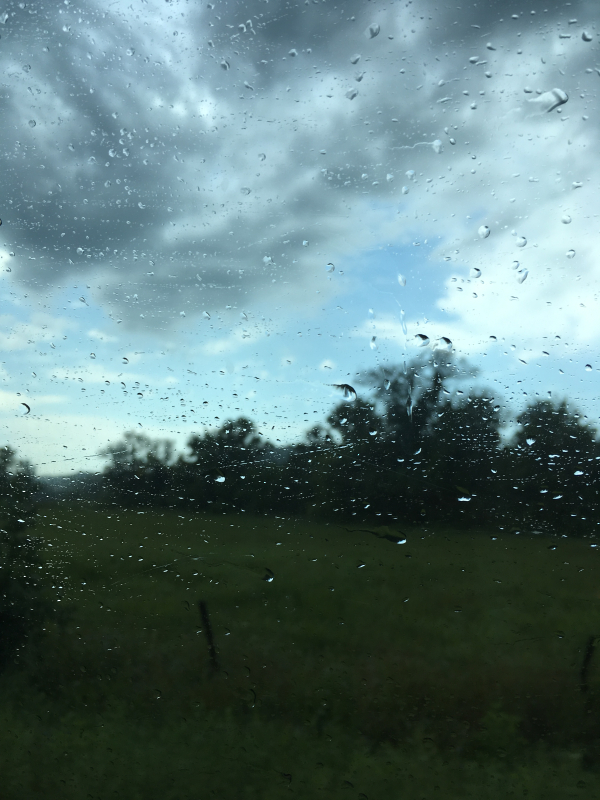
    IMG_2959

    Sixty minutes to totality.


    There was a patch of blue sky, and Mark made for it.  Amazingly, there were not a large number of cars on the road with us.

    We came out of the rain.
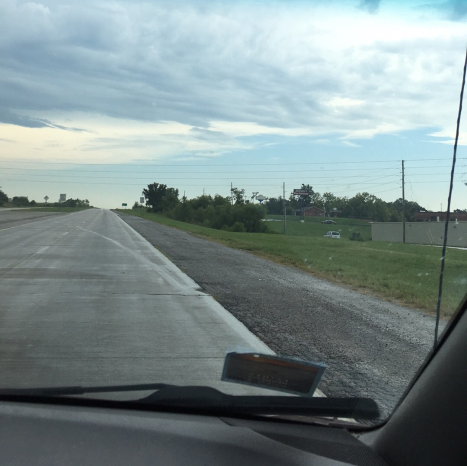
    IMG_2960

    Fifty-three minutes to totality.

    "GO GO GO" I typed into Facebook.  A friend under blue skies in Tennessee replied:  "It's like Twister in reverse."  It was.  We were chasing the edge of the storm from the inside.  I documented our location (Lexington, MO):

    IMG_2961

    Forty-three minutes to totality.

    Blue skies were ahead.

    + + +

    "Let's stop here."

    "We've got time."

    "Look, there's space at this crossroads." 

    "We can get farther."

    And then we passed a little driveway into a pasture, with a little chained gate a few yards from the road, and a pond on the other side of the gate, and Mark said:  "That's where I'm going to stop.  He pulled into the driveway of a bed and breakfast that was the next mailbox down, turned around, and went back to the little driveway and pulled in.

    I got out of the car and I saw my shadow:


    IMG_2964

    Twenty-five minutes to totality.


    IMG_2963

    The sky.


    + + +

    We set up telescopes, and pulled out our eclipse glasses embedded in paper plates for safety, and I looked up at the crescent sun and I realized that it was really going to happen.  The children were positively leaping.  
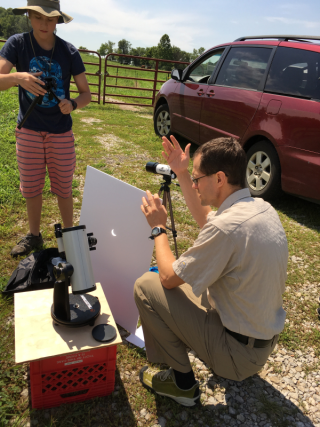
    IMG_2965  IMG_2966   IMG_2969

    We put the three-year-old in the van for safety's sake, partly so he would not look at the sun, but mostly so he would not wander into the road.  And we looked up, and stopped taking photos, and waited.  

    We felt it get cooler.  We saw the light going all wrong, and I saw Mark laughing:  "This light is crazy!"

    "It's like a tornado sky," said my daughter.  I agreed, it was like that.

    The crickets began to sing.  The children exclaimed over the shadow bands rippling in the road.  I stood next to the van door so that I could keep some attention on the three-year-old.  I watched the crescent get smaller through the eclipse glasses.  This was so interesting that I forgot to look around at the deepening sky, or look to see the great shadow coming.  I watched through the eclipse glasses until the light was completely gone and the children started shrieking.  Then I looked.

    + + +

    I had known what was going to happen.   And… I had not known.   What happened to me was this:  

    I staggered backward, two, three, steps, staring at the sky.  I'm not sure if I was recoiling, or backing up to try to take it all in — either way, something crazy that couldn't make sense, because there is no way to get farther from the sky.  "Oh, my God," I was saying, over and over again.  

    Yes, I could see the corona, ghostly in the blackness, and Venus down and to the right.  Yes, I could see the ruby-colored sparkles around the black disk of the moon.  Yes, it was beautiful.  

    It was not like seeing the tide rise and fall according to the tables.  It was not like knowing that general relativity had been proven correct.  It was just like the photographs, and yet it was nothing like the photographs.  It looked just like the photographs, but standing there between a pasture and a cornfield, in the chilly midday of August, was not 

    I know some people say that it was like a religious experience.  It was not like that for me.  A religious experience is a sense of communing with the supernatural.  I am kind of familiar with those, oddly enough.  This was new.  It was a natural experience.   And it was making tears well out of my eyes.  

    "Oh, my God," I kept saying.  My 13-year-old son kissed me on the cheek.  I became aware of someone standing close behind me, grasping my bare upper arms in his warm hands.  I remember deciding that it was probably Mark, but I could not tear my eyes away from the moon and the sun.  

    + + +

    The first thing I came up with to try to explain the experience was:  Have you ever seen videos of audiences from the Beatles' tour of the U. S. in 1964?  The young women weeping and dropping to their knees upon catching sight of the stars?  I always wondered what on earth would make people act like this.  But having seen the eclipse, I think it was a little bit like that, an extremely nerdy celebrity sighting.  I am a science nerd.  It is essential to my being.  Total solar eclipses are celebrities, rare celebrities, a thing that I thought was tame but that has tamed me, apprivoisé, a thing I know like an old friend, like Fibonacci's sequence, like the digits of pi, like the hydrogen atom.  

    And there it was right in front of me!  A thing I'd hoped to see for my whole life, but not ever allowed myself to long for, because maybe I would never attain it.  And now I was face to face with it, and I knew — knew – it was something worth longing for.  Had always been.  And I was, in fact, weeping at the sight, and my knees really were weak.

    + + +

    You can study the biology of human gestation for your whole life, become an expert, do original research, earn a medical degree, a Ph. D., see patients, weigh evidence, make predictions, feel the satisfaction of measuring the outcomes and watching them come true.  Knowledge is valuable.  And yet:  it is not a substitute, never can be a substitute, for bringing your own child to birth.  It's not the same.  

    You can know everything that's going to happen, and everything can progress exactly as you expect, and then experience knocks you back, with something you didn't even know was there, something beyond knowledge, something that ties you to every other human on the planet who has ever experienced the thing, and forever separates you from those who haven't.

    And they don't know either, any more than you did, in the time before.

    + + +

    The second thing I came up with to describe the experience was:  It was less like an event than it was like a feature, like the mountains and the sea are features of our planet, but this is a feature of the solar system instead, the first feature I ever really got to see.   Oddly enough, the starry night sky seems also to be a feature of our planet; even though it is located outside the planet, it looks the same all the time; we can look in different directions from here, but the view is essentially the same.  The planets moving against the sky is a little like this, but you cannot really watch it happen because it is too slow.   

    Our planet has some very beautiful features.  Before Monday I often said that the most beautiful place I have ever been is the Alps above the Chamonix Valley; I said that the first time I went there when I was in college, and I said it again when I returned with my husband and five children twenty years later.  I have seen and heard other beautiful features:  certain birds and jellyfish, certain beaches at sunrise, certain echoes of laughter ringing in columned arcades, certain cleverly shaped and polished stones.   The total solar eclipse is like that:  a thing worth traveling to see, all by itself, but it's not of this earth, it's of something larger, it's of the sun and all its orbiters, including me.  The limited slips of time in which it happens, well, that's just part of the directions to get there, they're simply directions that include both time and space.

    I will be back in the Alps very soon, and I somehow think it will no longer be the most beautiful place I have ever been. 

    + + +

    If there's one thing I perceive intellectually more than I did before, it's the tremendous gift given to us at the formation of the solar system, the gift of a moon that is, sometimes, the same size in the sky as our sun.   Much larger or closer and it would cover up the corona; much smaller or farther, and we would never have totality.   It did not have to be that way, and it is, for no particular reason; it just is.  A gift.  Everything that is beautiful is a gift, but knowing it increases its beauty.

    I knew that, but I know it more now, and I am truly grateful.

    + + +

    It was over fast, and the light came back, and the shadow bands were streaming over the road, like the shadows of clouds, but impossibly fast.  And we threw everything in the car and raced to beat the traffic going home on I-35.

    The memory of those two minutes and nine seconds is truly dreamlike; I remember the feeling, the shock, the staggering backwards, the tears, reaching my hand out to the van to steady myself.  One of the strangest parts of the memory is the way I realized that Mark was standing behind me and holding me:  that I hadn't even noticed him coming up to me and putting his hands on my arms, the way he seemed to came out of nowhere, the way I had become aware of that sensation without really being aware of what it meant, or who he was, or thinking, really, about anything at all.

    Astonishment.  Pure astonishment, and a sight, and even now I can barely remember the sight, but in a breath I can remember the way the astonishment took hold of me.  I can relive it, sometimes, not by watching videos of the sun disappearing, but by hearing audio of the crowds gasping and stammering, the way I gasped and stammered.

    Will it happen again, if I travel to see another one?

    I don't know.  I will find out, I hope, in 2024.


  • At the risk of accusations of virtue signaling.

    It's just possible that not signaling opposition could be taken as signaling collaboration.

    So.

    1200px-Modern_British_LED_Traffic_Light

    + + +

    (1) Neo-Nazis, Classic Nazis, white supremacists, white nationalists, the Confederate flag, swastikas, and anti-semites are wrong and indefensible.

    (2) There is no "both sides."  People who showed up to resist and protest Nazis-and-their-friends were on the right side of the Nazi question, not on the wrong side.

    (3) Even when Nazis and those who are content to march with them have permits, they're wrong and their ideas are anathema.

    (4) Even when Nazis and their friends get punched before throwing any punches, they're wrong and their ideas are anathema.
    (5) There is no equivalence.

    (6) I knew Donald Trump was a disgraceful human being before the election, and to my amazement he keeps revealing that he is even worse than I thought he was.

    (7) Whereas I concentrated my rhetorical efforts before the election, such as they were, on trying to convince those conservatives who thought they were obliged to vote for Trump to vote 3rd-party instead — trying to help people, especially well-meaning Christians, see that they would do better to move from the pro-Trump column to, at least, the Pox-On-Both-Their-Houses column;

      and whereas, at minimum I tried to show them that they were free to choose, in the face of a disturbing amount of pressure from people claiming that nothing but a vote for Donald Trump would satisfy the Almighty;

    and whereas,   I stand by those efforts today, wishing Trump had lost by more in Minnesota, but rejoicing that he did not, at least, take this state;

    … I understand that people may have done the best they could with their vote given the information they had at the time.  Heck, that's my only defense for throwing my vote to a third-party Hail Mary, after all, when arguably I should have voted for Clinton (I had many discussions with people on this topic and went back and forth quite a bit).  But: If you're still standing by Donald Trump, I don't have much to say to you.  It's better that I say nothing, for now.

    (8) The fact that there are still Christians carrying water for this immoral, unbalanced, self-obsessed, small-souled, white-supremacist-appeasing human being fills me with more sorrow than I can describe.  Not surprise in many cases; but in all cases, sorrow.

    (9) You will never, ever achieve a win for life by allying yourself with dealers in a philosophy of death.  Never.  No politics of pragmatism can ever justify it.  Any apparent success will be fleeting and hollow, or will be expiated at the cost of souls.  I believe we are watching it play out now.

    (10)  Conservatives need to clean their own damn house.  I'm uncomfortable with the label "conservative" and don't belong to the GOP, but the fact is that I've voted for GOP candidates, though not every time, much more often than I've voted for Democrats or independents since I became eligible to vote.  So this is, in part, my own damn house to clean.  And this is me saying:  This mess is unacceptable.  No, this is me saying, perhaps rather than rolling up our sleeves and getting back to work, we would do better to set this house on fire and start over in a new place with a new foundation, with fewer rats and roaches.   Perhaps it hasn't gone quite that far yet, but it's getting close.

    President Donald Trump should resign.  Failing that, the cabinet and Vice President should act to remove him under the 25th Amendment.  Failing that, the House should move to impeachment.  Failing that, the GOP in both the Senate and the House should vote to censure the President publicly.  

    Tear him down.

    Don't wait for the light to change.


  • Yesterday changed my mind.

    First, the obvious caveats:  I am white and, to be blunt about it, wealthy.

    Second, the less obvious caveats:  I have always lived in the Midwest, primarily in cities, and have never lived in the South except for a few months' internship at a chemical plant in small-town Kentucky.

    + + +

    Confederate flags flying as part of, or next to, state and municipal government flags are awful.  A flag is what you decide to fly to represent yourself right now; you make a decision every morning to haul it up the pole in first light.  If it's a reflection only of your heritage, then it's a reflection of the parts of your heritage that you feel are banner examples.  Thus:  Flying a Confederate flag or an image of one is an implicit endorsement of, or expression of fondness for, the Confederacy.  Full stop.  They don't belong in the government display of any U. S. State.

    + + +

    I had a different opinion about Confederate monuments and memorials.  A monument and a memorial are placed by the people of one time to represent themselves to the people of the future.  My opinion was that it would be better to leave them in place.  

    Not because I disagreed with the desire to root out the ideology of enslavement and dehumanization that put the monument there, and for which the memorialized combatants fought and died; the desire to take them down from a place of figurative and literal elevation.

    My reasoning:  
    I thought that it would be a kind of whitewashing that would someday allow the descendants of the monument-builders to pretend that it didn't really happen.  To pretend that the ordinary white Americans who lived and shopped and worked in the communities around those monuments were not participants in the ideology of enslavement, did not really support politicians who openly advocated white supremacy, were just following orders, were themselves victims of oppression (economic, gender) and all the rest of the tired old excuses that never go away.

    No, the monuments were proof that the people with the power to make monuments—and the docents love to tell the story, when the monuments have been built not just by the grand benefactors of the day but with children's pennies and young housewives' pin-money—that the people who built the monuments wanted us to know this about them:  they mourned the slave system, along with the men who died to protect it.

    I thought it was better that we had that proof, where it could stand out in the open and in the center of the town, shat upon by pigeons and washed by the rain, so we couldn't deny it now or in the future.

    + + +

    But this wish was supported by a certain failure of imagination:  the idea that people of all sorts would mainly, and increasingly, see in them what I see, monuments to shame, complicity in the promotion of a truly disgusting set of ideas, and participation in an untold list of violations against the dignity of human beings and of family life.

    I didn't really expect them to become once again popular rallying points for people — violently or without laying a finger on anyone — who are openly carrying the flags of America's defeated and nearly universally reviled enemies.

    Failure of imagination.  Yes, I'll raise my hand:  I am a fool for not anticipating this.  I know about systematic racism.  I know about overt racism and that it still happens even though I am insulated from it.  I've got my own sins and to the extent that I know them I am ashamed.  I have been silent when I should have spoken, when to afflict the comfortable would have meant to afflict myself too.  I have been a coward.  

    Failure of imagination.

    + + +

    If this is going to be a thing, now and in the future — and it seems that we have no kind of guarantee that it will not;

    If Confederate monuments and the graves of fallen soldiers are to be a rallying point for swastika flags and chants of "Blut und Boden";

    If anti-Black and anti-Jew and anti-immigrant cheers are to rise from crowds, encircling the bronze hooves of poor effigied horses bearing graven images of white supremacy on their backs;

    then tear them all up, and shove them every one–the more beautifully executed and artistic, the more damning, because white people really did pour their creativity, their resources, and their capacity for beauty into memorials to crushing faces with boots–shove them all into the museums, where people with sense can make rules about maximum occupancy, noise levels, and weapons.

    I thought we needed to have it all out in the open, where we would all be forced to reckon with our past.  It turns out that we are not wise enough or kind enough as a people to handle it.  We must, it seems, put them under armed glass after all.

    DHCaO6rVoAAzCGc


  • Repost: The lack of checklists.

    This is a repost from October 2014.

    + + +

    Recently a friend of mine asked me if I could recommend any books for someone who was struggling with scrupulosity — in particular, the Do I Have A Sufficiently Serious Reason To Delay Pregnancy sort of scrupulosity, mixed with depression and struggles with anger and being overwhelmed. I wanted to help, so I put some thought into it.

    Longtime readers will know of my irritation with the tendency of some corners of the Catholic internet, lacking any actual lists of rules from the Magisterium, to write their own rules for what constitutes a Serious Reason and then disseminate them.

    My position is that those entrusted with the teaching authority of the Church, as well as the inspired writers of Scripture, knew what they were doing when they didn't, for example, add "subclinical depression isn't a good enough reason to watch your fertility signs" or "if only one spouse is sure that it's a good time to try for another baby, the other one should get in line." The fact that the Church has declined to give further guidance beyond generosity and the good of the family, is itself a kind of guidance: a signal that discernment about family size and childbirth timing belongs not to theologians and pastors, nor to doctors and therapists, nor to social media friends and Twitter, but to a well-formed married couple themselves — and no one else.

    I couldn't think of any books that I could recommend through experience, although I found some promising titles via Google. I know of a number of web-published articles and blog posts that make the case for backing off from pressuring others with the so-called Grave Reasons and minding yer own business, but as it was of course web-published articles and blog posts that helped convince my friend's friend that her own struggles were not bad enough — that she was not good enough, and if she could only be better she could handle everything, and maybe the first step towards being better was to take on more and more and more — well, I wasn't sure that piling more websites, no more authoritative than the others, would help.

    So I suggested working on recognizing scrupulosity in general, and left it at that.

    + + +

    Later on this week it occurred to me that there is another sort of commandment — one that is much, much more fundamental to the Christian life than anything having to do with married life, since it applies quite strictly to everyone of any age and state of life — that, despite its importance, is similarly light on the details.

    We all know we've got to do it. In a very real sense our salvation is said to depend on it. But no one — not Christ's words in scripture, not the Catechism, no papal teaching document, no synod — has ever told us exactly how to do it, or how to know when we've done it, or given us a checklist of features of successfully practicing it. And yet this virtue, this activity, is not something that is purely spiritual or invisible; like generosity in the service of life, it plays out in the arena of real contact between real human beings, and if we invite it in, if we practice it, somehow (but no one will tell us how, exactly) it will change the course of our days.

    I am speaking of forgiveness. We know it's always necessary: Jesus said himself that we can't be forgiven unless we forgive. We know it must be offered again and again, without practical end; that, at least, is what the exegetes tell us that "seventy times seven" times means to say to us.

    But beyond the teaching that we have to do it, and that we are never allowed to give up doing it — we are not told what we have to do to be forgiving.

    How can we ever forgive enough? There is no "enough," because our model of forgiveness — just like our model of life-giving generosity — is God Himself.

    There is only what we are called to do. And because it is a matter of a call, no one can figure that out for us. We have to discern on our own.

    + + +

    Let's talk extremes: Almost nobody (unless they are trapped, themselves, somehow) believes that the injunction to forgive means that a physically abused person must go on putting himself or herself in danger of more abuse. We don't say that there is a limit on forgiveness; rather, we advise that forgiveness doesn't require the risk of being harmed by a dangerous person.

    And yet… all forgiveness means some level of risk and vulnerability (otherwise we wouldn't have to remind people to do it). And so there is always the open question of how much vulnerability we can create before we have forgiven.

    The question is open. There is no checklist.

    "If your neighbor commits such-and-such a crime against you, and then he apologizes and makes restitution, forgiving him means declining to press charges. But if your neighbor commits such-and-such a different, particular, crime, and then apologizes and makes restitution, forgive him some other way while you still press charges." Nope. We don't get advice like that.

    "If you lend money up to $X and the borrower never pays you back, forgiveness means that you stop demanding the money and you should be willing to lend to that person again. If the unpaid amount is between $X and $Y, forgiveness means that you stop demanding the money, and don't think of it again, but probably you should not lend to that person again. If the amount is between $Y and $Z, it is permissible to take the borrower to court for the money, while forgiving the borrower in your heart…" Nope. We don't get advice like that.

    "If a family member hurts you in such-and-such a way, forgiveness means that you tell the person of your hurt and then never speak of it again, and not gossip to other members of the family, and keep going to visit the relative who hurt you, and send Christmas cards, and the like. If a family member hurts you in a different way, forgiveness means that you keep silent about the hurt, keep visiting with that person, and learn to change the subject when necessary to avoid the topics that lead to people saying hurtful things. But if a family member hurts you in such-and-such a different way, it's okay to separate yourself completely from that person and quietly work on your own anger issues without subjecting yourself to further mental abuse, and that is what forgiveness means in that case." Nope. No specific advice.

    Look in the encyclicals all you want. Read the Bible as much as you want. There is no algorithm.

    But isn't this dangerous? Aren't some people going to feel trapped by the injunction to forgive, trapped in cycles of self-hatred, trapped in abusive relationships, trapped by toxic family members demanding what they have no right to demand?

    Yes. It is dangerous. And people are trapped in this way.

    And yet it would be dangerous in a different way if we were given such an algorithm, because we would none of us have any room for discernment — for working out the best way to forgive in a specific situation, with specific human beings.

    We have a Church, not a clinic; we have a Teacher, not a Diagnostic and Statistical Manual; we deal with disordered human persons (including ourselves), not with disorders. We have to judge the situations that we are in by looking at the needs of the people who are affected by the situations. We as individuals are the only ones who can see the details of our surroundings. A predictive, exhaustive flowchart (if P then Q) would, I presume, hobble us; leaving no room for a flowering of authentic human forgiveness, it would tempt us to go just so far and yet no farther.

    It might serve as an excuse to limit forgiveness, by telling us when we had forgiven "enough."

    Forgiveness comes in different shapes, and we have to see the shape it will fit into, in our hearts and in our relationships, and work over and over again to more fully fit it into its place. But it isn't ever done and isn't ever enough. The nature of forgiveness, like generosity, is a nature of readiness-to-serve; never saying "I am done," but instead always ready to be called to do something more.

    What that something may be, we apparently have to figure out on our own, for it to be forgiveness and not some other thing — maybe, a good thing, but something else.