bearing blog


bear – ing n 1  the manner in which one comports oneself;  2  the act, power, or time of bringing forth offspring or fruit; 3 a machine part in which another part turns [a journal ~];  pl comprehension of one’s position, environment, or situation;   5  the act of moving while supporting the weight of something [the ~ of the cross].


  • Messaging vs. mercy, and the principle of double effect.

    I've been writing about mercy recently, spurred on by the quote-meme my friend posted on FB a couple of weeks ago.  I'm at the point where I think I need a hypothetical situation to analyze, a situation where one party stresses the importance of the message "this person is very wrong and we are right," and in the process utterly–and needlessly–fails to display a loveliness that might draw anyone in.

    Let's call this situation "the pregnant student at the Christian school," a situation that must happen far more often than it makes the news.  Here are the features of this hypothetical:

    • A girl attending a private religious school, which may or may not have a written moral code forbidding nonmarital sex, becomes pregnant.
    • When school officials learn of the young woman's pregnancy, they either expel her or punish her by removing her access to certain school functions.

    Here are typical arguments put forward by defenders of such a punishment policy:

    • The school has a moral code, written or unwritten, to which the family agreed explicitly or implicitly upon enrollment; the pregnant girl has clearly violated said code; the punishment is justified.
    • The policy is not sex-discriminatory because the school would of course punish in the exact same way a boy who fathered a child, if the mother decided to carry to term.*
    • The girl's education is not being restricted by anyone; she has lost nothing to which she has a right, only privileges.
    • The school's intent is not to punish, only to prevent her from being a scandal to other students.
    • The school's intent is not to punish, only to prevent her from representing the school to the community.
    • The school claims to be acting in the pregnant girl's best interest.
    • The school claims that they must punish her because otherwise the school would be teaching the falsehood that nonmarital sex is permissible, something they may not do even for good reasons.

     + + +

    I oppose the punishing of students for pregnancy at Christian schools.

     This won't surprise you, I think, but I would like to offer some analysis that goes beyond the two obvious reasons (namely, "punishing students for being visibly pregnant encourages abortion" and "punishing students for conceiving children is de facto unfair to female students.")  These two concern justice alone, and I'd like to move beyond justice to mercy.  

    But again:  don't get hung up on the specifics.  The whole reason I bring this situation up is to move back out to general principles that can guide us in other situations of messaging vs. mercy.  So let's begin.  I can think of several principles at work here, moving from the specific to the general.   All of them at least permit the school to decline to punish the pregnant student; I think they all argue against punishment, too.  See what you think.

    In the following I draw on Catholic sources to back up my doctrinal arguments, but I believe them to apply broadly.

    + + +

    (1) No pregnancy is a scandal.

    Scandal is a technical term; it is defined (CCC 2284) as "an attitude or behavior which leads another to do evil."  

    There's a bit more to that:  people are guilty of scandal if they "establish laws or social structures" which degrade morals or religious practice or which make it "difficult and practically impossible" to obey the Commandments and conduct a Christian life (CCC 2286).

    Pregnancy cannot in and of itself constitute a scandal for a very basic reason:   it is neither an attitude nor a behavior; it establishes nothing.  Rather, it is a biological state which naturally progresses to its end.  


    Furthermore,

    (2) An unmarried woman's pregnancy is not evidence that she is in violation of any life-affirming moral code.

    Simply put, the pregnancy is not sufficient to "convict."  You can hem and haw all you want about likelihood and about gullibility and about these kids today, but it is true: a girl's pregnancy is not evidence that she is in violation of any life-affirming moral code.

    • Sexual activity is not always freely chosen.  The fact that a pregnancy is in progress says nothing about whether the pregnant young woman exercised full freedom in the sexual act that resulted in the pregnancy.  And there are degrees of freedom, coercion, and competence
    • Even if freely chosen, sexual activity that is (by Christian standards) illicit has the same character as any other sin:  its guilt can be absolved via repentance and (for a Catholic) the sacraments.  Pregnancy says nothing about whether the pregnant young woman is in a state of grace.
    • It would  be a grave violation of the  student's dignity for a school official — in fact for anyone who is not her parent — to attempt to coercively extract from her a confession about the freeness of her choice, the degree to which she regrets or repents her choices, or the identity of any persons who have had sexual contact with her**.  If she freely seeks the sacrament of confession–which she cannot be made to seek — then she is protected by the seal of the confessional.

    Objection:  "But the pregnancy is only part of the picture — can't there be additional evidence that proves the student is in violation of the moral code?" 

    Reply:  Sure, this is a hypothetical, so we can imagine more information.   A student might brag about bad behavior (not just sex; could be drug use, shoplifting, bullying), or get caught in a banned activity, or be overheard pressuring other students to misbehave, or parents could choose to bring problems to the school's attention in an attempt to get help.   But if you've got any of that, a pregnancy doesn't add any information relevant to "Should we punish this girl?"


    (3)  All Christian ministries, including schools, can distinguish between the people they serve and the people WHO serve.

    What I'm getting at here is the notion that a pregnant or parenting student is disqualified from school activities because she cannot represent the school the way that the school wants to be represented.   The ministry of a Christian school is to provide a Christian education to the young people who are enrolled in the school.  The students do not bear the burden of "representing" the school.  The school is represented by its board, its officials, its employees, and its volunteers:  grownups.    

    Schools sometimes tell young people that they are "representing" the school when they travel outside of it for extracurricular activities, and so they should be on good behavior.  This is faulty reasoning.  They should be on good behavior because good behavior is good.  They should practice good behavior as a student because that is how one learns to behave.  It's not for the institution's benefit that the institution teaches good behavior, but for the clients of the institution:  the people served by its mission.

    The real representatives of the school are the adults who serve students through the school.  The school protects its identity in part by vetting its employees and volunteers for their commitment to the institution's mission.  

    Even extracurricular activities are means by which a school serves the children it is teaching, not means by which the children are meant to serve the school.  An institution does not need to require correct moral character of the people it exists to serve; it does need to require good moral character of the people doing the serving, because that is how it ensures good service that is aligned with the mission.  Unless you want to come right out and say that your mission is only to serve people who are of good moral character; in which case, I commend you for your honesty, but not particularly for your charity.

     (An institution does, however, need to require clients to refrain from obstructing other clients' receiving service safely.  More on this below, so as not to leave a loophole.)

    All this is to say:  Yes, you can expel or punish students for violating the moral code; reasons may exist why this makes sense.  However:   "because they make our school look bad" is not a Christian reason.  

    If you persist in thinking that this is a reason, you might rather unjustly think that visibly pregnant students, because they make your school look bad (to people who haven't thought it through), must be expelled or punished too — even if you somehow knew the student to be repentant or not at fault!  


    Now I want to address the notion that a school must punish a pregnant student in order to avoid inadvertently teaching that freely engaging in nonmarital sex is okay.  "We could give scandal if we don't respond punitively," the school might argue, and since a school (unlike one pregnant girl) is an institution that is capable of establishing social structures within itself (cf. CCC 2286 again), it's true:  a school can give scandal.  And they are supposed to try to avoid it.

    This is the most difficult to answer, because it is undoubtedly within the school's mission to convey Christian doctrine regarding sexual conduct, and they are right to want to avoid scandal.  However, we can be guided here by a sound principle of moral reasoning:  the principle of double effect.  

    (4)  The principle of double effect permits a Christian institution to decline to punish a student for reasons aligned with their mission, even if giving scandal and leading others into error is a foreseeable outcome.

    There are many good reasons for a Christian school to accommodate a pregnant student without reservation.  It provides the girl — like any other student at the school — the education that she and her parents have chosen and that the school thinks best.   It welcomes her child into the world.  It teaches by example that unborn children are a gift and not a burden, and that supporting women in difficult pregnancies is a work of mercy.  It lets other students know that, should they become pregnant, they need not have an abortion to finish their education at the school.

    Although it's obvious, it's necessary for completeness to note another condition upon the principle of double effect:   accommodation of the girl is not itself illicit:  there is nothing inherently wrong about educating pregnant girls.  The school needs to do nothing whatsoever that is inherently contrary to its mission.

    It is foreseeable that some people — perhaps students, perhaps parents, perhaps members of the community — may interpret the school's declining to punish the girl as teaching that Christianity passes no judgment on nonmarital sexual activity.  But because this outcome — which would indeed be, technically, the school's giving scandal — is a foreseeable side effect of the charitable and merciful act of accommodating the pregnant student, and not an intended outcome, the accommodation is permitted under the principle of double effect.  

    Not only that, but the school is in an excellent position to use its foreknowledge to mitigate the outcome of possible scandal.   It is a teaching institution, after all; it can, you know, use its words to teach Christian doctrine about both sexuality and mercy to the rest of the school and to the community even as it is using its powers of administration to try to enact Christian teaching in the lives of one of its students and her child.

    If the school actually intends  to teach that nonmarital sex is not grave matter, or if they try to accommodate the student by the inherently illicit means of teaching "Nonmarital sex is not a big deal, there is no shame or guilt in it" — well, then, they would be guilty of scandal.  But concern that people might get that unintended impression is not, actually, a reason that requires school officials to punish the student.

    + + +

    A possible objection:  "Technically, the principle of double effect could also work in the opposite direction.  The school intends to firmly teach a Christian moral code.  The school does not intend to encourage students who become pregnant to try to hide their pregnancies or to seek abortions, either.  Nor does the school intend to block a student from receiving an adequate education.  Nor does the school intend to teach the error that carrying a pregnancy to term is the real sin.    Therefore, the school officials, who intend to promote morality and discourage nonmarital sex, are permitted to punish students whose sexual contact is discovered because of carrying their babies to term.  That other students may, for example, conclude that abortion is the better option, or that babies are unwelcome, is a foreseeable but unintended effect of the school's visibly consistent enforcement of its moral code."

    This reasoning is, as far as I can tell, correct; so it becomes a matter of deciding which of two paths are better.  

    • Let us stipulate that to punish a pregnant student directly teaches that chastity is important while at the same time it risks indirectly encouraging other students to destroy the living human evidence of their sexual activity.
    • Let us also stipulate that to accommodate such a student directly teaches that unborn children are welcome gifts while at the same time it risks indirectly encouraging other students to view nonmarital sexual activity as permissible in the eyes of Christian authorities.  

    If we accept both stipulations, then it is impossible for the school officials to choose a path that certainly avoids all scandal, since how others receive their messages is ultimately out of their control.   

    We must turn then to CCC 2287:  "Anyone who uses the power at his disposal in such a way that it leads others to do wrong becomes guilty of scandal and responsible for the evil that he has directly or indirectly encouraged."

    The school must choose which evil it would rather risk being held responsible for.

     + + +

    I'm going to write more about double effect and double messaging, I think.  I suspect there are more applications, anytime we feel that we are caught between showing truth and showing love.

     ADDED:  Here I write about, and link to, one Catholic diocese's life-affirming policy on student pregnancy in its high schools.

    ______

    *N. B.  Try googling to find examples in the US of such a policy being enforced against a boy.

    ** (If a crime is suspected, law enforcement and child protection should be involved and the student should have legal counsel; it's not a job for school officials).




  • The immovable object and the irresistible force.

    I've been doing some mercy-blogging recently, trying to stab at some unformed thoughts.

     What all of them have in common is the concept of "meeting people where they are:"  – a point of difficulty for many Catholics who are engaged in the world, because it seems to put two values in tension:  

    • speaking the truth without compromise
    • welcoming, loving, and serving people without reservation.

    The reason for the tension is the combination of the two "withouts" — it seems as if we wish to put into play both an immovable object and an irresistible force.  

    You know that old paradox, right?  There is a handy Wikipedia article about it.  It goes like this:

    The irresistible force paradox, also called the unstoppable force paradox, shield and spear paradox, is a classic paradox formulated as "What happens when an unstoppable force meets an immovable object?"

    …The immovable object and the irresistible force are both implicitly assumed to be indestructible, or else the question would have a trivial resolution.

    Furthermore, it is assumed that they are two separate entities.

    The paradox arises because it rests on two incompatible premises: that there can exist simultaneously such things as irresistible forces and immovable objects. The "paradox" is flawed because if there exists an irresistible force, it follows logically that there cannot be any such thing as an immovable object and vice versa.

    ….The problems associated with this paradox can be applied to any other conflict between two abstractly defined extremes that are opposite. 

    We wish to speak the truth without compromise:  that's the immovable object (and indeed, we are not relativists, we affirm that there exist immovable truths).    We have a duty of self-donation:  to love the neighbor as ourselves, to serve everyone — but believing in the human person as subject means always and everywhere the interaction of service must start with inviting everyone in, hopefully successfully; we wish our love to be an irresistible force which attracts everyone.

     Unsurprisingly, we run into problems. It seems that we wish both to radiate a love that is stronger than truth, so that it draws people in regardless of whether we tell them the truth, and proclaim a truth that is stronger than love, so that our poor showing in the love department does not matter.

    This cannot stand.  The commonest resolution of the irresistible-force-immovable-object paradox, mentioned above, is to point out the logical fallacy:  both cannot exist in the same causal domain.  Thus the easiest answer comes to mind:  Either there is no truth that cannot yield, or there is no love that can move every heart.  

    If I stick within the rigid fence I build from Truth, and my attempts at Love from within its boundaries fail to move people outside it, I conclude those people are unreachable by Love.  Not my neighbor. 

    If I regard Truth as essentially flexible, then when in the course of exercising Love I encounter a person who resists it beyond my ability, I conclude those people are un-attractable by Truth.  I feel free to distort, deny, or denigrate Truth to attract them; I draw them wherever I can draw them, in the process taking both of us off-target.  

    In practice (practice only), faced with any moral dilemma or tension that appears between serving truth and serving others, Catholics seem to fall into two camps:  the "truth" faction and the "love" faction. 

    In that practice, by the way, it isn't a moral fault, may simply reflect incompetence or lack of practice, to find ourselves stuck in one camp. 

    I mean, how do I stay within the bounds of truth, and yet reach out to people in love?  Maybe I'm just not good at navigating a particular situation.  We might find it very easy to avoid distorting the truth, but not know how to reach out.  Or we might find ourselves overflowing with energy to serve all sorts of people, but be flummoxed as how to answer questions truthfully and stay in that place of tact and kindness.

    The crucial trouble — in practice — comes when the two camps point at each other and say "You are the problem."

    + + +

    There is an intriguing hint at the resolution (sadly, marked "citation needed!") in the Wikipedia summary of the irresistible force paradox.

    One of the answers generated by seeming paradoxes like these is that there is no contradiction—that there is a false dilemma….

    [A]n irresistible force, an object or force with infinite inertia, would be consistent with the definition of an immovable object, in that they would be one and the same. Any object whose momentum or motion cannot be changed is an immovable object, and it would halt any object that moved relative to it, making it an irresistible force.

    The less common resolution is not to deny the existence of the opposing realities, but to remove the assumption that they are separate, and to assert that they both exist in the same entity.  They will never meet each other because they are fused in their essence from the beginning.  

    I think this is the correct way for Christians to look at it:   Love and Truth are  one and the same, and in fact are personified on earth in Christ.

    In theory Christians accept this, actually.  It's just that we don't behave like it.  We behave in every situation as if one is more important than the other, and to emphasize the "wrong" one is sure to lead to disaster.

    (See above regarding "in practice.")

    In theory, whichever camp we fall into, we claim we are uniting Truth and Love.  

    The "sola veritas" crowd theorizes, "I am putting Love first, because I put Truth first, and Truth is the same as Love."

    The "sola caritas" crowd theorizes, "I am putting Truth first, because I put Love first, and Love is the same as Truth."

    But in practice, because it is difficult, we usually compromise one for the sake of the other.  And always, always, always, we point at people who make the opposite error — even people trying hard in good faith! — and say, "You are the one making it hard for the rest of us!"

    + + +

    Only in the person of Christ have Truth and Love ever been perfectly united.  In one sense this lets us off the hook:  we don't have to be perfect, because we can't.  On the other hand it means we have to let other servants off the hook in the same way.   And we have to strive for that unity, and encourage others to strive for it too:  point out the contradictions, point out the gaps into which people fall, keep bringing that fraying thread right up to the the eye of the needle over and over again.


  • If Love isn’t first, then something else is.

    Yesterday, I posted something my friend said in response to a quote-meme:

    Everything starts with actually loving people. If you don't love the person first, for who they are right now, why the heck would they want to converse with you about deeply personal topics? I sure wouldn't.

    Love before all else. Love underlying everything. Love informing every action.

    So, essentially, the friend had attempted a link, an identification:   the problem with reaching-out-with-correction, she was saying, is that it does not start with loving people.  It does not put love before all else.

    I thought:  Yes, intuitively that seems to be an accurate identification.  

    And I thought:  I wonder, then, if love is not coming first, then something else must be put first.  So what is the value, or message, or whatever, that is being put ahead of love when people make the mistake that the meme quote is calling out?  The mistake of trying to "draw people to Christ by loudly discrediting what we believe, by telling them how wrong they are and how right we are."  The mistake of failing to show them "a light that is so lovely that they want with all their hearts to know the source of it."

    If the problem is caused by not putting love first, then something else is being put forward in its place and underlying the attempt.

    And yet I am sure that the problem is obscured.  Whether they say "You are wrong, you do wrong" explicitly or subtly, I think many evangelizers of that sort would say that they are putting The Truth first.  And that, because Truth = Jesus and Jesus = Love, this means that they are putting Love first.  "You don't love someone by hiding the Truth," we might imagine them saying.  "You don't love someone by lying to them.  That's not loving."

    You might imagine such a person pointing out that right in the midst of the Seven Spiritual Works of Mercy are "Instructing the Ignorant" and "Admonishing the Sinner."  They are instructing and admonishing; ergo, they are offering Mercy.  If the listener stops listening or responds in defensive anger — or, say, simply stops tweeting back — whose fault is that?  "Perhaps I planted a seed," says the evangelizer.  "I'll pray that his heart softens."

    + + +  

    I know that this line of reasoning — which I know I've articulated so poorly that it's simplified to a near-caricature, forgive me — is not quite right.  At least, that's not all there is to it.  The pieces are right — truth is good and Jesus is the Truth and instruction is a work of mercy — but they seem to have been put together crooked.  How to put them back together correctly, and show what went wrong?

    + + +

    I look back at the corporal works of mercy, which are so much easier to understand.  Feeding the hungry is a work of mercy; but force-feeding even the dangerously malnourished is a work of cruelty.  Giving drink to a thirsty man is a work of mercy; waterboarding him is not.  Visiting the sick is merciful; barging in on one who needs privacy and quiet is not.

    Not-dead-yet

    Not a work of mercy.

    A crucial ingredient of mercy is respect for the knowledge and will of the human subject.  

    + + +

    Whenever the subject is Love, we do well to consider some ideas that were articulated by Pope St. John Paul II.  These are my paraphrases, which we'll put together in order to understand what it means to put forth, before all else, love; and what it would mean to let something that was not love underlie our outreach.

    • Idea 1:  The human person is the entity towards which the only proper response is love.
    • Idea 2:  The human person must always be regarded as a "subject" and never as an "object."
    • Idea 3:  The opposite of love (the noun) is use (the noun)' to use a person, instead of loving the person, is to treat the person as an object.
    • Idea 4:  An object, but never a person, may be treated as a means to an end; if we catch ourselves treating a person as a means to an end, we may be sure that we are not loving them.

    It strikes me that in every interaction or contact with another person, we either can put love first; or we can put first the furthering of some end that we find desirable.  

    In the first case, the person exists for us as an end in himself; perhaps we enter into a transaction, a conversation, a mutual labor, or a cooperation together, as two subjects whose equal dignity is a reality to us.  

    But in the second case, the person exists for us primarily as the means of furthering that different end that we desire.  How do we know that we have treated someone as the means to an end?  We fail to recognize their subjectivity, their personhood. We treat them as a being devoid of knowledge and will, at least for the length of that interaction.  We do not engage them as persons, but as a tool; or perhaps as a creature that we have the power stimulate as we wish in order to evoke a looked-for response.  If our stimulus yields the desired response, we are content, and if it gives us a response we do not like, well then, that particular one is messed up, broken, won't work.  

     + + + 

    So, if we aren't putting love first when we try to draw people to Christ, what are we putting first instead?  How do we reconcile the intellectually obvious fact that Truth = Love from the intuitively obvious fact that certain presentations of the Truth are not demonstrations of Love?

    I think the answer is that if you aren't putting Love first in the interaction, you are seeking — not really the good of the other — I mean, maybe if everything worked perfectly that would be a by-product — but are seeking an end that satisfies your own self, your ego.  

    You are perhaps using that person in order to make yourself feel good about yourself.

    Or as a mock-debate partner (an involuntary one) on which you can practice your logical argument.

    Or to rack up points on a scoreboard in your head.

    Or to amuse and impress the onlookers or the readers of your blog.

    Or to satisfy your sense that you have done all you could for that person and you are clear of any obligation to try to reach them any more.

    There are lots of things you could be seeking entirely for your own good, while you tell yourself with plausible deniability that you are really only seeking the instruction of that ignorant person, the admonishment of that sinner.  And you could be using that person not as a subject, but as an object, a toy with which to stroke yourself, for your own intellectual or emotional or moral gratification.

    + + +

    It is really easy in even close relationships for an abuser to convince himself that his abuse is a kind of love.  So in distant or tenuous or momentary relationships it should be even easier to convince yourself that your using that person is a kind of love.

    + + +

    The 1917 Catholic Encyclopedia, the online incarnation of which I referred to just now to check my memory of the lists of works of mercy, offers a helpful reminder:

    It has to be remembered however that the precept [to perform any of the works of mercy] is an affirmative one, that is, it is of the sort which is always binding but not always operative, for lack of matter or occasion or fitting circumstances.  It obliges, as the theologians say, semper sed non pro semper.

    Thus in general it may be said that the determination of its actual obligatory force in a given case depends largely on the degree of distress to be aided, and the capacity or condition of the one whose duty in the matter is in question.  There are easily recognizable limitations which the precept undergoes in practice so far as the performance of the corporal works of mercy are concerned…. Likewise the law imposing spiritual works of mercy is subject in individual instances to important reservations.

    • For example, it may easily happen that an altogether special measure of tact and prudence, or, at any rate, some definite superiority is required for the discharge of the oftentimes difficult task of fraternal correction.


    • Similarly to instruct the ignorant, counsel the doubtful, and console the sorrowing is not always within the competency of every one.


    • [on the other hand…. ] To bear wrongs patiently, to forgive offences willingly, and to pray for the living and the dead are things from which on due occasion no one may dispense himself on the pleas that he has not some special array of gifts required for their observance. They are evidently within the reach of all.


    • It must not be forgotten that the works of mercy demand more than a humanitarian basis if they are to serve as instruments in bringing about our eternal salvation.  The proper motive is indispensable and this must be one drawn from the supernatural order.


    It seems I have been too harsh.  It could be that some of the people who are "loudly discrediting what people believe," "telling them how wrong they are," are failing to draw people to Christ out of simple incompetence.  They are out of their depth.  They do not know that they need to have a relationship with a person — must be fratres — before they can exert fraternal correction.  They do not realize that the relationship they have is the wrong one.

    There comes a time, however, when incompetence is confronted with its lack of results and must decide whether to go on being incompetent just the same, or whether to attempt to acquire competence, or to go off and serve people by some method that is actually in the servant's wheelhouse.  And it is maybe in that  moment when the motive becomes clear, and whether they ever meant to serve at all.


  • Which came first? The truth, or the love?

    Last week I tried to start writing about why it seems so hard, for so many Catholics trying to live faithfully, to “meet people where they are,” to really welcome people in. I wound up veering off course (seemingly) into a monograph about pronoun usage in the Divine Mercy Chaplet.

    I mean, it is relevant, but it wasn’t quite where I intended to go, as I tackled this mass of unformed thoughts I have been having.

    This is me coming back around from another direction and trying another stab at the beast.

    And as you’ll see, I wind up being deflected again into a place I didn’t mean to go when I started the post.

    + + +

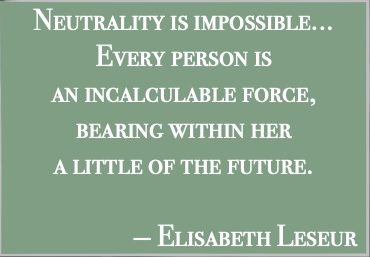
    A friend of mine posted this quote-meme on Facebook:

    My friend added,

    Everything starts with actually loving people. If you don’t love the person first, for who they are right now, why the heck would they want to converse with you about deeply personal topics? I sure wouldn’t.

    Love before all else. Love underlying everything. Love informing every action.

    + + +

    I agree with her, and I agree with the meme, except I would tweak it in one way. I would prefer a different adverb, or no adverb at all, where the meme says “loudly.” No qualification there is needed.

    Discrediting what others believe does not do any of the work in drawing people to Christ; or at least, it pulls very little of the weight, and then only if it’s done by an unusually well-spoken and sensitive person.

    Now: Lots of us believe that people are intellectually convinced by good arguments. Especially, those of us who value logic and therefore believe that we ourselves were convinced mainly by good arguments, like to believe this. I believed it for a long time. Let me tell you a story:

    Once when I was a teenager, mostly still being shuffled back and forth between weekends at one parent’s house and school days at the other parent’s house, I found myself away and alone and with an opportunity to go to Mass. I stayed after everyone else had finished shaking hands, had left; and approached the priest (very, very nervously) and asked if I could talk to him.

    When I got him alone I spilled out my story, living at home, no car, longing for what the Church offered, having many months before I would go away to college, wondering what to do in the meantime.

    He listened to me and he gave me a copy of a book that he had handy — it was a catechism for adults — it’s not important which one — but not “the Catechism,” which wouldn’t be released yet for another year or so. A thick paperback, about the size of the Catechism that would come out later, but written by some American priest. It had an IChThYS on the cover. I took it home and hid it and read the whole thing. It explained so much that I had been wondering about.

    And you know, for years and years I told myself that the important thing, what pushed me to go through RCIA when I finally found myself living in a college dorm across the street from a Newman Center, was content of the book. That its clear and logical explanations, along with other ones I encountered later when I sought out more books like it, had spoken to my mind and my intellect, had convinced me.

    The book was important, yes. But:

    It wasn’t until relatively recently that I realized that the thing that started everything moving forward was not the book, but that the priest listened to me, and that he responded. The first thing that this first representative of the Church offered me was not, actually, the book that explained Catholic doctrine. The first thing he offered me was a chair and a box of tissues.

    The thing is, even I do not know how significant the chair and tissues were, relative to the book. I am a fairly cerebral person, and a private one; it was easier for me to accept the book (free book!!) than to accept the tissues. Perhaps the main thing that drew me in for good really was the catechism, and the tissues — the “You are welcome” message of the tissues — only mattered insofar as they got the book into my hands.

    Then again, maybe they were everything.

    + + +

    So, that is the story that I did not plan on telling today when I started writing this post. But now that I have, I want to get back on message. Let me just throw something out there:

    We, human beings, are evidently readier to listen to and understand new and different ideas when they come to us from a person with which we have a relationship based on trust.

    This is inconvenient to people who like to believe that the only thing that matters, or should matter, is objective evaluation of the facts. But apparently many apparently rational decisions are really made in intuitive reaction to rapid emotional response. One of the ways we fool ourselves, apparently, is by letting our reasoning powers (Jonathan Haidt called human reason the “press secretary of the emotions” in his fantastic book The Righteous Mind) convince ourselves retroactively of the satisfying logic that supposedly led to our judgments — judgments that our emotions made in a flash, leaving our reason to catch up.

    (Besides Haidt’s book, I strongly recommend Thinking, Fast and Slow by Daniel Kahneman for more on how intuition makes decisions that reason subsequently ratifies.)

    None of this, by the way, implies that the steps of reasoning are faulty; it only means that most of the time, unless we are sitting down to do a geometry proof, we don’t begin with an intellectually reasoned step in the most logical direction. The reasoning part, especially if we are careful to remain skeptical of our own biases (as scientists are supposed to be trained to do), can be transformed from a satisfying rubber-stamp of our impulses into a check upon them. I find that writing out those steps of reasoning — or of back-justification, or of rationalization, call it what you will — does at least sometime lay them bare to where I am forced to recant my first conclusion.

    Kahneman put it this way: “People can overcome some of the superficial factors that produce illusions of truth when strongly motivated to do so.” (Although they often do not.)

    + + +

    If you need logical convincing of the practical importance of relationship-building in evangelization, you would do well to read those two books.

    Haidt, for example offers data that demonstrates that the only thing that is reliably associated with the moral benefits of religion is how “enmeshed” people are in relationships with their co-religionists, and that our minds are designed for a sort of groupthink, based on feeling a sense of belonging with the group. This can be a feature, not a bug, if we accept that it isn’t going away, if we reach out to people with commonalities instead of right away underscoring the things that set them apart from us, send the message “You could belong — if you change — which means that you don’t belong at this time.”

    Each human being is, evidently, adapted to regard with suspicion and skepticism all groups to which s/he appears not to meet the criteria of belonging.

    Furthermore, information (this is Kahneman again) that comes from “a source you trust and like” carries
    with it the “sense of cognitive ease” that reinforces an impression of truth; this implies the converse, that information that comes from a source you dislike or distrust carries with it a sense of cognitive stress that doesn’t dispose you to accept it.

    I don’t write this in order to advise you to pretend that you are trustworthy and likable in order to get people to swallow your difficult message.

    I write this in order to make plain that few interlocutors will consider your pleasant-sounding but difficult-to-believe messages, let alone your unpleasant-sounding ones, if you are not demonstrably worthy of their trust.

    + + +

    Like, not putting on a trustworthy face, but actually really you are really trustworthy, and they can sense that reality.

    If you can’t do that, it is not their fault if they do not listen to your truth.


  • Kuku for asparagus (recipe).

    Today Mark came home early, right around lunchtime, to take our oldest to the local university for an afternoon visit at the college of business.  I have some hopes that he and I might go out for a dinner date this evening, so I decided this morning to make the food that had been intended for tonight's dinner for a quick family lunch instead.  I expected the smaller children to eat their fill of peanut butter sandwiches, leaving the tasty vegetables for the rest of us.

    First I started bread in the bread machine, then considered a fat bunch of asparagus, probably at least a pound, that I had picked up on sale a couple of days ago.   Then I scrounged around in the pantry and found a jar of roasted red peppers; in the fridge I found half a red onion and some aged white cheddar.   Perfect for finishing off a carton of eggs.   My inspiration here is the Persian frittata known as a kuku, which often contains herbs and spices and feta and huge handfuls of greens—but which can be adapted to contain almost anything you might put in an omelet.  The recipe is very elastic—you can increase the vegetable-to-egg ratio quite a bit, probably by fifty percent or more, and it will still hold together fine.

    This recipe is  3-4 servings, sized to fit a seasoned 10" cast-iron skillet.

     If you double it, either use two skillets, or bake the vegetable-egg mixture for a longer time in a well-oiled glass dish (after sautéing the vegetables on the stove top).  You can also bake it in muffin cups.  Baked outside the skillet, I bet, this would be a great dish for a brunch potluck.

    Asparagus and Red Pepper Kuku with Rosemary and White Cheddar

    • 1 pound (or more) fresh asparagus, trimmed, tips set aside, and tender stalks cut into 1/4" lengths
    • 1/2 a large red onion, sliced 1/4" thick
    • 1/4 to 1/2 cup roasted red peppers (I used a jar of piquillos), cut into thin strips
    • 3 oz extra sharp white cheddar cheese, cut into small dice
    • 2 tsp dried rosemary leaves
    • Plenty of olive oil (sorry, I don't measure this)
    • 6 to 8 eggs
    • Salt and pepper to taste

    Preheat the oven to 400° F.  

    Heat the skillet dry over medium-high heat.  When it is hot, scatter the onion slices in the dry pan, then cover and cook five minutes to begin caramelizing the onion (following the technique here).  Uncover, add oil and salt, and continue sautéing and stirring the onions until they soften and are nicely caramelized.  Transfer to a bowl.

    Add more oil to the pan along with the cut asparagus stalks.  Sauté a few minutes until they begin to brown a bit, then add the rosemary, salt, and pepper.  Add a couple of tablespoons of water to the hot pan, cover, and steam until the water evaporates.  Add the tips and continue to sauté for just a couple more minutes until the asparagus is tender and the tips are crisp-tender.   Transfer to the bowl with the onions; mix in the roasted red peppers.

    In a  separate mixing bowl, beat the eggs well.  Fold the vegetables into the beaten eggs, mixing well.  

    Return the skillet to medium heat and add oil, coating the bottom and sides of the pan.  Pour the vegetable-egg mixture into the hot skillet and cook for 2-5 minutes (or more if needed), until the edges are set.  Dot the top of the mixture with the diced cheese and transfer the pan to the preheated oven.  Bake until firm, 5–10 minutes in the cast-iron pan.

    Allow to cool at least ten minutes before cutting into wedges.   Serve warm, room temperature, or cold.  

    I had it ready before Mark got home, and we enjoyed it hastily with warm buttered homemade wheat bread before he had to run off to his appointment with the big boys in tow.  If it weren't eleven o'clock in the morning, a cold witbier or hefeweizen would have been a lovely accompaniment.    And the leftovers will make you a beautiful breakfast.


  • Pronouns in the Divine Mercy chaplet.

    I've been thinking a lot lately about the mercy-related problem of, so to speak, "meeting people where they are."  About one dilemma of the good news:  some demands of Christian life are scary, off-putting, downright repugnant at times.  Certainly from outside, but I've felt that way from the inside from time to time too.  So how do we attract and welcome people, exercise the hospitality and mercy we are commanded to do, avoid hurting people or driving them away, and yet, be honest and not lie about the difficulties?  We know we must reject lies and reject everything that separates human beings from God; we must not do so by rejecting human beings, or provoking them.   "The truth hurts" is the world's saying, not ours. 

    It is an old problem, tackled by saints and yet not solved; a problem that reinvents itself in every place and time.  So even though it's the saints' problem it's our problem too.  We can all try to approach it and yet be doing new work.  

    + + +

    It's been a long time since I made it to any Saturday-morning mass, let alone a first Saturday, so I was glad this past weekend to be entirely free.  I carried some special intentions for old friends having hard times, and one of the children's rosaries hooked away from its thumbtack on the schoolroom bulletin board, to the parish thirty blocks south where daily mass happens on Saturday.  

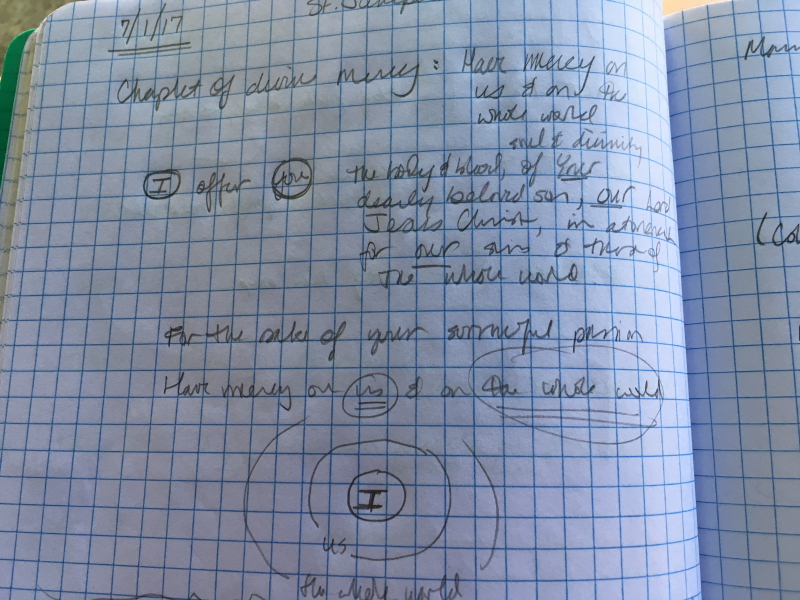
    I got there near the end of the rosary but before the Chaplet of Divine Mercy.  And found myself, as I recited along with the parishioners, thinking about the first-person pronouns in the CDM.  I copied them down in my notebook after the chaplet, while I waited for mass to start.  Let me show you what I mean:

    Eternal Father, 

    I offer You the body and blood, soul and divinity of Your dearly beloved son, our Lord, Jesus Christ,

    in atonement for our sins and those of the whole world.

    For the sake of His sorrowful passion, have mercy on us and on the whole world.


    IMG_2700

    So what I was asking myself is:  Who is "I?"  Who is "us" and is it the same "us" to whom belong "our" sins?  

    Who is "the whole world?"  Is that the same "us" or is it actually a "them?"  Or is "us" a part of "the whole world?"

    + + +

    One of the beauties of communal prayers, like this one, with agreed-upon texts, is that they can and do have slightly different meanings inside the heads of all the individual people who say them.  But I want to be clear about what they mean inside my own head.  I want them to be real words, not just my mouth moving in agreed-upon patterns.  So I think about those words and sometimes form theories about them.  Even the pronouns.

    (If you like this sort of thing, here's a guest-post I did for Jen Fulwiler some years ago.  Good times.)

     So let's get started, and why not start with the first person.  I'm not exactly taking these phrases in order as they appear in the poem, by the way, but more in the order in which they came to my mind.

    1.  "I" offer

    I'm going to go out on a limb here and assume that the "I" refers to the person speaking the prayer.  For now let's just note that it's an "I" not a "we," although later we'll speak of "us" and not "we."  The agent of the offering-sentence is an individual, not a collective, despite the fact that the Chaplet is very often a communal prayer, and it has a very communal-prayer feel to it if you ask me.  The sense of community comes out the most when it is recited — even alone — at 3 p.m., the "hour of mercy," the time when the Church especially invites us to recite it.  So at that hour one knows that one is among many with the same, or similar, intention.  And yet we do not say, "we offer you."  offer you.   This offering is a personal offering.  offer the part that I possess in myself, however much or little that may be.  It is not, so to speak, pooled, at least not at the moment that I offer it.

    2.  …[to] "You"

    Is "You" God?  Yes, but more precisely, "You" is another "first person" — in this case the first person of the Trinity, the Father, and precisely, distinct from the Son and from the Holy Spirit.   This is made obvious by the first two words of the prayer.  The Father is the one whose will Jesus does on earth, and the one to whom he makes offering of himself on the cross.  So when "I offer" the offering mentioned in the prayer, "I" make that offering to the same Person.  

    3.  …in atonement for "our" sins and those of the whole world"

    This sentence makes it clear that "I" am making an offering not just for myself, but for others.  In fact I am making the offering on behalf of everybody ("the whole world.")  

    But here is a curious puzzle.  As long as this offering is meant to make atonement for everybody, why do we not just say "…in atonement for the sins of the whole world?"  Why is there an "us" and a "them" of sorts here, or if not that, at least an "us" and a wider "us?"  

    I see two possibilities.  Either we are meant to make a sort of mental distinction between "us/our" and "the whole world," or we are meant to make a distinction  between the "our sins" and "those [sins] of the whole world."    The prayer makes it clear that everybody's sins demand atonement, "ours" as well as "the whole world's," but why the distinction?  Who is "us?"

    Before embarking on this contemplation, my mental picture of the "us" had been framed by my habit of reciting the CDM mainly in community, like I was doing on Saturday with other parishioners before Mass.  I had been picturing the "us" as "all the people here in this room with me, all of us here together reciting in this place."  "The whole world" then, must have meant to me "everybody outside this room."  And it may be an acceptable interpretation of the phrase; I don't know.  

     But it breaks down for me a bit when I remember that the chaplet is not only to be said in community, but also alone.  So I'm inclined to think that "our" is more expansive than "the people in this room."   Fortunately there is another clue…


    4.  "our" Lord, Jesus Christ 

    Here at least, "our" is apparently those of us of whom it may be said, Jesus Christ is Lord.  The phrase "our Lord" is an appositive; it mentions a second time and renames "Your dearly beloved Son;" it is, strictly speaking, unnecessary.  One of its purposes is apparently to stress that Jesus is "our" Lord.  So going out on a limb here and assuming that the two "our"s have the same antecedent:  the "we" is the set of all faithful Christians, all those who recognize Jesus and sincerely call him Lord and try however imperfectly to follow His commands.   I tend to think that here we can interpret the set relatively broadly and not restrict it to Christians who are visibly members of the Catholic Church; I think there's room for discussion there.

    So what does that get us?  Well, I think it means that "the whole world" refers to all the other people who don't call Jesus Lord for one reason or another, and possibly some people who do call Jesus Lord but insincerely or with an entirely wrong idea about who Jesus is or what Lord means.  Roughly, Christians and non-Christians, or followers of Christ and others, or the Church and people outside the Church (with perhaps some acknowledgment that there may be folks who are really in the Church but only God knows it).  This does jibe pretty well, incidentally, with Scripture tending to contrast "the world" with Christ.

    And the salient point here is that "I" am making this offering in atonement for the sins of Christians, and, apparently equally, for the sins of everybody else.


    5.  Have mercy on "us" and on the whole world

    I don't need to belabor the point again, so I'll just note that the distinction between "us" and "the whole world" is significant enough to make it twice.  I think this underscores that it's a real distinction.  "I" ask for mercy for "us" and for all the other people too.

     + + +

    All this being said, let's come back to "I" in the context of exactly what it is that "I" am offering.


    6.  the Body and Blood, Soul and Divinity

    It's meditating on the meaning of this that got me thinking about this at all.  How can "I" offer this, which is basically "Himself," what Jesus offered on the cross?  I know how Jesus could do it; it was His to give.   I know (sort of) how a priest at Mass does it:  He is alter Christus and makes the offering in persona Christi.  What is it for someone like me to offer these back to the Father?

    The way I figure it is that "I" can offer the Body and Blood, Soul and Divinity of Christ only because I somehow possess it — and the way I possess it is through having received it the Eucharist.

    I freely admit that I may have worked it out wrong, but the Eucharist itself only remains literally with a person for a short time after Communion.  So one possible meaning here is that each of us makes this offering by dedicating the fruits of the Eucharist that he has received to do God's work and God's will; another is to consecrate the graces the Christian has received from it back to God, which may mean, so to speak, allowing God to redistribute or enact them for His good will and not specifically the good of the person making the offering.  

    + + +

    The latter possibility, I clearly came up with under the influence of the idea of Marian consecration, and perhaps it's mixed up too much, so let's explore the first option:  That "I" offer the Body and Blood, Soul and Divinity, by dedicating the fruits of the Eucharist that I have received outside myself somehow.

    The fruits of the Eucharist are said to be seven (cf. the Catechism, ¶1391–1398; scroll down from this link to the section):

    • augments our union with Christ
    • separates us from sin
    • preserves us from future mortal sin
    • wipes away venial sins (specifically, by strengthening our charity)
    • makes the Church
    • commits us to the poor
    • signifies our unity

    There are many, many people who in their circumstances do not or cannot receive the Body and Blood, Soul and Divinity.   But the whole world can receive its fruits, no matter who they are or what their circumstances.

    God can increase and make full any person's knowledge of and union with Christ.

    God can detach any person from whatever sins trouble them.

    God can wipe away any person's venial sins.

    God can preserve any person from mortal sin.

    God's power and mercy can incorporate anyone God chooses into the mystical body of Christ.

    God can turn any heart toward the poor.

    God can, someday, unite any person at all to the rest of us in the gift and sign of the Eucharist, and grant to any person the possession, not just of its fruits, but of the Eucharist itself.

    + + +

    I think that when "I" am offering to God the Body and Blood, Soul and Divinity, I am saying:  You, Father, may take these fruits back from me, and spread them around to everyone; or at least, I say to you, God, that the fruits you have given me through the Body and Blood, Soul and Divinity, help me to use these fruits for the good of everyone else.  To realize these fruits for the people who (though they cannot yet receive the Body and Blood, Soul and Divinity) may yet receive its fruits, by my words and actions.

    By the works, you may say, of mercy.

    The offering makes atonement, and enacts mercy, at the same time.  Atonement requires a sacrifice, and the sacrifice that the Chaplet enacts is a commitment to turn the great gift of the Eucharist outward, not keep its fruits just for myself, but actively work toward their wider distribution.


  • College applications: smoothing out the bumps.

    At the start of this week I drove my two eldest sons to a large public university in a neighboring state. The younger one came so that I could drop him off at a weeklong residential STEM camp the college of engineering was hosting for soon-to-be-eighth-graders. The eldest, who will be a (homeschooled) high school senior this year, came to make a college visit.

    This is the second university that he and I have visited; the first was the large public university in our home city. We live in that city today because that is where I went for graduate school. Our son is price-conscious, and likes a big place and city life, so these two universities are his two likely choices. They cost about the same (thanks to tuition reciprocity), and both have about equally rated engineering colleges and business colleges. These are his two interests. When I asked him if he didn’t want to apply to a third school as a “backup,” he explained that majoring in business instead of engineering was his backup plan, because this essentially means he is applying to four colleges. This makes a great deal of sense to me.

    + + +

    I have worked very hard to anticipate problems that we might run into along the way, and because I am a stickler for filling out forms correctly and fitting into the right boxes, I have documented things with near obsession. I have been thinking about applications since my first was in kindergarten, at first idly and then with more and more interest.

    Still, one of the consequences of charting your own path is that unexpected bumps are to be expected. And this year I have run into the problem of official letters of recommendation. Which is something I failed to anticipate. I wound up talking to the admissions counselors, by the way, and my son and I have a plan for how to deal with it, so there is a happy ending; but let me save you some trouble if your kids aren’t in high school yet, by helping you foresee what I didn’t.

    So the deal with us is this: Engineering colleges, it turns out, want academic (official) letters of recommendation from math and science teachers specifically. But in our family, Mark and I are my own children’s only math and science teachers (so far). Why would we have outsourced this? I outsourced English, physical education, and music because there are other people who can teach this far better than I. If any of my children had shown more-than-passing interest in studio art or performance art, or in a modern language, or maybe in up-to-date computer programming (I coded in Fortran 77, and Mark only writes Visual Basic), I would have sent them for outside lessons in those as well.

    If there is anything that the outside observer, mildly biased against non-institutional schools, would think that I am officially qualified to teach, it is math, physics, and chemistry. I enjoy teaching those subjects, and I am confident teaching them, and therefore I do not outsource them. And if I may say so myself, I teach them well. At least, I am having fun, and the kids I have taught (mine and H’s) seem to enjoy the courses and also appear to learn the material. I make my own syllabi that are closely aligned to the AP syllabi, and I use college textbooks (which are very affordable if you go just a couple of editions out of date), and I have even found an adequate home laboratory kit for general physics and chemistry, and I insist on excellent lab notebook maintenance.

    The consequence, which I failed to foresee, is that there is no math or science teacher from which I can request a letter of recommendation. H’s kids can get a letter from me, with the full alphabet soup after my name. My kids can get a letter from H, of course; she is their their English-degreed literature and composition tutor who’s worked with them since they were learning to read. But no parent can write a credible letter of recommendation for their own offspring. And I failed to foresee that a STEM college would want an institutional STEM letter.

    (Cue sound of me smacking myself in the forehead.)

    + + +

    Are you thinking, “But that’s crazy! Surely they have enough homeschooled students applying by now, most of whom do pretty well in college from what we hear, that they have alternate instructions on their website for applications.”

    They do have some general instructions, indeed. But I think the numbers show that really, only a tiny number of their applicants find themselves in the position we are in re: STEM grades. Let’s do an engineering estimate:

    • About three percent of K-12 students are being homeschooled in my state this year.
    • That figure is the number over all the grades from K-12. Lots of homeschooling families only homeschool through sixth or eighth grade — more, I would wager, than the number who switch from institutional school to home school in the high school years. So I am thinking that fewer than three percent of high school students are likely to be homeschooled.
    • You do have to correct for the fact that homeschooled students — likely because of the correlation with the education level of the parents — appear to be slightly more likely to attend college than the general population of students. The data on this is variable and not great, but could be as high as a doubling of the percentage who attend college. My argument is weaker the larger this number is, so I will concede it. Let’s say that maybe five to six percent of college applicants might be homeschooled. Now we have a potentially significant number, yes. (Although the few colleges I could find online that made a reference to it — mostly elite private colleges — stated that a only tiny number of their applicants were homeschooled.)
    • But! Lots of homeschooling families use an umbrella school, “school-in-a-box,” or distance learning program which generates official grades and an official transcript and which may have nonparent instructors, tutors, or graders. (Certain states, though not mine, require homeschoolers to use such a service.) Even if the school or program is not accredited, universities will probably take their grades and transcripts as evidence of the student’s performance. So now we have narrowed that small percentage to even fewer students who, like mine, lack a complete institutional high school transcript.
    • Finally, even those high school homeschoolers who chart their own course often use tutors, co-op classes, community colleges, and the like to teach subjects that they aren’t comfortable teaching themselves. And the STEM classes are often the ones that get outsourced. So you just don’t get many kids who have *no* institutional or nonparent STEM teachers who are nevertheless attempting to enter colleges of engineering.
    • + + +

    Anyway, this is just to say that if you want to reduce your bureaucracy later on, it’s probably a good idea to help your teens rack up the sorts of experiences that naturally lead to letters of recommendation.

    It isn’t so much that they won’t be able to put together a good application without checking all the boxes — we really did get the impression, at least at the colleges that we visited, that they just want to be able to get a comprehensive picture of the student. It’s more that it feels better to be confident that you’re sending them something their system can deal with.

    And so, I reached out to the admissions counselor, and she helped me come up with a plan that I can work with that will give them the information they need. I now feel not that there are no boxes to check, but that we have been issued an alternate set of check boxes.

    I was telling Mark last night, the main benefit I got from talking to the admissions counselor and getting advice, tailored to our family’s approach, about how to set up transcripts, grades, and recommendations, was that I will spend less time wondering “We can’t just follow the directions, so…. Should we do this or should we do that?” With that advice in my pocket, my guidance counselor hat will fit a
    little bit more comfortably and I will waste less time trying out different approaches.

    I get the impression that even though there are plenty of experienced homeschoolers around who can tell us how they navigated this final step, it’s normal and expected to feel somewhat at sea. We provide an individualized education — that is, after all, the point. And because it is so individualized, there is a limit to how much we can follow each others’ examples. Sooner or later you just have to figure out how to fit into systems in a way that is tailored to your own family’s unique approach. Which is true for everyone, really; it’s just that for some folks the systems make that uniqueness more obvious than for others.


  • The benefit of doubt: Acquittal in the death of Philando Castile.

    Last year I wrote several posts about the fatal shooting of St. Paul Schools employee Philando Castile a few miles from my home. Castile was a concealed carry permit holder who was shot in the car, next to his girlfriend and with a four-year-old girl in the back seat, by a panicked police officer during a traffic stop.

    (First post: Not so much about Mr. Castile as about bumper stickers and jumping to conclusions.)

    (Second post: About Mr. Castile — appropriately — being laid to rest from the Catholic Cathedral of St. Paul at the request of his mother.)

    (Third post: On the charges that were brought, in particular on the legal distinctions between manslaughter and murder.)

    By now you all know — it made the national and international news, I saw it in a French news site yesterday — that the police officer who shot and killed Castile and endangered the woman and child in the car was acquitted by a jury of all charges.

    The prosecutor’s burden in the manslaughter charge was to demonstrate to the jury that the police officer caused Mr. Castile’s death by “culpable negligence” whereby he created an “unreasonable risk” and “consciously” took “chances of causing great bodily harm or death”. And, since the defense claimed that the officer acted in self-defense, to overcome the finding that the shooter “reasonably believed deadly force was necessary” to prevent loss of life.

    I don’t think very many people dispute that the police officer — at least momentarily — believed that he needed to defend himself. I suppose it all turns on whether the police officer’s belief was “reasonable.”

    It is true that white concealed-carry permit holders have on occasion been unreasonably shot by alarmed police, but it isn’t a common occurance. Nevertheless, I believe it’s very likely that if Philando Castile had done everything the same, but had not been a black man, he’d be alive today.

    I also believe it’s not reasonable for that to be the fact that made the difference.

    + + +

    Civil liberties cut both ways. Mr. Castile had a legal right to be armed, and while people are disputing whether he did all the things exactly right during the traffic stop — mentioning the gun and his permit to the officer (neither were legally required of him), moving his hands after the officer requested his license — nothing he did was unusual behavior for a permit holder in Minnesota, except for being black.

    It is questionable whether our Second Amendment rights are meaningful if their lawful exercise can “reasonably” frighten a police officer enough to kill someone.

    And that is before you get to the Equal Protection clause and use it to test the notion that a police officer can legally be more easily frightened by people of one color than by people of another color, and that distinction called “reasonable.”

    + + +

    Nevertheless, thanks to other civil liberties which are perhaps even more important, we have theoretically got “innocent until proven guilty” in this country, and the state law is written with certain words and not with others, and there is no special part of the law about manslaughter and murder and self-defense that lays out clearly what “reasonably believed deadly force was necessary” means in the context of a police officer making a traffic stop or any other circumstance where the officer has seen fit to interact with a person who has not committed any crime.

    Whether Mr. Castile’s killer’s belief was “reasonable” is apparently something that is not so obvious that it was proved to those twelve jurors beyond a “reasonable” doubt. Some doubt remained. And if doubt remained, then their duty was to acquit.

    + + +

    It still stinks to high heaven for Mr. Castile’s family and friends, and it stinks for all of us too — maybe not so much because a jury found room for doubt in the police officer’s reasonableness, but more because we know that juries often do not seem to find room for doubt in other people’s reasonableness, people who do not enjoy the great deference that a police uniform affords. And we know that many people in our justice system never see a jury, because of the high proportion of people who are frightened into pleading guilty to one charge in exchange for dropping a more serious charge, and whose experience has been of not getting the benefit of the doubt. And we know that Mr. Castile did not get the benefit of the doubt, and he is dead.

    It is not wrong that an unsure jury acquitted. That is what unsure juries are supposed to do. They owe every defendant the benefit of the doubt.

    The wrong is that Mr. Castile’s killer was allowed, by the law which does not define “reasonable,” to be very unsure himself — so very far, far from being sure — and that another human being who had not hurt anyone paid with his own life. That Mr. Castile could not have the benefit of the doubt.

    And years and years and years of other people, especially but not exclusively black men, who had the same right to the benefit of the doubt, and yet could not have it. Exhaustion, dismay, and fury is justified.

    + + +

    I don’t know what the answer is. I think re-examining the wording of our state law about self-defense and homicide might be a start.

    Perhaps we should consider laying out more clearly what “reasonably believed” means; perhaps we should enshrine it in the law that fear of blackness itself is not reasonable (because people are definitely arguing around here that it is totally reasonable for a police officer to be more frightened of One of Those People than of your average white CCW permit holder).

    Perhaps the legal definitions of manslaughter, murder, and self-defense need to be examined in the specific circumstance of police interactions with non-police citizens. Maybe we should be honest and lay out what we can agree on regarding the responsibility of police officers to make rapid judgments in quickly changing situations while protecting life and safeguarding civil liberties. It is clear that juries are willing to defer greatly to police officers’ narratives of their own judgment process. Perhaps this is what we want; perhaps not; perhaps we want it up to a point. Maybe we should write down where that point is. Maybe we should lay out clearly and specifically what it means for a police officer to be reasonable and unreasonable in the exercise of deadly force. Then we, and they, would know better what to expect from a jury. Maybe training would change to reflect the clearer rules, and maybe snap judgments would be better judgments.

    This is what the rule of law means.

    + + +

    I have nothing more to say. Look around and listen to what other citizens have to say who are closer to the pain and struggle and fear than I am, even in the middle of it. I’m not likely to be shot during a traffic stop, nor to have to decide whether to use deadly force on someone. I am a citizen, and that’s as far or as important as my say goes; so for now I’ll write my state legislators, and … and something, I don’t know.

    I am sorry for your loss.


  • Attempting the mind to flex.

    Darwin writes:

    As we wrap up a year of family German classes …I find myself taking stock of my abilities in the language. What I want, even more than the ability to converse fluently (which I have little opportunity for) is the ability to read in German relatively well. Right now I'm at something of a halfway stage….

    However, as I was working through a couple pages of German this way the other night, it was striking me that aside from my vocabulary issues there's still something fundamentally different about what I'm doing in comparison to how an actual German reader would deal with a text. What I'm doing right now might be better termed decoding, because in some ways I'm still turning things into a more standard English structure as I figure them out.

    For instance, the use of a past continuous is very common in German, and a standard sentence order in that case is: [Phrase denoting time or place] [helping verb: a form of sein (to be) or haben (to have)] [subject] [object] [past participle].

    Laying something like that out in English might go like this:

    Early in the morning had we on the train to Berlin to ride.

    Of course, in English we'd keep the verb together, and a natural order would be something like:

    We had to ride on the train to Berlin early in the morning.

    Now, these are easy enough words that I'd make it through fine on my own and wouldn't even be consulting the dictionary, but throw in a bunch of vocabulary and I find myself going back to my old schoolboy Latin habits. Latin, of course, also has the habit of saving the verb for last. We all get the explanation during the early weeks of our first Latin class that this creates a sense of anticipation as you want to find out what is being done by the subject to the object in the sentence. However, I virtually always did what a lot of beginning decoders of a foreign language do: I would identify my subject, then jump to the end of the sentence and wee what my verb was, then go back and pick up the rest of the sentence. In essence, I was transforming the sentence into English sentence order as I went along.

    This is fine for getting the sense of what's written, but it strikes me that if you stick with this, you never really move into thinking in the other language the way a speaker or reader of it would. 

    Turning it into the English order as you go is, I think, what you do if you aim to translate into English eventually, as you'll be thinking all along "how am I going to render this in English?" So it's not like that habit doesn't have its uses.

    I like the term "flexibility of mind" for what you're seeking. I wonder if doing some translation exercises from German to English might help you along the way — but a German->English in which you flout more workaday English word-order conventions and seek a word-order that captures some of the anticipation inherent in the German, so you can begin to get a feel of how that might work in one's native language.

    So what I'm saying is:  Go ahead and put it "Early in the morning had we on the train to Berlin to ride."  At least in your head.

    In short, translate into a sort of Yoda-speak, but one in which enough licit English style choices are made that the meaning is clear, if a little unusually phrased. And feeling free to switch from active to passive voice if warranted in order to preserve the anticipation.

    Let me give you an example — I'm going to draw from Latin (French is no good, its word-order conventions are not dissimilar enough from English ones to serve as an example).  I have a textbook with its answer key in front of me, and opened it to a passage entitled "Seneca Reflects on Having Lodgings over a Public Bath."  Here are the first two sentences in Latin:

    Ecce undique me varius clamor circumsonat: supra ipsum balneo habito.  Propone nunc tibi omnia genera vocum quae in odium possunt aures adducere…

    The textbook translates conventionally like so:

    Look, on all sides a varied noise surrounds me:  I live above the bath-house itself.  Consider now to yourself all the types of voices that can draw the ears into hatred…

    but if you want to preserve the sense of anticipation above all, the periodic sentence, you could write this (partly by switching to passive, partly by choosing a less-colloquial construction):

    Look, on all sides I'm by a varied noise surrounded:  above the very bath-house I live.  Consider now for yourself  all the kinds of voices by which into hatred can the ears be drawn…

    It's not a great translation:  when you go from active to passive you lose some of the punch, and the style seems too ethereal and academic for such an earthy topic.  But different translations serve different purposes, and this exercise is to see the flavor of the periodic sentence:  the sentence that goes around and around, and doesn't wrap up till the end (of clause or of sentence).  Notice I swapped a synonym too so I could keep the order intact:  "the very bath-house" for "ipsum balneo" rather than  "the bath-house itself."

    I've always found that literal mental translations help me get into the mind of the foreign language better.  The Romans wouldn't pitch camp; they would 'put' camp, and by the way, "castra" being a plural word, think of it as "they put the campythings."  (castra ponunt). French people don't play tennis with a tennis racket, they "play at" tennis with a "racket of tennis"; and they don't "play piano," nor do they "play at piano", they "play of the piano" or maybe "play some piano."

    So, I think you can do this with word-order too.  And no, it isn't quite the same as doing a literal word-for-word translation in the order the words appear in the original text.  You can keep certain syntactical chunks together or separate them as needed, and do things like put the adjective before the noun in English.  It must remain understandable.  But it's okay if it sounds a little weird or archaic; the point is to get the sense of anticipation in.

    So, let me continue my weird-English translation:

    Look, on all sides I'm by a varied noise surrounded:  above the very bath-house I live.  

    Consider now for yourself  all the kinds of voices by which into hatred can the ears be drawn…

    When somebody (lazy and with this commonplace oiling contented) I've met, I hear the slapping of the hand on the shoulders, which, depending on whether flat it strikes [there] or hollow, thus the sound changes.  

    If, though, the scorekeeper too has arrived and begun counting the balls, it's finished.  

    Add now the brawler and the the apprehended thief, and he who by his own voice in the bath himself he pleases.  

    Add now those who into the pool, with a mighty surge-of-water's sound, jump.  

    Beyond those of whom, if nothing else of them is, proper their voices are:

     Of the hair-plucker [you must] think, reedy and strident his voice so that it might be more conspicuous, rising and falling, not ever silent, except when he plucks the armpits and someone else,  on his behalf, to shout is then forced.

    Yes, it's a poor translation, and sacrifices a couple of connections in order to push those verbs back.  (They're not all pushed to the end of the clause:  "begun counting the balls" is "to count begun the balls" in the original, and I didn't think moving the infinitive would matter much.)  The textbook does a better job of rendering decent English, and I could probably do a still better job making it come out sounding well-turned.     But I find that the exercise helps me get under the skin of the word-order.  

    So first you do that translation, then you set it aside and you read the Latin, or German or whatever, again.

    Your mileage may vary.  I don't know enough about German word-order to know if it's so crazy that you'll never be able to make a sensible English sentence this way.  But it's worth a try?

    + + +

    Another thing that you might try, especially if (in English) you're a relatively fast reader:  Watch a movie in the target language, but with English subtitles. The subtitles (at least when they are hard coded) usually appear a split second before the character begins to speak.  When the subtitle appears, take the meaning in quickly, then look up and at the character's face, and attempt — expect – to hear that same meaning.  Expect that verb at the end, if that's a feature of the language, or whatever feature of word-order is giving you trouble. 

    I suspect you could do it with a side-by-side translation of a piece of literature too, at least with the help of some index card markers to keep your place and cover up the text when necessary.  I haven't tried that, though.

    + + +

    The suggestion in all of these is to train yourself — using either English or your target language — to attend to the meaning-chunks coming in an order that's characteristic of the target-language.  Word-order, like vocabulary, is something that comes to you through pattern-recognition, and that takes practice with the patterns.  We can, I think, render those patterns into our native language with a little tweaking, and harness the power of our brain's flexibility with the language it's wrangled since birth, until the new patterns speak to us too.


  • Translating English-to-Latin along with my students.

    My high school Latin III students have come to the end of their extremely beat-up Henle Latin grammar books, the green ones, and we aren’t sorry to see them go. There remain a few weeks in the year; and though I have focused the course on Latin-to-English translation, I wanted to spend a little bit of time doing English-to-Latin translation. I am not very practiced at this, but I thought it would be fun, and anyway, the teenaged boys I work with know very well that I am an amateur, so why not jump in together?

    There are a few “continuous passages for translation” in the books as English-to-Latin exercises, accompanied by an answer key. They are certainly written at the correct level for the Latin III students to parse, steeped as theyare in an adaptation of De bello gallico, but they are not very much fun to work with. First of all, they’re about nothing but English colonialism: the Boer War and Cecil Rhodes; and the vocabulary (and the age of the book) doesn’t admit a, shall we say, nuanced treatment of this subject. Second of all, the English they’re written is ghastly boring.

    So I used a couple of those passages in class only, as a teaching tool for a process of going about rendering the English into Latin. I put them up on the board and talked to them a little about the kinds of things to keep in mind and the way to go about translating, one clause at a time.

    Much of this lesson I drew from my experience — I do have a little — putting English into practical, nonacademic French and Spanish, i.e., a target language of which I’m a non-native and halting speaker. I am no expert in the theory of translation, only an amateur, but I believe a lot of those skills transfer, and of those many would transfer even for non-Romance, maybe even non-Indo-European languages. I know enough to know, for example, that you don’t just get your dictionary and plod from left to right translating one word after another (a habit I had to break them of in Latin-to-English translation). You can start off that way if you want, but it isn’t always the most efficient approach.

    For example, first you have to read and understand the text itself: make sure that you know the definition of every word and idiom, that you’ve identified ambiguities of meaning, that you know each word’s job in its sentence (does that “for” act as a conjunction or a preposition? and if it’s a preposition does it mean “intended to be received by” or does it mean “on behalf of”?), that you know the antecedents of all the pronouns, and so forth.

    And then it’s helpful to deconstruct the sentences, to set aside all the modifiers and all the appositives and all the subordinate clauses, and write out simply the subjects-verbs-objects. It isn’t necessary to diagram the sentences, but if you enjoy that sort of thing you can do it.

    And another thing you can do, especially if you have a limited vocabulary or a limited sentence structure, is to think how you might rewrite the English text in English: an English that might or might not be simpler, but that in any case is an English that you know how to say in the target language. For example, to go on a search-and-destroy mission for all idioms whose target-language equivalent you don’t possess.

    For example: I have read enough French to know that if I translate an English fairy tale into French, I know to render that opening phrase “Once upon a time”, characteristic of the genre, into “Il y avait une fois…” But off the top of my head I do not know whether Italian, Spanish, Latin, Polish, Somali, Mandarin, Tagalog, or any other languages use any such catchphrase to alert the reader that they have commenced to read a fairy tale. (Let’s acknowledge that I could search for examples of fairy tales in these languages and find out how they begin — but for now set aside the wonders of Google.) I recognize “Once upon a time” as idiomatic — do we ever say we are “upon” any measure of duration? — so I know not to trust a word-for-word translation (“a single occurrence — located atop — a point in history”). I begin my translation by rewriting the idiom’s sense — an indefinite place, an indefinite time in the past, a tale which may or may not be historical — in a more straightforward English: “I have heard of a story from long ago, in a distant land….”

    And finally you can recast the English into a form that, while remaining English, is more characteristic of the thought-patterns of the target language, at least in the ones you know how to use. One example of this that comes to mind from going into French is to break up all the compound nouns and reverse them: instead of going home, because it’s time for the game, to get my hockey stick and my old woolen hat and my ice skates, I go home, because the game will soon begin, to get my stick of hockey and my old hat in wool and my skates for ice. If I am about to translate into Latin, from what I can tell, this often means making explicit in my preliminary English the meanings that we often gloss over, such as purpose: I won’t go home “to get” my equipment. Instead, the game being about to start, in order that I might get my equipment, I will go home.

    + + +

    So I walked the boys through a couple of paragraphs, mostly not going into Latin at all, spending most of our time rearranging the English into phrases that they knew how to render in Latin. That was just the practice. What did I give them to translate?

    Well, I felt that poetry would just be mean, so it had to be prose, and it was going to be good prose. I also wanted it to have a lot of vocabulary and, shall we say, purpose overlap with the Latin they had been translating all year. This having been Caesar’s Gallic Wars, I searched for a passage that would recount something military in nature. Furthermore, because I know my own limitations, I wanted something for which a Latin version already existed, so that I might check my own efforts against something more masterly.

    First I considered something from a literary translation of the Bible, a passage somewhere detailing a battle. After all, I have the Latin Vulgate to compare it to I thought perhaps to draw from 1 Maccabees, which starts out rather auspiciously for the Latin teacher used to dealing with battles and slaying and strongholds and kings:

    Now it came to pass, after that Alexander the son of Philip the Macedonian, who first reigned in Greece, coming out of the land of Cethim, had overthrown Darius, king of the Persians and Medes: he fought many battles, and took the strongholds of all, and slew the kings of the earth; and he went through even to the ends of the earth: and took the spoils of many nations: and the earth was quiet before him.

    et factum est postquam percussit Alexander Philippi Macedo qui primus regnavit in Graecia egressus de terra Cetthim Darium regem Persarum et Medorum: constituit proelia multa et omnium obtinuit munitiones et interfecit reges terrae et pertransiit usque ad fines terrae et accepit spolia multitudinis gentium et siluit terra in conspectu eius.

    Besides the subject matter, I thought another advantage of 1 Maccabees (compared to other Bible texts I might choose) is that it was only composed (although originally in Hebrew, that version being lost and only a Greek translation surviving) about a hundred years before Caesar was writing. So it would have, I thought. a more modern and historical style to it, closer to the kind of writing Caesar was trying to produce, than a selection from more ancient texts.

    The second thing I considered was an English rendering of the Latin news broadcasts Nuntii Latini put out by Finnish state radio. I would use the Latin transcript as my “an
    swer key,” and I would give the boys my best English translation of the Latin (rendered in a journalistic style) to use as their source text. I would find a story about some military action somewhere, so that their battle-hardened vocabulary would be put to good use.

    But in the end, knowing that a Latin version was available, I settled for this:

    The Clouds Burst

    So began a battle that none had expected; and it was called the Battle of Five Armies, and it was very terrible. Upon one side were the Goblins and the wild Wolves, and upon the other were Elves and Men and Dwarves. This is how it fell out…. Messengers had passed to and fro between all the Goblins’ cities, colonies, and strongholds… Tidings they had gathered in secret ways; and in all the mountains there was a forging and an arming. Then they marched and gathered by hill and valley… until…. a vast host was assembled… they hastened night after night through the mountains…

    How much Gandalf knew cannot be said, but it is plain that he had not expected this sudden assault. This is the plan that he made in council with the Elven-king and with Bard; and with Dain, for the dwarf-lord now joined them: the Goblins were the foes of all, and at their coming all other quarrels were forgotten. Their only hope was to lure the goblins into the valley between the arms of the Mountain; and themselves to man the great spurs that struck south and east. Yet this would be perilous, if the goblins were in sufficient numbers to overrun the mountain itself, and so to attack them also from behind and above; but there was no time to make any other plan, or to summon help.


    It’s high-interest (one of my charges let slip a “Cool!” before he recollected himself), military in scope, contains sentences that are complex yet amenable to being rearranged or recast into simpler language, and — best of all — it’s good English writing.

    I do have Mark Walker’s Hobbitus Ille to refer to, but I have already tried my hand at recasting the English and setting up the Latin on my own, and I don’t intend to peek until I have made a stab at the Latin.

    If you would like to try along with me, let me supply you with some of Walker’s vocabulary and proper nouns, the same that I provided for my high school juniors:

    • hobbitus, -i, hobbit
    • gobelinus, -i, goblin
    • dryas, dryadis, elf
    • nanus, -i, dwarf
    • Gandalphus, -i, Gandalf
    • Vates, -is, Bard
    • Dainus, -i, Dain
    • jugum, -i, ridge, for “spur”

    Have fun! I know I will.


  • Language capstone: the big picture.

    My Saturday morning project, to be completed (maybe) between dropping my oldest off for the SAT and picking him up again, is to dash out a plan for his fourth year of Latin instruction. And maybe a plan for the half-credit’s worth of my little study group that will span sixth through ninth grades.

    + + +

    I bring my own particular weirdness to homeschooling; I think too much, I like things to make sense and not be too messy and confusing, and — worst of all — I crave understanding things myself. Which means that before I facilitate my own kids through a subject, I need at least to tell myself a story about it that makes sense. Even if it is something I have never really studied before.

    Foreign languages are a good example of that. I have a strong background in French, and used that experience to teach myself enough Latin to pass it on, by the “just stay a few steps ahead of the students” method.

    I got out in front and managed to stay ahead all through middle school and until the third year of high school Latin, when my pupils (who put in more time drilling than I did) got better at, for example, rattling off the third person singular ending of perfect subjunctive active verbs in the third conjugation. I am still ahead of them in the ability to turn a translated sentence from Yoda-speak into good, sturdy English, and often in parsing a complicated sentence with many subordinate clauses and parentheticals; but I often have to point at such-and-such a verb on the whiteboard and ask them “uh, is this the subjunctive?” or bluff my way through a parsing by putting up a sentence and telling them, “Okay, kids, pick out all the participles for me.”

    + + +

    I still have things to teach them about the big picture, so to speak. And as I prepare for the final year of high school language instruction — most likely the final year of instruction at all in this particular language — I’d better start by deciding what my goals are. Because there are a few different directions I can take it.

    + + +

    What is the point of all this? What do we want our kids to take away from high school language learning? There are lots of potential goals, and you don’t have to shoot for all of them. Hitting a few targets well, while spending much less time aiming for others, might be a better approach.

    Potential language learning goals include:

    • conversational fluency while immersed in the target culture (say, in travel or business abroad)
    • conversational fluency with speakers of the target language who are immersed in your own culture (say, a clinic nurse in our home city having the necessary Spanish or Somali to communicate with patients)
    • to communicate more deeply with a particular person in his or her mother tongue (an adopted child, a friend, a partner)
    • enough reading and writing to conduct business or friendly correspondence at the slower pace of email
    • lifetime appreciation and enjoyment of literature (of any particular genre) in the target language
    • lifetime appreciation and enjoyment of audiovisual media in the target language
    • enhancement of the study of the sociology, politics, or history of populations who use or are immersed in the target language
    • acquiring the tools of metalanguage
    • an enhanced vocabulary
    • a foundation for learning a different language later (for example, learning Latin now in order to learn French, Spanish, or Italian later on)
    • laying a foundation for certain studies in linguistics, child development, neurology, and other fields
    • better understanding of one’s own mother tongue, by contrast and comparison
    • better understanding of human cognition itself, by broadening one’s sense of how language can work
    • analytical skills and other forms of logic
    • some or all of the technical skills of the translator, either of texts or of spoken words
    • some or all of the creative skills of the translator, finding just the right turn of phrase to express the translated meaning, even doing so with meter, rhyme, alliteration, puns, and other tricks from the literary bag
    • exploration of the philosophy of translation, whether “equivalent meaning” is possible, and if it is not possible, what does the translator actually seek to produce; contemplation of the whole notion of equivalence, and whether even speakers of the same language can really achieve understanding; and so forth
    • the pure delight of playing with words and phrases and texts and sounds, not restricted to one’s own native tongue

    I would be amiss not to mention these box-checking goals as well:


    • to obtain the required credits for high school graduation and/or admission into a particular college
    • to acquire enough skills in language learning that one will be able to get a decent grade in the minimum number of required college language courses

    + + +


    The first thing to notice is that when time is limited, you can’t meet all these goals (except in a very broad and shallow sense). Although there is some overlap in the basic skills that are developed during both activities, every hour spent translating written text is an hour not spent developing one’s conversational fluency; every hour spent reading poetry is an hour not spent listening to the language in films or lyrical music. And languages themselves compete for your time: a future linguist might do better to acquire a basic grasp of the syntax several languages from different language families than to spend much time developing fluency in only one.


    The second is that some languages are better suited for certain goals than others. Conversational spoken Latin exists these days only in highly contrived circumstances, such as classrooms, or the classical-Latin news reports broadcast by Finnish state radio, or perhaps (I like to imagine) in papal conclaves. Almost any modern language will do instead if conversation is the student’s goal — but which language to concentrate on will be guided by a prediction of the populations they’ll come in contact with. Conversely, if the main goal is enhancement of English vocabulary, Latin will be a workhorse — certainly compared with even widely populated modern languages from which English has acquired little vocabulary, like Mandarin, or with languages that have so many everyday words and word-parts in common with English — say Dutch — that there simply isn’t much bang for the buck in terms of vocabulary building.


    So my goals will be guided first by the limitations and strengths of the already-selected language, which is Latin; and second by the best interest of my students; and third by my own limitations, interests, and strengths.


    + + +

    Let’s start with limitations. As major goals for ordinary people, we can rule out conversation, we can rule out business and personal communication, we can rule out real-time translation into or out of spoken Latin, and we can rule out the enjoyment of films and recordings. Latin also will not help us (much) to prepare for the study of non-Indo-European languages. Since we have already spent years specializing in Latin, one more year will not broaden our understanding of human language very much, at least not as much as starting an entirely new language might, and we have probably hit a point of diminishing returns when it comes to expanding our English vocabulary with new Latin roots. Finally, these students already have the necessary three credits to get into college, possibly enough to test out of college requirements; and if they do choose to study a new modern language in college, they probably have already picked up enough study skills to succeed, especially if they pursue one of Latin’s modern descendants.

    The strengths, then, remain. These are the historical culture of the Roman world and of the educated medieval wo
    rld that inherited its language; a large body of literature to read and appreciate, encompassing rhetoric, philosophy, science, engineering, poetry, history, narratives, and drama; the logical, analytical, and synthetic skills that are developed more deeply by exploring ever-more-detailed intricacies of grammar and syntax; and the skilled, creative, and pondering mind of the translator of written texts.

    There is a lot of overlap here. If you concentrate on translating Latin literature into English, you must read it closely, parse each sentence, and appreciate the texts’ style and content; by doing so (also, in order to do so) you must learn something of the culture that produced it. An advanced study of grammar and syntax necessarily uses authentic texts drawn from literature and history as its raw material. The history and culture are best encountered in the literature itself, the primary sources from which we know almost everything of that foreign country, the past, and here and there we are compelled to make a direct translation if we want to talk about the texts’ meaning in our own language. So by focusing on one of these strengths, we won’t fail to touch on any of the others.

    The overlap implies that I could try to balance them all, have some of everything. This has been the mode of the third year, after the syllabus published by Mother of Divine Grace School: translation (mostly Caesar, a little Horace and a little Vulgate) as homework, grammar exercises in class as whiteboard work, occasionally reading passages quickly for their informational content, trying to go straight from the Latin into the brain, so to speak, without the English middleman.

    That could be the best for them; certainly it covers all the bases. But what do I want for them two or three or twenty years out? I know what I still enjoy from my years of French: I can and do read it with some regularity, novels and plays and poems, news articles and now tweets and Facebook posts; I can speak it well enough to get by, and from time to time have sought out conversation; I translate for fun and the peculiar joy of geeking out with fellow amateurs; I possess boundless optimism about learning bits and pieces of other languages.

    They’re not the same as me, but I can see bits of particular interest. Translating the Gallic Wars, I catch them wisecracking about learning yet another word for “slaughter” or “bloodthirsty;” I recognize it, a teenage expression of a certain pride in their own expertise, that they know enough to get the joke. This or that vocabulary word lights up recognition of even an obscure English cognate. After months of slogging through Caesar’s prose word by word, they notice things like euphemism (“Hey, when Caesar says ‘pacified’ he actually means ‘completely subjugated’!”) and misdirection (“When this battle didn’t go well, Caesar says it’s because he wasn’t particularly lucky that day.”) A brief interlude of translating a poem, and being encouraged to do so with creativity and a free hand of interpretation, was met with declarations that it was fun, challenging, interesting (although weeks later when a second poem-translation was suggested, they denied enjoying it all that much).

    I am pretty set on not concentrating purely on more grammar exercises, although we will surely have to do some, if only to parse difficult sentences as we encounter them. We could do more reading and less translating, so that the homework assignments were questions about interpretation and appreciation, and learn about literary devices and such. They could read in the original Latin, or in Latin translations from Greek, texts that they have already studied in English. If we continue doing translation, we could concentrate on rhetoric (Cicero being the next logical step) or poetry (Virgil, Ovid, Horace, Catullus), or evenly divide between them. For more specialization in translation, we could spend all our time working practically on Latin texts, or we could spend some time learning about all the tools in the translator’s kit and about the different approaches one can take when translating a text in any language. No matter which approach I choose, I will have to learn more myself.

    My interest right now lies in translating theory, so I often envision a course built not just on translating Latin, but in considering how different translators-into-English have solved problems peculiar to source texts in modern languages as well. I have acquired some books of essays by working translators, with sources drawn from French, German, Japanese, Italian, and Old English, and I think it would be fun to assign readings from that. I also have a textbook from a college translation course written generally so that it could be used for students of many different languages. It walks the student through concepts of equivalence at the word level, the sentence level, the paragraph; how ideas are logically linked, how transitions may be managed, ways to move back and forth in time and tense. It contains exercises at the end of each chapter, and I envision myself using them as models for constructing exercises specific to Latin-to-English translation, or more generally putting a word-for-word literal English rendering (of a text in any source language) into good English style.

    Then, too, I sometimes imagine a course built more on literary appreciation. My students won’t become professional translators, and I am not sure they will ever share my passion for amateur translation, no matter how enthusiastically I gush. Perhaps I could get them started with a conviction that the enjoyment of reading Latin literature is worth the extra effort and practice, or set them up with a broad understanding of literary style and devices to support college literature learning. But for that I need to acquire some more-than-basic knowledge of the body of Latin literature, and — let’s face it — my practice of staying one step ahead of my students has not yet prepared me for it. I definitely don’t have time to read widely enough that I could on my own select the right readings. I could perhaps borrow some other teacher’s syllabus, or follow along with a sufficiently detailed literature-course spine. I’m not sure I would be able to do the subject justice. Then again, maybe I could… with a lot of work, work I would enjoy but that would take me away from other things that deserve my time.

    Because in the end the teacher has to know her own strengths and limitations too. The best you can get out of me might not be exactly the thing that you want, but perhaps you would rather have my best than something you like better but that I can’t do quite as well.

    I think translation of both poetry and prose excerpts, combined with some reading and discussion drawn from introductory coursebooks, and enough grammar to support it, with a little work about translation theory, is the way to go. Yes, the balanced approach: Some of what I like and am confident in, but also the bringing in the work of experts (not me) for learning together with my students something of the breadth of Latin literature. This is my first time through advanced Latin too, and I have to pick it up as I go along. The next younger students might get better content out of me, once I have incorporated it into myself. But for now, let’s not fool myself: I am no further along than my students in much of the field. What I can do well is organize information (even while I am still working to understand it) into pieces that make a coherent whole.

    So I’ll do that, keeping bite-sized the chunks I have still to learn, and we will all find out together what sort of picture emerges.


  • Second draft of “Romance.”

    Of the poem I translated in the last post.

    Have I improved it, or not?


    Romance, by Arthur Rimbaud

    I

    You can’t be serious!  Not at seventeen;

    One night out at the café, you’ve had enough!

    Enough pints, lemon-fizz, enough clashing and glare,

    out you flee to the path, hung over with spring;


    The lindens’ scent fine in the fine June night air,

    so sweet, so heady — your eyes close;

    the wind spills over with sound (the city’s not far)

    and with perfume of vines and of beer.


    II

    That’s when you glimpse just a scrap of deep blue

    Caught between the young shoots of the trees,

    Pierced by a faulty star

    that in one slight shiver vanishes, so small and pure white…


    O June night!  Seventeen!  You’ll let it go to your head,

    the sap rising in you like foam, like champagne,

    delirious, intoxicating; rising too, as on fluttering wings,

    to your very lips, you feel a buzzing, a kiss…


    III

    Across each romance your heart has played Crusoe,

    been washed ashore, gone back to nature, alone; but now

    A girl flashes into the lamplight, then back into the shadow

    of Papa’s head towering above the rim of his collar;


    She seizes on your frightful innocence, and so, all the while 

    Putting one tiny foot in front of the other,

    she whirls, alert, on booted heel, and in one blow

    swats all the tunes right from your lips.


    IV

    You’re in love.  You’re taken — at least for the summer.

    You’re in love.  You’ll make sonnets — they’ll just make her laugh.

    All your friends will run off — you’ll have gone out of style;

    till your object, one night, cares to send her reply!


    On that night you’ll run back to the blinding cafés,

    you’ll be begging for beers and for more lemon-fizz,

    You can’t be serious!  Not at seventeen,

    When the linden-blooms loom over the green paths of spring.