bearing blog


bear – ing n 1  the manner in which one comports oneself;  2  the act, power, or time of bringing forth offspring or fruit; 3 a machine part in which another part turns [a journal ~];  pl comprehension of one’s position, environment, or situation;   5  the act of moving while supporting the weight of something [the ~ of the cross].


  • Tower and St. Paul’s.

    I have to be brief today!
    Friday we decided to go to the Tower, the one place Mark has insisted we must go, despite (because?) having seen it before on a business trip.
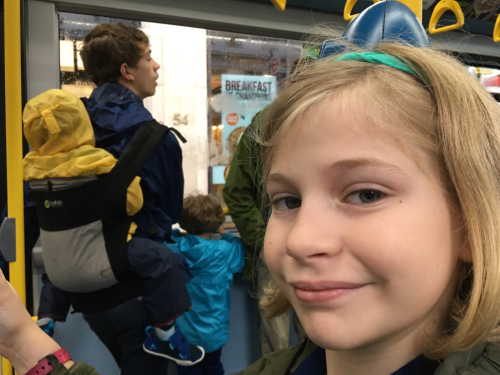
    We went by bus. The bus that came was a lowly one-level, which saddened some of the children. The rain might have kept us from seeing much anyway.

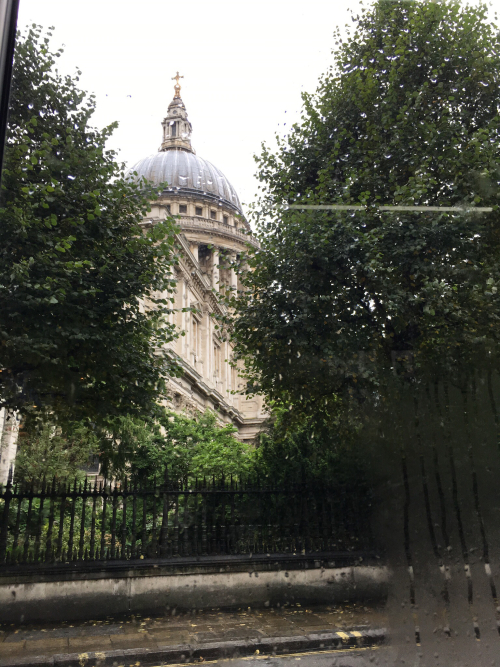
    But I did catch a tantalizing glimpse of St. Paul’s as we swung past.

    The Tower, of course, figures heavily in history and also in some of my favorite books. I have seen a map of it many times, with historical overlays and such, and wondered if it would feel “right-sized” when I got there. Not so much its height but its layout. It is, after all, nearly a tiny walled village. Would it feel as broad and wide, as compact and enclosed, as it did in my mind’s eye? Its walls as thick, its towers as stout?

    Remarkably… it did! The books I read must have done a good job of evoking it, because I almost felt as if I knew my way around.

    We took the Yeoman Warder’s tour. These fellows are showmen (and, presumably, show-women), with many prepared one-liners for the crowd.

    “Any Australians here? There’s always some! Well, you all must feel right at home, here in an English prison!”

    “Americans? Yes? Well, if you had been quicker about paying your taxes, all this history could be yours! How’s democracy working out for you these days?”

    “Speaking of democracy, for this next part of the tour I’ll be taking a vote. Shall we hear about prisoners, death, and executions? Or shall we hear about unicorns and kittens?….. I’m always glad when the prisoners, death, and executions wins, because I only have one unicorn story. It’s about a unicorn trampling a kitten to death.”

    The 7- and 11yo’s were quickly cured of their despair at having been roped into a guided tour. When it was over the 7yo was astonished to learn that it had lasted a whole hour.

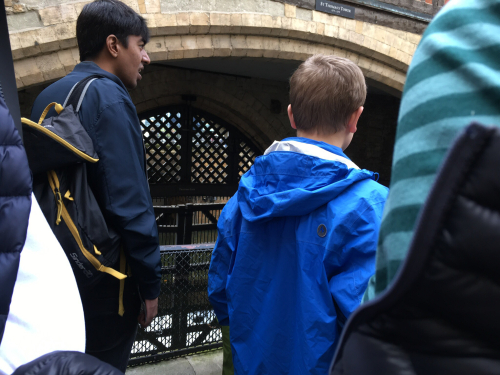
    Here is Traitor’s Gate, the trip through which was described in detail by our Yeoman:

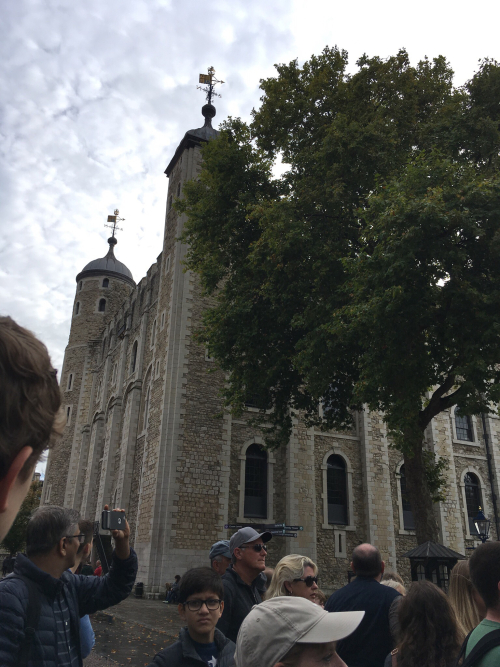
    And here the central fortress, stout and looming and impenetrable-looking at the time, meant to cow the City of London into submission:

    I had to leave in the middle of the tour to take the 3yo to the toilets, and when I returned the family was seated in the middle of the chapel listening to the end of the tour. (I had to convince the Yeoman Warder keeping non-tour tourists out of the chapel to let me past the chain.) I decided not to try to take him back in and hung about just outside, looking at the private living quarters, some of them in literal (Tudor) row houses. I suppose this window is over somebody’s kitchen sink.

    Afterwards we walked along the top of the north battlements, which takes you through a few towers that have been set up with exhibits of one kind or another (e.g. The Princes In The Tower, with a rather frightening short animated film being shown, in a style that reminded me of Fiver’s dream in the Watership Down movie). And we went through the Crown Jewels exhibit, which was relatively uncrowded (we walked right up to the moving sidewalk) and which I liked better than I expected.

    I mean, you just have to be impressed when you find yourself in front of a beautifully crafted, gleaming golden spoon, looking brand new, and then you find that it’s well over eight hundred years old.

    + + +

    The Tower, for me, is a good example of the sort of compromise you must make when you travel with smaller children. I could spend the whole day there. I would want to walk over the whole thing, with a good map (can you believe the maps they give you when you come in don’t even have the names of all the towers labeled on them? Only the famous ones) and really understand the distances, take it home in my head as something I have gotten to know a little bit. But you simply cannot do that with kids under 12, unless they happen to fall in love with the place right then and there.

    We ate in the cafe so we wouldn’t be hungry, and then we left.

    + + +

    It was a twenty-four-minute walk to St. Paul’s, and not much faster on the tube or bus, so to avoid the complications of transit we walked there. We did get a feel for the distances, and admired the big buildings in the City of London.

    I don’t have many pictures of St. Paul’s. I was busy herding children on the exterior, and inside photography is not allowed, as far as I can tell.
    All I really wanted to see, in St. Paul’s, was the building itself. We split up, since I had the 3yo on my back, so that Mark could take all the others up to the Whispering Gallery right away. I wandered around, relishing the sense of space, walked right to the center of t
    he dome and looked up, admiring. It really is, in terms of pure aesthetics, one of the finest domes I have ever beheld: not the tallest or widest (I have been to the Pantheon, I have been to St. Peter’s, I have been to the cathedral in Florence) but possibly the loveliest.
    My family hadn’t returned yet, so I went down to the Crypt and wandered around, stepping on the tombstones that make up much of the floor. Found Wren’s memorial, and William Blake’s right by, and John Rennie’s great polished-granite block.

    + + +

    I found Mark sitting in a chair in the middle, and passed the 3yo to him so I could climb the steps to the Whispering Gallery. The 13yo and 7yo went with me to show me.

    This week, the path up to the gallery is by a different staircase from usual, for some reason (perhaps workis being done on the regular stairs?). The “Secret Stairs” were frighteningly narrow and steep, not to mention numerous, and I was very glad that I hadn’t attempted them with a child on my back. The muscles in my thighs trembled by the time I was up.

    These stairs take you to a passage where you can see between the two roofs. I didn’t see any no-photos sign here, and we weren’t in the worship space, so I tried to snap one. Too dark for the photo. You could see the gray humps of vaulting through the gloom.


    The Whispering Gallery is fun. It really works! A couple of rows of benches encircle the dome. I sat with the 7yo directly across from the 13yo. A handful of other people paced or sat. We waved at each other. At first I thought I couldn’t hear anything, just a strange, pinging echo, a general murmur, like being underwater: sound comes from far away, strange directions, distorted. Then I heard the 13yo’s voice, clear but still far away, and I thought at first he had shouted, or spoken sharply, to me across that wide space. And then I realized he hadn’t been shouting at all.

    I tried it. “Hello?” My own voice came back to me an instant later, distorted and sharp, again like an underwater reflection. You couldn’t say where it was coming from, it was just there, as if inside your head.

    Before leaving I walked swiftly all the way around, my eyes trained on the floor far below, on the upper-floor corners (full of church things like stacks of folding chairs and cardbord boxes) under the evangelists, watching them turn below me, and felt I was flying.

    + + +

    To the store with the 11yo for groceries for dinner.

    St. Paul’s may be a marvel of engineering. I am less impressed by the self-checkouts at Sainsbury’s. I cannot please them.

    The assistants who have to bail me out five or six times per transaction are probably similarly unimpressed with me. It always climaxes with the trouble caused by a chip-and-signature card.

    I made macaroni and cheese for dinner. I forgot both the garlic and the mustard, but the shredded English cheddar was so beautifully sharp that no one missed it.

    I added broken-off bits of a slice of Red Leicester to the sauce so it would be ever so slightly orange for the sake of the youngest children’s expectations. I served it with steamed green beans, a can of Heinz baked beans, and fresh blackberries.

    Mark and I went out, to a Puglian wine bar called Li Veli. My dinner was better than his. We split a grilled vegetable appetizer (eggplant, zucchini, asparagus, tomato, long slivered onions); he had the sea bass, with potatoes and bitter greens; I had an orecchiette-like pasta with turnip tips, anchovies, cherry tomatoes, and bread crumbs.


  • Engines and Parliament.

    With Mark back from his business trip to Sweden, I realized that there was something I wanted to do with just him, not distracted by the younger children. But he had a Skype meeting at two and planned to work after that until dinner.
    So in the morning we woke up the teen boys and told them they had to babysit. And we headed off together…
    …to the Science Museum.
    + + +
    I know, I know. The Science Museum in London is probably one of the best places in the city to take children. And I do plan to take them. It’s free, after all, and relatively easy to get to.
    But I wanted to take Mark to Energy Hall to see the steam engines.
    + + +
    Which did not disappoint! There is a huge central room on the ground floor full of enormous machines, from the black and stained to the gleaming and polished. It is dominated by one in the center with a brightly painted wheel, several meters in diameter, grooved deeply on the outside, which once supplied the power for 1700 looms in a factory.
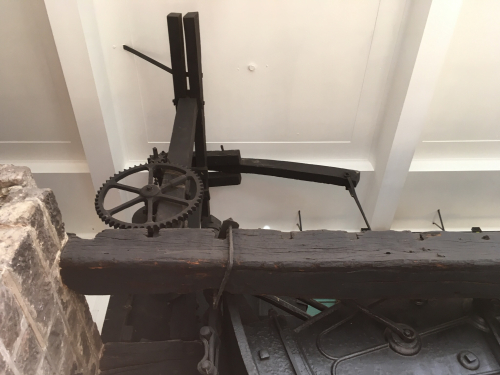
    There is a progression of historical steam engines, from the earliest meant to draw water from mines, through Watt’s and on to more advanced ones. For example, the oldest surviving “atmospheric engine” is here, used for pumping water up from mines; it gets its name because atmospheric pressure supplies the force for the return stroke, as cold water is injected into the steam chamber to condense the steam rapidly and create a vacuum.
    Each engine is accompanied by a well-design touch screen which includes a careful animation of the operation of the engine, so you can see exactly how each part of the cycle worked, while standing in front of the engine itself and able to see all its parts. It’s one of the best-designed galleries I have ever seen.
    I was so busy enjoying it that I forgot to take pictures. Mark and I moved from engine to engine, sometimes studying them, sometimes just enjoying them.
    We laughed at an apologetic description: “These machines may look crude, but in fact they were among the most advanced technologies of their day.” Crude? How could they look crude? They are beautiful. And they are amazing, when you pause for just a moment and think about the constraints upon them when they were made. I see nothing crude about them. They had to drill smooth, straight bores through narrow cylinders that were meters long, for the pistons. They had to make pressure vessels out of metal that was not steel. They had to invent the machines that made the machines.
    I was very taken by a description of how the designers of one very popular sort of engine for factories supplied to their customers only the blueprints, so to speak, and a professional engine erector to oversee the work; it was up to the owner of the new engine to obtain local laborers and even to source parts. I had no idea that the economy of engine-installation had been so decentralized. But the expertise must have been in such high demand then, with comparably few designers and so many new machines needed. How could it have been any other way?
    + + +
    “Clockmaker’s museum,” read Mark off the museum directory, but I said, “No, no, we have to go through ‘Making the Modern World,’ that is why I brought you here. Besides the steam engines, I mean.”
    And… in a series of displays that were lit from beneath, good for drama, not for photography…
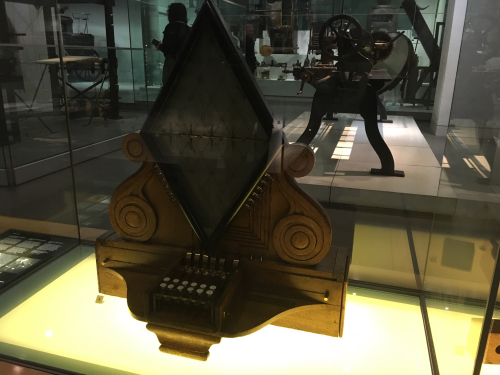
    A Cooke and Wheatstone Telegraph!
    Davy’s safety lantern with its wire mantle! (On the right.) Lister’s compound microscope—that is, Lister the surgeon’s dad’s microscope. And that spindly thing second from left? Faraday’s magnet and coil. Faraday’s!
    Look! A Jacquard punchcard loom! I ran around it and halfway up a staircase so I could get a good look at the cards.

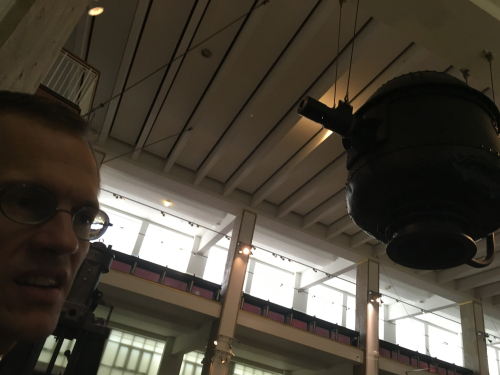
    The original pilot Bessemer converter! Not a copy. Not one in a later factory from Bessemer’s design. Bessemer’s own kettle from which the very first cast of mass-produced steel was poured:

    “This is where it came from,” Mark said in real awe. And then, in a case next to (oddly enough; but it was at about the same time) Elias Howe’s sewing machine:

    James Joule’s calorimeter!

    I may have teared up slightly.
    + + +
    There were many other artifacts, too many to photograph. Roentgen’s X-ray apparatus is
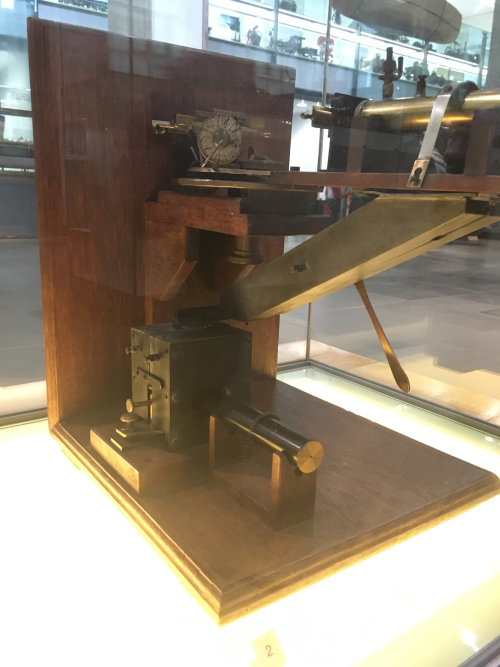
    there, for example. And here is Bragg’s X-ray spectrometer:
    Having spent time in the company of modern ones, I was charmed by the wooden supports and nearly struck dumb by the necessity of obtaining parts for it from a machine shop.

    Here is Watson and Crick’s DNA model, reconstructed from some replica and some original parts (particularly the metal plates that represent cyclics) as they had built it to show physically the three-dimensional structure of the double helix:

    “It’s made of ring stands,” I pointed out to Mark.
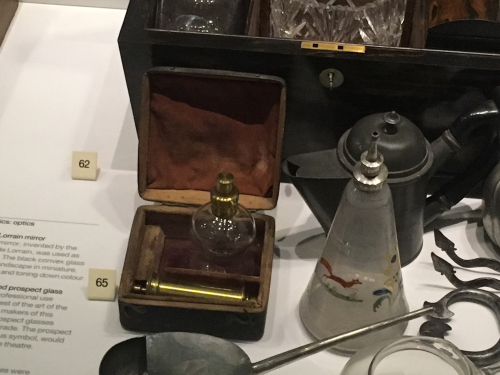
    Along the sides of the gallery are a collection of technological artifacts from everyday life: porcelains and plastics, wood and textile and metal, the materials and tools and machines that surrounded ordinary people in what must have seemed ordinary times. I took a picture of a breast pump, with a tulip-shaped glass bell that fitted to a brass piston:
     

    We finished out the gallery, hung with airplanes (“I am always amazed those old metal prop planes could fly,” said Mark, “the early ones are light like gliders and the later ones had jet engines and better metal, but these middle ones I cannot believe could get off the ground”) and cars; penicillin, thalidomide, modern dentist’s drills, anesthetics, an early MRI machine, a Cray-1 supercomputer.

    There was so much in that one gallery alone, I could come back and spend the same amount of time again, and still not see all I wanted.

    That’s good, because I really should, you know, bring the kids here.

    + + +

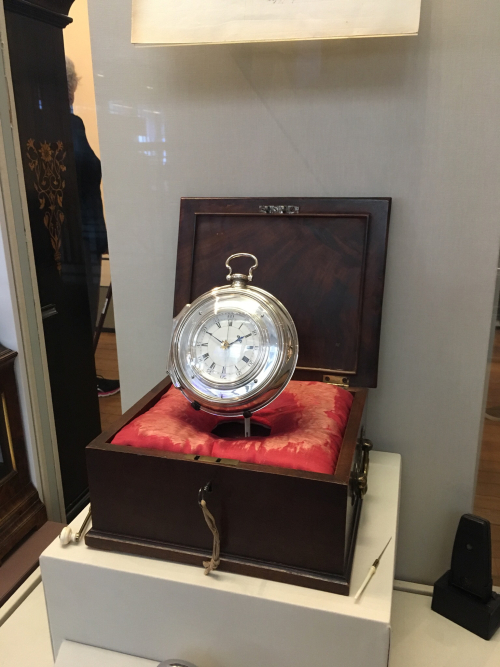
    Upstairs we went to the Clockmakers’ Museum. Much of what they have here is similar to the smaller, concise gallery in the British Museum, but there was one historical piece I made a beeline for: Harrison’s “H5” marine clock.

    We marveled at the tiny, beautiful watches. I honestly had had no idea they could make watches that small that early.

    Everything was really beautiful. The worksmanship, top notch. But there was a bit of the interpretation displayed that issued a sort of caveat. The English clockmakers had refused to accept that their customers wanted more affordable goods, with less-than-top-quality (but still functional) construction, and foreign-made affordable goods put many of them out of business.

    One of my FB friends, on seeing the photo of the old cash register from the British Museum that I shared a couple of days ago, commented “I wish they made ordinary things this beautiful today.”

    Beauty can be made at any price, I believe; but the nature of economics is such that if you will not sell people the thing they want at the price they can pay, someone else will.

    + + +

    We had to go, so that we would have time for lunch before Mark’s Skype meeting. On the way out I took some pictures in the first gallery, Energy Hall.


    + + +

    When we got back, I queried the children and settled upon walking in for a tour of Parliament. My daughter frowned and said, “I don’t like tours. Tours aren’t fun.” I have limited patience for making eleven-year-olds do things they don’t want to do, especially when I am on vacation, and don’t have help from a spouse (remember, Mark had telecommuting work to do), so I took the teen boys.

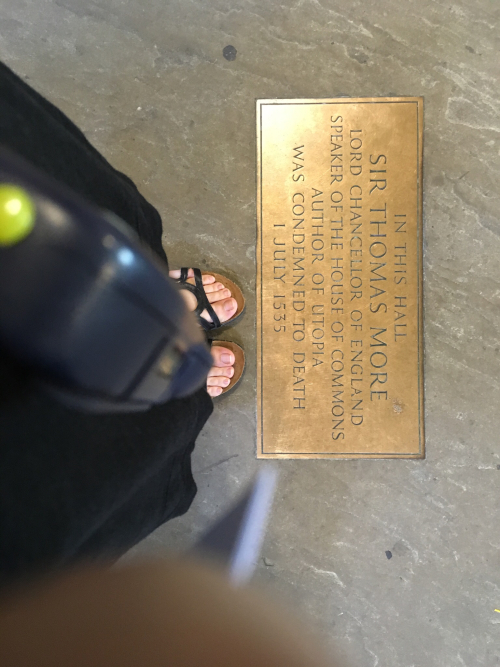
    You aren’t allowed to take photos except in a few places in Parliament. I took one in Westminster Hall.

    This medieval hall was really the thing I came to see, the only surviving part of the earliest Parliament building, but I enjoyed the whole tour. The audio tour was really quite well done, and I enjoyed the artwork, the statuary and paintings of kings and prime ministers, the spot on the great wooden door that is splintered from being ceremonially bashed by the Queen’s representative to be let in. We wondered at the system of vote-counting where the members physically sort themselves into “yes” and “no” lobbies (or, in the House of Lords, “content” and “not content” lobbies) and file past the clerk in person.

    Standing in the House of Commons, walking up the steps to the top rank of green benches not so far from the ones on the other side, you sense how claustrophobically small it is, how the opposing parties face one another, and how very different in character it is from the U. S. system. My boys found it fascinating.

    + + +

    We emerged from Parliament just a few minutes too late to enter Westminster Abbey as tourists, so we continued north, past the Treasury, to the Churchill War Rooms, and took the tour there. It was even more claustrophobic, but very interesting, especially the map room, and filled with small artifacts like job acceptance letters, memos to staff, and a do
    or hung with dozens of keys and their handwritten tags. There is a Churchill Museum that is part of it, with interactive displays on the life of the prime minister, but we skipped that for lack of time and explored the underground government bunker only, with the aid of the audio tour. I was pleased by the heavy sculptured telephones, some of which could be switched from “Normal” to “Scrambled,” and by the voice interviews coming through on the audio tour with women who had worked as typists and switchboard operators, never talking to their families about exactly what it is they did at their jobs in “an office” until after the war.

    We reunited the family at dinner time and headed off to an Indian restaurant for a feast of papadum (“This minted chutney tastes like key lime yogurt.” It did), and onion bhaji and tiny samosas and chicken pakora, and lamb vindaloo and tandoori chicken and dal and sag paneer. The little children had fish fingers and fries. Our waiter chatted with us for a long time about different things to see in London, asking about where we came from, and when Mark asked where he liked to eat, admitted that his favorite food was made in his own kitchen.
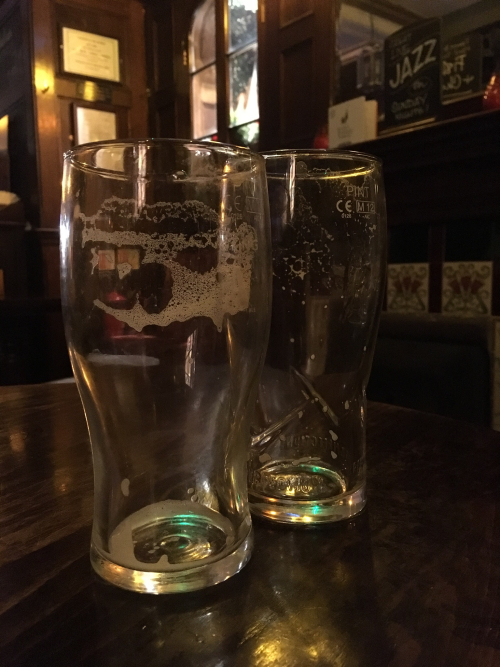
    Back at the apartment, we dropped off the kids and headed to another pub. Just one pint for me, thanks; I was nearly exhausted. We sat for quite a while, looking around at the interior, on a leather (or leather-like) banquette seat that ran around the back of the pub next to the fireplace.
    “No restaurant at home is such a welcoming place to imagine meeting a friend for a beer,” said Mark.
    “It’s the materials,” I said, “they’re so much warmer than any restaurant or bar.” The paneling was a dark polished wood, the floor was Oriental-carpeted, the fireplace set around with colorful tile, the round, wooden tables were crowded closely together in this back room, a little randomly as if they’d been left behind by a large group of friends who had moved them closer and pulled up their chairs, squeezing into the space. The walls were a mass of framed photographs (the sort signed by actors, but the effect was of a wall of family portraits) and theater posters. A staircase with a carpet runner and a wide polished bannister went up and around a corner. A television was on, and music played, but not so loud as to squelch a conversation.

    I was too tired for another pint, but not too tired for a meandering walk through Seven Dials and Chinatown. I’m amazed at how dense the small boutiques are, there’s no such thing it seems as an alley that goes behind things; everything is full of storefronts. The energy of people and crowds are everywhere. You can just walk and walk and take it all in for hours.

    Back to the apartment, and a collapse.


  • Buses, coaches, and everything else.

    On my way out to get some cash from the machine in the morning, I happened upon a strike march, complete with loud upbeat music and vuvuzelas.
    Just an odd note. But if I were going to give this photo a title, it would be “Wait/Look Right.”
    + + +
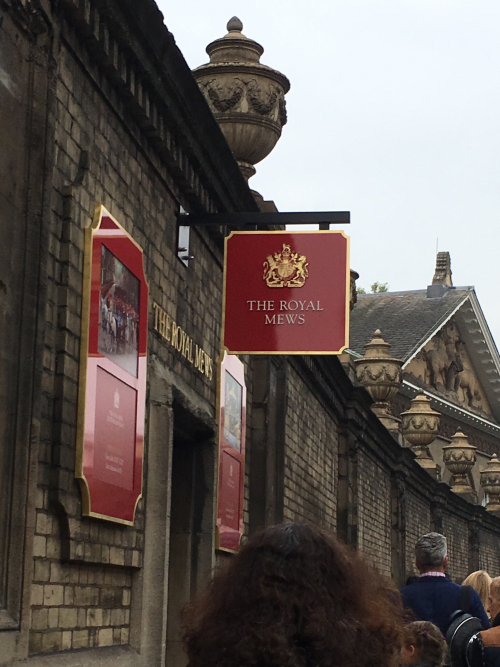
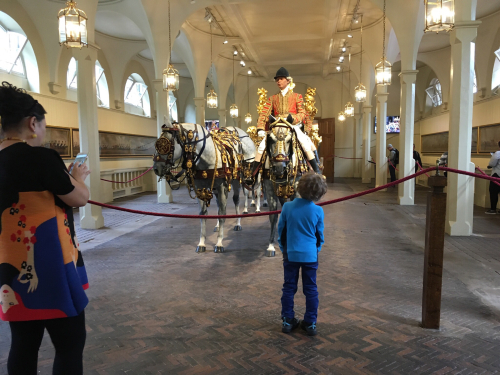
    I came back and gave the cash to the teenagers for lunch. They had offered to stay home with the 3yo so I could take the 7- and 11yos somewhere without him. “Should we go on the tube to St. Paul’s and climb up in the Whispering Gallery?” I asked. “Should we take a bus to the Royal Mews and see the Queen’s horses? Where do you want to go?”
    “I want to stay here and sleep,” groaned the 11yo.
    “I want to go on the top of a bus,” said the 7yo, “really anywhere.”
    So I went out with just him.
    I thought the Mews would be a good place for him, anyway, because he is interested in horses. So we waited for the number 38 bus, touched in my card, and climbed the steps to the upper level, swaying a little and clutching at the handrail as the bus accelerated away from the curb.
    I am glad I only had one child to manage for my first bus trip. It turns out that the London buses are not hard to manage or to figure out, but I am wary from having lived and traveled in cities where they can be more confusing.
    It was a twenty-minute ride or so, fairly scenic, with lovely views of Green Park toward the end, and the bus let us off just across from where we were going.
    As we walked in the first door, a staffer with long straigh gray hair and a kind face pointed out horses exercising in an indoor yard just visible over the sill of a half-door. I lifted him up to see. “Those are the Windsor Grays,” she said, “though they look rather white. They’re the queen’s horses, and in a procession she’s always pulled by those. You’ll learn more about that on the audio tour.”
    “No thank you,” he said, “I don’t really like tours.”
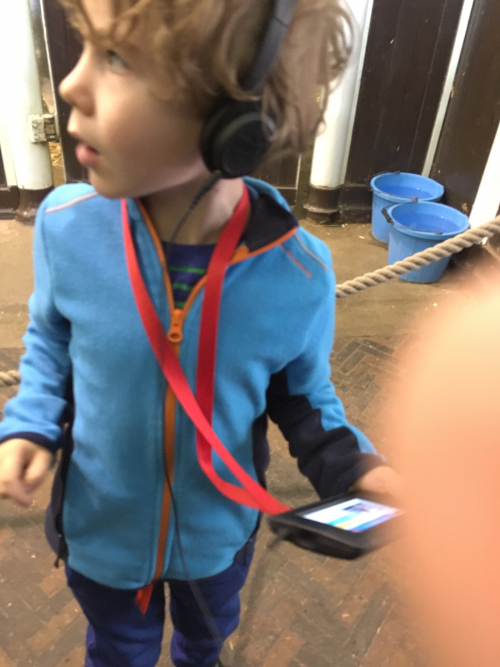
    “You really ought to take the player with you,” she said, “it’s very fun and tells you a story. If you don’t want to listen to it, you can always take it off.”
    He decided to give it a try.
    The children’s audio tour was nicely designed, with a little video on the player; a couple of horses (and a corgi) take you from stop to stop, and you can skip the details or click more to hear and see more of them, like interviews with staff.
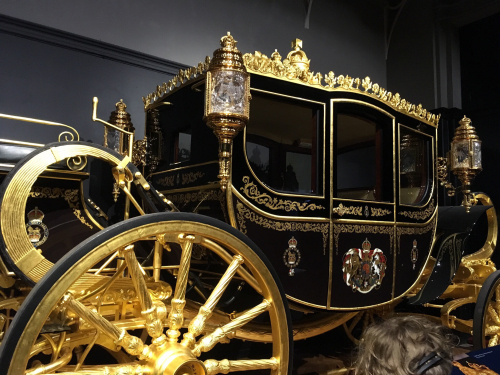
    We looked for quite a while at the various coaches. The newest one, only a few years old, is fitted with many shock absorbers for a gentler ride. I liked the older ones myself.


    It’s very interesting how they have put rooms of a working stable behind glass for visitors to see. I am sure there is much more going on behind the scenes. We saw the Harness Room, and I pointed out the leather-polishing equipment on the table, and the perfection of the finish of the leather on the hanging harnesses.

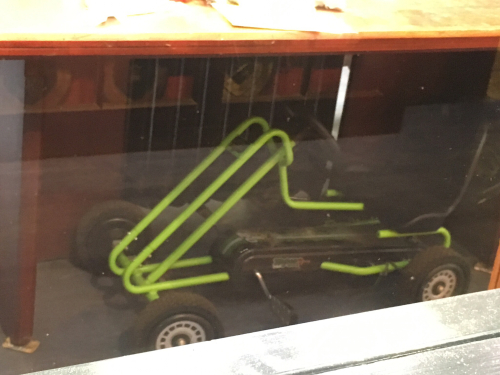
    Under the table: a child’s toy pedal-cart. The 7yo tried to convince me it could possibly have belonged to Prince George.

    Children do live here, in apartments around the central courtyard, with their parents who work here. This idea fascinated him, and he surveyed the balconies and thought aloud about what it would be like to live among the Queen’s horses.

    In a grand stable hall built for George IV they no longer have horses, but they have a carriage replica you can sit in, mounted on springs, that rocks from side to side if you lean.


    And a dress-up closet with miniature uniforms.
    And a wooden pony with a harness you can take off and put on again. The harness was already on the pony when we arrived, with the reins pulled back and draped casually over the hanging hooks, and the 7yo set himself to trying to take it off. He ignored the numbered step-by-step instructions written on the sign behind the horse and went for the nearest buckle.
    An older British couple was coming through taking pictures. The woman said to him, “Oh dear, you’ll never get it off like that. First the reins, and then this bit over here, and then this comes off after that.” She placed her hands on the leather, and I could see she knew what she was talking about.
    “Thank you,” he said, “but I want to figure it out by myself.”
    They went away, and while he struggled I walked around, looking at the smaller carriages displayed here: everyday carriages, and a miniature one that royal children used to use, pulled by a pony. Words from books, like “brougham,” known only in a vague fog before as a wheeled thing pulled by horses, condensed into a solid object.
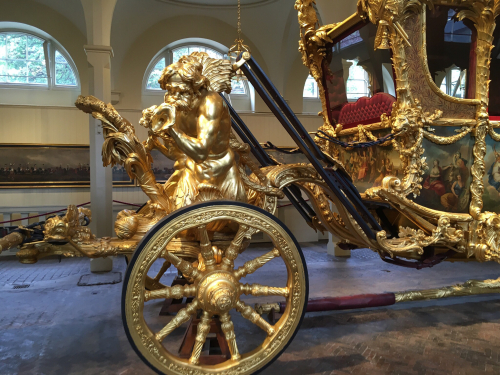
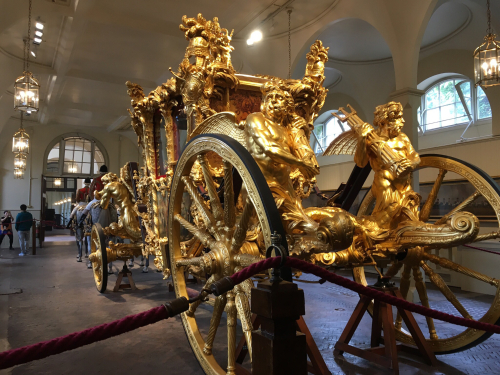
    After a long time in that room, the 7yo gave up on the harness and instead spent time standing behind the wooden pony with the reins in both hands, shouting “Giddyup!” I got him to buckle up what he had undone and put the reins back, and we went on to the tour’s finale, which is the Gold Coach.

    Commissioned in 1760 for George III and still in use, albeit rarely (I think it was last in a procession in 2012), it only goes at a walking pace and yet requires 27 meters’ braking distance. The wheels are not spoked in a plane, and so they are tilted outward to make the spokes meet the ground at 90 degrees.


    We put our audio players in the slot and headed back outside. Google Maps told me to walk to Green Park station to get either the bus or the tube, so we started off toward Buckingham Palace.

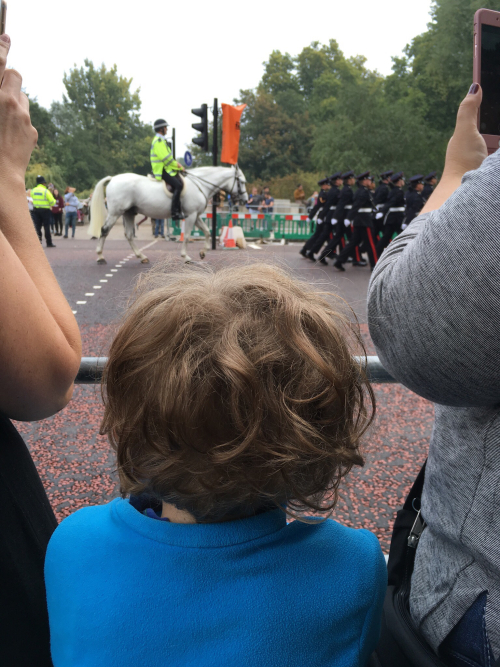
    Just as we got there, there was a blare of a marching band, and the crowd there started moving from the outside in, with people dancing about on the fringes trying to get a good view on their phones. I could see horses.

    I looked at my watch. Eleven-thirty. We had stumbled upon something I hadn’t planned to see at all, because it isn’t really my thing: the changing of the guard.

    All that we saw was a brief little parade from the front of the palace, out the gates and across the street into another gated yard (Wellington Barracks). But it impressed the 7yo anyway. He made me follow the crowd, climb through a handrail separating sidewalk from street (lots of other people were doing it) and cross over so we could get a good look. The music was all over quite soon.

    I had gotten turned around with our rush to figure out what the music was, so we walked the wrong way at first, and then when I figured it out the 7yo nearly collapsed in despair for his lunch. I promised to feed him before we got on the bus, and worked out that there would be food available near Green Park station.

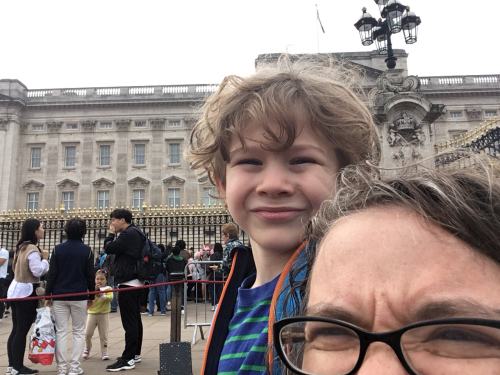
    We took a quick selfie in front of Buckingham Palace, to celebrate accidentally seeing a quintessential London tourist thingie we hadn’t meant to.

    Then walked north through Green Park while the 7yo fretted about how long it would be until he could eat lunch, as this was obviously an enormous park that would take forever to get out of.
    We made it out, however, and after searching for a place to cross the street, found ourselves at a Pret-a-Manger. “I don’t like sandwiches,” protested the 7yo, but I enticed him in with the promise of a Tuna Melt Toastie.
    He always forgets that he likes tuna melts.
    For me, a Posh Cheddar And Pickle Baguette, with kale chips and a petite bottle of carrot juice.
    I had a clueless culture moment when, the place nearly full, I set the child on the last empty stool in a long bank against the window, figuring I had room to stand at the end myself. A few minutes after I had done the work to set him up, opened his drink, extracted onions from his sandwich, etc., the woman seated at the stool next one over turned and looked at him pointedly a couple of times, with a look that I associate at home entirely with “I was dining here peacefully and then you had to g
    o and put a child near me where I might hear it.” I ignored the look, because that is what you do (where I come from) when people glare silently at your children who are behaving perfectly fine.
    (It’s different if they are misbehaving or having other difficulties like spilling or being audibly sad. Of course I acknowledge that. But I generally don’t apologize for children’s merely taking up space in places they have every right to be. And yes, you do encounter people who think otherwise. And I generally respond by behaving exactly as if nothing is wrong.)
    A few minutes later a man came by with the tray and the two of them gathered up their things exceedingly rapidly, too fast for me even to realize what had happened, and left, presumably in search of another pair of seats together, without ever saying anything to us, let alone “Oh, do you mind, I am saving this seat.”
    Ahhhhhhh. I see what you mean now about the silent seething.
    That was embarrassing. In my defense, I come from a land where the apology would have been expected to come from the person taking up two seats in a crowded restaurant.
    But, you know, when in Rome. I’ll try to be more alert next time.

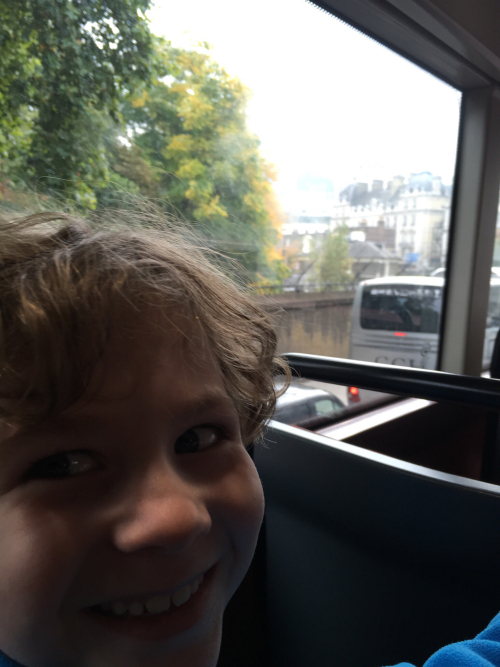
    The top of the bus, home. Front row this time, which really does afford a nice view.

    + + +

    Back at the apartment, the teen boys were slurping down the last of the noodles from their second Wagamama order in eighteen hours. “What shall we do now?” I asked, and ticked off some choices.

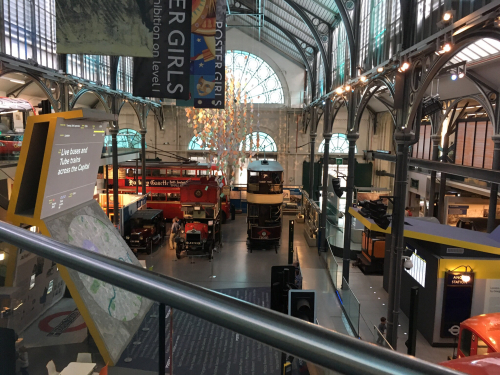
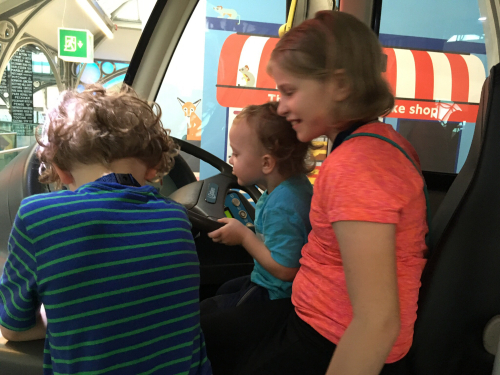
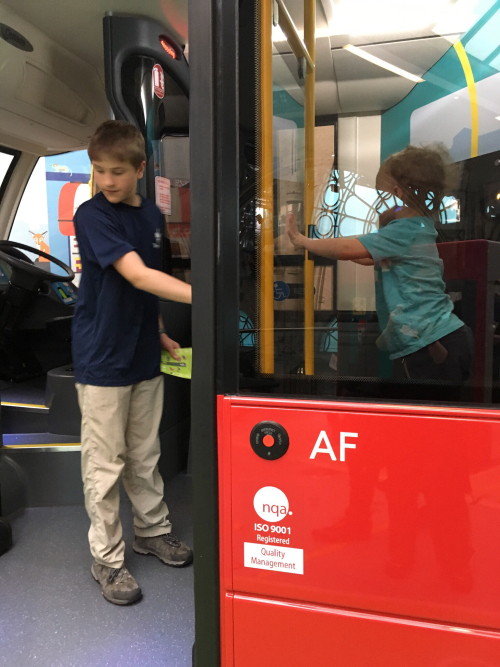
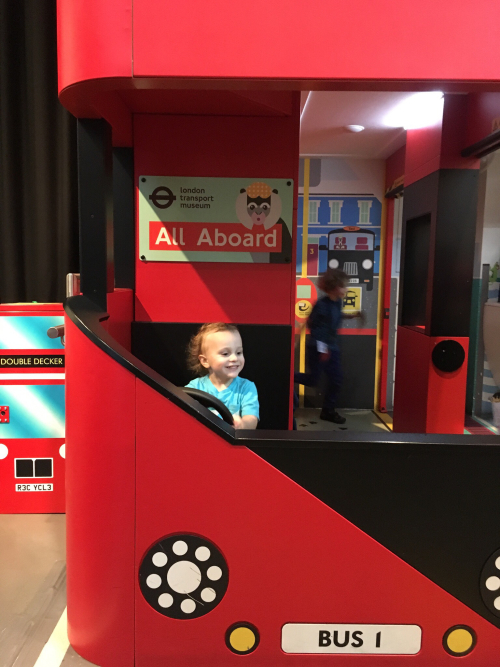
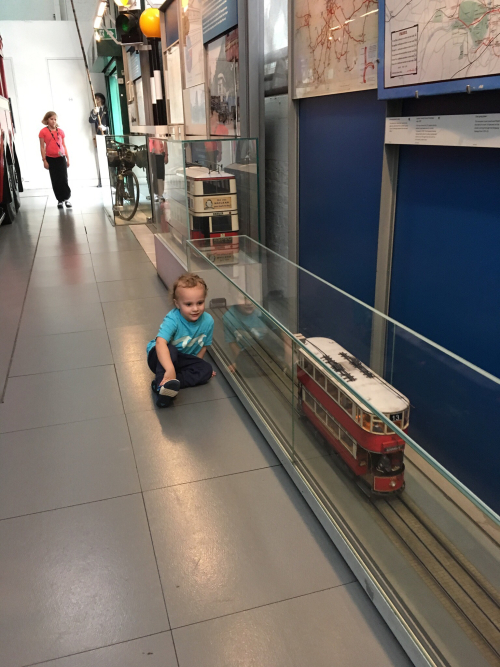
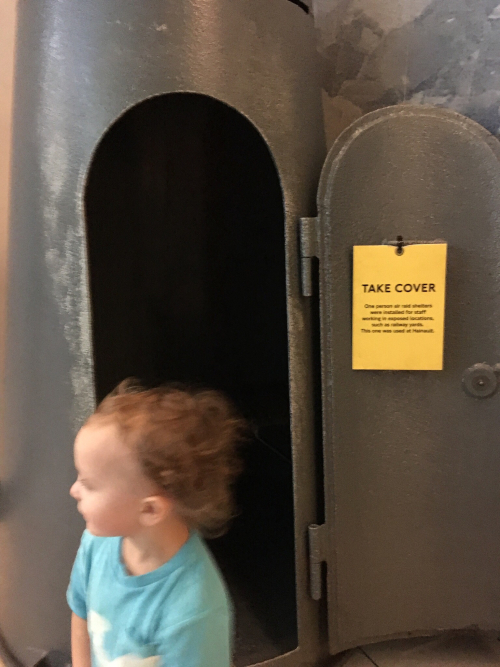
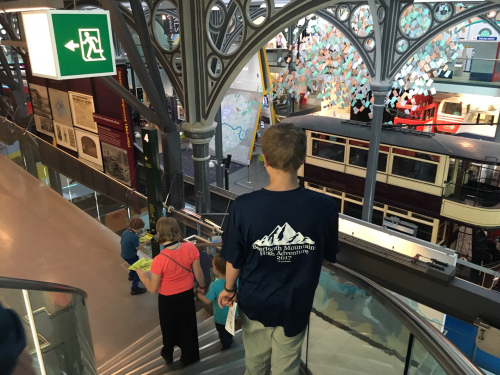
    We went for the London Transport Museum, which is less than fifteen minutes’ walk away, in a structure that was once the Covent Garden flower market. I carried the 3yo until we got there, and then put him down because it’s the sort of museum where little children run around frantically pushing buttons and having their paper passport punched at different stations.


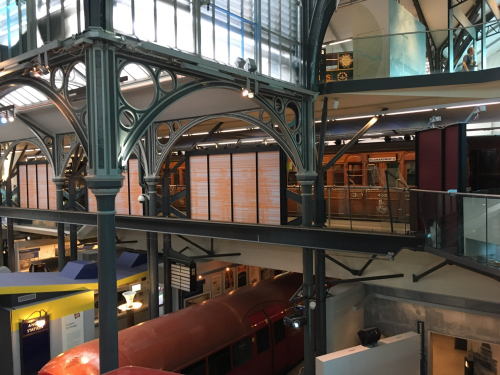
    The building itself is really cool.

     
    And there are plenty of interactive exhibits, especially for kids who like sitting behind Driving Wheels.


    Spent quite a bit of time in the play structure designed to look like a Tube station. Was amused that they included the detail of a busker’s open violin case on the floor, with some percussion instruments to play.


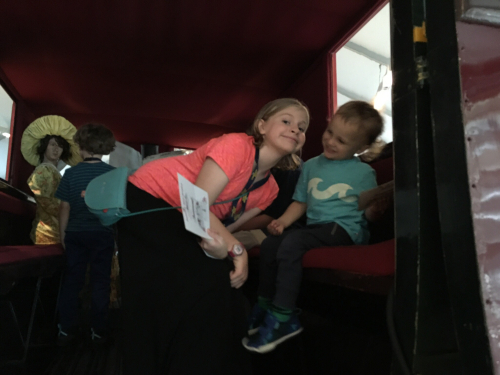
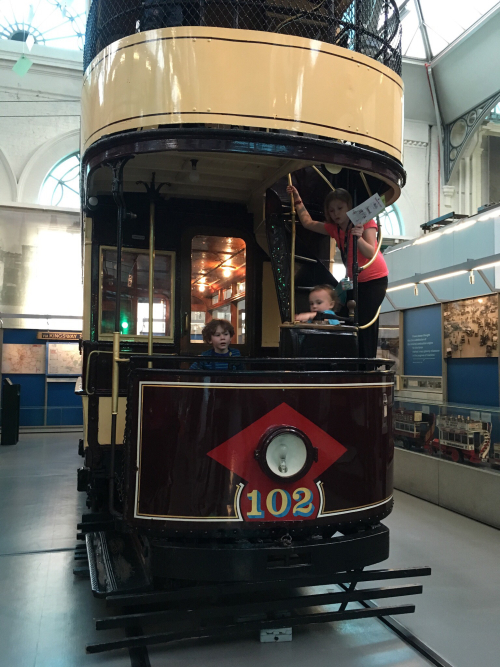
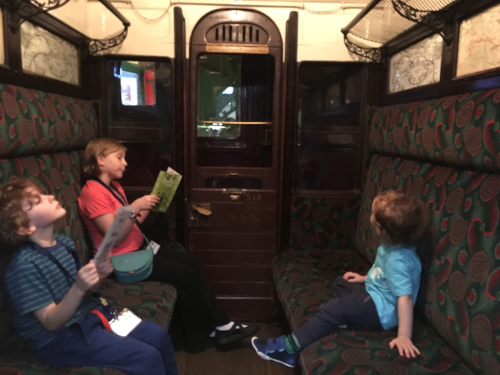
    I was able to enjoy the exhibits myself, too. I loved a diorama showing how the Underground was built, by digging a trench, laying tracks, and roofing it over; miniature people standing in miniature back gardens with a gaping hole behind, planks laid over the edge to give them a way to walk to the shops. I played with the subway-driving simulation (key to success: begin braking long before getting to the station) and took pictures of the kids seated in various restored vehicles, from horse-drawn omnibus to twentieth-century double deckers.

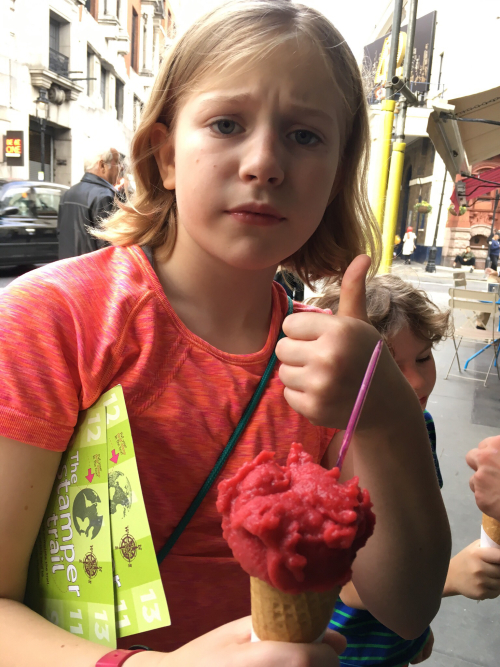
    On the way back we stopped to get ice cream from a shop we’d seen on the way in, just before arriving at Covent Garden. Our 3yo can be messy like any 3yo, but he has inherited his dad’s ability to consume an entire ice cream cone without wasting any, faster than the ice cream can melt. So (after myself removing just a bit of the excess, to be sure) I had no compunction about ordering him one and letting him eat while walking in London, holding my hand. He was barely sticky when it was gone.


    I was completely exhausted when we returned. I sent the teen boys and the little boys back to the apartment, and went with the 11yo to the store, where I bought things I could cook. The easiest scratch meal I could think of: chicken soup. I bought a small whole chicken, and onions and celery and carrots, and salt and a package of fresh tagliatelle, the only egg noodles I could find.
    Then back to the apartment where I discovered there was no soup pot big enough to hold the chicken.
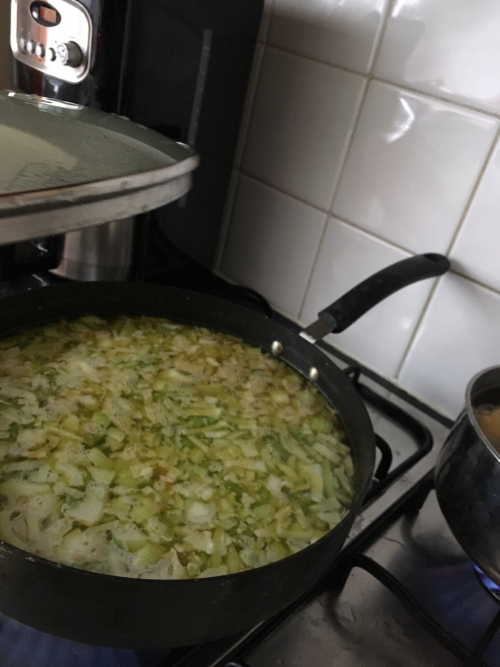
    I opened a cider and drank it (rapidly), and then made do by spatchcocking it and squashing it into a deep saucepan with the whole aromatics and as much cold water as I could fit. Not enough for a proper quantity of broth, so after it was cooked I retrieved the aromatics and bones and stuffed them into a smaller saucepan with more water to make a second batch of broth. Into the first batch went the diced aromatics.

    And when that was done, in went half a kilo of noodles, which soaked up all the liquid. In the end we had to assemble our bowls from one pot of broth, one bowl of shredded chicken, and one pan of noodles and veg.

    + + +

    I fell asleep before Mark got back and failed to answer his texts asking to be let in, but fortunately our teen son was awake. And that was one day.


  • British museum and a short solo outing with a purpose.

    My teen boys are using their vacation, in part, to—get this—relax.

    Plenty of this going on with the little ones, too.

    Tuesday Mark had to take off for a business trip. One of the ways we managed to pull together such a long trip is by having him do some work while we’re gone: a few days of telecommuting and some European business that he would have had to travel for anyway.

    With him not here to help, I planned something fairly easy:

    Yes, it’s enormous, but it’s also a five-minute walk from our apartment and free, so we can just go in, spend time, and leave again, and come back later easily if we want.

    My plan: all five kids and I would go together at the ten o’clock opening, see what we could manage before lunch, have lunch there, then split up. The teen boys could go off on their own together, and I would take the younger ones back to the apartment to rest.

    There is a little line outside just to get through security. They look in all your bags and purses and don’t allow large ones. They did not have a problem with the child carrier, but they do not like it if you absent-mindedly take a picture while you are in the security tent (ask me how I know).

    We made a beeline for the Egypt collection.

    The Egyptian artifacts are so numerous as to be overwhelming. We had young ones, remember, so we could not give each item a very close scrutiny, but I left with a strong impression of the painted and carved funerary objects as items crafted by real people with individual styles and hands. The picture-words aren’t printed or stamped, each bird and stream of water isn’t the same as each other; there is a fleeting imperfection to each one, as in pop art paintings where the artist has reproduced some scrap of text in the Courier font by hand-drawing and inking each enlarged letter-form.

    My 3yo, on the 17yo’s back, greeted the canopic jars: “It’s a bird pot, and a dog pot, and a monkey pot, and a person pot.”

    I marveled at the painted linens and funerary portraits from the Roman period. The realism, the twinkle in the eyes:

    It isn’t hard to find the Rosetta Stone; just follow the crowds. We squeezed through and got a good long look at it, up close and personal; the best unobstructed view was from the side of the case, which still got you a nice good view of the inscribed texts on the face of the stone. I took a moment to point out to the 7yo the everyday, easier-to-write Egyptian script in the middle. What a treasure, this otherwise plain black rock, unlocking all the gloriously painted ceremonial writings on all the funerary objects in the other rooms.

    Here’s what I wish, though: That, however lengthy and tedious and repetitive it might be, that the museum would post by the hieroglyphic objects the translation of the texts that are written on them. I don’t just want to look. I would like to know what everything said.

    I suppose it might slow down the crowds. And maybe I would spend more time reading cards than admiring craft. There is a cost to everything.

    + + +

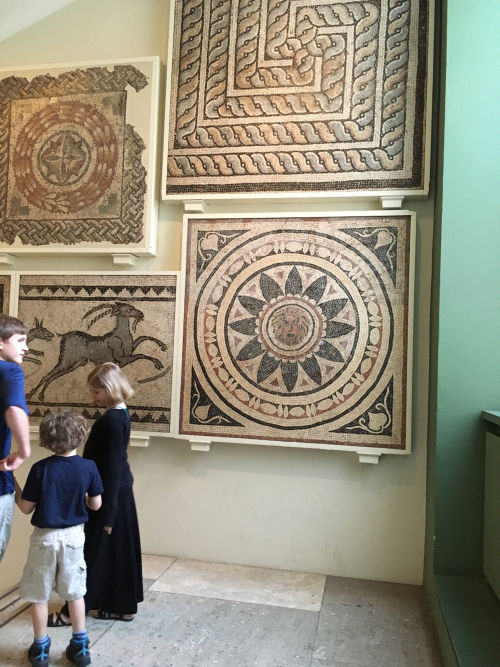
    A staircase was hung with Roman floor mosaics:

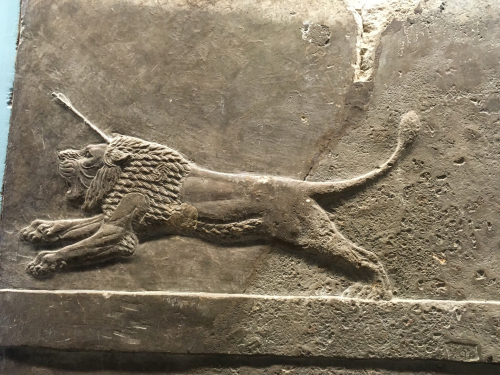
    We spent a long, long time admiring the stone palace reliefs from Assyria, depicting the Lion Hunt of Ashurbanipal:

    These were really, really amazing, and I am not surprised to read that they are among the most popular antiquities in the museum. There are a lot of lions, some of them dead and dying, many of them wounded (one has an arrow through the eye sockets; some are vomiting streams of liquid as they pace, arrows sticking out of them), some are fleeing, some attacking. It is practically a study of all the ways you can depict a lion.
    Many panels are packed with action. I am very fond of art, especially very old art, that appears to have stumbled upon the conventions of twentieth- and twenty-first-century superhero action comic and graphic novels; I think because it is evidence of something universal in human communication. I mean, it’s obviously possible that the Lion Hunt formed part of the chain of influence that led to Spider-Man, since it preceded it and was famous, but I think it more likely that this sort of communication of motion and sequence developed largely separately.
    Anyway, I am thinking of a single particular panel that I approached from left to right: a wounded lion, pierced by arrows, fleeing away to the left; some empty space; a single arrow in sharp relief, at the height of its flight; empty space; and at the far end, the hunters, much flatter and more stylized
    than the lions, aiming to shoot again. Taken as a whole, you can see the arc of the arrows’ flight, and it functions as a three-panel snippet of a story, the intentional blank spaces providing a sense of separation. You can follow one arrow from right to left in time (he shoots—the arrow flies—hits its mark) or you can see the arrows in succession from left to right (the first already piercing the lion—the second in the air—the third already on the bow).
    The hunters’ beards and the lions’ manes are beautifully curled, the armor detailed. Stylized vegetation and waves indicates forested hills or sea. In one panel, horses swim a river, seen in whole as in profile, surrounded by large fish. A city wall is detailed by myriad individually carved fish-scale-like stones. A siege machine batters away at a wall with a menacing levered boom, and cubical bricks tumble down from a growing hole, its edges jagged in right angles, the negative space where square bricks came away. And there are meters and meters of the carved stone.
    + + +

    The 7yo was seriously waning by now, so we promised him something modern. Upstairs were two little galleries I wanted to see: Clocks and Watches, and Money.

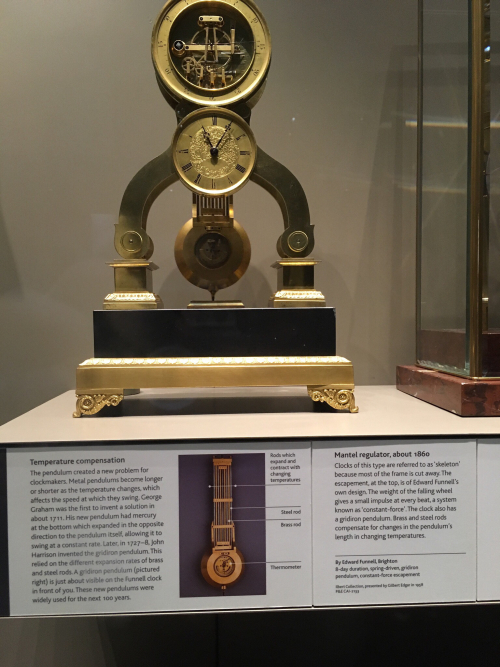
    We walked into the clock gallery just a moment or two before eleven o’clock, and were rewarded with the unexpected music of many chimes: I had not expected this, but many (not all) of the clocks were running.

    This one has metal rods mounted on the bottom of the pendulum which expand upward as the pendulum expands downward, compensating for the effect of temperature change by keeping the center of mass closer to where it is supposed to be than it would be otherwise.

    We had a physics problem about this a few months ago, so I made my 17yo come look at it.

    In turn, he pointed out to me a springed, chain-driven clock, the chain wound about an axle whose diameter changed as the spring ran down. “The axle profile is a graph of the changing force expected from the spring,” he said. Indeed.

    (This clock was also notable for the little silver-colored ball, seen at the left side near the support, that rolled down a zigzag channel, taking a minute to do so; when it reached the edge, the table tipped the other way and the ball rolled back.)

    + + +

    The Money gallery included collections of coins and notes and other monetary objects, like cowrie shells and gold wire. There were seals, too, each displayed face up, next to a little wad of putty or clay bearing their impression. The detail on some of the coins was amazing; I have seen many ancient coins in pictures and in museum displays that were very degraded, but I have never seen so many pristine ones.

    There were pieces of eight, I think the first ones I have ever seen up close, and a whole case of counterfeit British pounds. There were dies and tools for minting coins. There were examples of some of the world’s oldest paper money, Ming dynasty I think, a note about the size of a piece of A4 paper with a picture of a string of stacked hole-punched coins that was some sort of official measure, displayed next to a physical reconstruction of the same string of coins.

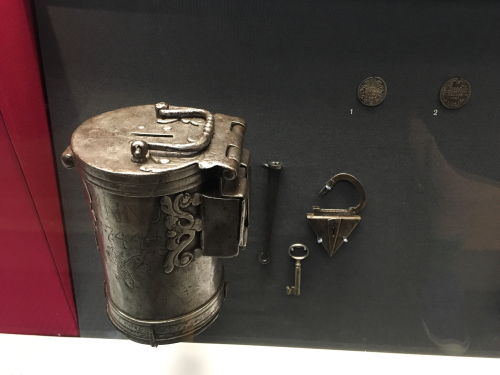
    There were items for storing money, such as this 18th-century poor-box, which had a double lock so that it required at least two different keys to open it.

    There was this beautiful cash register, which I photographed because it was made (according to the card, in London) by the National Cash Register company, a business which was headquartered in my home city of Dayton, Ohio.


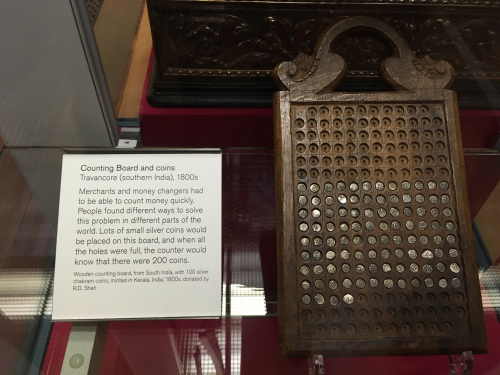
    I loved this quick coin-counting board, with slots for the right number of coins to fall into until the excess slides right off. A useful engineering trick you’ll see in other places besides money-counting.

    + + +
    We had lunch in the café on the ground floor of the Great Court.
    People like massive domes around here, and dramatic entrances.
    Not much to report about lunch: cold smoked salmon from the case for me, hot panini for the 17yo, pasta salads for the 11- and 13yo, grapes and popcorn and potato chips for the smaller children. Then I handed some money over to the teen boys and they disappeared.

    I decided to build a little endurance into the others by inviting them to pick a gallery to see before leaving. The 7yo refused, but the 11yo wanted to take a closer look at Greek and Roman things. She wasn’t interested in the Elgin marbles (the 7yo was a bit interested in the model of the Parthenon displayed in the entryway, but only for a moment), but in the statuary.

    What she seemed especially interested in was delivering a lecture on the relevant myths to the 7yo. To his credit, he listened attentively. So she told him all about Aphrodite:

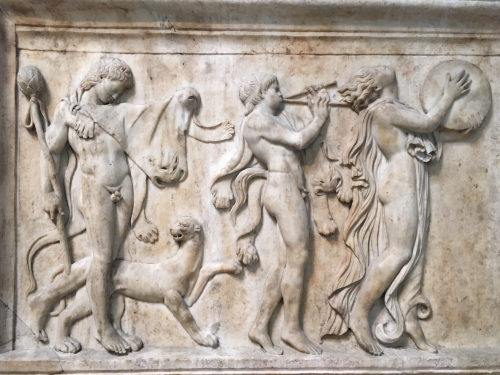
    And about Dionysus, and the panther associated with him:


    And also about Apollo and Diana and the bragging of Niobe, mother of fourteen, and the twin deities’ subsequent slaughter of her children (thanks to a large medallion-shaped depicting that particular event).

    + + +

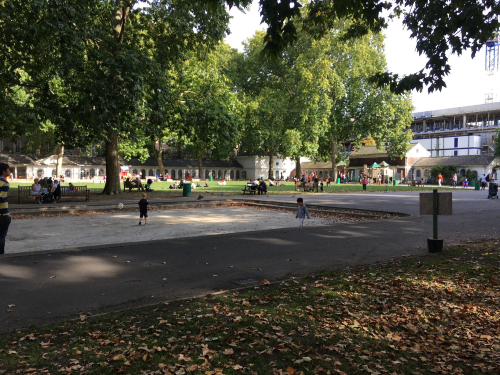
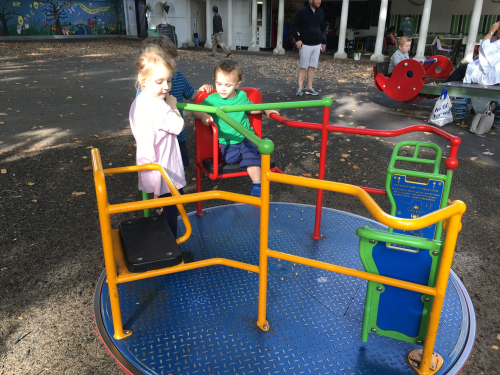
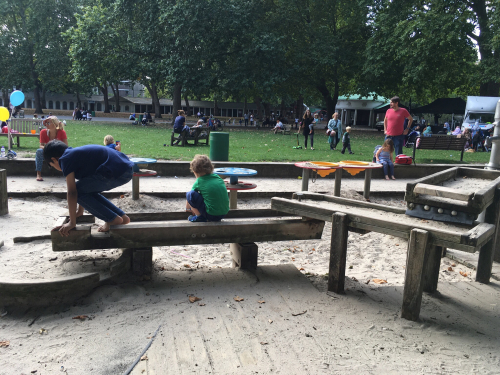
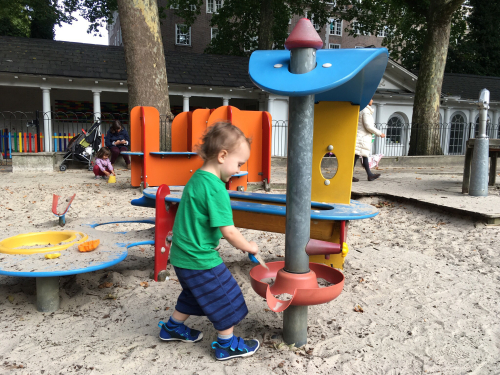
    But that was about all the small boys could take, so we left and headed through Bloomsbury Square to stop in the tot lot for a little while.


    It couldn’t last long, because people had to go to the bathroom. Fortunately our apartment is only a block away. We went there, and turned on the TV, and rested a while.

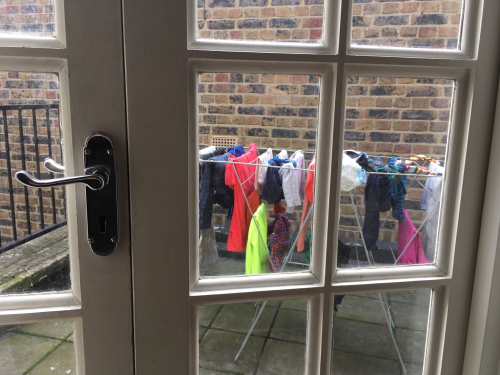
    I hung up the still-damp laundry, still hot and moist from the “dryer.” There was a little sun, and I thought perhaps it might evaporate some more of the moisture outside.

    I sat down to make a list of the things I wanted to do and a list of the dates that are available to do them in. I stared at the two lists in some dismay. One is long and the other is short. Here I have been in London since Saturday evening, it was Tuesday already, and I have not laid eyes on St. Paul’s or on Parliament or even on the Gherkin. How will I find the time?

    Well, if I am going to spend lots of time in one neighborhood, at least I am in a good one, with lots of things to see, eat, and drink.

    + + +

    The teen boys returned around three o’clock, and I headed out on my own with a mission.

    After having learned from the discount ticket office that everything I was interested in seeing wasn’t likely to be discounted much at all unless I got lucky in the rush line a few minutes before the show, I decided the simplest way to get tickets for things in the next couple of weeks was just to stroll right into the box office and buy them in person. We are quite close to many theaters so this was

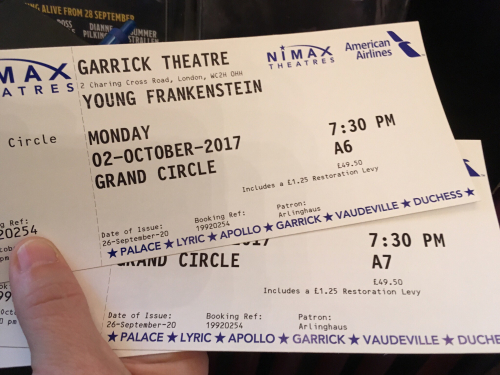
    This show opens tomorrow. I haven’t even read the previews yet. I bought tickets for myself and for Mark:

    These are in the front row of the upper balcony (I like the wide scope of balcony views, which is handy for money-saving) and cost me in total £99, in case you are curious, at full price.
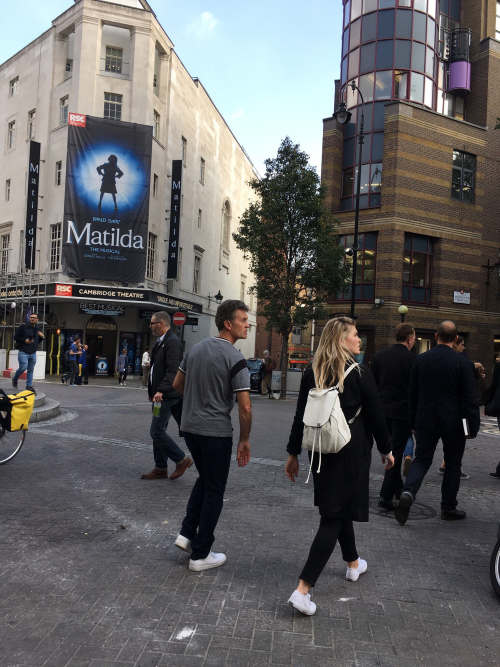
    My other goal was to find tickets to a musical I could take three or four of the kids to. I hesitated. To the Strand, to see if there were any tickets for Les Miz? I have seen it before but would see it any number of times, the kids haven’t, and I am in London. Or to Seven Dials….
    for Matilda?
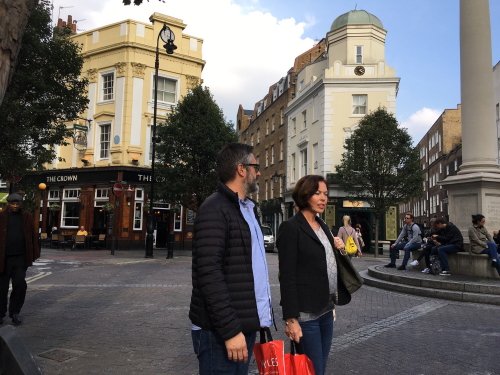
    (Seven Dials is cool. Look at all the pointy flatiron buildings around the roundabout.)
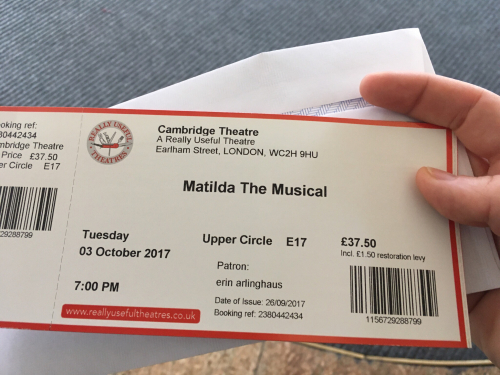
    I made the mistake of jaywalking to the center column-pedestal thingy instead of taking the sidewalks around, and was trapped for a few minutes while the traffic in the circle passed by. Then I went into the Cambridge Theater box office and bought five tickets. These are also upper-balcony, but not in the front, and you see the price there. So, not what I would call cheap, but also not like buying Hamilton tickets in the secondary market or anything.

    Then I headed back to the apartment, but not in a big rush. I went a roundabout way.

    Tried on a couple of wool coats in a vintage store, but had no luck. I am not very attuned to fashion trends, but I have noticed the usefulness of a feminine look that appears common in this part of London in this cool weather: A well-made felt or wool coat, expensive but not ostentatious, either of the slightly battered and beloved variety or shapely and new with a b
    eautifully turned collar; sometimes a thick solid color like pigeon-gray or camel, sometimes a retro sort of bright tweed; worn open, the belt loose, over Literally Anything You Just Threw On To Run To The Store.

    Maybe if you have a pretty enough coat, you don’t ever have to buy anything pretty to go under it.

    + + +

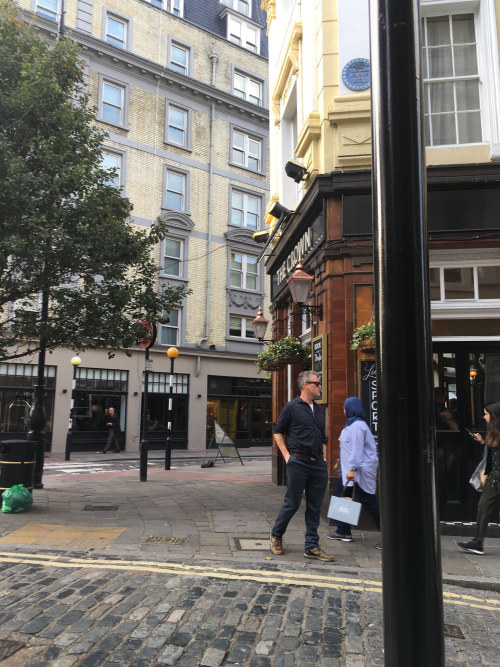
    Some neighborhood scenes:

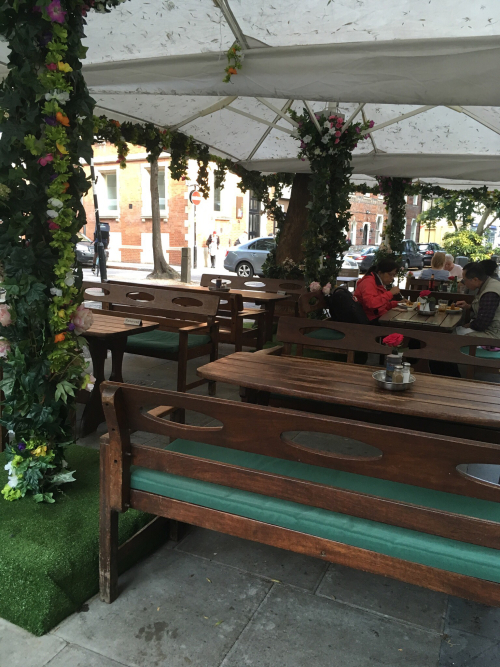
    A fish-and-chip shop with outdoor seating at tables large enough for our family:
    + + +
    I stopped at Sainsbury’s to buy groceries. I had told the kids to text me if they thought of something they wanted from the store. My phone had been pinging for blocks.
     
    I bought the snacks and sweets they wanted, and also square white bread and milk and crumpets (yum) and little dessert pots and coffee and ginger beer and tuna and pre-cut mango. From the hot bar, Spiced Potato Wedges and Southern Fried British Chicken Thighs.
    (The 7yo is still bitter about yesterday’s chicken strips that turned out to have been roasted.)
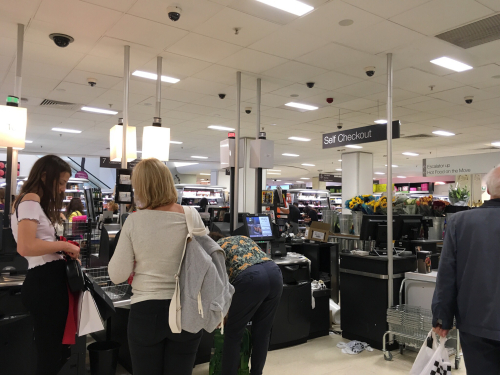
    I struggle with the Sainsbury’s self-checkout. If you take too long trying to find the bar code, it alerts the shop assistant that you need help. If you get the handles of your bags tangled when you are trying to bag an item, it alerts the shop assistant that you need help. If you try to rearrange items in your bag so the soft things don’t get crushed, it alerts the shop assistant that you need help. And every time, the light on top changes from green to red and the touch screen shuts down with a “Please wait for the attendant to assist you” and there’s no button to push that says “Sorry, thank you, I’ll manage quite fine by myself.”
    And then at the end I need them again because my card is chip-and-signature. I apologize a lot.
    Eventually I got everything into my two roomy mesh drawstring shoulder-handled shopping bags (tip for European travel: bring your good reusable bags from home), came home, fed the younger ones, and then gave the teens cash and told them to go get takeaway from Wagamama and order what they wanted.
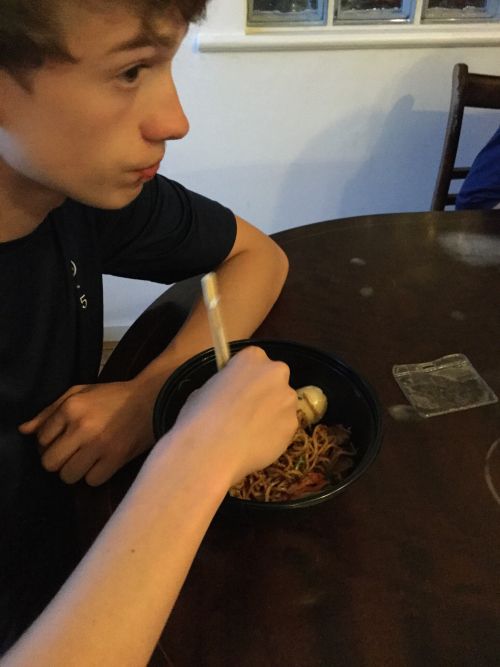
    House ramen for the 17yo.
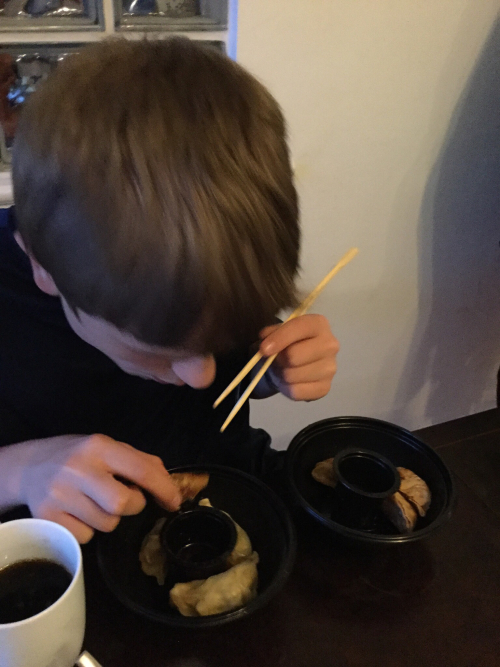
    A massive pile of gyoza, two different kinds, for the 13yo.
    For me, duck-leg donburi with a petite cup of kimchee. And a gin and tonic I’d had in the fridge from M&S.

    Canned, cold, and well-earned.


  • Tube, Natural History, chicken dinner.

    Mornings begin around here with blogging and coffee.

    One by one the children stumble out of their rooms and wake up with British cable TV, which seems always to have several children’s shows on at any given time. There are lots of ads for kids’ board games, or boardless games, such as the one where you are supposed to stuff miniature pizzas into a plastic pig and pump up his stomach until he pops, or the one where the plastic dog makes so many plastic poops every turn, and the like.

    We think British children, or possibly their parents who pay the cable bill, must really like poop jokes.

    Monday morning Mark and the 17yo walked to an office in Trafalgar Square. When they came back we stuffed, into plastic sleeves on lanyards, six London Passes (the 3yo gets into attractions for free) and five prepaid Oyster Cards (the 7 and 3yos travel free on public transit). After a day of walking where we could walk on our own two feet, it was time to try the Tube.
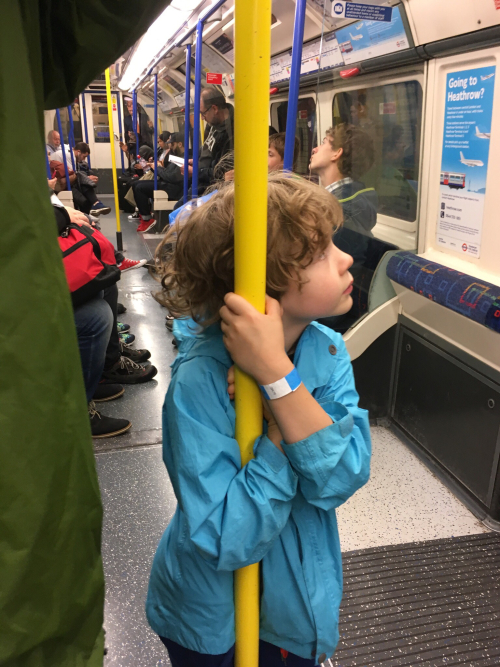
    I wrote our phone numbers on Tyvek wrist bracelets for the two youngest children. They have all been coached, and we are going to keep hold of them, but this is just one more layer to speed up the resolution should we have An Incident.
    And off we went, to Holborn Underground Station. I had the 3yo on my back, and Mark had the 7yo by the hand. We herded the others nervously. To his credit, the 17yo (who would be able to navigate the Underground with no problem on his own) was very patient with us. One of the hopefully mild frustrations of being the oldest teenager in a family that runs down to toddlers is that sometimes, your parents are overstimulated and they just want to deal with the whole family as a group, to simplify things (“How many kids do we have? Five? Okay then”) and then, well, you’re being herded.
    We got into the station, collected in a corner to review how the little door opens when you touch the Oyster card to it, asked an attendant what to do to get the 7yo through (answer: go together through the accessible gate on the end, wide enough to accommodate a wheelchair or a person who needs an attendant), and then headed through. This first time we all went through the wide gate behind Mark. Then, repeating our train and destination like a mantra (Piccadilly line, westbound train, South Kensington station, STAND TO THE RIGHT, WATCH WHERE YOU’RE WALKING) we filed along with everyone else and waited on the platform.
    “We’re going on an underground train,” I told the 3yo, and he was very pleased.
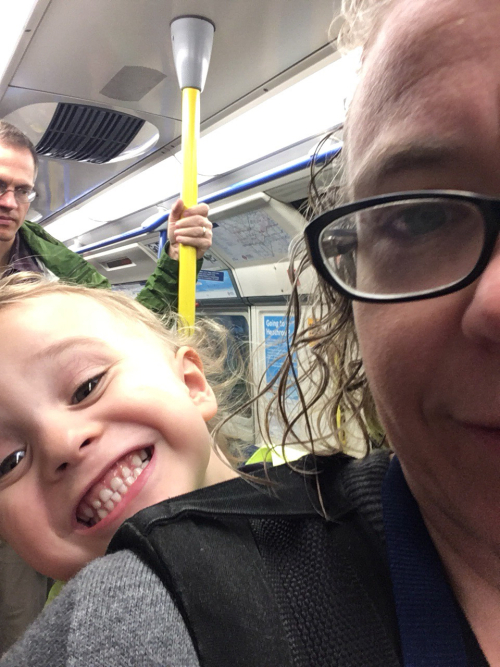
    The train came, we got on it, yes we’re all here, and I stood and held the pole because of the 3yo on my back.
     
     
    We counted the stations, I showed the 11yo how to read the map, and we made it off okay. Whew! It isn’t that subways are themselves a problem—I love them—it’s just the kid-management in a new and crowded place. It’s always a little bit of a strain.
    + + +
    We chose the Natural History Museum for our first Tube outing because it’s easily reachable on the same line as our home station, Holborn. Changing lines we will save for another day.
    Also, there was a backup plan. Our London Passes let us jump the line into participating attractions (that’s really why we got them), but the NHM isn’t one of them; it’s free. So if there was a prohibitive line to get into the NHM, we would go to the Science Museum next door, where we could jump the line there.
    There was a line at the NHM, but we decided it was not that bad, all contained well inside the courtyard, so we went in.
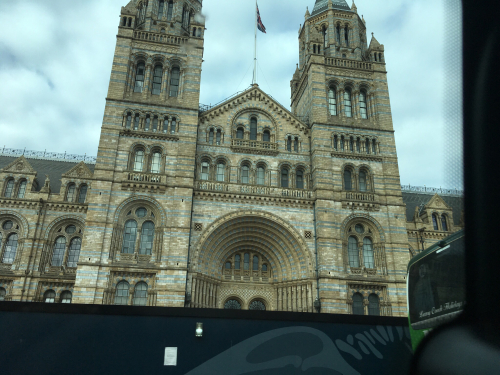
    The exterior of the building itself is fun to look at. There are many details to search out to pass the time while you wait. I have read that it was designed to look like a church, to function as a sort of temple of knowledge. Its striping reminds me of the candy-colored columns in what used to be the great mosque of Cordoba in Moorish Spain; its spires are topped with weather vanes that look like globes or like speared fish; its gargoyles are an assortment of animals living and extinct; the false columns flanking the front entrance, under the multilayered arch, are carved with a variety of dazzling geometric patterns. Medallions carved with various creatures (squirrel among oak leaves and acorns; two rats with intertwined tails; thistles and wild roses) decorate the pillars of the gate and guardhouse. It reminds me of the picture books illustrated by Graeme Base, full of hidden creatures for children to discover.
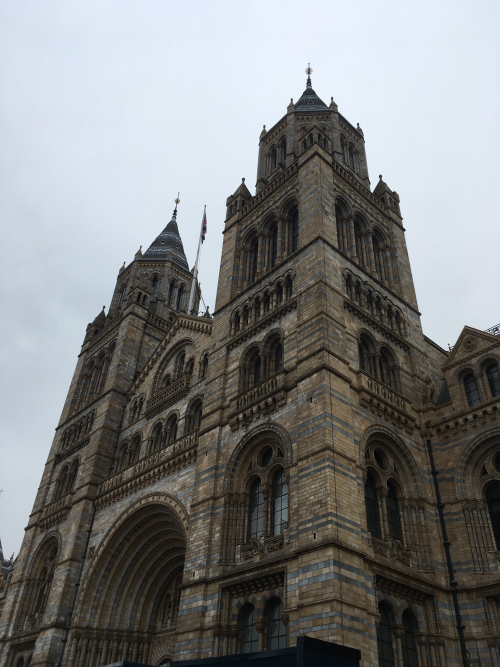
    The cavernous great hall inside has a blue whale’s skeleton hanging from the ceiling, its great loop of a jaw open toward the visitor as they come up the stairs, its vertebrae disappearing into the distance. The effect is wonderfully dramatic. It really has a lot of the bigger-on-the-inside effect that you get inside a well-proportioned cathedral.
    I read that until recently the creature hanging in the great hall was a Diplodocus; but that’s gone on tour to museums throughout the UK, and so they’ve put the whale there instead. It serves as a reminder, too, that the NHM is not just about extinct creatures, but also living ones.
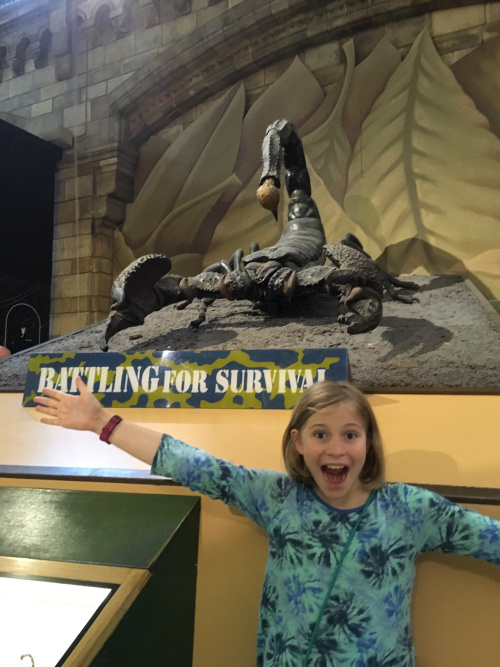
    The two teen boys went off on their own, and Mark and I ducked into the first exhibit, “Creepy Crawlies.” Many, many arthropods. All three kids enjoyed this very much, even the 3yo on my back; I had to bend over to le
    t him push the occasional button, but mostly he chattered happily about the different kinds of animals. Here is my daughter in front of an animatronic enlarged scorpion, which turned its head, wagged its tail, and snapped its claws:
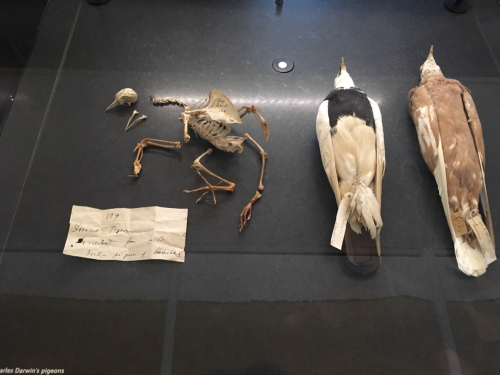
    Next we went upstairs because she wanted to see the gems, but I diverted us to see the Treasures gallery first. These are historically important individual pieces, most of them carefully protected in glass boxes, some of them with a “please touch” replica outside the box. Many have a touch screen next to them that will provide considerable information if you have time to peruse it. There is a dodo skeleton, and a chambered nautilus (with its touchable replica), and a moon rock donated by the USA, and the Archaeopteryx fossil. There are some of Charles Darwin’s pigeons:
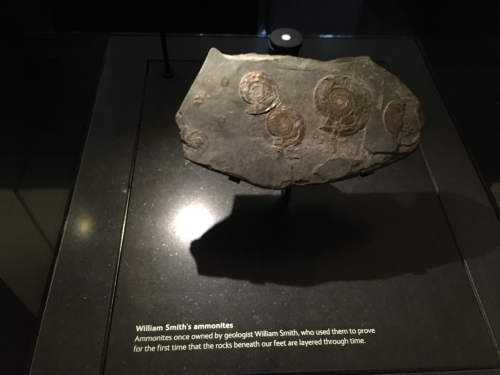
    And William Smith’s ammonites:
    We went on to the gem exhibit, but the 3yo was not at all interested in a room full of rocks, so I left Mark with the 11 and 7yos and went to find the dinosaurs.
    I have to say: the Natural History museum in Utah is the one you really must see if you want to see dinosaur skeletons. But the dinosaur exhibit has some really special individual items, like a whole Stegosaurus and a T. Rex head and a skeleton still half-encased in stone in a box. The displays are very well designed; I learned a lot from them. But possibly not as much as I could have learned from a season of watching Dinosaur Train on PBS, judging from how much the 3yo on my back was explaining things to me.
    There is an animatronic T. Rex that is supposed to be cool, but it was out of order today. So instead, in response to a text from Mark, we met up at the T. Rex Grill. The 13yo was AWOL for a while because he had accidentally turned his ringer down, but we zeroed in on him with Find My Friends and sent his big brother to track him down on foot.
    The T. Rex Grill had very lovely food. I had a big bowl of raw vegetables and pita with hummus and some really outstanding baba ganoush. Mark and the 13yo had falafel sandwiches. The little boys had fish and chips. The 11yo had a chicken burger, and the 17yo had a pepperoni pizza.
    Fed, we headed back out to the museum. The 3yo wanted to walk, and I said he could if he held my hand and behaved. The 7yo had had no dinosaurs yet, so we walked this time into a gallery of different fossils. There was a docent behind a table, so we sent the kids over. I coached the 3yo to say, “Hello, sir, what do you have to show us today?”
    The seven-year-old is absolutely in his element with an adult whose job is to talk to 7-yos one on one. “Can you guess what this is?” said the docent, handing him a large and heavy brown rock. “It came from a dinosaur.”
    “Well, it doesn’t feel like a dinosaur part,” he said, “but I am not grossed out because I know it is fossilized!” Later, shown a plesiosaur cast: “Now I’ve heard that plesiosaurs are not really dinosaurs. Is that true?”
    This is all Dinosaur Train, not me.
    While he chattered, I wandered around and looked at the cases on the walls.
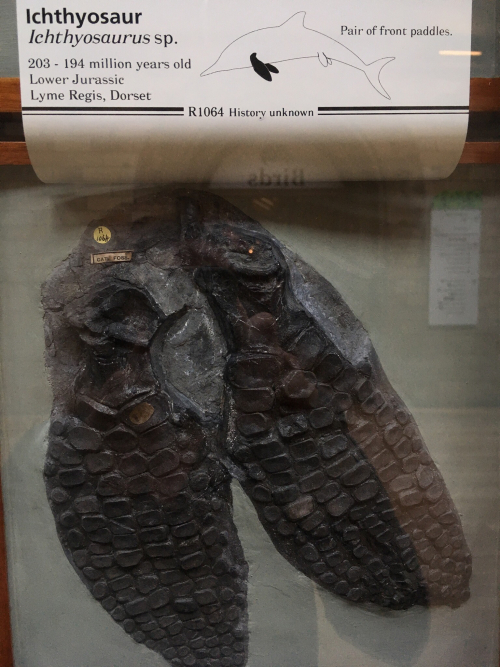
    Several animals collected by Mary Anning are right here. I made my daughter come over and pose in this picture for scale. It’s a big skeleton.
    There were many other delights in the zone full of creatures, especially an amazingly detailed exhibit case, presented exactly as it first appeared in the 1800s, that carefully and systematically laid out the anatomy of birds through description, diagrams, and meticulously dissected taxidermy. For example, there was a whole thrush from which all the down and fiber had been removed from the feathers, leaving the quill ends sticking out and clipped short, so you could see the direction that all the feathers pointed as they emerged from the body, and there was a collection of different bird heads (including a beautiful owl) so you could examine their diversity of eyes, hearing organs, and beak up close, and something similar for feet, the grebes and the coots and the ducks compared. It was like a three-dimensional scientific poster, or a whole textbook chapter in a lovely nineteenth-century font, under glass in a beautiful wooden case.
    Also there was a case with dozens or hundreds of different taxidermied hummingbirds, all arrayed in a chaotic jumble on a branchy structure along with some nests and eggs. The eye couldn’t find a place to land, and as you moved about their iridescence sparkled blue, green, and rose.
    We moved past an office of the British Geological Survey, through a dark little door squeezed between a coffee shop and a gift shop, and unexpectedly into a high open room, dark and dramatically red-lit, with rocky and crystalline treasures set at a child’s height into the black wall all spotlit and visible through circular windows, and an escalator going up into the heart of a vast globe, paved with metal foil and curved irregular metal shields, some studded with the forms of ammonites, evoking the continental plates without expressing them exactly. It was the entrance to the earth-science section.
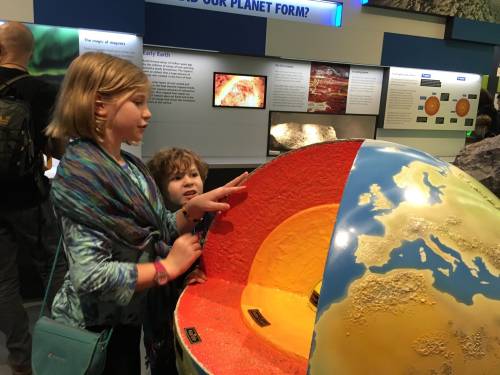
    This was a very well designed series of exhibits, interactive and interesting. The highlight for Mark, I think, was the earthquake simulator, a shake table room decorated to look like the inside of a Japanese grocery store, and set with TV screens that played black-and-white footage from a grocery security camera during the 1995 Kobe earthquake while the floor recreated the seismic pattern under your feet and the goods attached to the walls rattled alarmingly. On the screen, everything fell over and the people tried to cover themselves with anything they could find.
    “OH. MY.” said Mark.
    We also liked ventifacts, three-sided stones with sharp edges tumbled by blowing sand.
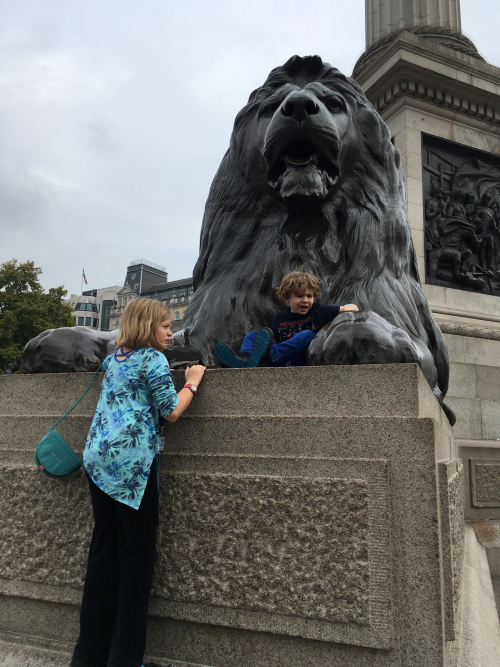
    Eventually we left, without the 17yo who was off doing his own thing (he would go to the Science Museum and to Harrods that afternoon without us). We got off the tube at Leicester Square and walked to Trafalgar, to cross something off 7-yo Lion Man’s bucket list:
     
     
    The 3yo also wanted to climb up, but we satisfied him by lifting him to let him pet the lion’s tail.
    Then, a longish walk through a new neighborhood back to Holborn.
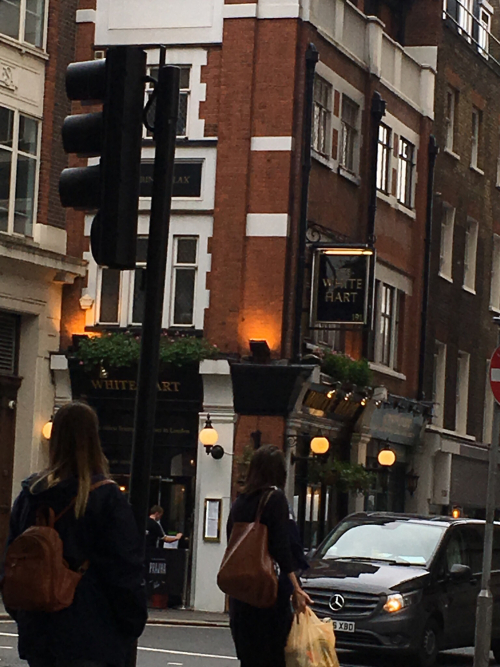
    We found a pub, the White Hart, that promised in an outdoor posting that children were welcome, even to the point of having a kids’ menu available, and we made a mental note to go there. (It isn’t that we need the kids’ menu, but its existence is reassuring.)
    And then we went back to our rooms for a rest. It was about 4 p.m. Somebody was tired.
    He got run over by the nap lorry, I guess.
    + + +
    We rested until about six, when I proposed we try a chain restaurant that author/travel-with-kids-blogger Amy Welborn had specifically recommended to me on Facebook: Nando’s.
    It promises Afro-Portuguese roasted chicken. We were a little worried because it looks somewhat fancy inside, but it’s counter service. We squeezed our seven into a generous booth for six.
    The two smallest were a bit put out that their strips of chicken were roasted and not fried, but they got over it and ate their chips and garlic bread. The rest of us adored it. The chicken just has a good, grilled flavor with a hint of char: simple and perfect.
    Mark and I split a wing platter with sides of peas, rice, mashed potatoes, and salad. The 17yo got “wing roulette,” ten wings with random flavors. The 13yo got a massive chicken sandwich with cheese and a vinegary pepper relish. The 11yo got a child’s plate with three wings.
    It was very good, but we couldn’t help laughing at the British conception of “XXX SPICY EXTREME HOT SAUCE FOR MASOCHISTS ONLY” which was gingery and delicious and complex but maybe rose to the hotness level of a medium buffalo wing.
    Anyway: Thanks, Amy, for passing this tip on so early in our trip. I think we’ll be going there at least one more time.
    As a couple of Londoner commenters promised me in earlier posts (thank you, Beth and Kathgreenwood), London chain and takeaway restaurants are so far THE way to feed kids here. The children are thrilled, all the way up to the teenagers; the parents are relaxed; and it’s still new and different from home. It is nice to be in a place that has its own chain/fast food, not just more of ours.
    Aaaaaand after the kids are fed, there is plenty of time for a couple of grownups to go out to the pub.
    + + +
    Out into the evening on a Monday night. First we looked in the window of the modern pub on the corner, which advertised bratwurst and fries (yes, fries, not chips) via a neon sign in the window, and amused us because it had Lagunitas on tap. But we also noticed that it had six different beers from casks, newer Real Ale movement beers rather than old faithful bitters, including a milk stout, so we resolved to come give it a try on another night.
    We wound up at a sort of random pub where Mark had a pint of Guinness Extra Cold and I had a pint of Whitstable Bay Pale Ale. It had a good flavor, maybe the second best so far, but I thought it was under-carbonated; hardly a sparkle, and just a lacy scum on the top instead of the layer of fine froth on other pints. I understand this is part of the variation of cask ales, so I wasn’t offended or anything, of course.
    We drank it slowly, while talking of shows we might try to see, and googling ticket prices, until the pub closed at nine.
    We walked the long way home, past the White Hart (menu looked good), and came upon the Princess Louise which was still serving. “Let’s go in,” I said. It was another one of the Sam Smith pubs.
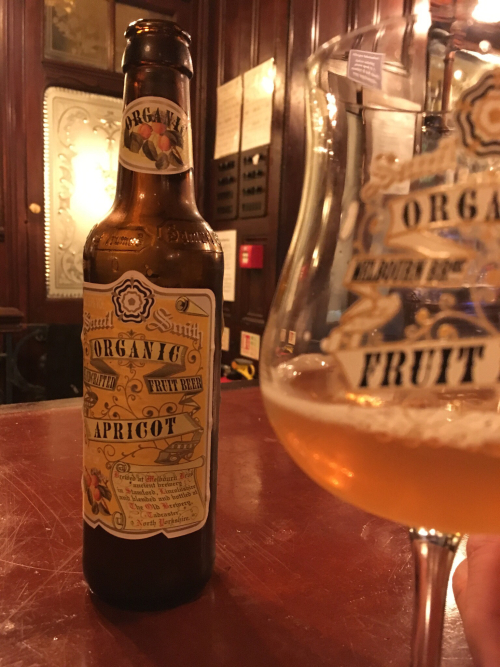
    I had had the Old Brewery Bitter before, it had been my favorite yet, and I ordered a half-pint to test its consistency. I let Mark order (because I knew he would share) a thing we had been intrigued by when we saw it on the menu at another Smith pub:
    One sniff and I fell in love with it. Apricot is one of my favorite flavors, and this was the scent of fresh apricots and a whiff of yeast. As for the taste, it is balanced (far more balanced than kriek or than raspberry lambic) and yet fruit-forward. I have never had a fruit beer like it. I don’t know if I can find it in the U.S., but you can bet I will try.
    Mark relished the visual treat of the pub interior. “I have the feeling, walking into these places, of walking onto a sound stage or a movie set,” I commented, and he agreed. Is it real? Is it a show put on for people like us? Or is the show real?
     
    We walked back, very happy to be here and to be together, and to be hatching plans to do more things with just the two of us. “You picked the right neighborhood,” Mark said.
    We are contemplating not taking the children to the Science Museum until we have gone together, as a date.
    + + +
    Home again, where Mark went to bed and I stayed up to upload these photos, before going to sleep, saving the writing for the morning.
    Tuesday: Mark flies to his business trip in Sweden, and I am left with children in London.



  • Walking distance: Bloomsbury, Covent Garden, and Soho.

    On the first morning in London, a Sunday, I slipped out to walk around for a little while before I had to come back and help the children get ready for Mass.
    Our apartment is on a short pedestrian-only street that cuts off a corner of a block just southeast of Bloomsbury Square. The pedestrian street has restaurants and cafés at both ends, where it meets High Holborn and Southampton Row, and impossibly stylish shops in the middle.

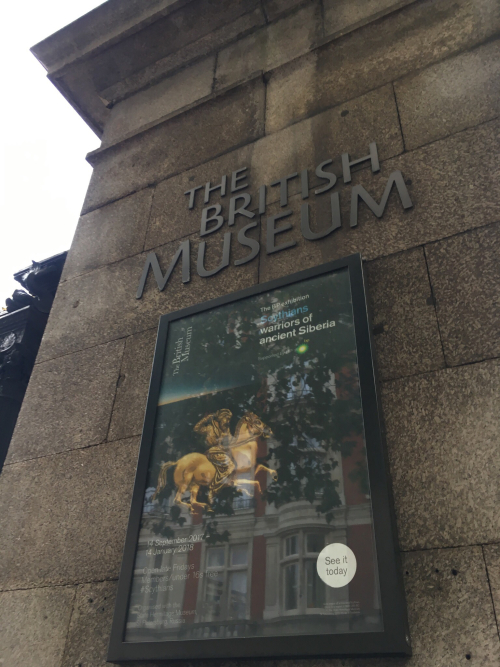
    I walked around the perimeter of Bloomsbury Square and, just as Mark promised, I found the British Museum less than five minutes’ walk away:

    When it came time to narrow down where we would stay, I told Mark I wanted to be within walking distance of this, since it’s free and enormous. I wanted to be able to slip in and out with the kids for forty minutes or an hour whenever we want, on any day, without feeling that we had to stay till we get tired.

    We shall see if that plan works. I will try to put it into effect on Tuesday. But already I am sure we are in a good place, lively and busy, near the Covent Garden area, with a Sainsbury’s around the corner. We will not starve here, that is for sure.

    I stood there and looked at the British Museum. People were going in. I looked at my watch. I stuck my head in the gates and looked around. I looked at my watch again. I turned around and headed back through Bloomsbury Square.

    On the way back I stopped in a café, a tiny one with one table inside and two outside and a pleasant deli case with a variety of prepared salads, and ordered an inexpensive, probably not too large Roll with Egg and a coffee to take away. The woman who took my order passed it (in a language I didn’t recognize) to the woman behind the counter, who straightaway made me a Full English Breakfast in a rectangular plastic box and put it in a petite paper bag with handles and handed it to me cheerfully.
    I decided that if fate would hand me the Full English, I would take it. I paid and brought it back to the apartment and shared it with Mark.
    The egg had been previously fried, stored in the case, and reheated, so it wasn’t amazing, but I like any egg really. The sausage was pretty good, but I left that for Mark. The combination of the beans (there’s my grandmother’s recipe again! Is this what you get in the blue cans of Heinz beans?) and the English bacon was lovely. I can see why this is a national comfort food.
    + + +
    We are equidistant between two Roman Catholic churches in opposite directions: St. Patrick’s Soho and St. Etheldreda’s. Both have an eleven o’clock Mass, but we were wary of taking the children to the sung Latin one at St. Etheldreda’s (I know, I know, but we have an impatient three year old and we were worried it would be longer), so we walked 15 minutes to St. Patrick’s.
    We could shorten it with the Tube, but we don’t have our Oyster cards yet and also we want to see things in our neighborhood. To get a sense of distance, you almost have to walk.
    I led, carrying the 3yo on my back, and the others followed. St. Patrick’s is an old parish, founded soon after Catholicism became somewhat more legal in the 1780’s, mainly to serve the Irish living in London. The interior is compact, relatively simple, and prettily painted, with a St. Patrick (snakes and all) above the altar, a Very! Assertive! Pipe! Organ!, and paintings for art (it’s not set into its surroundings in such a way that it can have much in the way of windows). The painting we could see best from our pew was of Christ with Martha and Mary.
    One downside: The pews had backs, but with only a couple of high slats over a smooth bench, and were completely open, so the smaller kids (and once, me) kept knocking hymnals, bags, etc. onto the feet of people behind us. Public service message: If your large family finds itself in such a church, sit in two rows and put your organized less-physically-organized family members in front of the others. And keep your open-topped tote bag on the floor.
    Besides the Organist! there was a very lovely polyphonic ensemble singing the mass parts in Latin. They were off to a side chapel and invisible, and I actually thought we were being played a recording until I got up to the front at Communion time and realized that there were people over there.
    The church was quite full, with a number of people arriving late and standing in the back and the foyer. I went back there with the 3yo eventually, after my stay-quiet-in-the-pew tricks had run out. The foyer was watched over by a statue of (I think) St. Anthony, in a side chapel behind a little stone railing, the bank of votive candles asking 40p for the cost of the candle, and on the railing were balanced a stack of weekly bulletins and a prayer card for a recently deceased cardinal. On the other side, a Divine Mercy image on an easel, by a table with a number of D. M. pamphlets, and a box asking for donations in return for them. There were stone stairs going up and down, probably to parochial common areas and offices, with a big old metal gate closing them off and a big shiny new chain and padlock wrapped around; it doesn’t look welcoming, but when tourists wander into your church for tourist reasons all the time, something like that has to be done.
    I admit to being somewhat amused at the English Catholics’ expense at a plaque on the wall celebrating a former rector or someone (d.1802) because (paraphrasing from memory) “wherever he went, his preaching improved the morals of the poor.” Wondered if he did anything for the morals of the rich, or if the people who put up the plaque noticed. I shouldn’t laugh, my morals could use a boost most of the time.
    + + +
    When Mass was over, and we were done singing new hymn words to familiar hymn melodies, we regrouped by a big tree in Soho Square while the smaller children ran on the grass. Would we buy groceries and eat in the apartment, or stop and eat in a restaurant on the way? I wanted to eat out, if we could find a place that looked not too full and not too intimidating with the children, and Mark said that I had to just step up and pick the place when I saw
    it.
    So we went down the road, with the 17yo navigating, and I looked in a few windows (and then we stopped and Mark reminded the 17yo not to walk so fast and the 17yo said that he had to be clearer in his expectations and then Mark reminded me that if I wanted to stop in a restaurant I had to pick one because he really, really didn’t care where we went and he would not be upset if it was too expensive or if the children didn’t like it) and we kept going and then I saw a nearly-empty noodle/salad/sushi chain restaurant called Itsu and said, “Let’s go there!”
    Thanks to some readers I have in London (hello!) I had been assured that London counter-service chain restaurants can be quite good, family-friendly, and exotic enough to be a real travel experience. After all, we don’t have Itsu, Wagamama, and Pret-a-Manger at home.
    There was some uncertain, panicked shuffling in front of the variety of bottled juices, canned sodas, and boxed coconut waters (“Do we have an algorithm for how to buy drinks in cans? We need an algorithm. Is everyone getting Coke? Just make a decision”) but in the end some had sushi, some had hot dishes ordered from the front counter and delivered to us in waxed-cardboard containers with lids, some had fruit, and everyone had something to drink.
    I wound up with a salady vegetarian platter grabbed basically at random while I was trying to calm people down. Fortunately, it was delicious, with lots of avocado and greens and a tasty cilantro dressing. The 7yo had taken a chance on chicken noodle soup, and liked the broth and the meat and was upbeat about the fact that the cellophane noodles were unusual and not to his taste. The 3yo had a fruit cup and was startled by pomegranate seeds, but liked some of it. The 11yo tried salmon rolls for the first time and enjoyed them very much. One teen was very happy with his sushi and the other was very happy with his pulled pork udon noodles. Mark liked his rice bowl. We decided that London Chain Restaurants were a-ok.
    Back at the apartment, we made some plans for the upcoming week—Mark has to travel for a couple of days, and that will require some logistics—and I proposed we take the three younger children to Coram’s Fields for a couple of hours. It was a fifteen-minute walk, and it promised to let them blow off some steam.
    We left the teens with some money and a set of keys in case they wanted to go out. Then we headed off. I carried the 3yo again.
    + + +
    We wound through the University College of London medical school area.

    Mark was highly amused by this building and made me take a picture of it.

    Google Maps dropped us at the closest, but wrong, end of the Coram complex, between the football fields and the entrance to the program reception, and we had to skirt the perimeter till we found the gated entrance to the children’s play area.

    Coram’s Fields is not a public park, but a private one, free admission unless there’s a special event, run by a foundation for the benefit of children. No adults are admitted without an accompanying child. The whole complex includes kids’ programming, athletic fields, a small zoo of farm animals, and a big open area with different play structures scattered about, grass and trees, a fountain-paddling pool thing (dry now), and a sort of gazebo in the middle.


    The truck parked in the background is for setup for an event that would be happening that evening. The park was closing early for an outdoor film series. They were setting up a wood fire (maybe a pizza oven?) and a cash bar under a tent. The film wasn’t for children, but maybe the admission fee was? It was £12, anyway.

    The best part for the 11- and 7-yos was a big spinny swing and a sort of bouncy zip line, two of them that could race. Kids climbed up a ramp, leaped onto a hanging disc-seat suspended on an elastic hanger, and sailed bouncing to the end where they dismounted and ran back to return the swing to the next child in line.

    There was also a tantalizing dynamic pile of hinged logs that would move when you climbed on them, but someone had fenced it off. Perhaps it had proved to be a bit too dynamic without supervision.

    We spent more than an hour there, enjoying a sunny and warm day, and then walked back by a different route, considering all the pubs and restaurants along the way.

    The 7yo, holding Mark by the hand, was looking at so many things that he walked right into a pole with his forehead. No concussion, I think, but I was worried for a moment.

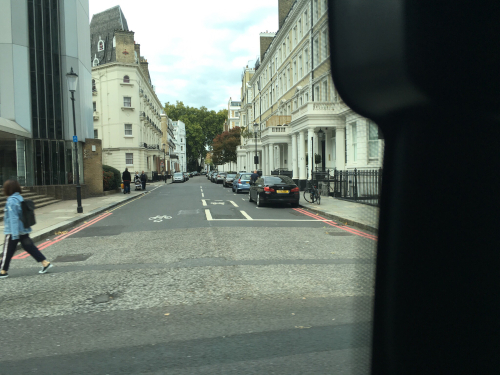
    For that reason, and others, I am very glad for these markings on the road.

    I knew I would have to get used to the traffic coming at you from unexpected directions, but I was not prepared for the combination of one-way streets, little corner cutoffs, alleys, large crowds of people looking at their phones and stopping to take pictures, and distracting things to look at. The direction of oncoming traffic at any given curb is pretty random, and our pattern-recognition faculties are strained. So the “which way to look” signs—many say to look left, it isn’t all right—are welcome.

    Fortunately, the crosswalks are super well designed, with little signs on posts that have a single button (that the 7yo loves to press) and a lit-up “WAIT” sign that you can see even if people and tall buses obstruct the crossing signal on the other side (or if it’s damaged), and sometimes an audible signal.

    + + +

    Mark and I took those kids back, and then headed back out to the Covent Garden neighborhood with the 13yo to shop for the kids’ dinner. It was getting crowded. Some shops had people offering samples of tea, sausage, things like that.

    Someone outside a shop offered me a brightly colored, bite-sized rectangle dusted in white. I said no. Mark started to take one, then said “No thanks” also.

    The shop woman asked him suspiciously, “Do you know what this is?”

    Mark confessed that he didn’t, actually.

    The rectangle was soap. “I’m glad I didn’t take a bite of that free candy,” said Mark.

    “You almost made a sugar mistake,” pointed out the 13yo.

    + + +

    We arrived soon after at the much-anticipated M&S food shopping store.

    We bought refrigerated samosas, naan, chicken jalfrazie, chicken piripiri, pizza, a roast chicken sandwich, cut mango, greengages, and more sliced Red Leicester for the 3yo who now eats square orange cheese on buttered square white bread three times a day.

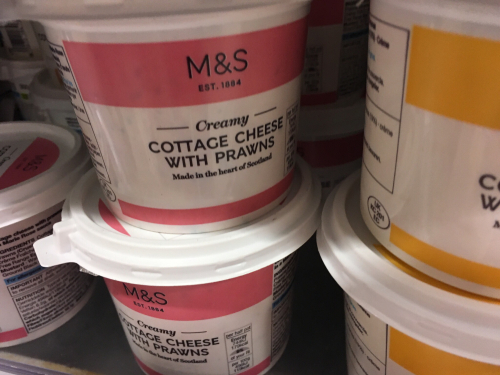
    We did not buy this:

    Really?
    Trouble with the self-checkouts, which are terribly moody compared to American ones. Also we have a chip-and-signature card, and were buying wine and beer and cider and a canned gin and tonic. The attendant was terribly friendly all three times we needed help.

    Back to the entrance of our little pedestrian mall.

    + + +

    Maybe Mark and I will just get carryout for the kids and then go out by ourselves every single evening.

    I found one of the Samuel Smith’s pubs (The Angel) from the online map that one of my London readers gave me (thanks!) and we went there. No food on Sunday, but we tried a pint of the only cask-conditioned ale, Old Brewery Bitter, and I pronounced it the best so far.

    Mark informed me that he was soon going to stop helping me experiment with cask-conditioned ales and start asking for things that came from a keg and had detectable hops in them.

    We spread out the map on the table and mused about what to do as we finished our pints, then walked on.

    + + +

    We walked for a really long time: through Covent Garden itself, packed with people and delicious odors, and the music from live violins coming up from a large ensemble on the lower level. We kept walking and I saw a bridge: “Are we at the Thames already?” I wondered. We turned right, and there were theater marquees everywhere: The Lion King, Dreamgirls, Kinky Boots. “Is this the Strand?”

    The names of things keep delighting me. So many literary associations laid down over so many years. I can’t always remember whether I know them
    from Mary Poppins or from the Baroque Cycle or from Bridget Jones’ Diary, but something on every corner, it seems, rings a bell.

    + + +

    We looked carefully at a French-style restaurant and at a bar and grill and it seemed okay but I said no. We stopped on the way at the discount theater tickets office to ask how that worked, and picked up a list of shows.

    And ended up at another pub, the Nag’s Head this time, which was open for meals upstairs. Downstairs it was all glossy wood paneling, upstairs it was surprisingly modern looking and bright, with stools at a counter and a few small tall-windowed rooms with tidy little tables. We got a round table in the back by an empty fireplace, near a table of three American-accented young women who were joking about drinking the cider from one glass with three straws.
    We split:

    • a garden salad (very crisp and fresh with a pleasant dressing; mustard figures heavily here)
    • a bowl of sweet potato fries (also very good, crisp and hot, served with mayonnaise and ketchup)
    • roast beef blade with mashed potatoes and a deeply brown and glossy gravy, plus an afterthought of steamed broccoli and carrots which I ate dutifully between bites of lovely tender roast beef and gravy and potatoes
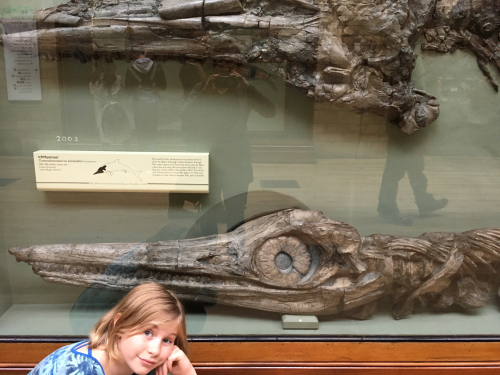
    Honestly, I think I will happily eat pub fare. I like meat and potatoes.


    I had a half-pint of the Nags Head bitter (pleasant, not as good as the last pint, but also not cask-conditioned) and Mark had a pint of Aspall cider which was startlingly apple-forward, sweet, and crisp. If he can’t have hops, he’ll have apples.


    + + +


    It was a pleasant evening. I especially like having the first pint, then walking for a long time, and then having the second with dinner. It’s a nice way to see a city.


  • Transit to London.

    We had more luggage than would fit in our rented minivan, so we had to split up for the trip to the Geneva airport. I went with the 13yo and the 7yo in the van, run by Mountain Dropoffs, an outfit that shuttles people from Chamonix to Geneva; took our three passports, three big bags, and our carryons, plus a tip for the driver, and off we went at 8:45. Mark and the other kids stayed behind to finish cleaning up the apartment; they would drive our rental back to the airport.

    We still have two round trips through the Mont Blanc tunnel left on our ticket. They don’t expire for two years, so Mark decided to save the ticket, in the box of European currency he keeps on top of his dresser, in case he is lucky enough to score a business trip over a weekend.

    + + +

    It takes more than an hour to drive to Geneva. We rode with a retired couple from Chicago and a Norwegian who had just summited Mont Blanc by the standard route. The 13yo dozed the whole ride. He had the look of, well, a teenaged boy who stayed up late and got up early.

    Our first task was to locate the British Airways check-in counter. It was at the far end, right before EasyJet. So we trundled the length of the airport, each of us with a backpack and a roller. Even the 7yo had our smallest of the rollers we were to check.

    Second: bathroom trips. The 13yo watched the luggage and the 7yo while I went, and then he watched the luggage alone while I took the 7yo to the men’s room and waited outside.

    You’d think it would make more sense to send the 13yo with him, but the 13yo was so sluggish and morose and droopy that I decided to let him rest sitting on the luggage.

    Next: to find an unattended counter where I could weigh the bags on the scale, to save time later if one turned out to be overweight. EasyJet had those, so the 7yo and I trundled our bags over in batches to check. Everything that we had was fine: carryons under 10 kg and checked bags under 23—or was it 26? No matter, the heaviest was about 21 kg.

    Then we had an hour or so left. The food court was right over our heads, but our bags would not go easily up the escalator. 70 m to the elevator, up, and 70 m back. I thought the 13yo was going to keel over.

    But there was a McDonald’s there. Both of these guys perked up considerably after a familiar sandwich and a big, big Coke.

    The 7yo’s Happy Meal came with a little book, in French, which I translated on the fly for him to pass the time. It was the story of some animal friends who banded together to convince a family of littering picnickers not to throw their trash in the river, by having the duck bite them and then glaring disapprovingly.
    Everyone lived happily ever after.
    + + +
    We had to go back downstairs, another 140 meters of walking, to meet Mark, but the Coke had made it all easier. They found us: the 17yo carried the 3yo on his back and pushed two rollers standing back-to-back, and Mark and the 11yo managed the rest. We joined up, checked our bags fairly easily, and were ushered to a priority line through security because of having small children (THANK YOU EUROPE). The automatic thingy flashed alarmingly and didn’t let us through but the human being did.
    At the gate at the very end, we spent our Euros and Swiss francs on a few last panini. Plain cheese (on a petite buttered pretzel roll!) for the 3yo, caprese on baguette for me, tuna (of course) for the 11yo on a round white soft roll, and an enormous roast beef and tartar sauce sandwich on a beautifully seedy brown bread for the 17yo.
    + + +
    Here is a brief comment on sandwiches.
    I hadn’t paid much attention to it before, but the French (and, I guess, the Swiss) know how to match bread to sandwich fillings. In the US, you buy a sandwich, you get to choose the bread and the fillings separately, as if it were merely a matter of personal choice. And I suppose if the bread variety is only a matter of differently-flavored or differently-dusted bread, as is sometimes the case, that’s okay.
    But when your available bread varies significantly in terms of chewiness, crustiness, seediness, shape, and flavor, well, it matters.
    Especially for tuna.
    If you put tuna between two halves of a chewy crusty bread, then when you bite it, the tuna will squeeze out and make a mess, along with the tomatoes and the sliced egg.
    Chewy crusty bread is for salami-and-butter-and-pickle sandwiches.
    Tuna needs soft, pliable, squishy, tender bread with only the barest crust.
    End of sandwich discussion.
    + + +
    British Airways. I had a whole bag of Dum Dum Pops (sorry, Europe, they are superior to Chupa Chups, if only because you can unwrap them in under a minute) for ear depressurization.
    Completely uneventful flight. Nobody tried to buy an airplane Bacon Butty.

    There was a long, long, long line to get through UK customs. The 13yo’s Coke had worn off and he was sad and slumpy again. The 3yo was frenetic-and-loopy tired, the kind where as a parent trapped in a crowd (literally—we were being watched over by Border Patrol, where were we going to go?) you eye them warily, and make strategic decisions about when to speak firmly and when to just give them what you think might keep them quiet.

    Customs is not really the time to exercise consistent discipline. It’s the time where hopefully your discipline decisions in the past will bear some fruit.

    I decided that if he didn’t want to be on my back in the carrier, trying to put him there would fail. But I kept threatening it.

    My 11yo stepped in, and held his hand, and played little games, and made a sort of ritual where the queue would shuffle forward, we would move the car seat forward a few feet, and then he would run forward and leap into the seat and sit there till the queue moved again, and then the 11yo would open her arms and he would jump into them (all this in a serpentine queue kept orderly only by nylo
    n webbing straps stretching between wobbly poles), and she would hold him till I set the car seat down again a few feet further.

    It could have been a nightmare, not least because this guy usually grabs at the webbing every time we pass one of those queue-poles in normal life, but she made it work. She deserves an award.
    + + +
    Finally through and out into the cavernous baggage hall in Heathrow, where nobody’s luggage but ours (ALL 7 BAGS!) was trundling out of the mouth of the carousel, and then out to arrivals where a man was holding a sign with our surname on it.
    I’ve never been one of those people with their name scrawled on the sign!
    Mark had hired a van to pick us and all our stuff from the airport and drive us directly to our apartment. This is one of the smartest things he has ever done, and he’s a pretty smart guy.

    Apparently it was only barely more expensive than trying to do this any other way, and less expensive than some of the ways we might have tried.

    Our stuff barely fit in the van, but we managed. Mark sat in the front (on the left!) and we settled in for a surprisingly long drive that began in the relatively calm country outside Heathrow (I had no idea it was so far away) and progressively became more and more clogged and congested and reinforced Mark’s certainty that hiring the van driver was the right thing to do. And that he was never, ever, ever going to try driving in this country.

    Our daughter spotted our first London cab.


    I tried to take many pictures of ordinary London-outskirts neighborhoods as we came in, but pictures out the window of a moving van rarely look like you wanted them to.

    Let’s just say that I was transfixed. There is so much same-but-different here. The language is the same but the voices sound different. The ordinary row houses express the same home-ly-ness but in different materials and shape. The cars are the same but in mirror image.

    And I delighted in just this gradual approach into a bigger and bigger city, denser and denser as you go in. I love cities; in truth I don’t need to live in, raise children in, a city bigger than mine; but I delight in them, love to be surrounded by people and the things people have built.

    Mark loves the mountains, and I love cities: even the grime and the sirens and the scents of diesel and cigarettes. I love being around people and the things they have made, big things, beautiful things, delicious things. I love being alone in a crowd.

    + + +

    Here is one picture I made up one street:

    Not a church, but a temple of a different kind: the Natural History museum. On a Saturday like this, the queue wrapped around the block. Dismaying! But I hear it is better on weekdays.

    First double decker bus!

    Our apartment is on a pedestrian mall that cuts off a corner of one city block, so we could not be dropped at the door. The driver went around the block a couple of times, then made a calculation and pulled over at a (left!) curb, and before we knew it we were standing on the sidewalk of a busy street, herding our pile of enormous suitcases.

    I convinced the 3yo, who’d slept the whole way from Heathrow, to get on my back in the carrier. The 13yo had to carry two packs, one back one front, and the 17yo had to roll two rollers and carry a pack besides. We crossed two streets, warning smaller children to stay close, and turned into the quiet little mall of restaurants and shops.

    Mark went ahead and rang the right doorbell, and soon waved at us to follow.

    + + +

    It isn’t an apartment building, but a building of different business suites, with a rentl apartment on the very top floor.

    We have three bedrooms: one for the girl, one for three boys, and one for Mark, me, and the 3yo. There is one full bath, and a comfortable living room with windows that open wide, and a balcony (too frightening to let the small kids onto at all) that overlooks Bloomsbury Square.

    It has wifi and a coffee maker. There was some beer in the fridge left over from the last tenant.

    It will do, yes.

    + + +

    The 13yo went straight to bed.

    The younger kids went straight to the TV and watched cartoons.

    The first thing Mark wanted to do was sit on the couch quietly with a beer. Any beer.

    I let him.

    Then we made a plan. It was 6 pm.

    He and the 17yo would walk to the Sainsbury’s just around the corner and buy food for breakfast and for dinner. And then Mark and I would go out.

    + + +

    They bought cereal and milk, yogurt and square white bread, and slices of square orange cheese.

    On
    ly this time the square orange cheese was Red Leicester.

    They bought takeaway pasta, and cut fruit, and hot potato wedges. And we put it on plates and fed it to all the children. And then they were all much happier.

    And then!

    + + +

    Mark and I set out and walked through Covent Garden, on a Saturday night, and I was too overwhelmed to take pictures. We didn’t have a plan for food, but wandered and wandered, past noodle shops and pubs and tea rooms and curry houses and bars, and an M&S food market which I had to go in and marvel at (so much takeout food! Samosas! Pre-cut pre-peeled mango chunks! Beautiful salads!) then somehow there wasn’t any food at all but a lot of designer clothing, so we turned around and walked back looking more closely at menus, and wound up in a pub called the Freemasons Arms or something like that.

    Tired of having to transact everything in France and Italy, I made Mark walk up and talk to the very nice woman behind the bar, who explained how pubs worked, and we took the menus she handed us and found ourselves a table for two by the front window (so cozy we had to squeeze between table-corners to get there). A man brought us a beat-up wooden box labeled “Condiment Box” that contained knives, forks, paper napkins, salt, pepper, Colmans mustard, Heinz ketchup and mayonnaise, HP sauce (which Mark examined curiously and sniffed, deciding it was of the same family as A1), and malt vinegar.

    I want a Condiment Box.

    Mark went up to order. He told the woman “We are Americans, and this is our first night in London, and we have never had cask-conditioned ale before.”

    “Oh dear,” she said, and pulled us a pint of Spitfire. He brought it back and we shared it. It was mild, velvety soft, not too bubbly, and not too alcoholic. I thought it was just fine, though I don’t know yet what I am looking for.

    (Mark prefers hops, so our second pint would be something else, a red ale, but beer will be its whole saga by itself here, so I’ll move on.)

    Mark ordered a Malay chicken curry with rice. Me, after such a long day I was apparently desperate for comfort food, but not terribly hungry; and wound up with just about the cheapest thing on the menu, a jacket potato stuffed with cheese and mild, slightly sweet baked beans.

    It came with a tiny pile of salad with a pale dressing spiked with mustard seeds. It was simple and boring and plain and exactly what I wanted. The beans were probably canned, but almost exactly like the baked beans my grandmother used to make, in a thin sweetish sauce that is not at all like the barbecuey beans most Americans are used to.

    We ate the food, drank the beer, and walked back. I was still gaping like a country cousin at all the buildings and the lights. I was worried it would be too crazy here for the family. I am not worried anymore. I think I am going to really love it.


  • Last day in Cham.

    Friday dawned as pretty as Thursday.
    I drank some coffee with Mark, sitting in our two chairs by the sliding door onto the balcony (too cold to keep the doors open), and then I slipped out and headed into town by myself. The plan was for me to meet Mark and our friend for coffee at 11:30, then I would head back to the apartment to pack.

    I took a few photos in the town just to have a little record of my walk.

    I have never gotten anything from this bakery even though it is the closest one to our apartment.

    We have this kind of sign in Minneapolis too.

    Post office near center of town.

    Multi-story sporting goods store. There are a lot of sporting goods stores in town, but this one seemed to be about the actual business of selling athletic gear (and luggage and sunglasses and that sort of thing) to people who intended to use it.

    I browsed the clearance racks and found a tee for my daughter and a dressy-looking shirt in a performance fabric for me.

    Off to the bookstore to stock up on French reading material. I bought a stack of cooking magazines and something that looked kind of like Scientific American. Will dole these out to myself over the upcoming year.

    I wish there was enough time to read the backs of the novels and choose one I am really going to enjoy, but it takes me about 20 times as long to make that sort of assessment in French as in English. So I settled for a mystery novel by an author I already know I like, and a thriller by an author I don’t.

    I surveyed the cookbooks, but they are heavy and I had already bought one, so I resisted. I might get the top one from Amazon later.

    With a little time left before meeting our friends, I stopped for one last French-style protein-free petit dejeuner. Apricot juice, espresso, bread, butter, and jam (strawberry and raspberry; I think they were homemade, as they were exceedingly low in pectin). Delicious. I could only eat half of my half-baguette.

    + + +

    Back to the apartment, and pack pack pack. We spread random small items on the table and stuffed the suitcases.

    They are significantly reorganized from their initial state. Three whole suitcases were devoted to items we will not need for the rest of the trip: rope, helments, harnesses, puffy coats, long underwear, hiking boots, beach gear.


    + + +

    We split up for dinner. The two youngest boys ate square white pain de mie spread with butter and (for the 7yo) jam and (for the 3yo) processed orange-colored cheese slices.

    Plus a bowl of fresh, petite strawberries. (Which we later regretted because they got all over the floor and were stepped on)

    The 11- and 13yos were sent into town with money, and they chose to go to the French McDonald’s for one last time. The younger one’s Happy Meal came with a fresh wedge of pineapple labeled “P’tit Ananas.”

    Mark and I and our oldest went out for a nice restaurant dinner at Le Cap’Horn. We split sushi to start (salmon maki and a fancy maki stuffed with tomato and spicy tuna and shrimp and then tempura fried; not very Japanese, but I wanted the French interpretation of the fancy maki, and it was good).

    Mark ordered “gambas à la plancha,” shrimp that came with flavorful rice and also their heads and legs. I ordered a starter as my plat: three petite “taquillos” stuffed with avocado and sushi-grade red tuna. Very nice! I didn’t share. The 17yo ordered wok-seared prawns in sesame-soy sauce with noodles and pickled vegetables. It was great.

    Dessert: a sweet strong wine for Mark, a cheese course of fresh chèvre with myrtilles for me, and a cheesecake mousse in a glass with red berries and speculoos crumble for the teenager.

    I didn’t talk much, but listened as my husband and son talked college planning. He thinks he’s picked his major, and must write the applications when we get home, and there’s much to discuss.

    The future looks bright.


  • Flight.

    The whole point of leaving for Italy earlier than planned, and coming back to France earlier than planned, was to get better weather in Chamonix. Thursday this paid off in a big way.
    So we made another stab at getting MJ a chance to fly with the parapenters. We made another appointment with Sandie the pilot (and instructor, and championne de parapente).
    It’s funny, a few years back when we were here we were sort of joking about “maybe we’ll let the kids go parapenting,” and we didn’t really mean it as anything more than an outlandish joke. Because it seemed a little bit too extreme.
    And then the 13yo asked for it. And it is exactly the sort of thing we would expect our 13yo to want to do. So we thought about it, looked into the tandem flights, decided it was not actually crazy, and said yes. And then the oldest spoke up about wanting to do it, too. We got a recommendation from a friend who lives in the valley, who knows Sandie personally, and felt very secure entrusting our children to her and her organization.
    So, okay, we were doing this.
    We walked across town and got in line with the 11yo for tickets at the Aiguille de Midi lift (the Brévent lift is now closed for the season). Waited twenty minutes and finally got to the window where I asked for a one-way pass just for her.
    Sandie the pilot arrived carrying all her gear, the sail packed small, and greeted us warmly. We zipped our daughter’s ticket into her pocket and sent her off to the lift with Sandie. Then the two of us walked together through the town, wending our way toward the landing fields, which are not really very far from our apartment.
    There were already pilots there, folding their wings in the nearby parking lot.
    More were coming in for landings. As each pilot comes in, they begin running a moment before their feet touch the ground. When they come to a stop, the pilot makes a swift turning jerk that collapses the wing into a swift waterfall on the ground. Then they spread it out again, perhaps to get pointed in the right direction and let it inflate behind them as they jog off the field toward the folding place.

    Sandie’s outfit, Les Ailes du Mont Blanc, is an école de parapente and there is a little wooden building there with an office inside it; outside is where, I think, some classes must meet. While we waited for any sign of our little flier, I perused some of the posted educational materials. How to use, and not to use, your emergency parachute.

    And we waited, with Jake, the bilingual secretariat of the organization, who offered us coffee and conversation, smoking hand-rolled cigarettes and squinting at the sky with us while his friendly, brown, and not-at-all-striped dog Zébra snuffled around and chewed sticks at our feet.

    Sandie had told us to watch for a white sail with a sun in the middle. “I wonder how many different ones she has,” mused Mark. “She said she needs different ones depending on how much the tandem rider weighs.”

    We watched the blue sky for a long time. The occasional airplane left brilliant white contrails that faded quickly, a testament to the perfection of the weather. Wings of other colors circled lazily high above. We heard from Jake, keeping tabs via text, that they had had a long line for the lift and a long line at the launching grounds. Finally I saw a white sail at about the place where we thought we might see one appear.

    Can you see it? It’s a white speck, silhouetted against deep green trees, just at the treeline.


    Eventually after many turns it came over the landing ground. The sun was high (it was just a bit after noon) and I had to eclipse the sun with the eaves of the shed to get a picture.


    She came in for a landing smoothly. I took no still photos, but I did take some video, which is complicated to upload right now.
    The pilot is seated in the back of the harness. The rider has to do all the running. So our daughter had been the one to run, pulling against all the force of the wing, off the cliff up above, and it was she who landed them both on her own two feet.

    At the last minute a fuzzy dog ran in front of them and I was worried, but they were fine. They landed, and collapsed the wing, and separated themselves from the harness right there. We stayed off the field and watched Sandie pack it up, while our daughter (in the black coat, no hat, and gray pants) chatted excitedly with her. We could not hear what
    she said, but we could hear the animation in her voice.


    We waited until Sandie delivered her back to us at the edge of the field. “She did great! Even though the running field was very small and there were rocks in the middle, she did it just right.”
    Our girl was grinning from ear to ear. “I had to run and not stop, Sandie said, even if my brain said stop running,” she said. Right over the edge.
    “She is eleven?” asked Sandie. “Next year she will be old enough for lessons in solo flying. Next time, lessons for everyone!”


    + + +
    Later Mark took us, in shifts, to the crag. I went with the 13yo, and watched while Mark freeclimbed up to set up a top rope (I could see that it was an easy climb, practically a staircase, but really? Couldn’t he have at least worn a helmet? The French safety standards are rubbing off on him).
    I climbed first, and in two attempts scaled what the 11yo had managed in her last climb. It was a fun and tricky climb, requiring me to concentrate, I surprised myself when I realized I had gotten all the way up.
    Here’s the 13yo on the same climb.


    + + +
    Then while Mark took the 17yo for a more challenging attempt at the crag, I was back at the apartment for three hours or so with all the other kids. The bigger ones went into town one at a time, and one at a time texted to be let back in.
    Later, after a foiled attempt to take the kids to a street carnival that turned out not to be ready yet (don’t need to get into it, tears and walking and a public tantrum were involved), Mark and I first picked up carryout for the kids (burgers from Poco Loco, apparently a Chamonix institution of sorts for hungry climbers) and then went out ourselves.
    Wine and a “Spanish-style” plank of meats and cheeses, with bread, tomatoes, beetroot slices, and golden raisins.

    We walked around some more, fed Mark a second dinner of a crepe (I was full already), and came back to a pile of burger wrappers, a few spare burgers, and kids all watching British DVDs.

    Next day: packing and a last farewell to Cham.


  • Lunch date with number 4, and a recipe for fondue.

    Italian caffè is really quite bracing, but I was content to return to an apartment with a drip coffee maker that allowed me to fill a whole mug. Wednesday morning back in France was lovely.
    Mark really, really wanted to do the Via Corda Alpina before leaving. This is a part-hiking, part-climbing trail that would involve ropes, switching between climbing shoes and hiking shoes, and what Mark cheerfully described as “route-finding,” as the online descriptions of the trail are somewhat vague.
    We debated, on our way back from Italy, whether I would come or whether the 17yo would. Someone had to stay with the little boys. I was torn: I love hiking and would gladly do more, but Mark was probably right that I would not enjoy having to hunt for cairns to be sure we were still on the trail. Also, the 3yo was clearly stressed, and I felt a pull to stay with him and help him have a refreshing recovery day.
    In the end Mark took the 17yo and the 11yo. They left relatively early in the morning, after coffee, and headed to The Best Bakery In The World (TM) to buy breakfast and then sandwiches for their journey.
    The 13yo stayed with me for his own rest day. I was glad because his babysitting would free me up to go into town myself.
    Plan for the day: first the 13yo would get a chance to go into town with money for lunch and time to relax and shop. Then on his return I would take the 7yo to lunch and shopping for a toy and for an snack to eat later. In the afternoon I would go back into town by myself to buy food for dinner. The 3yo we would just let play, use the iPad, and nap. He needed a day off.
    + + +
    While the 13yo was down in the town, I did laundry. We had still-damp clothes in a mesh bag, clothes I’d pulled off the Italian drying rack right before leaving the last apartment. There were clothes in shopping bags, clothes in piles on the floor, clean clothes in backpacks, clothes piled on chairs, all mixed up. And in a few days we would have to be organized enough to get everything on British Airways.
    I made all the beds (except the teen boys’—I don’t do their laundry) to give me a place to put everything. And then I sorted. The damp stuff from the mesh bag went into the dryer in the hopes that it would wind up a bit less moist. Then I found the truly dirty items (visible smears) squirreled away in all the corners outside the teen boys’ room and put them in the wash. Then I started folding all the clean stuff I could find and putting it on the made beds.
    Except the teen boys’ stuff, which I just tossed into their room for them to deal with, and shut the door.
    By the time the 13yo had returned, I had made satisfying progress. I know there is an element of having to still do housework when I am ostensibly on vacation that is a bit bothersome. But honestly, I can only stand living surrounded by total chaos for so long. And it was truly pleasing to see my own clothes neatly refolded in an open suitcase, ready to wear.
    + + +
    I told the 7yo he could pick anyplace in town for lunch, except McDonald’s.
    “I want to have chicken nuggets.”
    He has gamely tried many unfamiliar foods during our trip, and after a tiring day of travel I was inclined to help him find something familiar. But chicken nuggets are relatively uncommon here, so I cautioned him, “I am not sure we will find a place with chicken nuggets.”
    “How about a hamburger with no bun and some fries?” (This child dislikes sandwiches of all kinds and always deconstructs them.)
    I had seen “steack haché” on numerous menus in town, so I agreed: we would try to find nuggets, but he would accept the bunless hamburger.
    But lo and behold, the first restaurant we looked at had a menu enfant featuring “Nuggetts et frites” along with a fruit-syrup drink and a boule de glace. Who was I to say no?
    We sat outside in full sun as he wished, but the sun got in his eyes. I had sunglasses, so we switched places.
     
    Normally I don’t enjoy sitting outside in the sun, but today it was just fine. It was cool, 45° F, but the sunshine was so warm that I took off my coat. I had a fine view of the mountains.
    I ordered the kids’ menu for him, and for myself a crêpe stuffed with ham, cheese, cream, and mushrooms, with a perfect sunny-side-up egg on top. It came with a lovely green salad with rings of red onion and a cream dressing. I ordered a small bottle of Vittel mineral water (echoes of my high school French teacher in Paris; she always ordered Vittel, and that is the reason why I always do; I can get Evian or San Pellegrino at home after all). And asked for a café allongé to come at the same time as the child’s ice cream.
    It was all very lovely until three bees came along, causing the 7yo to flee the table. He retreated to the next one over. The bees got his ice cream and what was left of his strawberry syrup drink.
    I told him that he could stay there if he wanted, but I was sure the bees would not bother either of us since they were so busy with the ice cream, so I was going to finish my coffee and pay. And that
    is what I did. I explained to the waitress, “Il a peur des abeilles,” and she said “Moi aussi” and did not seem to mind his cowering a table away.
    The first order of business was macarons for snack. “You can have any flavors you want,” I told him, “but only two this time. Three is too many. They’re very rich.” He picked out passionfruit and lemon. “What kind do you think your little brother will want?”
    “Green ones,” he decided, so I asked for one pistachio macaron, but I wasn’t sure it would be popular, so for the second one I asked for chocolate. Chocolate, too, for the 13yo, along with chocolate-orange. The seller, like the one from a few days ago, picked them out with silver tongs onto a silver tray, and carefully packed them one by one in tissue in a pale blue box, which he handed to my 7yo gravely. The 7yo took it with both hands and said “Merci.”
    We wandered around looking at shops for a while, spent some time in a bookstore looking for things that might be fun for English-speaking children, and finally ended up at the supermarket, which has miscellaneous household goods on the lower level. He picked out a small LEGO kit for himself and a Playmobil Mini kit for the 3yo, and helped me select grape juice, square bread, wine, and milk. We packed these and the macarons into my two mesh shopping bags and each carried one home.

    On the way we were amused to see a very Chamonix sight, a young boy on a skateboard being pulled along by a dog harnessed to him via a piece of retired climbing rope.

    I stopped to take a picture with a beautiful backdrop on the pedestrian bridge. And then we hiked up the hill to the apartment.

    + + +

    I came in, put away groceries, nursed the 3yo, and did another round of laundry folding. Then I turned my mind to dinner.

    I had found a fondue set in a box on the top shelf in the apartment kitchen, and thought I might try my hand at a Fondue Savoyard. I mentally made a composite recipe from the three different recipes in my two local cookbooks: emmental, gruyère, Beaufort, comtè, about a kilogram in all; and most of a bottle of Apremont wine, with kirsch, garlic, pepper, and nutmeg. I headed out with a penciled list.

    On the way I got an update text from Mark, who after some route-finding challenges had finally located the way down. The kids had had a great day out. He sent a picture.

    + + +

    I continued on to the grocery store for my second round. The best thing about French grocery stores is the dairy aisle. Yes, there is also a cheese counter where you can have any of dozens of cheeses hand cut by weight; but I like to peruse the packaged section, where varieties of cheese that can only be found at specialty shops in Minneapolis are wrapped up as if they were Colby or Velveeta. Tomme de Savoie in a shrink-wrapped wedge; chèvre patties pre-breaded for you to fry up in a pan and nestle into your salad; slices of raclette the correct size to melt under the broiler in little pans.

    And the yogurt! So many kinds of whole-milk yogurt, and related treats like fromage frais. I like it plain and tart, but there is also yogurt with apricot, or myrtilles, or blackcurrant, or chestnut, or acacia honey, and of course the ubiquitous hazelnut.

    I bought my four French cheeses, plus some more Babybels, and found the wine, and after some hunting, the kirsch. A bag of salad greens, some garlic, sugar snap peas, and plums—Reine Claude greengages, velvety soft and no bigger than walnuts—and apples, Reine des Reinettes, “Queen of Pippins.”

    Also three loaves of bread.

    On my way up the hill.
    Once home, and having heard that Mark was on his way back, I prepped the dinner. I tried to grate the Beaufort but it was too soft (sort of like Havarti in texture, but much more potent) so I cut it into thin lamellae.
    My recipe:
    • 1 clove garlic
    • 225 g Beaufort sliced thin
    • 420 g Comté, grated
    • 200 g Emmental, grated
    • 125 g Gruyère, grated
    • About 2/3 of a bottle of Apremont (dry, minerally white wine)
    • About 125 mL of kirsch
    • Fresh-ground pepper and nutmeg to taste
    • Cubes of stale white bread
    Halve the garlic clove and rub the inside of the fondue pot all over, not leaving any fragments of garlic behind, In the fondue pot on the stovetop, heat the wine and kirsch with the pepper and nutmeg to a simmer. Gradually add the Beaufort, stirring with a wooden spoon, and then the other cheeses. Thin with more wine if necessary. When a smooth sauce is obtained, move the pot to the fondue base and serve with bread cubes.


    Unfortunately, I lost track of the stuff and broke my emulsion, so instead of getting a smooth sauce I got a two-phase pot of flavorful broth and protein s
    lurry.


    Oh well. Instead of using fondue forks to dip bread in the pot, we divided slurry and broth into individual bowls and let the children put bread into it and eat the whole porridge with a spoon.


    And you know what? The texture was all wrong, but it tasted amazing. Mark said it was the best fondue he’d had, and the 13yo said I had gotten the cheeses just right. So perhaps this is something I should add to my repertoire at home.

    + + +
    Later I found in the 7yo’s room the notebook I had bought him in Italy. He had been using his seven-color gift shop pen to draw rockets.
     
     
    I think he is pleased with these gifts.
    + + +
    We finished the night with another run for ice cream. I had pear this time, and it was grainy and sweet like a ripe pear can be. The first few bites were too sweet, but it grew on me as I got into it.
     

    And that was the end of that rest day.


  • Return to Chamonix, via Turin.

    Tuesday morning we were to check out of the apartment in Andora, but first the 11yo and I went on a little walk, for breakfast and souvenirs. It was a gorgeous, calm, blue-sky day. The waves rolled gently from the sea onto the nearly-empty beaches. It would have been fun to spend an hour or two on the beach before leaving, but Mark and I had agreed that dealing with bathing suits and sand and going straight to the car would complicate things. Alas.


    But souvenir shopping is not complicated!


    We chose Bar Napoleon for its overflowing pastry case. I saw a gentleman choose his own pastry from the case and bring it to the bar, and we copied him. The 11yo chose a croissant labeled nocciola—I really do not understand why the kids love hazelnut so much, I can do completely without the stuff—and I chose one that looked wholesome and grainy and was labeled something like cereali.
    We carried them to the bar and I ordered un cappuccino per me, e per lei, una cioccolata calda o qualcosa comme ça, because one problem I have sometimes is that when the Italian pipeline runs dry the French starts to spill out behind it.
    No matter. We got our drinks. The barista made the hot chocolate from a packet and with steamed milk, which is fine.
    The croissants were good (I didn’t taste hers, but she ate it up; mine contained a sweet filling, sort of like apple or maybe honey).
    She didn’t like the hot chocolate. It was bitter, barely sweet, and thick, spoonable, almost like pudding. I suggested she add sugar, people put it in their espresso and there is plenty around, but she wrinkled her nose and we wound up leaving the chocolate behind.
    We walked up and down the beach. She had a little money to spend and wanted some souvenirs and gifts from Italy. On the previous days in the later morning there had been sellers of bags, wood carvings, laced tall and narrow drums, all spread out on sheets on the plaza or hanging on temporary stalls (“Good price, good price, come see”); we thought that some of the woven wicker bags might be cool; but it was too early for those sellers. The plaza was still empty.
    There are numerous little shops that read as “tourist shops” because they sell things like bobbleheads and refrigerator magnets with your name on them, crossed by plastic palms; but if you look closely they are also selling items that are very functional for an impromptu beach vacation, or for the traveler who has lost or forgotten something important. Sunglasses, and beach mats, and plastic pails and shovels and dump trucks; magazines, even swimsuits, coverups, scarves.
    She bought a scarf (I coached her to feel the fabric first, to make sure it at least felt soft and comfortable, ot cheap crepe) and felt satisfied. We went on, and back to a little store I had noticed on our way out: school supplies, office supplies, and stationery.
    I love paper and pens, neat little art kits, notebooks. I thought about buying a child’s illustrated Italian-English vocabulary book, the kind with two-page spreads of scenes, and the nouns labeled with both words. But I resisted.
    I got a little notebook for the 7yo, who had been wishing for paper ever since he spent some of his own money on a seven-color retractable pen from the gift shop in the Genoa aquarium. The 11yo found a sweet little nylon portfolio with three zip compartments, one with scissors, ruler, pens, pencils, sharpener, and eraser, the other two with colored pencils and markers. I bought it for her and called it a School Supply, so she did not have to spend her own money.
    + + +
    Back at the apartment, we repacked our clothes, pulled still-damp items off the drying rack and stuffed them into mesh bags, stowed random items in shopping bags, and crammed this luggage among our bodies in the car, which has nearly no cargo space. I was sad to leave the Andora apartment, probably the nicest rental apartment we have ever had.
    We aimed for Turin, with a modest goal: to stop in the cathedral there—yes, it is the one where they keep the Shroud, but that was not what we were after, and anyway, it isn’t on display now. We wanted to visit the tomb of Bl. Piergiorgio Frassati. I would have liked to set an additional goal of walking twenty minutes from there (past what would be some cool sights on their own) to the basilica Maria Ausiliatrice, which is the resting place of Sts. John Bosco (my child discipline mentor, also a fan of St. Francis de Sales) and Maria Mazzarello, but I knew that would be too ambitious for the small children, so I only kept it as a vague perhaps-it’ll-work-out thought.
    + + +
    Our 17yo is rocking the restaurant picks, so we assigned him to pick one on the way for a leisurely lunch. He picked Ristorante “Al Bue Grassi” at the Carrù exit; the place was close to the highway, sharing a building with a coffee bar, and surrounded by agricultural fields. They advertised a “laborer’s menu” for €10 on the sign. Mark sent me in ahead to ask.
    Siamo sette—possiamo pranzare?”
    Yes. Yes, we could eat lunch. There was only one table open in the whole place, but it was the big one. Every other table w
    as occupied by men, except one with a retirement-age couple next to us.
    The menu was a little more complicated than others we’d looked at, with no English. Normally we let everyone choose a dish, but nobody could read the menu but me, so finally I shut everyone down and took over, while Mark was in the bathroom with the 3yo and couldn’t object.
    I ordered:
    • peperoni bagna cauda (I focused on the peppers a marinade but forgot it was made of anchovies)
    • salumi misti
    • a pasta course: tagliatelle pomodoro, tagliatelle ragù, gnocchi pomodoro (wish I had gotten the butter and herb sauce instead, as while it was good, I think that would have been perfect), ravioli ragù
    • mixed grill (sausage, pork, veal, chicken, beef)
    • filet of beef with green peppercorn sauce
    I cannot believe that those meat portions were supposed to be for one person only. Huge. At least a pound total in the mixed grill and half a pound for the filet.
    Like the trompe-l’oeil on the ceiling?
    The children drank a liter each of natural and frizzante mineral water. Mark asked me to order him a glass of Barolo, since we were in the Piedmont; but what we are finding is that most restaurants only have one wine of each color by the quarter-liter and half-liter, though they may have dozens of bottles.
    But! One bottle on the long list measured 0.375 L. It was a Barbera, a good runner up to Barolo. Perfect for splitting at lunch time.
    For dessert, they had a cart. An eggy amaretto-soaked ring cake, caramelized on the outside. (Mark.) A hazelnut torte with a custardy sauce. (The 11yo, who had not had enough nocciola that morning.) Tiramisu (the 17yo). Panna cotta (my 13yo’s new fave). Gelato, crema and limone in the same bowl, for the two little boys. And prunes simply stewed, then chilled, in sweetened, spiced red wine (me).
    My 17yo tried the prunes and pronounced them better than his tiramisu. They were quite good. I will have to make that at home.
    + + +
    On to Turin, with flat country on our right and mountains on our left.
    Driving into the middle of Turin was on the edge of what Mark is comfortable with. He has driven in Rome (never again, ever, for any reason) and Bologna (never again unless he has to), and he says that Turin was not quite as bad as those, only because there were not as many motorcycles and scooters, and we did not drive any narrow streets. He focuses on not hitting things, and I tried to navigate.
    I wasn’t sure whether to try it or not, but on researching I figured out there was a big public parking garage right on the edge of the limited-traffic zone, a few minutes’ walk from the cathedral inside it. And the roads that approached the garage were all big major streets. So we decided to try it.
    But then we missed a turn (largely because of a confusion between “right” the direction and “right” meaning correct, combined with needing to be on a frontage road instead of a main road to make a certain turn), and Google Maps rerouted us. We crossed the river five or six times, and got glimpses of numerous cool views: the Piazza San Carlo spread out before us, stunningly, at one point, until we turned and it disappeared, and a long road along the river, its walk lined with fat, shady, knobbly trees.
    Suddenly not far from the garage we were heading to, Mark spied a street parking spot and grabbed it. We were puzzling over the electronic parking meter when a traffic parking official stopped, rolled down his window, and told us it was free today.
    We couldn’t understand why, but we accepted it gladly.
    + + +
    I did not take any pictures inside the cathedral. It is not a breathtakingly grand building, and I barely glanced at the art inside. We passed quietly to the left until we found the side chapel with a large portrait of Bl. Piergiorgio, and a large informational poster giving his biography (Italian only I think), and a kneeler with a suggested prayer in Italian.
    There were candles burning in tiny votive holders, and little cone-shaped candles in a box below with a sign: €0.50. I let the 3yo down from my back and gave him a half-euro coin, and more coins to the other children, and let them put the coins in the slot. The lighter was the pull-the-trigger butane kind, but the 11yo helped the 7yo and I helped the 3yo and it was fine, we lit the candles and not our clothes.
    I knelt down next to the 3yo and said my prayer out loud in vocabulary meant for a 3yo to hear. Then we moved on to the chapel, glassed-in and with a closed red curtain behind the glass, where they keep the Shroud; there is a picture or a replica hanging in front of it, which confused the kids at first. I stayed out, though, because there was a sign saying “silencio” and I was gripping the 3yo. Across on the other side was the chapel of the Blessed Sacrament, the red lamp burning, and we paused there for a moment; and then we left.
    It was clear from the 3yo and the 11yo that we were not going to walk twenty minutes to the basilica. I gathered the children together, while Mark bought the 7yo a holy water fon
    t from the gift shop, and swept past the beggars holding out their cups, an old and easy habit from one who has lived in cities all her life (and remembers well being followed and grasped at by strange men in foreign cities)—and thought of Bl. Piergiorgio, the rich young man who quietly made real friendships with the poor in this very city, who gave his life for them, whose parents were amazed when throngs turned out to mourn him.
    We are advised by wise people, including our pastors, not to give alms directly to beggars. And Piergiorgio is not a hero because, among other reasons, he gave alms to the poor—any rich young man can do that—but because he made relationships with them.
    Nevertheless, sometimes we are shown that contrast is striking, between ourselves and what we would like to be.
    + + +
    So we walked on, past the archeological park with its remains of the theater from the old Roman castrum.
    And out through terrifying traffic, including a near-mishap in a multi-lane roundabout. Mark swore and I covered my face with my hands. We made it out alive.
    People parallel parked in two rows on the street. We have no idea how that was supposed to work.
     

    Finally we escaped. This looks like Piedmont to me: totally flat, with mountains very close.


    Eventually we came back into the Val d’Aosta. Here we had a good view of the rock face that our teenager climbed with Jeff the guide and the aspiring aspirant guide the previous week.
    And the ubiquitous castles-on-a-hill that dot the valley.
    + + +
    Finally, around 7:30 pm, we rolled through the Mont Blanc tunnel and back into Chamonix, where the other apartment and most of our stuff was waiting for us. I was in a sleeveless top, having been walking on the beach this morning; here there was fog, and snow mid-mountain, and I shivered. The 3yo was so very stressed out (and had wet his pants) that I took him right in, stripped him, and put him to bed and nursed him there.
    Then Mark and I found hats and socks and warm coats and headed out in search of pizza. We ordered four pizzas to carry out, and two glasses of wine to drink while we waited for them. It was perfectly comfortable under the heated awning, and our wine glasses were warm in our hands. Nice; almost all the red wine in Liguria had come chilled, and I was glad to drink wine that was not cold.
    It really felt like a homecoming. The kids devoured the pizza, and settled in to watch some videos, and everyone calmed down just a little bit.
    Four nights here, and then we move on again.


  • Genoa, limited.

    On Monday, with some trepidation, I suggested we drive one hour to Genoa for the day. There are things to see in Genoa, quite a lot, but I had a modest goal: the Aquarium, one of the largest in Europe. And possibly the Museo del Mare. Both are part of the same massive entertainment and tourist complex at the “old port.”
    Google Maps gave us confusing directions, so I spent a lot of the drive deciphering the driving directions on the aquarium website.


    We maneuvered our way into a massive parking garage and emerged onto a huge plaza. It reminded us of other places we have been where an “old port” has been turned into an entertainment and restaurant complex: Chicago, and Newport, Kentucky, across the river from Cincinnati.

    We weren’t sorry, though, because all that new construction made it easy to slip in from the elevated highway that snakes over the old port, with no slow nervous passage through medievally narrow streets. The “porto antico” was a little port within a port; it was full of boats, a working marina, and we even saw a big bright-orange tugboat in drydock there; but at the same time it was the home of several museums, a Disneyesque tourist pirate galley, and a big movie theater. It was disorienting to look around and think: This is the port from which the Niña, Pinta, and Santa Maria sailed.
    But then if you turned and looked up at the buildings dotting the hills, all facing the sea, it wasn’t so hard to believe.
    Sure, the houses are modern now, towering apartment blocks, and there are cars winding on the elevated highway, enclosed under perforated roofs, maybe sound protection to muffle the traffic noise from the inhabited balconies above. But there is something timeless about the way the buildings cling to the steep side of the cliffs, all of them craning their necks to see the expanse of the sea. Genoa is a craggy, green, creased city on the side of the hills, squinting permanently over the sparkling horizon, where travel was swift instead of (as on the hilly land) arduous. That intent gaze must have been the same five hundred years ago as it is now.
    + + +
    There are antiquities and architecture to see in Genoa, but I had a much more modest and modern goal in mind. I wanted to take the kids to the Aquarium.
    The Acquario di Genova claims it is the largest aquarium in Europe, although other sites name it the second-largest; maybe it depends on how you define it. I have only been to one aquarium that rivaled it, and that was the freshwater-only aquarium in Duluth. But this covered the Mediterranean and the whole world. It claims 15,000 animals; 200 plant species; and 27,000 square meters in area.
    We saw a roomful of jellyfish; a pair of manatees; piranha; many sharks; seahorses; crocodiles; part of the dolphin show (very impressive, four dolphins synchronizing their leaping, and we were very close); manta rays, enormous moray eels emerging sluglike from their holes, scintillating spidery crabs, two sawfish skimming bizarrely along the bottom.
    There was a touch pool where you could pet a sort of ray that fluttered along in the sand. And an exhibit with many species featured in “Finding Nemo.”
    We all thought it was tremendous, from Mark down to the youngest. But it was that youngest who was really entranced. Our three-year-old’s favorite show is Octonauts, that cartoon about deep dives into the ocean among the sea creatures; and he spent the two hours of our visit in a state of utter delight. One of his brothers had him in the back carrier, so he didn’t tire, and he wanted to stay and look at every fish.
    One of the last exhibits was about explorers and biodiversity and evolution, and it was very attractively set up as a mock deck on the H. M. S. Beagle. My 7- and 11-yos, in the process of learning about transatlantic explorers, were surprisingly engaged in the exhibit.
    We ate a forgettable, but functional, fast food meal in the museum canteen midway through the visit. The fries weren’t bad, I should say, and I was pleased with myself for transacting everything relatively smoothly in Italian.
    One thing that I think is funny is that the cashiers and baristas are always impressed with me for rattling off the numbers on the receipts. I think numbers must be difficult for most people who struggle with a little traveler’s Italian. Me, I have Italian numbers down cold by now: Tredici cinquanta, cente ottantasette, ventidue ventotto. I hear them and the numerals appear in my inner eye: 13.50, 187, 21.28; easy. You would think it was maybe because I am a math person, what with the engineering degrees and all that; but the truth is I am not nearly so facile with numbers in French, and have to think hard and “translate” them, not merely deal with them as words in a language I know. Before learning Italian I had a theory that the left and right brain both have to crunch the numbers in order to translate them from a foreign language, because I felt a real resistance in my head to press through to the meaning of treize cinquante, cent quatre-vingts-sept, vingt-et-un vingt-huit. But the Italian numbers just seem to work perfectly. Is it because they are less cumbersome than French: novanta (ninety) instead of quatre-vingts-dix (four-twenties-ten?) Or is it because the Italian enunciation is clearer to English-speaking ears? I don’t know; just that Italian numbers seem to work right away in my head, with no translation.
    + + +
    After the aquarium we went to the Galata Museo
    del Mare
    . This is the Genoa naval museum, and it includes a stunning variety of models of ships, from ancient times through Genoa’s golden age of shipping and exploring to today.
    There are a few lifesize, walk-through ship reproductions: a whole galley, rooms on a transatlantic steamer, a more modern ship with a simulation of steering into the Genoa port.
     
    There was also a temporary exhibit about the Andrea Doria and its sinking, including a reconstructed room listed to 30°. And some atlases and globes were exhibited under glass, some hundreds of years old. One was an edition of Mercator’s atlas. There were also navigational instruments, clocks, and a simulated galley bench with an oar-handle to try to row.
    + + +
    Eventually the 3yo got too tired, and we had to rush through the last bit of the museum. Mark and the 17-, 13-, and 7-year-old boys went to tour the Real Submarine while the 3yo (forbidden to tour the sub) and the 11yo (bored) and I went to find a treat; we found a coffee bar that sold sorbetto popsicles. The barista, hearing that I was American, first expressed condolences for the destructive hurricane season and then commented that in America we had weak coffee; I pointed out that at least in the U. S. we could obtain large quantities of coffee and did not serve it in thimble-sized portions.
    It was good espresso, though. Can’t argue with that.
    + + +
    We drove the hour back to Andora, stopped in a grocery store for bread and olives and jarred peppers and beans, and made a feast out of refrigerated pasta boiled three minutes with Genovese pesto from the deli, and bread and meat and fruit.


    And limoncello right before bed, bought from an Italian gas station.


    A good day.