bearing blog


bear – ing n 1  the manner in which one comports oneself;  2  the act, power, or time of bringing forth offspring or fruit; 3 a machine part in which another part turns [a journal ~];  pl comprehension of one’s position, environment, or situation;   5  the act of moving while supporting the weight of something [the ~ of the cross].


  • Free agency.

    Before Lent started I had been revisiting some self-help books from far back, when I was losing weight, or on-and-off trying to, and struggling with a constant onslaught of impulses that I could barely handle.  

    One concept that I tried to wrap my head around, and didn't manage entirely, was the concept of accepting my own freedom of choice. 

    I tended to insist on controlling myself and in forbidding myself freedom, rather than allowing myself freedom to choose, and then freely making the choices that accord with my long-term intentions.  But although this ended in the weight loss I sought, it didn't really make me "better" underneath.  I was and am still dependent on iron-fisted self-control, on slavish adherence to routines and numbers; I still waver between poles of triumph and panic.

    Honestly, I think I succeeded the most in overcoming my underlying eating disorder when I came closest to doing this in reality, even if I never would have put it in so many words.   When I was saying to myself, "I don't do such-and-such anymore" instead of "I can't do such-and-such anymore."  Because although the improved health and strength of my body is an important metric for my success, it's not the only metric.  How things are inside my head, how I view the freedom to make choices; above all how much mental space and effort I allot to something that should really only occupy a small part.  

    I'm trying to break the dependency on control, or at least it was what I was trying before Lent, and it's been difficult.  I'm trying to get away from thinking, "I have to stop… I have to change… I have to do things differently…" and move towards truer things like:  "I could choose to satisfy this momentary urge, or I could choose to experience it–without satisfying it–for the sake of working towards a longer-term intention." 

    It's difficult.  I've barely scratched the surface of this dependency.  But I'm convinced it would be a healthier place than I've been for the past few years, and as much as I am struggling, I don't want to give up.  And at the same time since one of my real goals is to think about it less and not more I am worried that trying hard is counterproductive.

    + + +

    I'm not sure that any of that made sense outside my own head, but let me move on anyway:

      It occurred to me this morning that maybe it's not just about food and exercise, but about so many other things that loom up to me as a kind of duty or obligation. 

    I cannot count how many times a day I think to myself, "I have to…" when… I don't have to!

    Maybe it's time I acknowledge the choices I in fact have?

    + + +

    For example, take this one:  I have to get dinner ready by four-thirty today so it'll be done before I have to leave to take the boys for camping.

    True?

    Well… I could neglect to make dinner at all.  I could work on something else instead, or lock myself in my room and read a novel right up until it's time to leave. 

    And if I did?  Would the world come to an end? 

    I could, then, call Mark at work and say, "Listen, I didn't get dinner ready in time."  And he would suggest something:  that he could make dinner when he got home, or we could order carryout, or I could make a quicker soup and open a box of crackers, and the only consequence would be a somewhat later dinner.

    I don't have to get dinner ready by four-thirty at all.

    I could stop making dinner, period.  I don't have to make another home-cooked meal.  We could live on chilaquiles, delivered pizza, peanut butter sandwiches, and frozen entrées.  Mark and the children could cook more.  Mark and I could eat at restaurants more often, while I let the children make bags and bags of frozen pizza rolls at home.

    I'm not going to do this.  I know I'm not going to stop making dinner.

    But contrary to what I've been telling myself, it's not because I have to cook dinner every night.  It's because I choose to.  (And, arguably, because most of the time it's what I really want to do.) 

    I could choose something different.  I could choose a lot of possible somethings-that-would-be-different.  A lot of those somethings would be objectively worse choices than I have been making.    Others would be completely acceptable and okay, and some might even be better.

    I am lying to myself every time I say I have to cook dinner.

    I'm freer than that.

    + + +

    Or take the second part of that.  I have to drive the boys to their drop-off point so they can go camping this weekend.  

    I don't actually have to do this.

    I could call Mark and say "I changed my mind.  I'm not driving the boys across town this afternoon."  Then he could decide whether he wanted to leave work early and do it himself.  

    Let me point this out:  I'm sure that would not be pleasant for him.  He'd be baffled as to what would have come over me.  (If I had done such a thing for a reason, such as having suddenly been taken ill, though, he'd adapt—that is one of the things that proves to me that I don't have to do it.)  He might even be angry, although I think baffled is more likely because it would really be unlike me.

    And if he couldn't? or chose not to?  If that in turn caused the boys to miss their campout, they would be upset.  And some of the other boys on the campout, adults too, would be seriously inconvenienced, since one of my sons is supposed to be in a leadership role at the campout and others would have to scramble to make up for his absence.

    I'm not going to decline to do what I promised, what others planned around.   It would be wrong to do so without a sufficient reason, and I don't have such a reason, and I don't want to inconvenience people, upset them, or go back on my promise.  These are reasons that I will do what I said I would do.

    I'm going to continue choosing to do it.

    It's not a have to.  

    + + +

    I'm not sure what the point is of all this.  I think I need to think about it and meditate on it some more.  

    I could see it going a few different ways.

    First of all, let's acknowledge the great freedom that I have due to the privilege of my position.  Nearly all the constraints I feel myself to be in, from moment to moment, are imaginary constraints.  I have enough disposable income, and time, and various kinds of privilege to arrange my life as I see fit.  I don't really have to in the way that many other people have to do certain things, because I do not really find myself in any situation where the best alternative paths are frightening, dangerous, or irreversible.  If I grind myself down with "have to" is it not an insult, of sorts, to people whose "have tos" are more real than mine?

    Second, maybe I should give myself–and by extension, other people–a little more credit as a relatively free agent, because only as a person who makes choices am I able to exercise love.  I don't often feel myself to be a loving person, a person who chooses love; and while it is a mark of humility to recognize one's failures to act in love, it doesn't strike me as a mark of humility to falsely deny love and the opportunities for love where they really are.  If I tell myself that I have to make dinner for my family, and I believe that, then doesn't this become the real reason that I make dinner?  But if I were to really acknowledge that I don't have to, can it become a free choice?  A really free choice?  And then do I acquire the ability to do it because I love them and I choose love?  Is this a necessary part of the "little way" of doing even our smallest duties as an act of love?

    Finally, as a practical matter:  "Have tos" keep me from seeing possibilities that could be objectively better than the one I have pre-chosen.  It's not sensible to restrict oneself by false "have-to"s into a preplanned course of action, when circumstances change all the time and we ourselves, the planners, are fallible and can't always choose the best course from the beginning.  At any moment some better course of action might come along, and just  think what we lose out on when we are needlessly fixed on false have-tos.   For one thing, we might miss out on many opportunities for charity when we  say to ourselves, "I can't stop, I have to keep going."

    + + +

    It's just a thought, still rather unformed.  I'm not sure where I'm going with it.  But one thing I think I say too much is "I have to figure out what I'm doing before I start." 

    "I have to know the end before I begin." 

    It's simply not always true.


  • Unexpected language study tip.

    On Sunday afternoon I left the house, because that is the easiest way for me to concentrate:  stuffed a bag full of notebooks and pens, and headed to the car. 

    My favorite places to work are coffee shops that serve food.  Restaurants want to turn over the table; ordinary coffee shops can leave you stuck with nothing but a croissant should you require sustenance.  What’s perfect is a place where I can spread my books over the table, drink coffee and work for a while, then wander up to the counter and order soup and a half sandwich, then stay drinking pots of herbal tea and scritching in my notebooks until I am good and ready to leave.

    + + +

    I was muttering frustratedly to myself when the server brought me my grilled cheese and vegan butternut-squash soup and set it down in front of the chair opposite, where there was room among my books and papers.  She leaned over to remove the little flag with its take-a-number card, glanced down, and said, “Oh!  You’re studying Somali!  That’s so cool!  I know how to say a little bit, we had a workshop at work.”

    ”I literally just started,” I told her.  “I had my second class this week.”

    ”Where are you taking classes?”  I named the local community college.  “It’s a continuing ed program,” I said, “not for credit.”

    ”I heard that you could take it there,” she said.  “But it costs money, right?”

    “Yes.  Not as much as taking it for university credit, though.  Six classes were, uh, something like $140.”  

    “How’s it going?”  She had tucked the table flag under her arm.  

    I put down my pen.  “Good, I think!  Like I said, I really have only just gotten started.  The first class was historical and cultural background information, mostly, and now I’m trying to learn how to pronounce the new consonants.”  

      IMG_2597

    "Yes!"  she said excitedly.  "Some of those are really hard.  I know how to say 'my name is' and I had to practice that one with my coworker who speaks Somali.  Magacaygu Brittany.  She told me to say 'ma-ga' and then" [here she leaned back, lowered her eyelids and gave two thumbs up] "'ayyyyyyy!'  Maga-ayy!gu Brittany."  

    She picked up some mugs from the neighboring table.  "Well!  Good luck!  Have fun!" and bustled back to the kitchen.

    I looked down at my paper.

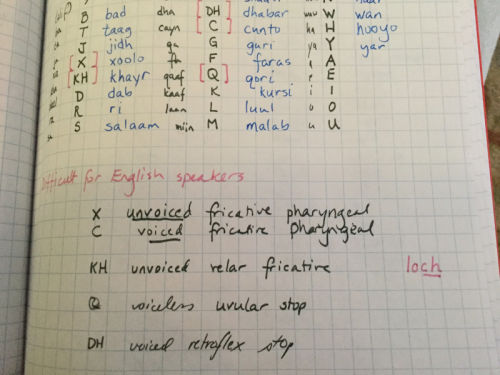
    C – Voiced fricative pharyngeal.

    Magacaygu.  Magacaygu Erin.

    "Maga-ayygu."

     Who says there's no voiced fricative pharyngeal in English?

    + + +

    Do you remember learning to whistle?  I barely do, but I've been watching my 8yo do it for a month or so.  I showed him how to purse his lips and put his tongue, and he worked until he got the faintest little hint of a whistle when he blew.  "Start there, and keep trying," I told him.  I've been noticing him walking about the house puffing and working his mouth, the little whistles getting stronger and stronger; he's controlling it better and better as he goes.  Now that he's adjusting his lips and tongue and diaphragm in response to the feedback he gets from his own ears, he's improving; but he needed to learn how to make that thin, high near-whistle before he could even start practicing on his own.

    I'll have to check with the instructor next class… but perhaps my waitress's channeling of the Fonz will give me a place to start, at least with the letter C. 


  • Quiche au thon, from an American fridge.

    I really need to recipeblog more, if for no other reason than it keeps the posts coming (has it really been eleven days?)  Anyway, Lent is coming, and I've got a good meatless recipe for you.  

    + + +

    I'm in a very busy time of life.  I know, we're all busy, but I'm convinced that I'm in one of the busiest times of the arc of my entire life as a parent, thanks to lifestyle choices that have me homeschooling a preschooler, a second grader, a sixth grader, an eighth grader, and a high school senior all at once.  Many things that are not just enjoyable, but objectively good for me, have gone by the wayside:  getting to the gym more than once or twice a week; reading novels; cooking dinner.

    It turns out that I can get by on planning cooking three and a half dinners a week.  What happened to the other three and a half?

    • Saturdays, one of the kids makes dinner.  They take turns.  This week, the 8th-grader got a hankering for sausage ragù, so he announced that he would be making that.  I am not complaining, though I did strongly suggest that he make a very light side dish to go next to it, like fresh grapes, or plain green beans.  Caesar salad–his first choice–would be a bit much.
    • Sundays, we have "plate"–or you could call it smörgåsbord–or charcuterie.  Cured meats, cheeses, crackers, maybe a baguette with spreads, veggies and hummus.  Occasionally we swap it out for raclette.  
    • Mondays, I'm at H's, and she and I take turns making dinner.  That's the half-dinner.  I am not even sure this should count, as about three-quarters of the time I make the same pot of emergency chili in her crockpot.
    • Wednesdays Mark goes to the grocery store, and so Wednesday is Leftover Night.

    + + +

    I interpret "leftovers" broadly. 

    No one is allowed to open new packages on leftover night, except insofar as is necessary to contribute ingredients to other dishes made out of leftovers.

     If there are enough refrigerated containers of partial meals that weren't entirely eaten to feed our children (plus H.'s children who stop by between choir and climbing practice), then those things go out on the counter and that's that. 

    If that isn't quite enough I will conjure a fresh loaf of bread from the bread machine, and set out butter and peanut butter and jam.  Perhaps I'll put out cheese and crackers or vegetables and hummus, if it's already opened.

    If that isn't quite enough either, I will make something out of eggs. 

    + + +

    Tonight I had only a little bit of soup left over, so I made something out of eggs.  I had a single refrigerated pie crust that's been in the fridge since, I think, Thanksgiving.  I also had an elderly half-jar of sun-dried tomatoes to use.

    I took some inspiration from a recipe on a French cooking website that I subscribe to on Facebook, but engaged in some serious substituting–remember, the name of the game was using up leftovers. 

    The result was very good–probably more appealing to the children, with the mildness of mozzarella cheese, than the original might have been.

    Quiche au Thon aux Restes

    • One pie crust or pȃte feuilleté (whatever you have on hand or like to make)
    • About 1.5 Tbsp dijon mustard
    • One 5-oz can tuna in oil, ideally a better-quality tuna in better-quality oil (mine was Italian wild-caught yellowfin in olive oil)
    • About four halves, or the equivalent, from a jar of oil-packed sun-dried tomatoes
    • 4 large eggs
    • 1 cup cream, or however much cream you have plus whole milk to make a cup.  Sour cream or Greek yogurt will probably also work if thinned with some milk
    • Shredded mozzarella cheese, a couple of handfuls
    • Salt and pepper

    Preheat the oven to 400° F.   Unroll the pie crust into a pie dish according to package directions or recipe for a single-crust pie.  

    Smear the mustard all over the bottom of the pie crust; use enough mustard to cover with a thin layer.  If you really like mustard, go to town, but don't overdo it.

    Drain the tuna, flake it with a fork, and cover the pie bottom evenly with tuna flakes.

    Use a knife to chop or sliver the sun-dried tomatoes (if they are already in slivers, just use those as-is) and distribute over the tuna.  Again, if you love sun-dried tomatoes, go crazy if you want.  I found that four half-tomatoes was enough.

    Sprinkle about a half-handful of the mozzarella over the contents in the pie crust.

    Beat the eggs and the cream with salt and pepper, and pour over all.

    Then add more mozzarella, until it looks like the pie crust is full-ish.  Really, it doesn't matter how much you add.  It's mozzarella.  It'll be cheesier if you add more, and eggier if you add less.  Don't stress.

    (If you have a little parmesan, comté, or gruyère, I'm sure it would be fine also.)

    Bake near the top of the oven for… I don't know… twenty minutes?  Twenty-five?  I forgot to set my timer.  It got a little brown.  You should always check a quiche, because sometimes the crust gets too brown before the eggs are fully set; and if that starts to happen, put on a silicone pie guard, or make one out of aluminum foil.

    Cool until just a bit warmer than room temperature and enjoy.

    With leftovers.

    IMG_4681

    I found that the creamy eggs softened the salty, mustardy tuna and the acid tang from the tomatoes, and made for a balanced dish.  Mozzarella, of course, hardly makes itself noticeable; with tuna, I prefer a cheese that fades into the background, because I think that tuna and cheese often fight with each other except in very specific contexts (e.g. classic American diner tuna melts).  But the Italian olive-oil-packed tuna has an assertive flavor, not the tinny taste of Chicken-of-the-sea, that stands up to it.  Made with heavy cream, it's rich and yet simple, and the mozzarella raises the protein content and holds it together without getting in the way at all.  Puff pastry or a homemade butter crust would make this even better, but a refrigerated rolled pie crust did not noticeably detract (and made the whole thing very quick and easy).


  • Bullet journal for young teens, II.

    In the last post I wrote about transitioning my 14yo homeschooled eighth-grader from managing his assignments with a daily to-do sheet filled out by me, to a bullet journal.  I described how I sat down with him on a Monday and showed him how to set it up.  

    On that Monday, I went through the following steps with him:

    1. numbered the pages
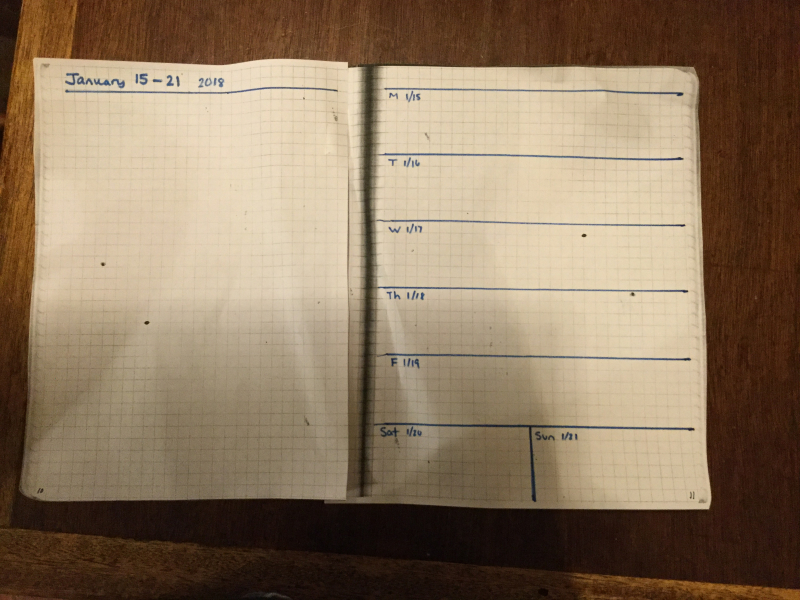
    2. made a two-page-spread Weekly Log, left side undated, right side divided into days
    3. entered his assignments for the upcoming week on the undated side of the Weekly Lig
    4. put check boxes next to all the to-do items
    5. started a Key for him
    6. showed him how to migrate tasks from the undated list forward to specific days
    7. made an undated Future Log for tasks to do “sometime”
    8. showed him how to migrate a non-urgent task back from the weekly list to the Future Log
    9. made an Index

    Later in the week, as he worked with the bullet journal and completed tasks, we added more features.

     + + +

    10.  “Go back to the blank page 9 and label it ‘Next 5 Weeks.’  This part of a bullet journal is usually called the Monthly Log, but we are going to organize things on a weekly basis because that’s how I do your school assignments.”

    He flipped back and labeled the top of the page, and then I showed him how to date each line of the page, starting with Monday of this week and ending with Sunday of the fifth week out.

    "This is like the Future Log, except that it has specific dates for the next month or so.  We’ll make a new one after four weeks.  If you are looking at your Weekly Log and you decide that one of the tasks is something you would like to do, say, next Tuesday, you can migrate it back here and write it on Tuesday.”

    11.  “Let’s enter some things from the family calendar on the Five-Week Log.”  I pulled up my Google Calendar on my phone and showed him.  He wrote down a couple of upcoming Scout events and two days he was scheduled to serve Mass.  

    I added, on the last Monday, “make a new ‘next 5 weeks’ page.”

      CA155197-6D3C-4881-B460-77240C4EA1DE

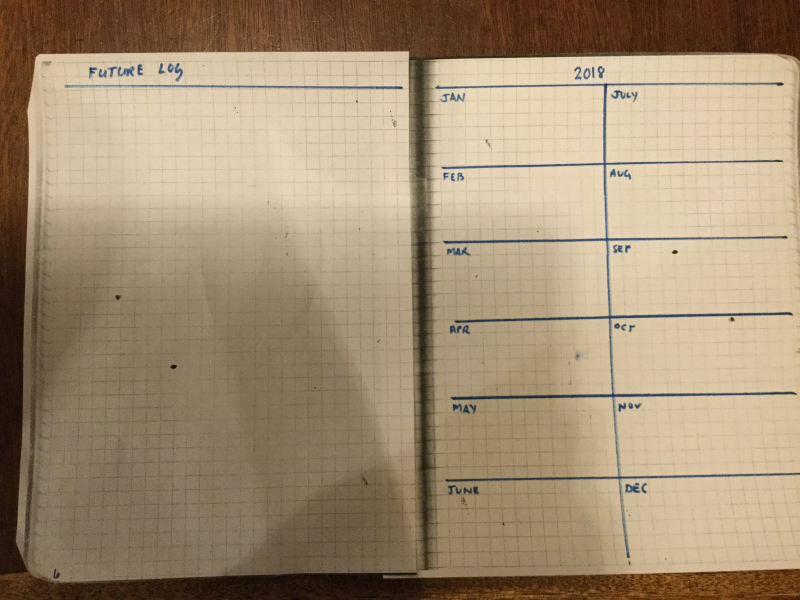
    12.  “What if you decide you want to do something in a couple of months, say in March?  For that we need to make a dated page on your Future Log.”  I sent him back to the Future Log and had him copy a simple twelve-month calendar onto the facing page.  We added a couple of events to it.

      0671F88E-382A-47BD-ABD6-EC8BB35F087A

    “Here’s an important rule to keep the journal simple and uncluttered:  Don’t put tasks on a month unless you are sure you will do them that month.  Don’t put tasks on a day unless you are sure you will do them that day.  Tasks can stay on the undated lists and be checked off from there.”

    13.  “Let’s go through your Weekly Log so far and update it.”  He turned back to the weekly page with the assignments I had added on Monday, both in the undated list and in specific days.  Some of the items were checked off, some not.  

    I went down the list with him:

     “Did you do this one yet?” 

    “Yeah.”

    ”Fill in the box.  Okay, what about this one, is it done yet?”

    ”No, I don’t have to do that one till tomorrow.”

    ”Okay, are you going to really have to do it tomorrow?  Or can it wait till the weekend if you run out of time?”

    ”I really have to do it tomorrow.”

    ”Okay, let’s migrate it to the tomorrow list.”  

    He added the “migrate forward” symbol and rewrote the task in tomorrow’s day box.

    We ran down the list, updating, and adding a few new tasks.  “The idea behind this key is that by the time you make a new weekly list on Monday, you won’t have any more empty check boxes on this week’s list. You don’t have to have actually done everything.  The main thing is you won’t have lost track of any tasks.  You’ll either have completed the task, moved it to another list, or deleted it, and in all of those cases you will have marked the check box.”

    14.  “We’re nearly through the week, and there’s still stuff to do.  Let’s mark all the remaining schoolwork items as Urgent.”  I got a red pen and put an exclamation point next to all these items, without changing the checkboxes.

    ”So we won’t put these on the day lists, because you are free to do them any day this week you want, including over the weekend.  But let’s require you, on Friday, to make a plan to do whatever’s left of these.”  

    I wrote “make a plan to do all the ! before bedtime” in Friday’s block.

    ”This way, we haven’t cluttered up your days with all the tasks that are still outstanding now, but if there are some left on Friday you’ll need to decide what to do with each one then.”

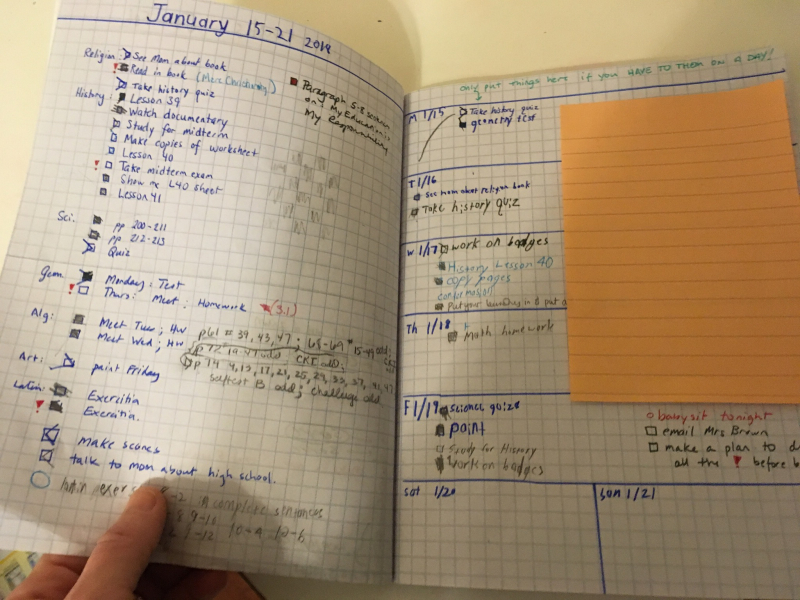
    By now the weekly log looked like this:

      EFD4EA60-B5D2-4270-9F93-8D76E12B7107

     + + +

    How did it go?  So far, pretty well, I think.  I saw him carrying it around and writing in it.  I used a paperclip to fasten his science quiz inside the front cover on Friday, just like I used to clip the quiz under his to-do sheet on his to-do clipboard before, and that worked really well.  I wish there was a little more room to write the exact assignments, like the math problem numbers; maybe this means we will have to expand the undated weekly log to a whole two-page spread and go to individual daily logs, I don’t know.  We will be tweaking the layout as we go.

    One pleasant surprise:  the boy in question seems very positive about this new development, even eager.  I get the impression that he now regards the weekly sheets I made for him all through middle school as a thing of childhood to be put away, and the bullet journal as a manlier thing.  Something that sets him apart from his younger sister and puts him in the company of his older brother now taking college classes.

    A test of this will come on Monday, when we set up the second weekly log.  Will it be too boring and repetitive?  Will he balk at migrating tasks by rewriting them?  Or will it still be interesting?  And will he have gotten things done?  

    Come to think of it, I’d better check that last bit on Sunday night, while there’s still time left in the week.


  • Bullet journaling: Teaching the method to an easily distractible teen.

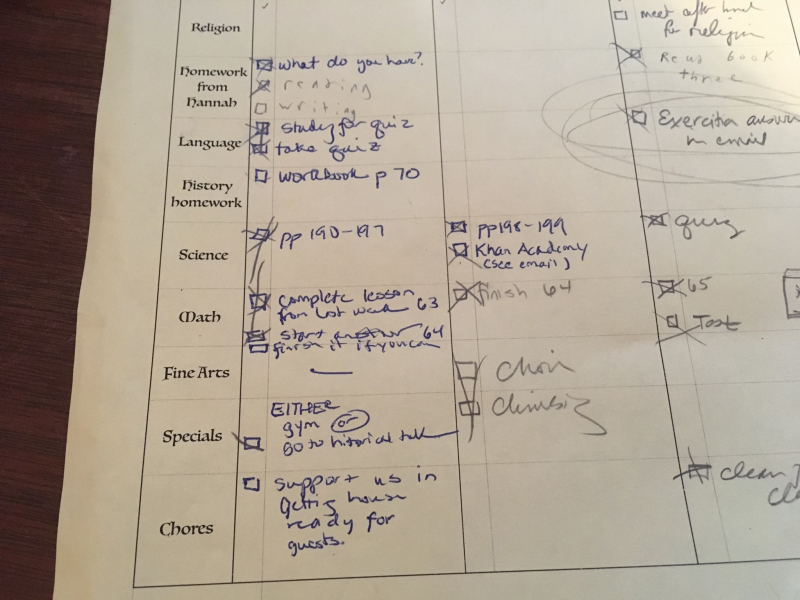
    I write my middle schoolers’ assignments on a weekly to-do form.  Each entry is assigned on a particular day (Tuesday, Wednesday, or Friday—the other days, we coschool).  They check the assignments off as they are done.  Chores go there too.  At the end of the week, I file the to-do list away as my record of what got done.

    0A5CDE78-A548-4CC3-B7F7-EDB3FE935719

    When my oldest started high school, we simply dropped the to-do list, and I started giving him assignments weekly.  That worked pretty well—he’s always been a responsible one—but not as well as I would have liked, at least at first.  

    As my current 14yo enters the second half of his eighth grade year, I want to lead him a little more intentionally through learning to keep track of his own assignments.  It seemed to me that the bullet journal is a good place to start for this one:

    • He’s a very physically active, kinetic sort of teenager, easily attracted from his work and never sitting still.  He craves novelty.  A planner page that can’t be changed is a planner page he’ll get bored with.
    • He doodles on absolutely every piece of paper you put in front of him.   Extra blank paper will help.
    • He has been developing his power to stay on task through distractions and interruptions by practicing the pomodoro technique, at my encouragement*.  This involves making a little check mark on paper when an interruption or distraction comes along, as a way to sort of satisfy the urge, and perhaps writing down the thought or desire so one can come back to it; and keeping track of how many cycles of 25-minute work periods and 5-minute rest periods one accomplishes.  So it helps to have extra blank paper for this, too.

    *Tip for helping a distractible young person learn the pomodoro technique: Immediately reward them with a piece of candy upon completion of each pomodoro.  

    Besides all these, I had been watching some videos promoting bullet journaling as a good technique to help the ADHD brain manage tasks.  A child psychologist evaluated the 14yo over the summer and did not diagnose him with ADHD, but we were advised that he has a few things in common with kids who do receive that diagnosis, and I thought that the video advice might apply to him.

    I had a nice new graph paper composition book, the kind I like best, lying around waiting to be used for something.  So I snagged it, along with some pens and a ruler, and waited for an opportune time.

    + + +

    Before I sat down with him I put some thought into how I would introduce it.   I didn’t want to overwhelm him with too much information at once, so I decided that we would set it up over several days, and start with the absolute minimum.   I drew up some dummy example pages, made from photocopied blanks, as I planned them. Here is what I settled on:

    • Page 1: blank
    • Pages 2–3:  Index
    • Pages 4–5:  Blank for now in case we need to add something
    • Pages 6–7:  Future log, generic on the left, monthly on the right:


    65A90648-6147-4003-86E1-C00ED91139E3


    • Pages 8–9:  Sort of a monthly log, generic on the left, dated on the right; only instead of a calendar month, it’s just going to be for the next five weeks, Monday-through-Sunday.

    6E20568C-F5ED-43A2-9917-EAAFBE974E8E

    • Pages 10–11:  The first weekly log.  The left page would be where I would write the week’s assignments, to start a to-do list.  The right side would be divided up into the days of the week.

    DF04763B-3169-462D-8629-AAC7762DDE1B

    For the time being, no daily logs.  I figured I would only introduce those as they became necessary.

    + + +

    On the first day of the second semester I sat down with him, the notebook, and writing supplies.  I explained that instead of to-do lists every day, we were going to start practicing time management weekly.  "I will write your weekly assignments in your notebook on Monday mornings," I explained.  "You'll check them off as you go.  Then, at the end of the week I'll photocopy your list and save that for my records, and you'll keep the notebook from week to week."

    Here's how I told him to set it up:

    1.  "Number the first twenty pages or so."  No point in going crazy and numbering the whole book at once; when we run past the first twenty, we'll number another few.

    2.  "Turn to the spread on pages 10 and 11, and copy the weekly log."  I had him copy it exactly:  ruled lines, dates, and all.  He had a mostly-blank page on the left, and a space for each of the next seven days on the right. 

    3.  "I'll write your week's assignments on the left side of the page."  I fetched my own pen and my school schedule, and with him watching I wrote out his list of assignments on the undated side.  I wrote them organized by subject, which is how they come out of my brain:  first the week's three history assignments, then the week's three science assignments, and so on.  

    "I was thinking, sometime I want to learn to make scones," he suddenly interrupted me.

    "Good thought!" I said, and added "make scones" to the bottom of the list.  Aha, I thought, I can use this later.

    4.  "For each of these tasks we'll make a check box, just like the ones you're used to having on your to-do list."  I drew a little square to the left of all the tasks (including "make scones").  

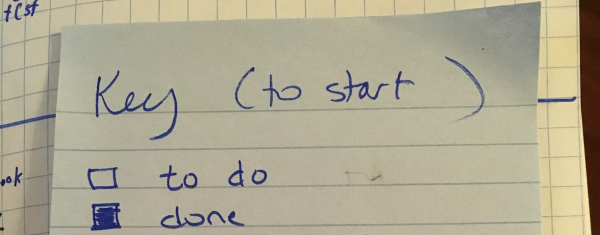
    5.  "When you finish a task, fill in the box completely.  Here, let's start a key so you can see what you're doing."  I grabbed a pad of large-format sticky notes and wrote:

    IMG_4575

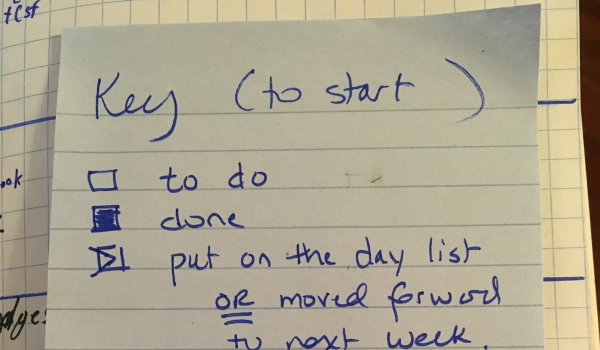
    6.  "If there's anything that you already know you absolutely have to do on a particular day—say, this science quiz that you'll take on Friday—we're going to migrate it to that day."  I went down the list and found the science quiz, and showed him where to copy it into the Friday box.  And then I showed him how to fill the weekly check box with the "migrated forward" symbol, and added it to the key:

    IMG_4575

    I had him migrate a few more things to specific days.  While he was at it, I had him add some new dated events that we thought of:  confirmation class on Wednesday, for instance, and painting, which we only do on Fridays.

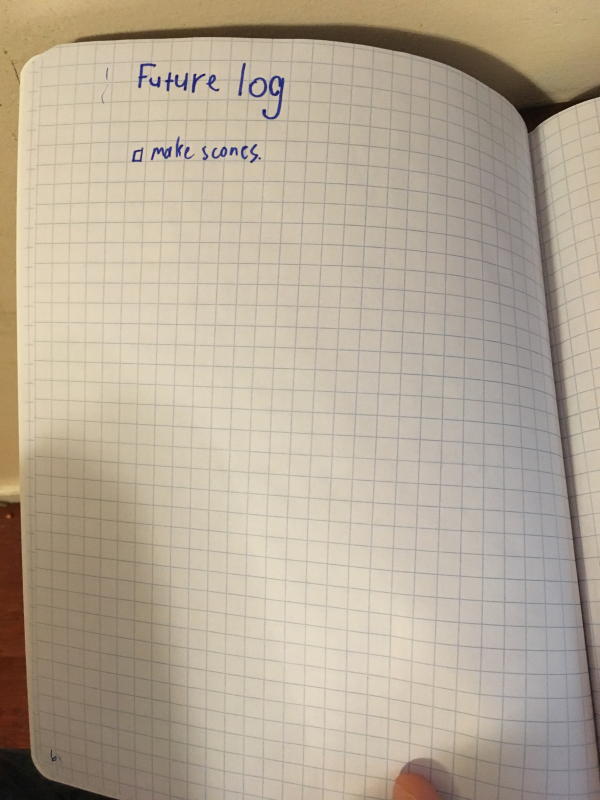
    7.  "Now turn back to page 6 and label the very top of that page 'Future Log.'"  He went back and wrote that down.  I didn't have him add the twelve-month calendar just yet.

    8.  "If there's anything on your weekly list that you realize you're not going to get to this week, but you still want to get around to it sometime, you'll migrate it back to your Future Log."  

    He looked confused, so I said:  "Look, let's talk about those scones you mentioned, okay?  Let's say you won't have time this week to make scones, but you still want to do them sometime and you don't want to forget that you had the idea."

    "Okay…"

    "Go back to your Future Log and put an entry for 'make scones.'"

    He did this.  Then I brought him back to his weekly log and showed him how to make the "migrated back" symbol in the check box.  And the we added it to the key:

    IMG_4575

    9.  "The last thing to do today is make an Index."  I had him go back to page 2, label it Index, and add the following entries:

    Future Log p. 6

    Jan. 15-21 p. 10–11

    And that was the end of our first session with the teenaged bullet journal.  Tune in next time for the introduction of the monthly-ish log and a summary of how it all went.  And possibly a recipe.


    IMG_4576


  • Intrusion of someone else’s schedule.

    Maybe the thing that Mark and I love best about homeschooling all the children is that we set our own schedule.  Nobody tells us how much time we get to spend with our own children.  Nobody tells us how much homework we have to supervise each night.  Nobody tells us when we are allowed to go on vacations, or when we have to come home.  We decide when to get up in the morning and when to go to bed.

    All that is about to change this coming week, and I'm bracing myself for it.

    + + + 

    My oldest is a high school senior, and in this last semester of school-at-home he has elected to take a few college courses at the state's flagship university, for which he'll get both high school and college credit.   Our main motivation for encouraging this is to get him used to rigid demands on his time, after twelve and a half years of flexibility and personal attention, before he has to jump right into full time college next year.

    Q.  Why didn't he start in the fall and get two semesters' experience? 

    A.  Because we wanted to take a long family trip in September.  

    Priorities.

      IMG_0602    IMG_1022     IMG_5867

    + + +

     So I'm sitting here making a spring-semester daily schedule for the rest of us, for the first time ever; up till now, our schedules were always good for a full year.  I'm deleting the two meetings a week I had in the fall with our oldest to teach him Calculus II; I'm deleting our once-weekly meeting for Religion; I'm moving Physics II to the afternoons.  He won't have English with H. anymore, although we'll still do Latin IV together on our coschooling days, along with H's oldest who is otherwise a full-time college student himself now.

    Besides Latin IV and Physics II with me (twice a week each), he'll be taking microeconomics, calculus (again), and contemporary literature, for ten college credits.   I heartily approve of this schedule.  I think it will be challenging but not overwhelming.  I am glad he is taking economics from someone who is not me.  I am glad that H. concentrated on composition for the first half of his senior year, and am satisfied that contemporary literature will slot nicely and with novelty into a high school curriculum intentionally dominated by classic works.

    He will have to be on campus by eight a.m. most days, nine a.m. the others; conveniently, Mark can drive him there on the way to work, much as he used to drive me while I was in my Ph.D. program at the same university.  He can get home on the bus most days.  On Mondays I will fetch him from campus on my way to H.'s.  On Thursdays H.'s son will fetch him on the way to my house.  We shall see how well this commuting plan works.

    + + +

    We are going to have to take our ski trip during Spring Break this year, instead of in February, and we can't take any extra time to drive leisurely.   This fact keeps blowing my mind.

    + + +

     Another thing that's different:  I am going to have to assign him fewer chores than his siblings this semester, despite the fact that he is by far the most competent chore-performer in the house. 

    Currently, he does a lot of child care, lunch-making, dishes, and daily sweeping-up, as well as the monthly pickup we have to do before the professional housecleaner arrives, the occasional cooked dinner, and assistance with some household project of his dad's. 

    (Not to mention reaching a lot of things from high shelves for me.)

    This aspect of his absence is going to be really difficult, so habituated am I to yelping to him for help all day long.   I've calculated:  He really should be spending forty hours a week on his studies, if you add up class time and homework time and commuting, and include the two high school courses he's still taking from me.  

    We'll still be requiring him to do some chores, of course; they're part of living in a family.  But we are going to have to dial it back.  I'll probably have a talk with Mark and work out how many hours a week is a reasonable amount for a full-time student living at home to contribute (mental note:  should be at least as much time as he spends playing online games), and from that derive a list of which responsibilities he should keep and which I should dole down the line to his younger siblings.   

    + + +

    The silver lining:  I, too, have to ease into the time when my young right-hand man heads off into the next chapter of life.  I'm really excited for him.  I can't wait to hear how his classes are going.  I'm pleased, vicariously, at the thought of this firstborn launching into the world.  I remember well the intoxication of leaving home and finally having power over my life, my environment—indeed, over my schedule. 

    I'm so happy for him that he is finally going to be able to pass into that part of life.  Even if, temporarily, I have to live with his schedule for a while first. 


  • Dodging the bullet (journals).


    It is Sunday, and I am resolutely resting.  My iPad is propped up on my lap, and I am about to indulge in some blogging.

    Advent is when I like to start my new year, partly because it is the start of the liturgical year and I like being countercultural, partly because it gives me an excuse to procrastinate all the Christmas things.  So over the past couple of weeks, I spent time setting up a new notebook.

    Are you familiar with the “bullet journal” productivity fad?  If you have so far escaped knowledge of this, and you are prone to declaring that there exist no individuals who have time for such activities, I have a suggestion: Take a look at the original concept by the man who coined the term and then this minimalist self-proclaimed ugly version by a woman working in tech before you do any such fool thing as google “bullet journal ideas.”  

    Especially without the -pinterest tag.

    + + + 

    Paper notes and lists have always pleased me more than digital ones.  I have a near-religious devotion to the utility of taking class notes on paper.  I write out daily to-do lists for my K-8 homeschoolers.  I still make my grocery lists on paper forms, and I go through post-it notes and index cards terrifyingly fast.

    Some transitions I have made.  I was one of the last people I know to move from a paper calendar on the wall to a Google calendar, but it has been years now and I am completely comfortable with it.  I have stopped making paper flash cards for the students I tutor and have encouraged them to get onto Quizlet.  I store some lists (notably, meal plans) on Wunderlist so I can access them from anywhere.  I use my email inbox to capture miscellaneous thoughts I have now, and email ideas to my future self via followupthen.com.  Every Saturday I shoot out a series of emails to all the homeschoolers I supervise with their assignments for the week.

    But I can't see myself going full digital quite yet.  I still love thinking on paper, and I am used to finding information I've written down by flipping through a book.  So I carry a paper notebook around in my bag, next to my iPad. 

    + + +

    What I do NOT do:  

    • color-coding
    • calligraphy
    • write out a year-at-a-glance page or month-at-a-glance pages
    • have an expensive boutique-quality paper notebook 
    • elaborate layouts
    • numbered pages and a table of contents
    • daily to-do lists

    What I DO use it for:

    • periodically writing out master lists (“brain dump”) of tasks, projects, and “someday/maybes”
    • making notes of things as I go through my inbox each day or two
    • thinking through things by writing about them
    • planning how to spend time
    • blocking out project timelines in the form of a mini-calendar
    • taking (or rewriting) notes to organize information
    • taking notes I’ll never look at again just to help me listen and pay attention
    • as handy paper to write the odd grocery list

    As a system it is semi-intentional.  I observed how I do and don’t use it, and constructed a standardized (not idealized!) algorithm.

      80431513-58FD-4684-AFB9-D56292723A32

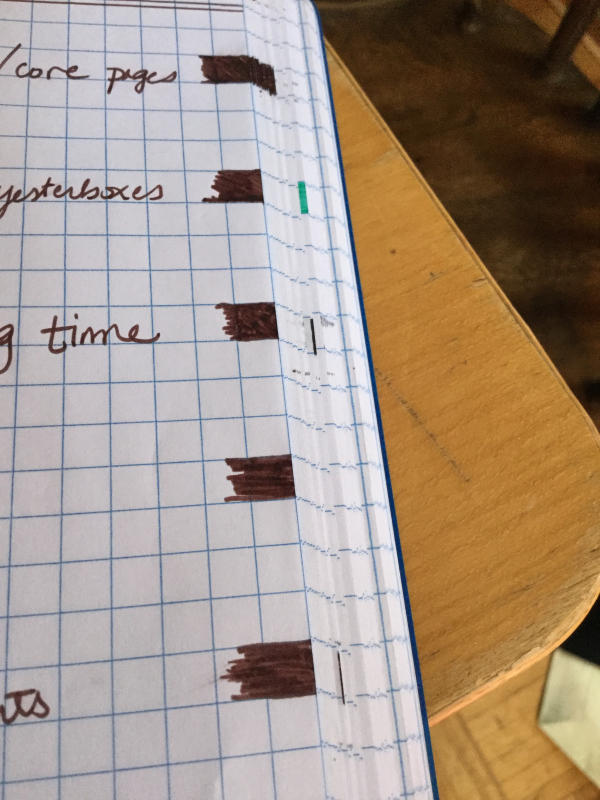
    As I was transferring information into my new notebook this year, I decided to add a tabbed index, but not a table of contents.  In a journal where notes are added chronologically, tables of contents get too jumbled up for me to find them useful. Instead,  I created just a handful of broad categories and used a blacked-in square at the edge of the page to tag pages.

    F600438B-5622-4045-B50B-2C82E48C69EE

    The categories are:

    • Pages copied from last year’s journal and core pages
    • Task lists and brain dumps and notes from going through inboxes
    • Planning out projects and time
    • Thinking on paper
    • Insights I want to remember

    There’s a last category, but instead of giving it a tab I write it from the back toward the front by turning the notebook upside down and backwards:

    • Notes just for listening

    This lets me treat the back of the book as a simple chronological notebook of things I was trying to pay attention to.  It keeps the organized matter at the front from being interrupted by scrawls of low importance.

    CORE PAGES

    So in the very front of my notebook, which is just a quadrille-ruled composition book with a plastic cover, I have made:

    • a page with my contact information
    • the tabbed index with the list of categories
    • a page of long-term goals (roughly ten years out)
    • a page labeled “Backlog” of tasks that aren’t urgent but I want to get around to
    • a couple of pages of memory-joggers for when I am making task lists.

    There is also a set of pages of reference information that I copied forward from last year’s notebook.  For example, the long-term school planning chart (picture above) that tells me what grade everyone will be in each school year for the next ten years.


    BRAIN DUMPS

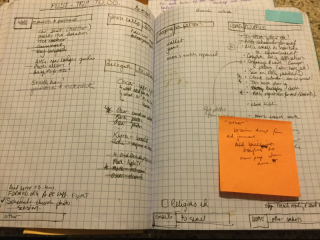
    My system starts off with a master task list, a.k.a. a “brain dump.”  This corresponds roughly to a monthly review and task migration in the minimalist bullet journal system, or to a weekly review in GTD, but I don't do it at set intervals.  I dump my brain whenever I feel that it is starting to fill up with loose ends of things that I need to remember, or whenever the existing lists start to feel out of date.  It is a mini fresh start, best done on a Saturday morning after one and a half cups of coffee.

     I usually make a brain dump onto a two-page spread, and often put items into categories, depending on how I am feeling.  Sometimes I categorize by people:  a list for self, for Mark, for each of the children (or sometimes just a KIDS list), extended family and friends, community.  I often do that if I am trying to jog my memory and write down all my current responsibilities toward other people.

     Other times I categorize tasks by context.

    457FA602-4E1B-4D66-8A81-A1F6E29C6F3A

    Context means the environment where I can perform the task.  The idea is that when I find myself in a particular context, I should work from the part of the list that contains the tasks I can do most easily there.  

    Sometimes context is a physical space and sometimes it is more of a state of mind, or both.  My contexts include

    • Web (researching, purchasing, reading, other)
    • Phone calls (for which I need quiet)
    • At home, with quiet access to my school materials, archives, and files
    • Emailing
    • Household tasks (for which quiet is not necessary)
    • Brick-and-mortar errands and shopping
    • Coffeeshop work
    • Tasks to delegate to someone else
    • Complicated multistep projects (not really a context, but important to put on the same page as the brain dump)


    YESTERBOX

    This is what I call the intermediate step between the brain dump/master task list and today’s to-do list.  It is kind of like a daily review.  I don’t do it every single day, although I probably should.  

    The concept of the yesterbox comes from Tony Hsieh, who wrote about it concisely here.  It works brilliantly with the technique of using your email box as a way of collecting tasks and thoughts.  I already email myself reminders pretty often, so I have found it useful.  The basic idea: Yesterday’s inbox is today’s to-do list.   Every day you must deal with the emails that came in the previous day, and then you may call yourself done (with email, anyway).  There’s some fine print at the link for how to adapt it as needed, but that is the basic idea.  

    I have employed synecdoche, calling the whole daily review a “yesterbox,” to remind me of this focus.  I open the notebook to a new page, date it, and then start going through my email from yesterday (including any email reminders I sent myself).   Here I write down new tasks that the emails suggest to me.  I also add events and scheduled tasks to my digital calendar at this time—these do not go into my notebook, since I will get an electronic reminder about those.  And I note things coming up on the calendar.  Anything else that comes to mind, too.  I also look at notes I made for myself yesterday (i.e., yesterday’s yesterbox) and carry things forward as seems appropriate, or delete them if they have become irrelevant, or cross them off if I actually accomplished them.  In any case, I can stop when I get through all the emails and reminders that came in yesterday.  Or, if I wish I can look at older emails and at new ones that came in today.

    I do not use the yesterbox as today’s task list.  It’s too long.  So the next thing I do is:


    THE INDEX CARD

    I make my daily to-do list on one side of an index card.  This prevents me from making a to-do list that is too long.

    I write down things I know I must do today first. Then I select tasks from the yesterbox list and copy them onto the index card.  If I know I am not going to get to a yesterbox task today, I might copy it back onto the master task list if it is not already there.   That would be the best and most organized thing to do, but I often don’t have the self-discipline to admit to myself that I am not going to get to it today.  So sometimes just leave it there for now where I will be able to see it tomorrow and carry it forward onto the next yesterbox.

    If my card is not full, I go back to the brain dump (working master task list) and pull tasks from there to put on my index card.  

     The index card goes in my pocket or purse and follows me around.  I sometimes write information on the back, like a phone number I need to call.  At the end of the day, whether I have finished everything on it or not, I put it up on the prayer shelf above my desk and forget about it.    

    Most of the tasks are duplicated in the notebook, so I won’t lose any vital information.  Shelving the cards, finished or not, up on the little shrine of sorts where I keep a crucifix and some devotional images, is a way of letting go of the day’s obligations and making peace with my imperfections.   A stack of to-do cards grows there, like a little pile of offerings.  Every so often I throw them away.


    BACKLOG

    This is a relatively new addition to the notebook, but I have high hopes for it.  It comes into play when it is time to make a new brain dump.  My plan to try for this year is to migrate every non-obviated task from the old brain dump:  either forward onto the new brain dump, if it is still relatively fresh; or, if it has fallen to “if I get around to it” status, backward onto the backlog.  Anything that I just don’t need to think about anymore (I missed my chance, or somebody else did it, or it became irrelevant) can get crossed out, but things I still hope to do will be captured either on the new brain dump, or saved in the backlog for possible future consideration.  The old brain dump is no longer active or useful.

    + + +

    Well, that is a decent overview of my hybrid digital-paper system, such as it is.  No glitter, washi tape, stamps, or fountain pens allowed.  And I break my own rules all the time.  Does it still count as a system?  Well, I am on maybe my fourth notebook in as many years, so I think it does.  I still probably use it to procrastinate more than anything else, but it makes me feel organized, and sometimes that is enough of a boost to get some things done.


  • Prepare ye.

      A couple of weeks ago, a friend emailed me to check on me, because I hadn’t blogged.  And here it is, even later than that.   What happened?

    I am not sure, but I guessed it had something to do with Christmas.  The holiday season descended upon me, as it does this time of year, and fell with a quiet, suffocating thump.   I cannot seem to help it, but I always wilt under a sense of obligation, this time of year.  I think the stress is mainly associated with presents, and I joke (okay, it isn’t actually a joke) that I have a Gifting Disorder.  So I have tried to reduce that, through asking relatives if we can’t just skip it.  I also have reduced the number of people I spend time at the holidays down to people I actually want to spend time with.  And yet this generalized holiday-season dread remains.

     It is usually all right once I actually arrive at the party, or exchange presents.  It turns out fine, mostly.  But there is a nasty dread in the anticipation.   It’s just a sense of not being able to dredge up the correct feelings and motivations.  “Giftmas” makes me feel like a bad person.  I am grateful to be aware that Christmas depression is not uncommon and to recognize the pattern in myself, because I know it is temporary.  The soft slumping weight will all melt away in January.

    + + +

    It has helped for me to remember that Advent is a season of preparation.  Some of my FB friends and I were grousing good-naturedly (I hope) about pastors who preach from the pulpit to keep Advent peaceful and watchful  and not do things like put up the Christmas lights until Christmas.  We were observing that perhaps Father doesn’t realize that if you want to have a “nice” Christmas, it takes about a month to get ready.  I suggested that waiting patiently with joyful anticipation during Advent is appropriate if one is in a stage of life, such as being four years old, when Christmas is something that just comes along; but when one is in charge of making Christmas, the only way to keep Advent meaningful is to think of it as a season of preparation.  Which it is.  

    I was thinking about the parable of the ten virgins, which was one of the daily readings sometime in the last couple of weeks, I forget when.  Everything eschatological applies to Advent and vice versa, I think, so it seemed appropriate.  As Advent gets closer and Christmas draws near, we must get ready; we must fill our lamps with oil.  It is a huge effort for me to do this.  I want to crawl into bed, forget the lamps, and hide from it.  Part of what I am hiding from are people who appear to be one-upping each other with gaudy, complicated, blinding lamps that take a lot of work.   

    I do not know whether those other people’s lamps are full or not, but the thing I have to keep in mind is that all that is required is that the lamp be full of oil on the inside.  I mustn’t let the outward appearance of others get me down so much that I don’t fill my own.  Preparation for Christmas is not optional.  It is necessary.  Some work is necessary.  Even some of the work that intimidates me!  But not all of the bustle and business is part of what’s needful.  Wake up, fill my lamp, trim my lamp, don’t worry about the standards set by other people and their fancy glittering lamps.  Eyes on my own work.  It is real effort, this quieter, appropriate preparation.  And that part is worth doing, even if it is hard not to just crawl into bed.  

    + + +

     Related (probably):  I have been ill for weeks, off and on.  There were cold symptoms at some point, and Mark had them too, and some of the kids.  I thought I was better, then got tired and achy again.  I have missed a lot of workouts, but not all of them, since just before Thanksgiving.  Maybe I have managed one per week.  This past week I haven’t managed any; I have slept a lot.   I began to wonder if I had some kind of mononucleosis-type viral infection, either milder than mono or maybe it was mono and I was one of the lucky people who was only mildly impaired by it.   Then this Monday a blister like a cold sore erupted on my hard palate (so, exactly like a cold sore, the rarer intraoral type), and then on both Tuesday and on Friday I took 4-hour naps in the middle of the day.  And also the nodes on the left side of my neck are tender to the touch, off and on.  I keep thinking I am better and then crashing again.

    I don’t get cold sores very often.  Years and years go by between them.  I know that flare-ups of HSV (the cold sore virus) are often associated with stress.  I must have had a primary infection at some point before this, but the  first time I remember getting them was the week my mother died.  

    + + +

    Christmas is not as bad as all that, of course, but it is undeniably a source of stress, even though objectively speaking there is no real reason* for me to be stressed.  A lot of the things that I used to point to as stressful are not really there anymore.  Many dreadful gift-giving situations have gone away; we deliberately see fewer people than we used to, and all the ones we do see are people I am genuinely excited and happy to see; I guess it is just residual association?  But I am willing to believe it is a strong one.

    ———

    *After writing this, I remembered that in a short number of days I have to drive 12 hours with all the kids (and without Mark).  Also, before that, there is the usual checklist of things like packing and cleaning up the house, with some added responsibilities such as present-wrapping.  This possibly counts as a “real” reason to feel somewhat burdened.


  • A little translation for you.

    Something different for Sunday.  A while back, I wrote some posts about the books I bought while I was in France, and I promised to read Marielle Blanchier's Et Ils Eurent Beaucoup d'Enfants first and get back to you.

    This, you'll remember, is the memoir of a woman, trained as a chemist, who has twelve children.

    Well, I haven't finished the book yet, but I'm a few chapters in, and for a fun evening project I thought I would translate a bit of chapter 3.

    Chapter 1 is sort of the story of how she and her husband met and married and how her rather surprising lifestyle unfolded.  Chapter 2 is called "Mother's Day Treasures" and is a humorous account of how she deals with all the handmade gifts her children bring her home from school.

    Chapter 3 is called Neuf Années de Grossesse:   "Nine Years of Pregnancy."  This is the first part of it.

    + + +

    In the last twenty years, I have lived through nine years of pregnancy. 

    And, no, it's not so much that I like to be pregnant. 

    Yes, and no.  My feelings are very ambivalent.  Honestly, it's not a pleasure in and of itself.  Carrying life is a great joy, in my view the most marvelous that one can experience; but it's also a handing-over of the self, and a time of anxiety:  will I have a miscarriage for the umpteenth time?  And what if by the fifth month I'm already completely drained?  Will my cervix dilate to soon and bring on a pre-term birth?  There is also the apprehension of having to accompany a new human being for a whole lifetime.  And my body, changing.  I feel weakened, diminished.

    Digging out the foundations of a house in the middle of winter, under the rain, would that be a pleasure in and of itself?  Not really… but we likes the result.  To give life to one m0re person.  Carry that life within oneself, feel the baby move in one's belly, discover him on the screen of the ultrasound.  A new marvel every single time… However, as the pregnancy draws toward the end, there are so many challenges to take up.  Putting up with the constraints of fatigue.  Keeping charge of the house despite having no energy.  Finding time to rest enough to allow the baby to grow.  Enduring the ordeal of the transformation of my body, the burden of these 25 to 40 extra pounds.

    At the beginning, the baby bump is cute.  Then, naturally, I grow… and grow.  I eventually get to the point of asking myself if I'm not going to end by losing all femininity.  To become, once and for all, "the fat old bag who had twelve children."  The kind about which people think:  "The poor thing, she is already on her twelfth…"  That prematurely aged woman who people mistake for Grandma.   

    Even though what I really want is for people to keep asking me if the child in my stroller is my first.  Happily, that still happens to me sometimes when I am out by myself with Charles [the youngest]. 

    I answer "No," obviously. 

    Then they question me:  "Oh, he has a little brother or sister?" And sometimes they go on to give me a few child-rearing tips. 

    I let them speak, then I savor the effect when I reply,  "Oh. this is my twelfth child."  

    "What?!?  How many?"  My interlocutors never recover from this. 

    Some can't believe it at all, and toss "Ha, that's a good one!" over their shoulder as they walk away.  But most often, they shout to their husband, their wife, their children, or passing strangers, "Did you hear that?  This lady, she had twelve children!"  Then they add:  "Well, you don't look like it—you look good!"  

    Naturally, I like to hear this, because it means that I haven't been permanently scarred by the pounds, the fatigue, the tension.  Because it demystifies the caricatured mother of a large family:  I have made an unusual choice, but I'm not some kind of alien.  And also because their reaction testifies that I accord this baby the same attention as if he was an only child.  I comport myself as if he were the first.  Quite a lovely compliment!

    I have noticed that sporting a bulging belly has a lot in common with walking a dog or fixing a car in the middle of the street:  everyone wants to talk to you about it.  It is a way for people to make a connection—and I have noticed that people often have a need to talk.  They seize upon this pretext, and it pleases me that they are willing to speak to me so easily, even if it means moving on to other subjects afterward. 

    Even so, on thorough reflection, there are one or two things that irritate me.  When anyone tries to touch my belly, for example—but people rarely attempt this, they must sense that I am ready to bite!  Or when they tell me for an hour about the family life of some second cousin who had just as many children.  Or when they prognosticate, "A pointy belly means it's a boy, a round belly means it's a girl."  And it's not just the grannies who play Madame Fortune-teller.  I never know what to answer to avoid offending them.  They really seem to believe what they say.

    — From Marielle Blanchier and Pascale Krémer, Et Ils Eurent Beaucoup d'Enfants (Éditions des Arènes, Paris, 2013)


  • Entering year 10 of maintenance (V): Long-term thinking.

    Let me tell you what I had to eat yesterday (still following along in my French book of meal plans):

    Breakfast called for coffee or tea, 50 g of bread, and 20 g of cheese.   

    ………I had: coffee, a packaged English-style crumpet (49 g) and 20 g of four-pepper goat cheese spread on it.  140 calories.

    Lunch called for 100 g of chicken "escalope grillée;" 120 g of pasta, rice, or quinoa; vegetables; 1 teaspoon of oil to dress the vegetables; and 1 unsweetened dairy product.

    ……..I made salsa chicken rice bowls to feed the co-schooling horde for lunch.  I had:  shredded chicken breast cooked in the crockpot with salsa; 120 g of mixed brown rice and red beans; a pile of braised green peppers and onions; 1/4 avocado in lieu of the oil ; and 20 g of shredded cheddar cheese.   500 calories.

    Dinner called for 200 g of a velouté of winter vegetables with a teaspoon of crème fraîche stirred in; 2 soft-boiled eggs; 40 g of whole grain bread; and 2 clementines.

    ……..I had:  200 g of some leftover curried squash soup that contained coconut milk; 2 soft-boiled eggs; 40 g of homemade whole wheat waffles; and the prescribed two clementines.  I also indulged in some syrup for my waffles, but skipped the sausage patties that everyone else had.  400 calories.

    Also:  I chose to have half a doughnut at snack time—it was a birthday, with candles in the birthday teen's doughnut—165 calories—and enjoyed a gin and tonic at the theater (215).  The latter probably had something to do with my decision to eat a cold waffle out of hand when I got home, and also some saltine crackers (let's call that an additional 175 calories). 

    I'd say the doughnut and the gin and tonic were celebratory pleasures that I freely chose to enjoy, and fit nicely into my overall-moderate day; but consuming the cold waffle and crackers was an impulse that represented the kind of behavior I want to minimize in long term. 

    As maintenance has stretched into years, distinguishing between freely-chosen pleasures and not-so-pleasurable impulses has gotten easier and easier.

    Remembering to put down the cold waffle, in the moment?  Not really any easier, especially under the influence of G&T-induced munchies.

     Still, the distinguishing is the first step.

    + + +

    A couple of weeks ago, I decided to take another look at my long-term goals regarding weight, eating, and fitness.  The point of this exercise:  to inject some sanity and, well, serenity.  Too often I swing wildly between two poles:  either panicked feelings of lost control, or rigid, unhealthy obsession.

    Fact:

    If a time traveler from the future

    came back and told me that I would weigh the same at age 55 as I do now

    —even at my highest recent weight, which is ten to fifteen pounds more than I wish I weighed—

    I'd be thrilled.


    Because most of my anxiety surrounding weight gain has to do with slowly creeping back up to my old weight in the long term.  Where I am is a fine weight to grow older in. 

    Sure, I'd be a little more thrilled to learn that future-me would weigh ten pounds less.

    Or, better, to find out that I would weigh the same but would have more muscle mass because I will have made the time to lift weights consistently.

    The point is that the difference is not so big as to call "I weigh the same at age 55" a failure.  If it comes to pass, I will count it a measure of success.

    + + +

    The number "55" is not an arbitrary number, but it's a generous estimate.   

    That's because at age 43, the most sensible long-term timeframe is "the other side of menopause."  No matter what, that'll be a time to take a new look at things.  So there's not much point in looking far beyond that.

    I'm healthy now.  So one way to look at the long term is:  

    What conditions do I want to persist until after menopause?

    + + +

    (Before reading on, please recall that I'm under five feet tall.  People who forget this tend to gasp in horror)

    + + +

    As long as I'm not engaged in systematic weight training, I would be happy to see my weight remain between 117 and 125.   The latter number represents a BMI that is just barely into the "overweight" category, but especially as I age, I'm fairly certain that it would still be a fine weight for me. 

    (I am extremely skeptical of the boundaries of the "normal" BMI range for people as short as me.  Really?  I could go down to 92 pounds and be healthier than I am at 125 pounds?  This beggars belief.  When I briefly weighed 108 pounds, people said I looked unwell, and I was freezing cold all the time.)

    In my last post in this series, I laid out my theory that numbers aren't goals, they're metrics.  

    But I do have a goal related to those numbers.  The goal is:

     Stop myself from freaking out at weights between 117 and 125.

    I know what many of you are thinking.

     Erin, do you really freak out at the scale when it measures between 117 and 125?

    The answer is:  Yes.  Yes, I do freak out at these numbers, which are 40-45 pounds lower than the weight of the average American woman (who's only four inches taller than me, by the way).

    And this is not a sign of good mental health.

    Anxious feelings are not always under our control.  I'm aware of that.  But one way we can dispel anxious feelings is to look critically at the picture of reality that they are painting for us.  We do that by holding on to pieces of objective reality to which we can compare them.  And this is such an anchor.  When I feel anxious about numbers that are between 117 and 125, I must talk myself down from it:    

    Your feelings do not reflect your rational thinking about this number. 

    This is a good number. 

    This is a number that you have already decided is a fine place to be, not just now, but far into the future.

    Mind you, I'm not giving myself permission to indulge in anxiety when my weight is out-of-range.   Anxiety at those times, however, is a different problem, and not a problem I have right now.

    Dealing with my present problem requires me to banish the periodic delusion that the good place I happen to be in will never be good enough.  

    And while "I don't freak out" is more of a metric than a goal, because anxious feelings aren't entirely under my control:  I can set a goal to react to them by consciously changing my thought patterns.

    + + + 

    I have now-until-55 goals for exercise too.

    Because I'm engaged in many activities that put pressure on my time and that I wish to prioritize alongside fitness, my long-term fitness goals are modest.  

    I very much want to maintain the level of fitness that I have.  I can run three to four miles without stopping, I can climb stairs, I can sprint to catch a bus or a fleeing child, I can climb at a climbing gym, I can ski any intermediate downhill terrain, and I can hike all day carrying a weighted pack.

    I can do that, I believe, with three workouts per week.  Where a workout is defined as any of the following:

    • A run at any pace around any of the local lakes
    • 30 minutes of running in a gym or on a treadmill
    • At least 20 minutes of steady lap swimming
    • 1 hour spent at the climbing gym
    • 60 minutes of continuous walking
    • 30 minutes of walking with a weighted pack

    A secondary goal is to record performance data.  That's to give me more than one number, so the scale gets less important by comparison.

    How many workouts per week?  That's the simplest thing to record.  But I'm also tracking, now, my average running and swimming pace.  I hope, no, expect, to speed up and eventually plateau, at a point where I would have to change my priorities to go faster; and then, if I don't want to change my priorities, I suppose I will have to be satisfied with maintaining those paces.

    If I decide to take up weight training between now and then, I'll re-evaluate my goals.

    + + +

    These are my long-term thoughts.  I do have short-term and medium-term ones.  I touched on those at the beginning of this post and in my latest maintenance story, where I explained my post-vacation austerity measures working with the French book of meal plans.  In the next post I will try to tie the short-, medium-, and long-term thinking together.  This might require me to repeat myself, but I think it'll be a little more organized presentation of the information.  Stay tuned.


  • On the logistics of serving family meals in courses.

    A side note on logistics.

    I've been dabbling in serving "first course" before "mains" at family meals ever since our first European trip three years ago, and it's a habit that has persisted remarkably well.  I wrote about it for the first time here:

    [O]ne thing I noticed that I liked is the serving of meals in courses.  Yes, I know that is a totally normal thing to do "over here," but it's nothing we ever do; we tend to put all the serving dishes in the middle of the table and help ourselves to everything at once.  

    There's nothing wrong with that per se, but I wonder if I could slow us down just a wee bit, and have a first course.  

    Not make anything extra.  I typically have two or more vegetable side dishes at each meal anyway.  Just take that salad, or that soup, and put it out ahead of time so we can warm up to the table and to each other before we start snarfing down our meat and carbs.

    In the next post after that, I listed some examples of potential first courses.  But I don't think I have written much about it since then, until yesterday when I wrote about searching for meal-planning guidance in French bookstores.

    There appeared in the comments a question from ChristyP:

    I was thinking yesterday about the logistics of separate courses and quickly became overwhelmed by the number of dishes and potentially serving pieces to wash.

    You certainly have more helpers, but are you actually running the dishwasher after the first course so that it can be emptied and refilled with the rest of the dishes from dinner?

    Or do people keep the same plates and have other items served upon them (possibly with wiping up any extra salad dressing with a paper towel between courses)?

    I can answer this one! 

    There are several reasons why I have been able to execute this without getting overwhelmed. 

    + + +

    Simplifying factor #1.  I make a maximum of 3 "family-style" meals per week.

    How is this so?

    • Mondays we take turns preparing meals with another family whose kids and grownups are going to the same Monday night meetings.
    • Wednesdays are self-serve Leftover Buffet Nights.  
    • Saturdays, one of the kids makes dinner.  They take turns.  I don't micromanage the planning, cooking, or serving.
    • Sunday dinner is a cheese-and-meat board with bread, crackers, and crudités.

    Not doing it every day is surely one of the reasons it is not overwhelming.

    + + +

    Simplifying factor #2.  Though I might have three "courses," it's only two sets of dishes, not three.

    Except for parties, I basically never make a sweet baked dessert or anything else that couldn't go on the same plate with the mains.  The sugariest thing I might cook to go with a regular dinner is a baked apple.

    For the most part, until this year, I only ever tried to manage two courses:  a first course (usually a salad or other vegetable), and a main. 

    Lately, inspired by careful attention to French magazine articles and serving suggestions on French prepared-food packages, I have been putting out a "dessert course" which amounts to a platter of either cut fruit or wedges of cheese, at the same time as the main and sides.   

    I have been enjoying taking my portion of the fruit or cheese after I have finished the main course, but of course anyone can serve it to themselves as a side.   It goes on the same plate as the other food, or on the bread-and-butter plate if the main happens to be soup or something else that requires a bowl.

    So if you're imagining three sets of plates, banish that.  Think two, max.

    + + +

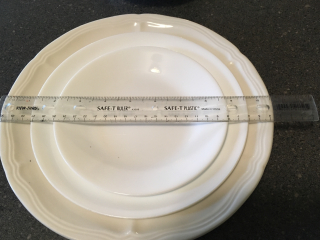
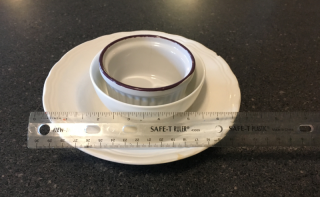
    Simplifying factor #3:   Smaller plates.

    This really helps with the dishwasher.

    Shown below, stacked from bottom to top:  (1) a "standard" 10-3/4-inch dinner plate, (2) our dinner plates, (3) the plates we typically use for first course (or for a bread plate if we're having soup):

    IMG_4403


    Shown below, stacked from bottom to top:  (1) a bowl for first-course soups for Mark and teenagers, (2) a bowl for first-course soups for me and middle-size children, (3) a ramekin for first-course soups for smaller children:

    IMG_4405


    I generally get away with two dishes per person.  And unless I have to break into our "standard" plates for some reason, every plate and bowl can fit on either the bottom or the top rack of the dishwasher.  So it's not terribly difficult to get them all in.   

    That is, it wouldn't be difficult if we started with an empty dishwasher.   In truth, with six people here all day long, the dishwasher is almost never empty, and there's usually a backlog waiting in the sink; so maybe the real reason it seems easy is that seven extra dishes from first course don't make a noticeable contribution to the pile.  

    + + +

    Simplification #4:  It's routine.

    In practice, when I am in charge of a multicourse dinner, I plan it this way:

    • I plate the first course and put it on the table while the table is being set. 
    • We wait for everyone to come to the table and say grace before we let anyone dig in (or complain).
    • As we start eating, the main course items (including the stealth fruit-or-cheese-course) are in resting on the counter, chilling in the fridge, or staying hot in the oven, depending.   
    • When most of us are done with the first course (except for the 3yo, who can't be reasoned with yet), I get up, take away those plates and drop them into the sink or stack them by the dishwasher. 
    • I then bring the dinner dishes in a stack and hand them to a teenager to distribute. 
    • While he is doing that, I fetch the serving dishes to the table. 
    • I'm not above just putting the soup pot or the crockpot insert on the table, by the way.  I draw the line at serving from the rice cooker because I am not tall enough to see over it when seated.
    • We pass the rest of the dishes family style.

    If I really needed to conserve plates, I think I would not be above using our divided plates and serving the first course in one of the sections of the divided plates, and letting people keep those plates between first and main courses.  Alternatively, I could allow people to opt-in to the multi-plate dinner, keeping their first plate unless it really bothered them that there were traces of salad dressing or whatever on it; in that case they could get their own clean plate if necessary.

    I personally find the rhythm of changing the plates to be pleasanter. 

    + + +

    Simplification #5:  I have three offspring who can load and unload the dishwasher and hand-wash dishes without help, plus one apprentice.

    I almost never wash dishes in my own house.

    As ChristyP noted, this surely is part of what makes it all seem feasible.


  • Entering year 10 of maintenance (IV): The trap of Only One Number.

    Before starting, a few things à propos my last post

    On the subject of publicly available advice from the French on "what should I serve my family?":  

    • Read French?  Here is a website (put out by the French national health program Manger Bouger) that will generate random menus for your week, with links to recipes for everything.  To stave off despair, don't forget to check the "Express" box which will give you meals that are supposedly quick to prepare and include convenience foods.  You know, like individual pots of prepared tiramisu, which I'm sure you can find at the supermarket.
    • Are readers interested in my doing a little more live-blogging of my experimental menu-planning with the help of my weird little French eating-plan book?  It may have to wait till I finish my maintenance series.   But it would be something along the lines of:  hey, breakfast on the plan today is yogurt, 30 g of cereal, and 10 g of nuts; I'm having a mix of Cheerios and puffed kamut, with pecans, on my yogurt.
    • Forgot to link yesterday, but the weird little book is available on Amazon.fr here.  There is also a second volume which I will probably acquire.

    + + +

    On to the Only One Number trap.

    IMG_4402

    I've written before about The Numbers:  as I put it, "the weight on the scale, the dress size, and even the calorie count."

    "[T]he numbers" are not under your direct control. Behavior and habit development are under your direct control; the numbers aren't. If weight/size control for health is your desire. the numbers are useful — not as goals or targets, because you cannot really aim at them — but as diagnostics to evaluate existing habits and behaviors….

    [I]f you're going to freak out and feel like a failure, don't do it because the numbers are bad. Focus all concern about failure, all motivation to succeed, on the behavior. Not on the numbers. The behavior is what you can control. The numbers are an indirect effect.

    Let me restate the point of that post as follows: 

    Nothing that is a number is useful as a goal nor a resolution.

    Self-deception is required to "resolve" to lose ten pounds or some such thing.   We can only resolve to act upon things that are under our direct control.  To do or do not.  And none of the numbers are things we can control.  

    (Really?  Miles per month?  Can't I control that?  Sort of— you can decide to do it, but the resolution comes down to things like "I will set my alarm to go off every Tuesday and Thursday at 5 am" and "When my alarm goes off tomorrow, I'll get up and go running").  You don't just…. run 15 miles this month by force of will.  Real, deception-free resolutions are, basically, yes-no questions and not quantitative ones.)

    A better way to think of each number (the scale, the dress size, the lipid levels, calories per day, cigarettes per week, miles run per month) is this:

    Numbers are metrics that measure our response to our resolutions.

    They are measures of our body's response to the things we can control.

    They are, mostly*, objective tests of whether our resolutions have been useful.


    + + +

    Successfully reframing numbers as metrics rather than as resolutions takes away the power of the number as a number to cripple us with shame or despair.   

    The anguished question of "Why can't I make this number change?" fades away, because the plain truth is that no one can make this number change.    

    Instead, when the number fails to do what we hope, there's really only one question** to ask:

    What resolution can I make that would be more useful for this number?

    If we have kept a resolution faithfully and given it plenty of time but the number has not responded the way we want:  That resolution is not useful, at least not for changing this number.

    If the problem seems to be that we have made a useful resolution but have failed to keep it:  The only useful resolutions are the ones that we keep.  If we find that we have not kept a resolution, it needs to be tweaked until we do keep it.

    So:  

    Nothing, here, about Why can't I keep my resolutions?!? either. 

    No Why can't I??? at all.  

    + + +

     All that is ground I've covered before.  Here's the new bit:

    Multiple metrics help you identify useful resolutions.


    If the only metric I use is the scale, then I might give up too soon on resolutions that, behind the scenes, have been helping me in other ways.

    Maybe I've changed my diet and my weight hasn't budged—but perhaps I haven't noticed that my blood pressure has gone down.  Maybe I've been getting to the gym a couple of times a week for months and my pants size hasn't changed—but perhaps I haven't noticed that I can now climb a whole flight of stairs without getting out of breath.  

    I risk giving up, never having noticed that the effort I made was paying off in better health.  And if I give up on enough resolutions, I may give up making new ones at all.

    + + +

    One of my newer maintenance resolutions, therefore, is to actively track more numbers.

    The number on the scale is not one that makes me happy on a regular basis, even though the news it delivers me is not objectively bad.  I would like to decrease this metric's significance, its hold on my imagination. 

    could do that by stepping, permanently, off that scale.   

    I'm not ready to take that step.

    But… I am ready to make it just one of several numbers.

    + + +

    Here's what I'm doing.

    First:  I'm adding physical performance metrics.

    I'm  trying out the free version of an app called Runkeeper to store exercise data.  So far I'm tracking:

    • my average running pace in 5K workouts (currently 12:30 minutes/mile)
    • my average lap-swim pace, without regard to length of workout (currently 48:15 minutes/mile)


    Second:  I'm adding behavioral metrics.  Right now, I'm tracking

    • number of workouts per week (Runkeeper stores this data too)
    • (temporarily) daily caloric intake, for which I am using the premium version of the app Lifesum

    Besides these, I'm looking for a good data-recording method to track

    • fraction of days on which I did, or didn't, have feelings that my habits were "out of control" 


    The third category is "body" metrics:

    • the number on the scale
    • upper arm measurement
    • hip measurement


    + + +

    I'm wary of tracking too many things, too often.  I hope these aren't too onerous:

    • Calorie entries are the most time-consuming and have to be entered every time I eat.  I don't intend to do it every day for the rest of my life.
    • Exercise metrics need to be entered into my app at the end of every workout.  That's usually pretty fun and easy because I always feel satisfied to have finished the workout and eager to see progress.
    • I'm trying to step on the scale only every few days rather than every single day.   Once a week is plenty.
    • There's no point in measuring with a measuring tape more often than every month or so (although getting average readings from several days in a row isn't a bad idea, because measuring tapes aren't so precise).
    • I'm least likely to remember to do the "how did I feel about my eating today?" but in many ways it is the most important metric because it is probably the poorest metric related to my diet.

    + + +

    What numbers could be useful for you to measure?


    ___________________________

    *Remain humble and allow for the possibility that the numbers changed because of circumstances that are out of our control, not necessarily because of our smarts, strength, or lack thereof.  It does happen.

    ** Supposing, of course, that the desired change would be a real good for us that is worth real effort.