bearing blog


bear – ing n 1  the manner in which one comports oneself;  2  the act, power, or time of bringing forth offspring or fruit; 3 a machine part in which another part turns [a journal ~];  pl comprehension of one’s position, environment, or situation;   5  the act of moving while supporting the weight of something [the ~ of the cross].


  • Six short pieces on which language to learn.

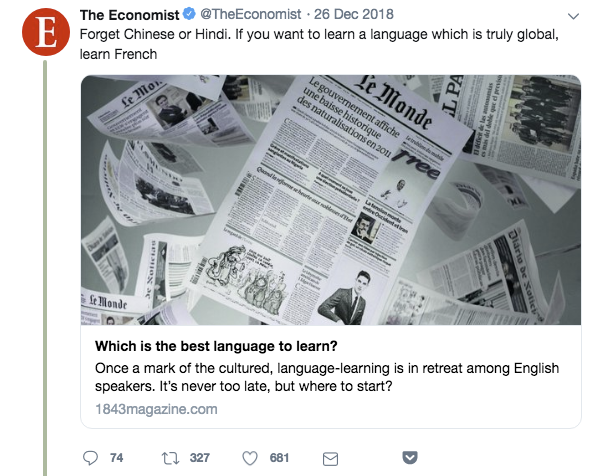
    A couple of weeks ago The Economist tweeted out a link to an 2012 article from their lifestyle arm, 1843 Magazine, entitled "Which is the Best Language to Learn?"  

    Screen Shot 2019-01-20 at 7.39.56 AM

    (image not clickable)

    The caption/link writers were a bit too vague.  I think this for two reasons: 

    First, they mention too subtly that the article is aimed at native speakers of English.  Granted, the problem is not entirely on their end, but we can all learn to be more clear from the flood of Twitter comments complaining that English was not identified as the best language .

    Second, more pointedly, the tweet suggests that clicking on the link will lead you to an article decidedly in favor of English speakers learning French.

    It's not!  It's better than that, and I only wish the editors had made the feature longer.  It's actually six separate pieces, written by six different people.  It's almost like a panel discussion with six speakers, each making an argument for learning their own favorite languages: 

    • French
    • Spanish,
    • standard Chinese, aka Mandarin
    • Arabic
    • Brazilian Portuguese
    • Latin.

    The feature has a major structural flaw, which probably contributed to the bad captioning.   The piece ought to have a distinct introduction, followed by arguments for each of the six languages.  Unfortunately, the introduction-writer and the French-learning-cheerleader are the same writer, as if one of the panelists was also the moderator.   He didn't take care to separate these two rhetorical tasks (not only that, but he feels the need to defend French from Chinese in particular, something that comes across as a sort of pre-buttal of the Mandarin fan whose bit appears later).  

    And of course, I'd have loved for the feature to have been even longer and included arguments promoting the learning of even more languages.   Even more importantly, I'd have loved to see more attributes of different languages being considered.  

    Still, they covered most of the key points to consider, and promoted language learning in general.  All too often, languages are suggested to English speakers merely on the basis of "usefulness," which in practice is rhetorically limited to considering the likelihood that one expects to have economic transactions in the language.   

    But there are lots of different reasons to learn languages, and the six "panelists" touch on many of them:

    • acquiring meta-language that allows you to understand and use all languages better, including your own
    • broadening your cultural understanding in general
    • deepening your cultural understanding of whatever particular culture you are most interested in
    • grasping, a bit, another way to think about various concepts, say through interesting idioms
    • career preparation for conducting international business
    • career preparation for conducting diplomacy 
    • reading literature
    • enjoying the challenge

    And what's great about this article is that it acknowledges that different languages fulfill these needs to varying degrees and in different ways.   

    And individual learners' tastes and ambitions matter more than anything.  Even the pro-French, Chinese-isn't-all-that-it's-cracked-up-to-be introduction writer says:  "By all means, if China is your main interest, for business or pleasure, learn Chinese. It is fascinating, and learnable."

    Beyond a particular interest, though, what are the arguments for each of the six featured languages?

    • Robert Lane Greene prefers French, calling it the most global language, with native speakers in every region; it's relatively easy for English speakers to learn, with grammar not very different from ours, and a great deal of vocabulary overlap.
    • Daniel Franklin promotes Spanish.  It has an enormous number of native speakers, is a regional champion, is heavily used on the Internet and as an international language, and has great literature and film.  Like French, it is relatively easy for English speakers to learn (and, I'd add, is far easier to pronounce and to spell).  It's also a bridge to Portuguese and Italian.
    • Standard Chinese, says Simon Long, has the most native speakers and its economic importance is growing very fast.
    • Josie Delap makes an enthusiastic aesthetic argument for Arabic:  difficult for English speakers at first, particularly because of the new script, but extremely rewarding and beautiful to learn (as well as an impressive feat).
    • Helen Joyce argues for Brazilian Portuguese on the grounds that it's not very difficult, invites you to visit and work in an interesting, beautiful, and half-continent-sized nation (plus a few other places), and will help you with your Spanish/French/Italian while letting you stand out from people who've chosen those more common second languages.  
    • Tim de Lisle begins by humorously stressing the lack of direct usefulness of Latin, but argues that it strengthens your linguistic "core," improves your understanding of grammar and syntax, requires rigor, and (perhaps ironically) claims it makes it harder to bullshit.  Its vocabulary is everywhere and its surviving literature is timeless.  He seems to argue that it is a great pleasure for a particular kind of nerd.

    So, across these few paragraphs, we have languages defended because they are easy and also because they are difficult.  Because your language has many second-language speakers, and because it has few.  Arguments based on economic importance, and arguments that concede nearly no economic importance at all.  

    It really depends on what your goal is.

    + + +

    There are a few more attributes for choosing a second language that aren't mentioned in here, which I would add.   Mine are:

    • Ease of accessing resources to learn a specific language in your town
    • Number of native speakers living near you
    • Closeness to English on the language family tree (which brings a kind of "easiness" that is distinct from the sort Latinate languages have).

    I never really thought about these three much until two things happened in our family.  

    First, something just for me:  I decided that for no reason other than personal interest, I wanted to learn a non-Indo-European language.  I wanted to explore a grammar that behaved sufficiently differently from the other languages I knew to give me a broader understanding of human beings' relationship to language, and see how different words worked together to create idioms. 

     In Minnesota overall, the non-Indo-European language that's spoken most widely is Hmong; but in my city, Minneapolis, public school students are much more likely to speak Somali at home than Hmong.  (In fact, they are nearly as likely to speak Somali as Spanish.)   That plus the convenience of not having to learn a new alphabet made it an obvious choice.  Not only do I have the chance to encounter native speakers regularly, but there are materials available which have been produced for Somali speakers:  signage, library books, newspapers, a radio station.   So even though my progress is fairly slow, as I work in my spare time through an imperfect text and meet a small study group monthly, I constantly get little affirmations from overheard snippets of conversation, from "thank yous" and "good mornings," and from being able to pick out words from signs and newsprint.  I don't know if I'll ever be able to have a real conversation, but I am enjoying the journey.


    Second, for one of my offspring, who begged to be allowed to quit Latin.  We all learn Latin at home because (being dead, and pronunciation and conversation unimportant) it's really well suited to the homeschool.  Most of the kids enjoy it, but one of mine… didn't.  He didn't have a particular desire to converse in a modern language either; he was struggling, and he needed something easier, because some language in high school is required for college.  "Anything but Latin!" he told me.  

    Well, if "anything but Latin" will do, then I was free to find something that would be relatively easy to arrange. 

    I speak French passably, read it fluently, and could probably have scraped together the time to teach it.  But I suspected that "Anything but Latin" also served, for him, as a tactful way to express "Anything but learning more language from you, Mom, who is a complete language nerd and can't deal with the fact that I find this really difficult."

    So I looked outward, and discovered relatively inexpensive Saturday-morning classes in Swedish, of all things, within walking distance of our house.

    Swedish doesn't hit many of the reasons from the article for why an English speaker would want to learn it.  It doesn't have global importance; its native-speaking population is small and almost entirely living in Sweden and Finland; fewer than 60,000 people living in the U. S. speak it at home (although, granted, a lot of them are probably living in Minnesota).   Finally, Swedes themselves overwhelmingly learn English and have even been called the "best in the world" at speaking it.

    What it does have going for it — besides the convenience of having classes available, and the fact that it is possible to supplement with commonly available commercial and online learning programs — is ease.    Although there's definitely grammar and vocabulary to learn, Swedish is possibly the easiest language for an English speaker to acquire.  And that is exactly what my son needed.  He has realized that learning a foreign language is something he can do.  And, surprising to both of us, he actually enjoys it.

    It's also slightly quirky, an unusual choice for an American kid with no Swedish heritage, and I think he enjoys that.   He had a fun time seeking out and greeting a small collection of very surprised Swedes at World Youth Day in Panamá.  We have a photo of him posing with them, grinning and holding the Swedish flag.

    I'm just saying, sometimes making it as easy as possible is the right thing to do.  There is no shame in that.

    + + +

    So, to sum up, what I've said before:  Really considering what you'd like to get out of a language, honestly — whether it's "I want to read cool literature" or whether it's "I just need the minimum possible so that I can get into college" — is key.


  • Consolations and the prosperity gospel.

    Amy Welborn recently put up a post on the prosperity gospel's more subtle forms, a "well-trodden road" that she's considered many times.   

    This is an interesting discussion, because while some versions (the "health-and-wealth" gospel) are so obviously out of line with orthodox Christian thought as to be almost a parody, others are more difficult to untangle precisely because they seem to grow right out of unarguably Christian and Judeo-Christian beliefs.  

    It’s easy for us to look at an interpretation of Christianity with which we disagree and dismiss it out of hand, mock or condemn it – especially something as obviously wrong as the health-and-wealth gospel. More fruitful, I think, is to look at the why and the roots and explore how aspects of an incorrect interpretation might have crept into our own thinking. To examine it, see what’s true, what’s false and use it as a way, not so much to condemn others – over whom we have no control – but to grow in our own faith and conform ourselves more closely to truth.

    So let’s take the most recent newsworthy example – pastor John Gray purchasing a $200K Lamborghini for his wife.  Gray defended his purchase against criticism by pointing out that he’d not used church money to buy it, but rather money from a book deal, a television show on Oprah’s network and other income sources. He didn’t go whole hog Prosperity in defending it, but he did say: “God helped me to make my wife’s dream come true,” he wrote in an Instagram post Tuesday night. “Why not? She’s made mine come true!”

    This is a little different from promising the impoverished that if they align themselves correctly with God’s will, they’ll find more material comfort, but the very basic fundamentals are the same: When we do God’s will, it shows in our earthly lives. God helps us make our dreams come true.

    This is not, of course, incorrect. The deep roots of the Prosperity Gospel are in the ancient life of Israel. Read Psalms, read Proverbs. External blessing is a sign of God's favor in our tradition.

    But then along came the Exile.  And the challenge of Job. God’s people had to ask themselves: What does it mean to be blessed by God? What does God’s presence among us look like?

    The philosophical problem here is that our faith teaches that here on earth, all good things, visible and invisible, do come from God.   And we have plenty of Scripture to back us up that God does (at least some of the time) provide some kind of good to His faithful servants.  Perhaps health and wealth and safety; perhaps supportive mentors, friends, and family; perhaps graces of understanding and acceptance that help us put into perspective our lack of such things.  

    And yet… if this is the leaping-off point… can we leap off in the wrong direction?  

    One of the biggest dangers would be if we become satisfied.   Satisfied that our temporal blessings (visible and invisible) constitute evidence that we are doing the Christian life correctly.  Satisfied, too, in the sense of no longer… longing.

    Amy muses in this direction:

    It seems to me that the fundamental error of any “Prosperity Gospel” lies in the elevation of the truth that yes, we find authentic peace and true joy when our wills and choices are aligned with God’s will. That’s the truth we find in the very beginning of Scripture: Adam and Eve at peace in the Garden, and then at war with each other, God, nature and themselves outside of it.

    The way that a “Prosperity Gospel” twists this truth is when it encourages us to uncritically identify the fruits of a right relationship with God with anything temporal.

    It instrumentalizes the spiritual life.

    So now, look beyond the easy targets of health-and-wealth. Survey the contemporary popular spiritual landscape, Catholic and otherwise. If there’s a current self-help trend out there, are spiritual gurus close behind, baptizing it?

    ou might see and hear some of this:

    Through faith, I came to understand my purpose and look at the success I’ve found because of that.

    Through faith, I came to see and accept how beautiful I am, and what true beauty is.

    Because of faith, I feel great about myself and affirm my life as amazing and accomplished.

    This is hard, this is tricky, and I hope I can tease this apart correctly. Because I’m sure this might be striking you as just wrong. Because isn’t that  part of what faith is? In accepting Jesus as Lord of my life, aren’t I opening myself to a re-orientation, a proper understanding of myself and my relationship to the world that’s going to bear this fruit?

    True. All that is fruit of a relationship with Christ.

    Plot twist: But it’s really not that important, either.


    There's more, and you should go read what she has to say.   

    But I think there may be a way to… make it a little less tricky?  The Prosperity Gospel is a modern thing, but human nature is the same as always, and I suspect it's merely a new-ish manifestation of a very old temptation.

    In short:  Humans are perfectly capable of taking true graces that truly come from God and… screwing up our responses to them.

    + + + 

    This is what I wonder: 

    This sort of celebration of temporal happiness and satisfaction, accompanied by a broader understanding of what happiness and satisfaction means

    –e.g. “Now that I know what true beauty is” — something unspecified, but more than just conventional outer attractiveness — “I see that I am beautiful.”

    –Or: “now that I know what true wealth is, I see that I am wealthy”) —

    might fall under the category of “consolations.”  

    Consolations are, in the writings of the saints and in the writings of the magisterium, the opposite of affliction.   These are free gifts of happiness, contentment, felt blessings, confidence in the presence of God, strong feelings of conviction. All bestowed by God on some of the faithful, and occasionally understood to be withdrawn from them by God, as a means of increasing their (or someone's) growth in faith.

    Numerous saints have warned Christians against mistaking the consolation for something it is not. It is not (necessarily) a reward or a punishment; it is certainly not a reliable indication of the holiness of the individual, such that holier people receive more or fewer consolations; and while we may hope for consolations, we are expressly warned against making the consolation the end that we seek.

    In the Introduction to the Devout Life (IV.13) St. Francis de Sales includes "Spiritual and sensible  consolations" in the catalog of temptations to be overcome. 

    [Man's state] is ever changing, constantly in movement; his life on earth like waters which ebb and flow, sometimes lifted up by hope, sometimes depressed by fear, swept one way by consolation, another by affliction; no day, no hour, exactly the same.

    It is well to remember this, for we must strive to preserve our equanimity in the midst of these various changes; though all should change about is we must remain immovable, our eyes and our hearts ever fixed on God.

    He then lists items of "particular advice," which are really quite detailed and wonderful but which I will paraphrase here for brevity.

    1. Feelings of pleasure, sadness, consolation, or compassion which make our spiritual exercises pleasing or agreeable are not evidence of real devotion and can even be "snares of the devil, who encourages them to make much of these consolations and take such satisfaction in them that they no longer seek true devotion, which is to do constantly, resolutely, promptly, and energetically whatever we know to be pleasing to God."
    2. However, they are sometimes very useful, for they make the spiritual life attractive to us.  "
    3. How to know the difference between the two situations?   You will knmow them by the fruit they yield.  Our hearts are as trees, our feelings and desires their branches, our actions which follow from them the fruit.  If [consolations] make us more hunble and patient, considerate and merciful towards our neighbour, more fervent in mortifying our evil desires and inclinations, more constant in our devotion, more docile and submissive to those in authority over us, more simple in our lives [!], there can be no doubt that they come from God; but if we seek such feelings for our own satisfaction, if they make us selfish, irritable, self-assertive, impatient, overbearing, proud, presumptuous and harsh towards others and make us imagine that we are already saints and no longer in need of guidance or correction there is no doubt that they are false and evil….
    4. We must receive consolations with humility, never taking them for evidence of our own goodness, and use them according to God's intention, and also "occasionally detatch ourselves" from consolations by protesting to God that we seek only His love and not the sensible goods that he sends.

    Now, St. Francis doesn't take the position that I suggested above, that all consolations come from God and it is our response to them that matters.  He phrases it that some consolations are good and come from God whereas others arise "from our fallen nature" or are "sent by the devil."  I think either construction works.

    If indeed the sentiments that lead one into the prosperity-gospel error are incorrect responses to real spiritual consolations, then the ancient and medieval fathers will have much to say to us about how to avoid falling into this apparently modern error.


  • Basque ratatouille, or, never wonder what to do with too many zucchini again.

    After having spent a week in the Basque Country with Mark, I immediately came home and bought a cookbook, of course.    I ended up with a beautifully photographed book, The Basque Table by Alexandra Raij (a Minnesotan!) and her Basque husband, Eder Montero.  I probably won’t make many of the seafood recipes, for lack of ingredients, but fortunately the book has many dishes of eggs, meats, vegetables, and desserts.   

    The first thing I made was so beautiful that I must share it immediately.  It is pisto, a Basque ratatouille, which I adapted as suggested by the authors to locally available ingredients.  I found guaijillo peppers packed in small plastic boxes in the local upscale grocery store; lacking them, omit them, or you might try a quarter cup or so of puree of roasted red peppers?  

    We ate this topped with pan-sauteed fish and sourdough bread.

    Also, at the bottom:  how to use the leftovers in delicious scrambled eggs.

    Basque Ratatouille (adapted from The Basque Book)

    • 0.75 oz dried guajillo peppers, about 4 peppers
    • 2 cups diced Vidalia onion
    • 1 tsp dried marjoram
    • 3/8 tsp cayenne pepper, divided
    • Olive oil
    • Salt
    • 1 cup diced red bell pepper (1/4” dice)
    • 1 cup diced green bell pepper (1/4” dice)
    • 4 pounds zucchini, cut into 1/4”-thick half moons)
    • 1 cup hand-crushed canned whole tomatoes with juices

    First, make a pepper puree:

    Preheat oven to 350° F (you will raise the temperature later).  Begin to bring a saucepan of lightly salted water to a boil.

    Toast the dried peppers until fragrant for 2 to 5 minutes, until fragrant and pliable.  Remove the seeds and stems from the warm peppers.  Put the toasted, seeded peppers in the boiling water, turn off the heat, cover, and let steep 20 minutes.  Puree the hydrated peppers with just enough of the soaking water to make a puree.   Half of this puree will be used in this recipe, and the other half you can reserve for another use.  (The soaking water makes a vegetarian stock.)

    While the peppers steep, raise the oven temperature to 500° F.

    In a dutch oven or other soup pot with a lid, combine the onion, marjoram, 1/8 tsp cayenne, 3 Tbsp oil, and 1/tsp salt and gently cook the onion over low heat for about 20 min until soft and translucent.

    Meanwhile, in a large bowl, toss the red and green peppers and the zucchini with 1.5 tsp salt and 4 Tbsp oil.  Roast the vegetables on two large baking sheets, stirring halfway, for 15 min.

    Add the peppers and zucchini to the onion, with a little more oil if necessary, and cook for two minutes.    Turn up the heat to medium; add the tomatoes and half the guajillo pepper puree that you made in the first step.  (Save the rest.)

    Stir, cover, and place in a 250° oven for a couple of hours.  

    Before serving, check the flavors; the mixture should be dark and sweet, and if it is not qute yet, cook it on the stove top for a few more minutes, stirring.  Add the remainder of the cayenne and serve.


    Scrambled Eggs For One With Leftover Ratatouille

    Warm about a half cup of ratatouille in a small nonstick saucepan with a film of olive oil.  When the ratatouille is warm, lightly beat 2 eggs with a pinch of salt; move the ratatouille to one side of the pan, add another tablespoon of oil to the empty side, and pour the eggs in.  Let set for ten seconds then gently stir, incorporating some of the ratatouille.  Let set again, and continue gently stirring until the eggs are softly scrambled and roughly mixed with the ratatouille.  Turn out and eat — crusty bread is a nice addition.


  • The arms and the Manger.

    She wrapped him in swaddling clothes and laid him in a manger, because there was no room for them in the inn.

    + + +

    If there's one tiny detail that doesn't ring familiar to me, a woman who has given birth, about the Gospel accounts of the nativity, it's the "laid him in a manger" part.   

    I acknowledge that everyone's experience is different, but the last thing I wanted to do in the first minutes and hours with a healthy newborn was to put the baby down anywhere at all, with or without swaddling clothes.  I was always pretty fixated on the irretrievability of the first moments: those liquid eyes open and searching for another human face to take in, to take possession of; those tiny ears, listening and alert for the familiar, now unmuffled voices; the tender skin, wanting human warmth.  

    I did have practical matters to attend to eventually, and so I let the baby go—and I had the good fortune to be able to put the baby in others' arms; I know not everyone gets to do that, depending on the circumstances of birth, but it's certainly where I wanted to put him and where I felt he belonged.

    + + +

    From the very beginning Christians have taken note that the place Mary chose to put the baby was a food bin.  Foreshadowing for sure, that this child would grow to say things like "my flesh is true food and my blood is true drink."  The food bin was handy, and chances are good that she and her husband were not entirely aware of the prophetic nature of the action; the whole story was (perhaps? probably?) not unspooled to them as of yet, despite the angel, despite the dream.

    But they knew the Child was divine, uncreated, holy beyond every thing and person that their people ritually and faithfully set apart as holy; they knew that.

    + + +

    I have to rely on Wikipedia a bit for a review of the relevant art traditions. 

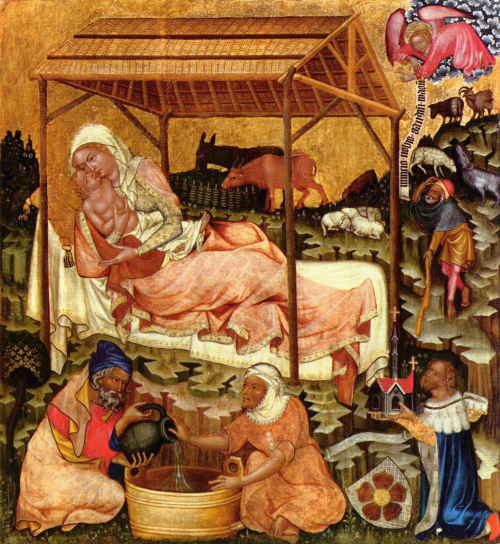
    The Byzantine depiction of the Nativity, which arose in the 6th century (after images of the child alone with ox and ass and images of the Adoration of the Magi),  includes both mother and child and depicts a postpartum scene that feels more familiar to me.  The mother reclines with the infant next to her, and Joseph rests nearby.  (Sometimes, separately, midwives are shown bathing the baby).   


    Meister_von_Hohenfurth_002
    Nativity by a Bohemian master, c. 1350.  Public domain


    The Western traditional image of Mary and Joseph kneeling in adoration of the infant appeared by 1300.


    8285725356_d25d8dabd9_b
    Missal of Eberhard von Greiffenklau, Nativity, c. 1446.  Public domain

    + + +

    Clearly when we think about the scene we can consider it in merely practical terms.  At some point, the couple probably had to do something that required all four hands, and they had to put the baby somewhere.    In the kind of place that needs a feed bin, any surface raised above the floor is likely to be cleaner than the floor itself, so the food bin is perhaps the obvious "putting place" for a baby if you're having to work under those conditions.  Foreshadowing aside.

    But let's think about the notion of the Virgin's adoration of her child. for a moment.  Perhaps it's a pious invention by 13th-century artists and iconographers, and reinforced by the influence of published descriptions of the visions of St. Bridget of Sweden.   But it's also consistent with the Gospel story:  she had the message of an angel stating Who her child was, and Joseph had received his own message.  

    She herself, though thoroughly filled with grace, a pinnacle of creation, still, a created being; beheld the Uncreated clothed in flesh.  She knew what mere humans are meant to do with Holiness.   To adore it; and, by necessity, to separate it, at least ritually, from what is created, what is not as holy.   

    Ordinary mothers everywhere are able to adore their newborn children best, in the most natural and human way possible, in the way the infant's nature best responds, with the infant in their own arms.  This is natural adoration, from one creature to another, a personal connection, eye looking to eye, skin-to-skin, the little lips moving and the little voice crowing in response to the mother's encouraging voice.

    And of course Mary could do that too.  She is the natural mother of the Christ, the Theotokos.  She must have adored her child in this natural way.  And we have the Byzantine icons to remind us of that.

    But something else separates them in a way that Mary would also have known.  What do you do with the holiest things?  You set them apart.  They are wrapped up behind a veil and placed out of reach.  Catholic tradition identifies the pregnant Mary as a type of tabernacle or ark herself, containing the Bread of Life, containing the Law; but for all that she is also a human, and the grace God filled her with would have moved her to adore the Divine, step back from the Sacred to look upon it from the necessary distance.

    So, because she willed what God willed, she might well have detached (with difficulty) the tiny fists from her mantle, wrapped him up and laid him down on the wood, drawn back onto her knees.  It might, if the baby were awake, have felt distressing (have you seen an infant on its back, eyes closed or open, searching with open birdlike mouth, first tentatively, then frantically?  have you been its mother?)  It might have been quite brief, because physical needs of the mother-and-infant pair cannot wait forever.  We aren't sure whether she adored the way the Western art shows her.  But it might have happened in this way.  She knew Who he was, after all.  And we have the words of the Gospel:  She wrapped him in swaddling clothes and laid him in a manger, because there was no room for them in the inn.

    Why did she lay him in the manger? In the plain words of the Gospel,  Because there was no room for them in the inn.  

    That's the other part of the foreshadowing.  Because the hospitality of the world had rejected her,  the Tabernacle, the Ark, and (more to the point) what she contained, she could only adore — relate, as a created being, appropriately to Divinity —  by interrupting the (natural, good!) maternal drive to protect, by laying him upon the wood, setting him out for food.

    The swaddling, the setting-down — it may have been entirely practical, but it was because there was no room for them in the inn, and we know what that foreshadows.  So:  Mary's act of will, and not just where she put him, is foreshadowing too.


  • A couple full days in Bayonne.

    Mark had to leave for work quite early on my first day here, so we got up around six and had breakfast together in the hotel.  

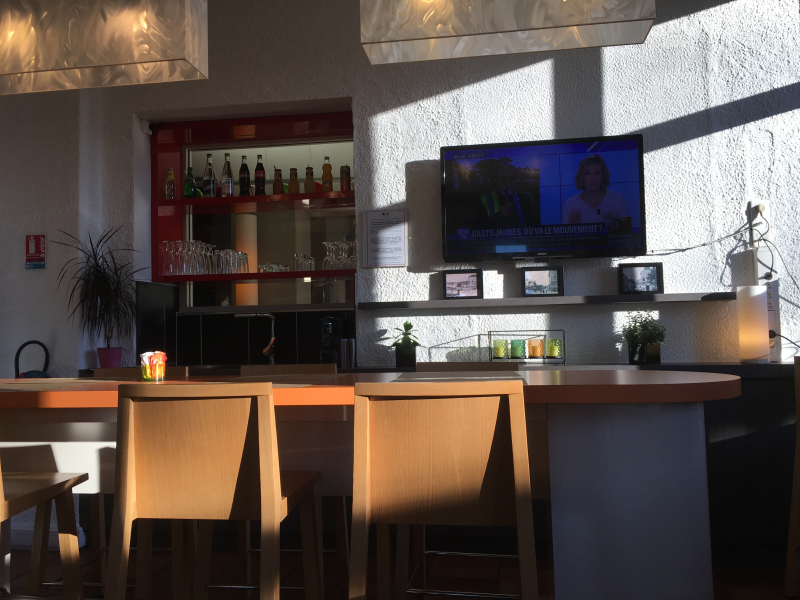
    This is a European chain, catering to business travelers, that struck me as about the same level as a Hilton Garden Inn.  It is warm and well-equipped with small rooms and a generous continental breakfast buffet included with the room, as well as a full bar open till 11 pm (although during the week you have to go to the front desk to request your glass of wine).  In the breakfast room-slash-bar here is a coffee machine in the European style available nearly all day for free, which I heartily appreciate.  I have to hit the café long button twice to fill my coffee cup, but it is good coffee.

    I should pause at this moment to apologize again for upside down pictures.  I will not be able to fix them until I can get to a desktop computer.  I am sorry.

    F8036BBC-2862-4E5C-805B-4098EDFB7E90

     (The hotel bar)

    The breakfast spread included about five different kinds of fresh slice-your-own bread including panettone, baguette, wholemeal, pain aux raisins, and a sort of poppyseed pound cake; four different kinds of “Bonne Maman” preserves, which you can buy in the US; butter; jambon Bayonne and jambon blanche; three kinds of medium-hard cheeses; peeled hardboiled eggs; two or three kinds of yogurt and (oh hurray!) fromage blanc; a basket of oranges and a juicer; and a blonde-colored torte labeled “Gateau Basque” which got Mark very excited, as it is apparently his favorite thing around here.

    I was busy eating the protein, but I took a moment to taste the Gateau Basque.  I have already looked for the recipe online and I just want to tell you, ignore any English-language recipes you find that have puff pastry in them, because they are wrong.  The French-language recipes I found look correct.  It is supposed to be an eggy cake with a fine crumb, baking-powder leavened, that is rolled out, cut into two circles, and stacked with a pastry cream in between, flavored with vanilla, almond, or rum.  It is almost like a jelly roll except not rolled up and with custard in the middle, maybe like a Boston cream pie without the chocolate and only about an inch thick all told.   Anyway, it’s bloody marvelous with coffee.

     + + +

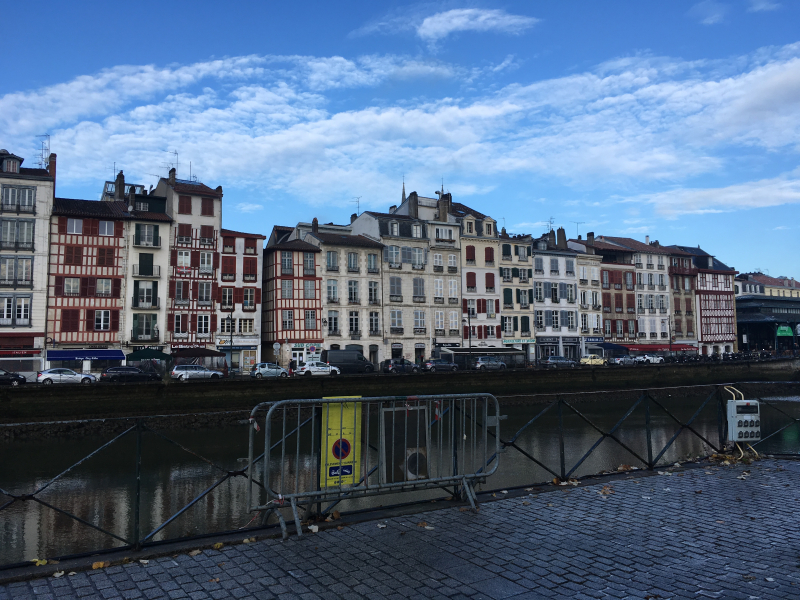
    Mark left, and I gathered my things together and walked across the big river.  Bayonne is built at the confluence of a big river, the Adour, and a little river, the Nive.  Our hotel is in the quarter called Saint-Esprit, which was a major stop along the pilgrimage route to Compostela (coquilles St Jacques are, incidentally, everywhere).  The whole reason that the only wine AOC in the French Basque region developed was so that the monks could sell it to the pilgrims.  I haven’t had any of the wine yet.  Anyway, on the other side of the Adour, with the Nive running between, are Grand Bayonne and Petit Bayonne.  The quays are lined with adorable tall and narrow buildings, shops on the bottom, apartments above.

      4B5B4AF2-E7FE-4CF7-AA09-709A48EAF775
    4B5B4AF2-E7FE-4CF7-AA09-709A48EAF775
    4B5B4AF2-E7FE-4CF7-AA09-709A48EAF775
    4B5B4AF2-E7FE-4CF7-AA09-709A48EAF775

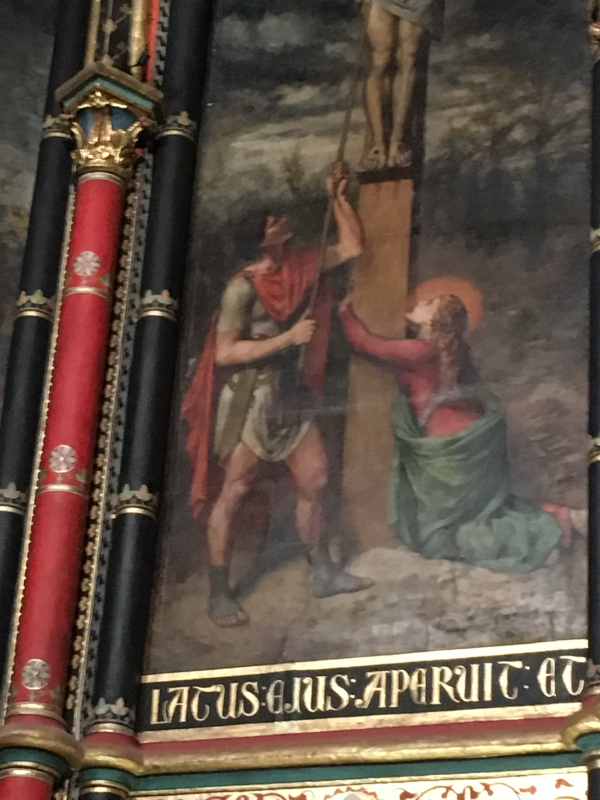
    I spent about six hours wandering around Bayonne.  I looked in a lot of shop windows.  I visited the cathedral Sainte-Marie, which is really lovely, in the northern Gothic style with spires and flying buttresses.  The three part mural of the Passion was one of the most striking I have seen in a church.

      08B520AA-6477-4AB0-9897-B7D6C27E9808

    E911F7C9-B3FE-4878-A036-A2245DB595A0
    E911F7C9-B3FE-4878-A036-A2245DB595A0
    E911F7C9-B3FE-4878-A036-A2245DB595A0

    7EE76880-B880-4CD6-80F8-ED4E3590AC2E
    7EE76880-B880-4CD6-80F8-ED4E3590AC2E


    + + +

    I still felt self-consciously American so I did not have very many conversations, but I managed a few that worked surprisingly well.  Something that is pretty amazing:  Since the last time I was in France, my ability to hear, parse, and understand spoken French has really taken off.  I honestly don’t know why.  I have been reading French all year, but I have not been listening to it very much.  

    Unless the Bayonnais speak particularly clearly and slowly?  

    Or maybe I have been working so hard on other languages that I have somehow developed my general receptive skill?

    I don’t know but it is really kind of shocking.  I don’t speak a whole lot better than I did a year ago, in fact I feel very halting and sometimes it is quite difficult to even get a word out.  There is a sort of performance anxiety that seems to strike me randomly, or perhaps it is more that certain people, unpredictably, seem to set me at ease while others make me nervous.  But the hearing and understanding has really taken off.  

    I can understand the news anchors on TV.  

    I answered the ringing room telephone and heard “This is the front desk, we weren’t able to clean your room earlier because you had the do not disturb sign up, and we just wanted to ask if you would like your room cleaned now or is there anything else you need?” and I answered “No, I don’t need anything at now, and I am resting at the moment,” and it wasn’t till I had hung up that it struck me how smoothly that call had gone.

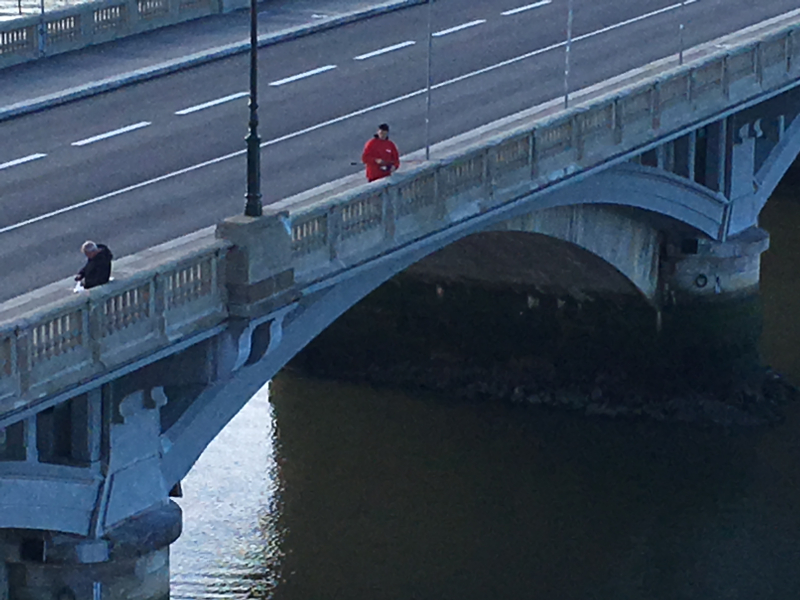
    I have discussed chocolates with the woman at the chocolate shop and beer with the guy in the beer shop and leather goods with the guy in the bag shop.  And police novels with the bookstore clerk.  And washing instructions for the tablecloth I bought.  And also I asked the guy fishing off the bridge what kind of fish he was trying to catch.

      52F1F998-424B-4E7E-8C1E-A4A526B77165

    “La louvine.”  That is the name of the fish.  Not sure what it is.  My technical vocabulary does not extend to angling, even in English.

     + + +

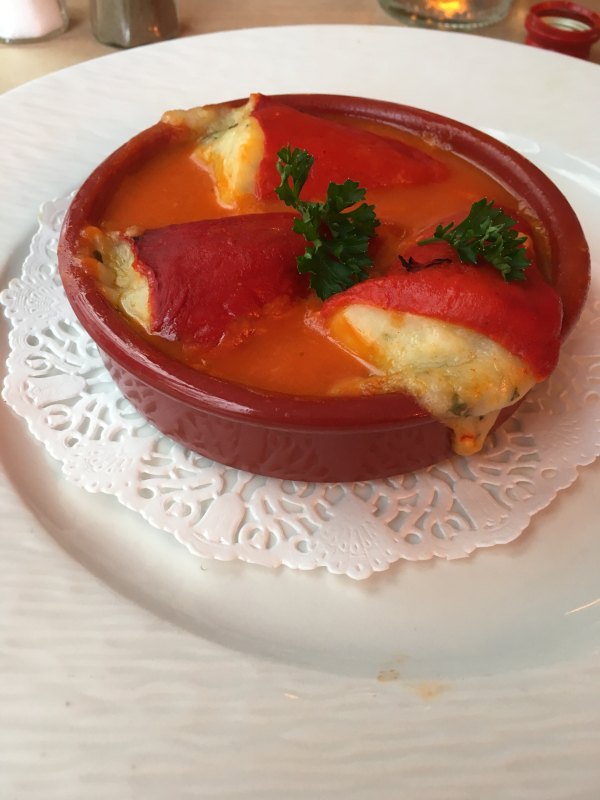
    For lunch that first day I found a café that served the stuffed red peppers that are particular to the region.  They are like the piquillo peppers of Spain — maybe they are the same.  These were stuffed with a potato-and-salt-cod puree and baked in a dish with the ubiquitous Basque sauce of tomatoes and red peppers.

    072301F7-6E39-4A13-83A7-D7C4018C64D8

    So far this is the best thing I have eaten.   It is so good.  I don’t want to hassle with salt cod but I bet I could stuff these peppers with anything, say cheese, and bake them in the sauce and it would be marvelous.

     Anyway, that was the first course; the second course was cod in a cream sauce with vegetable flan.  Also good.  It was interesting because the waitress brought out scalloped chicken and pasta first, and I had to explain that possibly I had made a mistake, but I meant to order the cod.  She said “you ordered the escalope” and I really did not know how to say “I do not think so” and anyway it seemed very likely that I might have messed up, so I apologetically said that maybe I made an error of language and she said it wasn’t serious and she could make a change and I said yes please and she took it away.  And then the woman dining at the next table with a companion leaned over and said “You definitely ordered the cod.  I heard you.”  So I felt better.  And I left a tip for the waitress, because I was glad that she didn’t berate me too badly and that she brought me what I wanted at the end.

     + + +

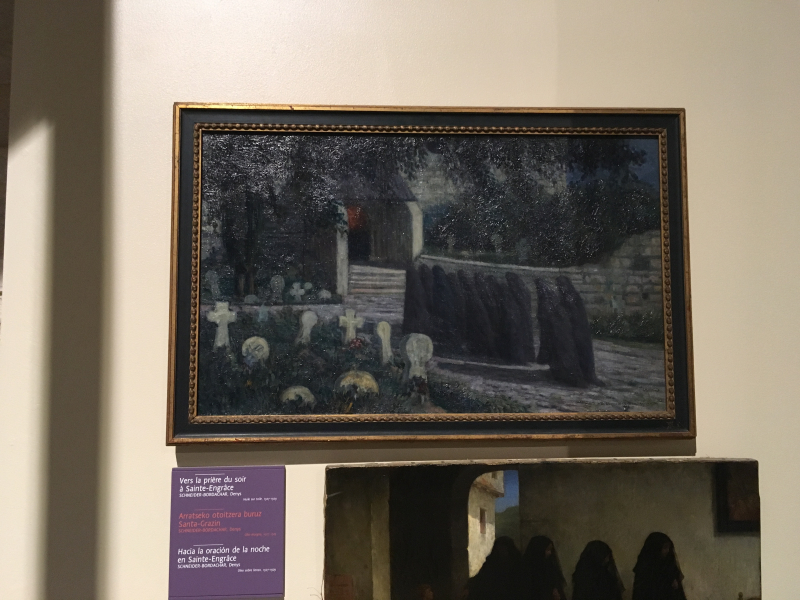
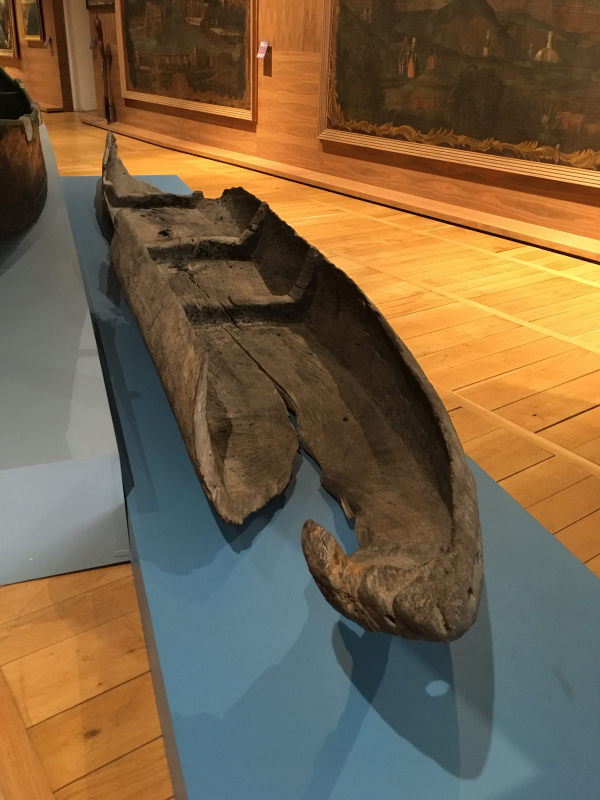
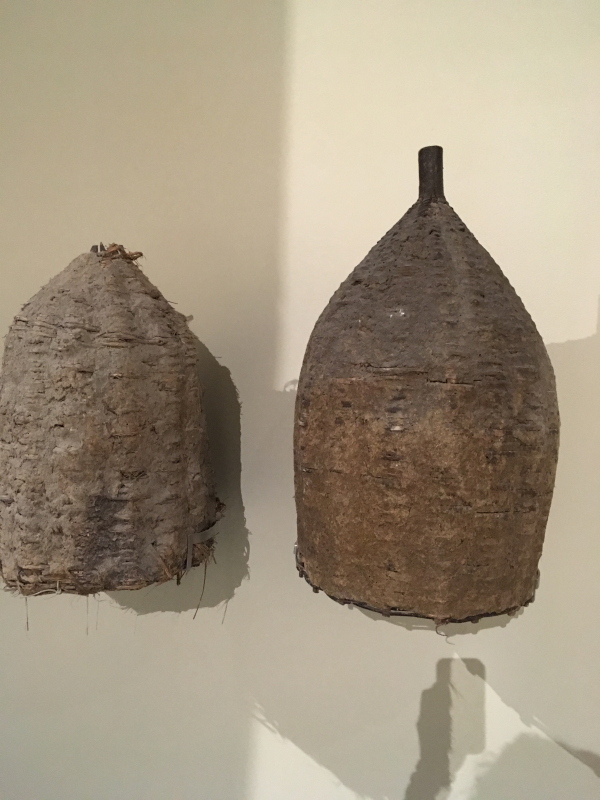
    The last thing I did that afternoon was spend a couple of hours at the Basque history museum, which was fascinating and quite detailed.  I will just leave you with a few photos because it is almost time for Thanksgiving tapas.

    Carved bench with convenient flip down table and high back for keeping warm in front of the fire in your traditional basque house.

    33BE71C1-AE81-42D2-960A-5D5F2DB7B0C4

    Painting of nuns going to a funeral which I photographed because it reminded me of “Madeline.”
    33BE71C1-AE81-42D2-960A-5D5F2DB7B0C4


    Ancient dugout canoe dredged up from the nearby river.
    33BE71C1-AE81-42D2-960A-5D5F2DB7B0C4


    Traditional beehive
    33BE71C1-AE81-42D2-960A-5D5F2DB7B0C4


    Funerary stele of a pre-Christian design that is still used today for headstones
    33BE71C1-AE81-42D2-960A-5D5F2DB7B0C4


    Chocolate grinding stone.
    33BE71C1-AE81-42D2-960A-5D5F2DB7B0C4


    The chocolate is very interesting here.  Bayonne was an early adopter of chocolate in France, and early center of chocolate making in a tradition that still continues, because Spanish Jews took the techniques with them when they were expelled from Spain and settled in the Basque country, particularly in the quarter near my hotel (the local synagogue is still in the neighborhood).

    Not coincidentally, I bought a lot of chocolate today.

    Ok, it is time to go out and have tapas.  Do not expect to see any turkey, but potatoes and pumpkins may make an appearance.  Happy Thanksgiving!


  • Travel day.


    063CA4FB-387D-44DE-BF16-FB230B1F36C0


    + + +

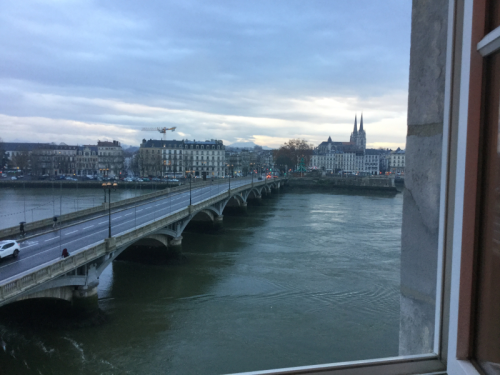
    The image is of the Pont Saint-Esprit in Bayonne, seen from the window of our hotel.

    Long travel day including a missed flight to Biarritz; I asked to be put on a flight to Pau, an hour or so away, which worked fine although I missed having dinner with Mark.  He picked me up at nearly ten at night and we drove into Bayonne and checked in after some difficulty locating the parking.

    We made it to breakfast together anyway, in a bright and modern self-serve breakfast room with an automatic coffee machine and a lovely selection of breads and jams and fruits and cheeses and cups of yogurt and cold meats.  Then Mark headed off to the plant and I went back to the room to make a brief post and wait for the weather to clear.

    Now I have a map and a brochure for the city obtained from the concierge and am about to head out for a walk across that bridge.  

    Life could be worse….


  • Tripping.

    I am sitting at my kitchen counter, waiting for the pizza that will feed my three kids and their grandma and grandpa, my husband’s parents, for dinner.  Not long after the pizza man knocks, the bell will toll for me, and it will be a taxi taking me and a suitcase to the airport.  

    Grandma and Grandpa are here all week, spending Thanksgiving with the kids at our house, and me?  Well, I am going to be… elsewhere!  And (except from 8 to 5) with Mark!

    I will have plenty of time during the day while he is at work, assisting with tweaking the controls on the startup of a snack-food line.   Keeping my fingers crossed that when Friday rolls around he will not be needed anymore and we can dash off for a weekend before both of us return home together next week.

    At this point I should pause and note that we have spent exactly one night away from the children since our oldest was born at the turn of the century, and we have never gone anywhere just the two of us on a plane since our honeymoon.

    The time went by…. really fast?  And we enjoyed going places with our kids, and occasionally alone while the other stayed back?  What I am saying is, no regrets.

    But just in time for our twentieth anniversary is a good time to go have a little fun.  (Thanks to those lovely grandparents.)

    Perhaps I will report back later?


  • Specialization and generalization.

    Yesterday was a very busy and raucous co-schooling day at my house, but it was fun, for a couple of reasons.

    The first is a welcome new development for this year:  H and I now have our friend M joining us again after a few years of working through different options, with the one child that she's homeschooling this year.  It's so lovely to have her back with us twice a week; we've really missed her and her kids.  I made taco salad for lunch (general recipe at the end of the post), and M brought apple crisp and cheese for afternoon snack, and we kept the coffee flowing.  Faster now that teen boys drink it.

    The second thing is that I have fun things to teach this year, practically all high-school level.  I had to skip geometry today because of an unintentional late start, but I still got to teach one of the enjoyable parts of civics, and a challenging-to-communicate topic in chemistry, and all about relative clauses in Latin.  By the end of the day I was, truly, happy about how I'd done (at least from my end; can't know how well the kids absorbed it all).  I enjoyed interacting with the kids each time, and as I looked back on the day, I was left feeling:  "Hey!  I'm pretty smart.  I did a good job."  Which always feels nice.

    + + +

    Mark, too, has been having some successes at work that leave him feeling good.  We were talking about our days last night over dinner out (new "soul-inspired, chef-created" place went in a few blocks from our house; grits and biscuits and collard greens and country ham feature prominently, as well as brioche buns and good craft beer); we talked about them some more over coffee this morning.  A lot of Mark's research and development work winds up being proprietary to his employer, but he occasionally gets to publish with his colleagues:  there are eight patents, for example.  He doesn't have to be secretive about the fact that he's done significant work on prominent and popular brands.  And soon he'll be an author on a new open-access  item that's the culmination of a lengthy collaboration he's really proud of.

    "It's very weird to work on the same project for years," he told me this morning.

    "I know what you mean," I said.  "I am not sorry that I had the opportunity to become an expert in one very narrow subject area.  It was a valuable experience, to learn how to focus that tightly for so long.  But I am glad that I did not spend my life's work on it."

    "I'm not sure if I'm a specialist or a generalist," he said thoughtfully.   "On the one hand, I'm definitely one of the go-to guys in my specific area of work–" [this sentence heavily paraphrased to remove technical details –ed.] "–on the other, I enjoy being the person who generally knows how to solve whatever problem happens to come up anywhere in the process."

    "Perhaps you're not all that different in scope from an academic.  I mean, they may be the worldwide expert on one very narrow thing; they do active research on a set of narrowly related different topics; they have to have a working understanding of everything closely related to the field so that they can spot new directions of inquiry and support or criticize their colleagues' work; and they have to stay well-enough grounded in the basics of the field that they can deal with it if they have to teach some random undergraduate class."

    I didn't get to hear his thoughts analyzing that one, because he looked at his watch and had to jump up and give me a kiss and run out the door because he had a 7:00 a.m. call to Europe and a meeting across town right after that. 

    Me, I poured myself another cup of coffee and wrapped my bathrobe more tightly around myself and settled back on the couch, thinking about writing a blog post in the time before the children wake.

    + + +

    Chemistry yesterday was the most challenging to teach, not because I don't grasp the material well, but because the material is not very easy to explain to newbies.  The language that's used by convention seems poorly designed; maybe it's the best we could do, but sometimes you'd like to go back in time and straighten people out before they named things.  ("Ben.  Trust me.  You want to label the resinous electricity as 'positive.'  Not the vitreous electricity.") 

    Anyway, I was laying the foundation for understanding electron configurations:  the four principal quantum numbers, how they give a unique "address" for each electron in the multielectron atom.  At one point the teen boys were laughing:  "Wait, the numbers are called n, l, m… and SPIN?"  and:  "Wait, l is also s, p, d, and f?"

    ["No… is allowed to have the values zero through n-1.  It's just that when it's zero, we call it s, and when it's 1, we call it p, and so on.  It's like a code.  I don't think the reason why we haven't changed to using numbers is anything other than that it's less confusing to label, say, 3p instead of calling them 3-1 orbitals."  I've since looked it up and been reminded what I had forgotten, that s, p, d, f stand for sharp, principal, diffuse, and fundamental, and refer to groups of spectral lines.  I'll be sure to tell them next time we meet.] 

    The whiteboard was a mess, but it made sense.  I loved it.

    Then in Latin we read through a long passage of a story from the textbook which was designed to teach them about relative pronouns (qui quae quod, "which/that" as in "the fruit that rotted was an orange") and the use of the same words as interrogative adjectives ("which/what" as in "what fruit rotted?") and demonstrative adjectives (ille illa illud, "that" as in "that fruit was really disgusting") and demonstrative pronouns ("that" as in "that made me sick) and third person pronouns (is ea id, "he/she/it" as in "it totally had to be trashed.")  In all five cases ("the fruit that made me sick"/"the person whose lunch this is will be disappointed"/"to whom can I complain about the fridge?"/"the odor that I smelled is tremendous"/"the bin in which I will throw this is over there").  It's relatively elementary stuff but there was a giant chart on my whiteboard and also some passages in which I had to keep switching marker colors so I could show them how the relative clauses and the prepositional phrases can be set apart from the main thrust of the sentence for easier translating.  And it was all very fun.

    And finally there was Civics, where I am going through parts that are not so suffused with gloom and disappointment, but the workmanlike stuff of, having discussed the history first, outlining the Constitution (Preamble.  Articles, I-III in the first group, IV-VII in another.  Amendments:  1-10 in the first group, 11-27 in another,)  giving them the big picture as they get ready to read it straight through for the first time.  All laid out once again on the same whiteboard.

    + + +

    I have to think about all of these things, and how to communicate them, and I like that it's languages and politics and chemistry.  I never get sick of it.  I'm not saying I would necessarily have been sick of it if I was concentrating on only chemistry, or only languages, but I do like having to think hard about all three.

    Am I a generalist or a specialist?  I specialize in a small group of kids, and I specialize in putting things into terms they can understand.  That's kind of a special skill.  But it requires me to know a fair amount about quite a lot of different things.  Not very prestigious; no publications yet (since I quit academia); but day to day, pretty fun, and I count it valuable to our family.  I suppose that's more important than how it is categorized, and that goes for what Mark does too.

    ______

    *Taco salad:  a lot of ingredients but a relatively simple and low-mess way to feed a crowd with varying tastes.  My crowd had three 4yo, two elementary schoolkids, two junior high age kids, two high school boys, and three adult women.  I do this:

    • Put a cup (dry) of brown rice on in my rice cooker in the morning
    • brown three pounds of 80% lean ground beef, season it generously with a mild spice mix (packets or your own), and put it in the crockpot with some water to stay hot; when the rice is done, mix that in (the rice absorbs the fat and flavor, and extends the meat some, and also rice served separately gets all over the place).  That will keep till lunch.
    • shred half a small red cabbage, chop 1 green bell pepper, and tear up two hearts of romaine; mix
    • put out the salad mix and the crockpots with bowls of: spicy pinto beans, plain black beans, sliced black olives, chopped avocado, sour cream, cheddar cheese, mild salsa, hot sauce, and tortilla chips.  Let kids decide what goes in their salad, unless they are four, in which case parents make the best guess.

  • Humorless.

    "What happens at Georgetown Prep stays at Georgetown Prep.  That's been a good thing for all of us, I think."

    –Brett Kavanaugh, of his all-male high school, in a 2015 speech to the Columbus School of Law, to laughter from the audience

    + + +

    As I get older and gain experience in the world, and in particular become a middle-aged woman on my way to becoming an older one, I have had occasion to muse about the stereotype of older women as humorless.

    MNY4355

    Here's what I have discovered:

    The more time I have had to encounter the jokes of men, the more time I have had to realize just how effing often certain classes of jokes are employed as a tool to deflect, deny, disguise, and defend abusive and selfish and objective acts towards women and girls.

    And, of course, toward other marginalized persons.

    The older we are, the more likely we are to have experienced a particular class of joke as a threat instead of as an amusement.

    After a while that class of joke simply ceases to be funny and is only ominous.

    This is true even when it comes from a person who only intends to be amusing. 

    It is still ominous, though for a different reason, when it comes from a good person who, because they generally have good intentions, can sometimes find it very difficult to believe in the badness of other people's intentions.   What's ominous about that is: to preserve their own innocence by refusing to believe in certain kinds of guilt, certain kinds of human vileness, they implicitly refuse to believe the testimony of those who have suffered from witnessing that violence.

    Ominous can't be funny.  It can maybe be deployed as pointed, dark satire.  But not ha-ha funny.

    + + +

    I believe I understand the "humorless" stereotype now.

    When you've had a few more years to watch it happen, it becomes obvious, and then you see it everywhere: how very, very often the accusation of humorless (often tied to an accusation of being no longer young) is weaponized to control the discourse.

    And then it’s not funny even from people who really do only want to amuse. Because it has associations with some other guy who we saw use it as a tool to cover up his awful treatment of someone or his terrible beliefs.

    + + + 

    There are other jokes we could point to (those that involve slurs, for instance) but let's take a look at the timely one I quoted above.

    The joke about “what happens in X stays in X” (popularized by an ad campaign for Las Vegas attractions) is a joke about lying to your spouse after deliberately doing something that you know would hurt them or damage their trust in you.   

    Funny, right?

    This is a classic example of imposing an expectation that the in-group will treat transgressions as a joke, precisely in order to escape consequences for the transgressions.

    + + +

    So one time (not that long ago, I was 41) I had the experience of being called an unacceptably righteous prude who couldn't take a joke, among other things, because I called someone out (privately! with I-statements and everything!) for making jokes in front of my kids with slurs for gay people. 

    Having this experience was a bit of an awakening for me because I found that for just about the first time I did not have one single fuck to give about how this person thought of me, or how they might describe me to other people. 

    I attribute this to a certain long-awaited wisdom of middle age.

    I realized in that moment that I honestly don’t give a shit about being perceived as humorless when it comes to jokes that are at base dehumanizing.

    I might leave, I might try to undermine the jokes subversively, or I might call them out on the spot, depending in the circumstances; but I won’t laugh anymore and I don’t care what men think of me for it.

    The power of older women is not giving a flying fuck what men think.  And I'm grateful for it.


  • Prologue.

    I am sitting on H.’s back porch in the waning days of summer, watching my oldest son swing a badminton racket. 

    He has been playing all morning against the younger kids, both mine and hers, in various combinations.  It is humid out, and the kids are all sweating as they shriek and swing and dive.  The oldest does not particularly like hot weather, but he is grinning.  He comes in, declares it to be terribly hot, gets a drink of cold water, heads back out again.  Plays against the sixteen-year-old boy, against a doubles team of his eleven-year-old sister and her friend, against the eight- and fifteen-year-olds.

    Comes back in for iced coffee made by H.’s oldest.  “How hot is it?  At least eighty.”

    H. opens a weather app:  “Eighty-one.  Feels like eighty-six.”

    “More like, feels like ninety-six.”  He goes out again. 

    + + +

    This is the last day we will spend over here before we take him off to college in a few days.   He has spent two days a week with this family since he was born.   H., who used to let him help her bake bread when he was a toddler and I was working on my dissertation, marveled to me, last Thursday, that it’s hard even for her to believe that she will see so little of him from here on out.

    + + +

    And what about me?  Is it hard?

    Right now the dominant feeling is wishing I could rip the bandage off more quickly.   Preparing the first young person for college (including lots of homeschool-specific tasks, like writing the transcript) has occupied a huge part of my attention for the past year, and I almost can’t bear to think about it for even two more days.   I would like to go now and get it over with.  

    I am not, not at all, worried:  he is a sensible young man, and I’ve internalized that he is his own responsibility now. 

    I am not sad:  this has always been the plan, it has finished exactly how I hoped it might.  

    I am a little surprised at how quickly it went by, and also at this logical amusement:  at the same time, it seems that it take a very, very long time for the youngest (not quite five) to get past the stage where he must be supervised at nearly every moment.  

    + + +

    Like all diarists and memoirists, I am an unreliable narrator.  I have been telling my story for years; maybe he was six or so when I started?  Kindergarten, or first grade?  In any case, I still felt fresh out of school myself.  (He was three and a half when I walked across the stage with his younger brother in a a baby wrap.) 

    But the thing is, wherever I have written about my son, that first oldest boy, I have not really been writing the story that belongs to me.  My perspective is limited, by necessity and design,

    If I myself had been a character written by a master, then the perceptive reader would have been able to see the true story between the lines, the story that managed to elude me even as I spooled it out in my own words.  But I am not so well-crafted as that.  

    He has a story, and I am not the truthful narrator, and when I have tried to be one, I have fallen short.  I cannot even see where to bring the seams together, let alone stitch it up neatly for show.  And you cannot look through the seams.

    + + + 

    There is a lot to do, to keep busy, these last few days.  Clothes and supplies to buy, paperwork to sign, accounts to open.  I am staying out of his way and watching, watching the birdie fly across the lawn, back and forth.

    “Score!” Arms raised in mock triumph.

    + + +

    Let me go back to my own story:

    The first day of the rest of my life went unrecorded, but it must have been quite soon after I moved in to my freshman year at college, maybe as soon as the first Saturday morning; in my memory the marching band was audible already (because what college story isn’t better with the marching band in the background); one of the guys from down the hall stuck his head in at the door and offered to us freshmen girls in the quad room, as I usually tell the story, tequila. 

    But now I doubt myself; from all that I know about the guy now (and that’s a lot), I suspect it was far more likely to have been bourbon.  Did I insert the tequila myself because it connotes more mischief?  Maybe it was tequila, and if so, maybe it was his roommate (the best man) who was there and who offered, actually.  But he did stick his head in at the door, and I did say no, that time.   I am sure of that.

    This is what I think of about that first move.  Whatever algorithm put me on that floor of that dorm in that year, and that culminated in (among other gifts) the gift of this tall young man wiping the sweat away and laughing and playing lawn games with his sister and brothers,  whatever made it happen was completely out of my control.  And for that I am thankful.  How could I have planned this?  I couldn’t.  I couldn’t have come up with it in a million years.

    And off he goes.  I won’t say to write his own story.  Discover it, maybe.  

    D3F27663-D9A9-4206-AF3C-787BFE9BE7DA


  • When freedom isn’t free, and someone else pays.

    A recent Twitter thread by @KGuilane got me thinking.  (Here it is in situ, and here in unrolled form.)

    We [need] to stop framing racism as offense and start to frame it as abuse.  This [is] really not about hurt feelings.  This is about health, psychological and economic abuse.  We need to move away from the feelings discourse.

    The hurt feelings discourse is what allows…fools to run the right to offend argument.  You may have a right to offend but sure have no right to abuse.

    …Abuse has long [term] consequences.  Offence is short lived.  Offence is about sensibilities.  Racism is not, it is about our right to health & mental [health].  It is about our right to safety and dignity.  It is about our right to freedom from psychological violence.

    ….when racism is framed as offence.  You need to recognize it and reframe shit as appropriate… Trust me being offended is the least of POC [people of color]’s concern.  No one gives a shit about being offended.  POC are being harmed.  Harmed not offended.  Reframe shit…

    [O]ffence does not cause depression/low mood.  Offence does not make you despise yourself.  And the world.  Offence does not make [you] lose hope.  Offense does not make you lose the will to live… Abuse does.


    To forestall an anticipated counter-argument:  The author doesn’t spend characters distinguishishing between moral right and legal right in this Twitter thread.  I do distinguish them; but remember, I think that moral rights are real and respecting them is at least as important to the protection of human flourishing as is respecting legal rights.  So.  

    I think she’s right.  The question is, what to do about it?

    + + +

    What she wrote made me notice something I hadn’t noticed before.  Free speech advocates, including myself, assert that “nobody has the right not to be offended,” and we generally mean that “right” in both the legal and moral sense:  the law doesn’t protect anyone from being offended, and we don’t have a moral right either:  if we are offended, we can’t say we have been wronged either intentionally or unintentially.

    But that’s only true if we’re careful about the meaning of the word “offended.”  

     + + +

    Feeling “upset, annoyed, or resentful; displeased” is something that can happen when we encounter opinions we disagree with or uncomfortable facts.   Particular annoyance at a particular perceived insult or snub is natural and common.  One of the reasons free speech advocates insist that there is no right not to be offended is because these feelings of annoyance and resentment and displeasure are so subjective.  Sometimes they come from encountering wrongness and bad-faith arguments and irritating people; but other times, they come from being wrong and encountering the truth.  

    Sometimes muscle aches are a symptom of having done/encountered something wrong, but other times they are a symptom of being stretched and exercised.  Being “offended” by discourse is like that.  It’s uncomfortable to be right and to encounter arguments that are really wrong; it’s also uncomfortable to be wrong and to encounter arguments that are really right.  

    Insisting that no one has the right not to be offended—made uncomfortable—therefore supposedly protects normal, healthy discourse from being quashed.  Remember “comfort the afflicted and afflict the comfortable?”  The second part only works at all if there’s no moral right not to be afflicted, no?

     + + +

    So.  I’ll be talking about moral rights and not legal ones in what follows (what I write will sometimes apply to legal rights too, but mainly I am talking about moral rights).

    The temptation, I think, for free speech advocates, including myself, is to try to protect the moral right to speak freely by including—without speaking it, perhaps without interrogating it— far too much under the umbrella of “being offended” in the statement “no one has the right not to be offended.”

    That’s a consequence of thinking only from the point of view of speech producers and failing to think from the point of view of speech targets.

    No one has the right not to be offended.  But everyone has the right not to be abused.  And so when we say “no one has the right not to be offended” we cannot make the error of including things that count as abuse (whether by neglect or by malice) under the umbrella of offense (normal discomfort at encountering opposing opinions, discourse that’s heated in a way that’s not to our taste, or unpleasant facts).

    + + +

    Let me reiterate that I am in the U. S. and just about an absolutist when it comes to freedom from government interference with speech and actions-as-speech protected by the First Amendment.  That’s a legal, political, pragmatic position.

    I’m also a personalist.  Speech affects human persons.   Speech carries responsibility to treat those persons with the dignity appropriate to their status as humans.  That’s a moral position.

    The consequence of holding those two positions?  We have to reckon with the real harm that “mere” speech can cause to real, individual human persons.

    If speech can do harm, then “more speech” is not always a sufficient remedy. 

     Can speech (leaving aside fraud and other unprotected categories) do real harm?  Of course it can.  Begin with the obvious case and then move away step by step through the ambiguous.  I won’t pretend to know where the line should be drawn, but the line is there somewhere, because at the extreme, some rather common speech objectively, measurably harms people.  Consider, for example, a child verbally abused by his or her parents, or a bullied teenager.  Consider vulnerable adults, and adults made vulnerable by careful grooming and deliberate verbal abuse.   

    Verval abuse from people who are supposed to protect you, or who share a space and protection by your own protectors, harms you.  It deprives you of a measure of the security that human persons require to thrive.

    + + +

    Consider, too, the accumulation of many “little” abuses even from strangers, even at a distance.  Those add up, no?  Those add also to more personal, close-up abuses.

    If a thousand strangers each hurl a single abuse at you, perhaps it harms you the way you would be harmed if one person with the opportunity abused you a thousand times.

    Are we thinking too much from the point of view of one of those thousand strangers, each committing one sin, something they might repent of and be forgiven for?  Or are we ever thinking from the point of view of the person who bore a thousand insults?  This is the difference between focusing on “intent” and focusing on “impact.”

    (It’s one reason why I am unsatisfied by the current term “microaggression” to describe this phenomenon.  I understand that the goal is to call something out as more harmful than it has been acknowledged to be, but I fear that it misses the mark:  it focuses on intent rather than impact and literally minimizes it (“micro”).  It allows the people who commit small hurtful acts to excuse themselves by interrogating their own perception and intent rather than the perception of the target: I cannot have committed a microaggression because I did not feel aggressive.  I’m not sure exactly what term would be better, but I would like to see something that acknowledges the total impact and wearing-down, the bleeding from many wounds, the oblivious just as dangerous and exhausting as the malicious.)

    + + +

    When bad speech damages the public discourse, I believe that more speech and better speech is the correct remedy.

    The remedy for the discourse, that is.

    The better and more convincing ideas may win the day, may shed a cleansing light on harmful nonsense and drive it out.

    But it likely leaves behind harmed human beings who still need a remedy for the damage that they sustained.  More speech may improve the discourse, but on its own it will not make them whole.

    + + +

    I do not have a good answer for this.

    Non-governmental consequences for “bad speech” that rises to the level of abuse are surely one corrective.  Employers do not have to keep on a verbally abusive employee.  Forum owners do not have to harbor abuse.  Shunning and shaming for abuse, setting boundaries that clearly communicate it won’t be tolerated, enforcing those boundaries, are all fair game.

    Government regulation of bad speech that rises to the level of abuse?  Something to be wary of.  Bad actors, confronted with deft arguments against their positions or evidence of their misdeeds, whine about being attacked and abused, and may succeed in getting the arguments and evidence suppressed.    Who is in charge of drawing that line?

    Private, non-governmental punishment for speech that’s wrong or unwise but isn’t abusive?  Allowed, if we’re not talking about tortious interference, or abuse in return; because it’s also speech.  But maybe unwise too, like the speech it counters.

     I am not wise enough or good enough to write the “rules” defining abuse on my own.

    But let’s start reckoning with remedies, for harmed persons, that go beyond “more speech.”  Can we shield, at least, children and vulnerable adults from abuse by strangers or not?  Can we reverse or mitigate the damage done?  Can we help the abused recover?  To even a small degree?  If not, what obstacles stand in our way?

    It’s a first step.

    And what about when we think we need to say, “okay, but sometimes, the truth hurts?”

    Let’s pause, and be very careful, and listen first, and consider our own fitness and authority to speak, when we think we might be holding that truth.   Am I distributing bread, or am I casting a stone?

    + + +

    Freedom is not free.   It turns out that often one person, without consenting, pays the cost for another person’s freedom.  The rest of us who enjoy liberty and value strong protections for it need to share and bear some of those costs, by getting behind efforts to help people who get hurt by bad actors who use their liberty maliciously, or even cluelessly.

    True freedom is the freedom to act with justice.  The right reason, the correct end, of declining to suppress bad speech—including much speech that causes real harm—is to allow sufficient freedom for good speech to flourish without fear of repression.   This is the end of all human freedoms: legal protections for  free markets, free association, freedom of religion or of no religion; and speaking of religion, I believe it’s the purpose of the free will that we were created to possess and exercise.  

    It’s my hope that people of good will can value and protect the freedom because of its intended end (the flourishing of good uses of freedom), without mistaking the entirely foreseeable abuses of that freedom as something valuable in itself.  That we can value and protect it while at the same time confronting and remedying and trying to prevent the real harms caused by the malicious or negligent use of that same freedom.

    It might require experiencing discomfort in the face of heated discourse, challenging opinions, and uncomfortable facts.

    Good thing we don’t have the right to avoid those feelings.


  • Some pragmatic motivation: Thinking beyond the single vote.

     I last posted that, as I prepare to teach civics to a few homeschooled kids next year, I find myself enmeshed in a cynicism that makes it hard to get excited about passing it on.  My old motivations feel too o ptimistic, and until things turn up, I fear I need a different set.

    So I am going to try to take a more pragmatic approach to the question:  why are we learning this anyway?  And I will take that approach by starting from a rather cynical-sounding assertion, inspired by Ilya Somin’s work of a few years ago, the book Democracy and Political Ignorance.

     (I have not spent enough time with Somin’s arguments to decide if I am fully convinced by them, but they are interesting and worthy of consideration.  He outlined them in a series of posts,beginning here, on the Balkinization blog some years ago; and in an article for Cato Unbound.)

     Somin argues that, given the complexity of our political system, it takes significant time and effort to acquire sufficient political knowledge to make wise choices about the various options in any given election.    People know this.  They also know that one vote does very little.  That is why they reasonably do not choose to be informed.

    In short, here are the assertions:

    Most political ignorance is rationally chosen.  

    and

    An individual voter has virtually no chance of influencing the outcome of an election.

    I want to begin by assuming arguendo that these assertions are true, and yet, to articulate a motivation for expending costly effort to learn the content of the high school civics course that I plan to facilitate.

     In other words, either

    the information content of the high school civics course is more valuable than most political information;

    or else

    there are other uses for political information, besides influencing an election with a vote, which make its acquisition more valuable in circumstances where those uses can be exercised.

    So let’s take a look at both.

    + + +

    I.  The political information content of the high school civics course is extra valuable.

    A.  It contains locally tailored information.

    First let’s concede that the insignificance of one vote is relative.  As elections become smaller and more local, the power of an individual vote increases.  Your vote is worth many times more in smaller states than in larger states, in municipal and district elections than in state elections, in primaries than in the general election, on obscure and boring referenda than on interesting and controversial referenda.   So, although the chance of swaying any of these may be quite low, it might be rational for a purely utilitarian voter to expend the effort to learn about small and local elections but not about large and statewide ones.  Therefore, one of our principles might be:  Local political information is worth more.

     And indeed, my high school civics course includes local political information.  Since we all live in the same general area, and the class is small, I can tailor my course to the individual students’ districts.  Each of the teens will learn who represents them in the state house and in Congress.  They will develop lists of the most pressing issues in their own community; they will find out when the next municipal elections will be held; they will learn about the local flavor of the national political parties; and they will project which issues will likely be on the table in the first local election of their eligibility to vote (2020 and 2021).  

     But the local information is only a small fraction of the course; and again, even in small local elections, the individual vote has low absolute value.  It’s just that it has more value than in large elections.  So I will have to look for another source.

    B.  Rather than information on specific issues, it contains structural information that is useful across many issues and from year to year.


    We will spend a little bit of time talking about political issues and current events, because there will be times when particular examples will illustrate a greater point.  

    But most of a basic civics course is about the structure of the government and how power and responsibility is distributed (and how it might possibly be redistributed  through ordinary channels).  This makes the information more valuable because it applies all the time.  

    So, for example, rather than spending a great deal of time on background information that would help students decide how they should vote on a particular issue, in this course students will learn how to determine who can, and cannot, take action on what sorts of issues.

    • Which officials are responsible for each issue?
    • When are social conditions directly impacted by policies and when are they largely out of the immediate control of politicians?  
    • Which branch of government has power over the aspect that you would like to improve?
    • Which level of government–local, state, federal–is in charge of this particular problem?
    • Whom do you approach when you have a complaint?  Do you contact your congressional representative, your city council member, the mayor, the chief of police, the school board, a judge?  Or someone not in the government at all:  a party official, the local newspaper, your neighbor?
    • What's the process for changing the law and the Constitution?  

    There are also some conceptual basics, some of which are matters of fact and some of which are matters of philosophy:

    • How do checks and balances work?  Is your "obstruction" my "safeguard?"
    • A good deal of history:  how did we wind up with a population-based House and a not-population-based Senate?  why are there nine justices on the Supreme Court and not five or twenty-one?   why do we have exactly two major parties?
    • Where do rights come from?  Can a right exist if a government has not agreed to protect it?  
    • When is it important to make a law uniform across the country, and when does it make more sense to have the law be different in different places?  
    • What is the value of compromise? 
    • What is the value of tolerance?
    • What is the value of a freedom to say and do things that are wrong?
    • Is it possible and good to live peacefully with people who are very different from us?  Or should we always be struggling for dominance so that "our" idea of how to live a right life will come out on top?
    • What happened, at each step, in the lives of people who had the least political power?

    The point of all this is to acquire the habit of thinking a step more deeply and being aware of the tensions that are inherent in the structure of U. S. government.  There is a lot of balancing two goods that cannot perfectly co-exist, or trying to eliminate one evil without also eliminating something good with which it is entangled.  There is a great deal of historical justification of why certain classes of people ought not to be able to access the benefits and protections and rights that are secured by "regular Americans," the definition of which is constantly shifting.

    Sometimes the habit of thinking historically helps:   if you know a little about how the sausage was made in the past, then you know to be skeptical about proposed future encased meat products.   The structure and processes of American government were not handed down to us on high, but were put together by human beings–exceptional human beings, no doubt, or such a structure might never have been formed; but unrepresentative in their exceptionalness, and deeply flawed; everyone is flawed, but these folks (being exceptional) were flawed in some systematic and exceptional ways.  They left us a way to change their work, and that is a power for both good and ill.

    There are no perfect analogies, and every historical situation is different; still, we can see through some of the rhetoric of the past with hindsight, and developing that habit, maybe we can see through some of the rhetoric of the present.   

    I don't have to get too embroiled (or angry) laying out the details of What's Going On right now.   Mind you, it's extremely important to avoid falling into the error that all the bad things happened in the past and now we've gotten over them, so it's not a matter of "back then bad things happened"; it's more a matter of pointing out the continuity of themes of history.   The First Amendment and the Fourth Amendment, the Equal Protection Clause, the opening and shutting of the Prohibition era, the meaning of citizenship, the role of commercial operations in public life, the role of ideas about powers that are higher than government itself, asymmetrical power and asymmetrical freedoms and asymmetrical protections: all these are still in play.

     II.  There are other uses for political information besides the (relatively worthless) casting of a single informed vote. 

     In Democracy and Political Ignorance, Ilya Somin asserts

    Only those who value political knowledge for reasons other than voting have an incentive to learn significant amounts of it.  Acquiring extensive political knowledge for the purpose of becoming a more informed voter is, in most situations, simply irrational.  This point applies even in cases when political information is available for free… As long as learning the information and analyzing its significance requires time and effort, the process is still costly for citizens.

     This is true even for highly altruistic and civic-minded citizens, he argues:

    the rational altruist would … seek to serve others in ways where a marginal individual contribution has a real chance of making a difference to their welfare, such as donating time or money to charitable organizations.  By spending time and effort on becoming an educated voter, the altruist might actually diminish others' welfare by depriving them of the services he might have conferred on them through alternative uses of the same resources.

    So if we accept all this, and we seek an incentive to learn significant amounts of political information, we must work out whether we have some reason other than voting to motivate us.  I think we do have these reasons.  Let's take a look.

    A.  (Trivial use): A course of some kind in U. S. Government is a state graduation requirement.

    I include this only for completion of the argument, but it is worth noting because it is important to me.   While homeschooled students do not strictly have to meet the state graduation requirements, it is one of the goals I set for my home school.  The diploma I issued personally to my first high school graduate stated that he had fulfilled all the same requirements that institutionally-schooled students must, and I meant it.  I intend the same for my other offspring.  

    B.  Contributing, in a very small way, to the public good of the "informed electorate."

    Somin mentions this.  An informed electorate is a public good.  We all consume its benefits.  If the teens expend time and money to become informed, if I expend time and money to teach them, then they and I are contributing to the production of this public good.  The value is offset perhaps by the opportunity cost mentioned above:  we might have expended the same time and money to serve the public in a direct way that is much more valuable.  But these resources would only ever have been used on some homeschool course, after all, and likely another social studies course.   I don't think it's crazy to think that working hard on a civics course might be the most beneficial use that we were likely to make of this aliquot of resources.  

    C.  Preparing these teens in case one becomes an influencer.

    There are some individuals who can and do use political information to influence society far more than by a single vote:

    • journalists
    • widely-read opinion writers
    • policy makers
    • lawyers and judges
    • politicians and high-level administrators
    • teachers at the secondary and university levels
    • wealthy-enough donors to campaigns and to nonprofits

    I don't know what these kids are going to do with their lives, but any of them could wind up in a position to have a nontrivial effect on communities through influencing elections and their aftermath.  If they go in a direction that makes that possible, then the public will be better off if they have been well prepared and are informed.  We don't know which young persons will become influencers; but we want all our influencers to be well informed; one way to make that more likely is to give everybody a good, thorough grounding in the basics.

    D.  If the subject sparks particular interest, it can be its own reward.

    It can be difficult to escape political information; there's a bit of consolation for those of us who are self-described "political junkies," who like discussing politics with like-minded or differently-minded people of good will, and who are intellectually stimulated by keeping up on legal and political news (and perhaps engaging in activism here and there:  citizen journalism, contacting officials, going to town meetings, showing up at demonstrations).   Someone who enjoys political knowledge for its own sake, and for the sake of positive interactions with other people, will reap the rewards of an interesting and accurate treatment in the teen years.   

    Furthermore, if I am careful about the attitude that I bring to class and foster among the teens, I can set a good example for how to talk and argue about politics with charity, fairness, inclusivity, and truth-seeking.  That is a worthy goal.

    E.  In order to truthfully and convincingly persuade others.

    Persuading other people can reach farther than your own ballot, and can even reach into places where you cannot vote, such as in local elections in other states.  It's very easy these days to put your thoughts out there and inflict them on the unsuspecting populace.  Much better for those thoughts to be informed and not ignorant.

    As a side note, it may be necessary for these young people to persuade others — not so much of political information — but of their own worthiness as an employee, a student, a writer, a thinker, a colleague.  It would be a worthy goal to contribute to their intellectual development and knowledge acquisition as it applies to political information. 

    In other words, "so they don't look foolish."

    F.  So you can decide where to send your money or spend your time.

    Political contributions, like persuasion, can reach outside your own district.  We can support candidates anywhere in the country where we think the dollars will do the most good.  But to decide where the money should go requires rather a lot of political information.  

    Knowledge of the structure of the nation, state, and city also helps you decide where to send charitable contributions and perhaps how to spend your volunteer time.  Often charitable donations are a way to respond to the aftermath of bad law and bad policy:  we can mitigate the effects of harmful legislation by directly helping the people who have been harmed by it.  And we can also support nonprofit organizations which are committed to changing law and policy.   

    For example, we can respond to cuts in services for the poor by stepping up our individual almsgiving and support of civic groups that work to help them. 

    We can support organizations that provide lawyers to vulnerable people, or organizations that argue cases before the Supreme Court on behalf of individuals, businesses, and nonprofits, or "think tanks" that work to shape policy.  But to envision these uses of our money requires considerable political information.

    G.  So you can "vote with your feet." 

    This is one of the points that Somin stresses the most, since it supports his overall thesis that decentralized federalism is the best system to promote citizen welfare and government accountability:  "foot voting" has a direct and immediate impact.  I have found it to be a fruitful point for motivating my teaching.

    [O]ne of the main causes of political ignorance is the fact that it is "rational."  Because even an extremely well-informed voter has virtually no chance of actually influencing electoral outcomes, he or she has little incentive to become informed…if the only purpose… is to cast a "correct" vote.  By contrast, people "voting with their feet" by choosing the state or locality in which to live are in a wholly different situation from the ballot box voter.  If a foot voter can acquire information about superior economic conditions, public policies, or other advantages in another jurisdiction, he or she can move there and take advantage of them even if all other citizens do nothing.  This creates a much stronger incentive for foot voters to acquire relevant information about conditions in different jurisdictions than for ballot box voters to acquire information about public policy.

    …It is an option that can be made available to most, if not all, of the population, and individuals' choices are causally effective in a way that ballot box votes are not.  Moving costs and other constraints limit the extent to which participation in foot voting is ompletely equal.  But… these constraints are not nearly as severe as conventionally thought.  And, obviously, individual influence over government policy in ballot box voting systems is also far from fully equal.

    Political information can be applied in the students' individual lives to answer many questions which will directly impact their quality of life and their interactions with government:

    • Where will you live?
    • Where will you buy property?
    • Where will you go to school and how will you pay for it?
    • Where will you raise children and how will you educate them?
    • Where will you do business? 
    • Where will you select health care?
    • What industry will you engage in?
    • In what communities will you perform services?
    • Which jurisdictions will receive your sales, property, and income taxes?

    The more they can foresee interacting with government at the local, state, and federal level, the more important it will be for them to understand the ramifications of choosing the jurisdiction to live in. 

    I could add that the altruistic foot voter can also employ political information in order to decide — not so much where the economic and political conditions will help them prosper the most — but where they can do the most good for others.  Particularly for people who are considering going into a career of serving others — health care, teaching, law, clergy — acquiring political information may pay dividends not just for themselves but for society at large.

    + + +

    I feel like I need to write down a list of these "reasons to do a good job with this" and paste it on the inside cover of my teacher's edition.  I think if I can keep all these at top of mind, I might be able to keep the cynicism at bay.  And maybe it will give me some material for my first, introductory class:  the one where I explain to them all why they are here, and why they should listen to me.