bearing blog


bear – ing n 1  the manner in which one comports oneself;  2  the act, power, or time of bringing forth offspring or fruit; 3 a machine part in which another part turns [a journal ~];  pl comprehension of one’s position, environment, or situation;   5  the act of moving while supporting the weight of something [the ~ of the cross].


  • Results of soaking/bread machine experiment #1; Experiment #2.

    I decided to stop Experiment #1 early, and baked the bread after about 4 hours of soaking. Here's why:

    1. The question I wanted to answer was:  Will the yeast stay dry?  After 4 hours there wasn't any sign that the dry flour the yeast was sitting in had gotten even the slightest bit moistened.  I decided it was safe to stop the counter-top experiment and try a timed-in-the-bread-machine experiment instead; I no longer worried that the yeast would get wet and explode the dough all over the inside of my bread machine.
    2.   I was concerned that the dough was drying out too much.  So I thought, "If I bake the bread now, I can check it during the knead cycle and add back enough water to rehydrate it.  Then I'll know about how much water to add to my recipe next time." 

    (Mark, later:  "Why didn't you just weigh it to find out if it lost an appreciable amount of water?"  Well.  Duh.  Even though I have two degrees in chemical engineering, I have been cooking for far longer than I have been using laboratory equipment, and I tend to forget to replace my (imaginary) chef's toque with my (imaginary) lab goggles when I need to do any sort of analytical cooking, or cooking analysis.  See here for another example.)

    So, having learned "the yeast will stay dry if protected by a layer of dry flour,"  I put the pan in the machine and turned it on.  When the beep sounded during the knead cycle I checked it… and discovered an apparently perfectly hydrated dough ball.  It hadn't dried out at all!  (Or, if it did, I had put in extra liquid to begin with.)  The bread baked up fine, a little bit short and dense perhaps (Cathie says that vinegar might inhibit the yeast), but tasty.  I like a denser bread for toast anyway.

    SANY0799
    So:  experiment #1, even though aborted, tells me the yeast can safely sit on top of the rest of the ingredients separated by dry white flour, and that the bread (though it looks dry) won't dry out too much in 4 hours.  

    Still, I'd like to keep it wet all through, and having read a little bit more about bread soaking I decided to try the following procedure for Experiment #2.  (The original recipe is at the link above for Experiment #1.)

    1. I mixed soured milk, all but 2 Tbsp of the whole wheat flour, and coconut oil in the bread machine as "quick bread,"  the only setting that begins the MIX cycle immediately.  Then I turned off the machine before it could start the BAKE cycle.
    2. I mixed sugar, salt, 2 Tbsp white flour, and gluten powder in a small bowl.  This was about 1/3 cup dry ingredients.
    3. I covered the wet mixture with the dry ingredients, leaving an extra heap on the very top.
    4. I dug a little well in the dry ingredients and added the yeast to that. 
    5. I set the machine's timer to complete the bread 12 hours later (allowing for 8 hours soaking). 

    See, it occurred to me that the gluten, sugar, and salt don't need to be soaked (in fact it's probably better if they're not mixed in there, and if kept dry, they could add to the total volume of dry ingredients and provide a thicker blanket with which to cover the wet flour mixture.  

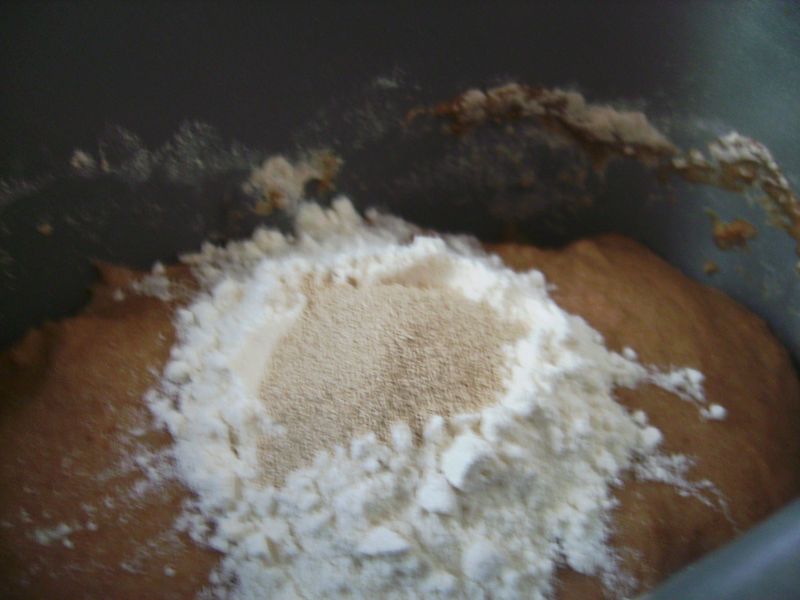
    Here it is in the machine, waiting.  See how I've nearly covered the wet dough with dry stuff this time?

    SANY0804
     
    When I locked the pan into the machine after adding the dry ingredients, some of my yeast pile tumbled over and made contact with a bit of the moist dough (center right of the photo).  I haven't noticed any activity in that spot about 3 hours after setting it up, but I'll keep an eye on it.

  • Something else for a change: Soaking flour in the bread machine, Experiment #1.

    Believe it or not, I'm getting tired of writing about diet and exercise all the time.  I know I've lost a lot of readers since last year (though I've gained more); I never intended for this to become a weight loss blog, and I hope to go back to my previous mix of homemaking, mothering, politics, nerdy stuff, and theology at some point.  But I kind of want to finish out the series and make a nice handy index of all those diet and exercise posts.  

    So anyway, I suppose recipes are sort of about diet and exercise, but here's what I'm starting this morning.

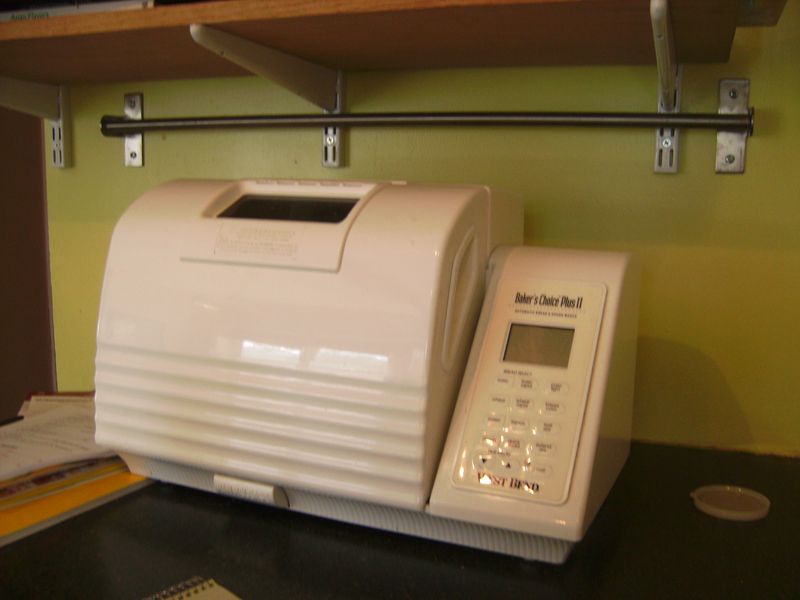
    I bake our family's sandwich bread in a bread machine.  It's really a perfect device for me and I wish I hadn't waited so long to buy one.   In July I paid $50 for a used West Bend Baker's Choice Plus II from Craigslist.  I have not bought a single loaf of bread from the store since then.  (Bagels and English muffins and hot dog buns, yes; bread, no.)   

    SANY0792

    The West Bend produces nearly-normal-loaf shapes (there's always two divots in the bottom of the loaf for the kneader bars), is ridiculously easy to operate, and has a time-delay feature.  I can make whole wheat bread in less than 10 minutes of work, plus a little less than 4 hours rise and bake time.  I can also make dough for shaped breads, which I don't do as often because they require a little bit more thought.   I have made bagels for Sunday breakfast and hoagie buns for a weekday dinner of meatball sandwiches.  Day in and day out, though, it's loaves of whole wheat bread for the kids' peanut butter sandwiches or for a slice of toast under my poached egg.    An optimized recipe hangs in a frame on the refrigerator, so that anyone in my house who can read can make a loaf of honey oatmeal bread.  

    Now that the habit of making our own bread is really well established, I am ready to move on to the next stage:  Figuring out how to add a pre-soaking step while still harnessing the advantages of the bread machine (time delay, one-pan convenience, mix-rise-knead-rise-bake completely unattended).

    Pre-soaking whole grains and flours in an acid solution is something I learned about a few years ago.  My friend Cathie wrote about why to soak whole grains here and included some links; it's a good place to start.  The short answer is that whole grains (but not refined ones) contain phytic acids and enzyme inhibitors that slow the absorption of nutrients, and presoaking in acid deactivates those compounds.  This isn't conspiracy-theory natural-foodie beardy-weirdy stuff; follow Cathie's links and you'll see that this is a mechanism that nutritionists know well, even though it has not filtered down much into general knowledge.  Cathie also notes that her family, with various allergies and metabolic problems, tolerates whole grains better if they're soaked; and I note that whole wheat pancakes and waffles have a much tenderer texture if they're soaked.  That's good news for people trying to wean their family off Bisquick. 

    (Here's Cathie's favorite soaked 100% whole wheat bread, not a bread machine recipe.  It's the first recipe in the post.)

    I have always made waffles and pancakes with soaked flour, because I always mix the batter the night before anyway, and so it never added an extra step to soak them.   But I have not yet been sure how best to combine soaking with the bread machine, at least the one that I have.  There are two problems with this.
    The first problem is the yeast.  (I'll get to the other problem in a moment.)  Some bread machines have a yeast compartment that keeps the yeast separate from the other ingredients during the time delay, until the bread is ready to be mixed.  Mine does not have this feature.  Instead, to use the time delay with normal bread baking, the ingredients are carefully layered in the bread pan:  first all the liquid, then the dry ingredients on top of the liquid, and finally the yeast on top, in a little well made in the dry ingredients.  This keeps the yeast dry throughout the time delay until the machine comes on and the mix cycle begins.  But it also keeps the flours dry, except for the boundary layer in contact with the wet ingredients at the bottom.  

    What I'd like to be able to do is 

    1.  mix the flours and acid liquid together in the bread machine pan
    2.  add the other ingredients — including the yeast and salt —  in the pan in some way that the yeast will not raise the dough during the soaking time and the salt will not mix into the dough and inhibit the deactivation of the enzymes
    3.  set the timer to produce bread 13 hours later (the maximum), which gives me a bit more than 9 hours of soaking time

     
     I have a few ideas for how to do this, and am going to investigate them over the next few loaves of bread.

    Idea #1.  Protect the yeast from moisture in a pile of dry white flour:  Decrease whole wheat flour by 2 tablespoons.  Mix the flours, oil, liquid, and sugar in the bread machine.  Then put 2 tablespoons of all-purpose flour in a pile on top of the wet mixture.  Make a little well in the pile and add the yeast and salt.    Question:  How long (up to 24 h) will the yeast stay dry?  

    Idea #2.  Protect the yeast from moisture in a capsule of solid fat:  Mix the flours, liquid, and sugar in the bread machine.  Then make a little "cup" of 2 Tbsp solid coconut oil and add the yeast and salt to the cup.  Dig a little well in the wet mixture and place the capsule in the well.  Question:  How long will the yeast stay dry?  Question:  Will it still mix, moisten, and rise properly if it's been embedded in a fat phase?  (Note:  Coconut oil melts at 76 degrees F.)

    Idea #3.  Protect the yeast from moisture in a pool of liquid fat:   Mix the flours, liquid, and sugar in the bread machine.    Dig a little well in the wet mixture and add 2 Tbsp vegetable oil.  Add the yeast and salt to the oil phase.   Question:  How long will the yeast stay dry?  Question:  Will it still mix, moisten, and rise properly if it's been embedded in a fat phase? 

    Idea #4.  Don't bother protecting the yeast, just use less of it:  Mix the yeast right into the flours, add the salt to a corner of the pan after mixing the flours (so it won't interfere with the deactivation), and use less yeast so that the bread will rise only very slowly during soaking.   Question:  What is the empirical function y(T) where y is the optimum quantity of yeast and T is the duration of soaking?   Question:  What adjustments must be made for ambient temperature over the range 68-90 degrees F?

    Idea #5.  Pre-presoak:  Mix the flours and liquid in a bowl at least 7 hours ahead of time.  At a convenient bread-making time, add the soaked flour/liquid mixture and the other ingredients to the bread machine pan.   Set the time delay as usual, perhaps protecting the yeast as in Ideas 1-3.  Question:   Is this more convenient than mixing the flours and liquid in the bread pan?

    Idea #6.  Forget yeast and learn to make sourdough bread in the machine.

    For my basic recipe, I'm using this "buttermilk" recipe, since it's designed for an acidulated liquid anyway:

    Whole Wheat – Buttermilk Bread (really soured-milk)

    3 cups whole wheat flour
    1 and  1/2 Tbsp wheat gluten
    1 tsp kosher salt
    1 and 1/2 Tbsp sugar
    2 Tbsp coconut oil
    1 and 1/2 cups whole milk, soured with 1 and 1/2 Tbsp white vinegar

    1 and 1/2 tsp bread machine yeast

    I mixed everything except the yeast and 2 Tbsp of flour on the "dough" setting of my bread machine, then unplugged the machine and pulled the bread pan out onto my counter, where I can keep an eye on it all day.  (Yes, I remembered too late that the salt is not supposed to be soaked with the flour.  I don't think it will affect my experiment about yeast-wetting.)

    SANY0793

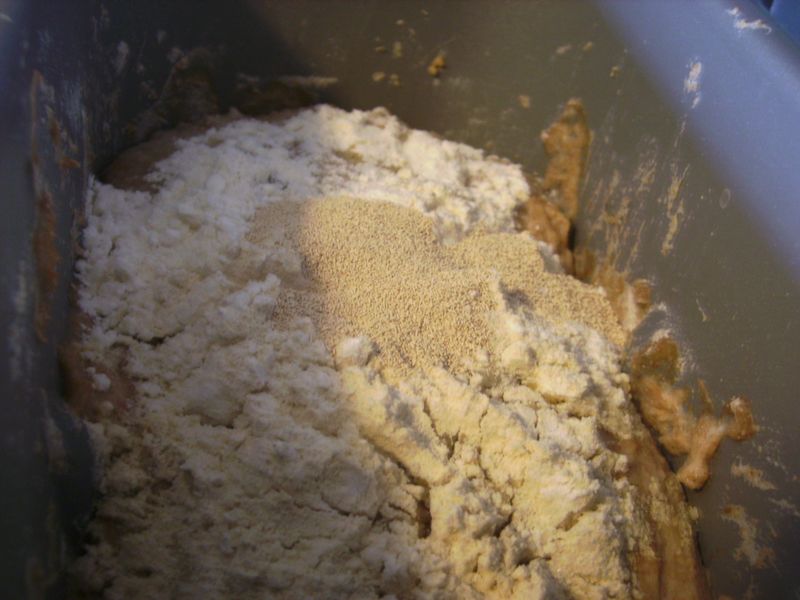
    I added 2 Tbsp of all-purpose flour, and added the yeast (1/2 Tbsp) on top.

    SANY0798

    Now I'm watching and waiting.  I put the yeast in at 8:45 a.m. and took the picture at 10:40 or so.  The yeast is still completely dry:  no moisture has wicked up through the all-purpose flour, as well as I can tell.

    Here's where I can show you the second problem with letting the flour soak in the bread machine:  the dough dries out.   When the ingredients are layered in the pan, the dry ingredients on top keep the water from evaporating; when the bread is soaking like this, though, the water has a continuous transport path, right up and out.   If I let the bread soak in the bread machine with the timer ready to turn it on, quite obviously I can't cover the bread with plastic wrap to prevent it from drying out (that's why I'm letting it sit uncovered on my counter).  Already the surface of my dough is dry to the touch.   

    This leads to more ideas to be tested:

    Idea #7:  Protect the dough from getting dry and the yeast from getting wet by covering the whole wet layer of dough with a layer of dry white flour, and putting the yeast on top.  Question:  How thick a layer of dry white flour is necessary?  (I want to use as little as possible, because I want the bread to be mostly whole wheat.)

    Idea #8:  Protect the dough from getting dry with an oil layer.  In this scenario I would brush liquid oil on top of the mixed ingredients, and then put the yeast on top of that, protected by a couple tablespoons of dry white flour.

    Idea #9:  Compensate for the dough drying out by adding more liquid to begin with.  Question:  How much to add?

    Stay tuned for the results.

  • Backup plans and transition plans: Induced exercise part 19.

    (Parts 1 2 3 5 6  7  8   10 11  12 13  14 15  16 17 and 18)

    I wrote before that it's important to keep your workout plan (time slots, activity, route, people-taken-care-of) simple and do-able, especially for a beginner, or for someone who's had trouble with quitting in the past.  Too much variety may "spice things up" but it can keep you from seeing measurable improvement from week to week, from developing an identity, or even from evaluating whether your plan is working.  And if you start small, saving "doing more" for later, you're much more likely to see yourself following through with your commitments to yourself.

    But even though the main plan needs to be simple, it also has to be ready for changes, expected and unexpected.  That's what the backup plan and the transition plan are for:  to keep your induced exercise from falling through when your circumstances change.   If they are to work, they (and you) must be ready before you need them.

    The backup plan is what you rely on when your main workout plan becomes temporarily impossible.  The pool is closed; it's too hot to safely run outside; you're traveling out of town; your spouse who usually watches the kids for you can't do it today; you have a dentist appointment at the time you usually work out.   Your backup plan provides a temporary substitute for your normal exercise plan, to be deployed when your normal plan falls through.

      The primary goal of a backup plan is to preserve the habit of "showing up" for exercise.  As such, it doesn't have to fit into your "vision" of who you are; it doesn't have to match your usual plan in any way, or supplement it; it doesn't have to give you the same kind of a workout; you don't have to enjoy it very much, as long as you're willing.  It is only a secondary goal of a backup plan to maintain your fitness until the normal plan can resume within a few days.   So if you have some discretion in designing your backup plan, you can try to have it give you a workout of similar intensity to your normal plan; but your number-one-goal is to have a backup plan that you can deploy successfully on short notice.  One you can show up for.

    A transition plan is different—and not everyone needs one.  Transition plans are necessary when your vision for your induced exercise has "seasons" — traditional climate-based seasons ("I cross-country ski in the winter and bike in the
    summer") or life-change-based seasons ("I run and lift weights most of the time, but when I'm pregnant I prefer yoga and swimming") or a season of recovery ("I'm walking right now but when my knees get better I'm going to start running").  

    The transition plan prepares you for the change in seasons.  It helps you make a smooth transition between them so you're not caught off guard with the sudden failure of your workout plan (e.g., all the snow melts overnight and though your skis are still ready to go, your bike is in pieces in the garage!)  The primary goal of the transition plan is to maintain your discipline and your athletic identity as you cross from one season to another.

    Here is where the four parts of a workout plan — time slot, activity, route, and people-taken-care-of — can really help you:  they can be a step-by-step process of designing your backup plan and your transition plan.


    Designing the Backup Plan

    Since a workout plan has four parts that all need to work together, it's pretty easy to see that your plan will fail if any one of the four parts falls through.  So, write your workout plan down on a piece of paper where you can see it all laid out.  I find it easiest to make a separate mini-plan for each time slot.  My current plan looks like this:

    Monday 10:30 a.m-11:45 a.m.  Swim 40 min, shower, and change at the YMCA while kids are in Y child care.

    Thursday evening.  Run 40 minutes on the treadmill at the YMCA while husband makes sure kids get in and out of swim lessons and Y child care.

    Saturday morning 7:45-9:45.  Meet friends to swim 40 min, at the Y on the other side of town while husband takes kids grocery shopping.

    You see that each time slot has an activity, a place, and a plan for the children.  You see that I blocked out extra time for the swims to allow for showering and changing.  Also, you see that while there is some variety (swim or run?  which YMCA?) there is not a lot of variety.  My workouts are the same length and always at a YMCA.  There is more  consistency about it that you can't see from this plan:  for one thing, I keep all my gear, toiletries, and clothes, for swimming or for running, always packed together in the same gym bag (along with my YMCA membership card).  I don't even have to look in the bag:  if I have the bag, I know I am ready for any of my three workouts for the week.

    For each of your time slots, write down these questions:

    1.  What will I do if I can't exercise at this time?

    2.  What will I do if I can't do my usual activity?

    3.  What will I do if I can't exercise at this place (or along this route?)

    4.  What will I do if my arrangements for caring for my people fall through?

    Any one of the four pieces might fail.  The backup plan is not complete unless it is ready for any of the four failures.

    Here are some things to think about as you go about answering the questions:

    The backup plan does not have to be only one answer.  You might choose one alternative if your time slot fails, or a different alternative if your activity fails.  For example, if I have to take the kids to a doctor's appointment at 10:30 on Monday, I might simply go with the kids to the Y in the afternoon instead.  If I get an ear infection and am advised not to swim until it clears up, I might substitute running for swimming at 10:30 on Monday.  

    Changing as few parts of your plan as possible keeps your plan simple and do-able.  If I can't swim because of the ear infection, I try to run at the same time and in the same place as I would have had my swim.

    A given problem might be interpreted as any one of the four failures.  Let's say I arrive at the YMCA at 10:30 on Monday only to find a sign taped up across the pool door announcing that the pool is unexpectedly closed.  I might interpret this in several ways:

    (a) I can't exercise now.  I have to find another time to swim.

    (b) I can't exercise here.

    (c) I have to do something besides swimming.

    I can pick the backup plan that seems easiest in the moment.  At ten-thirty on Monday, with the kids already comfortably ensconced in the child care, that's probably to put on my running shoes and hit the treadmill instead of the pool.   But in other circumstances (say when Mark was watching the kids at home and I was really looking forward to a swim) I might instead head back out to the car and drive to the next nearest pool.  And in yet other circumstances I might have said "Let's go home kids," and rescheduled my workout for the next day.  Because I have a backup plan in mind for any of the four failures, I have extra flexibility.

    This is what my backup plan looks like:

    Time failures:  If I can't exercise at 10:30 Monday, I'll exercise at 4:30 and we'll have a late dinner.  If I can't exercise Thursday evening, I'll exercise Friday morning before Mark leaves for work.  If I can't exercise Saturday morning, I'll exercise Sunday morning.

    Activity failures:  If ever I can't swim, I'll run instead.  If ever I can't run or swim, I'll walk, either on the treadmill or on the track.

    Place failures:  If I can't exercise at this YMCA, I'll exercise at some other YMCA.  

    My people-care arrangements fall through:  If I can't put my children in the YMCA childcare, I'll have to reschedule my exercise.  I'll ask my husband or my friend if they can watch my children while I exercise at a different time.

    Notice that in my plan, I interpret "people-care" failures as equivalent to "time" failures.  It doesn't have to be that way, though.  One mother might keep a yoga video at home just for using when the babysitting falls through, and do that yoga tape at the same time as the "normal" workout.  Another parent might decide that when the child care falls through, it's time to hit the playground with the kids, and try to run around with them a little bit…  it wouldn't really be enough to count as a weekly workout, but it is a fun way to get everyone moving and more importantly to keep that appointment with yourself.   Remember, the crucial feature of a backup plan is that it gives you an alternative that you can show up for.


    Using the Backup Plan

    Once you have the backup plan designed, you must get everything ready so that you can switch to your backup plan quite literally at a moment's notice.  Sometimes you will know a few days in advance that you will have to rely on your backup plan:  for example, I usually know ahead of time when my husband is going to be out of town, and have a chance to arrange alternative child care or to reschedule my exercise.  Other times, however, you will be "caught out.&quo
    t;  For me the classic example is arriving at the pool to find it closed for cleaning (translation:  some kid pooped in the pool).  Another example might be a sudden rainstorm that keeps you from going out for a run, or maybe your power goes out and you can't use your treadmill or your exercise videos.  Unexpected failures are not an excuse to skip your workout; instead, build into your backup plan the possibility of unexpected failure.  Get ready to switch.

    Being ready to change my workout time means that the minute I realize I can't make my usual time slot, I'm on the phone with my husband figuring out when he can watch the kids so that I can make it up.  Being ready to change my workout place means that I always have my YMCA member card, so that I can be admitted to any YMCA in the city (or indeed in the country).  Being ready to change my workout activity means that I keep my gym bag packed, always, with everything I need to swim OR to run.  (That in turn means that I have two complete sets of running clothes and two lap suits, one in the laundry and one in the bag).  

    I'll save the detailed discussion of the transition plan for the next post.


  • Some exercise plans: Induced exercise #18.

    (Parts 1 2 3 5 6  7  8   10 11  12 13  14 15 and 16 and 17)

    Drawn from comment box, email, and my own life.  The first one is my beginner's plan:

    Plan #1:  "I'm a swimmer, an individual athlete."
    Swim Monday evenings at the YMCA for 40 min while husband watches the kids.
    Swim Thursday evenings at the YMCA for 40 minutes while kids are in lessons and husband watches the baby.

    Later, the "baby" became comfortable in the YMCA child care and that became:

    Swim Monday mornings at the YMCA for 40 minutes while the kids stay in the child care (and the oldest does his schoolwork.)
    Swim Thursday evenings at the YMCA for 40 minutes while husband shuttles kids back and forth between lessons and child care, and squeezes his own lifting sessions in between.

    Here's another plan:

    Plan #2.  "I'm a runner, working on the basic fundamentals."
    Block off the time every weekday, and exercise at the local Y three or four days a week, from 11:45 to 1, while the kids are in the YMCA child care.

    This is a good plan once your kids are comfortable staying in the child care.  (It doesn't happen immediately upon signing up for a gym membership.)  I have suggested that a beginner plan a firm two days a week; but it also can work to block off the same block of time every day and then each week decide which two or three days you're going to do it.  The important thing is that you're keeping that consistent minimum.

    Plan #3.  "I'm a runner, staying fit off-season (during pregnancy)."
    Walk every fair weekday three miles through the neighborhood with two toddlers in the jogging stroller.

    Very nice!  Walking through the neighborhood, even with the kids in the stroller, is a good "easy on, easy off" activity, as long as you keep the stroller and shoes handy.  Because of this it's an ideal activity for attempting to do every day, even beginning at five minutes and working you way up to distances measured in miles.  

    By the way, when you begin an activity that requires your kids to behave a certain way (stay strapped into a stroller or play quietly in their room), working your way gradually from five minutes to longer periods might be m
    ore important for them than it is for you.   If you decide your solution is, for example, to train your children to play in their rooms while you walk on your treadmill for 30 minutes, you might well have to begin by training the children to play in their rooms every day for 5 minutes (set a timer) and then gradually lengthen the time.  Even if you can walk for more than 5 minutes, it may take some work on  your part to be able to focus on walking for more than 5 minutes.

    I haven't actually tried this.  Maybe it won't work.  Just throwing it out there.

    Plan #4.  "I'm a runner."
    Run two days a week, plus one weekend day, through the neighborhood, while husband watches the kids.

    Sounds fun… and sounds like a great opportunity to focus.

    Plan #5.  "I'm an individual athlete who does strength training."
    Follow the program in The New Rules of Lifting for Women at home with home equipment:
    Tuesday afternoons, Thursday afternoons, or both, while the baby naps and the older children watch a video.
    One weekend day, taking turns watching the children with husband.

    This athlete comments that the nap/video arrangement is reaching its limit.  I learned while I was in grad school that it is incredibly frustrating to count on The Nap as a reliable source of free time.  You just can't control when The Nap starts or stops, or whether it happens at all, and sooner or later they start to grow out of them.  Yes, certainly, before The Nap disappears, find some other way of carving out the time. 

    Plan #6.  "I am a runner."
    Run 4 miles, 3 to 5 times a week, at 6:30 am while husband is still home with the children.
    Recently added swimming, in  the same time block, 1-2 times a week at the rec center of the local college.
    Plan to swim in the "off season" of pregnancy.

    What I really love about this plan, what this person has done that is really, really, really smart, is that she is starting NOW (even though she is still in the season of running) to practice her "off-season" conditioning sport of swimming.  She knows she won't be able to run much during mid-to-late pregnancy, and so she's starting now to develop the alternative routine that will carry her through that time.   Which brings me to this example:

    (Partially Successful) Plan #7.  "I am a cyclist."
    Bike in the neighborhood, a few evenings a week, while husband is home with the children, after dinner.  When winter comes, switch to walking through the neighborhood.

    This is a friend of mine who successfully bicycled like this all last summer.   Her plan fell through, though, when winter came.   She stopped biking and somehow didn't start walking.  She has told me that she thought perhaps the problem was that she never tried going for walks in the summer as an occasional alternative to cycling.  Maybe if she had done that, it would have been a smoother transition from biking most of the time to walking most of the time.  

    Plan #8.  "I am a runner, in rehabilitation."
    Exercise at the Y three times a week:  using the elliptical trainer while husband or friend watches the children.  If that's not possible, walk on the track with the baby while the older children stay in the child care. 

    What's so great about this plan is that it has a "backup plan" built right into it.  More on backup plans later.

    Now here's a plan from the combox that didn't work:

    Failed plan:  Meet a friend at the Y, three times a week, to do "nautilus machines, maybe treadmill, and occasionally an aerobics class."  While the kids were in childcare.   Plus toddler gymnastics afterward.   Stopped because it took "all morning three times a week."  I never got to the place where I loved the activity or had an identity in it…where my body missed the workout when I missed one."


    I hope Tabitha can write a little more about why she thinks this plan failed for her.  A couple of things stand out:  

    First, could it have been more about socializing with her friend than about getting exercise?  There's nothing at all wrong with that, and lots of people do very well when they exercise with other people; but if the activity "felt" more about getting together with a buddy than about taking care of yourself, it might have gotten in the way of developing an identity as an athlete.  It seems that it would help in developing the identity of the friendship as "we're the kind of friends who meet at the gym."  But not necessarily in developing your own personal identity.  The other thing is that if you are with a friend, you may not be able to focus on the activity — to generate psychological "flow."  The activity can be an annoying thing that makes you huff and puff too much to  carry on a conversation.

    Second, were they trying to do too much?  If it really took all morning, it was probably unrealistic to expect you could keep that up as a lifestyle change.

    Third, were they trying for too much variety?  If you do nautilus sometimes, and aerobics sometimes, and treadmill other times, maybe you don't have a chance to improve and to set goals at any one of them.

    Next up:  Backup plans and transition plans.


  • If you’re still with me, you have to comment on this: Induced exercise plans.

    (Parts 1 2 3 5 6  7  8   10 11  12 13  14 15 and 16)

    Readers who are still with me most of the way through what is turning into a very lengthy series:  Help me out.  I need some material to work with.

    Got any exercise plans?  Ones you hope to do, are thinking of doing, are already doing?

    Let's see if we can't get it into the TARP (or whatever) format that I described in this post, and append to it some thoughts about athletic identity and attitude.

    So… in the exercise plan or plans that you are considering, that you would like to do if you could just figure it out, or are already doing…. 

    (1) What's your athletic identity?

    a.  "I'm an individual athlete"

    b.  "I play a sport"

    c.  "I'm working on the very basic fundamentals" e.g. walking to become a runner

    d.  "I'm rehabilitating myself"

    e.  "I'm cross-training—I do several different things"

    f.   "I'm staying fit in the off-season, so to speak"

    (2)  What's your sport?   What's the activity that defines what you are or what you hope to become?  Running, swimming, dancing…  (It's not necessarily what you actually do to exercise each week.  My husband would tell you he's a skier, not a runner; he runs all year to stay fit for 6-10 days of skiing.)

    (3)  What are your time slots (in your plan, whether it's active or only thought of)?  

    (4)  What activity?

    (5)  Where?

    (6)  What arrangements have you made, or might you make, for people in your care during the workout?

    ****

    My example is my Winter '08, brand-new exercise plan:

    I wanted to become a swimmer, an "individual athlete."  I planned two workouts per week, Monday and Thursday, for forty minutes.  Swimming both times.   I went to the local YMCA, where we have a family membership.  On Monday nights, I left the children with my husband Mark.  On Th
    ursday nights, the family went to the gym together, and Mark would stay with the baby (who wouldn't stay by herself) in the child care center while I swam.   (He'd get his turn to exercise after I was done.)

    ****

    So, those of you who do get regular exercise, tell us how.  Or if you had a plan that worked great in the past, especially a beginner plan, describe it.  Those of you who have a plan only in mind, throw it out there for us to hear.  I really want to hear from as many readers as I can on this one, because I want to use the results as a jumping-off point to write about making backup plans.


  • Homeschooling home run.

    One of the perils of reading too many blogs by homeschoolers is that we often write about our best ideas and our best days.  Too much of that, and you can easily start to feel as if everybody is doing a better job than you are.

    I'm going to contribute to the problem today by announcing that, in the middle of what has seemed like a month of half-finished, half-completed plans, a day finally came that was one of those bright spots, the "this is why we homeschool" moments.  Nothing dramatic; but after having read and discussed medieval China and the voyages of Marco Polo yesterday, I woke up this morning with the idea of going to the Minneapolis Institute of Arts to see the China galleries.  

    Lacquer  Dragons

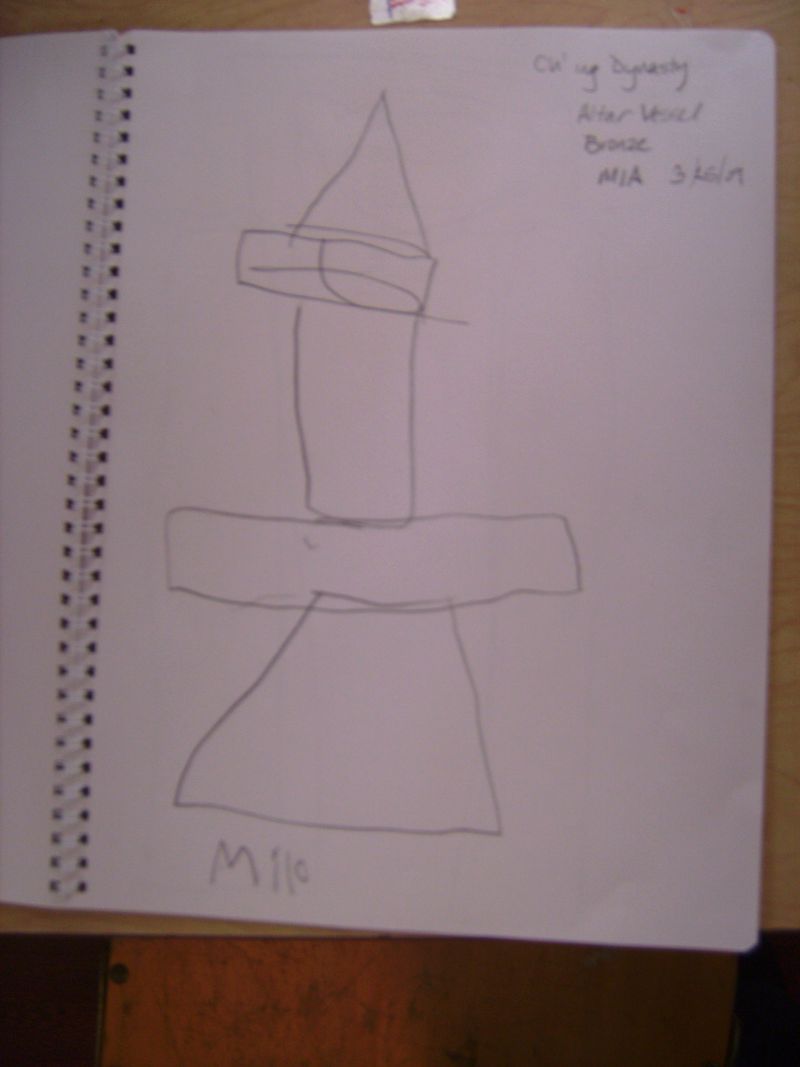
    While I fed the kids oatmeal, I told them my plans, and warned them we wouldn't stay long.  The MIA is in the same part of town as our house.  We drove there, checked the coats, checked the turned-out-to-be-forbidden sling and got a stroller ("Um… do you think you can ride in this, MJ?"  "Yes!" she shouted.  So exciting), and went straight to the China galleries.  I had brought a sketchbook and art pencil for each child, and we went around looking at the bowls and ewers and iron horses and lacquered boxes.  Milo was the first to find something he wanted to draw, a bronze altar vessel; I made him sit on the floor, gave him his pencil, and let him draw (took the pencil away before he stood up—no five-year-old pencil-wielders in the art museum.)  
    SANY0782

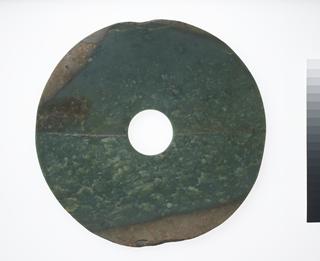
    Oscar and Milo wandered and paused and sketched and pointed, and Mary Jane wiggled her feet and scribbled in her notebook.  I pointed out a bronze Pi Disc:

    Pi disc

    and she drew it, a little penciled doughnut, her first still life.

    SANY0779

    Oscar drew many things, and had to be dragged away from some as he added final details.  That's life when you've got two younger siblings to keep happy.

    SANY0780

    We left before anyone could get tired or antsy and had lunch in a Chinese restaurant before heading home.  What a pleasant morning.

  • Making sure your people are taken care of: Induced exercise part 16.

    (Parts 1 2 3 5 6  7  8   10 11  12 13  14 15)

    Most people know that a workout plan has to include a time, a place, and an activity.  Usually the question "but where are your kids?" is kind of rolled into those three, assuming you'll mentally calculate times, places, and activities that make room for them.  I want to pull it out separately and give it equal attention.

    I don't want to focus on the minutiae of leaving children in gym childcare facilities (though that is worth a post) or having your spouse care for them while you exercise or asking a friend to watch for a little while.  I want to focus on, well, focus.    If you struggle with boredom and distraction during exercise, or if you feel that the activities you're constrained to choose are drudgery, then the solution is to find a way to experience psychological flow; and to do so requires concentration, plus the perception that without concentration, you'll not meet your goal.

    Psychological flow is its own reward:  

    "The best moments usually occur when a person's body or mind is stretched to its limits in a voluntary effort to accomplish something difficult and worthwhile.  Optimal experience is something that we make happen.  For a child , it could be placing with trembling fingers the last block on a tower she has built, higher than any she has built so far; for a swimmer, it could be trying to beat his own record; for a violinist, mastering an intricate musical passage.  For each person there are thousands of opportunities, challenges to expand ourselves."  (From Flow:  The Psychology of Optimal Experience by Czikszentmihalyi)

    But flow requires concentration, and if the activity doesn't inherently require concentration, then achieving flow requires willfully creating a context of concentration:

    "Flow experiences based on the use of physical skills do not occur only in the context of outstanding physical feats… Every person, no matter how unfit he or she is, can rise a little higher, go a little faster, and grow to be a little stronger.  The joy of surpassing the limits of the body is open to all.

    "Even the simplest physical act becomes enjoyable when it is transformed so as to produce flow.  The essential steps in this process are:  (a) to set an overall goal, and as many subgoals as are realistically feasible; (b) to find ways of measuring progress in terms of the goals chosen; (c) to keep concentrating on what one is doing, and to keep making finer and finer distinctions in the challenges involved in the activity; (d) to develop the skills necessary to interact with the opportunities available; and (e) to keep raising the stakes if the activity becomes boring."

    Czikszentmihalyi proposes the act of walking as an example of a simple activity that can be transformed into a flow activity by the setting of goals that require concentration.  I propose, maybe a bit optimistically, that walking on a treadmill or doing y
    oga at home in your living room can also be transformed into a flow activity, with some forethought and planning and goal-setting     and the opportunity to concentrate.    I believe habitual experience of flow is the difference between many people who love exercise, and are drawn back to it by desire, and people who hate it, avoid it, or do it only with a sense of duty.   Flow bestows a sense of meaning, purpose, competence, and (yes) fun on the most prosaic of activities (I used to get it from writing computer code!).  You deserve to be able to achieve it.

    And this is why I believe it's crucial (if you're to become someone who enjoys exercise) to make sure your people — your children or anyone else you're responsible for — are completely taken care of while you are getting your exercise.  

    You can't achieve flow without focus.  You can, of course, exercise without focus and do without flow.  But why would you, if you can find a way to get it?

    For most people, total focus on the activity at the same time as being responsible for small children is either (a) impossible, because part of the attention is always on the children—listening for sounds of distress or wakefulness, or watching out of the corner of the eye; or (b) dangerous, because none of your attention is focused on the children.

    It should be obvious by now that I'm speaking to people who try to get their exercise at home, while they are alone in the house with the children; or who hope that they can get it with their kids by their side.  I am arguing that to settle for this is to deny yourself the benefits of flow.  Only if somebody else can respond to all your small children's concerns short of real emergencies, are you free to concentrate enough to achieve it.

    Achieving flow through exercise with children younger than 3 or older than 10 is, I think, workable.  One can run with a jogging stroller, or walk briskly with a baby in a backpack; and a 10-year-old can be a real workout partner, if she wants it as much as you do!  

    But those 3 through 9 year olds… They are too big to carry, and they are not big enough to keep up with many adults who are really exerting themselves.  They also are not usually big enough to be completely responsible for themselves, or to be completely responsible for younger siblings.  Hannah and I tried to brainstorm  ways to get real vigorous exercise with a passel of mid-sized kids, and the only thing we could come up with is running around playing chasing games in a big yard or field—though even that can end in tears before you really want to be done.

    So this post is a sort of appeal:  Even if you are sure that you can only exercise at home anyway, still, try not to settle for exercising while you're the only responsible person around.  Naps and videos are simply not reliable enough.  Exercise in the morning or evening or lunch hour while your spouse is home, and instruct the kids to take their concerns to him.  Arrange to take turns with another mother.  Hire a mother's helper.  Begin training an older child how to be responsible for ninety percent of their younger siblings' needs for fifteen minutes or half an hour, and how to tell when it's time to call Mom.

    Give yourself a chance to know that your people are taken care of for the block of time you've allowed, be it five minutes daily or a big block of time twice a week.  Give yourself the freedom to lose yourself in body motion, to experience a sense of competence and challenge.  It may be difficult to arrange if you're "just" following videos on the floor of your living room; but the first step to making it possible is giving yourself the gift of concentration.

    Next up:  How to make a backup plan!

    ——————————

    Note:  Two books by Czikszentmihalyi are available in "limited preview" on Google Books.  One is Optimal Experience:  Psychological Studies of Flow in Consciousness and the other is Finding Flow:  The Psychology of Engagement with Everyday Life.  I haven't read either of these yet, but maybe they will give you a taste of the material.


  • Place and path: Induced exercise part 15.

    (Parts 1 2 3 5 6  7  8   10 11  12 13 and 14)

    Even though we have picked up on some other threads that need to be covered — psychological "flow," and feeling like an athlete when you mostly need to use exercise tapes or books at home — I have to finish out the Big Four parts of an exercise plan.

    I have already made recommendations about two of these:

    1. Time slot:  Depending on which is more appropriate for your activity, either begin with five minutes every day OR with two full-length sessions every week. 
    2. Activity:  Choose activities that allow you to claim the title "athlete."  

    The other two are route—the place or path where you exercise—and people—making sure that the people you're responsible for are taken care of during your time.  For these I am not going to recommend, so much as I am going to try to suggest some ideas and principles.

    Let's talk about place and path.  What might those be?

    Outside, beginning and ending at your front door.  Around the neighborhood, around the block, in your own yard.  Outside there is weather; weather can be worked around, or met head on.  How will you feel when it is wet, cold, or slippery?  How will you feel when it is hot and sunny?  Is your neighborhood safe by day?  By night?  

    Outside, beginning and ending at some other door.  The neighborhood where your children take piano lessons for an hour each week, or the park right next to the grocery store.  The track behind the school.  The little wooded nature center that offers classes for kids.  The area around your best friend's home, or your kids' grandparents' house.   Where do you go every day, week, or month?  What outdoor places can be found nearby? 

    Outside, beginning and ending at your car door.  Around (or in!) a lake, along a hilly trail, up and down some long set of stairs you've driven by countless times but never climbed; over the snow, or through the puddles; around the walking or running track; near the play structure at the park.  In some other neighborhood that's safer or pleasant than yours.  A big open field, with room for everyone to run as fast as they can, where everyone can be seen.  Where could you drive a couple of times a week?  Where could you stop on the way home?

    Outside, going from one place to another.  The trip to the grocery store, to the local coffee shop.  The way to your best friend's house, the way to work, the way home.  From church to your friend's house, from the store to work.  Too far?  What if you drive partway and leave your car behind?  What will you need to carry?  How will you carry it?  If you have no path you could create one:  Take a bus a few blocks away, come back under your own power.  Every week you could ride a little farther.

    Inside, in your own house.   The bedroom, the family room, the basement, the attic.  Behind a locked door or no door at all.  Up and down the flights of stairs.  Before the TV or the computer or the Wii.  There may be a place to use equipment; a place for heavy things to lift and move, maybe a machine of some kind.  Maybe the equipment is already there?  Are you using it already?  What's getting in your way?  What do you see while you're deciding whether to exercise, while you're exercising?  Is it a pile of laundry to sort or some other work to do?  Should you go somewhere else or should the laundry go somewhere else?  Are you energized and renewed from being at home, or from leaving it?  Is it a lot of trouble to leave, or a lot of fun?  Is your home a private place, a refuge, a place of safety, a place where you feel confident?  Or is it a place where it's difficult to do anything different?

    Inside, in someone else's house.  Has your best friend got a treadmill, or a flight of stairs, a place to use your exercise tapes, or a big back yard?  A set of weights in a comfortable basement, and a teakettle upstairs whistling your reward when you're done?  Somewhere homey and friendly, private and safe, but… where the piles of laundry and dishes are not calling out to YOU?  

    Inside, in a public place.  A mall in the early-morning hours; a local community gym, a couple of bucks to use the place.  Are there open gyms in your town?  Municipal recreation centers?  Indoor parks?  Field houses?  Networks of tunnels or skywalks?   Schools or churches with gyms and classrooms for public use?  Have you checked the local parks and recreation departments?  How about community education?  Maybe even the local senior center?  All may offer free or low-cost access to public areas for exercise.  Visit the different possibilities in your community.  Consider the cost of daily use fees and parking, and figure out the cost to you per workout, per month, per year.

    Inside, in a private gym.  What is there in your town?  For-profit, full service gyms?  For-profit, no-frills storefront gyms?  Does your city have a partnership with any private gyms offering low-cost passes for city residents?  How about nonprofits like the YMCA and YWCA?    Places to get to know the staff, to take classes, to meet other people?  Or a place to go by yourself, shutting out the world with headphones or with swim cap and goggles.   Is this a place to find a new entry ritual, changing from one uniform, one persona, to another?  Is it a place with good hot showers and friendly staff in the child care?  Does it cost too much?  Run the numbers:  Might you qualify for low-income discounts, or for reimbursement to your health insurance company?  Can you pay for daily use or month-to-month, using a gym only part of the year?  Are classes offered to non-members for a fee, and can you use the child care if you sign up?  Conversely, can nonmembers use the facility while their children are in a paid class?  Most of these offer a free tour or guest pass for prospective members.  Even if you think you can't afford it, consider paying visits to the possible sites.  See what sort of scenarios you can construct, and how much they cost:  per workout, per month, per year.

    What places could you go?  Visit them all, and see what ideas they spark. 


  • Other helpful self-images: another side note to induced exercise.

    Commenter "4ddintx" had a good comment on the post about choosing activities to form a self-image as an athlete:

    Just had a thought this morning that being a dancer is another identity that someone may have in terms of their fitness. Not usually what I think of under the category of "athlete" but definitely in the same vein. 

    What a great point!  The point is to cultivate a self-image that inherently implies regular physical exertion and training.  "Athlete" is the one that I've worked to develop in myself; "dancer" is another.  I suppose some dancers think of themselves as athletes first and performers second!

    Really, any descriptor  that appeals to you will do, as long as it implies the need for physical training and fitness to keep up the skill, and as long as the activity you choose makes sense within that context.  Can we come up with more?  Gymnast?  Circus artist?  I can't think of a concise noun for it, but an image of someone who is capable of fairly hard physical labor might also be helpful — think of how fit you'd have to be if you worked, say, as a landscaper.

    Are you a parent, homeschooling or otherwise, or another sort of mentor?  How about cultivating a self-image as a trainer, coach, fitness instructor?  I'm just throwing it out there.    Does your work, paid or not, make you a role model?  (Health care professional?  Educator?)   How about internalizing that and turning it into "I am a person who sets a good example by getting regular exercise?" 

    There's room for a lot of creativity here, and you may even think of a completely original self-image.  Reinhard Engels (he of the No-S Diet and other everyday systems) came up with an excellent one for, well, walking wherever you have to go:  he calls it the Urban Ranger.  The image is borrowed from Lord of the Rings:

    Remember Strider, in Lord of the Rings? They didn't call him Sneaker or Sprinter or Sworder, though he possessed these skills in abundance. His distinctive quality, the important, even lethal skill, for which he was named, was that of walking rapidly and mindfully over great distances. Not only could he thus outpace his enemies, but he came to outknow them.

    A lethal skill? Well, you say, that's fantasy. OK, skeptic, how did the army of Alexander the Great get to India? They walked. How about the Grande Armee of Napoleon, how did they get all the way from Paris to Moscow? Not on the concorde. For thousands of years winning a war was largely a matter of being there before your enemy. Forced marches routinely left a great deal more than every tenth man dead from exhaustion. So get the aqua sweatpants out of your mind, this is man stuff!

    See what I mean?  Reinhard totally made that up, but it's a fantastic reimagining of the self, no?  (At least for anyone who doesn't have kids between ages 3 and 11).

    What else can you think of?  Who else can you be?

    ADDED:  I happened upon the blog of Deb, a Search and Rescue volunteer, who happened to mention:

    Well, it's time to trade my pajamas for spandex and a cotton tee and head to Jazzercise. I'm still trying to lose some pounds off of me and up my fitness level in preparation for that "3 miles in 45 minutes with a 45-pound pack" test for the Technical Rescue Team. 


    Add "technical rescue team" to the list of helpfully motivating self-images.  If it's your volunteer calling, or job, to save other people's butts, it helps if yours gets off the couch now and then.


  • Flow? A side note to induced exercise.

    This is just a short note from the road, to be filled in later.

    Mark was skeptical about my definition of an athlete, pointing out that high school athletes (he's been one, I haven't) aren't exactly characterized as long term thinkers, and also that many athletes are willing to risk permanent injury to make the big play (not exactly health conscious.)  He said, "I think what you want is to tell your readers that they deserve to experience flow, and that this will help them be motivated to keep up their physical fitness.  And you're trying to use the concept of being an athlete as a proxy for experiencing flow through fitness activities."

    What's "flow?"  I know what he means, because we've both read the same book. "Flow" is a psychological concept described by Mihaly Czikszentmihalyi in a book by the same name.   There's a wikipedia article on flow here.

    I think Mark is right on, and I'll write more about flow later when I've had a chance to review Czikszentmihalyi's book, which I own but don't have with me.  IIRC there's a chapter on athleticism and flow.  In the meantime, see the wiki article and see if you don't see what he means.  Gotta go.

    I'll follow up on this, though I still have to cover the remaining parts of TARP: choosing a route or location, and making sure your people are taken care of.


  • The athlete’s attitude: Induced exercise, part 14.

    and 13)

    In the last post, I urged you to take up at least one activity that will help you claim the title "athlete."  Commenter Mary asked rhetorically, "If I just do exercise videos, what kind of athlete would that be?"

    A reasonable question.   It's hard to feel like an athlete if you're "just" doing exercise tapes at home… all the more reason I encourage people to try to find ways to add activities that seem "real athlete stuff."  It's worth a great deal of sacrifice, at least for a short time period, to remake your self-image in that way.

    When I began to exercise, I took up swimming precisely because it engendered feelings of "being an athlete" in me:  I could measure my time in a 50-yard sprint, or see how many yards I could swim in 40 minutes, or how many breaths I had to take in one lap, and so I could easily measure my improvement from week to week.  And I could read articles about swimming, by competitive swimmers and swim coaches both amateur and professional.  I felt very soon that I was a member of a group, even though I don't belong to a team or anything like that; that I could call myself "a swimmer."  And as I put in time at the pool and got to know the lifeguards by name, recognize other regular swimmers at the Y, I began to feel even more part of a group.  This redefining of myself from basically sedentary, to athlete, gave me a huge confidence boost.

    But many people have constraints, and have to deal with them.  If you can't run, swim, or bike, can you still have an athlete's attitude toward your sport?

    Here are five different athlete's attitudes.  One may fit you.

    1.  You're an individual athlete.
    2.  You play a sport.
    3.  You're working on the fundamentals.
    4.  You're in rehabilitation.
    5.  You're a cross trainer.

    Who fits each profile?

    1.  You're an individual athlete.  Some activities are tailor-made to develop this attitude:

    running
    swimming
    rock and ice climbing
    cross-country and downhill skiing
    weightlifting
    cycling
    mixed competitions like triathlons
    kayaking, canoeing, and rowing

    Let's check this against the list of characteristics of an athlete I developed in the last post:   Their enthusiasts claim an identity, e.g.,  "I am a runner."  They are specializations.  Performance goals are easy to set, as are levels of ability.   Lots of books and articles are available for enthusiasts, as well as personal trainers, coaches, and other experts.  Self-care is necessary, and in seasonal activities, such athletes can look to the sport for motivation to train year round.   Depending on where you live, you may be able to sign up for competitions, community outings, and races that give you a medium-term training goal.  Yup:  athletes.

    2.  You play a sport.  Sports you play with other people, as in a club, with a regular partner, or in an amateur league, can also turn you into an athlete:

    basketball
    softball
    volleyball
    soccer
    tennis
    racquetball
    squash
    Ultimate Disc
    broomball
    golf (carry your own clubs)

    You have to stay in shape in order to keep up!  Just as with seasonal activities, even if you meet to play your sport less than twice a week or only part of the year, you can work on your game in your other weekly exercise sessions.  Targeted strength training, balance work, cardio, or skill drills on "workout days" can be motivated by the upcoming "play day."

    * * *

    After you set aside all the obvious sports, there's a whole series of activities that may not exactly connote "athletics" in and of themselves… but which you might regard as a stepping stone to more athletic activities.  One example is moderate walking. 

    Now, taking a moderate walk is recommended for just about everyone, because it's a basic human skill; almost everyone can do it at least some, and if you can't do it much then you stand to benefit a lot from getting better at it.  It's especially good for people who are very movement-impaired or whose joints can't handle much impact.  But let's be real here—it's hard to feel like an athlete when you're just walking around the block.  What to do?  Depending on your reasons for choosing such a gentle activity, there are at least two good ways of looking at these, which brings us to attitudes number 3 and 4.

    3.  You're developing the fundamentals.  Beginning athletes need attitude too, even when they are working on developing the basic, basic skills, the pre-fundamentals, of a "real" sport.  If you have some hope of improvement—and most of us do—then walking is not "just" walking, but is a fundamental skill that must be mastered before you are fit enough to go on to something else.  You have to walk before you can run—or hike on hills, or race-walk, or carry your golf clubs.  Set your sights on the activity that you have some realistic hope of someday engaging in.  Walk there.  Set performance goals along the way.  And practice those markers of being an athlete that I alluded to in the last post.

    4.  You're in rehabilitation.  Physical therapy and rehabilitation is something that athletes have to do when they are recovering from injury or illness.  Has a football player ceased to be an athlete just because he's recovering from knee surgery and is only up to walking on the treadmill?  The athlete's attitude says that this too-wussy-to-count-as-a-sport stuff is a kind of physical therapy prescribed to correct your particular injuries, weaknesses, and debilitations.  Yes, even if the debilitations come from years of sedentary living.   You may say you've always been this way, but that's not really true, is it?   Imagine you're under doctor's orders (maybe it's not your imagination) to undergo gentle activity as a sort of "sports therapy" to improve your fitness.  What will you take on when you are fit enough? Running, hiking, walking to the grocery store?  Imagine yourself getting better and better, stronger and fitter and faster.  What will you do then?  Instead of setting performance goals—since you're in therapy—look just ahead for the next milestone in health and fitness.   How's your blood pressure doing?  What about your resting heart rate? How many steps can you climb before getting out of breath? 

    I mentioned walking above.  Other "stepping stones to sport" or physical therapy regimens:

    • water exercise classes taken with an eye towards land exercise classes,

    • strength training classes taken with an eye toward gaining confidence to try the free weights,

    • winter snowshoeing taken with an eye toward learning to cross-country ski,

    • swimming lessons

    • very gentle weight-bearing exercises and stretching exercises

    • actual physical therapy

    Now, what about activities that are intended to improve body function, but don't qualify as sports because they lack any element of competition or, well, pressure?  Yoga, Pilates, and other stretching or balance disciplines are obvious examples.  One doesn't compete in yoga, not against others and not even really against oneself.  Instead, yoga is a method of improving your general balance, strength, flexibility, and breathing, possibly also for relaxation or meditation.  Another such activity might be following along with aerobics tapes at home, or playing with the Wii Fit.  Again, there's not really a competition here, you use the tapes as a method or a tool to get your heart rate up.  How to develop the athlete's attitude?

    Alone, these activities are less like athleticism than they are like, well, medicine.  You "take" them because you want them to do something to your body.  It may be that the medicine tastes pretty good!  Maybe you really enjoy yoga classes because they're so relaxing and they get you out of the house.  Maybe the Wii Fit is really fun and addictive.  Fantastic!  Maybe you don't need to think of yourself as an athlete at all because you have these activities that you really enjoy and that you stick with with not much trouble.

    And of course, you can also think of them as stepping stones towards an activity you expect to be able to do in the future, or as physical therapy to correct problems you have that stand in the way of more active endeavors.

    But.  If you do want to think of yourself as an athlete, I suspect that all these activities are best used in combination with something else—however infrequently—that DOES turn on the "I'm an athlete" pathways in your brain.  Then you can regard the different physical activities in combination as a sort of training program that turns you into an athlete, precisely because each activity supports your development of the skills in the other.  This attitude can work really well if you can only swing part of your schedule towards an athletic endeavor, and you find you have to make up the difference with something like an exercise tape.   All is not lost if you can only schedule one run per week, or even one run per month!

    For example:  You might find that your schedule supports one weekly run and one yoga class.  The yoga improves your balance and your breathing, which helps you run better.  The running increases your lung capacity, which helps you hold yoga poses.   Or perhaps you can manage to schedule one swimming workout and one appointment with an aerobics tape.  Swimming is a whole-body workout that incorporates some resistance and some cardio; adding aerobics helps keep bones strong in a way that swimming, a non-weight-bearing exercise, can't.

    In other words, you're not just cobbling together a bunch of unrelated activities as time allows….
      5.  You're cross-training!   If you are consistent in your efforts from week to week, and especially if you pay attention to the ways that the different activities support and complement each other, you will find it much easier to create an identity as an athlete.

    Some final notes.

    1.  Let's step outside the realm of "induced exercise" for a minute and acknowledge that there are fun or useful everyday activities that work together with your induced exercise to develop your overall fitness.  Maybe you love taking family hikes on weekends, maybe you like turning up the music and cleaning the house at a frenetic pace, maybe you've discovered an open field near your house where you and all your kids can chase the dog for twenty minutes every fair afternoon, maybe you walk to the grocery store twice a week.  Once you have established  a good, solid, predictable plan for induced exercise, you can draw these activities in and begin to think of them as part of the whole fitness package.  The key is to see them as part of the whole, and to recognize that your induced exercise makes you stronger and fitter and faster for those activities, and also to see that because you engage in those fun or useful extras, you'll have a more well-rounded fitness plan.  The weights you lifted on Saturday helped you carry the groceries more easily on Tuesday.  The dog-chasing on Wednesday helped you sprint faster on the treadmill on Friday.  That's how it all comes together.

    2.  Beware of activities that feel like a chore or seem pointless.  If you can't see obvious benefits—weight loss does not count—to the activity or sport; if it feels like a drag even after you have dutifully worked at it for a few months; if you are not getting a sense of accomplishment from the improvements you have made (or if you cannot see any improvement); AND if you cannot see how this activity could prepare you for some other thing you'd like to take up, either in the change of seasons or when your skills develop… then maybe you need to do something else. 

    3.  Even though I started this post with a hopeful note for them, and even though I think reforming your attitude will probably help, I admit to worrying about people who rely entirely on exercises done at home from a book or a videotape.  It is hard for me to imagine developing a sense of athleticism through such activities in the same way that swimming and running has changed my view of myself.  It is also hard for me to imagine that one doesn't get bored with such a routine.  But maybe those of you who have stuck to home-based exercise programs can tell me more about what they've done for you.  Can  you feel real improvement, stay motivated, and feel like an athlete while using mostly book- or videotape-led exercises at home?  Do you think you can apply the athlete's attitude to your activity and transform it into something life-changing?  Tell me what you think.