bearing blog


bear – ing n 1  the manner in which one comports oneself;  2  the act, power, or time of bringing forth offspring or fruit; 3 a machine part in which another part turns [a journal ~];  pl comprehension of one’s position, environment, or situation;   5  the act of moving while supporting the weight of something [the ~ of the cross].


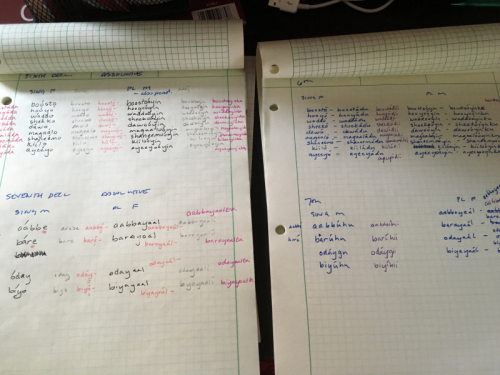
  • Af-Soomaali, continued.

    You may remember that I have been studying the Somali language — here are a few previous posts about it.

    I took a series of twelve two-hour continuing-education classes at  the closest community college.   The pedagogy was… all over the place?  The instructor didn't really come in with a detailed syllabus, a pre-existing idea of what one should learn,  or a plan with more than minimal structure. 

    But what he was, and this I think is more valuable than an organized syllabus, was friendly, approachable, generous, patient, and interesting.  After the very first class, when he had a lecture prepared about the historical, geographical, and cultural background of the language, he took a very casual approach. He came in and chatted with us.  We had a textbook, we asked "how do you say such-and-such a thing?" and he answered.  We took notes.   We learned about the culture of the Somali diaspora.  We heard his views of the challenges facing members (especially children) of that community here in Minneapolis.  We talked about the vocabulary needed by health care providers, elementary school teachers, and social workers.  

    It wasn't like other language classes I have taken, and it wasn't what I thought I wanted  going in, but I think it had the most important things I needed. 

    I can, after all, study grammar from books and written material, pretty well on my own.  But I was stalled without a chance to have a real conversation with a native speaker of Somali.  I'm not going to accost a random person at the YMCA or bus stop and ask them to do free labor, and (not being all that fond of small talk even in English) I'm not confident enough even to break out  the "please" "thank you" "I'm so sorry I stepped on your foot."  

    So it was really helpful to be able to pay someone to set up a formal relationship where I could ask very basic questions, and where I could hear speech, slowed down for my benefit, while the speaker wrote the words on the board and showed where the syllables began and ended.  

    + + +

    Having got a dose of interaction with the spoken language, and a sense for the flexibility of the grammar and spelling in natural language, I feel ready to invest time in working on vocabulary and grammar independently.   If I manageto reach a point where I can't get any farther without additional instruction from a native speaker, I'll look for another tutor. 

    (Meanwhile, I have the email address of the previous instructor, who implored us to email him if we have any questions later.  I do not take the value of this invitation for granted.)

    + + +

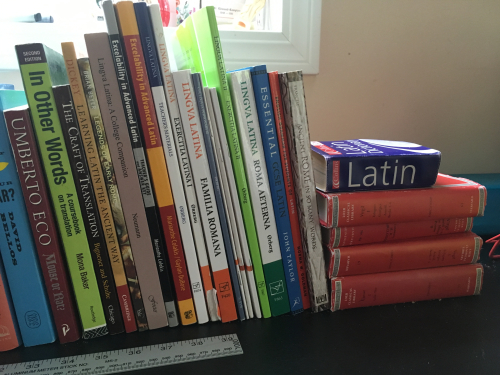
    Studying Somali has already paid off for me as a homeschooling parent, I think.  I love languages, and some of my children have progressed very well in Latin and even gone on to dabble in other languages for fun with free resources like Duolingo; but not all of my children. 

    I have one young person who seems not to be able to hold vocabulary and grammar in his head, nor to recognize cognates when he sees them.  It's been very frustrating for all of us, not the least for me because learning Latin (at least in the early stages) was easy for me.  So it's been very hard for me to understand how to help him; what worked for me hasn't worked for him, and it's tempting in the moment to believe it's because he has the wrong attitude, unhelpful study habits, poor work ethic, etc.   It's also tempting to just stop teaching him, but unfortunately persisting through a couple of years of world language classes is an entrance requirement for pretty much all colleges around here.  To give in to either of those temptations would be to do him a real disservice.

    I have to say, starting from scratch in an almost totally unfamiliar language with few recognizable cognates gave me a necessary dose of empathy and humility.  I had almost forgotten how hard it can be to learn something completely new.   It's probably not enough empathy — I still like working on hard learning for fun, and I can't easily put myself in the shoes of someone who is being made to learn something they aren't interested in learning*, but it is a start. 

    I remember reading the teacher-philosopher John Holt's recounting of this side effect of taking up the cello as an adult.  I hope it helps me help this particular kid.**

     + + +

    A general resource for language learning that's a quick read and contains all the obvious advice as well as some novel tips is Fluent Forever by Gabriel Wyner.  (He also has a website with lots of free helps, and apparently is trying to get an app backed on Indiegogo.)   

    I read Wyner's book because I was looking for new ideas, and also because a classmate in Somali 1 mentioned he had a master list of 600-some words that he suggested learning in any target language as a start. 

    The 625-word list is here — I think it could probably be improved on, but it's not a bad place for anyone to begin, especially if they're willing to adapt it to languages coming from different cultures (e.g. where it makes sense to have the word for "camel" on the list of common animals).

    The most helpful things the book has introduced to me so far: 

    • the very well-designed flashcard application Anki
    • the pronunciation website Forvo.

    Anki:  You can read about, and download, Anki here.  The desktop application is free, supported by a relatively expensive mobile app (worth every penny to me).  There are other, cheaper, and quicker-to-learn flashcard apps out there—I've been using Quizlet with the kids for Latin for a long time—but Anki is so much more powerful and l that I'm probably going to switch at least some of my homeschooled language students (such as the kid who's having difficulties) as soon as I can teach them how to use it.  

    Although it doesn't (yet?) have game-like aspects, Anki is superior to free Quizlet for two big reasons:  first, because it allows you to include photos and audio files (more on those below), but second and most importantly, because it automatically presents flashcards to you at variable intervals based on how well you have learned them; you don't have to have the discipline to work out the schedule yourself.

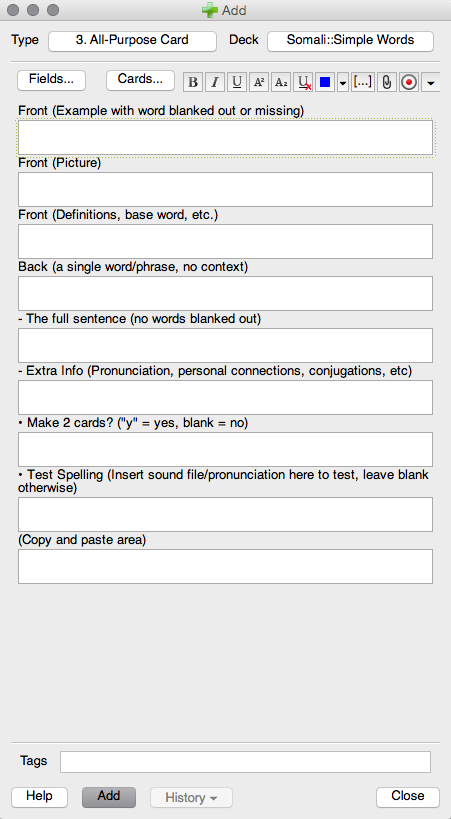
    Furthermore, Gabriel Wyner is offering among his free resources a few templates for useful Anki flash cards which helped me get very quickly up to speed.   These range from simple picture-word cards for learning concrete vocabulary terms, to more complicated flash cards that have you insert the correct ending for a partly-blanked-out conjugated verb.  The template for creating an "all-purpose card" looks like this:

    Screen Shot 2018-05-09 at 9.18.07 AM

    All you have to do is fill in the fields, and it generates at least one card for you, plus the "reversed" card and (if you wish) a third card that presents an audio file and asks you to produce the correct spelling.

    Forvo:  Speaking of audio files, the website Forvo.com has downloadable audio files of native speakers producing individual words.   Not only is it fun to browse, but you can insert the sound files into Anki flash cards to practice your spelling and pronunciation.  You'll have many more words available to you if your target language is widely spoken (Forvo's searchable Swedish lexicon numbers more than 114,000 words; its Somali lexicon, small enough to be presented as a list, has only 165), but even a small collection can help your ear.  I made several dozen audio flash cards in Somali.  

    + + +

    So I've been using Anki daily to make and review vocabulary and grammar.  I'm drawing a lot of the grammar examples from my (sadly, rather expensive) textbook, Colloquial Somali by Martin Orwin.

    51Glo4MKwsL._SX317_BO1 204 203 200_

    It's a pretty standard grammar text designed for self-study, with exercises (all the answers are in the back), accompanying audio files available for free download from the publisher, and a decent if limited glossary.

    One thing I've been doing differently is turning most of the exercises into flashcards.  I don't know why I've never done this before.  It's really, really helpful.  Wyner's book has some advice about how to make flashcards to learn grammar concepts, and I've been putting them into practice here for the first time.

    + + +

    I'm sure someone will want to know by now what I've learned so far.   I've been introduced to a fair amount, but I would say that what I've learned can be summed up as follows:

    • how to pronounce words from their spellings (granting that I can only approximate the pharyngeal fricatives)
    • a dozen or so verbs, maybe a hundred nouns, and a handful of stock phrases ("good morning," "what is it?," "here you are")
    • the endings for the present progressive tense and the general past tense in the first verb conjugation 
    • how  to form plurals in the first three noun declensions
    • how to make simple questions and declarative statements using subject pronouns with verbs and direct objects

    The next thing up for me is how to use the definite article. 

    I'm also occasionally looking at text written in Somali and trying to pick out words I know, or identify verbs and nouns; browsing Somali Wikipedia and the Somali-language online resources of Minnesota Public Radio; and I'm trying not to be noticed while eavesdropping on unwitting bystanders who are speaking Somali into their phones within earshot (the words for "yes" and "no" jump right out to me***, but nothing else does at this point).

    I'll update this now and again, I hope.  Practically speaking, I've turned a corner:  I've started picking up the Somali book and thumbing to the flashcards in order to procrastinate some other task I ought to be doing, which means I'm likely to keep moving forward daily, or at least every day that there's laundry to be done.

    Now if only I could transfer that last skill to my reluctant language-learning child.

    ____

    *there was that one time I had to take a graduate course in rheology thanks to having passed my oral prelims "with reservations" expressed by the department's chief rheologist

    ** Next year, we're switching him from Latin to a modern language, probably Swedish.  I look forward to writing about how that goes.  Also to learning Swedish.

    *** "haa" and "maya"


  • Roast beef for beginners, part II: Boeuf à la mode.


    Remember last week when I said I was going to learn to make roasts, and I started with the American, 1950s-style, dried-plus-condensed-soups-in foil?  And it was better than I expected?

    Yesterday I made the second one, and in an attempt to hit the polar opposite in chicness (but still fairly retro), I went with boeuf à la mode, a classic French pot roast.

    How classic, you might ask?  So classic that Samuel Pepys wrote about it:

    Against noon we had a coach ready for us, and she and I to White Hall, where I went to see whether Sir G. Carteret was at dinner or no, our design being to make a visit there, and I found them set down, which troubled me, for I would not then go up, but back to the coach to my wife, and she and I homeward again, and in our way bethought ourselves of going alone, she and I, to go to a French house to dinner, and so enquired out Monsieur Robins, my perriwigg-maker, who keeps an ordinary, and in an ugly street in Covent Garden, did find him at the door, and so we in; and in a moment almost had the table covered, and clean glasses, and all in the French manner, and a mess of potage first, and then a couple of pigeons a la esterve, and then a piece of boeuf-a -la-mode, all exceeding well seasoned, and to our great liking; at least it would have been anywhere else but in this bad street, and in a perriwigg-maker’s house; but to see the pleasant and ready attendance that we had, and all things so desirous to please, and ingenious in the people, did take me mightily.

     Well, if it will work anywhere else but in that perriwigg-maker's house on the ugly street in Covent Garden, I trust it will work in mine.

    + + + 

    I looked at several different recipes before I settled on a plan.  I had decided to make my roasts on Thursdays, my second-busiest day of the week, in order to force myself to stick only to realistic weeknight roasts.  That decision, along with its corollary (only ordinary grocery-store ingredients) helped me narrow down my choices quickly. 

    • One I thought of using purported to be from Cook's Illustrated, which is reliable, but it seemed a little fiddly for a Thursday. 
    • Another, from the New York Times, looked beautiful and authentic (it contains a pig's foot and dried porcini mushrooms), and instructs you to salt the beef two days ahead and cook it one  day ahead of serving.  I did momentarily consider cooking it the night before, which certainly would have simplified dinner on the day-of.
    • In the end I chose one that was streamlined, but that looked to have preserved the essence of the dish, and I adapted it slightly, both for our tastes and in order to do much of the prep the night before.  This let me add a couple of extra steps, such as salting the meat and letting it rest overnight before cooking, that would tweak the recipe a bit more toward the classic.

    If you want to look at a recipe in recipe format, try one of those.   Here, I'm just going to blog.

    + + +

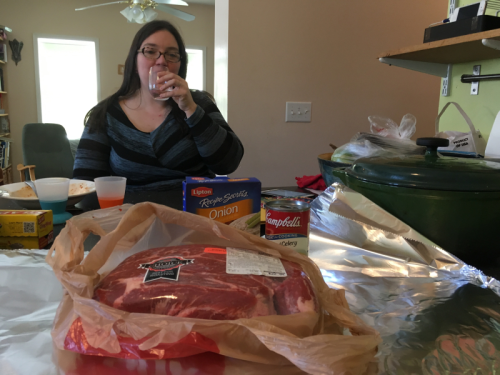
    On Wednesday night, I started with a nearly-three-pound chuck roast ("Select," according to Mark, so not even the best chuck), patted it dry with paper towels, and plopped it onto a piece of plastic wrap. 

    Then I blended 1/4 tsp freshly grated nutmeg with 1/2 tsp kosher salt and 1/2 tsp black pepper.  Tip:  to measure nutmeg while you grate it, deposit the same measure of kosher salt into a little pile on the plate, and stop when the nutmeg-pile looks about the same or a little bigger (since it's fluffy).

    I rubbed the nutmeg mixture all over the roast, wrapped it up tightly in plastic and a zip-top bag for secondary containment, and chucked it in the fridge.

    IMG_5200

    The next step:  fat-rendering and bacon-crisping.  In the Dutch oven I started 4 ounces of bacon cooking.

    (I like to render bacon submerged in water.  It works wonderfully, and is also a good way to make breakfast bacon.  Put your bacon in the pan, cover it with about 1/4" of water, and turn up the heat.  The water comes to a boil and stays there, while the fat slowly and evenly melts out of the bacon; eventually the water boils away, leaving the fat behind, and the bacon begins to crisp.  If not enough fat has come out by the time the water is gone, add a little more.)  

    While the bacon cooked, I chopped one onion and peeled the slenderest carrots I could find, cutting thicker ones into pieces that matched.  I guessed on the quantity of carrots, enough to give everyone in the family a handful.   I wrapped the onion and carrots up and stowed them in the fridge.  And I used the time to gather other ingredients, like red wine, tomato paste, and beef broth.

    Bacon was removed to paper towels, leaving the grease behind.  

    IMG_5198      IMG_5199

    The bacon was also stored carefully in the refrigerator, after a stern warning to other family members not to touch it.  And then I put the lid on the pot, warned people equally (though probably not as necessarily) not to wash it, and left the grease till the next day.

    + + +

    Thursday in the morning I assembled my ingredients:

    IMG_5201

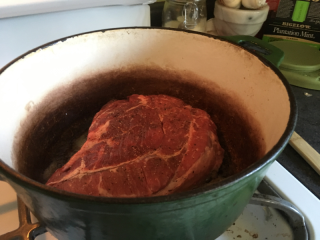
    After lunch I turned the oven to 300° F.   I reheated the bacon fat in the Dutch oven, unwrapped the roast, and tossed it in along with some extra kosher salt.  I browned it well, about three minutes per side in a quite-hot pan, and held it on its edge with tongs to brown on the sides for good measure.   
      IMG_5208      IMG_5209


    Then I removed the roast to a plate, and sautéed the diced onion in the remaining fat until it was golden.  Next, two tablespoons of tomato paste; finally, deglazed the pan with 1 tablespoon red wine vinegar and 1 cup red wine (a 2011 Bordeaux that I bought at Jungle Jim's over Christmas, probably at a good price because there is at least one more bottle in my pantry).  A cloud of scent:  wine, evaporating alcohol, beef, onion, well-smoked bacon, filled the kitchen.

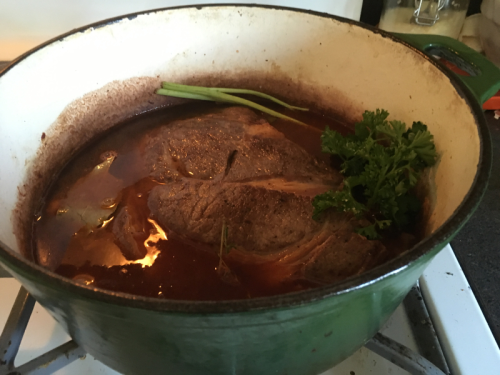
    In went the crisped bacon bits,  the roast, a couple of sprigs of parsley, a bunch of fresh thyme tied up with one of its own stems, and two bay leaves.  

    IMG_5210

    Then I poured in enough beef broth to cover about 3/4 of the roast.
    IMG_5211

    Covered, into the oven it went.  This was at 2:25 p.m.

    + + +

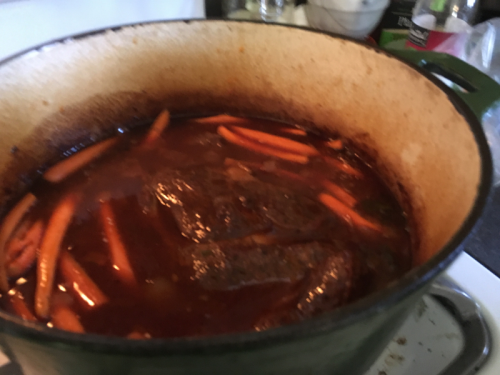
    At 4:30 I added the carrots.  I pushed them down under the liquid surface.
    IMG_5215


    The lid went back on for another hour. 

    (Somewhere during that hour, I put together a spinach salad with blueberries and pine nuts.)

    And then it was time to finish the dish.

    + + +

    Uncovered, it looked like this:

    IMG_5216


    The carrots had acquired that speckled gloss that I associate with the best beef stews.

    I moved the roast with tongs and a spoon to a cutting board; this one did not fall completely to pieces, unlike the onion-soup roast.  I covered it with foil to rest while I steamed new potatoes (the kind that come in a microwaveable bag) and fiddled with the sauce.

    I strained the liquid, and moved the vegetables and bacon to a deep serving dish, discarding the herbs and stray bits left behind in the colander.  Then I put the liquid back in the pot and turned up the heat to reduce it by half while I sliced the roast.

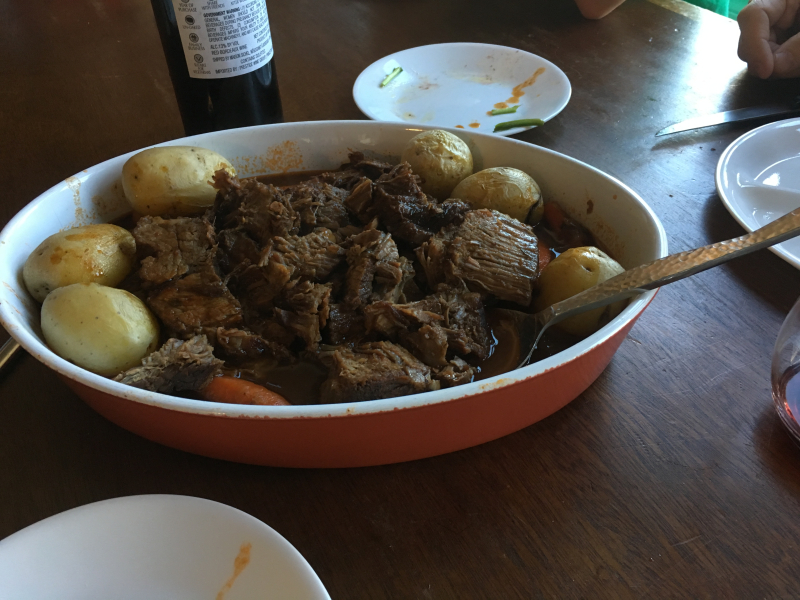
    This time, the roast remained more or less sliceable.  It didn't fall apart like butter or like a school-cafeteria turkey hot shot; it sliced, although it was hard to slice it really thin because it did want to tear.  It wasn't tough.  I could slice it about three-quarters of an inch thick, and at the very ends it did fall apart into shreds.  I arranged it on the platter with the carrots, encircled it with the steamed potatoes, and poured the reduced cooking liquid (not a gravy exactly; it wasn't starch-thickened) over all.
      IMG_5217


    Even though they had already eaten their salads, everyone was so eager to dig into the beef that I failed to scatter parsley and lemon zest atop it for the photograph.

    + + +

    How was it?

    I came back to the table after the others had already started, since I was doing things like turning off the oven and softening butter for the bread (whole-wheat challah bought from the natural-foods co-op up the street), and Mark said to me:  "Sit down.  Listen.  Start… with the carrots."

    He held up a forkful of carrots.  "This.   This is what I think of when I think of roast beef.  The onions and the carrots underneath.  This."

    The carrots were definitely beautiful.  Luscious and melting and savory.

    "Can you put more carrots in?"

    "Yes," I said, "but I'd have to use a smaller roast or more liquid.  They have to be submerged."

    "Do it."

    + + +

    Meanwhile, the children (except the four-year-old, who is very into bread and butter) were chowing down, making little grunts of pleasure now and again.

    I turned to the beef.

    IMG_5218

    I have to say, the onion-soup beef was more tender than this one; but this one had a more pleasant texture, something that you could chew and savor.  And the flavors were fuller, cleaner, and richer.  Bacon and red wine and beef, all together, is a beautiful combination.  Mark and I drank the remaining Bordeaux with dinner, and it went down very smoothly.  

    The thin French pan sauce didn't cling like a gravy (of course, if you wanted it to, it would be a simple matter with a little butter and flour or cornstarch), but it sopped up well with a chunk of challah, and everyone cleaned their plates (except for the four-year-old, who had his plate cleaned by others.)

    + + +

    Would I make this one again?  Definitely.  It was not quite as foolproof as the onion-soup roast, and a good deal more fiddly, but not too fiddly for a Thursday night, at least not with some prep the night before.  And the results were company-quality.

    I agree with Mark that more carrots (or some other root vegetable, like parsnips) could only have improved the dish; but I'm pretty sure that I should increase all the sauce-components to keep them submerged:  the onion, tomato paste, wine, and broth.   

    Potatoes are nicer cooked in the broth, too, but really it was a good deal easier to steam them in the microwave and add them at the last minute.

    The bread was a must because of the delicious, thin sauce.  

    + + +

    I think next time I am going to try an Italian stracotto with fresh tomatoes and pesto, on top of polenta.  For now, while the spring weather is still relatively cool, I'll continue with the slow-oven method; later I will be searching out the best Instant-Pot recipes to avoid heating up the kitchen.  Stay tuned.


  • Springtime in the city.

    Yesterday was the first day above 50° F in Minneapolis.  It was Saturday; I got up early and went out to breakfast, and then decided to take a walk, just to walk and enjoy the nice weather.

    I started to drive to the lakes, where I normally go when I want to run outside, and then decided that the paths around the lakes would be insanely crowded.  So instead I turned north on Hennepin Avenue, in the busy district of Lowry Hill. I parked at the first place I found a meter-free spot, in front of an eyeglasses shop.  One-hour parking:  perfect. 

    I jettisoned the books and notebooks out of my satchel, put on my coat (it was still breezy), locked the car, and started walking north.   

    Unmistakable signs of spring made me smile:  bass thumping from a passing car with its windows open; a whiff of cigarette smoke from a coffee shop with outdoor tables; water pouring from hoses at the car wash on the corner.  And just the air of the city, outdoors, after weeks of being bundled up tight indoors.  Diesel exhaust, the splash of puddles, the soft thump of snow sliding off a roof.

    + + +

    After a few blocks I would have been walking on the berm of a highway, so I crossed the street and diverted into a residential area.  I very quickly left the busy streets behind. 

    47B77F7B-3904-4953-B650-73B5870C8913

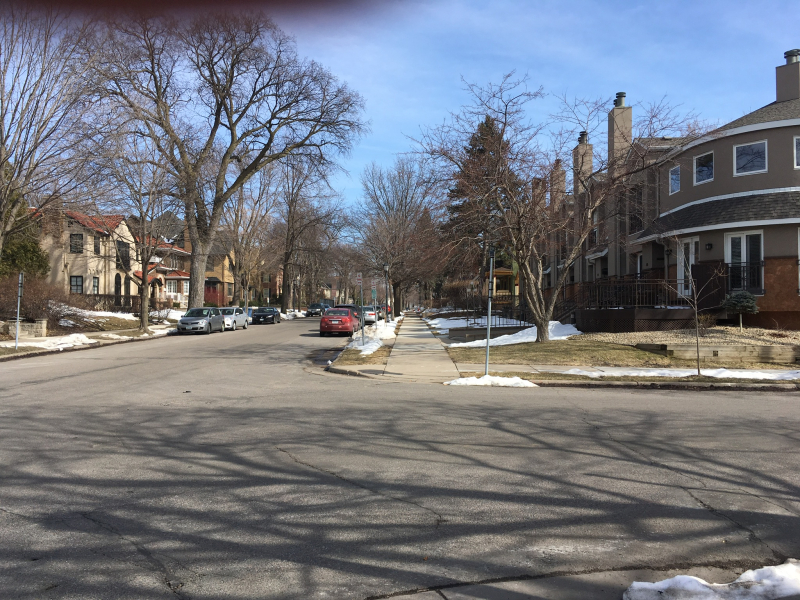
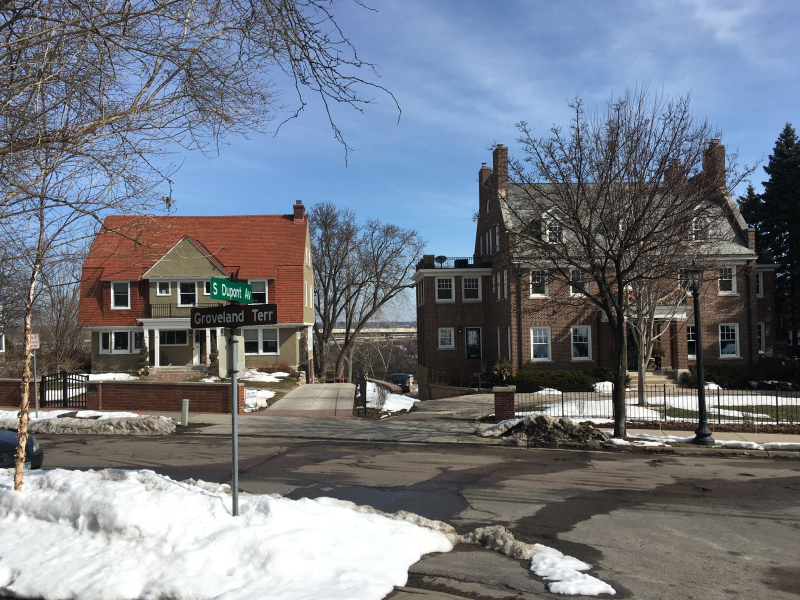
    This neighborhood has giant Victorian houses as well as giant more-modern ones.   I have driven through here a couple of times but never walked.

    I find it pleasant to stroll through the quiet streets here, wondering how much the houses cost, admiring the landscaping.  Although the landscaping is not very attractive just now, having been buried in a foot of snow less than a week ago.

    Eventually I came to a tiny city park, less than half a city block in size, surrounded on four sides with imposing, beautiful old houses, and two-hour street parking that had plenty of empty spaces.  I made a mental note that this would be a good spot to park the car, if we wanted to take an urban hike with the children.

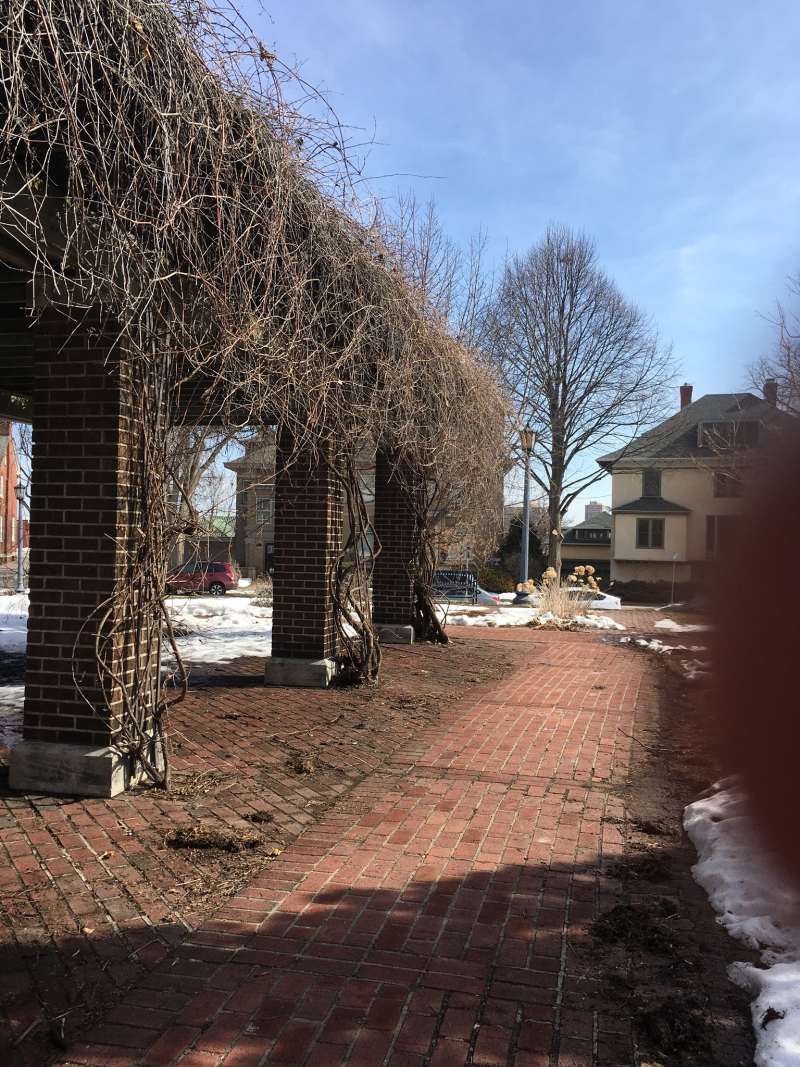
    The tiny park had crumbling brick paths crossing it at a diagonal and an attractively sculpted watercourse, or drainage ditch anyway.

    3FA86E46-8597-418E-98A1-F694E50AE5D8

     And one of these things.

    13E9CFA4-8478-4183-A334-CF4C4FE1B27F


    Look:  snow on the ground, but no boots.  I'm wearing my comfortable walking flats, the ones that took me all over London in the fall.  And the leather coat I thrifted there.  I'm still dressed as if it were autumn.

    A358997D-4DD4-4EE9-A20B-28D52AEDE767

      You can see the highway down below, between the big houses.   I passed very few people:  joggers, people walking dogs.  They smiled and said good morning. 

    Current events are on my mind.  I reflected on the fact that I have no fear whatsoever that anyone in this neighborhood will perceive me as a threat, even though I am looking around as if I don't know which way to go, even though I am taking pictures of their houses.  No one is going to call the police.  And if the police were to cruise by, I would not need to alter my path.

    455A9A41-DF5D-4CCA-9D07-C4A2F5C11532


     I came out of the neighborhood at the top of a hill, looking down.  A lovely spot for a cityscape.  There is the Basilica of St. Mary, to the left, where my 14yo was confirmed a couple of weeks ago.  The Irene Hixon Whitney Bridge, in pale blue that stands out and pale yellow that disappears into the trees, a truss that lets pedestrians cross from the Sculpture Garden to Loring Park on the other side of the highway.  The cityscape, crowned by the reflective IDS Center tower.  At the right, one squat corner of the Walker Art Center.

    D5FBC35F-595C-40FF-8034-1F9079A96F5D


    I walked down the hill and made a short loop through the Sculpture Garden.  Renovations were completed last year, but the new trees have not gotten very much bigger, and so it still looks denuded to me, compared to my memories of its old layout thick with shrubbery.  But its most iconic piece is still where it always has been.    

    53317F49-51D8-4557-AB30-3892111C31E0


     I squinted into the sun and took a selfie.  See what I mean about the place looking barren?  After a few years, when the young trees have filled out a bit, it will be better.

    A8B11591-6650-481A-B1EE-42613A0A44C3

     Come to think of it, it will probably look a lot better later this summer, once the landscapers have done their work.

     I finished my loop through the garden just as my phone rang the thirty-minute timer I'd set to remind me to turn around.  Back up the hill.

    203E05D3-59DB-4FED-8DF9-01D36EF5D381


    The Walker is the modern art museum.  I like it, but then I like art of all kinds.  

    In the summer the hillside is crowded with people enjoying the weather.  Not today.  But it won't be long.


    B084BBEC-D422-474F-AFBB-477D60A174FF


    I took the long way around, wondering how much it costs to rent one of these apartments that are here in the middle of everything with a view of the skyline.


    8064AEE8-422F-4E34-A425-79B2491CCAE8


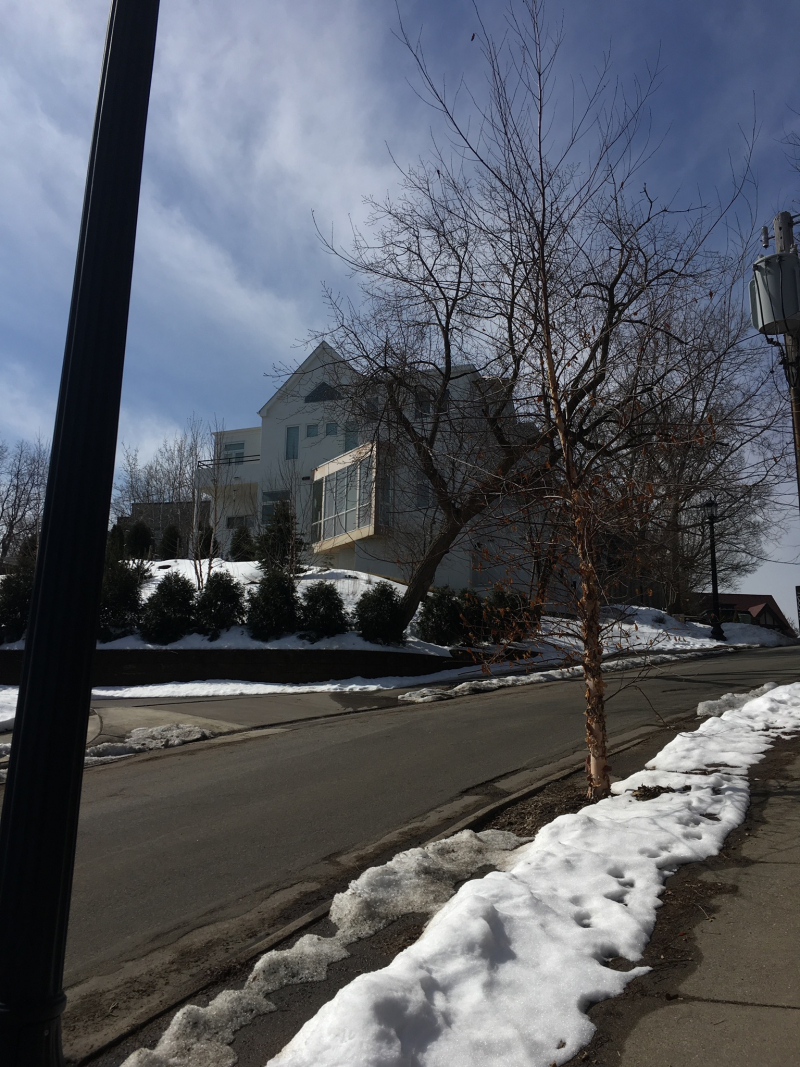
    Or how much these houses cost, with the bones of Victorian mansions but retrofitted windows for soaking in a view that must have been very different when their foundations were laid.


    A68E9BE3-CF58-49EB-8E8F-0069FD595C8D


    I passed a man pulling bamboo stakes out of his yard, the kind you put up so you can see where your path is when the snow covers everything. 

    "Thought it was never going to get here," he said.

    "Oh, you're telling me," I agreed.

    + + +

    As I walked back across the tiny brick park, I was struck suddenly by a deep happiness at living where I do.  The snow weighs heavily all spring, but the pavement is only made more so beautiful when it finally emerges.  

    "Beautiful."  I know not everyone would think so.  But I do, I really, really do. 

    I thought to myself:  I am not always very secure in my preferences.  I sometimes wonder if I say I like things only because I don't want to anger people, or because I have difficulty expressing myself in socially acceptable ways. 

    But I know one thing:  I truly love living in the middle of the city.  I don't mind that it isn't a sprawling metropolis; Minneapolis is compact, easy to get to know intimately, but it still has (writ smallish) everything one could want out of an urban area.  I love that in a half hour's walk I can go from the parks and art museums, through the streets of the mansions of the wealthy, past a ring of more modest apartment blocks and homes; into a business district with ice cream shops and auto repair and cafes and pet groomers,  and that it's only a couple of miles from my own comfortable house full of kids.

    5E51DFC5-60B4-467F-AEB2-C588C2303578

     I just like the variety of it all, and the noise, and the crowds. 

    FB129D66-6625-468A-9D32-C81E3363F0FC

     I went south of the car, crossed the street, came up north behind it. 

    BF8505C3-8003-424B-84BF-E0CE6ABE85BE

     Truly the first day of nice weather, almost a record for how late it is, the end of the third week of April.  In six months we'll be saying goodbye to it again.  I better enjoy it while I can.


  • Roast beef for beginners, part I: 1950s style.

    I am a good cook, but for some reason I am absurdly bad at a few easy things.  One of these is roasting whole birds or big chunks of meat.

    Up till now I have dealt with this by buying birds already reduced to a pile of parts, and meat already reduced to steaks, chops, cubes, and ribs.

    Occasionally we would order a quarter-beef for the freezer, and I would gaily tell the processor on the phone, "No roasts please, just steaks and stew beef," and out of the corner of my eye I would see Mark's face fall a bit.  

    + + + 

    I have decided that to celebrate 20 years of marriage to my uncomplaining husband, and my acquisition of an Instant Pot two Christmases ago, and also because I have been tired and suspect I could use a little more iton in my diet, I am going to learn how to make roast beef without screwing it up.

    I will do this in my usual systematic way, like the time I decided to learn how to be a beer drinker, by experimentation many times.

    Today, despite being a decent cook for 35 years, I made the first one.  Come along with me…

    + + +

    As soon as I made up my mind to work my way through the world of roast beef, I knew exactly which recipe I was going to start with:  the "Forgotten Roast" from this article which is one of my favorite local foodie articles ever.  In this article, six local uber-hipster food writers get together to cook a dinner-party menu from a 1969 socialite cookbook.  The roast beef in the recipe features onion soup mix and condensed cream of celery soup.  In other words, it is roast beef like Grandma used to make.   

    The writers don't know what to make of the roast, about which it is written, "Before serving, you will find it has made its own gravy:"  

    I keep referring to this as the “autogenerating gravy.” Everyone was skeptical about the dehydrated soup and cream of celery. These are the key ingredients in the sorts of mediocre casseroles and hot dishes that are said to autogenerate in church basements.

    I'm not sure, but I think something very similar also made an appearance in Peg Bracken's I Hate To Cook Book, profiled here by Bon Appétit a few years ago.  (I have a copy of the 50th anniversary edition around here somewhere.)

     + + +

    H. was over for the day, so she got to watch me assemble this monstrosity right after lunch.

    IMG_5141

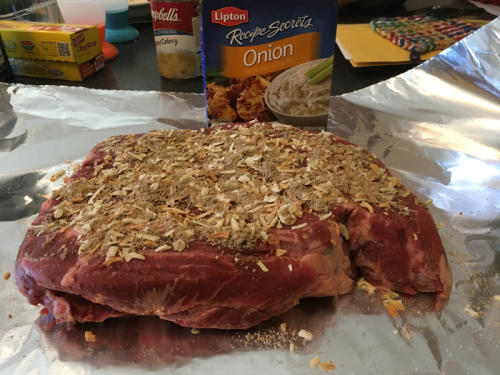
    This is a three-and-a-half pound chuck roast.  You dry it off and place it on a piece of heavy-duty aluminum foil.  You do not brown it.  Instead you sprinkle it all over with a packet of onion soup mix.  

    I thought maybe Mark might go all exotic and get the Knorr, but knope, it's Lipton.

    IMG_5143

    Then you open a can of cream of celery soup.  The recipe says "pour," but you can't exactly pour condensed cream of celery soup.  I spooned blobs of soup globs onto the roast.  I couldn't stop myself from saying "Blob" every time I added a spoonful, which made H. laugh.   Then I sort of frosted the roast with it.

    IMG_5144

    I texted a picture of the roast to Mark.

    IMG_5146


    "I remember liking roasts" amused both H and me.

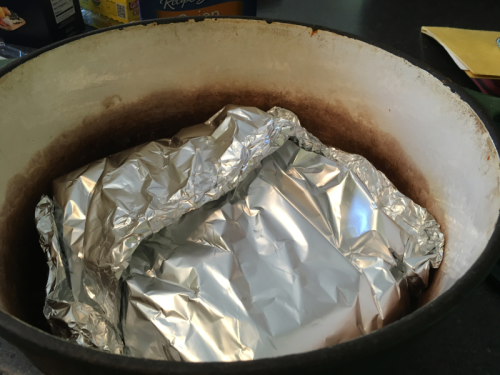
    Anyway, then you wrap the roast up tightly in the foil and put it inside a roaster, or in my case an enameled cast iron Dutch oven, in which it just barely fit.  I snapped this picture before I put the lid on.

    IMG_5145

    Then it goes in the oven at 275° F for four to five hours.  A convenient recipe for Thursdays, when I am home all day but very busy.

    + + +

    After schoolwork was over I made mashed potatoes and added an oiled tray of asparagus to the oven to roast for 30-40 minutes alongside.  When it was time for dinner I pulled the Dutch oven out and called to H., who was getting her coat on, "Do you want to see the big reveal before you go?"

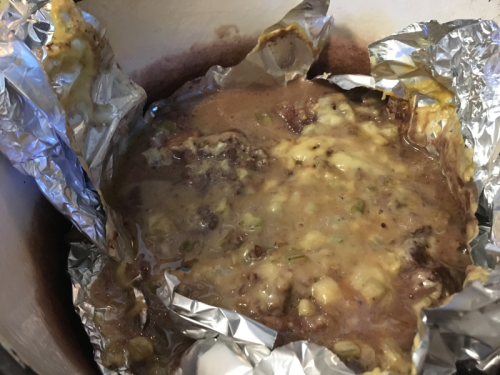
    She came over and first I fiddled with my fingertips trying to unfold the foil, then gave up and cut it open with a knife.  Inside was a mottled, soft, brown mass of gravy-pooled beef, here and there dotted with a residual dab of pale from the cream of celery soup.

    IMG_5147

    It did not really look very appetizing.  I put the knife in it to cut it—and discovered that the knife went right into it and sliced it with nearly no resistance.

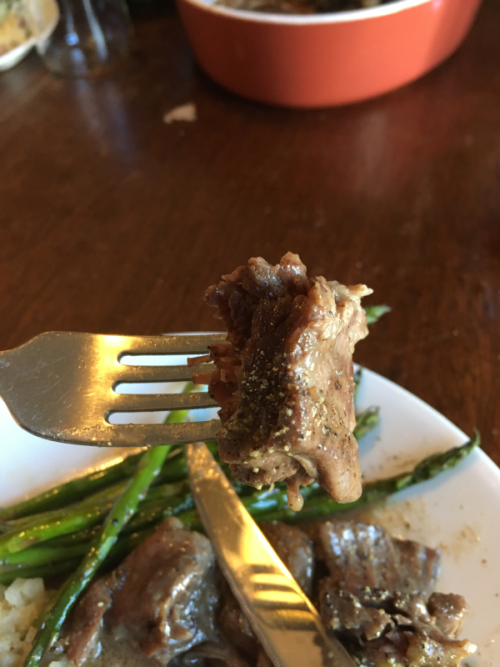
    How do I serve this?  I had expected to turn it out onto a cutting board for slicing.  I burned my fingers trying to lift the foil package out of the pot.  Eventually I just sliced it by poking the knife (like buttah) down into the foil over and over, and then used tongs to extract the slices, which fell apart into tender shreds as I transferred them into a serving dish.  The pale globs melted away and left behind a beautiful brown gravy.  I strained the gravy through a colander (because of the chunks of celery), and poured it, glossy and thick, over the roast beef.

    IMG_5148

    It was… amazing?  I don't know if I would say that exactly, but the children all used that word.  Mark was happy, and extolled the virtues of Midwestern midcentury cooking.  "Not to disparage the wonders of living in the city where we can walk to upscale modern restaurants any time we want," he said, but 
    like roast beef.  I like pancakes.  I like good ordinary food."  

    "This is the best," said my daughter.  "Never make any other kind of beef again."  She wrinkled her nose.  "Short ribs are not as good as this."

    IMG_5152

    Here is what the hipsters at The Heavy Table had to say about their own dinner-party roast:

    The star of the evening to that point, though, was unquestionably the Forgotten Roast and its autogenerative gravy. True to Mrs. Randolph’s promise, we opened the foil, and there it was – a tender, juicy and altogether perfect roast, lying in a pool of gravy. It is the simplest, most foolproof recipe imaginable. And yet it’s so perfect. A few weeks later, in fact, I tried it again with reverse-engineered fresh ingredients – a cream soup made from scratch with fresh celery in a food processor, and a homemade dry onion soup mix. It was OK, but nowhere near as good as what I got from pouring stuff out of a can and a paper packet. Our grandparents my have been onto something with this one.

    Yes, I think so.  

    We ate well over half of the three-and-a-half pound roast for dinner.  I will definitely make this again—after I have tried some other techniques for comparison.  Next up… something with (non-dehydrated) onions and carrots in it.  But not until we've finished digesting this one, i.e., sometime in the middle of next week at least.


  • Rejecting the professional model in favor of a different one.

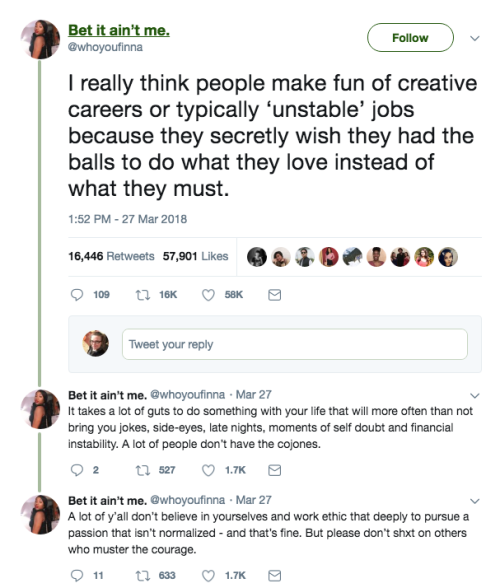
    I have been stirring some uncrystallized thoughts over in my head for a few months.  Today I saw a brief little thread on Twitter, almost unrelated, and it was like scratching the side of the flask:  instant nucleation. 

    I can articulate some of what I'm thinking now.  There's still a lot of it yet to solidify.  

    Here's what I saw:

    Screen Shot 2018-03-29 at 8.37.30 AM


    I want to start off by saying that I don't like the term "don't have the balls/cojones for" and I won't apply it to anyone; it's totally inappropriate for the context that I wish to shift to in my analogy.   That's not the part that struck me.  Let's set it aside.

    I want to call attention instead to phrases like:

    • typically 'unstable' jobs
    • do what they love instead of what they must
    • do something with your life that will more often than not bring you
      • jokes
      • side-eyes
      • late nights
      • moments of self doubt
      • financial instability
    • pursue a passion that isn't normalized
    • muster the courage


    I feel… a certain affinity with this description as applied to my own life's work.  Let me dig in to the analogy, quickly so I can get the post out, and see where it is useful and where it is not.

    + + +

    I put my finger on what I've been trying to articulate lately:  a new way of seeing my work.   That I walked away from the career I trained for, not without missing many aspects of it, for a different one:  unstable, but essentially a creative career.

    By many measures, I have made poor choices.  I got an advanced degree, which sounds good, but according to some conventions that was a misguided and limiting choice.  I completely failed to build up a work history post-PhD.  I have maintained practically no networking contacts, certainly none who can vouch for my employability.  I haven't kept up with the literature. I've not cultivated an online persona.  

    Everyone, it seems, knows a woman who's had life's rug pulled out from under her.    If only she'd kept up her skills/not stayed home with the kids so long, she'd be in a more stable position.  One such woman raised me, and she never felt secure again for the rest of her life; and is that always in the back of my mind?  Well, yes, how could it not be?   So there's this certain self-doubt, that even though I do appear to be quite secure, this shame that I've gone about it all wrong, insufficiently protected myself, and if everything goes south through malice or through random chance it'll be my fault that I made the choices I made.

    + + +

    I've had the good fortune to meet, in real life and virtually, a collection of really interesting, creative, brilliant, and educated-or-self-educated women who have spent years out of the paid economy or interacting in only a limited way with it, because all their time went to family-based work: for spouse, children, and sometimes siblings and parents.  A few men, too.  I don't meet very many who have not expressed, at one time or another, an internal-or-external attempt to cram the peg of how they spent that time into the square hole of economic/labor language.

    A lot of people in this position go with the model that full-time childrearing, dependent care, bureaucracy-navigating, and/or homekeeping is itself a kind of profession.  A "professional" profession, with all the word's associations of specialization, advanced training/recertification, and (let's face it) social class.

    I tried to make this fit myself, for a long time.  In retrospect, it was obvious that the "professional" model would tempt me, because I grew up and trained with every expectation that I would spend my working years in the professional class.  I was loath to give up that view of myself.  And I had a lifetime habit, if not a compulsion, of reading the literature, of self-teaching and constant improvement, of honing long-developed skills, learning new ones, and analyzing systems and procedures looking for ways to streamline them or to improve their outcomes.  All those elements are there.  It seemed to fit!  And especially when I started homeschooling, it felt that it satisfied that compulsion-to-excellence.   I don't think I vocalized it too much (I hope I didn't) but it was definitely part of my new mental model of myself.

    But… as the years go by and I gain experience, the shine has worn off, and I find the "professional" model doesn't actually fit all that well. 

    First of all, it's just too obvious that I pasted it on hastily as a way to cover up the lingering embarrassment I felt (even though I knew I had good reasons!) about having dropped out of my original profession, one which I hold in considerably high regard.

    Second (and this is the real killer, I think) a sine qua non of professional work is measurable-to-the-outside accountability:  to the client, to the patient, sometimes to a certifying body or to the state.  Whether for its goods or for its ills:  Measurable accountability is not a feature of my life or my work.   I don't wish to establish it:  Life in the United States would be rather horrifying if it, generally, were!  I only wish to point out that the nature of family life, when it is accorded its rightful sphere of independence, is such that the measurable accountability of professional work is entirely absent. 

    (And—I'm very sorry if this opinion bothers any of my readers—it looks ridiculous when this kind of labor is put forth as equivalent to labor that's accountable and measurable.  It is real labor with real economic value, but it doesn't go on your resume.  You are not employed by your spouse-with-a-paid-job, or your children, as a domestic engineer.  Please stop this, and should you need to make a resume or a LinkedIn profile, embrace the convention that you have an employment gap of a very easily explained, no-red-flags type.)

    The final reason, perhaps the most important, for ridding myself of the mental model of my work at home as a "profession:"  my children and my close relationships are not projects, or patients, or clients, or processes, or products.

    + + +

    If one must project this life onto the work-for-hire economy—and no one said we have to, it's just that sometimes we need the analogy in order to explain our choices to people for whom it's senseless, people who cannot conceive of any other kind of economy—"creative, yet unstable career" strikes me as an improvement over the other.  It is, after all, as @whoyoufinna put it, a kind of choice to do something one loves (as far as one can) instead of what one must.  It is an imperfect model, as all models are; the only thing that fits this life perfectly is itself, and that is not really something that can be called a career at all.

    "Creative" is, obviously to anyone who has lived it out of choice, a very appropriate descriptor.

    "Unstable" is also appropriate.  None of us will do this permanently, except the ones who will have to until they can't physically keep up, and that is a kind of unstable.  And the choice entails taking on considerable personal financial risks:  you have tied your financial stability, often, to other people's fortunes and behavior, and whatever individual capital you have built up in a previous life begins immediately to decay.  These risks are perhaps viewed by polite society as greater the higher your economic stratum in the first place, although the absolute risk is probably not so in reality—interesting, that question, and a subject for people more versed in sociology than I am.

    And then there are the attitudes that @whoyoufinna describes.  They are not, of course, universal:  creative careers are thought worthless, unrespectable, ridiculous by one group; they are thought unreservedly admirable by another; and a large group in the middle considers such pursuits as okay as long as you demonstrate sufficiently that you can afford your hobby, whether by being supported by someone or by scraping together enough income to justify your existence,  and that you don't generate a burden on other people and/or the state.   

     Check.

    + + +

    There's also the fact that many folks have to give a great deal of time to some kind of day-job for hire, and the rest of their time to their creative pursuit; and they live with the code-switching that comes with answering the question "what do you do?" one way to one group, and  another way to another.  Their identity, what they would like to make their life's work and the word for what pays the necessary bills, are not the same, and it's deeply felt.

    (Here's where I reject the don't-have-the-balls formulation.  For quite a lot of people, it's don't-have-the-privilege.)

    There's a similarity there, too, for a lot of us.   Some creative people put the main focus of their work onto their passion and their craft, maybe partly supporting themselves with it, and do other jobs part-time or sporadically, perhaps along with support from others, to cobble together a living.   Other creative people have a "real" day job and have turned their leisure time into their creative outlet, perhaps hoping they can make a go of it with more of their time someday, perhaps accepting this is likely the most they can do.  And there's a whole spectrum of people in between.  A few *cough*, supported by someone else who earns a wage, have the freedom to give all their labor to their craft, whether they help to increase the wealth or only to spend it.

    Again:  an imperfect model.  But better than the professional model.

    + + +

    Maybe the biggest point of similarity that I feel, personally, is that all the very real constraints that come from taking on such a life are also accompanied by a sense of, at least intellectual, freedom.  I mean, these are the constraints that I chose to live under:  and I continue to choose them every day, implicitly sometimes, and even better when I do so explicitly.  

    I have no boss.

    I can direct my time as I see fit.  I am relatively free to make choices and engage in behaviors that I think are the best choices in my circumstance.  I am relatively free to make creative choices;  I am relatively free to make choices that turn the world to the good.  I am relatively disentangled from and protected from many broken and corrupt systems that coerce people to cooperate with the banality of evil.  I am not producing a product.  I am not outcome-based.  I do not have to keep the clients happy, perhaps at the cost of justice; I am freed (and thereby have complete responsibility) to treat people with kindness and respect.   

    I am free to make something good in the world.  That is one of the best kinds of freedoms, even if it's sometimes frightening in the responsibility it implies.

    + + +

    This comes with many of the kinds of troubles that other creative careers do.  Instability is a good word for it; risk, and loss of status among one sort of people (maybe you gain it in another), and often but not always net financial loss.  A few of us have the weird luck or maybe talent and work ethic to be able to confidently say that our choices increased our family's economic security, but lots don't and… 

    …is it worth it?  The thing is, I think only the individual can really say whether it is worth it.  Ultimately, the sneers or condescending adulation of the outside world don't matter.  Not even enough to make it worth throwing the shade back, by retorting the sneers come from a place of jealousy or cowardice.  They definitely don't matter that much.

    Hopefully your work is appreciated and honored by at least a few people whose opinions you really care about.  That can matter.

    + + +

    But:  yes.  "Creative work."  That is what it feels like to me now, 14 years after making my side hustle (at the time, just two little boys) into my full-time gig.


  • Bots, trolls, and my fellow Americans.

    One of the things that's bothered me since the rise of Trumpism:   I feel I've lost contact with a part of my identity that was dear to me, lost touch with a deeply held value.  

    I value this:  I desire to take people at their word.  I don't want to have a strawman image in my head of the people that I disagree with on this issue or that.  I want to understand their arguments on their own terms.  I want to begin with the assumption that my political opponents are sincere; that their beliefs are based on values that I can respect, even if they are different from mine; that everyone has a story that is worth listening to; that people may have different priorities from me, but nearly everyone wants some vision of good to prevail.

    I try not to be naive.  Sometimes the values and priorities people have are wrong, worthy of opposition.  Often people say and do things that are very, very wrong.  But the people themselves are worthy of consideration, compassion, and—well—of being taken seriously.  If I didn't think so, what would be the point of engaging, of trying to win people over?

    I've always tried to make sure that I stated opposing opinions as fairly as possible, in the same words that the holders of those opinions would use for themselves.  I've always tried to deal with people in terms that they and I can agree on.  Above all, I've always tried to avoid dismissing people as beyond hope.  Everyone, I thought, has some hope of being reached, either with logic or with compassion.

    I mean, there's a point beyond which you stop trying, to protect yourself and to save your energies for where they might do some good.  But still you try, at least a little, or at least you try to salvage that hope in human nature.

    + + +

    Trumpism, I confess, has destroyed some of that in me.  I have lost all capacity to give any benefit of the doubt to, say, evangelical Trump supporters, or the purportedly conservative commentators who used to give the appearance of caring about classical liberalism, civil liberties, and subsidiarity.  Not to mention the xenophobia, racism, and venom spewed towards immigrants of all types.  I can't find compassion in me for any of that.  I can't see a perspective in which I share any real values with any of these people, even in the most obscured and smudged and tattered way.

    And I feel, in that, that it's me who's lost something.  It's troubling.  I don't want to be in a situation where I have lost so much hope in any of my fellow citizens.  It's like we don't belong to the same country.

    + + +

    Which is why I sense an odd sort of hope in the news that our various organizations and social media platforms had been infiltrated by foreign agents intent on sowing discord.

    The odd sort of hope comes in this:   I have a new way to think better thoughts about my fellow Americans.  

    It's very odd because once upon a time, I found hope by assuming that people who expressed wrongheaded opinions were sincere, if misguided.

    Now I can find hope by assuming that people who express wrongheaded opinions are not sincere at all.

    I find that as I tool around Twitter or idly click through the comments section in newspapers, the dumbest and vilest opinions no longer bother me because I assume that they have been produced in a St. Petersburg troll factory with the blinds over the windows, or generated by some bot programmer's machine learning algorithm.

    I don't have to worry that a significant fraction of my fellow Americans are completely unhinged, because I can merely assume that the totally unhinged messages don't come from Americans at all.  I don't have to despair at being unable to detect good will, because I can simply assume that there is no one of good will behind the messages.  There are only algorithms, and pieces of silver. 

    This assumption makes them easy to ignore.  And it has mostly done away with my despair about the condition of the American people (although I am concerned about the impact of said bots on the electorate).  

    If this vile opinion is probably not real, but is generated by a bot, then I don't have to feel sick that my fellow citizens are holding it.  

    I suppose some of them might be unusually gullible Americans, who are only parroting things they learned from troll farms and bots.  I can't get too upset about gullible people.  I can feel hypothetically sorry for these hypothetical real Americans who are generating multiply-exclamation-pointed, red-hatted tirades.  But I also can't tell them apart from the bots. 

    And I'm not about to waste my time and compassion on bots.

    + + +

    I feel like I'm missing something somewhere.  Messages are coming in.   Messages of ignorance and wrong.   If a human being were saying such things, it would be worthy of engagement and rebuttal, worthy of trying to seek someone's conversion of heart.   But it turns out that only some fraction of the messages are coming from real humans who could potentially be reached by a reply.  The rest are generated by a machine or by an industry.  Is it our duty to reach back with compassion or not?  Does it depend on what fraction of the messengers are human? 

    Maybe I should go watch Blade Runner again.  Perhaps I'll get some moral clarity.


  • Free agency.

    Before Lent started I had been revisiting some self-help books from far back, when I was losing weight, or on-and-off trying to, and struggling with a constant onslaught of impulses that I could barely handle.  

    One concept that I tried to wrap my head around, and didn't manage entirely, was the concept of accepting my own freedom of choice. 

    I tended to insist on controlling myself and in forbidding myself freedom, rather than allowing myself freedom to choose, and then freely making the choices that accord with my long-term intentions.  But although this ended in the weight loss I sought, it didn't really make me "better" underneath.  I was and am still dependent on iron-fisted self-control, on slavish adherence to routines and numbers; I still waver between poles of triumph and panic.

    Honestly, I think I succeeded the most in overcoming my underlying eating disorder when I came closest to doing this in reality, even if I never would have put it in so many words.   When I was saying to myself, "I don't do such-and-such anymore" instead of "I can't do such-and-such anymore."  Because although the improved health and strength of my body is an important metric for my success, it's not the only metric.  How things are inside my head, how I view the freedom to make choices; above all how much mental space and effort I allot to something that should really only occupy a small part.  

    I'm trying to break the dependency on control, or at least it was what I was trying before Lent, and it's been difficult.  I'm trying to get away from thinking, "I have to stop… I have to change… I have to do things differently…" and move towards truer things like:  "I could choose to satisfy this momentary urge, or I could choose to experience it–without satisfying it–for the sake of working towards a longer-term intention." 

    It's difficult.  I've barely scratched the surface of this dependency.  But I'm convinced it would be a healthier place than I've been for the past few years, and as much as I am struggling, I don't want to give up.  And at the same time since one of my real goals is to think about it less and not more I am worried that trying hard is counterproductive.

    + + +

    I'm not sure that any of that made sense outside my own head, but let me move on anyway:

      It occurred to me this morning that maybe it's not just about food and exercise, but about so many other things that loom up to me as a kind of duty or obligation. 

    I cannot count how many times a day I think to myself, "I have to…" when… I don't have to!

    Maybe it's time I acknowledge the choices I in fact have?

    + + +

    For example, take this one:  I have to get dinner ready by four-thirty today so it'll be done before I have to leave to take the boys for camping.

    True?

    Well… I could neglect to make dinner at all.  I could work on something else instead, or lock myself in my room and read a novel right up until it's time to leave. 

    And if I did?  Would the world come to an end? 

    I could, then, call Mark at work and say, "Listen, I didn't get dinner ready in time."  And he would suggest something:  that he could make dinner when he got home, or we could order carryout, or I could make a quicker soup and open a box of crackers, and the only consequence would be a somewhat later dinner.

    I don't have to get dinner ready by four-thirty at all.

    I could stop making dinner, period.  I don't have to make another home-cooked meal.  We could live on chilaquiles, delivered pizza, peanut butter sandwiches, and frozen entrées.  Mark and the children could cook more.  Mark and I could eat at restaurants more often, while I let the children make bags and bags of frozen pizza rolls at home.

    I'm not going to do this.  I know I'm not going to stop making dinner.

    But contrary to what I've been telling myself, it's not because I have to cook dinner every night.  It's because I choose to.  (And, arguably, because most of the time it's what I really want to do.) 

    I could choose something different.  I could choose a lot of possible somethings-that-would-be-different.  A lot of those somethings would be objectively worse choices than I have been making.    Others would be completely acceptable and okay, and some might even be better.

    I am lying to myself every time I say I have to cook dinner.

    I'm freer than that.

    + + +

    Or take the second part of that.  I have to drive the boys to their drop-off point so they can go camping this weekend.  

    I don't actually have to do this.

    I could call Mark and say "I changed my mind.  I'm not driving the boys across town this afternoon."  Then he could decide whether he wanted to leave work early and do it himself.  

    Let me point this out:  I'm sure that would not be pleasant for him.  He'd be baffled as to what would have come over me.  (If I had done such a thing for a reason, such as having suddenly been taken ill, though, he'd adapt—that is one of the things that proves to me that I don't have to do it.)  He might even be angry, although I think baffled is more likely because it would really be unlike me.

    And if he couldn't? or chose not to?  If that in turn caused the boys to miss their campout, they would be upset.  And some of the other boys on the campout, adults too, would be seriously inconvenienced, since one of my sons is supposed to be in a leadership role at the campout and others would have to scramble to make up for his absence.

    I'm not going to decline to do what I promised, what others planned around.   It would be wrong to do so without a sufficient reason, and I don't have such a reason, and I don't want to inconvenience people, upset them, or go back on my promise.  These are reasons that I will do what I said I would do.

    I'm going to continue choosing to do it.

    It's not a have to.  

    + + +

    I'm not sure what the point is of all this.  I think I need to think about it and meditate on it some more.  

    I could see it going a few different ways.

    First of all, let's acknowledge the great freedom that I have due to the privilege of my position.  Nearly all the constraints I feel myself to be in, from moment to moment, are imaginary constraints.  I have enough disposable income, and time, and various kinds of privilege to arrange my life as I see fit.  I don't really have to in the way that many other people have to do certain things, because I do not really find myself in any situation where the best alternative paths are frightening, dangerous, or irreversible.  If I grind myself down with "have to" is it not an insult, of sorts, to people whose "have tos" are more real than mine?

    Second, maybe I should give myself–and by extension, other people–a little more credit as a relatively free agent, because only as a person who makes choices am I able to exercise love.  I don't often feel myself to be a loving person, a person who chooses love; and while it is a mark of humility to recognize one's failures to act in love, it doesn't strike me as a mark of humility to falsely deny love and the opportunities for love where they really are.  If I tell myself that I have to make dinner for my family, and I believe that, then doesn't this become the real reason that I make dinner?  But if I were to really acknowledge that I don't have to, can it become a free choice?  A really free choice?  And then do I acquire the ability to do it because I love them and I choose love?  Is this a necessary part of the "little way" of doing even our smallest duties as an act of love?

    Finally, as a practical matter:  "Have tos" keep me from seeing possibilities that could be objectively better than the one I have pre-chosen.  It's not sensible to restrict oneself by false "have-to"s into a preplanned course of action, when circumstances change all the time and we ourselves, the planners, are fallible and can't always choose the best course from the beginning.  At any moment some better course of action might come along, and just  think what we lose out on when we are needlessly fixed on false have-tos.   For one thing, we might miss out on many opportunities for charity when we  say to ourselves, "I can't stop, I have to keep going."

    + + +

    It's just a thought, still rather unformed.  I'm not sure where I'm going with it.  But one thing I think I say too much is "I have to figure out what I'm doing before I start." 

    "I have to know the end before I begin." 

    It's simply not always true.


  • Unexpected language study tip.

    On Sunday afternoon I left the house, because that is the easiest way for me to concentrate:  stuffed a bag full of notebooks and pens, and headed to the car. 

    My favorite places to work are coffee shops that serve food.  Restaurants want to turn over the table; ordinary coffee shops can leave you stuck with nothing but a croissant should you require sustenance.  What’s perfect is a place where I can spread my books over the table, drink coffee and work for a while, then wander up to the counter and order soup and a half sandwich, then stay drinking pots of herbal tea and scritching in my notebooks until I am good and ready to leave.

    + + +

    I was muttering frustratedly to myself when the server brought me my grilled cheese and vegan butternut-squash soup and set it down in front of the chair opposite, where there was room among my books and papers.  She leaned over to remove the little flag with its take-a-number card, glanced down, and said, “Oh!  You’re studying Somali!  That’s so cool!  I know how to say a little bit, we had a workshop at work.”

    ”I literally just started,” I told her.  “I had my second class this week.”

    ”Where are you taking classes?”  I named the local community college.  “It’s a continuing ed program,” I said, “not for credit.”

    ”I heard that you could take it there,” she said.  “But it costs money, right?”

    “Yes.  Not as much as taking it for university credit, though.  Six classes were, uh, something like $140.”  

    “How’s it going?”  She had tucked the table flag under her arm.  

    I put down my pen.  “Good, I think!  Like I said, I really have only just gotten started.  The first class was historical and cultural background information, mostly, and now I’m trying to learn how to pronounce the new consonants.”  

      IMG_2597

    "Yes!"  she said excitedly.  "Some of those are really hard.  I know how to say 'my name is' and I had to practice that one with my coworker who speaks Somali.  Magacaygu Brittany.  She told me to say 'ma-ga' and then" [here she leaned back, lowered her eyelids and gave two thumbs up] "'ayyyyyyy!'  Maga-ayy!gu Brittany."  

    She picked up some mugs from the neighboring table.  "Well!  Good luck!  Have fun!" and bustled back to the kitchen.

    I looked down at my paper.

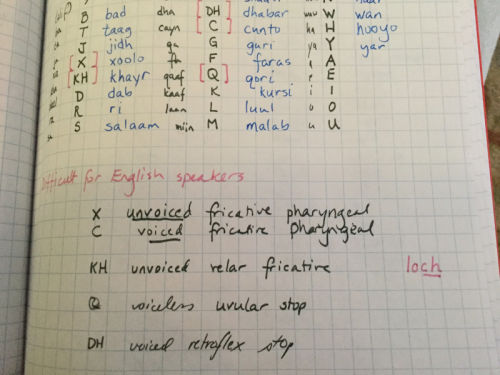
    C – Voiced fricative pharyngeal.

    Magacaygu.  Magacaygu Erin.

    "Maga-ayygu."

     Who says there's no voiced fricative pharyngeal in English?

    + + +

    Do you remember learning to whistle?  I barely do, but I've been watching my 8yo do it for a month or so.  I showed him how to purse his lips and put his tongue, and he worked until he got the faintest little hint of a whistle when he blew.  "Start there, and keep trying," I told him.  I've been noticing him walking about the house puffing and working his mouth, the little whistles getting stronger and stronger; he's controlling it better and better as he goes.  Now that he's adjusting his lips and tongue and diaphragm in response to the feedback he gets from his own ears, he's improving; but he needed to learn how to make that thin, high near-whistle before he could even start practicing on his own.

    I'll have to check with the instructor next class… but perhaps my waitress's channeling of the Fonz will give me a place to start, at least with the letter C. 


  • Quiche au thon, from an American fridge.

    I really need to recipeblog more, if for no other reason than it keeps the posts coming (has it really been eleven days?)  Anyway, Lent is coming, and I've got a good meatless recipe for you.  

    + + +

    I'm in a very busy time of life.  I know, we're all busy, but I'm convinced that I'm in one of the busiest times of the arc of my entire life as a parent, thanks to lifestyle choices that have me homeschooling a preschooler, a second grader, a sixth grader, an eighth grader, and a high school senior all at once.  Many things that are not just enjoyable, but objectively good for me, have gone by the wayside:  getting to the gym more than once or twice a week; reading novels; cooking dinner.

    It turns out that I can get by on planning cooking three and a half dinners a week.  What happened to the other three and a half?

    • Saturdays, one of the kids makes dinner.  They take turns.  This week, the 8th-grader got a hankering for sausage ragù, so he announced that he would be making that.  I am not complaining, though I did strongly suggest that he make a very light side dish to go next to it, like fresh grapes, or plain green beans.  Caesar salad–his first choice–would be a bit much.
    • Sundays, we have "plate"–or you could call it smörgåsbord–or charcuterie.  Cured meats, cheeses, crackers, maybe a baguette with spreads, veggies and hummus.  Occasionally we swap it out for raclette.  
    • Mondays, I'm at H's, and she and I take turns making dinner.  That's the half-dinner.  I am not even sure this should count, as about three-quarters of the time I make the same pot of emergency chili in her crockpot.
    • Wednesdays Mark goes to the grocery store, and so Wednesday is Leftover Night.

    + + +

    I interpret "leftovers" broadly. 

    No one is allowed to open new packages on leftover night, except insofar as is necessary to contribute ingredients to other dishes made out of leftovers.

     If there are enough refrigerated containers of partial meals that weren't entirely eaten to feed our children (plus H.'s children who stop by between choir and climbing practice), then those things go out on the counter and that's that. 

    If that isn't quite enough I will conjure a fresh loaf of bread from the bread machine, and set out butter and peanut butter and jam.  Perhaps I'll put out cheese and crackers or vegetables and hummus, if it's already opened.
    If that isn't quite enough either, I will make something out of eggs. 

    + + +

    Tonight I had only a little bit of soup left over, so I made something out of eggs.  I had a single refrigerated pie crust that's been in the fridge since, I think, Thanksgiving.  I also had an elderly half-jar of sun-dried tomatoes to use.

    I took some inspiration from a recipe on a French cooking website that I subscribe to on Facebook, but engaged in some serious substituting–remember, the name of the game was using up leftovers. 

    The result was very good–probably more appealing to the children, with the mildness of mozzarella cheese, than the original might have been.

    Quiche au Thon aux Restes

    • One pie crust or pȃte feuilleté (whatever you have on hand or like to make)
    • About 1.5 Tbsp dijon mustard
    • One 5-oz can tuna in oil, ideally a better-quality tuna in better-quality oil (mine was Italian wild-caught yellowfin in olive oil)
    • About four halves, or the equivalent, from a jar of oil-packed sun-dried tomatoes
    • 4 large eggs
    • 1 cup cream, or however much cream you have plus whole milk to make a cup.  Sour cream or Greek yogurt will probably also work if thinned with some milk
    • Shredded mozzarella cheese, a couple of handfuls
    • Salt and pepper

    Preheat the oven to 400° F.   Unroll the pie crust into a pie dish according to package directions or recipe for a single-crust pie.  

    Smear the mustard all over the bottom of the pie crust; use enough mustard to cover with a thin layer.  If you really like mustard, go to town, but don't overdo it.

    Drain the tuna, flake it with a fork, and cover the pie bottom evenly with tuna flakes.

    Use a knife to chop or sliver the sun-dried tomatoes (if they are already in slivers, just use those as-is) and distribute over the tuna.  Again, if you love sun-dried tomatoes, go crazy if you want.  I found that four half-tomatoes was enough.

    Sprinkle about a half-handful of the mozzarella over the contents in the pie crust.

    Beat the eggs and the cream with salt and pepper, and pour over all.

    Then add more mozzarella, until it looks like the pie crust is full-ish.  Really, it doesn't matter how much you add.  It's mozzarella.  It'll be cheesier if you add more, and eggier if you add less.  Don't stress.

    (If you have a little parmesan, comté, or gruyère, I'm sure it would be fine also.)

    Bake near the top of the oven for… I don't know… twenty minutes?  Twenty-five?  I forgot to set my timer.  It got a little brown.  You should always check a quiche, because sometimes the crust gets too brown before the eggs are fully set; and if that starts to happen, put on a silicone pie guard, or make one out of aluminum foil.

    Cool until just a bit warmer than room temperature and enjoy.

    With leftovers.

    IMG_4681

    I found that the creamy eggs softened the salty, mustardy tuna and the acid tang from the tomatoes, and made for a balanced dish.  Mozzarella, of course, hardly makes itself noticeable; with tuna, I prefer a cheese that fades into the background, because I think that tuna and cheese often fight with each other except in very specific contexts (e.g. classic American diner tuna melts).  But the Italian olive-oil-packed tuna has an assertive flavor, not the tinny taste of Chicken-of-the-sea, that stands up to it.  Made with heavy cream, it's rich and yet simple, and the mozzarella raises the protein content and holds it together without getting in the way at all.  Puff pastry or a homemade butter crust would make this even better, but a refrigerated rolled pie crust did not noticeably detract (and made the whole thing very quick and easy).


  • Bullet journal for young teens, II.

    In the last post I wrote about transitioning my 14yo homeschooled eighth-grader from managing his assignments with a daily to-do sheet filled out by me, to a bullet journal.  I described how I sat down with him on a Monday and showed him how to set it up.  

    On that Monday, I went through the following steps with him:

    1. numbered the pages
    2. made a two-page-spread Weekly Log, left side undated, right side divided into days
    3. entered his assignments for the upcoming week on the undated side of the Weekly Lig
    4. put check boxes next to all the to-do items
    5. started a Key for him
    6. showed him how to migrate tasks from the undated list forward to specific days
    7. made an undated Future Log for tasks to do “sometime”
    8. showed him how to migrate a non-urgent task back from the weekly list to the Future Log
    9. made an Index

    Later in the week, as he worked with the bullet journal and completed tasks, we added more features.

     + + +

    10.  “Go back to the blank page 9 and label it ‘Next 5 Weeks.’  This part of a bullet journal is usually called the Monthly Log, but we are going to organize things on a weekly basis because that’s how I do your school assignments.”

    He flipped back and labeled the top of the page, and then I showed him how to date each line of the page, starting with Monday of this week and ending with Sunday of the fifth week out.

    "This is like the Future Log, except that it has specific dates for the next month or so.  We’ll make a new one after four weeks.  If you are looking at your Weekly Log and you decide that one of the tasks is something you would like to do, say, next Tuesday, you can migrate it back here and write it on Tuesday.”

    11.  “Let’s enter some things from the family calendar on the Five-Week Log.”  I pulled up my Google Calendar on my phone and showed him.  He wrote down a couple of upcoming Scout events and two days he was scheduled to serve Mass.  

    I added, on the last Monday, “make a new ‘next 5 weeks’ page.”

      CA155197-6D3C-4881-B460-77240C4EA1DE

    12.  “What if you decide you want to do something in a couple of months, say in March?  For that we need to make a dated page on your Future Log.”  I sent him back to the Future Log and had him copy a simple twelve-month calendar onto the facing page.  We added a couple of events to it.

      0671F88E-382A-47BD-ABD6-EC8BB35F087A

    “Here’s an important rule to keep the journal simple and uncluttered:  Don’t put tasks on a month unless you are sure you will do them that month.  Don’t put tasks on a day unless you are sure you will do them that day.  Tasks can stay on the undated lists and be checked off from there.”

    13.  “Let’s go through your Weekly Log so far and update it.”  He turned back to the weekly page with the assignments I had added on Monday, both in the undated list and in specific days.  Some of the items were checked off, some not.  

    I went down the list with him:

     “Did you do this one yet?” 

    “Yeah.”

    ”Fill in the box.  Okay, what about this one, is it done yet?”

    ”No, I don’t have to do that one till tomorrow.”

    ”Okay, are you going to really have to do it tomorrow?  Or can it wait till the weekend if you run out of time?”

    ”I really have to do it tomorrow.”

    ”Okay, let’s migrate it to the tomorrow list.”  

    He added the “migrate forward” symbol and rewrote the task in tomorrow’s day box.

    We ran down the list, updating, and adding a few new tasks.  “The idea behind this key is that by the time you make a new weekly list on Monday, you won’t have any more empty check boxes on this week’s list. You don’t have to have actually done everything.  The main thing is you won’t have lost track of any tasks.  You’ll either have completed the task, moved it to another list, or deleted it, and in all of those cases you will have marked the check box.”

    14.  “We’re nearly through the week, and there’s still stuff to do.  Let’s mark all the remaining schoolwork items as Urgent.”  I got a red pen and put an exclamation point next to all these items, without changing the checkboxes.

    ”So we won’t put these on the day lists, because you are free to do them any day this week you want, including over the weekend.  But let’s require you, on Friday, to make a plan to do whatever’s left of these.”  

    I wrote “make a plan to do all the ! before bedtime” in Friday’s block.

    ”This way, we haven’t cluttered up your days with all the tasks that are still outstanding now, but if there are some left on Friday you’ll need to decide what to do with each one then.”

    By now the weekly log looked like this:

      EFD4EA60-B5D2-4270-9F93-8D76E12B7107

     + + +

    How did it go?  So far, pretty well, I think.  I saw him carrying it around and writing in it.  I used a paperclip to fasten his science quiz inside the front cover on Friday, just like I used to clip the quiz under his to-do sheet on his to-do clipboard before, and that worked really well.  I wish there was a little more room to write the exact assignments, like the math problem numbers; maybe this means we will have to expand the undated weekly log to a whole two-page spread and go to individual daily logs, I don’t know.  We will be tweaking the layout as we go.

    One pleasant surprise:  the boy in question seems very positive about this new development, even eager.  I get the impression that he now regards the weekly sheets I made for him all through middle school as a thing of childhood to be put away, and the bullet journal as a manlier thing.  Something that sets him apart from his younger sister and puts him in the company of his older brother now taking college classes.

    A test of this will come on Monday, when we set up the second weekly log.  Will it be too boring and repetitive?  Will he balk at migrating tasks by rewriting them?  Or will it still be interesting?  And will he have gotten things done?  

    Come to think of it, I’d better check that last bit on Sunday night, while there’s still time left in the week.


  • Bullet journaling: Teaching the method to an easily distractible teen.

    I write my middle schoolers’ assignments on a weekly to-do form.  Each entry is assigned on a particular day (Tuesday, Wednesday, or Friday—the other days, we coschool).  They check the assignments off as they are done.  Chores go there too.  At the end of the week, I file the to-do list away as my record of what got done.

    0A5CDE78-A548-4CC3-B7F7-EDB3FE935719

    When my oldest started high school, we simply dropped the to-do list, and I started giving him assignments weekly.  That worked pretty well—he’s always been a responsible one—but not as well as I would have liked, at least at first.  

    As my current 14yo enters the second half of his eighth grade year, I want to lead him a little more intentionally through learning to keep track of his own assignments.  It seemed to me that the bullet journal is a good place to start for this one:

    • He’s a very physically active, kinetic sort of teenager, easily attracted from his work and never sitting still.  He craves novelty.  A planner page that can’t be changed is a planner page he’ll get bored with.
    • He doodles on absolutely every piece of paper you put in front of him.   Extra blank paper will help.
    • He has been developing his power to stay on task through distractions and interruptions by practicing the pomodoro technique, at my encouragement*.  This involves making a little check mark on paper when an interruption or distraction comes along, as a way to sort of satisfy the urge, and perhaps writing down the thought or desire so one can come back to it; and keeping track of how many cycles of 25-minute work periods and 5-minute rest periods one accomplishes.  So it helps to have extra blank paper for this, too.

    *Tip for helping a distractible young person learn the pomodoro technique: Immediately reward them with a piece of candy upon completion of each pomodoro.  

    Besides all these, I had been watching some videos promoting bullet journaling as a good technique to help the ADHD brain manage tasks.  A child psychologist evaluated the 14yo over the summer and did not diagnose him with ADHD, but we were advised that he has a few things in common with kids who do receive that diagnosis, and I thought that the video advice might apply to him.

    I had a nice new graph paper composition book, the kind I like best, lying around waiting to be used for something.  So I snagged it, along with some pens and a ruler, and waited for an opportune time.

    + + +

    Before I sat down with him I put some thought into how I would introduce it.   I didn’t want to overwhelm him with too much information at once, so I decided that we would set it up over several days, and start with the absolute minimum.   I drew up some dummy example pages, made from photocopied blanks, as I planned them. Here is what I settled on:

    • Page 1: blank
    • Pages 2–3:  Index
    • Pages 4–5:  Blank for now in case we need to add something
    • Pages 6–7:  Future log, generic on the left, monthly on the right:


    65A90648-6147-4003-86E1-C00ED91139E3


    • Pages 8–9:  Sort of a monthly log, generic on the left, dated on the right; only instead of a calendar month, it’s just going to be for the next five weeks, Monday-through-Sunday.

    6E20568C-F5ED-43A2-9917-EAAFBE974E8E

    • Pages 10–11:  The first weekly log.  The left page would be where I would write the week’s assignments, to start a to-do list.  The right side would be divided up into the days of the week.

    DF04763B-3169-462D-8629-AAC7762DDE1B

    For the time being, no daily logs.  I figured I would only introduce those as they became necessary.

    + + +

    On the first day of the second semester I sat down with him, the notebook, and writing supplies.  I explained that instead of to-do lists every day, we were going to start practicing time management weekly.  "I will write your weekly assignments in your notebook on Monday mornings," I explained.  "You'll check them off as you go.  Then, at the end of the week I'll photocopy your list and save that for my records, and you'll keep the notebook from week to week."
    Here's how I told him to set it up:

    1.  "Number the first twenty pages or so."  No point in going crazy and numbering the whole book at once; when we run past the first twenty, we'll number another few.

    2.  "Turn to the spread on pages 10 and 11, and copy the weekly log."  I had him copy it exactly:  ruled lines, dates, and all.  He had a mostly-blank page on the left, and a space for each of the next seven days on the right. 

    3.  "I'll write your week's assignments on the left side of the page."  I fetched my own pen and my school schedule, and with him watching I wrote out his list of assignments on the undated side.  I wrote them organized by subject, which is how they come out of my brain:  first the week's three history assignments, then the week's three science assignments, and so on.  

    "I was thinking, sometime I want to learn to make scones," he suddenly interrupted me.

    "Good thought!" I said, and added "make scones" to the bottom of the list.  Aha, I thought, I can use this later.

    4.  "For each of these tasks we'll make a check box, just like the ones you're used to having on your to-do list."  I drew a little square to the left of all the tasks (including "make scones").  

    5.  "When you finish a task, fill in the box completely.  Here, let's start a key so you can see what you're doing."  I grabbed a pad of large-format sticky notes and wrote:

    IMG_4575

    6.  "If there's anything that you already know you absolutely have to do on a particular day—say, this science quiz that you'll take on Friday—we're going to migrate it to that day."  I went down the list and found the science quiz, and showed him where to copy it into the Friday box.  And then I showed him how to fill the weekly check box with the "migrated forward" symbol, and added it to the key:

    IMG_4575

    I had him migrate a few more things to specific days.  While he was at it, I had him add some new dated events that we thought of:  confirmation class on Wednesday, for instance, and painting, which we only do on Fridays.

    7.  "Now turn back to page 6 and label the very top of that page 'Future Log.'"  He went back and wrote that down.  I didn't have him add the twelve-month calendar just yet.

    8.  "If there's anything on your weekly list that you realize you're not going to get to this week, but you still want to get around to it sometime, you'll migrate it back to your Future Log."  

    He looked confused, so I said:  "Look, let's talk about those scones you mentioned, okay?  Let's say you won't have time this week to make scones, but you still want to do them sometime and you don't want to forget that you had the idea."

    "Okay…"

    "Go back to your Future Log and put an entry for 'make scones.'"

    He did this.  Then I brought him back to his weekly log and showed him how to make the "migrated back" symbol in the check box.  And the we added it to the key:

    IMG_4575

    9.  "The last thing to do today is make an Index."  I had him go back to page 2, label it Index, and add the following entries:

    Future Log p. 6

    Jan. 15-21 p. 10–11

    And that was the end of our first session with the teenaged bullet journal.  Tune in next time for the introduction of the monthly-ish log and a summary of how it all went.  And possibly a recipe.


    IMG_4576


  • Intrusion of someone else’s schedule.

    Maybe the thing that Mark and I love best about homeschooling all the children is that we set our own schedule.  Nobody tells us how much time we get to spend with our own children.  Nobody tells us how much homework we have to supervise each night.  Nobody tells us when we are allowed to go on vacations, or when we have to come home.  We decide when to get up in the morning and when to go to bed.

    All that is about to change this coming week, and I'm bracing myself for it.

    + + + 

    My oldest is a high school senior, and in this last semester of school-at-home he has elected to take a few college courses at the state's flagship university, for which he'll get both high school and college credit.   Our main motivation for encouraging this is to get him used to rigid demands on his time, after twelve and a half years of flexibility and personal attention, before he has to jump right into full time college next year.

    Q.  Why didn't he start in the fall and get two semesters' experience? 

    A.  Because we wanted to take a long family trip in September.  

    Priorities.

      IMG_0602    IMG_1022     IMG_5867

    + + +

     So I'm sitting here making a spring-semester daily schedule for the rest of us, for the first time ever; up till now, our schedules were always good for a full year.  I'm deleting the two meetings a week I had in the fall with our oldest to teach him Calculus II; I'm deleting our once-weekly meeting for Religion; I'm moving Physics II to the afternoons.  He won't have English with H. anymore, although we'll still do Latin IV together on our coschooling days, along with H's oldest who is otherwise a full-time college student himself now.

    Besides Latin IV and Physics II with me (twice a week each), he'll be taking microeconomics, calculus (again), and contemporary literature, for ten college credits.   I heartily approve of this schedule.  I think it will be challenging but not overwhelming.  I am glad he is taking economics from someone who is not me.  I am glad that H. concentrated on composition for the first half of his senior year, and am satisfied that contemporary literature will slot nicely and with novelty into a high school curriculum intentionally dominated by classic works.

    He will have to be on campus by eight a.m. most days, nine a.m. the others; conveniently, Mark can drive him there on the way to work, much as he used to drive me while I was in my Ph.D. program at the same university.  He can get home on the bus most days.  On Mondays I will fetch him from campus on my way to H.'s.  On Thursdays H.'s son will fetch him on the way to my house.  We shall see how well this commuting plan works.

    + + +

    We are going to have to take our ski trip during Spring Break this year, instead of in February, and we can't take any extra time to drive leisurely.   This fact keeps blowing my mind.

    + + +

     Another thing that's different:  I am going to have to assign him fewer chores than his siblings this semester, despite the fact that he is by far the most competent chore-performer in the house. 

    Currently, he does a lot of child care, lunch-making, dishes, and daily sweeping-up, as well as the monthly pickup we have to do before the professional housecleaner arrives, the occasional cooked dinner, and assistance with some household project of his dad's. 

    (Not to mention reaching a lot of things from high shelves for me.)

    This aspect of his absence is going to be really difficult, so habituated am I to yelping to him for help all day long.   I've calculated:  He really should be spending forty hours a week on his studies, if you add up class time and homework time and commuting, and include the two high school courses he's still taking from me.  

    We'll still be requiring him to do some chores, of course; they're part of living in a family.  But we are going to have to dial it back.  I'll probably have a talk with Mark and work out how many hours a week is a reasonable amount for a full-time student living at home to contribute (mental note:  should be at least as much time as he spends playing online games), and from that derive a list of which responsibilities he should keep and which I should dole down the line to his younger siblings.   

    + + +

    The silver lining:  I, too, have to ease into the time when my young right-hand man heads off into the next chapter of life.  I'm really excited for him.  I can't wait to hear how his classes are going.  I'm pleased, vicariously, at the thought of this firstborn launching into the world.  I remember well the intoxication of leaving home and finally having power over my life, my environment—indeed, over my schedule. 

    I'm so happy for him that he is finally going to be able to pass into that part of life.  Even if, temporarily, I have to live with his schedule for a while first.