bearing blog


bear – ing n 1  the manner in which one comports oneself;  2  the act, power, or time of bringing forth offspring or fruit; 3 a machine part in which another part turns [a journal ~];  pl comprehension of one’s position, environment, or situation;   5  the act of moving while supporting the weight of something [the ~ of the cross].


  • Before the start of the year.

    Trying to get back into the blogging habit means, I'm sorry to say, writing when I can't think of something to write. 

    + + +

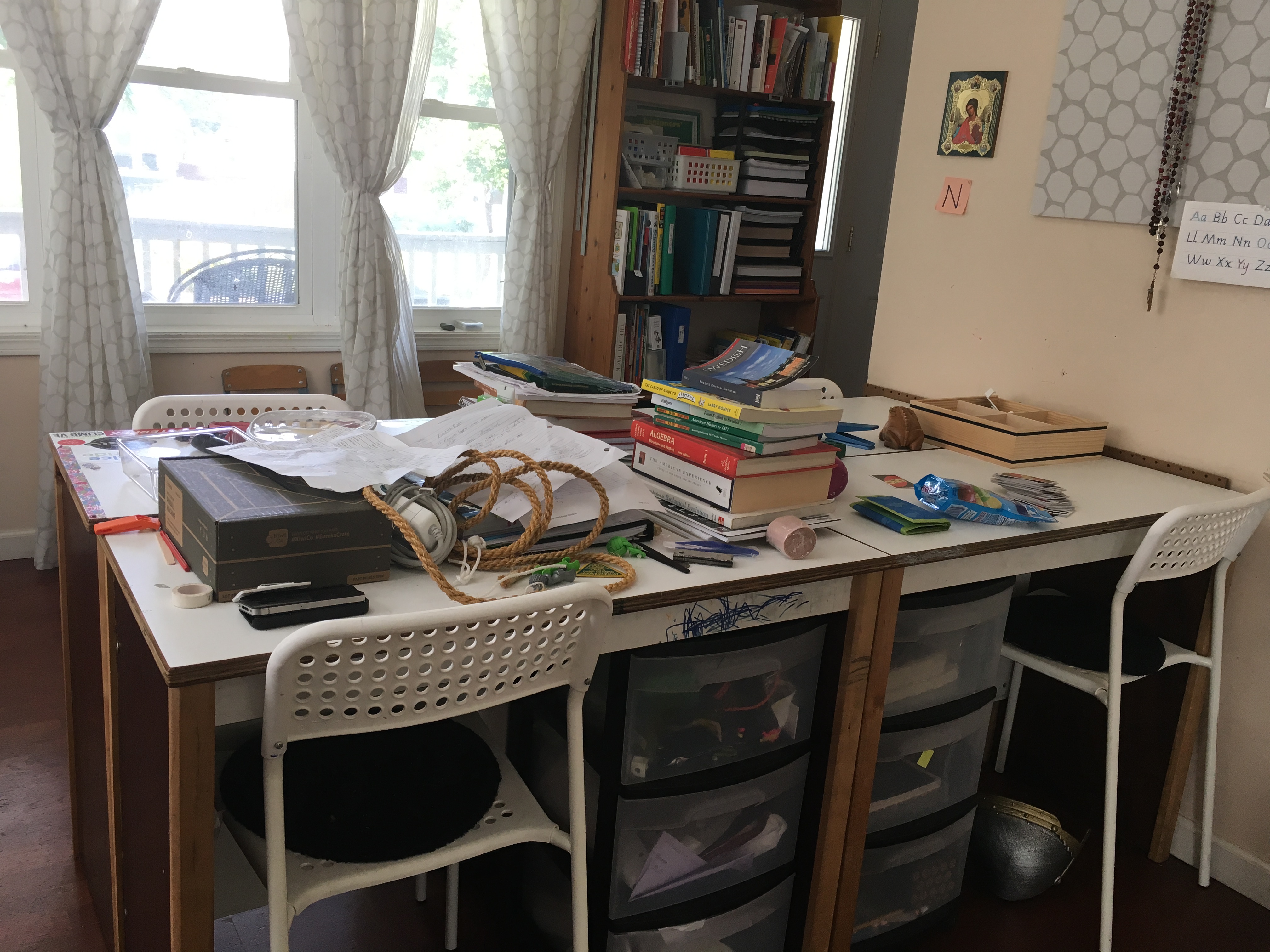
    It's late July, and I am just now pulling my schoolroom together as well as my outlined lesson plans for the year.

    IMG_7401

    After a couple of years of having the desks separated, I've pushed them back into table formation.  This is mainly for H's convenience, because on Thursdays she'll be running language arts sessions (mainly phonics and memorization of nursery rhymes) with three kindergarteners, while my fourth-grader does independent reading and such nearby.  I think it'll also help me manage the two youngest on the other days of the week, though.  

    The bigger two don't sit at the desks much anymore, but it's there if we need the table for something else, and they do store supplies in the drawers.

    + + +

    IMG_7406

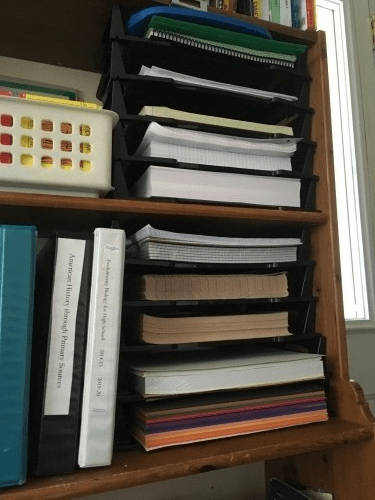
    Now that my youngest is five whole years old, I realized I don't actually have to lock away everything that could be dumped out on the floor.  I can put a box of colored pencils and another box of crayons on the bottom shelf.  I can stack trays of all the paper right out there where I can see it.  It's so freeing.

    + + +

    What's going on this year?  Number one son will be off at college again, of course.  He got into the business school, which was the main unknown hanging over his head, and so things are looking good as far as he is concerned.  Number two, who turns sixteen soon, will have biology and algebra and English and driver's ed and American history and Swedish and art.  Number three, the eighth grader, has Latin and algebra (half time) and geometry (half time) and English and history and botany and also art.   What's great about those two kids is that nearly everything they are doing, I have been through once before, and I saved all my stuff, so maybe I won't have to reinvent so many wheels.  Botany and Swedish are new, but I have a workable curriculum for each.

    The nine-year-old is sort of cobbling together a bunch of things.  He wants to learn Greek still, so I'm doing my best to feed that.  And he's got his math program, and language arts from Hannah, and he'll be starting the geography program I love so much this year.  For science, what he wanted more than anything was just to alternate doing kits with good read-alouds, and that sounds fun to me, so I'm going to give that a try.  We're going to start by building a Gauss rifle and learning about velocity and acceleration, I think.  After that I have a kit about collisions.  I don't know how long it will take to do those, so we'll start from there and then decide what to do next.

    As for the kindergartener, who is already five and a half, well, all you really need to do is follow along in a math program, work on learning to read and write, and read aloud some books.  Have some art supplies available, I would normally say, except that this five-year-old doesn't spontaneously make art much.   They're all different.

    + + +

    The years are much the same, in broad strokes.  A big binder labeled with the different subjects,filled with grade recording sheets I make myself, and the first few weeks' assignments ready to go.  The bookshelves behind me all newly rearranged and arrayed in their beauty.  A newly cleared-off counter:

    IMG_7404

    And of course that sense that this year I'll totally be able to keep track of everything, no one will flop onto the floor making grunting noises, everyone will do all their assignments on time, nothing will take longer than the time I have allotted for it, and serenity will reign in our home.   I can enjoy it for a few weeks, anyway.


  • Accomplishments.

    Do you ever tell yourself the story of your life, in your head?  Do you ever revise the story as you go?  

    I do, all the time.  I am not sure if the revisions are a kind of erasure and rewriting of history, or if they are a kind of re-interpretation of history, an improvement of perspective as time carries me farther and farther away and I can take a wider view.

    + + +

    As a girl I was told, too often I think, that I would someday do Great Things:  all the individual people meant well, or at least meant nothing serious, but the total accumulation of expectations weighed heavily.   

    At the same time I heard other things, too, and I think they carried the same weight:  that I didn't know how to deal with people, that I didn't know how to make friends, that I wasn't naturally likeable, that the problem wasn't what I say but always how I say it, that I didn't know how to dress myself, that I was physically clumsy and physically lazy. 

    It wasn't my sibling's fault, and I know this, but I got compared to him a lot, and the message was something along these lines:  You're pretty book-smart, but I'm a lot less worried about him than I am about you.  I know he'll do well because he's doing fine in school and he knows how to get along with people.  People like him.

    (Who knows what he heard or didn't hear from the other side of those comparisons?)

    + + +

    So, ultimately, I achieved some of the things I said out to do, and a lot of them were difficult and much of them were rewarding.  I haven't (yet) accomplished any of the Great Things.  I mean, plenty of Not-Too-Shabby things in that domain, but nothing world-changing.   And then of course I stopped trying in that domain entirely; I quit it.

    One of the things I'm gradually editing and rewriting in my story, though, is the column labeled "Accomplishments."   And here's the reason. 

    I quit that other domain, in part, because I felt myself (more than most people!  this isn't about you!) to be internally and invisibly disabled, hampered, struggling.   I'm not talking about imposter syndrome, I'm not talking about struggling as a scientist, though of course there was imposter syndrome, and of course it is challenging to be a young scientist.  I expected that, we should all expect that.  I'm talking about feeling disabled as a human being who relates to others.  I felt that I operated in a kind of impairment, that it was always going to take extra work, extra attention, extra care for me to hold my family together, or maybe to hold myself together enough.  Deep down, I did not think I could do both things adequately.  (No, not even when acknowledging that it's not just me who has to do the holding-together.)

    I know and admire many parents who can, and who do; who don't just hold it together, who excel.  I didn't think I could be one of them.   A few years of parenting and sciencing at the same time only reinforced it for me.

    + + +

    Weighing the opportunity cost now, I am trying to honor as accomplishments the relationships I have built.   The girl who wasn't naturally likeable has been married twenty years to a very good spouse who, by all appearances, loves her dearly.  The girl who was physically lazy is raising five lovely children.   The girl who didn't know how to make friends, well, she doesn't have a lot of friends, but she has some very, very good friends, real ones, who have made a tremendous difference; with some effort (maybe more than most people need) she's kept the best of the ones that go way back, and still occasionally makes new ones.

    These are things that I have worked hard for, and not things that were laid on me like weight, like expectations; they are unlooked-for gifts that I've thrown all my efforts to,  in order to keep and steward them.  I'm grateful for the opportunity.  They will never belong on a CV, of course, but I'm telling this story to myself, and they go in.


  • Cognitive labor and recipes.

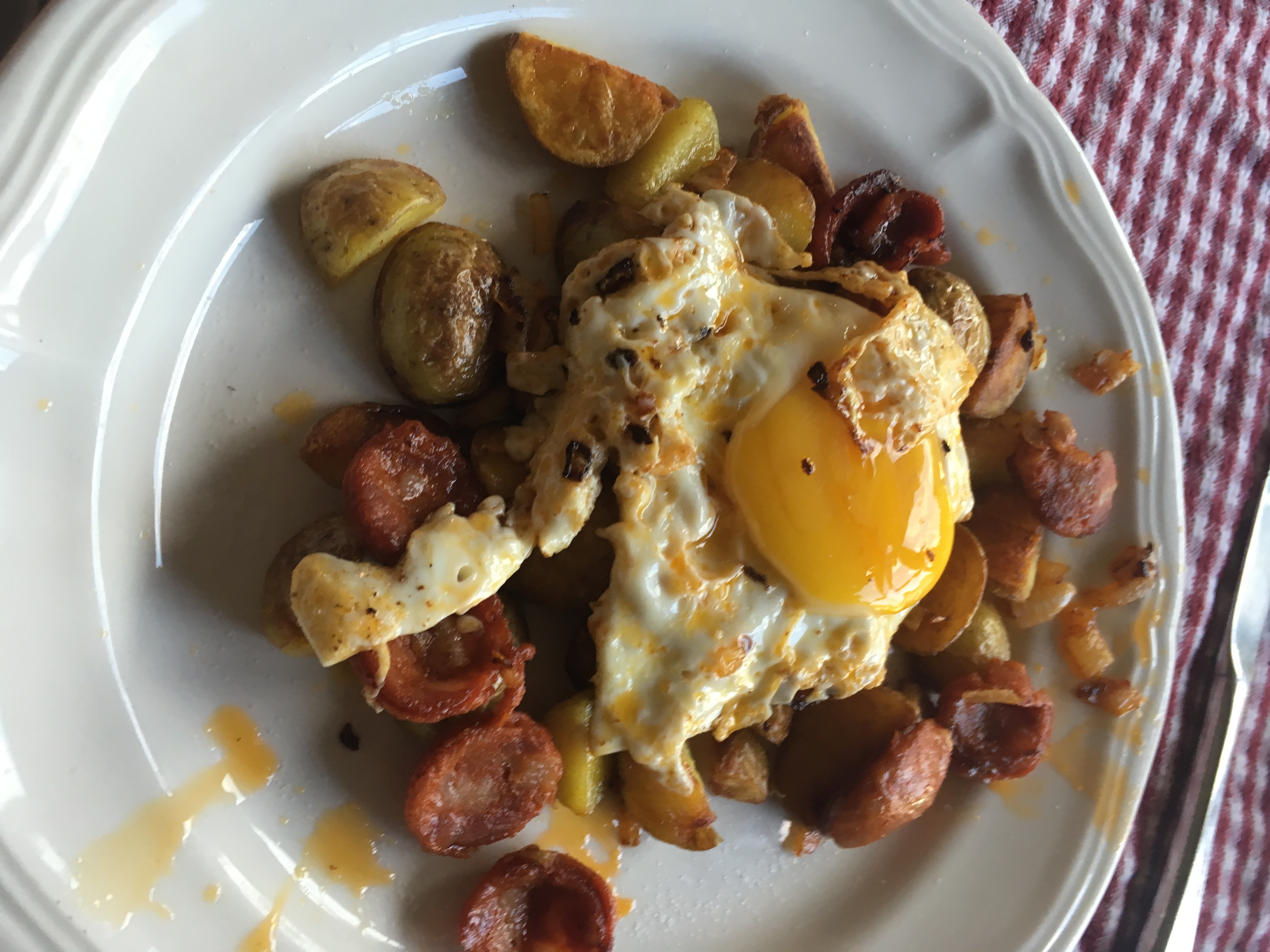
    Last night I used the second half of a package of Spanish-style chorizo to make huevos rotos.  This tastes pretty close to how we had it in Spain. Recipe follows, and blog post below that.

    IMG_7396

    Simple Huevos Rotos (broken eggs)

    • 1.5 lb tiny potatoes… you know those bags of prewashed potatoes they have now?  One of those bags.
    • 2 links (so, 4-6 oz) of Spanish-style, fully-cooked chorizo sausage
    • 1 small onion, optional
    • About 1/3 cup extra-virgin olive oil
    • 4 eggs
    • Salt to taste

    Cut the potatoes into halves or quarters, 1" pieces, and boil in salted water until just tender; drain and spread on a towel-lined tray to dry fully.

    Meanwhile, cut the optional onion into small dice and slice the chorizo thinly.

    When the potatoes are dry, heat 1/4" of olive oil in a broad skillet that can hold them all.  Fry the potatoes, stirring gently, till browned and as crispy as you like them.  Remove all the potatoes with slotted spoon and divide among four plates (if that's too many potatoes, put any extra to drain on paper towels); salt them.

    Add to the hot oil the onion (if you like) and stir, then the chorizo, just for a couple of minutes; remove with slotted spoon (if you dislike burned onion, be sure to get it all out) and scatter over potatoes.  

    Fry eggs two at a time in the hot chorizo-flavored oil, sunny side up.  Poke the whites with your spatula to spread them out and give them a lacy edge; baste the whites with a spoon.  When the edges are crispy and the whites set, but the yolks still runny, drape the eggs over the potatoes and chorizo.  Break the yolks so they run all over, and serve.

    + + +

    I've wanted to attempt huevos rotos ever since we had it on our brief vacation together in Spain last fall.  I've kept it there in the back of my mind as I made the grocery lists and meal plans, and checked the meat sections of the various supermarkets I have shopped in; they often had chorizo, but always the Mexican style, which I'm not as fond of, or an American "chorizo" that isn't quite the same.  When I was out on a long walk in Northeast Minneapolis last weekend, I stopped into Kramarczuk's (no dice) and then into Surdyk's cheese shop, where–hurrah!– I found a twelve-ounce package of Spanish-style chorizo.  I stuck it in the fridge and the next time the meal plan came around I figured out which day I wouldn't be gone all day, nor too tired to cook in the evening—a Saturday—and put it on the list.  I stuck a Spanish rosé in the fridge that morning.  It was a brilliant dinner.  And since it only used half the package of chorizo, I did it again last night.

    + + +

    A few days ago a new paper came out in American Sociological ReviewDaminger A, "The Cognitive Dimension of Household Labor."   I appreciate Daminger's emphasis of the term "cognitive labor" here, because there's been a lot of messy terminology being thrown around about the work of generally keeping on top of the household.  I've particularly been annoyed by a trend towards calling it "emotional labor," which is a problem because

    • (a) "emotional labor" already has a useful meaning, i.e., the part of any job where you have to work to manage other people's emotions or work to control your own, and
    • (b) "emotional labor" as a referent to the management of physical tasks is precariously and non-ironically close to meaning "women's work."

    The same tasks have also been called "invisible labor" by others, but Daminger's term is more precise, and I think she's done us a favor in describing it in some detail.  From the abstract:

    The data [in-depth interviews with 35 couples] demonstrate that cognitive labor entails anticipating needs, identifying options for filling them, making decisions, and monitoring progress. Because such work is taxing but often invisible to both cognitive laborers and their partners, it is a frequent source of conflict for couples. Cognitive labor is also a gendered phenomenon: women in this study do more cognitive labor overall and more of the anticipation and monitoring work in particular. However, male and female participation in decision-making, arguably the cognitive labor component most closely linked to power and influence, is roughly equal. These findings identify and define an overlooked—yet potentially consequential— source of gender inequality at the household level and suggest a new direction for research on the division of household labor.

    I am genuinely interested in cognitive labor as a gender issue, not because it is a source of conflict in my own marriage, but explicitly because it isn't

    I completely understand how it can be.  I have observed such conflicts in others.  In my experience, this kind of conflict is responsible for a very high number of the "ha ha, aren't husbands always like this" sort of small talk that you occasionally get when a lot of mothers are together in a room.   

    So… why do I not perceive it as a source of conflict in our home?  Here are some possibilities.  

    1. My spouse and I share the cognitive labor relatively equally:  I specialize in some parts, and he in others, and we don't have an expectation that we'll keep track of the stuff that's in the other's sphere.  (This is my knee-jerk explanation.)
    2. We don't share it equally, but we are content with the division:  whoever's shouldering more is glad enough to be in charge of that stuff instead of something else. 
    3. We don't share it equally, but whoever's shouldering more has lower standards and/or has accepted their lot in this marriage.
    4. Actually, it's Mark who is carrying a burdensome cognitive load and I'm the one who is as clueless as the spouses (both male) who are quoted in the opening lines of the paper.  If you knew me in person, you would know that this is not an outlandish possibility.

    I'm looking forward to reading the paper in depth because Daminger applies to her thirty-five couples the kind of analysis that speaks to me.  She divides up the cognitive labor in the household into separate "domains," and classifies each as "male-led," "female-led," "shared," or "undetermined."  Along the way she identifies four components of cognitive labor (anticipation of a need, problem, or opportunity; identifyion options; choosing an option; and monitoring the results).  I noticed and appreciated that she left out the performing of the task—a lot of discussion of this kind of thing seems to me to have conflated the task-doing with the mental tasks, so she's made a newly nice distinction.  And then she examines the couples' dynamics for sources of conflict, the reasons why it doesn't make always make it into the couple's "economy of gratitude," and the balance of overall load and decision-making power.

    (Yes, I'm setting myself up to write a follow-up post.  Fingers crossed.)

    In the meantime I find myself musing about the cognitive load I perceive myself to carry. As a matter of personality and skill-set, I enjoy most kinds of cognitive labor more than most kinds of physical labor.  I will very often perform cognitive tasks, even fairly rote and low-level ones, as a means of procrastination of physical labor.  I loved being at school.  I didn't like the stress of graduate school very much, and I turned out to be a poor experimentalist, and it was hard to juggle everything after I had babies, but the actual academic work—the reading and writing, the computer code, the hours in the library, the organizing of information, the pencil-and-paper calculations—flowed right by.  I would look up and hours would have gone by, and I didn't even notice it.

    It would not be an exaggeration to say that I have chosen to take on most of the work homeschooling our offspring, in part, because it has allowed me to "cognitivize" a life of mothering at home.  As I write, the other windows open on my computer desktop involve detailed schedules of the school subjects that my homeschooled children will be starting this fall:  pages and pages of spreadsheets and booklists.  I've taught myself one whole new language and parts of four others, learned a considerable amount of  biology and art that I never got in school, crammed a lot of educational psychology to try to help one child struggling with the ability to focus, and worked out on my own how to put together a transcript customized for two different universities.

    All this is a lot of work, but work I enjoy (much more than the work of sitting down with anyone who is at all recalcitrant or fighting off sleep and trying to teach them).  I am primarily concerned with my own sense of satisfaction in a life well lived.  I admit one navel-gazing indulgence:    I occasionally consider whether the wider world has, in net, lost or gained from my decisions.  I'm not a special person, but my cognitive power has been trained at considerable expense to the taxpaying public, who might have expected to get some kind of results out of me.  And what do they have?  Not much work put into the economies of money and academy;  almost everything into an economy of relationships.  Almost all my efforts  into just a few people, instead of spreading it out and having a smaller effect on many.  Who knows who paid the opportunity cost?

    I do not know.  But I know this:  I eat very well.   

    And that is as good a stopping point for this post as any.


  • In which I make an appearance.

    The most boring kind of blog post is the "why I haven't been writing" blog post.

    + + +

    Scratch that.  Sometimes, I bet, posts of this type can be gripping.  I might have just awoken from a coma.  Mark might have come home unexpectedly, weeks ago, with tickets and inn reservations for a lengthy hiking adventure in Scotland.   I might have gone bankrupt and failed to pay my Typepad subscription on time.

    But, no.

    + + +

    If these posts are so boring, why do they exist?  Why am I making one?  I think these posts aren't for the reader, for a reader, for any reader.  They are not really meant to be read at all.  They are for the writer:  they are the first interminable jog around the track after months on the couch.  Barely an effort.   The point is not to make an effort.  Effort has been a barrier.  This is just showing up, because  showing up is the first step.  

    + + +

     I think some of what has kept me away is a feeling of being unable to add clarity to anything at all.   The more experience one gains in any area, the more one realizes how little one knows; how very not-universal are the things one has figured out.   That sometimes translates to a sense of not having something new or useful to contribute, especially in an arena where there are already so many voices clamoring for attention.   

    I guess you could say that I took some time off to listen to other people?  That sounds more high-minded than it is.  It hasn't exactly been intentional.  I just kept finding, day after day, that I wanted to read a new person's opinion and ideas more than I wanted to generate any of my own.   

    + + + 

    I would like to believe that my lapse into radio silence is a symptom of having passed peak Dunning-Kruger, as in the following comic, but extending from political discourse to all discourse:

    20110308

    Weinersmith Z, "Saturday Morning Breakfast Cereal." Web. 8 Mar 2011.

    That is, I would like to believe that I shut up, having finally realized that I don't know as much as I think I do, and that ever afterward I can restrict myself to writing things I actually understand something about. 

    There are a couple of problems with this scenario, one of which is that (whatever readers may think) I don't blog in order to get my great ideas out into the world, I blog in order to think more clearly.  I always have done that, used writing to figure things out.  The possibility that other eyeballs will see it is only a kind of accountability:  I have to make some sort of sense, I have to write with some level of compassion and charity, or someone I respect will make fun of me for being wrong on the Internet.

    Perhaps I have suddenly realized that there is no level of sense that will protect any of us for being pointed at as an example of Wrong On The Internet.

    Perhaps I have suddenly realized that I do not, in fact, have anything like sufficient compassion and charity.

    + + +

    A couple of years ago I really started examining in earnest the notion that persuasion is for most people an exercise in relationship.  There's nothing wrong with trying to clearly articulate a position as a mental and logical exercise alone, or even in order to compile a useful resource for interested individuals; but persuasion itself, for most people, is mediated not by the persuader's logic but by the persuader's trustworthiness.  That's trustworthy not in the sense of "reliably correct" or even "intellectually honest," but a more intuitive and emotional connection between persuader and persuaded:  a sense of a real relationship and true, not fake, concern.

    It's possible that becoming aware of this has stopped me up a bit, because I cannot sense in myself anything real that can connect, that can generate true concern and charity and compassion, beyond my immediate friend-circle.  I mean, maybe I have it but I'm not sure, and I doubt I could fake it, and if I did fake it I would hate myself for it.   If Love must be seen before Truth can be heard, well, then, what point is there for me to write?  I can Love the people close to me, but invisible and imaginary potential readers are abstractions, and the only abstraction I can Love is truth itself.  I second-guess myself a lot when I think about writing hard topics.  Where I used to relish working out the connections and classifications, I find myself thinking:  but why am I doing it?  Am I just trying to win points in a game?  Am I just trying to feel satisfied that my position is the most sensible?  Is this in any way at all an attempt to communicate anything to a real human being?  Am I thinking of my imaginary reader as a real human person, a subject, or just an object which I may use as an imaginary receptacle for my polished arguments (or worse, a scratching-post upon which I can polish them)?  

    I think that's where I am.  I might have a lot to say, but what is any of it worth when it comes from me in particular?

    I don't mean that I know it to be worthless.  I mean that I don't know its worth, and the realization that I don't know its worth has suddenly clammed me up, made me want to figure it out, so I can put the proper disclaimer on it, whatever that is.


  • St. Francis de Sales on the worth of the Passion.

    Occasionally theologians, visionaries, saints, and homilists assert that no human being ever suffered pain, abandonment, and humiliation to such a degree as did Jesus in his Passion.  I certainly have heard that from the pulpit.  I have had conversations in which people speak movingly of their belief that no one ever suffered as much pain, or was tortured as cruelly, as Jesus was; that no human suffering can ever compare to it.

    It's possible.  I confess it is not an assertion on which I will stake everything, even interiorly.   And because of that uncertainty, I definitely would not give voice to it, lest I wound some listener.  Among mere humans, to sit in judgment over sufferings, deciding whose pain measures up and whose doesn't rate so highly, is fruitless and cruel.      "You have suffered, but I know someone who has suffered more; let me tell you about him."  Even some believing Christians, thinking back on their own suffering, find this approach dismissive.   This assertion sounds dangerously close to:  Your suffering doesn't matter, is nothing, in the shadow of this greatest suffering. 

    (Sometimes, in the midst of a sermon about Having Some Perspective, it sounds exactly like this.)

    But our faith does not rest in any way on the assertion that Jesus's suffering was the worst-ever suffering in the history of the human race.

    Here is another approach:

    Our Lord had two natures, human and divine. 

    As God, He could not die.  Further, He could neither suffer nor die…. And just as He could never sin, He also could never die, for, like sinning, dying is a lack of power. 

    Even as man He could die or not die; for although it is a general law that all men die, nevertheless He could have ben exempted from that law because there was no sin in Him.  Remember, it is sin that gave death entrance.  But our Lord never chose to avail Himself of this privilee, and so took a passible and mortal body.  He became incarnate in order to be Saviour. 

    He chose to save us by suffering and dying, and to take on Himself, in His sacred humanity, and in strictest justice, what we had merited because of our iniquities.  He was so one in His divine and human natures that even though He suffered only in His humanity and not in His divinity, which is impassible nevertheless, when one sees the manner in which He suffered, one cannot tell, so to speak, if it was God or man who suffered, so admirable are the virtues He practiced.

    Even though he suffered nothing as God, yet His divinity united with His humanity gave such price, value and merit to these sufferings, that the smallest tear, the smallest movement of His Sacred Heart, the smallest loving sigh was more meritorious, more precious and more pleasing to God than would have been all imaginable torments of body and spirit—more pleasing even than the torments of Hell—endured by creatures endowed with the greatest perfection. 

    I will say even more:  all the pains in a hundred thousand million Hells suffered with the greatest perfection possible to a human creature would have been nothing compared to the smallest sigh of Our Lord, to the smallest drop of the blood that He shed for love of us. 

    For it is His divine Person, infinitely excellent and infinitely worthy, that gives price and value to such actions and sufferings.

    Yet His divinity is so united with His humanity that we can truly say God suffered death, death on a Cross, to redeem us and give us life.

    This is St. Francis de Sales's "Sermon for Good Friday, March 25, 1622." 

    What makes the sufferings of Jesus valuable is not the degree of suffering that He endured.  All such sufferings are (by their nature) finite.  What gives them value is the infinite and uncreated value of the One who willingly underwent them.  It is the Incarnation:  the Passion is what brings it to fulfillment and completion; but the value of the Incarnation alone is infinite.

    God who is all Good and whose will is all Good willingly chose suffering of all kinds.  Therefore we can know that human suffering (of all kinds) is not worthless, has been baptized with the value of one who suffered all the little scrapes and stings of life with us in His compassion, all the way to the end.   

    The Passion cannot overshadow our human sufferings and make them worthless by outshining them in horror or shame or intensity.  The Incarnation, the moment when God entered into human suffering, infuses all human suffering with its value and power.  Our suffering is not worth less because God suffered all the things He did:  it is worth more.  


  • Self-care with St. Francis de Sales.

    (Read my other posts on Introduction to the Devout Life by following links here.)

    Introduction to the Devout Life may be read online here.  Link goes to table of contents.

    But if you are willing to purchase a physical book, and believe me this work is worth it because it's the sort of thing you might want to carry around with you, my recommended translation is that of Fr. Michael Day.  Look for it as a used book.

    + + + 

    When the year comes around to the end of January, close to St. Francis de Sales's feast day, I like to go through the method of "annual renewal and preservation of devotion" that he lays out in Introduction to the Devout Life.    

    A little ways into the method there's a fairly detailed, fairly general examination of conscience.  In fact, St. Francis offers two different forms of examination of conscience, a long form in V.3-6  and a shorter form in V.7; I'm considering the longer form, which he suggests doing in pieces over the course of one or two days. 

    It's quite reasonably structured, and might work well as a day-to-day examination of conscience as well:  it is divided into instructions on how to make the examination, then considerations of one's behavior towards God, towards self, and towards neighbor. 

    Despite this relatively ordinary form, it's a somewhat unusual examination of conscience.  It's not a simple accounting of sins, for the purpose of making a good regular confession.  Nor is it an overview of one's faults, temptations, inclinations, and bad habits, as one does before making a general confession (you know, the type that often requires one to make an appointment and block off an hour).  It's the medium-perspective E. O. C., with an object that is hardly penitential and accusatory. 

    Rather, it's celebratory, serene, and motivating.  Look at the language:

    • Protest [to God] that you wish to note your progress, not for your own satisfaction but to rejoice in it for God's sake;
    • not for your own glory but for his, that you may thank him
    • Protest also, if you seem to have made little progress or even fallen back, that you will not give way to discouragement and become faint-hearted and lukewarm,
    • but on the contrary that you will stir yourself to greater efforts, humble yourself and strive with God's grace to remedy your defects. 
    • Having done this, consider calmly and peacefully how you have behaved up to the present towards God, your neighbour and yourself.

    I want to pull out specifically a subsection from V.5, "Your Behavior Towards Yourself."  This is the very essence of self-care, now and circa 1609:

    3.  What sort of love have you for your heart?  With what care do you seek to cure it in its infirmities?  It is your duty to do all you can for it when it is tormented by passions and to lay all else aside to bring it relief.

    Now, the precise definition of "heart" here matters.   I took some time to search for other occurrences of the term "heart" in the book, working with an English translation (one of these days I'll attack the French, but I haven't cracked my copy yet).   

    In my opinion, what St. Francis de Sales means by "heart" is the seat of affections, inclinations, attachments, and emotions.  It's not, to him, the only part of the self, but a component that's closely linked to the body and to relationships both human and divine.

    I love St. Francis de Sales's tender regard for the human self, not a kind of disappearance of the self in favor of the divine, but recognizing the value of the human person as a creature that can be taken up to participate in the divine.   

    Amy Welborn wrote about this on the feast day, last week, and it's really closely related:

    In an empty, meaningless universe, if we can start there – you matter well,that’s where we have to start. It may strike me as solipsistic and goopy, but if you have been formed to believe that your life means whatever you want  which means, in essence your life means nothing –  to learn that: your life has happened because the Creator of the Universe wants  it to…

    ….is, indeed, transformative.

    But here we are, back with St. Francis de Sales. And he won’t let you rest there. He won’t let you rest with I’m okay, I’m loved, I’m here for a reason, I have amazing gifts and talents. 

    Nope.

    Traditional Catholic spirituality – as expressed by today’s saint – is not about resting on our laurels and delighting in our unique gifts and talents. It’s about honestly looking at ourselves, seeing what trash we’ve allowed in, and sucking it up, embracing hard discipline, and moving forward.

    We post-Vatican II babies were raised to look back at this type of spirituality and shudder: Scrupulosity! God loves you just as you are!

    The basic difference has been:

    • Salvation = understanding and accepting that God made you and loves you as you are
    • Salvation = cooperating with the grace of God to restore the you he made. 

    And this is why St. Francis de Sales is so wonderful. He bridges this gap, he is realistic on every score, reminding us that we are not perfect and that we should be striving for perfection, but warning us against unrealistic expectations as well…

    I think I'd like to add that really, this vision of the human person and their relationship to God can be totally sufficient for conversion of people in 2019 — as long as we remember that it's not just ourselves for which we bridge this gap. 

    • We need to accept that other people, our neighbors, aren't perfect, but that they're not hopeless either, they're capable of striving for perfection, and it's appropriate to their dignity that we mentor those in our care to do so.
    • We must be warned against unrealistic expectations of those other human persons as well.
    • God made our neighbor, and loves our neighbor as they are.  Really!
    • Our neighbor is capable, is wanted, cooperating with God to restore the one he made.

    And if you read into St. Francis you'll see that there's constantly this tenderness (and realism) about the soul's relationship with other human beings. 

    I keep telling people that it's ahead of its time.  It feels like a modern book.  This is why I prefer the most contemporary-sounding language possible in the translation; anything with a scent of antiquity about it tends to obscure the frank and clear voice, the way a black-and-white photograph feels more distant from us than one in color.   It's the best manual I've found so far, at least for myself, because (I think) it was truly written, four hundred and some years ago, for someone like me.


  • Six short pieces on which language to learn.

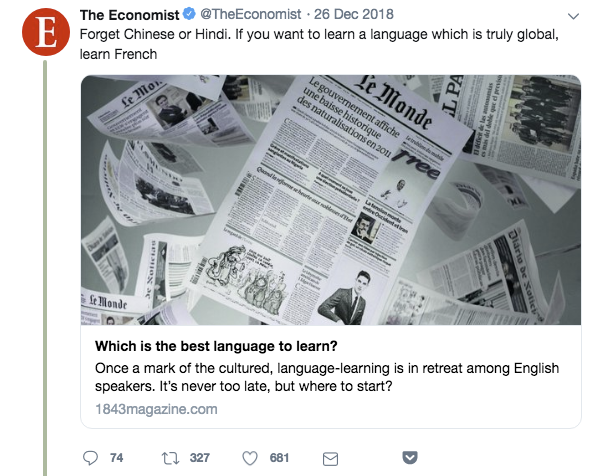
    A couple of weeks ago The Economist tweeted out a link to an 2012 article from their lifestyle arm, 1843 Magazine, entitled "Which is the Best Language to Learn?"  

    Screen Shot 2019-01-20 at 7.39.56 AM

    (image not clickable)

    The caption/link writers were a bit too vague.  I think this for two reasons: 

    First, they mention too subtly that the article is aimed at native speakers of English.  Granted, the problem is not entirely on their end, but we can all learn to be more clear from the flood of Twitter comments complaining that English was not identified as the best language .

    Second, more pointedly, the tweet suggests that clicking on the link will lead you to an article decidedly in favor of English speakers learning French.

    It's not!  It's better than that, and I only wish the editors had made the feature longer.  It's actually six separate pieces, written by six different people.  It's almost like a panel discussion with six speakers, each making an argument for learning their own favorite languages: 

    • French
    • Spanish,
    • standard Chinese, aka Mandarin
    • Arabic
    • Brazilian Portuguese
    • Latin.

    The feature has a major structural flaw, which probably contributed to the bad captioning.   The piece ought to have a distinct introduction, followed by arguments for each of the six languages.  Unfortunately, the introduction-writer and the French-learning-cheerleader are the same writer, as if one of the panelists was also the moderator.   He didn't take care to separate these two rhetorical tasks (not only that, but he feels the need to defend French from Chinese in particular, something that comes across as a sort of pre-buttal of the Mandarin fan whose bit appears later).  

    And of course, I'd have loved for the feature to have been even longer and included arguments promoting the learning of even more languages.   Even more importantly, I'd have loved to see more attributes of different languages being considered.  

    Still, they covered most of the key points to consider, and promoted language learning in general.  All too often, languages are suggested to English speakers merely on the basis of "usefulness," which in practice is rhetorically limited to considering the likelihood that one expects to have economic transactions in the language.   

    But there are lots of different reasons to learn languages, and the six "panelists" touch on many of them:

    • acquiring meta-language that allows you to understand and use all languages better, including your own
    • broadening your cultural understanding in general
    • deepening your cultural understanding of whatever particular culture you are most interested in
    • grasping, a bit, another way to think about various concepts, say through interesting idioms
    • career preparation for conducting international business
    • career preparation for conducting diplomacy 
    • reading literature
    • enjoying the challenge

    And what's great about this article is that it acknowledges that different languages fulfill these needs to varying degrees and in different ways.   

    And individual learners' tastes and ambitions matter more than anything.  Even the pro-French, Chinese-isn't-all-that-it's-cracked-up-to-be introduction writer says:  "By all means, if China is your main interest, for business or pleasure, learn Chinese. It is fascinating, and learnable."

    Beyond a particular interest, though, what are the arguments for each of the six featured languages?

    • Robert Lane Greene prefers French, calling it the most global language, with native speakers in every region; it's relatively easy for English speakers to learn, with grammar not very different from ours, and a great deal of vocabulary overlap.
    • Daniel Franklin promotes Spanish.  It has an enormous number of native speakers, is a regional champion, is heavily used on the Internet and as an international language, and has great literature and film.  Like French, it is relatively easy for English speakers to learn (and, I'd add, is far easier to pronounce and to spell).  It's also a bridge to Portuguese and Italian.
    • Standard Chinese, says Simon Long, has the most native speakers and its economic importance is growing very fast.
    • Josie Delap makes an enthusiastic aesthetic argument for Arabic:  difficult for English speakers at first, particularly because of the new script, but extremely rewarding and beautiful to learn (as well as an impressive feat).
    • Helen Joyce argues for Brazilian Portuguese on the grounds that it's not very difficult, invites you to visit and work in an interesting, beautiful, and half-continent-sized nation (plus a few other places), and will help you with your Spanish/French/Italian while letting you stand out from people who've chosen those more common second languages.  
    • Tim de Lisle begins by humorously stressing the lack of direct usefulness of Latin, but argues that it strengthens your linguistic "core," improves your understanding of grammar and syntax, requires rigor, and (perhaps ironically) claims it makes it harder to bullshit.  Its vocabulary is everywhere and its surviving literature is timeless.  He seems to argue that it is a great pleasure for a particular kind of nerd.

    So, across these few paragraphs, we have languages defended because they are easy and also because they are difficult.  Because your language has many second-language speakers, and because it has few.  Arguments based on economic importance, and arguments that concede nearly no economic importance at all.  

    It really depends on what your goal is.

    + + +

    There are a few more attributes for choosing a second language that aren't mentioned in here, which I would add.   Mine are:

    • Ease of accessing resources to learn a specific language in your town
    • Number of native speakers living near you
    • Closeness to English on the language family tree (which brings a kind of "easiness" that is distinct from the sort Latinate languages have).

    I never really thought about these three much until two things happened in our family.  

    First, something just for me:  I decided that for no reason other than personal interest, I wanted to learn a non-Indo-European language.  I wanted to explore a grammar that behaved sufficiently differently from the other languages I knew to give me a broader understanding of human beings' relationship to language, and see how different words worked together to create idioms. 

     In Minnesota overall, the non-Indo-European language that's spoken most widely is Hmong; but in my city, Minneapolis, public school students are much more likely to speak Somali at home than Hmong.  (In fact, they are nearly as likely to speak Somali as Spanish.)   That plus the convenience of not having to learn a new alphabet made it an obvious choice.  Not only do I have the chance to encounter native speakers regularly, but there are materials available which have been produced for Somali speakers:  signage, library books, newspapers, a radio station.   So even though my progress is fairly slow, as I work in my spare time through an imperfect text and meet a small study group monthly, I constantly get little affirmations from overheard snippets of conversation, from "thank yous" and "good mornings," and from being able to pick out words from signs and newsprint.  I don't know if I'll ever be able to have a real conversation, but I am enjoying the journey.


    Second, for one of my offspring, who begged to be allowed to quit Latin.  We all learn Latin at home because (being dead, and pronunciation and conversation unimportant) it's really well suited to the homeschool.  Most of the kids enjoy it, but one of mine… didn't.  He didn't have a particular desire to converse in a modern language either; he was struggling, and he needed something easier, because some language in high school is required for college.  "Anything but Latin!" he told me.  

    Well, if "anything but Latin" will do, then I was free to find something that would be relatively easy to arrange. 

    I speak French passably, read it fluently, and could probably have scraped together the time to teach it.  But I suspected that "Anything but Latin" also served, for him, as a tactful way to express "Anything but learning more language from you, Mom, who is a complete language nerd and can't deal with the fact that I find this really difficult."

    So I looked outward, and discovered relatively inexpensive Saturday-morning classes in Swedish, of all things, within walking distance of our house.

    Swedish doesn't hit many of the reasons from the article for why an English speaker would want to learn it.  It doesn't have global importance; its native-speaking population is small and almost entirely living in Sweden and Finland; fewer than 60,000 people living in the U. S. speak it at home (although, granted, a lot of them are probably living in Minnesota).   Finally, Swedes themselves overwhelmingly learn English and have even been called the "best in the world" at speaking it.

    What it does have going for it — besides the convenience of having classes available, and the fact that it is possible to supplement with commonly available commercial and online learning programs — is ease.    Although there's definitely grammar and vocabulary to learn, Swedish is possibly the easiest language for an English speaker to acquire.  And that is exactly what my son needed.  He has realized that learning a foreign language is something he can do.  And, surprising to both of us, he actually enjoys it.

    It's also slightly quirky, an unusual choice for an American kid with no Swedish heritage, and I think he enjoys that.   He had a fun time seeking out and greeting a small collection of very surprised Swedes at World Youth Day in Panamá.  We have a photo of him posing with them, grinning and holding the Swedish flag.

    I'm just saying, sometimes making it as easy as possible is the right thing to do.  There is no shame in that.

    + + +

    So, to sum up, what I've said before:  Really considering what you'd like to get out of a language, honestly — whether it's "I want to read cool literature" or whether it's "I just need the minimum possible so that I can get into college" — is key.


  • Consolations and the prosperity gospel.

    Amy Welborn recently put up a post on the prosperity gospel's more subtle forms, a "well-trodden road" that she's considered many times.   

    This is an interesting discussion, because while some versions (the "health-and-wealth" gospel) are so obviously out of line with orthodox Christian thought as to be almost a parody, others are more difficult to untangle precisely because they seem to grow right out of unarguably Christian and Judeo-Christian beliefs.  

    It’s easy for us to look at an interpretation of Christianity with which we disagree and dismiss it out of hand, mock or condemn it – especially something as obviously wrong as the health-and-wealth gospel. More fruitful, I think, is to look at the why and the roots and explore how aspects of an incorrect interpretation might have crept into our own thinking. To examine it, see what’s true, what’s false and use it as a way, not so much to condemn others – over whom we have no control – but to grow in our own faith and conform ourselves more closely to truth.

    So let’s take the most recent newsworthy example – pastor John Gray purchasing a $200K Lamborghini for his wife.  Gray defended his purchase against criticism by pointing out that he’d not used church money to buy it, but rather money from a book deal, a television show on Oprah’s network and other income sources. He didn’t go whole hog Prosperity in defending it, but he did say: “God helped me to make my wife’s dream come true,” he wrote in an Instagram post Tuesday night. “Why not? She’s made mine come true!”

    This is a little different from promising the impoverished that if they align themselves correctly with God’s will, they’ll find more material comfort, but the very basic fundamentals are the same: When we do God’s will, it shows in our earthly lives. God helps us make our dreams come true.

    This is not, of course, incorrect. The deep roots of the Prosperity Gospel are in the ancient life of Israel. Read Psalms, read Proverbs. External blessing is a sign of God's favor in our tradition.

    But then along came the Exile.  And the challenge of Job. God’s people had to ask themselves: What does it mean to be blessed by God? What does God’s presence among us look like?

    The philosophical problem here is that our faith teaches that here on earth, all good things, visible and invisible, do come from God.   And we have plenty of Scripture to back us up that God does (at least some of the time) provide some kind of good to His faithful servants.  Perhaps health and wealth and safety; perhaps supportive mentors, friends, and family; perhaps graces of understanding and acceptance that help us put into perspective our lack of such things.  

    And yet… if this is the leaping-off point… can we leap off in the wrong direction?  

    One of the biggest dangers would be if we become satisfied.   Satisfied that our temporal blessings (visible and invisible) constitute evidence that we are doing the Christian life correctly.  Satisfied, too, in the sense of no longer… longing.

    Amy muses in this direction:

    It seems to me that the fundamental error of any “Prosperity Gospel” lies in the elevation of the truth that yes, we find authentic peace and true joy when our wills and choices are aligned with God’s will. That’s the truth we find in the very beginning of Scripture: Adam and Eve at peace in the Garden, and then at war with each other, God, nature and themselves outside of it.

    The way that a “Prosperity Gospel” twists this truth is when it encourages us to uncritically identify the fruits of a right relationship with God with anything temporal.

    It instrumentalizes the spiritual life.

    So now, look beyond the easy targets of health-and-wealth. Survey the contemporary popular spiritual landscape, Catholic and otherwise. If there’s a current self-help trend out there, are spiritual gurus close behind, baptizing it?

    ou might see and hear some of this:

    Through faith, I came to understand my purpose and look at the success I’ve found because of that.

    Through faith, I came to see and accept how beautiful I am, and what true beauty is.

    Because of faith, I feel great about myself and affirm my life as amazing and accomplished.

    This is hard, this is tricky, and I hope I can tease this apart correctly. Because I’m sure this might be striking you as just wrong. Because isn’t that  part of what faith is? In accepting Jesus as Lord of my life, aren’t I opening myself to a re-orientation, a proper understanding of myself and my relationship to the world that’s going to bear this fruit?

    True. All that is fruit of a relationship with Christ.

    Plot twist: But it’s really not that important, either.


    There's more, and you should go read what she has to say.   

    But I think there may be a way to… make it a little less tricky?  The Prosperity Gospel is a modern thing, but human nature is the same as always, and I suspect it's merely a new-ish manifestation of a very old temptation.

    In short:  Humans are perfectly capable of taking true graces that truly come from God and… screwing up our responses to them.

    + + + 

    This is what I wonder: 

    This sort of celebration of temporal happiness and satisfaction, accompanied by a broader understanding of what happiness and satisfaction means

    –e.g. “Now that I know what true beauty is” — something unspecified, but more than just conventional outer attractiveness — “I see that I am beautiful.”

    –Or: “now that I know what true wealth is, I see that I am wealthy”) —

    might fall under the category of “consolations.”  

    Consolations are, in the writings of the saints and in the writings of the magisterium, the opposite of affliction.   These are free gifts of happiness, contentment, felt blessings, confidence in the presence of God, strong feelings of conviction. All bestowed by God on some of the faithful, and occasionally understood to be withdrawn from them by God, as a means of increasing their (or someone's) growth in faith.

    Numerous saints have warned Christians against mistaking the consolation for something it is not. It is not (necessarily) a reward or a punishment; it is certainly not a reliable indication of the holiness of the individual, such that holier people receive more or fewer consolations; and while we may hope for consolations, we are expressly warned against making the consolation the end that we seek.

    In the Introduction to the Devout Life (IV.13) St. Francis de Sales includes "Spiritual and sensible  consolations" in the catalog of temptations to be overcome. 

    [Man's state] is ever changing, constantly in movement; his life on earth like waters which ebb and flow, sometimes lifted up by hope, sometimes depressed by fear, swept one way by consolation, another by affliction; no day, no hour, exactly the same.

    It is well to remember this, for we must strive to preserve our equanimity in the midst of these various changes; though all should change about is we must remain immovable, our eyes and our hearts ever fixed on God.

    He then lists items of "particular advice," which are really quite detailed and wonderful but which I will paraphrase here for brevity.

    1. Feelings of pleasure, sadness, consolation, or compassion which make our spiritual exercises pleasing or agreeable are not evidence of real devotion and can even be "snares of the devil, who encourages them to make much of these consolations and take such satisfaction in them that they no longer seek true devotion, which is to do constantly, resolutely, promptly, and energetically whatever we know to be pleasing to God."
    2. However, they are sometimes very useful, for they make the spiritual life attractive to us.  "
    3. How to know the difference between the two situations?   You will knmow them by the fruit they yield.  Our hearts are as trees, our feelings and desires their branches, our actions which follow from them the fruit.  If [consolations] make us more hunble and patient, considerate and merciful towards our neighbour, more fervent in mortifying our evil desires and inclinations, more constant in our devotion, more docile and submissive to those in authority over us, more simple in our lives [!], there can be no doubt that they come from God; but if we seek such feelings for our own satisfaction, if they make us selfish, irritable, self-assertive, impatient, overbearing, proud, presumptuous and harsh towards others and make us imagine that we are already saints and no longer in need of guidance or correction there is no doubt that they are false and evil….
    4. We must receive consolations with humility, never taking them for evidence of our own goodness, and use them according to God's intention, and also "occasionally detatch ourselves" from consolations by protesting to God that we seek only His love and not the sensible goods that he sends.

    Now, St. Francis doesn't take the position that I suggested above, that all consolations come from God and it is our response to them that matters.  He phrases it that some consolations are good and come from God whereas others arise "from our fallen nature" or are "sent by the devil."  I think either construction works.

    If indeed the sentiments that lead one into the prosperity-gospel error are incorrect responses to real spiritual consolations, then the ancient and medieval fathers will have much to say to us about how to avoid falling into this apparently modern error.


  • Basque ratatouille, or, never wonder what to do with too many zucchini again.

    After having spent a week in the Basque Country with Mark, I immediately came home and bought a cookbook, of course.    I ended up with a beautifully photographed book, The Basque Table by Alexandra Raij (a Minnesotan!) and her Basque husband, Eder Montero.  I probably won’t make many of the seafood recipes, for lack of ingredients, but fortunately the book has many dishes of eggs, meats, vegetables, and desserts.   

    The first thing I made was so beautiful that I must share it immediately.  It is pisto, a Basque ratatouille, which I adapted as suggested by the authors to locally available ingredients.  I found guaijillo peppers packed in small plastic boxes in the local upscale grocery store; lacking them, omit them, or you might try a quarter cup or so of puree of roasted red peppers?  

    We ate this topped with pan-sauteed fish and sourdough bread.

    Also, at the bottom:  how to use the leftovers in delicious scrambled eggs.

    Basque Ratatouille (adapted from The Basque Book)

    • 0.75 oz dried guajillo peppers, about 4 peppers
    • 2 cups diced Vidalia onion
    • 1 tsp dried marjoram
    • 3/8 tsp cayenne pepper, divided
    • Olive oil
    • Salt
    • 1 cup diced red bell pepper (1/4” dice)
    • 1 cup diced green bell pepper (1/4” dice)
    • 4 pounds zucchini, cut into 1/4”-thick half moons)
    • 1 cup hand-crushed canned whole tomatoes with juices

    First, make a pepper puree:

    Preheat oven to 350° F (you will raise the temperature later).  Begin to bring a saucepan of lightly salted water to a boil.

    Toast the dried peppers until fragrant for 2 to 5 minutes, until fragrant and pliable.  Remove the seeds and stems from the warm peppers.  Put the toasted, seeded peppers in the boiling water, turn off the heat, cover, and let steep 20 minutes.  Puree the hydrated peppers with just enough of the soaking water to make a puree.   Half of this puree will be used in this recipe, and the other half you can reserve for another use.  (The soaking water makes a vegetarian stock.)

    While the peppers steep, raise the oven temperature to 500° F.

    In a dutch oven or other soup pot with a lid, combine the onion, marjoram, 1/8 tsp cayenne, 3 Tbsp oil, and 1/tsp salt and gently cook the onion over low heat for about 20 min until soft and translucent.

    Meanwhile, in a large bowl, toss the red and green peppers and the zucchini with 1.5 tsp salt and 4 Tbsp oil.  Roast the vegetables on two large baking sheets, stirring halfway, for 15 min.

    Add the peppers and zucchini to the onion, with a little more oil if necessary, and cook for two minutes.    Turn up the heat to medium; add the tomatoes and half the guajillo pepper puree that you made in the first step.  (Save the rest.)

    Stir, cover, and place in a 250° oven for a couple of hours.  

    Before serving, check the flavors; the mixture should be dark and sweet, and if it is not qute yet, cook it on the stove top for a few more minutes, stirring.  Add the remainder of the cayenne and serve.


    Scrambled Eggs For One With Leftover Ratatouille

    Warm about a half cup of ratatouille in a small nonstick saucepan with a film of olive oil.  When the ratatouille is warm, lightly beat 2 eggs with a pinch of salt; move the ratatouille to one side of the pan, add another tablespoon of oil to the empty side, and pour the eggs in.  Let set for ten seconds then gently stir, incorporating some of the ratatouille.  Let set again, and continue gently stirring until the eggs are softly scrambled and roughly mixed with the ratatouille.  Turn out and eat — crusty bread is a nice addition.


  • The arms and the Manger.

    She wrapped him in swaddling clothes and laid him in a manger, because there was no room for them in the inn.

    + + +

    If there's one tiny detail that doesn't ring familiar to me, a woman who has given birth, about the Gospel accounts of the nativity, it's the "laid him in a manger" part.   

    I acknowledge that everyone's experience is different, but the last thing I wanted to do in the first minutes and hours with a healthy newborn was to put the baby down anywhere at all, with or without swaddling clothes.  I was always pretty fixated on the irretrievability of the first moments: those liquid eyes open and searching for another human face to take in, to take possession of; those tiny ears, listening and alert for the familiar, now unmuffled voices; the tender skin, wanting human warmth.  

    I did have practical matters to attend to eventually, and so I let the baby go—and I had the good fortune to be able to put the baby in others' arms; I know not everyone gets to do that, depending on the circumstances of birth, but it's certainly where I wanted to put him and where I felt he belonged.

    + + +

    From the very beginning Christians have taken note that the place Mary chose to put the baby was a food bin.  Foreshadowing for sure, that this child would grow to say things like "my flesh is true food and my blood is true drink."  The food bin was handy, and chances are good that she and her husband were not entirely aware of the prophetic nature of the action; the whole story was (perhaps? probably?) not unspooled to them as of yet, despite the angel, despite the dream.

    But they knew the Child was divine, uncreated, holy beyond every thing and person that their people ritually and faithfully set apart as holy; they knew that.

    + + +

    I have to rely on Wikipedia a bit for a review of the relevant art traditions. 

    The Byzantine depiction of the Nativity, which arose in the 6th century (after images of the child alone with ox and ass and images of the Adoration of the Magi),  includes both mother and child and depicts a postpartum scene that feels more familiar to me.  The mother reclines with the infant next to her, and Joseph rests nearby.  (Sometimes, separately, midwives are shown bathing the baby).   


    Meister_von_Hohenfurth_002
    Nativity by a Bohemian master, c. 1350.  Public domain


    The Western traditional image of Mary and Joseph kneeling in adoration of the infant appeared by 1300.


    8285725356_d25d8dabd9_b
    Missal of Eberhard von Greiffenklau, Nativity, c. 1446.  Public domain

    + + +

    Clearly when we think about the scene we can consider it in merely practical terms.  At some point, the couple probably had to do something that required all four hands, and they had to put the baby somewhere.    In the kind of place that needs a feed bin, any surface raised above the floor is likely to be cleaner than the floor itself, so the food bin is perhaps the obvious "putting place" for a baby if you're having to work under those conditions.  Foreshadowing aside.

    But let's think about the notion of the Virgin's adoration of her child. for a moment.  Perhaps it's a pious invention by 13th-century artists and iconographers, and reinforced by the influence of published descriptions of the visions of St. Bridget of Sweden.   But it's also consistent with the Gospel story:  she had the message of an angel stating Who her child was, and Joseph had received his own message.  

    She herself, though thoroughly filled with grace, a pinnacle of creation, still, a created being; beheld the Uncreated clothed in flesh.  She knew what mere humans are meant to do with Holiness.   To adore it; and, by necessity, to separate it, at least ritually, from what is created, what is not as holy.   

    Ordinary mothers everywhere are able to adore their newborn children best, in the most natural and human way possible, in the way the infant's nature best responds, with the infant in their own arms.  This is natural adoration, from one creature to another, a personal connection, eye looking to eye, skin-to-skin, the little lips moving and the little voice crowing in response to the mother's encouraging voice.

    And of course Mary could do that too.  She is the natural mother of the Christ, the Theotokos.  She must have adored her child in this natural way.  And we have the Byzantine icons to remind us of that.

    But something else separates them in a way that Mary would also have known.  What do you do with the holiest things?  You set them apart.  They are wrapped up behind a veil and placed out of reach.  Catholic tradition identifies the pregnant Mary as a type of tabernacle or ark herself, containing the Bread of Life, containing the Law; but for all that she is also a human, and the grace God filled her with would have moved her to adore the Divine, step back from the Sacred to look upon it from the necessary distance.

    So, because she willed what God willed, she might well have detached (with difficulty) the tiny fists from her mantle, wrapped him up and laid him down on the wood, drawn back onto her knees.  It might, if the baby were awake, have felt distressing (have you seen an infant on its back, eyes closed or open, searching with open birdlike mouth, first tentatively, then frantically?  have you been its mother?)  It might have been quite brief, because physical needs of the mother-and-infant pair cannot wait forever.  We aren't sure whether she adored the way the Western art shows her.  But it might have happened in this way.  She knew Who he was, after all.  And we have the words of the Gospel:  She wrapped him in swaddling clothes and laid him in a manger, because there was no room for them in the inn.

    Why did she lay him in the manger? In the plain words of the Gospel,  Because there was no room for them in the inn.  

    That's the other part of the foreshadowing.  Because the hospitality of the world had rejected her,  the Tabernacle, the Ark, and (more to the point) what she contained, she could only adore — relate, as a created being, appropriately to Divinity —  by interrupting the (natural, good!) maternal drive to protect, by laying him upon the wood, setting him out for food.

    The swaddling, the setting-down — it may have been entirely practical, but it was because there was no room for them in the inn, and we know what that foreshadows.  So:  Mary's act of will, and not just where she put him, is foreshadowing too.


  • A couple full days in Bayonne.

    Mark had to leave for work quite early on my first day here, so we got up around six and had breakfast together in the hotel.  

    This is a European chain, catering to business travelers, that struck me as about the same level as a Hilton Garden Inn.  It is warm and well-equipped with small rooms and a generous continental breakfast buffet included with the room, as well as a full bar open till 11 pm (although during the week you have to go to the front desk to request your glass of wine).  In the breakfast room-slash-bar here is a coffee machine in the European style available nearly all day for free, which I heartily appreciate.  I have to hit the café long button twice to fill my coffee cup, but it is good coffee.

    I should pause at this moment to apologize again for upside down pictures.  I will not be able to fix them until I can get to a desktop computer.  I am sorry.

    F8036BBC-2862-4E5C-805B-4098EDFB7E90

     (The hotel bar)

    The breakfast spread included about five different kinds of fresh slice-your-own bread including panettone, baguette, wholemeal, pain aux raisins, and a sort of poppyseed pound cake; four different kinds of “Bonne Maman” preserves, which you can buy in the US; butter; jambon Bayonne and jambon blanche; three kinds of medium-hard cheeses; peeled hardboiled eggs; two or three kinds of yogurt and (oh hurray!) fromage blanc; a basket of oranges and a juicer; and a blonde-colored torte labeled “Gateau Basque” which got Mark very excited, as it is apparently his favorite thing around here.

    I was busy eating the protein, but I took a moment to taste the Gateau Basque.  I have already looked for the recipe online and I just want to tell you, ignore any English-language recipes you find that have puff pastry in them, because they are wrong.  The French-language recipes I found look correct.  It is supposed to be an eggy cake with a fine crumb, baking-powder leavened, that is rolled out, cut into two circles, and stacked with a pastry cream in between, flavored with vanilla, almond, or rum.  It is almost like a jelly roll except not rolled up and with custard in the middle, maybe like a Boston cream pie without the chocolate and only about an inch thick all told.   Anyway, it’s bloody marvelous with coffee.

     + + +

    Mark left, and I gathered my things together and walked across the big river.  Bayonne is built at the confluence of a big river, the Adour, and a little river, the Nive.  Our hotel is in the quarter called Saint-Esprit, which was a major stop along the pilgrimage route to Compostela (coquilles St Jacques are, incidentally, everywhere).  The whole reason that the only wine AOC in the French Basque region developed was so that the monks could sell it to the pilgrims.  I haven’t had any of the wine yet.  Anyway, on the other side of the Adour, with the Nive running between, are Grand Bayonne and Petit Bayonne.  The quays are lined with adorable tall and narrow buildings, shops on the bottom, apartments above.

      4B5B4AF2-E7FE-4CF7-AA09-709A48EAF775
    4B5B4AF2-E7FE-4CF7-AA09-709A48EAF775
    4B5B4AF2-E7FE-4CF7-AA09-709A48EAF775
    4B5B4AF2-E7FE-4CF7-AA09-709A48EAF775

    I spent about six hours wandering around Bayonne.  I looked in a lot of shop windows.  I visited the cathedral Sainte-Marie, which is really lovely, in the northern Gothic style with spires and flying buttresses.  The three part mural of the Passion was one of the most striking I have seen in a church.

      08B520AA-6477-4AB0-9897-B7D6C27E9808

    E911F7C9-B3FE-4878-A036-A2245DB595A0
    E911F7C9-B3FE-4878-A036-A2245DB595A0
    E911F7C9-B3FE-4878-A036-A2245DB595A0

    7EE76880-B880-4CD6-80F8-ED4E3590AC2E
    7EE76880-B880-4CD6-80F8-ED4E3590AC2E


    + + +

    I still felt self-consciously American so I did not have very many conversations, but I managed a few that worked surprisingly well.  Something that is pretty amazing:  Since the last time I was in France, my ability to hear, parse, and understand spoken French has really taken off.  I honestly don’t know why.  I have been reading French all year, but I have not been listening to it very much.  

    Unless the Bayonnais speak particularly clearly and slowly?  

    Or maybe I have been working so hard on other languages that I have somehow developed my general receptive skill?

    I don’t know but it is really kind of shocking.  I don’t speak a whole lot better than I did a year ago, in fact I feel very halting and sometimes it is quite difficult to even get a word out.  There is a sort of performance anxiety that seems to strike me randomly, or perhaps it is more that certain people, unpredictably, seem to set me at ease while others make me nervous.  But the hearing and understanding has really taken off.  

    I can understand the news anchors on TV.  

    I answered the ringing room telephone and heard “This is the front desk, we weren’t able to clean your room earlier because you had the do not disturb sign up, and we just wanted to ask if you would like your room cleaned now or is there anything else you need?” and I answered “No, I don’t need anything at now, and I am resting at the moment,” and it wasn’t till I had hung up that it struck me how smoothly that call had gone.

    I have discussed chocolates with the woman at the chocolate shop and beer with the guy in the beer shop and leather goods with the guy in the bag shop.  And police novels with the bookstore clerk.  And washing instructions for the tablecloth I bought.  And also I asked the guy fishing off the bridge what kind of fish he was trying to catch.

      52F1F998-424B-4E7E-8C1E-A4A526B77165

    “La louvine.”  That is the name of the fish.  Not sure what it is.  My technical vocabulary does not extend to angling, even in English.

     + + +

    For lunch that first day I found a café that served the stuffed red peppers that are particular to the region.  They are like the piquillo peppers of Spain — maybe they are the same.  These were stuffed with a potato-and-salt-cod puree and baked in a dish with the ubiquitous Basque sauce of tomatoes and red peppers.

    072301F7-6E39-4A13-83A7-D7C4018C64D8

    So far this is the best thing I have eaten.   It is so good.  I don’t want to hassle with salt cod but I bet I could stuff these peppers with anything, say cheese, and bake them in the sauce and it would be marvelous.

     Anyway, that was the first course; the second course was cod in a cream sauce with vegetable flan.  Also good.  It was interesting because the waitress brought out scalloped chicken and pasta first, and I had to explain that possibly I had made a mistake, but I meant to order the cod.  She said “you ordered the escalope” and I really did not know how to say “I do not think so” and anyway it seemed very likely that I might have messed up, so I apologetically said that maybe I made an error of language and she said it wasn’t serious and she could make a change and I said yes please and she took it away.  And then the woman dining at the next table with a companion leaned over and said “You definitely ordered the cod.  I heard you.”  So I felt better.  And I left a tip for the waitress, because I was glad that she didn’t berate me too badly and that she brought me what I wanted at the end.

     + + +

    The last thing I did that afternoon was spend a couple of hours at the Basque history museum, which was fascinating and quite detailed.  I will just leave you with a few photos because it is almost time for Thanksgiving tapas.

    Carved bench with convenient flip down table and high back for keeping warm in front of the fire in your traditional basque house.

    33BE71C1-AE81-42D2-960A-5D5F2DB7B0C4

    Painting of nuns going to a funeral which I photographed because it reminded me of “Madeline.”
    33BE71C1-AE81-42D2-960A-5D5F2DB7B0C4


    Ancient dugout canoe dredged up from the nearby river.
    33BE71C1-AE81-42D2-960A-5D5F2DB7B0C4


    Traditional beehive
    33BE71C1-AE81-42D2-960A-5D5F2DB7B0C4


    Funerary stele of a pre-Christian design that is still used today for headstones
    33BE71C1-AE81-42D2-960A-5D5F2DB7B0C4


    Chocolate grinding stone.
    33BE71C1-AE81-42D2-960A-5D5F2DB7B0C4


    The chocolate is very interesting here.  Bayonne was an early adopter of chocolate in France, and early center of chocolate making in a tradition that still continues, because Spanish Jews took the techniques with them when they were expelled from Spain and settled in the Basque country, particularly in the quarter near my hotel (the local synagogue is still in the neighborhood).

    Not coincidentally, I bought a lot of chocolate today.

    Ok, it is time to go out and have tapas.  Do not expect to see any turkey, but potatoes and pumpkins may make an appearance.  Happy Thanksgiving!


  • Travel day.


    063CA4FB-387D-44DE-BF16-FB230B1F36C0


    + + +

    The image is of the Pont Saint-Esprit in Bayonne, seen from the window of our hotel.

    Long travel day including a missed flight to Biarritz; I asked to be put on a flight to Pau, an hour or so away, which worked fine although I missed having dinner with Mark.  He picked me up at nearly ten at night and we drove into Bayonne and checked in after some difficulty locating the parking.

    We made it to breakfast together anyway, in a bright and modern self-serve breakfast room with an automatic coffee machine and a lovely selection of breads and jams and fruits and cheeses and cups of yogurt and cold meats.  Then Mark headed off to the plant and I went back to the room to make a brief post and wait for the weather to clear.

    Now I have a map and a brochure for the city obtained from the concierge and am about to head out for a walk across that bridge.  

    Life could be worse….