bearing blog


bear – ing n 1  the manner in which one comports oneself;  2  the act, power, or time of bringing forth offspring or fruit; 3 a machine part in which another part turns [a journal ~];  pl comprehension of one’s position, environment, or situation;   5  the act of moving while supporting the weight of something [the ~ of the cross].


  • Introduction to the Devout Life: 5-9 through 5-14, “Considerations on renewing your resolution.”

    For other posts in this series about St. Francis de Sales's most well-known work, follow this link to the index, also available in the right sidebar.   I outlined the structure of part five here.

    + + +

    We've been looking at Part Five of Introduction to the Devout Life, which is about the annual review and renewal of devotion.   

     If Part Four is a sort of "troubleshooting guide," then Part Five is a preventative maintenance manual. Francis recommends doing this review  at the time of the celebration of the Baptism of the Lord (January 9 this year).   I'm going to try to finish up blogging Part Five by then.

    The last post concerned itself with an annual examination of conscience that is aimed specifically at considering one's progress in devotion and the devout life over the course of the year.  When the examination of conscience is completed (over one to three days), Francis prescribes five days of meditations:

    Having completed the above… make each of the following considerations the subject of your daily meditation, following the method I have already explained, placing yourself first of all in the presence of God and praying for grace to establish you firmly in his love and service.

    The link goes to my post about chapters 2-1 through 2-8 — in these chapters, Francis carefully explains the basics of prayer and meditation to the total beginner.  

    So, let's look at the content of these five days of meditation.

    Day 1:  The Excellence of your Soul.

    I think it must be common for people to fall away from devotion, or never to start in the first place, because they think of their own soul as not really worth saving, or not quite good enough or important enough to merit so much attention.  It is logical, then, that St. Francis repeatedly begins these series of considerations with meditations on the value of one's own soul:  here is another example.  Before you embark on a program to work on your soul, you have to believe that this soul is worth working for.

    So on this first Day, Francis has you consider the gifts of reason, knowledge, and understanding that you already possess.  He has you consider the nobility of your will "capable of loving God and incapable of hating him in himself."  He has you consider "how great is your heart which can find no rest except in God and which nothing created can ever satisfy."

    In other words, Francis is showing you that your own human nature points you toward God simply by virtue of being a human nature — and if we stop to think about it for even a moment, we know that every human, no matter how mean and lowly, deserves to become devout.  Humans require only love to have that opportunity to the fullest.  And however low we may feel, we must admit that we ourselves are worthy of lavishing that work of love even on ourselves.

    One of the things which the prodigal son most regretted was that, when he might have been eating delightful food at his father's table, he had been eating husks with swine.  'O my soul, what wretchedness, when you can enjoy God, to be content with anything less.'  Lift up your soul in this way; realize that it is eternal and worthy of eternity; stir up your courage to attain this end.

    Day 2:  The Excellence of the Virtues

    Here Francis wants you to stir up your desire to possess the virtues — certainly whichever virtue you are specially working on, but each and every other besides, because Francis's "method" puts all of them within your reach.

    Consider the beauty of the virtues compared with their contrary vices.  How beautiful is patience compared with revenge; gentleness compared with anger and acrimony; humility compared with pride and ambition; generosity compared with avarice; charity compared with envy; moderation compared with dissipation!…

    Those who know the value of devotion might well exclaim with the woman of Samaria:  Lord, give me this water (Jn 4:15)…

    Day 3:  The Example of the Saints

    Francis singles out for consideration martyrs, women martyrs and virgin martyrs in particular; pastors; Stes. Monica an Paula as examples of saintly life as married women and as widows.  (Sorry, married men!  I get the impression that Francis served as confessor to a lot of women.    But I'm sure if you think about it you can come up with some saints that are particular for your situation.)

    After such wonderful examples, what is there that we may not do?  They were as we are; they did it for the same God and for the same virtues.  Why should we not do as much, according to our state of life and our circumstances, in order to keep our cherished resolution and to fulfil our holy protestation?

    You see now why it was so important to place that meditation "on the excellence of your soul" first — otherwise many people would not be able to see so clearly that there is not some special kind of person called a "saint."  We really are all called to be so.

    Day 4:  Christ's Love for Us

    Here Francis wants us to consider specifically the act of love in time and history which is the Savior's Passion:  the sacrifice on the cross.  This is very much a "Jesus is my personal savior" meditation; worth pointing out to people who think the Protestants came up with that idea:

    As a woman with child prepares the cradle, the linen and the swaddling clothes, even arranging for a nurse and everything necessary for the child she hopes to bring forth, so our Lord, his goodness, as it were, pregnant with you upon the Cross, wishing to bring your forth to salvation and make you his child, prepared everything you would need:  your spiritual cradle, linen and swaddling clothes; your nurse and everything required for your happiness, in other words, all the means, all the attractions and graces by which he guides your soul and seeks to lead it to perfection….

    How wonderful to realize… that God has loved you… as though you were the only person in the world to be considered, just as the sun shines on one part of the earth as brightly as though it shone nowhere else.

    Day 5:  God's Eternal Love for Us

    The previous meditation is, as I said, concentrated on the temporal sufferings of Jesus.  The fifth meditation steps back to consider love in its eternal unchanging form, that of the Godhead.

    Before our Lord, as man, suffered for you on the Cross, as God, he knew and loved you in his infinite goodness.  When did he begin to love you?  When he began to be God?  No, for he is without beginning and without end; he has always been God and so has loved you from eternity…

    He tells you so through the Prophet Jeremias in words addressed to you as though there were no one else:  With unchanging love I love thee, and now in mercy I have drawn thee to myself.  Among other things he thought of drawing you to make your resolutions to serve him.

    'How important these resolutions must be, my God, since you have thought of them, considered and designed them from all eternity!…"

    + + +

    So you see how Francis, in the course of these five days of meditations, leads you from the center of the self ("the excellence of your soul") outward, through the virtues that will illuminate your soul, to the example of other virtuous people throughout history, to God made man loving you in time, to God the Eternal loving you even outside time.  

    And along the way he encourages you to look at your resolutions, the ones you are about to renew, from all these perspectives.

    •  Yes, your soul is worthy of your own efforts, including the making and keeping of resolutions.  
    • Yes, virtue is desirable as an end, for which the means are your resolutions.  
    • Yes, you can keep your own resolutions; we know this because the saints have kept theirs.  
    • Your resolution is precious, "the fruit of your Saviour's Passion." 
    •  Indeed, your resolution is eternal, for it has existed from the beginning as an idea in the mind of God that He "considered and designed from all eternity" as a means of your salvation.

    If that doesn't get you in the mood to renew your resolutions, nothing will!

    In the next post, we'll look at the conclusion of these considerations.


  • Jimmy Akin on priestly celibacy.

    Jimmy Akin has a post up that's worth noticing.  

    The post's purpose is to be part of a series of posts dealing with a particular current-events scandal involving a philandering priest.

    But in order to set up the necessary background information for understanding the scandal, Jimmy lays out a concise (really) twelve-point explanation of the nature of the rule about priestly celibacy:  what it means, why we have it, what are the exceptions, why it's possible to disagree with the rule in good faith, etc.

    Worth checking out if you need a refresher on this information yourself.


  • Introduction to the Devout Life: 5-3 through 5-7, Examinations.

    For other posts in this series about St. Francis de Sales's most well-known work, follow this link to the index, also available in the right sidebar.   I outlined the structure of part five here.

    + + +

    In the last post, we looked at Chapter 5-2, which encourages you to start off your annual review and renewal by considering the value of the resolutions you've made.  This chapter ends with a segue into the examination of conscience that is the concern of the next five chapters:

    After all these considerations, which should inspire you with many good desires, end quite simply, with an act of thanksgiving and a prayer that you may draw great profit from them.  Then retire with humility and great confidence in God, reserving the task of making your resolutions until you have carried out the following exercises.


    Two Options for Examination of Conscience

    Francis suggests two options.  The first is a "long-form" examination of conscience, which he introduces in Chapter 3 (and continues to discuss in Chapter 7):

    This exercise is rather long, but remember that there is no need to go through it all at once; examine at one time, for example, your conduct towards God [detailed in chapter 4], at another your duty to yourself and the state of your inclination [chapter 5], at another your conduct towards your neighbor [chapter 6].

    …Take these points quite peacefully, one at a time, and consider the state of your heart in their regard since you made your resolution, noting any serious faults.

    The second option is "An examination of your general dispositions," introduced and outlined in Chapter 7:

    If a detailed examination such as I have suggested would prove too laborious it may be simplified and reduced to a scrutiny of your passions… In other words, what inclinations sway your heart?  What passions possess it?  Where has it gone most astray?  Test the passions of your soul one by one and you will know its state.

    Either of these could function as a pre-confession guide to examination of conscience:  print 'em up in a pamphlet and carry the with you to the line for the confessional.  

    One is long and the other short, but length is not the only difference between them:

    The first, long form of the examination — the one that Francis suggests taking three separate sessions to perform — attends to details of behavior and on the feelings that are signs of our love for the devout life.  In it Francis enumerates questions like "How do you talk about yourself?  Are you boastful and conceited?" and "Do you do anything to harm your neighbor either directly or indirectly?"  

    The second, shorter form asks us to examine our consciences from a different direction, so to speak, by enumerating not our actions and thoughts, but our "passions."  Francis lists seven to be scrutinized:  love, hatred, desire, fear, hope, sadness, and joy.  The question is then, do we (for example) desire the right things?  do we desire the wrong things?  do we desire things in proportion to their worth?  and so on.

    How to prepare for the examination "sessions."

    It is not necessary nor expedient to kneel except for prayer at the beginning and the end.  You can easily make your examination while out walking, perhaps more easily still in bed, so long as you can remain sufficiently awake for long enough.  In this case, however, you should have read through the necessary considerations before retiring, and aim at completing the whole of this exercise within three days at the most, setting aside some convenient time each day, for it will lose its efficacy if too long protracted.

    "It is not necessary… to kneel except for prayer at the beginning and the end."  This is a good reminder that an examination of conscience is not a kind of prayer.  Prayer is always an appeal to someone outside yourself; an examination of conscience is focused on the self.  One prepares for self-examination by praying, asking for help in making the examination, and one ends by spiritual acts (these are given in detail in Chapter 8) thanking God for the insights and asking for pardon and the like, but the stuff in the middle is the simple application of your sense and brain to hard reality.  Where do I measure up, and where don't I?

    It is not necessary to withdraw from company entirely while carrying out these exercises but you should do so to a certain extent, especially towards evening, retiring early to take the bodily and spiritual repose so necessary for meditation.

    During the day make frequent aspirations to God, our Lady, and to the angels, in fact, to all the citizens of the heavenly Jerusalem, your heart filled with love of God and a desire for your spiritual perfection.

    The picture I am getting of this examination is of one or three days set apart for a small "season of reflection."

    1. Designate one day, or three consecutive days, as days to examine your conscience.
    2. Set aside some time in the evening to be alone for reflection:  perhaps in the spot of your usual evening prayer, but perhaps during an evening walk, or even just going early to bed and reflecting there in the time before you close your eyes to sleep.
    3. Plan that day to get extra rest and quiet during the day, "especially towards evening."
    4. During that day, keep your upcoming meditation in your heart, and make frequent aspirations (short prayers), expressing your love of God and your desire for spiritual perfection.
    5. Just before performing the examination, read through the text of Francis's guides (either the long form in chapters 4-6, taking one chapter each day; or the short form chapter 7).  Have them with you during the examination if the chosen place and time makes that possible.


    Beginning the "session" of examination

    This would be the part where Francis implies you should be kneeling for prayer.  Francis instructs:

    To begin your examination properly place yourself in the presence of God and invoke the Holy Spirit that he may enlighten you and enable you to see yourself clearly as you really are, praying humbly with St. Augustine, "Teach me to know thee, O Lord, and to know myself;" or saying with St. Francis [of Assisi], "Who art thou, O Lord, and who am I?"

    Protest that you wish to note your progress, not for your own satisfaction, but to rejoice in it for God's sake; not for your own glory but for his, that you may thank him.

    Here is another one of those spots where I sit back and marvel at St. Francis's down-to-earth, pastorally unique approach.  If I came across a modern "Guide to Examination of Conscience" that encouraged the penitent to examine his progress in the spiritual life as well as his sins, I'd be annoyed.  The examination of conscience isn't a place for pats on the back!  It's a place for simple self-accusation!  But Francis clearly puts it into perspective:  The progress that Francis so confidently predicts has been made only because of God's saving work in the penitent.  The penitent owes it to God to acknowledge his progress during the course of this examination, so that he can better thank and praise God for God's saving work in him.  

    And Francis is no dummy of a pastor either:  He is writing for beginners, after all, and he knows that beginners need encouragement.  Noticing where God's work is really working counters the sadness that can accompany acknowledgement of failures.

     Protest also, if you seem to have made little progress or even fallen back, that you will not give way to discouragement and become faint-hearted and lukewarm, but on the contrary that you will stir yourself to greater efforts, humble yourself and strive with God's grace to remedy your defects.  

    Examination Session

    Now, preliminary prayers finished, you can get up off your knees!  Begin thinking and judging, and trust that the Holy Spirit will be quietly working beside you and in you.

    Having done this, consider calmly and peacefully how you have behaved up to the present towards God, your neighbor, and yourself…

    OR, if you are doing the short form,

    Take the points [of the short form — that is, each passion that is listed] quite peacefully, one at a time , and consider the state of your heart in their regard since you made your resolution, noting any serious faults.

    I won't get into the details of the examinations here; you can get it from the book, or you could probably adapt any other published examination of conscience.  If you are doing the long form, Day 1 concerns your behavior toward God, Day 2 concerns your behavior toward self, and Day 3 concerns your behavior toward your neighbor.   

    (The "behavior toward self" part deserves a little description, since many published examinations are organized by  the Ten Commandments, which fall into the "love God/love your neighbor" dichotomy.  This is, of course, after Christ's greatest commandment.  Still, it isn't just "love your neighbor;" the command is to "love your neighbor as yourself," and to evaluate that requires us to determine how we love neighbor and how we love self, and then weigh the two!  Anyway, on Day 2 Francis is asking us to consider things like whether we are humble or proud, how we talk about ourselves, whether we seek to correct our faults, and whether we have habits that harm our health.)

    Concluding the Session

    At the end of each day's session — whether you do it all in one day or whether you complete only part of the examination each day — return to your knees.

    Having quietly completed your examination and discovered the state of your soul, conclude with the following spiritual acts:

    1. Thank God for any progress you have made since your resolution, acknowledging that it is entirely due to his mercy.
    2. Humble yourself…. acknowledging that if this progress is scanty it is entirely due to your lack of fidelity, courage and constancy…
    3. Promise to praise him eternally for the graces which have enabled you to… make progress…
    4. Ask pardon for having been so unfaithful and disloyal to grace.
    5. Offer him your soul that he may be its sole master.
    6. Beg him to make you completely faithful to him.
    7. Invoke the saints, our Lady, your guardian angel, your patron saint, St. Joseph, and so on.

    After the days of examination are complete

    It's not time to go to confession yet (unless maybe if you've discovered serious sins).  The next part of the renewal consists of five daily meditations, which Francis goes into in some detail.  We will begin looking at these in the next post.


  • And so this is Christmas.

    I might have mentioned at some point how much I hate having my plans changed.

     Whenever that happens, until I finally manage to wrest myself into acceptance of my new schedule, I find myself playing a movie in my mind of the way things were supposed to go.

    Chickensoup 

     So today I'm thinking about waking up with my family in the bustle of my in-laws' house in Ohio. I'm thinking about my daughter making cookies with Grandma and my sons plashing about after Grandpa in their boots. I'm thinking about my sister-in-law finally getting to know her newest nephew in person. I'm thinking about Mark meeting old friends for breakfast and me catching up on clothes-shopping with my best friend from high school at the after-Christmas sales. I'm thinking about the annual $15 round-robin gift exchange at Mark's family get-together, with — what was it? ten, eleven?– little cousins running around, so that the Christmas tree will have to be braced with wires running into eye-hooks in the wall. I'm thinking about my own grandma's cookies and pie, and my smaller (but just as loud) extended family gathered together. I'm thinking about looking forward to the long drive back on New Year's Day, the kids in the back seat and fourteen hours of sitting next to my husband musing about all the blessings we have and had and will have.

    What I'm doing, though, is making chicken soup in my own kitchen.

    Monday night Leo started throwing up. And then it was Oscar, and then Milo, and then me, and now Mark is down for the count. MJ was sick last night too, although she seems pretty lively this morning.

    Today I felt well enough to dig out the car and go to the grocery store, and I tried to pick up things enough to make cookies and things. It feels pretty thin though. There's no tree yet (I suppose there's still time for that – but Mark is too ill to help, and I'm not sure I can put up the artificial tree myself with a baby crawling around). Almost all our presents are in Ohio (save one biggish one for the kids that I'm hoping will be exciting enough to suffice).

    I could say "Oh well, it's the non-materialistic, meditative Christ-centered Christmas I've always wanted," but I'm not even sure that any of us are going to go to Mass — some special kinds of Christmas cheer, you don't want to spread around, if you know what I mean, and even if we all feel better tomorrow we might still be contagious.

    There is some cheer to be had; I sang "Gloria in excelsis deo" as I loaded the groceries into the trunk of the car, and arrived home to find happy children devouring chocolate and fruit from a basket newly sent by Mark's mom and dad. Still, I'm a little melancholy and stuck in the Christmas that might have been.

    So I'll tend my soup, and hope that it appeals to everyone by the time it's finished; and I'll clear off the counters and maybe make a batch or two of cookies. I think that everything will be different in the morning. It should, shouldn't it?

    Merry Christmas to my little band of readers and friends.


  • 168 hours, part two.

    I said in my last post that I had recently logged my time for a week to see how I was spending it.  

    How did I spend my 168 hours?

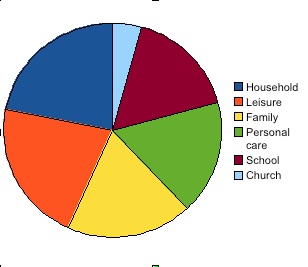
    Well, I'm getting enough sleep.  I spent 51.5 hours sleeping, an average of more than 7.5 hours per night. 

    This left 115.5 waking hours.

      28 of these were spent on household tasks.  This includes food prep (11.5 hours), tidying (7 h — who knew I only spent an hour a day?), shopping and errands (6 h).  Apparently someone else does most of the laundry because I only recorded half an hour.  1.5 of these "household" hours were spent supervising the children's chores.  Almost 2 more hours were spent on listmaking, meal planning, and making appointments and the like.  

    Including travel, 27 hours were spent at leisure, not counting dedicated "family" time.    This included 13 hours devoted to socializing with other adults, 8 hours using the internet. about two and a half hours watching videos, and almost 4 hours reading print matter (including some time reading to kids, but not including reading in bed).

    Dedicated family time took up 24 hours – one day out of my week.  That includes the 5.25 hours I recorded nursing (even though some of that was multitasking, and surely I really nursed a lot more than that.)  I spent 8 hours being with my husband, and almost 11 hours interacting directly with the kids outside school and meals.

     Personal maintenance took 22 hours.  That includes eating (more than 9 and a half hours), changing clothes and bathing and the like (7 hours – really?), and time devoted to exercise (5.75 hours, but that includes travel, changing, and showering).  I got a little more exercise under the "family" heading, too.

     Next comes my "job" — homeschooling.  I always thought it was a full time job, but really it's only part time!  I spent a little more than 21 hours on school.  Of that, ten hours were one-on-one instruction — which was about what I would have guessed, 2 hours per day.  I spent a bit less than 9 hours on planning, preparing lessons, record keeping, and keeping the schoolroom tidy.  2.5 hours were school-related travel time.  (The children all spent some time on independent work and being taught by others, too.  Also, this leaves out about an hour of reading to kids.)

     Finally, I spent 5 and  half hours on church and prayer, including travel and getting the kids ready.

    What about the analysis?

    My first impression is that my life is remarkably balanced:

    168h dec 2010

    A quarter of my waking hours were spent at leisure, either alone or with friends and neighbors.  A bit more than a fifth were spent leisurely interacting with my family.  A bit less than a fifth of my time is the interesting and challenging work of schooling the children.   (Alternatively, if you count up all the time I'm interacting directly with the children, including instruction, care, and discipline, it's well over one-fourth of my time.)

    Necessary household tasks take a quarter of my waking time, and caring for my own body and clothes takes a fifth.    I spend about as much time on going to church as I do on going to the gym:  five percent of my waking hours was spent on each.

    There are some other ways to crunch the numbers by re-assigning categories.

     For instance, what is "work?"  I have long considered my "job" to be homeschooling.  But because we're home all day, there is more housework that needs to be done.  If you think of me more as a "homemaker" than a "homeschooler," and count as my "job" the schooling plus all the household tasks I perform, then I work a nearly-fifty-hour week.  But on the other hand, maybe only M-F housework should count.  In that case it's about a 45-hour week.  Or maybe I should count as "work" only the housework done while  my husband is working for pay (as a measure of the hours I've specialized in homemaking; presumably Mark doesn't think of his evening and weekend housework as "being at work.").  In that case, I work 38 and a half hours per week, plus 11 weekend-and-evening hours at more household tasks.

     Or how about analyzing based on whether I have to interact with other people?  I am an introvert and I dig my alone time, even if that's cleaning the kitchen.  Turns out I spend 73 hours a week having to interact with other people, and 56 waking hours per week recovering from that time by being (whew) psychically isolated, i.e. exercising with headphones on or sitting on the couch with my nose stuck in a book.  That's probably enough to meet my needs.

    Or you could divide it up by how much I like to do the stuff I do — am I spending time on things that are fulfilling and/or fun?  I like teaching, planning, prepping school, socializing, cooking, using the internet, exercising, and spending time with my family.  I don't like driving, running errands, housework,  or phone calls.   I'm neutral on personal care, I guess – let's call that a "dislike" since I would rather do something else (even though I famously love a hot shower). 

    By that measure, I am pretty happy most of the time.  I spent about 100 hours doing things that I find purely enjoyable (like exercise and reading) or else at least a meaningful use of my competencies (like cooking, teaching the kids, and preparing the schoolroom).  In contrast, I spent less than 24 hours on tasks I don't really like to do.  That's a four-to-one ratio — not bad!  (Unless it just means I don't pull my own weight.)

     There were a few surprises.  I thought I spent a lot more than 8 hours on the internet, but it turns out that I must be getting that impression because of the many times per day I check "just for a minute" if I have a new email or blog comment.  Even though those "just a minutes" add up,  I didn't track that "non-sitting" internet time.  I probably should track it better, but I learned one thing at least:  it's clear that I'm not getting a feeling of "leisure" from these little checkings-in, and maybe I should be more disciplined about avoiding them.  I wouldn't be depriving myself of very much, and maybe I'd gain focus.  On the other hand, the total time is pretty low — it doesn't seem like something I have a huge problem with, so maybe I shouldn't worry about it.

     How else could I use my time better?  I spend about seven hours a week on tidying and cleaning up, and only 1.5 hours supervising while children tidy or clean up.  Surely  I could shift away from solo chores and towards directing children who are learning to do those same chores?  They are not as efficient as I am, so the more I delegated these tasks to the children, the more time it would take from me.  But teaching the children to clean is arguably a more productive and fulfilling use of the hours, and also an investment for the future — because the more I supervise their chores, the more competent they will get.

    I also spent almost twelve hours on food prep.  Cooking is a household task I enjoy, but maybe I'm indulging in this hobby  more than I ought to at about 1.75 hours a day.  I have already cut back a lot in recent years, settling on a repertoire of frequently made dinners and trying no more than one new recipe per week.   I'm not sure how much more I could cut back without relying more heavily on prepackaged foods and takeout.  I could certainly enlist the children's help more than I do. 

    To sum up, I have been pleasantly surprised to discover that my time allocation is more in line with my values than I thought it was.  I would like a little more data on my internet usage (I'm sure that a lot of that time is wasted — neither work nor particularly pleasing leisure time), and maybe I'll track that soon.  But what I have already learned can, I think, help me.   I have identified a couple of places that I could tweak to improve things a bit.  

    Also, I really have no business complaining about the laundry, because apparently my husband has been doing, um, all of it.  If there's one place I should spend more time, it's on counting my blessings.


  • 168 hours.

    In my "Resolution" post from this summer, I said I was going to try to kick the habit of considering my time as my own:

    Previously, I tried to deal with the visible problem in ways that actually worsened the underlying cause.  When I dieted to lose weight, I became MORE obsessed with food, and especially with "getting enough nutrition" and "getting enough to feel satisfied."  When I have wrangled with time in the past, I have tried to do it through ever-more-finely-divided scheduling:  Not enough time with the kids?  Put them in another block on the schedule!  Some scheduling is necessary, obviously, just as nutrition is necessary for the dieter, but a schedule is not going to solve the problem of undue attachment to control over my time.  If anything it feeds the notion that I CAN control and own time that "belongs" to me.

    But I still think it's a good idea to know how I'm spending my time; a basic axiom of my personal philosophy is Data is good.  (Gathering data isn't always time well spent, of course, but the data itself is a good thing to have.)


    I recently read a somewhat-fluffy book with one good central idea:  168 Hours: You Have More Time Than You Think by Laura Vanderkam.  The author has, I think, bought a little too much into the anyone-can-have-it-all fallacy, and accepts a bit too unquestioningly the way time-use researchers classify home parenting activities (is "child care" really only the hours we spend feeding, dressing, and playing with our kids?  how about cleaning and cooking and gardening alongside them?)  She also suggests a little too blithely that the problem of the time crunch can best be solved by paying hired help, e.g., by sending out laundry.  (I recognize that it's a matter of figuring out what your time is worth and outsourcing the things that make financial sense; but still, that's going to rankle people who could never afford that kind of outlay.)    

    But she's still written a fairly interesting book around this core concept:  Measure how you spend your time, on the scale of hours-in-a-week, and then you can look at how you're spending it and decide if you're spending it the way you want.

    I've thought about making a time log for a number of years, and have always been kind of intimidated by the prospect.  But this book got me into the mood to try it for a week.  So I printed up seven spreadsheets marked out in fifteen-minute increments, and started writing down what I was doing periodically through the day.  I started at 3 pm on a Monday, and I stopped at 3 pm the following Monday. 

    (My recommendation if you try this, by the way:  I found that by far the easiest way to get most of it written down was to go make a record on the page every time I finished doing something.  Also, not to sweat the plus-or-minus-a-few-minutes, and not to worry if it doesn't all add up because of multitasking.)

    Then, on a morning with a cranky teething baby in need of lots of rocking, I sat down with a spreadsheet program and added it all up.

    Next post:  what I found out.


  • Probably this is a bad omen.

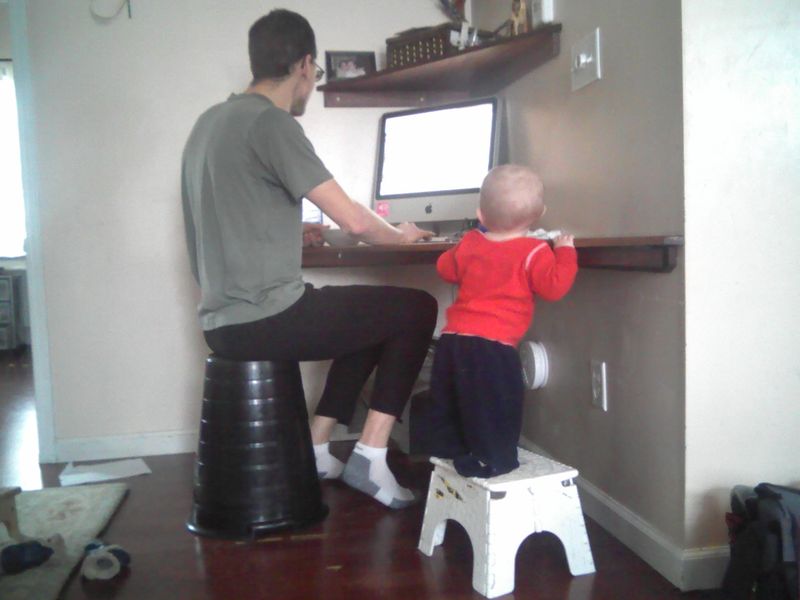
    The child can't even walk yet, and already:

    Babyonstool_2010_12_18

    I think we are in for it.


  • Math and music videos.

    Remember a while back when I linked to the Music Animation Machine videos?  These animations visually represented some fairly complicated pieces of music, such as one of my favorites, Mozart's Symphony No. 40, as a series of colored bars scanning across the screen:


    I loved the way the structure of the music was made visible; how I felt I could understand and grasp the music in a way I couldn't before.

    At the time I posted that it reminded me of something, but I couldn't think what.  

    Then this morning I saw a website that told me instantly what it was I had been reminded of:  Music boxes!

    The above movie is from vihart.com, which is a treasure trove of videos about mathematical and musical recreations.  I can't recommend it highly enough.

    Here's another video from vihart.com, this one about graph theory:

    Enjoy!  My kids and I all did.


  • Cheater’s biryani.

    Last night I was coming home late from Hannah's, so I made it the day to try a new shortcut I'd been pondering.  

    In the morning before leaving, I plugged my rice cooker — it's restaurant-style, Tiger brand — into the automatic light timer and set it to come on at 4 p.m.  Then I added brown rice, enough water to cook it, the contents of a commercial package of Vegetable Biryani Spice Mix, and half a bag of frozen peas and carrots.  Also a handful of frozen red bell pepper strips.  And a glob of coconut oil.  And then I went away.

    When we got home, the house smelled wonderful.  To the rice cooker I added a handful of raisins and another handful of almonds.  These warmed up while I put the other things on the table.  We had the vegetable biryani with plain yogurt, chopped cucumber, steamed fresh green beans, and sliced fresh pears.  Pretty good!


  • “Sushi chef.”

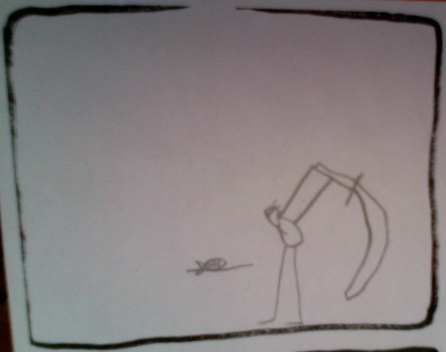
    As conceived by my seven-year-old son.

    Photo on 2010-12-14 at 22.19

    I find that giving a passel of kids a stack of photocopied comic-strip blanks really stimulates the creativity glands.  Something, anyway.


  • Introduction to the Devout Life part 5: Getting started on the renewal of devotion with 5-2.

    For other posts in this series about St. Francis de Sales's most well-known work, follow this link to the index, also available in the right sidebar.

     + + + 

    A couple of weeks ago I outlined the structure of part five, the final part of Francis de Sales's Introduction to the Devout Life.  This section on regularly renewing your devotion consists of fourteen or fifteen specific meditations, and I said I was going to try to finish blogging about them by the feast day of the Baptism of the Lord (January 9), so I'd better get cracking.  I think I can do this in about six posts.  

    Here's a bit from the end of Chapter 1 that leads us into Chapter Two.

    Having consulted your confessor, choose a suitable time and having secured for yourself a greater solitude than usual, both interior and exterior, make two or three meditations, in the way I have already described, on the following [six] points.

    Let's pause here to take this as a set of instructions.

    Choose a suitable time.  If you do the long form of the examination, there are about two weeks' worth of daily meditations coming up for this renewal, so it's probably a good idea to begin by setting aside a time slot for the whole lot of them.    

    It doesn't have to be a long time slot.  The meditations have all been broken up into manageable pieces.  I would guess, about the length of time you would set aside to pray a regular, five-decade rosary:  20 minutes or so.

    Having secured yourself a greater solitude than usual "Greater than usual" can mean whatever we need it to mean — this is one of the things about Francis that I love; he prescribes a program to follow, but is quite flexible in his recommendations for how we are to go about it.  I think the point here is that the renewal needs to feel at least somewhat different and special compared to our normal daily meditations.   We are supposed to create a temporary daily mini-retreat for ourselves, even if we really can't get away from our daily duties.  

    (Once again, it's obvious that Francis is writing for people living in the world.  His advice is different in quality from that you'll find in the writings of "greater" saints like St. Teresa of Avila… yes, we can learn a lot from it, yes, we can draw analogies from the cloistered life to family life, but in the bottom line, St. Teresa wasn't thinking of me when she considered her audience.  Francis, on the other hand, seems to specialize in advising women who have a a lot of distractions, a lot of responsibilities, and a lot of leisure time.  Um.  That would be me.)

    In Chapter 3, incidentally, Francis suggests that some of this spiritual work can be done "while out walking" or "while in bed."  So if that's a place you can create "greater solitude than usual," and you can concentrate in such an environment, know that you have Francis's blessing.

    both interior and exterior  You may be thinking he means "not just exterior solitude, but interior solitude as well; not just physical alone-ness, but also freedom from interior distraction."  I rather think it is the other way round.  Francis has advised us quite specifically how to create a place of interior solitude, and has not written as much about finding exterior solitude.  So I'm thinking that this means "not just solitude in your heart, but really you should also go somewhere you are physically alone."

    + + +

    So when these plans have been made for the upcoming fourteen days or so, the renewal begins.  

    The subject matter of Part 5, Chapter 2 is "The Value of Your Resolution."  It is intended to help you to appreciate the good that has already been accomplished in you.  And so Francis begins:

    make two or three meditations, in the way I have already described Francis gave explicit instructions on how to meditate — remember, this really is an introductory instruction! — in Part 2, chapters 1 through 8.

    on the following [six] points.  I guess you just split this up — either two per day for three days, or three per day for two days.  I'm inclined to pick the latter because, as I noted, there are plenty of days of meditation to keep you busy.  

    Here are excerpts from the six points, presented by halves in two meditations.

    + + +

    RENEWAL MEDITATION ONE

    1.  Consider the points of your resolution:

    • first that you have forsaken… mortal sin forever;
    • secondly that you have dedicated and consecrated [yourself]…to the love and service of God;
    • thirdly that you have promised… to rise again at once should you ever fall into sin…

    2.  Consider to whom you made this resolution, for it was to God…

    3.  Consider in whose presence you made your resolution… in the sight of the very court of heaven.


    RENEWAL MEDITATION TWO

    4.  Consider what led you to make your protestation, and how gentle and gracious God was to you… Consider how gently he drew you on by his grace, by the sacraments, by spiritual reading and by prayer; while you were asleep… he was watching you…

    5.  Consider when it was that God inspired you to make this resolution for it was in the prime of your life.  What joy to know already what we can never know soon enough!  … If he had called you in your old age, after a misspent life, that too… would have been a great grace…  

    [Love that bit above.  How delicately Francis refers to those among his readers who know quite well that they were called after a misspent life!]

    6.  Consider the effects of your resolution; compare yourself now with what you were and I am sure you will find a change for the good.  Is it not a blessing to know how to pray, to desire to love God, to have mastered your passions and tranquillized your soul, to have avoided so much sin and remorse and above all to have gone so much more often to Holy Communion…?  …[T]his is the work of God's right hand.

    [Love that last one too.  Is it not a blessing… to desire to love God?  The smallest positive change, the very smallest, is worthy of praise.  Francis writes, "Such wonderful favors must be weighed… in the scales of the sanctuary."    We are to be assured that even a very little progress is progress indeed.]

    + + +

    In the next post, we'll see Francis's plan for your annual examination of conscience.


  • It’s official.

    We are not making it to Mass today, no, not even the 9 PM Mass at the one parish that has one.

    Mark tried to drive the van around the block this evening and it didn't go well.  (He did manage to get it back home and back into the garage, fortunately.)

    Nor are we making it out to dinner for our anniversary tonight.  There is a restaurant within walking distance, a really good one actually, but it does not serve dinner on Sundays.

    So we are going to settle in for an evening of "Daddy's Spaghetti Sauce" and garlic bread, and probably demolish a bottle of red wine between us while the kids suck back juice boxes and we reminisce about a similarly snowy week — well, it was snowy in the mountains anyway — twelve years ago.

    Ciao!