A typically concise and excellent post from Disputations. RTWT.
(By which I mean, "read the whole thing." Why hasn't that abbreviation taken off in the blogosphere? It should.)

bear – ing n 1 the manner in which one comports oneself; 2 the act, power, or time of bringing forth offspring or fruit; 3 a machine part in which another part turns [a journal ~]; 4 pl comprehension of one’s position, environment, or situation; 5 the act of moving while supporting the weight of something [the ~ of the cross].
A typically concise and excellent post from Disputations. RTWT.
(By which I mean, "read the whole thing." Why hasn't that abbreviation taken off in the blogosphere? It should.)
I'm absolutely floored by the photographs in this blog, and even more entranced by the story behind it:
h/t Althouse, where I agree with the commenter who wrote that to be this young man, John Maloof, is like being an aspiring poet who discovers the trunk full of Emily Dickinson's poems. Just amazing. I hope in the end he gets a payoff for the huge amount of work he's putting into introducing Vivian Maier's photographs to the world.
So, here in the Author's Preface, St. Francis explains quite clearly what's so special about his "Introduction." I heartily agree with him, and I think you will too: namely, that it's for ordinary people.
St. Francis says:
This Introduction contains nothing which has not already been written; the bouquet that I offer you is made up of the same flowers, but I have arranged them differently.
What's different about his approach?
Nearly everyone who has written about the spiritual life has had in mind those who live apart from the world, or at least the devotion they advocate would lead to such retirement.
My intention is to write for those who have to live in the world and who, according to their state, to all outward appearances have to lead an ordinary life;
and who, often enough, will not think of undertaking a devout life, considering it impossible; no one, they believe ought to aspire to the palm of Christian piety while surrounded by the affairs of the world.
I had skipped reading the preface, and had still immediately seen what Francis was driving at. He is trying to grab people who are swamped with duties in the world. People with jobs, families, problems that keep them busy. Ordinary people. So many of us think that we don't have time for real devotion. We long for the days when the children are grown, when we can work less, when such-and-such a problem has been resolved; then we'll be able to practice the devout life.
St. Francis is saying, Don't wait. So you aren't a contemplative in a convent. So you have many duties. You live in the world. Live that life in the world devoutly. It's possible. I will show you how.
I will show them that a strong and resolute person may
- live in the world without being tainted by it,
- find spiritual springs amid its salt waters and
- fly through the flames of temptation without burning the wings on which they soar to God.
True, it is no easy task and must be undertaken with much more zeal than many have so far shown, and I hope that this work will help those that undertake it with a generous heart.
Francis then explains how he came to write this work (it was originally a set of notes for spiritual direction of a particular person) and apologizes for the brevity and hasty organization.
What I have treated I have explained clearly and simply, at least that is what I have aimed at, but I have given no thought to style, as I have too much else to do.
I think I can forgive the good bishop, no?
He goes on to list the five parts:
In the first part I seek to lead Philothea from a simple desire for the devout life to a strong resolution to embrace it…
In the second part, I show her two great means by which she may unite herself more closely to [her Saviour]: the Sacraments, by which he comes to us; prayer, by which we unite ourselves to him.
In the third part, I show her how to practise the various virtues…
In the fourth part, I show her some of the snares of the Enemy, how she may escape them and go forward.
In the last part, I make her go aside for a while to refresh herself, take breath and renew her strength for further progress in the devout life.
Then he defends his decision to write such a guide for individuals, even though as a bishop he is quite busy:
…[M]any will say that it is the task of religious and spiritual directors to guide individual souls on the way to devotion, that such a work requires more leisure than a bishop with a diocese as large as mine can well afford, and must prove a distraction from affairs of greater importance. I answer… that it belongs primarily to bishops to lead souls to perfection…, so their leisure could never be more worthily employed.
…To guide individual souls, I will admit, is exacting; but it is consoling work like that of the labourer in the vineyard, who is happiest when he has most to do. It is a work which refreshes the heart of those who undertake it, being a source of joy.
And he hopes that he will become more devout through this work:
It is true that I write about the devout life without being devout myself, though I certainly desire to be so, and it is my desire for devotion that encourages me to write. As a wise man once said, 'To become learned it is good to study, better to have a learned master, but best of all to teach others.'…
I undertake the work most willingly, as much to fulfil my duty as to become more devout myself through imprinting this virtue on the hearts of others, and I hope that if ever God sees that I truly love devotion, he will give her to me in an eternal marriage.
I really like all this. I don't think St. Francis's humility ("without being devout myself") is put on or false in any way. There is a tendency to say, "Yeah, Francis, you're not devout, suuuuuurrre, what with all the sainthood and all," but he's quite serious and it's not as self-deprecating as you might think (especially if you've just opened the book instead of, like me, coming back to the author's preface after having finished the rest of the book).
Because remember, all through the book Francis has been writing to encourage people to be grateful to God and to praise Him when they notice small good signs of improvement in themselves. Devotion is the thing which we seek; and Francis wants us to acknowledge frankly that we are not devout yet and that we must become more devout; but at the same time he wants us to acknowledge that we have made progress, because we desire devotion, because we love devotion, and that itself is a good thing, a wonderful thing, a thing to be glad about. It's not humble to ignore the good things in ourselves; it's just false, and it deprives us of the opportunity to praise God for them.
And so here, Francis says quite simply that he "desires" devotion, that he "truly loves" devotion. This is the same thing he has been encouraging people to be glad to see in themselves. Yet he knows he is not "devout."
So if you're not devout, St. Francis, where do you get the idea you are qualified to write a treatise on how to become devout? I think it's pretty clear that Francis is confident that he's qualified to do it, for four reasons.
(1) He has a fully developed love for devotion.
(2) He has been progressing towards devotion for long enough that he is capable of showing other people the first steps on the journey (and that's really all this book is: how to begin becoming devout). A graduate student in physics could write an introductory text without having finished his doctorate; so St. Francis, who's been "practicing" devotion for a long time, can tell the beginner how to start. He can put the initial difficulties into perspective.
(3) The good bishop has been a spiritual director. He's taught people in person and by correspondence. They've come back to him and told him what was working and what wasn't working. So he has a significant amount of what you could call "clinical experience."
(4) He has the capability and authority, by virtue of his sacramental office as bishop. Whatever his human weaknesses, he is confident that he will be given the necessary grace to be of at least some help to the faithful through his labors. "We always do enough, when God works with us," he writes, and of course he believes that through the sacrament of Holy Orders God is working with him when he performs his duties as a bishop to lead and instruct the faithful.
+ + +
I'm not done with the book yet. I'm going to go over what I've written about it and see if I can't put together some organized suggestions for how to use Introduction to the Devout Life, handbook-style, as a program for learning devotion.
I put Lenore Skenazy's Free Range Kids blog in my reader a few weeks ago, since I aspire to give my kids the freedom they need to become capable adults.
And it is a good blog with some good ideas. I like it for those things.
But I think I might have to remove it from my reader because of the high proportion of preposterous blood-boiling stories like this one.
I thought when I started reading FRK I would feel encouraged by other like-minded parents to do things like let my ten-year-old walk to the library by himself, and teach my kids to make independent trips on the city bus, and make decisions with his own money, and that sort of thing.
Instead I think it is making me MORE worried — not about kidnappers or accidents, but about police/CPS intervention. Because of all the "can you believe this" stories of people calling the police on each other. Yuck.
I'll give it a few more days and then maybe move it into another folder so I don't read it automatically every single morning. It's really too bad, because I agree with most of what's written there in terms of the importance of kids to have freedom. But reading it may be counterproductive for me.
It's been a while since I posted an update on the topic of weight loss and weight maintenance, which continues to be the number-one reason people find their way to my blog. So…. how is it going?
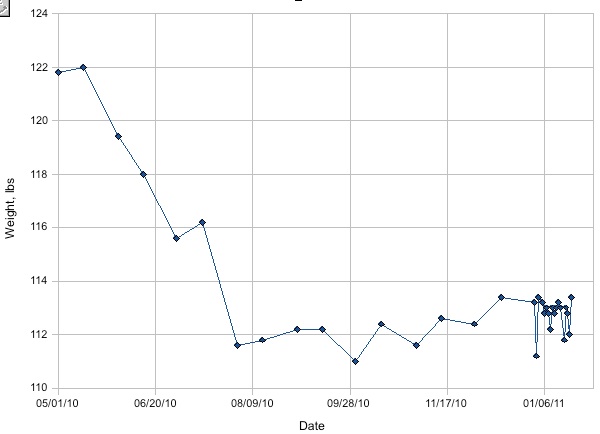
Well, let's recap with a little data. I gave birth almost a year ago, in January. Here's some data that begins May first. My postpartum goal was to take the weight down to 112. Right about the time I got down to 112, the baby started solids.
Here's a closeup of data from this month.
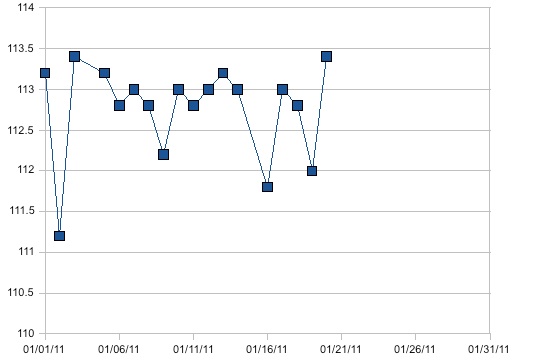
I think I can safely say I'm holding pretty steady at 113, without much effort. I want to bring it down to 110 eventually, but not on any particular time frame; and not because 113 is "too heavy," more because I want to give myself a little extra margin of error.
So, one thing that I have noticed, about 3 years since I began the lifestyle changes that took me down to a healthy weight: I think my body is doing a pretty good job at driving me to eat to maintain my current weight.
About a month ago I thought I might try to control my eating a little bit more strictly to try to slowly take off just one pound. Interestingly enough, it didn't work. Granted, I wasn't working very hard at it (and I'm still confident that if I decide to work hard at it, I will do it). But this is what happened several times.
(1) Day 1: Wake up in the morning, decide "Today I will carefully watch what I eat, avoid taking seconds or nibbling leftovers, and I'll skip bedtime snack."
(2) Follow through well on this plan all day long.
(3) Day 2: the scale will look about the same, which is fine and to be expected. I'll continue my plan.
(4) All goes well until dinner.
(5) At dinner I'll be freezing cold and RAVENOUSLY HUNGRY. Real, pit of the stomach hunger. Since it's not terribly important that I lose weight at this time, I go "Screw this, I'm starving" and I have more than one helping.
(6) Continue craving, freezing, and nibbling all evening.
(7) Day 3: Get on the scale expecting to see that it is spiking high because I put so much food into my body the night before. Scale actually shows that I am a pound or so low.
(8) Remain hungry, cold, and nibbly for the next couple of days. Scale eventually returns to where I was on Day 1.
(9) Once scale goes back to where I was, I miraculously regain the will to control my food intake.
My guess as to what's going on: my body is driving me to eat every time I start to burn some fat, and I am mostly responding to it. This is not a bad development, considering that where I am is a good place to be (BMI 22.8, and looking pretty good in my own opinion, and my clothes all fit.)
I think I always have had this weight-stabilizing mechanism in place though. I suspect most people have it, and it works pretty well even in the obese: a feedback loop, a system of urges which responds to fat burning by driving people to eat, and which go away when we stop burning fat. Weight stability seems to be something the body naturally seeks.
When people say that their "hunger signals are broken" I think that this may really just mean that they have difficulty identifying the sensation of hunger as hunger — a cognitive difficulty. Ultimately it doesn't matter how the body convinces your will to put stuff in your mouth. I think, sometimes, in its drive to keep you from burning more than a little fat, it will use all the tools at its disposal to get you to eat and STOP THE SCARY DANGEROUS FAT BURNING, from pure animal hunger to emotional mood swings to higher-brain rationalization.
If you have ever tried to lose weight on purpose, think back. After dropping a couple of pounds, and still wanting to lose more, did you ever find yourself thinking, "I'm down a couple of pounds. I can afford to splurge at this meal/have this extra snack/eat the whole thing." I am sure it is really common; I have done this myself, lots of times.
Step back and look at how loony it is from a loss standpoint. "I'm down a couple of pounds; I can eat more" is correct if your goal is to remain the same. Because eating more will fix the problem of having lost weight. This is what your body has tricked you into thinking with that supposedly smart brain of yours!
It is as if you have started driving from New York to L. A., and after a while you realize you've gotten all the way to Akron, so you decide you can afford to turn around and go east for a while, which feels better because now the sun isn't in your eyes so much, and then after a while you're like: What the hell? Why am I seeing these signs for Scranton? This isn't working!
No, the proper response is: I want to go past Akron. I got to Akron by traveling west. Therefore, I can keep going west and that will get me past Akron.
Not "I have made progress, so I can reverse my progress;" but "I have made progress, so I can continue my progress."
Successful weight losers have to exert their will to override all the messages the body sends them to try to put the brakes on their progress. They have to get hungry and stay hungry for at least a little while every day. They have to resist the impulse to respond to a milestone by turning around and going back to the last one.
It isn't terribly important to me to drop one pound right now, so I haven't resisted the corrections my body keeps applying every time I start. But having made a few attempts and watching what happens, I think I understand those corrections a little bit more. If I decide I am going to drop that one pound, it will require me to spend a couple of weeks feeling an urge to eat and resisting that urge. I know I could do it if I really wanted to because I've done it before; the evidence is that I don't want to enough right now to push back (which is fine; as I said, I am in a healthy weight range).
And there's the hard truth about weight loss in general — if you have many pounds that you want to lose, it requires you to spend quite a long time feeling the urge to eat and resisting the urge. It is do-able, but it is difficult, and because (I believe) the body enlists the help of the brain's rationalization capacity to trick your will into submission, it requires mustering your intellect as well.
Because really, don't you want to get out of Akron?
Here is a wonderful blog post by Penelope Trunk about how to answer that question, which is (I know) difficult for many stay-at-home mothers.
How you answer the question “What do you do?” is important because it frames your story for you in a much more visceral way than it frames it for anyone else.
When I told people I was decorating the house, they were happy for me. And worried for me. Because I am not going to make a living as a decorator. But the best answer to the question “What do you do?” is “Here’s what I’m passionately learning right now.”
If I had answered in a way that focused on my worries about not knowing where my career was going, then there would have been nothing to talk about. But when I answered in a way that revealed my excitement about the house and everything I was learning, then there was a lot to talk about.
I tell you this to show that everyone has trouble answering the question at some points in their life, but the more comfortable we are being lost, the faster we can get unlost, and this is a good example of why—you can tell yourself better stories about yourself.
So here are some steps to help you get better at the process of answering the question “What do you do?”
She gives seven tips for coming up with the right answer for you — which come down to re-framing the question as "What are you doing or learning right now that makes you different from everybody else?" Well worth a read.
h/t Althouse
Dear Mark Bittman,
You are an awesome chef. I love your videos, I like your low-meat philosophy that admits for a big juicy cheeseburger whenever one is in the mood, and I have at least five cookbooks by you, all of them well-used.
But you have got to get over this notion that everything baked/pastry/griddled/breadlike MUST include some white flour.
I had hope when I saw the video this morning encouraging people to eat whole-grain pancakes. Perhaps finally you had seen the light. There you were, with cooked oats and soaked cornmeal and bulgur and some whole wheat flour, plus nuts and dried fruit and cardamom, showing people how to put together a tasty whole-grain pancake. And yet, there you were tossing some white flour into the mix yet again.
Mr. Bittman. It's not necessary. These are pancakes, for crying out loud. They need no gluten development. You can go 100% . Don't fear it.
And don't get me started on your muffin recipes, by the way. How to Cook Everything has a basic muffin recipe plus lists totaling at least twenty or twenty-five variations. And the best you can do is, in one variation, suggest "Replace up to one cup of all-purpose flour with whole wheat flour"? One of the two cups? You couldn't go crazy and suggest "You know, you might if you like make the muffins with all whole wheat flour?" Did you think they would explode if you used too much?
Look, I can understand if you simply prefer the texture of white flour. But especially with your new healthy-food focus, it's simply unconscionable that you don't admit that the stuff isn't necessary. Certainly not in pancakes, waffles, brownies, quick breads — even in many kinds of cookies — the extra tenderness of whole grain flours is maybe even preferable.
Some really nutty people even bake yeast bread with the stuff. I know it's crazy but you might try it some time.
Sincerely,
Bearing Blog
I love the turn of phrase as well as the principle, from PrawfsBlawg:
When I was a graduate student in comparative literature, I had the good fortune of having a popular, older professor in his last semester of teaching….
This particular professor, himself no deconstructionist, took a moment at the end of his last class of his last semester of teaching, after a long and accomplished career, to urge us to do one thing as we went forward in our careers: read generously. We are taught from a very young age to read critically, of course, and he insisted that there is nothing wrong with this. But, he mourned, there is such a spirit of skepticism toward the text that now dominates our discourse. We are encouraged to take it to task, tear it apart, read it against the grain at every possible turn. There is a place for this, no doubt, he said, but don’t forget how to read with a spirit of generosity toward the text. Try to see what it is saying to you; accept it on its own terms, if only to strengthen your own critique. It is nearly impossible to learn anything from a text if you are not willing to read it in this spirit.
This has always stuck with me…. I think it not only makes us better critics and scholars to read generously – I would even venture to say that we owe it, almost as an ethical responsibility, to our colleagues and our readers. Is it possible not only to read critically but also, at the same time, to read generously?
We could listen generously too. A commenter at that site adds:
I would think the norm (is?) should be a "principle of charity" as we say in philosophy (and rhetoric) prior to practice of any deconstructionist critique (I'm still not quite sure what that is) or a hermeneutic of suspicion. In philosophy at least, this can entail the reader's re-formulation of an argument in stronger terms than the original or in a way unanticipated by the author. One frequently finds, however, performance anxiety and unbridled ambition combining in a premature "critique" that ends up saying more about the critic than the work-at-hand. Of course some folks are just downright nasty or possessed of an irritable dispostion or bewitched by some belief or ideology that precludes the possibility of any charitable reading of a text (I've thought this applies to some extent, for example, to Frederick Crews' reading of Freud).
I would think the blogosphere could take a few lessons from the old prof or from the philosopher-commenter.
h/t Mr. Adler of the Volokh Conspiracy.
Here's a keeper that I sort of invented this evening. I say "sort of" because I derived it from a classic Italian combination I have made a few times, pork braised in milk with sage and potatoes. (Here, I Googled it for you).
I didn't have a dinner plan and I didn't have any potatoes, but I managed to turn up two pork chops in the freezer, and the pantry yielded part of a bag of wild rice, and there were parsnips in the fridge along with some limp-looking carrots and celery. Also I found some bacon. So this is what I did:
– Chopped up an onion, a carrot, and some celery, and smashed a couple of cloves of garlic with the side of my knife.
– Peeled and thinly sliced four parsnips.
– Minced up a couple of slices of bacon and browned them in some olive oil in a skillet. I lifted the crispy bits out with a slotted spoon and left the grease in the pan.
– Added the two pork chops and browned them well on both sides. Salt and pepper of course. And removed them to a plate.
– Poured off all but about 2 Tbsp of the fat, and then added the onion/carrot/celery/garlic. I stirred that around, scraping up the browned bits from the pork, until it was nice and soft. Then I added the sliced parsnips and tossed them till they were coated.
– Nestled the pork chops in amongst the vegetables.
– Poured milk into the pan until it came about halfway up the side of the inch-thick chops. I brought it to a boil, added a bit more salt and pepper, turned it down and let it simmer until the chops were done and the parsnips quite soft. I turned the chops halfway through, by the way.
– Removed the chops to a fresh cutting board and chopped up the meat. Here is where I would have returned the meat to the pan, except that I am feeding children who accept unmixed food a bit better. So I kept the pork out and passed it separately.
– Mixed in 1 can white beans (drained). Turned up the heat and let the mixture bubble a bit to reduce and thicken.
– Transferred to serving bowl and sprinkled with reserved bacon bits.
I served this with wild rice, plain brussels sprouts, and my mother-in-law's home-canned pears. It was really good — I might never use potatoes again, the parsnips were so sweet. There were lovely little flecks of orange color from the carrots. It was a very autumn-like dinner, even though we had it in January.
And it's yet another entry in the list of "ways to stretch a little bit of meat." We didn't even eat all of the pork.
This is about as close to ranting as Jimmy Akin gets, and I'm cheering. After an explanation of the latest bad summary of something the Pope didn't really say (in this case, "Pope challenges Big Bang theory," which not only didn't happen, it's just nuts if you know anything about B16), Jimmy tackles the problem on the Vatican side:
… [A] couple of thoughts for the folks responsible for getting the Pope’s homilies up on the Vatican web site (translators, web guys, whoever):
1) What’s the major international language these days? Hint: It’s not Italian.
It’s also not French, or Spanish, or even Chinese. It’s English. English has 450 million native and secondary speakers. It is an official or the majority language in fifty-seven countries (nearly twice that of its closest competitor, French, which has this distinction in 31 countries).
If you want to get the Pope’s message out to the world and avoid (or at least mitigate) him being misunderstood due to difficulty checking what he actually said, devote the resources needed to get his speeches on the web site in English in a timely manner! Don’t make us wait over a week, as in this case, by which time the media story has grown cold and sewn whatever misunderstandings it contained. Also . . .
2) Make sure that your translation into English is correct.
Because it isn’t always.
There have been any number of cases when people point to a sloppy translation that has been posted on the Vatican web site and come away with a misimpression. This is particularly bad because people will say—and often have said—“Hey, this is what it says on the Vatican’s own web site!” It’s understandable that they’d think that what they find on the Vatican’s web site is accurately translated, and they have every right to think that, because it should be.
But too often it’s not, and it creates a mess for those of us who are trying to help get the Vatican’s actual message out, in spite of mistranslations appearing on its web site.
So lest anybody be too sure that just because something appears on Vatican.va, it must be an accurate translation, consider this passage from the English version of Pope Benedict’s Epiphany homily:
And so we come to the star. What kind of star was the star the Magi saw and followed? This question has been the subject of discussion among astronomers down the centuries. Kepler, for example, claimed that it was “new” or “super-new”, one of those stars that usually radiates a weak light but can suddenly and violently explode, producing an exceptionally bright blaze.
These are of course interesting things but do not guide us to what is essential for understanding that star.
Here the Pope asks a question we’ve all wondered about: What was the Star of Bethlehem? He notes as an “example” (presumably one among several) an idea Kepler had and says it is “interesting” (which means he finds it interesting, not that he’s endorsing it as the truth), and all that’s fine.
What is not fine is the way whoever translated this rendered the Pope’s description of Kepler’s idea.
“NEW”????
“SUPER-NEW”???
You don’t have to have a doctorate in astronomy (or Italian) to recognize this for what it is: a mistranslation of nova and supernova.
I mean, just look at the Italian:
Keplero, ad esempio, riteneva che si trattasse di una “nova” o una “supernova” . . .
It’s got the words “nova” and “supernova” right there! And notice it doesn’t have a bare presentation of these words without the indefinite article (un, una = “a, an”). It’s got the indefinite article right in front of both nouns! That tells you these are nouns, not adjectives. “A nova,” not “new”; “a supernova,” not “super-new.”
The translation is so bad that one wonders if the Italian was plopped into a machine translation program or something. If so, it wasn’t Google’s, because that churns out:
Kepler, for example, believed that it was a “nova” or a “supernova” . . .
So, Google’s machine translation wins hands down on this one.
While even Homer nods, it is hard to imagine how such an obviously erroneous translation could be made by someone with a functional grasp of Italian and English, much less how it could survive any kind of review.
This is a big problem and you just have to wonder what is going on in the Vatican to have such bad English translations being churned out. Do they have non-native English speakers doing it? Is there some kind of anti-English faction in the translation service, possibly led by French or Italian speakers who resent the dominance of English? Search me, but it's really annoying. I suspect it's mainly dead time in new-media adaptation (did it really matter that it took a week to get the English translation out before all this instantaneous-news stuff started?), but… annoying.
Bill Nye, on his show for kids, used to have a feature called "Way Cool Scientist" in which he featured some interesting science-related job.
(My memory is that often the "Way Cool Scientists" were actually engineers or technicians, and I was a little bit annoyed that they all got lumped together).
(Also I would like to argue with They Might Be Giants's album Here Comes Science for the same reason. Didn't they notice that several of the songs are about engineering or technology? But. I digress.)
Anyway, every once in a while I come across some cool kind of research, and I always think about it as "Maybe I should have majored in that."
Here is a nifty slideshow about a cool bit of linguistic field research. It looks just like the sort of thing I would have liked to study, if I had been a linguist instead of a chemical engineer. I know, I know, these things always look a lot more glamorous when they're done than when they begin, usually with a lot of very tedious background research, trying to figure out what's already been done and what's left to figure out. Actually the beginning can maybe be more exciting than the middle part, when the annoying intractable little problems start to crop up in earnest. What I'm getting at is that I'm aware that when NSF decides to make a nifty slideshow about your research, they are cherry-picking the nifty parts on purpose, and editing out all the non-nifty parts, so that people will look at it and think: Cool! Let's make sure the government keeps giving money to the Nifty Science Foundation! Still: nifty.
h/t Literal-Minded, in a post worth reading on its own and that explains a little more about linguistic clicks.
(Disclosure: My own doctoral research was funded partly by the NSF.)
I am on the cusp of swearing off all recipes for curries and related spice blends in Indian or Thai cooking, throwing out all my cardamom pods and cinnamon sticks and dried tamarind, and switching entirely over to pre-blended spice packets.
It started with the innocent suggestion (from Cooks' Illustrated if I recall correctly) that one could fake tom yum gai pretty well with a spoonful of green curry paste and maybe a piece of lemon grass. I tried it. They are right.
Yes, the best Thai restaurants in town make better tom yum gai. But I don't.
I just made my third rice cooker cheater's biriyani, consisting of (1) rice (2) water (3) coconut oil (4) packet of spice paste manufactured by "Kitchens of India" (5) bag frozen mixed vegetables (6) handful of raisins.
It's better than any biriyani I ever made, and I got to basically ignore it while the rice cooker simmered.
I am trying to decide if this means I lose my foodie street cred, or if it enhances it, now that I'm admitting that I would rather eat biriyani blended by someone in Kolkata than by a transplanted Ohioan in Minneapolis.
Possibly I will soon stop trying to make my own pie crust. It's a slippery slope.
Recent Comments
Recent Posts
Categories
…more to come later
 bearing blog