Tull @ the Orpheum, Mpls.


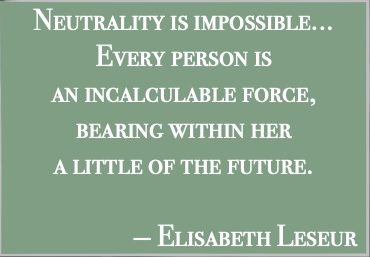
bear – ing n 1 the manner in which one comports oneself; 2 the act, power, or time of bringing forth offspring or fruit; 3 a machine part in which another part turns [a journal ~]; 4 pl comprehension of one’s position, environment, or situation; 5 the act of moving while supporting the weight of something [the ~ of the cross].
Tull @ the Orpheum, Mpls.
Do you ever feel like you are fighting your children, and your children are fighting you, all day long?
+ + +
From the Office of Readings for today, the Solemnity of the Nativity of St. John the Baptist:
Jeremiah 1:4-10, 17-19
The word of the Lord came to me thus:
Before I formed you in the womb I knew you, before you were born I dedicated you,a prophet to the nations I appointed you.
"Ah, Lord God!" I said, "I know not how to speak; I am too young."
Too young, too old, too tired, too busy, too faltering, too selfish, too confused, too inexperienced, too unprepared, too overwhelmed.
But the Lord answered me,
Say not, "I am too young."
Or whatever.
To whomever I send you, you shall go; whatever I command you, you shall speak. Have no fear before them, because I am with you to deliver you, says the Lord.
"To whomever I send you, you shall go."
Because they come after us, we often think of the children as being sent to us.
But John turns this time-sequence on its head. John testified: He who is to come after me existed before me.
And though they didn't exist before us, this paradox recalls that, rather than them being sent to us, it's more true that we are sent — to each child in turn, and at the same time.
"To whomever I send you you shall go."
Then the Lord extended his hand and touched my mouth, saying,
See, I place my words in your mouth!
This day I set you over nations and over kingdoms,
(Or perhaps only over one family of children),
To root up and tear down, to destroy and to demolish, to build and to plant.
But do you gird your loins;
Get out of your pajamas. Put on your shoes and tie back your hair. Wash your face. Chin up.
stand up and tell them all that I command you.
Be not crushed on their account, as though I would leave you crushed before them;
And boy, don't I feel that way sometimes.
For it is I this day who have made you a fortified city, a pillar of iron, a wall of brass, against the whole land; Against Judah's kings and princes, against its priests and its people.
The Lord fortified Jeremiah against Judah. He expected conflict. (And got it.) Conflict, however, was not the purpose of their relationship. The purpose was guidance, correction, reconciliation, love.
In Jeremiah on St. John's birthday we are to see the purpose of "preparing a way for Christ" as well. A road into the heart.
They will fight against you, but not prevail over you, for I am with you to deliver you, says the Lord.
If you had told me a few years ago, when my children were fewer and smaller, that I would read this and immediately identify with Jeremiah (knowing to whom I am sent), I probably would be horrified at the language of antagonism and conflict and power struggle. Isn't our ideal a little bit more… collaborative? Shouldn't we turn to language that sounds a bit more… encouraging? Warm nurturing welcoming nourishing protecting cuddling sheltering blah blah blah?
<ringing sound of sword being unsheathed>
The Lord made my tongue a sharp sword; he hid me in the shadow of his hand.
Both, perhaps?
I am the voice. The voice of one crying. The voice of one crying out.
I have placed my words in your mouth.
Do you gird your loins.
It is I who have made you a pillar.
Want to point you to this post by Kara at Mama Sweat, about workout wear that looks good and presentable and cute and… deliberate, not accidental… outside the gym.
Since my transformation from lumpy slob to regular swimmer/runner, I have always been the "wear normal clothes but keep the gym bag packed" sort of person. This is compatible with my exercise lifestyle, which includes a full-service YMCA membership with child care one mile from my house. But: I think she makes some great points. Really great.
The best way to maximize your time and improve your odds of working out and/or finishing a workout you started earlier in the day, and/or squeezing in two mini-workouts, is simple: Put on workout clothes in the morning, wear them all day and don't look back….
When you have one of those mornings when you don’t have an opportunity to workout before the rest of the family rises (or, ahem, slept through it) don’t bother with the shower. Don’t wash your hair, silly (that’s just a waste of water if you haven’t had a chance to sweat first). Reach instead for “all-day workout wear” and be ready to sweat if the opportunity presents itself. Spandex, Dri Fit, and sports bras have a way of tricking your mind into making time. Heck, if you make time to dress for the workout, you might as well do it.
To make all-day workout wear truly functional you can’t just put on any ole smelly shorts and t-shirt. You have things to do girlfriend! People to see! Groceries to buy! Classrooms to volunteer in! Neighbors that drop in unexpectedly! Before and after the workout you want to be fit-inauspicious (especially if there’s no time to shower or refresh after). That is, all-day workout wear is sporty, cute, and presentable. But make no mistake, this is workout wear. If you were to go the whole day in these clothes and not workout, you’d consider the outfit wasted.
More wise words, with pictures, at the link. The strategy of having "real" clothes that can turn into workout wear, or vice versa, is a good one for those of us who have to stay flexible. Flexible is not always easy, you know. It took me a while just to get used to the idea that if I was going to be a regular swimmer, sometimes I might wind up washing my hair twice in one day.
So if I can find a mental barrier to exercising in "gosh, but I already showered today once," that means that someone out there might have a mental barrier in "gosh, but I'll have to change clothes." So. One way to knock that barrier down is to acquire some clothes that work. Out.
(Kara includes a disclaimer for the working-in-an-office kind of girl, but … commenter ChristyP? If anyone I know would have found office-worthy active-lifestylewear, it's you! If you're not off camping somewhere, have you a comment?)
Doesn't this look like a fantastic resource? I am so buying this book when she finishes it.
This book is the result of a blog I started about a year ago, Verbosum, where I looked for proverbs and mottoes to illustrate basic Latin vocabulary. I was surprised and impressed at how well the proverbs were able to illustrate vocabulary usage, with an abundant supply of proverbs for all the basic vocabulary of Latin.
Then, earlier this summer, I had a sudden idea of how to organize the proverbs in terms of vocabulary: I could build the vocabulary, step by step, starting with the most common words and adding vocabulary one word at a time, thus creating a "ladder" or "stair step" structure. Hence the name: Scala Sapientiae, from the Latin scala, meaning a "ladder." From proverb to proverb there is at most just one step (one word) which you need to move on to the next one.
Then, I set as my goal to organize 5000 proverbs into this ladder formation.
She starts with 25 basic vocabulary words (mostly functional grammar things like prepositions and demonstrative adjectives) and then the proverbs:
1. Do ut des (ut is from the basic 25; the new word is: two forms of do, to give)
2. Qui non habet, ille non dat (Qui, non, ille are from the basic 25; the new word is habeo, to have; the word dat is a form of do from #1)
3. Nihil dat qui non habet (Nihil, nothing, is the new word)
… and so on.
I'm going to start using this, literally, TODAY. I don't know what the kids will think, but this kind of thing is the way I like to think.
So, you'll recall that I have been teaching history and Latin to two families besides my own, right?
I wrapped up my three-year American history program (more on that again later) with a few weeks' study of mass communication in the twentieth century, and finished that off with a discussion of social media and email.
Why did I put this in the context of history class? Well, for starters, for our family anyway, the timing is just about right. My ten-year-old is ready to have his own email address and to be a little bit freer to use and find things on the Web — and you know, before you send them out in the world you have to have "the talk," right?
It's also something that is very different for these young people than it was for us. I didn't have to rely very much on books here, because Hannah and I could be the primary sources. We sat down and told them what it was like to read and contribute to Usenet groups, or to look for information using Gopher, or how hard it was to filter out the irrelevant junk before Google revolutionized the search engine.
Anyway, I ran the "Internet safety" lesson as a sort of discussion group. I thought I'd provide the outline here.
+ + +
Part I: The part that fits neatly into an American History context
A. Definition of social media: "Places" on the internet where people can virtually meet and communicate with each other.
B. How do people communicate using social media?
1) By sending files to each other
–files can be messages (long or short), documents, photographs, audio files, video files
2) Or by storing such files where they can be accessed by others
3) Or by playing games with each other which they access through various websites
4) Or by real-time chat or videoconference
C. Imagine a metaphor of a big room with lots of bulletin boards where messages may be left behind for all to see. I used this to emphasize the lack of real privacy.
D. Discussion question: How does the advent of easy, cheap social media change American culture?
(Looking for concepts like: people can make friends they've never met in person; people can form associations based on common interest regardless of geographical location; more international interaction; people may be more connected to "strangers" than to their own families; changes family culture; people can get addicted to being on line; business models change; people expect to connect to the internet everywhere so free time changes; advertisers have new ways to reach people; it's much easier to find information; etc.)
Extension: Watch the 90-minute PBS documentary Frontline: Digital Nation (available streaming through Netflix or here for free).
+ + +
Part II. New risks to be aware of because of social media.
Kinds of risks, ranked from the most dangerous to the most benign (in my opinion).
1) The risk of being physically harmed in "real life." Someone who wants to harm you for fun — an online predator — might try to use the computer to find kids like you, to trick you into telling him where you can be found, or to trick you into meeting him in person.
Discussion questions:
(2) Harming you non-physically via computer communication. Another kind of online predator might try to harm you, for fun, even without actually meeting you in person. A person can do this by sending you harmful messages or videos, or just putting it where you'll see it.
(2a) Some things may be harmful to you even though the person who made them available did not intend to hurt anyone. What kinds of things are these? (material that's meant for adults but not appropriate for children; incorrect facts)
(3) Stealing your identity or your parents' identity. If a thief can successfully pretend to be me, she could gain access to a lot of my stuff. What kinds of things could such a person gain access to?
Could such a person also break the law and get me in trouble for it? (yes)
Could they borrow money and then I would have to pay it back? (yes)
Could they send nasty messages that look like they came from me and then I might get in trouble or lose my reputation? (yes)
Discuss: What kind of information can be used to steal your identity or your parents' identity?
(4) Spreading things that you wanted to keep secret or private. Suppose you had a secret that you wanted to share with one close friend and nobody else. You told the secret to your friend and made her swear that she would never tell anyone. But suppose that this friend wasn't as trustworthy as you thought she was. She told your secret to one other person. And then that friend told another person. And before you know it, everyone you know knows your secret. How would you feel? Could some secrets even put you or your family in danger?
There is nothing new about this. Secrets have gotten out for as long as people have been keeping secrets from each other. But secrets that are passed around by computer can be a problem in a new and particularly dangerous way. Do you know why?
Discussion question: How can you protect yourself against online spreading of secrets or secret pictures or secret videos?
(5) Harming your computer. Computer viruses can infect your computer. Any file that you download from the internet may contain a virus or a piece of malware. How can you protect your parents' computer against unwanted programs?
(6) Selling you stuff you don't want. There are many advertisements on websites. You need to be cautious about the things that advertisements on the internet say, just as you need to be cautious about claims made on TV. Some of it is there to trick you into spending your money.
(7) Gathering information about you so they can figure out what stuff to try to sell you. You know that when you type words and numbers into a form on a website, or when you send an email, some information leaves your computer and goes out into the world where someone can get it. On many websites, information can be gathered just from a mouse-click. Some companies gather information about what you like to read or look at, and they use this information to send you advertisements that they think you will respond to.
General Discussion and Assessment:
What risks are there in each of these places? What precautions should you take?
One of the side effects of co-schooling comes when it's time to sit down and update my end-of-the-year school records. Sometimes when you see it all together, the effect can be surprising.
See, I like to transcribe highlights from my daily what-we-did-today sheets into a sort of journalistic what-we-did-in-each-subject-this-year record. It's all the same information, but sort of re-shuffled: from a daily page that says, "art – we did this lesson" and "handwriting – we did that lesson" each on a separate page, I get a couple of paragraphs that sum up "all the art lessons for the year" and "all the handwriting progress for the year." I find it to be a worthwhile exercise, especially when I need to gauge how fast I should plan to work next year.
So, surprising. Here is a highlight from my seven-year-old's record for the third quarter:
Fine Arts
The seven-year-old continues art appreciation lessons. In one lesson (combining science and art) the seven-year-old studied paintings and engravings of birds 1500-1940 from The Art of Ornithology by Elphick and Audobon's Birds of America. Issues discussed included artists, methods, drawing from models vs. drawing from life, the purpose of this kind of art, and how the backgrounds often show food sources and habitat. The children discussed how the naturalist's purpose in creating art differs from other types of artists. He chose a favorite ornithological drawing of an avocet.

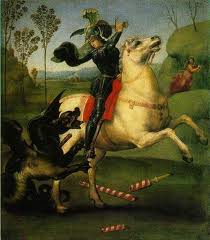
In another lesson he studied Raphael's "The Knight's Dream" and discussed color, detail, and symbolism, as well as locating the painting in space and time on a historical map. Raphael's "St. George and the Dragon" was studied and compared to "The Knight's Dream."

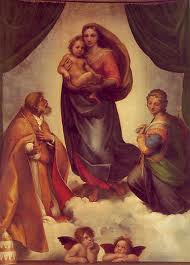
Raphael's "The Sistine Madonna" was studied and used to discuss technique, symbolism, development, and the idea of painting "things unseen."
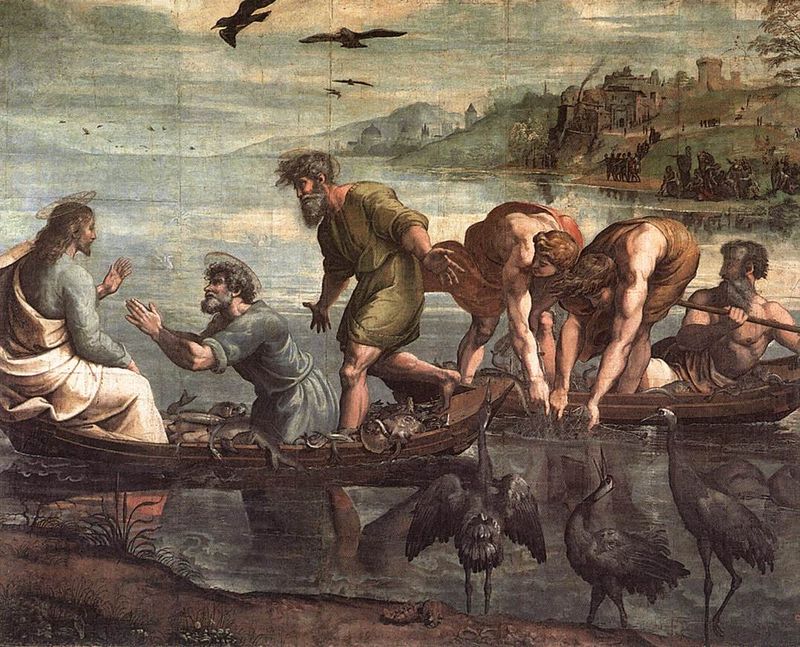
Raphael's "Miraculous Draft of Fishes" was studied along with the story from chapter 5 of the Gospel of Luke.
In Music Theory, the seven-year-old reviewed the names of the notes over two octaves, both on a keyboard and on the staff, and then began a study of intervals. First he learned to identify 2nds and 3rds by written notes, on a keyboard, and by ear. Then he learned to identify the second through seventh intervals. He and other children learned to circle-sing thirds on a mock piano keyboard. They played "Guess the Interval" with a bell set and a piano. They learned to sing second through seventh intervals on C major.
Um. I didn't have much to do with this. Art appreciation and music theory is what Hannah does while I am teaching Latin and history to bigger kids. Reading this over I am blinking and thinking: Really? My seven-year-old?
And: We managed that and we managed to feed them lunch twice a week?
I sincerely hope she is as impressed with what I taught her kids as I am with what she taught mine!
This is just a placeholder post while I finish my coffee before running upstairs to haul children out of bed.
+ + +
It's sort of our first week of summer. I say "sort of" because we actually have one school-week left, which we're doing next week.
+ + +
It's the time of year where as you drive around town you see big lawn signs out front of all the Protestant churches announcing "Kids Adventure Camp!" or "Jump Into Summer Fun Week!" When I was little, I am pretty sure they called it Vacation Bible School. I think they still call it that ("vee bee ess") out loud, but it does not appear on the lawn signs anymore.
My kids are going to a VBS camp entitled "Immaculate Mary: The Story of Saint Bernadette and Our Lady Of Lourdes!"
(I love our parish DRE.)
We don't have a lawn sign. Maybe we should. Except then the camp might fill up even faster than it already does.
+ + +
I'm volunteering in the nursery this year. Margaret took a good picture of me with my coffee and the other nursery volunteers. I don't photograph particularly well so I'll link to this one because I like it. She's a good photographer, or at least she has a damn good camera.
+ + +
We are having a very dental week. The seven-year-old needs a filling, the four-year-old has an abscess and needs an extraction, the sixteen-month-old is screaming teething on two sides all night long, and the ten-year-old — about whom the dentist announced to us, "This kid is never going to have a cavity, count your blessings" — has an orthodontia consultation this afternoon. Here's hoping the outlook is sunny there.
(UPDATE: Braces are not in our imminent future but will remain an option farther down the road, and probably a minor option at that. So. Good. But. This poor teething baby is SO NOT HAPPY. I think we'll be exercising the "quesadillas for dinner" option.)
+ + +
OK, coffee cup's empty. I've got some good homeschooling posts in the queue, I think — my internet-safety lesson for middle schoolers, and I'm almost done collating the information for my three-year literature-based American history curriculum, which I'm gonna put up free of charge.
But somewhere in there I plan to head out to the playground.
Have a great day!
A few days ago I wrote about how I discovered that stacks of disorganized files, despite being ugly, can actually be an efficient way of dealing with many kinds of household paper records. They cost time in file-retrieval, but they save time in file-storage (since you don't have to take much time making folders and putting them in the right spots). This kind of storage is only appropriate if the piles stay where you put them, and if it's much more important that you be able to easily put files away than that you be able to easily retrieve them — that is, if it's okay if it takes you a while to find what you're looking for as long as you know it's in there somewhere.
In this post, I write about how I changed paper-storage in my schoolroom to exploit this principle: How can I best use messy piles as quick, safe storage?
+ + +
The whole concept is counterintuitive — we assume that a system must be tidy to be efficient, and conversely, that tidying will make us efficient. But tidiness takes work. Whether that work pays off depends on how much time you can afford to spend putting something away, how long you expect to store it before the next time you need it, and on how much time you can afford to spend locating and retrieving it.
Lots of homeschool items must be kept safe. The law requires me to keep copies of certain forms; I want to preserve a "portfolio" of each child's selected artwork and writings; I must keep and add to the current year's school records, aka "grades"; I already printed up some worksheets and I want to assign them in a few days. I also have to promptly put up certain dangerous tools like the hot glue gun and the craft knife. But only sometimes do I have the leisure to carefully store files and tools away in an organized system. And only some of these things need to be kept close at hand.
So let's look at the different categories of "kept items" for the homeschool.
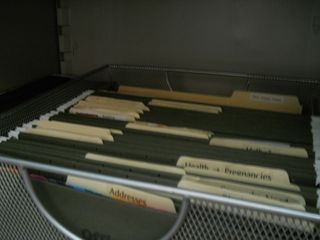
Things I probably have time to store carefully away in a file, and might need to find quickly: vaccination records, other medical records, annual reporting forms, the results from the standardized testing.
The reason I have time to put these away properly is because I don't deal with them every day. I only generate them once or a couple of times a year, and that's enough of a special occasion that I'm willing to take the time to file. For these, I keep a small box of hanging files.
+ + +
Things I have time to put away at my leisure, and can take my time finding: curricula that I'm done with for now but might use again. I keep this stuff in a storage area in the basement, in big bins on big shelves, along with the camping gear and Christmas decorations.

+ + +
Things I don't have time to put away carefully, but that I want to keep for a long time, and probably won't need to find quickly: selected work to archive permanently, and the records of what we did every day (the "lesson plans/grade books"). For these I have a two-stage system. I keep one magazine file for each child, labeled "Records," close at hand on an upper shelf of a bookcase in my school room.
 <–closeup ……..
When I select some child's artwork for his "portfolio," I stow it in the appropriate magazine file. I also drop daily and weekly records and grades, some assessments, and other things in these files as they are generated. Then, when the magazine file is full or the year comes to an end, I transfer the material to one of the labeled bins in the basement storage area.
….eventual destination–> 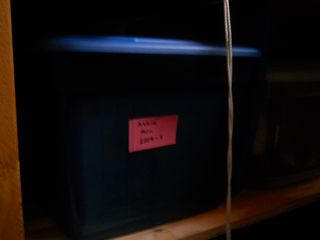
(I don't have much space in my schoolroom, so I don't save everything; a lot of stuff gets tossed instead of stowed in the portfolio file. A person with enough room for a big bin might save everything, let it incubate all year, and cull it at the end. There are some advantages to this idea, but as I said, I don't have enough space to save everything, so I don't.)
+ + +
Things I don't have time to put away carefully, but that I will need pretty soon, and won't want to spend time searching for: schoolwork sheets that I'm preparing and assembling for upcoming lessons; schoolwork that's partly done and needs to be worked on again; finished work I need to go over again with the children; library books.
Much of the material we use daily — the self-contained textbooks and workbooks — are kept in each child's desk drawers. Basically, if it's all bound up nicely so a child can care for it easily, it lives in their desks.
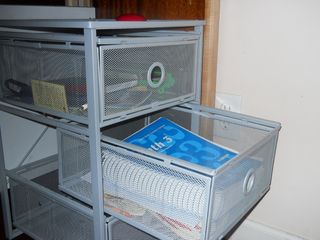 … spiral-bound or tear-off math books
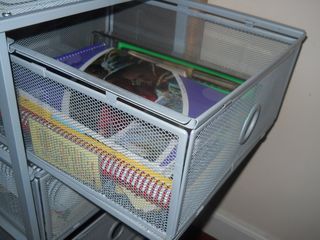 … spiral-bound handwriting and art
But for other subjects, I seem to need to temporarily store a lot of loose paper during school planning or between assignments. History, for example, with all the maps, or Latin, because I often make up translation worksheets. For these I use stacking plastic in-baskets, one for each subject that takes a lot of paper to prepare to teach, especially paper that I need to keep on hand for a few weeks and use intermittently. Some subjects get their own stack box, and then I try to have a "misc." stack basket as well.
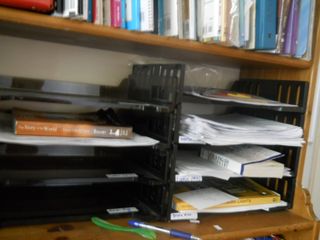 … always keep a baby spork handy
The stack boxes are only for loose paper (and sometimes for small books) – books, being reference materials, are shelved normally, and I mostly try to use binders, not for filing, but for keeping papers together that are supposed to stay that way. Pseudo-books. I try to keep library books in a basket unto themselves, but I won't deny that they often wander off to a child's bedroom.
(A side note: If you've ever used David Allen's productivity system, Getting Things Done — or GTD as it's often called — you might recognize that the stack-baskets function as context-specific lists of action items, where the context of one basket is @planning history and the context of another is @planning Latin. I can only concentrate on one subject at a time, so each one may as well be its own context, right up there with @calls and @computer and @home and @errands.)
It's true that within a stack basket, the papers are disorganized. I have to shuffle through them to find the exact one I want. But it's a manageably-sized pile, and — most importantly — it is very quick to put something away in there. Much quicker than filing it, or even than hole-punching it and putting it in a binder. I don't have to think, "Argh — got to file this — oh well, I'll get to it later" and leave it on the counter where something might happen to it. I can just stick it in the appropriate basket, and trust that it will still be there when I need it the next day or the next week.
What goes in these boxes in your diagram?

I like Jamie's my-little-boy-is-growing-up-(sniff) story from yesterday. I like it a lot.
It's good to be a nerd.

Not that kids are slime molds or anything.
All I'm saying is, I may not be a speech pathologist like Jamie, but the language of nerd is a universal one, and nerd-mom is even better.
(Comic here)
Just a brief interjection here: This morning I ran my fourth 5k, and I set a new PR at 27 minutes 30 seconds. I placed 64th overall out of 160, and 22nd out of 90 women. Third out of the 15 women in the 35-39 age group.
I did much better than I expected, given these four facts:
(1) It's my first race using the forefoot strike (aka Pose or Chi running, and often used by the barefoot running types, though I run in cross-country flats). You may remember that I took a running clinic last year in which I learned the new form.
(2) I haven't been training on pavement at all since I started forefoot striking. Only treadmill and indoor track.
(3) It didn't occur to me to sign up for the race until about 5 pm the evening before, when I was surfing around and discovered that one of my favorite small local races was scheduled for 8 am. (Just as an aside: I am so thrilled that I can just decide in the evening that I'm going to run a 5k the next morning. That rocks. I love the internet.)
(4) I forgot to eat breakfast.
For all those reasons, I went into it reminding myself that I didn't want to push too hard. Still, when I checked my stopwatch at the one-mile mark, I found that I'd run my fastest-ever first mile. Oops!
A couple quick takes:
-You know how they tell people not to worry about whether your gear looks like "real" running gear because nobody notices it? Lies, all lies. The man warming up next to me at the start said, "I see you've raced before. You're wearing flats."
-Just as they were telling us to get ready, the big purple inflatable START arch suddenly went flaccid and collapsed in front of us all. They had to delay the race a few minutes while the volunteers removed it. (It was back up again in time for me to cross it going the other way at the end)
-Also the first race that I tried listening to my iPod while I ran. Wonder what the people next to me were thinking when "The Time Warp" from The Rocky Horror Picture Show came on and I suddenly blurted out, "Group sex group sex group sex."
– Oddest thing I noticed that I attribute to the forefoot strike: I felt physically more comfortable running uphill than running downhill, which is a first, believe me. I tried hard to work it.
Recent Comments
Recent Posts
Categories
…more to come later

 bearing blog