bearing blog


bear – ing n 1  the manner in which one comports oneself;  2  the act, power, or time of bringing forth offspring or fruit; 3 a machine part in which another part turns [a journal ~];  pl comprehension of one’s position, environment, or situation;   5  the act of moving while supporting the weight of something [the ~ of the cross].


  • Photostream idea: Home schoolroom show and tell?

    Longtime readers know I do not make "homeschooling blogs" a regular part of my blog reading diet.  It tends to make me restless and unhappy about all the things we are not doing (as opposed to happy and peaceful about all the cool things we are doing).

    The exception is when I am actually searching for inspiration and ideas, particularly about something specific.  And late July is a great time for that, because the school year is still a few weeks away and the possibilities don't seem so constricted.

    I thought of that when I happened upon an interesting photostream this morning.   Lifehacker has this Flickr "Workspace Show and Tell" which is mostly a set of annotated pictures of cool home office setups.

    Now what I would like to see is a similar show and tell for home schoolroom setups. Homeschoolers with Flickr accounts could post photos, explain the ages of the children, how the schoolroom fits into the larger home, and tell why the space works for them.

    Yes, this is one of those things where I throw it at the Internet and say, "Somebody should set this up." I've never used Flickr and I'm afraid if I did it, nobody would come to my party. Anybody else interested?


    UPDATE:  Dorian Speed of Scrutinies and Convolare Design is possibly going to help me put this together.  If so it will be the first time I accomplished anything via Google+.  In return I will tell her what color to paint her dining room.


  • More on Benedict for families: Prayer, work, and study.

    I'm totally buried in school planning this week, so blogging has gone to the back burner.

     Scratch that:  I'm immersed in school planning.  Planning is absolutely my favorite part of homeschooling.  It's summer, I only have to teach a little bit of "remedial" stuff (or let them teach themselves; for example, my 10-y-o's special summer subject is intensive typing practice with Mavis Beacon), and to top it all off, two of my kids are visiting Grandma and Grandpa for two or three weeks right now, so I have tons of time.  And I'm pouring most of it into lesson planning NOW so I won't wake up some morning in February 2012 and say "I don't know what I'm going to do today so I guess we'll just watch movies."

    So speaking of being immersed in work, did any of you go and read Fr. Longenecker's Saint Benedict for Busy Parents that I recommended a few posts ago?*

    I found myself unable to stop myself from creating a three-by-three matrix:


    Prayer

    Work

    Study

    Obedience


    Stability


    Conversion of Life


    …and trying to fill in all the cells, or at least some of them.  Do I practice obedience with regard to prayer, etc.

    Because that's the kind of response a girl like me has to a piece of spiritual reading.  (You should have seen my notebook after I finished The Interior Castle.)

    Of course, I immediately ran into another question, because while some of the stuff I do every day is undoubtedly prayer, and some of it is surely work, and some of it is arguably study, there's a lot of other stuff that isn't clearly any of them.   It's not hard to classify, for example, driving to the grocery store as "work."  What about going for a swim?  What about eating dinner?  And for that matter:  what about hanging out with friends or just sitting down with a cup of coffee in the morning getting ready to face the day?  I noticed a distinct lack of "just chillin'" in St. Benedict's trinity of how you spend your time.  And yet the monks were expected to have recreation time.   So do you suppose St. Benedict thought of the free time the monks had as part of prayer, part of work, part of study?  Or is free time some kind of fourth thing outside of prayer, work, and study?  Or is free time spent doing things that all can get classified as either prayer or work or study?  (If scrubbing the floor can be a form of prayer if it is done with love, I suppose finally getting that cup of coffee can be prayer if it is done with gratitude.  "If?"  Who isn't grateful for that cup of coffee?)    

    Or maybe there really is no such thing as free time and the reality is that whatever we're doing, we are working, or studying, or praying, whether we realize it or not, and maybe we should sit up and pay attention to what it is we're making, or learning, or saying to God.

    But anyway, I made a stab at classifying all the things I do as either "prayer," "work," or "study."  

    Prayer wasn't too hard.  Attending Mass is prayer (even if I'm too busy attending to children to pay much attention to it, I decided).  Prayer is prayer.  Going to Confession or Adoration is prayer.  No problem.  

    So you could say it was pretty easy to classify everything I do into "prayer" and "not-prayer."  (Subject to the caveat about all activities being a form of prayer if you do it in love, à la St. Thérèse.)  It was trickier to decide what to do with all the "not-prayer."   

    In other forms of "what do you call what you do" classification, "work" is divided from other things, like "leisure," by monetary considerations.  Does it create wealth?  Can you get paid for it?  This won't work here.  It's more essential than that; it has to make sense whatever the context of economy.  And anyway, we're not distinguishing it from "leisure," but from "study."

    So, in this system, "work" is something you do (I decided) that participates in creation:  remakes the physical world somehow.  It "co-operates with God in the redemption of the world," to quote Fr. Longenecker.  "Study" is something primarily interior that involves taking in the world as it is, and shaping it in the mind.   

    With that in mind, I decided that teaching children is work; that preparing lessons is work.  That all the aspects of life that I could call "homemaking" is work.  For the purpose of dividing life up into this trinity, writing is work, even though I do it almost entirely for fun.  Traveling of all kinds is work, even driving to the grocery store.  Physically caring for other people, like nursing this child on my lap right now as I type, is work.  Physically caring for myself is work, too, and that includes getting the exercise I need and want.  And so having dinner with my family or friends is work.  Indeed, interacting with other people is almost always work, even just hanging out, because through our interactions with each other don't we remake the world in a small way?  Don't we have an opportunity to co-operate (if we are kind and prudent and open to the spirit) in redemption?

    That leaves a number of things that can be called "study."  Scripture study and spiritual reading seem like they could be either "study" or "prayer," but fortunately, St. Benedict himself called them "study," and that is a bit of a guide to help us define the category.  All kinds of scholarship and research are "study."

    Now, if you work as an academic, or a scientist, or a teacher in or out of the home, the distinction between "work" and "study" may be a little difficult to pinpoint; I, personally, make the classification based on whether I am remaking my own mind or something outside my own mind at the time.  When I skim through a stack of history books to decide what I will teach the children, I am studying.  When I put pen to paper to make a list of points I plan to teach, I am working.  

    I have worked in laboratories, and I think I can figure out how I would classify as work or as study the various tasks: planning experiments, building apparatus, running experiments, collecting and analyzing data, writing up results and presenting them.  There is some prayer, of course, too:  I suspect that even if you include all the atheists, it's a rare researcher who hasn't uttered "OH PLEASE LET THIS THING WORK" at least once.  

    Much leisure is study.  All reading for pleasure, and by extension all media consumption of any kind (this includes reading Facebook — but not updating your status, which would be work, since you are creating content for others).   Developing skills of your own through reading or watching others  is study (although practicing them may be work).  Self-examination is study, even when prompted by prayer.

    + + +

    Speaking of self-examination:  here is where I explain something about myself, because I can hear a voice asking "What's the point?"  The point is, I find a peculiar entertainment in continually examining my life, interior and exterior.  I find a meditative peace in the act of simplifying and filtering it.  Creating a blank table in a spreadsheet, all crisscross black lines, and empty  – like the one above, before I started filling in the cells — rakes the sand in my little mental Zen garden.

    And I like the exercise of "What if I thought of –say– getting to the gym as part of my work?  How would that change my attitude toward it?  Would it affect how I see it interrelating with the other things that are part of my work?"

    Actually, the bit that felt most satisfying when it clicked into place was the concept that for me, hanging out with my friends, insofar as I am capable of "hanging out"  – being with other people in general — what I called "Fellowship" in my spreadsheet — was to classify that as "work."  Because really, I am a classic introvert, and even though I enjoy other people, it wears me out.  Calling "fellowship" "work" lifted a bit of weight from my shoulders. 

    The most useful insight for me, though, is that when you classify everything as either prayer, work, or study, no time is wasted.  It's either spent for good, or spent for ill.  

    When I attend Mass, or pick up the breviary, or stand in line for confession, or even utter a voiceless "please!", I'm praying.  Am I referring to God or to myself?  Am I aligning my will with God's or against it?  Am I a channel for grace or an obstruction?  Am I opening my heart or trying to conceal it?

    When I watch a video, or check comments on a news story, or listen to music, or read a book, I'm learning something.  Did I learn something true or something false?

    When I write a blog post, or clean up a mess, or assign work to the children, or go for a run, or go to sleep, or spend time chatting with my friends, I'm participating in the creation and redemption of the world.  Did I help it or hinder it?


    ________________

    * I forgot to mention on that post that I owe a hat-tip to Rich Leonardi for linking to it.


  • Before and after.

    Before and after shots of joggers.  A novel photography project.

    I think some of the people look more attractive and winsome in their out-of-breath, sweaty state.  Don't you?


  • Focus.

    Sorry, can't post right now.  Kids want to paint.  I'm sure you understand.


  • Hot.

    You can gauge how crafty I am ("not very") by the execution of this play stove I made today for the 17-month-old, but I did think it was a pretty creative idea that used a kid-table we already had and some remnants from the fabric store.

    0722111614-00

    I would like you to know that this stove is SO REALISTIC that I really burned myself on it.

    Photo on 2011-07-22 at 16.42

    Mark was skeptical that the baby would  recognize the faux-electric-burners, as we have a gas stove, but indeed he immediately identified them as HOT and started putting pans on them.

    So, that was what I did with my summer Friday morning.  What about you?


  • “Complicate my life with technology, please.”

    Jennifer Fitz has a fresh take on the "how-is-NFP-different-from-contraception" thing.

    No no no.  NFP is not contraception.  It is not like contraception, it does not do what contraception does, it has nothing to do with contraception.   Ask a happy contraceptor to use NFP, he’ll quickly confirm this for you.

    NFP is a form of abstinence.  It’s a method for not having sex. 

    I realize that doesn't make it sound very fun, but go read the whole thing.  

    Readers of mine who are not even Catholic may find it very bizarre that, among Catholics who are aware of and accept Church teaching against contraception, there is a substantial contingent who are deeply suspicious even of couples discerning that they ought to use NFP at all.

    Yes, it's a fringe group.  But Catholics-who-are-aware-of-and-accept-Church-teaching-against-contraception is already a fringe group.  So the fringe group within the fringe group can seem fairly substantial.

     And if you're firmly within the larger fringe (as in my position, which is that we can have interesting hypothetical discussions about "sufficiently serious reasons" all day, but when it comes to real couples in real marriages, it is their own damn business whether to abstain from sex today or not) it is exhausting to keep having a public debate over and over again about what is essentially a matter of private discernment.  Nevertheless, I soldier on.

    Anyway, I like Jennifer's take.  Worth reading.


  • Are you an apple or a pear or a banana?

    Or an hourglass?  

    Betty B. defines the characteristics of the shapefruit.

    I have been following her series of posts on body type with much amusement.   Mostly self-directed.

    Look, I'm a geek-type mom.  I don't know many homeschoolers who aren't (at least who really like homeschooling, as opposed to just doing it because they think they should, and more power to those moms by the way, but if you're really drawn to homeschooling you are almost by definition a nerd).

    Most of my life I didn't get along very well with other women (still don't much) and have itched a little under the imaginary constraints of being (still have trouble typing this word) a homemaker.

    Still, if I plop down in a waiting room next to a stack of Good Housekeeping and Family Circle and Real Simple, I'm going to read them.  And I'm going to enjoy doing it.  It's kind of a dirty little secret, but apparently I want to know ten household uses for a cut lemon, or how to pair silver and gold, or what the aspect ratio of my handbag should be, or whether this marriage can be saved.

    And here I am with the entire Internet at my fingers, which is kind of like having an infinite supply of waiting room magazines, and what is the most engrossing, thought-provoking thing I read this week?  Betty Beguiles telling me how to figure out if I am an apple, a pear, a banana, or an hourglass.

    + + + 

    So this is what she said about it:

    • Banana -Your waist is at least 75% of your chest and hips, which are virtually the same.
    • Apple -Your waist is at most 75% of your chest, and your chest is at least 110% of your hips.
    • Pear - Your waist is at least 75% of your chest, and your hips are at least 110% of your chest.
    • Hourglass - Your waist is less than 75% of your chest and hips, which are virtually the same.

    So the first thing I did (obviously, because wouldn't you?) was to try to make a handy flowchart.  Because that is the way that I wanted to re-blog the information.

    And of course I couldn't, because the second thing that jumped out at me about her instructions was that they do not cover all mathematically possible cases.  I restated them in the comments as follows:

    Chest bigger than hips
    Waist less than 75% of chest – apple
    Waist more than 75% of chest – Unknown Fruit V

    Hips bigger than chest
    Waist less than 75% of chest – Unknown Fruit B
    Waist more than 75% of chest – pear

    Hips and chest similar
    Waist less than 75% of chest and hips – hourglass
    Waist more than 75% of chest and hips – banana

    I nominate, respectively, a morel mushroom and a kabocha squash, but I am not sure that these have quite the cachet of apples, pears, and bananas.

    Later I thought that Unknown Fruit B should really have been a butternut squash, which definitely doesn't have the cachet of apples, pears, or bananas.  But I digress.

    + + +

    It turns out that, despite believing myself to be an apple based on the less, er, scientific and more subjective criteria that you'll find in, say, Wikipedia or Cosmo, I am an extremely short banana.  36-31-35.  Telescoped all together.

    Which explains a lot, actually.

    Because BB has been telling bananas that, since they have no waist, they should work to create a waist and define one.  For example, she writes, "Invest in cute waist-defining belts to wear over shirts, cardigans and coats."

    Good advice for tall bananas.

    But short people are always told that we should never, never, never define our waist, because it cuts the body in half and emphasizes the shortness.

    (Handy tip:  If you google "cut the body in half" you will get a lot of results that are NOT ABOUT FASHION.  Don't say I didn't warn you.  Adding the term "belt" will help immensely.)

    How short am I?  I am so short that I literally cannot wear many "cute, waist-defining belts."  You know that pelvic bone (iliac crest) that defines the top of your "hips?" And you know the bottom of the ribcage? And you know the gap between them where normal people put their waist? For me that gap is less than two and a half inches wide. Many belts won't even fit there.   Wide cloth belts would fold themselves in half the long way.  Wide leather belts would leave scars.

    (I also have trouble fitting growing babies between my pelvis and my ribcage.  In case you don't remember, here is a picture of what I looked like the last time I was nine months pregnant with a normal-sized baby. The definitive pregnant short banana.)

    Anyway, I look forward to BB's resolving this basic dilemma of the short banana.  

    Because what else am I going to find out today from the Internet that will be more useful?  I already know ten household uses for a cut lemon.


  • Titles.

    Simcha has a brief post up about images of Mary that aren't Mary.

    There was a lively and fascinating discussion about portrayals of Mary a few weeks ago after Steven Graydanus’ post The Many Faces of Mary and after my response, Even More Faces of Mary.  It’s been a wonderful revelation to see how Mary is depicted in different cultures at different times—both in miraculous visions and as she appears through the lens of different cultural sensibilities.  This variation is, of course, a feature and not a bug:  the mother of us all is going to look different to different people, because we need her in different ways.

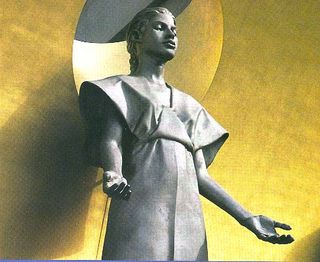
    …Several commenters in my “Even More Faces” post made the point that the heartily despised new statue in the new L.A. cathedral doesn’t look like Mary, because it didn’t have the easily-identifiable signs of either humble virgin or exalted queen. 

    Mary_sculpture

    I wasn’t actually crazy about that particular statue in itself, although it seemed okay to me.  What I liked about it was that it made me think about Mary in a slightly new way—a way which is often harder to access in more traditional imagery, which can be clouded in a haze of overly familiar symbology. It’s debatable whether or not that this unfamliarity made the image inappropriate as a feature in the sanctuary of the church—but I believe that, for private devotions, we can only benefit by looking for Mary everywhere in art, whether the artist had her in mind or not. 

    I also rather like the pictured statue, even though it has been stripped of most of Mary's imageries that are particular to certain peoples, places, devotions, and times.

    These statues and images can get quite specific:  she’s shown in a Carmelite habit, or wearing a traditional South American maternity belt, or with a lap full of harvested fruit, or holding a rosary, or breastfeeding the infant Jesus, or all in white, or all in blue, or… you get the picture.  Queen of Heaven, Queen of Martyrs, Immaculate Heart, Immaculate Conception, Daughter of Zion, Star of the Sea… so many particular titles.  And of course many of the parishes and cathedrals and basilicas dedicated to her are named after these titles.  It’s usually not just “St. Mary’s” but “Queen of Peace Parish” or “Immaculate Conception Parish.”

    And maybe it was a mistake for Our Lady of the Angels to miss a chance to depict Mary, Queen of Angels.  Since that is her particular title in Los Angeles.

    But I try never to forget that one of Mary’s most exalted titles is “Woman.” 

    Remember who came up with that one?

    It doesn’t have much in the way of “easily-identifiable” signs to it. 

    Still… I have to say… wouldn’t “Our Lady, Woman” be an awesome name for a parish?  


  • Imagine a spreadsheet…

    …with time down the left hand side, divided up into fifteen-minute blocks, for a whole day.

    Not every day, just Tuesdays and Thursdays.

    And imagine across the top, column headings for me and for Hannah and for ten children.  Ages 13, 12, 11, 9, 9, 8, 6, 5, 3, and 1.  (No, they aren't all ours.  That is a somewhat long story.)

    Spread

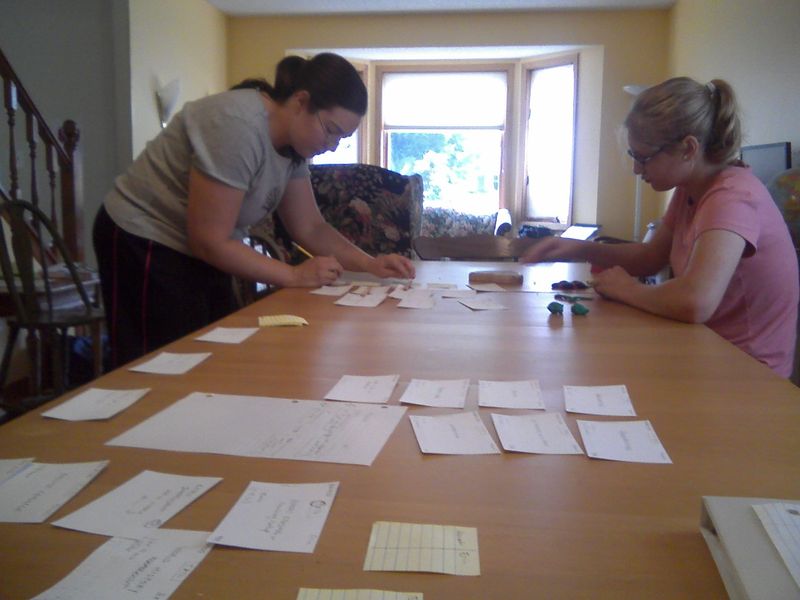
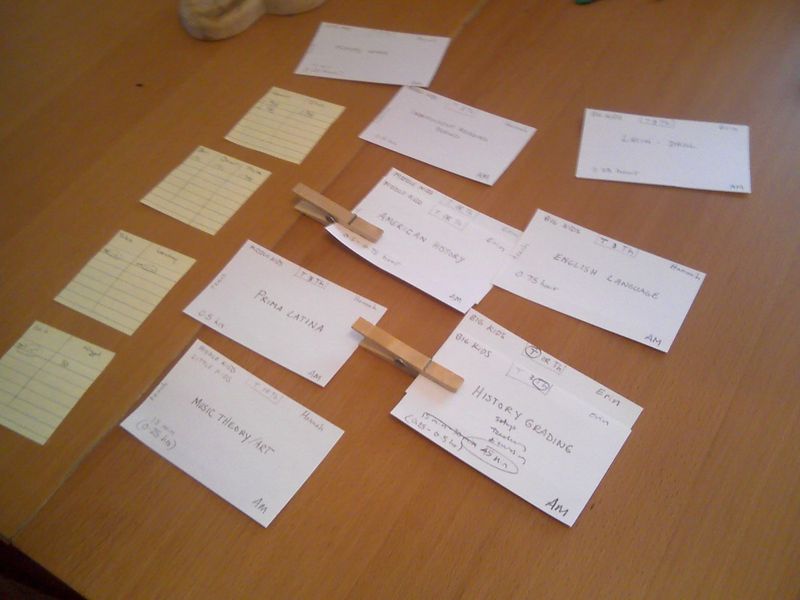
    Scratch that. Imagine a dining room table. And a whole lot of index cards. And some post it notes. And clothespins to hold some of the cards together.

    That's how it started.

    + + +

    You may remember that I co-school with my friend Hannah, and her children, and two or three extra children, two days a week.  We don't cover all our school subjects on those days, just some of them:  Latin, English, history, and some assorted craft and art and music.  

    Monday-Wednesday-Friday, separately, we teach our own kids all the other subjects.  Math and such.

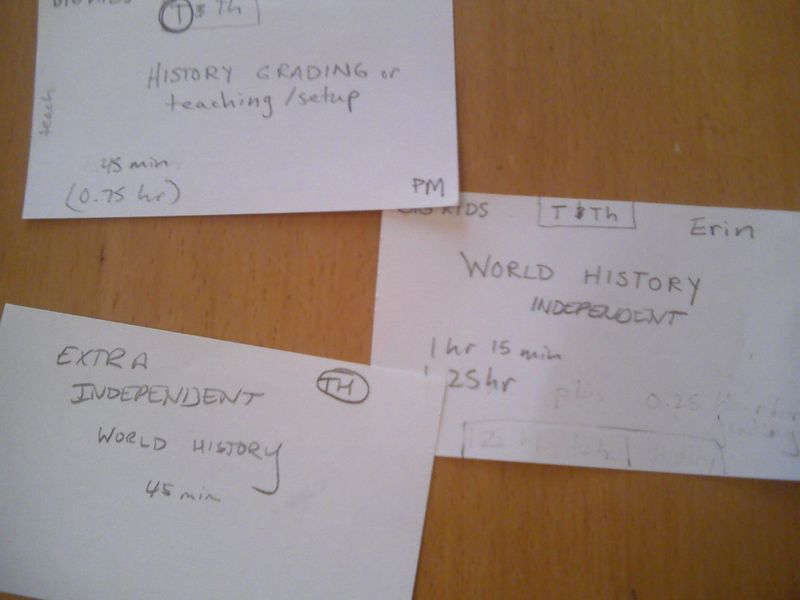
    Four of our kids were off visiting various grandparents, and the remaining ones were mostly playing happily, so we started off listing every subject and every kid.  Then, while I made lunch, Hannah transferred the information to index cards.  "I thought of cutting them up into different lengths to represent different time blocks," she said later, "but then I thought, 'That's insane.'"

    0719111309-02

    Later we decided:  insane is sometimes more useful.

    Cut to the long dining room table.

    Time runs from left to right across the table.  We commence moving index cards around. 

    0719111309-00

    There are constraints, of course:

    • The same child cannot be taught two subjects at the same time.
    • Each child can only be trusted for so long to sit and work independently.
    • I am not, personally, capable of teaching two of my subjects simultaneously.    
    • Someone has to be responsible for the toddlers at all times.
    • If you row to the other side of the river with the bag of grain, the fox will eat the chicken. Or something like that.

     We can loosen things up by deciding to teach some stuff on Tuesdays and other stuff in the same block on Thursdays.  Hence the clothespins:  if these two things are each done once a week, and they each take 45 minutes, and they entrain the same children, they could occupy the same time block.  So they move around as one.

    0719111309-01

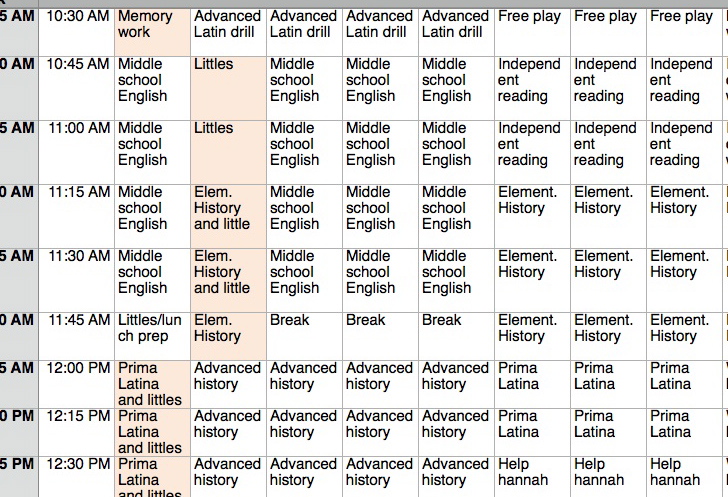
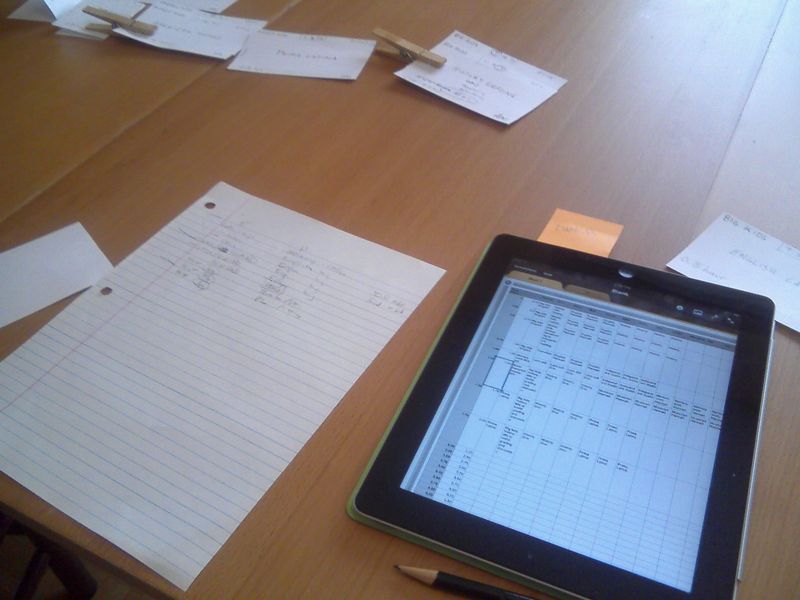
    Eventually the cards and clothespins stop making intuitive sense to me, and I am worried that a child will disperse them, so I start trying to freeze them in place in a spreadsheet.

    0719111457-00

    At this point we realize that we have failed in our first attempt:  In two places, both Hannah and I are focused on intensive teaching at the same time.  This means that the preschooler and the toddler are, hypothetically, running feral for an hour and forty-five minutes (although to our credit, we did plan to feed them lunch in the middle).

    We have tried the "feral preschooler" solution before.  It ends badly.   We shuffle things around again.

    It turns out that we cannot — literally cannot — free up one of us at every hour of the day to care for the preschoolers.  We cannot even free up one of us to "keep an eye on them" while teaching something less intense.  So we do our best to minimize the overlap, and assign simultaneous responsibility for teaching and preschoolers where necessary.  

    So, for example, I have a half-hour block where I am reading history books aloud to three elementary-school kids, but because Hannah is teaching middle school English and she needs to concentrate, I must also be responsible for the two preschoolers.

    I'll figure that out as I go along.  Maybe I'll give them some playdough at the same table, maybe I'll be reading a picture book and I'll have them listen, maybe I'll put on a DVD for them, maybe I'll assign an eight-year-old to entertain them while he listens to the reading, maybe I'll strap them in a chair and feed them chocolate chips one at a time.  I'll do something.  But what I won't do is assume that Hannah will take care of them while she assumes that I will. 

    Hannah has a similar time block later in the day, where she has to teach elementary-school Latin and I have to go over history homework with middle schoolers.  So at least it's fairly fair.

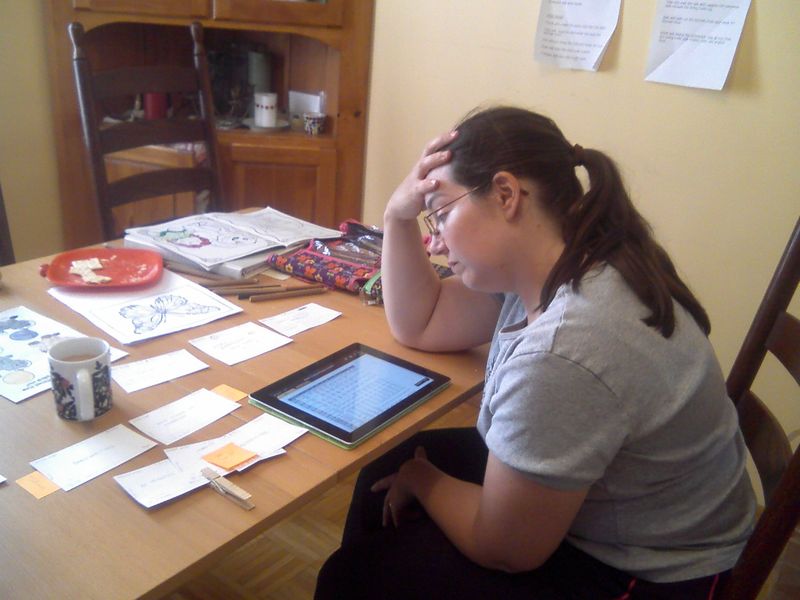
    Finally we had a spreadsheet that made sense to me.  Hannah had to absorb it and check it over for a while.  I left her alone with my iPad and some tea.

    0719111612-00
    .

    And I think we have something that will work.  We have to start school by 10:15, which gives us time for a vitally important cup of coffee together before we start.  Everyone gets an hour for lunch (and this year we will be rotating "server" assignments among the bigger children so that Hannah and I can actually sit down and eat our lunch instead of fetching cups of water and slices of bread).  The elementary school kids finish at 3:45.  We're done teaching at 4.  The middle schoolers have until five to finish up their independent work.

    Are we going to follow the schedule slavishly?  Is that the point of this exercise?

    No, the main point is to find out if our ideas about all the things we would teach next year were even possible.  Are there enough hours in the day?  How many times a week can we do such and such a thing?  What do we think we will have going all at once?  

    So, we have a plan.  We even have a "what if we start an hour late" plan.  We can be flexible, but we have to start with a plan first.


  • I’m on Google+, by the way.

    I'm just getting started, but already I like it very much.  

    Here's the thing about FB.  I've decided to use it to keep up with a fairly small number of people (less than 60 at this writing).  I don't have time to deal with a bunch of interlinked privacy settings and lists each time I make a post, so I've made an executive decision to control my privacy at the level of "whom do I friend."   To make the cut, a person has to be either

    • someone I would literally have called "my friend" now or at some stage in my life — and I can afford to be generous with this because there never have been that many people who fit that description at any level; or
    • someone who is related to me; or
    • someone whom I have had a long, 2-way correspondence with online.  Long enough that I feel I know them and they know me.

    Between that and setting almost everything to "Only friends can see this" I feel satisfied with the level of privacy, and I enjoy using FB to keep up with all those people.

    What I don't get to do, with these sensible rules, is follow strangers who produce good content.  For example, I don't get to friend Simcha Fisher under these rules, because I don't know her.  In my imagination, Simcha posts very funny status posts all day, and I don't get to see them.  Poor me.  I suppose  I could friend her, but in my imagination, she could also be an evil stalker, right?  Bent on world domination?  Anyway, I am leery of sending Simcha Fisher (whom I don't know) photographs of me and my children rolling out cookie dough*  for her to repost to the world (HA HA HA JUST LOOK AT THOSE PANTS), just because I like her blog.  You know?

    But (not that Simcha is on G+ yet) I anticipate a different experience with G+.  It's very easy to control whom you share a given post with.  So I anticipate putting LOTS of people in my circles, so that I can see what they choose to share publicly.  And then I think I can be comfortable with writing a fair number of public posts but also reserving some posts to go out only to people I know personally.  And who knows, maybe I will wind up listening more than talking; it depends how many people I know make the switch.

    All this is to say to my readers, I'm there, and I'm expecting to encircle people fairly promiscuously, unlike on FB, where chances are if you sent me a friend request I would decline it.  Look for me under my real name.  

    (p.s. If you need an invite, let me know — in the comments are fine — and I'll send it to the email address you type in the combox.)

    _____________________

    *Hypothetical situation for rhetorical purposes.  No pictures exist of me and my children rolling out cookie dough because that has never happened in real life.  I only ever make drop cookies, except for my Grandma's filled Hungarian cookies at Christmas, which are very rich and are rolled out in powdered sugar, and I won't let the kids help with those because (a) you have to work quickly unless your kitchen is very cold (b)  they would eat all the raw cookie dough scraps and get sick and (c) there would be no leftover dough for me.


  • Bastille day.

    I only have time for a short post, so here's a little quiz for you.  Choose the right answer:

    (A) It's totally plausible that on Bastille Day in 1993, the author of this blog, finding herself in France, got drunk with a couple of other Americans (male graduate students) and went down to the festival by the river to stumble around singing "La Marseillaise" as loudly as possible, because she knows all the words, while French people glared at her and her gym shoes and her T-shirt from an American rock concert.  Then she got some killer ice cream.

    (B) No, no, the Bearing I know would never do such a thing.


  • Another look at St. Benedict’s Rule in the family.

    Are you, like me, one of the women who read Holly Pierlot's A Mother's Rule of Life, got all excited, ran with it for a while, went completely overboard, and never opened the book again?

    (Bonus points if you still have a multicolored schedule spreadsheet stashed somewhere in a daily planner, one from two or three kids ago.)

    (Extra bonus points if you have an old excited blog post about how it was going to change your life).

    (Extra-extra bonus points if moldering in a cupboard somewhere — that is, if organizational supplies can molder –are materials produced by the organization that I think of as the MOTH People.)

    I don't want to dis Holly Pierlot too much.  There really are some good things in that book.  It's more that tendency in me to jump on the latest schedule-tweaking idea that comes along.  Nothing wrong with trying out new things, but after mothering for almost eleven years and homeschooling up to sixth grade I am starting to come to terms with the, shall we say, fluid nature of time-block expectations in this particular vocation.  Changing systems will not do away with this fundamental truth.

    Anyway, a nice antidote to being a card-carrying member of Mother's Rule of Life Quitters Anonymous is this new little booklet by Fr. Dwight Longenecker, hosted at the Knights of Columbus national website:  Saint Benedict for Busy Parents.  (pdf file) It's about 25 pages long and is well worth a download-and-read. 

    Where Pierlot drew inspiration from St. Benedict's Rule to create a well-prioritized schedule for herself and for her family, a sort of copycat version of the bells that mark the hours in monastic life, Fr. Longenecker encourages us to be centered not on the bells but on the principles of Benedictine spirituality.  Those principles are embodied in what Fr. Longenecker calls the "two holy trinities:" 

    • The Benedictine monastic vows: 
      • obedience
      •  stability
      • conversion of life
    •  

    • The daily pursuits of individuals living in a Benedictine community:
      • prayer
      • work
      • study


    (Note that popular culture generally associates monastic vows or even, confusing it further, priest's vows, as being "poverty, chastity, and obedience."  That's the Franciscans, not the Benedictines; although it turns out that Benedictines are supposed to embrace chastity just like any Christian, and own nothing or very little as a consequence of obedience to their Rule, Benedictines do not vow poverty and chastity).

    Fr. Longenecker considers each of these six principles and, without going out of his way to show us exactly how to apply them to the vocation of family life, explains their purpose, and tries to show where joy can be found in them.

    On obedience:

    We must remember…that Benedict portrays the Abbot… as a virtuous, wise and patient man, who never demands anything of his sons that is not for their best. He understands the weaknesses of human nature, and while he expects obedience, he never demands anything harsh or burdensome. In addition to this, he always wants the monks to engage with their obedience in the deepest, most curious and adventuresome way. The command of the abbot (and therefore the commands of parents) should be there to help the monk (and the child) to be intrigued by their spiritual path, and to obey with a sense of adventure and discovery rather than with blind and dull obedience alone.

    On stability:

    A famous writer on the Benedictine way has summed up the vow of stability. He says: “God is not elsewhere.” In literal terms the vow of stability means the monk makes a vow to remain part of one particular religious community for life. By taking a vow of stability, the monk is deciding that the path to heaven will begin exactly where he is and nowhere else. His love of neighbor must become incarnate in charity toward the members of the community, rather than allowed to become a vague benevolence toward no one in particular.

    On work:

    Work helps to incarnate the spiritual realities of the praying monk. When he works in the kitchen or in the fields; when he teaches in school or works in a hospital; when he works in a factory or shop, the monk applies the graces obtained through prayer to the real, physical world. In his Rule, Benedict instructs the monks in small ceremonies and prayers which they are to observe in their everyday work. For instance, when they set about their work in the kitchen, they preface their work with the words “O God, come to my assistance. O Lord, make haste to help me.” This call for God’s help and grace in their work is the same prayer with which they begin the Divine Office in chapel. So their prayer life and their working life are intertwined.

    The whole piece is worth sitting down and reading carefully and in full.  It makes me want to read Fr. Longenecker's  book on Sts. Benedict and Thérèse cited in the endnotes.

    Incidentally, anyone of the "what does a Catholic priest know about family life" persuasion should note that Fr. Longenecker is one of those converted former Anglican priests; he is married with four kids…